UNIVERSITY OF SOUTHERN QUEENSLAND
Faculty of Engineering and Surveying
Problem Based Learning for teams working in virtual
space
A Dissertation Submitted by
Lynette Meryl Brodie
For the Award of
Engineering Doctorate
2010
Principal Supervisor Professor Frank Bullen
Associate Supervisor
i
Abstract
Australia is facing a critical shortage of engineers at all levels of the profession – associates, technologists and professional engineers. Universities face three main challenges in responding to this predicted shortfall: the impact of technology and the information revolution both on higher education and the profession, the increasing diversity and choices of the student population, and the changing requirements of governments, professional accreditation agencies, industry and society.
Over the last decade, universities have implemented recommendations from accrediting agencies to demonstrate the competencies of graduates in a broad range of key graduate attributes such as teamwork, communication and problem solving, as well as lifelong and self-directed learning. Universities have also strived to open the access pathways to higher education, granting entrance to more students with a wider range of educational backgrounds and ages and who are looking for flexible study patterns, that is, something other than full time on-campus. This trend is likely to continue in the future. Whilst the efforts of universities have resulted in changes to curricula and teaching methodologies, technology and the global economy is beginning to demand, if not new skills, then extensions of the current graduate attributes: working in a multicultural environment; working in interdisciplinary, multi–skilled teams; sharing of work tasks on a global and around–the–clock basis; working with digital communication tools and working in a virtual environment. These attributes are difficult to attain through traditional, didactic educational programs.
The intent of this dissertation is to document the design, implementation and evaluation of an innovative curriculum strategy to respond to these demands. Problem Based Learning (PBL) meets the demands of the profession with respect to technical content and key graduate attributes. The addition of virtual teams1, students working in a team in virtual space with no face–to–face contact, is original and meets future demands of the profession and changes in the higher education sector. The research spans several broad areas including student teams working in
1 Virtual team is a term used in the literature to describe a team working in virtual space,
ii
distance education, engineering education, assessment, staff professional development and problem based learning. It takes an overarching view and develops, through an action research methodology, a model of how to deliver PBL to students studying by distance education and in particular for delivery to a large and diverse student cohort.
The research process identified five key areas for successful delivery of course content, both technical knowledge and graduate attributes, to meet student learning outcomes and requirements. These areas include: staff training and changing staff attitudes, curriculum development beginning with basics of team development, individual learning goals, communication skills, development of a ‗learning community‘ among the students and staff, reflection and reflective practice and effective assessment in line with course objectives.
The dissertation presents a case study of successful design and implementation. Evaluation and confirmation of the strategy has been evidenced by a significant contribution to the current body of knowledge through peer reviewed publications, national awards and the uptake of the concepts and resources by other institutions and academics.
iii
Certification of Dissertation
I certify that the ideas, experimental work, results, analyses and conclusions reported in this dissertation are entirely my own effort, except where otherwise
acknowledged. I also certify that the work is original and has not been previously submitted for any other award, except where otherwise acknowledged.
____________________________________ ______________
Signature of Candidate Date
Endorsement
____________________________________ ______________
v
Acknowledgements
I am greatly indebted to many colleagues and friends for their support, guidance and encouragement over the course of this project, its phases and documentation.
Firstly, thanks to my supervisors Professor Frank Bullen and Professor David Dowling for their excellent contributions and guidance.
Associate Professor Nigel Hancock, Sandra Cochrane and Patrick Danaher provided much support with proof reading.
Many colleagues have been part of the staff team, which implemented and trialled strategies and I am very grateful for their cooperation. Special thanks go to Ron Ayers, Chris Snook, Peter Gibbings, John Worden, Mark Porter and Rod Smith. These colleagues provided inspiration and motivation over many years in the quest to take the Faculty over the rough road to believing in PBL.
vii
Table of Contents
Abstract ... i
Certification of Dissertation ... iii
Acknowledgements ... v
List of Figures ... x
List of Tables ... xii
Summary of Innovations and Original Contributions ... xiv
Recognition of Innovation ... xvi
1
Introduction ... 1
1.1 Organisation of Dissertation ... 10
1.2 List of Papers ... 11
1.2.1 Publications directly related to the Award of Engineering Doctorate (EngD) ... 11
1.2.2 Supporting Publications ... 17
2
Literature Overview... 19
2.1 Problem Based Learning (PBL), Engineering Education & Distance Education . 19 2.1.1 History of Problem Based Learning (PBL) ... 19
2.1.2 Theory of Problem Based Learning ... 22
2.1.3 Problem Based Learning in Engineering Education ... 26
2.1.4 Distance Education and eLearning ... 31
2.2 Nexus between Engineering Education, Teamwork and Virtual Teams ... 35
2.2.1 Virtual Teams – teams in virtual space ... 37
2.2.2 Virtual Teams in Education ... 39
2.2.3 Making Virtual Teams Work in a Learning Environment ... 42
2.3 Assessment – Teams & Problem Based Learning ... 46
2.3.1 Assessment of Teamwork ... 47
2.3.2 Assessment in Problem Based Learning ... 49
2.4 Learning Community – Community of Practice ... 50
2.5 Staff Training ... 51
2.5.1 From Supervisory Role to Facilitator Role ... 52
3
Education Requirement and Context ... 56
3.1 Introduction ... 56
3.2 Student Demographics and Diversity ... 56
3.3 Information Revolution ... 58
3.4 Student, Government and Industry Requirements ... 59
3.5 USQ Context and Responses ... 62
3.6 The Case for PBL ... 65
viii
4
Methodology ... 68
4.1 Introduction ... 68
4.2 The Research Process – a learning journey ... 69
4.3 Research Methods... 77
4.3.1 Surveys ... 79
4.3.2 Interviews ... 79
Staff ... 80
Students ... 80
4.3.3 Use of Learning Management System ... 81
4.3.4 Thematic Analysis of Student Portfolios ... 82
4.4 Summary ... 83
5
Challenging the Boundaries – The Application of PBL to
Distance and Online Education ... 84
5.1 Introduction ... 84
5.2 PBL in a Virtual Teams for Distance Education ... 86
5.3 Phase 1– An Initial Investigation of the First Offers ... 92
5.3.1 Student Profile and Perceptions ... 93
5.3.2 Student Issues ...101
5.3.3 Staff (Facilitator) Perceptions ...102
5.3.4 Summary of Initial Investigations ...107
5.4 Changes to the Course ... 108
5.4.1 Foundations for a Successful Team ...108
5.4.2 Reflective Writing – Helping Students Understand Their Learning ...111
5.5 Phase 2 – Effectiveness of Change ... 112
5.5.1 Teamwork ...117
5.5.2 Independent and Self Directed Learning ...121
5.5.3 Communication Skills ...126
5.5.4 Problem Solving Skills ...128
5.6 Summary ... 131
6
Forming and Supporting Virtual Teams in Higher
Education Using a Learning Management System ... 133
6.1 Introduction ... 133
6.2 PBL and Distance Education – a framework ... 134
6.3 Data from the LMS ... 137
6.4 Overview of Postings to Discussion Forums ... 141
6.4.1 Forming, Storming and Norming ...142
6.4.2 Barriers to Participation and Learning ...144
6.5 Summary ... 148
7
Assessment ... 149
7.1 Introduction ... 149
ix
7.3 Operational Aspects ... 155
7.3.1 Team Project Reports ... 156
7.3.2 Individual Portfolios ... 157
7.4 Analysis of Assessment Scheme ... 159
7.5 Assessment Rubrics ... 162
7.5.1 Background ... 163
7.5.2 Development of Rubrics ... 166
7.5.3 Evaluation of Rubrics ... 169
7.5.4 Results of Evaluation ... 170
7.6 Summary ... 176
8
Developing a Learning Community ... 178
8.1 Introduction ... 178
8.2 A Learning Community in Virtual Space ... 180
8.2.1 Social Learning ... 181
8.2.2 Facilitation Role ... 183
8.3 Developing a Common Goal ... 184
8.4 Recognising and Using Diversity ... 187
8.5 Developing Trust in the Team ... 191
8.6 Summary ... 192
9
Staff Training and Professional Development ... 194
9.1 Introduction ... 194
9.2 Instruction to Facilitation ... 194
9.3 Achievements ... 197
9.4 Summary ... 200
10
Conclusion and Further Work... 202
10.1 Areas for further investigation ... 202
10.2 Conclusions ... 204
References ... 209
x
List of Figures
Figure 1-1 Scaffolding and articulation of the PBL courses in the Problem Solving
Strand ... 6
Figure 1-2 Concept map of major interactions and overlaps in distinct research areas ... 9
Figure 2-1 Mechanisms for entry to undergraduate programs in Australia ... 33
Figure 2-2 Articulation of Faculty programs ... 34
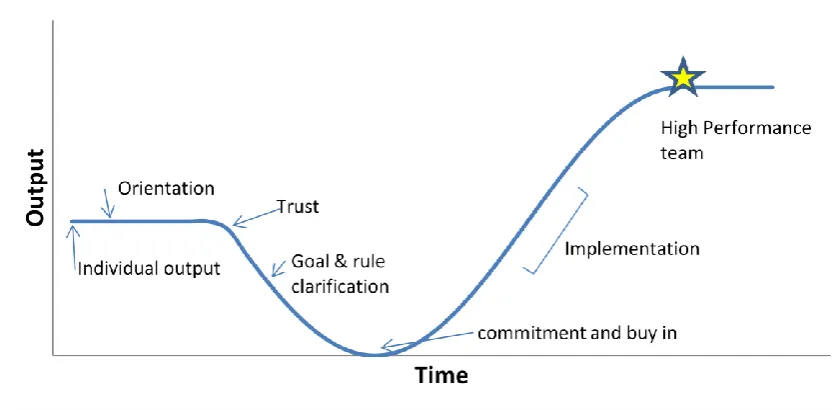
Figure 2-3 Team phases and team outputs ... 43
Figure 3-1 Commencing student age profiles at USQ in the engineering programs . 63 Figure 4-1 Educational experience resulting in change ... 69
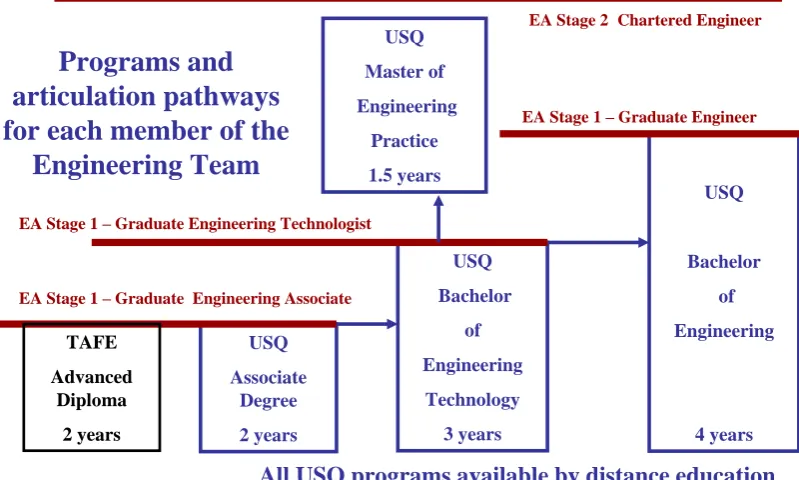
Figure 4-2 Research experience ... 71
Figure 4-3 Research contributing to the body of knowledge – a personal synthesis . 72 Figure 4-4 Areas and interactions of investigation ... 73
Figure 4-5 Action Research Strategy ... 78
Figure 5-1 Implementation and initial investigation ... 84
Figure 5-2 Scaffolding in the problem solving strand ... 88
Figure 5-3 Program distribution for the first offers ... 93
Figure 5-4 Students enrolled in each major ... 94
Figure 5-5 Experience in the work force ... 94
Figure 5-6 Student response on preference of lectures for course delivery ... 95
Figure 5-7 Student response to retention of knowledge being less than in traditional subjects. ... 96
Figure 5-8 Student response to the courses increasing learning ability ... 96
Figure 5-9 Student responses to the courses increasing their ability to undertake independent learning ... 97
Figure 5-10 Student response to PBL course enhancing their problem solving skills ... 97
Figure 5-11 Student response to PBL course increasing their appreciation of prior knowledge in problem solving. ... 98
Figure 5-12 Individual facilitator marks for portfolio (semester 1 2002) ... 105
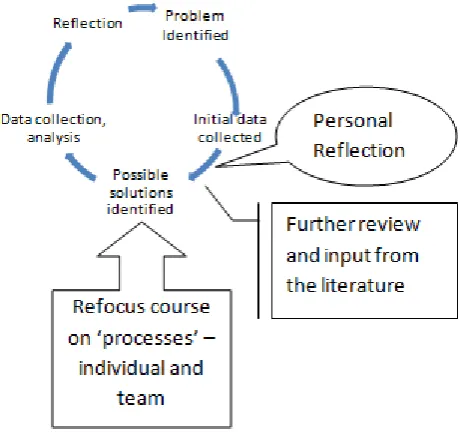
Figure 5-13 Personal research process ... 107
Figure 5-14 Overview of team report 1 ... 109
xi
Figure 5-16 Distribution of discipline majors ... 114
Figure 5-17 Age profile of students ... 115
Figure 5-18 Student perceptions on the use of developing a team code of conduct 116 Figure 5-19 Student perceptions on teamwork ... 118
Figure 5-20 Setting my own goals was helpful to my learning ... 122
Figure 5-21 Survey responses to test student perceptions of independent and self learning skills ... 124
Figure 5-22 Retention of knowledge was less than in traditional courses ... 124
Figure 5-23 Student perceptions on the improvement of communication skills as a result of the course ... 128
Figure 5-24 Student perceptions on problem solving skills ... 129
Figure 5-25 Problem Solving cycle ... 131
Figure 6-1 A model for online teaching and learning ... 136
Figure 6-2 Usage of the LMS for a typical semester ... 138
Figure 6-3 Use of discussion forums ... 139
Figure 6-4 Average number of postings to discussion boards for a typical semester ... 139
Figure 6-5 Average number of postings per student per week ... 140
Figure 6-6 Total average time per student per week for semester 1 2007 ... 140
Figure 6-7 Barriers to student learning in virtual teams ... 144
Figure 7-1 Task 1 of the first individual portfolio ... 156
Figure 7-2 Section of new marking rubric ... 168
Figure 7-3 Summary of final marks for each team ... 172
Figure 7-4 Student survey results relating to assessment over a three year period of development ... 174
Figure 8-1 Student self perceptions of the social aspect of the course – the course helped me to meet other students ... 182
Figure 8-2 Our team discussed and agreed on goal/s ... 186
Figure 8-3 Having a goal kept our team focused ... 186
Figure 8-4 Having a team goal help me participate in the team more effectively ... 186
Figure 8-5 Student responses to ‗my appreciation of how the prior knowledge and skills of my colleagues can be used to solve a problem has been increased‘ ... 187
xii
Figure 8-7 Student usage of the LMS – total average time per student for each week
of semester for two typical semesters ... 190
Figure 8-8 Average mark for reflective portfolio by facilitators ... 198
List of Tables
Table 1-1 Comparison of graduate attributes from Engineers Australia and ABET ... 2Table 1-2 Examples of literature discussing PBL in a virtual environment ... 7
Table 2-1 Requirements for engineers of the 21st century ... 27
Table 2-2 Modes and Functions to describe group activity ... 45
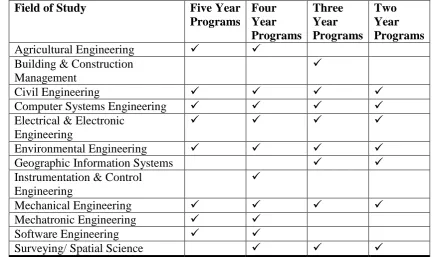
Table 3-2 Undergraduate programs in Engineering and Surveying ... 63
Table 4-1 Publications showing the work of author and contributions to BOK ... 74
Table 4-2 Supporting publications ... 76
Table 5-1 PBL Strand of Courses and team sizes ... 87
Table 5-2 Sample Problem outlines and learning objectives ... 92
Table 5-3 Themes from portfolios and surveys ... 99
Table 5-4 Student unsolicited reflections on main objects of the course ... 100
Table 5-5 Assessment criteria for Team Report 2 ... 110
Table 5-6 Significant difference in student responses between on-campus and distance students ... 113
Table 5-7 Data for on-campus and distance students relating to problem solving and teamwork skills ... 114
Table 5-8 Correlation statistics ... 119
Table 5-9 Short answer response to the course evaluation survey – Teamwork ... 120
Table 5-10 Example of student entry for Portfolio 1 ... 121
Table 5-11 Correlation statistics for problem solving skills and application of prior knowledge ... 130
Table 7-1 Comparison of marks and level of achievement for criterion of ‗experimental methodology‘ ... 171
xiv
Summary of Innovations and Original Contributions
The principal innovation in this work is the integration of four separate areas within the Scholarship of Teaching and Learning, areas which have hitherto been essentially separate. These are Problem Based Learning, reflective practice in engineering education, distance education and virtual teams. The work presented in this dissertation advances some topics and then sets out a unification in the form of a single practical package. The unification also encompasses authentic assessment, community of practice, appropriate staff training and evaluation appropriate to the context. With this unification there have been contributions to the body of knowledge through peer reviewed publications and an uptake of materials developed by the author through the course of this project.
In 2000, when the work underpinning the dissertation began, there were no publications relating to student teams using Problem Based Learning when the teams were constrained to working entirely in virtual space. For practical reasons these teams could use only asynchronous (on–line) communication methods (i.e. not the telephone) and had no opportunity to meet face–to–face. Development of the program and support material has continued, making use of and evaluating new technologies and approaches (e.g. wikis) as they have become readily available. Recognition of student requirements, backgrounds and varying personal access to technology remains critical.
This work has the potential to create truly global engineering graduates by linking students across the world working in virtual teams and sharing tasks on an around– the–clock basis: a requirement for engineering graduates which is just emerging in the engineering education literature.
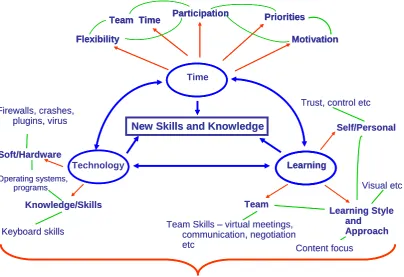
xv of a model, illustrated in Figure I and discussed in detail in Chapter 6, which describes the interactions and barriers to student learning when confronted with the mix of teamwork and technology. Whilst this model was developed and tested for teams working in virtual space, it applies equally well to traditional on–campus teams and provides a structure for curriculum development for team and collaborative learning projects to maximise student learning and minimise the pitfalls and frustrations encountered by academics and students alike.
Figure I Barriers to student participation in teams
It is vital to effectively incorporate key graduate attributes into the engineering curriculum, a fact recognised by educators and industry alike. Outcomes of this work presents not only a development which supports curriculum change and effective delivery of both technical content and graduate attributes but looks to the future to ensure the education of engineers with skills to meet the challenges which lay ahead.
Self/Personal
Visual etc Operating systems,
programs
New Skills and Knowledge
Time
Learning Technology
Flexibility
Team Time Participation Priorities Motivation
Team
Learning Style and Approach
Team Skills – virtual meetings, communication, negotiation etc
Trust, control etc
Content focus Soft/Hardware Knowledge/Skills Firewalls, crashes, plugins, virus Keyboard skills LEARNING COMMUNITY LEARNING COMMUNITY Self/Personal Visual etc Operating systems, programs
New Skills and Knowledge
Time Time Learning Learning Technology Flexibility
Team Time Participation Priorities Motivation Flexibility
Team Time Participation Priorities Motivation Flexibility
Team Time Participation Priorities Motivation
Team
Learning Style and Approach
Team Skills – virtual meetings, communication, negotiation etc
Trust, control etc
xvi
Recognition of Innovation
The work represented in this dissertation has been reviewed and its merit recognised by several external bodies in the form of university and national award as listed following. These awards are team awards as they recognise the implementation of the innovation and hence work of the teaching team. The major innovations and core development of the package are that of the author except where noted in the dissertation.
Awards
2008 Australasian Association for Engineering Education – Innovation in Curricula, Learning and Teaching ―Engineering Problem Based Learning Strand” (Team Leader)
2007 Carrick Award for Australian University Teaching (now Australian Learning and Teaching Council ALTC) – Innovation in Curricula, Learning and Teaching ―Engineering Problem Based Learning Strand” (Team Leader)
2006 Carrick Institute Citation (now ALTC) –―Educating Engineers for the 21st Century – Successfully designing and delivering the world's first Problem–Based
Learning course for distance engineering students‖ (Team Leader)
2005 Finalist in Australian Awards for University Teaching (AAUT) Enhancement of the Quality of Teaching and Learning, Institutional Awards Category, ―Educating Engineers and Surveyors for the 21st Century‖ (Team Leader)
2005 Australasian Association of Engineering Educators – Excellence in a Curriculum Team Project in Engineering Education (Team Leader)
2003 USQ Award for Excellence in Design and Delivery of Teaching Materials (Team Leader)
Use and Uptake of Materials
xvii
Reflective Writing Guide:
Used in CDS2002 Independent Project 1 from the Bachelor of Human Services program, Faculty of Business, USQ
Used in Graduate Certificate in Tertiary Teaching and Learning, Faculty of Education, USQ
Adapted for use in ENG8300 Self assessment portfolio from the Master of Engineering Practice program, Faculty of Engineering and Surveying, USQ
Adapted for use in the OBL (Outcomes Based Learning) and Technology Enhanced Assessment Initiative at the Centre for Learning, Teaching and Technology (LTTC), The Hong Kong Institute of Education, Hong Kong
Peer and Self Assessment Resources:
Used in ACC3101 Accounting Information Systems, Faculty of Business, USQ
All course materials have been reviewed and used, with acknowledgement, for the:
2008 ALTC Competitive Grant – ―Business education in the 21st century: Examining the antecedents and consequences of student team virtuality (2008)‖
1
1 Introduction
Over a decade ago, Brisk (1997) stated in a paper sharing his views on engineering education for 2010 that, ―…engineering education must fully exploit telecommunications and information technology to improve teaching and
learning…” and that ―…engineering educators will move from simply passing on knowledge to becoming facilitators for students' learning…‖ He also believed that
engineering education should exploit technology to provide distance education services that achieve an improved use of resources and self paced learning. It is now
timely to ask, are these improvements being realized, and how far has engineering education progressed in achieving the goals espoused more than a decade ago (Brodie & Porter 2008; Brodie 2009b).
In the early part of this decade, engineering accreditation bodies worldwide reviewed their national guidelines for engineering education to determine whether universities were actually delivering graduates ready for employment and, more importantly, able to cope with the future requirements of the profession. These reviews resulted in a refocusing of the engineering curriculum to outcomes rather than process. The reviews also recognised the need for the inclusion of the key graduate attributes of teamwork, problem solving, communication and lifelong learning within the curriculum (IEEE 1996; IEAUST 1999; Engineering Council UK (EC UK) 2003; Engineers Australia 2004; ABET 2007). Today, the recommendations of these reviews have been implemented and as well as addressing the traditional math, science and engineering fundamentals, and discipline specific knowledge, faculties must also demonstrate graduate acquisition of a broad range of key graduate attributes (Felder et al. 2000). Graduate attributes from Engineers Australia and ABET are listed in Table 1-1 as being typical for those specified by accrediting
2
Table 1-1 Comparison of graduate attributes from Engineers Australia and ABET
Engineers Australia ABET Criteria 2008–2009
1. Ability to apply knowledge of basic
science and engineering fundamentals
(a) An ability to apply knowledge of mathematics, science, and engineering (k) An ability to use the techniques, skills, and modern engineering tools necessary for engineering practice
2. Ability to communicate effectively,
not only with engineers but also with the community at large
(g) An ability to communicate effectively
3. In–depth technical competence in at
least one engineering discipline
(b) An ability to design and conduct experiments, as well as to analyze and interpret data
4. Ability to undertake problem
identification, formulation and solution
(e) An ability to identify, formulate, and solve engineering problems
5. Ability to utilise a systems approach
to design and operational performance
(c) An ability to design a system, component, or process to meet desired needs within realistic constraints such as economic, environmental, social,
political, ethical, health and safety, manufacturability, and sustainability
6. Ability to function effectively as an individual and in multi–disciplinary and multi–cultural teams, with the capacity to be a leader or manager as well as an effective team member
(d) An ability to function in multidisciplinary teams
7. Understanding of the social, cultural,
global and environmental
responsibilities of the professional engineer, and the need for
sustainable development
8. Understanding of the principles of
sustainable design and development
(h) The broad education necessary to understand the impact of engineering solutions in a global, economic, environmental, and societal context
(j) A knowledge of contemporary issues
9. Understanding of professional and
ethical responsibilities and commitment to them
(f) An understanding of professional and ethical responsibility
10. Expectation of the need to undertake
lifelong learning, and capacity to do so
(i) A recognition of the need for, and an ability to engage in life–long learning
3
than just technical knowledge. A significant level of common attributes should exist, given that both agencies are signatories to the Washington Accord2 (Brodie 2009b). Engineers now require a great depth and breadth of skills and knowledge and engineering educators must deliver an ‘education’ and not just training in a technical discipline. Engineering students and professionals require good communication and teamwork skills and an understanding of the fluid and dynamic global, social and cultural environments in which they work (Brodie & Porter 2004).
Whilst delivering these skills in a traditional setting may require new teaching methodologies and a changing role for academics, current literature also goes on to suggest that desirable graduate attributes should be expanded to include working globally in a multicultural environment; working in interdisciplinary, multi–skilled teams; sharing of work tasks on a global and around–the–clock basis; working with digital communication tools and working in a virtual environment (Thoben & Schwesig 2002; National Academy of Engineering 2004; Jamieson 2007a). If these skills are to be incorporated into engineering education in a meaningful way, it will require a significant change in teaching methodologies and technologies, and may hasten the incorporation of what is currently seen as innovative or even radical approaches to education.
Problem based learning, project based learning, cooperative learning and active learning are just some of the terms now populating engineering education literature. Each of these approaches uses a constructivist paradigm which, when correctly resourced and implemented, can deliver the more recently recognised valuable graduate attributes of communication, teamwork and problem solving. Currently none of these approaches fully utilise the broad spectrum of electronic communication technologies for delivery and as such have not successfully been incorporated in the pedagogy of online learning.
2“The Washington Accord was signed in 1989. It is an agreement between the bodies responsible for
accrediting professional engineering degree programs in each of the signatory countries. It
recognizes the substantial equivalency of programs accredited by those bodies, and recommends that graduates of accredited programs in any of the signatory countries be recognized by the other countries as having met the academic requirements for entry to the practice of engineering. The Washington Accord covers professional engineering undergraduate degrees. The signatory countries of the Washington Accord are Australia, Canada, Ireland, Hong Kong, New Zealand, South Africa, United Kingdom, and the United States.” (http://www.washingtonaccord.org/wash_accord_faq.html
4
Thus to deliver the requirements of ‗virtual environments‘ and electronic communication skills, technology such as discussion boards/forums, synchronous chat rooms, email and web 2.0 technologies (such as wiki) must be integrated into the delivery of meaningful content. Most importantly, these new delivery systems must cater to the individual learning style of students. The ever increasing existence and application of fast developing technologies therefore provides both opportunities and serious challenges to engineering and engineering educators (Shuman et al. 2002).
Many of these technologies are already being utilized by universities with varying degrees of success to supplement delivery of existing courses and to tap into the new market of distance and online education (Brodie 2006). Likewise, virtual teams and associated research are making their way into education literature. However, this still remains a recent trend and most, if not all, publications still refer to the need for face–to–face interaction to establish initial communication and trust before moving to a semi–virtual environment.
Curriculum revitalisation
In 2000, the Faculty of Engineering and Surveying (FoES) at the University of Southern Queensland (USQ) began planning for its Engineers Australia (EA) accreditation review. A curriculum design project was undertaken across all engineering disciplines to plan the incorporation of the new requirements for accreditation. These requirements placed an increased emphasis on graduate attributes such as teamwork, communication, problem–solving and life long learning (Dowling 2001b; Dowling 2001a).
5 learning (PBL) courses creatively called Engineering Problem Solving 1, 2, 3 and 4 (Course codes ENG1101, ENG2102, ENG3103 and ENG4104).
The new curriculum design and delivery also had to cater for a diverse student cohort that had widely differing backgrounds in terms of existing skills, knowledge and experience. For example, the USQ cohort has approximately 20% on–campus students while the remaining 80% study by distance. The average student age is 35, with a 16 to 70 year age band. As a result, the students bring to their university studies a wide range of knowledge and work experience, often in engineering or a similar technical field. They have a wide range of technical knowledge and life skills that must be recognised and utilised within courses wherever possible.
Students are encouraged to set individual learning goals and to mentor team members by sharing their prior knowledge and skills. Students reflect on their own learning experiences, and evaluate the progress of the team as well as their own learning. This sets the foundation for their success in the strand.
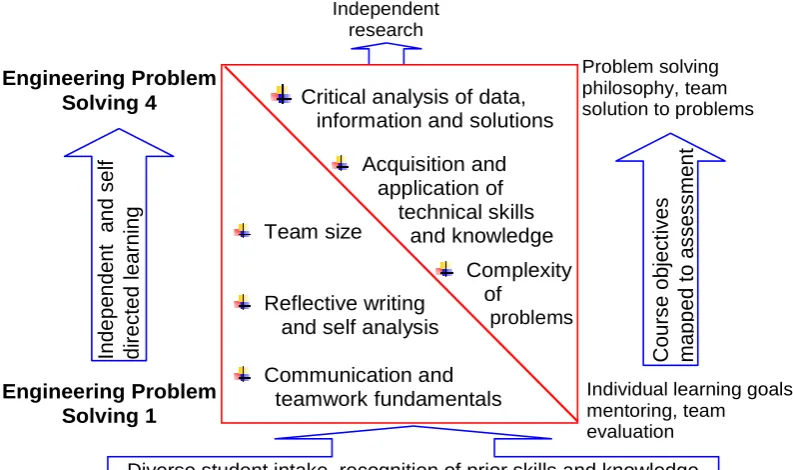
The articulation and scaffolding that occurs within the strand seeks to ensure that the learning is reinforced and extended in both graduate attributes and key technical areas. The problems undertaken by the teams become increasingly complex and teams must acquire and apply appropriate technical knowledge to solve these problems. The technical, research, critical analysis and evaluation skills of individual students significantly improve during their progression through the strand while the emphasis on developing communication and teamwork fundamentals and the assessment of reflective writing has a decreasing emphasis. This articulation and scaffolding of the curriculum is shown in Figure 1-1.
6
Figure 1-1 Scaffolding and articulation of the PBL courses in the Problem Solving Strand
The dissertation includes a description of the design, implementation, evaluation and continuous development of the first of the courses in this strand, ENG1101
Engineering Problem Solving 1. An innovative component and innovation of the course was to ‗deliver‘ ENG1101 to students via virtual teams utilising a range of electronic communication systems whilst ensuring both technical content and graduate attributes are developed and attained. As this was the first course in the PBL strand offered to the student cohort, the course design, including communication strategies, curriculum, staff development, problem design strategies and requirements, became the model for subsequent courses.
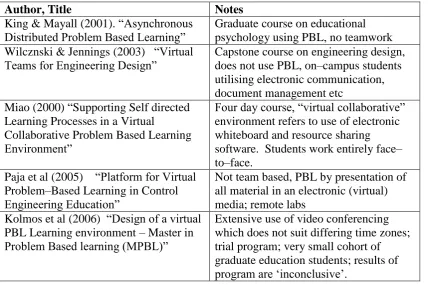
While PBL is not new to higher education, its application to distance education with students working in virtual teams has been sparsely discussed in the literature. There have been numerous references to PBL for distance students in various disciplines, however in nearly every case these students or student teams are required to meet face–to–face at least once during the course and often team members work entirely in a face–to–face mode. Alternatively, the literature describes courses that are not true interpretations of PBL, but simply use some form of technology to deliver course content as outlined in Table 1-2.
Independent research
Diverse student intake, recognition of prior skills and knowledge
Individual learning goals, mentoring, team
evaluation Problem solving philosophy, team solution to problems
Acquisition and application of technical skills and knowledge Complexity of problems
Critical analysis of data, information and solutions
Team size
Reflective writing and self analysis
[image:26.595.70.467.77.312.2]Communication and teamwork fundamentals Engineering Problem Solving 1 Engineering Problem Solving 4 Cours e o bj ec ti v es ma pp ed t o a s s es s me n t
Figure 1: Scaffolding and articulation of the courses in the Problem Solving Strand
7
Table 1-2 Examples of literature discussing PBL in a virtual environment
Author, Title Notes
King & Mayall (2001). ―Asynchronous Distributed Problem Based Learning‖
Graduate course on educational psychology using PBL, no teamwork Wilcznski & Jennings (2003) ―Virtual
Teams for Engineering Design‖
Capstone course on engineering design, does not use PBL, on–campus students utilising electronic communication, document management etc
Miao (2000) ―Supporting Self directed Learning Processes in a Virtual
Collaborative Problem Based Learning Environment‖
Four day course, ―virtual collaborative‖ environment refers to use of electronic whiteboard and resource sharing software. Students work entirely face– to–face.
Paja et al (2005) ―Platform for Virtual Problem–Based Learning in Control Engineering Education‖
Not team based, PBL by presentation of all material in an electronic (virtual) media; remote labs
Kolmos et al (2006) ―Design of a virtual PBL Learning environment – Master in Problem Based learning (MPBL)‖
Extensive use of video conferencing which does not suit differing time zones; trial program; very small cohort of graduate education students; results of program are ‗inconclusive‘.
Typically, the literature on ―distance PBL‖ refers to a course delivery process where students are either working away from the main campus on a satellite campus, or normal teamwork is supplemented by electronic communications with the lecturer, tutor or other team members (Brodie 2006). Wilczyski & Jennings (2003) note that ―
…
a general framework has not yet been presented to guide the formation and management of Internet–based design teams within engineering education‖. Also,there is a distinct lack of published information on situated learning in virtual teams (Robey et al. 2000).
8
Curriculum development beginning with the basics of team development, individual learning goals of a diverse student cohort, communication skills and other graduate attributes
Development of a ‗learning community‘ among the students and staff
Effective support and scaffolding for virtual teams including online
facilitation, often in an asynchronous mode
Reflection and reflective practice
Effective assessment in line with course objectives
Staff training and the need to change staff and student attitudes to teaching and learning.
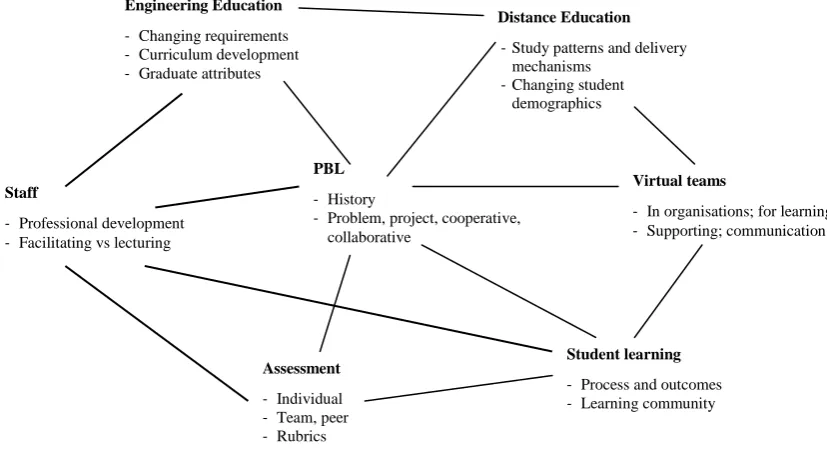
An investigation of PBL for distance education students working in virtual teams touches on many issues – PBL, engineering education, distance and online education, teamwork, virtual teams, assessment and staff development. Each of these is a broad and complex area of research in itself and a review of the literature shows the complexity of interaction and overlaps. This web of interactions is depicted via the concept map in Figure 1-2. Thus, each section of the dissertation forms part of a three dimensional jigsaw, which must be seen in the context of its application to a new area – PBL in virtual teams for engineering education.
The current literature can be categorised into the following broad areas:
PBL and PBL in engineering education where PBL becomes a complete curriculum or PBL is seen a partial implementation in discrete courses within a whole program of study.
Virtual ‗teams‘ (teams working in virtual space) – working collaboratively ‗online‘ but not necessarily as a ‗team‘; Virtual teams in business or organisations.
Online and distance education (but not using a PBL paradigm). Assessment of teams, teamwork and in PBL
Staff training or professional development
9
Figure 1-2 Concept map of major interactions and overlaps in distinct research areas
Very little literature combining all of these areas, especially at the undergraduate level and more specifically in engineering education was found.
The innovation of the work underpinning this dissertation is categorised by:
Embedding key graduate attributes which meet not only current industry requirements, but that also target the future needs of the global industry
No face–to–face contact between student team members and between students and the academic facilitator. Students work in true virtual teams, separated by time, geography and often a societal context
High level of student interaction and engagement with learning objectives delivered via a PBL paradigm, with modifications to suit the student cohort
Developing a learning community for both staff and students.
Analysis of data collected over several years, using anonymous student surveys, thematic analysis of reflective portfolios and discussion board postings, shows that key graduate attributes of teamwork, communication, self directed learning and problem solving can be achieved by using PBL in which students work in true virtual teams.
Distance Education
-Study patterns and delivery mechanisms
-Changing student demographics
Engineering Education
- Changing requirements
- Curriculum development
- Graduate attributes
PBL
- History
- Problem, project, cooperative, collaborative
Virtual teams
- In organisations; for learning
- Supporting; communication
Student learning
- Process and outcomes
- Learning community
Assessment
- Individual
- Team, peer
- Rubrics
Staff
- Professional development
10
1.1 Organisation of Dissertation
This dissertation is the synthesis of a body of work which has been extensively peer reviewed and published (See section Publications directly related to the Award of Engineering Doctorate (EngD) on page 11). These publications are supported by other peer reviewed publications as listed on page 17. The dissertation is organised in 10 chapters as summarised below.
Chapter 1 Introduction and Overview: This chapter provides theoverview for the dissertation. Where appropriate, all publications by the author have been cited in this chapter. This chapter also provides lists of publications directly related to, and supporting, the work of the dissertation. Papers are listed by topic and also arranged by year of publication.
Chapter 2 Literature Review: – This chapter summarises literature in each of the key topics. In some areas e.g. virtual teams, where there is extensive literature, only literature relevant to distance education or education has been selected.
All Brodie and Brodie et al publications which have been used in this dissertation have a literature review or background section relevant to the topic. Where appropriate, sections of these publications have been reused in this chapter.
Chapter 3 Education Requirement and Context: This chapter gives the rationale for curriculum change and its implementation at USQ. The actual implementation of the course was undertaken by a team of academics; however, the fundamental development, strategies for implementation and evaluation was the work of the author of this dissertation unless otherwise cited.
11 fields, but also the growth of the author as a researcher, gaining knowledge, skills and experience in the field of engineering education.
Chapters 5 to 9: Summarises the related publications which directly support the work of this dissertation. The sources of publications are provided for reference. Research has been published (or is in press) by a number of international journals including the International Journal of Engineering Education (IJEE), European Journal of Engineering Education (EJEE) and the Australasian Journal of Engineering Education (AJEE) and national and international peer reviewed conferences.
Chapter 10 Conclusion: This final chapter summaries the achievements and outcomes of the work of the dissertation.
Appendix A: The appendix contains copies of selected publications.
1.2 List of Papers
For clarity, all publications are listed twice. Firstly arranged by topic to show the breadth of work and contributions to the body of knowledge in specific areas by the author and secondly, by year of publication to show the development of the research and research methodology over the period of the project.
1.2.1 Publications directly related to the Award of Engineering
Doctorate (EngD)
Peer Reviewed Journal and Conference Publications – arranged by topic
PBL in Distance Education
Brodie, L. 2009, 'eProblem Based Learning – Problem Based Learning using virtual teams', European Journal of Engineering Education, vol. 34, no. 6,pp. 497-509. Brodie, L. 2009, 'Transitions To First Year Engineering – Diversity As An Asset',
12
Brodie, L. & Porter, M. 2008, 'Engaging distance and on-campus students in
Problem Based Learning', European Journal of Engineering Education, vol. 33, no. 4,pp. 433-443.
Brodie, L. & Porter M. 2006, 'Problem based learning for on-campus and distance education students in engineering and surveying', Proceedings of The Internal Conference on Innovation, Good Practice and Research in Engineering Education, vol. 1, eds Doyle S & Mannis A, The Higher Education Academy, Liverpool, England, pp. 244-255.
Virtual Teams and the use of a Learning Management System
Brodie, L. 2009, 'Virtual Teamwork and PBL - Barriers to Participation and Learning', paper presented to the Research in Engineering Education Symposium (REES),20-23 Jul, Cairns, QLD, Australia.
Cochrane, S., Brodie, L. & Pendlebury, G. 2008, 'Successful use of a wiki to facilitate virtual team work in a problem-based learning environment', AAEE, Yeppoon, QLD.
Brodie, L. 2007, 'Problem Based Learning for Distance Education Students of Engineering and Surveying.', Connected - International Conference on Design Education,Sydney.
Brodie, L. 2006, 'Problem Based Learning In The Online Environment – Successfully Using Student Diversity and e-Education', Internet Research 7.0: Internet Convergences,Hilton Hotel, Brisbane, Qld, Australia,
Learning Community (Community of Practice)
Brodie, L. & Gibbings, P. in press, 'Connecting learners in Virtual Space – forming learning communities', in L. Abawi, J. Conway & R. Henderson (eds), Creating Connections in Teaching and Learning, Information Age Publishing.
13 Brodie, L. & Gibbings, P.D. 2007, 'Developing Problem Based Learning
Communities in Virtual Space', Connected 2007 International Conference on Design Education,University of New South Wales, Sydney, Australia.
Assessment
Brodie, L. & Gibbings, P. 2009, 'Comparison of PBL Assessment Rubrics', paper presented to the Research in Engineering Education Symposium (REES),20-23 Jul, Cairns, QLD, Australia.
Brodie, L. 2008, 'Assessment strategy for virtual teams undertaking the EWB Challenge', paper presented to the Australasian Association of Engineering Educators, Yeppoon, QLD, 7-10 December 2008.
Gibbings, P. & Brodie, L. 2008, 'Assessment Strategy for an Engineering Problem Solving Course', International Journal of Engineering Education, vol. 24, no. 1, Part II,pp. 153-161.
Brodie, L. 2007, 'Reflective Writing By Distance Education Students In An
Engineering Problem Based Learning Course', Australasian Journal of Engineering Education, vol. 13, no. 1,pp. 31-40.
Gibbings, P. & Brodie, L. 2006, 'Skills audit and competency assessment for engineering problem solving courses', Proceedings of The Internal Conference on Innovation, Good Practice and Research in Engineering Education,vol. 1, eds Doyle S & Mannis A, The Higher Education Academy, Liverpool, England, pp. 266-273.
Gibbings, P. & Brodie, L. 2006, 'An Assessment Strategy for a First Year
Engineering Problem Solving Course', 17th Annual Conference of the Australasian Association for Engineering Education,Australasian Association for Engineering Education, Auckland, New Zealand, p. 33.
Academic Staff Training and Professional Development
14
Good Practice and Research in Engineering Education,Liverpool, England, pp. 226-231.
Journal and Peer Reviewed Conference Publications – arranged by year of publication
2010
Brodie, L. & Gibbings, P. in press, 'Connecting learners in Virtual Space – forming learning communities', in L. Abawi, J. Conway & R. Henderson (eds), Creating Connections in Teaching and Learning, Information Age Publishing.
2009
Brodie, L. 2009, 'eProblem Based Learning – Problem Based Learning using virtual teams', European Journal of Engineering Education, vol. 34, no. 6,pp. 497-509. Brodie, L. 2009, 'Transitions To First Year Engineering – Diversity As An Asset',
Studies in Learning, Evaluation, Innovation and Development vol. 6, no. 2.pp 1-15 Brodie, L. 2009, 'Virtual Teamwork and PBL - Barriers to Participation and
Learning', paper presented to the Research in Engineering Education Symposium (REES),20-23 Jul,, Cairns, QLD, Australia.
Brodie, L. & Gibbings, P. 2009, 'Comparison of PBL Assessment Rubrics', paper presented to the Research in Engineering Education Symposium (REES),20-23 Jul,, Cairns, QLD, Australia.
2008
Gibbings, P. & Brodie, L. 2008, 'Assessment Strategy for an Engineering Problem Solving Course', International Journal of Engineering Education, vol. 24, no. 1, Part II,pp. 153-161.
Brodie, L. & Porter, M. 2008, 'Engaging distance and on-campus students in
15 Brodie, L. 2008, 'Assessment strategy for virtual teams undertaking the EWB
Challenge', paper presented to the Australasian Association of Engineering Educators, Yeppoon, QLD, 7-10 December 2008.
Gibbings, P. & Brodie, L. 2008, 'Team-Based Learning Communities in Virtual Space', International Journal of Engineering Education, vol. 24, no. 6,pp. 1119-1129.
Cochrane, S., Brodie, L. & Pendlebury, G. 2008, 'Successful use of a wiki to facilitate virtual team work in a problem-based learning environment', AAEE, Yeppoon, QLD.
2007
Brodie, L. 2007, 'Reflective Writing By Distance Education Students In An
Engineering Problem Based Learning Course', Australasian Journal of Engineering Education, vol. 13, no. 1,pp. 31-40.
Brodie, L. 2007, 'Problem Based Learning for Distance Education Students of Engineering and Surveying.', Connected 2007- International Conference on Design Education,Sydney.
Brodie, L. & Gibbings, P.D. 2007, 'Developing Problem Based Learning
Communities in Virtual Space', Connected 2007 International Conference on Design Education,University of New South Wales, Sydney, Australia.
2006
Brodie, L. 2006, 'Problem Based Learning In The Online Environment – Successfully Using Student Diversity and e-Education', Internet Research 7.0: Internet Convergences,Hilton Hotel, Brisbane, Qld, Australia,
16
Brodie, L., Aravinthan, T., Worden, J. & Porter, M. 2006, 'Re-skilling Staff for Teaching in a Team Context.', EE 2006 International Conference on Innovation, Good Practice and Research in Engineering Education,vol. 1, eds Doyle S & Mannis A, The Higher Education Academy, Liverpool, England, pp. 226-231. Gibbings, P. & Brodie, L. 2006, 'Skills audit and competency assessment for engineering problem solving courses', Proceedings of The Internal Conference on Innovation, Good Practice and Research in Engineering Education,vol. 1, eds Doyle S & Mannis A, The Higher Education Academy, Liverpool, England, pp. 266-273.
Gibbings, P. & Brodie, L. 2006, 'An Assessment Strategy for a First Year
17 1.2.2 Supporting Publications
Journal and Peer Reviewed Conference Publications –– relevant
publications supporting the innovations and research
Brodie, L & Loch, B. 2009, ‗Annotations with a Tablet PC or typed feedback: does it make a difference?‘ In: AaeE 2009: 20th Annual Conference for the Australasian Association for Engineering Education: Engineering the Curriculum, 6–9 Dec 2009, Adelaide, Australia.
Brodie, L., Zhou, H. & Gibbons, A. 2008, 'Developing a Software Engineering Course using Problem Based Learning', Engineering Education, vol. 3, no. 1,pp. 2-12.
Sabburg J., Fahey P., Brodie L. 2006 ‗Physics Concepts: Engineering PBL at USQ. Australian Institute of Physics‘ 17th National Congress 2006, Brisbane, Australia, 3– 8 December 2006 p 1–4 (paper no 105) http://www.aip.org.au/Congress2006/136.pdf
Brodie, L.M. & Porter, M.A. 2005 ‚‗Responding To Changing Demands In
Engineering Education – PBL For Distance And On–campus Students‘. The Higher Education Academy – Engineering Subject Centre online at
http://www.engsc.ac.uk/downloads/pbl_aus.pdf
Brodie, L. & Porter, M. 2004, ‗Design, Implementation and Evaluation: an entry level Engineering Problem Solving course for on-campus and distance education students‘. 5th Asia Pacific Conference on Problem Based Learning – Pursuit of Excellence in
Education, Petaling Jaya, Malaysia, 15–17 March, 2004
Wood, D. & Brodie, L. 2004, ‗Student Perspectives on Engineering Problem Based Learning – The Portfolios‘.5th Asia Pacific Conference on Problem Based Learning – Pursuit of Excellence in Education, Petaling Jaya, Malaysia, 15–17 March, 2004
Brodie, L. & Borch, O. 2004, 'Choosing PBL paradigms: Experience and methods of two universities', Australasian Association of Engineering Educators Conference, eds Snook C & Thorpe D, Faculty of Engineering and Surveying, USQ,
18
Brodie, L. & Porter, M. 2004, 'Experience in Engineering Problem Solving for On-campus and Distance Education Students', Australasian Association of Engineering Educators Conference,eds Snook C & Thorpe D, Faculty of Engineering and Surveying, USQ, Toowoomba, QLD, University of Southern Queensland, Toowoomba, Australia, pp. 318-323.
Brodie, L. & Porter, M. 2001, ‗Delivering Problem Based Learning courses to
engineers in on–campus and distance education modes‘. 3rd Asia Pacific Conference on Problem Based Learning. Yeppoon, 9–12 Dec.
19
2 Literature Overview
This chapter summarises the literature in each of the key topics as outlined in Figure 1-2. The chapter is in five main sections:
PBL, engineering education and distance education
Connections between engineering education, teamwork and teams work in virtual space
Assessment practices for teams and PBL
learning communities and the need and advantages of establishing them
staff training and professional development.
In some areas e.g. virtual teams, where there is extensive literature, only literature relevant to distance education or education has been selected.
2.1 Problem Based Learning (PBL), Engineering Education &
Distance Education
2.1.1 History of Problem Based Learning (PBL)
Most current literature points to McMaster University in Canada as beginning the implementation of (modern) PBL with the introduction of the methodology into its medical schools in the 1960's. Its intellectual history however, is much older (Brodie & Borch 2004). Thomas Corts of Samford University sees PBL as ―…a newly recovered style of learning‖. He believes that ―…it embraces the question–and– answer dialectical approach associated with Socrates as well as the Hegelian thesis– antithesis–synthesis dialectic‖ (Rhem 1998). In short, PBL is about student engagement in problem solving, active questioning, finding and applying
information, all of which have been recognised as the keys to motivation and effective education for many generations. However, for some time universities have supported a ‗coverage‘ model reflected in standard chalk and talk delivery of ‗content‘ delivered to a class.
20
the cognitive and metacognitive approaches to learning, especially in adults, and the recognition of the need for different approaches to knowledge transmission and acquisition. Second, is the ‗information explosion‘ – with more information becoming more readily available. What students now require is a fundamental
understanding of key content, ability to find information, evaluation and critiquing of this information; and its application to new and unique situations with intellectual rigor. Hence problem solving and a PBL approach have been ―newly recovered‖ in the last two decades (Rhem 1998).
Rhem (1998) also suggests that PBL is successful because of, ―The way the world works now, it's about working together. What students learn about collaboration, different approaches to a problem, cooperation and responsibility, makes their learning in PBL courses multisided, richer, and … deeper‖.
The educational and philosophical theories underpinning PBL were not explicit in early PBL literature (Newman et al. 2001; Rideout & Carpio 2001) and the pioneers of the McMaster program had no background in either education or psychology. They simply thought that learning in small teams, using authentic cases and problems, would make medical education more interesting and relevant for their students (Barrows 2000; Newman et al. 2001). This PBL methodology is now currently used in more than 80% of medical schools in the USA (Vernon & Blake 1993; Ribeiro & Mizukami 2005a) and is an entrenched component of medical school programs in Canada, the United Kingdom, the Middle East and Asia (Blight 1995; Finucane et al. 1998). In Australia, it was predicted that by the year 2000 more than 50% of Australia's doctors will have graduated from schools with PBL– based curricula (Finucane et al. 1998). This number has been more than exceeded with many of the largest medical schools in the country with large student intakes (e.g. University of Queensland, Sydney University, Monash University) moving to a PBL curriculum (Stephen & Paul 2000).
21 The literature presently discusses Problem Based Learning, Project Based Learning, Inquiry Based Learning and Project Orientated Problem Based Learning among others as quasi separate themes. These are all used to describe a range of instructional strategies but with conceptual similarities. The common core is that all rely on open–ended scenarios, which have more than one approach or answer and stimulate student interest. Learning is defined as being student centred while the teacher or instructor takes on the role of facilitator. Students work in cooperative groups and individually and collectively seek and use multiple sources of information. Learning is active and self directed and key skills of problem solving, communicating and researching are fostered along with acquiring and transferring knowledge to novel or new situations. Formal teaching as such does not occur, but facilitators pay close attention to the process of enabling the students' autonomy and self direction in undertaking the problem or project. The importance that the group or ‗team‘ brings to the mix is that of the additional inducement of peer collaboration, mentoring and peer assessment.
However, there are two main distinctions that can be made between project based and problem based learning. In problem based learning the overall goals and the problems are set by the teachers while the solution pathways are not. Project based learning requires the students to set their own learning objectives and decide on their own learning strategies. In addition, project based learning typically induces the goal of producing a product or artefact. Problems will be encountered which add to the learning experience, but these problems may or may not be solved. Projects reflect real–world practices and the process of producing the product is as valuable as the end result itself (Brodie 2008a).
22
The PBL strand at USQ, developed by the author, embraces elements of both problem and project based learning. Thus for the purpose of this dissertation PBL is defined as:
…a constructivist learning paradigm where small groups of students, engage in cooperative learning and collaborative problem solving to solve
problems in complex and authentic projects. These projects pursue
specified learning outcomes that are in line with academic standards and
course objectives with assessment focusing, to a varying degree, on the
project outcome versus team and individual process (Brodie & Borch 2004; Brodie 2007a).
2.1.2 Theory of Problem Based Learning
In its original form, a PBL curriculum is delivered in a set of problems
which provides the starting point for the learning process. Problem–based
learning constitutes the backbone of such a curriculum. Other educational
methods such as lectures and skills training are present, but only to
support PBL (Perrenet et al. 2000).
Traditional education tends to approach learning by presenting concepts in identifiable blocks, in a linear, or at least logical, sequence. Implicit in this approach is the belief that learning amounts to acquiring a set of ‗rules‘ which much be practiced separately to be learnt and only then can be applied. The ‗practice‘ relies on applying the rules to similar situations and with enough practice comes understanding and then the knowledge and rules can be applied to new or novel situations (Norman & Schmidt 2000).
23 is little concern for their future self–learning skills (Barrows 1984; Perrenet et al. 2000).
Educational psychology research of the last decade has shown that a ―student is not an empty vessel waiting to be filled with new knowledge‖ and many traditional teaching practices resulted in surface learning (Sawyer 2006, pp. 2-5). In a traditional lecture situation it is the lecturer who is active – preparing and delivering material and the student who passively receives the content (Brodie & Borch 2004). However, productive and ‗deep‘ learning is an active process. Students must engage with the material, deconstructing, constructing and reconstructing ideas and knowledge. PBL is an approach consistent with these needs.
PBL is based on the principles of adult education and cognitive psychology (Knowles 1990; Norman & Schmidt 1992). Barrows (1984) describes a cycle of three phases of PBL:
1. Students first encounter a problem, as opposed to a fact or theory. The problem is discussed and deconstructed usually in a small group setting. 2. The problem and discussion motivates the student to undertake self directed
study and research framed by prior knowledge, understanding and gaps within these areas.
3. New knowledge is applied and learning summarised by reflection.
These steps may be repeated with a new problem, or an iterative approach to the initial problem may be used. Koshmann et al (1994) extended the three step process and identified five fundamental steps for students in problem based learning:
1. Project / problem formulation
2. Development of a solution through a self–directed learning approach 3. A re–examination of the problems to test the proposed solutions
4. Abstraction where the solutions are contextualised with other known cases 5. A final reflection stage where the students reflect and critique their learning
24
When these stages of PBL are addressed correctly, Perrenet et al (2000) states that three main objectives for education are simultaneously met:
1. Acquisition of knowledge that can be retrieved and used in a professional setting
2. Acquisition of skills to extend and improve one‘s own knowledge
3. Acquisition of professional problem–solving skills and the integration of skills from many relevant disciplines.
From an institutional perspective, PBL also offers advantages. When correctly resourced and implemented it provides learning which:
1. Is student centred and motivational
2. Is highly relevant to education for a ‗profession‘ 3. Is adaptable to student needs and learning styles
4. Promotes problem solving, interpersonal skills, teamwork, self directed learning, critical thinking skills and deep learning (Barrows 1984)
Given these advantages, PBL has now been adopted by many disciplines and is practiced very differently in different institutions (Maudsley 1999; Norman & Schmidt 2000; Duch 2001; Kolmos 2002; Mills & Treagust 2003; O‘Kelly et al. 2006). It is therefore no surprise perhaps that this diversity has also led to misapplications and misconceptions which may lead to a failure to achieve anticipated learning outcomes (Savery 2006). In this regard Boud and Feletti (1997, p. 5) described several possible issues, all of which are related to the fundamental principles of PBL.
First, PBL is a ‗curriculum design‘ not merely replacing lectures with ‗problems‘ for discussion. Second, there is often insufficient investment in appropriate learning resources. In some cases academics and even institutions ―…hold a naïve view of the rigor required to teach with this learner–centred approach‖ (Savery 2006).
Barron et al (1998) identify four design principles for PBL: 1. defining appropriate learning goals,
25 3. ensuring opportunities for formative self assessment and revision, and
4. developing social structures.
Whilst these are obviously four important areas, they neglect the important area of staff training and development, and the necessary commitment from staff at all levels. They also minimise research and development on the nature and type of problems to be used, the need for reflection and the overall assessment strategy, summative as well as formative. The change to PBL implies an overall pedagogy encompassing learning objectives, learning resources, appropriate assessment methods, evaluation strategies and professional development for staff, all of which must integrated and satisfactorily addressed.
The role of staff (teacher or instructor) in PBL moves from a traditional lecturer, a conveyor of knowledge and content, to a supervisor or facilitator (Brodie & Borch 2004). O‘Hara–Deveraux and Johnansen (1994) define facilitation as ―the art of helping people navigate the processes that lead to agreed upon objectives in a way that encourages universal participation and productivity‖. For the academic there is a greater emphasis on designing and preparation, guidance and support, managing and delegating, rather than lecturing and tutoring.
Reflection by both staff and students is a very important part of the learning process and the theory on learning and reflection comes from a number of different sources. It is founded on Kolb‘s (1984) work on the learning cycles and Schon‘s (1987) theory about reflection. Students must be given time to synthesize their new knowledge and reflect upon what they have discovered. This is particularly important in PBL where learning is sometimes covert – problems and projects are solved without the student being aware that skills and knowledge have been acquired and enhanced (Brodie 2007b).
26
working in virtual teams. Reflection, therefore, should be a key part of the implementation and assessment plan (Brodie 2007b; 2008a).
To summarise, the key components for successful PBL include the following:
1. A high level of research and development on the scenarios and resources given to students. The problems/projects must be real world, ill structured, applicable to the profession and include a wide range of disciplines.
2. Recognition of the difference between PBL and problem solving. 3. Commitment from staff.
4. Appropriate assessment.
5. Time and recognition of the need for reflection from both staff and students. 2.1.3 Problem Based Learning in Engineering Education
Interest in problem based learning (PBL) arose in engineering higher education in the mid 1990s when employers found fault with current programs that failed to equip graduates with collaborative problem solving skills required for a lifelong learning and the reality of the work place (Cawley 1991; Hadgraft 1991; Wilkerson & Gijselaers 1996; Boud & Feletti 1997; Brodeur et