City, University of London Institutional Repository
Citation: Karcanias, N. & Hessami, A. G. (2011). System of Systems and Emergence.
Part 1: Principles and Framework. Paper presented at the 4th International Conference on
Emerging Trends in Engineering and Technology (ICETET), 18-11-2011 - 20-11-2011, Port
Louis, Mauritius.
This is the accepted version of the paper.
This version of the publication may differ from the final published
version.
Permanent repository link: http://openaccess.city.ac.uk/7301/
Link to published version:
Copyright and reuse: City Research Online aims to make research
outputs of City, University of London available to a wider audience.
Copyright and Moral Rights remain with the author(s) and/or copyright
holders. URLs from City Research Online may be freely distributed and
linked to.
City Research Online:
http://openaccess.city.ac.uk/
[email protected]
System of Systems and Emergence
Part 1: Principles and Framework
Nicos Karcanias
Systems and Control Engineering Research Centre City University SEMS, Northampton Square
London, UK
e-mail: [email protected]
Ali G. Hessami
Systems Research, Development & Innovation Vega Systems Ltd.
London, UK
e-mail: [email protected]
Abstract—The paper is in two parts and in Part (1) attempts to formalise the loose concept of “System of Systems” (SoS) within the context of Systems Theory whilst in Part (2) explores and develops a conceptual framework for emergence that is suitable for further development. We view the notion of SoS as an evolution of the standard notion of systems and provide an abstract and generic definition that is detached from the particular domain. To achieve this we deal first with the abstraction of the fundamental components of the system, describe the different aspects of the structure of a composite system and then embark on the task to explain the difference of the new notion, to the standard notion of Composite Systems. We present a new abstract definition of the notion of System of Systems as an evolution of the notion of Composite Systems, empowered by the concept of autonomy and participation in tasks referred to as plays which are usually linked to games. The notion of the play is introduced as an extension of the notion of the system and involves the notion of autonomous agents in place of objects and the notion of scenario in place of interconnection topology. This new definition characterises SoS as a development of the Composite System notion where now the subsystems act as autonomous intelligent agents in a multi-agent system play based on a scenario that possibly involves a game. The notion of emergence is considered within both the framework of Composite and SoS and it is linked to the problem of defining functions on a given system and evaluating their values. The emergence is thus presented as the defining signature of a system including System of Systems.
Keywords-component; Emergence, Complex Systems, Composite Systems, System of Systems;
I. INTRODUCTION
In the last ten years a lot of interest has been given to the concept of “System of Systems” (SoS) which has emerged in many fields of applications. This new concept describes the integration of many independent, autonomous systems, frequently of large dimensions, which are brought together in order to satisfy a global goal and under certain rules of engagement. The fields of applications range from air traffic control to constellations of satellites, integrated operations of industrial systems in an extended enterprise to future combat systems. These complex multi-systems are very interdependent but exhibit features well beyond the standard notion of system composition. They represent a synthesis of
systems which themselves have a degree of autonomy, but this composition is subject to a central task and related rules. The subjection of subsystems to a central task introduces special features and these often introduce new challenging problems, which are different than those presented by the design of a single complex system of the engineering domain.
“interconnection topology” by the notion of scenario. We thus define the notion of System of Systems, as a new form of systems, which is an evolution of the standard notion and it is characterised by a systems play of autonomous agents acting within a scenario that may involve a game. The notion of the system play is the defining new feature that gives to SoS the property of being a “super system”.
II. THE NOTION OF A SYSTEM
The development of a systems framework for general systems is not a new activity [1, 2, 30]. However, such developments have been influenced predominantly by the standard engineering paradigm and as a result they failed to cope with new paradigms such as those of the business processes, data systems, biological systems, and emerging complex systems paradigms. Our task here is to reconsider existing concepts and notions from the general Systems area [2], detach them from the influences of specific paradigms, generalise them appropriately to make them relevant for the new challenges and then use them to define the notion of “System of Systems”. We follow a conceptual systems approach that may lead to formal notions as described in [4]. Our work here uses the existing methodologies, but aims at redefining notions, concepts and introduce new ones reflecting the needs of the new paradigms. In this paper, the emphasis is on introducing a conceptual framework, rather than developing a formal mathematical set up that supports it.
Dealing with systems coming from many and diverse disciplines requires defining the abstract notion of the system in a way such that: (i) It encompasses the basic features of all classes of paradigms known at the moment. (ii) It has the potential to specialise and being capable to cover the special features of certain interesting classes. (iii) It provides the potential to build up concepts and properties in a progressive way from the general to the particular. This section is an attempt to establish such a general conceptual framework and we follow the formalism introduced in [4].
Definition (2.1): A system is an interconnection, organisation of objects which are embedded in a given environment.
Definition (2.2): An object is a general unit (abstract, or physical) defined in terms of its attributes and the possible relations between them.
Definition (2.3): For a given object, we define its environment as the set of objects, signals, events, structures, which are considered topologically external to the object, and are linked to the object in terms of a structure, relations between their attributes.
Definition (2.4): The set of objects in a system are related between themselves and to the system environment in a specific way and these relationships are referred to as interconnection topology. The part of topology expressing the internal linking between the objects of the system defines the internal interconnection structure, whereas that part expressing the links of the objects to the system’s environment will be called external interconnection topology.
III. BACKGROUND TO THE NOTION OF SYSTEM OF
SYSTEMS
An aggregate of systems leads to the creation of new forms of systems which may be either described within the framework of composite systems, or demonstrate additional features which add complexity to the description and may be referred to as system of systems. The term system of systems (SoS) has been used in the literature in different ways and a good treatment of the topic is given in [10], [11]. Most definitions ([10], [13], [14], [15], [16]) describe features or properties of complex systems linked to specific examples. The class of systems exhibiting behaviour of Systems of Systems typically exhibit aspects of the behaviour met in complex systems; however, not all complex problems fall in the realm of systems of systems. Problem areas characterized as System of systems exhibit features such as [16]:
• Operational Independence of Elements • Managerial Independence of Elements • Evolutionary Development
• Emergent Behaviour
• Geographical Distribution of Elements • Inter-disciplinary Study
• Heterogeneity of Systems • Networks of Systems
The definitions that have been given so far, contain elements of what the abstract notion should have, but they are more linked to specific features linked to areas of applications.
Summary of Definitions:
(i) Systems of systems exist when there is a presence of a majority of the following five characteristics: operational and managerial independence, geographic distribution, emergent behaviour, and evolutionary development [12]. (ii) Systems of systems are large-scale concurrent and distributed systems that are comprised of complex systems [12; 13].
(iii) Enterprise Systems of Systems Engineering is focused on coupling traditional systems engineering activities with enterprise activities of strategic planning and investment analysis [13].
(iv) System of Systems Integration is a method to pursue development, integration, interoperability, and optimisation of systems to enhance performance in future battlefield scenarios [14].
(v) In relation to joint war-fighting, system of systems is concerned with interoperability and synergism of Command, Control, Computers, Communications, and Information (C4I) and Intelligence, Surveillance, and Reconnaissance (ISR) Systems [16].
which offers more functionality and performance than simply the sum of the constituent systems [17].
A literature survey and discussions on these definitions are given in [11, 13]. A more generic definition that captures the key features and which is a good basis for further development is given below [11]:
Definition (4.1): (i) Systems of systems are large-scale integrated systems which are heterogeneous and independently operable on their own, but are networked together for a common goal. The goal, as mentioned before, may be cost, performance, robustness, etc.
(ii) A System of Systems is a “super system” comprised of other elements which themselves are independent complex operational systems and interact among themselves to achieve a common goal. Each element of a SoS achieves well-substantiated goals even if they are detached from the rest of the SoS.
Developing a generic definition for SoS that transcends specific domains of applications is essential for the development of systems engineering framework [21] which is needed to improve decision support for system of systems problems. The above definitions are mostly descriptive, but they capture crucial features of what a generic definition should involve; however, they do not answer the question, why is this new notion different than that of composite systems. The distinctive feature of our approach is that we treat the notion of System of Systems (SoS) as an evolution of the standard notion in engineering of Composite Systems (CoS) [19]. Developing the transition from CoS to SoS we need to identify the commonalities and differences between the two notions. We note:
(a) Both CoS and SoS are compositions of simpler objects, or systems.
(b) Both CoS and SoS are embedded in the environment of a larger system.
(c) The objects, or sub-systems in CoS do not have their independent goal, they are not autonomous and their behaviour is subject to the rules of the interconnection topology.
(d) The interconnection rule in CoS is expressed as a graph topology.
(e) The subsystems in SoS may have their own goals and some of them may be autonomous, semi-autonomous, or organised as autonomous groupings of composite systems.
(f) There may be a connection rule expressed as a graph topology for the information structures of the subsystems in a SoS .
(g) The SoS is linked to a playwhere every subsystem enters as an agent with their individual Operational Set, Goals.
The definitions available in the literature capture the central features, but they do not explain the fundamental difference that gives to SoS its distinctive character that also demonstrates the needs for fundamental developments. The essential new building blocks required for the formal definition of SoS are considered next.
IV. THE NOTION OF SYSTEM PLAYS
A new notion of a “systems play” emerges as a crucial element required for explaining the “super system” nature of the System of Systems concept. The notion of the systems play is defined below and provides an extension of the traditional concept of the system.
Definition (4.1): We define as a systems play,
, as a collection of independent agents which interact under a given scenario
that is initiated by events and executed within a given environment.The above definition involves a number of fundamental notions which are involved in this new construction and are defined below:
Definition (4.2): The systems play notion involves a number of key basic concepts defined below:
• Independent agents, or Actors: These are
independent integrated systems that have their own goals and capabilities to react to changes in their environment.
• Cast: This refers to the set of independent agents,
actors, participating in a systems play.
• Scenarios: These are sets of rules defining the
operation and interactions between independent agents acting within a set of constraints.
• Initiation Events: These are events that stimulate the
execution of a play.
• Internal Stimulating Events: These are initiation
events generated by the agents in response to their realisation of their state in the running of the play.
• Acting: This is the execution of a play under the
stimuli of initiating events.
• Scene Sequence: Observation of acting by an
external to the play observer.
• Director: This is an external to the play agent that
may set objectives and generate initiation events and define games.
System
↔ System Play
Object ↔ independent agent/actor Interconnection Topology ↔ Scenario
Environment ↔ Environment Inputs, Disturbances ↔ Stimulating Events Trajectory ↔ ActingOutputs ↔ Scene Sequences Supervisor ↔ Director
The notion of “scenario” C is a crucial new element in the systems play notion that defines the rules of engagement, operation amongst agents. Scenarios may be classified as: (i) rigid scenarios, when the rules defining the action of agents produce a unique outcome for any initiating event; (ii) flexible scenarios, when the operating rules do not provide a unique outcome and it is the agents who finally decide the outcome based on local criteria and knowledge of the constraints and environment. The existence of flexible scenarios allows the agents to use their intelligence which may be expressed as capability to react to the realisation of their relative position in the play; given their inherent “intelligence” agents may react by generating initiating events and also participate in games within the play. Within a given scenario C, the actors may participate in games G which are introduced by the director. Introduction of alternative games is possible within a given scenario and it is this that gives the scenario more refined alternative forms.
As a result of the initiation events we have a running of the play, which leads to acting and this is similar to the stimulation of responses in a conventional system. The running of the play leads to acting; observation of acting by an external to the play “observer” (audience external to the system play) yields a scene sequence and it is this that expresses a notion equivalent to that of an output in a conventional system. For a systems play we may define its state as the aggregate of states of all its agents under the composition defined by the given scenario. The initial positions (values of state) of the agents in the cast are also contributors to acting of the play. System plays may be driven by external, or internal events which act as stimuli for the running of the play. Such externally generated events play the role of both inputs, disturbances in conventional systems and are generated by the director, or unforeseen to the play scenario events and they are external to the system. Furthermore, the agents themselves may generate stimulating events in response to the realisation of their state in the acting; we refer to them as internal stimulating events, and this is a manifestation of their “intelligence” and ability to react to the perceived state of the play. The latter gives to
plays a fundamental new feature, which is the self generation of stimulating events and it is this that gives to plays their self adaptation potential. The introduction of the new concept of systems play provides the means to define formally the notion of System of Systems and distinguish it from the conventional notion of the composite system. We may define:
Definition (4.3): Consider a set of systems Σ = {Si i=1,2,…,µ} and let F be an interconnection rule
defined on the information structures of Si systems. The action of
on Σ, defined as: Sc = Σ *
produces a new system which will be called a Composite System, or the composition of Σ under
.The above definition may now be extended to define formally the System of Systems notion as follows:
Definition (4.4): Consider a set of integrated systems Σ = {Si, i=1,2,…,µ}, referred to as a cast,
be a flexible scenario
defined on the cast Σ and let
= Σ c = Σ*
be the resulting system play. If
is a game that is defined on the scenario
, then the action of
on
denoted by S*c = Σ*
●
is a new system which will be called a System of Systems, or the (
,
) composition of the cast Σ.Definition (4.5): Consider a set of systems Σ = {Si, i=1,2,…,ρ; S'j, i=1,2,…,σ}, where the {Si,
i=1,2,…,ρ} subset is integrated and the {S'j, i=1,2,…,σ} subset is simple. We consider
to be an interconnection rule defined on the information structures of sub-systems of Σ and let Sc = Σ*
be the resulting composite system. If
is a play defined on the cast {Si, i=1,2,…,ρ} with a scenario
involving a game
defined on the integrated systems Si then the action of
,
on Sc is a new system S"c = Σ*
●
●
which will be called a Weak System of Systems, or the weak (
,
,
) composition of Σ.interconnection topology defined on the subsystems, but in addition they are now assumed to possess information processing capabilities, expressed in terms of self-modelling, diagnostic capabilities and supervisory capabilities which allows the to set goals, initiate events and take decisions; it is the latter property that allows these subsystems to act as agents in a play. Thus, SoS emerges as a multi-agent system (MAS) composed of multiple interacting intelligent agents (the subsystems).
This multi-agent systems view allows SoS to act as vehicle to solve problems which cannot be addressed by the traditional view of the system. The multi-agent dimension of SoS has characteristics such as [20]:
• Autonomy: the agents are at least partially
autonomous
• Local views: no agent has a full global view of the system, or the system is too complex for an agent to make practical use of such knowledge
• Decentralisation: there is no designated single
controlling agent, but decision and information gathering is distributed.
It is the above properties that allow SoS to develop “self-organisation” capabilities and find the best solution to the problems defined on them. The nature of the problems is closely related to the type of scenario and possible game that is defined. The composite system concept and the system of systems concepts are captured as a UML Classes as shown in Tables (4.1) and (4.2).
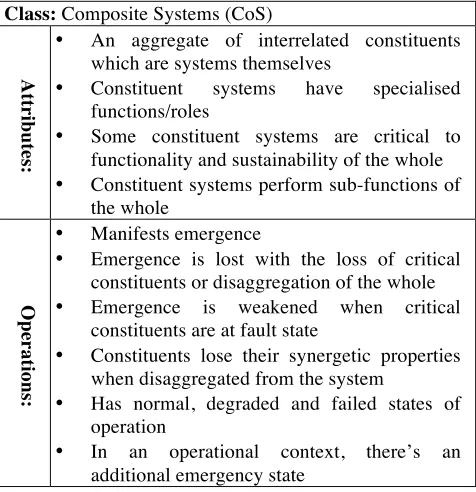
Table (4.1): The definition of Composite System as a UML Class
Class: Composite Systems (CoS)
At
tr
ib
u
te
s:
• An aggregate of interrelated constituents which are systems themselves
• Constituent systems have specialised functions/roles
• Some constituent systems are critical to functionality and sustainability of the whole
• Constituent systems perform sub-functions of the whole
Op
er
a
tio
n
s:
• Manifests emergence
• Emergence is lost with the loss of critical constituents or disaggregation of the whole
• Emergence is weakened when critical constituents are at fault state
• Constituents lose their synergetic properties when disaggregated from the system
• Has normal, degraded and failed states of operation
• In an operational context, there’s an additional emergency state
Table (4.2): The definition of System of Systems as a UML Class
The UML definitions provide a basis for characterisation and differentiation of a composite system from a system of systems in that, the concept of criticality of constituents and their specialisation is hugely diminished or absent in a system of systems thus resulting in a much higher level of resilience and sustainability. This is a significant difference between the two types of complex systems and to some extent, negates the notion that a System of System, is an evolution of a Composite System.
V. CONCLUSIONS
There are already many challenges in the understanding, characterisation and assurance of complex systems especially those involving a large integrated body of hardware, software, rules and human agents. The SoS paradigm offers architectural and operational attributes that present a potent alternative in tackling large scale and global problems. The new definition of SoS provided by the notion of systems play and the associated games that may be defined within it, clearly indicates the direction for research that may lead to the development of a methodology for a new form of systems engineering that may be referred to as System of Systems Engineering. The key challenges in system of systems science pertain to:
Class: System of Systems (SoS)
At
tr
ib
u
te
s:
• An aggregate of interrelated constituents which are systems or composite systems themselves
• Constituents are sustainable and independent functioning systems on their own
• There’s absence or lack of constituent criticality in the sustainability of the whole
• Constituent systems may have specialised functions/roles
Op
er
a
tio
n
s:
• Manifests emergence
• Possesses high degree of resilience and sustainability
• Emergence is sustained with the loss of constituents
• Emergence is weakened when constituents are at fault state
• Constituents retain their intrinsic synergetic properties when disaggregated from the SoS
• Has normal, degraded and failed states of operation
[image:6.612.315.556.113.392.2] [image:6.612.57.295.425.671.2]• Development of the science fundamentals of the
system plays which are the new crucial ingredients in the notion of SoS;
• The need for a more comprehensive treatment of the
system environment as a supra-system rather than a vague and often deemed benign backdrop where a system resides;
• Design heuristics, performance forecasting and
non-deterministic yet resilient behaviours of SoS is worthy of further theoretical development and standardisation;
• The rules, constraints, pre-requisites and enablers of
metamorphosis from composite to system of systems should be investigated and formalised;
• The need for the further development of a systems
framework for characterisation, quantification, evaluation and assessment of complexity and hierarchy [32];
• The threat of global warming, population rise,
ecosystem issues, climate change and economic downturns can potentially explored with a formalisation and advancement of the system of systems paradigm.
The new definition for the SoS is the starting point for the development of methodology that may lead to systematic design. Examining the rules of composition of the subsystems, the nature of scenarios in the corresponding plays and their coordination as agents in a larger system defines a challenging new area for research and requires links across many disciplines. The part 2 of this paper addresses the concept of Emergence and proposes a framework for further development of this notion within the context of System of Systems.
ACKNOWLEDGMENT
The authors acknowledge the support from the Systems and Control Engineering Research Centre at the City University London School of Engineering and Mathematical Sciences.
REFERENCES
[1] M.D. Mesarovic and Y. Takahara, 1989 , “Abstract Systems Theory”, Lecture Notes in Control and Information Asiences, Springer-Verlag, Vol. 116, Berlin.
[2] L.A.Zadeh & C.A. Desoer,1963, “Linear System theory”, McGraw-Hill Book Co, New York
[3] M.D. Mesarovic and Y. Takahara, 1974 , “General Systems Theory: Mathematical Foundations” Academic Press, New York.
[4] N. Karcanias, 2004. “System concepts for general processes: specification of a new framework”, Systems and Control Centre Research Report, November 2004.
[5] G.J.Klir, 1972, Trends in general systems theory, New York, Wiley-Interscience.
[6] S. Beer, 1959, “Cybernetics and Management”, University Press, London
[7] Maier, M.W., "Architecting Principles for System of Systems," Systems Engineering, Vol. 1, No. 4, 1998, pp. 267-284.
[8] N. Karcanias, 1994, Global Process Instrumentation: Issues and Problems of a Systems and Control Theory Framework, Measurement, Vol. 14, pp. 103-113.
[9] N. Karcanias, 1995, Integrated Process Design: A Generic Control Theory/Design Based Framework, Computers in Industry, Vol. 26, pp.291-301.
[10] DeLaurentis D., "System of Systems Definition and Vocabulary," School of Aeronautics and Astronautics, Purdue University, West Lafayette, IN, 2007. [11] M. Jamshidi, 2008 “System of Systems Engineering –
Innovations for the 21st Century” Wiley Series in Systems Engineering, 2008 John Wiley & Sons, Inc.
[12] Jamshidi, M. (2005). “System of Systems Engineering Definitions,” Proceedings IEEE Systems, Man, and Cybernetics Conference, Waikoloa, HI, October (http://ieeesmc2005.unm.edu/SoSE_Defn.htm).
[13] Carlock, P. G., and R. E. Fenton, 2001 "System of Systems (SoS) Enterprise Systems for Information-Intensive Organizations," Systems Engineering, Vol. 4, No. 4, pp. 242-261.
[14] Pei, R.S., "Systems of Systems Integration (SoSI) - A Smart Way of Acquiring Army C4I2WS Systems," Proceedings of the Summer Computer Simulation Conference, pp. 134-139, 2000.
[15] Luskasik, S.J., "Systems, Systems of Systems, and the Education of Engineers," Artificial Intelligence for Engineering Design, Analysis, and Manufacturing, Vol. 12, No. 1, pp. 11-60, 1998.
[16] Manthorpe, W.H., "The Emerging Joint System of Systems: A Systems Engineering Challenge and Opportunity for APL," John Hopkins APL Technical Digest, Vol. 17, No. 3, pp. 305-310, 1996.
[17] Maier, M.W., "Architecting Principles for System of Systems," Systems Engineering, Vol. 1, No. 4, 1998, pp. 267-284.
[18] R. Saeks and R.A. De Carlo, 1981. “Interconnected Dynamical Systems”, Marcel Dekker, New York.
[19] N. Karcanias ,2008, “Structure evolving systems and control in integrated design”, Annual Reviews in Control 32, pp. 61–182
[20] M. Wooldridge, 2002, “An Introduction to MultiAgent Systems”, John Wiley & Sons Ltd, ISBN 0-471-49691-X