S
TRATHCLYDE
D
ISCUSSION
P
APERS IN
E
CONOMICS
D
EPARTMENT OF
E
CONOMICS
U
NIVERSITY OF
S
TRATHCLYDE
G
LASGOW
TIME VARIATION IN THE DYNAMICS OF WORKER FLOWS:
EVIDENCE FROM THE US AND CANADA
B
Y
MICHELE CAMPOLIETI, DEBORAH GEFANG AND
GARY KOOP
Time Variation in the Dynamics of Worker
Flows: Evidence from the US and Canada
Michele Campolieti
Department of Management, University of Toronto Scarborough
Centre for Industrial Relations, University of Toronto
Deborah Gefang
Department of Economics, Lancaster University
Gary Koop
Department of Economics, University of Strathclyde
September 24, 2011
ABSTRACT
VAR methods have been used to model the inter-relationships between
in-‡ows and outin-‡ows into unemployment and vacancies using tools such as impulse
response analysis. In order to investigate whether such impulse responses change
over the course of the business cycle or or over time, this paper uses TVP-VARs
for US and Canadian data. For the US, we …nd interesting di¤erences between
the most recent recession and earlier recessions and expansions. In particular,
we …nd the immediate e¤ect of a negative shock on both in‡ow and out‡ow
haz-ards to be larger in 2008 than in earlier times. Furthermore, the e¤ect of this
shock takes longer to decay. For Canada, we …nd less evidence of time-variation
in impulse responses.
JEL Classi…cation: J64; J63; C32.
Keywords: unemployment hazards, labor market dynamics, time-varying
1
Introduction
Changes in unemployment rates depend on both ‡ows into and out of
unem-ployment. Understanding how unemployment is a¤ected by both these ‡ows
has a attracted a great deal of attention in the literature. Since the seminal
work of Darby, Haltiwanger and Plant (1986), many studies have used
descrip-tive measures to investigate the ins and outs of unemployment (e.g. Hall, 2005,
Shimer, 2007, Elsby et al, 2009, Fujita and Ramey, 2006 and 2009 and
Campoli-eti, 2011, among many others). However, while these descriptive methods can
be helpful in characterizing the ‡ows into and out of unemployment as well as
changes in unemployment rates, they do not take into account dynamics so they
miss some aspects of the adjustment process in the labor market. Arguing that
descriptive measures may not be useful in disentangling shocks generated out
of the labor market, such as productivity shocks, from those generated within
the job search/matching system, Fujita (2011) uses VAR models to explore the
interrelationships between the ins and outs of unemployment and vacancy rates
in the US. He identi…es the structural VAR structure using the sign restriction
approach of Uhlig (2005). In particular, he identi…es a negative aggregate shock
as one which causes changes to unemployment to be negative forkquarters and
does not immediately raise vacancies. This is the framework on which we build
in the present paper.
The analysis of Fujita (2011) is conducted using a VAR with constant
co-e¢ cients and, thus, impulse responses which are also constant. This can be
potentially misleading if the mechanisms underlying the job search/matching
process are varying over time. Results of many studies (e.g. Hall 2005, Shimer
2007, Elsby et al, 2009) suggest that the dynamics of the ins and outs of
un-employment can be closely related to the ‡uctuations of business cycles. In the
1999 and Skalin and Teräsvirta, 2002) …nd considerable evidence of
nonlineari-ties in unemployment. To take account of these possible nonlinear e¤ects, this
paper extends Fujita (2011) by using a time-varying parameter (TVP) VAR.
We adopt the TVP-VAR of Primiceri (2005) which additionally allows for
mul-tivariate stochastic volatility and is popular in the empirical macroeconomics
literature. This framework is attractive since it allows both the VAR coe¢ cients
and the error covariance matrix to vary over time in a ‡exible and unrestricted
fashion.
We estimate VARs and TVP-VARs using three series: the in‡ow hazard
(job separation rate); the out‡ow hazard (job …nding rate); and, vacancies. We
use both Canadian and US data. Our empirical results provide support for the
TVP-VAR with multivariate stochastic volatility. This support is particularly
strong for the US data. We also …nd support for the inequality restrictions
we use to identify the impulse responses. These lead to uniformly sensible
responses to a shock for all the series we consider for both the US and Canada.
In particular, we …nd that the in‡ow hazard (separation rate) increases quickly
after a shock before declining slowly. In contrast, the out‡ow hazard (job …nding
rate) and vacancies decrease after a shock before increasing in a hump shaped
pattern. This general pattern holds for both the US and Canada. The only slight
di¤erence between the countries is that the impulse responses for Canada tend
to oscillate a bit before decaying in some cases. We do not …nd much evidence
of time variation in impulse responses using Canadian data. However, we …nd
some interesting time variation in the US data. While the impulse responses for
most of the time periods we consider are similar, the impulse responses for the
in‡ow and out‡ow hazard in the US Great Recession di¤er from earlier periods.
In particular, the in‡ow hazard tends to respond more strongly to a shock and
strongly initially and takes longer to decay and is still quite large at the end
of the time horizon we consider. These …ndings tend to be consistent with the
observations made by Elsby et al (2010a) on the US labor market during the
Great Recession.
2
Econometric Methods
VAR methods have enjoyed wide popularity in empirical macroeconomics since
the pioneering work of Sims (1980). VARs are atheoretical models which
al-low the researcher to investigate the relationships between time series variables
without imposing any economic theory. Structural identifying restrictions are
placed on VARs in order to give an economic interpretation to impulse responses
and other features of interest. Traditionally, these identifying restrictions have
been equality restrictions and, in some cases, have been criticized for being
overly strong. Uhlig (2005) proposes using weaker sets of inequality restrictions
in order to identify impulse responses. This attempt to impose the minimum
amount of economic theory used, and let the data speak, is in the spirit of the
atheoretical VAR literature. These considerations presumably motivated Fujita
(2011), who used a VAR involving in‡ow and out‡ow hazards and vacancy rates
along with a sign restriction approach.1 This approach required the minimal
as-sumptions that a negative shock cannot immediately raise vacancies and cannot
cause the unemployment rate to fall fork quarters.
Our econometric methods also begin with VARs with impulse responses
be-ing identi…ed through similar sign restrictions. However, we also use TVP-VARs
which allow for VAR coe¢ cients to change over time. In empirical
macroeco-nomics, there is a plethora of evidence of structural breaks and other kinds of
1Fujita (2011) also considers an expanded VAR, which includes additional shocks and
parameter change (see, among many others, Stock and Watson, 1996) and this
has led to a large number of papers which use TVP-VARs (see, among many
others Cogley and Sargent, 2001, 2005, Cogley et al, 2005, Primiceri 2005, and
D’Agostino et al, 2009 and Koop et al, 2009). It is also worth noting that most of
these TVP-VARs paper allow for multivariate stochastic volatility which seems
to be empirically important in many macroeconomic applications. One purpose
of the present paper is to see whether TVP-VARs with multivariate stochastic
volatility will prove equally useful in applications in labor economics.
In this section, we brie‡y outline the structure of TVP-VARs and describe
how we implement the sign restriction approach to impulse response analysis.
The Technical Appendix provides additional details. Our TVP-VAR setup
fol-lows Primiceri (2005) and the sign restriction approach is implemented as in
Uhlig (2005) and the reader is referred to these papers for additional motivation
and explanation.
The basic VAR used by Fujita (2011) can be written as
yt=Zt +"t (1)
whereytis ann 1vector of observations on the dependent variables,Ztis an
n mmatrix of containing a vector of intercepts and lagged dependent variables
and"tare independentN(0; H)fort= 1;2; :::; T. The TVP-VAR extends this
as
yt=Zt t+"t (2)
where
t= t 1+ t: (3)
and tare independentN(0; Q). Notice that this takes the form of a state space
vector of unobserved states. This is a popular speci…cation which allows for the
coe¢ cients to vary over time. It has the advantage that standard statistical
methods for state space models exist. In our empirical work, we refer to this as
the homoskedastic VAR, to distinguish it from the heteroskedastic
TVP-VAR which assumes"t are independent N(0; Ht). Following Primiceri (2005),
we use a triangular decomposition to modelHt:
Ht=At1 t 0 t(At1)
0
; (4)
where t is a diagonal matrix with diagonal elements j;tforj= 1;2; :::; nand
Atis a lower triangular matrix with ones on the diagonal. That is, it takes the
form:
At=
0 B B B B B B B B B B @
1 0 ::: : 0
a21;t 1 ::: : :
: : ::: : : : : ::: 1 0
an1;t : ::: an(n 1);t 1
1 C C C C C C C C C C A
Let t= ( 1;t; 2;t; :::; n;t)0 andat= (a21;t; a31;t; a32;t; :::; an(n 1);t)0. These
are allowed to evolve according to the following state equations:
log( t) =log( t 1) +ut; (5)
and
at=at 1+vt; (6)
whereut i:i:d:N(0; W), vt i:i:d:N(0; C), andutandvtare independent to
each other with all the leads and lags. As discussed in Primiceri (2005), this
speci…cation is a ‡exible one, allowing both error variances and covariances to
Our empirical work considers VARs, homoskedastic TVP-VARs and
het-eroskedastic TVP-VARs. We use the Bayesian information criterion (BIC) to
compare these models. This can be interpreted as an asymptotic approximation
to the log of the marginal likelihood (the conventional Bayesian model
compar-ison metric). Note that BIC does not involve the prior, which is potentially
an advantage in high-dimensional models such as VARs and TVP-VARs where
marginal likelihoods can be sensitive to prior choice. Following Carlin and Louis
(2000, Section 6), we calculate the BIC using the posterior expectation of the
log-likelihood.
Additional technical details, including discussion of posterior simulation and
the priors used in our Bayesian estimation procedure, are given in the Technical
Appendix. The reader is referred to Koop and Korobilis (2009) for complete
details Bayesian estimation of VARs and TVP-VARs.
The Technical Appendix also gives details of how the sign-restricted impulse
responses are calculated. We use the same methods as Uhlig (2005) and Fujita
(2011). These require the speci…cation of restrictions and we use the same
restrictions as in Fujita (2011) which identify an aggregate shock using the
following restrictions:
1. A negative aggregate shock will causes changes in unemployment to be
non-negative forkquarters.
2. A negative aggregate shock will not raise vacancies in the impact quarter.
In line with Fujita (2011), in this paper we setk= 2. In the online empirical
appendix, we also present results for k = 1;3;4 and …nd results to be fairly
robust to choice ofk.
Note that the …rst restriction relates to the unemployment rate. Following
(uet) by the steady-state unemployment rate:
uet
st
ft+st
wherestis the in‡ow hazard andftis the out‡ow hazard.
We present impulse responses for the three variables in yt (i.e. the in‡ow
and out‡ow hazards and the vacancy rate) plus the unemployment rate. With
regards to the latter we proceed as follows. After a shock at time t, if the
responses of the in‡ow hazard and out‡ow hazard at time t+ 1 are irfs;t+1
andirff;t+1, respectively, the impulse response of unemployment at timet+ 1
(irfue;t+1) can be approximated by the following equation:
irfue;t+1
st+irfs;t+1
ft+st+irfs;t+1+irff;t+1
uet
Similarly, the impulse responses of unemployment for future horizonsthr, which
is longer than1, can be approximated by:
irfue;t+thr
st+Ptiihr=1irfs;t+ii
ft+st+Ptiihr=1(irfs;t+ii+irff;t+ii)
st+Ptiihr=11irfs;t+ii
ft+st+Piithr=11(irfs;t+ii+irff;t+ii)
In our empirical work, we also present a variance decomposition arising from
the sign-restricted impulse response approach. De…ned as in Fujita (2011), this
measures the proportion of the forecast error variance at di¤erent horizons which
can be attributed to the identi…ed aggregate shock.
3
Empirical Results
We divide our empirical results section into three sub-sections. The …rst
de-scribes the data while the second discusses modelling choices and volatility
decom-positions.
3.1
Data
We use quarterly data from the US and Canada. The US data runs
1951Q1-2009Q4, while the Canadian data spans 1981Q1 through 2003Q2. The shortness
of the Canadian data is due to the decision of Statistics Canada to terminate
the help wanted index in April, 2003.
The US data were obtained from Elsby et al (2010a) and include the in‡ow
and out‡ow hazard series, which were computed using data from the Current
Population Survey (CPS), as well as a help wanted index. The US help wanted
index is collected by the Conference Board and is based on help wanted ads in
51 prominent newspapers in the US. The Canadian in‡ow and out‡ow hazard
series were originally computed in Campolieti (2011) using the public release
…les of the Labour Force Survey (LFS), which is collected by Statistics Canada
and is comparable to the US CPS. The help wanted index is obtained from
Statistics Canada’s CANSIM database.2 The Canadian help wanted index is
based on the number of job ads in newspapers and is comparable to the US
help wanted index we use.3 The in‡ow and out‡ow hazard rates for both the
US and Canada are based on the framework introduced by Shimer (2007) with
the re…nements in Elsby et al (2009). These hazard rates measure the ‡ows
into unemployment and out of unemployment.4 Details on the computation of
the in‡ow hazards can be found in Elsby et al (2009), Elsby et al (2010a) and
Campolieti (2011).
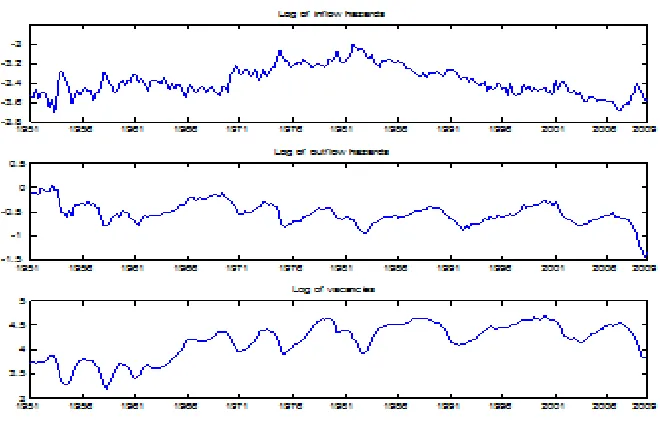
Figures 1 and 2 plot the raw data for the US and Canada, respectively.
2This help wanted index was introduced during the …rst quarter of 1981.
3There was also an earlier help wanted index that was available from 1962 to 1988. This
index was proportional to the space occupied by job o¤ers in Canada’s major newspapers, but is was not a robust a measure because it was sensitive to changes in fonts and column widths as well as paper size in the newspaper industry.
It can be seen that there is some evidence of low-frequency trends in the data.
Fujita (2011) argues that theoretical search/matching models are not associated
with low-frequency trends and, accordingly, takes out such low frequency trends.
Following Fujita (2011), we detrend all our series using deterministic quadratic
[image:12.612.171.501.263.475.2]trends.
Figure 2. Canadian data
3.2
Model Comparison
BIC chooses VAR models with lag length 2 for the US and Canada and we adopt
this choice for all of our VARs and TVP-VARs. With regards to the degree of
time-variation in VAR coe¢ cients and error variances, Table 1 presents BICs for
three models. For notational convenience, we use ’Homo TVP-VAR’to denote
TVP-VAR models with constant error covariance matrix, and ’Hete TVP-VAR’
to denote TVP-VAR models with time varying error covariance matrix. Table 1
indicates moderately strong support for time-variation in both VAR coe¢ cients
and the error covariance matrix. That is, for both countries the Homo
VAR has a substantially lower BIC than the VAR and the heteroskedastic
TVP-VAR in turn has a substantially lower BIC than the TVP-TVP-VAR. Accordingly, in
TVP-VAR. However, a complete set of results for all models is available in the online
[image:14.612.216.396.170.269.2]appendix.
Table 1: BIC for Various Models
Canada US
VAR 6.6504 7.5446
Homo TVP-VAR -0.4346 -1.6442
Hete TVP-VAR -8.1602 -9.0031
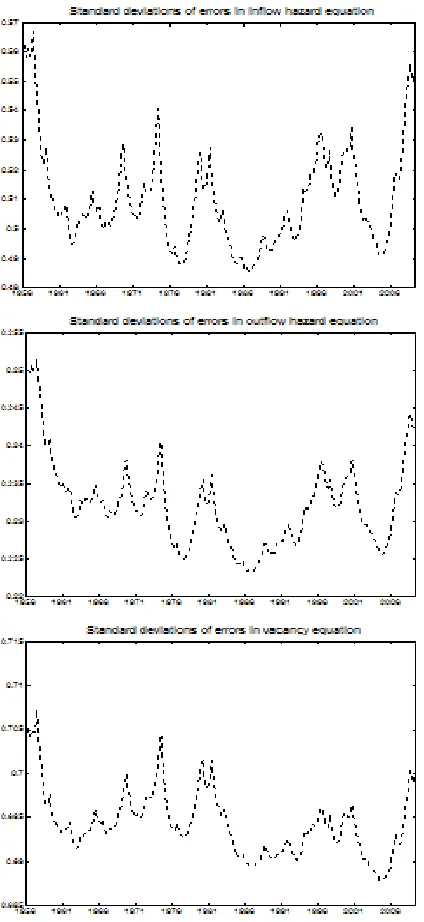
To shed light on the importance of allowing for stochastic volatility, Figures
2 and 3 plot the posterior means of the standard deviations of the errors in
the three equations of the TVP-VAR for the US and Canada, respectively. For
both countries, there is evidence of time variation, but the patterns are quite
di¤erent. For Canada, the time variation reveals itself largely through a spike
around 1997. For the longer US series, we see more peaks and troughs in
the volatilities. Furthermore, a careful examination of the scale of the Y-axis
indicates that it is only for the in‡ow hazard that substantial time variation in
the error variance occurs. For Canada, Campolieti (2011) notes that there is a
spike in the in‡ow hazard around 1997 and examines some other data sources for
similar patterns. Campolieti (2011) concludes that the spike in the in‡ow hazard
was likely related to changes in the LFS that occurred around this time, since the
spike is not present in other data. More speci…cally, there was increased use of
CATI interviews, changes in the survey questionnaire that added new variables
and, most importantly, a change in the wording of the temporary layo¤ question
that was phased in between September 1996 and January 1997 (Sunter et al,
1997) that would classify more individuals as unemployed. Campolieti (2011)
also observes an increase in the Canadian out‡ow hazard around 1997. This
increase in unemployment out‡ows is equivalent to a decrease in unemployment
Campolieti (2011) notes the reasons for this increase in the out‡ow rate from
[image:15.612.201.413.167.628.2]unemployment are unclear.
3.3
Impulse Response Functions and Variance
Decompo-sitions
For each country, we calculate impulse responses and variance decompositions
for various time periods. For the US, dates near business cycle troughs of
1982Q4, 1992Q3 and 2003Q2 are chosen as well dates near peaks of 1989Q2,
2000Q4. In addition, we use 2008Q2 to examine the e¤ect of the recent crises.
For Canada, troughs are 1982Q4, 1992Q4 and 2002Q1.5 Peaks are around
1989Q3 and 2000Q2. We also include 2003Q1 as the last observation in the
Canadian sample.
3.3.1 Variance Decompositions
Before presenting impulse responses, we provide information that the sign
re-strictions used to calculate them are reasonable ones. Tables 2 and 3 present a
summary of the variance decompositions for the US and Canada, respectively
(…gures containing a full set of variance decompositions, including credible
inter-vals, are available in the online appendix). The variance decompositions were
calculated up to a horizon of 20 quarters. The tables present the average of
the point estimate over all horizons. Tables 2 and 3 indicate that the aggregate
shock we have identi…ed accounts for an appreciable amount of the variability in
all three of our variables. For the US, it account for roughly 40-45% of the
vari-ability in all three series. For Canada, comparable numbers are about 30-33%.
These are similar to the …gures presented in Fujita (2011) for his benchmark
VAR.
Table 2: Average Variance Decomposition Rates for Hetero TVP-VAR, US
Time Q4 1982 Q2 1989 Q3 1992 Q4 2000 Q2 2003 Q2 2008
In‡ow Hazard 0.3888 0.3907 0.3914 0.4062 0.3950 0.4121
Out‡ow Hazard 0.4420 0.4429 0.4422 0.4394 0.4310 0.4376
[image:18.612.130.502.151.344.2]Vacancies 0.4444 0.4393 0.4393 0.4414 0.4349 0.4422
Table 3: Average Variance Decomposition Rates for Hetero TVP-VAR, Canada
Time Q3 1989 Q4 1992 Q2 2000 Q1 2002 Q1 2003
In‡ow Hazard 0.3328 0.3206 0.3262 0.3281 0.3326
Out‡ow Hazard 0.3231 0.3102 0.3137 0.3164 0.3223
Vacancies 0.3289 0.3167 0.3234 0.3249 0.3249
3.3.2 Impulse Response Functions
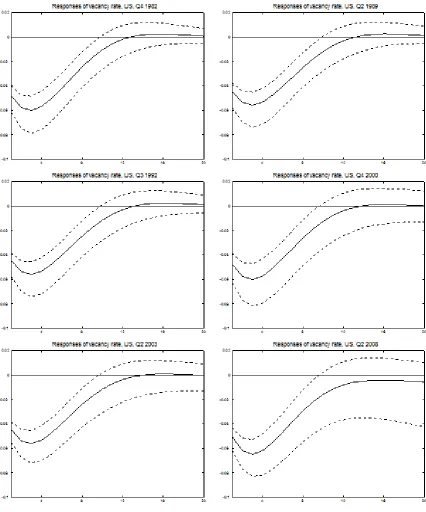
Figures 5 through 8 present impulse responses for the US data with Figures 9
through 12 repeating the analysis for the Canadian data. All of these …gures are
responses to the aggregate shock identi…ed using the sign restrictions. The four
…gures for each country are responses of four variables (in‡ow hazard, out‡ow
hazard, unemployment rate and vacancy rate) to this shock at the time periods
speci…ed above. In all these …gures the solid line is the posterior median and
the dashed lines are the 16th and 84th percentiles of the posteriors. We present
results only for the heteroskedastic TVP-VAR, but occasionally refer to results
for other models. These latter results are available in the online appendix.
US Results
The response of the in‡ow hazard to the aggregate shock dies o¤ steadily
and fairly quickly (in about 8 quarters). In contrast, the out‡ow hazard,
unem-ployment and vacancy variables exhibit hump-shaped patterns. These impulse
responses tend to be near zero after about 3 or 4 years. These general
homoskedastic TVP-VAR.
The sign of the response for all the series we consider are unambiguous
(i.e. they never ‡ip from being positive at some horizons and negative at
oth-ers), which provides support for the restrictions we use in the data. In other
words, despite using weak restrictions we observe some features of the
adjust-ment process in the US labor market quite clearly. The in‡ow hazard
(sep-aration rate) reaches its peak quickly and then declines slowly. The out‡ow
hazard (job …nding rate) and vacancies take a few quarters to reach the trough
before starting to fade. The patterns in these series are like those in Fujita
(2011). Moreover, they also support the conclusions in Elsby et al (2009) and
Fujita and Ramey (2009) that unemployment dynamics in the US are driven by
‡uctuations in both the in‡ow and out‡ow hazard.
Overall, the di¤erences across time periods do not appear to be too great.
However, there are some variations over time and di¤erences with standard VAR
results which are worth noting.
For the in‡ow hazard, the impact impulse response found using the
het-eroskedastic TVP-VAR is larger than what is provided by the VAR. In addition,
the impulse responses in 2000Q4 and 2008Q2 begin at a higher level and die
away more steeply than for the other time periods.
For the out‡ow hazard, the point estimate for the impulse responses is
sim-ilar in each time period, but the credible interval between the 16th and 84th
percentiles becomes wider over time, with the 2008Q2 interval being very wide.
The wider credible interval in 2008Q2 is also found for the unemployment
rate impulse response function. For this variable, the impulse responses exhibit
the most variation over time. In particular, the responses to the negative
aggre-gate shock in the peak years of 1989Q2 and 2000Q4 are smaller than in other
is particularly large. And in 2008Q2 the e¤ect of a shock takes much longer to
die away.
For the vacancy rate, this pattern of wide credible interval in 2008Q2 and a
tendency of the impulse response function to take a long time to move towards
zero, is also found. Other than this, impulse responses for this variable are quite
similar in each time period and similar to what is found for the standard VAR
or homoskedastic TVP-VAR.
The time variation in impulse responses is most visible in the impulse
re-sponses for 2008Q2. Elsby et al (2010a) noted that there was an increase in
the half-life of a deviation from steady state unemployment during the Great
Recession relative to estimates of the half-life of a deviation from steady state
unemployment obtained with data before the Great Recession (see also Elsby
et al 2009; Elsby et al, 2010b). In addition, Elsby et al (2010a) also highlight
that there was an overall slowdown in the rate of exit from unemployment
dur-ing the Great Recession resultdur-ing in an accumulation of long-term unemployed
persons. This accumulation of the long-term unemployed reduced the ability of
the out‡ow hazard in the US to rebound. Our impulse response functions for
the out‡ow hazard from 2008Q2 are consistent with these observations. More
speci…cally, while the impulse responses for the out‡ow hazard for most of the
periods we consider fade to zero, the impulse responses for 2008Q2 are still fairly
large after 20 quarters. The impulse response for the in‡ow hazard 2008Q2 also
tends to be larger than that for earlier periods and also takes longer to fade
away. Elsby et al (2010a) also found some evidence of elevated levels of job
loss, relative to earlier recessions, during the Great Recession. In particular,
they found evidence of more separations due to layo¤s during the Great
Reces-sion. Our impulse responses for 2008Q2 would be consistent with this changed
The online appendix presents results for various priors and di¤erent choices
[image:21.612.142.568.186.649.2]forkand these are found to be of the same pattern as those presented here.
Figure 8. Impulse responses of vacancies -Hete TVP-VAR, US
The general patterns found in the impulse responses using the Canadian
data are somewhat di¤erent than US patterns. Impulse responses for the in‡ow
hazard do indeed die o¤ in a similar manner as we found for the US. But for the
other variables, the hump-shaped US impulse responses are replaced by a more
oscillatory response. The previous statement holds for the point estimates of the
impulse response, although the credible intervals are fairly wide and include the
hump-shaped pattern. The oscillation in the impulse response for the out‡ow
hazard, relative to the US, is interesting in the context of the di¤erence in
unemployment rates that has existed between the two countries since the
early-1980s (Riddell 2005). For most of the period we are considering the Canadian
unemployment rate was higher than the US unemployment rate. The impulse
responses for Canada, relative to the US, suggest that there could be lower exits
from unemployment at longer horizons. This is consistent with the observations
made in Campolieti (2010), who found that changes in the out‡ow hazard were
responsible for a large part of the Canada-US unemployment rate gap.
In general, with Canadian data there is less evidence of time-variation in
impulse responses. For the in‡ow and out‡ow hazards and the vacancy rate,
there is little evidence of change over time in the impulse response functions.
Although, for the in‡ow hazard, there is some weak evidence that the e¤ect
of the negative aggregate shock is getting weaker over time. That is, impact
responses are slightly less in 2002Q1 and 2003Q1 than in earlier years.
The similarity of the impulse responses for the periods we consider is like
the pattern we observe in the US, except for 2008Q2.6 The Canadian estimates,
like the US ones, suggest that response to a shock is similar across time and the
business cycle. Also, like the US, the in‡ow (job separation rate) and out‡ow
(job …nding rate) hazards both play an important role in the adjustment of the
6Remember that our Canadian data ends in 2003Q1 so we are not able to investigate the
labor market.
However, for the unemployment rate, the impulse response in 1992Q4 is
substantially di¤erent than other years. The impact and maximum responses are
higher in this trough year than at other periods. While 1992Q4 is contained in
the 1990-1992 recession, the period covered by the time horizon for the impulse
responses corresponds to the period referred to as the ‘The Great Canadian
Slump’ (Fortin 1996), which was a prolonged period of slow growth for the
Canadian economy that extended into the mid-1990s following the end of the
1990-1992 recession.
Results using di¤erent values for k are similar those presented here.
How-ever, results using the VAR or homoskedastic TVP-VARs do di¤er from those
presented here in some minor ways (e.g. the VAR results do not exhibit the
same oscillatory responses noted above). Furthermore, results are more
sensi-tive to prior than was found with the US data (although this is not unexpected
due to the shorter data span). The reader is referred to the online appendix for
4
Conclusions
In this paper, we have built on the existing literature which uses VAR methods
for investigating the relationship between in‡ow and out‡ows into
unemploy-ment by using TVP-VAR methods. We also use both Canadian and US data.
This allows us to see whether these relationships are changing over time. We
…nd, particularly for the US, some interesting intertemporal changes. In
par-ticular, we …nd that responses of the in‡ow and out‡ow hazard during 2008Q2,
which is during the US Great Recession, di¤er from those in the other periods
we consider. More speci…cally, the in‡ow hazard (job separation rate) responds
more strongly initially to a shock and takes longer to decay than the impulse
responses for the other periods we consider. Likewise, the out‡ow hazard (job
…nding rate) also responds more strongly to a shock and does not decay as
quickly or to the same level as the impulse responses for the other periods we
consider. These …ndings suggest that unemployment dynamics and labour
mar-ket adjustment during the US Great Recession di¤er from those in the other
periods we consider. In contrast, the estimates from Canada indicate that the
response to a shock does not vary a great deal over time or the business cycle
and suggests that labor market adjustment occurs in a similar fashion during
all the periods we consider in Canada.
Fujita (2011) concluded based on his …ndings from the VAR that models of
the labor market should consider endogenous separations and the development
of models that can replicate the hump shaped response in the out‡ow hazard
References
Campolieti, M. (2010). “The Canada-US unemployment rate gap:
Decom-posing cross-country di¤erences in unemployment rates using in‡ow and out‡ow
hazards,”Centre for Industrial Relations and Human Resources, University of
Toronto, unpublished manuscript.
Campolieti, M. (2011). “The ins and outs of unemployment in Canada,
1976-2008,”Canadian Journal of Economics, forthcoming.
Carlin, B. and Louis, T. (2000). Bayes and Empirical Bayes Methods for
Data Analysis, second edition. Boca Raton: Chapman and Hall.
Carter, C. and Kohn, R. (1994). “On Gibbs sampling for state space
mod-els,”Biometrika, 81, 541–553.
Cogley, T., Morozov, S. and Sargent, T. (2005). “Bayesian fan charts for
U.K. in‡ation: Forecasting and sources of uncertainty in an evolving monetary
system,”Journal of Economic Dynamics and Control, 29, 1893-1925.
Cogley, T. and Sargent, T. (2001). “Evolving post World War II in‡ation
dynamics,”NBER Macroeconomics Annual, 16, 331-373.
Cogley, T. and Sargent, T. (2005). “Drifts and volatilities: Monetary policies
and outcomes in the post WWII U.S.,”Review of Economic Dynamics, 8,
262-302.
D’Agostino, A., Gambetti, L. and Giannone, D. (2009). “Macroeconomic
forecasting and structural change,”ECARES working paper 2009-020.
Darby, M., Haltiwanger, J. and Plant, M. (1986). “The ins and outs of
unemployment: The ins win,”National Bureau of Economic Research, working
paper 1997.
Elsby, M., Michaels, R. and Solon, G. (2009). “The ins and outs of cyclical
unemployment,”American Economic Journal: Macroeconomics, 1, 84-110.
recession,”Brookings Papers on Economic Activity, Spring, 1-48.
Elsby, M., Hobijn, B. and Sahin, A. (2010b). “Unemployment dynamics in
the OECD,”National Bureau of Economic Research,working paper 14617.
Fortin, P. (1996). “The Great Canadian Slump,”Canadian Journal of
Eco-nomics, 29, 761-787.
Fujita, S. (2011). “Dynamics of worker ‡ows and vacancies: Evidence from
the sign restriction approach,”Journal of Applied Econometrics, 26, 89-121.
Fujita, S. and Ramey, G. (2006). “The cyclicality of job loss and hiring,”
Federal Reserve Bank of Philadelphia, working paper #06-17.
Fujita, S. and Ramey, G. (2009). “The cyclicality of separation and job
…nding rates,”International Economic Review, 50, 415-430.
Hall, R. (2005). “Employment e¢ ciency and sticky wages: Evidence from
‡ows in the labor market,”Review of Economics and Statistics, 87, 397-407.
Kim, S., Shephard, N. and Chib, S. (1998). “Stochastic volatility: likelihood
inference and comparison with ARCH models,”Review of Economic Studies, 65,
361-93.
Koop, G. and Potter, S. (1999). “Dynamic asymmetries in U.S.
unemploy-ment,”Journal of Business and Economic Statistics, 17, 298-312.
Koop, G., and Korobilis, D. (2009). “Bayesian multivariate time series
meth-ods for empirical macroeconomics,”Foundations and Trends in Econometrics,
3, 267-358.
Koop, G., Leon-Gonzalez, R. and Strachan, R. (2009). “On the evolution of
the monetary policy transmission mechanism,”Journal of Economic Dynamics
and Control, 33, 997-1017.
Macklem, T. and Barillas, F. (2005). “Recent developments in the
Canada-US unemployment rate gap: Changing patterns in unemployment incidence and
Primiceri, G. (2005). “Time varying structural vector autoregressions and
monetary policy,”Review of Economic Studies, 72, 821-852.
Riddell, W. (2005). “Why is Canada’s unemployment rate persistently
higher than in the United States,”Canadian Public Policy/Analyse de
Poli-tiques, 31, 93-100.
Shimer, R. (2007). “Reassessing the ins and outs of unemployment,”
Na-tional Bureau of Economic Research, working paper 13421.
Skalin, J. and Teräsvirta, T (2002). “Modeling asymmetries and moving
equilibria in unemployment rates,”Macroeconomic Dynamics,6, 202-241.
Sims, C. (1980). “Macroeconomics and reality,”Econometrica, 48, 1-48.
Stock, J. and Watson, M. (1996). “Evidence on structural instability in
macroeconomic time series relations, ”Journal of Business and Economic
Sta-tistics, 14, 11-30.
Sunter, D., Kinack, M., Akyeampong, E. and Charette, D. (1997). “The
Labour Force Survey: Development of a new questionnaire for 1997,”Statistics
Canada: Household Surveys Division.
Uhlig, H. (2005). “What are the E¤ects of Monetary Policy on Output?
Results from an Agnostic Identi…cation Procedure,”Journal of Monetary
Technical Appendix
Bayesian Econometric Methods
In this section we provide additional details about our estimation of the VAR
and heteroskedastic TVP-VAR. The homoskedastic TVP-VAR is the same as the
heteroskedastic TVP-VAR except the treatment of its error covariance matrix
model is the same as the VAR. Complete details on posterior inference in all
those models is given in, among other places, Koop and Korobilis (2009).
The VAR given in (1) can be rewritten as:
Y =X +E
whereE= ("1; "2; :::; "T) 0
is theT nmatrix of error terms,Y = (y1; y2; :::; yT)
0
is theT n matrix of observations, X be aT (np+ 1) matrix withtth row
containing an intercept andp lags of each of then dependent variables. is
the matrix of VAR coe¢ cients withvec( ) = .
In this model, with a noninformative prior, the posterior forH 1is Wishart:
W(Hb 1=T; T) with E(H 1) = Hb 1. The posterior for conditional on H is
N(b; H (X0X) 1)where
b = (X0X) 1X0Y; Hb = 1
T(Y Xb)
0
(Y Xb)
For the TVP-VAR de…ned by (2), (3), (5) and (6), MCMC methods are
required. We use the same MCMC algorithm as Primiceri (2005) and the reader
is referred to his paper for complete details. Brie‡y, conditional on all the other
parameters, we draw from the posterior for t (fort = 1; ::; T) using standard
Bayesian methods for state space models. We use the algorithm of Carter and
Kohn (1994). The same algorithm is used to draw at. The algorithm of Kim,
The covariance matrices of the errors in the state equations, Q, W andC
are drawn from inverse-Wishart distributions (see Koop and Korobilis, 2009,
Section 3.2 for precise formulae). As in Primiceri (2005), we assume C to be
block diagonal with blocksC1 andC2.
We also using training sample priors as in Primiceri (2005) to initialize the
states in the state equations and provide priors forQ,W andC. In particular,
OLS estimates from a constant coe¢ cient VAR using an initial training sample
of size are used to calibrate the prior. Let bOLS and V(bOLS) be the OLS
estimate and its covariance matrix for the VAR coe¢ cients. Similarly, the OLS
estimate of the error covariance matrix can be decomposed as in (6) to provide
us withbOLS,AbOLS andV(AbOLS). Primiceri (2005) uses the following prior
0 N(bOLS;4:V(bOLS))
A0 N(AbOLS;4:V(AbOLS))
log( 0) N(log(b0); I3)
Q IW(k2Q V(bOLS); )
W IW(4k2WI3;4)
C1 IW(2kC2V(Ab1;OLS);2)
C2 IW(3kC2V(Ab2;OLS);3)
whereAb1;OLS andAb2;OLS are the blocks ofAbOLScorresponding to the blocking
ofCintoC1andC2. With this setup, the complicated prior elicitation procedure
for the high-dimensional TVP-VAR is reduced to the choice of and the scalars
kQ, kC and kW. Following Primceri (2005), the main results in our paper set
use the initial 5 years of data, = 20. In a prior sensitivity analysis, available in
the online appendix, we investigate the sensitivity of the prior to these choices.
For the homoskedastic TVP-VAR, we require a prior forH. Given the scale of
the data the following choice is centered in a sensible region, but is relatively
noninformative:
H IW(Hb0;4):
whereHb0is the OLS estimate of the error covariance matrix using the training
sample.
Impulse Response Analysis Using Sign Restrictions
To estimate the impulse responses, we extend the sign restriction approach
of Uhlig (2005) which was developed for the VAR to the TVP-VAR framework.
Basically, the approach of Uhlig (2005) involves repeatedly simulating impulse
responses from the VAR, but omitting draws which violate the sign restrictions.
With the TVP-VAR we implement this approach by calculating sign-restricted
impulse responses at timetusing the VAR coe¢ cients and VAR error covariance
matrix which hold at timet (i.e. tandHt). With the TVP-VAR the impulse
response simulation must be done within a posterior simulation algorithm which
can be computationally costly. Accordingly, we calculate sign restricted impulse
responses at a few selected time periods, rather than for allt. Precise details
are provided in the remainder of this section.
Suppose that!tis ann 1vector of mutually independent structural
inno-vations withE(!t!
0
t) =In. The relationship between"tand!tcan be written
as "t =Gt!t, with the only restriction that GtG 0
t =Ht. Thus, if!t+1 = ej,
withej be ann 1vector with zeros everywhere except for thejthentry equal
1, we have"t+1=Gtej =gt;j, withgt;j be thejth column ofGt. Similarly, we
can computerh
ej, asrehj;o;t= (
h
tgj;t)o, where gj;t= (g
0
j;t;01;p(l 1))0, and
t= 0 B B B B B B B B B B @
B1;t B2;t ::: Bl 1;t Bl;t
In 0 ::: 0 0
0 In ::: 0 0
::: ::: :::
0 0 ::: In 0
1 C C C C C C C C C C A
with the n n matrix Bi;t, whose elements are contained in t, being the
parameter matrix corresponding to the ith lagged dependent variables in the
TVP-VARs.
Following Uhlig (2005), we decompose Ht into Gt=Xt
1 2
tFt, where Xt is
ann northogonal matrix whose columns are the orthonormal eigenvectors of
Ht, t=diag( 1;t; 2;t; :::; n;t)is the corresponding eigenvalues matrix of t,
andFtis ann northogonal matrix (i.e.,FtF
0
t =In). Then an impulse vector
gtcan be constructed as following:
gt=Xt
1 2
tft (7)
where ft is an orthonormal vector uniformly drawn from a unit sphere. Let
gt = (g 0
t;01;p(l 1))
0
, with l being the lag length of the TVP-VARs. We can
calculate the impact responses of variableoat horizonhto a shock at timetas
rh
o;t = ( htgt)k. By repeatedly generating a large number of gtand imposing a
set of inequality constraints onrh
o, the impulse responses are obtained.
The sign restriction approach is incorporated in our TVP-VAR MCMC
al-gorithm. We generate 1000 impulse response vectors,gt, at each MCMC draw.
The posteriors for our impulse responses are based only on those draws that