City, University of London Institutional Repository
Citation: Jahromizadeh, S. (2013). Join rate control and scheduling for providing bounded
delay with high efficiency in multihop wireless networks. (Unpublished Doctoral thesis, City University London)This is the accepted version of the paper.
This version of the publication may differ from the final published
version.
Permanent repository link: http://openaccess.city.ac.uk/11790/
Link to published version:
Copyright and reuse: City Research Online aims to make research
outputs of City, University of London available to a wider audience.
Copyright and Moral Rights remain with the author(s) and/or copyright
holders. URLs from City Research Online may be freely distributed and
linked to.
City Research Online: http://openaccess.city.ac.uk/ [email protected]
Jahromizadeh, Soroush (2013). Join rate control and scheduling for providing bounded delay with high efficiency in multihop wireless networks. (Unpublished Doctoral thesis, City University London)
City Research Online
Original citation: Jahromizadeh, Soroush (2013). Join rate control and scheduling for providing bounded delay with high efficiency in multihop wireless networks. (Unpublished Doctoral thesis, City University London)
Permanent City Research Online URL: http://openaccess.city.ac.uk/2454/
Copyright & reuse
City University London has developed City Research Online so that its users may access the research outputs of City University London's staff. Copyright © and Moral Rights for this paper are retained by the individual author(s) and/ or other copyright holders. All material in City Research Online is checked for eligibility for copyright before being made available in the live archive. URLs from City Research Online may be freely distributed and linked to from other web pages.
Versions of research
The version in City Research Online may differ from the final published version. Users are advised to check the Permanent City Research Online URL above for the status of the paper.
Enquiries
Bounded Delay with High Efficiency in Multihop
Wireless Networks
By: Soroush Jahromizadeh
Supervisor: Dr Veselin Rakočević
Systems and Control Research Centre
Department of Electrical and Electronic Engineering
A Thesis Submitted to the School of Engineerng and
Mathematical Sciences, City University London,
in Fulfilment of the Requirements for the Degree of
Doctor of Philosophy in Electrical Engineeirng
Abstract
This thesis considers the problem of supporting traffic with elastic bandwidth
re-quirements and hard end-to-end delay constraints in multi-hop wireless networks,
with focus on source transmission rates and link data rates as the key resource
allocation decisions. Specifically, the research objective is to develop a source
rate control and scheduling strategy that guarantees bounded average end-to-end
queueing delay and maximises the overall utility of all incoming traffic, using
net-work utility maximisation framenet-work. The netnet-work utility maximisation based
approaches to support delay-sensitive traffic have been predominantly based on
either reducing link utilisation, or approximation of links as M/D/1 queues. Both
approaches lead to unpredictable transient behaviour of packet delays, and
in-efficient link utilisation under optimal resource allocation. On the contrary, in
this thesis an approach is proposed where instead of hard delay constraints based
on inaccurate M/D/1 delay estimates, traffic end-to-end delay requirements are
guaranteed by proper forms of concave and increasing utility functions of their
transmission rates. Specifically, an alternative formulation is presented where the
delay constraint is omitted and sources’ utility functions are multiplied by a weight
factor. The alternative optimisation problem is solved by a distributed scheduling
algorithm incorporating a duality-based rate control algorithm at its inner layer,
where optimal link prices correlate with their average queueing delays. The
pro-posed approach is then realised by a scheduling algorithm that runs jointly with an
integral controller whereby each source regulates the queueing delay on its paths
at the desired level, using its utility weight coefficient as the control variable. Since
the proposed algorithms are based on solving the alternative concave optimisation
problem, they are simple, distributed and lead to maximal link utilisation. Hence,
they avoid the limitations of the previous approaches. The proposed algorithms
are shown, using both theoretical analysis and simulation, to achieve asymptotic
regulation of end-to-end delay given the step size of the proposed integral controller
1 Introduction 10
1.1 Multi-hop Wireless Networks . . . 10
1.2 Multi-hop Wireless Networks Design . . . 12
1.2.1 Physical Layer . . . 12
1.2.2 Access Layer . . . 14
1.2.3 Network Layer . . . 16
1.2.4 Transport Layer . . . 20
1.2.5 Application Layer . . . 20
1.2.6 Motivations for Cross-Layer Design . . . 21
1.3 Research Objectives . . . 25
1.3.1 Background on QoS-Oriented Load Control . . . 25
1.3.2 Problem Description and Assumptions . . . 26
1.3.3 Limitations of Current Solutions . . . 27
1.3.4 Research Objectives . . . 27
1.4 Summary of Contributions . . . 28
1.5 Structure of the Thesis . . . 30
2 Problem Definition 32 2.1 Introduction . . . 32
2.2 Assumptions and Notations . . . 32
2.3 Problem Formulation . . . 34
2.4 Approximation of Links as M/D/1 Queues and Its Limitations . . . 34
2.5 Conclusions . . . 36
CONTENTS 2
3 Related Work 37
3.1 Introduction . . . 37
3.2 Modelling Delay-Sensitive Traffic . . . 38
3.2.1 Representation as Non-Concave Utility Functions . . . 38
3.2.2 Representation as Hard Constraints . . . 43
3.2.3 Comparison of the Modelling Approaches . . . 45
3.3 Joint Rate Control and Scheduling for Elastic Traffic . . . 46
3.3.1 Scheduling Solution Approaches . . . 47
3.4 Joint Rate Control and Scheduling for Delay-Sensitive Traffic . . . . 49
3.4.1 Minimising Delay Using Virtual Data Rates . . . 49
3.4.2 Minimising Network Congestion . . . 49
3.4.3 Minimising Total Distortion for Video Transmissions . . . . 50
3.4.4 Providing Bounded Delay for Traffic with Elastic Bandwidth Requirements . . . 51
3.5 Rate Control for Heterogeneous Traffic . . . 52
3.5.1 Maximising Utility as a Function of Rate and Delay - The Concave Case . . . 52
3.5.2 Maximising Utility as a Function of Rate and Delay - The Non-Concave Case . . . 55
3.6 Conclusions . . . 56
4 Alternative Problem Formulation 58 4.1 Introduction . . . 58
4.2 The Alternative Optimisation Problem . . . 58
4.3 Representation as a Scheduling Problem . . . 60
4.3.1 Solution of the Multipath Rate Control Subproblem . . . 61
4.3.2 Solution of the Scheduling Problem . . . 63
4.4 Conclusions . . . 67
5 Proposed Solution for Providing Bounded Delay 69 5.1 Introduction . . . 69
5.3 Delay Regulation via Dynamic Adjustment of Sources’ Weights . . . 72
5.4 Conclusions . . . 77
6 Simulation Results 79 6.1 Introduction . . . 79
6.2 Network Model . . . 80
6.3 Implementation Using SimEvents . . . 81
6.4 Results . . . 85
6.5 Conclusions . . . 89
7 Conclusions 99 7.1 Main Findings . . . 99
7.2 Contributions to Knowledge . . . 102
7.3 Limitations of the Work . . . 103
7.4 Future Work . . . 104
A SimEvent Simulation Models 106 B Mathematical Background 110 B.1 Sensitivity Analysis in Nonlinear Programming . . . 110
B.2 Discontinuous Control . . . 113
List of Figures
1.1 An infrastructure-based wireless network (left) and a multi-hop
wire-less network (right) . . . 11
1.2 Five-layer architecture for modular design of wireless networks [16] . 13
1.3 Transmission using nodeB as relay requires less power than direct transmission between nodes A and C . . . 17 1.4 Interference region for the transmission via the relay nodesR1. . . Rk
is less than direct transmission between nodesA and C . . . 18 1.5 Interdependencies between the functions within the layered
archi-tecture in multi-hop wireless networks . . . 22
3.1 Utility functions for common classes of applications [34] . . . 39
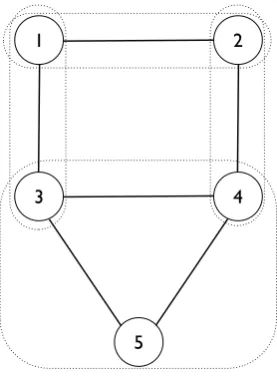
6.1 Network topology and alternative paths for source-destination pairs
A→C and E →D . . . 82 6.2 Network contention graph and its maximal cliques . . . 82
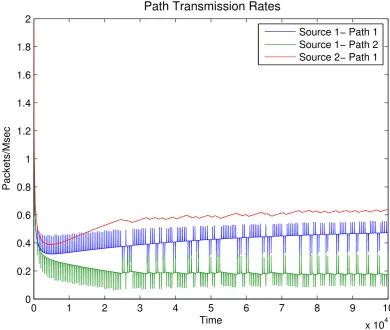
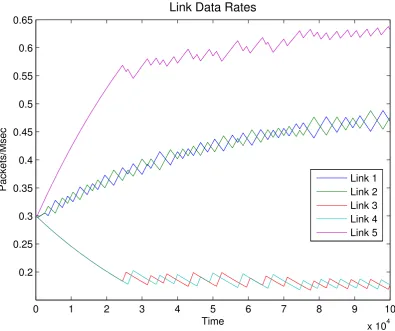
6.3 Path transmission rates when source weights are fixed at w1 = 2 and w2 = 1 and algorithms (4.13)-(4.14) are simulated . . . 90 6.4 Link data rates when source weights are fixed atw1 = 2 andw2 = 1
and algorithms (4.13)-(4.14) are simulated . . . 91
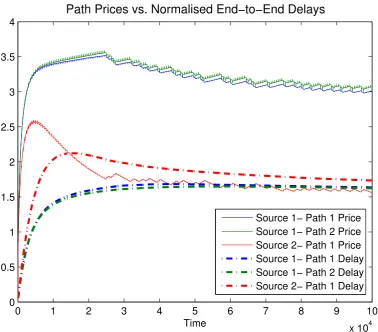
6.5 Path prices and normalised end-to-end delays when source weights
are fixed at w1 = 2 and w2 = 1 and algorithms (4.13)-(4.14) are simulated . . . 92
6.6 Packet end-to-end delay when algorithms (4.13)-(4.14) are
6.7 Path transmission rates when (4.13)-(4.14) are simulated jointly
with (5.5) with delay bounds d1 = d2 = 1×10³ msec, and flow
E →D starts at time2.5×104 . . . . 94
6.8 Link data rates when (4.13)-(4.14) are simulated jointly with (5.5) with delay bounds d1 =d2 = 1×10³ msec, and flow E →D starts at time2.5×104 . . . . 95
6.9 Path prices when (4.13)-(4.14) are simulated jointly with (5.5) with delay bounds d1 = d2 = 1×10³ msec, and flow E → D starts at time 2.5×10⁴ . . . . 96
6.10 Packet end-to-end delays when (4.13)-(4.14) are simulated jointly with (5.5) with delay bounds d1 = d2 = 1×10³ msec, and flow E →D starts at time2.5×104 . . . . 97
6.11 Source weights when (4.13)-(4.14) are simulated jointly with (5.5) with delay bounds d1 =d2 = 1×10³ msec, and flow E →D starts at time2.5×104 . . . . 98
A.1 Simulation model of the network in Figure 6.1 . . . 107
A.2 Source 1 Rate Control subsystem . . . 108
List of Symbols
Symbol Meaning
S Set of traffic sources and its cardinality
s Index for traffic sources
L Set of links and its cardinality
l Index for links
Is Set of alternative paths to the destination of source s and its cardinality
I Total number of paths
i Index for paths
Rsi L×1 vector defining the set of links used by path i∈Is
Rs
l,i Elements of vector Ris
Rs L×I
s routing matrix for source s defined by Rs = [Rs1. . . RsIs]
R L×I routing matrix for the network defined by R= [R1. . . RS]
p L×1 vector of power assignments
pl Power assignment at link l
c L×1 vector of link data rates, or schedules
cl Data rate of link l
u Rate-power function of the system which maps p toc
Π Set of feasible power assignments
C Set of feasible link data rates, or schedules
C∗ Set of optimal link data rates, or schedules
Co Convex hull
xs
i Data transmission rate on path i∈Is
xs Aggregate data transmission rate of source s
x I ×1 vector of path transmission rates
yl Total traffic rate on link l
LIST OF FIGURES 8
Symbol Meaning
θ L×1vector of average queueing delay at links
θl Average queueing delay experienced by a packet at link l
ds Upper limit on average end-to-end delay for source s
d I×1 vector with elementsdsi =ds, for all i∈Is
ws Utility weight coefficient for source s
λ L×1vector of link prices
λl Price, or Lagrange multiplier associated with routing constraint at link l
q I×1 vector of path prices
qsi Price of path i∈Is
qsi∗ Optimal price of path i∈Is
q∗s Optimal path price for source s (i.e. qs∗
i are equal ∀i∈Is, xsi∗ >0 )
µ I×1 vector of Lagrange multipliersµs
i
µs
i Lagrange multiplier associated with non-negativity of rate on pathi∈Is
x(c) Primal optimal solutions givenc
(λ(c),µ(c)) Dual optimal solutions given c
(x∗,c∗) Primal optimal solutions (λ∗,µ∗) Dual optimal solutions
Λ(c) Set of optimal Lagrange multipliers associated with routing, given c
x(λ) Path transmission rates given λ
Id Set of disjoint paths and their cardinality
Sd Set of sources with only disjoint paths and their cardinality
β Step size parameter of link price update algorithm
γ Step size parameter of the scheduling algorithm
α Step size parameter of the delay regulator
∂C Clarke gradient
˙
V, q˙ Nonpathological derivatives of the maps V and q
IL L×LIdentity matrix
x∗(w) Primal optimal solutions given parameter w
q∗(w) Optimal path prices given parameter w
w∗ S×1vector of utility weight coefficients that guarantee bounded delay
qs(c,w) Optimal path price for source s given c and w
Abbreviation Meaning
MIMO Multiple input multiple output system
UAV Unmanned aerial vehicle
SINR Signal to interference and noise ratio
BER Bit error rate
PER Packet error rate
TDMA Time division multiple access
FDMA Frequency division multiple access
CDMA Code division multiple access
FH-CDMA Frequency-hopping code division multiple access
CSMA Carrier sense multiple access
AWGN Additive white Gaussian noise
ARQ Automatic repeat request
AODV Ad hoc on-demand vector routing
DSR Dynamic source routing
MDC Multiple description coding
QoS Quality of service
NUM Network utility maximisation
MAC Medium access protocol
FIFO First in first out
TCP Transmission control protocol
KKT Karush-Kuhn-Tucker
VoIP Voice over IP
Chapter 1
Introduction
1.1
Multi-hop Wireless Networks
A Multi-hop wireless network is composed of a cluster of wireless mobile nodes
that form a network without a fixed infrastructure, using distributed control
algo-rithms. A distinctive feature of such networks is multi-hop routing where any node
can be a relay for the traffic of any other node in order to provide enhanced network
coverage. Moreover, through multi-hop routing, data transmission between source
and destination nodes is carried out via low power communication links between
intermediate relay nodes. This leads to improved power efficiency – due to path
loss exponential increase with distance – as well as overall network capacity – due
to the reduced level of interference – as will be described in Section 1.2.3.
Addi-tionally, communication between sources and destinations can be carried out via
alternative paths which can increase data transmission rates as well as robustness
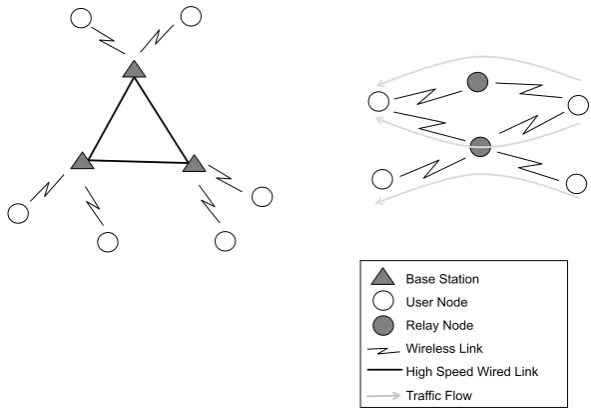
to the network topology changes (Figure 1.1). However, the lack of infrastructure
in multi-hop wireless networks leads to more design complexities and less efficient
utilisation of network resources, compared to the infrastructure-based wireless
net-works. Infrastructure-based wireless networks consist of stationary base stations
positioned across a geographical area to optimise network coverage. Base stations
are interconnected with high speed communication links, and connected to a
back-bone wired network. Each mobile node communicates directly with typically one
Base Station User Node Relay Node Wireless Link High Speed Wired Link Traffic Flow
Figure 1.1: An infrastructure-based wireless network (left) and a multi-hop wireless
network (right)
base station at a time via single-hop routes (Figure 1.1). Base stations provide
access for mobile nodes to the network and perform all networking and control
functions including transmission scheduling, power control, routing and handoff,
in a centralised fashion. As a result, they lead to more efficient utilisation of
net-work resources. Furthermore, as all computationally intensive functions are carried
at base stations, the required computational tasks at mobile nodes are minimal.
Finally, single-hop routes result in lower delay and loss, as well as higher data
rates. In multi-hop wireless networks, however, networking and control functions
are distributed among all wireless nodes, any node can be a relay for other nodes
traffic, and nodes are typically in motion.
Despite its performance limitations, multi-hop wireless networking is the only
viable technology in wireless communication applications where low-cost, rapid
[image:15.595.139.435.132.337.2]CHAPTER 1. INTRODUCTION 12
relevant to the subject of this thesis is providing communication support for
dis-tributed control systems with remote plants, sensors and actuators, in particular,
coordinated control of unmanned mobile units such as unmanned aerial vehicles
(UAVs) and vehicular networks in automated highway systems. Such systems
re-quire that sensor and actuator signals to be delivered to the controller with a
small and short delay, but can adapt to various data rates [16]. Other
applica-tion example is real-time interactive audiovisual communicaapplica-tion in disaster relief
or military applications. Similar to the distributed control systems these
applica-tions impose strict limit for maximum packet end-to-end delay. In addition, they
have high but flexible data rate requirements [24, 41, 37]. Supporting applications
with high data rates and bounded delay requirements in multi-hop wireless
net-works is highly challenging due to the performance limitations described earlier
and requires a joint optimisation design approach, as will become evident in the
following sections.
1.2
Multi-hop Wireless Networks Design
The main design issues in multi-hop wireless networks can be best described by
dividing the main network functions into the conventional five-layer architecture
used for modular design of wireless networks, as described in [16] (Figure 1.2).
1.2.1
Physical Layer
The physical layer involves functions that deal with transmitting bits over a
point-to-point wireless link. They include modulation/detection, coding, power control
and multiple input multiple output (MIMO) systems. Digital modulation consists
of mapping the information bits into an analog signal for transmission over the
channel. Detection consists of determining the original bit sequence from the
re-ceived signal. Digital modulation techniques are chosen based on the performance
characteristics including data rate, spectral efficiency, power efficiency and
robust-ness to channel impairments. Coding enables bit errors to be either detected or
Application Compression and Error Concealment
Transport End-to-End Error Recovery, Retransmissions, and Flow Control
Network Topology Control and Routing
Access Channel Access, Power Control, Error Recovery and Retransmissions
Physical
Modulation, Coding, Power Control, and MIMO
Figure 1.2: Five-layer architecture for modular design of wireless networks [16]
however, leads to increased complexity, decreased data rate or increase in signal
bandwidth. Power control adjusts the transmit power of all nodes such that signal
to interference and noise ratio (SINR) at each receiving node does not fall below
its minimum required level for acceptable performance. Power control is also an
access layer functionality and will be described in more detail as part of access
layer function. MIMO refers to systems with multiple antennas at the
transmit-ter and the receiver. Multiple antennas can be used to increase link data rates
through multiplexing, providing diversity to fading to reduce the average bit
er-ror rates (BER), and providing directionality to reduce fading and interference to
other signals.
The design choices at the physical layer impact the other layers in several
ways. For example, they determine the link packet error rate (PER) which affect
[image:17.595.235.354.112.372.2]CHAPTER 1. INTRODUCTION 14
link data rate and reduce interference to other links which impacts all the protocol
layers. Similarly, the transmission power together with adaptive modulation and
coding for a node determines the collection of nodes it can reach in a single hop
and therefore affects the context in which the higher layers operate.
1.2.2
Access Layer
The access layer controls the allocation the available spectrum to the users and
ensures successful reception of packets over this spectrum. Signalling dimensions
are allocated using either multiple access or random access techniques. In multiple
access signalling dimensions are divided into dedicated channels which are assigned
to different users. This includes orthogonal division along the time axis, as in time
division multiple access (TDMA), orthogonal division along the frequency axis, as
in frequency division multiple access (FDMA), and orthogonal or non-orthogonal
division along the code axis, as in code division multiple access (CDMA). In
ran-dom access channels are allocated to the active users dynamically, as in ALOHA,
CSMA, and scheduling. Multiple access methods are suitable for applications with
continuous data transmissions and delay constraints, while random access methods
are more suitable for users with bursty data transmissions. The access layer also
involves control mechanisms for channel assignment to users and their admission
into the system.
Power control is also a function of the access layer. As mentioned previously,
power control ensures link required SINR levels are satisfied by adjusting the
trans-mission power of all transmitting nodes. Link required SINR levels are determined
by link performance requirements such as connectivity in topology control (a
func-tion of the network layer), and link data rates decisions. Precisely, let L be the number of links in a multi-hop wireless network. The SINR at link l is then given by
γl =
gllpl
nl+ρPj6=lgljpj
where glj > 0 is the channel power gain from the transmitter of the link j to
interference reduction due to signal processing. For example, ρ ≈ 1
G for CDMA
with processing gain G, and ρ = 1 for TDMA. The data rate of link l can be modelled as function of its SINR, γl, as well as physical layer parameters. For
example, the Shannon capacity of linkl for additive white Gaussian noise (AWGN) channel is given bycl=Wlog2(1 +γl), where W is the channel bandwidth. Or in
[40], the data rate of link l is assumed to be given by cl = Wlog2(1 +
γl
Γ), where Γ is a parameter determined by the physical layer design.
Let γl∗ be the minimum required SINR for link l. The SINR constraints are then given by (I −F)p≥ u, where p is the L×1 vector of transmission powers with elementspl,uis anL×1vector with elements
γl∗nl
gll , andF is anL×Lmatrix
with elements
Fljs =
0 l =j,
γlgljρ
gll l 6=j.
If the eigenvalues of F are strictly inside the unit circle then there exists a power assignmentpthat supports the required SINR for all links, andp∗ = (1−F)−1uis the minimal (Pareto optimal) solution. In [15], a simple distributed power control
algorithm is proposed which converges to the minimal power solution p∗ when
feasible solution exists. This algorithm is extended in [3] to incorporate admission
control. However, it may be inefficient to activate all links concurrently at power
levels p∗, and combining power control and transmission scheduling can improve
power efficiency while satisfying minimum required SINR levels, as discussed in
[12]. For example in [12] an optimal transmission scheduling and power control
strategy is proposed which minimises total average transmission power while
en-suring the minimum required link data rates. Or in [13], a joint scheduling and
power control strategy is proposed which maximises network throughput and
re-duces power consumption.
Retransmission of corrupted packets, which is referred to as ARQ protocol, is
also a function of the access layer. In this protocol, using the error detection code
the receiver determines if there are corrupted bits in the packet that cannot be
corrected. The receiver then discards the corrupted packet and sends a
CHAPTER 1. INTRODUCTION 16
the receiver can save the original packet and use a form of diversity to combine
it with the retransmitted packet, or the incremental redundancy technique can
be used where instead of retransmission of the entire packet, the transmitter just
sends some additional coded bits to provide a stronger error correction capability
for the original corrupted packet.
1.2.3
Network Layer
The role of the network layer is to establish and maintain end-to-end connections
in the network. The associated functions include topology control, routing and
dynamic resource allocation. Topology control constitutes mechanisms for
adjust-ing and coordinatadjust-ing nodes transmission powers in order to generate networks
with the desired properties such as connectivity, while reducing overall power
con-sumption and/or increasing network capacity [33]. Roughly speaking, a network
is connected if for any two nodes in the network there exists a path through which
they can communicate. The transmission power determines the transmission range
of a node within which direct communication with other nodes is possible given
minimum link performance requirements such as link data rates and BER. Thus,
in the process of topology control each node identifies the network nodes that it
can directly communicate with.
The impact of topology control on improving network energy efficiency and
capacity can be demonstrated by means of the example shown in Figures 1.3 and
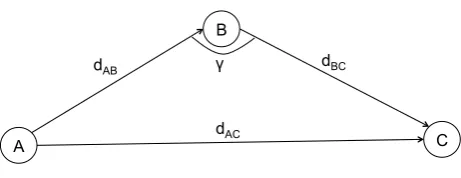
1.4 [33]. Figure 1.3 shows alternative transmission routes between nodes A and
C, where dij denotes the distance between nodes iand j. It is assumed that both
nodesB and C are within the transmission range of node A. Therefore, there are two alternative paths between nodes A and C: the multi-hop path A → B → C
using node B as relay, and the direct path A → C. Assuming the free space propagation model; i.e. Pr ∝ Pd2t wherePr and Pt are the received and transmitted
A
B
C
dAB dBC
dAC γ
Figure 1.3: Transmission using node B as relay requires less power than direct transmission between nodes A and C
to the square of their distances. From Figure 1.3 it follows that
d2AC = d2AB+d2BC −2dABdBCcosγ
> d2AB+d2BC
Thus, transmission using node B as relay requires less power than direct trans-mission between nodes A and C.
Similarly, in the network shown in Figure 1.4 there are two alternative
trans-mission strategies between nodesAandC: a direct transmission fromAtoC, and a multi-hop transmission using nodes R1. . . Rk as relays. To compare the impact
of the two alternative transmission strategies on the network capacity, the notion
of interference region based on the protocol interference model introduced in [17]
is used. According to the protocol interference model, the interference region for a
receiving nodej is defined as a circle of radius(1 +η)dij centred at nodej, where
η >0is a constant that depends on the features of the wireless transceiver anddij
is the distance between the transmitting node i and receiving node j. It specifies the region where no other node can transmit simultaneously in order for
[image:21.595.181.412.152.241.2]CHAPTER 1. INTRODUCTION 18
A R1 Rk C
Figure 1.4: Interference region for the transmission via the relay nodes R1. . . Rk
is less than direct transmission between nodes A and C
amount of wireless medium used by a certain transmission and thus can be used as
a measure of the network capacity. Using the above model, the interference region
for direct communication from nodeAto nodeC is given byπd2
AC(1 +η)2. On the
other hand, assuming dAR1 = dR1R2 = · · · = dRkC =
dAC
k+1, the interference region
for the transmission via the relay nodesR1. . . Rkis given by(k+1)π
d
AC
k+1
2
(1+η)2 which, by Holder’s inequality, is less than πd2
AC(1 +η)2. This implies that using
multi-hop transmissions can reduce total interference range and thus increase the
overall network capacity.
After performing topology control, the power control algorithms described in
Section 1.2.2 can be activated to achieve link required SINR levels with high power
efficiency. However, in the presence of node mobility, nodes transmission power
as well as physical layer parameters have to be dynamically adjusted to
compen-sate for the variations in link gains and hence maintain connectivity and the link
required SINR levels.
Routing determines how packets are routed through the network from their
source to their destination. Routing protocols for multi-hop wireless networks can
and reactive. Flooding is based on broadcasting a packet to all neighbouring
nodes which then broadcast the packet to their neighbouring nodes. This
pro-cess repeats until the packet reaches its destination. This approach requires little
communication overhead and thus is suitable for highly mobile networks where
network topology changes rapidly. However, flooding is highly inefficient in terms
of bandwidth utilisation and energy consumption and as a result is only practical
in small networks.
In centralised routing approach, information about network topology and
chan-nel condition are determined by each node and forwarded to a central node, which
then based on an optimisation criterion computes the routing tables for all nodes
and communicates them to the nodes. Centralised approach results in globally
optimal routes, however, it leads to significant communication overhead for
ex-changing routing information and as a result it cannot adapt to the rapid changes
in network topology or channel conditions. For this reason, this approach is only
suitable for small networks. In source-driven routing, each node receives the
net-work topology information and computes optimal routes to its destination. This
method also involves periodic exchange of routing information, which leads to
high communication overhead. In distributed routing, each node communicates
its connectivity information to its neighbouring nodes, and each node determines
its local routing information, i.e. the next hop in the route, using this local
in-formation. This approach requires low communication overhead and as such can
adapt quickly to link and connectivity changes. On the other hand, the computed
routes are suboptimal in general.
Both centralised and distributed approaches are based on maintaining
up-to-date routing information. In reactive (on-demand) routing approaches, however,
routes computation is initiated by a source node that has traffic to send, via a route
discovery process. The process is completed once a route or all possible routes
are discovered. The routes are then maintained by a route maintenance procedure
until they are no longer needed, or destination becomes inaccessible. This approach
leads to globally optimal routes with little overhead, since routes are maintained
CHAPTER 1. INTRODUCTION 20
routing include ad hoc on-demand vector routing (AODV) and dynamic source
routing (DSR).
As will be explained in Section 1.2.6, due to high coupling between the layer
functions, computation of optimal routes has to be carried out in conjunction
with design choices at other layers, in order to optimise overall network
perfor-mance. This calls for maintaining multiple paths between source-destination pairs
which enables splitting the traffic load among multiple paths to optimise
network-wide performance objectives. Multi-path routing can also be used to increase the
probability of packet reception in networks with rapidly changing topologies, by
transmitting duplicates of a packet over multiple paths between the source and
the destination [38]. Multi-path routing in conjunction with network coding has
also been shown to improve multi-hop wireless network throughput, when
mul-tiple multicast sessions are present [25]. Network coding is based on fusion of
data received from multiple routes which can then be decoded by intermediate or
destination nodes, as necessary.
1.2.4
Transport Layer
The transport layer consists of end-to-end functions of error recovery,
retransmis-sion, reordering and flow control. The error recovery and retransmission involve
mechanisms that check for corrupt or lost packets on the end-to-end route and
send a request for retransmission to the source node. The reordering function is
responsible for ordering packets that arrive out of order due to multi-path
rout-ing, delay, congestion, packet loss, or retransmission; before being passed to the
application layer. Flow control allocates the flow associated with the application
layer to different routes, based on an optimisation criterion.
1.2.5
Application Layer
The application layer involves functions that deal with generating the data to be
transmitted, and processing the corresponding data received over the network.
level of data compression depends on the application’s selected trade-off between
data rate and robustness to the changes in network conditions. High level of
compression reduces the required data rate but increases the data sensitivity to
error since it removes most of the redundancy. Applications such as voice and
video can tolerate some errors without significant degradation in their perceived
quality. In contrast, data applications cannot tolerate any packet loss and as a
result any lost or corrupted packet has to be retransmitted.
The application layer can also perform multiple description coding (MDC)
whereby multiple description of data are generated and the original data can be
reconstructed from any description with some loss. Using multi-path routing,
each description can then be sent over a different path to provide diversity in the
presence of network performance degradation.
Applications typically have performance requirements for end-to-end data rates
and delay, which are referred to as quality of service (QoS). Examples include
dis-tributed control applications [16], which require bounded end-to-end delay but
may be able to tolerate a lower data rate via a coarser quantisation of sensor
data. Similarly, interactive real-time voice and video applications require bounded
end-to-end delay but can adapt to various data rates using various encoding
quan-tisations [24, 41, 37].
1.2.6
Motivations for Cross-Layer Design
The functions within the layered architecture described in the previous sections
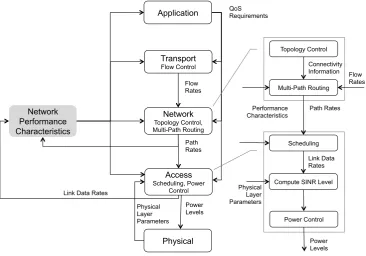
are tightly coupled in multi-hop wireless networks, as shown in Figure 1.5. The
network performance characteristics, e.g. end-to-end delay and data transmission
rates, are dependent on the network congestion level, which is determined by rate
of the traffic flow entering the network, the distribution of load across the
net-work links and the netnet-work link capacities. The flow rate is regulated by the flow
control function at the transport layer, given the QoS requirements from the
ap-plication layer and current network performance characteristics such as a measure
of congestion level. Distribution of traffic load is performed at the network layer
CHAPTER 1. INTRODUCTION 22 Application Transport Flow Control Network Topology Control, Multi-Path Routing Access Scheduling, Power Control Physical Network Performance Characteristics QoS Requirements Flow Rates Path Rates Power Levels Physical Layer Parameters Link Data Rates
Topology Control
Multi-Path Routing Connectivity Information
Scheduling
Compute SINR Level Link Data Rates Power Control Flow Rates Path Rates Physical Layer Parameters Power Levels Performance Characteristics
Figure 1.5: Interdependencies between the functions within the layered
architec-ture in multi-hop wireless networks
minimum network congestion, and current network performance characteristics.
The performance of the multi-path routing algorithm is dependent on the
net-work connectivity which is determined by the topology control algorithm. Given
the current network performance such as link congestions levels, link capacities
(data rates) are updated by the scheduling algorithm based on the optimisation
criterion. Given the physical layer parameters, the updated link data rates can
be attained at certain link SINR thresholds using power control algorithms. The
transmission powers can be jointly optimised with other physical layer parameters,
e.g. modulation and coding, to achieve the required link data rates. Finally, the
current performance characteristics can also be used at the application layer to
determine parameters such as data compression rates, encoding quantisation rate,
[image:26.595.113.480.109.365.2]The high level of interdependencies between the functions in the layered
archi-tecture motivates the joint optimisation of the design variables approach to solve
a network design problem. Specifically, in this approach the network design
prob-lem is represented as a network utility maximisation (NUM) probprob-lem [8] where
the end-user application preferences are captured as the objective function, design
constraints as the constraint set, and design freedoms as the optimisation variables.
Using the theory of decomposition for non-linear optimisation, the network design
problem can then be systematically decomposed into various functional modules
alternatives that correspond to a layered architecture. Each functional module
can be further decomposed into distributed computation and control over distant
network elements. Moreover, optimal solutions serve as benchmark for heuristic
layered architectures.
This research is based on the following NUM formulation presented in [29]
maxx,c
X
s∈S
fs(xs)
subject to Rx≤c c ∈Co(C)
x≥0
The formal definition of the notations are provided in Chapter 2. Briefly, xs
denote data transmission rate for the traffic source s ∈ S, where S is the set of traffic sources. The utility function fs represent the elastic QoS requirement
for the traffic source s. Here, the utility function is assumed to be a measure of the optimality of resource allocation efficiency. In other words, it defines the
QoS value a traffic source attributes to a particular transmission rate. The utility
function is typically assumed in the congestion control literature [35, 29] to be
smooth, increasing, and strictly concave function of the transmission rate. This
shape of utility function has been shown to lead to optimal resource allocation
that can achieve various fairness objectives [35, 29]. Furthermore, as discussed in
[34], this shape of utility function is typical (except for very small bandwidths) of
the utility (performance) of rate adaptive real-time applications which can adjust
CHAPTER 1. INTRODUCTION 24
of very small bandwidths, the marginal rate of utility (performance) enhancement
is diminishing as bandwidth increases. At high bandwidths the marginal utility
of additional bandwidth is very small since the signal quality is higher than what
human can perceive. Examples of such applications include voice over IP (VoIP)
application as described in [39]. Normally, acceptable voice quality requires a
transmission rate of about 64 kb/s to transmit an 8 kHz 8 bit signal. While it is
possible to cope with a little less quality than this, the utility of transmitting voice
at less than 64 kb/s drops sharply as the transmission rate is decreased. Also, the
quality of voice does not increase much if the transmission rate is increased beyond
64 kb/s, so the utility function remains almost flat above 64 kb/s.
R denotes the routing matrix that defines each source’s available paths to its destination. It is assumed that routing tables are already computed by a
source-driven routing algorithm, based on network connectivity resulted from a topology
control algorithm (Section 1.2.3). Thus, the key assumption in the above
formula-tion is that variaformula-tions at the physical layer are such that they can be compensated
at the physical layer without affecting the network topology within the timescale
of the above problem. xdenotes path transmission rates. c denotes the link data
rates and assumed to be a function of global power assignments, or any other
resource control decisions such as link activation and inactivation, or
retransmis-sion probability in random access MAC protocols, generally denoted by p. This
implies c = u(p). The function u captures the cross-layer control decisions at both physical and access layers (Sections 1.2.1 and 1.2.2). Specifically, by
choos-ing appropriate physical layer parameters, e.g. modulation and codchoos-ing, link data
rates are mapped to link SINR levels and the corresponding power assignments
via u−1. Let Π be the set of feasible power assignments, then C ={u(p),p∈ Π} is the set of feasible link data rates, or schedules. Link data rates are constrained
by the convex hull of C denoted by Co(C), which captures the time interleaving of the feasible schedules. It is assumed that variations in link SINR levels can be
compensated quickly by power control or adjusting other physical layer parameters
without affecting the link data rates within the timescale of the above problem. In
constraints can be added to the above formulation. The optimisation variables, or
the design freedoms, in the above NUM problem are the path transmission rates
x, and link data ratesc. The utility functionsfs,s ∈S, the routing matrixR, and
the set of feasible schedulesC are treated as constants over the problem timescale.
1.3
Research Objectives
The main focus of this research is the problem of supporting traffic with high
data rate requirements and hard end-to-end delay constraints in multi-hop wireless
networks, using source data transmission rates and link data rates as the key
design variables. Before presenting the research objectives, first, different load
control mechanisms for QoS provision are described and the preferred approach is
introduced. The design problem and its underlying assumptions are then described
followed by a summary of the limitations of the current solutions.
1.3.1
Background on QoS-Oriented Load Control
As discussed in [39], based on the type of QoS guarantees that can be provided,
load control mechanisms can be classified into Bandwidth reservation, and
best-effort schemes . Bandwidth reservation based schemes are suitable for supporting
traffic with minimum bandwidth requirements. In these schemes the network is
required to maintain information about each traffic flow and decide whether a
traf-fic flow can be admitted so that all the admitted traftraf-fic flows can be guaranteed
their minimum required bandwidth. Inevitably, the rejection of some of the traffic
results in inefficient utilisation of network capacity. More importantly, Bandwidth
reservation based schemes lead to a significant communication overhead in
net-works with dynamic settings and as a result are unsuitable for multi-hop wireless
networks due to their dynamic and distributed characteristics. In contrast,
best-effort schemes are suitable for supporting traffic whose demand for bandwidth is
elastic, but their perceived QoS referred to as their utilities, are generally assumed
to be an increasing and concave function of their transmission rates. As discussed
CHAPTER 1. INTRODUCTION 26
by admitting all traffic flows and allocating network capacity based on the traffics’
perceived QoS. This is the main design principle of best-effort schemes. The key
advantage of the best-effort approach is that it enables QoS optimal allocation of
network resources using simple and distributed algorithms [39], and as a result is
a suitable approach for QoS provision in multi-hop wireless networks. The basic
NUM formulation presented in Section 1.2.6 results in a best-effort solution and
hence forms the basis of this research.
1.3.2
Problem Description and Assumptions
The fundamental assumption in this research is that all incoming traffic have
elastic bandwidth requirements, but their perceived QoS due to bandwidth, i.e.
excluding the effect of end-to-end delay, are increasing and concave functions of
their transmission rates. Furthermore, all or some of the incoming traffic impose
a strict limit on the average end-to-end queueing delay. These requirements are
typical of QoS requirements of delay-sensitive applications such as distributed
control systems and real-time interactive audiovisual communication, as explained
in Section 1.1.
As explained in Section 1.2.6, it is assumed that routing tables are already
computed by a source-driven routing algorithm, and remain unchanged within the
time horizon of the problem. Furthermore, it is assumed the set of feasible link
data rates, or schedules, are known and remain constant over the time horizon of
the problem.
The key design variables are assumed to be the path transmission rates and link
data rates, or schedules. The main research objective is then to develop a path
rate control and scheduling strategy that ensures average end-to-end queueing
delays do not exceed their imposed upper bounds and maximises the aggregate
utility, or the perceived QoS due to bandwidth, of all incoming traffic. Moreover,
the strategy should enable distributed implementation with low communication
1.3.3
Limitations of Current Solutions
As will be described in Section 3, the network utility maximisation based
ap-proaches to support delay-sensitive traffic have been predominantly based on
ei-ther reducing link utilisation, or approximation of links as M/D/1 queues. The former approach normally leads to nearly zero queue lengths in the long term due
to reduced link utilisation, but provides no control over the transient behaviour
of packet delays. The key assumptions behind the latter approach are
unrealis-tic since the traffic at entry points are regulated by the rate controller and are
deterministic; multi-hop networks are composed of mostly disjoint paths which
comprise serial links, and the traffic entering the links can be further regulated to
limit its burstiness. Moreover, the algorithms for rate control and scheduling are
typically implemented as feedback control systems where path rates and link data
rates are regulated based on the current congestion level at links. The delay caused
by the burstiness of the arriving traffic at each link can therefore be assumed to be
negligible and consequently the average delay a packet experiences at equilibrium
is primarily a function of number of packets in the system at equilibrium, which
is determined by the dynamics of the rate control and scheduling algorithms at
their transient state. The other limitation of the M/D/1approximation is that it results in under-utilised links under optimal resource allocation.
1.3.4
Research Objectives
Based on the problem description and the shortcomings of the current solutions
described in Sections 1.3.2 and 1.3.3, respectively, the research assumptions and
objectives are summarised as follows:
Assumptions
• network topology remain fixed over the time horizon of the problem,
• routing tables are already computed by each traffic source and remain
CHAPTER 1. INTRODUCTION 28
• the set of feasible link data rates, or schedules, are known and remain
con-stant over the time horizon of the problem,
• all incoming traffic have elastic bandwidth requirements, but their perceived
QoS due to bandwidth are increasing and concave functions of their
trans-mission rates,
• main design freedoms are the path transmission rates and link data rates, or
schedules.
Objectives
• to develop a path rate control and scheduling strategy that
– ensures average end-to-end queueing delays do not exceed their imposed
upper bounds,
– maximises the aggregate utility, or the perceived QoS due to bandwidth,
of all incoming traffic,
– enables distributed implementation with low communication overhead
in order to be deployable in a multi-hop wireless network setting,
– leads to maximal link capacity utilisation,
– has controllable transient behaviour.
1.4
Summary of Contributions
Given the limitations of the conventional modelling of the delay constraints based
on M/D/1 queue approximation of links, an alternative formulation to the orig-inal optimisation problem is considered where delay constraints is omitted and
the source utility functions are multiplied by weight coefficients. The alternative
optimisation problem is then transformed into a master scheduling problem and
the well-known multi-path rate control with fixed link data rates subproblem.
The multi-path rate control subproblem is solved using a duality-based
the optimal dual variables, or link prices. While in general optimal path rates
are not unique, and path rates in duality-based algorithms do not converge and
continuously oscillate, conditions on the number of disjoint paths are derived that
guarantee unique optimal path rates. The underlying theoretical conditions that
guarantee unique optimal path rates can be further used for future work to
de-sign a multi-path rate control algorithm that converges the unique optimal path
rates, given the conditions on the number of disjoint paths are guaranteed by the
topology control algorithm.
A distributed algorithm for the master scheduling problem is then proposed,
and is shown to converge to the optimal data rates. The proposed algorithm
incorporates the solution of a well-known scheduling problem, for which efficient
and distributed solutions have been developed in several cases.
For the alternative optimisation problem, derived bounds on the sensitivity of
optimal path prices and aggregate source rates to the variations of utility weight
coefficients indicate that optimal path prices for each source increase with the
source’s weight coefficient. Given the correlation between path queueing delays
and path prices in the proposed scheduling algorithms, an alternative approach
is then presented where utility weight coefficients are used as control variables
to regulate end-to-end queueing delays in the scheduling algorithms. Specifically,
an integral controller is incorporated in the scheduling algorithm whereby each
source regulates the queueing delay on its paths at the desired level, using its
weight coefficient as the control variable.
The conditions under which the proposed joint scheduling algorithm and delay
regulator achieve asymptotic regulation of end-to-end delay are examined. The
proposed joint scheduling algorithm and delay regulator meet the objectives stated
in Section 1.3.4 since they regulate end-to-end queueing delay at the desired levels,
can be implemented distributively, and lead to maximal link utilisation. For future
work, linearisation and linear system design methods can further be used to adjust
the delay regulator parameter for the desired transient behaviour.
Simulation experiments show that the presence of feedback error the proposed
optimisa-CHAPTER 1. INTRODUCTION 30
tion problem. In addition, the proposed joint scheduling algorithm and delay
reg-ulator achieve asymptotic regulation of end-to-end delay. Simulation experiments
further demonstrate the deficiencies of other alternative approaches compared with
the proposed approach.
1.5
Structure of the Thesis
The rest of this thesis is organised as follows. In Chapter 2, the problem is
pre-sented formally as a network utility maximisation problem, and the limitations
of delay models based on approximation of links as M/D/1 queues is discussed. After describing the assumptions and notations in Section 2.2, in Section 2.3 the
network utility maximisation formulation is presented. The limitations of M/D/1 approximation of links for delay estimation are discussed in Section 2.4.
In Chapter 3 the predominant approaches that aim to address the requirements
of delay-sensitive traffic using the NUM framework, as well as their limitations,
are described. In Section 3.2, the two approaches to model delay-sensitive traffic,
namely, representation as non-concave utility functions and hard constraints
spec-ification, are explained. In Section 3.3, the well-known distributed solutions for
the problem of joint rate control and scheduling for elastic traffic, are presented.
Various approaches that tackle the same problem but for inelastic traffic,
includ-ing minimisinclud-ing delay usinclud-ing virtual data rates, minimisinclud-ing network congestion, and
minimising network distortion for video traffic, are introduced in Section 3.4.
Fi-nally, distributed rate control algorithms for networks with heterogeneous traffic,
for cases where delay-sensitivity is modelled as a concave, as well as a non-concave
function, are discussed in Section 3.5.
Given the limitations of the original optimisation problem discussed in Chapter
2, in Chapter 4 an alternative formulation and its proposed solution is presented, on
which the proposed approach for providing bounded delay will be based. In Section
4.2 the proposed alternative optimisation problem, in which the delay constraints
are omitted and utility functions are multiplied by weight coefficients, is presented
the alternative problem is introduced, which is based on vertical decomposition of
the problem into master scheduling problem and the well-known multipath rate
control with fixed link data rates subproblem. After deriving conditions for the
uniqueness of the solutions of the multipath rate control subproblem, the proposed
distributed algorithm for solving the scheduling problem is presented.
In Chapter 5, the proposed solution to the original optimisation problem is
de-veloped, with focus on the performance objectives described in Section 1.3.4. The
proposed solution exploits the properties of the alternative optimisation problem
and its proposed solution described in Chapter 4. In Section 5.2, bounds on the
sensitivity of optimal path prices and aggregate source rates to the variations
of utility weight coefficients in the alternative optimisation problem are derived.
Based on the sensitivity results, in Section 5.3 an algorithm for providing bounded
end-to-end queueing delays as well as other performance objectives is proposed,
which is integrated in the scheduling algorithms developed in Chapter 4.
In Chapter 6, simulation experiments are performed to address three
funda-mental questions. Firstly, to illustrate that the proposed algorithm for solving
the scheduling problem presented in Chapter 4 converge to its optimal solutions,
despite using approximate values of link prices computed by the inner layer rate
control algorithm. Secondly, to illustrate that the proposed joint scheduling
algo-rithm and delay regulator in Chapter 5 can regulate packet end-to-end latency,
us-ing an estimation of end-to-end delay as feedback in the schedulus-ing algorithm, and
to compare their performance against the previously proposed main approaches
to support delay-sensitive traffic. Finally, to assess the dynamic behaviour of
the proposed algorithms when network configuration changes. In Section 6.2, the
simulated network and its mathematical model are described. The SimEvents
implementation of the proposed algorithms in Chapters 4 and 5 for the network
model is described in Section 6.3. The result of the simulation experiments is
Chapter 2
Problem Definition
2.1
Introduction
In this chapter the problem is presented formally as a network utility
maximisa-tion problem, and the limitamaximisa-tions of delay models based on approximamaximisa-tion of links
as M/D/1 queues is discussed. After describing the assumptions and notations in Section 2.2, in Section 2.3 the network utility maximisation formulation is
pre-sented. The limitations ofM/D/1approximation of links for delay estimation are discussed in Section 2.4.
2.2
Assumptions and Notations
Throughout the text, vectors are denoted by boldface lowercase letters, and
ma-trices and sets by capital letters. For simplicity, the same notations are used to
denote the sets and their cardinality.
This thesis considers the problem of rate control and scheduling for
simulta-neous transmissions of multiple delay-sensitive traffic over a multi-hop wireless
network. LetS be the set of sources which generate the delay-sensitive traffic and
L be the set links which constitute the multi-hop wireless network. Each source
s ∈ S has multiple alternative paths to its destination denoted by Is. The set of
links used by each pathi∈Is are defined by theL×1vector Ris with elements
Rsl,i=
1 if path i∈Is uses linkl, 0 otherwise.
TheL×Is routing matrix for sourcesis subsequently defined byRs = [Rs1. . . RsIs],
and the L × I routing matrix for the network, where I = P
s∈SIs, by R =
[R1. . . RS].
Let pl be the power assignment, or any other resource control decisions such
as activation and inactivation, and retransmission probability in random access
MAC protocols, andcl be the data rate at link l. Based on the NUM formulation
presented in [29], link data rates are assumed to be a function of global power
assignments, i.e. c =u(p). As explained in Section 1.2.6, the function ucaptures the cross-layer control decisions at both physical and access layers (Sections 1.2.1
and 1.2.2). Specifically, by choosing appropriate physical layer parameters, e.g.
modulation and coding, link data rates are mapped to link SINR levels and the
corresponding power assignments via u−1. Let Π be the set of feasible power assignments, then C = {u(p),p ∈ Π} is the set of feasible link data rates, or schedules. The convex hull of C denoted by Co(C) captures the time interleaving of the feasible link data rates, and is assumed to be closed and bounded.
Let xs
i be the data transmission rate on path i ∈ Is, and xs = Pi∈Isx
s
i be
the aggregate data transmission rate of source s. It is assumed that each source
s ∈ S gains a utility fs(xs) at rate xs. fs are assumed to be twice continuously
differentiable, strictly concave, and increasing for all s ∈ S. Furthermore fs00 <
0. As explained in detail in Section 1.2.6, this shape of utility function is the
typical assumption in the congestion control literature since it leads to various
fairness objectives at optimality, and furthermore represents the performance of
rate adaptive real-time applications.
It is assumed that the average delay experienced by a packet at link l is given byθl(cl, yl), whereyl =Rlxis the total traffic rate on linkl. Furthermore,θl(cl, yl)
are differentiable, decreasing in cl and increasing in yl, for all l ∈L. Letθ be the
CHAPTER 2. PROBLEM DEFINITION 34
on path i∈Is of source s∈S is then given byRis
Tθ, and is assumed to be upper
bounded by ds. Let d be an I×1 vector with elementsdsi =ds, for all i∈Is.
2.3
Problem Formulation
The objective is to find data transmission rates x and link data ratesc such that
maxx,c
X
s∈S
fs(xs) (2.1)
subject to Rx≤c (2.2)
c ∈Co(C) (2.3)
RTθ≤d (2.4)
x≥0 (2.5)
The optimisation objective (2.1) is to maximise the aggregate utility of all
sources. Constraint (2.2) requires that the traffic rate entering each link not to
exceed its allocated data rate. Constraint (2.3) restricts link data rates to the
convex hull of feasible link data rates. Constraint (2.4) imposes an upper bound
on the average end-to-end delay faced by a packet on individual paths.
2.4
Approximation of Links as M/D/1 Queues
and Its Limitations
As will be discussed in Chapter 3, estimation of the average delay experienced
by a packet at a link, i.e. θl(cl, yl), l ∈ L, has been predominantly based on
ap-proximation of links as independent M/D/1 queues. This approach stems from the Kleinrock independence approximation [5], which is in principle based on
as-sumptions that the traffic arrives at network entry points according to a Poisson
packet delay θl(cl, yl) can be estimated as
θl(cl, yl) = 1
cl
+ yl
2cl(cl−yl)
, ∀l∈L
≈ 1
cl
+ 1
2(cl−yl)
, ∀l ∈L (2.6)
The approximation (2.6) is based on assumption that at optimality yl is close to
cl for alll ∈L. Given approximation (2.6), the optimisation problem (2.1)-(2.5) is
convex, and can be solved, for example, using primal decomposition [8] as follows
max c
˜
U(c) subject to (2.3) (2.7)
where
˜
U(c) = max x
X
s∈S
fs(xs) subject to (2.2),(2.4)and (2.5) (2.8)
Subproblem (2.8) can be solved using primal or dual algorithms proposed in [24].
Moreover, by standard convex programming results, U˜ is concave (Proposition 3.4.3 in [4]), and therefore the set of optimal Lagrange multipliers associated with
constraints (2.2) and (2.4) in subproblem (2.8) is the subdifferential ofU˜ (Section 5.4.4 in [4]). This property can then be used to develop algorithms for solving
(2.7), when duality-based approaches are used to solve (2.8).
However, the M/D/1 queue approximation of links has several flaws. Firstly, the key assumptions behind theM/D/1approximation (2.6) do not hold since the traffic at entry points are regulated by the rate controller and are deterministic,
multi-hop networks are composed of mostly disjoint paths which comprise serial
links, and the traffic entering the links can be further regulated to limit its
bursti-ness [10, 11]. The delay caused by the burstibursti-ness of the arriving traffic at each
link can therefore be assumed to be negligible and consequently the average delay
a packet experiences at equilibrium is primarily a function of number of packets in
the system at equilibrium, which is determined by the dynamics of the rate control
and scheduling algorithms at their transient state. Secondly, in the approximation
(2.6), as traffic rates at links approach their capacities, their delays grow
exponen-tially. This implies that at optimality links are not efficiently utilised, in order to
CHAPTER 2. PROBLEM DEFINITION 36
2.5
Conclusions
In this chapter the problem is formulated as a network utility maximisation
prob-lem. Furthermore, it is shown that when delay constraints are modelled based on
approximation of links asM/D/1queues, the problem is convex and can be solved by appropriate decomposition, and using the previously proposed algorithms in the
literature.
However, the key assumption behind M/D/1 queue delay model, i.e. Poisson arrival of packets at links, does not hold in the problem under consideration, as
delay is mainly determined by the transient behaviour of the rate control and
scheduling algorithms. As such, the estimated delay in such models is inaccurate.
Moreover, such delay models lead to inefficient utilisation of links at optimality
since their estimated delay grows exponentially as link flow rates approach their
capacities.
In next chapter, it will be shown that the predominant network utility
![Fig ur e 1 .2 : Fiv e - la y e r a r c hit e c t ur e f o r mo dula r de s ig n o f w ir e le s s ne t w o r k s [1 6 ]](https://thumb-us.123doks.com/thumbv2/123dok_us/1544976.107040/17.595.235.354.112.372/fig-ur-fiv-la-hit-dula-de-le.webp)
![Fig ur e 3 .1 : Ut ilit yf unc t io ns f o r c o mmo n c la s s e s o f a pplic a t io ns [3 4 ]](https://thumb-us.123doks.com/thumbv2/123dok_us/1544976.107040/43.595.143.449.104.349/fig-ut-ilit-yf-unc-mmo-pplic-ns.webp)