The Geometry of Moduli Spaces of Maps from Curves
Thesis by
Seunghee Ye
In Partial Fulfillment of the Requirements for the degree of
Doctor of Philosophy
CALIFORNIA INSTITUTE OF TECHNOLOGY Pasadena, California
2017
To Yang
© 2017 Seunghee Ye
ACKNOWLEDGEMENTS
First, I would like to thank my avdisor, Tom Graber, for his guidance over the past five years. I have learned a lot under his supervision, and his insights helped me get through numerous obstacles that I encountered in my research. I am very grateful for his help and guidance, without which I could not have completed my research. I would also like to thank Tanvir Ahamed Bhuyain, William Chan, Brian Hwang, Emad Nasrollahpoursamami, and Pablo Solis for helpful discussions and their sup-port. I am also grateful for Craig Sutton for having inspired me to pursue research in mathematics.
ABSTRACT
A class of moduli spaces that has long been the interest of many algebraic geome-ters is the class of moduli spaces parametrizing maps from curves to target spaces. Different such moduli spaces have distinct geometry and also invariants associated to them. In this thesis, we will study the geometry of three such moduli spaces,
f
Mg,n([pt/C×]),QuotC(n,d), andQ0,2(G(n,n),d). By understanding the global ge-ometry of each moduli space, we will produce a stratification, which plays a central role in proving a result about invariants associated to the space.
In Chapter 1, we study gauge Gromov-Witten invariants, which are the Euler char-acteristics of admissible classes onMfg,n([pt/C×]), the moduli space of maps from stable curves to [pt/C×]. In [1], Frenkel, Teleman, and Tolland show that while
f
Mg,nis not finite type, thsese gauge Gromov-Witten invariants are well-defined. By
using a particular stratification ofMf0,n, we prove that wheng =0,n-pointed gauge Gromov-Witten invariants can be reconstructed from 3-pointed invariants. This reconstruction theorem provides a concrete way to compute gauge Gromov-Witten invariants, and serves as an alternate proof of well-definedness of the invariants in genus 0 case.
TABLE OF CONTENTS
Acknowledgements . . . iii
Abstract . . . iv
Table of Contents . . . v
List of Illustrations . . . vi
Chapter I: Reconstruction Theorem in Gauge Gromov-Witten Theory . . . 1
1.1 Introduction . . . 1
1.2 Reconstruction in quantum K-theory . . . 2
1.3 Moduli stack of Gieseker bundles . . . 5
1.4 Outline . . . 8
1.5 EmbeddingCeg,n →Mfg,n+1 . . . . 10
1.6 Stratification ofZeg,n =Mfg,n\Ceg,n−1 . . . 15
1.7 Type I curves . . . 16
1.8 Type II curves . . . 22
1.9 Type III curves . . . 29
1.10 Cohomology overZeg,n . . . . 30
1.11 Towards finiteness of χ(Mf0,n, α) . . . . 33
1.12 String equation and divisor relations onMf0,n . . . . 41
1.13 Reduction to boundary loci . . . 46
1.14 Admissible classes onΣi . . . 51
1.15 Proof of the reconstruction theorem . . . 55
1.16 Future directions . . . 57
Chapter II: Generating Series for the Poincare Polynomials of Quot Schemes andQ0,2(G(n,n),d) . . . 60
2.1 Introduction . . . 60
2.2 Grothendieck ring of varieties and the Poincare polynomial . . . 61
2.3 Grothendieck Quot schemes . . . 63
2.4 Moduli space of stable quotients . . . 64
2.5 Poincare polynomials of punctual Quot schemes . . . 66
2.6 Generating series for Poincare polynomials ofQuotC(n,d) . . . 71
LIST OF ILLUSTRATIONS
Number Page
1.1 Examples of the correspondenceCg,n → Mg,n+1. . . 10
1.2 Examples of the correspondenceCeg,n →Mfg,n+1 . . . 12
1.3 Examples of type I curves . . . 15
1.4 Examples of type II curves . . . 15
1.5 Examples of type III curves . . . 16
1.6 Type I curve lying in the image ofCeg,n−1. . . 16
1.7 Modular graphs and curves ofWi,d1 . . . 17
1.8 Modular graphs and curves ofFi,d1 . . . 17
1.9 Smoothing the node in the dashed circle . . . 18
1.10 Smoothing the node in the dashed circle . . . 18
1.11 Stratification of Zi1by Zi,d1 . . . 19
1.12 Choosing a node on two stable components . . . 23
1.13 Choosing a point on a Gieseker bubble . . . 23
1.14 Choosing a node on a stable component and a bubble . . . 23
1.15 Modular graphs and curves ofWI,(d2 1,d2) . . . 24
1.16 Modular graphs and curves ofYI,(d2 1,d2) . . . 24
1.17 Modular graphs and curves ofFI,(2d 1,d2) . . . 25
1.18 Type II strata and their closure relations . . . 26
1.19 Closer look atUI,(2d 1,d2) . . . 26
1.20 Stratification of ZI2 . . . 28
C h a p t e r 1
RECONSTRUCTION THEOREM IN GAUGE GROMOV-WITTEN
THEORY
1.1 Introduction
In [9], Lee defines quantum K-invariants, which are K-theoretic push-forwards to SpecC of certain vector bundles on Mg,n(X, β). These quantum K-invariants are shown to satisfy several axioms. Moreover, wheng= 0 andX =Pr, Lee and Pand-haripande prove in [10] that there exist divisor relations in Pic(M0,n(Pr, β))which allow one to reconstruct all quantum K-invariants of M0,n(Pr, β) from quantum K-invariants ofM0,1(Pr, β).
In [1], Frenkel, Teleman, and Tolland consider the compactification of the moduli space of maps from curves to a space with automorphisms. They define the moduli stack of Gieseker bundles on stable curves,Mfg,n, and showed that there exist well-defined K-theoretic invariants in the case where the target is [pt/C×]. Proving well-definedness of these invariants is difficult because the resulting moduli space is complete but not finite type. Their proof of well-definedness of invariants relies on their description of local charts on the moduli stack. While the use of charts allows them to conclude that the invariants are indeed finite, it does not tell us how the invariants can be computed and does not easily generalize to[X/C×]for arbitrary schemeX.
Instead of using local charts, I describe a stratification of Mfg,n by locally closed strata. When g = 0, this stratification, along with divisorial relations, allows us to reconstructn-pointed invariants from lower pointed invariants.
Theorem 1.1. n-pointed genus 0 gauge Gromov-Witten invariants can be
recon-structed from 3-pointed invariants.
1.2 Reconstruction in quantum K-theory
In this section, we will define the moduli spaces Mg,n(X, β) and the resulting quantum invariants. We then state the reconstruction theorem for quantum K-invariants wheng = 0. The background onMg,nfollows [2] and the discussion of quantum K-invariants follows [9].
The moduli spacesMg,n(X, β)
Definition 1.1. [2] Let X be a scheme and let β ∈ H2(X). Then, a stable map of
classβfrom a prestable curve(C,x1, . . . ,xn)of genusgwithnmarked points,xi, is a morphism f :C → X satisfying the following conditions.
1. The homological push-forward ofCsatisfies f∗([C])= β.
2. Each irreducible component ofCcontracted by f is stable. In other words, if
E is an irreducible component ofCwhich is contracted by f, then
g(E)+n(E) ≥ 3,
wheren(E)is the number of nodes and marked points onE.
The moduli space of such maps is denoted byMg,n(X, β).
It follows from the definition that stable maps have finite automorphisms. Using this fact, Kontsevich prove the following theorem.
Theorem 1.2. [8] Let X be a smooth projective scheme overC, and letβ ∈H2(X).
Then,Mg,n(X, β)is a proper Deligne-Mumford stack.
When X = SpecC, we denote Mg,n(SpecC) = Mg,n. There are two classes of morphisms that arise naturally. The first is the class of forgetful morphisms which forget the k-th marked point and stabilize if necessary. We denote the morphism forgetting thek-th marked point by
f tk :Mg,n+1(X, β) → Mg,n(X, β).
We also have the stabilization morphisms which forget the map f : C → X, and stabilize the prestable curve, C, if necessary. This map is denoted by
Quantum K-invariants
Definition 1.2. [11] Let X be a scheme. The Grothendieck group of locally free
sheaves onXis the quotient of the free abelian group generated by the isomorphism classes of the locally free sheaves on X by the relation Í(−
1)iFi = 0, whenever 0→ F0 → F1 → · · ·Fk →0is an exact sequence.
The Grothendieck group of locally free sheaves onX is denotedK(X).
If f : X → Y is a proper morphism, we define the K-theoretic push-forward homomorphism f∗ :K(X) → K(Y)by
f∗([F])=
Õ
(−1)i[Rif∗F].
The K-theoretic push-forward to SpecCis denoted χ.
Now, we define the quantum K-invariants as the K-theoretic push-forwards of certain K-classes onMg,n.
Definition 1.3. [9] The quantumK-invariants are
hγ1, . . . , γn,Fi= χ(Mg,n(X, β),Ovir ⊗ev∗(γ1⊗ · · · ⊗γn) ⊗st∗F),
whereγ1, . . . , γn∈ K(X), F ∈K(Mg,n), andOvir is the virtual structure sheaf.
While quantum K-invariants do not satisfy all the axioms of cohomological Gromov-Witten invariants [7], they satisfy seven of them, two of which are the splitting axiom and the string equation.
Proposition 1.1. [9] Letg= g1+g2andn=n1+n2and let
Φ:Mg
1,n1+1× Mg2,n2+1→ Mg,n
be the map gluing the last marked point ofMg
1,n1+1 with the first marked point of Mg
2,n2+1. Then, pulled back quantum K-invariants from Mg,n can be written as a sum of products of quantum K-invariants ofMg
1,n1+1andMg2,n2+1.
Theorem 1.3 (String Equation). [9] Let f t : Mg,n+1(X, β) → Mg,n(X, β)be the
morphism forgetting the last marked point. LetLidenote the cotangent line bundle along thei-th marked point. Then, forg= 0we have
π∗ Ovir n
Ö
i=1
1 1−qiLi
! !
= 1+
n
Õ
i=1
qi
1−qi
!
Ovir n
Ö
i=1
1 1−qiLi
where both sides of the equation are formal series in formal variablesqi. Forg ≥ 1we have
π∗ Ovir 1
1−qH−1
n−1
Ö
i=1
1 1−qiLi
!
(1.1)
= Ovir 1
1−qH−1 "
1− H−1+
n−1
Õ
i=1
qi
1−qi
! n−1 Ö
i=1
1 1−qiLi
! #
, (1.2)
whereH= R0π∗ω
C/M is the Hodge bundle.
Note that Theorem 1.3 relates(n+1)-pointed quantum K-invariants notinvolving
Ln+1withn-pointed quantum K-invariants.
Reconstruction of quantum K-invariants
In [10], Lee and Pandharipande prove that two relations hold in Pic(M0,n(Pr, β)). These divisor relations, combined with the axioms of quantum K-invariants, show thatn-pointed quantum K-invariants can be reconstructed from 1-pointed invariants. Let β ∈ H2(Pr). Let β1, β2 ∈ H2(Pr) such that β1 + β2 = β. Partition the set
{1, . . . ,n} intoS1and its complementS2:= S1c. Then, we denote byDS1,β1|S2,β2 the
divisor inM0,nparametrizing reducible curvesC = C1∪C2 such that the marked pointspj ∈Ci if j ∈Si and the images ofCiareβi fori= 1 and 2. Now, define
Di,β1|j,βj =
Õ
i∈S1|j∈S2
DS1,β1|S2,β2, and Di,j =
Õ
i∈S1,j∈S2,β1+β2=β
DS1,β1|S2,β2.
Denote by Li the class in Pic(M0,n(Pr, β)) corresponding to the i-th cotangent bundle. Then, we have the following theorem.
Theorem 1.4. [10] Let β ∈ H2(Pr) and let L ∈ Pic(Pr). Then, the following
relations hold inPic(M0,n(Pr, β)).
1. ev∗i L =ev∗j L+ hβ,LiLj−
Õ
β1+β2=β
hβ1,LiDi,β1|j,β2.
2. Li+Lj = Di|j.
With Theorem 1.4, Lee and Pandharipande prove the reconstruction theorem for invariants in both quantum cohomology and quantum K-theory.
1. LetR ⊂ H∗(X)be a self-dual subring generated by Chern classes of elements ofPic(X). Suppose
(τi
1(γ1), . . . , τkn−1(γn−1), τkn(ξ))=0
for all n-pointed invariants with γi ∈ R and ξ ∈ R⊥. Then, all n-pointed invariants of classes of Rcan be reconstructed from 1-point invariants ofR.
2. Let R ⊂ K∗(X) be a self-dual subring generated by elements of Pic(X).
Suppose
(τi
1(γ1), . . . , τkn−1(γn−1), τkn(ξ))=0
for alln-pointed invariants withγi ∈ Randξ ∈ R⊥. Then, alln-pointed quan-tum K-invariants of classes ofR can be reconstructed from 1-point quantum K-invariants ofR.
1.3 Moduli stack of Gieseker bundles
We will now present the moduli stack of Gieseker bundles as defined in [1]. Moduli stack of Gieseker bundles arise when studying the moduli space of maps from prestable curve to spaces with automorphisms such as [pt/C×]. We recall the definition of families of prestable marked curves.
Definition 1.4. (π : C → B,{σi|i ∈ I}) is called a family of prestable marked
curves over a base schemeBif
1. π : C → B is a flat proper morphism whose fibers are connected curves of
genusgwith at-worst-nodal singularities, and
2. I is an ordered indexing set such that for all i, σi : B → C is a section not
passing through nodes of fibers, and
If all rational components of C has at least 3 special points, we say (C, σi) is a family of stable marked curves.
We will always assume that any rational component of a fiber ofπ has at least two special points.
of identifications of the two fibers is isomorphic toC×, the moduli stack of principal
C×-bundles on stable curves fails to be complete.
To make the space complete, we consider all Gieseker bundles on stable curves.
Definition 1.5. [1] Let (C, σi) be a stable marked curve. A Gieseker bundle on
(C, σi)is a pair(m,L)consisting of
1. a morphismm:(C0, σi0) → (C, σi)such thatmis an isomorphism away from preimages of nodes ofC, and the preimages of nodes ofCare either nodes or aP1with two special points; and
2. a line bundleL onC0such that the degree ofL restricted to every unstable P1has degree 1. Such unstable rational components ofC0are called Gieseker bubbles.
Then,Mfg,nis defined to be the moduli stack of Gieseker bundles on stable genusg, n-pointed curves.
Definition 1.6. [1] The stackMfg,nof GiesekerC×-bundles on stable genusgcurves
withnmarked points is a fibered category whose objects are(X,C, σi,P), where
1. X is a test scheme,
2. π :C → X is a flat projective family of prestable curves with marked points
σi : X →C, and
3. p:P →Cis a Gieseker bundle on the stabilization ofC.
The morphisms in this category are commutative diagrams
P f˜ //
p
P0
p0
C f //
π
C0
π
X
σi
H
H
/
/X0 σ0
i
V
V
,
f
Mg,ncarries several universal families. It has a family of stable curves of genusg
withnmarked pointsπ :Ceg,n→Mfg,nwithσi :Mfg,n→C, and a Gieseker bundle p:Pg,n → Ceg,n. The universal Gieseker bundle defines a mapϕ :Ceg,n→ [pt/C×]. We define the evaluation maps evi =ϕ◦σi :Mfg,n → [pt/C×].
The moduli space, Mfg,n, is a disjoint union of components corresponding to the total degree of the Gieseker bundle. Each of the components ofMfg,n is complete but is not finite type in general. For example, consider the component of the moduli space Mf0,4 corresponding to total degree D. There are infinitely many Gieseker bundles over reducible curve with two components,C =C1∪C2, such that the line bundle, L, has degreesd1 andd2overC1 andC2and d1+d2 = D. Thus,Mfg,nis not finite type and therefore not proper. However, the following properties hold for
f
Mg,n.
Proposition 1.2. [1]
1. Mfg,nis locally of finite type and locally finitely presented.
2. Mfg,nis unobstructed.
For a prestable curve with a Gieseker bundle (C, σi,P), we define its topological type to be the pair(γ,d), whereγ is the modular graph ofC and d :V(γ) → Zis the degree map. The topological type of Gieseker bundles allow us to stratifyMfg,n.
Proposition 1.3. [1]Mfg,nadmits a topological type stratification by locally closed
and disjoint substacksM(γ,d) parametrizing all curves with modular graphγ with degreed. Moreover,M(γ,d)are of finite type and finite presentation.
Moreover, we know which kinds of deformations of curves can occur.
Lemma 1.1. [1] Let(C, σi,P)be aC×bundle on a prestable curve having
topolog-ical type(γ,d). Suppose that we are given a deformation(C0, σi0,P0) of(C, σi,P) over the Spec of a complete discrete valuation ring. The topological type(γ0,d0)of the generic fiber can be any degree labeled modular graph obtained from(γ,d)by finite combinations of the following elementary operations:
2. Resolve a splitting node: join a pair of adjacent vertices v1 and v2 into a
single vertexv, having genusgv = gv1+gv2 and degreedv =dv1+dv2. Delete one edge joiningv1andv2, and convert the others to self-edges.
Moreover, all such modular graphs occur in some deformation.
OnMfg,n, there are special K-theory classes that we want to consider.
Definition 1.7. LetV be a finite dimensional representation ofC×. LetLi = σ∗
iTπ be the relative tangent sheaf to C at σi. Then, we define the following K-theory classes onMfg,n.
1. The evaluation bundle isev∗i[V]= σi∗ϕ∗V.
2. The descendant bundles areev∗i[V] ⊗ [L⊗ji
i ], where ji ∈Z. 3. The Dolbeault indexIV ofV is the complexRπ∗ϕ∗V.
4. The admissible line bundlesL are L (detRπ∗ϕ∗C1)
⊗−q, whereq ∈ Q>0.
5. An admissible complex is the tensor product of an admissible line bundle with
Dolbeaut index, evaluation, and descendant bundles
α= L ⊗ Ì a
Rπ∗ϕ∗Va
!
⊗ ⊗iev∗iWi ⊗ Lini
.
Theorem 1.6. [1] Let α be an admissible class. Let F : Mfg,n → Mg,n be the
forgetful morphism forgetting the bundle and stabilizing the curve. Then, the derived
push-forwardRF∗αis coherent.
1.4 Outline
LetMf0,n := Mf0,n([pt/C×])be the moduli stack of Gieseker stable bundle with the universal curveπn:Ce0,n→ Mf0,n. We will denote the universal bundle by P0,n. Let α = det(Rπ∗ϕ∗C1)−q ⊗ ⊗ev
∗
i Cλi ⊗ L
ai
i
First, we show that one can define an open embeddingCeg,n→Mfg,n+1. If we denote the complement of the image of Ceg,n by Zeg,n+1, using the long exact sequence of local cohomologies, we obtain
χ(Mfg,n+1, α)= χ(Ceg,n, α)+ χ
e Zg,n+1
(α),
provided all the terms above are finite. Now, since Ceg,n is the universal curve overMfg,n we can compute χ(Ceg,n, α) by pushing forward toMfg,n along the map πn: Ceg,n→ Mfg,n.
χ(Ceg,n, α)= χ(Mfg,n,Rπn∗α).
Therefore, we have
χ(Mfg,n+1, α)= χ(Mfg,n,Rπn∗α)+ χ e Zg,n+1
(α).
Repeating, we conclude that
χ(Mfg,n, α)=
χ(Mf0,3,Rπ∗α)+
Õ 4≤k≤n
χ
e
Z0,k(Rπ∗α) g= 0
χ(Mf1,1,Rπ∗α)+
Õ 2≤k≤n
χ
e
Z1,k(Rπ∗α) g= 1
χ(Mfg,0,Rπ∗α)+
Õ 1≤k≤n
χ
e
Zg,k(Rπ∗α) g ≥ 2
,
where π : Mfg,n d Mfg,k,k ≤ n is the composition of π` : Ceg,` → Mfg,` for k ≤ ` ≤ n−1.
We then stratify Zeg,n by countably many locally closed strata. This stratification will have the property that forg=0, we can compute χZe
0,n
(α)recursively as a finite
sum of products of lower pointed invariants onMf0,k, wherek <n.
Moreover, the embedding of Ceg,n → Mfg,n+1will show that for admissible classes, α, onMfg,n+1that do not involve ev∗
n+1Cλn+1 andLn+1, the push-forward ofα|Ceg,nto
f
Mg,nis an admissible class onMfg,n.
A divisor relation similar to the relation proven in Theorem 1.4 then reduce the problem of computing admissible classes onMf0,n+1to computing those that do not involve ev∗n+1Cλn+1 andLn+1. Lastly, understanding the structure of the boundary
loci inCe0,nasAs× (P1)t bundles over products ofMf0,n0, wheren0< n, allows us to compute χ(Mf0,n+1)as a finite sum of χ(Mf0,n0)wheren0< n.
1.5 EmbeddingCeg,n →Mfg,n+1
In this section, we will define an embedding Ceg,n → Mfg,n+1. Recall that we have a similar embedding for the stable curves. If we letCg,n → Mg,n be the universal curve, we have an embedding Cg,n → Mg,n+1. In short, given a point p on a n -pointed stable curve,(C,p1, . . . ,pn), we can associate to it a(n+1)-pointed curve,
(C0,p0 1, . . . ,p
0
n+1), where
1. if p ∈ C is not a special point, thenC0 = C, p0i = pi for alli = 1, . . . ,n, and pn+1= p; or
2. if p ∈ C is a special point, then (C0,p01, . . . ,p0n+1) is the stable curve whose stabilization after forgetting p0n+1isC, with the images ofp0i under the stabi-lization are pi fori = 1, . . . ,n and pfori = n+1. In other words,C0is the stable curve obtained fromC by adding a rational component atpwith three special points, one of which isp0n+1.
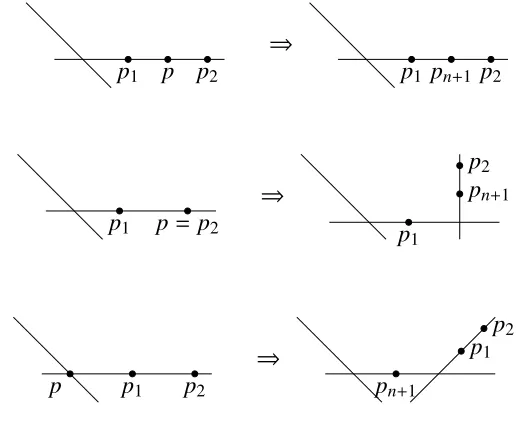
Figure 1.1 show a few examples of the correspondence described above. In the second and third examples in the figure, the components containingpn+1are rational.
⇒
p1 p p2 p1 pn+1 p2
⇒
p1 p= p2
p1
p2 pn+1
⇒
p1
p p2 pn+1
[image:16.612.172.435.410.621.2]p2 p1
Figure 1.1: Examples of the correspondenceCg,n → Mg,n+1.
In other words, we consider a resolution of Cg,n ×M
g,n Cg,n along the subscheme
is a(n+1)-pointed, genusg stable curve. This gives us the desired embedding of
Cg,n→ Mg,n+1.
More precisely, we have the following theorem by Knudsen.
Theorem 1.7. [6] Consider aS-valued point ofCg,n, i.e. ann-pointed stable curve
π : X → Swithnsections, σ1, . . . , σn, and an extra section∆. Let Ibe the ideal sheaf of∆, and defineK onX by the exact sequence
0 //OX //Iν⊕ OX(σ1+· · ·+σn) //K //0,
where δ : OX → Iν ⊕ OX(σ1+· · ·+ σn) is the diagonal, δ(t) = (t,t). Now, let Xs := Proj(SymK). Then, σ1, . . . , σn,∆have unique liftingsσ
0
1, . . . , σ
0
n+1making
Xs into a(n+1)-pointed stable curve with Xs → X a contraction. Moreover, this
gives rise to an embedding
Cg,n → Mg,n.
We will use a similar strategy to define our embedding of Ceg,n → Mfg,n+1. Let
(C,p1, . . . ,pn,P)be a Gieseker bundle parametrized by a point ofMfg,nand let p∈ C. Then, we define a Gieseker bundle on a(n+1)-pointed curve,(C0,p01, . . . ,p0n+1,P0) as follows:
1. ifp∈Cis not a special point, thenC0=C,p0i = pifori =1, . . . ,n,p0n+1= p, andP0= P; or
2. if p ∈ C is a special point, thenC0 is the curve obtained fromC by adding a rational component at p with three special points, one of which is p0n+1. The map, ϕ : C0 → C, contracting the component containing p0n+1 is an isomorphism away from p ∈ C, and the images ofp0i are pi fori = 1, . . . ,n. Finally, we defineP0:= ϕ∗P.
Note thatP0does satisfy the Gieseker condition. We always have a mapϕ:C0→C which forgets p0n+1 and stabilizes the component containing p0n+1 if necessary. In both cases, P0 = ϕ∗P and note that all Gieseker bubbles of C0 are preimages of Gieseker bubbles ofC1. Hence,P0satisfies the Gieseker conditions sincePsatisfies them.
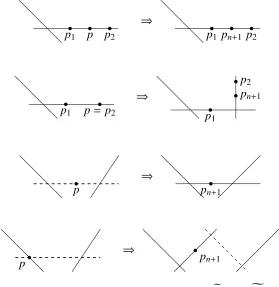
Figure 1.2 shows a few examples of the correspondence described above. The dashed lines in third and fourth figures represent Gieseker bubbles, which are
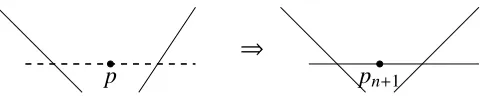
unstable rational components with two nodes over which the line bundle has degree 1. In the first and third examples, the line bundle over the(n+1)-pointed curve is the same as the line bundle over then-pointed curve as the two curves are the same. In second and fourth examples, p collides with a special point on the n-pointed curve and the corresponding(n+1)-pointed curve has an extra rational component containing pn+1. In these cases, the line bundle over the(n+1)-pointed curve has degree 0 over the component containing pn+1. Over the other components, the line bundle remains “unchanged”.
⇒
p1 p p2 p1 pn+1 p2
⇒
p1 p= p2 p
1
p2 pn+1
⇒
p pn+1
⇒
[image:18.612.166.445.226.513.2]p pn+1
Figure 1.2: Examples of the correspondenceCeg,n →Mfg,n+1
In other words, we can define an embedding Ceg,n → Mfg,n+1 as follows. Let πn : Ceg,n → Mfg,n be the universal curve over Mfg,n. Then, we have sections σi :Mfg,n→ Ceg,nfori =1, . . . ,n. Let Di := σi∗(Mfg,n)and letDsingbe the locus of singular points of the fibers ofπn.
Let∆ ⊂ Ceg,n×
f
Mg,n Ceg,n be the diagonal. Then, by using the analogous sheaf, K,
defined in Theorem 1.7, we get a contraction
ε: Ce:=Proj(SymK) → Ceg,n×
f
Composing with the projection from the fiber product toCeg,nwe get ˜
π = pr2◦ε:C →e Ceg,n×
f
Mg,nCeg,n→ Ceg,n,
such that the bundle(pr1◦ε)
∗P
g,nis a Gieseker bundle overCeg,n. As in Theorem 1.7, the sections,σi, have unique lifts, giving us nsectionseσi : Ceg,n → Ce. The lift of the diagonal,∆, gives us another section, which we will denote byeσn+1. Therefore,
(Ce,eσ1, . . . ,eσn+1,(pr1◦ε)∗Pg,n)is a family of Gieseker bundles overCeg,nwith(n+1) sections. Hence, we get a map Ceg,n → Mfg,n+1 which is an open embedding. We have the following diagram:
e
C //
e π=pr2◦ε
% % ε e
Cg,n+1
πn+1
e
Cg,n× f Mg,nCeg,n
pr2 //
pr1
e
Cg,n
πn
//
f
Mg,n+1
e
Cg,n πn //Mfg,n
Note that ϕ∗C1 eev
∗
n+1C1, where ϕ : Ceg,n → [pt/C×] and even+1 : Mfg,n+1 →
[pt/C×].
Now, we consider the restriction toCeg,nof the determinant bundle and the evaluation bundles onMfg,n+1. In particular, we want to compare these line bundles to the pull-backs of their analogs fromMfg,n.
Proposition 1.4. Let πn : Ceg,n → Mfg,n be the universal curve, and consider the
embedding of Ceg,n → Mfg,n+1 described above. Then the following are true over e
Cg,n.
1. For alli = 1, . . . ,n, πn∗◦ev ∗
i Cλ eve
∗
iCλ, whereevi : Mfg,n → [pt/C×]and e
evi :Mfg,n=1→ [pt/C×]are the respective evaluation morphisms.
2. detRπn+1∗ϕe∗C1 π
∗
ndetRπn∗ϕ∗C1, where ϕ : Ceg,n → [pt/C×] and ϕe : e
Cg,n+1→ [pt/C×].
Proof. First, let’s consider the evaluation line bundles. We know π∗
n◦ev ∗
i Cλ π ∗ n◦σ
∗ i ◦ϕ
∗
Cλ (σi◦πn)∗ϕ∗Cλ.
By definition, ˜σi is the lift of σi. In other words, ˜π ◦σ˜i σi◦πn. Hence, we see that (σi ◦πn)∗ϕ∗Cλ (π˜ ◦σ˜i)∗ϕ∗Cλ σ˜i∗(π˜∗ ◦ϕ∗Cλ) eve
∗
pull-back of the evaluation line bundles onMfg,nare isomorphic to the evaluation line bundles onMfg,n+1when restricted toCeg,n.
Since Ceg,n → Mfg,n is flat, we know that πn∗(Rπn∗P) Rpr2∗(pr∗
1P) and hence, π∗
n(detRπn∗P) detRpr2∗(pr
∗
1P). If ˜ϕ : C → [e pt/C
×]
, then we know that ˜
ϕ∗
C1 pr
∗
1 ◦ε
∗◦ϕ∗
C1. Since ε : C →e Ceg,n×
f
Mg,n Ceg,n simply contracts rational
curves, we have that Rε∗O e
C =OCeg,n×Mfg,nCeg,n
. Thus, we conclude that detRpr2∗(pr
∗
1ϕ
∗
C1) detR(pr2◦ε)∗((ε◦pr1)
∗◦ϕ∗
C1) detRπ˜∗(ϕ˜
∗ C1).
Sinceeπis the restriction ofπn+1toC →e Ceg,n, the pull-back of the determinant line bundle is isomorphic to the restriction of the determinant line bundle.
Letαbe an admissible class onMfg,n+1, which is a class of the form α=(detRπn+1∗ϕ∗C1)
−q⊗ ⊗
iev∗i Cλi ⊗ L
ai
i
.
We are interested in the push-forward ofα|Ceg,ntoMfg,n. We first recall the projection
formula.
Theorem 1.8 (Projection formula). [4] Let f : X → Y be a morphism of ringed
spaces. LetFbe anOX-module and letEbe a locally freeOY-module of finite rank. Then, for alli,
Rif∗(F ⊗ f∗E) Rif∗(F) ⊗ E.
By the projection formula and the observations above, we have
Rπn∗
α|
e Cg,n
Rπn∗ (detRπn+1∗ϕ
∗
C1)
−q⊗ n+1
Ì
i=1
ev∗iCλi ⊗ L
ai
i
! !
Rπn∗ π∗n(detRπn∗ϕ∗C1)
−q⊗ n
Ì
i=1
π∗ nev
∗
iCλi ⊗ L
ai
i
!
⊗ev∗n+
1Cλn+1⊗ L
an+1
n+1
!
(detRπn∗ϕ∗C1)
−q ⊗ n
Ì
i=1
ev∗i Cλi
!
⊗ Rπn∗ ev∗n+1Cλn+1⊗
n+1
Ì
i=1 Lai
i
!
.
In particular, ifαdoes not involve ev∗n+1Cλn+1 andL an+1
n+1, we have
Rπn∗
α|
e Cg,n
=(detRπn∗ϕ∗C1)−q⊗ n
Ì
i=1
evi∗Cλi
!
⊗ Rπn∗ n
Ì
i=1 Lai
i
1.6 Stratification ofZeg,n=Mfg,n\Ceg,n−1
Now, we will study the complement of the image of Ceg,n−1 in Mfg,n and define a stratification of the complement by a countably infinite collection of locally closed strata.
Recall that we embedded Ceg,n−1 in Mfg,n by considering points of the fibers of πn−1 : Ceg,n−1 → Mfg,n−1 as the last marked point and attaching an extra rational component atpif necessary. In particular, anyn-pointed curve such where pnlies on a component with more than 4 special points is in the image of Ceg,n−1. Hence, a point in Mfg,n is not in the image of Ceg,n−1 only if it parametrizes a Gieseker bundle(C,p1, . . . ,pn,P)such that the component containingpn, call itC
0
, becomes unstable after forgettingpn.
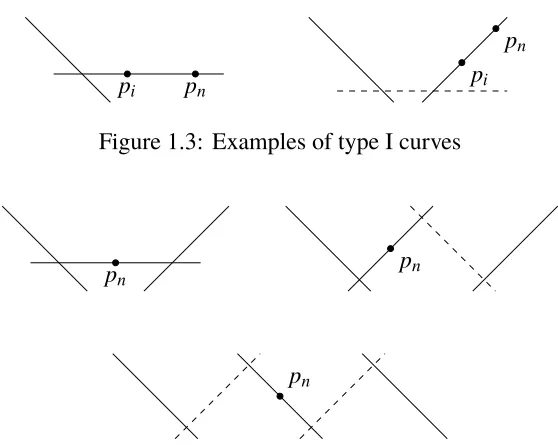
Thus,Cis not in the image ofCeg,n−1only ifC0is a rational curve containing precisely three special points2. Since one of the special points is pn, C0can have either one or two nodes. IfC0has exactly one node, we will callCa curve of type I. IfC0has two nodes,C\C0can either have one or two connected components. IfC\C0is the disjoint union of two connected components we will sayC is a curve of type II. If C\C0is connected, we will sayC is of type III.
pi pn pi
[image:21.612.166.445.392.615.2]pn
Figure 1.3: Examples of type I curves
pn pn
pn
Figure 1.4: Examples of type II curves
Figures 1.3, 1.4, and 1.5 show examples of type I, II, and III curves, respectively. As before, dashed lines represent Gieseker bubbles over which the line bundle has
2This is because all rational components have at least two components and only Gieseker bubbles
pn
pn
[image:22.612.205.406.68.195.2]pn
Figure 1.5: Examples of type III curves
degree 1. In all the figures, the component containing pn is rational. All other connected components of the curves in the figures, along with the restriction of the given line bundle, are lower pointed Gieseker bundles3.
Note thatZeg,nis the disjoin union of the strata of type I, II, and III curves. In the sub-sections that follow, we will stratify subschemes ofZeg,nof type I, II, and III curves. Also, we will consider the connected component Mfg,n,D ⊂ Mfg,n parametrizing Gieseker bundles of some fixed total degreeD.
1.7 Type I curves
Let (C,p1, . . . ,pn,P) ∈ Mfg,n be a type I curve. As before, let C0 denote the irreducible component of C containing pn. Then, C0 is a rational component containing 2 marked points and a node. Let the marked points be pi andpn. Note that there is only one way a type I curve can be in the image ofCeg,n−1. This happens when we choose the point p= pion the fiber as shown in Figure 1.6.
⇒
p= pi
pi
pn C 0
Figure 1.6: Type I curve lying in the image ofCeg,n−1
If a type I curve is in the image of Ceg,n−1, then the degree of P |C0 must be 0. Moreover, such curve cannot have a Gieseker bubble attached to C0. Therefore, the type I curves that do not lie in the image of Ceg,n−1are the ones such that either degP |C0 ,0 orC0is attached to a Gieseker bubble.
3
Fori =1, . . . ,n−1, letZi1be the closed subscheme ofMfg,nwhose points parametrize type I curves not in the image ofCeg,n−1such thatC0containspnand pi. First, note thatZi1is closed inMfg,n: any degeneration of a type I curve is another type I curve; and the degree ofP |C0 is locally constant away from the Gieseker bubble.
Now, denote by Wi,d1 the locally closed stratum corresponding to the topological types depicted in Figure 1.7, where (γ,D− d) is any topological type of genusg Gieseker bundle of degreeD−d. In other words,Wi,d1 is the stratum corresponding
pi
pn
g=0
d
γ D−d
pi
pn C 0
[image:23.612.197.417.224.286.2]degP |C0 = d Figure 1.7: Modular graphs and curves ofWi,d1
to type I curves such that
1. degP |C0 =d; and
2. C0is not attached to a Gieseker bubble. Note thatWi,d1 ⊂ Ceg,n−1if and only ifd =0.
Denote byFi,d1 the closed stratum corresponding to the topological types depicted in Figure 1.8, where(γ,D−d−1)is any topological type of genusgGieseker bundle of degree D−d −1. In other words, Fi,d1 is the stratum corresponding to type I
pi
pn
g=0
d
g=0 1
γ
D−d−1 pi
C0 pn
degP |C0 = d Figure 1.8: Modular graphs and curves ofFi,d1
curves such that
1. degP |C0 =d; and
Note thatFi,d1 1 Ceg,n−1for alliandd.
By Lemma 1.1, we see that for eachiandd, we have W1
i,d =Wi,d1 ∪Fi,d1 ∪Fi,d1−1.
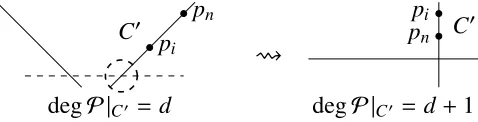
Moreover, all the curves inZeg,nthat are deformations of curves ofFi,d1 are parametrized by points ofFi,d1,Wi,d1 andWi,d1+1. More precisely, points ofWi,d1 parametrize curves obtained from a curve in Fi,d1 by smoothing the node on the connecting Gieseker bubble opposite toC04. Figure 1.9 shows such a deformation.
pi
C0
pn
degP |C0 = d
pi
pn C 0
[image:24.612.187.427.228.290.2]degP |C0 = d Figure 1.9: Smoothing the node in the dashed circle
Likewise, the points of Wi,d1 +1 parametrize curves obtained from curves in Fi,d1 by smoothing the node onC0as shown in Figure 1.10.
pi
C0
pn
degP |C0 = d
pi
pn C 0
[image:24.612.186.425.390.451.2]degP |C0 = d+1 Figure 1.10: Smoothing the node in the dashed circle
We can visualize the stratum of type I curves in the following way:
· · · W1
i,d−1 fF 1
i,d−1 W 1
i,d f Fi,d1 Wi,d1+1 fFi,d1+1 Wi,d1 +2 f· · ·,
where A Bmeans Alies in the closure of B. Now, we define Zi,d1 as follows.
Z1
i,d =
W1
i,d∪Fi,d1 d <0 W1
i,d+1∪Fi,d1 d ≥ 0 .
Keeping in mind Wi,10 ⊂ Ceg,n−1, we see that Zi1 = ∪Zi,d1 gives us the desired stratification ofZi1(see Figure 1.11).
4We cannot smooth both since such a deformation would result in a curve that lies in the image
... W1
i,−2
F1
i,−2 W1
i,−1
F1
i,−1 W1
i,0
F1
i,0 W1
i,1
F1
i,1
W1
i,−1
...
⊂ Ceg,n−1
Z1
i,−1← Z1
i,0←
Z1
i,1←
Z1
[image:25.612.240.373.80.382.2]i,−2←
Figure 1.11: Stratification ofZi1by Zi,d1
Before we move onto type II curves, we give an alternate way of definingZi,d1 , which will be useful later. LetUi,d1 be the stratum of points parametrizing all curves of
e
Zg,nobtained by smoothing nodes of curves inF1
i,d. By Lemma 1.1, this is precisely U1
i,d =Wi,d1 ∪Fi,d1 ∪Wi,d1 +1.
Note that{Ui,d1 | d ∈Z}is an open cover of Zi1. Then, we can defineZi,d1 as follows.
Z1
i,d =
U1
i,d\Ui,d1 +1 d < 0 U1
i,d\Ui,d1 −1 d ≥ 0
.
Geometry ofF1
i,d andZi,d1
We defined Fi,d1 as the stratum of points parametrizing curves of splitting type
({i,n},{i,n}c)
component, C0, containing pi and pn, and degree e := D−d −1 restricted to the component,C1, containing the other marked points. Hence,
F1
i,d Mfd 0,3×Mf
e
g,n−1,
where we identify the third marked point ofMfd
0,3 and the (n−1)-st marked point ofMfe
g,n−1as the two nodes on the connecting Gieseker bubble. The marked points
ofMfd
0,3 are denotedpi,pn, and the node p3. The marked points ofMf
e
g,n−1 are the pointspjfor j ,i,n, and the nodepn−1.
Now, we take a closer look at Zi,d1 . Proposition 4.15 and Corollary 4.16 of [1] tell us that Zi,d1 is an affine bundle overFi,d1 .
Proposition 1.5. [1]
1. For d ≥ 0, Z1
i,d classifies bundles which arise from Fi,d1 by smoothing away the node attachingC0to the connecting Gieseker bubble.
2. For d < 0, Zi,d1 classifies bundles which arise from Fi,d1 by smoothing away
the node attaching the connecting Gieseker bubble to the components not
containingpn.
3. We have a mapη : Zi,d1 → Fi,d1 such thatη is the structure map of an affine
bundle.
Note that ourFi,d1 correspond to those labeled F in [1], and our Zi,d1 correspond to those labeled Z (when d ≥ 0) andW (when d < 0). 1 and 2 of Proposition 1.5 follow directly from the definition ofZi,d1 .
While Frenkel, Teleman, and Tolland do not say exactly which affine bundle η : Z1
i,d → Fi,d1 is, the proof of Proposition 4.15 in [1] contains more information which leads to the following Proposition:
Proposition 1.6. The map η : Zi,d1 → Fi,d1 from Proposition 1.5 is given by the
bundle
(L−1 3 ⊗ P
d
3)(P
e n−1)
−1 d ≥
0
(Pd
3)
−1
(L−1
n−1⊗ P 3
n−1) d < 0 ,
where
2. Ln−1is the cotangent bundle along the(n−1)-st section onMfe g,n−1,
3. Pd
3 is the restriction of the universal bundle along the third section onMf
d
0,3,
and
4. Pe
n−1is the restriction of the universal bundle along the(n−1)-st section on
f
Me
g,n−1.
Proof. Letd ≥ 0 and consider curves parametrized by points ofZi,d1 . All such curves have splitting type({i,n},{i,n}c). Recall that we denote the component containing pnbyC0, and the other component byC1, where we discard the connecting Gieseker bubble between them if there is one. LetPdenote the universal bundle over curves of Zi,d1 . Now, we have two trivializations of P restricted to the two components C0 and C1, say t
0
: Ppn → C
×
and t1 : Ppk → C
×
, where k , i,n. These two
trivializations then give us the gluing isomorphism, ι, of the fibers of P over the node. Now, as proof of Proposition 4.15 in [1] points out, scalingt0to 0, we obtain in the limit a connecting Gieseker bubble with a degree 1 transferred from C05. Hence, this gives rise to a mapη : Zi,d1 → Fi,d1 ford ≥ 0. Similarly, scalingt0to∞ gives a mapZi,d1 → Fi,d1 ford <0.
Moreover, the choices of the trivializationst0andt1give us a map between the two fibers of the universal bundles over the nodes onC0andC1, which arePp3andPpn−1,
respectively. As Remark 1.12.1 in [1] explains, this map Ppn−1 → Pp3 is given by
t0/t1, and is precisely the gluing isomorphism,ι, over the node attachingC0withC1 when we have a type I curve with no connecting Gieseker bubble. When t0 = 0, this mapPpn → Pp3 becomes the 0 map and we get a connecting Gieseker bubble,
as we saw above. Hence, given a section ofη : Zi,d1 → Fi,d1 , we obtain a morphism
P |σn−
1 → P |σ3.
Now, since Fi,d1 Mfd
0,3 × Mf
e
g,n−1, we try to write P |σn−1 and P |σ3 in terms of
pull-backs of line bundles over Mfd
0,3 and Mf
e
g,n−1. Let pr1 : F 1
i,d → Mfd 0,3 and pr2 : Fi,d1 → Mfe
g,n−1 be the projection maps. First, P |σn−1 is equal to pr ∗
2P
e n−1
by definition. However, P |σ3 is not equal to pr1∗P3d since P3d is the restriction of the universal bundle over Mfd
0,3 to σ3 and thus, has 1 lower degree than P |σ3:
degP |σ3 = d+1. Recall that the mapη: Zi,d1 → Fi,d1 inserted a connecting Gieseker bubble by scaling the trivialization,t0, to 0 and transferring 1 degree fromC0to the bubble. Hence,P |σ3 pr1∗(P3d⊗ L3−1).
Therefore, sections ofη: Zi,d1 → Fi,d1 correspond to sections of
Hompr∗ 2P
e n−1,pr
∗
1(L
−1
3 ⊗ P
d
3)
pr1∗(L3−1⊗ P3d) ⊗ (pr2∗Pn−e 1)
−1.
Hence, we conclude that ford ≥ 0,η: Zi,d1 → Fi,d1 is the affine bundle given by
(L−1 3 ⊗ P
d
3)(P
e n−1)
−1.
Ford < 0, the situation is symmetric. Recall that whend < 0, instead of transferring 1 degree to the bubble fromC0, we transfer it fromC1. The mapη : Zi,d1 → Fi,d1 is then defined by scaling the trivialization,t0, to∞. By the same argument as in the d ≥ 0, case we conclude thatη: Z1
i,d → Fi,d1 is the affine bundle given by
(Pd
3)
−1
(L−1
n−1⊗ P
e n−1).
Another way to show thatZi,d1 is the affine bundle given by(L−31⊗ P3d)(Pne−1) −1
is by considering the formal neighborhood ofFi,d1 . Zi,d1 corresponds to smoothings of the node attachingC0to the connecting Gieseker bubble, which is the marked point p3onMfd
0,3. Smoothing a node is represented by the formal neighborhood given by T+⊗T−whereT±denote the tangent bundles at the node on the two components. In our case, those bundles areL3−1 fromC0, and P3d (Pn−e 1)−1 from the connecting Gieseker bubble. The tangent bundle at the node on the connecting Gieseker bubble is P3d(Pne−1)
−1
since O(1)of the Gieseker bubble is glued on the two nodes, p3 and pn−1, to the fibers Pp3 and Ppn−1. Hence, Z
1
i,d corresponds to the affine bundle overFi,d1 given by
pr1∗L−1 3 ⊗
Pd
3 (P
e n−1)
−1
(L3−1⊗ P3d)(Pn−e 1)
−1.
1.8 Type II curves
Now, we stratify the stratum of type II curves.
Let (C,p1, . . . ,pn,P) ∈ Mfg,n be a type II curve and letC
0
denote the irreducible component ofC containing pn. SinceC is a type II curve,C0contains the marked pointpnand two nodes, andC\C0has two connected components. Note that there are precisely three ways for a type II curve to lie in the image ofCeg,n−1.
2. we choose a point on a Gieseker bubble asp(Figure 1.13); or
3. we choose the node on a stable component and a Gieseker bubble asp (Fig-ure 1.14).
⇒
[image:29.612.183.429.152.200.2]p pn+1
Figure 1.12: Choosing a node on two stable components
⇒
[image:29.612.187.429.257.306.2]p pn+1
Figure 1.13: Choosing a point on a Gieseker bubble
⇒
p pn+1
Figure 1.14: Choosing a node on a stable component and a bubble
Therefore, a type II curve is in the image ofCeg,n−1if and only if either
1. degP |C0 =1 andC0is not connected to a Gieseker bubble; or 2. degP |C0 =0 andC0is connected to 0 or 1 Gieseker bubbles.
For a type II curve, C\C0 has two connected components. For I ⊂ [n− 1] :=
{1, . . . ,n− 1} such that |I|,|Ic| ≥ 2, let Z2
I be the closed subscheme of Mfg,n
whose points parametrize type II curves not in the image ofCeg,n−1such that points
{pi | i ∈ I} and {pi | i < I} are on separate connected components of C\C0. Without loss of generality, denote byC1the curve containing points with indices in I, andC2the other connected component.
[image:29.612.166.445.361.412.2]that type II curves can have 0, 1, or 2 Gieseker bubbles attached toC0. We will call these strataW2,Y2, andF2, respectively.
Let d1,d2 ∈ Z. We denote by WI,(2d1,d2) the locally closed stratum corresponding
to the topological type depicted in Figure 1.15, where (γi,di) is any topological type of genusgi Gieseker bundle of degree di with marked points ofCi, such that
g =g1+g2.
pn γ1
d1 g=0d
γ2 d2
d = D−d1−d2
[image:30.612.179.433.202.261.2]pn
Figure 1.15: Modular graphs and curves ofWI,(d2
1,d2)
In other words,WI,(2d
1,d2)is the stratum corresponding to type II curves such that
1. degP |Ci =di; and
2. C0is not connected to any Gieseker bubbles.
We will denote by
W2
I,d :=
Ø
D−d1−d2=d
W2
I,(d1,d2).
Note thatWI,d2 ⊂ Ceg,n−1if and only ifd =0 or 1 by the discussion from the beginning of the section.
The type II curves with a Gieseker bubble connectingC0withC1will be denoted Y2
I,(d1,d2). The topological type of such curves is shown in Figure 1.16.
pn γ1
d1
g=0 1
g=0
d
γ2 d2
d = D−d1−d2−1
pn
Figure 1.16: Modular graphs and curves ofYI,(2d
1,d2)
We also define
Y2
I,d :=
Ø
D−d1−d2=d
Y2
I,(d1,d2)∪YI2c,(d
2,d1)
[image:30.612.128.481.564.629.2]Note thatYI,d2 ⊂ Ceg,n−1if and onlyd =1. Lastly, we denote byFI,(2d
1,d2)the stratum of type II curves with two Gieseker bubbles
with the topological type shown in Figure 1.17. pn γ1 d1 g=0 1 g=0 d g=0 1 γ2 d2
d = D−d1−d2−2
[image:31.612.110.508.143.205.2]pn
Figure 1.17: Modular graphs and curves ofFI,(2d
1,d2)
Also, define
F2
I,d :=
Ø
D−d1−d2=d
F2
I,(d1,d2).
Again by Lemma 1.1, we see thatFI,d2 andFI,(d2
1,d2)are closed in
f
Mg,n. Similarly to
the type I case, letUI,(2d
1,d2) denote the stratum of points parametrizing all curves of
e
Zg,nthat are obtained by smoothing 0 or 1 of the nodes on each Gieseker bubble of
curves ofFI,(2d
1,d2) 6.
U2
I,(d1,d2) := F
2
I,(d1,d2) ∪Y2
I,(d1,d2) ∪Y2
I,(d1,d2+1) ∪Y2
Ic,(d
2,d1) ∪Y2
Ic,(d
2,d1+1) ∪W2
I,(d1,d2)∪WI,(d2 1+1,d2)∪WI,(d2 1,d2+1)∪WI,(d2 1+1,d2+1).
Note that{UI,(d2
1,d2)
| D−d1−d2= d} forms an open cover ofZ2
I,dinZeg,n. Also, the stratum of all smoothings of curves ofFI,d2 is
U2
I,d =
Ø
D−d1−d2=d
U2
I,(d1,d2)
= F2
I,d∪YI,d2 ∪YI,d2 −1∪WI,d2 ∪WI,d2 −1∪WI,d2 −2.
Note that{UI,d2 | d ∈Z}forms an open cover ofZI2.
We can visualize the closure relations of these type II strata using the following infinite two dimensional grid7in Figure 1.188.
Figure 1.19 showsUI,(2d
1,d2) as deformations of curves in
F2
I,(d1,d2). The dashed lines
attached to the nodes on the Gieseker bubbles indicate which deformation happen as we smooth the chosen node.
6
As we saw in Section 1.7, we cannot smooth both nodes of the same Gieseker bubble since such deformation would result in a curve lying in the image ofCeg,n−1.
7The two dimensions correspond to smoothings of the two connecting Gieseker bubbles. The
W2
I,(d1−1,d2−1) YI,(d2 1−1,d2−1) WI,(d2 1,d2−1) YI,(d2 1,d2−1) WI,(d2 1+1,d2−1)
Y2
Ic,(d
2−1,d1−1)
F2
I,(d1−1,d2−1) YI2c,(d
2−1,d1)
F2
I,(d1,d2−1) YI2c,(d
2−1,d1+1)
W2
I,(d1−1,d2) YI,(d2 1−1,d2) WI,(d2 1,d2) YI,(d2 1,d2) WI,(d2 1+1,d2)
Y2
I,(d1−1,d2) FI,(d2 1−1,d2) YI2c,(d
2,d1)
F2
I,(d1,d2) YI2c,(d
2,d1+1)
W2
I,(d1−1,d2+1) YI,(d2 1−1,d2+1) WI,(d2 1,d2+1) YI,(d2 1,d2+1) WI,(d2 1+1,d2+1)
U2
I,(d1−1,d2−1)
U2
[image:32.612.132.480.77.348.2]I,(d1,d2)
Figure 1.18: Type II strata and their closure relations
(d1,d2+1) (d1+1,d2+1)
(d1,d2+1) (d1+1,d2+1)
Figure 1.19: Closer look atUI,(2d
[image:32.612.107.515.386.665.2]We are finally ready to define our stratification ofZ2I. Define
Z2
I,d :=
U2
I,d\UI,d2 +1 d ≤ 1 U2
I,d\UI,d−2 1 d ≥ 2 .
We also define
Z2
I,(d1,d2) := ZI,d2 ∩UI,(d1,d2).
Recalling thatWI,20,WI,21,YI,21 ⊂ Ceg,n−1, we see that ZI,d2 stratify ZI2. Moreover, for eachd, ZI,d2 is the disjoint union
Z2
I,d =
Ø
D−d1−d2=d
Z2
I,(d1,d2).
Figure 1.20 shows the stratification ofZI2by ZI,d2 andZI,(d2
1,d2). All superscripts and
subscripts except for the degrees are suppressed for the sake of simplicity.
In Figure 1.20, d1,d2 ∈ Zare such that D− d1−d2 = 1. The strata that lie in the blue shaded region are the ones that are in the image ofCeg,n−1. The red boxes are theZ2I,(d0,d00), where(d
0,
d00)are the degrees corresponding to theF(d0,d00)in the same box. For example, the box labeled (2.2) correspond to ZI,(2d
1,d2−1). Moreover, each
box labeled(d,k)lie in ZI,d2 . For example, boxes (1.1), (1.2), and (1.3), which are Z2
I,(d1−1,d2+1),Z2I,(d1,d2),ZI,(d2 1+1,d2−1), respectively, all lie inZI,21. Note that
D− (d1−1) − (d2+1)= D−d1−d2= D− (d1+1) − (d2−1)=1.
Geometry ofF2
I,(d1,d2)
andZ2
I,(d1,d2)
By the same argument as in the type I case, F2
I,d1,d2 Mfd1
g1,|I|+1×Mf d
0,3×Mf
d2
g2,|Ic|+1,
whered = D−d1− d2−2. Also, by Proposition 1.5, we know that there exists a mapη : ZI,(2d
1,d2) → F2
I,(d1,d2), which is the structure map of an affine bundle. From
our description ofZI,(2d
1,d2), we know that
1. ford ≥ 2, ZI,(2d
1,d2)classifies bundles which arise from F
2
I,(d1,d2)by smoothing
away nodes attaching the connecting Gieseker bubbles toC1andC2; and 2. ford ≤ 1, ZI,(d2
1,d2)classifies bundles which arise from F
2
I,(d1,d2)by smoothing
Wd1−1,d2−2 Yd1−1,d2−2 Wd1,d2−2 Yd1,d2−2 Wd1+1,d2−2 Yd1+1,d2−2 Wd1+2,d2−2
Yd1−1,d2−2 Fd1−1,d2−2 Yd1,d2−2 Fd1,d2−2 Yd1+1,d2−2 Fd1+1,d2−2 Yd1+2,d2−2
Wd1−1,d2−1 Yd1−1,d2−1 Wd1,d2−1 Yd1,d2−1 Wd1+1,d2−1 Yd1+1,d2−1 Wd1+2,d2−1
Yd1−1,d2−1 Fd1−1,d2−1 Yd1,d2−1 Fd1,d2−1 Yd1+1,d2−1 Fd1+1,d2−1 Yd1+2,d2−1
Wd1−1,d2 Yd1−1,d2 Wd1,d2 Yd1,d2 Wd1+1,d2 Yd1+1,d2 Wd1+2,d2
Yd1−1,d2 Fd1−1,d2 Yd1,d2 Fd1,d2 Yd1+1,d2 Fd1+1,d2 Yd1+2,d2
Wd1−1,d2+1 Yd1−1,d2+1 Wd1,d2+1 Yd1,d2+1 Wd1+1,d2+1 Yd1+1,d2+1 Wd1+2,d2+1
Yd1−1,d2+1 Fd1−1,d2+1 Yd1,d2+1 Fd1,d2+1 Yd1+1,d2+1 Fd1+1,d2+1 Yd1+2,d2+1
Wd1−1,d2+2 Yd1−1,d2+2 Wd1,d2+2 Yd1,d2+2 Wd1+1,d2+2 Yd1+1,d2+2 Wd1+2,d2+2
4.1 3.2 2.3
3.1 2.2
2.1
1.1 0.1 -1.1
1.2 0.2
1.3
[image:34.612.109.510.68.665.2]Figure 1.20: Stratification ofZI2
Figure 1.21: Z2I,(d
1,d2)when
D−d1−d2 ≥ 2
Proposition 1.7. The mapη: ZI,(d2
1,d2) → F2
I,(d1,d2)is the structure map of the affine bundle
L−1
|I|+1⊗ P
d1 |I|+1
(Pd 1) −1 O e M2
⊕ O e
M1(P3d) −1
L−1
|Ic|+1⊗ P
d2
|Ic|+1 d ≥ 2
Pd1 |I|+1
−1
L−1 1 ⊗ P
d 1 O e M2 ⊕ O e M2
L−1 3 ⊗ P
d
3
Pd2 |Ic|+1
−1
d ≤ 1, where
1. L|I|+1is the cotangent bundle along the(|I|+1)-st section,σ|I|+1, onMfd1 g1,|I|+1;
2. Pd1
|I|+1is the restriction toσ|I|+1of the universal bundle overMf d1
g1,|I|+1 ;
3. L1andL3are the cotangent bundles alongσ1andσ3onMfd 0,3;
4. Pd
1 and P
d
3 are the restrictions to σ1 and σ3 of the universal bundle over f
Md
0,3;
5. L|Ic|+1is the cotangent bundle alongσ|Ic|+1onMfd2
g2,|Ic|+1; and
6. Pd2
|Ic|+1is the restriction toσ|Ic|+1of the universal bundle overMfd2 g2,|Ic|+1
.
1.9 Type III curves
A necessary and sufficient condition for a type III curve to be in the image ofCeg,n−1 is the same as the condition for type II curves. Denote by Z3the closed subscheme of Mfg,n whose points parametrize type III curves that do not lie in the image of
e
Cg,n−1. For j ∈ Zconsider the strata F3
d whose points parametrize type III curves
such that
1. degP |C0 = j; and
2. C0is connected to two Gieseker bubbles.
Then, for j ≥ 0, we defineZ3j recursively as Z3
j =
U3
j ∩Z3
\ Ø
0≤k≤j−1 Z3
k,
Similarly for j ≤ −1, we defineZ3j recursively as Z3
j =
U3
j ∩Z3
\ Ø
j+1≤k≤−1
Z3
k.
By the same argument we see that Z3j is locally closed for all j ∈Zand that χZ3(F)= Õ
j∈Z
χZ3
j
(F).
For j ≥0, Z3j parametrize all type III curves that are obtained from curves ofFj3by smoothing the nodes onC0. For j ≤ −1, Z3j parametrize all type III curves that are obtained from curves ofFj3by smoothing the nodes on the two connecting Gieseker bubbles that do not lie onC0.
1.10 Cohomology overZeg,n
Recall that we would like to compute χ(Mfg,n, α), whereαis an admissible bundle on Mfg,n. In order to compute χ(Mfg,n, α), we use the stratification of Mfg,n as a union of Ceg,n, Zi1, ZI2, and Z3. First, we recall the definition of cohomology with support on a locally closed subscheme.
Definition 1.8. [5] LetX be a topological space and let Z ⊂ X be a locally closed
subset. Define the sections ofFwith support inZ as
ΓZ(X,F):= {s ∈ F(X) | Supp(s) ⊂ Z}.
Then,ΓZ is left exact but not necessarily exact. We define the right derived functors ofΓZ to be the local cohomology groups with support withZ,
HZi(X,F):= RiΓZ(X,F).
Local cohomologies satisfy several properties.
Proposition 1.8. [5] Let Z be a locally closed subset of X. Suppose Z ⊂ Y ⊂ X.
Then,
HiZ(X,F)= HZi(Y,F|Y), for alliand for all sheavesFon X.
Proposition 1.9. LetZ ⊂ X be an open subset. Then,
HiZ(F)= Hi(Z,F),
for alliand for all sheavesFon X.
When Z ⊂ X is a locally closed subset, there is an associated long exact sequence of cohomologies.
Lemma 1.2. [5] Let X be a topological space and let Z ⊂ X be a locally closed
subset. LetZ0⊂ Z be closed inZ and letZ00 := Z\Z0. Then, we have the following long exact sequence of local cohomologies for any abelian sheafFon X:
0→H0Z0(F) →HZ0(F) →HZ000(F) →HZ10(F) →HZ1(F) →HZ100(F) → · · · .
Corollary 1.1. Let X be a topological space and let Z ⊂ X be a locally closed
subset. LetY = X \Z and letFbe a sheaf on X. Then, we have the following long exact sequence of local cohomologies:
0→ HZ0(F) →H0(X,F) →H0(Y,F) → HZ1(F) →H1(X,F) →H1(Y,F) → · · · .
Proof. The long exact sequence is the one associated to the triple Z,Y ⊂ X from Lemma 1.2, where the local cohomologies with support on open subsets of X are replaced with regular cohomologies using Proposition 1.9. Note thatCeg,n−1is open inMfg,nand thus,Zeg,nis closed. By Corollary 1.1, for any sheafFonMfg,n, we have the following long exact sequence of local cohomologies 0→ H0
e Zg,n
(F) →H0(F) →H0( e
Cg,n−1,F) →H1
e Zg,n
(F) →H1(F) →H1( e
Cg,n−1,F) → · · · ,
whereHi(F):= Hi(Mfg,n,F). Hence, if all the following terms are well-defined, we have
χ(Mfg,n,F)= χ(Ceg,n−1,F)+ χ
e Zg,n(F).
In following sections, we will show that when g = 0, the terms are indeed well-defined and that the equation above gives us a formula for computing n-pointed invariants, χ(Mf0,n, α), from lower pointed invariants, χ(Mf0,m, α), wherem< n. Note that the strataZ1,Z2, andZ3are a pairwise disjoint collection of locally closed strata. Hence, by using Lemma 1.2 onZ1,Z2,Z3 ⊂ Zeg,n, we get
χ
e