City, University of London Institutional Repository
Citation
:
Evans, Alison Ruth (2006). Use of the internet as a data collection tool: amethodological investigation of sampling and mode effect. (Unpublished Doctoral thesis, City University)
This is the accepted version of the paper.
This version of the publication may differ from the final published
version.
Permanent repository link:
http://openaccess.city.ac.uk/19750/Link to published version
:
Copyright and reuse:
City Research Online aims to make research
outputs of City, University of London available to a wider audience.
Copyright and Moral Rights remain with the author(s) and/or copyright
holders. URLs from City Research Online may be freely distributed and
linked to.
Use of the Internet as a data collection tool:
a methodological investigation of
sampling and mode effect
Alison Ruth Evans
Thesis submitted for the degree of
Doctor of Philosophy
City University
Department of Sociology and
School of Nursing and Midwifery
January 2006
Table of contents
Volume 1
List of tables
... 9List of figures
... 11
Acknowledgements
... 13
Declaration ... 14
Abstract
... 15
Abbreviations
... 16PART I - INTRODUCTION
1
Introduction
... 181.1 Overview ofthe thesis ... 18
1.2 Foundation elements ... 20
1.2.1 Emergence of the Internet as a data collection tool ... 21
1.2.1.1 Use o/technology for data collection ... 21
1.2.1.2 Emergence of the Internet ... 24
1.2.1.3 Use o/the Internetfor data collection ... 26
1.2.2 Researching the population of gay and bisexual men ... 29
1.2.3 Collecting data on sexual behaviour ... 34
2
Internet and HIV study:
the context of the methodological research
... 40
2.1
Introduction ...40
2.2 Internet and HIV study: quantitative methods ... " ... 41
2.3 Internet and HIV study: qualitative methods ... 45
2.4
2.5
Ethical framework ... 47The methodological research in context ... 49
3
Research strategy
... 503.1 Introduction ... 50
3.2 Adopting a pragmatic approach to research ... 53
3.3 Publications-as-theory strategy ... 57
3.4 The research design in a wider context ... ... ... 59
3.5 Secondary analysis ... ... ... ... ... 62
3.6 Data analysis ... 65
PART II - SAMPLING GAY AND BISEXUAL MEN
4
Web survey motivation for participation
... 674.1 Introduction ... 67
4.1.1 Factors that may influence participation ... 69
4.1.1.1 Societal Level Factors ... 69
4.1.1.2 Individual Level Factors ... 72
4.1.2 Empirical findings on respondent compliance ... . . ... 77
4.1.2.1 Survey topic ... 77
4.1.2.2 Reciprocation ... ... ... ... ... 79
4.1.2.3 Social validation . . . .. . . ... 80
4.1.2.4 Liking ... 80
4.1.2.5 Consistency ... 81
4.1.2.6 Scarcity . .. . .. . .. . ... .. ... . .. ... ... . . .. . . . .. . . . ... . . .. . .. . . .. . . . 82
4.1.2.7 Authority ... 83
4.2
l\fethods ... 854.2.1 Development of the survey instrument ... 85
4.2.2 "A survey on surveys" ... ... 94
4.2.3 Data analysis ... 95
4.3
4.3.1 4.3.2 Findings ... 106Men who completed the motivational section · ... 106
4.3.3 Analysis of the motivational items ... 111 4.3.4 4.3.5 4.4 4.4.1 4.4.2 4.4.3 4.4.4 Motivations volunteered ... 122
Analysis ofthe survey behaviour items ... 123
Discussion of findings ... " ... 128
Altruistic motivation ... 128
Egotistical motivation ... 130
Other aspects of motivation Implications for researchers ... 133
... 135
5
Web survey drop out ...
1365.1 Introduction ... 136
5.1.1 Classifying survey response ... 137
5.1.2 Factors that may influence drop out ... 140
5.1.2.1 Amount and point of drop out ... 141
5.1.2.2 Commitment ... 142
5.1.2.3 Time and the perception ofburden ... 143
5.1.2.4 Personal information ... 145
5.1.2.5 Use o/incentives ... 146
5.1.2.6 Respondent characteristics ... 148
5.1.2.7 Internet behaviour ... 148
5.2 l\1ethods ... 150
5.2.1 Drop out point ... 150
5.2.2 Comparison of subgroups '" ... 151
5.2.3 Data analysis ... 153
5.2.4 Drop out pop-up and drop out questions ... 155
5.3
5.3.1 5.3.2 5.3.3 5.2.4.1 Drop out pop-up ... 1555.2.4.2 Drop out questions in motivational section ... 158
Findings ... 159
Drop out over full questionnaire - all men Drop out over pre-filter questions - all men Drop out over post-filter questions - UK men 4 ... 159
... 162
5.3.4 Drop out from 2002 web survey ... 171
5.3.5 Drop out over post-filter questions - all men ... 172
5.3.6 Influence of survey routing - UK men ... 172
5.3.7 Analysis of drop out pop-up ... 176
5.3.8 Analysis of drop out questions in motivational section ... 179
5.4 Discussion of findings ... " ... 182
5.4.1 Drop out in the early stages ... 182
5.4.2 5.4.3 5.4.4
6
Drop out in the later stages Drop out pop-up and questions Implications for researchers ... 183... 186
... 186
Comparison of Internet and offline samples
... 1876.1 Introduction ... 187
6.1.1 Purpose of sampling ... 188
6.1.2 Probability sampling ... , ... , ... 190
6.1.3 Non-probability sampling ... 193
6.1.4 Online sampling ... 194
6.1.4.1 Online probability sampling ... " ... 195
6.1.4.2 Online non-probability sampling ... 199
6.1.4.3 Who responds to Internet surveys? ... 202
6.1.5 Samples in surveys of sexual behaviour ... 207
6.1.6 Sampling minority populations ... " ... 210
6.1.6.1 Ojjline sampling of gay and bisexual men ... 213
6.1.6.2 Online sampling ofminority populations ... 216
6.1.6.3 Who responds to Internet surveys of gay and bisexual men? ... 219
6.2 Methods ... 223
6.2.1 Description of samples ... 223
6.2.2 Sample comparison ... , ... '" ... 224
6.2.3 Sociodemographic and behavioural comparisons ... " ... 226
6.3 Findings ... 234
6.3.1 Comparison of national samples ... 234
6.3.2 Comparison of samples of London men ... 245
6.3.3 Comparison of samples of men from outside London ... 255
6.3.4 Comparison of national gaydar and gay.com samples ... 257
6.4 Discussion of findings ... 260
6.4.1 Implications for researchers ... 265
Volume 2
PART
111-MODE EFFECTS IN STUDIES OF SEXUAL BEHAVIOUR
7
Web and pen-and-paper survey item non response ... 8
7.1 Introduction ... ... ... .... ... 8
7.1.1 Item nonresponse and its effects ... 9
7.1.2 Sensitive content ... 12
7.1.3 Respondent influences ... 14
7.1.3.1 Inadequate understanding or comprehension ... 18
7.1.3.2 Low motivation or effort ... 21
7.1.3.3 Retrieval of information ... 23
7.1.3.4 Withholding available information .. . .. ... .... .. .. .. ... .. .. 25
7.1.3.5 Beliefin the adequacy of response ... 27
7.1.4 Interviewer influences ... 28
7.l.5 Questionnaire influences ... 30
7.1.5.1 Question routing ... 34
7.1.5.2 Question order ... 35
7.1.5.3 Data checking ... 36
7.l.6 Mode influences ... 38
7.1.6.1 Computerisation and sensitive behaviour ... 38
7.1.6.2 Use of the Internet ... 42
7.2 Methods ... 46
7.2.1 Sample comparability ... ,. 46
7.2.2 Questionnaire comparability ... '" ... '" ... 47
7.2.3 Defining item nonresponse ... '" ... 48
7.2.4 Data analysis ... 50
7.2.4.1 Item nonresponsefor each respondent ... 50
7.2.4.2 Item nonresponse for each question 7.2.4.3 Quantifying item nonresponse ... 51
... 51
7.2.4.4 Analysing item nonresponse ... 52
7.3 Findings ... , 55
7.3.1 Influence of respondent variables ... 55
7.3.2 Influence of questions and survey mode ... 68
7.4 Discussion of findings ... ... 85
7.4.1 Implications for researchers ... 91
8
Participating in online and offline qualitative interviews ..
928.1 Introduction ... 92
8.1.1 Interviews in social research ... 93
8.1.2 Internet-mediated communication ... 95
8.1.3 Online interviews ... 98
8.1.3.1 What are online interviews? ... 98
8.1.3.2 What are the pros and cons of online interviews? ... 99
8.1.3.3 Features of synchronous and asynchronous interviews ... 102
8.1.4 The online interview in context ... 106
8.1. 4.1 Respondent use of the online medium . . .. . . .. . .. . .. . . . .. . . . .. 106
8.1.4.2 Online identity and self-presentation ... 108
8.1.4.3 Online rapport and trust ... 111
8.1.5 Interviews with sexual content ... ... 114
8.2 Methods ... 117
8.2.1 Interview procedure ... 119
8.2.3 Ethics for methodological interviews ... 124
8.2.4 Analysis of methodological interviews ... 126
8.3 Findings ... 130
8.3.1 Respondent profile ... 130
8.3.2 Methodological interview duration and word count ... 133
8.3.3 Internet and HIV interview experience ... 135
8.3.3.1 Freedom of expression ... 135
8.3.3.2 Nature of the interview interaction ... 138
8.3.3.3 Verbalising behaviour ... 140
8.3.4 Respondent perspectives on personal privacy ... 141
8.3.4.1 Anonymity and confidentiality in the interview ... 141
8.3.4.2 Perception of general online privacy ... 142
8.3.5 Rapport from the interviewer's perspective ... 144
8.3.5.1 Paralanguage in the methodological online interviews ... 144
8.3.5.2 Online speed of interaction and multi-tasking ... 146
8.3.6 Practicalities of the methodological interview ... 148
8.3.6.1 Interview arrangements ... 148
8.3.6.2 Use of technology in online and face-lo-face interviews ... 152
8.4 Discussion of findings ... 154
8.4.1 Implications for researchers ... 158
PART IV - CONCLUSION
9
Concluding discussion
... 1609.1 Introduction ... '" ... 160
9.2 Researching the population of gay and bisexual men ... 160
9.3 Collecting data on sexual behaviour ... 167
9.4 Limitations and future directions ... 170
List of appendices
...
...
171 172Appendices
References
... 239List of tables
Volume 1
Table 1.1: Response to questions of sexual behaviour
33
Table 2.1: Background characteristics of London men in quantitative survey 44 samples
Table 2.2: Background characteristics of London men in qualitative interview 47 samples
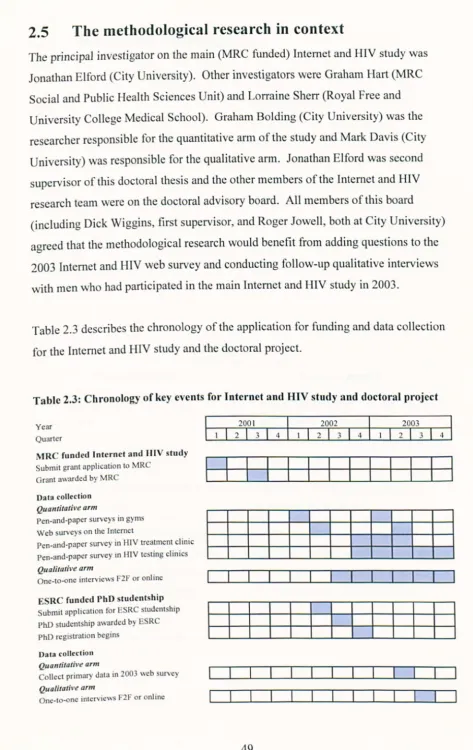
Table 2.3: Chronology of key events for Internet and HIV study and doctoral 49 project
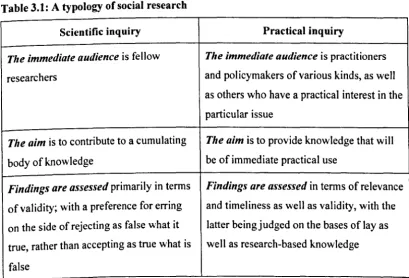
Table 3.1: A typology of social research 50
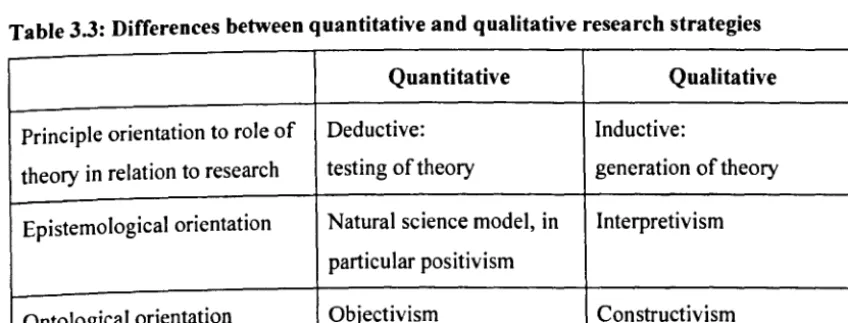
Table 3.2: Research strategy: questions, methods and data 52 Table 3.3: Differences between quantitative and qualitative research strategies 54
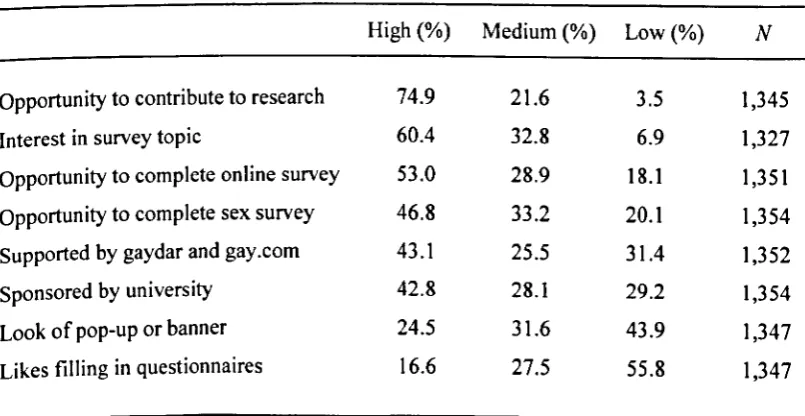
Table 4.1: Variables associated with completing the motivational section 107 Table 4.2: Level of importance attributed to motivational factors 108
Table 4.3: Response to survey behaviour items 109
Table 4.4: Association between independent variables and motivational items 110 Table 4.5: Correlation between motivational variables 116 Table 4.6: Loading of motivational factors onto egotistical and altruistic 118
Dimensions
Table 4.7: Scores on the motivational items for the three-cluster solution 119 Table 4.8: Motivations for participation volunteered by respondents 122 Table 4.9: Association between independent variables and survey behaviour 124
items
Table 4.10: Variables associated with taking part in other online surveys 126
Table 5.1: Log rank comparison of drop out during pre-filter questions - 161 all men
Table 5.2: Log rank comparison of drop out during post-filter questions - 166
UK men
Table 5.3: Variables associated with drop out during post-filter questions - 170
UK men
Table 5.4: Log rank comparison of drop out during post-filter questions - 171 all men
Table 5.5: Significant differences in subgroup response to routing questions 173 Table 5.6: Number of reasons given for dropping out of 2003 web survey 177 Table 5.7: Reasons given for dropping out of2003 web survey 177 Table 5.8: Number of reasons given for not starting 2003 web survey 180 Table 5.9: Reasons given for not starting the 2003 web survey 180 Table 5.10: Retrospective reasons given for dropping out of the 2003 web 181
Table 6.1: A taxonomy of probability selection methods 191
Table 6.2: Previous studies comparing characteristics of non-Internet and 203
Internet Samples
Table 6.3: Data collection for Natsal and Internet samples 224
Table 6.4: Derivation of scaled up Natsal frequencies 232
Table 6.5: Comparison of national samples 235
Table 6.6: Comparison of samples of London men 246
Volume 2
Table 7.1: Significant associations between subgroups and item nonrepsonse 59
Table 7.2: Significant associations between subgroups and number of 63
questions
Table 7.3: Coefficients predicting item nonresponse for Internet respondents 66
Table 7.4: Coefficients predicting item nonresponse for gym respondents 67
Table 7.5: Item nonresponse associated with questions 69
Table 7.6: Item nonresponse for subsets of questions in web and pen-and- 72
paper surveys
Table 7.7: Item nonresponse to equivalent questions in web and pen-and- 80
paper surveys
Table 7.8: Questions with disproportionately high pen-and-paper item 82
nonresponse
Table 8.1: Profile of respondents in methodological face-to-face interviews 131
Table 8.2: Profile of respondents in methodological online interviews 131
Table 8.3: Methodological interview duration and word count 133
Table 8.4: Use of para language by respondents (and interviewer) 145
Table 8.5: Delay between interview with MD and initial contact by AE 150
List of figures
Volume 1
Figure 1.1: Populations ofMSM and self-identified gay and bisexual men 32
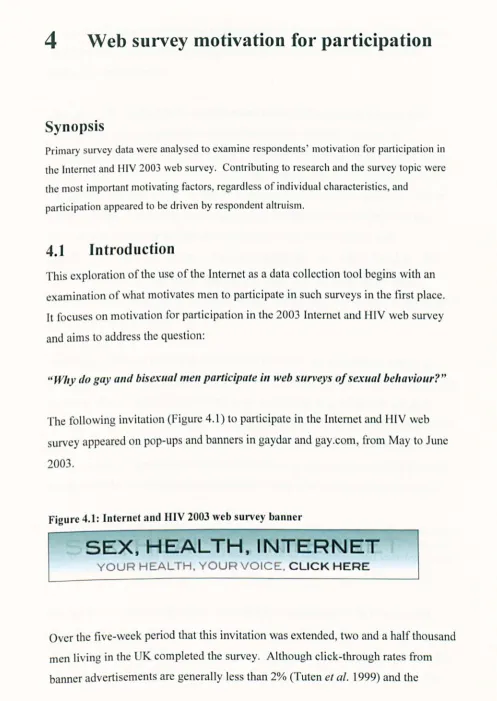
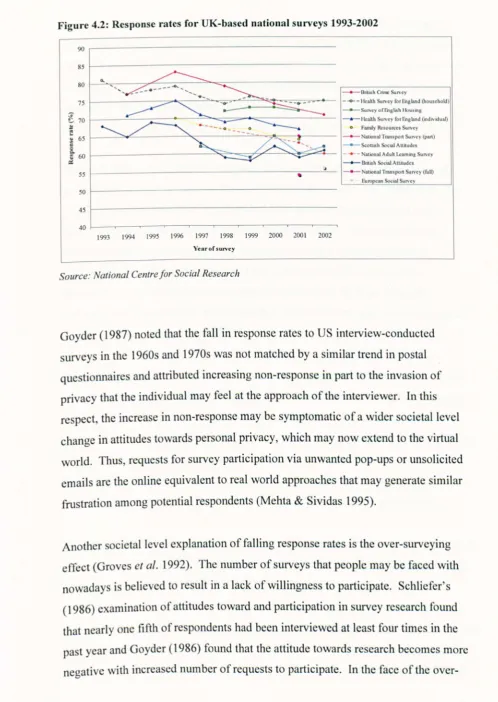
Figure 4.1: Internet and HIV 2003 web survey banner 67 Figure 4.2: Response rates for UK-based national surveys 1993-2002 70
Figure 4.3: Cialdini's model of compliance 73
Figure 4.4: Internet and HIV banner in gay.com chatroom 85 Figure 4.5: Final page ofInternet and HIV 2003 web survey 86
Figure 4.6: Illustration of motivational items 87
Figure 4.7: Ordinal dependent variables 96
Figure 4.8: Dichotomous dependent variables 97
Figure 4.9: Importance of motivational dimensions to respondents in cluster 121 groups
Figure 5.1: Types of response in web surveys and their prevalence 139
Figure 5.2: Drop out pop-up 156
Figure 5.3: Drop out 2003 over full questionnaire 159 Figure 5.4: Pre-filter drop out 2003 by website of origin 163 Figure 5.5: Pre-filter drop out 2003 by week of completion 163 Figure 5.6: Pre-filter drop out 2003 by age group 163 Figure 5.7: Pre-filter drop out 2003 byethnicity 164 Figure 5.8: Pre-filter drop out 2003 by place of residence 164 Figure 5.9: Pre-filter drop out 2003 by place of birth 164 Figure 5.10: Post-filter drop out 2003 by age group - UK men 167 Figure 5.11: Post-filter drop out 2003 by ethnicity - UK men 167 Figure 5.12: Post-filter drop out 2003 by work status - UK men 167 Figure 5.13: Post-filter drop out 2003 by education - UK men 168 Figure 5.14: Post-filter drop out 2003 by type of area - UK men 168 Figure 5.15: Post-filter drop out 2003 by sexual orientation - UK men 168 Figure 5.16: Post-filter drop out 2003 by openness - UK men 169 Figure 5.17: Post-filter drop out 2003 by sexual partners - UK men 169 Figure 5.18: Post-filter drop out 2003 by HIV status - UK men 169 Figure 5.19: Frequency of drop out because oftime 178 Figure 5.20: Frequency of drop out because of boring questions 178
Figure 6.1: Cumulative percentage of Nat sal men reporting anal sex in the 230 past year
Volume 2
Figure 7.1: Beatty and Herrmann's decision model of item nonresponse 17
Figure 7.2: Radio button question format 32
Figure 7.4: Unacceptable and acceptable survey instructions 34
Figure 7.5: Data checking pop-up 37
Figure 7.6: Proportion of questions skipped by respondents 56 Figure 7.7: Item nonresponse for the 78 matched questions 71 Figure 7.8: Proportion of item nonresponse for sensitive sexual questions 75 Figure 7.9: Proportion of item nonresponse for alcohol and drug use questions 76 Figure 7.10: Pen-and-paper survey format for questions about alcohol and 77
drug use
Figure 7.11: Web survey format for questions about alcohol and drug use 77 Figure 7.12: Pen-and-paper survey format for question about HIV positive men 81 Figure 7.13: Format of question about number of sex partners in past 3 months 83
Figure 8.1: Extract from topic guide
Figure 8.2: Extract of framework used in analysis
Figure 9.1: Kinsey's heterosexual-homosexual rating scale
12
123 127
Acknowledgments
Declaration
I grant powers to the University Librarian to allow this thesis to be copied in whole or in part without further reference to me. This permission covers only single copies made for study purposes, subject to normal conditions of acknowledgement.
Alison Ruth Evans
Abstract
This methodological investigation set out to examine the use of the Internet as a data collection tool: its potential for sampling gay and bisexual men and gathering data on sexual behaviour.
The research took place in the context of the Internet and HIV study, an examination of high risk sexual behaviour among gay and bisexual men seeking sex on the
Internet. The Internet and HIV study collected quantitative data using
self-administered questionnaires completed online or by pen-and-paper, and qualitative data using one-to-one interviews conducted face-to-face or online. Its design
provides an invaluable opportunity for investigating Internet-based research methods.
Methodological issues were explored through collection of primary data from respondents who had participated in the Internet and HIV study and secondary analysis of data collected for the study.
The first area of exploration was the use of web surveys for sampling gay and bisexual men. The results indicated that participation in the Internet and HIV web survey was driven by an altruistic desire to contribute to research into sexual health promotion and HIV prevention. Drop out was most likely to occur in the early stages of the survey and minor differences in sub-group drop out were identified. Men who participated in the web survey were broadly similar to the MSM drawn from a national probability sample, but were more likely to participate in high risk sexual activity. Differences were more pronounced when the samples were restricted to London men.
The second area of exploration was the effect of the Internet mode on data collection. The web survey reduced item nonresponse in comparison to the pen-and-paper survey but did not improve response to sensitive questions over and above this general mode effect. The results indicated that online synchronous interviews may be suited to a more structured format, given the difficulty of expressing complex ideas through typing in real time.
Abbreviations
ACASI AIDS BIDR CAPI CASI CATI DBM ESRC HIV HTML IRCKMO
LGB LGBT MEG MSM MOO MUD Natsal NHS PAFPIN
RDD STD STI T-ACASI UAI URL WWWaudio computer assisted self interview auto immune deficiency syndrome
Balanced Inventory of Desirable Responding computer assisted personal interview
computer assisted self interview computer assisted telephone interview disk-by-mail
Economic and Social Research Council human immunodeficiency virus
hyper text markup language Internet relay chat
Kaiser-Meyer-Olkin measure of sampling adequacy lesbian, gay, bisexual
lesbian, gay, bisexual, transgender moderated email groups
men who have sex with men MUD object oriented system multi-user dungeon
National Survey of Sexual Attitudes and Lifestyles National Health Service
postcode address file personal identity number random digit dial
sexually transmitted disease sexually transmitted infection
telephone-audio computer assisted self interview unprotected anal intercourse
universal resource locator World Wide Web
PART I
1
Introduction
1.1
Overview of the thesis
The aim of this study is to examine the issues surrounding the recent and rapid emergence of the Internet as a new research tool, in order to inform those wishing to undertake research via the Internet. Use of the Internet is often recommended for its ability to reach minority populations that are otherwise difficult to access and its capacity to facilitate reporting sensitive behaviour. This has no doubt given rise to an increased interest in Internet methods for the investigation of HIV risk behaviours and potential preventive measures. Yet much remains to be learnt about the impact of the Internet on accessing minority populations and gathering sensitive data. This thesis sets out to address these two broad issues in the context of online research into sexual behaviour among gay and bisexual men.
The thesis takes an empirical approach to the exploration of the methodological issues surrounding the use of the Internet for quantitative and qualitative data collection. Part one establishes the background to the research. Chapter 1 begins this account with an examination of the three key elements of the study: the emergence of the Internet, the population of gay and bisexual men and data of a sexual nature. Chapter 2 goes on to describe the context of the thesis: the Internet and HIV study, a Medical Research Council funded project, which set out to examine sexual risk behaviour among gay and bisexual men. Chapter 3 concludes the
background to the research with an overview of the methodology and analytical strategy for the thesis.
Parts two and three describe the empirical research undertaken. Part two (Chapters 4, 5 and 6) addresses the issue of use of the Internet for capturing samples of gay and bisexual men and part three (Chapters 7 and 8) examines the impact of the Internet mode on reporting in studies of sexual behaviour. Because each of these chapters involves a different methodological research question which is addressed by discrete
analysis, each chapter opens with a brief synopsis of the method and findings and contains a review of the relevant literature and description of the methods, before going on to describe and discuss the findings. The research questions and findings from these chapters can be summarised as follows:
Chapter 4
Why do gay and bisexual men participate in web surveys of sexual behaviour?
The opportunity to contribute to research was the most important reason for taking part in the web survey, followed by the topic of the survey. The findings indicate that the altruistic desire to contribute to research into sexual health promotion and HIV prevention was one of the principal reasons for participation.
Chapter 5
Among gay and bisexual men, who drops out of web surveys of sexual behaviour, at what point and why?
Drop out was much more likely to occur in the very early stages of the survey. Drop out in the later stages tended to be more likely among men who were younger, minority ethnic and not open about their sexual orientation. Respondents indicated that lack of time was the most important reason for quitting.
Chapter 6
How do self-selected Internet samples of gay and bisexual men differ from men who have sex with men drawnfrom a probability sample?
The national Internet samples of gay and bisexual men were broadly similar to the sub-sample of men who have sex with men (MSM) drawn from a national
Chapter 7
What is the modal difference in item nonresponse when gay and bisexual men complete web and pen-and-paper surveys of sexual behaviour?
Use of the web survey reduced item nonresponse to a considerable degree. It did not appear to reduce item nonresponse to potentially sensitive questions over and above the general effect of mode on all questions.
Chapter 8
What is the modal difference in interview experience when gay and bisexual men are interviewed about sexual behaviour face-to-face or by online synchronous chat?
The use of online synchronous interviews increased the speed of turnaround. However, the quantitative-qualitative hybrid nature of the online interview meant that some respondents were unsure about how to respond in this context. The
medium of chat was less well suited to the emotional and intellectual demands of the interview, given the additional burden of translating thoughts into typing.
Chapter 9 forms the fourth and final part of thesis. It draws together the findings from parts two and three to discuss the use of the Internet in research into sexual behaviour among gay and bisexual men.
1.2
Foundation elements
Three key foundation elements are involved in this examination of use of the Internet for collecting data on sexual behaviour among gay and bisexual men. These are the mode of data collection, the target population and the nature of the data. This chapter aims to place each of these elements in context, in order to lay the foundations for the methodological research which follows. It provides a brief history of the use of technology for data collection in social research, the emergence of the Internet and its adoption as a data collection tool. It goes on to describe the complexities involved in researching the popUlation of gay and bisexual men.
Finally, it examines the issues associated with research involving data of a sexual nature and the concept of sensitivity that is generally applied to it.
1.2.1 Emergence of the Internet as a data collection tool
1.2.1.1 Use of technology for data collection
In order to locate the emergence of the Internet as a data collection tool, the following begins with an account of how technologies other than the Internet have been used for data collection in social research. It is concerned with data collection that is mediated by technology in the same way that this study is concerned with data collection that was mediated by the Internet. The two methods of interest here are survey research and qualitative interviewing.
Despite the vast literature on the use of technology in survey data collection, there is relatively little in the literature on technology-mediated qualitative interviewing. The lack of such literature is likely to be because qualitative interviews are almost
invariably conducted face-to-face (Legard et al. 2003). Although there is a place for the telephone in qualitative interviewing (Burke & Miller 2001), the general
preference for the face-to-face mode means that the equipment used to record such interviews has been the main application of technology in the data collection process. Such equipment has certainly become cheaper, better, more acceptable and more widely used (Gibbs et al. 2002) but there appears to be no widespread chronological development in the use of new technology in qualitative interviewing. Indeed, the Internet is the only use oftechnology described by Fontana and Frey (2000) in their account of qualitative interviewing.
survey information collection methods" for the historical details of the
computerisation of the survey process and the reader is referred to this paper for a fuller treatment of the subject.
Although the telephone was the first piece of technology to be used in survey data collection, it was not until comparatively recently that this mode was widely adopted. In 1936, the Literary Digest famously predicted that Landon would beat Roosevelt in the presidential election based on their biased sample of car owners and telephone subscribers (Webb & Wybrow 1974). This mistaken forecast can be attributed to the fact that only 35% of US households had telephones in 1936. It took nearly forty years and a dramatic increase in telephone coverage for US survey researchers to accept the legitimacy of such surveys (Massey 1988). US coverage was still only around 80% by the beginning of the 1960s but the following years saw an increase to its current level of96% (Tourangeau 2004).
The acceptance of telephone interviewing was also no doubt assisted by additional new technology which facilitated its use. The first nationwide telephone interview facility was established in the United States in 1966. This was followed by the first computer assisted technique with the invention of computer assisted telephone interviewing or CA TI which was first implemented in the US in 1971 by Chilton Research Services for a survey by AT & T to evaluate customer satisfaction with their telephone services (Nicholls & Groves 1986). Despite the rapid escalation in the use of this technology in the United States, it was not adopted in Europe until the
1980s. Although a study by Collins
et al.
(1998), reports a dramatic increase in the adoption of CA TI by UK market research companies over the 1980s and 1990s, many such companies continued to operate without it and face-to-face interview modes have continued to dominate in Europe (de Leeuw & Nicholls 1996; Jeavons1998).
Whereas CA TI was first used in the US commercial sector, European government statistical agencies were the first to implement computer assisted personal
interviewing or CAP!. This is attributed to the commitment of these agencies to
face-to-face methods and their ability to afford the equipment (Couper & Nicholls 1998). Early efforts to develop appropriate portable computer technology were superseded by the commercial launch of laptops in the mid-1980s which was followed by the first use of CAP I in a national survey by the Dutch Labour Force Survey in 1987. CAPI was first used in a British government survey in 1990 and most of such surveys had converted to CAPI by the mid-1990s (Martin & Manners 1995). Its use also quadrupled among UK market research companies over the 1990s (Collins et al. 1998).
Whereas all leading European and North American governmental and private sector survey organisations had moved or were moving over to computerisation of
interview surveys by the end of the 1990s, the take up of computerised alternatives to postal surveys was slower and mainly restricted to North America. Although self-completion computerised questionnaires were first used in the early 1980s, the introduction of computer technology has therefore had the least impact on postal surveys (Couper & Nicholls 1998; Tourangeau 2004). One of the earlier methods of this type was disk-by-mail (DBM), where a floppy disk containing an electronic version of the survey was sent by post to the respondent, and another was the use of electronic mail surveys (Couper & Nicholls 1998). Tourangeau (2004) describes web surveys as the third generation of computerised counterparts to postal surveys, following DBM and email surveys.
1.2.1.2 Emergence o/the Internet
The Internet began to emerge as a potential data collection tool in the 1990s. What follows is a description of the historical development of the Internet which draws mainly from information provided in two online resources which are both entitled "A brie/history o/the Internet" by Howe (2004) and Leiner et al. (2003), before turning to the use of the Internet for data collection.
As these sources recount, the earliest carnation of the Internet was ARPANET which came online in 1969 when research led by the Advanced Research Projects Agency enabled connection of computers in four US universities. As further institutions were gradually added to the system, ARPANET was adopted by computer experts, engineers, scientists and librarians who needed the technical ability to master the complicated system. Following the first public demonstration of ARPANET in
1972, the subsequent years saw a number of developments before the emergence of the Internet in the form that we would recognise today. Thus, email was adapted for ARPANET in 1972 to become the largest network tool for over a decade (Leiner et al. 2003). The first international connections were made when the UK and Norway joined the network in 1973 (Hewson et al. 2003). USENET, which is not considered as part of the Internet, began in 1979 and the news groups that it facilitated allowed shared access to the communication forums. The first MUD (Multi-User Dungeon) was produced in 1979, enabling participants to develop online personae to interact with each other. 1981 saw the development of BITNET for which Listserv was developed allowing further communication possibilities through use of this and other email discussion lists. JANET, the Joint Academic Network, was established in 1984 in the UK (Hewson et al. 2003). Internet relay chat or IRC began in Finland in 1988 and took off globally in 1991 when it was used to get up-to-date information on Iraq's invasion of Kuwait after radio and television broadcasts had been cut off (Living Internet 2005).
The World Wide Web was invented by Tim Berners-Lee, a scientist at CERN
(L'Organisation Europeenne pour la Recherche Nucleaire) in 1989. A key feature of the web is that it is based on hypertext, a system whereby links embedded in one text
enable connection to other texts. The web is, however, just one of many Internet-based services and is a distinct entity from the Internet. Thus, the Internet has been likened to a road system which requires the three essential elements of physical conditions, common behaviour and services of which the web is one (CERN 2005). The physical conditions are the cables and hardware which link computers and can be represented by a road map. The common behaviour is the Internet protocol which provides the rules whereby computers are able to exchange data in the same way that traffic rules govern effective use of the road system. And just as services such as public buses and delivery vans use the road system, so services such as email and the web use the Internet.
1993 heralded the launch of Mosaic, the first point-and-click graphical browser, from which Netscape evolved to become the most successful tool until the release of MicroSoft's Internet Explorer. CERN (2005) name 1994 "Year of the Web" because it saw the world's first international World Wide Web conference and a surge in web use that is illustrated by its 10,000 servers and 10 million users by the end of the year. It also saw the release of HTML forms which enabled users to communicate back to server and was a necessary development for the implementation of web surveys (Kehoe & Pitkow 1996). The subsequent release of the programming language Java signalled a further leap forward in the retrieval, display and use of information over the Internet (Musch & Reips 2000).
Although the Internet was originally funded by government and limited to research, educational and governmental use, restrictions on commercial use officially ended in May 1995 with the discontinuation of the National Science Foundation's sponsorship of the Internet backbone. AOL, Prodigy and CompuServe were the first commercial networks to come online and the entry of MicroSoft completed the move to a
The early image of the Internet user was a young, white male with high education and socio-economic status but the profile of Internet users has become more diverse over the years. Despite the dramatic increase in use of the Internet, however, certain disparities remain. Thus, British national statistics show that the proportion of males who had recently used the Internet increased from 47% to 64% between 2000 and 2004 whereas the proportion of females increased from 33% to 58%, and the
proportion of 16-24 year olds increased from 70% to 90% whereas the proportion of 55-64 year olds increased from 24% to 48% (Office for National Statistics Omnibus Survey, http://www.statistics.gov.uk). Similarly, the lowest income households with Internet access increased from 3% to 15% between 1998-99 and 2003-04, whereas the highest income households saw a considerable increase from 32% to 89% (Office for National Statistics Family Expenditure and Expenditure & Food Surveys,
http://www.statistics.gov.uk). The Oxford Internet Survey also found a continuing disparity in the education of current Internet users in 2005, with 27% of people with no qualification using the Internet compared to 66% of those with school leaving qualifications and 83% of those with a degree level qualification (Dutton et al. 2005).
1.2.1.3
Use of the Internetfor data collection
Despite the above differences in Internet take up, survey researchers have embraced the potential of the Internet, describing it as,
"the hottest, fastest growing and most revolutionary development to change our industry since George Gallup demonstrated in 1936 that 'scientific' opinion polls were the best way to predict elections" (Taylor 2000: 51).
There is little doubt that the Internet is having an enormous impact on survey research. For the time being, it seems that qualitative interviewers are unlikely to adopt the Internet on anything like the same scale, but it remains a revolutionary development with future possibilities that few can ignore.
At the present time, many questions remain about the potential and credibility of Internet data collection and this thesis sets out to examine some of these issues in detail. Agreement has, however, emerged on the general benefits of Internet
research. It is fast and economical, has the potential to access distant and minority populations and facilitates the collection and collation of data. These advantages apply to a range of Internet methods whereas its additional capacity to reach large samples is of particular importance to survey research. Probably the main
disadvantage at the present time is that Internet use remains far from universal.
The Internet can be used to collect data in many ways, from ethnographic studies of online communities to tracking usage through analysis of log files. The present study, however, is concerned with data collected in surveys and qualitative
interviews under conditions where respondents are explicitly offered the opportunity to participate. The following will briefly describe how the Internet developments described earlier have been incorporated into these forms of data collection. A more detailed discussion of these methods is given in parts two and three, by way of rationalisation for the empirical research undertaken here.
Online surveys
Online surveys can be divided into two main forms - the email survey and the web survey. Email was one of the earliest forms ofInternet-based communication and was indeed used in online self-completion surveys before the introduction of the Internet as we know it (Batagelj & Vehovar 1998). Thus, Kiesler and Sproull published the first article on email surveys, "Response effects in the electronic survey", in 1986. Email surveys can be embedded in the text or sent as attachments. Broadly speaking, the respondent can complete and return them electronically or print them off to complete by hand and return by fax, post or any other available method. They are technically simple and non-interactive and have been described as online pen-and-paper surveys (Mac Elroy 1999).
"represent a huge increase in the use of self-completion surveys and is a radical change in directionfor survey data collection" (Jeavons 1998: 1).
Dillman and Bowker (2001) argue that web technology caught survey
methodologists by surprise and that the impetus to develop such surveys came mainly from computer programmers. Thus, the first publicly accessible web survey was developed by computer scientists at the Graphics, Visualization and Usability Center (GVU) of the Georgia Institute of Technology and posted on the Internet in January 1994, in order to explore the profile of web users, their reasons for using the web and their opinions about it (Kehoe & Pitkow 1996). It achieved nearly five thousand responses over a one-month period (Pitkow & Recker 1994). Over the decade that has passed since the first GVU survey, innumerable web surveys have been used to recruit countless respondents in a range of different ways, as Chapter 6 will illustrate. Although web survey methodology has made great advances, the technology continues to evolve and it is important that survey researchers continue to work closely with the programmers to bring the expertise of both parties to bear on web survey design (Dillman & Bowker 2001).
Online interviews
Market research organisations were among the first to realise the potential of the Internet for qualitative research (Chase & Alvarez 2000). Thus, moderated email groups (MEGs) were developed in this sector whereby respondents individually supply answers to questions by email and these are summarised by a group moderator and sent back for comment (Adriaenssens & Cadman 1999; Eke & Comley 1999). Other researchers have pioneered the use of online interviews by simply entering into an email correspondence with individual respondents. Whether involving groups or individuals, this type of interview is known asynchronous because the communication between the interviewer and respondents is not
instantaneous. It is thus distinguished from interviews that are synchronous and take place in "real time", involving communication that is more or less immediate.
Synchronous interviews can be carried out using any online instant forms of communication, such as Multi User Dungeons (MUDs) or IRe, and they can be conducted with groups or one-to-one. Although qualitative researchers have not
rushed to use online interviews, there is a growing literature in this area that is described in Chapter 8 which also provides an empirical analysis of the use of online synchronous interviews for collecting data on sexual behaviour.
1.2.2 Researching the population of gay and bisexual men
The above has summarised how the Internet emerged as a data collection tool. Part two of this thesis will go on to examine its potential for conducting research among gay and bisexual men. What follows is an introduction of the issues associated with researching this population which also aims to clarify some of the terminology that will be used in this thesis.
Defining a target population of gay and bisexual men is a complex matter. Whatever criteria are adopted, however, the fact remains that these men form a tiny minority of the general population. In 2000, just 2.8% of British men reported sex with another man in the previous 5 years (Mercer et al. 2004) which means that finding effective methods of reaching this group is a significant challenge and a key concern of this
thesis.
In the literature, the term "gay" is generally applied to the group of men who self-identify as gay (Sell & Petrulio 1996). It is used here alongside "bisexual" to describe the men who participated in the Internet and HIV study (described in Chapter 2) because the vast majority ofthese men self-identified as gay or bisexual. Such self-identification was indeed one of the criteria for eligibility in parts of the study. The problem of how to define a population of "gay and bisexual" men is, however, infinitely complex. Sexual behaviour is just one of a range of dimensions that are used to define homosexuality. These dimensions, which include feelings, physical or emotional attraction, fantasies and self-definition, do not necessarily overlap and are subject to change (Sandfort 1997). As Plummer (1981) has written,
"there is, in short, no absolute 'fit' or congruency between doing, thinking or feeling, and there is no necessary fit between any of these and the act of labelling
oneself as 'a homosexual'" (Plummer 1981: 67).
Thus, an online survey of self-identified lesbian, gay, bisexual and transgender (LGBT) college students found that although 90% of males were primarily or exclusively attracted to males, 28% had engaged in penile-vaginal intercourse over their lifetime and 24% had performed oral sex on a female (Lindley et al. 2003). Although all respondents self-identified as LGBT, males and females who were at least 25 years old were significantly more likely to report sex with a same sex partner than younger respondents. Boulton and Fitzpatrick (1996) describe a typology of bisexual men which includes men who identify as gay and their emphasis on the fluidity and diversity of bisexuality furthermore illustrates the problem of definition. In the light of such complexity, Martin and Dean (1993) argue that it is unlikely that experts would ever agree on the boundaries of homosexuality that are the essential precursor to drawing up a sampling frame of homosexual males.
This lack of consensus is illustrated in the work of earlier eminent researchers in the field of sex and sexuality. Kinsey and his colleagues conceived a homosexual-heterosexual rating scale which combined sexual behaviour and psychosexual reactions on a continuum from zero which is fully heterosexual to six which is fully homosexual (Kinsey et al. 1948). Although the scale includes the psychosexual,
Kinsey's work tended to emphasise sexual behaviour whereas Masters and Johnson emphasised the psychosocial aspects. They defined lesbians and gay men as,
"men or women who have a preferential sexual attraction to people of their same sex over a significant period of time" (Masters et al. 1995: 372).
Similarly, bisexuals were described as men and women who are attracted to either sex. Although homosexuals and bisexuals were likely to engage in same sex sexual activity, this was not considered a necessary condition for the definition of a
homosexual or bisexual person.
Given the problem of definition, it is not surprising that a review of the literature on public health research in the early nineteen-nineties involving male and female homosexuals found that only 4 of 152 studies (2.6%) conceptually defined the population they were sampling (Sell & Petrulio 1996). Although most of the studies described the operational method used to identify respondents, with self-report and setting the most commonly used, the researchers concluded that it was impossible for the studies that they identified to generalize to a population of homosexuals without including important caveats. In line with this, Sandfort (1997) argues that we know little about the homosexuality of men who are not connected to the gay community. He points out that Humphreys' (1970) ethically controversial work "Tearoom Trade: A Study of Impersonal Sex in Public Places ", which used covert methods to explore male sexual behaviour in public conveniences, was an unusual study that did not sample directly from the population of men who participate in gay culture.
much of the research to which it refers is based on samples of men who self-identify
in this way. Furthermore, the use of"MSM" has been associated with making gay
men less visible and undermining the gay movement (Sandfort 1997).
There are circumstances, however, where MSM is the most appropriate term to use.
For example, this thesis involves analysis ofa sub-sample ofMSM drawn from the
British National Survey of Sexual Attitudes and Lifestyles (Natsal) 2000 (as detailed
in Chapter 6). This sub-sample was defined according to the criteria described in the
previous paragraph and because Natsal did not contain any questions about sexual
identification, no assumptions can be made about the sexual identification of these
men who report that they have been sexually active with men. Men in the Natsal
sample are therefore described throughout this thesis as MSM.
This thesis is therefore concerned with both the population of self-identified gay and
bisexual men and the population of MSM. As Figure 1.1 illustrates, there is a
substantial overlap between these populations but this overlap does not account for
men who self-identify as gay or bisexual yet do not have sex with men or men who
have sex with men but do not identify as gay or bisexual.
MSMwho
identify as gay or
bisexual
Gay and bisexual men
Figure 1.1: Populations ofMSM and self-identified gay and bisexual men
This latter category is likely to be missed in traditional sexual health research
because, as Chapter 6 describes, men are generally recruited from gay community
contacts and / or sexual health services. The Internet may, however, offer an important new site for sampling MSM which part two of this thesis will consider.
Even studies that define the target population based on sexual behaviour must be specific about the nature and timescale of the same sex activity that leads to
inclusion. Different definitions of same sex activity will lead to different estimations of prevalence as illustrated in Table 1.1. It uses data from Natsal2000 and its
predecessor Natsal 1990 to show how different questions elicit different proportions of same sex activity within the male population.
Table 1.1: Response to questions ofsexual behaviour
Ever had sexual experience, not necessarily including genital contact, with a partner of the same sex?
Ever had sex with a same sex partner, including genital contact?
Have you had a same sex partner in the last five years?
Natsal I
(%) 1990
5.3
3.7
1.5
Natsal II
(%) 2000
8.4
6.3
2.6
Source: National survey of sexual attitudes and lifestyles II: Reference tables and summary report (Erens et al. 2003)
The table also shows how responses to these questions have changed between 1990 and 2000. Such changes are attributed to a true change in prevalence but also to a greater willingness to report same sex activity, due to improved survey methodology and more tolerant social attitudes (Johnson et al. 200 1 b). This illustrates how even when the researcher has a clearly defined inclusion criteria, the achieved sample may depend to a certain extent on respondent willingness to report certain sexual
at all", compared to 74.1 % in 1990 (Mercer et al. 2004), disclosure of homosexual behaviour undoubtedly remains an issue for some men. Such disclosure may also be affected by the survey mode, with 7.1 % of women in N atsal 2000 reporting a same-sex experience in the face-to-face interview compared to 9.7% in the self-completion mode (McManus 2003).
The above summary has introduced some of the issues that arise in researching sexual behaviour among gay and bisexual men. It shows that the samples achieved are dependent on how the target population is defined and how the respondents define themselves and it illustrates the problems of generalising from such research. It thereby sets the scene for part two of this thesis which examines the role of the
Internet in sampling this population. This assessment of the Internet is undertaken by addressing the following questions, each of which will be fully elaborated in Chapters 4,5 and 6:
• Why do gay and bisexual men participate in web surveys of sexual behaviour?
• Among gay and bisexual men, who drops out of web surveys of sexual behaviour, at what point and why?
• How do self-selected Internet samples of gay and bisexual men differ from men who have sex with men drawn from a probability sample?
1.2.3 Collecting data on sexual behaviour
Part three of this thesis is an examination of use of the Internet mode in studies of sexual behaviour. The topic of such studies is often described as sensitive and the following sets out to examine the application of this concept to the Internet and HIV study, beginning with a discussion of what is meant by sensitive data.
A meta-analysis of studies of socially desirable responding coded questions as sensitive if they asked for what the authors described as, "personal information not normally discussed among casual acquaintances" such as matters of finance,
criminal behaviour, sexual behaviour and drug use (Richman et al. 1999). Throughout the literature, these topics are described as sensitive without further elaboration, lending support to Lee and Renzetti's (1990) assertion that the label "sensitive" is often applied as if it were self-explanatory. They argue that any topic may potentially be sensitive, depending on its context, and provide the following broad definition,
"a sensitive topic is one which potentially poses for those involved a substantial threat, the emergence of which renders problematic for the researcher and/or the researched the collection, holding, and/or dissemination of research data" (Lee & Renzetti 1990: 512).
Tourangeau and Smith (1996) also provide a definition which describes sensitive questions as those which raise concern about disapproval or other negative consequences, or are otherwise considered as an invasion of privacy. These definitions recognise that question sensitivity is not an invariable property of the topic but something that Catania (1997) argues will vary as a function of factors including respondent and interviewer characteristics, the recency of the behaviour in question and the wording of the question.
Respondent perception of the question is therefore of key importance in determining its sensitivity to that individual and how such perceptions are shaped may be
understood with reference to the concept of social desirability. Groves (1989) describes social desirability in the following way:
" 'Social desirability' is a judgement about how highly valued a particular attribute is in the culture. Some attributes of individuals are negatively valued by societal norms .,. Other attributes are positively valued ... The concept requires an evaluation by a person concerning what the society judges as a desirable trait. These judgements need not be consistent over persons in the same group" (Groves 1989: 437).
however, the impact of social desirability has been examined in terms of its effect on self-reports of sensitive behaviours. Since people want to present a positive image of themselves (Catania et al. 1990), social desirability bias is said to occur,
Hi/respondents perceive their behaviour as being deviant from a socially acceptable norm and modify their responses either by understatement or
overstatement to bring them closer to that norm" (Wadsworth et al. 1996: 112).
Socially desirable responding has generally been captured by one of two measures. The first is the Marlowe-Crowne scale (Crowne & Marlowe 1960) which was developed to measure the need for social approval as a personality trait. The second is the Balanced Inventory of Desirable Responding (BIDR) which was developed by Paulhus (1991) and has two sub-scales. The first measures impression management or the deliberate manipulation of self-report in specific situations and the second measures self-deceptive enhancement whereby respondents actually believe their positive self-reports.
The use of such scales provides an objective measure of socially desirable responding but an understanding of how social desirability shapes answers to sensitive questions requires an appreciation of what is socially acceptable to the respondent. Groves (1989) points out that this need not be consistent between members of the same group which may be partially attributed to the multiplicity of cultural norms to which individuals may refer (Catania 1997). The empirical
evidence, however, indicates that group differences may be particularly powerful for certain questions of sexual behaviour.
In studies of sexual behaviour, men are found to report higher mean numbers of sexual partners and women to report lower numbers than would be possible in a closed population (eg Wellings et al. 1994). The social norm whereby having multiple sexual partners is more likely to be applauded in males and censured in females is generally given by way of explanation for these findings. Although the discrepancy can be reduced when certain assumptions are made, it is not entirely removed. Thus, Wadsworth et al. (1996) reduced the disparity by accounting for the
age mixing in male-female sexual partnerships, the under-representation of female sex workers and lower male response rates. The gap was also narrowed from 3.2:1 to 1.2: 1 when respondents with greater than 20 lifetime sexual partners were excluded from the analysis (Morris 1993).
Another examination of male and female differences in reporting sexual behaviour found that male college students were likely to positively bias their responses in questions of condom use and attitude towards condoms whereas females were not likely to do so (Agnew & Loving 1998). The bias in male reporting was somewhat reduced where instructions emphasised respondent anonymity.
In the same way that these gender differences have been found in reporting particular sexual behaviours, other group differences are likely to exist for other questions of sexual behaviour. A good example is that of sexual orientation and anal sex which is arguably one ofthe cases where,
"what is contra-normative behavior in the society as a whole may be socially valued by some subcultures and therefore overreported by its members" (Bradburn et al. 1978: 222).
Whereas anal sex is considered to be a stigmatised activity within certain sections of the heterosexual population, only unprotected anal sex with a non-primary partner is similarly stigmatised among the gay male population, for whom anal sex with a condom may be considered socially desirable (Acree et al. 1999). In an attempt to reduce the social desirability bias associated with reporting unprotected anal sex, Difranceisco et al. (1998) re-framed survey questions to ask about total amount of anal sex followed by frequency of condom use. These questions were associated with higher reporting of unprotected anal sex than questions which asked separately about sex with and without a condom, particularly for men who had more frequent
anal sex.
suggests that the reliable reporting of one sexual behaviour does not necessarily entail the reliable reporting of another (Catania et al. 1990; 1993). The example also highlights the impact of the broader societal context on shaping socially acceptable behavioural norms. Gay men nowadays may be more reluctant to report casual unprotected anal sex, whereas prior to the AIDS epidemic, it may have been more readily reported (Catania et al. 1990).
The differences in the social acceptability of certain sexual behaviours suggest that there may be less consensus among the population as a whole on the extent to which they find other topics to be sensitive than has been assumed. Thus, it is unsurprising that Tourangeau et al. (2003) found a low level of internal consistency (Cronbach's a = 0.19) for eight questions measuring healthiness of lifestyle, use of recreational drugs, voting and church attendance that were purposively selected as sensitive topics. An earlier study by Tourangeau and his colleagues (1997b) also highlights the variable nature of topic sensitivity. When respondents were led to believe that the truth of their answers to a range of sensitive questions was detectable by a physiological recording device, they were generally less likely to give more socially desirable answers. The magnitude and significance of these differences, however, was found to vary both between and within sets of questions on drinking, sexual behaviour and recreational drug use.
Such differences in reporting may also be related to the individual's style of self-presentation. Whereas some people have a general tendency to present a socially acceptable self, others vary their self-presentation according to the situation (DeMaio 1984). People may therefore vary in the degree to which their reports of sexual activities are subject to social desirability (Catania et al. 1990).
The relationship between the respondent's personal experiences and the substantive content of the question is also of key importance. Thus, Copas et al. (1997) found that embarrassment and refusal to complete the more sensitive questions in the self-administered questions of a survey of sexual behaviour were associated with less varied sexual experience. An association between item nonresponse to such
questions and less sexual experience was also found in the US General Social Survey (Wiederman 1993).
Although the evidence indicates that question sensitivity is not a dichotomous attribute, Groves (1989) argues that much of the research on socially desirable responding does not address this issue. He finds that,
"researchers, based on their ownjudgements, have labelled attributes as socially desirable or undesirable and interpreted responses to the questions using those labels. Such an approach is wise only when there is homogeneity in the
population on the extent of social desirability of the attribute" (Groves 1989: 447).
As described earlier, the population of gay and bisexual men is by no means a homogenous group and, as Groves suggests, this may result in a lack of consensus as to what constitutes socially desirable behaviour. In the light of this potential
diversity, part three of this thesis focuses on the impact of the Internet mode in studies of sexual behaviour. It thus seeks to address the following questions which will be further developed in Chapters 7 and 8:
• What is the modal difference in item nonresponse when gay and bisexual men complete web and pen-and-paper surveys of sexual behaviour?
• What is the modal difference in interview experience when gay and bisexual men are interviewed face-to-face or using online synchronous chat?
This chapter has sought to lay down the foundation elements involved in this thesis: the emergence of the Internet, the population of gay and bisexual men and data of a sexual nature. These elements were integral to the context within which the
methodological research for this thesis took place, the Internet and HIV study. To illustrate this further, Chapter 2 gives a summary of the Internet and HIV study and the methods that it used. It provides the background for Chapter 3 which is a
2
Internet and HIV study: the context of the
methodological research
2.1
Introduction
The Internet and HIV study provided the context for this research into the use of the Internet as a data collection tool. The methodological research undertaken for the thesis involved secondary analysis of data collected for the Internet and HIV study and collection of additional primary data from respondents who took part in the Internet and HIV study. This chapter summarises the design and methods of the Internet and HIV study in order to provide the framework for the chapters which follow and Chapter 3 goes on to describe the research strategy that was adopted.
A detailed description of the design and methods employed by the Internet and HIV study can be found in "The Internet and HIV study: design and methods" by Elford et at. (2004a) which is available at: http://www.biomedcentral.coml1471-2458/4/39 . The main findings are described in "Gay men who look/or sex on the Internet: is there more HIV/STI risk with online partners?" by Bolding et at. (2005). They indicate a tendency for HIV positive gay men in London to meet casual partners of the same HIV status for unprotected anal intercourse (hereafter referred to as VAl) through the Internet. This does not present a risk of HIV transmission because both partners are HIV positive but it does present a risk for STI transmission. Although VAl with a partner of unknown or discordant HIV status presents a risk for HIV transmission, gay and bisexual men were not found to be more likely to meet casual VAl partners of unknown or discordant HIV status online rather than offline. Taken together these findings suggest that the Internet does indeed contribute to STI
transmission, particularly among HIV positive men, but there was no evidence that the Internet per se creates a risk for HIV transmission (Elford 2006).
The Internet and HIV study was funded by the VK Medical Research Council and Department of Health under the AIDS Epidemiological Research Programme
(GO 1 00159). A number of earlier studies had found an association between seeking sex on the Internet and high risk sexual behaviour. The Internet and HIV study therefore set out to investigate whether the Internet represents a new sexual risk environment for gay and bisexual men living in London and, if so, to examine its underlying processes. It also sought to consider the potential of using the Internet for HIV prevention. It focused on London men because of the higher incidence and prevalence of HIV infection among gay men in the capital.
The Internet and 1I1V study employed both quantitative and qualitative methods in order to draw a fuller picture of how gay and bisexual men use the Internet for meeting sexual partners. What follows begins with a description of the quantitative arm and goes on to describe the qualitative arm. It concludes with a description of the ethical protocol employed in the Internet and HIV study which also provided the framework for the ethical approach adopted in this methodological study.
2.2
Internet and HIV study: quantitative methods
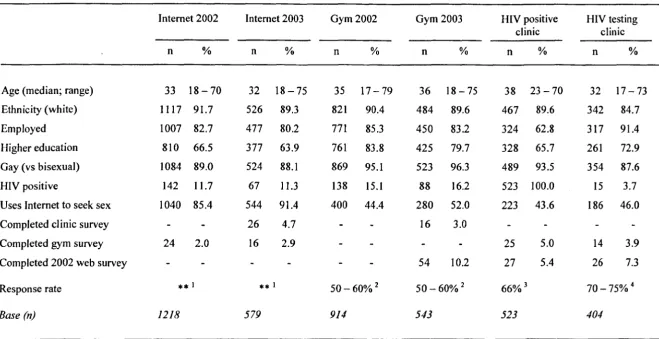
The Internet and HIV study recruited four samples of gay and bisexual men for the quantitative arm, with the aim of triangulating data from a number of sources and gathering samples with relevant features to address the research question. The following describes each of these four samples (Internet, gym, HIV positive clinic and HIV testing clinic) in order to provide a full description of the Internet and HIV methods. However, only data from the Internet and gym samples were used in the methodological research which forms the basis of this thesis. The gym, HIV positive clinic and HIV testing clinic samples completed pen-and-paper questionnaires
whereas the Internet sample completed a web survey.
Internet sample
Men who use the Internet to seek sexual partners were of key importance to the Internet and HIV study. In 2002 and again in 2003, men who used UK chat rooms and personal profiles on gaydar (http://www.gaydar.co.uk)andgay.com
could click on pop-ups and banners that appeared on these websites and took them directly to the homepage of the web survey. Although the target population was London men, it was not technically possible to restrict the pop-ups and banners to London chat rooms and profiles only. The pop-ups and banners therefore appeared in UK chat rooms and profiles. Although these are used mostly by men in the UK, some non-UK residents also use them. The surveys drew worldwide samples of 4,974 men in 2002 and 2,752 men in 2003. It is estimated that these samples represent less than 1 % of the people using the chat rooms and profiles over the survey period. Whereas only data from London men were used in the Internet and HIV study, the methodological research undertaken for this thesis includes data from the Internet samples at the London, national (British and UK) and worldwide level.
Gymsamp/e
Gay and bisexual men who use central London gyms are broadly representative of London gay men "on the scene", who go to gay bars, clubs and so on (Elford 2002). Gym-based surveys are therefore an effective method of gathering detailed data on sexual behaviour from this group of men (Elford et al. 2004a). In 2002 and again in 2003, all men who used one of seven central London gyms during a one-week period between January and March were invited to participate in the survey. All seven gyms had a substantial gay membership (40-100% of clients) but only men who identified as gay or bisexual were asked to answer the questions on sexual behaviour and the Internet. Completed pen-and-paper questionnaires were returned to
collection boxes in the gym or posted back to the research team. In 2002, the gym sample consisted of 914 gay and bisexual men who completed the survey and provided information on their HIV status and in 2003, it consisted of 543 men.
HIV positive clinic sample
HIV positive men were over-sampled to allow for in-depth study of their sexual risk behaviour and Internet use. Gay and bisexual men attending a National Health Service (NHS) outpatient HIV clinic are considered to be broadly representative of those living with diagnosed HIV. From October 2002 to May 2003, HIV positive men attending an NHS outpatient treatments clinic were invited to participate in the