Optimizing overhead irrigation systems
Joseph Foley1,2,3, David Wigginton2,4 and Jochen Eberhard2,
Faculty of Engineering and Surveying1, National Centre for Engineering in Agriculture2,
Cooperative Research Centre for Irrigation Futures3 and New South Wales Department of Primary Industries4,
University of Southern Queensland, Toowoomba, Queensland 4350, Australia. Tel. +61 7 46311871
Centre Pivots and Lateral Moves in the Australian Cotton Industry
Centre Pivots and Lateral Moves (CP&LMs) or overhead irrigation systems have been successfully installed in every cotton growing district in Australia. This industry now has the capacity to broaden the uptake of this irrigation technology, and benefit from its simplicity and improved water use efficiency while moving away from farming systems based on saturated fields.The greatest source of information that the Australian cotton industry has in respect of CP&LMs is the small number of people that have experience with these machines. The greatest disadvantage that the Australian cotton industry faces in respect of CP&LMs is the small number of people that have experience with these machines. Growers considering purchasing CP&LMs should do everything in their power to look, listen and learn from these people. Their experience is invaluable in ensuring that the Australian cotton industry implements this irrigation technology successfully.
In keeping with the cotton industry's mantra of "Concentrate on the things you can change and forget about the rest", I will outline the important parameters you can alter during design to optimize the overall performance of CP&LMs. This paper will examine the optimal design, installation and management of Centre Pivot and Lateral Moves or overhead irrigation systems. Topics will include optimizing the design to achieve an adequate system capacity or water supply rate, designs to minimize energy and labour inputs, and design to maximise the irrigation performance of CP&LMs in terms of uniformity and application efficiency. Discussion will follow on a range of recently completed tools that will assist surface irrigation growers and agronomists to more easily understand the practice of irrigation under CP&LMs.
Good irrigation system design is being ignored by growers
cost effective, labour saving device that uniformly applies the desired amount of water when and where required. It is a simple objective that is often simply missed. Cotton growers in the process of purchasing their first CP&LM are in the precarious and unenviable position of having the least amount of knowledge at a time when they require it most. Many growers already using CP&LM irrigation systems will advise prospective buyers that a good understanding only develops after 2-3 seasons of operation. Operators then begin to optimize their management to achieve water and labour savings, and produce cotton yields comparable to traditional surface irrigation systems. Growers with existing surface irrigation should work through the process of measuring and modelling the performance of their surface irrigation system to ascertain potential performance improvements (Smith et al. 2005) before considering alternative irrigation systems such as CP&LMs.
Optimized overhead irrigation system
An optimized CP&LM design will maximise the amount of water placed into the crop root zone from the water pumped, will distribute the required depth of water uniformly across the field, will be capable of meeting peak crop water use rates and will have minimal energy and labour inputs. These elements of an optimized irrigation system are very strongly, if not solely influenced at the design stage for any CP&LM installation. The need for the purchasing grower to be acutely aware of these important design elements is paramount if the grower is to achieve an optimized CP&LM design successfully irrigating in his field over the 15 to 25 year life of the machine.
Quantity, rate and quality of your water resources are most important
The irrigation design process for a greenfield site must firstly include an analysis of the water resource in terms of the available seasonal volume, maximum supply rate, probability of accessing this volume and rate, and the water quality. A legally granted allocation does not mean access to a particular volume every year, and for groundwater supplies the maximum sustainable rate can only be inferred from a 48 hr groundwater pump test. The reliability or probability of success of an irrigation system is considerably improved by a thorough analysis of the possible water resource before final sustainable flowrates or system capacities are chosen. Modern CP&LMs designs are capable of applying a system capacity of more than one ML/week (14.3 mm/day) to every CP&LM irrigated hectare when the system capacity is designed appropriately (Foley 2004b) for cotton's peak water use periods in Australia's hottest cotton growing districts. The successful resurgence and expansion of CP&LMs across the Australian cotton industry can be solely attributed to the higher system capacities currently being deployed in modern machines. Remember that if the CP&LM will only operate during weekdays during the peak crop water use periods of full summer, then considerable increases in the system capacity are warranted and must be included in the design process by increasing the flowrate delivered to the CP&LM irrigated area.
channels, there is nothing more certain to drastically reduce the life of a galvanized CP&LM than corrosive groundwater. Machine life can be reduced to less than 3 years when corrosive groundwater quality is not accounted for when selecting the span pipe lining material. Options such as polythene and PVC linings, aluminium and stainless steel pipe exist to extend span pipe life when operating with corrosive water supplies. Growers are best advised to have water samples tested by accredited laboratories, so that CP&LM companies or locally skilled hydro-geologists can advise upon the most appropriate span pipe lining material.
These three aspects of the water resource in the quantity or volume, the sustainable flowrate or system capacity, and the water quality, are the first priority in the design of CP&LMs.
Soil type, distribution and soil condition with field slope are important in design Secondly, field and site conditions need to be analysed for soil type, their distribution and extent, field slope and the manner in which the soil surface will be conditioned throughout the growing season. At all times, only one soil type should be irrigated by any one CP&LM, and it is paramount that soil surveys map out the different soil types that exist on and around the proposed development site. Every effort should be made before the final field design to have the machine only irrigate a single soil type at any one time. No irrigation block containing two different soil types can be irrigated well with any of the available irrigation systems. Ensuring that drier fields, like CP&LM irrigated fields, will still drain after large rainfall events is essential, but CP&LM fields are rarely cut to a single grade with selective field cuts regularly used to ensure drainage.
Designing for low pump pressures reduces long-term running costs
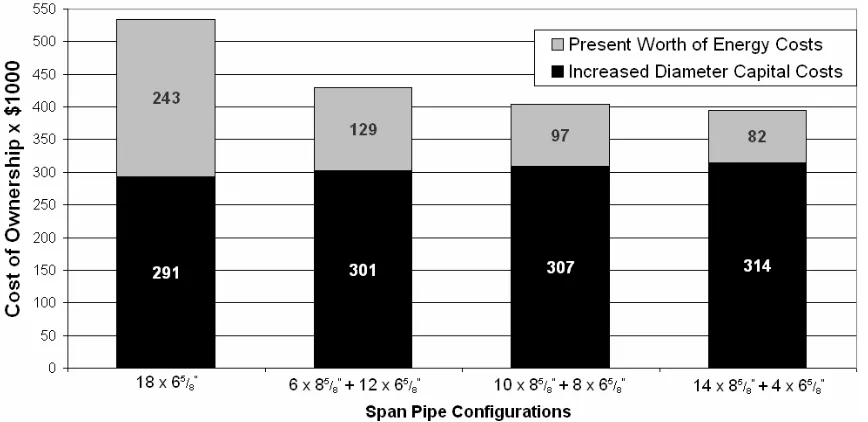
Figure 1. Upfront capital costs for an increasing number of larger span pipes and the present worth of 15 years of future energy costs for an 18 span lateral move pumping 23.3 ML/day. Calculations based on 835 ML per annum pumped and 7% interest. Future energy costs are reduced to one third using a majority of large diameter span pipes when compared to a CP&LM design containing all small diameter span pipes.
Still greater reductions in the running costs of the largest lateral moves are possible by improved selection and matching of pump types and diesel motor brands using two motor configurations for pumping and movement power on large lateral move carts. These improved designs have the potential to reduce running costs by 20%, and will be the topic of future work with large lateral move designs for the Australian Cotton Industry.
After the machine hydraulic design, nozzle size selection by CP&LM sprinkler manufacturers will be carried out accounting for nominal machine flowrate, so as to produce precise supply point flowrates and pressures. Good nozzle size selection software used here in Australia produces high levels of uniformity. Pump and pipelines are then designed to produce this required pressure and flowrate at the CP&LM supply point, minimizing operating pressures and resultant long-term running costs. After this hydraulic design is completed, consideration should be given to appropriate automation technology to minimize labour input, such as mobile phone remote control and rainfall shutoff switches (Foley 2004a). Fertigation of nitrogen is now carried out by many growers with new large lateral moves in polythene lined machines. Wheel and tyre sizes, and tower sprinkler/nozzle options towers will then be chosen to minimize wheel rutting.
High soil surface detention capacity is required for high flowrate CP&LMs
more than 70% of the machines performance. Modern CP&LM sprinklers on close spacings apply water into the crop root zone both uniformly and efficiently. The choice of sprinkler packages will depend on the soil type and the expected soil surface condition throughout the cotton growing season. The major delineation in thinking should arise due to soil type and its surface roughness condition during the peak water use period. If a hard-setting, sodic or dispersive soil types will be irrigated with a CP&LM, then keep centre pivot lengths short, lateral move machine lengths long, and reduce the system capacity to a level that produces your highest acceptable risk of crop yield loss. Ensure that medium pressure long throwing, multi-stream, moving plate sprinklers on close spacings are setup on booms perpendicular to the span pipe, or use double the number of static plate sprinklers on longer booms. Where high sprinkler flowrates and hard setting soil types exist, use at least 3 to 4 sprinklers per boom with boom spacings of 1 to 2 metres along the full length of a lateral move or the outer 1/3 of a centre pivot. In the worst soil conditions the additional use of furrow dikes between low hills/beds, with stubble retention, and aggressive inter-row tillage will increase the detention capacity of the soil surface to hold the applied water where it is placed. Double-ended LEPA socks with reservoir tillage or furrow dikes in every second furrow bottom work well on the hard-setting "difficult" soil types across the Australian cotton industry. Cracking clay soils are successfully irrigated using simpler static plate sprinklers spaced at 1 or 2 metres at operating heights of 1.4 metres. LEPA bubblers are used at 0.1 metre height after sprinkler germinated crops are established. Through the main crop growing season LEPA is used in cracking clay soil types on 2 metre spacings, utilizing this soil's crack volume as the detention capacity. Producing a fine soil tilth in furrow bottoms will exacerbate run-off issues and is never recommended under CP&LMs. Significant soil roughness outside of the planted seed zone is always desirable and lower hills/beds are regularly used, with innovative growers moving to "on-the-flat" broad-acre production systems under CP&LMs.
It is only after these important design issues have been adequately covered, that thoughts should progress to the purchase and installation processes. Ensuring that your chosen CP&LM design is correctly implemented through the purchase and installation phases of the CP&LM development is absolutely critical in providing you with the opportunity to manage it well. The role of the independent irrigation engineer/advisor in ensuring that a CP&LM capable of delivering your required system capacity in a uniform and efficient manner, while minimizing running costs and labour input is installed in your field in a timely fashion is important. Underestimate independent advice on CP&LM design at the expense of your enterprise's future profit levels.
The following concluding sections discuss some recently developed CP&LM irrigation management tools and issues.
Simulation tool to assist CP&LM irrigation management in the learning years
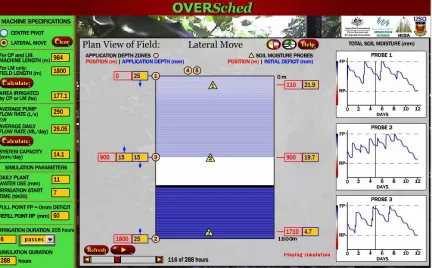
management style. Recent developments as part of CRDC funded work on CP&LMs have included a graphical web based CP&LM irrigation simulation tool, OVERSched shown below in Figure 2.
Figure 2. Graphical interface of the web-based CP&LM management tool OVERSched showing system capacity calculator on the left, with the lateral move irrigator graphic and the three corresponding moisture probe outputs on the right hand side.
Probe readings from LEPA irrigated cracking clay soils can be misleading
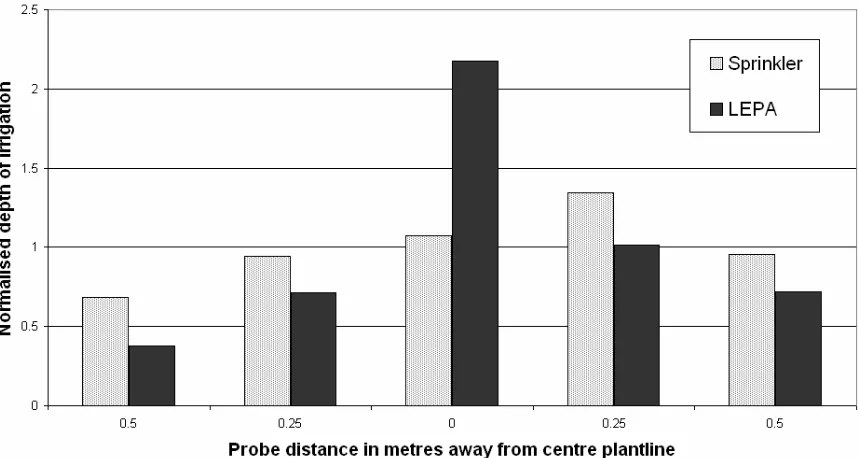
[image:7.595.97.526.227.456.2]There exists large variability in the soil moisture change after LEPA irrigation of cracking clay soils as assessed by point source soil moisture sensors like capacitance probes. This variability arises as a direct result of the applied depths commonly being less than the soil moisture deficit and the preferential distribution of irrigation water through the cracked soil profile. A typical result showing the large variation in probes readings across a crop plant line under LEPA irrigation on a cracked soil profile is shown in Figure 3.
Figure 3. Variation in the total depth of applied irrigation water as indicated by soil moisture capacitance probes across a plant line, with probe 3 positioned in the plant line. The probe in the plant line during LEPA irrigation indicated 2.2 times the actual average depth of applied irrigation water, while much smaller variation was indicated under sprinkler irrigation.
Consequently, any measurement of soil moisture levels for LEPA irrigations in cracking clays soils, where depths of water less than the soil moisture deficit are usually applied, should be considered in conjunction with a soil water balance using FAO56 ET calculations, rainfall and the CP&LM applied depths. A plant's water status is the ultimate integrator of the irrigation requirement when growing crops on cracking clay soils and further work investigating this water status monitoring technique is underway within the NCEA through the CRC for Irrigation Futures. Guidelines for probe placement in CP&LM irrigated fields will not differ from the existing practice, except for the recommendation to use a greater number of probes or access tubes in plant-lines at any single site in the lowest clay content soil type in the field.
Development of a Centre Pivot and Lateral Move Training Package
containing additional trainer's notes and information. Delivery of this training package was completed with the Cotton CRC Water Extension Team in March of 2005, and further development has been occurring with the CRC for Irrigation Futures. The package contains material ideal for delivery to growers, agronomists and irrigation extension personnel. Collaborative work between the CRCs for Irrigation Futures and Cotton will deliver a cotton specific irrigation management course containing elements of this CP&LM training package. A more general non-crop specific CP&LM training package is also being developed by the CRC for Irrigation Futures for national delivery.
CP&LM machines will irrigate more Australian cotton in the future
CP&LMs are complex machines that require a high level of knowledge to design for minimal energy and labour inputs while irrigating with high levels of uniformity and application efficiency. There is a wealth of published information now available for the Australian cotton industry to continue to learn about the design and management of large area, high flowrate, low pressure CP&LMs. A great source of information for the Australian cotton industry remains with growers who successfully irrigate with CP&LMs. Always design for low running costs and minimal labour input, and high uniformity and application efficiency while ensuring that you have the system capacity to adequately irrigate your crop. Independent design advice and/or performance assessment will ensure success for your CP&LM development.References:
Foley, JP & Raine, SR 2001, Centre pivot and lateral move machines in the Australian cotton industry, NCEA publication 1000176/1, University of Southern Queensland, Toowoomba. Foley, JP 2004a, 'Centre pivot and lateral move machines', Ch 4.6, pp. 195-220, in H Dugdale, G
Harris, J Neilsen, D Richards, G Roth, & D Williams (eds.), WATERpak - a guide for irrigation management in cotton, Cotton Research and Development Corporation, Narrabri. Foley, JP 2004b, 'System capacity the key for overhead irrigators', The Australian Cottongrower,
Dec. 2003-Jan. 2004, pp. 24-27.
James, LG 1988, Principles of farm irrigation system design, Wiley, New York.
Jensen, ME (ed) 1983, Design and operation of farm irrigation systems, ASAE Monograph 3, St. Joseph, MI.