Link-Based Methods for Web
Information Retrieval
MSc Thesis
written by
Clive Nettey
under the supervision of Dr. ir. Jaap Kamps, and submitted to the Board of Examiners in partial fulfilment of the requirements for the degree of
MSc in Logic
at the Universiteit van Amsterdam
Date of public defense: Members of the Thesis Committee:
6th March 2006 Dr. ir. Jaap Kamps
Prof. dr. Maarten de Rijke
Dr. Peter van Emde Boas
Acknowledgements
Without the support and patience of my supervisor: Dr. ir. Jaap Kamps, this thesis may well not have materialised. Jaap has taught me many lessons that will stay with me long from now – amongst which is the benefit of perceiving a half empty glass as half full.
I owe a debt of gratitude to my employers PricewaterhouseCoopers (in particular Martin Beckwith-Brown and Anthony Faucher) who have supported me through my endeavours above and beyond the call of duty.
Abstract
Although commercial search engine companies have reported a great deal of success in appropriating link-based methods, these methods have struggled to demonstrate significant performance improvements over content-only retrieval methods in several off-line Web IR evaluations. In this thesis the effectiveness of link-based methods is assessed against content-only retrieval baselines. Algorithms embodying established HITS, in-degree, realised in-degree, and sibling score propagation techniques are evaluated alongside variants of those algorithms. The variant algorithms are devised to aid in three secondary lines of investigation relating to link-based methods: the effects of link randomisation, the utility of sibling relationships and the influence of link densities.
All established link-based algorithms are demonstrated to improve on several content-only retrieval baseline performance metrics with the realised in-degree algorithm proving to be particularly effective across all considered metrics. In relation to the other lines of investigation, the experimentation reveals that: leveraging sibling relationships does not lead to significant performance improvements, higher link densities do not afford performance improvements and that algorithms are susceptible to link randomisation.
Keyword List
Table of Contents
1.
Introduction
. . . Page
6
2.
Overview of Web IR
2.1 Information Retrieval . . . . Page 9
2.2 Web IR Challenges . . . Page 11
2.3 Web IR Evaluation . . . Page 13
2.4 Link Structure Analysis . . . . Page 15
2.5 Link Structure Analysis in Web IR . . Page 17
2.6 Typical Web IR Implementations . . . Page 21
2.7 Chapter Summary . . . . Page 23
3.
Experimentation
3.1 Experimental Aims . . . Page 24
3.2 Experimental Setup . . . Page 28
3.3 Content-Only Retrieval Baseline Runs . . Page 33
3.4 Featured Algorithms . . . . Page 34
3.5 List of Experiments . . . Page 43
3.6 Implementation Details . . . . Page 46
3.7 Chapter Summary . . . . Page 47
4.
Results
4.1 Algorithm Performance . . . . Page 49
4.2 Algorithm Tuning . . . Page 52
4.3 Influence of Link Density . . . . Page 62
4.4 Effects of Randomisation . . . . Page 64
4.5 Utility of Siblings . . . Page 66
4.6 Chapter Summary . . . . Page 72
5.1 Effectiveness of Link-Based Methods . . Page 73
5.2 Utility of Sibling Relationships . . . Page 75
5.3 Link Density and Link Randomisation . . Page 78
5.4 Further Work . . . Page 79
Bibliography . . . Page 81
Appendices
Appendix A - Empirical Correlations . . . Page 88
1. Introduction
In many respects, content on the World Wide Web is no different to content in off-line document collections. For that reason, the approaches taken in traditional Information Retrieval are highly applicable to the Web.
The nature of the Web introduces a number of challenges to traditional Information Retrieval but alongside those challenges are opportunities for exploiting sources of evidence not present in other contexts. Examples of this evidence are structured documents facilitating richer abstracted representations, and document usage data provided by Web servers. Hyperlinks are a particularly valuable source of
information. Due to the fact that hyperlink authors are often not the authors of documents that are the targets of their hyperlinks, potentially impartial judgments on documents can be discerned. From the perspective of Web Information Retrieval, the payload of hyperlinks is two fold. Firstly, the hypertext associated with hyperlinks enable the representation of target documents to be enriched with typically terse annotations. Secondly, collectively – hyperlinks allow otherwise unconnected documents to be modelled as nodes within a graph, yielding valuable topological properties for those documents.
The value of topological properties has been exalted by commercial Web search engine companies such as Google who use topological link-based methods to improve their search results. Although search engine companies remain positive about the value of link-based methods, many attempts to verify the effectiveness of these methods with a number of test collections have been unsuccessful. The divergence between what has been reported by search engine companies and neutral empirical evidence has raised some doubt as to whether link-based methods really do work.
The primary goal of this thesis is to analyse the effectiveness of a variety of
topological link-based methods by contrasting their performance with content-only retrieval baselines.
¾ In-degree
¾ Realised In-degree ¾ HITS
¾ Sibling score propagation
In addition to implementations of these methods, a number of variations are introduced and evaluated. The variants are designed to help fulfil three secondary research goals:
¾ Determine the utility of sibling relationships ¾ Determine the influence of link density ¾ Determine the effects of link randomisation
Additionally, an insight into the tuning of all algorithms is sought. A detailed account of experimental aims can be found in section 3.1.
The remainder of the thesis is organised into four additional chapters:
¾ In chapter 2: The fundamentals of Web IR and link structure analysis are introduced through an overview of influential and introductory literature in the field.
¾ In chapter 3: The aims, setup and scope of experimentation is presented. Specifically, all evaluated algorithms are introduced and the evaluation environment detailed.
¾ In chapter 4: The results of experimentation pertaining to all research aims are presented.
2.
Overview of Web Information Retrieval
Web search engines are typically extensions of Information Retrieval (IR) systems which were established long before the Web came into existence. With the rapid growth of the Web in the 1990s, a need for search capability became imminent and by the mid 1990s rudimentary appropriations of IR systems for the Web surfaced from early adopters such as AltaVista (who claim to have delivered the Internet’s first Web index [AltaVista]).
Even before Web searching, searching of other Internet information sources was possible. Archie facilitated searching of FTP files by name and Veronica offered keyword search of Gopher menu titles.
Although today’s Web search engines are tailored for searching Web data, their roots lie in IR and many of the techniques established in IR remain characteristic of Web search engines.
2.1 Information
Retrieval
A number of retrieval models have been devised to abstract the processes underlying Information Retrieval systems. Models in which formal queries specify precise criteria for retrieved documents are said to be exact-match models, whereas best-match models return a ranked list of documents for a query conveying suitable documents. Exact-match models such as the Boolean model in which queries are formulated as logic expressions are more popular in legal and scientific search systems than Web search engines. The Web’s user base generally demand less-rigorous, informal querying and are willing to sacrifice certainty in exchange. Popular contemporary Web search engines in tune with their user base therefore tend to be underpinned by best match retrieval models.
Perhaps the three most prominent best match models are the vector space model [Salton1968], probabilistic model [Robertson1977] and the language model
[PonteCroft1988]. In the vector space model, queries and documents are modeled as vectors in a high-dimensional Euclidean space where each axis corresponds to a distinct term and the co-ordinate along the axis is a weight determined by statistical occurrence data for the term. Once encoded in vectors, similarities between queries and documents can be deduced according to vector arithmetic. Often the inner product of vectors is used in this regard. Term weighting schemes are key to performance in these models since terms carry varying levels of significance depending on context. Typically the weight of a term in a document or a query is determined by a combination of its local profile within the document or query, its global profile within a wider context (the document collection as a whole) and a normalization factor compensating for discrepancies in the length of documents.
The probabilistic model takes a more conceptually intuitive approach. Instead of being based on relatively abstract vector arithmetic, relevance rankings are based on a probabilistic measure of searchers’ relevance classifications given a query and
independent - a little manipulation of this measure involving application of Bayes rule, reveals that a proportional approximation of it can be derived from estimates of the probability that the document’s terms feature in relevant classification (
formulated as P(t|R) ) and non-relevant classifications ( formulated as P(t|NR). These estimates are typically sourced from maximum likelihood data taken from relevance feedback or from collection-wide term occurrence data.
Similar to the probabilistic model is the language model in which relevance rankings for documents are based on the probability that a searcher had that particular
document in mind when generating their query, this is formulated as P(D|Q). Under the assumption that query terms occur independently and some manipulation with application of Bayes rule it follows that the measure can be approximated using estimates for the probability that query terms feature in the document ( formulated as P(t|D) ) along with a prior probability for the document (formulated as P(D) ). Typically, maximum likelihood estimates taken from document term frequency data are used in estimating query-term probabilities whilst document lengths are used in estimating document prior probabilities. In the context of Web Retrieval, authority measures are more prudent document priors.
Irrespective of the retrieval model underlying an IR system, an inverted index is conventionally used to store representations of documents within the document collection. This structure typically consists of an index of terms with pointers to the documents in which they occur and additional metadata pertaining to those
occurrences. The process of creating an index is dubbed indexing.
Research into the tuning of classic Information Retrieval systems for various
document collections and query-sets can be useful for optimizing Web search engines. A study by Salton and Buckley on vector space model weighting schemes
2.2
Web Retrieval Challenges
The nature of the Web poses a number of challenges to classic IR systems. Several of these are outlined in this section.
Crawling
Web content is distributed across countless Web servers scattered across the Internet, therefore unlike IR collections it is a prerequisite to assemble a snapshot of the Web’s content (a crawl) before constructing a representation of it through indexing.
Typically snapshots are assembled by automated applications which engage in crawling; the process of recursively fetching documents using a pool of document locations (URLs) which is replenished with discoveries of new URLs referred to in the hyperlinks of fetched documents. Although implementing rudimentary crawlers is relatively straight forward, Google [BrinPage1998-B] intimate that industry strength crawlers capable of assembling the large crawls typical of major search engines requires a great deal of engineering.
Diverse Search Requirements
In tandem with developments in Web technology and Web programming, the Web is increasingly functioning as a platform for a growing number of on-line services and Web applications such as Internet banking and Web mail. Changes in the use of the Web induce changes in the intent of Web searchers. Broder [Broder2002] presents evidence that informational searches – as formulated in the context of traditional IR [SchneidermanByrdCroft1997] account for less than 50% of all searches. The
Although the category of informational searches is common to both IR and Web IR, the abundance of content on the Web demands greater discrimination when returning results for broad-topic searches of this type. A shift in emphasis towards a topic distillation approach to satisfying these queries is advocated by Chakrabarti [Chakrabarti1998-B]. By topic distillation, Chakrabarti refers to an approach in which potential search results are evaluated according to how well they represent a topic as opposed to how similar they are to the topic. Chakrabarti experiments with a means to identify this representative quality by analysing topological data. Although numerous techniques for capturing the representative quality of a document through topological analysis have been devised, Marchiori [Marchiori1997] challenges the fairness of these approaches. Instead of topological analysis, he advocates using information in discerning the added-value of a document, where hyper-information is described as the hyper-information that can be obtained through browsing additional content that is hyperlinked.
Search Engine Persuasion
Search Engine Persuasion, coined SEP by Marchiori [Marchiori1997] refers to deliberate manipulation of Web search engines in order to boost the ranking of documents in search results. SEP is far more common on the Web than in traditional IR contexts where there is relatively little competition for the attention of collection audiences. Due to the commercial motives of traffic hungry Web site owners, manipulation of this sort ranges from being deceptive to fraudulent. The implicit use of neutral quality judgments in the form of hyperlinks countered the effects of
primitive SEP methods such as hidden text. In more advanced SEP hyperlinks are manipulated also. Understandably, efforts made by commercial search engines to maintain the integrity of their search results tend not to be made public.
Incorrect Content
from important sites. The challenge of retrieving correct content is therefore closely tied to that of retrieving authoritative content.
Duplication
Duplication of content is far more likely in the context of the Web than it is well controlled collections. Duplication poses a problem for both Search engines and searchers alike. Search engines are computationally burdened by the crawling, indexing and storage of duplicate content and Internet searchers find the presence of duplicates amongst retrieval lists a nuisance. There are generally two approaches to duplicate elimination. Fine-grained duplication elimination concentrates on
discovering duplicate pages where as coarse-grained duplicate elimination places an emphasis on identifying duplicate resource directory trees (mirrors).
2.3
Web Retrieval Evaluation
There are a variety of outlooks on what constitutes a good Web search engine. Many suggestions for performance metrics are somewhat less formal than the criteria used in assessing Information Retrieval systems.
[Clevedon1966] identifies 6 criteria for the evaluation of information retrieval systems.
i. Coverage ii. Time Lag iii. Recall iv. Precision
v. Presentation vi. User Effort
[RossiMelliaCasetti2003]. In light of this figure ‘Time Lag’ is naturally a key performance factor. However variations in network latency at different points on the Internet make the evaluation of ‘Time Lag’ for Web Search engines unreliable. [GwizdkaChignell1999] intimate further problems with ‘Time Lag’ metrics due to variations in Internet load.
Although ‘coverage’ (scope of searchable content), ‘presentation’ and ‘user effort’ are important from a searchers perspective, they pale into insignificance when compared to precision. [JansenSpinkSaracevic2000] report that 58% of searchers view no more than the first 10 results returned for a query and that the mean number of pages examined is 2.35. These facts intimate the need for high precision in Web IR.
In their discussion on Web IR evaluation [Gwizdka&Chignell1999] suggest that ‘user effort’ can be approximated to the search length method introduced by Cooper
[Cooper1968]. As it’s defined by Cooper, search length corresponds to the number of irrelevant documents encountered before arriving at a relevant document. A more elaborate version of the metric is ‘expected search length for n’, which is defined as the number of documents it is necessary to traverse before finding ‘n’ relevant
documents. [vanRijsbergen1979] adds some mathematical fines to Cooper’s expected search length formulation.
Presentation of retrieval results has an impact on the precision and user effort a searcher experiences and for that reason is also a valuable metric. According to [GwizdkaChignell1999], the vast majority of Web search engines return a linear ranked list of results and even when there is an attempt to convey that several documents share the same rank – users are oblivious to it. Some research has gone into how best to present search results, but as so many search engines opt for the same linear ranked list presentation – it would be impossible to differentiate them in that regard.
Systems without a base requirement for relevance judgments have been proposed. [WuCrestani2003] present a number of variations of ranking methods in which the quality of an individual search engine is based on how well its rankings correlate with those of other evaluated ranking methods. To this end, the notion of a reference count is introduced as a measure of how many other evaluated search engines also rank a document that is ranked by an evaluated system. A sum of reference counts for all retrieved documents is then used as the basis for ranking the candidate search engines.
Other useful non-human, relevance judgment search engine ranking methods feature click-through data. Where click-through data can be loosely defined as data
pertaining to the activities of searchers, such as which retrieved pages they visit. [Joachims2002] presents a method for assessing the quality of two counterpart systems based on how a user interacts with a neutral retrieval result list featuring an even mix of results from each search engine. Joachim’s research demonstrates that the approach produces equivalent results to those obtained through traditional relevance judgments under a number of plausible assumptions which are empirically verified. One such assumption is that users click more frequently on relevant links than irrelevant links.
2.4. Link
Structure
Analysis
Social network theory is concerned with the application of graph theoretical
context of Web IR and a number of prestige measures emanating from social network analysis research have found their way into link-based Web IR methods.
Aside from Web IR, link analysis also plays a part in a number of other Web related disciplines including Webometrics, Web crawling and Web clustering. As the Web becomes a more integral part of society, a better understanding of its form becomes vital. To that end, Webometrics yields information on the structural properties of the Web such as its theoretical diameter and size. [Broder2000] intimates that such information can be utilized to improve Web crawler design and identify important phenomena that could be useful in managing the growth of the web. Broder’s study most notable for it’s bow-tie model of the Web’s structure in which there is a strongly connected core (SCC) of about 66m pages with a set of 44m pages linking into it (IN set) and another set of 44m pages linked to by it (OUT set). A number of pages that are totally isolated from the core then pertain to tentacles that hang off the IN and OUT sets.
Yet another application of Web link analysis is in Web clustering and categorization algorithms which grouping similar pages together. [Chakrabarti1998] demonstrates that links and their surrounding anchor text can be used to develop an automatic resource compiler with performance that is compatible to the manual Web directory Yahoo!. Clustering of Web pages also feature in Web meta search engines such as Vivisimo [Vivisimo] which further categorize search results for the convenience of searchers.
2.5
Link Structure Analysis in Web IR
Generally link-based methods in Web IR fall into two categories, local link structure techniques and global link structure techniques. Local link structure techniques focus on links within a sub-graph pertaining to a query whereas global link structure
techniques operate on the links of an unrestricted graph independent of any query. Further, global link based methods essentially incorporate the global status of a web page amongst all other web pages into retrieval assessments. The results of such global link analysis techniques are combined with the results of content focused analysis in determining an overall relevance score.
The status or importance that Web pages enjoy can be approximated in several manners. Perhaps the most simple of these is a citation count approximation
rendering the page with the highest number of in-links as that with the highest status. The idea central to this, that each in-link to a page is an equally important
endorsement of it, featured in academic citation analysis as early as 1972 [Garfield1972] and implementations of the technique have been employed in applications as diverse as speculating on future winners of the Nobel Prize [Sankaran1995].
Another class of link based methods are A mature variant of citation count (or in-link count in the context of the Web) is the iterative PageRank1 computation
[BrinPage1998] for a page in which the endorsement value of individual links vary according to their position within the Web graph. The intuition here is that the magnitude of endorsement contributed by a link should be proportional to the source pages own status and inversely proportional to the total number of endorsements offered by that source page.
Amongst the most widely cited link-based algorithms is HITS (Hyperlink Induced Topic Search) [Kleinberg1998]. At the heart of the HITS algorithm is an attempt to solve two fundamental problems of content based web retrieval. The first of these
1 (1 ) ( )
) ( ) ( ) ( ) , ( u C d v OutDegree v PR d u PR WebLinks u v − + =
∑
∈problems is introduced by Kleinberg as the abundance problem and is described as occurring when in his words; “The number of pages that could be reasonably relevant is far too large for a human to digest”. He notes that this problem arises when
applying content-only retrieval to “broad topic” queries with a large representation on the Web. In developing his extension of HITS; ARC (Automatic Resource
Compilation), [Chakrabarti1998] describes the analogous challenge of a “Topic Distillation”. Secondly, Kleinberg notes the phenomena of relevant documents which are elusive to content-only retrieval methods. A Web search engine home page is given as an example of a page that is unlikely to contain terms in common with a query such as “search engine” and thus evade retrieval by content-only retrieval methods. HITS approach to addressing both of these issues is to identify high quality, authoritative documents amongst self-descriptive and possibly non self-descriptive relevant documents by augmenting content retrieval methods with link structure analysis. Key to the link structure analysis is the distinction between hubs and authorities and the mutually reinforcing effect they have on one another. A hub is a document with links to authorities. The more plentiful and authoritative the out-linked sites are the better the hub is. Likewise an authority has in-links from many hubs. Should those in-links be plentiful and originate from good hubs then the better the authority is.
The meta-algorithm underlying HITS is characteristic of many other link analysis algorithms.
i. Start with a query focused set of lexically similar retrieved documents, referred to as a root set.
ii. Speculate on a set of potentially relevant documents related to root set members and expand the root set with these to produce a base set.
iii. Apply link analysis to the sub-graph structure pertaining to the base set in producing judgments on the authority of these documents.
The value in augmenting the root set in the second phase is two fold. Principally, there is a broadening of the scope of candidate authorities from just lexically similar ones which introduces the possibility of retrieving otherwise elusive documents. Additionally, the link density of the sub-graph will be increased as a consequence which is likely to be beneficial to subsequent link-analysis. Beyond stating the intention to keep the size of the base set relatively small for computational efficiency, Kleinberg gives little consideration to its construction. Interestingly,
[NgZhengJordan2001], show that changes in the linkage patterns within a base set could cause considerable changes in HITS authority results.
A number of heuristics have been implemented to better refine the semantics of links within the base set sub-graph. Kleinberg suggests that links from one site to a
particular page on an external site should not signify the same degree of endorsement as when those in-links are from a variation of sites. In the former case all the in-links are likely to represent one particular author’s endorsement of the site, whereas in the latter case the endorsements are widespread and thus more valuable.
[HenzingerBharat1998] makes the same over-influential author observation in the implementation of a refinement to HITS in which the influence of multiple intra-site links is tempered. In her experiments, this refinement renders a 25% improvement in average precision.
A clear semantic distinction between the authority conveyed between inter-site links and intra-site links is also intimated by Kleinberg in suggesting that inter-site links very often exist only to allow for navigation of the infrastructure of a site and thus unlike external links should not convey authority. Both [HenzingerBharat1998] & [Chakrabarti1998] note that an HITS analysis can result in a loss of focus on the original query, often referred to as topic-drift. This is demonstrated to occur in cases where suitably connected components infiltrate into the base set and emerge as authorities although they are off-topic. [Chakrabarti1998] tackles topic drift by weighting the links of the sub graph according to the relevance to the query of anchor and anchor-neighbouring text associated to the link. In this sense, the endorsement that a linked page gets is proportional to it’s relevance as can be discerned from the similarity between its associated text and the query.
good performance of anchor text only retrieval in entry page finding tasks, where an entry page is the home page of a site.
[HenzingerBharat1998] go a step further by weighting links in accordance to the similarity between the query and the content of the link target. This approach offered an improvement when compared to standard HITS as does another introduced content analysis heuristic that prunes irrelevant documents from the sub graph prior to link analysis. Interestingly, Henzinger and Bharat reveal that a combination of these two methods does not lead to a further improvement.
An effect similar to topic drift is introduced by [Lempel2000] as the tightly knit community effect or TKC. Lempel shows HITS to be susceptible to small clusters of highly connected nodes. Due to their high link density, the nodes of these clusters score higher under HITS authority assessment than nodes from larger connected clusters with more relevance. This phenomenon is well illustrated through examples before a stochastic approach is shown to alleviate the problem.
In essence, Lempel’s link analysis method considers a site’s authority scores to be the product of its in-degree and the size of its community where a community is defined in terms of the connected component the link belongs to. Allowance is thus given for a site with a high in-degree amongst a small community to have comparable authority with a site of lower in-degree amongst a larger community.
Although Lempel’s results are largely positive, he is cautious over their merits when evaluations extend beyond early-precision measures such as precision at 10 to precision at 200.
[RichardsonDomingos2002] and [Haveliwala2002] advocate the combination of multiple pre-computed topic-biased page rank vectors in constructing authority assessments biased towards queries. The idea of biasing page rank scores had already been conceived in [BrinPage1998] introductory paper for the purpose of
query time a scoring function is used which sums the vector score of each of the 16 topic biased PageRank’s weighted by the probability of the topic’s relevance to the query. This probability is calculated using a unigram language model and utilizes maximum likelihood estimates for parameters.
The scores are shown to be equivalent to the PageRank vector corresponding to a standard random walk except that instead of users jumping to pages with uniform probability when not following out-links, the jump is biased towards pages belonging to classes probabilistically more relevant to the query.
Topic sensitive re-ranking of URLs matching queries are demonstrated by Haveliwala to consistently better standard PageRank re-rankings. These results are especially encouraging when considering the efficiency and insusceptibility to link spam of topic sensitive scoring.
2.6
Typical Web IR Implementations
In a technological survey of Web IR systems compiled by Huang [Huang2000], three components are said to be characteristic of Web search engines; an indexer, a crawler and a query server. Huang explains that together the crawler and indexer work to produce a representation of the Web which is optimized for efficient use by the query server. That much is true of IR systems in general. Where Web IR implementations differ from IR systems significantly is in the variety of information they exploit in retrieval, much of which is unavailable in traditional IR collections. Although the exact details of their systems are generally kept in-house, commercial Web search engines are known to leverage several Web-rich sources of information such as hyperlinks, document structure, document meta-data and usage data from Web servers.
of images and number of documents on site were demonstrated to be effective. A similar study [KraaijWesterveldHiemstra2002] found URL form to be particularly effective for entry page (home page) finding tasks.
Document structure is perhaps more readily available than meta-data. The vast majority of content on the web is structured in conformance with mark-up languages such as HTML and increasingly XML. Mark-up offers implicit contextual
information which facilitates richer modelling of documents than the typical bag-of-words suited to plain text documents. Typically, this representation replaces the standard term frequency meta-data associated with terms occurring in a document with term frequency vectors where each co-ordinate of the vector represents the number of occurrences of the term within designated context classes. Retrieval algorithms can then take this context information into account during relevance evaluations, so that occurrences of terms within certain context classes are more valuable than those occurring within others. Whilst focusing on HTML mark-up, [CutlerShihMeng1997] demonstrate that ‘strong’ and ‘anchor’ text are particularly effective descriptors of Web pages.
In XML retrieval, context is important from an addition perspective also. Not only can context aid with retrieval performance, it is also key to meeting a searcher’s requirements. Typically the unit of retrieval in XML retrieval is a particular fragment of an XML document not necessarily the whole document itself. XML queries therefore often feature strict structural constraints so that not only are terms specified in queries but also the required contexts of those terms. The quality of retrieval is consequently not only based on the content resemblance of a fragment to a query but also on the context resemblance where the notion of context resemblance can be expanded in a number of ways. A popular context measure is longest common subsequence which is defined as the how many consecutive components within a context definition match.
improving Web IR systems. In an insight into the architecture of their Web search engine [BrinPage1998-B], Google confirm that they index anchor text. Further, structural information pertaining to terms such as font and capitalization are used to enhance their index entries. Terms appearing in URLs and meta-tags are also
distinguished within Google’s index structure. From the insight given by Google it is clear that commercial search engines must also concern themselves with optimizing efficiency and eradicating duplication.
TREC Web Track participants are more open about their techniques than Web search engine companies and their Web IR research publications are well cited. Participants from the University of Twente [KraaijWesterveldHiemstra2002] are believed to be the first to have published details on the effectiveness of applying URL form evidence in entry page searches [HawkingCraswell2004], a technique which is thought to have since been adopted in commercial Web search engines.
2.7 Chapter
Summary
3. Experimentation
In this chapter we start by re-stating and clarifying the aims of the experimentation carried out in this thesis. Next, in section 3.2 the test collection used for experiments is introduced and detailed. The content baselines and algorithms featuring in
experiments are then described in sections 3.3 and 3.4.
At the end of the chapter a list of all runs yielded by the experiments is presented along with an overview of the experimental architecture implemented to produce them.
3.1 Experimental
Aims
The experimentation carried out is designed to meet two primary objectives:
¾ Evaluate the effectiveness of link-based methods ¾ Gain an insight into the tuning of algorithms
In addition to established link-based methods, a number of variations on them are introduced and the performance and tuning of these will also be investigated. The variant algorithms are specifically devised with the following secondary objectives in mind:
¾ Determine the utility of sibling relationships ¾ Determine the influence of link density ¾ Determine the effects of link randomisation
In the remainder of this section all objectives are further expanded.
A selection of four familiar based methods has been chosen to represent link-based methods in general. The four selected methods are listed below.
¾ HITS Authority ¾ Realised In-Degree ¾ In-Degree
¾ Sibling Propagation
Although many retrieval systems have featured these techniques there is little
evidence of extensive independent appraisal of them. Amento’s study [Amento2000] is perhaps one of the most widely cited works of this nature. However, his
experimentation featured an arguably insufficient total of 5 queries in a tailor-made topic distillation task.
By comparing the performance of several link-based algorithms against content-only retrieval baselines the aim is to determine whether link-structure analysis is beneficial. Additionally, some insight into the relative merits of the evaluated algorithms is
sought. The emphasis of the experimentation is on the added-value offered by link structure analysis in addition to content analysis as demonstrated by implemented algorithms. To this end, the methodological choice is made to restrict algorithms to using only evidence obtained through link-structure analysis in supplementing ready-made content-only retrieval similarity information. Any improvements on pure content-only retrieval performance can then be attributed directly to link-structure analysis.
Gain Insight into Tuning of Established Algorithms and Their Variants
By varying parameter values, an understanding of which configuration of parameters lead to optimal performance on a per-algorithm basis is sought. As is a general impression of how changes in parameter values impact the performance of individual algorithms.
In contrast to link relationships, there is far less evidence of the employment of sibling relationships in Web IR algorithms.
A handful of TREC Web Track participants have experimented with sibling
relationships. The University of RMIT developed an algorithm for 1999’s TREC-8 which re-ranked the results of a content retrieval run by propagating the weighted scores of retrieved document siblings. A modification of their sibling score
propagation approach which limited the influence of sibling endorsements when re-ranking was also submitted for TREC-8 evaluation. Both RMIT sibling based runs failed to improve on their content-only run’s average precision. A subsequent un-submitted run in which the influence of siblings were further restricted showed more promise. The University of Twente unveiled an algorithm in TREC-9 which also made use of sibling relationships, but once again their technique failed to better the content-only baseline.
By altering several familiar algorithms to use sibling relationships, some insight on the utility of siblings in algorithms is sought. The aim is to determine if the inclusion of sibling relationships in algorithms (through a variety of means) lead to performance improvements.
Determine the Influence of Link Density
The specific question addressed here is if and how the link density of graph structures analysed by link-based algorithms significantly influences the performance of those algorithms. The indication from prior research is that link-densities may have an effect on link-structure analysis.
[EversonFisher2003] have carried out experimentation on the impact of link density on link-based algorithms for information access tasks. Although the experiments were specifically focused on the task of text classification, they suggest that their findings have similar implications in the area of Information Retrieval. In their experiments the performance of a text classification algorithm, given a low link-density corpus, a high link-link-density corpus and a randomized link corpus was
of homepages from the Computer Science departments of selected US universities and secondly a subset of already classified Web pages relating to Computer Science research. The results of both sets of experiments reflected one another – higher link densities lead to far better classification success, the improvements being more pronounced in the corpus with a higher innate link density. The link densities were lowered by removing links randomly and raised by adding ‘friendly’ links connecting documents of similar topics. In their paper, the authors state that the reason they were unable to concentrate their experimentation on a Web IR task as opposed to text classification was due to a lack of suitable data sets. However, in light of their findings, similar experimentation for a Web IR task is valuable.
It has been suspected that the failure of TREC-8 participant’s link based algorithms was partly due to sparse inter-server linkage in the WT2g test collection
[BaileyCraswellHawking2001]. Bailey et al. suggest that inter-server links are of a higher quality (from the perspective of link based algorithms) than intra-server links and that there were too few of these in the WT2g corpus. In engineering the
subsequent WT10g corpus for TREC-9, some attention was given to improving inter-server link density. Although there were no significant improvements for link-based algorithms in TREC-9, Bailey et al. demonstrate the benefit of the new corpus in a home page finding experiment.
[EversenFisher2002] suggest that the link density in the newly created WT10g corpus is still insufficient for the purpose of their link-density experiments, since it still falls some way short of the link densities considered in their own experimentation.
The .GOV test collection available since 2002 has higher inter-server link densities than WT10g and is perhaps better suited for density related experiments.
Determine the Effects of Link Randomisation
Aside from link-densities, Eversen and Fishers’ experiments also focus on the effects of link randomisation on text classification tasks [EversenFisher2002]. The
graph. The effect of the link randomisation was a huge drop in classification performance far greater than the decline caused by lowering link densities.
By experimenting with random link structures, the aim is to determine how randomizing link structures affect algorithm performance.
3.2
Experimental Setup
Three consecutive year’s Topic Distillation tasks from the TREC (Text Retrieval Evaluation Conference) WebTrack are appropriated for evaluations carried out in this thesis. Partially due to contributions from Web search engine companies, TREC Web related task results are increasingly becoming true indicators of Web IR performance and are widely employed in industrial and academic research.
TREC WebTrack Topic Distillation tasks challenge participants to find relevant documents (key resources) for a number of queries. A list of relevant documents for each query is pre-determined by a panel predominantly constituted by retired or active information professionals such as CIA analysts. The queries (topics) together with their relevance judgments provide a basis for evaluating the performance of
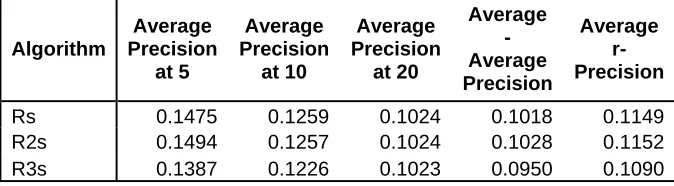
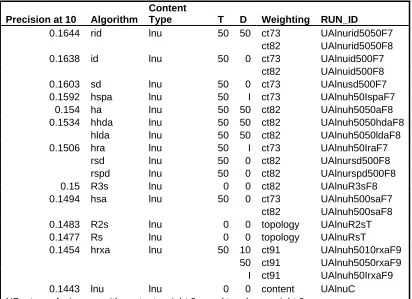
participant retrieval systems submitting up to 1,000 ranked results per query. Performance metrics such as precision at 10, r-precision and average precision are evaluated for submissions and based on mean averages across all query submissions. Ranked results for all participant submissions are evaluated and subsequently made publicly available.
Test Collection
Since 2002, TREC WebTrack evaluations have featured a test collection of over 1,000,000 documents crawled from the .GOV top level Internet domain. The 18G large collection (referred to as .GOV) crawled in early 2002, is distributed by the University of Glasgow who assumed responsibility from former distributors CSIRO (Commonwealth Scientific and Industrial Research Organisation) in 2005
[UniversityGlasgowIRDistribution]. Properties of the .GOV collection are listed in Table 1.
Table 1: TREC .GOV collection properties
Number of Pages 1,247,753 Number of pages by mime type
text/html 1,053,110 application/pdf 131,333 text/plain 43,753 application/msword 13,842 application/postscript 5,673 other (containing text) 42 Average page size 15.2 KB Number of hostnames 7,794 Total number of links 11,164,829 Number of cross-host links 2,470,109 Average cross-host links per
host 317
Queries and Relevance Judgements (QRELS)
Three consecutive year’s TREC Topic Distillation tasks are used in the experiments carried out here: TREC-2002, TREC-2003 and TREC-2004. A fourth task was synthesized by concatenating the topics, and qrels of the three official tasks. This synthesized task, referred to as TREC-0000, is essentially a combined Topic Distillation task. To avoid the overlap between TREC-2003 and TREC2004 topic numbers causing confusion, the topic numbers for TREC2004 topics were offset by 100. This allowed topic numbers 1 to 50 to exclusively designate TREC-2003 topics.
Table 2: TREC task details
Number of Queries
Median Average Relevant Resources
Total Relevant Resources
TREC-2002 49* 22 1574
TREC-2003 50 8 516
TREC-2004 75 13 1600
TREC-0000 174 13 3690
*A 50th query has been discounted since it did not have any relevant documents
A significant difference between the relevant documents of the TREC-2002 task and later years is the inclusion of non-homepages. Since 2003’s task, the hypothetical searchers information need for a topic distillation query such as ‘cotton industry’ is modelled as: ‘give me an overview of .gov sites about the cotton industry, by listing their homepages’, whereas previously it would have had a more ad-hoc interpretation along the lines of ‘give me all .gov URLs about the cotton industry’. The shift in emphasis towards home pages subsequently resulted in fewer relevant documents per query. Although an attempt to counter that effect was made by introducing broader queries, the two queries detailed below illustrate the gulf between the relevance judgments of TREC-2002 and TREC-2004.
Table 3
Task Query
Relevant Resources
TREC-2002 US immigration history demographics 126
TREC-2004 Federal and state statistics 86
The two queries only had 1 relevant resource in common
The TREC-2002 query ‘US immigration history demographics’ could be considered a subtopic of the TREC-2004 query ‘Federal and state statistics’, but yet many more relevant documents have been identified for it.
Topological Data
For the purposes of this thesis an inter-site link is defined as a link between two URLs in which (ignoring the hostname portion of the URL’s domain part, typically ‘www’), either one domain part is a sub-domain of the other or they are the same. For
example, a link between www.nlm.nih.gov/home and http://www.nich.nih.gov/home is not considered an inter-site link, whereas a link between
www2.nlm.nih.gov/portal/public.html and www.nih.gov/home is. Data on all inter-site links from the .GOV collection is extracted for use by algorithms performing link-structure analysis. The link graph corresponding to this data is referred to as the ‘inter-site.GOV’ graph.
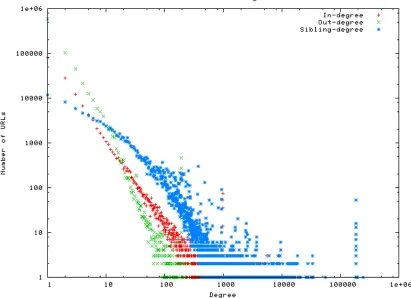
Soboroff demonstrates that the power law in-degree and out-degree distributions observed by Broder et al. for Web URLs [Broder2000] are reflected in the .GOV collection [Soboroff2002]. A further observation by Broder is that distributions are almost equivalent when intra-site links are discounted. From Figure 1 and Figure 2 it is clear that in- and out-degrees for the .GOV collection are distributed according to a power law whether only inter-site or all links are considered. Aside from link
Figure 1: Distribution of degree levels in the Web’s .GOV top-level domain. Log scale plot.
[image:32.595.94.505.455.753.2]Further evidence of similarities between in-degrees and sibling-degrees is apparent when considering degree correlations for the 65,000 URLs with the highest sibling degrees (Table 4). The correlation between in-degree and sibling-degree is 0.66, but understandably there is far less correlation where out-degree of URLs is concerned. The correlation figures quoted in Table 4 are calculated according to the formula presented in Appendix A.
Table 4: Degree correlation of the 65,000 URLs with highest sibling-degree
In-Degree Out-Degree
Sibling-Degree
In-Degree 1.00 Out-Degree 0.04 1.00
Sibling-Degree 0.66 0.08 1.00
In addition to the inter-site.GOV graph, two random mutations of that graph were created for experimentation. The first (dubbed ‘Random.GOV’) interchanged real links with arbitrary links ensuring that the in- and out-degrees for individual URLs were preserved. The second (dubbed ‘RandomX.GOV’) interchanged real links with arbitrary links ad-hoc with the only proviso being that the overall number of links was preserved.
3.3
Content-Only Retrieval Baseline Runs
Content-only retrieval results are the standard baseline against which the performance of link-based algorithms is contrasted. Since, link-based algorithms typically enrich content analysis with link-structure analysis; the expectation is that they improve on content-only baselines.
link-based algorithm runs and secondly they are combined with link link-based algorithm runs to produce fusion runs. A complete overview of all runs is detailed in section 3.5.
The University of Amsterdam’s Perl implemented FlexIR Information Retrieval system [MonzdeRijke2002] was used to produce the content retrieval runs. Pre-processing consisted of the removal of HTML-tags, punctuation marks, and Snowball stemming [Snowball2003].
Three sets of content-only retrieval runs were produced for each of the three official TREC topic distillation task topic sets TREC200[2-4]. A fourth set of three content-only retrieval runs corresponding to the combined TREC0000 task was synthesized by concatenating the retrieval results of the three official task runs.
The first of the three sets of content-only retrieval runs feature a statistical language model [Hiemstra2001] with a uniform query term importance weight of 0.35. These language model runs are referred to as LM runs in section 3.5’s run list.
The second set of content-only retrieval runs feature an Okapi weighting scheme [RobertsonWalkerBeaulieu2000] with tuning parameters of k=1.5 and b=0.8. These runs are referred to as OKAPI runs in section 3.5’s run list.
The third set feature an Lnu.ltc weighting scheme [BuckleySinghalMitra1995] with slope parameter set at 0.2 and pivot parameter set to the average number of unique terms per document. Lnu.ltc runs are abbreviated to LNU content runs in section 3.5.
3.4 Featured
Algorithms
¾ In-Degree (id)
¾ Realised In-Degree (rid) ¾ HITS Authority (ha) ¾ RMIT (Rs)
¾ RMIT2 (R2s ¾ RMIT3 (R3s)
The RMIT sibling score propagation algorithms (RMIT, RMIT2 and RMIT3) provide three ready made representative sibling algorithms.
The meta-algorithm underlying the other three algorithms is the same.
i. Start with a query focused set of lexically similar retrieved documents, referred to as a root set.
ii. Speculate on a set of potentially relevant documents related to root set members and expand the root set with these to produce a base set.
iii. Apply link analysis to the sub-graph structure pertaining to the base set in producing judgments on the authority of these documents which can be applied in re-ranking.
The key detail in which the algorithms differ is in step iii of the meta-algorithm where they take different approaches to re-ranking members of the base set. In phase ii, all algorithms that expand their root set select in- and out-linked documents for
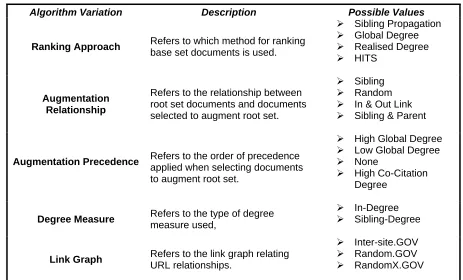
augmenting the root set in no particular order. By altering the details of this phase, variations of algorithms can be obtained. Instead of selecting in- and out-linked documents, alternatively related documents (augmentation relationship) can be selected and instead of ad-hoc selection of these an order of precedence can be applied to selection (augmentation precedence). Further variant algorithms can be obtained by altering the degree measures applied in the degree algorithms In-Degree and Realised In-Degree. The final means for varying algorithms is to interchange the link graph they were presented with from the standard Inter-site.GOV link graph to either the Random.GOV link graph or the RandomX.GOV link graph.
5, the ranking approach ‘global degree’ refers to a collection level degree measure as opposed to a degree measure that’s relative to the base set (local degree). The ‘Sibling and parent’ augmentation relationship refers to the interleaved selection of siblings of root set documents and the parents of those siblings (common in-links), the intention being to render a higher link density in the base set than achieved through sibling expansion.
The nine variant algorithms are listed below with their abbreviations.
¾ Sibling Degree (sd)
¾ Realised Sibling Degree (rsd)
¾ Realised Sibling & Parent Degree (rspd) ¾ HITS Sibling Authority (hsa)
¾ HITS Sibling & Parent Authority (hspa) ¾ HITS Low Density Authority (hlda) ¾ HITS High Density Authority (hhda) ¾ HITS Authority (ha)
¾ HITS Random Authority (hra) ¾ HITS Random X Authority (hrxa)
Table 5: Algorithm attributes
Algorithm Variation Description Possible Values
Ranking Approach Refers to which method for ranking
base set documents is used.
¾ Sibling Propagation
¾ Global Degree
¾ Realised Degree
¾ HITS
Augmentation Relationship
Refers to the relationship between root set documents and documents selected to augment root set.
¾ Sibling
¾ Random
¾ In & Out Link
¾ Sibling & Parent
Augmentation Precedence Refers to the order of precedence
applied when selecting documents to augment root set.
¾ High Global Degree
¾ Low Global Degree
¾ None
¾ High Co-Citation Degree
Degree Measure Refers to the type of degree
measure used,
¾ In-Degree
¾ Sibling-Degree
Link Graph Refers to the link graph relating
URL relationships.
¾ Inter-site.GOV
¾ Random.GOV
¾ RandomX.GOV
Table 6: Algorithm variations (variant algorithms are italicised)
Augmentation Relationship
Augmentation
Precedence Link Graph
Degree Measure Ranki ng A ppro ach Algori th m (A bbr eviatio ns) Sibling In
& Out Lin
[image:37.595.89.515.404.760.2]HITS High Density Authority selects in and out linked documents by descending order of combined degree (sum of in- and out-degrees), whilst HITS Low Density Authority selects by ascending order of combined degree. The intention is to render higher link densities in the base set of HITS High Density Authority than in the base sets of HITS Low Density Authority.
The variant algorithms have been devised with the three secondary objectives listed in section 3.1 in mind. The obvious interpretation of the connection between the
algorithms and those objectives is pronounced in Table 7. The table lists potentially valuable performance comparisons that can be made between algorithms in the last three columns, since those algorithms vary only in terms of the algorithm attribute listed in the second column.
Table 7: Directed like-comparisons between algorithms
Objective
Key Algorithm Attribute
1st Comparator
2nd Comparator
3rd Comparator
Utility of Siblings Degree Measure* rsd or rspd rid
Utility of Siblings Degree Measure* sd id
Utility of Siblings
Augmentation
Relationship rsd rspd
Utility of Siblings
Augmentation
Relationship hsa hspa ha
Influence of Link Density
Augmentation
Precedence hlda hhda ha
Effects of
Randomisation Link Graph* hra hrxa ha
*NB: Comparison only valid when root set is unexpanded
In the remainder of this section further details of the six established algorithms: In-Degree, Realised In-In-Degree, HITS Authority, RMIT, RMIT2 and RMIT3 are presented.
In-Degree
A major advantage of in-degree when compared to PageRank is that it is
pre-computed and reused when re-ranking content retrieval results, precluding the query-time need for link structure analysis required by algorithms such as HITS.
A simplistic use of in-degree is applied in the In-degree algorithm implemented here. A more principled approach might be to use in-degree prior relevance probabilities in a language model framework. The algorithm takes a root set of documents from a text retrieval algorithm, expands it into a base set by including in- and out-linked documents before re-ranking the base set according to the in-degree of its members. Pseudo code for the algorithm is presented in Algorithm 1 with ‘d’ and ‘t’ parameter values as defined in [Kleinberg1998].
Algorithm 1: Pseudo-code for In-Degree algorithm Let t denote maximum size of root set
Let x denote number of top scoring documents to return
<construct base set>
Set RootSet = GetRetrievalResults(ContentRetrieval, t) Set BaseSet = RootSet
For each page p є RootSet
BaseSet = BaseSet U SelectInLinks(p, d) BaseSet = BaseSet U SelectOutLinks (p,d) End
<calculate in-degrees>
For each p є RootSet
Score[p]=Indegree(Corpus, p)
End
<re-rank BaseSet based on in-degrees> Return TopScores(BaseSet, Score, x)
HITS Authority
Algorithm 2: Pseudo code for HITS Authority algorithm
Let t,d denote maximum size of root set and maximum in/out-links considered per document respectively
Let k be a natural number denoting the number of iterations after which Hub and Authority scores converge
Let x denote number of top scoring documents to return
<construct base set>
Set RootSet = GetRetrievalResults(ContentRetrieval, t) Set BaseSet = RootSet
For each page p є RootSet
BaseSet = BaseSet U SelectInLinks(p, d) BaseSet = BaseSet U SelectOutLinks(p,d) End
<initialize authority and hub vectors> For each p є BaseSet
HubScore[p]=1 AuthorityScore[p]=1 End
<calculate Hub and Authority scores> For s = 1 to k
<recalculate hub scores>
For each p є BaseSet
For each o є OutLinks(BaseSet, p)
HubScore[p] = HubScore[p] + AuthorityScore[o] End
End
<recalculate authority scores using updated hub scores>
For each p є BaseSet
For each i є InLinks(BaseSet, p)
AuthorityScore[p]= AuthorityScore[p] + HubScore[i]
End End
<normalize Authority and Hub score vectors> Normalize(AuthorityScore)
Normalize(HubScore) End
<Return top Hubs and Authorities>
Return TopScores(BaseSet, AuthorityScore, x)
Realised In-Degree
Realised in-degree is a measure introduced by the University of Amsterdam in their TREC2002 Web Track offering [KampsMonzdeRijke2003]. The measure
is the number of in-links originating from documents in the base set) divided by a document’s global in-degree (collection-wide number of in-links for the document). The resulting product is suggested by Kamps et al. to reflect both the topicality and relative importance of the document. The pseudo code for the algorithm is detailed in Algorithm 3 in which ‘d’ and ‘t’ variables are as defined by Kleinberg
[Kleinberg1998].
Algorithm 3: Pseudo code for Realised In-Degree Algorithm
Let t,d denote the size of root set and maximum in/out-links considered per document respectively
Let k be a natural number denoting the number of iterations after which Hub and Authority scores converge
Let x denote number of top scoring documents to return
<construct base set>
Set RootSet = GetRetrievalResults(ContentRetrieval, t) Set BaseSet = RootSet
For each page p є RootSet
BaseSet = BaseSet U SelectInLinks(p, d) BaseSet = BaseSet U SelectOutLinks (p,d) End
<compute relevance scores>
For each p є BaseSet
Score[p] = InDegree(BaseSet, p) * InDegree(BaseSet, p) /
InDegree(Corpus, p)
End
<return top scoring documents>
Return TopScores(BaseSet, Score, x)
RMIT, RMIT2 and RMIT 3
RMIT University’s TREC-8 Web Track submissions were the product of two sibling propagation algorithms [Fuller+1999]. A further algorithm was developed after the TREC-8 submission deadline. Their three algorithms have been selected for implementation and evaluation because of their reliance on sibling relationships. They are referred to here as RMIT, RMIT2 and RMIT3.
other retrieved siblings. The formalization of this approach is presented below in the form it was defined by RMIT.
∑
∧ ∈ + = ) ( ) ( ' ) ' , ( 1 ) , ( ) , ( q ret d sib d cc sim q d
k d q sim d q sim
where simc(q,d) is d’s content similarity score for query q, sib(d) is the set of d’s siblings and ret(q) is
the set of documents retrieved for the query.
RMIT2 addresses a concern over documents with poor content being overly endorsed in cases where they had several good siblings. The approach taken in RMIT2 is to limit the total endorsement from siblings and to only allow endorsements from top scoring documents. This is formalized below in a more terse form than presented by RMIT [Fuller+1999].
) ) ' , ( 1 ), , ( min( ) , ( ) , ( ) , ( ) ( '∈
∑
∧ + = q x ret d sib d c cc sim q d
k d q sim d q sim d q sim
where simc(q,d) is d’s content similarity score for query q, sib(d) is the set of d’s siblings and ret(x,q) is
the set of the ‘x’ top documents retrieved for the query.
Their final algorithm (RMIT3) further restricts sibling endorsements by only allowing sibling score propagation from the best sibling providing that sibling is an overall top scoring document. Although this is not formalized in their paper, the obvious
interpretation is presented below.
∑
∧ ∈ + = ) , ( ) ( ' ) ' , ( 1 ) , ( ) , ( q x ret d topsib d cc sim q d
k d q sim d q sim
where simc(q,d) is d’s content similarity score for query q, sib(d) is the set of d’s siblings and ret(x,q) is
the set of ‘x’ top documents retrieved for the query.
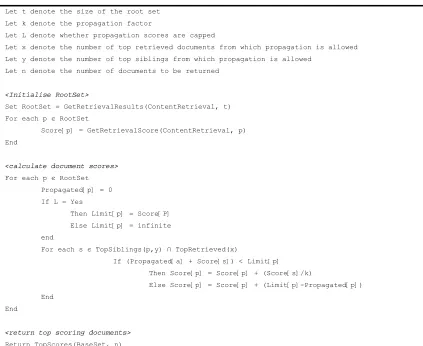
All three algorithms can be abstracted to a single algorithm with suitable constant parameters. The pseudo code for that algorithm template is presented in Algorithm 4.
Table 8: RMIT algorithm constant settings
Algorithm
't' (Root Set Size)
'k' (Propagation Factor)
'L' (Propagation Limited?)
'x' (Top Results)
'y' (Top Siblings)
RMIT 1000 50 No Unbound Unbound
RMIT2 2000 10 Yes 500 Unbound
RMIT3 2000 10 No 20 1
Algorithm 4: RMIT, RMIT2 and RMIT3 algorithm template Let t denote the size of the root set
Let k denote the propagation factor
Let L denote whether propagation scores are capped
Let x denote the number of top retrieved documents from which propagation is allowed Let y denote the number of top siblings from which propagation is allowed
Let n denote the number of documents to be returned
<Initialise RootSet>
Set RootSet = GetRetrievalResults(ContentRetrieval, t) For each p є RootSet
Score[p] = GetRetrievalScore(ContentRetrieval, p) End
<calculate document scores>
For each p є RootSet Propagated[p] = 0 If L = Yes
Then Limit[p] = Score[P] Else Limit[p] = infinite end
For each s є TopSiblings(p,y) ∩ TopRetrieved(x)
If (Propagated[a] + Score[s]) < Limit[p] Then Score[p] = Score[p] + (Score[s]/k)
Else Score[p] = Score[p] + (Limit[p]-Propagated[p]) End
End
<return top scoring documents>
Return TopScores(BaseSet, n)
3.5
List of Experiments
The product of the experimentation is a series of runs produced by the various
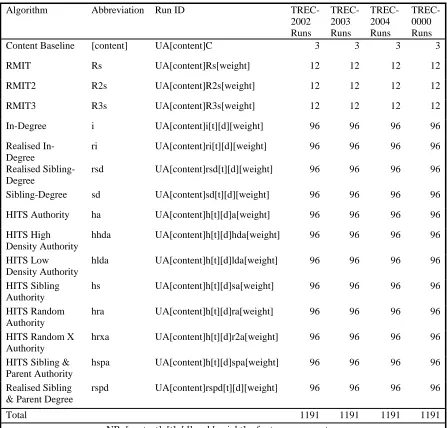
Runs vary according to the task (topic set) they were presented with, the link-based algorithm involved and the parameters passed to algorithms. All runs are given a unique run id which is an encoding of the algorithm and parameters it was invoked with.
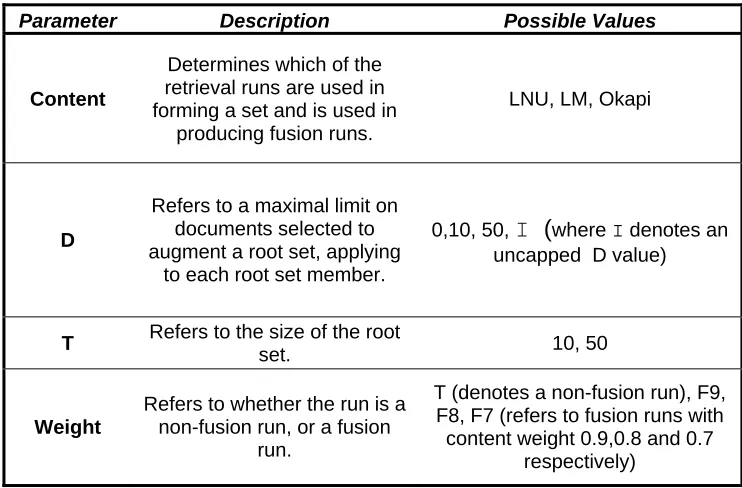
[image:44.595.88.459.218.462.2]The four parameters used in algorithm invocations are presented in Table 9.
Table 9: Algorithm parameter values
Parameter Description Possible Values
Content
Determines which of the retrieval runs are used in forming a set and is used in
producing fusion runs.
LNU, LM, Okapi
D
Refers to a maximal limit on documents selected to augment a root set, applying
to each root set member.
0,10, 50, I (where I denotes an uncapped D value)
T Refers to the size of the root
set. 10, 50
Weight
Refers to whether the run is a non-fusion run, or a fusion
run.
T (denotes a non-fusion run), F9, F8, F7 (refers to fusion runs with content weight 0.9,0.8 and 0.7
respectively)
Table 10: Summary of runs
Algorithm Abbreviation Run ID TREC-2002 Runs
TREC-2003 Runs
TREC-2004 Runs
TREC-0000 Runs Content Baseline [content] UA[content]C 3 3 3 3 RMIT Rs UA[content]Rs[weight] 12 12 12 12 RMIT2 R2s UA[content]R2s[weight] 12 12 12 12 RMIT3 R3s UA[content]R3s[weight] 12 12 12 12 In-Degree i UA[content]i[t][d][weight] 96 96 96 96 Realised
In-Degree
ri UA[content]ri[t][d][weight] 96 96 96 96 Realised
Sibling-Degree
rsd UA[content]rsd[t][d][weight] 96 96 96 96
Sibling-Degree sd UA[content]sd[t][d][weight] 96 96 96 96 HITS Authority ha UA[content]h[t][d]a[weight] 96 96 96 96 HITS High
Density Authority
hhda UA[content]h[t][d]hda[weight] 96 96 96 96
HITS Low Density Authority
hlda UA[content]h[t][d]lda[weight] 96 96 96 96
HITS Sibling Authority
hs UA[content]h[t][d]sa[weight] 96 96 96 96
HITS Random Authority
hra UA[content]h[t][d]ra[weight] 96 96 96 96
HITS Random X Authority
hrxa UA[content]h[t][d]r2a[weight] 96 96 96 96
HITS Sibling & Parent Authority
hspa UA[content]h[t][d]spa[weight] 96 96 96 96
Realised Sibling & Parent Degree
rspd UA[content]rspd[t][d][weight] 96 96 96 96
Total 1191 1191 1191 1191
NB: [content], [t], [d] and [weight] refer to run parameters
3.6 Implementation
Details
The fifteen evaluated algorithms were implemented in Perl. The algorithms are supported by a Perl module (WebRetrieval.pm) which provides a high level interface to .GOV collection components such as topics, relevance judgments and link structure data. Additionally, the module offers procedures and functions that abstract on
common Web IR algorithm routines such as vector normalization and root set expansion. Routines for fusion combination of runs and performance metric
calculations are also made available through the module. Together, the module and algorithms constitute over 2000 lines of Perl code.
The fusion combination (fusion) of link-structure analysis algorithm runs with content runs is integrated into the fifteen algorithm scripts. They therefore require only 3 of the 4 parameters listed in Table 9: ‘t’, ‘d’ and content. The ‘weight’ parameter is not required since a different run is produced for each possible ‘weight’ parameter value. Invoking an algorithm therefore results in four runs, a pure non-fusion link-structure analysis run (sometimes referred to as topology run) and three runs corresponding to fusions of that run and the content run denoted by the content parameter (fusion runs). Of the various methods for fusion of runs proposed in [FoxShaw1994], the
‘CombSum’ summation function in which a document’s combined relevance score is the sum of its normalized relevance scores from each run is used.
The final file produced as a result of algorithm invocations (referred to as ‘.stat’ file) reports details on each of the four outputted runs, including performance metrics and pertinent operational data such as base set size and link density. The reports consist of granular data for each query as well as aggregate and average data over all queries.