This is a repository copy of
Haptic identification of objects using a modular soft robotic
gripper
.
White Rose Research Online URL for this paper:
http://eprints.whiterose.ac.uk/95166/
Version: Accepted Version
Proceedings Paper:
Homberg, B, Katzschmann, R, Dogar, MR et al. (1 more author) (2015) Haptic
identification of objects using a modular soft robotic gripper. In: Intelligent Robots and
Systems (IROS), 2015 IEEE/RSJ International Conference on. 2015 IEEE/RSJ
International Conference on Intelligent Robots and Systems (IROS), 28 Sep - 02 Oct 2015,
Hamburg, Germany. IEEE , pp. 1698-1705. ISBN 978-1-4799-9994-1
https://doi.org/10.1109/IROS.2015.7353596
[email protected] https://eprints.whiterose.ac.uk/ Reuse
Unless indicated otherwise, fulltext items are protected by copyright with all rights reserved. The copyright exception in section 29 of the Copyright, Designs and Patents Act 1988 allows the making of a single copy solely for the purpose of non-commercial research or private study within the limits of fair dealing. The publisher or other rights-holder may allow further reproduction and re-use of this version - refer to the White Rose Research Online record for this item. Where records identify the publisher as the copyright holder, users can verify any specific terms of use on the publisher’s website.
Takedown
If you consider content in White Rose Research Online to be in breach of UK law, please notify us by
Haptic Identification of Objects using a Modular Soft Robotic Gripper
Bianca S. Homberg, Robert K. Katzschmann, Mehmet R. Dogar, and Daniela Rus
Abstract— This work presents a soft hand capable of ro-bustly grasping and identifying objects based on internal state measurements. A highly compliant hand allows for intrinsic ro-bustness to grasping uncertainty, but the specific configuration of the hand and object is not known, leaving undetermined if a grasp was successful in picking up the right object. A soft finger was adapted and combined to form a three finger gripper that can easily be attached to existing robots, for example, to the wrist of the Baxter robot. Resistive bend sensors were added within each finger to provide a configuration estimate sufficient for distinguishing between a set of objects. With one data point from each finger, the object grasped by the gripper can be identified. A clustering algorithm to find the correspondence for each grasped object is presented for both enveloping grasps and pinch grasps. This hand is a first step towards robust proprioceptive soft grasping.
I. INTRODUCTION
Soft and under-actuated robotic hands have a number of advantages over traditional hard hands [1]–[8]. The addi-tional compliance confers a greater intrinsic robustness to uncertainty, both for manipulating a broad range of objects easily and for more leniency towards interactions with the static environment.
A common downside of soft hands is that, due to their extra compliance, the hand’s specific configuration at a given time is usually not known, especially when it is interacting with objects or the environment. Knowing the configuration of the hand, however, is crucial for decision making dur-ing the manipulation process. The hand configuration, for example, can be useful for determining whether a grasp is successful, whether a grasp is robust, and whether the object was grasped in the intended pose. The hand configuration can also be very useful in determining the shape of an object the hand is grasping, since the soft links tend to conform to the environmental constraints they interact with.
In this paper we present a new soft robotic gripper with proprioception. The proprioceptive sensors enable us to recover certain features of the configuration of the fingers.
Each finger in our multi-fingered hand is designed based on the soft manipulators outlined in [9], [10]. We modify this design by adding a bend sensor to measure the curvature of a finger around a certain axis. Furthermore, we add a new constraint structure to limit the finger to curve only along the axis we can sense.
We pay special attention to themodularityof our design.
Our goal is to build a general-purpose proprioceptive hand which can easily be used by existing robotic arms/platforms.
All researchers are with the Massachusetts Institute of Technology, 77 Massachusetts Avenue, Cambridge, MA 02139, USA.{bhomberg,
[image:2.612.323.548.143.389.2]rkk, mdogar, rus}@csail.mit.edu
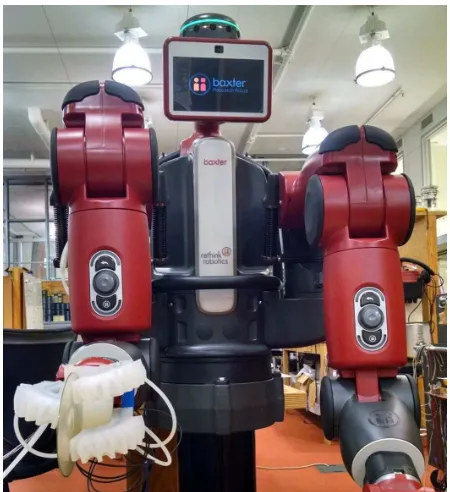
Fig. 1: The soft robotic hand, mounted to the wrist of a Baxter robot, is picking up a sample object.
Therefore, we designed each finger such that they can be attached on top of an existing rigid finger. Figure 1 shows the Baxter robot grasping an object with our hand.
Having proprioceptive soft hands enables exciting appli-cations in robotic manipulation. In this paper we focus on the haptic identification of objects. With the integrated bend sensors – one data point from each of the three fingers – our robot is able to identify a set of canonical objects of different shape, size and compliance by grasping them. We do this by building a relation between objects and the configurations the soft hand takes while grasping them. Then, given an unidentified object from our training set, our robot grasps it and uses proprioception to identify it. Through experiments we show that our hand can successfully distinguish between objects up to the resolution limit of the proprioceptive sensors.
than 70 randomly selected daily objects.
In this paper we make the following contributions to soft robotic grasping:
• A modular, easily adapted three finger soft gripper
which can interface to a variety of robot arms.
• Development of algorithms to successfully identify a
set of canonical objects while grasping using internal sensor data of the soft gripper.
This gripper is a first step towards robust proprioceptive grasping and we conclude our paper with possible future steps.
II. RELATEDWORK
In the following we present recent related work on soft manipulators and hands, state sensing within soft robots and compliant manipulation.
Recently there has been a significant interest in the design and development of soft or underactuated hands. Dollar and Howe [1], [2] presented one of the earliest examples of underactuated and flexible grippers. Deimel and Brock [3] developed a pneumatically actuated three-fingered hand made of reinforced silicone that is mounted to a hard robot and capable of robust grasping. More recently, they have developed an anthropomorphic soft pneumatic hand capable of dexterous grasps [4]. Ilievski et al. [5] create a pneumatic starfish-like gripper composed of silicone and PDMS membranes and demonstrate it grasping an egg. In [6], Stokes et al. use a soft elastomer quadrupedal robot to grasp objects in a hard-soft hybrid robotic platform. A puncture resistant soft pneumatic gripper is developed by Shepherd et al. in [7]. An alternative to positive pressure actuated soft grippers is the robotic gripper based on the jamming of granular material developed by Brown et al. and detailed in [8]. The fast Pneu-net designs by Mosadegh et al. detailed in [11] and by Polygerinos et al. detailed in [12] is closely related to the single finger design used in this paper. The design and the lost-wax fabrication of the fingers of our hand builds upon the soft gripper and arm structure proposed in Katzschmann et al. [10], which demonstrates autonomous soft grasping of objects on a plane.
To the best of our knowledge, configuration estimates of soft robots so far have been acquired through exterocep-tive means, for example motion tracking systems [13] or RGB cameras [14]. Various sensor types that can measure curvature and bending have been studied, but none have been integrated into a soft robot. Park et al. [15], [16] have shown that an artificial skin made of multi-layered embedded microchannels filled up with liquid metals can be used to detect multi-axis strain and pressure. Danisch et al. [17] describe a fiber optic curvature sensor, called Shape Tape, that can sense bend and twist. Weiss et al. [18] have reported on the working principle of resistive tactile sensor cells to sense applied loads. Biddiss et al. [19] describe the use of electroactive polymeric sensors to sense bend angles and bend rates in protheses. Kusuda et al. [20] developed a bending sensor for flexible micro structures like Pneumatic Balloon Actuators. Their sensor uses the fluid resistance
change of the structure during bending. Other recent work in this area include [21] and [22].
Previous studies on haptic recognition of objects focus on hands with rigid links [23]–[27]. Paolini et al. [28] present a method which uses proprioception to identify the pose of an object in a rigid hand after a grasp. Tactile and haptic sensors have also been used in manipulation to sense the external environment in [29]–[32]. We believe our study to be the first one to investigate the haptic recognition of objects using a soft hand.
[image:3.612.314.558.241.339.2]III. GRIPPER DESIGN AND FABRICATION In this section, we discuss the design goals contributing to the design of the gripper and the fabrication methods used to construct the gripper.
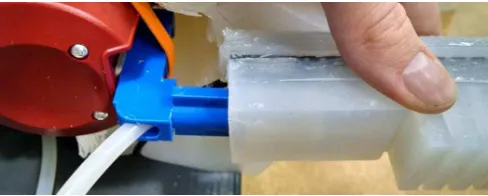
Fig. 2: Attaching a finger onto the 3D printed interface.
A. Design Goals
We designed this gripper with the following key goals in mind:
• Ability to grasp a range of objects
• Ease of fabrication
• Modular interface to existing hardware
To this end, we developed a gripper consisting of three individual soft fingers that can be slipped onto 3D-printed interface (see Figure 2). The interface piece screws onto an already existing robot hardware. We prioritized a modular interface in order to enable the gripper to be usable for a variety of existing hardware bases simply by swapping out the 3D printed interface. The fingers are identical in their design; this modularity allows for faster fabrication and therefore more rapid design iterations. The soft fingers and their composition allow the gripper to grasp a range of objects with varying diameters.
We designed each finger with several key goals in mind:
• Internal state sensing capability
• Constant curvature bending when not loaded
• Partially constant curvature bending under loaded
con-ditions
• Highly compliant and soft in order to be inherently safer
(a) Wax core model (b) Base finger mold (c) Mold assembly for finger base
[image:4.612.69.545.49.270.2](d) Constraint layer (e) Top mold for constraint and sensor (f) Wrist attachment parts
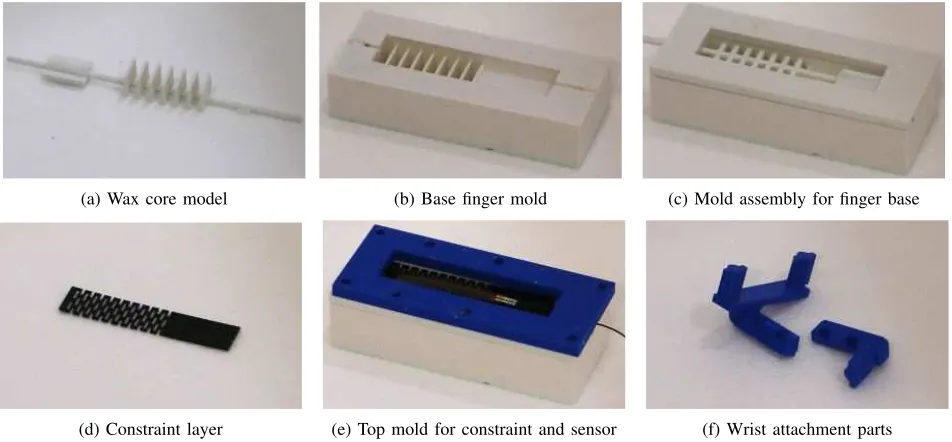
Fig. 3: Shown are all the essential components needed for fabricating a soft finger: (a) A wax core model, (b) a base finger mold, (c) a base mold assembly that contains the wax core and is filled up during the first pouring step of the finger, (d) a constraint layer that was laser cut from thin Delrin, (e) a mold add-on from the top for embedding a constraint layer and a bend sensor through a second rubber pouring step, and (d) two wrist interface parts to attach the fingers to existing robotic hardware.
user more flexibility during manipulation tasks. A resistive flex sensor was embedded into each finger by affixing it on top of the finger’s inextensible constraint layer. Bending the resistive strip changes the resistance of the sensor. The resistive change can be correlated with the curvature of the finger under the assumption that the finger bends with a constant curvature. This only holds true for the unloaded case; in the loaded case, partially constant curvatures can be assumed between points of loading.
B. Fabrication
The fabrication and assembly of a single finger is de-scribed followed by a description of how the fingers are composed and assembled to a gripper.
1) Single finger: The fabrication of a single finger is based on a lost-wax casting process.
The process begins with 3D printing a set of model and mold parts (see Figure 3). First, the wax core model piece (Figure 3a) is used to make a rubber mold for a wax core. Following this, wax is poured into this mold to make an actual wax core in the appropriate shape. Next, the first layer of the finger is cast in the base mold (Figure 3b) with the wax core inset, as seen in Figure 3c. This first layer is cast out of a medium-soft rubber (Dragonskin 20A), which is able to extend significantly without breaking. The wax core is then melted out of the rubber piece.
Next, the rubber piece is reinserted into the mold. The constraint layer (Figure 3d) is placed on top of the rubber piece within the mold. The constraint layer is made out of thin Delrin. In order to allow for flexing in the desired direction, the constraint layer is laser cut with horizontal
strips to allow for bending. The bottom portion of the constraint, which is required to stay flat, has a non-flexing pattern of cut circles to retain stiffness. To insert the resistive flex sensor (the BendShort 2.0 sensor from the company I-CubeX), we glue it to the constraint layer at two points, one along the length of the sensor, one at the circuitry base. This keeps the sensor in place when the silicone rubber is setting. Figure 4 shows an image of the inside of the finished finger; through the transparent silicone rubber, the constraint layer and the sensor are both visible.
Once both parts are in place as shown in Figure 3e, a second layer of rubber is poured into the mold. The rubber (Dragonskin 10A) has a lower shore hardness than the rubber used for the base rubber portion of the finger. This gives the inside of the finger greater compliance when grasping objects.
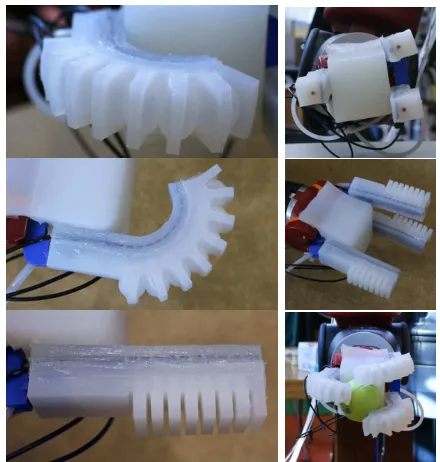
When the finger is completed, it is removed from the molds, cleaned with wax remover, and the tip is plugged with a piece of solid silicon tubing and sealed. Various views of a completed finger can be seen in the left column of Figure 5. The finger is 2.5 cm wide by 2.5 cm tall by 11 cm long.
Fig. 4: This is a view of the inside of the finger. Through the translucent rubber, the constraint layer and the bend sensor are visible.
Fig. 5: Views of an individual finger and the entire hand.
motor controllers connected to a PC and controlled via serial messages sent from a ROS node. Each sensor within a finger is connected to an Arduino micro controller running rosserial. To complete the hand, we made a compliant palm out of a very soft rubber (Ecoflex 00-10).
IV. HAPTIC OBJECT IDENTIFICATION Our goal with this hand is to enable the robot to pick up objects and, based on internal sensing data, identify the object. To achieve this we first characterize the relation between hand configurations and sensor readings. Then, we present a data-driven approach to identifying an object based on sensor readings.
A. Modeling the sensor noise
Our hand attains different configurations as it interacts with the environment and grasps objects. We define a
con-figuration of our hand as a vector q = [q1, q2, q3], where
each qi ∈ Q represents the way finger i is bent. Q is the
configuration space of a finger: that is, the space of all different shapes our soft finger can achieve. For a given
configuration of the hand, we get sensor readings s =
[s1, s2, s3], where eachsi represents the sensor reading for
fingeri.
Our sensor readings are noisy. Therefore, we represent the sensor reading given a hand configuration as a
proba-bility distribution,p(s|q). We assume the sensor value on a
finger is independent of the configurations of other fingers, and therefore the sensor model of the whole hand can be expressed in terms of the sensor model for each finger:
p(s|q) =
3
Y
i=1
p(si|qi) (1)
We can model p(si|qi), the sensor noise for a finger,
in a data-driven way by placing the finger at different configurations and collecting sensor value data. In Sec. V-A we present experiments for such a characterization, where we use constant curvature configurations of the unloaded finger. Note that when the finger is loaded, for example during an actual grasp, the resulting finger configurations and the corresponding sensor readings display significant variation due to the highly compliant nature of the fingers. Therefore, to identify objects during grasping, we use data collected under the grasp load, instead of assuming that the unloaded sensor model applies to the loaded case.
B. Object identification through grasping
When our hand grasps an object, it attains a certain configuration. We use the sensors on the hand to predict the hand configuration, which we then use to identify the grasped object.
The grasping configuration for an object can be different for different types of grasps. In this work we focus on two
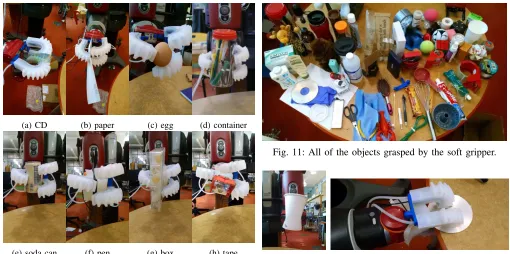
types of grasps:enveloping grasps(Fig. 10d, 10e) andpinch
grasps(Fig. 10a, 10b, 10c, 10f, 10g, 10h). For a given
ob-ject,o, we represent the configuration during an enveloping
grasp asqenvelo ; and we represent the configuration during a
pinch grasp as qpincho .
For a given sensor reading s and a grasp type g ∈
{envel, pinch}, we define the object identification problem as finding the object with the maximum likelihood:
o∗
←argmax
o∈O
p(qgo|s) (2)
whereOis the set of known objects ando∗
is the predicted object. Applying Bayes’ rule and assuming a uniform prior over finger configurations, the above formulation becomes:
o∗
←argmax
o∈O
p(s|qgo) (3)
In our experiments we use k-means clustering to build
models ofp(s|qgo)for different objects and grasp types. Then,
we identify the object for a new grasp (Eq. 3) using a k-nearest neighbor algorithm. The implementation details are presented in Sec. V-C and Sec. V-D.
V. EXPERIMENTS AND RESULTS
[image:5.612.66.286.178.409.2]A. Resistive Sensor Characterization
The sensors embedded in each finger are resistive flex sensors. The resistance of a sensor changes as it is bent. A sensor has three pins: power, ground, and signal. The signal pin outputs a voltage based on the differential change in resistance between two flex sensors along its length. The output signal reads somewhere between 0 and the input voltage based on the bending of the sensor. We buffer the output voltage through an operational amplifier before reading the voltage via an Arduino micro controller. The output voltage ranges from 0 to 5V in value. The Arduino is running rosserial and publishes messages with the sensor values to the main controller PC.
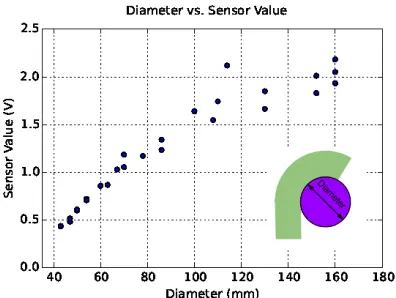
Due to the construction of the sensor, the relative change in resistance increases as the curvature of the sensor increases. Thus, the sensor has better accuracy and resolution as its diameter decreases. The diameter we refer to is the diameter of a circle tangent to the bend sensor at every point, for some constant curvature bend of the sensor. A diagram of the diameter can be seen in Figure 6. We see this relation between diameter of the finger and sensor value clearly in Figure 6, where sensor values versus finger curvatures are plotted for the unloaded case.
[image:6.612.332.527.52.200.2]We can also map the diameter values to the linear actuator position: the linear actuator can be controlled by specifying its linear position between 0 and 100mm. Thus, for the unloaded case, we can know the approximate diameter of the finger’s bend even without sensors, as seen in Figure 7. Due to the inherent changes in variance for the sensor values, we are able to distinguish objects more accurately for objects with a smaller diameter.
Fig. 6: The diameter of the finger versus the sensor values.
B. Grasps
We ran tests with two types of grasps: enveloping grasps that had the object entirely contained within the gripper and pinch grasps that had the object held by the tips of the fingers.
1) Enveloping Grasps: With enveloping grasps, we were able to pick up a variety of objects. Objects were grasped firmly between the fingers and the compliant palm of the hand. The objects grasped in these tests were a container of zip ties, an empty coffee cup, a lemonade bottle, an egg,
50 55 60 65 70 75 80 85 Linear Actuator Position (mm) 20
40 60 80 100 120 140 160 180
Dia
me
ter
(m
m)
Linear Actuator Position vs. Diameter
Fig. 7: The input linear actuator value versus the resulting diameter of the finger bend.
and a tennis ball. Figures 10d and 10e show two examples of enveloping grasps.
2) Pinch Grasping: For pinch grasping, we were able to pick up a variety of light objects between the tips of the fingers. In our tests, we picked up an empty zip tie container, an empty coffee cup, an empty lemonade bottle, a tennis ball, and a pen. For the pinch grasps, multiple orientations were possible for the grasps of the same object, so the clustering is less accurate. Figures 10a, 10b, 10c, 10f, 10g, and 10h show examples of pinch grasps.
C. Object Clustering
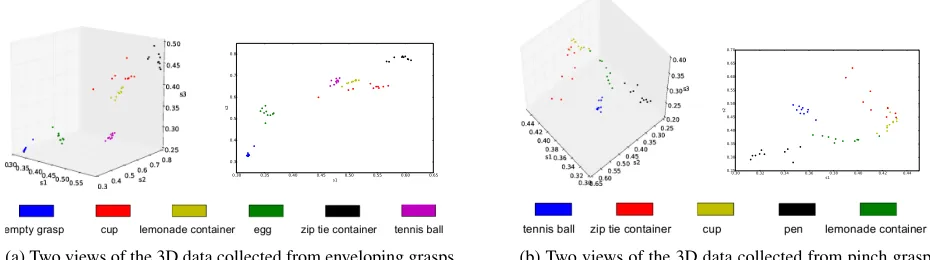
Based on the data from the bend sensor in each of the three fingers, we can cluster the data using K-means [33] to accurately distinguish each of the objects. For each of these tests, the fingers were simply commanded to close all of the way: the robot had no knowledge of the object which was being picked up. The clustered data for the enveloping grasps can be seen in Figure 8a and the clustered data for the pinch grasps can be seen in Figure 8b.
To get the data for clustering, we first warm up the gripper by repeatedly opening and closing it in order to get the best data from the sensors. Then, each object is grasped ten times, including the recorded values from ten empty grasps. All of this data is entered into K-means, which accurately outputs a point associated to each of the clusters. We plot each object’s points in a different color. For four out of the six enveloping grasps, all items were classified correctly. Some grasps of the cup and the lemonade container were misclassified. However, the means generate by the K-means cluster were still close to the true average of the sensor values for each object. The pinch grasp results still had means generated by the K-means cluster close to the true averages. However, only one object had all trials classified correctly in the same cluster.
The clustering algorithm runs in less than 0.03 seconds.
D. Object identification
[image:6.612.73.271.438.587.2]0.30 0.35 0.40 0.45 0.50 0.55 0.60 0.65 s1
0.3 0.4 0.5 0.6 0.7 0.8
s2
(a) Two views of the 3D data collected from enveloping grasps.
0.30 0.32 0.34 0.36 0.38 0.40 0.42 0.44
s1 0.25
0.30 0.35 0.40 0.45 0.50 0.55 0.60 0.65 0.70
s2
[image:7.612.69.534.55.185.2](b) Two views of the 3D data collected from pinch grasps.
Fig. 8: The clustered three dimensional sensor data for enveloping grasps and pinch grasps. There were ten grasps of each object; points can be identified via color, as seen in the keys of each subfigure.
known identities of each of the objects. We use this training set to identify objects as they are grasped in a separate testing phase. After each new grasp, the five nearest neighbors of the new point in the original training data are determined. We calculate the distance via the Euclidean metric on the 3-dimensional point comprised of the three sensor values. The object is identified based on the most common identity of the
five nearest neighbors, using theKNeighborsClassifier from
scikit-learn [34]. Pseudocode describing this is outlined in Algorithm 1. 98% percent of tests (59/60 trials) identified the objects correctly for enveloping grasps; the breakdown per object is shown in Figure 9. For pinch grasps, 68% of tests (34/50 trials) identified the objects correctly; again, the breakdown per object can be seen in Figure 9. This includes correctly identifying the empty grasp when the robot did not actually pick up an object (for enveloping grasps).
The identification algorithm runs in less than 0.01 seconds.
Algorithm 1: Object Identification Algorithm
Import previously recorded grasp data, 10 data points per item
forall objects to be graspeddo Grasp item.
Record sensor values.
Calculate Euclidean distances to all recorded points Find the 5 nearest neighbors.
Output the identity of the object-based voting from the 5 nearest neighbors.
end
VI. COMPARISON TO A RIGID GRIPPER
In order to demonstrate the advantages of the soft hand, we ran a series of experiments comparing our gripper to the default Baxter gripper. The Baxter gripper can be seen in Figure 12a deforming a cup. We kept the rigid gripper in a similarly sized configuration to the soft gripper. We used the same control inputs for the rigid gripper as we did on the soft gripper – the gripper had two states: entirely closed and entirely open. We did not adjust the gripper for the different
Object Enveloping grasp Pinch grasp
zip tie container 100 % 60 %
cup 90 % 100 %
egg 100 % –
tennis ball 100 % 0 % lemonade bottle 100 % 80 %
pen – 100 %
[image:7.612.327.546.240.331.2]empty grasp 100 % – %
Fig. 9: Identification percentages for each of the tested objects.
objects. We used the same program with symmetric positions for grasping objects vertically and off the table; there was no complicated manipulation planning needed in either scenario, just moving the arm to different pre-determined positions and executing a grasp. To demonstrate that objects were held securely, we included a 90 degree rotation of the hand after picking up an object.
These experiments tested two areas in which soft hands ex-cel: interfacing smoothly with the environment and grasping delicate objects. Specifically, we tested grasping a CD and a piece of paper off of a table and grasping an empty soda can and a cup. In these experiments the soft hand greatly outperformed the default rigid gripper. The default gripper was unable to pick up a CD or piece of paper. Our soft gripper was reliably able to pick up the CD and the piece of paper. A picture demonstrating how the soft gripper smoothly interfaces with the environment to pick up the CD can be seen in Figure 12b. When the default gripper picked up the cup (Figure 12a) and the soda can, it crushed them; the soft gripper was able to pick them up without issue.
(a) CD (b) paper (c) egg (d) container
(e) soda can (f) pen (g) box (h) tape
Fig. 10: Various objects grasped by our soft gripper.
again and released. Some objects were naturally configured so that the gripper could easily pick them up off the table. Other objects needed to be raised to the height of the gripper: for instance, the tennis ball and egg had to be placed on a small pedestal. Some objects such as the bin were placed in an easy to grasp configuration by laying it on its end, which is not the default configuration for the object. Some other objects were held vertically by pushing them into a piece of clay. This was done for several objects, including a hair brush, a pen, and a whisk.
When we discovered objects that weren’t able to be picked up, it was primarily because they were too heavy, too slippery, or both. The gripper had trouble picking up a slippery chopstick and toothbrush, though it had no issues picking up similarly sized pen or long Q-tip. The gripper was unable to pick up a slippery calculator and a small book, though it was able to grasp other heavier objects in other configurations. The gripper was unable to pick up a heavy action figure.
VII. CONCLUSIONS AND FUTURE WORK
[image:8.612.51.561.47.301.2]This paper presents a soft gripper which can successfully identify a set of objects based on data from internal flex sensors. Internal sensing addresses one of the primary disad-vantages of soft hands: the final configuration of the fingers and the final pose of the object are unknown. This system allows us to maintain the positive aspects of soft hands, including increased compliance leading to greater ability to pick up various objects with arbitrary shapes with no need for complicated grasp planning. The resulting data from the internal sensing, assumed to be independent for each finger, can be clustered in k-means and is sufficient to be used to
Fig. 11: All of the objects grasped by the soft gripper.
(a) Cup squashed by rigid gripper.
(b) Gripper performs a compliant grasp to pick up a thin object off a table.
Fig. 12: Rigid gripper squashing a cup and soft gripper picking up a thin object.
identify objects within a trained set of objects.
Future work will take these core principles and methods and expand them to create a more robust and capable gripper. Our algorithm allowed us to identify objects up to the sensor resolution. We assume that with more accurate sensors, the same algorithm would allow us to distinguish finer changes and improve the capability of the identification system. In addition to adding resolution with better flex sensors, we plan to add multiple internal flex sensors to give independent data about different segments of the finger to get more fine-grained knowledge about the pose of the finger. Additionally, we plan to add force sensors to the fingers to help us distinguish whether an object is being grasped via an enveloping grasp or via a pinch grasp. Force sensors along the inside of the finger will also allow us to perform force control. Force sensors will help with modeling the pose of the finger since they will identify which sections of the finger are loaded or unloaded. We also plan to consider using liquid metal sensors [22] in the fingers to get even higher resolution data. In order to create as robust a system as possible, it will be necessary to also incorporate data from multiple grasps and perhaps from visual data as well.
data will also make it simpler for the system to identify when objects are not grasped robustly and enable them to re-grasp accordingly.
Future work may also include to take the fingers off the gripper and restructuring them into a different format, for example an anthropomorphic hand, to determine which configuration is the most capable at grasping and identifying objects robustly and usefully.
ACKNOWLEDGMENTS
This work was done in the Distributed Robotics Lab-oratory at MIT with support from The Boeing Company and the National Science Foundation, grant numbers NSF IIS1226883, and NSF CCF1138967. We are grateful for this support. The authors declare no competing financial interests.
REFERENCES
[1] A. M. Dollar and R. D. Howe, “A robust compliant grasper via shape deposition manufacturing,” Mechatronics, IEEE/ASME Transactions on, vol. 11, no. 2, pp. 154–161, 2006.
[2] ——, “The highly adaptive sdm hand: Design and performance evaluation,”The International Journal of Robotics Research, vol. 29, no. 5, pp. 585–597, 2010.
[3] R. Deimel and O. Brock, “A compliant hand based on a novel pneumatic actuator,” inRobotics and Automation (ICRA), 2013 IEEE International Conference on. IEEE, 2013, pp. 2047–2053. [4] ——, “A novel type of compliant, underactuated robotic hand for
dexterous grasping,” inRobotics: Science and Systems, 2014. [5] F. Ilievski, A. D. Mazzeo, R. F. Shepherd, X. Chen, and G. M.
Whitesides, “Soft robotics for chemists,” Angewandte Chemie, vol. 123, no. 8, pp. 1930–1935, 2011.
[6] A. A. Stokes, R. F. Shepherd, S. A. Morin, F. Ilievski, and G. M. Whitesides, “A hybrid combining hard and soft robots,”Soft Robotics, vol. 1, no. 1, pp. 70–74, 2014.
[7] R. F. Shepherd, A. A. Stokes, R. Nunes, and G. M. Whitesides, “Soft machines that are resistant to puncture and that self seal,”Advanced Materials, vol. 25, no. 46, pp. 6709–6713, 2013.
[8] E. Brown, N. Rodenberg, J. Amend, A. Mozeika, E. Steltz, M. R. Zakin, H. Lipson, and H. M. Jaeger, “Universal robotic gripper based on the jamming of granular material,” Proceedings of the National Academy of Sciences, vol. 107, no. 44, pp. 18 809–18 814, 2010. [9] A. Marchese, R. Katzschmann, and D. Rus, “A recipe for soft fluidic
elastomer robots,”Soft Robotics, 2015.
[10] R. K. Katzschmann, A. D. Marchese, and D. Rus, “Autonomous object manipulation using a soft planar grasping manipulator,” in
Under Review: Intelligent Robots and Systems (IROS), 2015 IEEE/RSJ International Conference on. IEEE, 2015.
[11] B. Mosadegh, P. Polygerinos, C. Keplinger, S. Wennstedt, R. F. Shep-herd, U. Gupta, J. Shim, K. Bertoldi, C. J. Walsh, and G. M. White-sides, “Pneumatic networks for soft robotics that actuate rapidly,”
Advanced Functional Materials, vol. 24, no. 15, pp. 2163–2170, 2014. [12] P. Polygerinos, S. Lyne, Z. Wang, L. F. Nicolini, B. Mosadegh, G. M. Whitesides, and C. J. Walsh, “Towards a soft pneumatic glove for hand rehabilitation,” inIntelligent Robots and Systems (IROS), 2013 IEEE/RSJ International Conference on. IEEE, 2013, pp. 1512–1517. [13] A. D. Marchese, K. Komorowski, C. D. Onal, and D. Rus, “Design and control of a soft and continuously deformable 2d robotic manipulation system,” inProceedings of IEEE International Conference on Robotics and Automation. IEEE, 2014.
[14] A. D. Marchese, C. D. Onal, and D. Rus, “Autonomous soft robotic fish capable of escape maneuvers using fluidic elastomer actuators,”
Soft Robotics, vol. 1, no. 1, pp. 75–87, 2014.
[15] Y.-L. Park, C. Majidi, R. Kramer, P. B´erard, and R. J. Wood, “Hyperelastic pressure sensing with a liquid-embedded elastomer,”
Journal of Micromechanics and Microengineering, vol. 20, no. 12, p. 125029, 2010.
[16] Y.-L. Park, B.-R. Chen, and R. J. Wood, “Design and fabrication of soft artificial skin using embedded microchannels and liquid conductors,”
Sensors Journal, IEEE, vol. 12, no. 8, pp. 2711–2718, 2012.
[17] L. Danisch, K. Englehart, and A. Trivett, “Spatially continuous six degree of freedom position and orientation sensor,” Sensor Review, vol. 19, no. 2, pp. 106–112, 1999.
[18] K. Weiß and H. Worn, “The working principle of resistive tactile sen-sor cells,” inMechatronics and Automation, 2005 IEEE International Conference, vol. 1. IEEE, 2005, pp. 471–476.
[19] E. Biddiss and T. Chau, “Electroactive polymeric sensors in hand prostheses: Bending response of an ionic polymer metal composite,” Medical Engineering and Physics, vol. 28, no. 6, pp. 568 – 578, 2006. [Online]. Available: http://www.sciencedirect.com/science/article/pii/S1350453305002122 [20] S. Kusuda, S. Sawano, and S. Konishi, “Fluid-resistive bending sensor
having perfect compatibility with flexible pneumatic balloon actuator,” in Micro Electro Mechanical Systems, 2007. MEMS. IEEE 20th International Conference on, Jan 2007, pp. 615–618.
[21] D. Vogt, Y.-L. Park, and R. J. Wood, “Design and characterization of a soft multi-axis force sensor using embedded microfluidic channels,”
IEEE Sensors Journal, vol. 13, no. 10, pp. 4056–4064, October 2013. [22] J.-B. Chossat, H.-S. Shin, Y.-L. Park, and V. Duchaine, “Design and manufacturing of soft tactile skin using an embedded ionic liquid and tomographic imaging,”Journal of Mechanisms and Robotics, 2014. [23] P. K. Allen and K. S. Roberts, “Haptic object recognition using a
multi-fingered dextrous hand,” in Robotics and Automation, 1989. Proceedings., 1989 IEEE International Conference on. IEEE, 1989, pp. 342–347.
[24] S. Caselli, C. Magnanini, and F. Zanichelli, “Haptic object recognition with a dextrous hand based on volumetric shape representations,”
Multisensor Fusion and Integration for Intelligent Systems, pp. 280– 287, 1994.
[25] M. Johnsson and C. Balkenius, “Experiments with proprioception in a self-organizing system for haptic perception,”Proceedings of TAROS 2007, pp. 239–245, 2007.
[26] S. Takamuku, A. Fukuda, and K. Hosoda, “Repetitive grasping with anthropomorphic skin-covered hand enables robust haptic recogni-tion,” inIntelligent Robots and Systems, 2008. IROS 2008. IEEE/RSJ International Conference on. IEEE, 2008, pp. 3212–3217. [27] S. E. Navarro, N. Gorges, H. Worn, J. Schill, T. Asfour, and R.
Dill-mann, “Haptic object recognition for multi-fingered robot hands,” in
Haptics Symposium (HAPTICS), 2012 IEEE. IEEE, 2012, pp. 497– 502.
[28] R. Paolini, A. Rodriguez, S. S. Srinivasa, and M. T. Mason, “A data-driven statistical framework for post-grasp manipulation,” The International Journal of Robotics Research, vol. 33, no. 4, pp. 600–615, 2014. [Online]. Available: http://ijr.sagepub.com/content/33/4/600.abstract
[29] K. Hsiao, L. P. Kaelbling, and T. Lozano-Perez, “Grasping pomdps,” inRobotics and Automation, 2007 IEEE International Conference on. IEEE, 2007, pp. 4685–4692.
[30] A. Jain, M. D. Killpack, A. Edsinger, and C. Kemp, “Reaching in clutter with whole-arm tactile sensing,”The International Journal of Robotics Research (IJRR), 2013.
[31] S. Javdani, M. Klingensmith, J. A. Bagnell, N. S. Pollard, and S. S. Srinivasa, “Efficient touch based localization through submodularity,” inRobotics and Automation (ICRA), 2013 IEEE International Confer-ence on. IEEE, 2013, pp. 1828–1835.
[32] M. C. Koval, M. R. Dogar, N. S. Pollard, and S. S. Srinivasa, “Pose estimation for contact manipulation with manifold particle filters,” in
Intelligent Robots and Systems (IROS), 2013 IEEE/RSJ International Conference on. IEEE, 2013, pp. 4541–4548.