International Journal of Innovative Technology and Exploring Engineering (IJITEE) ISSN: 2278-3075, Volume-8 Issue-12, October 2019
Abstract:Economic Dispatch problem involves the scheduling of generating unit outputs that can satisfy load demand at minimum operating cost. This paper proposes a Lightning Search Algorithm (LSA) to optimize the economic dispatch in power system. LSA has three main steps which are transition projectile, space projectile and lead projectile. The proposed method has been applied to solve 3 unit and 6-unit generation system of economic dispatch problem. The objective of this problem is to minimize a total generation cost and to consider the losses. The propose method has been compared with other techniques such as GA, PSO, ABC, and GWO. The comparative result shows that the LSA can provide better solution with a convergence and robustness for solving economic dispatch.
Index Terms: Economic dispatch (ED); Fuel cost; Lightning Search Algorithm (LSA); Optimization.
I. INTRODUCTION
Economic dispatch is one of the main power system problems solved during operational planning stage. It is solved by power system engineers to find the best value of dispatchable generating units output for reducing the total production cost and at the same time abiding the system constraints. Economic dispatch also is an important to optimization problems in power system planning in term of power production plant and fuel cost. Many researchers have tried to find out the best solution to optimally hit the required load to the user. In problem of ED with minimum costs of power generations are shaped to catch the required demand in each by time break. The problem of ED involves several constraints such as prohibited operating zones, ramp rate limits and generation operating limits to determine the lowest cost of operation[1]. The purpose of ED is to minimize the total cost of operation and to achieve a balance in power production by significantly reducing the transmission losses. The previous researcher using conventional methods, metaheuristic method and hybrid methods. The conventional method suggested for solving the economic dispatch problem are such as Linear programming (LP)[2], (NLP) Non-Linear Programming [3] ,(QP) Quadratic Programming [4], and Lagrange Relaxation (LR) [5] have been proposed to solve the Economic Dispatch problems. The Meta-heuristic method can break up the global optimal solution of the non-convex ED problems. The convex and non-convex ED
Revised Manuscript Received on October 05, 2019.
S.H. Shamsudin, Marine of Electrical and Electronic Technology. Universiti Kuala Lumpur, Jalan Pantai Remis, 32200 Lumut, Perak.
M.N.Abdullah, Green and Sustainable Energy (GSEnergy) Focus Group, Faculty of Electrical and Electronic Engineering, Universiti Tun Hussein Onn Malaysia,86400 Parit Raja, Batu Pahat, Johor, Malaysia
W.M.Dahalan, Marine of Electrical and Electronic Technology. Universiti Kuala Lumpur, Jalan Pantai Remis, 32200 Lumut, Perak.
problem has been solving by using Modified Social Spider Algorithm (MSSA).The conventional method that previously used are Genetic algorithm(GA),Particle swarm optimization (PSO) [6], Differential evolution (DE) [7], Seeker Optimization Algorithm (SOA) , Differential harmony search algorithm (DHSA) , Artificial Bee Colony Optimization (ABC) [8], Group Search optimizer (GSO) [9], Immune Algorithm (IA)[10], Backtracking Search Algorithm (BSA)[11] , and Hybrid Harmony search (HSS) with arithmetic crossover operation. From the previous researcher the performance of algorithm still on tests to capture the best outcome in terms of convergence, robustness and optimal solution. In this paper lightning search algorithm (LSA) is used to solve economic dispatch of electrical power. Lightning search algorithm (LSA) was introduced Shareef et.al [12] in 2015. In 2019, Sarker et.al [13] demonstrate the strength of LSA to finding the global minimum value of the objective function for mean absolute error (MAE) . LSA was able to be achieved better result in term of the rising time, settling time, stability, boost maximum voltage, converter efficiency, and response time are excellent condition. From this finding, LSA was implemented on power system to minimize the fuel cost, losses and also to solve the ED problem.
II. PROBLEMFORMULATION
The center of loads and their fuel cost are different because the power plans are not at the same distance. The generation capacity is more than the total load demand and losses when the operating condition is normal. The real power scheduling of each power plant is to find the minimize operating cost. That means the generator real power and reactive power can vary within certain limits to gather a load demand with minimal cost. The ED problem considered a single-objective optimization problem. Its main parts are as follows.
Objective function
The simple economic dispatch problem is the case when transmission line losses are considered. A cost function is presumed to be known for each plant. The problem is to find the real power generation for each plant such that the objective function as by the equation [14].
) 2 (
) 1 ( min
1
g
N
k k g gT
gT
C C
C F
Where F is the objective function of minimization of the
total generation cost of a power system CgT.Cg k is define as
Lightning Search Algorithm (LSA) Technique For
Solving Economic Dispatch (ED) Problem
the generating cost for
k
th generation unit, andN
gis thenumber of generators operating in a power system. The generation cost of a generation unit depends on the power output of a generating unit and it can be shown as a quadratic function of the power generated in a generation unit. It can be mathematically expressed as:
α β P γP (3)
C k k G,k j G,2k
k
g
where
P
G,k is the active power generated byk
thgeneration unit and
k,
kand
k are the cost coefficientsof
k
thgeneration unit in a power system.In order to simulate the optimization problem, constraint is compulsory to include into the optimization process. The constraints subjected to the optimization process is power balance constraint. Power balance constraint states that the total power generated by the generation units in a power system should cater to real power losses and all the loads in the power system. The constraint can be expressed as:
g
N bus
j
loss N
n n D k
G P P
P
1 1
,
, (4)
where
P
D,n is the active power demand atn
thbus of thepower system,
P
loss andN
bus is the total active power lossand the total number of bus in the power system respectively. Next, the power output of generation unit is bounded between minimum and maximum limitation since operation below the minimum limit can cause the generation unit to become unstable, and operation beyond maximum limit can cause overload on the units. This restriction can be placed as an output power boundary constraint and it can be expressed equally:
) 5 ( max
, , min
,k Gk Gk
G P P
P
where
P
G,km inandP
G,km axare the minimum power output andmaximum power output of
k
thgeneration unit respectivelyIII. LSA(LIGHTNINGSEARCHALGORITHM)FOR
ECONOMICDISPATCHPROBLEM
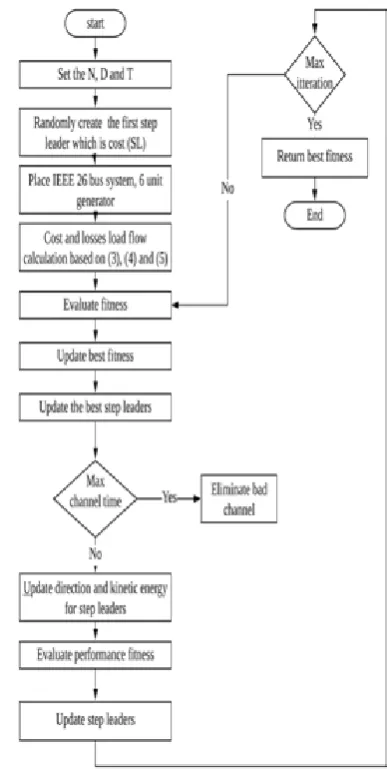
[image:2.595.331.525.63.448.2]The Lightning search algorithm (LSA) method was introduce a novel metaheuristic optimization to solve the constraint optimization problems [15]. The concept of fast particles which known as projectiles used the mechanism of step leader propagation where the natural phenomenon of lightning is based on LSA. The analytical model is the LSA process made in three steps. The three steps are known as transition projectile, space projectile and lead projectile. Fig 1 represents the process of LSA with ED. The following are the main steps of LSA are as follows:
Fig. 1 Flowchart of process for LSA with ED Initialization
The population of output power, maximum channel time, upper and lower bound were set.
The first step leader
To produce a step leader and a channel each projectile from the thunder cell is assumed. The first population size is the projectile, and the velocity is given by:
(6)
Where
v
p and vo are the current velocity and initialvelocity of the projectile :
c
is the speed of light, Fi is theconstant ionization rate,
m
is the mass of the projectile ands
is the length of the path traveled.
The population size can be created to increase the number of projectile forking using additional channel. There are two form of forking in the proposed algorithm. First, the projectile created the nuclei collision by symmetrical channel and using the opposite number as in Eq. (7).
(7)
2 1/22 2
/ / 1 / 1 1
v c sF mc
vp o i
i
i a b p
International Journal of Innovative Technology and Exploring Engineering (IJITEE) ISSN: 2278-3075, Volume-8 Issue-12, October 2019
Where, pi are the opposite and the boundary limits, a and
b are the original projectile in one dimension.
After several circulation trials, the energy redistribution of the most failed leader triggered a channel to appear at a successful step leader tip. This happened in the second type of forking. The channel time is defined as the maximum permitted number of trials and used to reallocated unproductive leader, so the population size of step leaders does not rise.
Transition projectile
Transition projectile can be a random number using the standard uniform probability. The probability density function of the standard uniform distribution can be
represented as:
(8)
Where xT is random number that may deliver a solution
or the first energy Esl_i of the step leader sli, a and b are the lower and upper bounds of the resolution space. For a population of N step leader
SL
sl
1,
sl
2,
sl
3,
...
sl
N
N random projectilesp
T
p
1T,
p
2T,
p
3T,...
p
NT
.Space projectile
By ionizing the section in the area of the former leader tip energy in the next step +1, the leaders are moved using active projectiles. This can be done after changing the N step leader tips. The position of the space projectile
s
N s
s s
s
p
p
p
p
p
1,
2,
3,
...
at step+1 can be presented as arandom number produced from the exponential distribution by determining the parameter µ. The probability density function of an exponential distribution is yielded from:
0 0 0 1 / s s x s x for x for e x f s (9)
Eq. (9) shows the direction in the next step can be measured by determined parameter µ. The distance between the lead projectile and the space projectile is accepted under
consideration µi in the LSA. The position of
s i
p
at step+1 is represented by:
i si s
new
i
p
rand
p
_
exp
(10)
The random number should be subtracted from the Eq. (10)
if
p
is is negative. This happened because the equation provides positive value only. The stepped leader propagation does not guarantee by the original position pis_new if theprojectile energy Eps_i is greater than the step leader Esl_i
for a good resolution. If pis_new provides a good resolution
at step+1, then the corresponding stepped leader sli is
prolonged to a new position
sl
i_newands i
p
is updated to snew i
p_ covers
sl
i_new past the extended leader during thisprocess it can turn into the lead projectile.
Lead projectile
The projectile connected with the ionize large section in front of the leader that has moved nearest to the ground from the step leader. The standard normal distribution with the form parameter µ and the scale parameter σ from the random number can be presented as a lead projectile. The normal
probability density function
f
x
L is represented as:
2/2 22
1
xL
L
e x
f
(11)
The current position clear by the form parameter shows the randomly produce lead projectile as Eq (11).
The scale parameter by a manipulation ability also in this projectile. The best solution for the scale parameter σ exponentially reductions as improvement towards the earth
as µL for the lead projectile
p
Lis taken asp
Lin the LSA.The position of
p
L at step+1 can be represented as:
L L
L L
new
p
normrand
p
,
(12)The normal distribution function produces a normrand by a
random number. The projectile lead energy ELp_i is greater than step leader Esl_i to extend the resolution for the new
lead projectile position
p
newL does not promise the step leaderincrease . The consistent step leader sliis extended to a new
position
sl
i_new , andL
p
is updated ifp
newL provides agood solution at step+1. The space projectile remains unmoved until the next step.
IV. SIMULATIONRESULT
The proposed LSA for solving economic dispatch problem has been tested on 2 benchmark IEEE standard test systems [16] and the results are compared with other methods available in the literature to demonstrate its effectiveness. The simulations were performed in MATLAB 2019a software on Intel Core [email protected], 8GB RAM system.
Test system 1: 3-unit system
The 3 unit test system was tested at load demand of 850 MW generator limit constraint [17]. The cost coefficient of all thermal generating unit are taken from [18]. The parameter of LSA algorithm considered are population size is 20 and the iteration is 100. The corresponding result are compared with Genetic Algorithm [19], Particle Swarm Optimization [19], Artificial Bee Colony [19] and Grey Wolf Optimizer [17]. Table 1 show the comparison of results with diverse algorithms and it is found that the optimal value of fuel cost 8227.71 $/h at transmission losses of 3.840 attained by LSA. The cost is much
less comparatively with GA,
The convergence curve of 3-unit system is presented in Fig1
Table. 1 Generating Unit System (load demand = 850 MW)
Unit power (MW)
GA PSO ABC GWO LSA
P1 342.255 394.524 300.266 300.51 372.23
P2 127.418 200 149.733 149.81 153.30
P3 340.320 255.475 400 399.67 328.30
Losses 4.280 4.060 3.940 3.940 3.840
Fuel cost ($/h)
8575.64 8280.81 8253.1 8253.10 8227.71
Fig. 2 Convergence curve for 3 unit generating system (850 MW)
Test system 2: 6-unit system
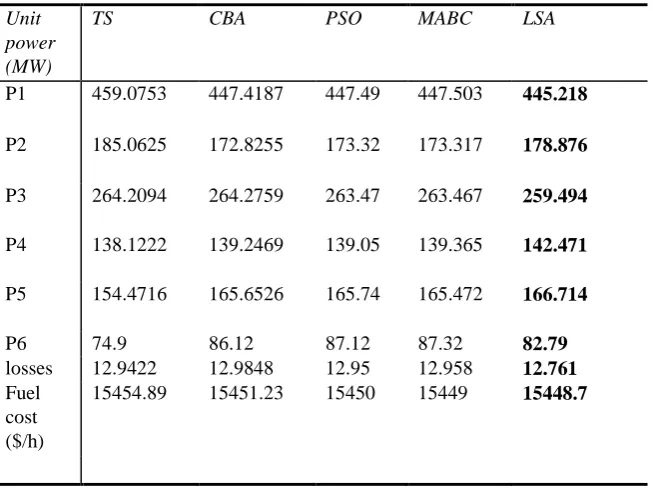
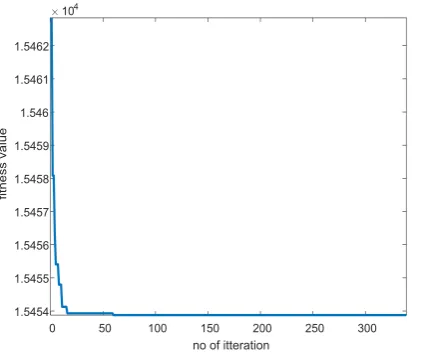
[image:4.595.137.464.434.679.2]The 6-unit test system [20] was tested at a load demand of 1263 MW generator limit constraints. 20 runs were performed at a maximum population size of 30 and the iterations were limited to 500. The best result in 20 runs is shown in Table 2 along with results of TS [20], CBA [21], PSO [22] and MABC [23] . It can be seen from Table 2 that LSA algorithm achieved minimum fuel cost 15448.7 $/h at transmission losses of 12.761 and the cpu time is 450.59 second. Convergence curve is demonstrated in Fig. 3 respectively. Robustness for 6-unit generator with 20 runs also presented in Fig. 4
Table. 2 Unit Generating System (load demand =1236 MW)
Unit power (MW)
TS CBA PSO MABC LSA
P1 459.0753 447.4187 447.49 447.503 445.218
P2 185.0625 172.8255 173.32 173.317 178.876
P3 264.2094 264.2759 263.47 263.467 259.494
P4 138.1222 139.2469 139.05 139.365 142.471
P5 154.4716 165.6526 165.74 165.472 166.714
P6 74.9 86.12 87.12 87.32 82.79
losses 12.9422 12.9848 12.95 12.958 12.761
Fuel cost ($/h)
International Journal of Innovative Technology and Exploring Engineering (IJITEE) ISSN: 2278-3075, Volume-8 Issue-12, October 2019
[image:5.595.59.273.55.233.2]Fig. 3 Convergence curve for 6 unit generating system
Fig. 4 Robustness of LSA for 6 Generating Unit
V. CONCLUSION
In this study paper, the application of LSA for solving the economic dispatch has been presented. The performance of LSA is tested for small power plants. The efficiency of proposed LSA is tested with the standard IEEE bus system consisting of 3 units generating system and 6 unit generating system. The result obtained show the LSA has been successfully implemented to solve ED problem. It found that, LSA can provide the result in term of minimizing total fuel cost and losses as compared to GA, PSO, ABC and GWO for small scale power system. LSA can also be tried out for multi objective optimization problems and economic dispatch problems that incorporate hybrid sources. All the presently tested systems were successfully solved by LSA and further improvement may be achieved by improving LSA algorithm or mixing it with different hybrid algorithm.
ACKNOWLEDGMENT
The writers would like to recognize the cooperation and support provided by, Green and Sustainable Energy (GSEnergy) Focus Group, Faculty of Electrical and Electronic Engineering, Universiti Tun Hussein Onn and UniKL Mimet as a main presenter for this publishing.
REFERENCES
M. H. Sulaiman, “An Application of Barnacles Mating Optimizer for
2. J. M. Lujano-Rojas, G. J. Osório, and J. P. S. Catalão, “New probabilistic method for solving economic dispatch and unit commitment problems incorporating uncertainty due to renewable energy integration,” Int. J. Electr. Power Energy Syst., vol. 78, pp. 61–71, 2016.
3. B. G. Lindner, R. Brits, J. H. van Vuuren, and J. Bekker, “Tradeoffs between levelling the reserve margin and minimising production cost in generator maintenance scheduling for regulated power systems,” Int. J. Electr. Power Energy Syst., vol. 101, no. January, pp. 458–471, 2018.
4. R. M. S. Danaraj and F. Gajendran, “Quadratic programmig solution to emission and economic dispatch problems,” J. Inst. Eng. Electr. Eng. Div., vol. 86, no. SEPT., pp. 129–132, 2005.
5. S. Krishnamurthy and R. Tzoneva, “Comparison of the Lagrange ’ s and Particle Swarm Optimisation Solutions of an,” pp. 1–8, 2012. 6. A. Gholami, M. Jamei, J. Ansari, and A. I. Sarwat, “Combined
Economic and Emission Dispatch Incorporating Renewable Energy Sources and Plug-In Hybrid Electric Vehicles,” vol. 4, no. 2, pp. 60–67, 2014.
7. R. Prasad and K. Nath, “DPD : An intelligent parallel hybrid algorithm for economic load dispatch problems with various practical constraints,” Expert Syst. Appl., vol. 63, pp. 295–309, 2016. 8. P. K. Adhvaryyu, P. K. Chattopadhyay, and A. Bhattacharjya,
“Dynamic economic emission load dispatch of hybrid power system using bio-inspired social spider algorithm,” 2016 IEEE 1st Int. Conf. Power Electron. Intell. Control Energy Syst., pp. 1–6, 2016. 9. Y. Z. Li et al., “Risk constrained economic dispatch with integration of
wind power by multi-objective optimization approach,” Energy, vol. 126, pp. 810–820, 2017.
10. V. S. Aragón, S. C. Esquivel, and C. A. C. Coello, “An immune algorithm with power redistribution for solving economic dispatch problems,” vol. 295, pp. 609–632, 2015.
11. H. M. Dubey, M. Pandit, and B. K. Panigrahi, “An overview and comparative analysis of recent bio-inspired optimization techniques for wind integrated multi-objective power dispatch,” Swarm Evol. Comput., vol. 38, no. March 2016, pp. 12–34, 2018.
12. H. Shareef, A. A. Ibrahim, and A. H. Mutlag, “Lightning search algorithm,” Appl. Soft Comput. J., vol. 36, pp. 315–333, 2015. 13. M. R. Sarker, S. Member, and R. Mohamed, “dSPACE
Controller-Based Enhanced Piezoelectric Energy Harvesting System Using PI-Lightning Search Algorithm,” IEEE Access, vol. 7, pp. 3610–3626, 2019.
14. M. Khairuzzaman, M. Zamani, I. Musirin, S. I. Suliman, and T. Bouktir, “Implementation of Modified Chaos Embedded Symbiotic Organisms Search Algorithm to Solve Economic Dispatch Problem.” 15. H. Shareef, A. A. Ibrahim, and A. H. Mutlag, “Lightning search
algorithm,” Appl. Soft Comput. J., vol. 36, pp. 315–333, 2015. 16. N. Kherfane, R. L. Kherfane, M. Younes, and F. Khodja, “Economic
and Emission Dispatch with renewable energy using HSA,” Energy Procedia, vol. 50, pp. 970–979, 2014.
17. V. Kumar and K. S. K. Bath, “Solution of non-convex economic load dispatch problem using Grey Wolf Optimizer,” Neural Comput. Appl., 2015.
18. A. J. Wood and F. Bruce, POWER GENERATION , OPERATION , AND CONTROL.
19. B. Mallikarjuna, K. H. Reddy, and O. Hemakeshavulu, “Economic Load Dispatch with Valve - Point Result Employing a Binary Bat Formula,” vol. 4, no. 1, pp. 101–107, 2014.
20. S. Pothiya, “Application of multiple tabu search algorithm to solve dynamic economic dispatch considering generator constraints,” vol. 49, pp. 506–516, 2008.
21. B. R. Adarsh, T. Raghunathan, T. Jayabarathi, and X.-S. Yang, “Economic dispatch using chaotic bat algorithm,” Energy, vol. 96, pp. 666–675, 2016.
22. F. S. Abu-Mouti, “Optimal Economic and Environmental Operation of Electric Power Systems Via Modern Meta-Heuristic Optimization Algorithms,” Zhurnal Eksp. i Teor. Fiz., no. December, 2011. 23. D. C. Secui, “A new modified artificial bee colony algorithm for the