NUR ATIKAH BINTI NOR’AZLAN
A report submitted in partial fulfillment of the requirements for the degree of Bachelor of Electrical Engineering (Control, Instrumentation and Automation)
Faculty of Electrical Engineering
UNIVERSITI TEKNIKAL MALAYSIA MELAKA
“Hereby declare that I have read through this report entitle “Multivariable PID Controller Design Tuning using Optimization Technique for Activated Sludge Process” and found that it has been comply the partial fulfillment for awarding the degree of Bachelor of Electrical Engineering (Control, Instrumentation and Automation)”.
Signature : ………...
Supervisor’s Name : NUR ASMIZA BINTI SELAMAT
I declare that this report entitle “Multivariable PID Controller Design Tuning using Optimization Technique for Activated Sludge Process” is the result of my own research except as cited in the references. The report has not been accepted for any degree and is not concurrently submitted in candidature of any other degree.
Signature : ………...
Name : NUR ATIKAH BINTI NOR’AZLAN
ACKNOWLEDGEMENT
First of all, I am grateful to The Almighty God for establishing me to complete this final year project.
I place on record, my sincere gratitude to Puan Nur Asmiza Binti Selamat, lecturer of Electrical Faculty and also my kind supervisor. I am extremely grateful and indebted to her for her expert, sincere and valuable guidance and encouragement extended to me during all time until project being finished.
I take this opportunity to express my deep sincere thanks to my parents and members for their cooperation and encouragement while helping me settled this project until became successful.
ABSTRACT
TABLE OF CONTENTS
Page
ACKNOWLEDGEMENT i
ABSTRACT ii
TABLE OF CONTENTS iii
LIST OF TABLES vi
LIST OF FIGURES vii
1 INTRODUCTION
1.1 Background of Study 1
1.2 Motivation 1
1.3 Problem Statement 2
1.4 Objectives 3
1.5 Project Scope 3
1.6 Project Report Summary 4
2 LITERATURE REVIEW
2.1 Introduction 6
2.2 Activated Sludge Process 6
2.3 Activated Sludge Process Controller 9
2.4 Multivariable PID 10
2.5 Multivariable PID Tuning Method 13
2.6 Optimization Technique 16
2.6.1 Bat Algorithm 19
2.6.2 Genetic Algorithm 19
2.7 Performances of BA, GA and PSO based on Previous Research 21
3 METHODOLOGY
3.1 Introduction 22
3.2 Project Flow 22
3.3 Activated Sludge Process 25
3.4 Multivariable PID Tuning 30
3.4.1 Davison method 31
3.4.2 Penttinen-Koivo method 31
3.4.3 Maciejowski method 32
3.4.4 Combined method 33
3.5 Optimization Technique 34
3.5.1 Bat Algorithm (BA) 34
3.5.2 Genetic Algorithm (GA) 38
3.5.3 Particle Swarm Optimization (PSO) 43
3.6 Objective Function 48
3.7 Simulation 49
4 RESULT AND DISCUSSION
4.1 Introduction 51
4.2 Open Loop Response 51
4.3 MPID Parameters Initialization and Selection 54
4.4 Linear system of Activated Sludge Process 57
4.4.2 MPID Tuning Result using GA 60
4.4.3 MPID Tuning Result using PSO 63
4.4.4 Comparisons between BA, GA and PSO 65
4.5 Comparisons of Best MPID Control between Optimization 69
4.6 Nonlinear System of Activated Sludge Process 72
4.6.1 MPID Tuning Result using BA 72
4.6.2 MPID Tuning Result using GA 75
4.6.3 MPID Tuning Result using PSO 78
4.6.4 Comparisons between BA, GA and PSO 81
5 CONCLUSION AND FUTURE WORK
5.1 Introduction 85
5.2 Conclusion 85
5.3 Future Works 87
6 REFERENCES 88
7 APPENDIX
6.1 Appendix A 93
6.2 Appendix B 95
LIST OF TABLES
TABLE NO TITLE PAGE
3.1 Initial condition value 28
3.2 Kinetic parameter value 28
3.3 Parameter initialization in BA 36
3.4 Parameter initialization in GA 41
3.5 Parameter initialization in PSO 46
4.1 Open loop system performance data 53
4.2 Parameter initialization for BA, GA and PSO 56
4.3 MPID tuning parameter data using BA 58
4.4 MPID tuning parameter data using GA 61
4.5 MPID tuning parameter data using PSO 64
4.6 Comparison standard deviation and average of PSO, GA & BA 69
4.7 Comparison proposed method between PSO, GA & BA 70
4.8 Nonlinear MPID tuning parameter data using BA 73
4.9 Nonlinear MPID tuning parameter data using GA 76
LIST OF FIGURES
FIGURE NO TITLE PAGE
2.1 The wastewater treatment process 7
2.2 Activated sludge process 8
2.3 Multivariable system with PID controller 11
2.4 Centralized controller for multivariable system 12
2.5 Decentralized controller for multi-loop system 12
2.6 PID turning method classification 14
2.7 Metaheuristic algorithm for optimization 17
3.1 Methodology Flowchart 23
3.2 Block diagram of activated sludge process 25
3.3 BA Flow chart 35
3.4 GA flow chart 39
3.5 PSO flow chart 44
3.6 Nonlinear activated sludge process 50
4.1 Open loop step response of ASP 52
4.2 Open loop with system performance 53
4.3 Performance index vs. No. of particle 54
4.4 Performance index vs. Range 55
4.5 Performance index vs. No. of Iteration 56
4.6 System performance of MPID control tuning using BA 57
4.7 Transient response between MPID control method of BA 59
4.9 Transient response between MPID control method of GA 62
4.10 System performance of MPID control tuning using PSO 63 4.11 Transient response between MPID control method of PSO 65
4.12 Comparison of BA, GA and PSO for Davison method 66
4.13 Comparison of BA, GA and PSO for Penttinen-Koivo method 67 4.14 Comparison of BA, GA and PSO for Maciejowski method 67
4.15 Comparison of BA, GA and PSO for Proposed method 68
4.16 Proposed method comparison between BA, GA and PSO 70 4.17 Nonlinear system performances using BA – substrate 72 4.18 Nonlinear system performances using BA – dissolved oxygen 73
4.19 Transient Response of BA for nonlinear system 74
4.20 Nonlinear system performances using GA – substrate 75 4.21 Nonlinear system performances using GA – dissolved oxygen 76
4.22 Transient Response of BA for nonlinear system 77
4.23 Nonlinear system performances using PSO – substrate 78
4.24 Nonlinear system performances using PSO – dissolved oxygen 79
4.25 Transient Response of PSO for nonlinear system 80
4.26 Comparisons of BA, GA and PSO for Davison method 81
4.27 Comparisons of BA, GA and PSO for Penttinen-Koivo method 82
4.28 Comparisons of BA, GA and PSO for Maciejowski method 82
4.29 Comparisons of BA, GA and PSO for Proposed method 83
CHAPTER 1
INTRODUCTION
1.1 Background of Study
Activated sludge process (ASP) is biological process that suspended growth secondary treatment process of Wastewater Treatment Plant (WWTP). It is a primarily removes dissolved organic solids while involving in controlling the concentration of microorganisms and sludge particles that are naturally found in unsettled wastewater. Besides, the controller parameters stay remained constant once after the plant been commissioned and this process involves a number of interacting controls. Therefore, a proper tuning of multivariable PID will improves the performances of WWTP while the parameter tuning can be obtained using optimization technique.
1.2 Motivation
1.3 Problem Statement
Lately much of the efforts are giving an attention on new sources of clean energy, transportation and of course, wastewater treatment. An accurate treatment of the wastewater is a common issue in all metropolises before its discharge into the receiving water. Besides, since the ecological awareness is more important for people and politicians nowadays, the quality standards for Wastewater Treatment Plants (WWTP) becoming constricted [7]. WWTP also is categorized as a complex system. Therefore, an effective control methods need to be implemented for economic and environmental reasons, especially its Activated Sludge Process (ASP) because it involve a biological process. Unfortunately, an increasing claim for a more stable effluent water quality [6] makes a scalar PID based control systems are become insufficient anymore due to complexity of the system such as interrelated and highly nonlinear of its biological, physical and chemistry phenomena. Hence, as the system becomes more complex, the process of tuning controllers also becomes more difficult [8].
1.4 Objectives
The aim of this project is to gain parameter tuning based on selected optimization technique. So, the goals of this project are:
1) To implement the Multivariable PID (MPID) control tuning method of Activated Sludge Process.
2) To tune MPID parameter using optimization technique, Bat Algorithm (BA), Genetic Algorithm (GA) and Particle Swarm Optimization (PSO) for MPID control tuning method.
3) To compare the system performances in term of transient response between selected optimization techniques
1.5 Project Scope
1.6 Project Report Summary
This thesis basically is distributed into five chapters and this section delivers a brief overview of the chapters comprised in it.
Chapter 1: Introduction
This section guides readers to the elementary of this project, such as overview of activated sludge process, objectives, problem statement and project scope towards it.
Chapter 2: Literature Review
This part provides a simple explanation on the concept and previous work of related literature studies. The activated sludge process flow, controllers, MPID tuning and optimization techniques are being reviewed.
Chapter 3: Methodology
In this section, the project flow and methodology along to accomplish this project are being presented. Davison, Penttinen-Koivo, Maciejowski and Proposed Combined method are the types of MPID tuning that will be explained. Instead, the process of implementation of optimization technique will be stated in this chapter
Chapter 4: Result and Discussion
Chapter 5: Conclusion and Future woks
CHAPTER 2
LITERATURE REVIEW
2.1 Introduction
This chapter explained about the definition of related subject or issues for this project. From this review, a several MPID methods and optimization technique will be chosen for additional studies. Hence, this section also reviews the related previous researches that have been done and other topic connected with this project.
2.2 Activated Sludge Process
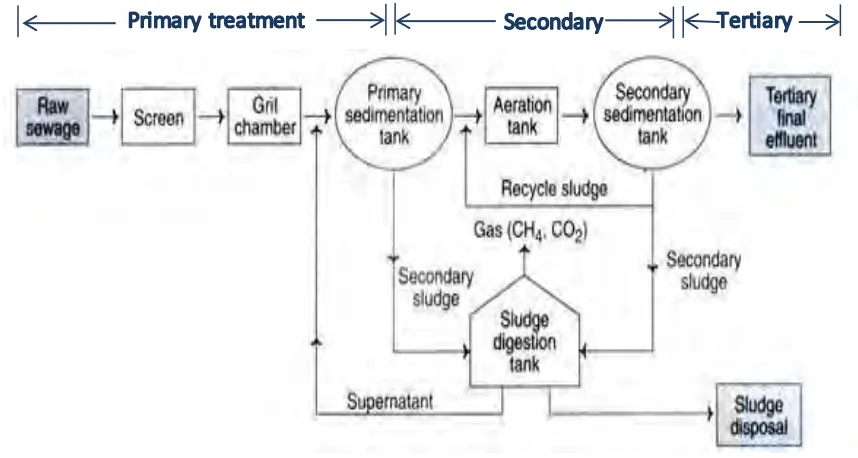
Figure 2.1: The Wastewater Treatment Process
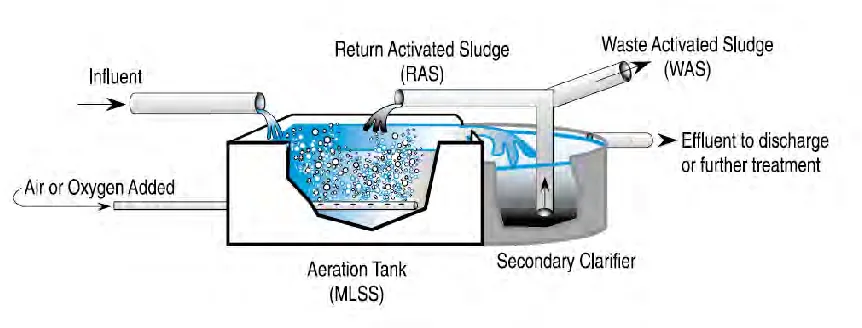
Activated sludge process is the most widely used for biological wastewater treatment plant [2] and a type of secondary treatment where a high level of elimination of biodegradable organic pollutants are given to keep receiving water quality that clarification alone cannot provide. The activated sludge process also can speeds up decomposition by adding an activated sludge into the wastewater where the activated sludge particles hold many living organisms that can feed on the incoming wastewater [3]. This process is divided into two parts; an aerator tank which where the growth of organisms take place and a secondary settling tank, in where the leaving of clear liquid free of organic material happened [4].
[image:18.596.89.518.106.335.2]Figure 2.2: Activated Sludge Process
[image:19.596.89.520.110.274.2]2.3 Activated Sludge Process Controller
Nowadays, the health of natural ecosystems has been giving more attention cause of the effect from the human development in very different ways [6] by increased environmental awareness in terms of water pollution anticipation. The constricted laws and requirements toward quality of water are fortunately acting like a driving force for the development of wastewater treatment plants (WWTPs) [7]. The complex, interrelated and highly nonlinear of its biological, physical and chemical phenomena make the WWTP become more difficult to be controlled while optimizing operating and management costs [8].
Meanwhile, the activated sludge process (ASP), a biological processes are usually popular methods used to remove carbon as well as components of nitrogenous from wastewater beforehand it being released [9]. ASP has been widely case study in the automatic control perspective, for example by Yong et al. [10] the concentration of ammonia in the fluent of the wastewater plant is reducing by implementation of cascading PI-like controllers with feed-forward actions. Different with the model predictive control (MPC) by Holenda et al. [11] proposed that MPC method determining and controlling the dissolved oxygen concentration only. A decreasing of more than 25% in power usage and an increasing in plant efficiency are the significant benefits that can be obtained of using the MPC system [12].
Rojas et al. [15] proposed that in order to be able to actuate based on the measurements of the disturbance, a three degree of freedom controller, tuned with the Virtual Reference Feedback Tuning (VRFT) is offered and applied to the WWTP. The three degree of freedom controller is an extended from a two degree of freedom PI which where control of nitrate concentration by manipulating the internal recycle flow rate, plus disturbance feed-forward action that can control ammonia using ammonia measurements from the influent. This methodology viewing the usability of model-free approach for WWTP control although there are no clear rules to select neither an appropriate close-loop target function nor the correct parameterization of the controllers
2.4 Multivariable PID
PID stands for Proportional Integral Derivative is a type of controller that encouraging to be used with more than 90% of industrial controllers due to its well-known robustness and its straightforwardness where the structure is easy to understand [16]. The structure of PID a combination of “three terms” and the transfer functions are given by (2.4.1) and (2.4.2) where proportional term represented gain factor, integral term by an integral and derivative term by a differentiator. Each of them has their own specific character to make sure better system performance. P-term decreases error but does not remove it. I-term eliminates the error but have a tendency to make the system oscillate while D-term improves the speed of the responses [17].
( ) ( )
( ) ( ) ( )
[ ] [ ( ) ( )
( ) ( )
] [ ]
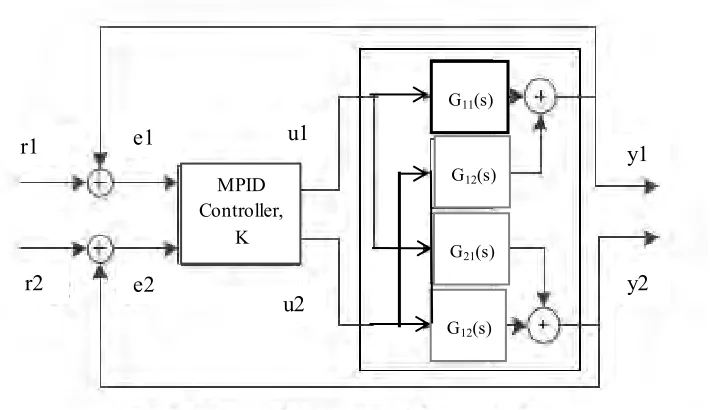
Along the implementation of PID controller due to the popularity of its advantages, this controller has limitation to control multivariable system. Multivariable process is a system with combination more than one variables at the input or output to be controlled in a system and a type of MIMO system which means input, multi-output system. Figure 2.3 shows a multivariable system with PID controller and its transfer function matrix is stated at (2.4.3).
Figure 2.3: Multivariable System with PID Controller
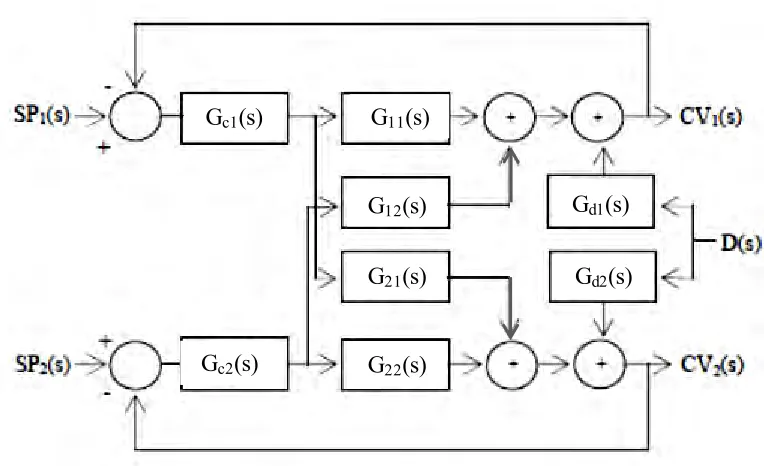
MIMO system can be divided into two, centralized and decentralized controller. Centralized controller only involves one loop while decentralized controller involves several loops. The multivariable system is the system that apply centralized controller since its deal with MIMO by using single controller. Then, the decentralized controller was applied to another system called Multi-loop where each control variables are controlled by different controller [18]. Figure 2.4 shows a centralized controller for multivariable system, while Figure 2.5 shows a decentralized controller for multi-loop system. r1 r2 e1 e2 u1 u2 y1 y2 MPID Controller, K
G11(s)
G12(s)
G21(s)
[image:22.596.121.476.239.444.2]Figure 2.4: Centralized Controller for Multivariable System
Figure 2.5: Decentralized Controller for Multi-loop System
Unfortunately, sometimes interactions phenomena can be occurred in MIMO system and it happen when loop gain in one loop also depends on other loop gains, particularly multivariable system [19]. Differ to the multi-loop system that does not acknowledge the interaction phenomena due to the structure of loop control which base on a single loop basis [20]. An interaction effect can be shown in (2.4.4) and (2.4.5). Besides, another factor which is quite important in multivariable system is input/output pairing problem. A number of quantitative techniques can be used to determine the right pairing of the manipulated and controlled variables [19]. So, the MPID is challenging to
CV(s)
SP(s)
Gd(s)
Gp(s) Gc(s)
Gc1(s)
Gc2(s)
G11(s)
G12(s)
G21(s)
G22(s)
Gd1(s)
[image:23.596.145.489.99.241.2] [image:23.596.123.505.285.518.2]build rather than PID that implement in SISO system because it is does not involved an interaction [21].
( ) ( ) (2.4.4)
( ) ( ) (2.4.5)
2.5 Multivariable PID Tuning Method
Multivariable PID tuning method can be classified into two parts; parametric and non-parametric methods. Parametric methods use whichever model or experiment data to determine the controller parameters and are mostly defined as offline tuning methods, through online approaches have also been tested. While, non-parametric methods only partly use models such as critical states and are suitable for online use as well as for application without previous extensive plant studies [22]. The example of parametric tuning methods are Biggest Log modulus Tuning (BLT), gain and phase margin, minimum variance control, internal model control, and robust decentralized method whereas Davison, Penttinen-Koivo and Maciejowski are categorized on non-parametric tuning methods. Figure 2.6 shows the PID turning method classification.