Open Access
Research article
Methicillin-resistant
Staphylococcus aureus
and
Acinetobacter
baumannii
on computer interface surfaces of hospital wards and
association with clinical isolates
Po-Liang Lu
1,2,3, LK Siu
4, Tun-Chieh Chen
1,3, Ling Ma
4, Wen-Gin Chiang
1,
Yen-Hsu Chen*
1,2,3, Sheng-Fung Lin
1and Tyen-Po Chen
1Address: 1Department of Internal Medicine, Kaohsiung Medical University Hospital, Taiwan, Republic of China, 2Department of Laboratory Medicine, Kaohsiung Medical University Hospital, Taiwan, Republic of China, 3Graduate Institute of Medicine, College of Medicine, Kaohsiung Medical University, Taiwan, Republic of China and 4Division of Clinical Research, National Health Research Institute, Taiwan, Republic of China
Email: Po-Liang Lu - [email protected]; LK Siu - [email protected]; Tun-Chieh Chen - [email protected];
Ling Ma - [email protected]; Wen-Gin Chiang - [email protected]; Yen-Hsu Chen* - [email protected]; Sheng-Fung Lin - [email protected]; Tyen-Po Chen - [email protected]
* Corresponding author
Abstract
Background: Computer keyboards and mice are potential reservoirs of nosocomial pathogens, but routine disinfection for non-water-proof computer devices is a problem. With better hand hygiene compliance of health-care workers (HCWs), the impact of these potential sources of contamination on clinical infection needs to be clarified.
Methods: This study was conducted in a 1600-bed medical center of southern Taiwan with 47 wards and 282 computers. With education and monitoring program of hand hygiene for HCWs, the average compliance rate was 74% before our surveillance. We investigated the association of methicillin-resistant Staphylococcus aureus (MRSA), Pseudomonas aeruginosa and Acinetobacter baumannii, three leading hospital-acquired pathogens, from ward computer keyboards, mice and from clinical isolates in non-outbreak period by pulsed field gel electrophoresis and antibiogram.
Results: Our results revealed a 17.4% (49/282) contamination rate of these computer devices by
S. aureus, Acinetobacter spp. or Pseudomonas spp. The contamination rates of MRSA and A. baumannii
in the ward computers were 1.1% and 4.3%, respectively. No P. aeruginosa was isolated. All isolates from computers and clinical specimens at the same ward showed different pulsotypes. However,
A. baumannii isolates on two ward computers had the same pulsotype.
Conclusion: With good hand hygiene compliance, we found relatively low contamination rates of MRSA, P. aeruginosa and A. baumannii on ward computer interface, and without further contribution to nosocomial infection. Our results suggested no necessity of routine culture surveillance in non-outbreak situation.
Published: 1 October 2009
BMC Infectious Diseases 2009, 9:164 doi:10.1186/1471-2334-9-164
Received: 24 January 2009 Accepted: 1 October 2009 This article is available from: http://www.biomedcentral.com/1471-2334/9/164
© 2009 Lu et al; licensee BioMed Central Ltd.
Background
In developed countries, computers are used in the bedside area for multiple functions, including ordering, checking laboratory and image results, recording patients' condi-tions, and accounting. Moreover, most computer devices, such as keyboards and mice, in many countries are not water-proof and not specially designed for hospital disin-fection needs. Therefore, there is a good possibility that computer interface surfaces may serve as reservoirs for nosocomial pathogens. Besides, the rate of hand washing compliance in healthcare institutions is low (~40%), which is presumably related to the contamination of inanimate surfaces of medical equipments and hospital environment with nosocomial pathogens [1]. Studies have shown that the hands or gloves of healthcare workers (HCWs) can be contaminated after touching inanimate objects in patient rooms or after touching environmental surfaces near patients [2-4].
One study reported that microbial contamination of com-puter interface surfaces was so prevalent that various microorganisms were isolated from more than 50% of the keyboards of hospital computers [5]. The levels of con-tamination varied with the proximity to the patients, the texture of inanimate surfaces and the frequency of contact. The hospital ward computer is found being less likely to be contaminated than bedside computers [6]. Schultz et al. have reported that 95% of keyboards in close proximity to patient sites had bacterial contamination. However, only 5% of these were pathogens known to be associated with nosocomial transmission [7]. Most previous studies have reported the contamination of computer interface surfaces by potential pathogens such as Methicillin-resist-ant Staphylococcus aureus (MRSA) [3,8]and Acinetobacter baumannii [9], but few have studied the relationship between contamination of the ward computers and clini-cal isolates in hospitals with improved hand hygiene com-pliance and during a non-outbreak period. Clinically, A. baumannii, P. aeruginosa, and MRSA cause the most com-mon nosocomial infections and their presence correlates with environmental surface contamination [10-12]. We conducted a hospital-based surveillance study of these three important pathogens on computer interface surfaces in different ward settings and then examined the relation-ship of contaminated computer interface surfaces with the presence of clinical isolates in these wards during a non-outbreak period.
Methods
We conducted a cross-sectional surveillance for S. aureus,
Pseudomonas species and Acinetobacter species on the key-boards and mice of computers in all ward stations of Kaohsiung Medical University Hospital, a 1600-bed terti-ary referral hospital that contained various speciality departments, in July 2006. The three organisms are
among the most common causes of nosocomial infection in the study site where Vancomycin resistant enterococcus (VRE) accounted for less than 1% enterococcus clinical isolates. Clinical isolates of MRSA, P. aeruginosa, and A. baumannii were recovered two weeks before or after the day of the cross-sectional surveillance, when computer-associated bacteria were collected. We selected clinical and computer isolates of the same species in the same ward for comparison by antibiograms and pulsed field gel electrophoresis (PFGE) typing.
All medical records and ordering systems were computer-ized in this hospital. No routine disinfection protocol had been established for computer equipment. The keyboards were not covered. No routine cleaning for the surfaces of computer interfaces was performed. Hand hygiene com-pliance has been continuously educated and monitored every three months with method as previously described [13] by members in infection control room and the department of nursing. Every week, HCWs' hand hygiene compliance was monitored for 30 minutes in each ward. The mean of the rates from four times of monitoring was regarded as the hand hygiene compliance rate of every ward.
A sterile swab (CultureSwab Transport System, Difco, Detroit, MI) moistened with sterile saline solution was moved over the keys of keyboards and the buttons of computer mice. Then the swabs were added to brain heart infusion broth medium for 48 h at 37°C. The inoculated broth was subcultured onto blood agar plates (BBL, Cock-eysville, MD, USA) and Mac-Conkey agar plates (BBL, Cockeysville, MD, USA). Organisms were identified using standard methods and the API Identification System (bioMe'rieux, Marcy l'Etoile, France). Isolates of Pseu-domonas and Acinetobacter were identified to species level. We used the coagulase test (Coagulase Plasma System; Difco) to identify S. aureus strains. MRSA was preliminar-ily detected by its characteristic growth on mannitol salt agar supplemented with oxacillin (4 μg/mL). All sus-pected MRSA isolates were inoculated onto Mueller-Hin-ton agar (BecMueller-Hin-ton Dickinson Microbiology Systems) supplemented with 6 μg/ml oxacillin and 4% NaCl. Iso-lates identified as P. aeruginosa, A. baumannii, and MRSA were further tested for antimicrobial susceptibility and for PFGE typing.
possibly related (four to six band differences), and unre-lated (more than six band differences), according to the criteria previously described [17]. To identify PFGE poly-morphisms, each sample was analyzed by Molecular Ana-lyst Fingerprinting, Fingerprinting Plus, and Fingerprinting DST Software (Bio-Rad Laboratories, Rich-mond, CA, USA). After calculation of similarities for every pair of organisms using Pearson correlation coefficients, we used the grouping method to deduce a dendrogram from the matrix via the Unweighted Pair Group Method using Arithmetic Average (UPGMA) clustering technique.
Statistics were run with SPSS software version 13.0 (SPSS Inc., Chicago, IL, USA). P values were calculated by the Chi-Square test for categorical variables. All tests were two-tailed, and p < 0.05 was considered significant.
Results
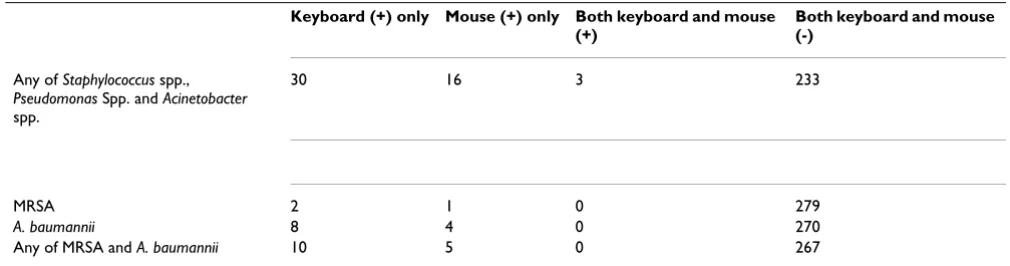
We screened 282 computer samples that each had a key-boards and a mouse device in 47 ward stations for S. aureus, Pseudomonas spp. and Acinetobacter spp. Twelve of the ward stations were from intensive care units (ICUs) and 35 were from Non-ICU wards One hundred and forty-four samples were from ICU computers and 420 from ward computers. All nurse stations had six desktop computers, one for accounting, one for radiological images, and four for ordering and laboratory data check-ing. Although the computers for accounting were mainly operated by accountants without direct contact with patients, the other HCWs accessed these computers occa-sionally when the accountants were off duty. The average compliance rate was 74% in the month that the cross-sec-tional surveillance on computer underwent. There was no significant difference on compliance rates among wards.
Before final species identification, we found 18 isolates of
S. aureus, 17 isolates of Pseudomonas spp., and 22 isolates of Acinetobacter spp. from 49 computer interface samples. Three computers had positive isolation from both key-board and mouse device. Five computer interfaces had two different species identified. The overall computer
con-tamination rate of the above three organisms is 17.4% (49/282).
For Acinetobacter isolates, 12 were A. baumannii, 7 were A. lwoffii, and 3 were A. junii. For S. aureus isolates, 3 were MRSA and 15 were MSSA. For Pseudomonas isolates, there were 12 P. putida isolates, 1 P. alcaligenes, 4 P. stutzeri, but none was P. aeruginosa. The computer contamination rate for A. baumannii was 4.3% (12/282) and the rate for MRSA was 1.1% (3/282) (Table 1). The combined con-tamination rate of either MRSA or A. baumannii is 5.3% (15/282).
There was no significant difference about contamination rate by any of S. aureus, Pseudomonas spp. and Acinetobacter
spp. between non-ICU (16.7%, 35/210) and ICU (19.4%, 14/72) computers (p = 0.591) and between accounting, radiology and order computers (p = 0.699). When the radiology and order computers were grouped together into the "clinical use" category, there was no significant difference in the contamination rate between accounting (10/47) and "clinical use" (39/235) computers (p = 0. 439). No significant higher rate of contamination of any of the above three between keyboard and mouse (p = 0.474) but there is a trend that the occurrence of keyboard contamination is associated with the occurrence of mouse device contamination (p = 0.054) by McNemar test.
When only considering MRSA, P. aeruginosa, and A. bau-mannii, all the differences between non-ICU and ICU computers (p = 0.476), keyboard and mouse specimens (p
= 0.191), and accounting and "clinical use" computers (p
= 0.722), were not significant (Table 2).
[image:3.612.52.557.596.729.2]Twenty isolates of A. baumannii, 34 isolates of MRSA, and 97 isolates of P. aeruginosa were identified from clinical specimens in the same hospital two weeks before and after the computer surveillance day. One MRSA isolate and two A. baumannii were isolated from patients of the wards where computer devices were also contaminated with MRSA and A. baumannii. We compared the clinical
Table 1: Culture results from computer interface surfaces.
Keyboard (+) only Mouse (+) only Both keyboard and mouse (+)
Both keyboard and mouse (-)
Any of Staphylococcus spp.,
Pseudomonas Spp. and Acinetobacter
spp.
30 16 3 233
MRSA 2 1 0 279
A. baumannii 8 4 0 270
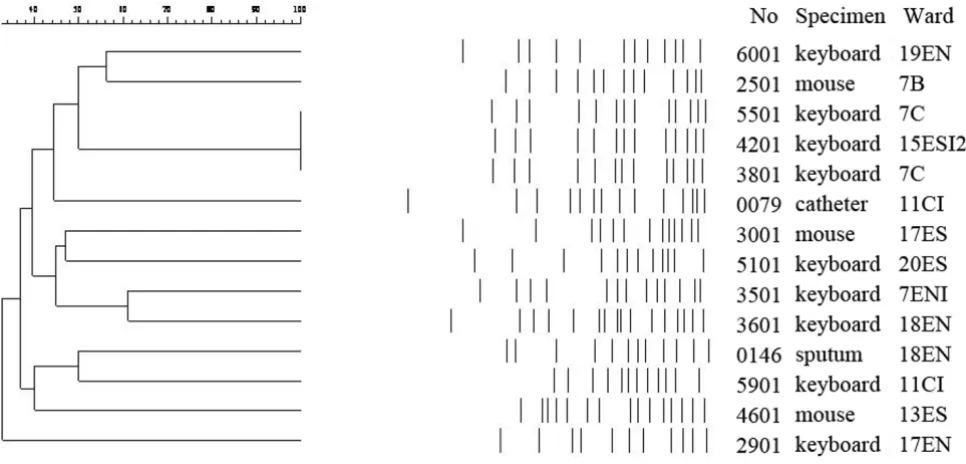
and computer isolates by antibiograms and PFGE typing. The antibiogram results of the A. baumannii isolated from clinical and computer specimens in ward 18EN were dif-ferent on fewer than three classes of antimicrobial agents. For the other groups of MRSA and A. baumannii isolates, the antibiograms differed in susceptibility by more than three classes of antimicrobial agents. The PFGE patterns of computer and clinical isolates in the same ward (MRSA isolates from ward 8B and A. baumannii isolates from ward 11CI and 18 EN) were different that had similarity
less than 70% (Fig. 1 and Fig. 2). However, interestingly, two A. baumannii computer isolates from ward 7C and one A. baumannii computer isolate from ward 15ESI2 had the same pulsotype (Figure 1).
Discussion
This hospital-based surveillance study indicated the rate of MRSA and A. baumannii contamination of ward com-puters was 1.1% and 4.3%, respectively. No computer device was contaminated by P. aeruginosa. The MRSA
con-Table 2: Culture results of MRSA and A. baumannii isolated from computer interface surfaces according to type of computer interface, type of ward, and computer function.
(+) for MRSA or A. bauman-nii
Keyboard (+) only Mouse (+) only Both keyboard and mouse (+)
Both keyboard and mouse (-)
Ward function
Non-ICU (N = 210) 6 4 0 200 ICU (N = 72) 4 1 0 67
Computer function
Accounting use (N = 47) 1 2 0 44 Clinical use (N = 235) 9 3 0 223 ICU: intensive care unit
[image:4.612.55.554.110.270.2]Similarity of PFGE patterns of A. baumannii isolated in hospital wards, calculated by the unweighted pair group method using arithmetic averages (UPGMA)
Figure 1
[image:4.612.67.550.437.669.2]tamination rate in our study was lower than that reported in a UK referral centre (1%) [18], but very different from that reported for a UK acute district general hospital (24%) [19]. This difference might be related to differences in hospital size, extent of computer use, and hand hygiene compliance. We supposed the relatively good hand hygiene compliance among our HCWs contributed to the lower contamination rate, although the two previous studies did not provide hand hygiene compliance data. The significant difference in the level of contamination of ward computers at different hospitals implies that com-puters can have very different roles as reservoirs of noso-comial pathogens. Compared with a high rate (37%) of environmental surfaces in patients' rooms harbor MRSA sampled from studies during outbreak and non-outbreak situations [20], ward computer interface surfaces seem to play a minor role as pathogen reservoirs.
Studies in ICUs indicate a more important role of comput-ers there as pathogen reservoirs than do the computcomput-ers of Non-ICU wards. Two previous studies have shown that contamination rate of computers in ICU workstations was as prevalent as that of the computers in patient rooms [8,21]. Computer interface surfaces in an ICU station were contaminated with potentially pathogenic microorgan-isms at a higher rate (6.3%) than the other surfaces [21]. However, for computer interfaces at ward stations, our results did not reveal a higher contamination rate in ICUs than that in non-ICUs.
Although contamination of inanimate surfaces by micro-organisms has long been recognized, its impact on patients' infections is not clear [22]. The fact that forty-two percent of personnel had MRSA contamination on their gloves without entering the rooms of patients with MRSA infections suggests that contaminated environmental sur-faces outside infected patients' rooms may increase the risk of MRSA transmission [3]. The association of clinical isolates and environmental contamination isolates was demonstrated for a 9-bed ICU, in which the researchers used PFGE typing of sequential isolates from clinical and
environmental specimens [23]. An investigation of com-puter interface devices in an ICU indicated indistinguish-able strains of MRSA from computers of patients' rooms, doctors' station, and clinical specimens [8]. Our hospital-based surveillance of MRSA by PFGE typing did not iden-tify an association of MRSA isolates from computer inter-face devices and from patients. It is noteworthy that our study was different for a significantly lower rate of MRSA contamination (1.1%) than this previous study (11.1%) [8]. However, the identity of indistinguishable strains of
A. baumannii from computer devices in two different wards (Figure 1) suggested the computer as a potential route of clonal spread in a hospital, although no subse-quent clinical isolate was of this strain in our study.
Compared with the relatively low MRSA contamination rate (1.1%) on ward computer interface surfaces in our study, the 53% MRSA hand contamination rate among HCWs after contacting environmental surfaces near hos-pitalized patients in Bhalla A. et al study, showed that HCW's role as pathogen reservoirs and suggested hand hygiene to be important [2]. Beside to improve hand-hygiene compliance, improvement of cleaning services could be administered as an effective infection control measure [20]. Disinfectants including chlorine, alcohol, phenol and quaternary ammonium are all effective against MRSA, P. aeruginosa, and vancomycin-resistant
Enterococcus species on keyboards of computers; and even sterile water is effective to remove more than 95% bacteria [5]. Flat keyboard with an alarm was suggested for being easy to clean and associated with better cleaning compli-ance [24]. Although keyboards can be safely and success-fully disinfected and the need to clean computer interface surfaces as a routine practice is generally accepted, no spe-cific cleaning and disinfection frequency and procedure for computer accessories has been defined [6,25]. Domes-tic cleaning has been reported useful to control MRSA [26]. As daily cleaning and hygiene regulation for using computer were demonstrated to be useful interventions to reduce keyboard contamination [9], several recommenda-tions were gradually adopted, including that computers
[image:5.612.63.555.88.170.2]Similarity of PFGE patterns of MRSA isolated in hospital wards, calculated by UPGMA
Figure 2
should be disinfected daily and when visibly soiled and HCW should not touch computer keyboards with con-taminated hands [5]. Our result of the trend for the asso-ciation of contamination rate of any of S. aureus,
Pseudomonas spp. and Acinetobacter spp on the keyboards and mouse devices suggested both interface surfaces required attention when conducting cleaning service.
In contrast to previous studies on the role of environmen-tal colonization that were performed during nosocomial pathogen outbreaks [27], our study was conducted when there was no outbreak. We did not investigate other fac-tors in the transmission route, such as HCWs' hand car-riage and colonization of patients. As sporadic MRSA strains differed in the shorter survival duration on envi-ronmental surface than outbreak strains [28], our study of a non-outbreak setting might be associated with the lower chance to find the similar genotype strains between com-puter and clinical isolates. Our study result is also limited by the cross sectional design that no measurement of the contamination levels was performed at two time periods with different hand hygiene compliance. Therefore it is difficult to make a conclusion about hand hygiene could help to prevent contamination of hospital ward comput-ers, though inanimate environment surfaces in hospitals played a role among many steps for the transmission of pathogen to patients and hand hygiene promotion may be beneficial to reduce the risk of cross contamination [29].
Conclusion
Our report documents that the contamination rates of computer interface surfaces by MRSA, P. aeruginosa, and A. baumannii in a hospital-wide surveillance were low when a relatively good hand hygiene compliance of HCWs was observed. Furthermore, no clinical correlation of contam-ination of these computer devices to clinical isolates was found. Routine disinfection and even surveillance of these computer devices may not be mandatory in non-outbreak settings.
Competing interests
The authors declare that they have no competing interests.
Authors' contributions
PLL and TPC designed the study. YHC and SFL advised on the clinical aspects of the study. LM and WGC participated in the laboratory work. PLL, LKS, YHC and CTC prepared the manuscript with major contributions from other authors. All authors read and approved the final version of the manuscript.
Acknowledgements
This work was supported by grants from the National Science Council (NSC 95-2314-B-037-076 to Lu PL, Chen YH) and National Health Research Institutes (Siu LK), Taiwan.
References
1. Boyce JM, Pittet D: Guideline for Hand Hygiene in Health-Care Settings: recommendations of the Healthcare Infection Control Practices Advisory Committee and the HICPAC/ SHEA/APIC/IDSA Hand Hygiene Task Force. Infect Control Hosp Epidemiol 2002, 23(12 Suppl):S3-40.
2. Bhalla A, Pultz NJ, Gries DM, Ray AJ, Eckstein EC, Aron DC, et al.:
Acquisition of nosocomial pathogens on hands after contact with environmental surfaces near hospitalized patients.
Infect Control Hosp Epidemiol 2004, 25(2):164-167.
3. Boyce JM, Potter-Bynoe G, Chenevert C, King T: Environmental contamination due to methicillin-resistant Staphylococcus aureus: possible infection control implications. Infect Control Hosp Epidemiol 1997, 18(9):622-627.
4. Hartstein AI, Rashad AL, Liebler JM, Actis LA, Freeman J, Rourke JW Jr, et al.: Multiple intensive care unit outbreak of Acinetobacter calcoaceticus subspecies anitratus respiratory infection and colonization associated with contaminated, reusable ventila-tor circuits and resuscitation bags. Am J Med 1988,
85(5):624-631.
5. Rutala WA, White MS, Gergen MF, Weber DJ: Bacterial contami-nation of keyboards: efficacy and functional impact of disin-fectants. Infect Control Hosp Epidemiol 2006, 27(4):372-377. 6. Neely AN, Weber JM, Daviau P, MacGregor A, Miranda C, Nell M, et
al.: Computer equipment used in patient care within a multi-hospital system: recommendations for cleaning and disinfec-tion. Am J Infect Control 2005, 33(4):233-237.
7. Schultz M, Gill J, Zubairi S, Huber R, Gordin F: Bacterial contami-nation of computer keyboards in a teaching hospital. Infect Control Hosp Epidemiol 2003, 24(4):302-303.
8. Bures S, Fishbain JT, Uyehara CF, Parker JM, Berg BW: Computer keyboards and faucet handles as reservoirs of nosocomial pathogens in the intensive care unit. Am J Infect Control 2000,
28(6):465-471.
9. Neely AN, Maley MP, Warden GD: Computer keyboards as res-ervoirs for Acinetobacter baumannii in a burn hospital. Clin Infect Dis 1999, 29(5):1358-1360.
10. Engelhart S, Krizek L, Glasmacher A, Fischnaller E, Marklein G, Exner M: Pseudomonas aeruginosa outbreak in a haematology-oncology unit associated with contaminated surface cleaning equipment. J Hosp Infect 2002, 52(2):93-98.
11. Getchell-White SI, Donowitz LG, Groschel DH: The inanimate environment of an intensive care unit as a potential source of nosocomial bacteria: evidence for long survival of Acineto-bacter calcoaceticus. Infect Control Hosp Epidemiol 1989,
10(9):402-407.
12. Sekiguchi J, Teruya K, Horii K, Kuroda E, Konosaki H, Mizuguchi Y, et al.: Molecular epidemiology of outbreaks and containment of drug-resistant Pseudomonas aeruginosa in a Tokyo hospital. J Infect Chemother 2007, 13(6):418-422.
13. Rosenthal VD, McCormick RD, Guzman S, Villamayor C, Orellano PW: Effect of education and performance feedback on hand-washing: the benefit of administrative support in Argen-tinean hospitals. Am J Infect Control 2003, 31(2):85-92.
14. Clinical and Laboratory Standards Institute: Performance Stand-ards for Antimicrobial Susceptibility Testing; Seventeenth Informational Supplement (M100-S17). Wayne, Pennsylvania, USA: Clinical and Laboratory Standards Institute; 2007.
15. Macfarlane L, Walker J, Borrow R, Oppenheim BA, Fox AJ:
Improved recognition of MRSA case clusters by the applica-tion of molecular subtyping using pulsed-field gel electro-phoresis. J Hosp Infect 1999, 41(1):29-37.
16. Takahashi A, Yomoda S, Kobayashi I, Okubo T, Tsunoda M, Iyobe S:
Detection of carbapenemase-producing Acinetobacter bau-mannii in a hospital. J Clin Microbiol 2000, 38(2):526-529. 17. Tenover FC, Arbeit RD, Goering RV, Mickelsen PA, Murray BE,
Pers-ing DH, et al.: Interpreting chromosomal DNA restriction pat-terns produced by pulsed-field gel electrophoresis: criteria for bacterial strain typing. J Clin Microbiol 1995, 33(9):2233-2239. 18. Man GS, Olapoju M, Chadwick MV, Vuddamalay P, Hall AV, Edwards A, et al.: Bacterial contamination of ward-based computer terminals. J Hosp Infect 2002, 52(4):314-315.
Publish with BioMed Central and every scientist can read your work free of charge
"BioMed Central will be the most significant development for disseminating the results of biomedical researc h in our lifetime."
Sir Paul Nurse, Cancer Research UK
Your research papers will be:
available free of charge to the entire biomedical community
peer reviewed and published immediately upon acceptance
cited in PubMed and archived on PubMed Central
yours — you keep the copyright
Submit your manuscript here:
http://www.biomedcentral.com/info/publishing_adv.asp
BioMedcentral transmission and handwashing compliance? J Hosp Infect 2001,
48(1):72-75.
20. Dancer SJ: Importance of the environment in methicillin-resistant Staphylococcus aureus acquisition: the case for hos-pital cleaning. Lancet Infect Dis 2008, 8(2):101-113.
21. Hartmann B, Benson M, Junger A, Quinzio L, Rohrig R, Fengler B, et al.: Computer keyboard and mouse as a reservoir of patho-gens in an intensive care unit. J Clin Monit Comput 2004,
18(1):7-12.
22. Hota B: Contamination, disinfection, and cross-colonization: are hospital surfaces reservoirs for nosocomial infection? Clin Infect Dis 2004, 39(8):1182-1189.
23. Hardy KJ, Oppenheim BA, Gossain S, Gao F, Hawkey PM: A study of the relationship between environmental contamination with methicillin-resistant Staphylococcus aureus (MRSA) and patients' acquisition of MRSA. Infect Control Hosp Epidemiol 2006,
27(2):127-132.
24. Wilson AP, Ostro P, Magnussen M, Cooper B: Laboratory and in-use assessment of methicillin-resistant Staphylococcus aureus contamination of ergonomic computer keyboards for ward use. Am J Infect Control 2008, 36(10):e19-25.
25. Sehulster L, Chinn RY: Guidelines for environmental infection control in health-care facilities. Recommendations of CDC and the Healthcare Infection Control Practices Advisory Committee (HICPAC). MMWR Recomm Rep 2003, 6;52(RR-10):1-42.
26. Rampling A, Wiseman S, Davis L, Hyett AP, Walbridge AN, Payne GC, et al.: Evidence that hospital hygiene is important in the control of methicillin-resistant Staphylococcus aureus. J Hosp Infect 2001, 49(2):109-116.
27. Harris AD: How important is the environment in the emer-gence of nosocomial antimicrobial-resistant bacteria? Clin Infect Dis 2008, 46(5):686-688.
28. Wagenvoort JH, Sluijsmans W, Penders RJ: Better environmental survival of outbreak vs. sporadic MRSA isolates. J Hosp Infect 2000, 45(3):231-234.
29. Pittet D, Allegranzi B, Sax H, Dharan S, Pessoa-Silva CL, Donaldson L, Boyce JM: Evidence-based model for hand transmission dur-ing patient care and the role of improved practices. Lancet Infect Dis 2006, 6(10):641-652.
Pre-publication history
The pre-publication history for this paper can be accessed here: