37
A HOMOGENEOUS CHARGE COMPRESSION IGNITION ENGINE: AN INTRODUCTION
A. Aziz Hairuddin1,2*, Andrew P. Wandel1 and Talal Yusaf1
1
Faculty of Health, Engineering and Sciences, School of Mechanical and Electrical Engineering,
University of Southern Queensland, Toowoomba, 4350 QLD, Australia *
Email: [email protected] 2
Department of Mechanical and Manufacturing Engineering, Faculty of Engineering, Universiti Putra Malaysia, Malaysia.
ABSTRACT
Homogeneous charge compression ignition (HCCI) engine technology is relatively new and has not matured sufficiently to be commercialised compared with conventional engines. It can use spark ignition (SI) or compression ignition (CI) engine configurations, capitalizing on the advantages of both: high engine efficiency with low emissions levels. The HCCI engines can use a wide range of fuels with low emissions levels. Due to these advantages, the HCCI engines are suitable to be used in a hybrid engine configuration, where it can reduce the fuel consumption even further. However, the HCCI engines have some disadvantages such as knocking and low to medium operating load range, which need to be resolved before the engine can be commercialised. Therefore, a comprehensive study has to be performed to understand the behavior of HCCI engines.
Keywords: Diesel; HCCI; Gasoline; Natural Gas; Hydrogen
BACKGROUND
38
2001). Then, this electric energy will be stored in a high capacity battery and is used to drive the electric motor. Hybrid vehicle uses a combination of the conventional internal combustion (IC) engine and electric motor. The IC engine could be Spark Ignition (SI) or Compression Ignition (CI) engine, which is connected to the electric motor either in parallel or in series to drive the wheel. High capacity battery is again used to power the electric motor. Therefore, it can be summarised that the vehicle is driven by two or more power sources in hybrid configurations.
Table 1 summarises the advantages and disadvantages of those technologies and high implementation cost related to each of them leads to a slow commercialisation rate. Thus, an interim solution is required to improve the current IC engines with low implementation cost.
Table 1. Comparison of newly developed engine technology (Chan, 2002).
Engine Type Advantages Disadvantages
Hydrogen Fuel Cell Compact design
relatively long
operating life
high efficiency
low temperature
operation.
Higher loads reduce efficiency considerably
high energy cost
high manufacturing cost
heavy auxiliary
equipment
complex heat and water management
safety issues
Electric No fuel
100% emissions free at
the vehicle
(substantially reduced emissions overall)
fewer moving parts to wear out.
Limited operating
battery ranges
long recharge time
battery size and weight issues
high battery
replacement costs
limited charging
facilities
Hybrid Lower emissions level
better fuel economy
over conventional
engines.
Unachievable
break-even point before
replacing the battery
high and costly
maintenance
39
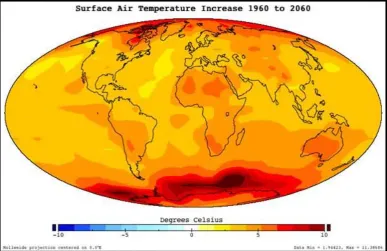
Figure 1. Simulated surface air temperature increase by the year 2060 (Rob, 2005).
INTRODUCTION
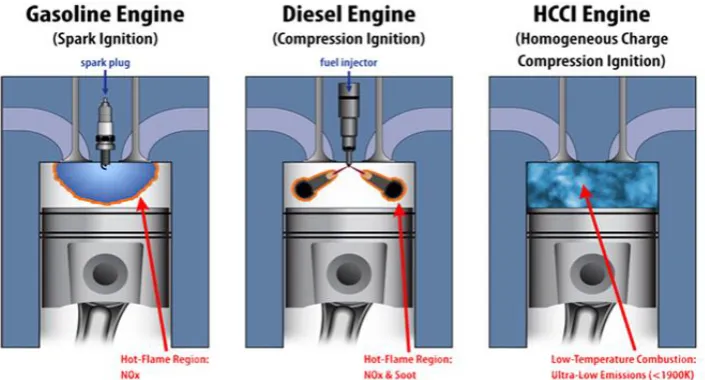
IC engines are widely used in numerous applications: vehicle engines, power generation and ships. The emissions generated from these applications have a high impact on the environment, thus alternative solutions have been investigated to achieve low emissions levels (Chan, 2002, Cho and He, 2007, Jonathan, 2006, Taylor, 2008). A new mode of combustion is being sought in order to reduce the emissions levels from these engines: a potential candidate is the Homogeneous Charge Compression Ignition (HCCI) engine. Figure 2 shows the differences among SI, CI and HCCI engines, where SI engines have a spark plug to initiate the combustion with a flame front propagating across the combustion chamber. CI engines have a fuel injector to inject the diesel and the combustion takes place in a compressed hot air region. HCCI engines on the other hand, have no spark plug or fuel injector and the combustion starts spontaneously in multiple locations. High engine efficiency can be achieved with low NOx and soot emissions.
40
Figure 2. The differences among SI, CI and HCCI engines, reproduced from (William and Charles, 2011).
Since the mixture is lean and is fully controlled by chemical kinetics, there are new challenges in developing HCCI engines: difficult to control the auto-ignition of the mixture and the heat release rate at high load operation, achieve cold start, meet emission standards and control knock (Kong and Reitz, 2003, Soylu, 2005). The advantages of using HCCI technology in IC engines are:
1. High efficiency relative to SI engines - approaching the efficiency of CI engines due to the ability of these engines to use high compression ratio (CR) and fast combustion (Killingsworth et al., 2006, Mack et al., 2009);
2. The ability to operate on a wide range of fuels (Aceves and Flowers, 2004, Mack
et al., 2009, Christensen et al., 1997); and
3. The ability to be used in any engine configuration: automobile engines, stationary engines, heavy duty engines or small sized engines (Epping et al., 2002, Hiltner et al., 2002, Kawano et al., 2005).
On the other hand, HCCI engines have some disadvantages such as high levels of unburned hydrocarbons (UHC) and carbon monoxide (CO) (Kong and Reitz, 2003, Nathan et al., 2010, Yap et al., 2006). Knocking is also occurred under certain operating conditions and reduces the operating range of the engine (Andreae et al., 2007, Jun et al., 2003, Kong and Reitz, 2003, Nathan et al., 2010, Yelvington and Green, 2003).
41
important to investigate the HCCI engine’s performance because it can be used in the near future.
State of the Art Current Internal Combustion Engines
Producing homogenous mixtures to achieve near-complete combustion is a common goal that will lead to the development of low polluting engines. Some technologies including Fuel-Stratified Injection (FSI), Turbo-Stratified Injection (TSI) and HCCI, are used to improve the combustion efficiencies by introducing the homogeneous mixture. FSI and TSI are commercially used by the Volkswagen Aktiengesellschaft (AG), which consists of other child companies: Audi, Skoda, Seat, Bugatti, Lamborghini, Bentley and Scania (Volkswagen, 2009). FSI uses direct injection fuel with high injection pressure, where the evaporating fuel has a significant cooling effect on the cylinder charge (Audi, 2012). This effect helps in reducing the knock and therefore higher compression ratio can be used. The air enters the combustion chamber at a certain angle by using a moveable flap inside the intake manifold (Wurms et al., 2003), while fuel is directly injected during the intake stroke. The fuel injector is located close to the inlet valve in the cylinder head. With the help of the piston crown design, the air will experience tumbling effects inside the chamber. This in turn will help the fuel mix with air homogeneously. TSI engines, on the other hand, uses a high intake pressure (using multipoint injectors) on an FSI engine (Böhme et al., 2006). This allows the fuel to mix homogeneously with the air during the compression stroke. The pressurised intake air will assist the combustion and therefore produce better efficiency, allowing smaller engines to be built with power and torque similar to that of bigger engines. The first engine to use direct injection technology to stratified charge engine was the Texaco combustion process (Barber et al., 1955), as reported by Takagi (1998). HCCI engines can be considered as new technology (Yao et al., 2009) even though the research was initially undertaken by Onishi et al. (1979). Researchers worldwide are investigating HCCI engines as this technology has not yet been sufficiently developed and commercially available. General Motors (GM) corporation has unveiled a prototype car with a gasoline HCCI engine, which could cut fuel consumption by 15% (Premier, 2007). The engine is able to virtually eliminate NOx emissions and lower throttling losses, which improves fuel economy.
Gasoline Operated HCCI Engines
42
(Fuerhapter et al., 2004). It is found that a high CR engine (as high as 18:1) has advantages by producing ultra-low NOx emissions (1ppm) and higher thermal efficiency (43%) at a fixed operating condition (John and Magnus, 2002).
[image:6.595.82.516.361.473.2]Gasoline can also be mixed with diesel to operate in HCCI mode. A study by Kim and Lee (2006) on the effect of multiple fuels on emissions showed that the combination of diesel and gasoline (diesel is direct injected while gasoline is port injected) is an effective way to reduce NOx levels, with the increase of premixed ratio. The premixed ratio is defined as the energy of premixed (port injected) fuel to the energy of total fuel (direct and port injected). Zhong et al. (2005) also studied the effect of blended fuels between gasoline and diesel, and reported that UHC and NOx were significantly reduced throughout the HCCI engine load ranges. The purpose of blending gasoline and diesel is that gasoline has a high volatility and is easy to vaporise, thus can be used to form a homogeneous mixture. Gasoline also has a high octane number, where higher numbers show higher resistivity to knocking. Diesel on the other hand has good ignitability and fast combustion due to its high cetane number. Table 2 compares the characteristics between the gasoline and diesel fuels, where for the selected gasoline (octane number 98) the heating values are almost similar between those fuels.
Table 2. Characteristics between gasoline and diesel fuels (Kim and Lee, 2006).
Gasoline Diesel
Octane number 98 -
Cetane number - 54
Higher heating value (kJ/kg) 47 300 44 800
Lower heating value (kJ/kg) 44 000 42 500
Boiling point (K) 468 553
Density (kg/m3) 750 814
Stoichiometric air-fuel ratio 14.6 14.5
Natural Gas and Hydrogen with Diesel in HCCI mode
43
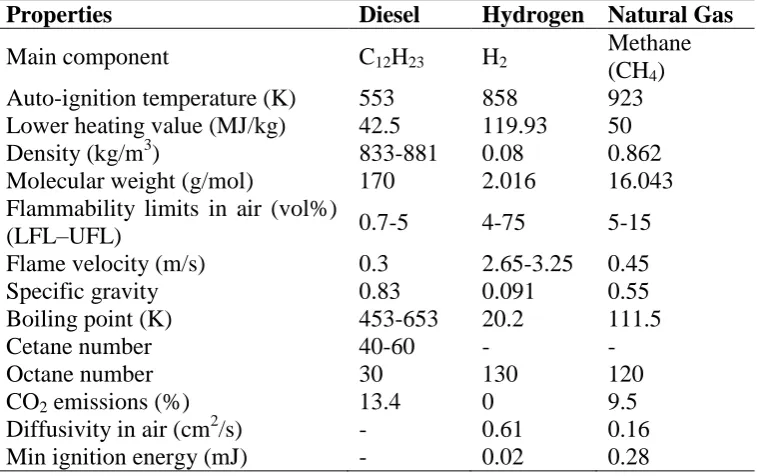
[image:7.595.110.489.251.489.2]Hydrogen has a high octane number (approximately 130) and a high Lower Heating Value (LHV) (119.93 MJ/kg). Its combination with diesel helps to increase engine efficiency (Saravanan et al., 2008a) and control the auto-ignition point in HCCI engines (Szwaja and Grab-Rogalinski, 2009). Natural gas, on the other hand, has a higher auto-ignition temperature and it can be used in high CR engines (Akansu et al., 2004). Table 3 compares the physical and chemical properties of diesel with natural gas and hydrogen.
Table 3. Diesel Properties Compared to Hydrogen and Natural Gas (Liu and Karim, 2008, Saravanan and Nagarajan, 2010, Saravanan et al., 2008b, Verhelst and Wallner,
2009).
Properties Diesel Hydrogen Natural Gas
Main component C12H23 H2
Methane (CH4)
Auto-ignition temperature (K) 553 858 923
Lower heating value (MJ/kg) 42.5 119.93 50
Density (kg/m3) 833-881 0.08 0.862
Molecular weight (g/mol) 170 2.016 16.043
Flammability limits in air (vol%)
(LFL–UFL) 0.7-5 4-75 5-15
Flame velocity (m/s) 0.3 2.65-3.25 0.45
Specific gravity 0.83 0.091 0.55
Boiling point (K) 453-653 20.2 111.5
Cetane number 40-60 - -
Octane number 30 130 120
CO2 emissions (%) 13.4 0 9.5
Diffusivity in air (cm2/s) - 0.61 0.16
Min ignition energy (mJ) - 0.02 0.28
From the Table 3, hydrogen has the highest LHV or Lower Calorific Value (LCV) compared to both diesel and natural gas, which means it releases a high amount of energy during combustion and thus produces the highest flame speed. A wide range of the flammability limits in air allows a wider range of engine power outputs through changes in the mixture equivalence ratio. Flammable mixtures of hydrogen can go from as lean as λ = 10 to as rich as λ = 0.14 (Verhelst and Wallner, 2009), where λ is the air-to-fuel ratio actual divided by the air-air-to-fuel ratio stoichiometric.
CONCLUSION
44
To this end, a simulation model has been developed to investigate the combustion behavior and, once completed, it has to be validated against experiments.
ACKNOWLEDGEMENTS
The author would like to thank University of Southern Queensland (USQ) and Universiti Putra Malaysia (UPM) for providing support and laboratory facilities. Also a great thanks to Ministry of Education, Malaysia for financial support.
REFERENCES
Aceves, S. and Flowers, D. 2004. Engine shows diesel efficiency without the emissions. Lawrence Livermore National Laboratory.
Akansu, S. O., Dulger, Z., Kahraman, N. and Veziroglu, T. N. 2004. Internal combustion engines fueled by natural gas - hydrogen mixtures. International
Journal of Hydrogen Energy, 29, 1527-1539.
Andreae, M. M., Cheng, W. K., Kenney, T. and Yang, J. 2007. On HCCI engine knock.
SAE Paper 2007-01-1858.
Audi. 2012. Available: http://www.audi.com/com/brand/en/tools/advice/glossary/fsi. browser.html [Accessed 19 April 2012.
Barber, E. M., Reynolds, B. and Tierney, W. T. 1955. Elimination of combustion knock-Texaco combustion process. SAE Q. Trans, 5.
Bates, B., Kundzewicz, Z. W., Wu, S. and Palutikof, J. 2008. Climate change and water. Technical Paper of the Intergovernmental Panel on Climate Change. IPCC
Secretariat Geneva.
Bodansky, D. 2010. The Copenhagen Climate Change Conference: A Postmortem.
American Journal of International Law, 104, 230-240.
Böhme, J., Jung, M., Fröhlich, G., Pfannerer, D., Märkle, T. and Felsmann, C. 2006. The new 1.8 l four cylinder T-FSI engine by Audi. MTZ worldwide, 67, 2-5. Chan, C. C. The state of the art of electric and hybrid vehicles. 2002. Institute of
Electrical and Electronics Engineers.
Cho, H. M. and He, B. Q. 2007. Spark ignition natural gas engines - A review. Energy
Conversion and Management, 48, 608-618.
Christensen, M. and Johansson, B. 1998. Influence of Mixture Quality on Homogeneous Charge Compression Ignition. SAE paper, Journal of Fuels and Lubricants, 107. Christensen, M., Johansson, B. and Einewall, P. 1997. Homogeneous charge compression ignition (HCCI) using iso-octane, ethanol and natural gas - A comparison with spark ignition operation. SAE paper 971676.
De Risi, A., Carlucci, A. P., Laforgia, D. and Naccarato, F. 2008. Experimental investigation and combustion analysis of a direct injection dual-fuel diesel-natural gas engine. Energy, 33, 256-263.
Epping, K., Aceves, S., Bechtold, R. and Dec, J. 2002. The Potential of HCCI Combustion for High Efficiency and Low Emissions. SAE paper 2002-01-1923. Fuerhapter, A., Unger, E. and Piock, W. F. 2004. The new AVL CSI engine: HCCI
operation on a multicylinder gasoline engine. SAE 2004-01-0551.
Graham, R. L., Turner, M. G. and Dale, V. H. 1990. How Increasing Co2 and Climate Change Affect Forests - at Many Spatial and Temporal Scales, There Will Be Forest Responses That Will Be Affected by Human Activities. Bioscience, 40,
45
Hairuddin, A. A., Wandel, A. P. and Yusaf, T. F. Hydrogen and natural gas comparison in diesel HCCI engines - a review. Southern Region Engineering Conference (SREC2010), 11-12 Nov 2010 2010 Toowoomba, Australia.
Hiltner, J., Fiveland, S. B., Agama, R. and Willi, M. 2002. System Efficiency Issues for Natural Gas Fueled HCCI Engines in Heavy-Duty Stationary Applications. SAE paper 2002-01-0417.
Hosseini, V. and Checkel, M. D. 2009. Reformer gas application in combustion onset control of hcci engine. The Journal of Engine Research, 14.
Houghton, J. T., Ding, Y., Griggs, D. J., Noguer, M., Van Der Linden, P. J., Dai, X., Maskell, K. and Johnson, C. A. 2001. Climate change 2001: The scientific basis,
Cambridge, The Press Syndicate of The University of Cambridge.
John, E. D. and Magnus, S. 2002. HCCI combustion: the sources of emissions at low loads and the effects of GDI fuel injection eighth diesel engine emissions reduction workshop.
Jonathan, P. 2006. Responses to Questions on the Design Elements of a Mandatory Market-Based Greenhouse Gas Regulatory System. Energy and Natural
Resources Committee. World Resources Institute.
Jun, D., Ishii, K. and Iida, N. 2003. Autoignition and combustion of natural gas in a 4 stroke HCCI engine. Jsme International Journal Series B-Fluids and Thermal
Engineering, 46, 60-67.
Kawano, D., Suzuki, H., Ishii, H., Goto, Y., Odaka, M., Murata, Y., Kusaka, J. and Daisho, Y. 2005. Ignition and combustion control of diesel HCCI. SAE paper 2005-01-2132.
Killingsworth, N. J., Aceves, S. M., Flowers, D. L. and Krstic, M. 2006. A simple HCCI engine model for control. Proceedings of the 2006 IEEE International
Conference on Control Applications, Vols 1-4, 1479-1484.
Kim, D. S. and Lee, C. S. 2006. Improved emission characteristics of HCCI engine by various premixed fuels and cooled EGR. Fuel, 85, 695-704.
Kong, S. C. 2007. A study of natural gas/DME combustion in HCCI engines using CFD with detailed chemical kinetics. Fuel, 86, 1483-1489.
Kong, S. C. and Reitz, R. D. 2002. Use of detailed chemical kinetics to study HCCI engine combustion with consideration of turbulent mixing effects. Journal of
Engineering for Gas Turbines and Power-Transactions of the Asme, 124,
702-707.
Kong, S. C. and Reitz, R. D. 2003. Numerical study of premixed HCCI engine combustion and its sensitivity to computational mesh and model uncertainties.
Combustion Theory and Modelling, 7, 417-433.
Liu, C. and Karim, G. A. 2008. A simulation of the combustion of hydrogen in HCCI engines using a 3D model with detailed chemical kinetics. International Journal
of Hydrogen Energy, 33, 3863-3875.
Mack, J. H., Aceves, S. M. and Dibble, R. W. 2009. Demonstrating direct use of wet ethanol in a homogeneous charge compression ignition (HCCI) engine. Energy,
34, 782-787.
Najt, P. E. and Foster, D. E. 1983. Compression ignited homogeneous charge combustion. SAE paper 830264.
Nathan, S. S., Mallikarjuna, J. M. and Ramesh, A. 2010. An experimental study of the biogas-diesel HCCI mode of engine operation. Energy Conversion and
45
Hairuddin, A. A., Wandel, A. P. and Yusaf, T. F. Hydrogen and natural gas comparison in diesel HCCI engines - a review. Southern Region Engineering Conference (SREC2010), 11-12 Nov 2010 2010 Toowoomba, Australia.
Hiltner, J., Fiveland, S. B., Agama, R. and Willi, M. 2002. System Efficiency Issues for Natural Gas Fueled HCCI Engines in Heavy-Duty Stationary Applications. SAE paper 2002-01-0417.
Hosseini, V. and Checkel, M. D. 2009. Reformer gas application in combustion onset control of hcci engine. The Journal of Engine Research, 14.
Houghton, J. T., Ding, Y., Griggs, D. J., Noguer, M., Van Der Linden, P. J., Dai, X., Maskell, K. and Johnson, C. A. 2001. Climate change 2001: The scientific basis,
Cambridge, The Press Syndicate of The University of Cambridge.
John, E. D. and Magnus, S. 2002. HCCI combustion: the sources of emissions at low loads and the effects of GDI fuel injection eighth diesel engine emissions reduction workshop.
Jonathan, P. 2006. Responses to Questions on the Design Elements of a Mandatory Market-Based Greenhouse Gas Regulatory System. Energy and Natural
Resources Committee. World Resources Institute.
Jun, D., Ishii, K. and Iida, N. 2003. Autoignition and combustion of natural gas in a 4 stroke HCCI engine. Jsme International Journal Series B-Fluids and Thermal
Engineering, 46, 60-67.
Kawano, D., Suzuki, H., Ishii, H., Goto, Y., Odaka, M., Murata, Y., Kusaka, J. and Daisho, Y. 2005. Ignition and combustion control of diesel HCCI. SAE paper 2005-01-2132.
Killingsworth, N. J., Aceves, S. M., Flowers, D. L. and Krstic, M. 2006. A simple HCCI engine model for control. Proceedings of the 2006 IEEE International
Conference on Control Applications, Vols 1-4, 1479-1484.
Kim, D. S. and Lee, C. S. 2006. Improved emission characteristics of HCCI engine by various premixed fuels and cooled EGR. Fuel, 85, 695-704.
Kong, S. C. 2007. A study of natural gas/DME combustion in HCCI engines using CFD with detailed chemical kinetics. Fuel, 86, 1483-1489.
Kong, S. C. and Reitz, R. D. 2002. Use of detailed chemical kinetics to study HCCI engine combustion with consideration of turbulent mixing effects. Journal of
Engineering for Gas Turbines and Power-Transactions of the Asme, 124,
702-707.
Kong, S. C. and Reitz, R. D. 2003. Numerical study of premixed HCCI engine combustion and its sensitivity to computational mesh and model uncertainties.
Combustion Theory and Modelling, 7, 417-433.
Liu, C. and Karim, G. A. 2008. A simulation of the combustion of hydrogen in HCCI engines using a 3D model with detailed chemical kinetics. International Journal
of Hydrogen Energy, 33, 3863-3875.
Mack, J. H., Aceves, S. M. and Dibble, R. W. 2009. Demonstrating direct use of wet ethanol in a homogeneous charge compression ignition (HCCI) engine. Energy,
34, 782-787.
Najt, P. E. and Foster, D. E. 1983. Compression ignited homogeneous charge combustion. SAE paper 830264.
Nathan, S. S., Mallikarjuna, J. M. and Ramesh, A. 2010. An experimental study of the biogas-diesel HCCI mode of engine operation. Energy Conversion and
45
Hairuddin, A. A., Wandel, A. P. and Yusaf, T. F. Hydrogen and natural gas comparison in diesel HCCI engines - a review. Southern Region Engineering Conference (SREC2010), 11-12 Nov 2010 2010 Toowoomba, Australia.
Hiltner, J., Fiveland, S. B., Agama, R. and Willi, M. 2002. System Efficiency Issues for Natural Gas Fueled HCCI Engines in Heavy-Duty Stationary Applications. SAE paper 2002-01-0417.
Hosseini, V. and Checkel, M. D. 2009. Reformer gas application in combustion onset control of hcci engine. The Journal of Engine Research, 14.
Houghton, J. T., Ding, Y., Griggs, D. J., Noguer, M., Van Der Linden, P. J., Dai, X., Maskell, K. and Johnson, C. A. 2001. Climate change 2001: The scientific basis,
Cambridge, The Press Syndicate of The University of Cambridge.
John, E. D. and Magnus, S. 2002. HCCI combustion: the sources of emissions at low loads and the effects of GDI fuel injection eighth diesel engine emissions reduction workshop.
Jonathan, P. 2006. Responses to Questions on the Design Elements of a Mandatory Market-Based Greenhouse Gas Regulatory System. Energy and Natural
Resources Committee. World Resources Institute.
Jun, D., Ishii, K. and Iida, N. 2003. Autoignition and combustion of natural gas in a 4 stroke HCCI engine. Jsme International Journal Series B-Fluids and Thermal
Engineering, 46, 60-67.
Kawano, D., Suzuki, H., Ishii, H., Goto, Y., Odaka, M., Murata, Y., Kusaka, J. and Daisho, Y. 2005. Ignition and combustion control of diesel HCCI. SAE paper 2005-01-2132.
Killingsworth, N. J., Aceves, S. M., Flowers, D. L. and Krstic, M. 2006. A simple HCCI engine model for control. Proceedings of the 2006 IEEE International
Conference on Control Applications, Vols 1-4, 1479-1484.
Kim, D. S. and Lee, C. S. 2006. Improved emission characteristics of HCCI engine by various premixed fuels and cooled EGR. Fuel, 85, 695-704.
Kong, S. C. 2007. A study of natural gas/DME combustion in HCCI engines using CFD with detailed chemical kinetics. Fuel, 86, 1483-1489.
Kong, S. C. and Reitz, R. D. 2002. Use of detailed chemical kinetics to study HCCI engine combustion with consideration of turbulent mixing effects. Journal of
Engineering for Gas Turbines and Power-Transactions of the Asme, 124,
702-707.
Kong, S. C. and Reitz, R. D. 2003. Numerical study of premixed HCCI engine combustion and its sensitivity to computational mesh and model uncertainties.
Combustion Theory and Modelling, 7, 417-433.
Liu, C. and Karim, G. A. 2008. A simulation of the combustion of hydrogen in HCCI engines using a 3D model with detailed chemical kinetics. International Journal
of Hydrogen Energy, 33, 3863-3875.
Mack, J. H., Aceves, S. M. and Dibble, R. W. 2009. Demonstrating direct use of wet ethanol in a homogeneous charge compression ignition (HCCI) engine. Energy,
34, 782-787.
Najt, P. E. and Foster, D. E. 1983. Compression ignited homogeneous charge combustion. SAE paper 830264.
Nathan, S. S., Mallikarjuna, J. M. and Ramesh, A. 2010. An experimental study of the biogas-diesel HCCI mode of engine operation. Energy Conversion and
46
Ogden, J. M., Steinbugler, M. M. and Kreutz, T. G. 1999. A comparison of hydrogen, methanal and gasoline as fuels for fuel cell vehicles: implications for vehicle design and infrastructure development. Journal of Power Sources, 79, 143-168. Onishi, S., Jo, S. H., Shoda, K., Jo, P. D. and Kato, S. 1979. Active thermo-atmosphere
combustion (ATAC) - a new combustion process for internal combustion engines. SAE paper 790501.
Premier, A. S. 2007. HCCI could cut fuel consumption by 15%. Advanced Materials
and Processes, P. 27 [Online]. Available: EBSCOhost [Accessed May 17,2010].
Rattanapaibule, K. and Aung, K. Performance predictions of a hydrogen-enhanced natural gas HCCI engine. International Mechanical Engineering Congress and Exposition (IMECE2005), 2005 Florida. Energy Conversion and Resources, 289-294.
Rob, G. 2005. Watching Earth's Climate Change in the Classroom [Online]. NASA
Goddard Space Flight Center. Available:
http://www.nasa.gov/vision/earth/everydaylife/climate_class.html [Accessed 1 August 2011].
Saravanan, N. and Nagarajan, G. 2010. An experimental investigation on hydrogen fuel injection in intake port and manifold with different EGR rates. Energy Environ.,
1, 221-248.
Saravanan, N., Nagarajan, G. and Narayanasamy, S. 2008a. An experimental investigation on DI diesel engine with hydrogen fuel. Renewable Energy, 33,
415-421.
Saravanan, N., Nagarajan, G., Sanjay, G., Dhanasekaran, C. and Kalaiselvan, K. M. 2008b. Combustion analysis on a DI diesel engine with hydrogen in dual fuel mode. Fuel, 87, 3591-3599.
Soylu, S. 2005. Examination of combustion characteristics and phasing strategies of a natural gas HCCI engine. Energy Conversion and Management, 46, 101-119. Szwaja, S. and Grab-Rogalinski, K. 2009. Hydrogen combustion in a compression
ignition diesel engine. International Journal of Hydrogen Energy, 34, 4413-4421.
Takagi, Y. A new era in spark-ignition engines featuring high-pressure direct injection. Twenty-Seventh Symposium (International) on Combustion, 1998. The Combustion Institute, 2055-68.
Taylor, A. M. K. P. 2008. Science review of internal combustion engines. Energy
Policy, 36, 4657-4667.
Tomita, E. Dual fuel HCCI combustion - High octane and high cetane number fuels. HCCI Symposium, 2004 Berkeley. Okayama University.
Tomita, E., Kawahara, N., Piao, Z., Fujita, S. and Hamamoto, Y. 2001. Hydrogen combustion and exhaust emissions ignited with diesel oil in a dual fuel engine.
SAE paper 2001-01-3503.
Tomita, E., Kawahara, N., Piao, Z. and Yamaguchi, R. 2002. Effects of EGR and early injection of diesel fuel on combustion characteristics and exhaust emissions in a methane duel fuel engine. SAE paper 2002-01-2723.
Trimm, D. L. and Onsan, Z. I. 2001. Onboard fuel conversion for hydrogen-fuel-cell-driven vehicles. Catalysis Reviews-Science and Engineering, 43, 31-84.
Verhelst, S. and Wallner, T. 2009. Hydrogen-fueled internal combustion engines.
Progress in Energy and Combustion Science, 35, 490-527.
47
Wang, Z., Shuai, S. J., Wang, J. X. and Tian, G. H. 2006. A computational study of direct injection gasoline HCCI engine with secondary injection. Fuel, 85, 1831-1841.
William, J. P. and Charles, K. W. 2011. Combustion Chemistry [Online]. California, United States: Lawrence Livermore National Laboratory. Available: https://www-pls.llnl.gov/?url=science_and_technology-chemistry-combustion [Accessed 9 August 2011 2011].
Wurms, R., Grigo, M. and Hatz, W. 2003. Audi FSI technology improved performance and reduced fuel consumption. ATA-TORINO-, 56, 118-125.
Yao, M. F., Zheng, Z. L. and Liu, H. F. 2009. Progress and recent trends in homogeneous charge compression ignition (HCCI) engines. Progress in Energy
and Combustion Science, 35, 398-437.
Yap, D., Peucheret, S. M., Megaritis, A., Wyszynski, M. L. and Xu, H. 2006. Natural gas HCCI engine operation with exhaust gas fuel reforming. International
Journal of Hydrogen Energy, 31, 587-595.
Yelvington, P. E. and Green, W. H. 2003. Prediction of the knock limit and viable operating range for a homogeneous-charge-compression-ignition (HCCI) engine. SAE Paper 2003-01-1092.
Yingnan, G., Fengjun, G., Fafa, L., Hua, L., Honggang, J. and Manzhi, T. Control of HCCI engine fueled with gasoline with electro-hydraulic variable valve system. 2nd International Asia Conference on Informatics in Control, Automation and Robotics, 2010. Institute of Electrical and Electronics Engineer (IEEE).
Zhong, S., Wyszynski, M. L., Megaritis, A., Yap, D. and Xu, H. 2005. Experimental Investigation into HCCI Combustion Using Gasoline and Diesel Blended Fuels.