Students' mathematical preparation Part B: Students’ perceptions
TIM DALBYa, CLARE ROBINSONa, SHAHAB ABDULLAa*, LINDA GALLIGANb, ANITA FREDERIKSc, ROBYN PIGOZZOa AND ANDREW WANDELd
a
Open Access College, b School of Agricultural, Computational and Environmental Sciences, Learning and Teaching Support, d School of Mechanical and Electrical Engineering, University of Southern Queensland, Toowoomba, Australia
*Corresponding author: [email protected]
Keywords: Tertiary mathematics education; mathematical under-preparedness; diversity of student population
There is a growing concern worldwide over the decrease in the number of mathematics and science graduates. Associated with this are factors such as the mathematical under-preparedness of students entering the university system, and a lack of emphasis on the importance of mathematics for post-secondary studies.
This paper analyses students’ perceived preparation in mathematics encountered in their first semester of undergraduate study at the University of Southern Queensland. The excerpts are drawn from surveys and interviews of students enrolled in first year courses that have mathematical content. The survey showed that there was a broad response of being “well prepared” for mathematics across first year courses. Interviews generally confirmed the responses to the survey in terms of students’ confidence in their mathematical preparation. However a significant number of students in the science based degrees acknowledged that they were inadequately prepared
1. Introduction
The student population of Australian universities has become more diverse than ever before [1, 2]. This diversity covers not just cultural or socio-economic diversity but also academic background and approach to study. The federal government’s acceptance of the Bradley Review [3] and the resulting policy changes including uncapped places and more graduates from low socio-economic areas are going to heighten this diversity and hence the difficulties faced by students, lecturers and university policy designers.
Students’ preparation in mathematics and statistics is of particular interest in this study, because a smooth transition to tertiary education can, for many students, be hindered by less than adequate mathematical background. It has been shown that students who face difficulties with their first year mathematics may not continue or may fail some courses [4].
suite of English language courses. Many students may also have a considerable time gap between finishing formal study and beginning university and some of these gain entry without a preparatory program, entering on their past experience often with very dated qualifications.
In order to ameliorate these difficulties, USQ staff need to be aware of what first year students feel about their mathematical preparation coming into undergraduate study. So the aim of this project is to examine first year students' perceptions of their mathematical preparedness for tertiary study. This information was obtained by student questionnaires and interviews. At the same time, the views of lecturers of first year courses were sought. They were asked what requirements, in terms of topics and level of mathematics, are necessary for their course even though there may not be a formal prerequisite of a certain level of mathematics. Lecturers were also asked their opinions of how well their students were mathematically prepared. These results can be found in a companion paper.
The results from this study will assist the planning of lectures and assessment in all programs, particularly in first year mathematics service courses, such as Engineering Mathematics, and enabling programs such as the TPP and the EAP. Academic support, in the form of The Learning Centre, also would benefit from this information for developmental purposes.
2. Literature review
Mathematics, along with the other STEM (Science, Technology, Engineering and Mathematics) areas, is crucial to the development of modern society. However there is a world-wide shortage of graduates in these fields [8-10].
Research in mathematics education at the tertiary level is still modest [10], and does not adequately cover the secondary-tertiary transition. A review of the literature produces clear evidence that this transition in mathematics is a complex problem [11, 12]. For example, in Hong Kong there are four factors that are making the transition problematic: students’ lack of preparation; adjustment to the pace of courses; mathematical rigour; and examination processes [13]. In particular, other researchers have also identified mathematical under-preparedness as problematic and suggest this has an influence on students’ achievement in university mathematics [13-16]. Part of the problem is that parents and guidance officers influence their students’ ideas about the significance of mathematics and its applicability [17, 18].
Researchers from around the world have provided a number of reasons for the under-preparedness in mathematics such as inadequate funding and a recent trend of moving to mass university education and hence to a greater diversity of student backgrounds. The approval of the findings of the Bradley Review [3] means there will be more graduates from low socio-economic areas. The increase in numbers of students that have low SES has meant that greater support is needed to maintain academic achievement [14, 19, 20]. There has been a lowering of the mathematics standards at school and hence at universities [20, 21]. This has also led to students having problems in areas such as biology and nursing [21-25].
Confusion can be caused by the assumed knowledge for a university course not being made explicit to students. Students may be accepted into a university even though their mathematical background does not match published assumed knowledge for their degree program [23, 24].
comes to beliefs of students’ preparation for first year study. The current project investigates these issues.
3. Method
Students from the main first year courses were surveyed. Ethics clearance was obtained to survey and communicate with students from the Faculties of Arts, Business and Law, and Sciences. However, students from the Faculties of Education and Engineering and Surveying were included in the survey because many were enrolled in the courses surveyed.
All the examiners (coordinators) of the key first year courses within the three faculties were asked to email their students with our invitation to fill out the survey. All these examiners agreed to do so. Students were encouraged to participate by offering them the chance of winning a $100 book voucher at the University bookshop. Their consent to a brief interview about their perceptions of their mathematical preparedness was sought within the survey. The survey elicited 122 responses and 20 student interviews.
Information was gathered from the students after the end of Semester 1 and in the first weeks of Semester 2. This was after the students had received their results for Semester 1 in order to obtain a clearer picture of their perceptions.
The questions that the students were asked covered topics such as the degree they were enrolled in, their major subject and pathway into university and what level of mathematics that entailed. Another question was what courses they had studied in Semester 1 that required some mathematics even if it was elementary mathematics. Perceptions of their preparation in various topics were sought using a Likert scale with the options “Well prepared”, “Prepared”, “Poorly prepared”, “Very poorly prepared” and “Not applicable” in this order. Analysis of the survey responses revealed a possible ambiguity with the term “Not applicable”. Adjustments will be made to the survey for future use. The topics included percentages, ratio, algebra, statistics, decimals, problem solving and calculus. There was an opportunity for them to add a topic. They were asked if their overall mathematical preparation was adequate for first year study followed by a possibility to make any comments. Finally they were asked to suggest what USQ could do better in terms of mathematical preparation.
4. Results
All first year students enrolled in key first year courses were sent the survey resulting in a broad spectrum of views about their mathematical preparation. These data are categorised by the level of mathematics required for their study because students following different pathways have different mathematical needs. The students were grouped into three areas; Engineering and Science, Nursing and Business, Arts and Education.
Figure 1. School level completed as a percentage within area of study (n = 104).
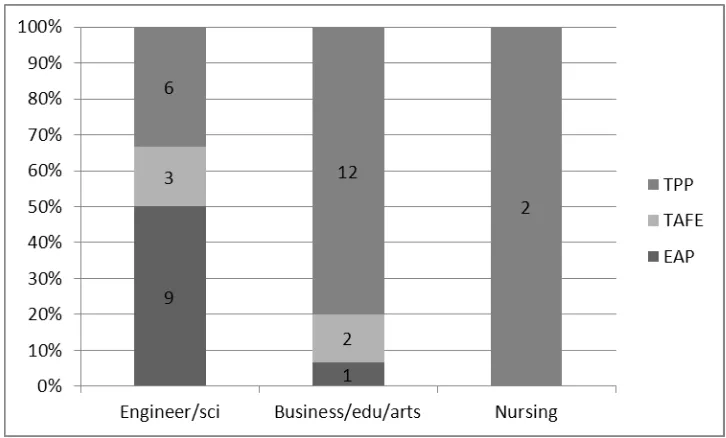
Figure 2. Alternative pathway completed as a percentage within each area of study (n = 35).
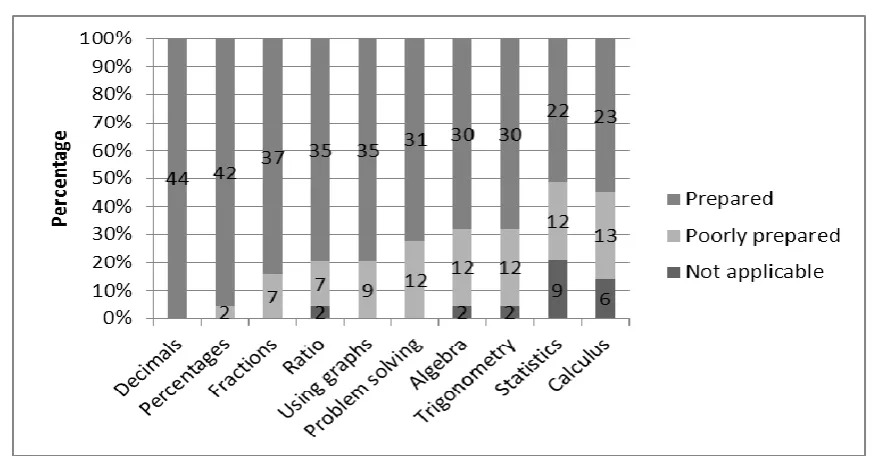
The following graphs relate to students’ perceptions of how well prepared they were in the area of basic arithmetical concepts through to the more complicated mathematics of trigonometry and calculus, when encountered in first year courses. To be noted is that a response of “not applicable” should imply that the student felt that he/she had not encountered this area of mathematics in any of his/her first year courses. This option was not fully explained and may have led to some students responding with “Prepared” or “Not prepared” when their choice should have been “Not applicable”.
[image:4.595.115.478.333.552.2]Figure 3. Engineering and sciences student responses to preparedness in mathematical topics (n=44).
[image:5.595.85.509.414.640.2]Figure 4 indicates that on the whole, business, education, arts and general studies students felt well prepared for the mathematics encountered within their first year courses. Many of the concepts had not been experienced in first year courses by some of these students.
Figure 4. Business, education, arts and general studies student responses to preparedness in mathematical topics (n=57).
Figure 5. Nursing student responses to preparedness in mathematical topics (n = 20)
[image:6.595.114.479.403.621.2]Figure 6 indicates whether students agreed or disagreed that their pre-university mathematics had prepared them for mathematical concepts encountered in their university studies.
Figure 6. Pre-university mathematics preparation was adequate by degree of enrolment (n = 121)
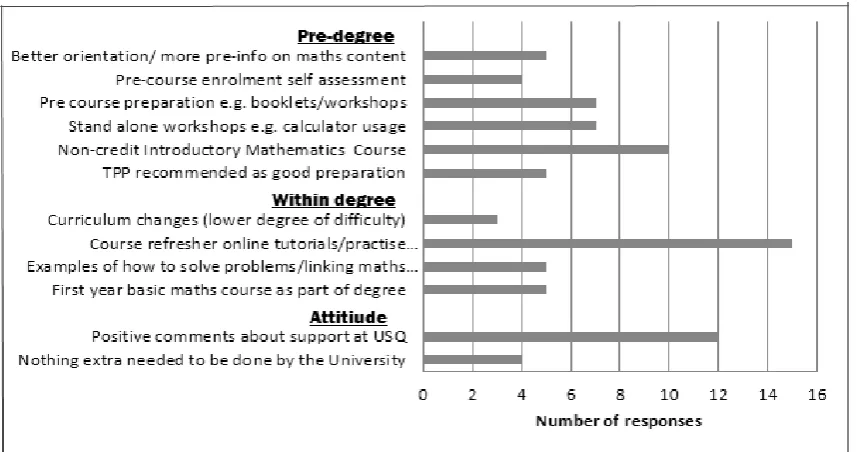
Ten respondents recommended a whole semester Mathematics non-credit revision course for students that were underprepared. Five respondents felt that they had benefited from doing the Tertiary Preparation Mathematics course prior to Undergraduate degree enrolment. Several comments were made about the difficulties faced by mature-aged students who had not done mathematics for many years. Further submissions were that students should be given more detail on the mathematics content of a course so that they could better prepare themselves along with a few suggestions for some sort of self-assessment prior to enrolling in a course. There were seven proposals for pre-course preparation that would target specific courses. Stand-alone workshops were recommended for mastering the use of calculators and graphing packages.
Recommendations from fifteen students that were considering mathematical preparation from an in-course perspective were for a greater number of tutorials, online videos, practice quizzes, workshops and video conferencing tutorials as part of the course offering. Five respondents also recommended a basic mathematics course as part of a degree.
[image:7.595.86.515.325.551.2]Twelve positive comments indicated that the respondents have accessed the current support structures in place at the university Four respondents indicated that the in-course support was sufficient.
Figure 7. Student recommendations for mathematics preparation for undergraduate studies
Eighteen students were interviewed about their perceptions of their mathematical preparedness for their first semester. A summary of notable responses to the interview questions is shown below.
To the question “Broadly, are you happy or unhappy with your mathematical preparation for first year study?” sixteen students responded positively, with only two being cautious in their response.
Students were aware that when providing solutions to a mathematics related problem in an assignment or exam the method should be to “Write out all the steps”. The majority of interviewees stated that they had no difficulties with word problems.
Response to the question “What about the approach to learning – were you surprised at the differences (between pre-university and university)?” received 13 responses of “no” with five exceptions:
I find differences as an external student. The lecturers put up the problem but do not break it down into steps. I have only had one good teacher who has done this. I find they don't take time to explain things. I find they have a different attitude towards external students and can be rude when you ask questions.
At uni I know there is help there but you have to ask for it. At school someone will help. Maths and physics were explained differently at school.
Not surprised - find a way to work it out and seek answers for yourself - about the same.
I am no good at maths but understand all the accounting things. Lecturers do not explain steps, do not take the time to break it down.
big jump - big!
Responses to the question “mathematics assessment – did you find any differences between pre-university study and university? Do you think you needed to be better prepared?” elicited only three positive responses:
Yes, because there are different between studies in my country and Australia.
Needed to be more prepared - school to uni was a 15 year gap.
A lot of difference, mainly formal qualities of assessment, harder and is of a higher quality.
To the question “Can you think of ways where the teaching of pre-university maths could be improved?” some students replied that courses in high school should be more aligned to university studies. All but two of the students responded positively to whether their pre-university subject choice was the best one. Two comments were
TAFE course was a good choice as I did not get the OP to go to uni from school.
From school I did a trade certificate and apprenticeship in mechanics/ spare parts used a lot of maths - addition, estimation, stocktaking. Did Maths B and C at school but dropped to Maths A.
5. Limitations
6. Discussion and conclusion
Comparing the more mathematically based degrees, Engineering and Science, against Business and Nursing, there is a higher percentage of students who felt underprepared for the mathematics that they encountered in their first semester at university. Current research literature indicates that many students enter university with an inadequate mathematical background for their intended degree. This survey shows that a significant percentage of respondents in mathematically based degrees acknowledge this.
The interview question that elicited the most interaction was the difference in the approach to learning at University. In addition, there were useful written suggestions from the students for self-assessment, workshops, practice quizzes and online tutorials. Such support is available in many courses, but perhaps a university approach to such support is needed [26].
Overall the survey showed that there was a general response of being “well prepared” for mathematics encountered in first year subjects, particularly in the Social Sciences and Nursing, although if 20 to 30% of students feel poorly prepared for the quantitative components in their courses, then there is a role for enabling and support programs. Interviews generally backed up the responses to the survey in terms of students’ confidence in their mathematical preparation.
Lecturers, particularly in support and large first year service courses, may see a higher percentage of these underprepared students which could skew their view of students’ preparedness. A closer analysis of the connection between the lecturers’ perception (Part A of this project) and students’ perception has yet to be undertaken.
References
[1] James, R., K.-L. Krause, and C. Jennings, The First Year Experience in Australian Universities.
2010.
[2] MacGillivray, H., Learning support and students studying mathematics and statistics.
International Journal of Mathematical Education in Science and Technology, 2009. 40(4): pp. 455-472.
[3] Bradley, D., Review of Australian higher education: Final report. 2008: Department of Education, Employment and Workplace Relations.
[4] Hansen, H.B., Examining the implementation of an innovative mathematics curriculum, 2010,
University of Minnesota. PhD thesis
[5] University of Southern Queensland. Student Business Intelligence Centre. 2013 13 Aug 2013; Available from: https://intranet.usq.edu.au/bi/student/Pages/Home.aspx.
[6] Department of Industry Innovation Climate Change Science Research & Tertiary Education. My University: University of Southern Queensland. 2013 13 Aug 2013; Available from: http://myuniversity.gov.au/University-of-Southern-Queensland/2201#!uni-stats/tables.
[7] Phillips, P. and B. Loch, Building lectures and building bridges with socio-economically disadvantaged students. Educational Technology & Society, 2011. 14(3): pp. 240-251.
[8] Brown, G., Review of Education in Mathematics, Data Science and Quantitative Disciplines: Report to the Group of Eight Universities. Group of Eight, 2009.
[9] Office of the Chief Scientist, Science, technology, engineering and mathematics in the national interest: a strategic approach, 2013, Australian Government: Canberra.
[10] Holton, D., The teaching and learning of mathematics at university level: An ICMI study. Vol. 7. 2001: Springer.
[11] Barnard, D., The transition to mathematics at university: Students’ views. New Zealand Journal of Mathematics, 2003. 32: pp. 1-8.
[13] Luk, H.S., 2004, The gap between secondary school and university mathematics. International Journal of Mathematical Education in Science and Technology, 36(2–3), pp. 159–172.
[14] Hourigan, M. and J. O’Donoghue, Mathematical under-preparedness: the influence of the
pre-tertiary mathematics experience on students’ ability to make a successful transition to pre-tertiary level mathematics courses in Ireland. International Journal of Mathematical Education in Science and Technology, 2007. 38(4): pp. 461-476.
[15] Kajander, A. and M. Lovric, Transition from secondary to tertiary mathematics: McMaster University experience. International Journal of Mathematical Education in Science and Technology, 2005. 36(2-3): pp. 149-160.
[16] Lowe, H. and A. Cook, Mind the Gap: are students prepared for higher education? Journal of Further and Higher Education, 2003. 27(1): pp. 53-76.
[17] Matthews, K.E., P. Adams, and M. Goos, Putting it into perspective: mathematics in the undergraduate science curriculum. International Journal of Mathematical Education in Science and Technology, 2009. 40(7): pp. 891-902.
[18] Wilson, T.M. and H.L. MacGillivray, Counting on the basics: mathematical skills among tertiary entrants. International Journal ofMathematical Education in Science and Technology, 2007. 38(1): pp. 19-41.
[19] Perkin, G. and S. Bamforth, A variety of approaches to the provision of mathematics help for first-year engineering undergraduates. International Journal of Electrical Engineering Education, 2011. 48(1): pp. 80-91.
[20] Varsavsky, C., Chances of success in and engagement with mathematics for students who enter university with a weak mathematics background. International Journal of Mathematical Education in Science and Technology, 2010. 41(8): pp. 1037-1049.
[21] Jennings, M. Issues in bridging between senior secondary and first year university mathematics. In Proceedings of the 32nd Annual Conference of the Mathematics Education Research Group of Australasia. MERGA32. 2009.
[22] Croft, A.C., M.C. Harrison, and C.L. Robinson, Recruitment and retention of students–an integrated and holistic vision of mathematics support. International Journal of Mathematical Education in Science and Technology, 2009. 40(1): pp. 109-125.
[23] Gordon, S. and J. Nicholas, Students’ conceptions of mathematics bridging courses. Journal of Further and Higher Education, 2013. 37(1): pp. 109-125.
[24] Gordon, S. and J. Nicholas, Prior decisions and experiences about mathematics of students in bridging courses. International Journal of Mathematical Education in Science and Technology, 2013(ahead-of-print): pp. 1-11.
[25] Rylands, L. and C. Coady, Performance of students with weak mathematics in first-year mathematics and science. International Journal of Mathematical Education in Science and Technology, 2009. 40(6): pp. 741-753.