Dilek Yılmaz1
1. Department of Nursing, Faculty of Health Sciences, Bursa Uludag University, Bursa, Turkey.
* Corresponding Author:
Dilek Yılmaz, PhD.
Address: Department of Nursing, Faculty of Health Sciences, Bursa Uludag University, Bursa, Turkey.
Tel: +90 (507) 358 0330
E-mail: [email protected]
Research Paper:
Professional Image Perceptions in First-year Nursing
Students
Background: Determining the professional image perceptions of the first-year nursing students who have recently chosen the nursing profession is of great importance in delineating the profession profile. The present study aimed to determine the image perception of first-year nursing students and its related factors.
Methods: This descriptive cross-sectional research was conducted in the Fall semester of the 2019-2020 academic year. In total, 105 first-year nursing students were selected from the Nursing Department of the Faculty of Health Sciences of Bursa Uludağ University in Turkey. The study subjects were recruited randomly. A Student Identification Form and the Image Scale for the Nursing Profession were used as data collection tools. Mann-Whitney U and Kruskal-Wallis tests were applied for analyzing the obtained data in SPSS.
Results: The Mean±SD score of the Image Scale for the Nursing Profession was achieved as 149.06±11.19. Students who had willingly selected the nursing profession gained higher scores than those of other students in professional qualifications, education, professional status, and appearance scale sub-dimensions and total scale mean scores (P<0.05). In addition, the mean scores of the female students in the sub-dimensions of education, gender, and total scale were significantly higher than those of their male counterparts (P<0.05).
Conclusion: The nursing students indicated a good image perception of the nursing profession. Conducting a similar study is recommended for senior nursing students and staff nurses.
A B S T R A C T
Keywords:
Nursing, Nursing image, Professional image, Student
Citation: Yılmaz, D. 2019. Professional Image Perceptions in First-year Nursing Students. Journal of Client-Centered
Nurs-ing Care, 5(3), pp. 141-146. https://doi.org/10.32598/JCCNC.5.3.141
: https://doi.org/10.32598/JCCNC.5.3.141
Use your device to scan
and read the article online
1. Introduction
he image of a profession is its evaluation by the society and the widespread acceptance of such evaluation (Dost & Bahçecik 2015; Emiroğlu 2000). A professional image is the beliefs, ideas, and impressions of an in-dividual about a profession (Eşer, Orkun & Çetin 2017). Individuals’ positive or negative impressions of a profes-sion are shaped by their education as well as the status of that profession in society (Şimşek & Alpar 2019). The prevailing status of a profession and the image of the pro-fessional group in the society are of great importance to the profession members (Eşer, Orkun & Çetin 2017).
The image of nursing has become among the key factors affecting the nursing profession in its 100-150-year history in the world (Khorshid, Eşer & Çınar 2005). The image of nursing is a factor affecting nurses’ work performance, their intention to leave the job, and nurses’ status, strength, and skills in developing healthcare (Fletcher 2007;Takase, Maude & Manias 2006). Accordingly, the image of nursing has always been of great importance and concern (Emeghe-bo 2012;Kartal & Kantek 2018). Nurses considering the profession as promising and providing services to the so-ciety who are concerned with what the profession is could be more effective in modifying the negative perceptions of society regarding the profession. Thus, nurses need to rec-ognize the changes in perceptions associated with the views of nursing roles and their future (Dost & Bahçecik 2015).
Additionally, to improve the nursing profession, there is a need for the members who love, have mastered the profession, and are qualified and have the responsibility
in the practice of nursing care. Furthermore, this need is to be met by university students who are training to be future nurses (Korkmaz & Görgülü 2010;Özkan et al. 2017).
According to the literature, nursing students’ percep-tions of the image of nursing are affected by the view-point of society towards the profession (İnce & Khorshıd 2015;Morris-Thompson et al. 2011). Studies on the same topic that included nursing students revealed that stu-dents have positive (Al Jarrah 2013;Andsoy et al. 2012; Karadağ, Pekmezci & Sapçı 2015;Özdelikara, Boğa & Çayan 2015) and negative (İnce & Khorshıd 2015;Nazik & Arslan 2014; Tan et al. 2007) images of nursing in soci-ety. Özkan et al. (2017) reported that nursing students had a moderate image perception of the nursing profession. Besides, Kaya and Dalgıç (2019) argued that the nursing image perception of nurses was at a low level.
The nursing profession has the potential to have a strong status as well as a desirable professional image among nurses (Sezer, Esenay & Korkmaz. 2017). A positive im-age for nursing is critical in increasing nurses’ job satisfac-tion as well as demonstrating professional successes and effectiveness (Hung et al. 2019;Kartal & Kantek 2018). Thus, studies are required to investigate the professional image perceptions of nursing students as future nurses. In particular, determining the professional image perceptions of first-year nursing students, who have recently chosen the nursing profession, is essential in delineating the profession profile. The current study determined the image perception of first-year nursing students and their related factors.
T
Highlights
• The nursing students’ perception of the image of nursing is affected by the viewpoint of society towards the profession.
• The variables of gender and willingly selecting the profession could affect the professional image perception of nursing students.
• Willingly selecting the profession and liking the profession contribute to the formation of positive self-respect as well as professionalism.
Plain Language Summary
2. Materials and Methods
This was a descriptive and cross-sectional study. The research population consisted of the first-year students of the Nursing Department of the Health Sciences Faculty of Bursa Uludağ University, Turkey, in the Fall semester of the academic year 2019-2020. The research sample consisted of 105 students who voluntarily participated in the study. The inclusion criteria were being a first-year nursing student and voluntarily joining the study. A simple random sampling technique was used to select the study subjects.
A Student Identification Form and the Image Scale for the Nursing Profession were used as data collection tools. Student Identification Form, prepared by the re-searchers, contained questions on age, gender, willingly selecting the nursing profession, and the existence of rel-atives who were nurses. The Image Scale for the Nurs-ing Profession was developed and validated by Dost & Bahçecik (2015). It is a five-point Likert-type scale and consists of 42 items.
The scale has 6 sub-dimensions: professional qualities, working conditions, gender, education, professional sta-tus, and society view. A high score on all sub-dimensions of the scale indicates high positive image perception in nurses. The obtainable total scale score ranges from 42-210. The scale’s reliability has been confirmed by Dost & Bahçecik (2015), and its Cronbach’s alpha coefficient was calculated as 0.88. In the present study, the Cron-bach’s alpha coefficient was determined to be 0.80.
The required data were collected in the classrooms before the beginning of classes. Prior to data collec-tion, the researchers informed the students about the re-search purpose. It was ensured that the data collection
process did not affect class time. It was explained to students that all of the data would be used for scientific study and that it would not affect their class marks. The data forms were completed by the students, and later collected back for evaluation.
The obtained data were analyzed in SPSS by fre-quency, percentage, mean, and standard deviation. The Kolmogorov-Smirnov test was used to determine the conformity of the scale score to normal distribution. Because the scale score did not indicate the normal dis-tribution of the data, non-parametric tests were used; the Mann-Whitney U test for two independent vari-ables, and the Kruskal-Wallis test for more than two independent variables.
3. Results
In total, 82.9% of the participating students were fe-male, with a Mean±SD age of 18.90±1.88 years. Addi-tionally, 76.2% of the samples had selected the nursing profession willingly, and 41% had relatives who were working as nurses.
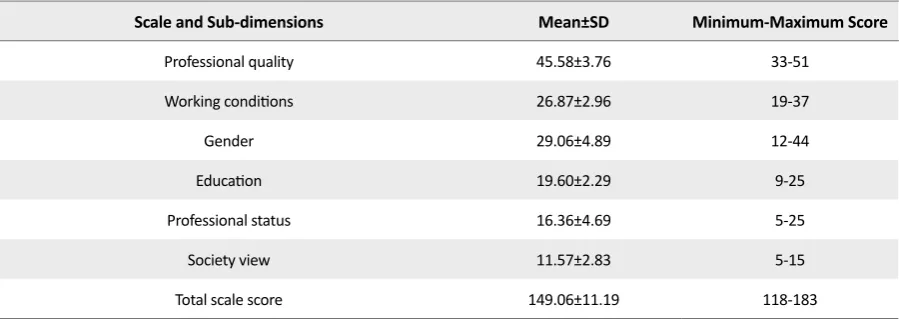
The students’ Mean±SD score on the Image Scale for the Nursing Profession was calculated to be 149.06±11.19. The subjects’ sub-dimensions scores of the scale were 45.58±3.76 on professional quality, 26.87±2.96 on working conditions, 29.06±4.89 on gender, 19.60±2.29 on education, 16.36±4.69 on professional status, and 11.57±2.83 on society view (Table 1).
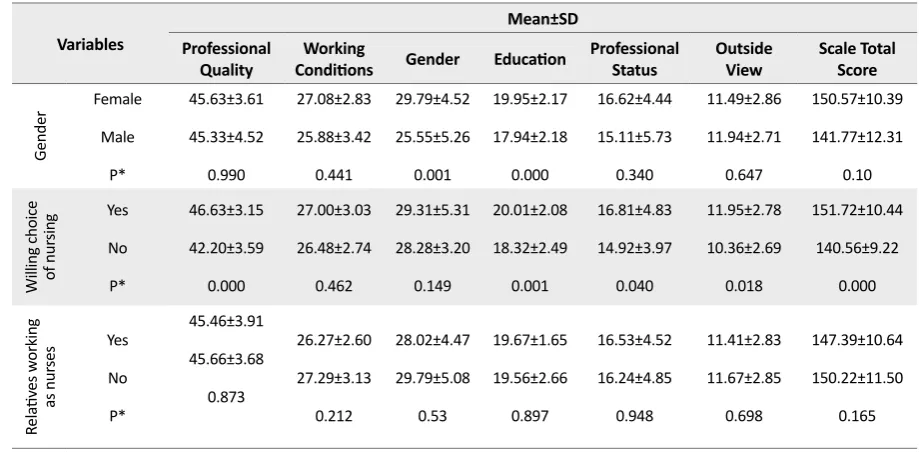
Table 2 illustrates a comparison of the students’ Mean±SD scores on the Image Scale for the Nursing Profession and its sub-dimensions according to their de-scriptive characteristics. The students who had willingly chosen the profession had significantly higher mean
Table 1. Distribution of students’ scores on the image scale for the nursing profession and its sub-dimensions (N=105)
Scale and Sub-dimensions Mean±SD Minimum-Maximum Score
Professional quality 45.58±3.76 33-51
Working conditions 26.87±2.96 19-37
Gender 29.06±4.89 12-44
Education 19.60±2.29 9-25
Professional status 16.36±4.69 5-25
Society view 11.57±2.83 5-15
Total scale score 149.06±11.19 118-183
scores on the sub-dimensions of professional quality, education, professional status, outside view, and on the total scale (P<0.05). In addition, the Mean±SD scores of female students on the sub-dimensions of education and gender and the total scale were calculated to be sig-nificantly higher than those of their male counterparts (P<0.05). On the other hand, no significant difference was found between the sub-dimension and scale total Mean±SD scores and whether the students had relatives working as nurses (P>0.05) (Table 2).
4. Discussion
Fealy (2004) stated that the image of nursing could identify the profession’s limitations and reflect the value of a professional nurse. The image of nursing af-fects the quantity and quality of those making deci-sions for nursing, as a profession (Özmen & Çetinkaya 2016). Determining the professional image perceptions of first-year nursing students who have recently cho-sen the nursing profession is escho-sential for determining the professional profile. According to the present study findings, students’ image perception regarding the nurs-ing profession was at a good level. A study reported that the perceptions of nursing students in their profes-sion were generally positive (Al Jarrah, 2013). Cook, Gilmer & Bess (2003) investigated the perceptions of nursing students at the beginning of their nursing edu-cation. They concluded that the students had very ide-alistic views of the profession, focusing on concepts, such as kindness and compassion.
Other related studies also found that the students’ images of nursing were at a good level (Andsoy et al. 2012; Karadağ, Pekmezci & Sapçı 2015;Özdelikara, Boğa & Çayan 2015). These conclusions are similar to those of our study. However, in a study by Özkan et al. (2017), the nursing students’ image perceptions of the nursing profession were at a moderate level. Further-more, Kaya and Dalgıç (2019) suggested a low level of students’ image perceptions of nursing. Such data discrepancy may arise from the demographic and cul-tural differences of the study samples and the history of nursing in different countries.
Nurses must possess certain characteristics in order to carry out their professional roles, duties, and responsi-bilities. These include such qualities as having scientific knowledge, being patient in guiding patients, and com-municating openly (Kumcağız et al. 2011;Özkan et al. 2017). Moreover, the investigated students achieved the highest mean scores on the sub-dimension of profession-al quprofession-ality. Similar results were reported by Özkan et al. (2017) and Andsoy et al. (2012).
A promising finding was the high score of professional quality sub-dimension in nursing students. This is be-cause the nursing profession depends on science; has high creativity and multi-directional communication; re-quires devotion and patience, and carries social respon-sibilities (Sezer, Esenay & Korkmaz. 2017). The image of the profession is related to the value accorded, and the respect felt for the profession by those who practice it. It
Table 2. Comparing students’ scores on the image scale for the nursing profession and its sub-dimensions by their descriptive characteristics (N=105)
Variables Professional Mean±SD
Quality ConditionsWorking Gender Education Professional Status Outside View Scale Total Score
Ge nder Female Male P* 45.63±3.61 45.33±4.52 0.990 27.08±2.83 25.88±3.42 0.441 29.79±4.52 25.55±5.26 0.001 19.95±2.17 17.94±2.18 0.000 16.62±4.44 15.11±5.73 0.340 11.49±2.86 11.94±2.71 0.647 150.57±10.39 141.77±12.31 0.10
Willing choice of nur
sing Yes No P* 46.63±3.15 42.20±3.59 0.000 27.00±3.03 26.48±2.74 0.462 29.31±5.31 28.28±3.20 0.149 20.01±2.08 18.32±2.49 0.001 16.81±4.83 14.92±3.97 0.040 11.95±2.78 10.36±2.69 0.018 151.72±10.44 140.56±9.22 0.000 Rela tiv es w orking as nur ses Yes No P* 45.46±3.91 45.66±3.68 0.873 26.27±2.60 27.29±3.13 0.212 28.02±4.47 29.79±5.08 0.53 19.67±1.65 19.56±2.66 0.897 16.53±4.52 16.24±4.85 0.948 11.41±2.83 11.67±2.85 0.698 147.39±10.64 150.22±11.50 0.165
is of particular importance for the status of the nursing profession as well as professional development that new nurses have professional qualities.
According to the collected data, students who had will-ingly chosen the nursing profession obtained signifi-cantly higher mean scores on the sub-dimensions of pro-fessional quality, education, propro-fessional status, social view, and the total scale, compared to others. Choosing the profession willingly and loving the profession could contribute to the formation of positive self-respect and professionalism. This is because students will be more successful in academic and professional life, could de-lightedly practice the profession, internalize the pro-fession, and improve their professional knowledge and skills (Pınar et al. 2013). Therefore, satisfaction with the profession increases professionalism, i.e. positively re-flected in professional image perception.
The nursing profession may alter through socio-cultural, scientific, and technological developments
(Karamanoğlu et al. 2009). Furthermore, it is affected by a person’s knowledge, competence, communication, gender, education, working conditions, professional qualities, status, and social view (Fletcher 2007;Sezer, Esenay & Korkmaz 2017; Tzeng 2006); gender is the most significant factor of all, because the nursing profes-sion, given its caregiving role, has long been considered by society as a females’ profession. Besides, the gender-discriminated roles in society are reflected in their pro-fessional status. We observed that female students had a more positive image perception of nursing than males. As a result, the later addition of males to the nursing pro-fession in Turkey and the perception that nursing was a profession for women could have a more positive effect on the nursing image perception of female students than that of males. Furthermore, according to some studies, gender does not affect the image perception of nursing
(Özkan et al. 2017; Sezer, Esenay & Korkmaz 2017). These differences between studies are interpreted as aris-ing from dependent variables relataris-ing to the samples in-cluded in the studies.
Özkan et al. determined the professional image per-ceptions of nursing students. They found that having a relative who was working as a nurse positively affected students’ image perceptions. In the same study, it was reported that having a relative who worked as a nurse helped individuals to recognize the nursing profession more clearly and realistically and that this positively shaped their professional image perception (Özkan et al. 2017). Other studies documented the professional image perceptions of those in the profession who knew
members of a health team were positive (Çelik et al. 2013; Sarıkaya & Khorshid 2009). The present study revealed that students’ image perceptions were not af-fected by having a relative working as a nurse. Thus, the present study conclusion differs from that of the literature. Conducting the study at only one center, re-stricting the samples to first-year nursing students, and the self-report nature of the questionnaire were among the current study limitations.
To improve the image of nursing, students’ awareness of the importance of professional image should be pro-moted. To develop a more positive professional image in students, it is recommended that academic and clinical nurses serve as role models and guiders. In addition, it is suggested that the study be repeated in broader groups. Conducting a similar study is also recommended for se-nior nursing students and staff nurses.
Ethical Considerations
Compliance with ethical guidelines
The necessary written permission for the research was obtained from the Clinical Research Ethics Committee of the Medical Faculty of Bursa Uludağ University (Code: 2019-14/6), and permission was obtained from the own-ers to use the Image Scale for the Nursing Profession. Besides, an informed consent form was obtained from the students who voluntarily participated in the study af-ter providing explanations on the study purposes.
Funding
This research received no specific grant from funding agencies in the public, commercial, or not-for-profit sectors.
References
Al Jarrah, I. A. T., 2013. Associate nursing students’ perceptions toward nursing profession in Jordan. European Scientific Jour-nal, 9(6), pp. 147-66.
Andsoy, I., Güngör, T. & Bayburtoğlu, T., 2012. Karabuk universıty health school students’ thoughts about the future
of their profession and the causes of preferring nursing.
Ba-likesir Health Sciences Journal, 1(1), pp. 124-30. [DOI:10.5505/
bsbd.2012.87597]
Cook, T., Gilmer, M. & Bess, C., 2003. Beginning students’ defini
-tions of nursing: an inductive framework of professional iden
Çelik, A. S., et al. 2013. [Determination of the image of nursing
profession in community (Turkish)]. Florence Nightingale
Jour-nal of Nursing, 21(3), pp. 147-53.
Dost, A. & Bahçecik, A. N., 2015. Developing a scale for the
image of nursing profession. Journal of Academic Research in
Nursing, 1(2), pp. 51-9. [DOI:10.5222/jaren.2015.051]
Emeghebo, L., 2012. The image of nursing as perceived by
nurs-es. Nurse Education Today, 32(6), pp. 49-53. [DOI:10.1016/j.
nedt.2011.10.015] [PMID]
Emiroğlu, N., 2000. [Nursing image of health personnel and so
-ciety (Turkish)]. Journal of Nursing Research, 1(1), pp. 9-18.
Eşer, İ., Orkun, N. & Çetin, P., 2017. [The image of nursing and a series of advertisements published in the 1950s (Turkish)]. Dokuz Eylul University Faculty of Nursing Electronics Journal, 10(4), pp. 275-8.
Fealy, G. M., 2004. The good nurse: visions and values in images of the nurse. Journal of Advanced Nursing, 46(6), pp. 649-56.
[DOI:10.1111/j.1365-2648.2004.03056.x] [PMID]
Fletcher, K., 2007. Image: Changing how women nurses think
about themselves: Literature review. Journal of Advanced
Nurs-ing, 58(3), pp. 207-15. [DOI:10.1111/j.1365-2648.2007.04285.x]
[PMID]
Hung, C. A., et al. 2019. The effect of gender‐friendliness bar-riers on perceived image in nursing and caring behaviour among male nursing students. Journal of Clinical Nursing, 28(9-10), pp. 1465-72. [DOI:10.1111/jocn.14693] [PMID] İnce, S. & Khorshıd, L., 2015. Determination of factors affecting
career choices of nursing students. Journal of Anatolia
Nurs-ing and Health Sciences, 18(3), pp. 163-71. [DOI:10.17049/
ahsbd.08012]
Karadağ, G., Pekmezci, S. & Sapçı, E., 2015. Thought and expec
-tations of nursing students through education and
profession-al. Gaziantep Medical Journal, 25(1), pp. 26-31. [DOI:10.5455/
GMJ-30-168148]
Karamanoğlu, Y. A., Gök, Ö. F. & Tuğcu, A., 2009. [Evaluation of surgical ward nurses professionalism in their work, in Denizli (Turkish)]. Fırat Medical Journal, 14(1), pp. 12-7.
Kartal, H. & Kantek, F., 2018. Examination of psychometric char
-acteristics of the nursing image scale among nurse manegers.
Medical Journal of Bakırkoy, 14, pp. 190-7.
[DOI:10.5350/BTD-MJB.20170322030251]
Kaya, A. & Dalgıç, A. İ., 2019. Relationship between student nurses’ perception of nurses, nursing images and effective factors: A
cross-sectional study. Paper Presented at the 2nd International Health
Sciences and Life Congress, Burdur, Turkey, 24-27 April 2019.
Khorshid, L., Eşer, İ. & Çınar, Ş., 2005. [Students’ views on nurs
-ing image in society (Turkish)]. Journal of Ege University
Nurs-ing Faculty, 21, pp. 581-8.
Korkmaz, F. & Görgülü, S., 2010. [Viewpoint of nurses on nurs
-ing in respect to professionalism criteria (Turkish)]. Hacettepe
University Faculty of Health Sciences Nursing Journal, 17(1), pp.
1-17.
Kumcağız, H., et al. 2011. [Communication skills of nurses: Sam
-sun sample (Turkish)]. Dicle Medical Journal, 38(1), pp. 49-56.
Morris- Thompson, T., et al. 2011. Diversity, fulfilment and priv
-ilege: The image of nursing. Journal of Nursing Management, 19(5), pp. 683-92. [DOI:10.1111/j.1365-2834.2011.01268.x] [PMID]
Nazik, E. & Arslan, S., 2014. The future of nursing: The hopes of
students. Bozok Medical Journal, 4(1), pp. 33-40. [DOI:10.16919/ btd.03702]
Özdelikara, A., Boğa, N. M & Çayan, N., 2015. [Nursing image
from the view of nursing students and other section students
(Turkish)]. Journal of Duzce University Health Sciences Institute,
5(2), 1-5.
Özkan, Z. K, et al. 2017. [Professional image perception of a
group of nursing students (Turkish)]. Journal of Research and
Development in Nursing, 19(1), pp. 38-47.
Özmen, D. & Çetinkaya, A., 2016. [A qualitative study of profes
-sional perceptions of senior nursing students (Turkish)].
Jour-nal of Research and Development in Nursing, 18(1), pp. 40-52.
Pınar, Ş. E., et al. 2013. [Analysis of occupational professional
-ism of midwifery students and affecting factors (Turkish)]. Fırat Health Services Journal, 8(23), pp. 19-37.
Sarıkaya, T. & Khorshid, L., 2009. [The investigatıon of the fac -tors that affect university students’ profession choice:
Univer-sity students’ profession choice (Turkish)]. The Journal of
Turk-ish Educational Sciences, 7(2), pp. 393-423.
Sezer, T. A., Esenay, F. I. & Korkmaz, G., 2017. [Occupational image of pediatric nurses: Professional or traditional (Turkish)]. Journal
of Research and Development in Nursing, 19(3), pp. 45-54.
Şimşek, A. K. & Alpar, Ş. ., 2019. [Image perception of the society
for nursing profession: Systematic review (Turkish)]. Sakarya
University Journal of Holistic Health, 2(1), pp. 32-46.
Takase, M., Maude, P. & Manias, E. 2006. Impact of the per
-ceived public image of nursing on nurses’ work behaviour.
Journal of Advanced Nursing, 53(3), pp. 333-43. [DOI:10.1111/
j.1365-2648.2006.03729.x] [PMID]
Tan, M., et al. 2007. [Point of view on nursing of university
stu-dents (Turkish)]. Journal of Anatolia Nursing and Health Sci-ences, 10(1), pp. 22-9.
Tzeng. H. M., 2006. Testing a conceptual model of the ımage of