Rochester Institute of Technology
RIT Scholar Works
Theses
Thesis/Dissertation Collections
5-11-1979
Noise reduction by multiple image printing
William McDonnell
Follow this and additional works at:
http://scholarworks.rit.edu/theses
This Thesis is brought to you for free and open access by the Thesis/Dissertation Collections at RIT Scholar Works. It has been accepted for inclusion in Theses by an authorized administrator of RIT Scholar Works. For more information, please [email protected].
Recommended Citation
NOISE REDUCTION
BY
MULTIPLE IMAGE PRINTING
by
William McDonnell
A thesis submitted
in
partial fulfillmentof the requirements for the degree of Bachelor of Science
in
the School ofPhotographic Arts and Sciences
in
theCollege of Graphic Arts and
Photography
of the Rochester Institute of
Technology
Advisor
Prof. Mohamed F. Abouelata
G- 1Z*Stfl
ABSTRACT
A method of noise reduction
by
the successive partialprintings of
identical
negatives was investigated. Imageenhancement
in
terms of granularity reduction and resolutionINTRODUCTION
The
ability
of a film to record fine detailis
ultimatelylimited
by
the granularity of the emulsion. If a greaterrecording
capacity
is
requiredit
is
usually necessary to usean extremely fine grained emulsion.
However,
considerationsof photographic speed, contrast, availability, and cost may
make this
impractical,
if
notimpossible.
In1947,
Stevenslreported on a comprehensive study to reduce graininess based
on suggestions
by
Hickman-- . A negative superimpositiontechnique,
whichinvolves
making successive partial printingsof optically
identical
negatives onto a single piece of printmaterial, not only resulted
in
reduced graininess, but alsoin
increased
resolution.Using
eight negatives, Stevensachieved a reduction
in
graininessby
aboutone-third,
andan
increase
in
resolution from 20 to 60 percent. The resolutionimprovement
was greater for lower contrastimage
detail.In light of the present understanding of the nature of
graininess and
its
quantitative measure called granularity,the
following
explanation for thisimage
enhancementis
presented. For a multiple
image
print made from the successivepartial exposures of N identical negatives
(identical
heremeans the same
image
detail on the same type of film), thegrain distribution
is
the result of the combination of Ngrain distributions each with the same standard deviation of
is
exposed so that it contributes equaldensity,
then to afirst approximation the granularity of the composite print
is
inversely
proportional to the square root of N(see appendix).The reduced noise will result
in
anincreased
signal to noiseratio. If the negatives are printed
in
exact register,increased
information
capacity and resolution would be expected.In
1963,
Kohler and Howell3investigated
the use ofmultiple
image
printing for aerial photography. For a combinedprinting of three negatives
they
found a reduction ofgranularity of 35 percent and a similar
increase
in
resolution.Once again, the resolution
increase
was greater for lowercontrast
images.
Multiple
image
printing has also been used extensivelywith astronomical photography.^ in
1959,
Johnson5- combinedten
images
of a star field to produce a composite print thatyielded stars 1.2 magnitudes fainter than that of the
individual
images (magnitude
is
a measure of the apparentbrightness of a star6) . Additional details of using this
method for stellar enhancement are described
by
Baum ,Bowen^,
and Racine9'10. Applications to planetary photography have
been described
by
Lyot11,
Kuiper andCalvert12,
and Kirby13.Wallis and Provin14, and Hudgins1^ have illustrated the method
for use
by
amateur astronomers to enhance their ownastro--photographs.
The purpose of this research was to investigate the
r.J
multiple
image
prints from which granularity(noise)
and resolution could be measured as a function of the number of negatives used to make the multipleimage
print.EXPERIMENTAL
The production of multiple
image
prints that would answer the objectives required a sturdy projection printer, negativeand print photographic materials, a test target from which resolution and granularity could be measured, a method for
registering the negatives, the determination of proper printing exposures, and a microdensitometer for granularity measurements,
Enlarger and Film Materials
A Simmon Omega D-2 enlarger with a 50mm f/4.5 Kodak Ektor
enlarging lens was selected for sturdiness, availability, and
adaptability to floor projection. Kodak film type Plus-X Pan was selected as the negative material because
it
has medium grain and resolving power and common availability. Films with extreme resolution and fine grain would necessitate very highprinting magnifications. Kodak film type Commerical 6127
(4x5
inch
format)
was selected as a print material that wouldnot contribute noise to the system. In addition, it was usable with safelight illumination.
Test Target
A test target was made consisting of three 8x8
inch
RIT1.3,
0.7,
and0.2,
a Kodak gray scale, and an 18 percent graycard. The gray card provided an area of uniform
density
onthe print
transparencies
for granularity determination. Thegray scale was
originally intended
to permit measurement ofprint contrast, but this was later considered unimportant.
However,
image
detail of the gray scale was used to assistin
negative registration.A Konica Autoreflex T 35mm camera with a 50mm f
/l
. 8Konica Hexagon lens was used to
image
the target onto thePlus-X film at a reduction of 84.8 times; This reduction was
selected for the
following
reasons;1)
The largest characterson the resolution targets must be resolved.
2)
The targetimage
at the print exposing plane must fit within the 4x5inch
format,
yet the degree of enlargement had to be enough forthe Plus-X grain to become apparent.
Negative Registration
Stevens used pin registration to align each negative of
a series of cinematograph
images.
However,
pin registrationwas considered too restrictive since the
image
may not beprecisely
in
the same location within successive negativeframes. Wallis and Provin suggest using a pencil to mark
image
details from the first negative on white cardboard attached
to the printing easel cover, and then visually
aligning
thecorresponding
image
detail from successive negatives to thesemarks. While this method may work well for the star
images
iaes!ii--3-.-Fig. 1. The printing set
up.
printing,
it
was consideredtoo crude for the test
target images and for
conventional
images
aswell.
A special registration
device,
as shownin
Fig. 1at the exposing plane of
the Simmon Omega enlarger,
was designed and built to
achieve negative alignment
in
a manner similar tothat suggested
by
Wallisand Provin. The crosshairs
in
two Patterson brandimage
finders are used foralignment reference
instead of pencil marks.
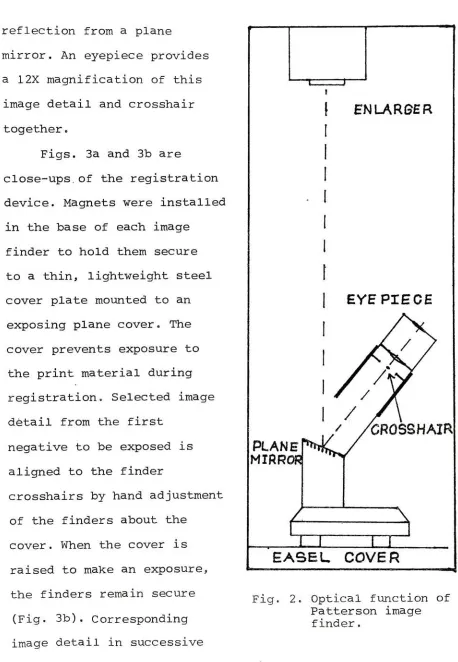
Fig. 2 illustrates
the optical function of a
Patterson
image
finder.Image detail that would
otherwise focus on the
exposing plane
is
focusedon a crosshair
in
the tube [image:8.562.72.267.84.642.2]reflection from a plane
mirror. An eyepiece provides
a 12X magnification of this
image
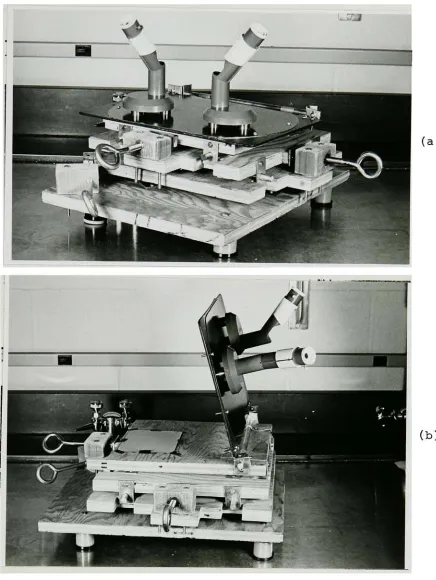
detail and crosshair together.Figs. 3a and 3b are
close-ups. of the registration
device. Magnets were installed
in
the base of eachimage
finder to hold them secure
to a
thin,
lightweight steel cover plate mounted to anexposing plane cover. The
cover prevents exposure to
the print material
during
registration. Selected
image
detail from the firstnegative to be exposed
is
aligned to the findercrosshairs
by
hand adjustmentof the finders about the
cover. When the cover
is
raised to make an exposure,the finders remain secure
(Fig. 3b).
Corresponding
image detail
in
successivePLANE
MIRROR!
f
ENLARGER
EYEPIECE
CROSSHAIR
A
nr
nr
EASEL
COVER
Fig. 2. Optical function of
Patterson
image
[image:9.562.64.522.56.718.2]3
_^J 1.
l Itt^ii
y
(a)
(b)
[image:10.562.71.507.74.654.2]8
negatives
is
aligned to the finder crosshairsusing
threeprecision movements which adjust the position of the exposing
plane. One circular and two perpendicular straight motions
are provided
by
threeindependantly
moving stacked carriages.The
bottom
carriage moves circularly about a centrallylocated
1^ inch
diameter steel tube. It rides on the headsof three
h
inch
bolts which rest on three 3x1x1/8inch
steelstrips attached to the base. The middle and
top
carriage movestraight
by
riding on two 3/8inch
steel rods. Three-eighthinch
holes drilledin
four 2x1x1/8inch
steel strips securelyattach the carriages to the rods permitting motion only
in
the
intended
direction. The movements of all three carriagesare controlled
by
3/8inch
diameter bolts with sixteenthreads per
inch.
A 1/32 bolt revolution provides a precisionmovement of 0.05mm with no detectable backlash.
Printing Exposures
It was desired that each negative
involved
in
makinga multiple
image
print contribute equal density.Thus,
whendetermining
printing exposure times forindividual
negatives,the effects of the non-linearity between exposure time and
density,
theintermittency
effect, and the reciprocity lawfailure of the print material must be considered. In addition,
the total exposure time
(the
correct exposureif
printing onlyone negative
)must
belong
enough so that individual exposurescan be accurately made.
magnification
(
25 .8X)
so that the test target filled the 4x5inch
format. An exposure time series ranging from two to 160seconds was made using the Kodak Commercial film 6127.
Gray
card
image
density
was plotted as a function of exposuretime. This curve permitted calculation of equal
density
exposures
using any
mumber of negatives. It was decided tomake multiple
image
prints using1,2,4,
and 8 of the Plus-Xnegatives based on a total exposure time *of 100 seconds.at
f/11. Samples were made using intermittent exposures as
calculated for each of these numbers of negatives. The
resulting gray card
image
densities were within 0.03 of 1.66indicating
no significantdensity
variation due to theintermittency
effect.Two sets of the four multiple
image
prints were made.The gray card
images
were scanned with an Ansco Model 4automatic recording microdensitometer. For each print
transparency; approximately 500
independent
density
valueswere used to determine the granularity. Resolution was
determined
by
visually examining the transparencies with aslide illuminator. The
images
of the RIT alphanumeric targetswere evaluated
by
determining
the smallest rowin
which all10
RESULTS AND DISCUSSION
Table 1.
Granularity
and resolution of individual print sets.Negatives Printed
Standard Deviation of
Density
Fluctuation(90%
confidence)Set 1 Set 2
Resolution
(setl,
set2)
(
1ine: paiit s/mm D 1.3 0.7 0.21 2.85-3.15 2.73-3.03 30,30 27,27 24,21
2 2.05-2.28 2.11-2.37 30,30 30,27 24,24
4 1.45-1.62 1.49-1.66 34,30 30,30 27,27
8 0.99-1.10 1.08-1.20
4
34,34 30,30 30,30
Table 1 shows resolution and the standard deviation of
density
fluctuation as determined for each multipleimage
print set. For the values of the standard deviation of
density
fluctuation,
the confidenceinterval
arises from thestatistical limitation when
determining
actual values from afinite sample of measured print densities. The true value
has a 90 percent probability of
being
between the valuesindicated.
An F-test between corresponding printsin
the twosets
indicated
that each was an estimate of the same actualstandard deviation of
density
fluctuation.Table 2. Pooled granularity and average resolution.
Negatives
Printed
Normalized and Pooled
Granularity
(90%
conf.)Avera
AD
ge res 1.3 olution 0.7(lps/mm)
0.21 0.96-1.04 30 27 22
2 0.72-0.78 30 28 24
4 0.51-0.55 32 30 27
[image:13.562.62.511.558.693.2]11
1-0
y_
0
-QH CC
<
%
OH
0.2
1 1
1
VS.
<v
-^mil ai j a^iiiii,---J--MM-w~--ta-|-wi---nBi--aM---i--MWiwww*Jgiiiiiii nm him-mj
i
a
3
NEGATIVES
H-
S
6
7
a
SUPERIMPOSEO
Fig. 4.
Granularity
as a function of number of negativessuperimposed. The dotted line
is
the predicted curve.Table 2 shows granularity as the pooled standard deviation
of
density
fluctuation between sets 1 and 2 which has beennormalized to 1.00 for the single negative prints. The
resolution
is
the average of the two sets. These results areplotted
in
Figs. 4 and 5.Fig. 4 shows granularity as a function of the number of
negatives combined. Hash marks represent the 90 percent
confidence intervals. The dotted curve
is
the expectedinverse
[image:14.562.65.507.107.432.2]12
tKDr
f
2
3
4*5
6
7
a
NEGATIVES
SUPERIMPOSED
Fig. 5. Resolution as a function of the number of negatives
superimposed for target
density
contrasts of1.3,
0.7,
and 0.2.negative print.
Considering
the confidenceintervals,
theexperimental curve appears to agree with the expected curve.
Thus,
theinverse
square root relationshipbetween
granularity
and number of negatives superimposed
is
a good predictor ofthe noise reduction obtained
by
the process.Fig. 5 shows resolution as a function of the number of
negatives combined for the three target contrast levels. For
all three
levels,
the resolutionincreases
most rapidly when [image:15.562.62.504.100.433.2]13
negatives would not be expected to increase resolution
enough to warrant the additional time and effort required
for most applications. The superimposition of eight negatives
resulted
in
a 13 percent high contrast resolutionincrease
and a 27 percent low contrast resolution increase. The
resolution
difference
between the high and low contrastresolution dropped from eight to four lines per millimeter.
One explanation for this
is
that the low Contrast resolution-is
influenced
lessby
negative registration errors becauseit
is
smaller to begin with.Thus,
multipleimage
printingcould be used to enhance shadow detail of conventional
photographic
images
.CONCLUSIONS
Multiple
image
printing will provide a useful reductionin
grain(noise) and anincrease
in
resolutionif
the problemsof negative registration and exposure can be overcome. Present
applications are subject to whether the time and effort
involved
justifies
the amount ofimage
enhancement obtained.Considering
the constantimprovement
of photographic materials,electronic
imaging
techniques,
and computer enhancementtechniques,
it
seems unlikely that multipleimage
printingwill ever
increase
in
application. Yetit
will remainavailable for use
by
those who findit
to bejust
the14
REFERENCES
1. G.W.W.
Stevens,
"The Effect of Diffusion on the Graininessand Resolution Obtained From Processed
Negatives",
The Photographic Journal, Vol.
87B,
ppsi.74-80.(1947)
2. K.C.D.
Hickman,
J.S.M.P.E. , Vol.10,
pg. 49.(1926)
3. R.J. Kohler and H.K.
Howell,
"Photographic ImageEnhancement
by
Superimposition of MultipleImages",
Photographic Science and Engineering, Vol.
7,
pps.241-245.
(1963)
4. A. A.
Hoag
and W.C.Miller,
"Application of Photographic Materials InAstronomy",
AppliedOptics,
Vol.8,
No. 12pps. 2417-2430.
(1969)
5. H.L.
Johnson,
R.de F.Neville,
and B.Iriarte,
LowellObservatory Bulletin , Vol.
4,
p. 85.(1959)
6. J.A.
Mauro,
ed., OpticalEngineering Handbook,
GeneralElectric,
Sect.11,
pps. 39-40.(1957)
7. W.A.
Baum,
Astronomical Technigues, W.A. Hiltner,Ed.(University
of ChicagoPress,
Chicago,
1962).8. I.S.
Bowen,
AstronomicalJournal,
Vol.69,
p. 816(1964)
9. R.
Racine,
Journal Royal AstronomicalSociety
ofCanada,
Vol.
60,
p.52.(1966)
10, R.
Racine,
Astronomical Journal, Vol.72,
p. 65.(1967)
11. B.
Lyot,
L-Astronomie, Vol.57,
p 67.(1943)
12. G.P- Kiuper and M.R.
Calvert,
AstrophysicalJournal.
Vol.
105,
P. 215.(1947)
13. D.S. Kirby, Publ. Astron. Soc.
Pacific,
Vol.71,
p.334.(1959)
14. B.D. Wallis and R.W..
Provin,
"Integration Printing: AnAid to
Long
ExposureAstrophotography",
Astronomy,
Vol.1,
No.3,
pps. 35-39.(1973)
15. D. Hudgins,
"Printing
Your Astrophotographs-PartFour",
Astronomy, Vol.
5,
No.12,
pps. 34-39.(1977)
16. A.D. Rickmers and H.N.
Todd,
Statistics: AnIntroduction.
15
APPENDIX
Given a film sample A characterized
by
adensity
fluctuation due to thegranularity
of the emulsion, letD(A)
be theaverage
density
andD(A)+d(Ai)
be thedensity
of any i**1 spotin
the emulsion whered(Ai)
is
thedensity
difference betweenthe ith spot and the
mean. The variance of the
density
fluctuation about the mean
D(A)
can then be defined as(Tk2
=
(
D(A)+d(Ai)
-D(A)
9/n
=d(Ai)2/n
,
hi
is/
where n
is
the number ofindividual
spot densities.Similarly,
a film sample B has a variance of
density
fluctuation ofCr
=d(Bi)2/n
For the combination of film sample A and
film
sampleB,
theaverage
density
becomes(D(A)+D(B)
)/2
and thedensity
of theith
spot becomes
(
D(A)+d(Ai)+D(B)+d(Bi)
)/2.
Thus,
for the combination, the resulting variance ofdensity
fluctuationabout the mean
is,
2
n
(J~AQ
=^((D(A)+D(B)
+d(Ai)+d(Bi))/2-(D(A)+D(B)
)/2
)2/n
=
(
(d(Ai)
+d(Bi))/2)2/n
=
(
(d(Ai)2/4n)+(d(Bi)2/4n)+(d(Ai)d(Bi)/2n)
)
=
C5/4
+6g/4
+p
(d(Ai)d(Bi)/2n)
To a first approximation, the third term above can be
neglected. In addition,
if
film sample A and film sampleB are samples of the same type of
film,
then(Tr=^^
and2
2
CTAB
=CTA/2The standard deviation of the
density
fluctuationis
thenO^b
ffin
=6^/jrThus a composite print made from two identical negatives has
a granularity reduction of/zf"as compared to the
individual
negatives.
It can similarly be shown that for the combination of
N negatives, the granularity will reduce
by
a factor ofJW
.Hence,
/~ ^_
On
=U-r/jN
whereOn
is
the granularity of acomposite print made from N negatives and
Oj^
is
the