User-Friendly and Learner-Friendly Courseware Design,
Development and Evaluation
By
Yasmine Howard BA BA (hons)
Submitted in fulfilment of the requirements for the Degree of Doctor of Philosophy
Dedication
To my beautiful mentor Dr Thao Le. Your encouragement, expertise and support inspired my journey. You offered me a beacon, and showed me the door at the end of the journey. I am
so grateful my path was led to yours. Thank you.
To my wonderful Angus Wallace. Your endless love, financial and emotional support made it possible for me to complete this study. You refuelled the beacon, kept it going when the light was dimming, and held my hand along the journey. This is our journey. We open the door
together. We shut it hand in hand.
To our little Siddhartha. Your endless love, fluffy wuffy humour, and protection kept me sane. You were the beacon when the light had gone, shouldered a responsibility humans cannot
be capable of, and carried me to the door when I had fallen. I love you.
To the participants in this study – students, academics and experts, who gave their time and attention to this study. Also, to participants on the international educational technology
Abstract
Table of Contents
Statement of Material, Authority of Access--- 1
Dedication --- 2
Abstract--- 3
Chapter One: Introduction 1.1 Introduction --- 8
1.2 Teaching and Learning Online --- 11
1.2.1 Technological Revolution --- 11
1.2.2 Commercial Training Provider --- 13
1.2.3 Higher Education --- 14
1.3 Courseware Design --- 16
1.3.1 Definition --- 16
1.3.2 User-Friendly Design --- 17
1.3.3 Learner-Friendly Design --- 18
1.3.4 Moving Towards a New Design Model --- 20
1.4 Research Objectives --- 21
1.5 Research Methodology--- 23
1.6 Significance of the Research --- 24
1.7 Limitations of the Research --- 25
1.8 Ethics --- 26
1.9 Overview of Thesis --- 27
Chapter Two: Literature Review 2.1 Overview --- 31
2.2 Courseware Design --- 32
2.2.1 Courseware in Higher Education --- 32
2.2.1 User-Friendly and Learner-Friendly Design --- 34
2.2.3 Learning Management Systems --- 35
2.3 Learner-Centered Design--- 36
2.3.1 Traditional Paradigm: Teacher-Centered Design --- 37
2.3.2 Emerging Paradigm: Learner-Centered Design --- 38
2.4 User-Friendly Design --- 39
2.4.1 Definition of User-Friendly Design --- 39
2.4.2 General Heuristics for Web Site Design --- 41
2.4.3 User-Friendly Design for Courseware--- 43
2.5 Learner-Friendly Design --- 47
2.6.1 Objectivist Epistemologies and Designs --- 51
2.6.2 Constructivist Epistemologies and Designs --- 52
2.7 Evaluation--- 61
2.8 Conclusion --- 62
Chapter Three: Research Methodology 3.1 Introduction --- 64
3.1.1 The Nature of Instructional Design --- 65
3.1.2 Purpose of This Study --- 66
3.2 Research Aims and Objectives --- 66
3.3 Statement of the Problem--- 67
3.4 Research Assumptions--- 68
3.5 Research Limitations--- 69
3.6 Courseware Evaluation --- 70
3.6.1 Development of the Courseware --- 70
3.6.2 Delivery of Courseware --- 71
3.7 Research Design--- 72
3.8 Software Engineering Approach --- 73
3.9 Quantitative Research Approach --- 75
3.9.1 Questionnaire data collection.--- 75
3.9.2 Participants--- 79
3.9.3 Procedure --- 79
3.9.4 Validity and Reliability --- 80
3.10 Qualitative Research Approach --- 81
3.10.1 Interview--- 82
3.10.2 Participants and the Process --- 83
3.10.3 Web Based Feedback --- 84
3.10.4 Validity and Reliability--- 84
3.11 Ethical Considerations --- 85
3.12 Conclusion --- 85
Chapter 4: Courseware Design 4.1 Introduction --- 86
4.2 Design Guidelines --- 88
4.2.1 Learner-Centered Design--- 88
4.2.2 User-friendly Design --- 89
4.2.3 Learner-Friendly Design --- 94
4.3 Courseware Design --- 98
4.3.2 Learner-Friendly --- 100
4.4 Courseware Prototype --- 105
4.4.1 Introductory Pages --- 105
4.4.2 Login Page --- 108
4.4.3 First Time Tutorial Pages. --- 108
4.4.4 Homepage --- 113
4.4.5 Navigational and Learning Aids --- 115
4.4.6 Learner and Instructor Screens --- 119
4.4.7 Course Information Screen --- 121
4.4.8 Activities Screen --- 128
4.4.9 Communicate Screens --- 130
4.4.10 Resources Screens--- 132
4.4.11 Exit --- 134
4.5 Conclusion --- 135
Chapter Five: Quantitative Analysis 5.1 Introduction --- 136
5.2 Quantitative Research Objectives. --- 137
5.3 Tools and Techniques --- 139
5.4 The Sample --- 141
5.5 Data Analysis --- 144
5.5.1 Analysis of Perspectives of Teaching and Learning --- 145
5.5.2 Analysis of User-Friendly Design --- 148
5.5.3 Analysis of Learner-Friendly Design--- 155
5.5.4 Analysis of Behaviourist and Constructivist Designs --- 165
5.6 Discussion of Findings --- 179
5.6.1 Teaching and Learning Online --- 180
5.6.2 User-Friendly Design --- 182
5.6.3 Learner-Friendly Design --- 185
5.6.4 Behaviourist and Constructivist Designs --- 188
5.7 Conclusion--- 199
Chapter Six: Qualitative Analysis 6.1 Introduction --- 203
6.2 Qualitative Analysis --- 204
6.2.1 Qualitative Analysis. --- 204
6.2.2 Design --- 208
6.2.2.1 Open-ended Questionnaire--- 208
6.3 Results--- 215
6.3.1 Open-ended Questionnaire --- 216
6.3.2 Courseware Evaluation --- 271
6.4 Discussion --- 307
6.4.1 Teaching and Learning Online --- 308
6.4.2 User-Friendly Design --- 314
6.4.3 Learner-Friendly Design (incorporating behaviourist and constructivist-oriented designs) --- 321
6.5 Conclusion --- 332
Chapter Seven: Conclusion 7.1 Overview --- 333
7.2 Research Journey at its Conclusion --- 334
7.3 Limitations --- 336
7.4 Overall Discussion of Findings --- 337
7.4.1 Teaching and Learning Online --- 337
7.4.2 User-Friendly Courseware Design --- 340
7.4.3 Learner-Friendly Courseware Design --- 343
7.4.4 Behaviourist and Constructivist-oriented Courseware Design --- 347
7.5 Courseware Evaluation--- 351
7.5.1 Participants’ Attitudes to the User-Friendly Design. --- 352
7.5.2 Participants’ Attitudes to the Learner-Friendly Design --- 354
7.6 Future of This Research --- 357
7.7 Conclusion--- .360
Bibliography --- 362
Chapter 1: Introduction
1.1 Introduction ... 8
1.2 Teaching and Learning Online ... 11
1.2.1 Technological Revolution... 11
1.2.2 Commercial Training Provider ... 13
1.2.3 Higher Education ... 14
1.3 Courseware Design... 16
1.3.1 Definition ... 16
1.3.2 User-Friendly Design ... 17
1.3.3 Learner-Friendly Design ... 18
13.4 Moving Towards a New Design Model ... 20
1.4 Research Objectives ... 21
1.5 Research Methodology ... 23
1.6 Significance of the Research ... 24
1.7 Limitations of the Research... 25
1.8 Ethics ... 26
1.9 Overview of Thesis... 27
1.1 Introduction
academics argued that both behaviourist and constructivist principles could be combined effectively to form a complementary design ‘toolkit’ for learning.
Having read the theory on the design of courseware, the researcher undertook several jobs as an instructional designer in both the fields of commercial Training and Higher Education, in order to gain more experience in the practice of designing courseware. The practice of designing courseware led the researcher to new insights into the area of courseware design, and inspired the design of this research to new levels. In particular, the researcher found that one of the themes from the literature was the move in the technological and pedagogical designs of courseware from teacher/software-centered methodologies (design from the perspective of the software developer and teacher), to learner/user-centered methodologies (design which incorporates the needs of the end-user as a learner). Nevertheless, these perspectives tended to come from the professional or academic, as opposed to the learners using courseware. Thus, although a move towards learner-centered methodologies is said to have occurred, the perspectives of learners tend to be left out of the literature. Interestingly, the researcher found that this theme extended to the design of courseware in practice. In particular, the researcher found that although courseware – particularly within the realm of commercial training was often labelled as ‘innovative’, traditional design methodologies were generally applied. There appeared to be hesitation by those involved in the production of courseware against learner-centered methodologies.
user-friendly elements, compared to those involved in designing and implementing these features?
The final influencing factor guiding the researcher’s personal journey on this research study was her experience as an instructional designer within the field of Higher Education. Within the commercial training industry, the researcher found that the tasks on courseware design were divided very specifically. Separate people were assigned specialised tasks. The tasks included those of instructional designer (those involved in the educational design and to some extent web design), web designer/developer (those involved in building the instructional design screens prototyped usually within a Word document), subject matter expert – SME (those involved in providing the content that the instructional designer interprets), and project manager (those involved in administering the development of the courseware, and liaising between different parties). Within the field of Higher Education however, the researcher found that instructional designers often multi-tasked as instructional designer, web designer, web developer, and project manager. In many cases, however, the researcher observed that academics did not often have the ‘luxury’ of an instructional designer, and thus performed the multiple roles on all aspects of courseware design themselves. In addition to this, academics were often untrained when it came to these specialised tasks, and some academics appeared to resent the time and effort involved in the design of courseware, which they weren’t convinced necessarily enhanced teaching and learning in Higher Education.
propelled the researcher through this research journey, and inspired her to explore those issues which appeared to be somewhat lacking in the literature.
1.2 Teaching and Learning Online
1.2.1 Technological Revolution
Over the past thirty years computers have had a profound effect on society, changing the way we access information and use technology on a day-to-day basis. The fear of near apocalypse due to the ‘Y2K Bug’ in 2000 emphasises our reliance on computers. Due to a potential error in the programming language used by many computer systems, experts could not safely declare that anything run by computers would continue to function as normal after December 31st, 1999. Airports, hospitals, commercial businesses and households were preparing for a worst-case scenario, that is, life without computers. Fortunately most computer systems operated as usual on the critical date, ensuring the popularity and usage of Personal Computers (PCs) and the growth of the Internet. The PC computer is now essential to the operation of commercial and government organisations, and an increasingly important feature of Australian households. More and more businesses, schools, vocational education, Higher Education institutions and households are transferring their paper-based tasks to an electronic environment. PCs are acting as multi-tasking agents. For example, database software is being used to hold client information, bill tracking, stocktaking and financial management; work processing is used for business proposals, letter writing and note taking; and spreadsheets are being used for mathematical functions among other tasks. PCs and their accessories are also being used for new activities, previously undertaken within specific businesses, for example, scanning, editing and printing digital photos. Furthermore, the growth of the Internet has spanned a technological and cultural revolution, further affecting how we undertake daily jobs and enabling new possibilities. We may now handle our banking, pay our bills, search for products and shop, find out more about specific companies or people, access recent and past news, research most phenomena, play games, download and play multimedia and communicate synchronously (in real time, e.g. MSN chat or Skype) or asynchronously (e.g. email, blog, listserv) with friends, colleagues, potential clients and even cyber-strangers.
on, non-technical people could share files using a browser, as well as utilise the traditional FTP, Telnet and email. Perhaps as a result of its past however, many Internet applications – including web pages and communications software may not be considered user-friendly. That is, they may be designed without consideration of the end user and therefore be difficult for non-experts to use. This may be because traditionally most end-users were experts themselves, or, the developer may not be trained in effective user-interface design or may think it unimportant. As a result, the application may have a low usability rating, decrease in popularity or end up highly distressing the user.
Another impact of the popularity of PCs and the Internet is the increased focus on the use of computers in education, including K-12 schooling, Higher Education, and corporate training (such as Vocational Education Training – VET). This focus comes through increased funding, lower computer-student ratios, increased training and usage of Information Communications Technology is schools (ICT) and an increase in fully-online or blended learning in Higher Education and the corporate sector. For instance, in May 2004, the Australian Government contributed $308 million in ICT funding, for research and development (R&D) in the industry, the commercial application of ideas and developing and retaining ICT skills (Dinham, 2004). Also, in 2000 the Australian Government created the Australian Flexible Learning Framework to provide direct funding and support of vocational education practitioners in the area of eLearning. This framework was extended for a year in 2005 by government and state bodies, through a $15 million dollar grant. Their purpose is to extend VET training to cater to more areas in Australia and provide support to registered training organisations of eLearning (AFLF, 2008)
access to a home PC, 65% cent have access to the Internet at home, and 95% made regular use of Information Communications and Technology (ICT).
1.2.2 Commercial Training Provider
The technological revolution has been mirrored by a significant growth in online learning (eLearning). This includes the delivery of training and education via educational software, particularly the Internet, by registered training organisations (RTOs), vocational educational training organisations (often RTOs or universities), and other educational organisations such as universities. The concept ‘educational technology’ often seems synonymous with that of ‘instructional designer’, although in practice instructional design is just one role involved in the production of eLearning material. Richey, Morrison and Foxon (2007) reported that since the 1980s, the majority of instructional design practice has occurred within the private sector, particularly corporate business and industry settings. They note a significant growth within the training sector of eLearning applications has occurred within the United States, and that this growth has been mirrored on a global level across the world, as employees have invested more money on training. Much of this training is aimed at either increasing the productivity of workers or complying with industry standards. Perhaps because of this, the vast majority of corporate training programs that the researcher has come across tend to be developed from an objectivist epistemology and thus utilises a behaviourist learning methodology (more about this methodology will be discussed in the next section of this chapter). In Australia the majority of eLearning applications are aimed at compliance training such as ‘Airport Security’ or ‘Occupational Health and Safety’, or business development training such as ‘Project Management’. Few eLearning applications within the commercial sector, which the researcher has come across, is aimed at developing higher order thinking skills, which encourage the end-learner to develop more conceptual skills such as ‘critical thinking’. This may be because the producers prefer to stick to developing lower order thinking skills, or it may be because some instructional designers are somewhat untrained for promoting higher order thinking skills. This tends to be supported by the findings of Merrill and Wilson (2007) that reported that 95% of all instructional design is done by designers-on assignment – that is, an employee whom is assigned to the task of instructional design but whom is not trained for the job.
producing eLearning software within the corporate sector tend to be divided quite purposefully into separate tasks and each task tends to be handled by a separate individual. This generally includes the tasks of instructional designer, subject matter expert, web developer, graphic designer, evaluator, and project manager (Richey, Morrison, and Foxon, 2007). The strict division of tasks may be due to the need for companies to manage the cost-effectiveness of developing eLearning material, due to the commercial nature of its delivery. Some industry experts are arguing that the growth of online learning has revolutionised the training industry (Richey, Morrison, and Foxon, 2007). Others however, point out that the Internet only changes the way in which learning materials are accessed, and that it can actually perpetuate traditional learning methodologies such as behaviourism. As, Hannafin and Reiber (1989) point out that “advances in technological capability alone no more improve instruction that sharpened pencils improve prose” (p.102).
1.2.3 Higher Education
Arguably, the technological revolution has had a significant impact upon the delivery of teaching and learning within Higher Education. The Commonwealth Department of Education Science and Training (DEST) commissioned a major study by Bell et al. (2002) between August and December 2001. The aim of this study was to ascertain the extent of online education at Australian universities. They found that from 1994 there has been considerable activity within universities in the use of Internet technologies for teaching, learning and administrative services. Their key findings showed that the use of the Internet in university units ranges from 99-100% of units in seven universities to just 9% in one university. Nevertheless, they found that at the time of their study all universities were employing the web to some extent for teaching and learning. For example, 54% of university units have content available via the web. The survey also found that there were 207 fully-online courses offered by 23 Australian universities at the time, and that 31% (65 courses) were delivered fully-online. Whilst the percentage of fully-online units (no face-to-face component) was relatively low, the study found that a high percentage of web-supplemented (course material available online but optional, such as resources and supplementary reading) and web-dependent (compulsory course material available online) units existed, and this appears to be a clear statement that many institutions are using online technology to add value to teaching and learning.
theoretical background. Also, specific training is generally a requirement for the job and not optional, whereas the pursuit of Higher Education tends to be the choice of the learner. When it comes to the tasks of developing and delivering online learning within Higher Education, Dempsey et al. (2007) report that they generally include the same as those from the training industry. That is, instructional design, subject matter expertise, and development. Nevertheless, what often differs is who performs each task. Within Higher Education instructional designers often perform the dual role of instructional designer and web designer, and may often be forced to undertake the roles of web and graphic developer as well. The researcher has found that in practice, more often than not, the academic (subject matter expertise) has often been forced to perform the multitude of tasks involved in designing, developing and producing online learning, with limited support from their institution. This may be due to a lack of funding, or it may be due to a lack of knowledge on the need for more support of teaching and learning within Higher Education.
1.3 Courseware Design
1.3.1 Definition
Courseware has become an important aspect in educational theory and practice. There are a myriad of definitions on courseware. At its most basic level, courseware is synonymous with ‘online learning’, and ‘eLearning modules/units’, and refers to part or whole of an academic course which may be available via the Internet. Bell et al. (2002) provide a comprehensive overview of the three categories of courseware that are available, this includes web supplemented, web dependent, and fully-online units. Within web supplemented units online participation is optional, and the “information is used to supplement traditional forms of delivery” (p.13). This may include course descriptions, study guides, and reading lists for example. Within web dependent units online participation is compulsory, although a level of face-to-face teaching is maintained. According to Bell et al., the three types of web dependent activities may include using the web to interact with content (web content dependent), using the web to communicate with peers or instructors (web communication dependent), or using the web to interact with the content and communicate with peers or instructors (web maximum dependent). Finally, fully-online units refer to courseware in which all learning activities and material are delivered online, without a compulsory face-to-face component. This research appropriates Bell et al.’s definition of courseware, into the following:
Courseware is a course (academic unit) that is delivered utilising educational media, and generally requires access to the web. It is designed to encourage learning, and may contain learning content, activities, resources, the ability to interact with instructor(s) and student(s), and/or links to support services integrated with the courseware provider.
1.3.2 User-Friendly Design
The design of courseware has become an increasingly important issue within the literature and practice of eLearning. The principles of ‘user-friendly’ design and ‘learner-friendly design’ both need to be applied for effective learning. Much of the pedagogically oriented literature on eLearning however tends to focus on learner-friendly design. Traditionally, the goal of user-friendly design is to make websites ‘easy-to-use’, with the intended outcome being increased web traffic, online sales, and productivity. As such, the development of user-friendly design is generally ‘user-centric’, and revolves around the needs and limitations of the end-user. Within courseware however, learning should be the focus of design, and the user-friendly design should be ‘learner-centered’. According to Zaharias and Poulymenakou (2006b), this means designing software “that makes people want to learn and know how to learn, beyond the computer task at hand” (p.88). There is a strong literature base on the role and features of user-friendly design, as they apply to general website design (Nielson and Loranger, 2006; McCracken and Wolfe, 2004). The problem with general user-friendly design however is that it doesn’t take into account a context where learning is the intended outcome. Researchers point out that this tends to be problematic within the literature and practice of courseware design, partly because there appears to be a lack of collaboration between experts within user-friendly and educational design (Squires, 1999; Zaharias, 2004).
There is a growing literature base, which supports the needs for eLearning to take into account both learning theory and usability (Myhill, Le, and Le, 1999; Zaharias, 2004; Zaharias and Poulymenakou, 2006a; Danielson, Lockee, and Burton, 2000). Furthermore, general web-usability experts, such as Nielson and Loranger (2006), point out that specific usability design and evaluation should occur for specific/niche area websites. There is a growing literature base on design guidelines for eLearning (see Clark and Mayer, 2003). Nevertheless, these guidelines tend to be expert-centered, and it is somewhat unclear what learners’ perceptions are of friendly design, particularly when it comes to how user-friendly design impacts upon their learning experience. Some researchers imply that applying generic user-friendly guidelines can significantly aid learning. For instance, Danielson et al. (2000) comment:
“the HCI field has its own experts and literature base; it is not necessary for all instructional designers to develop yet another expertise. Simply knowing basic interface design concepts will go far in the creation of effective Web-based instruction and the facilitation of learning in this electronic environment” (p.127).
so that users are the primary source of design inspiration. They recognise that a potential problem with utilising this perspective for the design of educational software, is that whilst the design may make users ‘happy ‘, it may actually be educationally ‘unfriendly’. Zaharias and Poulymenakou (2006b) point out the challenge for most e-learning designers are that an established set of heuristics do not exist. They emphasise that many guidelines are not adequately adapted for web-based learning environments. Furthermore, they believe that the perspectives of learners’ tend to be silenced, as much of the research focused on developing eLearning heuristics and evaluation methods that reflect the views of experts. Thus there is also an ellipsis on the impact of user-friendly design, which addresses the ‘user’ as a ‘learner’ (Zaharias, 2006).
1.3.3 Learner-Friendly Design
User-friendly and learner-friendly design has traditionally been considered as mutually exclusive concepts, but both are important in creating learner-centered courseware. For example, Myhill, Le and Le (1999) describe the development of a TESOL courseware for Higher Education students. They note “Two courseware design perspectives are considered in constructing this web-based courseware: the first perspective we shall refer to as the educational perspective; and the second as the human interface design perspective. These perspectives are mutually inclusive in any courseware development” (www, para 4.). Myhill, Le and Le introduce the term ‘learner-friendly’, to emphasise the significance of having an educational perspective to educational software development. They state that this term is user-friendly’s counterpart, but it is not necessarily its conceptual opposite. They imply that user-friendly design may impact upon the pedagogical design of courseware, and that the pedagogical design of courseware may impact upon the user-friendly design. Bell et al. (2002) found that one of the key issues requiring further research in online learning concerns the pedagogy. Their central concern is whether the teaching mode for Higher Education should shift from a teacher-centered methodology, to a learner-centered methodology. For instance, they question whether the teaching model in Higher Education should shift from teacher-centered traditional didactic methods where the lecturer is the ‘sage on the stage’, to a more ‘learner-centered’ discovery-based methodology through technology, where lecturers become the facilitator and the ‘guide on the side’.
other hand, they also argue that this methodology tends to encourage route learning and memorization, and is not suitable for ill-structured problem types – which this research focuses on. Instead, researchers argue that courseware designed using a constructivist philosophy is most appropriate here. That is, designing around the belief that learners actively construct their own meaning. In this vein knowledge cannot be transferred, it must be actively constructed by the learner based on their existing mental models. Jonassen, Cernusca, and Ionas (2007) argues that there has been a shift towards learner-centered constructivist methodologies within the literature and practice of online learning, and that constructivism has significantly impacted upon the pedagogical design of educational technology, Nevertheless, there still continues to be debate about whether constructivist-oriented approaches are viable (Hannafin and Hill, 2007). For instance, in contrast to Jonassen, Cernusca, and Ionas (2007), Merrill et al.,(1996) argues for a teacher-centered approach to the design of courseware, which is rooted in the behavioural sciences. From the recent proliferation of learner-centered research oriented towards a constructivist perspective, it may appear that the issue of behaviourism versus constructivism has been solved. Nevertheless, there is a gap in the literature on learners’ perspectives of constructivist-oriented designs. Furthermore, it is still unclear how a fully-online courseware developed from a user-friendly and constructivist-oriented perspective could be designed for Higher Education, and how learners’ may evaluate this compared to academics and professionals.
personal, social, information processing, and communal, the central tenet of all constructivist theories is that knowledge is actively constructed by learners, rather than directly transmitted from the teacher. Constructivists also believe that as a result, there will be multiple perspectives and realities, learning should be embedded in a ‘real-world’ environment that emphasises ‘real-world’ complexity and multiple solution paths, and that the role of teacher should move to that of facilitator and mentor rather than dictator.
As Bell et al.’s (2002) survey implies there still is a gap in the literature regarding learner-centered constructivist-oriented designs. Will learners accept responsibility for their own learning? Should instructional designers cater to learners who need more direct instruction than an authentic constructivist-learning environment may provide? What should the role be of direct instructional strategies in contemporary courseware? Is there any pedagogical advantage in maintaining elements of behaviourist instruction? David Jonassen created the Instructional Design model, constructivist-learning environment (CLE), based on elements of constructivist theory. This model emphasises building learning environments that fosters, rather than controls problem-solving. As Jonassen (1994a) notes, “Constructivists emphasize the design of learning environments rather than instructional sequences […] They do not seek to predetermine a sequence of instruction or a prescribed set of activities and thought processes by the learner. Rather, they seek to provide a supportive environment in which the learner can interpret at least a simulated reality in order to better understand that reality” (p.35). The strength of this model is that it provides an excellent base from which to start designing constructivist-based courseware and it utilises multiple constructivist philosophies. Although there have been numerous designs based on the theory of CLEs in Higher Education, most of these designs are oriented towards specific case-based activities, as opposed to the design of fully-online courseware. Furthermore, although the theory is said to be learner-centered, in practice is unclear what learners think about courseware designed influenced by CLE theory compared to academics and professionals.
13.4 Moving Towards a New Design Model
teacher-centered approach to learning that encouraged a passive approach to learning, and that this needed to move towards a student-centered approach to learning which encourages a more active approach to learning. Almost a decade later, the literature still tends to refer to learner-centered approaches as somewhat ‘new’, and academics are still navigating the path from teacher-centered to learner-centered approaches to teaching and learning online. There still seems to be some level of confusion and disagreement on the basic pedagogical principles behind courseware design. As Hannafin and Hill (2007) point out the “debate over the elusive ‘best’ approach has been lively and occasionally rancorous” (p.59). Interestingly, Hannafin and Hall believe that both behaviourist and constructivist perspectives can be considered within courseware, “if they employ methods than are consistent with the underlying epistemological frame” (p.59). Other academics (see Rieber, 1993; Winn, 1997; and Young, 1993) agree that both behaviourist and constructivist perspectives can be utilised as complementary ‘toolkits’. Nevertheless, the debate tends to be self-reflexive, with academics each referring to each-others work, and the perspectives of learners tend to be left out.
1.4 Research Objectives
The five objectives of this research are as follows:
Objective 1:
To investigate the attitudes and views of university students, academics, and professionals on courseware design as part of teaching and learning online in contemporary Higher Education. In particular:
(a) How do contemporary students, academics and professionals define courseware? (b) What are some of the strengths, requirements and concerns on teaching and learning online?
(c) Does participants’ backgrounds significantly affect their perspectives on teaching and learning online?
Objective 2
To examine the significance of user-friendly design for effective courseware design within Higher Education, and investigate the attitudes and views of university students, academics, and professionals on the features of user-friendly design. In particular:
(a) How important is screen design and layout, navigation design, and usability design for effective teaching and learning online?
(b) What are some of the requirements and concerns on user-friendly courseware design?
Objective 3
To examine the concept ‘learner-friendly’ design and its relevance to effective courseware design within Higher Education, and investigate the attitudes and views of university students, academics, and professionals on the features of learner-friendly design. In particular:
(a) Should learners be consulted in designing courseware? Should courseware be designed to accommodate different learning styles?
(b) Do participants believe courseware should be based on educational philosophies? Do participants value specific features of courseware, i.e. enabling independent learning, designing for flexible learning, providing learning resources, and self-tests for learners?
(c) What are some of the requirements and concerns on learner-friendly courseware design?
(d) Does participants’ background significantly affect their perspectives on learner-friendly courseware design?
Objective 4
To critically examine the role of behaviourist and constructivist philosophies in contemporary courseware design for Higher Education, and investigate the attitudes and views of university students, academics, and professionals on designs based on these philosophies. In particular:
(a) What are students’, academics’, and professionals’ attitudes in regards to design features on direct instructional guidance, open-ended environments, recall and memorisation, course objectives, real world learning for Higher Order Thinking, multiple-choice activities, and collaborative learning?
(b) What are some of the requirements and concerns on designs based on behaviourist and constructivist-oriented philosophies?
(c) Does a participants’ background significantly affect their perspectives on designs based on behaviourist and constructivist philosophies?
(d) Could the two philosophical concepts be amalgamated within courseware design to act as ‘complementary toolkits’?
Objective 5
present a range of perspectives on the user-friendly and learner-friendly design. The focus is specifically on:
(a) What are participants’ attitudes to the user-friendly and learner-friendly design of the prototype courseware evaluated in this study?
(b) Does the theory and practice on courseware design translate effectively into practice, when it comes to the courseware evaluated in this study?
1.5 Research Methodology
This research utilises a mixed-methods approach to the research methodology, by collecting both quantitative and qualitative data collection, and analysing the results to provide different insights into courseware design within Higher Education. The quantitative data included numerical questionnaire data, surrounding teaching and learning online, user-friendly courseware design, learner-friendly courseware design, and its subset of behaviourist and constructivist-oriented design. The qualitative data included the open-ended questionnaire data (including two questions which provide participants with the opportunity to state their perceived strengths/requirements and weaknesses of courseware), and the summative evaluation of a courseware prototype developed specifically for this study. Students and academics from Education and Other Disciplines, professional instructional designers, and web developers were invited to participate in the study. Most of the students and academics came from the University of Tasmania (UTAS), whereas most of the professionals came from registered training providers (RTOs) in Melbourne, Victoria.
academics, students, and experts opinions surrounding courseware design particularly within Higher Education.
1.6 Significance of the Research
The effect, implementation and features of online learning is currently a primary focus for teachers, learners and persons involved in Australian schools, Higher Education, and public organisations, as well as private registered training organisations and corporate organisations.
This research is significant because it involves the design, development and evaluation of a fully-online user-friendly courseware based on constructivist-oriented principles.
It will hopefully provide a better understanding of how a select group of contemporary research participants define and perceive courseware, and what some of their requirements and concerns are on teaching and learning online.
It is expected that this research will provide a better understanding of the importance of user-friendly design to teaching and learning online and how user-friendly design impacts upon learning. In particular, some of the requirements and concerns of user-friendly courseware design, according to a range of contemporary participants.
It is expected that this research will provide a better understanding of how important the learner-friendly design to teaching and learning online is, and more feedback on some of the requirements and concerns of learner-friendly design. In particular, what are the perspectives on behaviourist and constructivist-oriented designs, according to a range of contemporary participants?
This research is also significant because it will hopefully provide data on whether students’ perspectives on courseware design differ to academics and professionals, and whether participants’ backgrounds significantly affect their perception of some specific features courseware design.
1.7 Limitations of the Research
The following limitations of the research apply:
This study does not focus in-depth on the issue of online versus face-to-face learning, such as whether online learning is more effective than face-to-face learning in terms of cost-effectiveness, time-effectiveness or learning-effectiveness. The focus of the study is on online learning, so any direct questions relating to this study tend to revolve around the issues of face-to-face as they affect students online. For instance, is synchronous chat technology an effective alternative to face-to-face learning? It is anticipated however, that the responses from the open-ended questions relating to this study may provide feedback on the related issues of online versus face-to-face learning, nevertheless this study should not be used to justify whether online learning is more effective than face-to-face learning.
This study involves the design of an example prototype courseware for a first year university course on Intercultural Communication. The focus is on the design of the courseware, which is based on user-friendly and constructivist-oriented principles. Ongoing informal evaluation of the courseware’s user-friendly design was performed throughout its development, and it is the assumption of the researcher that the prototype is therefore user-friendly. The design of the learning environment revolved around ill-structured problem types, as they are more common amongst university studies, as opposed to well-structured problem types that are more common amongst the training industry. It should be pointed out that some of the associated limitations of this courseware are that the focus is on the design approach as opposed to the subject matter expertise. Thus, this research is not an in-depth study of subject Intercultural Communication. Also, whilst the researcher assumes the courseware is user-friendly, the intention is not to provide a professionally designed courseware that would be ready for commercial sale. Thus, the courseware is a prototype oriented towards Higher Education, and it is not assumed that it would be developed and saleable any time in the future as a commercial venture. Finally, since the design is focused on ill-structured problem types – that is, those with multiple answers, the courseware design and evaluation should not be used to justify the design and evaluation of well-structured problem types – that is, those with limited answers.
The interpretation of the constructivist epistemology into a design methodology is based on the researcher’s reading of the literature, and her practical experience as an instructional designer. It should be pointed out however, that the researcher’s interpretation is labelled as ‘constructivist-oriented’, as her perception of how a constructivist epistemology may be utilised, may differ from others’ interpretations.
Finally, the majority of students and academics participating in this study came from the University of Tasmania, and the majority of professionals participating in this study came from professional training organisations from Melbourne, Victoria. Thus, this study should not be used to generalise the perceptions of students, academics, and professionals across the broad spectrum of Australia, rather a quite select participant group.
1.8 Ethics
The face-to-face research participants could undertake the open-ended interview (courseware evaluation) without having completed the questionnaire. Likewise, the online research participants could provide open-ended feedback on the courseware evaluation, without having completed the questionnaire. It should be pointed out that the information collected in the questionnaire was de-identifiable and participation in this study was entirely voluntary. Participants could withdraw from the study at any time without any effect. Participants were informed that confidentiality and anonymity of their participation in the interview was to be maintained, as was the privacy of the information divulged during the interview session. Also, all interviews were to be audio taped, coded and transcribed. Copies of the audio and/or transcription of the interview could be supplied to the participants upon request. Once the study is completed, the audiotapes and transcripts are to be stored in a secure locked cabinet at the University of Tasmania for a period of 5 years after which they will be destroyed (erased/shredded). The school and interviewees will not be identified by name and extra care will be given to the way the schools’ profile is recorded in the data so that its identity cannot be definitively ascertained from the information in the data. This study received the approval of the Human Research Ethics Committee (Tasmania) Network, and participants were informed that if they have any concerns or complaints of an ethical nature or complaints about the manner in which the project has been conducted, to contact the Executive Officer, Mrs. Amanda McAully (03 62262763). They were also notified that they could obtain a copy of the summary of the study’s results and subsequent analysis. More information about the research methodology will be provided in Chapter Three.
1.9 Overview of Thesis
Chapter One: Introduction
This chapter has introduced the researcher’s journey to and throughout this research. It has provided an overview of teaching and learning online, and discussed the growth of online learning within both the areas of commercial training and Higher Education. A definition of courseware was provided, as well as an overview of the issues on user-friendly and learner-friendly courseware design. The objectives of this research were discussed, in particular the investigation of the user-friendly and learner-friendly design and evaluation of contemporary courseware. The significance of this research was discussed, as were some of the limitations of this research. A brief overview of some of the ethical issues on this research was also provided.
Chapter Two: Literature Review
courseware design. In particular, it investigates in depth the areas of user-friendly and learner-friendly courseware design, and looks at where the gaps in the research lie. For instance, the need for a greater level of understanding in regards to the way user-friendly design impacts upon online learning, the need for a greater level of understanding in regards to the design and impact of constructivist-oriented methodologies, and the need for learners’ voices to be heard when it comes to designing learner-centered courseware. The chapter then looks at how this research may address some of the gaps in the literature, which have been discussed.
Chapter Three: Methodology
This chapter introduces the mixed methods research methodology utilised by the researcher in this study. It provides an overview to the importance of having research aims and objectives, before discussing the importance of the research problem. The objectives on this study are then reaffirmed. Some of the assumptions made by the researcher are discussed, as well as the research design’ limitations. The development and delivery of the prototype courseware evaluated in this research study is discussed, before the researcher provides further discussion of the mixed-methods research design. Since this courseware involves the design, development, and evaluation of a prototype courseware, this chapter introduces the software engineering lifecycle. The quantitative approach to this study is then discussed, in particular the methodology and design on the questionnaire’s numerical component (Part A and Part B). The qualitative approach to this study is then discussed, in particular the methodology and design on the questionnaire’s open-ended questions (Part C), and the courseware evaluation (interviews and email data). Finally, some of the ethical issues on the research methodology are broached.
Chapter Four: Courseware Design
Chapter Five: Quantitative Analysis
This chapter introduces the quantitative analysis utilised in this research, before reaffirming the objectives that are relevant to this section. Some of the tools and techniques of the quantitative analysis are discussed, in particular the division of the questionnaire’s numerical data into sub-themes on teaching and learning online, user-friendly design and learner-friendly design, and the use of SPSS statistical software to perform a specific range of data analysis. That is, an investigation of the Means, analysis of ANOVA, and the Tukey post-hoc test. An overview of the research’s participant sample is provided, in particular the participants’ age, occupation, gender, institution, familiarity with teaching and learning online, and computer literacy. The data analysis is then provided, according to the themes of teaching and learning online, user-friendly design, learner-friendly design, and behaviourist and constructivist-oriented designs (these are a subset of learner-friendly design). Following this, a discussion of the findings is presented, again divided into the themes of teaching and learning online, user-friendly design, learner-friendly design, and behaviourist and constructivist-oriented designs. The conclusion of the chapter provides an overview of the main findings.
Chapter Six: Qualitative Analysis
Chapter Seven: Conclusion
Chapter 2: Literature Review
2.1 Overview ... 31 2.2 Courseware Design... 32 2.2.1 Courseware in Higher Education ... 32 2.2.1 User-Friendly and Learner-Friendly Design... 34 2.2.3 Learning Management Systems ... 35 2.3 Learner-Centered Design... 36 2.3.1 Traditional Paradigm: Teacher-Centered Design ... 37 2.3.2 Emerging Paradigm: Learner-Centered Design... 38 2.4 User-Friendly Design ... 39 2.4.1 Definition of User-Friendly Design ... 39 2.4.2 General Heuristics for Web Site Design ... 41 2.4.3 User-Friendly Design for Courseware... 43 2.5 Learner-Friendly Design... 47 2.6 Behaviourist and Constructivist Epistemologies and Designs ... 50 2.6.1 Objectivist Epistemologies and Designs ... 51 2.6.2 Constructivist Epistemologies and Designs ... 52 2.7 Evaluation ... 61 2.8 Conclusion ... 62
2.1 Overview
differs from user-friendly design, and why learner-friendly design is important to the development of courseware. We will then be introduced to the area of instructional design, and the issues on how the technological revolution has, and has not yet had, to understanding what instructional designers do. A general discussion of the developing heuristics for instructional design of courseware will be provided, followed by an introduction of the two epistemologies – behaviourism and constructivism, which are dominating the design of courseware. An in-depth discussion of behaviourist and constructivist epistemologies follows this, including a discussion of the design methodologies that have stemmed from these epistemologies. Particular attention will be paid to the design of constructivist learning environments, and the gap in the literature on the design of fully-online courseware based on theories on constructivist-oriented courseware. Finally, for courseware to be truly learner-centered it must include evaluation from learners. Thus, the literature on the evaluation of courseware will be presented, followed by the chapter’s conclusion.
2.2 Courseware Design
2.2.1 Courseware in Higher Education
Academics worldwide are acknowledging that technology is impacting the way in which education is delivered (Trinidad, 2003; Quinton, 2003). Le and Le (2007a) point out that computers “have become powerful tools and important resources in education” (p.41). Dramatic and rapid changes in technology have meant that the educational environment we are working in is constantly evolving (Lockwood, 2004). Educators have had to adapt quickly to these changes in technology, however confusion regarding how to implement the technology in classrooms, and how to best use the technology for learning is common. Sue Trinidad (2003) points out that whilst “many educational institutions move into the ‘technology-rich’ arena, educators have found it difficult to follow and use such environments to their advantage” (p.97). Le and Le (2007b) also point out that whilst computer technology has permeated the field of education, it has “created a big challenge to traditional teaching” (p.115). The World Wide Web (www) has significantly impacted the field of education, particularly within the past decade. The www was developed in 1989 as the ‘brainchild’ of Tim Berners-Lee at the European Organization for Nuclear Research (CERN) to help scientists share their knowledge with each other (Mayhew, 2003). Every day people within business organisations, educational institutions, and personal home settings, now use it to share knowledge with each other.
of education, the World Wide Web has become an important reference tool for downloading course-related material via courseware. Within Australia, every Higher Education institution is now reliant upon the use of the www, and students use the www in a variety of ways for the learning. As discussed in Chapter One, Bell et al’s (2002) survey of the use of courseware in Higher Education included a definition of the types of online units available. They point out that these virtual units may be used as a supplementary resource for face-to-face materials, or learners’ may be dependent upon courseware in order to complete their coursework. This may involve accessing course material, interacting with the courseware via online activities, or collaborating with other learners or the course instructor for example. The area of courseware design has therefore becoming important in the sphere of teaching and learning online, within Higher Education. As She and Fisher (2003) point out, “Web-based e-learning technologies offer promise and potential for the delivery of enhanced learning in any topic to as many students as possible without limitation, of time, place, and language” (p.344). They also point out however that the “key is to design a web-base e-learning environment that is suitable for the appropriate level of the students” (p.344). Since the use of courseware in Higher Education has only become common in the past decade, there is still a long way to go before academics’ fully understand how to design learner-centered courseware. That is, courseware and other learning products that are directed at the learning needs of the students themselves.
A major problem with the design of courseware from a student’s perspective, is that there is still debate on what it means to be centered. Much of the literature on learner-centered courseware tends to agree that learner-learner-centered courseware is based on a constructivist epistemology (Neo and Neo, 2002; Burns and De Silva Joyce, 2000). Much of the contemporary academic literature focuses on the move from traditional ‘teacher-centered’ behaviourist-oriented approach to design, to the emerging ‘learner-centered’ constructivist-oriented approach to design. Jonassen, Cernusca, and Ionas (2007) point out that the epistemology of constructivism has had a profound influence on the literature and practices on courseware design. Nevertheless, there is still some level of debate on whether this epistemology really helps in enabling learning, and some academics are critical of constructivist approaches to courseware design (Merrill et al, 1996). Furthermore, the majority of courseware that is developed still tends to be designed along traditional behaviourist-influenced principles, regardless of whether it is informed by constructivist principles. Some academics go as far as pointing out that both behaviourist and constructivist epistemologies should inform the design of courseware (Baylor and Kitsantas, 2005; Merrill 2007a).
towards learner-centered courseware design. Diana Laurillard (1993, 2002) points out that there is a significant gap in the literature on the perspectives of students, on the design of educational technology within Higher Education. Part of the problem is that the design and development of a fully-online courseware aimed at university students, and oriented towards a learner-centered perspective, is still to be documented within the research literature, and evaluated in-depth by learners, and not just academics or professionals. Whilst the potential benefits of learning via the web has been well-documented particularly by commercial providers of online education, there is still a gap in the literature on the potential weaknesses of learning via the web. Le and Le (2001b) presented their results of a qualitative study of university students’ attitudes towards the web in Education. They found that whilst students viewed the strengths of the web as a powerful resource, they also found that there were many negative perceptions of the web in Education. For instance, students found the web to be superficial, imperialistic, impersonal, socially destructive, and commercially driven. Le and Le point out that students’ perceptions’ of the web in Education should be taken seriously, however the researcher has come across few studies within the literature, which document the perceptions of students’ when it comes to courseware design in Higher Education. Perhaps because of the general lack of research on students’ perspectives of courseware design, researchers’ around the world have documented high levels of drop-out amongst online learners. Tyler-Smith (2006) reports that although the issue of dropout in eLearning needs further research, one of the ways in which dropout may be affected are the cognitive overload of students particularly within the first few weeks of study. Tyler-Smith found that students were somewhat overwhelmed with negotiating the technology, becoming e-Learners, as well as negotiating the content itself. Thus, it is the belief of this researcher that further research on the design, development and evaluation of courseware from students’ perspectives, may help researchers’ better understand how to positively influence course attrition levels.
2.2.1 User-Friendly and Learner-Friendly Design
gratifying learners’ visual and emotional senses, as opposed to focusing on student learning. Arguably, there is a proliferation of commercially-oriented courseware aimed at ‘pleasing’ the end-client through superficial techniques such as aesthetically pleasing screen design, as opposed to also addressing the pedagogical needs of learners. This emphasises the need to incorporate the pedagogical needs of learners through the ‘learner-friendly’ design of courseware. Myhill, Le and Le (1999) coined the term ‘learner-friendly’ and introduced it as ‘user-friendly’ design’s counterpart. They point out that the introduction of this term means having an educational perspective in the evaluation of courseware design. They also point out however, that the interpretation of ‘learner-friendly’ is theoretically bound. That is, they comment that whilst some academics may argue the case for behaviourist-oriented ‘drill and practice’ instruction, others may argue the case for the constructivist-oriented focus on exploration and creativity. This research provides a deeper analysis of the learner-friendly design of learning, as it is perceived by not only academics and researchers, but also the learners’ themselves.
2.2.3 Learning Management Systems
Learning Management Systems are a popular authoring tool for delivering teaching and learning online. Petrovic and Kennedy (2005) report that Learning Management Systems are widely implemented within Higher Education institutions within Australia. They point out that Learning Management Systems are generally used for four purposes in academia: to present content or resources; to enable communication; to provide assessment; and administration of these features, which are available 24/7. Learning Management Systems generally include login according to three different user-views, student view, instructor view, and developer view. They may include content development tools such as ‘multiple-choice questions’, and generally include both asynchronous and synchronous communication technologies. There is a range of commercially available Learning Management Systems utilised by universities, these include WebCT, WebCT Vista, Top Class, and Blackboard. There are also other Learning Management Systems that are publicly available, such as Moodle, which are also used by academics and instructional designers from Higher Education. At the time of writing this research, the University of Tasmania was using WebCT Vista’s Version 3.6 Campus Edition. This course management system enables academics to build multiple-choice or short answer quizzes, provides the ability to embed discussion boards and chat, and enables instructors to manage the administration of their students.
courseware was an embedded belief behind the design of the open source software Moodle. This Learning Management System was designed to better allow a social constructivist mode of learning, by attempting to provide more navigational flexibility, and by providing a range of social collaboration tools, which are more easily embedded within the interface design. Partially due to the perceived design and development restrictions on Learning Management Systems, some Higher Education courses are utilising custom-made Learning Management Systems, which have been specially developed for their own teaching and learning needs. The experiences of the researcher found that it is much more common for custom-made Learning Management Systems to be utilised within the commercially corporate driven sector of teaching and learning online. In many cases Content Management Systems are used, which allow designers, developers, and end-clients to perform much of the features of Learning Management Systems, except many of the administration tasks such as student tracking. As it is less common for online collaboration to occur within professional training environments, no Content Management System that the researcher has come across includes asynchronous or synchronous communication tools. The researcher did come across a perception by practitioners, that customised Content Management Systems provide more flexibility in terms of designing the ‘look and feel’ (interface) of courseware, and the navigational design. Due to the perceived limitations on Learning Management Systems and Content Management Systems, the researcher designed and developed the prototype courseware evaluated in this research utilising html programming code in Dreamweaver MX software, as opposed to a Learning Management System or Content Management System.
2.3 Learner-Centered Design
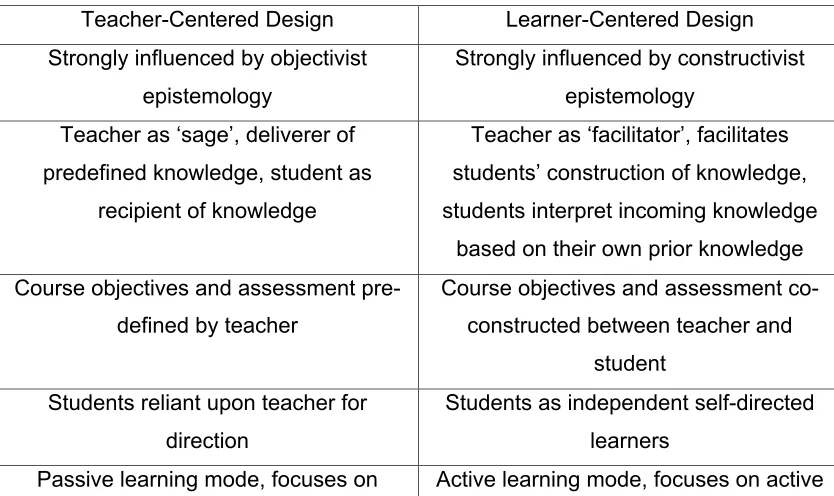
Table 2.3.1 Traditional Teacher-Centered Design Paradigm versus Emerging Learner-Centered Design Paradigm
Teacher-Centered Design Learner-Centered Design Strongly influenced by objectivist
epistemology
Strongly influenced by constructivist epistemology
Teacher as ‘sage’, deliverer of predefined knowledge, student as
recipient of knowledge
Teacher as ‘facilitator’, facilitates students’ construction of knowledge, students interpret incoming knowledge
based on their own prior knowledge Course objectives and assessment
pre-defined by teacher
Course objectives and assessment co-constructed between teacher and
student Students reliant upon teacher for
direction
Students as independent self-directed learners
[image:37.595.67.484.543.791.2]attrition of content via a predefined navigation route
exploration and construction of learning
Focus is on linearly covering the course content, and recalling the content through the teacher’s point of view
Focus is on problem-solving and meaningful interactions in the
construction of knowledge Somewhat inflexible learning
environment, less focused on addressing student needs
Flexible learning environment, which evaluates and addresses student needs
The table above indicates the main tenets of the traditional teacher-centered paradigm, compared to the emerging learner-centered paradigm that in theory at least, is starting to dominate the delivery of contemporary courseware in Higher Education. According to Soloway et al (1996) the traditional educational paradigm viewed learning as an ‘information transmission process’ where teachers are the main source of knowledge, and whose job it is to move information into the heads of students. In contrast to this, the emerging paradigm sees students as actively constructing and understanding knowledge, as opposed to passively receiving it. The role of the teacher on the other hand, moves to that of professional mentor, whom help students become independent and facilitates their construction of knowledge (Curtin University, 2004). Some researchers argue that the impact of the web is heralding a new learning paradigm, one that moves from teacher-centered instruction, to learner-centered instruction (Neo and Neo, 2007). It is important to point out however, that the web is simply a tool, and that new paradigms emerge from the development of educational theory into practice. It is also worth pointing out, that whilst the current literature is focused on the new paradigm emerging from the impact of the World Wide Web (see Fisher and Khine, 2003), and there is still a significant gap in the literature on students’ perspectives of the learner-centered paradigm. In particular, there is still a need for a courseware based on learner-centered principles to be designed, developed and evaluated by learners, as well as academics and experts. Until students’ voices are heard, then we cannot say a paradigm or a particular product is learner-centered.
2.3.1 Traditional Paradigm: Teacher-Centered Design
Internet in Education, is the change in pedagogical philosophies from teacher-centric to learner-centric modes (Neo and Neo, 2007, Neo and Neo, 2002). The traditional teacher-centered paradigm of delivering Education was based on an objectivist philosophy and a behaviourist approach to instruction. Within a teacher-centered mode of education the teacher assumed the role of content expert and sole source of knowledge. The teacher is considered the ‘sage on the stage’, and is given power to disseminate knowledge for students’ to acquire. As such, the teacher generally controlled what was learnt, and the pace of learning, which tended to make students’ passive learners. Popular teaching methodologies associated with teacher-centered modes of instruction included programmed instruction, and drill and practice instruction. These modes of instruction included guiding the learner linearly through a predefined sequence of content, and testing their knowledge generally through multiple-choice exercises. Although Laurillard (1993) influentially argued for Higher Education to utilise learner-centered methodologies over a decade ago, arguably, the shift towards learner-centered teaching methods has been quite slow within Australian universities. In Australia’s latest and most comprehensive study of online learning in Higher Education, Bell et al. (2003) commented on the need to investigate whether the traditional role of the lecturer as ‘the sage on the stage’ is appropriate for online learning, and whether they should become the ‘facilitator on the side’ (as associated with learner-centered strategies). The research of Bell et al. points to the need for more research into the pedagogical elements of online learning. In particular, there is significant leeway for research on designing courseware from a learner-centered approach, and discovering what students and academics’ think about this approach, as opposed to experts in online learning who are quite vocal within the literature.
2.3.2 Emerging Paradigm: Learner-Centered Design