Copyright © 1993,AmericanSocietyfor Microbiology
Replication
of
Poliovirus
RNA
Containing
Two VPg
Coding
Sequences Leads
to a
Specific Deletion
Event
XUEMEI CAO,1* RICHARD J. KUHN,2 AND ECKARD WIMMER1
DepartmentofMicrobiology, Schoolof Medicine, State UniversityofNewYork at Stony
Brook,
StonyBrook,
NewYork11794-5222,1and Departmentof Biological Sciences,Purdue University, WestLafayette, Indiana 479072
Received25 February1993/Accepted2 June 1993
Studies of thepoliovirus genome-linked protein VPg haveshown thatthis smallviralprotein is required for replicationof virus-specific RNA(Q. Reuer, R. J. Kuhn, and E. Wimmer, J. Virol. 64:2967-2975, 1990). To understandthe mechanism of RNAreplication,weconstructedarecombinantpoliovirus genomeencodingtwo
tandemly
arranged VPg coding sequences that werenearly
identical in both nucleotide and amino acid sequence. Following transfection ofthis two-VPg-containing RNA intoHeLa cells, we found a specific and selective deletioninthe progeny virusgenome.Sequence analysis of the recovered viral RNA indicated that the complete nucleotide sequenceencoding the second(3C-proximal)VPg coding sequenceswasremoved,restoring the authentic genome sequences in the poliovirus genome.Analysis
of viral RNAs following transfection suggested that the deletion event occurred during genome replication. Deletion could have occurred via homologous recombination between two VPg sequences or via intramolecular deletion with loop-out of the template. Invitro translation of the two-VPg-containing transcript RNA indicated aberrant processing of the viralpolyprotein. This result suggested that selection of the wild-type genotype inthetransfected cells may occuratthe level of viralprotein synthesis.Poliovirus VPg, a virus-encoded protein of 22 amino acids (1, 9, 20, 25), is covalently linked to the 5' termini of all newly synthesized viral RNAs recovered from infected cells (35, 37). VPg,abasicprotein havinga netchargeof +4 and apI of >10 (1), is linked tothepolynucleotide chain via a phosphoester bond between the O4 hydroxyl group of the tyrosineresidueatposition3 ofVPg and the5'-phosphateof the terminal uridine nucleotide in the RNA genome
(VPg-Tyr-04-pUUAAA--)
(2, 42). This tyrosine residue is con-served in allpicornavirusVPgs.The presence of VPg on the RNA is not required for either translation or infectivity, because proteolytic removal of the VPg protein from viral RNAdoes not affect the infectivity of the RNA (36).In reactions of poliovirus RNA synthesis with partially purified polypeptides, anti-VPg antibodies have been re-portedtospecificallyinhibit initiation of viral RNAsynthesis (4, 30). Since the poliovirus-specific RNA polymerase is strictly primer dependent (49), it has been proposed that a uridylylated form of VPg or its precursor 3A-VPg (3AB)
serves as aprimerfor thereplication ofviral RNA(31, 35, 44, 50). This hypothesis was supported bythe observation that in amembranous replication complex, the endogenous VPg can beuridylylated in vitro to VPg-pUpU and subse-quently extended tolonger RNA molecules (45, 46). More-over, antibodies raised against VPg do immunoprecipitate VPgaswell asauridylated form (VPg-pUpU) from poliovi-rus-infected cells(6). Recently, poliovirus has been synthe-sized de novo in an extract of uninfected HeLa cells (29), and it was found that anti-VPg antibodies can block virus formation in this reaction by inhibiting RNA replication (27b). Site-directed substitutions of the tyrosine in position 3, the only tyrosine in VPg of poliovirus, produced a lethal phenotypefor virus growth. In this mutant, RNA synthesis was found to be abolished (40), an observation suggesting
*Correspondingauthor.
that the covalent attachment of VPg to plus and minus strands isrequiredfor RNAreplication.
The genomes of allfivepicomavirusgenera(Enterovirus, Rhinovirus, Hepatovirus,Cardiovirus,andAphthovirus) en-codeVPgs 22to25aminoacidsinlength. However,whereas most of these viruses contain only one copy of the VPg reading frame,the genomes ofaphthoviruses(e.g., foot-and-mouth disease virus [FMDV]) contain three distinct VPg reading frames intandem(10),allof whichareimportantfor genomereplication (8).Thereasonfor thispeculiar complex-ity of the FMDV genome remains unknown.
In this study, we constructed a poliovirus genome con-taining twoalmostidentical VPgreading frames in tandem (designated 2VPg), usingthe cartridgemutagenesis method previously developed (22, 23). The genetic stability of this 2VPgmutant RNA(transcriptsof
pPVM-2VPg-1)
has been tested. Surprisingly, transfection of HeLa cells with the mutantRNAyielded poliovirusin whichoneVPgsequence was deleted, restoring the original gene order of the viral genome. Biochemical analysis suggested thatthe 3C-proxi-malVPgwasremoved. Our results indicate thatpoliovirus, unlikeFMDV, cannottoleratetwotandemVPgunits.MATERUILSANDMETHODS
Cells, strains of bacteria, and plasmids. Transfections, virus plaque assays, and viral RNA purification were per-formed with R19 HeLa cell monolayers maintained in Dul-becco modifiedEaglemedium (DMEM)supplementedwith 5% fetal bovine serum(GIBCO). Escherichia coliDH5was used forselection andpropagationofrecombinantplasmids. PlasmidpT7-VPg22 carriesa full-length poliovirusgenome which encodes aVPg protein with amethionine residue at theposition6(22). The in vitro-transcribed viral RNA from plasmid pT7-VPg22has thesamespecificinfectivityasdoes the cDNA clone ofpoliovirus type 1 carriedbypT7PV1-5
5572
on November 9, 2019 by guest
http://jvi.asm.org/
REPLICATION OF POLIOVIRUS RNA CONTAINING TWO VPg UNITS 5573 TABLE 1. Summary of oligonucleotides used in the work
Oligonucleotide Sequence (5'to3') Purpose
9g CCTAACGTGCCCACCATTCGGACCGCAAAG 9g,9h,9i, and 9j were used for construction of double-VPg mutant pPVM-2VPg-1
9h TGTACCTTTGCGGTCCGAATGGTGGGCACGTTAGG
9i GTACAAGGAGCATACACTGGTTTACCAAACAAGAGG
9j CCTCTTGTTTGGTAAACCAGTGTATGCTCCT
2910 GGGTTGGATAGTTAACATCACCAGCC Usedasprimerfor PCR andplasmidsconstruction
2912 CCTGCTTGATCTTCGAGCGC Same as 2910
2933 GCTGTAACAATGTTTCTTTTAGCC Used asprimer forPCR and RNA sequenceanalysis
(48). Two other type 1 poliovirus cDNA clones, pT7XLD andpT7XL2C (27, 32),werealso used inthis work.
Construction of pT7-PVM. Restriction enzymes used in cloning DNAwere purchasedfrom New England Biolabs. To facilitate mutagenesis in the VPg coding region, we introduced acleavage site for the restriction enzymeHpaI upstreamof theVPggenein clonepT7XLD.Todo so, clone pT7XL2Cwasfirstdigested with restriction enzymesNhteI (position2470)andBglII (position 5601);theresulting3.2-kb NheI-BglII fragment
coitaining
the unique HpaI site atposition 5242 was then ligated into the NhteI- and BglII-treatedvectorpT7XLDtogiverisetoplasmidpT7XLD2C. Finally, the BglII-EcoRI fragment(nucleotidepositions 5601 and 7527, respectively) of the new clone pT7XLD2Cwas
replaced by the BglII-EcoRI fragment derived from clone pT7PV1-5. Thegeneticorder of the resulting cDNA clone, named pT7-PVM, was confirmed by restriction enzyme mapping. The in vitro-transcribed RNA from the cDNA clonepT7-PVMproduced plaquesfaster than did RNA from clonepT7PV1-5 upontransfectionof HeLa cellmonolayers (18 to 20 h). The pattern of the processed proteins from translation products of pT7-PVM RNA in vivo and in vitro wasidenticaltothat of RNA ofpoliovirustype 1(Mahoney). Construction ofpPVM-2VPg-1.To insert the secondVPg sequence into the poliovirus genome, oligonucleotides 9g, 9h, 9i,and9j (Table 1)wereusedfor mutagenesis. Plasmid pT7-VPg22wasfirstdigestedwithStuI andBglII, resulting in 201-bp and 11-kbp fragments. The 201-bp fragment was blunt-end ligated to the preannealed oligonucleotide pair 9i-9j,whereas the 11-kbp fragmentwasblunt-endligated to the oligonucleotide pair 9g-9h. Thetwo newresulting
frag-ments were ligated to give rise to clone pT7-VPg33. The insertedVPg sequence in clone pT7-VPg33,containing two VPg sequences, wasconfirmedbysequence analysis, using
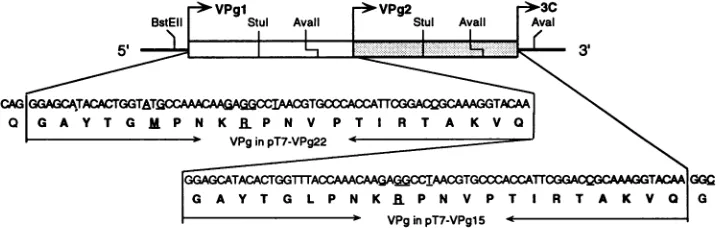
the dideoxy-chain termination method (43); the exact se-quencesof VPgl(3Aproximal) and VPg2 (3C proximal)are shown in Fig.1. Asthe last step,a470-bpfragment encom-passing the twoVPg coding sequenceswas amplified from clone pT7-VPg33, using the polymerase chain reaction (PCR) (13)with oligonucleotides 2910 and 2912(Table 1) as primers. Digestion of the 470-bp PCR product with HpaI-BgIII yielded a 429-bp fragment, which was then inserted into the cDNA clonepT7-PVMattheHpaI-BglIIsites. The sequenceof theVPg genesegment in the new recombinant clone, whichwas termed pPVM-2VPg-1,was confirmedby sequenceanalysis.Similarly, aPCRfragment containing the VPg sequence from pT7-VPg22 was generated by using primers 2910 and 2912, and the HpaI-BglII fragment of this PCR product was ligated into pT7-PVM at the
HpaI-BglII
sitestogiverisetoclonepPVM-VPg22.ClonepPVM-VPg22 wasused as apositive control throughout this work.In vitro transcription and RNA transfection. T7 RNA polymerasewaspreparedbyKevin Harris inourlaboratory by expression in E. coli (7) and subsequent purification. Transcription of RNA by T7 RNA polymerase was per-formedaspreviously described(48)exceptthatahigher final concentration of dithiothreitol (20 mM) was used in the reaction buffer. RNA transfection of HeLacell(R19) mono-layers by using DEAE-dextranwasperformedaspublished previously (23). For plaque assays, HeLa cells were first incubated with the RNA-DEAE-dextran mixture at room temperaturefor 30 min and thenoverlayed with DMEM-agar containing 5%fetal bovineserum.The transfected cellswere further incubated at37°Cuntil plaqueswereformed.
PreparationofviralRNAand nucleotidesequencing. HeLa cellmonolayers (4 x 10⁶ cells)wereinfectedwith virus that resulted from transfection ofpPVM-2VPg-1 RNAat a mul-tiplicity ofinfection of 20. At 7 h postinfection, total
cyto-G A Y T G L P N K JL P N V P T I R T A K V a G { VPg in pT7-VPg1 5
FIG. 1. Schematic representation of the double-VPg construction pPVM-2VPg-1. Two almost identical, tandemly arranged coding sequencesof thegenome-linked protein(VPg)wereconstructed in the cDNA clonepT7-PVM. The open box representstheVPgsequence oftheVPgmutantinpT7-VPg22,aderivativeoftheVPgmutagenesiscartridgeinpT7-VPgl5(shadedbox).Viruses derived frompT7-VPgl5 andpT7-VPg22werepreviously characterized; theywereindistinguishablefromwild-typevirusderived frompT7PVl-5(22).Nucleotides and amino acids which differ from thecorrespondingwild-typesequencesareunderlined.
VOL. 67,1993
on November 9, 2019 by guest
http://jvi.asm.org/
[image:2.612.139.503.560.674.2]plasmic RNA was extracted as described previously (40). The VPg regionof the RNA wassequenced by the dideoxy-chain termination method (43), using [a-35S]dATP (Amer-sham) and avian myeloblastosis virus reverse transcriptase (Boehringer Mannheim).
Detection of RNA synthesis by PCR. Total cytoplasmic RNAs wereextracted from HeLa cells at varioustimes after thecells were transfected with RNAsderived from plasmid pPVM-2VPg-1. After treatment of the isolated RNA fraction withRQ1 RNase-free DNase, the VPg regions of the virus-specific RNAs were analyzed by cDNA synthesis followed by PCR as described by Molla et al.(29). Primer 2933or2910 (Table 1) was used for synthesizing cDNAs derived from plus-strand RNAor minus-strand RNA, respectively. The PCRs wereperformedbyusingthe cDNAsastemplatesand oligonucleotides 2933 and 2910 as primers. RQ1 DNasewas purchased from Promega, and the Taqpolymerase used for PCR waspurchased fromPerkin-Elmer/Cetus.
In vitro translation and immunoprecipitation. In vitro translations of viral RNAs were performed essentially as described by Molla et al. (29). Briefly, viral RNAs tran-scribed in vitro frompPVM-VPg22 andpPVM-2VPg-1were mixed with a nuclease-treated cell extract (SlO fraction of the disruptedHeLacells) plus translationmixture (contain-ingessentialingredientsoftranslation)and 1mCiof
[35S]me-thionine (ICN Radiochemicals) per ml. Incubations were
performedat30°C from 2to11 h.Sampleswereanalyzed by electrophoresis on sodium dodecyl sulfate (SDS)-13.5% polyacrylamide gelsand subsequent autoradiography.
Immunoprecipitation of proteins was performed as fol-lows. Twenty microliters of the translation mixture was preincubated in 1% SDS buffer for 10 min at 65°C. After centrifugation at 10,000 rpm for 10 min, the supernatants
were diluted 1:10 with phosphate-buffered saline (PBS) buffer(8mMNa2HPO4,2mMNaH2PO4,140 mMNaCl)and then incubated at 4°C overnight with an equal volume of prebound pAS-antibody mixture. (pAS-antibody contains protein A-Sepharose complexed with specific antibody, di-luted 1 to 15 in50% Sephadex G-50. Protein A-Sepharose and SephadexG-50were purchased fromPharmacia.) The unbound material was washed off with PBS buffer; the pAS-antibodywith boundpolypeptideswasthenboiled for 5 min in Laemmli sample buffer and analyzed by SDS-poly-acrylamidegelelectrophoresis (24).
RESULTS
Generation ofa recombinant poliovirus genome encoding two VPg units. We are interested in understanding the mechanism ofRNAreplication ofpicornaviruses. Because of the essentialnatureofVPgin this process,weintroduced
[image:3.612.309.551.71.315.2]twoalmost identical VPgcodingsequences into the poliovi-rusgenomebycartridge mutagenesis (Fig. 1). To investigate possible pathways by which VPg is delivered for RNA linkage, the first VPg coding sequence (3A proximal) con-tained a methionine residue at position 6, whereas the second VPg coding sequence (3C proximal) contained a leucineatthisposition. This genetic difference was used as amarkertoanalyze which VPg would be linked to the viral RNA or, in the case ofdeletion,which VPgremained in the genome. In the FMDV genome, each of the threedifferent VPgs(10)hasbeen foundtobe linkedtothe viral RNA(17). Recent evidence suggests that all three VPgs of FMDV are importantfor virusviability(8).Weoriginally expected that duplicating the VPg genes in the poliovirus genome would
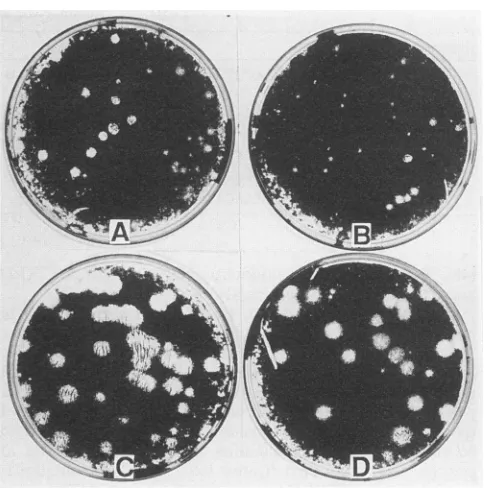
FIG. 2. Plaque morphologyofpolioviruses generated by trans-fectionofwild-typeRNA derivedfrompPVM-VPg22 (A andC) and of themutantRNA derivedfrompPVM-2VPg-1 (BandD). Trans-fections of 3ng ofwild-type RNAor 5 pg ofmutantRNAwere overlayed with DMEM-agar,andtheplaqueswerevisualizedafter 48h(A andB)or68 h(CandD)ofincubationat37°C.
yieldaviable virus but that it nevertheless would affect RNA replication.
Deletion of oneVPg from a2VPg poliovirus genome. After transfection of HeLa cells with in vitro-transcribed full-lengthRNAofpPVM-2VPg-1, containingtwoVPgunits in tandem,viable virusparticleswereformed. Thecytopathic effect (CPE) resulting from transfection with this mutant RNAwas apparentafterapproximately24h,whereas CPE from the control RNA of clonepPVM-VPg22 appearedat18 h posttransfection. When assayed under the DMEM-agar overlay, the monolayerof HeLa cells that had been trans-fected with the controlormutantRNAsexhibitedplaquesof different sizes. This difference, however, diminished if the cellswereincubated for 68 instead of 48 h. The average size ofplaques developedupontransfection withpPVM-2VPg-1 RNAwassmaller(Fig. 2B)than that aftertransfection with pPVM-VPg22(Fig.2A)at48 hposttransfection.Incontrast, theplaquesizeswerenearlyidentical after 68 h of incubation (Fig. 2C andD). Quantitative analysis also showedthat the
RNAs from pPVM-VPg22 and pPVM-2VPg-1 differed in their efficiencies to infect HeLa cells; the RNA prepared from pPVM-VPg22 had a specific infectivity averaging 104
PFU/tLg,
whereas theRNAfrompPVM-2VPg-1 had a spe-cific infectivity as low as 5 PFU/,ug. Therefore, a high concentration ofmutantRNA(5to10,ug/4 x106
cells)wasrequired to obtainroughly thesame number ofplaques by transfection under agaroverlay asfromwild-typeRNA.
The reason for thelargeamountofmutantRNArequired fortransfection of the HeLa cellsis unknown. It is conceiv-able, although not likely, that the RNA genome of the mutant is less stable as a result of formation of novel cleavagesites for nucleases. Alternatively,ahighernumber of mutant RNA molecules might be required to finally
on November 9, 2019 by guest
http://jvi.asm.org/
REPLICATION OF POLIOVIRUS RNA CONTAINING TWO VPg UNITS 5575 generate infectious virus
particles,
whereas mosttransfec-tionswere aborted. To
distinguish
between these twopos-sibilities,
we added 1to5 ,ugof tRNAascarrierto50RI
oftranscription
mixtures beforeorafter the invitro transcrip-tion withT7RNApolymerase.
The tRNA-protected RNAs werethen usedtotransfect HeLamonolayers.Noeffecton the transfectionwas observed with eitherwild-type
or mu-tantRNA.Although
this result isnotentirely conclusive,
it nevertheless suggests thatthe lowinfectivity
ofmutantRNAmight
be duetoits reducedability
toreplicate
intransfected cells and not todegradation occurring during
the process of transfection.Virus
generated
fromcellstransfected withpPVM-VPg22
andpPVM-2VPg-1
RNAswasusedtoinfect freshmonolay-ers of HeLa cells.
Surprisingly,
these virus preparationsproduced plaques
similarinsize. Moreover,the titers aftersecondary
infectionswereaboutthesame(109 PFU/ml).
We therefore considered thepossibility
that progeny virus of transfections withpPVM-2VPg-1
RNAcontainedwild-type
gene order-3A-VPg-3C-. Following
infection of HeLa cells withpPVM-2VPg-1progenyvirusat amultiplicityof infec-tion of20,
RNAwasextracted at7 hpostinfection
andtheregion containing
theVPgcoding
sequencewas sequencedby
using oligonucleotide
2933 as theprimer. Sequence
analysis
revealed that the genotype ofthis RNAwasexactly the same as that ofpPVM-VPg22:
the3C-proximal
VPg sequence was deleted in thepackaged
viral RNA derived from the2VPg
clonepPVM-2VPg-1.
Wesequenced
theVPgcoding regions
offiveindependent
virusplaque
isolates that wereobtainedfollowing independent
transfectionswith the2VPg RNA;
all isolates had sequences thatwereidenticalto that ofpPVM-VPg22.
Themechanism of theprecise
deletion of the secondVPg
isnotyetclear(see Discussion),
butonce itoccurred,
itmusthave beenfollowedbyastrongselection of theone-VPg-containing
RNAin transfected HeLa cells.We
repeated
theexperiment
with RNA ofpoliovirus
genomic
constructpPVM-2VPg-2,
which was identical topPVM-2VPg-1
except that the order of the twoVPgs
was reversed. InpPVM-2VPg-2,
the3A-proximal
VPg had the sequenceofpT7-VPgl5
whereas the3C-proximal
VPg con-tained the marker methionine ofpT7-VPg22
inposition
6. Transfection of the RNA derived from pPVM-2VPg-2yielded
progeny virus with aphenotype
similar to that ofpPVM-2VPg-1
(data
notshown).
Sequence analysis of the recovered viral RNA(purified
from total progeny viruses and four additionalindependent isolates)
revealed that it containedonly
oneVPg
unit and the genotypewasidentical tothat ofpT7-VPgl5,
thatis,
with leucine atposition
6.ReplicationofpPVM-2VPg-lRNA inHeLacells.Itwasof interest to determine the
point
in thereplication
cycle at which thespecific
deletion of the3C-proximal
VPg had occurred. To answerthisquestion,
HeLacells were trans-fected withRNAsderived frompPVM-2VPg-1.
Total intra-cellular RNAwasthen extractedat0,
2, 5, 8, 14, 18,
and 22 hposttransfection
andsubjected
to reversetranscription,
using
eitheroligonucleotide
2933oroligonucleotide
2910as aprimer specific
forplus-
or minus-strand reverse transcrip-tion,respectively.
Thereversetranscripts
werethen ampli-fiedby
PCR.Figure
3a shows theamplified
PCRproduct
derived from theplus-strand
viral RNA ofpPVM-2VPg-1;Fig.
3b shows that of minus strands. For markerfragments,we PCR
amplified plasmid
DNA of pPVM-2VPg-1 andpPVM-VPg22
with the sameoligonucleotides
asprimers,
a reactionyielding
DNAs of327 and 261bp, respectively (Fig.
3a and b, lanes 8and 9,respectively).
Deletion ofoneVPgunit,
as indicatedby
theshortening
of the PCR producta 1 2 3 4 5 6 7 8 9
b
327bp
261bp
FIG. 3. Detectionofreplication products generated from trans-fections with pPVM-2VPg-1 RNA. (a) Cytoplasmic RNAs were isolatedat different times posttransfection, the plus-strandRNAs were reversetranscribed andPCR amplified,andtheproducts were subjectedto agarosegel electrophoresisasdescribed in Materials and Methods. Lanes: 1to7,RNAsisolatedat0,2, 5, 8, 14, 18,and 22hposttransfection; 8, plasmidDNA ofpPVM-2VPg-1asthe PCR template; 9, plasmid DNA ofpPVM-VPg22 as the template. The
arrowsindicatethe specificPCRproducts from the2VPggenome (upper)and from the1VPggenome(lower). (b)The sameanalysisas inpanelaexceptthat reversetranscriptionwasspecific for minus strands.
derived from the plus-strand RNA, was detectable at 2 h posttransfection (Fig. 3a, lane 2). At22 h posttransfection, whenCPE of the transfected cellsjust started, most of the plus-strandRNAretainedonlyoneVPg in the genome (Fig. 3a,lane7). Adifferent resultwasobtained for minus-strand RNAsynthesis. Throughout the cycle, minus strands with two complementary VPg sequences were the predominant form detectable byreversetranscription-PCR, whereas the deleted form appeared only 14 h posttransfection and re-mainedaminorspecies(Fig. 3b, lanes 5 to 7).
Reverse transcription-PCR analysis of the RNA genome resultingfrom transfection of cells withpPVM-2VPg-2 RNA showed results similartothose obtainedwithpPVM-2VPg-1 (datanotshown).
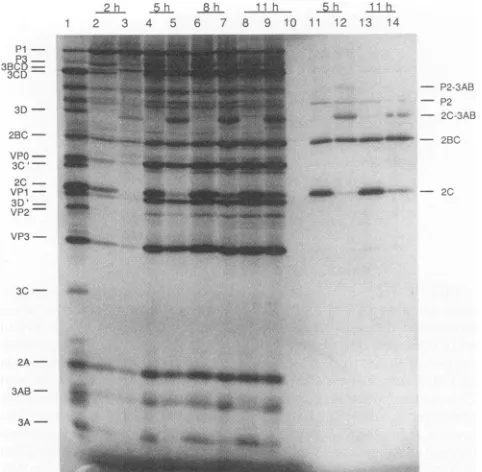
In vitro translation ofpPVM-2VPg-1RNA and proteolytic processing. In our search to identify the steps in viral replication responsible for the strong selection for the de-leted(wild-type)genome,weanalyzedprotein synthesis and proteolytic processingdirected bymutant2VPg RNA. For this purpose, we made use of the HeLa cell-free system developed by Molla et al. (29) which faithfully translated poliovirus RNA in vitro with concomitant proteolytic pro-cessing nearly indistinguishablefrom that observed in vivo. Translation of the RNAs derived from pPVM-2VPg-1 and pPVM-VPg22were carriedoutfor2, 5, 8, and 11 hat30°C (Fig. 4). As expected, the proteins translated from the pPVM-VPg22RNAshowedpatterns resemblingthat of the poliovirus-infectedcellextract(lanes 2, 4, 6,and8)with the exceptionsof3DPo'and3CPrO,whichwereproducedin very lowamounts.
It is apparent that the open reading frame of the 2VPg
RNA was intact, as the capsid precursor P1 is efficiently cleaved to
VPO,
VP1, and VP3, a cleavage catalyzed by 3CDPrO (16, 51); 3CDPrO maps to the C terminus of the polyprotein.Proteinase 2A is alsoproducedatnearly wild-typelevels,anobservationindicatingthat itsN-terminal cis cleavage and also its C-terminal trans cleavage (the latter being catalyzed byapolypeptide containing3Cpr' activity) VOL.67, 1993on November 9, 2019 by guest
http://jvi.asm.org/
[image:4.612.366.525.78.214.2]5576 CAO ET AL.
2h 5h 11 13
2 3 4 5 6 7 8 9 10 11 12 13
P1
3BC-=
3CD
-VPO
3C
vP1
VP2
-im
3C .
*:"''~~~~~~~~~~~~~~~~.'..
:'...'
2A
3AB
3A
*_...
FIG. 4. In vitro kinetics of protein synthesis ar directedbywild-typeor mutantRNA. RNAs,transc
weretranslated inanHeLacellextract asdescribedin Methods. Incubationswereperformed from 2 to 11 h Lanes:2,4, 6,8,11, and13,reactions withpPVM-VP 5, 7, 9, 12, and 14, reactions withpPVM-2VPg-1 RI plasmic extract of [35S]methionine-labeled poliovirus honey)-infectedHeLa cells asthemarker; 10, noR] polypeptides immunoprecipitated with anti-2Cserum
were normal. In contrast, proteolytic proces polyproteinconsisting of 2BC-3ABCD (3B = V an unusual pathway. The appearance ofa proi band of 50kDa,designated 2C-3AB,waseasilyi
(Fig.4, lanes3,5,7, and9).Atthesametime,g 2C and 3A was very slow (compare lane 4 v Immunoprecipitation with anti-2C antibodies (] 11to 14)and anti-3Aantibodies(datanotshowi theidentity of the 50-kDa band. Other unusual iI (P2-3AB and 3BCD) were also seen with the (lanes 3, 5, 7, 9, 12, and14).Weconclude thatt] between 2C-3A and 3A-3B were severely imp polyprotein containing two tandemly arrang quences. Cleavage between the two VPg sequ ever,appeared tohave occurredrapidly.
Itshould be noted that translation andproteoli ingofpPVM-2VPg-2RNA showedresults ident obtained with
pPVM-2VPg-1
RNA(datanotshDISCUSSION
Cartridge mutagenesis of segments of the p( nome has proven to be a versatile method in genomereplication(22, 23, 40) or of the biologic ofthepoliovirus capsid (33, 34). This method ha to construct a poliovirus genome with two t ranged VPg sequences and to testthe
replicati4
mutantwithin HeLa cells. This experiment was ] the report from Forss et al. (10) that
FMI
picornavirus belonging to the genus Aphthovir threeVPg units in tandem, all of which are use
h random fashion (17). Even though poliovirus hasno appar-14 ent need for more than oneVPg, we expected that the 2Vpg mutant would replicate, albeit with a phenotypethat, in turn, might shed light on the function of VPg.The results reported -P2-3AB here showed that poliovirus containing two VPg units in -P2 tandem was unable to proliferate sufficiently so that we were
-2C-3ABI
able to isolate virus stocks for biochemical analysis. In -- 23C contrast, FMDV cannot proliferate with just one VPg coding sequence,whereas, surprisingly,FMDVmutantscontaining -2C four VPg sequences in tandem have been reported to be
viable (8).
The progenyvirus that was recovered after transfections with 2VPg RNA contained only one VPg, regardless of the order in which two genetically distinctVPgs werearranged. Theretained VPg hadalways keptthe amino acidatposition 6 from the 3A-proximal VPg. It should be noted that the VPgs, which differed only inposition 6 (leucine or methio-nine), are functionally fully competent (22). Therefore, a preference of the deletion based on the single amino acid difference would not have been expected and, indeed, was not observed. The mechanism by which the 3C-proximal VPg wasdeleted in numerousdifferentanalyses is unknown. One possibility is homologous recombination whereby crossover occurred between theidentical RNA sequences of 48 nucleotides downstream from the codons for Met and nd processing Leu.
Alternatively,
loss of the3C-proximal
VPg
could have Materials and occurred by a mechanism of intramolecular deletion during as indicated. either minus- orplus-strand RNAsynthesis. The mechanism 'g22 RNAs; 3, of deletions in poliovirus replication is poorly understood NAs; 1, cyto- and may be divided into homologous deletions (of geneticstype 1 (Ma- units in viral RNA with homologous sequences) or illegiti-NA; 11 to 14, mate deletions, as in the formation of defective interfering
(14).
particles(21). In the former, the nascent RNA strand would stop elongation, partially dissociate from thetemplate (14), and resume elongation at a downstream homologousse-Psing
of the quence of the same template sequence. A hallmark ofPg) followed genetic recombination is its precision; that is, deletion or ninent, new insertions are not observed (15, 19, 41). Whether that is true recognizable for homologous deletions remains to be seen. We have not
;eneration
Of observed any deletions or insertions in the retained VPg vith lane5).
sequences which may be the result of selection. Thefre-Fig.
4,
lanes quency ofrecombination in poliovirus replication has been n) confirmed estimated to bei0'3
to 10' and is therefore surprisinglyntermediates
high (15). The difference in specific infectivity between 2VPg RNA wild-type RNA (104PFU/pg)
and 2VPg RNA (5PFU/p,g)
he
cleavages
observed by us is of the same order of magnitude. This)aired in the finding could be interpreted to suggestrecombination. How-ed
VPg
se- ever, differentiation betweenrecombination andintramolec-ences, how- ular deletion requires cotransfection with RNAs that are genetically marked both upstream and downstream of the ytic process- VPg region. These experiments are in progress.
ical tothose Analysis of replicating viral RNA from transfected HeLa own). cells suggests that synthesis of the deleted (wild-type) plus strands surpasses that of the 2VPg RNAby 8 h posttrans-fection (Fig. 3a). Although quantitative PCR (15) was not used in these studies, it nevertheless is apparent that the oliovirus ge- largest signal for 1VPg plus-strand RNA synthesis was analyses of observed by 22 h, coincident with CPE of the HeLa cells al properties detectable at 22 h posttransfection. The analysis ofminus Is allowed us strands, however, yielded a different result. Surprisingly, the andemly ar- signal of 2VPg minus-strand RNA was strong throughout the on of such a incubation of the transfected cells, whereas the signal for prompted by 1VPg minus-strand RNA was detectable only 14 h posttrans-)V, another fection and remained very weak.
us, encodes The strong signal of 2VPg minus strands is in contrast to d in a nearly an unexpected weaker signal of 2VPg plus strands. One J. VIROL.
on November 9, 2019 by guest
http://jvi.asm.org/
[image:5.612.54.295.76.312.2]REPLICATION OF POLIOVIRUS RNA CONTAINING TWO VPg UNITS 5577 possible explanation is that the 2VPg plus strands aie
degraded, which seems unlikely. Another intriguing possi-bility is that the products of proteolytic processing which contain aberrant products abrogate the down regulation of initiation of 2VPg minus strands that is normally seen in infections, an effect seen for 1VPg minus-strand synthesis. Apparently, this defect cannot be complemented in trans. Whether this reflects the possible cis action of certain gene products in poliovirus RNA replication (18) remains to be seen.
In vitro translation and polypeptide processing of wild-type 1VPg and mutant 2VPg RNAs allowed us to conclude that the mutant polyprotein, although synthesized in seem-inglynormal quantity, was not properly processed, particu-larly in the2BC-P3 region. This region contains
polypeptide
domains essential for genome replication:3DP",
the RNA polymerase (49); 3AB, a precursor for VPg (11, 44) and a cofactor for 3DP°l (37a); and 2C, an ATPase (27a) that has been implicated in RNA replication by mutational analysis (26, 27, 38, 39, 47). Moreover, 2BC has been suggested to be essential for vesicle formation occurring during poliovirus replication (5). Finally, 3CDPrO appears to be involved in viral RNA replication via its propensity to form, together with anunknown host cell factor, a complex with the 5' end of viral plus strands (3). The aberrant processing pathway of the2BC-P3 region of the viral polyprotein observed in 2VPg RNA translation may, therefore, be deficient in supplying therequired polypeptides in sufficient quantities for specific steps of RNAreplication. We propose that this is the reason for the strong selective pressure in vivo favoring the deleted genotype. An alternative mechanism of selection that is based onrestricted encapsidation of the 2VPg genome due to the 0.89% increase of its size may be envisioned. This is highly unlikely, however, in view of the recent construction of viabledicistronic poliovirus (28) containing a genome that is larger by 8% than that of the wild-type virus RNA. Selection at the level of encapsidation is also unlikely because the deletion event is apparent relatively early in replication, and the cleavage between the two tandemly arranged VPgs is very fast, at least in vitro.Aberrant processing of poliovirus mutant polyproteins, particularly those with alterations in the 2BC-P3 domain, has also beenobserved by Giachetti et al. (11) and by us (37b).It is likely that the 2BC-P3 region is processed predominantly if notexclusively by an intramolecular mechanism (in cis). It appears that the insertion of the second VPg into the P3 regioninterferes with the normal cascade of cis cleavages of 2BC-P3. Theresult is an imbalance of the normal processing products that may lead to the observed severe inhibition of plus-strand RNA synthesis. Removal of the VPg insert by recombination then provides the strong selection for the recombinant with wild-type gene order.
ACKNOWLEDGMENTS
We thank Aniko V. Paul andAndreeZibertforvaluable discus-sionand suggestions, GuenterBernhardt for improving the immu-noprecipitation technique, andAkhteruzzaman Mollafor providing theconditionsfor in vitrotranslation. Weare especiallygrateful to Kevin Harris forprovidingpurifiedT7 RNApolymerase.
This work wassupportedinpart byPublicHealthServicegrants A1-15122 andCA-28146 from the National Institutes ofHealth.
REFERENCES
1. Adler, C. J., M. Elzinga, andE.Wimmer. 1983. The genome-linked protein of picornavirus. VIII. Complete amino acid sequenceofpoliovirusVPgandcarboxyl-terminalanalysis of its precursorP3-9. J. Gen. Virol.64:349-355.
2. Ambros, V., and D. Baltimore. 1978. Protein is linked to the 5'-end of poliovirus RNA by phosphodiester linkage to tyrosine. J. Biol. Chem. 253:5263-5266.
3. Andino, R., G. F. Rieckhof, and D. Baltimore. 1990. A functional ribonucleoprotein complex forms around the 5' end of poliovi-rus RNA. Cell 63:369-380.
4. Baron, M. H., and D. Baltimore. 1982. Anti-VPg antibody inhibition of the poliovirus replication reaction and production of covalent complexes of VPg-related proteins and RNA. Cell
30:745-752.
5. Bienz, K., D. Egger, M.
Troxler,
and L. Pasamontes. 1990. Structural organization of poliovirus RNA replication is medi-ated by viral proteins of the P2 genomic region. J. Virol. 64:1156-1163.6. Crawford, N. M., and D. Baltimore. 1983. Genome-linked protein VPg of poliovirus is present as free VPg and
VPg-pUpU
in poliovirus-infected cells. Proc. Natl. Acad. Sci. USA 80: 7452-7455.7. Davanloo, P., A. H. Rosenberg, J. J. Dunn, and F. W. Studier. 1984. Cloning and expression of the gene for bacteriophage
T7
RNA polymerase. Proc. Natl. Acad. Sci. USA 81:2035-2039. 8. Falk, M. M., F. Sobrino, and E.Beck
1992. VPg geneamplifi-cation correlates with infective particle formation in food-and-mouth disease virus. J. Virol. 66:2251-2260.
9. Flanegan, J. B., R. F. Pettersson, V. Ambros, M. J. Hewlett, and D. Baltimore. 1977. Covalent linkage of a protein to a defined nucleotide sequence at the 5' terminus of virion and replicative intermediate RNAs of poliovirus. Proc. Natl. Acad. Sci. USA 74:961-965.
10. Forss, S., K. Strebel, E. Beck, and H. Schaller. 1984. Nucleotide sequence and genome organization of foot-and-mouth disease virus. Nucleic Acids Res. 12:6587-6601.
11. Giachetti, C., S.-S. Hwang, and B. L. Semler. 1992. cis-acting lesions targeted to the hydrophobic domain of a poliovirus membrane protein involved in RNA replication. J. Virol. 66: 6045-6057.
12. Hanecak, R., B. L. Semler, C. W. Anderson, and E. Wimmer. 1982. Proteolytic processing of poliovirus polypeptides: anti-bodies to polypeptide P3-7c inhibit cleavage at glutamine-glycine pairs. Proc. Natl. Acad. Sci. USA 79:3973-3977. 13. Innis, M. A., K. B. Myambo, D. H. Gelfand, and M. A. D. Brow.
1988. DNA sequencing with Thermus aquaticus DNA poly-merase and direct sequencing of polypoly-merase chain reaction-amplified DNA. Proc. Natl. Acad. Sci. USA 85:9436-9440. 14. Jarvis, T. C., and K. Kirkegaard. 1991. The polymerase in its
labyrinth: mechanisms and implications of RNA recombination. Trends Genet. 7:186-191.
15. Jarvis, T. C., andK. Kirkegaard. 1992. Poliovirus RNA recom-bination: mechanistic studies in the absence of selection. EMBO J. 11:3135-3145.
16. Jore, J., B. de Geus, R. J. Jackson, P. H. Pouwels, and B. E. Enger-Valk. 1988. Poliovirus protein 3CD is the active protease for processing of the precursor protein
P1
in vitro. J. Gen. Virol. 69:1627-1636.17. King, A. M. Q., D. V. Sangar, T. J. R. Harris, and F. Brown. 1980. Heterogeneity of the genome-linked protein of foot-and-mouth disease virus. J. Virol. 34:627-634.
18. Kirkegaard, K. 1992. Genetic analysis of
picornaviruses.
Curr. Opin. Genet. Dev.2:64-70.19. Kirkegaard, K., and D. Baltimore. 1986. The mechanism of RNA recombination in poliovirus. Cell47:433-443.
20. Kitamura, N., C. Adler, J. Martinko, S. C. Nathenson, and E. Wimmer. 1980. The genome-linked protein of picornaviruses. VII. Genetic mapping of poliovirus VPg by protein and RNA sequence studies. Cell 21:295-302.
21. Kuge, S., I. Saito, and A. Nomoto. 1986.
Primary
structure of poliovirus defective-interfering particle genomes and possible generation mechanisms of the particles. J. Mol. Biol. 192:473-487.22. Kuhn, R. J., H. Tada, M. F. Y. Wong, J. J. Dunn, B. L. Semler, and E. Wimmer. 1988. Construction of a "mutagenesis car-tridge" for poliovirus genome-linked viral protein: isolation and characterization of viable and nonviable mutants. Proc. Natl.
VOL.67, 1993
on November 9, 2019 by guest
http://jvi.asm.org/
Acad. Sci. USA 85:519-523.
23. Kuhn, R. J., H. Tada, M. F. Y. Wong, B. L. Semler, and E. Wimmer. 1988. Mutational analysis of thegenome-linked pro-teinVPgof poliovirus. J. Virol. 62:4207-4215.
24. Laemmli, U. K. 1970. Cleavage of structural proteins during the assembly of the head ofbacteriophage T4. Nature (London) 227:680-685.
25. Lee, Y. F., A. Nomoto, B. M. Detjen, and E.Wimmer.1977. The genome-linked protein of picornaviruses. 1. A protein co-valently linked topoliovirus genome RNA. Proc. Natl. Acad. Sci. USA 74:59-63.
26. Li, J. P., and D. Baltimore. 1988. Isolation of poliovirus 2C mutants defective in viral RNAsynthesis. J. Virol. 62:4016-4021.
27. Mirzayan, C., and E. Wimmer. 1992. Genetic analysis of an NTP-binding motif inpoliovirus polypeptide2C. Virology189: 547-555.
27a.Mirzayan,C., and E. Wimmer.Unpublished data. 27b.Molla, A., et al.Unpublished data.
28. Molla, A., S.-K. Jang, A. V. Paul,Q. Reuer, and E.Wimmer. 1992. Cardioviralinternal ribosomalentrysiteisfunctionalin a genetically engineered dicistronic poliovirus. Nature(London) 356:255-257.
29. Molla,A., A. V. Paul, and E. Wimmer. 1991.Cell-free,de novo synthesisofpoliovirus. Science 254:1647-1651.
30. Morrow, C. D., and A. Dasgupta. 1983.Antibodyto asynthetic nonapeptide corresponding to the NH2terminus ofpoliovirus genome-linked protein VPgreactswith nativeVPgand inhibits in vitroreplicationofpoliovirusRNA. J. Virol. 48:429-439. 31. Morrow, C. D., J. Hocko, M. Navab, and A. Dasgupta. 1984.
ATP isrequired for initiation of poliovirus RNAsynthesis in vitro: demonstration oftyrosine-phosphate linkagebetween in vitro-synthesized RNA and genome-linked protein. J. Virol. 50:515-523.
32. Murdin, A.,and E.Wimmer. 1989. Construction ofapoliovirus type1/type2antigenichybrid bymanipulation ofneutralization antigenicsiteII.J. Virol. 63:5251-5257.
33. Murray, M. G., J. Bradley, X.-F. Yang, E. Wimmer, E. G. Moss, and V. R. Racaniello. 1988. Poliovirus host range is determined by a short amino acid sequence in neutralization antigenic site 1. Science 241:213-215.
34. Murray, M. G., R. J. Kuhn, M. Arita, N. Kawamura, A. Nomoto, and E. Wimmer. 1988. Poliovirus type 1/type 3 anti-genic hybridvirus constructed in vitro elicits type 1 and type 3 neutralizing antibodies in rabbits and monkeys. Proc. Natl. Acad.Sci. USA85:3203-3207.
35. Nomoto, A.,B.Detjen,R.Pozzatti,andE. Wimmer.1977. The location of the polio genome protein in viral RNAs and its implication for RNA synthesis. Nature (London) 268:208-213.
36. Nomoto, A., N. Kitamura, F. Golini, and E. Wimmer. 1977. The 5'-terminalstructuresofpoliovirionRNAandpoliovirusmRNA differonlyin thegenome-linked protein VPg.Proc.Natl.Acad. Sci. USA 74:5345-5349.
37. Pettersson, R. F., V. Ambros, and D. Baltimore. 1978. Identifi-cationofaproteinlinkedto nascentpoliovirusRNAand to the
polyuridylic acid of negative-strandRNA.J.Virol. 27:357-365. 37a.Paul, A. V., J.Lama,andE. Wimmer.Unpublished data. 37b.Paul, A. V., M. Selvakumar, A. Molla, and E. Wimmer.
Unpub-lished data.
38. Pincus, S. E., D. C. Diamond, E. A. Emini, and E. Wimmer. 1986. Guanidine-selected mutants of poliovirus: mapping of point mutationstopolypeptide 2C.J.Virol. 57:638-646. 39. Pincus, S. E., and E. Wimmer. 1986. Production of
guanidine-resistant and -dependent poliovirus mutants from cloned cDNA: mutations inpolypeptide 2C are directly responsible for altered guanidine sensitivity.J. Virol.60:793-796.
40. Reuer,Q., R. J. Kuhn, and E. Wimmer. 1990. Characterization ofpoliovirus clones containing lethal and nonlethal mutationsin thegenome-linked protein VPg. J. Virol. 64:2967-2975. 41. Romanova, L.I.,V. M.Blinov, E.A. Tolskaya, E. G. Viktorova,
M. S. Kolesnikova, E. A. Guseva, and V. I. Agol. 1986. The primary structureofcrossoverregions ofintertypic poliovirus recombinants: a model of recombination between RNA ge-nomes.Virology 155:202-213.
42. Rothberg, P.G., T. J. R. Harris, A. Nomoto, and E.Wimmer. 1978. The genome-linked protein of picornaviruses. V. O4-(5'-Uridylyl)-tyrosineis the bond betweenthegenome-linked pro-tein and the RNA ofpoliovirus. Proc. Natl. Acad. Sci. USA 75:4868-4872.
43. Sanger,F., S. Nicklen, and A. R. Coulson. 1977. DNA sequenc-ing with chain-terminating inhibitors. Proc. Natl. Acad. Sci. USA 74:5463-5467.
44. Semler,B.L., C.W.Anderson,R.Hanecak,L. F.Dorner,and E. Wimmer. 1982. A membrane-associated precursor to polio-virusVPg identified by immuno-precipitation with antibodies directedagainasynthetic heptapeptide. Cell28:405-412. 45. Takeda, N., R. J. Kuhn, C.-F. Yang, T. Takegami, and E.
Wimmer. 1986.Initiation ofpoliovirus plus-strandRNA synthe-sis in a membrane complex of infected HeLa cells. J. Virol. 60:43-53.
46. Takegami,T., R. J. Kuhn, C. W. Anderson, and E.Wimmer. 1983.Membrane-dependent uridylylationof thegenome-linked protein VPgofpoliovirus.Proc.Natl.Acad.Sci. USA 80:7447-7451.
47. Teterina, N. L., K. M. Kean, A. E. Gorbalenya, V.I.Agol, and M. Girard. 1992. Analysis of the functional significance of amino acid residuesintheputative NTP-bindingpatternof the poliovirus 2C protein.J. Gen.Virol.73:1977-1986.
48. vanderWerf, S., J. Bradley, E.Wimmer,F. W. Studier, and J. J. Dunn. 1986. Synthesis ofinfectious poliovirus RNA by purified T7 RNA polymerase. Proc. Natl. Acad. Sci. USA 83:2330-2334.
49. VanDyke, T. A., and J. B. Flanegan. 1980. Identification of poliovirus polypeptide p63 as asolubleRNA-dependent RNA polymerase.J.Virol.35:732-740.
50. Wimmer, E. 1982. Genome-linked proteins of viruses. Cell 28:199-201.
51. Ypma-Wong, M.-F., P. G. Dewalt, V. H. Johnson, J. G. Lamb, and B. L. Semler. 1988. Protein 3CD is the major poliovirus proteinase responsibleforcleavageofthe P1 capsidprecursor. Virology166:265-270.