...
...
T h e
EC~s
response
to I I I V / A I D S
...
in developing
countries
-
Second,
1\DDRESSES
Health/AIDS Unit (V!Il/8)
FOREWORD
BY COMMISSIONER
MANUEL MARIN
HIV is one of the major public health issues of the end of this century. Despite major efforts undertaken by developing countries over the past eight years, with the support of the international community, the epi -demic continues to spread rapidly, especially in developing countries.
Aware of the seriousness of the problem in developing countries, the European Union had in 1987 already launched an important programme to support national strategies aiming to reduce the spread of the epidemjc and to mitigate its social impact. Interventions developed at both Community and bilateral levels since then make the Europe of the twelve the most important donor in the fight against HIV/AIDS today.
However, the facts must be recognised - our efforts are still not enough. This is why at the beginning of 1994 the Commission took the initiative of submitting to Ministers for Development Cooperation of the Member States a communication which aimed to mobilise the highest possible level of political support. Its objective was to increase European commitment to confront all aspects of the pandemic.
This appeal was well received by Development Ministers. During their meeting of May 6, 1994 they adopted a Resolution defining a European strategy and priorities for the next five years. The message is clear: the European Union and its Member States will increase both their financial and technical co1nmitment to in~proving interventions and action in the field. The aims are prevention and care, mitigation of the social conse-quences and strengthening of research.
INTRODUCTION
Figure 1 Burden of disease attributable to premature mortality and disability by demographic region, 1990
• premature mortality • disability
DALYs (disa!Jility- adjusted life year) lost per 1,000 population
600 500 400 300 200 100 0 ro u ~ c ~
a
~
ro '0 £c -c;
<U :;; ~
~ ~
""0
E :;;
~
ro~ <U <U
=o =
""0 0 ~
<U c ro ~~ -s~ c
:;:: -~
e
""0 . 0 uu " c -<> s:~ ~--=
-~B ~0
~ ~
E
E-~ ~ E < c ..!' g~
3
<U <U ~-~
E c ~
~
~ :0
j5
Figure 2 Hospital capacity by demographic region, about 1990
Beds per 1,000 population
12 10 8 6 4 2
0
.-
~
~ ""0 :;; ro ~ <U = 0
<U c £ a3 ""0 . 0 c-<> <'a·;:: r3U -;:::
E
< c ~II
ro ~ <UI
1iJ:D c ~0..:.c -~
e
~-~u u ,
s:~ E c ..bO ~ ~
~.~ ~ ~ E :0 ..!' 0
~
c ~
I
n the two years since the first edition of this brochure was pub-lished, the global response to the HIV/AIDS epidemic- and
with it, the response of the European Community-has broadened
and deepened. As a major contributor to the world's campaign to
contain the epidemic the Community has, through its specialists and
policy makers, been both an integral part of these broader global
developments in policy and practice, and in the vanguard of them.
This brochure explains what the European Commission has done and
is doing, why, on what principles, how much it costs, and describes
the programmes and countries that have benefited from EC support.
With the fading of any rem.aining hope that a vaccine or cure for
HIV/AIDS can be found speedily, or at a price that the average citizen of the hardest hit countries can afford, attention- and funds- have shifted to the health care systems and social attitudes that, on the one hand, can exacerbate the spread of HIV and, on the other hand, can act to prevent it.
The rallying cry is now more modest and more pragmatic than it was in those earlier days of emergency reaction and well-intentioned over-opti-mism. Rather than cure, prevent or eliminate, the goal now is to minimise the global spread ofHIV/AlDS, by whatever practical means are available. What the HIV/AIDS epidemic has done, is to focus attention on the
dis-tressing disparities in disease burden and health care capacity between richer and poorer countries; and to place HN/AIDS within the context of poverty and deprivation of human rights. Thus what began as a targeted response to a specific virus, HN, has transmuted into a gathering global response to profound contemporary issues of inequality, both personal and international.
THE HAVES AND THE HAVE-NOTS
The 1993 World Development Report issued by the World Bank bore the title Invest:ing in HeaLth-itself a recognition tl1ar good health is borh a basic human right and a necessary condition of economic prosperity. This report showed how wide these disparities are between the haves and the have-nots.
The disease burden on sub-Sal1aran Africa, for example, is about four times heavier than on the richer countries labelled 'established market economies' (see Figure 1) _ The disease burden on India is over twice as heavy. But the hospital capacity of these regions is, by comparison, tiny. Figure 2 shows that sub-Saluran Africa and India, for example, have six to 12 rimes fewer hospital beds than the West for every 1,000 people. The number of doctors for every 1,000 people in these regions is six to 20 rimes fewer.
Yet it is precisely on the areas of highest disease burden and lowest capaci-ty to cope that the HN/AIDS epidemic is inflicting and will inflict its worst impact. It is fair to say that the countries called by the World Bank 'established market economies', notably the USA and Western Europe, have scaled back their initial forecasts for the spread ofHIV within their populations.
mother-Table 1 Evolution of the HIV I AIDS epidemic
AIDS-related HIV i11cidence HIV prevale11ce deatl!s
(millions) (mil/iOIIS) (mil/iOIIS) Regio11 1990 2001! 1990 200!1' 1990 2001!
Demographically
developing group " 1.6 2.5 7.4 25 0.3 1.7
Sub-Saharan
Africa 1.1 1.0 5.8 12 0.3 0.9
Asia' 0.3 1.3 0.4 0.6
EME and FSE' 0.1 1.4 0.1 0.1
Total 1.7 2.5 8.8 26 0.4 1.8
**Less than 0.05 million.
Nole: Incidence refers to new infections in a given year; prevalence refers to the total number of persons infected.
a. Conservative estimates.
b. The countries of the demographic regions sub· Saharan Africa, India, China, Other Asia and islands, latin America and the Caribbean, and Middle Eastern crescent c. India, China, and the demographic region Other Asia and islands. d. EME, established market economies; FSE, formerly socialist economies of Europe. Source: World Health Organization data.
Table 2 Distribution of DALY loss by cause and demographic
region, 1990 (per cent)
Sub- Latit1
Salmnm America awl
Regio11 World Africa tl1eCarihhea11
Population (millions) 5,267 510 444
Communicable diseases 45.8 71.3 42.2
Tuberculosis 3.4 4.7 2.5
STDs and HIV 3.8 8.8 6.6
Diarrhea 7.3 10.4 5.7
Vaccine-preventable
childhood infections 5.0 9.6 1.6
Malaria 2.6 10.8 0.4
Worm infections 1.8 1.8 2.5
Respiratory infections 9.0 10.8 6.2
Maternal causes 2.2 2.7 1.7
Perinatal causes 7.3 7.1 9.1
Other 3.5 4.6 5.8
Non communicable diseases 42.2 19.4 42.8
Cancer 5.8 1.5 5.2
Nutritional deficiencies 3.9 2.8 4.6
Neuropsychiatric disease 6.8 3.3 8.0 Cerebrovascular disease 3.2 1.5 2.6 Ischemic heart disease 3.1 0.4 2.7
Pulmonary obstruction 1.3 0.2 0.7
Other 18.0 9.7 19.1
Injuries 11.9 9.3 15.0
Motor vehicle 2.3 1.3 5.7
Intentional 3.7 4.2 4.3
Other 5.9 3.9 5.0
Total 100.0 100.0 100.0
Millions of DALYs Equivalent infant deaths
(millions) 42.0 9.0 3.2
DALYs per 1,000 population 259 575 233
Note: DALY, disabilty-adjusted life year; STD, sexually transmitted disease; HIV, human immunodeficiency virus.
Source: World Bank data.
co-child transmission and contaminated blood adding to the toll. The
World Bank table reproduced here as Table 1 shows in broad-brush form
the expected progression of the HIV epidemic, with the incidence of HIV
(that is, new infections each year) worsening markedly in the poorer coun
-tries of Mrica, Asia and South America- but particularly in Asia-while
tending to improve in the USA and Europe. Predicted HIV/AIDS-related
deaths show an even more alarming trend.
Thus in a frighteningly short time-span of under two decades, HIV/AIDS
and other STDs (sexually transmitted diseases) have risen up the league
table to become the fourth biggest cause of lost human endeavour in sub
-Saharan Mrica, and the second biggest cause in Latin America and the
Caribbean- see Table 2.
CURRENT THEMES
So the 'new recognition' that has gathered strength over the past two years
can be divided into four themes:
1. HIV/AIDS are part of a 'devil's brew' of diseases which afflicts poorer
parts of the world, and which interact with each other and with personal
behaviour and personal status (or lack of it)_ Notably, these are tuberc
ulo-sis, malaria, STDs generally and HIV. So the impact ofHIV cannot be
measured solely by so-called 'AIDS deaths' and, conversely, HIV preven-tion m.ay best be carried out by attention to other ingredients in this 'd ev-il's brew'_
2. To contain the HIV epidemic there has to be a functioning health care and education system, where all roo often health and education systems
have broken down or fallen into neglect. The supply of uncontaminated
blood; proper treatment of STDs; adequate supply of essential drugs, con
-traceptives and condoms; re-creation of primary health care facilities; edu
-cation of women and young people-all these have to be elevated to a
big-ger and better planned part of national health and education budgets and
of external aid.
3. There is a causal link between HIV infection and being marginalised in
society. The most vulnerable are those with fewest rights. Thus the rural
and urban poor, women, people in prison, refugees from war, migrant
workers, street children, and still in many countries homosexuals, are
exam-ples of groups at high risk because they are either powerless or rejected.
4. For the general population, mere information about HIV/AIDS, now
almost universal throughout the world, appears not to be enough to
change sexual behaviour quickly or radically enough to stem the spread of
HIV. So there needs to be fresh thinking about human behaviour and its
determinants.
This then is the global backdrop against which to view and assess the
cre-ative contribution of the European Community. That contribution is the
How
THE
EUROPEAN
COMMISSION
SETS ABOUT
ITS TASK
o r g a n . r , s a t r , o n .
~he full meaning of the European Community's contribution
_._ can only be understood through a brief excursion into
histo-ry. In 1986, the international community reacted to the new and then
little known HIV/AIDS epidemic by setting up, under the World
Heald1 Organisation (WHO), a Global Programme on AIDS (GPA).
The GPA began work in February 1987. But what should the EC do?
On the one hand, it had no tradition of direct intervention in specific
health programmes aimed ar the control of specific diseases. On the other
hand, there was a desperate need. The late Lorenzo Natali, vice-president
of the Europea11 Commission, hardly hesitated. In a landmark memoran
-dum sene to all ACP (African, Caribbean and Pacific) stares who had
signed the Second Lome Convention on European aid to developing
countries, he invited them to take part immediately in an EC/ACP AIDS
control progra1nme.
"Rapid action using quick and flexible procedures is necessary in view of
the priority and complexity of the AIDS problem", he wrote. "The
pro-graJnme is intended as aJl identifiable EC contribution to the international
effort on AIDS controlled and co-ordinated by the WHO".
Almost all ACP countries responded to this initiative, which was unique in
the history of the EC- a unique response to a unique situation. But how
exactly should the EC carry out .its new mandate? At that time it had little
in-house expertise in health matters. A unique situation dema11ded a
unique solution. So, for the sake of speed a11d because it was a venture into
the unknown, the EC's AIDS Task Force was set up. It was able to get
going quickly, recruit the technical staff it needed swiftly, and build up
almost from scratch a body of knowledge about action on HIV/AIDS. It
answers to the EC's Directorate General for Development, known as DG
Vlii. The main task of the AIDS Task Force is to prepare, supervise and
follow up projects for the Commission.
THE ACTIVITY NOW
But this was never meant to be a permanent solution. And so in May
1993, with the dimensions of the HIV/AIDS problem much better known than in 1987, the 'quick fix' was replaced by a permanent
organi-sation which built on a11d incorporated what went before. A new Health
and AIDS Unit was set up within the formal structure of the Commission.
This symbolised cl1e long-term commitment of the European Community
to what was now, evidently, a long-term need. Along with the rest of the
international community, rl1e EC was moving out of the emergency phase
and into a long-term structtu·al approach to the problem.
Against the background of the 1993 Maastricht Treaty a11d its new con
-cern for health within dte European Union, the European Community
accepted rl1at its obligation to the health of the rest of the world must also
be, and must be seen to be, permanent. At the sa111e time, the financial
commitment increased, both in scale and in timescale (see pages 8 and 9).
The EC's Health a11d AIDS Unit consists of only five profess
ionals-essentially doctors and economists. But it is backed up by the technical
Mother-to-child transmission has been a particular concern of the EC
~
L.:_ _ _ _ _ __,_ _ _ ....J ~
EC/A TF stand at
ninth international AJDS
conforence, Berlin
0 11 p
WHAT THE HEALTH AND AIDS UNIT DOES
So what are the responsibiJities of the Commission's new HeaJth and AlDS Unit, known as DG VIII/8? In a nutshell, the main role of this unit
is to give technicaJ support to departments within the Commission that deaJ with particular regions of the world, and to Commission Delegations abroad, with the preparation, appraisaJ and monitoring of heaJth projects and programmes in developing countries. This aJso means that the unit takes part in the anaJysis of heaJth policies in developing countries, in the preparation of schemes to help the reorganisation of heaJth services, and in institutional strengthening in those countries.
The objective of including the management of the HN/AlDS programme in this new EC unit is to integrate HIV/AlDS issues more and more into other heaJth and development activities supported by the European
Community in the same developing countries. Specific responsibilities and activities of the unit in the field ofHN/AlDS include:
• development of, and monitoring the implementation of, policy
guidelines
• programming of interventions
• supervising the preparation and implementation ofHN/AlDS interventions, using the technicaJ assistance of the AlDS Task Force
• co-ordination, both internally between different departments of the Commission dealing with HN/AlDS and externaJiy, with other in teres ted parties (see page 7).
This then is the newly re-fashioned instrument of the EC. What is it used
SCALE
OF
INTERVENTION
Table 3 Regional distribution of EC funds committed to HIV I AIDS
activities In developing countries
Africa 66%
Asia 12%
Latin America 1 Oo/o Other developing countries 6%
-
Caribbean 3%•
Pacific 2%Mediterranean 1 o/o
[image:8.572.38.543.413.736.2]·n,is dotS not inclmh• cofimmcing lhro11gh Ewopt'illl NGOs nor rrscarc/1 arlil'ilii.'S by DG XII directom/t' {or Ti'Sellffll
Table 4 Distribution of EC funds committed to HIV I AIDS activi-ties by type of intervention or strategy
Prevention of sexual and perinatal transmission 39.5%
----===:::::1
Health sector support 33.3%
-
Training, conferences 7.3%-
Multiple strategies 6.5%-
Operational research 4.7%-
Managerial and technical assistance 3.6%-
Administration of programme 3.5%Publications, films etc. 0.7% Socio-economic consequences 0.5%
Bio-medical research 0.4%
,...he scale of EC intervention is determined by one idea: that
_I_
nothing less than total commitment to the global HIV/AIDS programme is good enough. So the list of countries that have benefit-ed from EC support, financial and technical, is a long one: from
Angola, Antigua and Argentina at one end of the alphabet to Vietnam,
Zambia and Zimbabwe at the other. Many countries have seen more
than one project. The total number of countries to which EC support
has been given, is now well over 80.
The total number of projects realised, allowing for their different start
dates and the different stages of implementation, from proposal to
finan-cial approval, implementation and completion, has now topped 220.
A few have for various reasons been suspended before completion. Of
tl1is total, over 160 are specific to one country and the rest are regional
projects or projects that apply to all developing countries. The first chart
(Table 3) shows the regional breakdown, but in terms of d1e amount of
money committed by cl1e EC. The variety of cl1e projects is also striking.
The second chart (Table 4) illustrates this great variety, again in terms of
the amount of money committed to different activities. The number and
variety of these projects demands advanced management skills.
Because the larger parr of tl1e funds for cl1e EC's HIVIAJDS progran1me
has been voted under the Lome Conventions, and because African states
make up the larger proportion of signatories to mose conventions- but
also because, so far, Africa has cl1e largest nLUnber ofHIV infections and
the least resources to cope- Africa in me beginning tended to get me l
arg-er share of attention and projects. Indeed, Africa will continue to be a
prime focus of activity. But it is notable that as the developing countries of
Asia, Latin America and elsewhere have begun to identify their needs and
problems, so the proportion of EC projects aimed at those regions has
risen. Now, of the total of over 220 projects at their various stages of
implementation, cl1e continent of Africa (north and sub-Saharan) accounts
for just about a half, with me other half directed elsewhere.
Countries with HIV I AIDS programmes for developing countries: Angola, Antigua & Barbuda, Bahamas, Barbados, Belize, Benin, Bolivia, Botswana, Brazil, Burkina Faso, Burundi, Cameroon, Cape Verde, Chile, China, Comoros, Congo, Costa Rica, Ivory Coast, Djibouti, Dominica, Dominican Republic, Ethiopia, Gabon, Gambia, Ghana, Grenada, Guatemala, Guinea Bissau, Equatorial Guinea, Guyana, Haiti, Honduras, India, Indonesia, Jamaica, Kenya, Kiribati, Lesotho, Liberia, Madagascar, Malawi, Mali, Marocco, Mauritania, Mauritius, Mexico, Mozambique, Namibia, Nepal, Netherlands Antilles, Nicaragua, Niger, Nigeria, Pakistan, Papua New Guinea, Peru, RCA, Rwanda, Sao Tome & Principe, Senegal, Seychelles, Sierra Leone, Solomon Islands, Somalia, South Africa, St Lucia, St Christopher & Nevis, St Vincent & Grenadines, Surinam, Swaziland,
PARTNERSHIP
&
COLLABORATION
A woman cares for her husband,
[image:9.572.22.535.15.669.2]who hasAJDS
Table 5 Distribution of funds for HIV I AIDS activities by main partner
National authorities 54%
Scientific institution, European 21%
-====:::::J
NGO, European 15%
Scientific institution, local 6%
NGO, local 3%
Other1%
o n e
~he primary objective of die European Community is to
_a_
support national strategies. It is the country, its government and its communities that are the focal point, and the aim of the EC'sextensive exercise in collaboration is to avoid duplication, identify
shortcomings, and spread the benefits of experience and research.
There is internal collaboration within the EC and within Europe and its institutions; there is external collaboration with United Nations agencies,
the World Bank, NGOs, and other donors and organisations involved in
HIV/AIDS work; and there is collaboration with the various agencies that
cany out the EC's interventions. Internal co-operation means:
• between the many directorates of the Comn~ission whose work touches
on HIV/AIDS
• agreement with the Council and the European Parliament on policies
• between the Commission and the European Union Member States.
For example, there are regular six-monthly meetings with experts from
Europe's Member States, at which the aim is to establish a coherent
strategy for Europe as a whole in its support and funding ofHIV/AIDS
activities in developing countries.
External co-operation means regular n~eerings with the WHO, which
has responsibility for leadership in global strategy and co-ordination.
The Commission and several Member States are on the Management
Committee of the WHO's Global Programme on AIDS (GPA). Bur it
also means collaboration at local and regional as well as international
levels with all UN agencies involved (WHO, UNDP, UNICEF, World Bank etc.).
THE NGO ALLIANCE
Nor is collaboration confined to government and inter-government institu-tions. Recently the EC has helped to create an NGO Alliance. The aim of this Alliance, which has irs own international secrerru·iar, is to strengthen
the capacity of indigenous NGOs in developing countries to carry out
HIV/AIDS activities, ru~d to channel the support of donors towards these NGOs. This innovative form of collaboration should help to meet three
problems experienced by indigenous NGOs.
• how can small, far-off orgru1isations get funding?
• where can rl1ey get technical support?
• how best should they get involved in HIV/AIDS work?
PROJECT PARTNERS
The European Commission could not get all its HIV/AIDS projects
completed on irs own. Irs primruy partners are usually goverments. Bur
to get things done, it often enters into a partnership, under contract, with
agencies working in the field. It is cl~ese agencies that actually cru-ry out the
projects. Among the many partners are universities, NGOs, and medical a11d educational institutes. Table 5 shows the pattern of collaboration with
FINANCE
Table 6 Global Health expenditure, 1990
Demogmpllic region
Established market economies
Formerly socialist economies
of Europe
Latin America
Middle Eastern crescent
Other Asia and islands
India China
Sub-Saharan Africa Demographically developing
countries
World
l'ercentage of world population 15 10 13 16 22 10 78 100
Total llealtlr Healtll expemliture expenditure
(billions of as percentage dollars) of world total
1,483 49 47 39 42 18 13 12 170 1,702 87 10 100
Table 7 Annual drug expenditures per capita, selected
countries, 1990
Country Expenditure Country Expenditure
(rlollars) (rlollars)
Japan 412 Brazil 16
Germany 222 Philippines 11 United States 191 Ghana 10
Canada 124 China
United Kingdom 97 Pakistan 7
Norway 89 Indonesia 5
Costa Rica 37 Kenya 4
Chile 30 India 3
Mexico 28 Bangladesh
Turkey 21 Mozambique Morocco 17
Table 8 Official development assistance for health by demographic region, 1990
Healtll aid Healtll aid as a received Healtll aid percentage (mil/iOIIS percapitrr o{llerrltlr Regiou of dollars) (dollars) ex1Je11diture
Sub-Saharan Africa 1,251 2.45 10.4 Other Asia and islands 594 0.87 1.4 Latin America and the Caribbean 591 1.33 1.3 Middle Eastern crescent 453 1.31 1.3
India 286 0.34 1.6
China 77 0.07 0.6
~he EC's spending on HIV/AIDS must be viewed against the
_I_
background of the enormous world disparities in healthexpenditure. World Bank figures (Table 6) show that the established
market economies with only 15 per cent of the world's population
spend 87 per cent of the world's public health expenditure. Put
another way, per capita health expenditures in the richer countries
average about $1,860 a year. In Africa it is $24, in India it is $21, in
China it is $11.
The same disparities-only worse-stand our from the figures for annual
drug expenditures (Table 7). Japan spends twice as much as anyone else
per person. Germany and the USA spend around $200 per person. But
Ghana, China, Pakistan, Indonesia, Kenya, India, Bangladesh and
Mozambique all spend $10 or less a year.
So over the years the world has developed an elaborate system of financial
aid to irs poorer countries. The amount is not large on a world
scale-about $4.7 billion in 1990, according ro researchers. Most of it is public
money, and it flows through a variety of channels to reach at least some of
those who need it.
Bur a further factor is that financial aid itself is not evenly spread across
the developing world. Sub-Saharan Africa receives far more than any other
area (Table 8) both absolutely and per capita. As a result, external
assis-tance provides over 10 per cent of Africa's total health expenditure. While
Africa's need is great, in the struggle against HIV/AIDS the priorities of
the future m.ay nor be exactly the same.
EUROPE'S CONTRIBUTION
This then is rl~e context in which to judge the financial contribution of
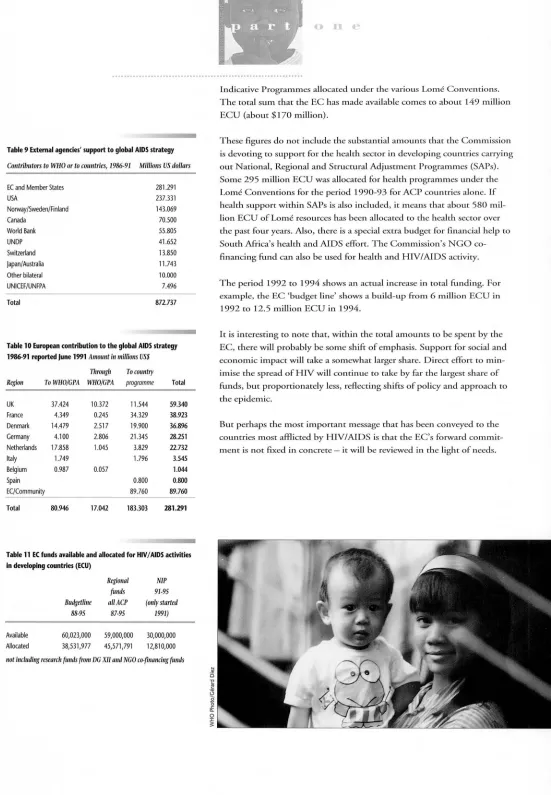
Europe to rl~e global HIV/AIDS programme. The raw statistics show that
over the period 1986 to 1991 Europe as a whole (that is, member coun
-tries of the European Union plus the Commission itself) spent slightly
more than the USA, and about twice as much as Nonvay, Sweden and
Finland, who collectively were the next largest donors. What Table 9
shows dramatically is that the global strategy against HIV/AIDS is heavily
dependent on a comparatively few sources-the USA, and Europe broadly
defined.
The scale of the Europe Community's own effort dten emerges clearly
from rhe analysis of Europe's financial commitment. Again, looking at the
period 1986 to 1991, Table 10 shows rhar the Community devoted nearly
$90 million to supporting international HIV/AIDS activity, compared to
the largest individual EU counny, the UK, with about $60 million,
followed by France with a little under $40 million.
Thus the Europe of the twelve emerges as the largest AIDS funder.
Without in any way detracting from the enormous effort made by the
USA, this shows the catalytic role that the EC has developed, from
scratch, over a short period of years.
It is also interesting to see where this money comes from. Table 11
shows the breal<down, for a slightly different period, 1987 to 1995,
between EC budget funds, regional funds and funds from the National
Table 9 External agencies' support to global AIDS strategy
Contributors to WHO or to countries, 1986-91 Millions US dollars
EC and Member States 281.291
USA 237.331
Norway/Sweden/Finland 143.069
Canada 70.500
World Bank 55.805
UNDP 41.652
Switzerland 13.850
japan/Australia 11.743
Other bilateral 10.000
UNICEF/UNFPA 7.496
Total 872.737
Table 10 European contribution to the global AIDS strategy 1986-91 reported June 1991 Amount in millions US$
Tlrrouglr To country
Region ToWHO/Cl'A WHO/CPA programme Total
UK 37.424 10.372 11.544 59.340
France 4.349 0.245 34.329 38.923
Denmark 14.479 2.517 19.900 36.896
Germany 4.100 2.806 21.345 28.251
Netherlands 17.858 1.045 3.829 22.732
Italy 1.749 1.796 3.545
Belgium 0.987 0.057 1.044
Spain 0.800 0.800
EC/Community 89.760 89.760
Total 80.946 17.042 183.303 281.291
Table 11 EC funds available and allocated for HIV I AIDS activities in developing countries (ECU)
Available
Allocated
Budgetline 88-95
60,023,000 38,531,977
Regional
fimds allACP
87-95
59,000,000 45,571,791
Nil' 91-95
(only started
1991)
30,000,000 12,810,000
not inc/ruling researclr fimds (rom DC XII and NCO co-financing fimds
0 11. .~
Indicative Prograrnn~es allocated under the various Lome Conventions.
The total sum that the EC has made available comes to about 149 million ECU (about $170 million).
These figures do not include the substantial arnoLmts that the Commission
is devoting to support for the health sector in developing cow1tries carrying
out National, Regional and Snuctural Adjustment Programmes (SAPs).
Some 295 million ECU was allocated for health programmes under the
Lome Conventions for the period 1990-93 for ACP countries alone. If
health support within SAPs is also included, it means that about 580 mil
-lion ECU of Lome resources has been allocated to the health sector over
the past four years. Also, there is a special extra budget for financial help to
South Africa's health and AIDS effort. The Commission's NCO
co-financing fund can also be used for health and HN/AIDS activity.
The period 1992 to 1994 shows an actual increase in total funding. For
example, the EC 'budget line' shows a build-up from 6 miJlion ECU in
1992 to 12.5 million ECU in 1994.
It is interesting to note that, within the total amounts to be spent by the
EC, there will probably be some shift of emphasis. Support for social and
economic impact will take a somewhat larger share. Direct effort to
min-imise the spread ofHN will continue to take by fa~-the largest share of
funds, but proportionately less, reflecting shifts of policy ~~d approach to
the epidemic.
But perhaps the most important message that has been conveyed to the
countries most afflicted by HIV/AIDS is that the EC's forward commit
GOALS.,
POLICIES AND
METHODOLOGIES
Denrist and patient in a
health clinic for persons
withAJDS
p r l n c l p l e s
L
earning the lessons of its first seven years of activity (see box,right), the European Community has drawn up a statement of goals, policies and strategies that underpin its HIV/AIDS work and
relate it to the wider context of health, education and human rights in
which HIV/AIDS is now seen to belong. This complex statement
would not have been possible in the early days of emergency reaction
to a new epidemic. But as the epidemic matures and spreads, and hard
choices have to be made, it is important to establish a sound theoreti-cal grasp of what the activity, and the expenditure, is for.
A. THE GOAI.S
There are six goals, and they are simple to state if hard to achieve: 1. to minimise the nwnber of new infections
2. to prevent discrimination against, and exclusion of, those already ill, or
infected by HN, or at risk of infection
3. to enable health systems to cope with the additional burden created by HIV/AIDS through selective strengthening of capacity and systematic
reorganisation; and to provide AIDS patients with care and enable
d~em to die with dignity
4. to minimise the effect on social and economic development
5. to reduce d1e impact of some types of development projects on the spread of HIV and, conversely, to mobilise development effort on
behalf of disadvantaged and marginalised people who are particularly at risk of HIV infection
6. to increase scientific understanding ofHIV/AIDS and of the possible
interventions, and to monitor and evaluate progress.
B. THE POLICIES
To achieve these six goals means following a set of policy principles, again
six in number. These also derive from the general development policy of
the EU and its Member States, which stresses the concepts of mutual dependency and solidarity, leading to an approach based on the notion of
partnership. The six policy principles are:
1. adaptation to risk environments
2. gender sensitivity and specificity (see also page 12)
3. social learning and respect for human rights and dignity
4. empowerment and responsibility
5. integration into a wider framework 6. timing.
Each of d1ese needs explanation to mal<e its purpose clear:
Adaptation to risk environments
Interventions should focus not only on the behaviour of individuals d1at puts them at risk, but also on the social and structural determinants of
exposure to risk. This is particularly important when dealing with specific
target groups such as women, children, young people, people in high-risk situations.
The EC's current policy and philosophy on HIV I AIDS has been illuminated by the lessons learnt from past experi· ence. What are the main lessons?
1. The HIV epidemic has stabilised in many industrialised
countries, but continues to spread in most developing countries.
2. The majority of HIV-infections therefore occur in develop· ing countries. This is because of their greater vulnerability and risk, in turn caused by social and economic weaknesses and deficiencies in health and education systems.
3.
Conversely, attempts to control the level of HIV have worked better in industrialised countries, partly because these attempts were better suited to those countries, and partly because their social, economic, educational and health systems were better able to cope.4. Where it is widespread, the HIV epidemic has an impact right across the public health system and beyond. Therefore, all sectors of society have to take account of the HIV/AIDS factor, and help to counter it.
5. Coercive approaches to HIV control are
counter-produc-tive. They merely drive the epidemic, and its carriers, under-ground where they cannot be reached. Empowerment of individuals and communities, and respect for human rights and human dignity, are cornerstones of HIV prevention.
6. The formal health sector has undervalued non-medical approaches to HIV control, through social policies and social
solutions. Moreover, responses to reproductive health have been compartmentalised, for example between family plan-ning clinics, STD clinics, HIV programmes, ante-natal clinics. This structural weakness must be remedied.
7. The epidemic has emphasised the importance of human capital, and the need to invest in it.
8. The future demands a new mix which combines, on the one hand, focused HIV/AIDS interventions aimed at particu-lar people or services; and on the other hand, a change in health, education, social and developmental policies to broaden and integrate HIV/AIDS strategy.
t
0Gender sensitivity
Analysis, planning and intervention must all show special sensitivity and specificity to gender. Long-term objectives such as the political and
eco-nomic empowerment, formal education and legal protection of women
must go hand-in-hand with short-term interventions focused on specific
groups of women and men (see also next page).
Social learning and respect for human rights
History has shown that measures based on coercion of individuals are
counter-productive. They drive epiden'lics underground and malce
inter-ventions unsustainable. So it is no use just nying to identifY the individu
-als at risk or infected by HIV, and then isolating them from their social
environment. Instead, there has to be a process of social learning, the aim
of which is to enable individuals and society to avoid the risk of infection
wherever possible, and to prevent discrimination against those already
infected through respect for their human rights and dignity.
Empowerment and responsibility
Most HIV/AIDS activity cannot be just administered. It needs the
moti-vation and support of individuals and communities. They in turn have to
have the power to take responsibility for their own behaviour, risks and
choices. Similarly, governments and others in positions of power have to take responsibility for limiting the risks run by those over whom they have
authority.
Integration into a wider framework
HIV/AIDS work must be integrated with other community activities,
other health and education problems and other medical care strategies, at
least where there are organisations and activities in these other areas.
Integration also requires a national HIV/AIDS policy which includes all
major participants, a multi-sectoral approach that involves all the main
departments of state, and open policy djalogue berween public and private
sectors.
Timing
The HIV epidemic takes time to spread over a region, and is at different
stages in different regions of the world. So responses to HIV/AIDS also vruy over time. But denial, and political and administrative delays, have
often meant that HIV prevention campaigns, needed before the epidemic
becomes widespread, have come too late. So the timelag should be short
-ened, and every response should come at a11 appropriate stage in the
progress of the epidemic.
continued on page 13
Handing out HIVIAIDS
litemture in a shanty town
A volunteer social worker 11isits a pregnant wornan with HIV
THE SPECIAL EEDS OF WOMEN
It is valuable to single out one particular lesson learnt from the EC's experience in HIV/AIDS con-trol. That is the special needs of women. Women are affected by HIV/AIDS in many ways- as direct victims of infection; as members of families impoverished by the HIV/AIDS-related deaths of bread-winners; as carers, both within the family and in the community; and as educators, both at home and in schools.
At the same time, women are often powerless to protect themselves. They may not be able to negotiate safe sex; through financial necessity they may be forced into multiple sexual relations; the burden of AIDS care almost inevitably falls upon them; and they may be the victims of sexual violence and practices, such as female circumcision, 'dry sex' or rape, which can exacerbate their risk of infection.
Some cultural practices involving women also increase the risk of HIV: for example, the custom in parts of Africa that a women whose husband has died should 'marry' her dead husband's brother- even if her husband had died of HIV/AIDS.
The statistics show the disturbing vulnerability of women to HIV infection. Women, it seems, acquire the infection more easily than men. They are often exposed to risk without knowing it. They become infected at an earlier age and, once infected, they receive less care than men.
Once infected, women also run the risk of infecting about one-third of their children. Finally,
women are in charge of the early education of almost all children and so play a key part in incul-cating a healthy attitude to sexuality in the next generation.
So short-tenn interventions that focus specifically on women, such as research into female con-doms and viral spermicides, are certainly important but are not enough. Longer tenn work, for example on the legal status of women (or lack of it) and on relations between the sexes, are cen-tral to the problem, as are education for women and the creation of employment opportunities.
All HIV/AIDS interventions and research must be gender-sensitive. All too often in the past the messages have, unwittingly, been biased against women simply because they did not take account of the realities of a woman's situation. For example, a woman may rate the risk of being beaten if she tries to insist on using condoms as more threatening than the risk of contracting HIV if she does not use them, and so on.
Laboratory tedmicicms being
trained in tesring blood
A home for people with AJDS
I
w
o
C. THE METHODOLOGIES
These goals and policies lead logically to certain methodologies for
carrying out HIV/AIDS work. These are basically fow- in munber:
1. establish strategic priorities for interventions
2. tnaking choices
3. establish greater coherence and co-ordination
4. mobilise alJ the resources available to the European Conununity.
These again need explanation to make them clear:
Strategic priorities
Given the goals outlined above, the priorities chosen for EC activity are to:
• minimise both the spread of cl1e epidemic and d.iscrimination against
those infected, by such means as improving STD and reproductive
health services, decreasing the poverty/AIDS cycle, improving sexual
education for children, and developing national AIDS charters that
define cl1e legal and ecl1ical principles ofHIV/AIDS work
• strengthen the health sector to enable it to cope
• measure the social and economic impact, so as to assist national
planning
• reduce cl1e (inadvertent) impact of some development projects and
economic policies on the progress of the epidemic, and develop tools
for assessing this impact during the investment planning stage
• promote better scientific w1derstanding, both biomedical and
socio-economic
• provide technical assistance and training.
Making choices
There have to be ways of making choices about alJocat.ing scarce resources.
For example:
• there must be clear coherence with national and regional development
plans, achieved through policy dialogue
• cl1ere must be co-operation with local com1nunities, and with com
-munity-based and private sector organisations: this recognises the
increasingly important role ofNGOs in HIV/AIDS prevention.
• the counrty or organisation receiving aid must be able to use it: weak
health and education systems in some countries have meant that activ
-ity was late or funds used too slowly
• interventions must be cost-effective, as far as cl1at can be measured
• The European Union and Commission must strengthen their own
capacity to co-operate with others.
Coherence and co-ordination
• EC policy must be consistent, as between the Community and
Member States
• the Community's HIV/AIDS policy n1ust be an integral part of cl1e
Community's healcl1 policy, and be consistent with other policies in
such areas as fan1ily planning, education and healcl1, employment, the
environment, alleviation of poverty, stntctural adjustJnent, and
A community leader at a meeting
A street theatre troupe performs a play about AIDS
l
u
human rights, both within Europe and in developing countries
• EC policy must be explained ro, and be consistent with the policies of, other international organisations such as the WHO/GPA, the UNDP
and the World Bank
• in each developing country where there is EC-supporred activity, the
EC must co-ordinate with other donors and UN agencies, under the
leadership of the country's government and with the support of the
WHO.
Mobilisation of resources
This is dealt with under organisation (pages 4 and 5) and finance
(pages 8 and 9).
The following pages examine how these policies have been applied in
practice.
CRITERIA FOR
EC SUPPORT
·~
How does the EC, through its Health and AIDS Unit and its AIDS Task Force, develop
interven-tions or programmes, and evaluate proposals put to it? What are its criteria for EC financial
sup-port? Clearly, proposals must conform to the general principles of
the
EC. But then a number of
practical considerations come into play.
1. Criteria about methodology
Interventions and proposals must be:
1
consistent with the national HIV
IAIDS policies of the country in question and with the
activities of other organisations there
1
technically feasible and cost-effective
likely to be sustainable, that is, continue after EC support ends
measurable in their progress and outcome by indicators and evaluation methods
defined
bya detailed work-plan.
2. Criteria about the competence of the agency carrying out the project
As
explained earlier, the EC normally works through an agency, under contract. In ACP countries,
the basic contract is between the agency and the government of the relevant country. Elsewhere,
the contract is with the EC with the general approval of the country concerned. In either case,
the EC must be satisfied about the technical and managerial competence of the contracting
agency. So it needs to know:
the main activities and experience of the agency in developing countries, in the health,
education and social sectors
1
previous experience and work carried out over the
pastthree years in developing countries,
in implementation of HIV/AIDS-related activities relevant to the proposal
previous work experience in the country where the proposed project is to take place
the availability and qualifications
oftechnical and support staff
the capability of head-office staff to provide back-up and monitoring of the project
the experience of the agency in planning,
Implementing
and evaluating similar projects
whether the agency can encompass all the methodological, technical, social and ethical
aspects of the project.
3.
Criteria about the financial integrity of the agency
Here, the EC is looking for:
financial resources which are adequate to back up the amount of EC support
asked
for
transparent, rigorous and sound financial management
previous experience in financial management of, and
accounting for,
projects
carried
out
with donor funding
the financial capacity to carry out project-related activities for at least
four
months before EC
funding arrives
the ability to provide a bank guarantee (this requirement may be waived in some
circumstances).
4. Criteria about legal status
The EC
needsto
knowthat the contracting agency is:
registered in one
ofthe member states of the European Community, or in the country
where the project will take place
legally able to sign a contract with the EC
z
~---
~
~
THE
MANY
FACETS OF
EC
ACTIVITY
THE RATE AND
CAUSES OF
MOTHER-TO-CHILD
TRANSMISSION
Children whose parents
died of AIDS
a c t l v l t l e s
~he HIV/AIDS-related activities of the European Commission
_I_
on behalf of the European Community form atwo-dimen-sional matrix. One dimension of the matrix shows the division between international projects, regional projects, and national
pro-jects. The second dimension of the matrix consists of different themes or types of intervention, such as safe blood, STDs, mother-to-child transmission, education, training, health services, health policy,
socio-economic impact. The following case studies start with international and regional activities, followed by examples of national programmes.
The educational theme is developed in the national case studies. The international and regional dimensions include, for example:
• exchange of information and experience through conferences, seminars and training courses
• development of methodologies for assessing socio-economic impact,
planning and management of STD programmes, and mother-to-child
transmission (see Rwanda, below)
• operational research on health interventions and education
• development of laboratory techniques, strategies and management methodologies
Often, the same project has international, regional, national and thematic dimensions. The following pages give some examples, among many poss i-ble ex.-unples, to .illustrate the many facets of EC activity.
Rwanda, at least until its recent political troubles, was the scene of impor -tant EC-initiated and supported research into mother-to-child trans mis-sion of the HIV virus-research with wide international implications. This project, spanning the years 1988 to 1994, aimed to:
• study the natural history of pediatric HN infection
• calculate the rate of transmission in developing countries • esmblisb the factors acting for or against such transmission
To widen the impact ofthi study and to establish better methodology, the
Commission set up an international group of experts to sort out the prob
-lems that had bedevilled research into mother-to-child transmission. The Rwanda study showed that:
• d1e rate of perinatal transmission was 25 per cent
• HN-positive mothers were more prone to illness and death
• advanced immunosuppresssion in the moth.er was an im.portant risk
factor for HN transmission
• HIV-infected infants tended to develop more slowly
• breast-feeding is a risk factor in transmission afi:er birth.
TRAINING
&
MANAGEMENT
l
Ja
I t~he European Commission has made its mark on the training
_I_
of health professionals in the management and planning ofHIV/AIDS/STD programmes. Since 1989 it has initiated and
sup-ported, in collaboration with other donors and institutes, intensive
STD management courses in English, French and Spanish, based on
group discussion, inter-active problem solving and practical learning.
The course numbers are small- about 30- to enable chis interactive
approach to reaching to rake place. Many of the participants are HIV/AIDS/STD Control Programme managers at national, regional or district level, bur they are joined by others from the private sector working
in this field.
Inherent in the courses is a particular philosophy, that STDs are part of public health and should be integrated with the existing primary health
care system. There is also a basic aim, which is to create a pool of qualified
and trained people, by a continuous programme of education. The English-language and French-language courses are held every other year,
the former in London or Antwerp, the latter in Dakar. The
Spanish-language courses, held in the Dominican Republic, have proved so
popu-lar that they are held evety year.
The same reaching model and course content is applied to
all
the threelanguage courses, though with adaptation to the circumstances of each
region. The documents are translated into each language.
The course content covers:
• programme management and planning
• costing of STD control strategies
• monitoring and evaluation of STD control programmes
• clinical features and diagnostic methods of STDs
• standard treatment regimes
• surveillance
• epidemiology
• sexual behaviour and its detenninants
• health promotion
• interventions for high risk groups
• STD control progran~mes at primary health care level
• identification of priority areas for operational research.
By the end of the course, the participants wi.ll have learnt:
• how to identifY priorities and plans for the concrol of STDs in their
countries
• how to develop strategies for STD concrol which will reduce
morbidi-ty and mortality due to STDs
• how to implement STD control programmes through the existing
health infrastructure
• how to evaluate the efficacy of an STD control programme.
These courses are in addition to training courses organised within
coun-tries, for example the STD training for health workers in Zambia in 1989, in Mozambique since the same year, and in Thailand starting in 1994, in
SAFE
BLOOD
R..:uueiNG
HIV
INFE<~TION BY
MAKING THE RLOOD ~UPPLY SA.FE
1l
€
a:!
r
Gc ~~--~--~----_.~~~~
Laboratmy worker testing blood for f-11 V
l
h
I~he EC has devoted great effort to safer blood supplies as a
_I_
means of reducing HIV transmission in Africa. The bestknown project is in Uganda (see opposite page). But the EC has
sup-ported a total of 37 safe blood projects in countries ranging from
Cameroon and Guyana to Mexico and Zimbabwe.
In industrialised countries, HIV infection through contaminated blood is now virtually nil, thanks to appropriate selection of blood donors and screening of blood before use. In developing countries, except where new
measures have been taken, between 5 and 10 per cent of infections have
been due to transfusion of infected blood.
Transfusion of HIV-infected blood is particularly frightening. It almost always leads to HIV infection of the recipient. This raises acute problems of medical and political responsibility for ensuring a supply of safe blood, not least because people in need of transfusions cannot protect themselves
and depend on others making choices for them.
Simple screening of blood is nor enough. A safe blood policy must also include these elements:
• blood donors need to be selected carefully, and actively retained • blood donors should be voluntary, not paid, to avoid (for example)
infected professional donors selling their blood under different names
in different places. An important plank ofEC policy is, wherever
possible, not to rely on the patient's family to provide blood when the
patient is already in crisis and in hospital, since this often leads ro the use of paid blood donors with no known history
• blood and blood substitutes must be more judiciously used
• prevention or earlier detection of some diseases reduces the need for
blood transfusions and therefore the risk ofHIV infection
• screening of blood for other diseases as well as HIV (for example,
hepatitis and syphilis) is a basic requirement
• sophisticated resting laboratories are of little use if collection of blood
is badly organised: for example, if it produces eitl~er too little blood
for testing or roo much highly infected blood because donors have been badly selected or if it fails to produce enough blood for a reserve
supply so dtat untested blood still has to be used for emergency operations.
A workshop about safe blood was held in 1991, along with a publication on the subject which is being updated.
SAFE
BLOOD
EXAMPLE
UGANDA
SAFE BLOOD
FOR A IIIGIILY
INFECTED
COUNTRY
Table 12 HIV frequency of NBB blood donors %positive for HIV antibodies 1989-93
25
20
15
10
5
0
1989 1990 1991
• schools • volunteers
1992 relatives
1993 total
Triplets whose fother died of AIDS: with a local health worker
l
h
r
•·
~"'
Uganda provides the classic example ofEC support for a safe blood sup-ply. In 1986 the National Revolutionary Movement w1der President
Museveni came to power, ending 12 years of civil strife. By then, the
Nabsero blood bank in Kampala, whjch in 1972 had been providing
10,000 w1its of blood a year to local hospitals, was in rwns. There were no
more than 2,000 blood donations a year for the whole of Uganda, and many of these were not tested for HIV or hepatitis. It was a tragedy. But the staff were still there. So the European Com.mission sent out a
technical adviser, and a temporary laboratory was set up while the
Nakasero building was rebuilt and re-equipped. Voluntary unpajd blood
donors were recruited to provide blood before patients needed it.
This has since been tal<en further by the setting up of blood donor clubs, whose members give blood regularly and are drawn from proven low-risk
groups, such as church congregations, who have a rate ofHIV as low as
0.1 per cent. This compares to recent figures for donors from schools of 2.2 per cent, and 1.2 per cent for blood donors provided by relatives (see
Table 12 for decline in HIV frequency in all these groups).
Within 20 months the Nal<asero project was a success. The seven hospitals
in the Kampala area were receiving 10,000 safe blood units a year from a
renovated Nal<asero blood bank with a retrained staff of60. This
prompt-ed a larger ambicion, now achieved, to create a national Uganda Blood Transfusion Service (UBTS) to supply all 88 hospitals in the country via four regional blood banks.
Attention was also given to better use of blood, through guidelines and trajning for medical personnel in hospitals, and to methods of cost
recovety.
The project has had important side benefits. Many thousands of people,
mostly between 15 and 25 years of age, have attended talks given by blood
donor recruiters. So knowledge about HIV/AIDS has been spread among a prime target group.
The laboratory itself has built up enough capacity to provide testing for
many thousands of people who are not blood donors. Meanwhile, cl1e
UBTS has virtually achieved its target of 40,000 units of blood a year
and can now pay its staff properly. The EC technical adviser remarked as
recently as 1992 mat:
"the success of mis project is due, more than any other reason, to cl1e
extraordinary spirit of co-operation of the staff. For four years they have
worked efficiently and for long hours wid1 remuneration below
subsis-tence level."
STDs
AN INTEGRATED
POl
.. tCY
FOR
STDs
AND REPHODUCTIVE
[image:22.572.37.231.84.422.2]IIEALTII
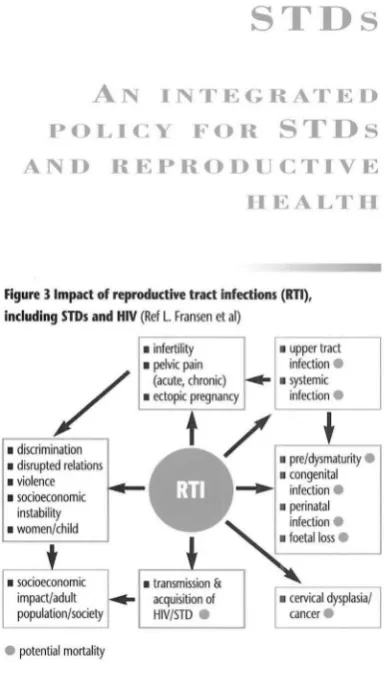
Figure 3 Impact of reproductive tract Infections (RTI),
Including STDs and HIV (Ref L. Fransen et al)
/
• discrimination
• disrupted relations
• violence
• socioeconomic
instability
• women/child
e
potential mortality• infertility
• pelvic pain (acute, chronic)
• upper tract infection
e
• ectopic pregnancy
• systemic infection
e
•
/
•
p
r
e/
dy
s
~
aturi
ty
e
• congenital ....,.. infectione
• perinatal infection
e
etallosse
. - - --'-
-• transmission &
acquisition of • cervical dysplasia/ HIV/STD
e
cancere
Figure 41ncrease In condom use and decrease of HIV incidence during an Intervention among female sex workers in Kinshasa, Zaire (Ref M. Laga et al)
70 60 50 40 30 20 10 0
0 3-5 6-8 9-11 12-14 15-17 18-20 21-23
months of follow-up
At the beginning of the Kenya project, only
a fraction of antenatal attenders eventually
received treatment. By the end, all attenders
were tested, most positives were treated, and
the cost of preventing one case of congenital
syphilis had come down from US$ 730 to
US$ 57.
~he European Conun.ission has made a name for itself in
_I_
placing HIV within the broader context of sexuallytransmit-ted diseases (STDs). It has taken a lead in developing an integrated
policy for sexual and reproductive health.
The health sector in developing countries has not traditionally paid much
attention to STDs. Now, research has demonstrated rhe biomedical and
socio-economic burden they create and STDs are recognised as a serious
risk factor for HIV transmission.
The concept of Reproductive Tract Infections (RTis) has also been gain-ing ground. It embraces borh STDs and other infections of the reproduc
-tive tract that are not sexually transmitted. Ir leads ro the idea of a unified
medical service for RTis, and to a more holistic approach char includes
education and sexual and reproductive behaviour (see Figure 3).
The EC has initiated and sponsored work on these questions at interna
-tional and regional level, and in several countries. Four African countries
are used here as examples.
1. ZAIRE: STD SERVICES AND CONDOM PROMOTION
AMONG SEX WORKERS IN KINSHASA
In 1988 the Commission defined and began a project in Kinshasa, in
which 1,200 commercial sex workers were provided with STD services
and condoms. After two years, the proportion of women using condoms
went from zero ro 60 per cent (see Pigure 4). Ar the same rime, the annual
incidence ofHIV went down from 18 per cent to 3 per cent, and four
other STDs also declined. Unfortunately, these efforts then had ro be ter
-minated because of the political turmoil which engulfed Zaire.
2. TANZANIA: LARGE SCALE INTERVENTION STUDY
A larger scale and longer term STD intervention study has been in
progress in the Mwanza region ofTanzania (see opposite page). Much
interim information has been gathered, so increasing expertise in STD
control in Africa.
3. MOZAMBIQUE: INTEGRATION WITH PRIMARY HEALTH
CARE
The Commission has been supporting STD control in and outside
Maputo, in the context of Mozambique's HIV/AIDS progran1me and of
primary health care planning (see page 22).
4. KENYA: CONTROL OF CONGENITAL SYPHILIS
A project was set up to screen and treat maternal syphilis, as part of the
national HIV/STD programme. The project was also a learning process
for other activities. lr had been estimated that 30,000 pregnant women a
year were infected by syphilis. The main conclusion was that most benefit
STD EXAMPLE
TANZANIA
NATIONAL AND
REGIONAL ACTION
ON
STDs
t h r E " ' e
Tanzania provides a classic example ofEC policy on HIV and sexually
transmitted diseases. On the one hand, the Commission has a project in
the Mwanza district of north-west Tanzania to quantify the effect of STD
treatment on the incidence of STDs and HIV. On the other hand, it has
supported the STD part of the national AIDS programme, and is trying to
apply nationally the lessons of Mwanza.
1. THE NATIONAL PROGRAMME
The Commission is supporting a technical adviser to the national
programme, with two specific tasks. One is education to prevent sexual
transmission. The other is to develop management of STDs nationwide.
The Commission is also supporting the supply of drugs, training
of medical personnel, and improvement of STD treatment.
2. THE MWANZA PROJECT
This five-year project began in mid-1991. In developing countries there
is little experience of STD programmes, through public or private health
systems, and of their impact on STDs and HIV. So there is too little
information about:
• how big a risk factor are STDs for transmission of HIV
• what is the prevalence of STDs
• how effective an attack on STDs would be in countering HIV.
So the primary objectives have been to:
• implement a programme for detecting and treating STDs duoughout
Mwanza
• determine whether this is effective in reducing the spread of STDs
andHIV.
The secondary objectives have been to:
• calculate STD and HIV prevalence
• calculate costs of STD management.
Early findings show HIV prevalence for rural villages, roadside settlements
and Mwanza town of 2.5, 8.3 and 11.6 per cent, respectively, witl1 a peak
of 20 per cent for young women in the town, and a prevalence of syphilis
of between 7 and 12.4 per cent, depending on sex and social stratum,
showing that syphilis is a serious public health problem.
A special effort has been made for commercial sex workers in Mwanza
town, using a community nurse. This consists of regular medical
check-ups, health education, and promotion and supply of condoms. Heald<
workers have been trained to manage STDs on me basis of symptoms and
examination, without laboratory tests (which are not available), in six
health centres and satellite dispensaries, and supplied witl1 drugs.
This programme will be extended to all health centres in tl<e region.
Because it is implemented through the existing health system, it should be