Research Report DCSF-RR020
Secondary School
Admissions
John Coldron, Emily Tanner, Steven Finch,
Lucy Shipton, Claire Wolstenholme, Ben Willis,
Sean Demack and Bernadette Stiell
Secondary School Admissions
John Coldron, Emily Tanner, Steven Finch, Lucy Shipton,
Claire Wolstenholme, Ben Willis, Sean Demack and Bernadette Stiell
Sheffield Hallam University and National Centre for Social Research
The views expressed in this report are the authors’ and do not necessarily reflect those of the Department for Children, Schools and Families.
© Sheffield Hallam University 2008 ISBN 978 1 84775 097 6
Project Team
Director: John Coldron (SHU CEIR)
Project Co-ordinators: John Coldron (SHU CEIR) Steven Finch (NatCen)
Project managers: Lucy Shipton (SHU CEIR) Bernadette Stiell (SHU CEIR) Emily Tanner (NatCen)
Database designer and consultant:
Dave Jefferies (SHU CEIR)
SHU CEIR Researchers: Claire Wolstenholme Ben Willis
Sean Demack Caroline Cripps Natalie Entwistle
NatCen Researchers: Sarah Tipping Rupert Sinclair
Project Administrator: Ian Chesters (SHU CEIR)
Centre for Education and Inclusion Research Sheffield Hallam University
Unit 7 Science Park
Howard Street, Sheffield S1 1WB www.shu.ac.uk/ceir
The National Centre for Social Research 35 Northampton Square
Acknowledgements
John Bigley Alan Winstanley and Richard Morse for advice throughout. Anna Vignoles and Rebecca Allen for their data on segregation.
Anne West, Hazel Pennell for discussions on the work.
CONTENTS
EXECUTIVE SUMMARY...i-x
1 INTRODUCTION ... 1
1.1 Background...1
1.1.1 Key findings ... 1
1.1.2 The aim of this study ... 1
1.1.3 The objectives of an admission system ... 2
1.1.4 Measures of effectiveness used in this study ... 12
1.2 Design of the Project ...15
1.2.1 Key points ... 15
1.2.2 Objectives of the study... 15
1.2.3 Strand 1: Admission arrangements for entry in September 2006... 16
1.2.4 Strand 2: Parents’/Carers’ experiences of the application process for 2006 ... 17
1.2.5 Strand 3: Outcomes of the application process for entry in September 2006 ... 19
2 ADMISSIONS ARRANGEMENTS... 20
2.1.1 Key findings ... 20
2.2 Introduction ...20
2.2.1 Secondary schools in England ... 21
2.2.2 Responsibilities for admissions ... 24
2.2.3 Regulation and co-ordination of admissions ... 25
2.2.4 The process and timing of admissions for entry to Year 7 in September 2006 ... 28
2.2.5 Parents and carers and children in care ... 29
2.3 Description of types of local authority co-ordination arrangements and their frequency...30
2.3.1 Key findings ... 30
2.3.2 Number of preferences required on the common application form:... 30
2.3.3 Equal preference/default ranking authorities and first preference first authorities. ... 31
2.4 Banding ...35
2.4.1 Introduction ... 35
2.4.2 Key findings ... 36
2.4.3 Authority wide banding:... 36
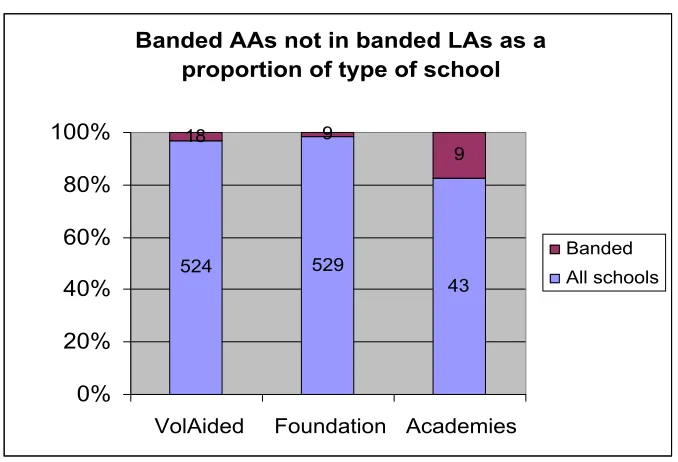
2.4.4 Banding in Voluntary Aided and Foundation schools and Academies ... 38
2.5 Selection...40
2.5.1 Key findings ... 40
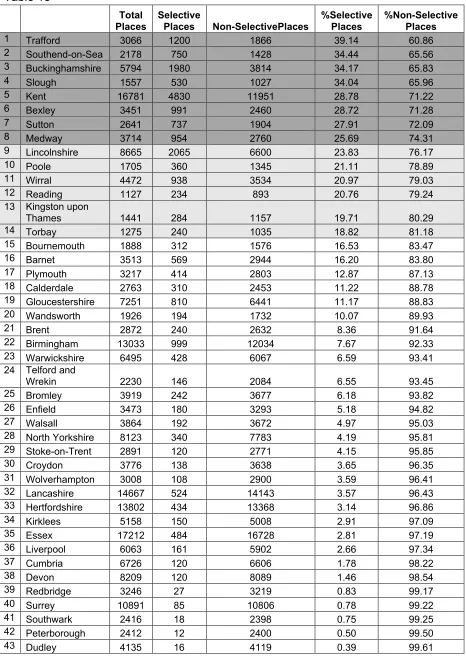
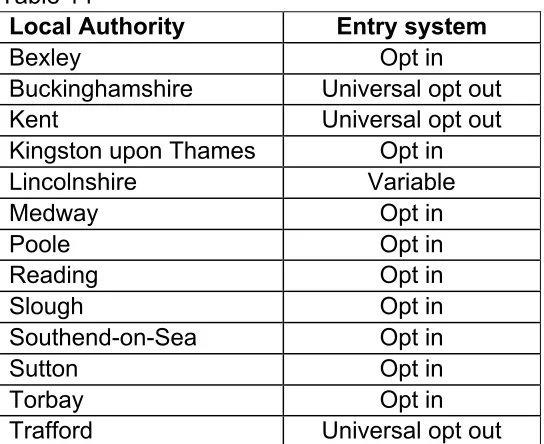
2.5.2 Authorities with schools that select by attainment ... 41
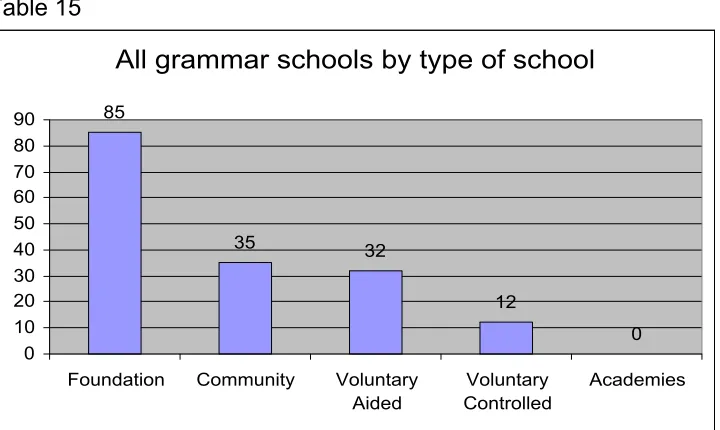
2.5.3 Grammar schools ... 44
2.5.4 Partially selective schools ... 45
2.5.5 Selection by aptitude... 48
2.6 Supplementary information...53
2.6.1 Key findings ... 53
2.6.2 Introduction ... 54
2.6.3 Representativeness of the respondents... 54
2.6.4 Categories of supplementary information ... 57
2.6.5 Examples of types of requests... 59
2.7 Schools that are over or undersubscribed...61
2.7.1 Key findings ... 61
2.7.2 Introduction ... 61
2.7.3 Subscription status of schools ... 62
2.7.4 Analysis of attributes of schools associated with subscription status... 63
2.8 Oversubscription criteria...65
2.8.2 Introduction ... 66
2.8.3 The nature of the data on oversubscription criteria ... 67
2.8.4 Frequency and importance of each category of oversubscription criteria .... 69
2.8.5 Levels of complexity... 82
3 PARENTS’ EXPERIENCES ... 85
3.1 Introduction ...85
3.1.1 Background to admissions process and survey comparisons ... 85
3.1.2 Summary of research methods ... 87
3.1.3 The format of regression tables... 88
3.2 How parents find out about schools ...89
3.2.1 Key findings of section ... 89
3.2.2 Comparison with 2000 survey ... 90
3.2.3 Use and usefulness of formal sources of information ... 91
3.2.4 Use and usefulness of informal sources of information... 99
3.2.5 School visits... 100
3.2.6 Overall use of information ... 105
3.2.7 Summary... 106
3.3 The application process... 107
3.3.1 Background to the application process ... 107
3.3.2 Key findings of section ... 107
3.3.3 Comparison with 2000 ... 108
3.3.4 Mode of applying for schools ... 110
3.3.5 Schools applied for... 112
3.3.6 Applying for schools outside the LA ... 114
3.3.7 Applying for faith schools ... 116
3.3.8 Schools with special application requirements ... 116
3.3.9 Over-subscribed schools ... 122
3.3.10 Summary... 127
3.4 Making choices ... 128
3.4.1 Key findings of section ... 128
3.4.2 Comparison with 2000 ... 128
3.4.3 Reasons why parents wanted a place at their preferred school ... 129
3.4.4 Reasons for not applying to the nearest maintained school ... 131
3.4.5 Favourite schools that parents chose not to apply to ... 136
3.4.6 Ordering schools ... 137
3.4.7 Involvement of family members and actions taken... 140
3.4.8 Summary... 143
3.5 Parental satisfaction with the application process and outcomes... 144
3.5.1 Key findings of section ... 144
3.5.2 Comparison with 2000 ... 145
3.5.3 Offers ... 147
3.5.4 Appeals ... 150
3.5.5 Satisfaction with application procedures ... 153
3.5.6 Satisfaction with application outcomes ... 156
3.5.7 Travel arrangements ... 158
3.5.8 Summary... 161
3.6 Chapter Summary ... 162
4 THE EFFECTIVENESS OF THE ADMISSIONS SYSTEM IN 2006: CURRENT OUTCOMES AND MEASURES OF THE SUCCESS OF ADMISSION ARRANGEMENTS ... 164
4.1 Introduction ... 164
4.2 Procedural efficiency, integrity and fairness ... 164
4.2.1 Key findings ... 164
4.2.2 The co-ordination and regulation of admissions ... 165
4.2.3 Transparency, Information and the manageability of the process ... 166
4.3 Diversity... 167
4.3.2 Kinds of diversity ... 168
4.3.3 Structural diversity... 170
4.3.4 Educational diversity ... 171
4.3.5 Compositional diversity ... 172
4.3.6 The inter-connection of dimensions of diversity... 177
4.3.7 Reputational Diversity ... 177
4.3.8 The number of schools from which parents can choose?... 177
4.4 How satisfied are parents? ... 178
4.4.1 Key findings ... 178
4.4.2 Results of the appeals measure ... 179
4.4.3 Results as to which of their expressed preferences applicants received ... 182
4.4.4 Acceptability of the school offered... 184
4.4.5 Results on those who expressed no preference... 185
4.5 Efficiency of the procedures ... 185
4.5.1 Key findings ... 185
4.5.2 Co-ordination of the system... 185
4.6 How fair is the system? ... 186
4.6.1 Key findings ... 186
4.6.2 Introduction ... 186
4.6.3 Segregation by socio-economic class... 187
4.7 Do the current admission arrangements contribute to better levels of attainment? ... 188
4.7.1 Key findings ... 188
4.7.2 How admissions might impact on attainment... 188
4.8 Summary ... 190
5 DISCUSSION OF POLICY OPTIONS ... 192
5.1 Direct and indirect social selection... 192
5.2 The effects of balancing intakes ... 193
5.3 Practical difficulties of balancing intakes ... 194
5.4 Fair Banding ... 195
5.5 Geographical Priority Areas (Catchments) ... 196
5.6 Feeder primary schools ... 197
5.7 Random allocation ... 197
5.8 Closing schools... 197
5.9 Effects of the wider policy context... 198
5.10 Subsidised travel... 198
5.11 Selection by prior attainment or aptitude and indirect social selection... 199
5.12 Faith schools... 199
5.13 Mixed methods under local control ... 200
5.14 Other considerations ... 200
6 REFERENCES ... 202
7 APPENDICES... 209
7.1 Appendix A Glossary... 209
7.2 Appendix B Examples of oversubscription criteria... 213
7.2.1 Example One... 213
7.2.2 Example Two... 216
7.2.3 Example Three ... 221
7.3 Appendix C Missing value analysis for local authorities who did not return first preference data ... 226
EXECUTIVE SUMMARY
Key Findings
• Admissions in 2006 were better coordinated and more effectively regulated
than in 2000. However in some areas the co-ordination role of Local Authorities ended with the offer of places in March. After this date each admission authority within the area dealt with its own appeals and any other matters and no one had responsibility for the management of admissions and appeals across the whole area.
• Appeals heard increased up to a peak of 7% of all admissions in 2000/01
and then have steadily declined to 6.1% in 2005/061
• In the sample, parental satisfaction was broadly similar to that in 2000.
Overall about 85% of parents gained their first choice school. The figure for London parents was 72%. Nationally 93% of parents gained either their first or second preference. Once their children start at the school, the great majority of parents are satisfied with the school with 95% of parents who got their first choice being satisfied and 82% of parents whose child attended a school that was not their first preference being satisfied.
• In the sample 81% of parents said they were satisfied with the choice of
schools in their locality. Satisfaction was lowest among parents living in London even though they have more schools to choose from.
• 25% of parents did not apply to their nearest maintained school. The main
reasons cited were poor reputation, poor exam results and problems with behaviour/discipline2.
• Socio-economic status is widely considered to be a factor in the fairness of
admissions. The sample was analysed to find any associations between the outcomes of the admissions process and socio-economic status. No association was found between the chances of gaining first choice of school and the socio-economic status of parents. This suggests that either different groups of parents seek different things from their secondary school or that parents are responding realistically to their chances of gaining entry to certain schools, or both. It does not mean that there are no educational disadvantages systematically visited on some groups rather than others. It indicates rather that the way that inequality of educational opportunity continues to occur is not reducible to whether or not a parent gets their first
1 Figures from DCSF Statistical First Releases
2 This is different from the number of children who do not attend their nearest school which appears to be
choice of school. There were no significant associations found between appealing and parents’ family characteristics.
• While less affluent and less educated parents accessed fewer sources of
information there was no evidence from the analysis of those gaining their first choice of school or of those appealing that this disadvantaged them in terms of their gaining their preferred outcome.
• It is a misconception to think that the unfairness of admissions consists in
some groups being denied access to ‘good’ schools. It does not take adequate account of how intake contributes powerfully to the public perception of schools as ‘good’ or ‘bad’. A more adequate account focuses on how the admissions system contributes to segregated intakes and how that segregation leads to unequal educational opportunity.
• Although admissions were better regulated in 2006 compared with 2000
some schools that were their own admission authorities, in particular voluntary aided schools, were less compliant with the School Admissions Code of Practice 2003 and were more likely to covertly select than community schools.
• The most highly selective LAs (those that have the highest proportion of
places allocated to children who score highest on an 11+ test) had more socially segregated schools, fewer parents gaining their first preference and a greater number of appeals.
• Admissions policy should concentrate not only on compliance with the 2007
Schools Admissions Code which is likely to reduce the incidence of direct covert selection by schools but priority should also be given to mitigating the indirect causes of segregated intakes.
• The most effective approach is likely to be a statutory requirement to take
action combined with freedom at the local level to determine what methods will work in particular contexts. Admission forums, local authorities and admission authorities will need to take positive action where the outcome of local arrangements is found to be intakes that are socially distinct to an unacceptable degree.
• Policy options available for redressing indirect selection that leads to
socially segregated intakes include a body to set the admission criteria for all the schools in an area, fair banding, subsidised travel for lower income families, measures to ensure balanced intakes to grammar schools, random allocation and removing the ability to select a proportion by aptitude. Procedural fairness with regard to appeals would be enhanced if Local Authority co-ordination was extended and if they fully managed appeals for all admission authorities in their area.
It is some years since a comprehensive study of admission arrangements was conducted and considerable changes to secondary school admissions have since been introduced. It is therefore timely to map the admissions arrangements and to evaluate outcomes enabling us to identify any trends since 2000 and to set a baseline against which to chart any changes following the new arrangements.
education and a more cohesive society. A number of dimensions of social justice are therefore implicated. That admissions should have regard to the need for the fair distribution of educational opportunity, the need for distributive justice, is widely acknowledged. This is however often cast as ensuring access to a scarce resource of ‘good’ schools. This is a misconception of the problem since it does not adequately take account of the role of intake in the way schools are constructed as ‘good’ or ‘bad’ and a more adequate account is in terms of avoiding segregated intakes. An effective system would also, as far as possible, enable parents to educate their children according to their beliefs, fulfilling the need to protect individual liberty, the dimension of justice of autonomy. Less often recognised is the need to avoid another form of injustice, the concern for justice of recognition, which arises from the harm inflicted by the denigration of schools, children and communities that can accompany the process of admissions.
From these aims the following nine objectives and three valid measures of effectiveness were identified and these provided the foci of the mapping and the evaluation of the admission arrangements operating in England in 2006.
An effective admissions system would:
• Provide a means by which those who consider admissions arrangements to
be unfair can refer the matter to an independent adjudicator
• Provide an effective means for parents to appeal to an independent tribunal
if they are unsatisfied with the outcome
• Provide access to clear and understandable information and criteria that are
transparent, and seen to be objectively applied
• Ensure that all parents are treated equally and schools do not covertly
select students on the basis of social status or prior attainment
• Satisfy parents’ wishes as to how and where their children are to be
educated
• Not inhibit the quality of education overall and, if possible, contribute to
enhancing it
• Not allow the greater achievement of some children to be at the expense of
others
• Contribute to social cohesion
• Not contribute to the harm inflicted by denigration of children and
communities
The measures are:
• the proportion of parents gaining their first preference • the level of appeals
• the level of segregation of intakes.
The study consisted of three strands.
Strand One aimed to provide a comprehensive description of the admission arrangements for entry to maintained secondary schools in England in September 2006.
Strand Three gathered data about the outcomes of the admissions process in terms of the number of parents who gained a place at their first preference school, the level of appeals and the level of segregation.
Responsibility for setting admission arrangements rests with the Admission authority for each school. Regulation of the practice of admission authorities is important to reduce unfair practices. Admissions in 2006 were subject to the School Admissions Code of Practice 2003. Three mutually reinforcing measures of regulation were in place namely the requirement to consult, the requirement to have regard to the published guidance, the opportunity to object to the Schools Adjudicator.
Admission arrangements
Banding Only a small minority of schools adopted fair banding (as defined in the School Admissions Code of Practice 2003) but it is likely that it will become more widespread in future. Three Local Authorities in London had authority wide fair banding. Of these two had fewer appeals and all three had less segregated intakes than other London authorities. These systems accommodated a number of Voluntary Aided faith schools. In two of the LAs there were 5 VA schools that did not opt in to the banding arrangements.
Selection by prior attainment (general ‘ability’) Selection by prior attainment was found to perform relatively badly in relation to the objectives of an effective admissions system as defined above. There were selective schools in 43 Local Authorities. Twenty of these authorities had 10% or more selective places. In the 14 most selective authorities (those with between 19% and 39% of selective places) there were more appeals, fewer parents gained their first preference and the intakes were more socially segregated compared to all other authorities. Other studies suggest that there is little if any compensating gain in overall educational standards.
Supplementary information Supplementary information forms that ask for extra information beyond that required to apply published criteria offer schools the means for social selection. 29% of non-Community schools ask for additional information of this kind with Voluntary Aided schools more likely to do so than any other type of school. The 2007 School Admissions Code now prohibits the use of supplementary forms which ask for any personal information that is not relevant to applying acceptable oversubscription criteria.
Subscription status In order to help parents gain a place at their most preferred school the published information is supposed to allow a parent to see whether the school is over or undersubscribed (the schools subscription status). For a very large proportion (42%) of schools it was not possible to tell their subscription status from the information given.
Over subscription criteria When schools are oversubscribed the admission authority, on the basis of criteria their admission authority has determined, decide which applicants are most eligible and therefore have higher priority. Some oversubscription criteria and the way they are implemented provide the means of covert selection by schools on the basis of social characteristics or prior attainment. Oversubscription criteria are often complex combinations of a limited number of elements. We looked in detail at the most common criteria.
The School Admissions Code of Practice 2003 recommended that authorities give top priority in their oversubscription criteria to children in public care. This is now a statutory requirement from September 2007. We found that 67% of all schools had this as a high priority (either first or second place) in their oversubscription criteria but for nearly 24% it did not feature anywhere in their criteria. Voluntary Aided and Foundation schools were least likely to have Child in Care as any kind of priority with nearly a half of Voluntary Aided and just over a third of Foundation schools not mentioning them at all. From the 2007/08 admissions round onwards, admission authorities are now required by law to give highest priority in their oversubscription criteria to children in care.
17% of all schools put Medical or Social Needs as their first priority. 53% of schools included it somewhere in their oversubscription criteria. Community and Voluntary Controlled schools and Academies were the most likely to have Medical or Social Needs as a priority. Foundation schools were less likely to do so, but Voluntary Aided schools were much less likely with only a quarter making this any kind of priority.
Issues relating to other criteria were:
• Siblings and Catchment areas were significant criteria for all types of
schools.
• 61% of all schools’ used Proximity but it was often used as a tie break for
• 32% of all schools used Feeder schools somewhere in their criteria. Only
6% have it as their first priority. Voluntary Aided schools used this more often than any other type of school.
• 30% of all schools used First Preference. A minority of all types of schools
had this criterion. This is now unlawful.
• Only 15% of all schools have any Faith Relatedcriteria but for these it is a
high priority. As would be expected, the great majority (nearly 90%) of Voluntary Aided schools designated with a religious character used Faith Related criteria. 60% of Voluntary Aided faith schools gave some priority to Other Faiths. 16% gave some priority to children of No Faith.
• Only 9% of all schools had Parent Commitment as a priority but this
included nearly a third of all Voluntary Aided schools. The 2007 School Admissions Code prohibits schools from taking account of parents’ personal interests or other circumstances, except for faith schools who may enquire about membership or relationship with a church or religious denomination. While there is some overlap between this criterion and faith criteria the third of VA schools appeared to go beyond the need to establish religious
commitment and all of the schools represented in this 9% would be likely now to fall into the unlawful category.
• 4% of all schools had criteria that gave priority to children who were related
in some way to adults connected with the school (Associated Adults) such as teachers or governors. This too is now unlawful.
Parents’ Experience
The survey presents a picture of parents’ experiences of secondary school admissions that is broadly positive and comparable with the findings of the previous study in 2000.
The broadly positive experiences of more than two-thirds of parents can easily be summarised. These parents found that information about schools was accessible, adequate and useful. They found the application process to be reasonably straightforward and the choice of school quite easy to make, focusing as it did on their local school. The outcome of the process was satisfactory as 84% of respondents were offered a place for their child at the school they had put as their first choice. There was a minority of respondents for whom the admissions process resulted in substantial disappointment (14% did not get their first preference school) and dissatisfaction (4% said that they were dissatisfied with the school that their child attended). For these parents dissatisfaction was generally focused on the outcome rather than the process.
internet access, poorer social networks and poorer information-gathering skills could be disadvantaged in the admissions process. It is important to stress that these findings only relate to access to the available information and we found no evidence that less well-educated parents or parents from less affluent socio-economic groups were disadvantaged in the applications because of their lower use of information. However, these findings clearly have relevance for the Choice Adviser initiative.
The survey identified some notable trends affecting a minority of parents. In areas where places were limited, particularly in London, parents were invited to express a larger number of preferences and did so, were more likely to apply to schools outside their local authority and were less likely to get a school of their choice. Special admissions arrangements, which will be more restricted under the new admissions code, increased the complexity of the process and were associated with increased special actions, such as coaching and extra tuition, by parents who were keen to improve their child’s chances.
Proximity to schools was found to be central to the over-subscriptions criteria of many admissions authorities and parents had a good understanding of how this affected their chances of success. A fifth of parents had taken account of catchment areas the last time they moved home and those who hadn’t done so were more likely to take other special actions to further their application. This established relationship between proximity and application success may be weakened as the School Admissions Code 2007 is implemented, with positive or negative consequences for some parents’ satisfaction with the system. In this context, it is worth noting that parents’ satisfaction with their child’s travel arrangements was greater when the child could walk or travel by school bus than when they had to travel by car or public transport.
Outcomes and effectiveness
The system in 2006 was more efficiently managed and better co-ordinated than in 2000. The requirement to consult combined with the opportunity to object to the Schools Adjudicator made compliance with the School Admission Code of Practice 2003 more likely. Community and Voluntary Controlled schools and Academies were more likely than Foundation and Voluntary Aided schools to follow the guidance and recommendations with Voluntary Aided schools the least likely to have complied.
more likely to explain the social segregation of intakes than an inability to understand or negotiate a complex system.
Diversity of provision is a current policy priority. The different rationales for diversity need to be noted and the different kinds of diversity need to be distinguished. One rationale is to provide the means to realise the right of parents to educate their children according to their views and beliefs; a second arises as a pre-requisite of an effective education market. Schools are diverse in many ways. We identified four categories of diversity and considered the evidence in this and other studies of their incidence and whether or not it was increasing or decreasing. The four kinds of diversity are: Structural, Educational, Compositional and Reputational. Each school presents a different mix of these. Structural diversity has increased significantly. It is difficult to judge whether educational diversity has increased or decreased but the evidence available suggests a decrease. In relation to compositional diversity, while grammar and secondary modern schools are at the extremes of segregation by attainment, all types of schools differed in this way. Social segregation nationally has not significantly increased since the introduction of more parental choice in 1988 but is higher in areas where: the population is more dense, there is a greater number of schools nearby, there is structural and religious diversity between schools, there are more schools that are their own admission authority, the area is one of the 14 most selective. Other studies provide evidence that, despite there being no overall increase, social segregation is increasing in specific localities particularly in London and other densely populated areas. There has been no increase in ethnic segregation between schools other than that explained by the increase in the BME school population. The minority population is not evenly spread across all LAs, but is concentrated in a few areas. In these enclaves there are schools where the students are almost exclusively White and others where they are almost exclusively from minority communities. While it is important to have identified the extent of diversity on each separate dimension, there are important inter-connections between them. How schools differ in reputation is extremely salient to parents’ expression of preferences but it is not amenable to measurement.
How satisfied are parents?
Appeals heard increased up to a peak in 2000/01 and then have steadily declined. Appeal rates are higher in Local Authorities with higher proportions of children whose first language is not English, outside London, with higher population density, where intakes are more socially segregated and where there is a high level of selection. There was no evidence that some groups of parents make more appeals than other groups.
The admission system is now more uniform across Local Authorities and more co-ordinated. The great majority of respondents (97%) received an offer for their child on the due date and parents’ satisfaction with the process was generally high.
How fair is the system?
A powerful driver of the social segregation of schools is residential segregation in combination with admission arrangements prioritising proximity. Added to this is further social sorting as a result of schools’ specific criteria and procedures. Voluntary Aided schools used aspects of, and particular arrangements of, admission procedures and criteria that lend themselves to covert social selection, more often than other schools. Other studies have shown that these schools have more advantaged intakes than other types of school.
While the better regulation in 2006 compared to 2000 may have reduced covert selection it did not eliminate it nor greatly mitigate residential selection. Admission arrangements such as banding, which are not widely used currently, can mitigate social segregation especially in densely populated areas. For example, segregation was much less in the three banded authorities than in comparable areas.
What are the effects on attainment?
Policy options
Because of the central role of segregation in falling short of a number of objectives, it is useful to consider the pros and cons of policy options available to better balance intakes. The theoretical benefits of balanced intakes are considerable but the practical problems arising from the complexity of particular contexts and the need to accommodate other policy priorities are great. A requirement on admission authorities to move towards better balanced intakes while leaving the detail to be worked out at local level would seem to be wise. This is the approach embodied in the new Schools Admissions Code 2007. Policy options include a body to set or apply the admission criteria for all schools in an area, fair banding, subsidised travel for lower income families, measures to ensure balanced intakes to grammar schools, random allocation and removing the ability to select a proportion by aptitude.
A number of arrangements suggest themselves as a means of reducing social segregation. Banding is a powerful means of balancing intakes both by attainment and social characteristics. Catchments of geographical priority areas are also an effective means but may be less manageable or sustainable. Feeder schools have the advantages of predictability and sustained relationship between schools but share similar problems to catchments. Random allocation can be an efficient and effective means of allocating places especially in combination with other oversubscription criteria.
A mixture of methods is indicated, with a requirement on admission authorities to determine locally how best to better balance intakes. Schools have a strong incentive to select on the basis of social characteristics. School reputations are gained and lost in a complex and little understood process but their pupils' performance in public examinations plays an important part in the way the school is perceived by parents, local authorities and agencies such as Ofsted bolstered by comparisons in performance tables of various kinds. It is also the case that some children offer challenges that make the day to day work of teachers harder and more stressful (Thrupp 1999). It is therefore in the school’s interests to attract children who are, because of their social characteristics or prior attainment level, more likely to perform well in these tests and are easier to teach. Reducing the incentives for schools to select might be achieved by changing the way schools are held accountable, making more explicit the inclusive mission of schools and providing resources according to the social characteristics of the intake. Selection by ability/attainment is currently also largely selection by social background. One option would be to abolish selection by attainment. A less drastic alternative is to take effective steps to ensure equal social representation amongst those who qualify on the 11+ test.
Some of the educational and social cohesion benefits of eliminating segregation between schools would be lost if social segregation was reintroduced within school. Procedures such as streaming and setting pose this danger.
1 INTRODUCTION
This section sets the project in the context of the debate and practical concerns about the administration of admissions. It gives an outline of the issues at the heart of the debate, explains why there is a need for greater clarification of what would be an effective admissions system and sets out the contribution this project is intended to make. Having attempted to better conceptualise what effectiveness might mean there is a discussion of how it might be measured.
1.1 Background
1.1.1 Key findings
• The time is right, following considerable changes, for a comprehensive
mapping of the operation of admissions to secondary school and setting a benchmark against which to measure the effects of changes from
September 2007.
• The debate about admissions is about how best to achieve a fair system,
improved education and a more cohesive society.
• The more social segregation of school intakes the less fair or equitable the
system.
• Where there are unbalanced intakes one group is gaining at the expense of
another.
• The system should not contribute to the harm inflicted by denigration of
children and communities.
• In order to be able adequately to describe how different kinds of admission
arrangements are operating we need to clarify what the objectives of the admissions system are.
• Nine objectives are identified.
• Three valid measures of effectiveness are identified: the proportion of
parents gaining their first preference, the level of appeals, the level of segregation of intakes.
1.1.2 The aim of this study
Admissions to schools is central to the achievement of important policy objectives of successive governments over the last thirty years and is often the subject of heated debate, acting as an arena where political and moral outlooks compete. It is therefore important that there is a solid basis of fact to enrich and ground this debate and to inform policy.
Appeals Code of Practice (2003), an increase in the number of specialist schools, the introduction of Academies, the consolidation of the work of admission forums and an increased number of rulings by the schools adjudicator. To date there has been no other such comprehensive study. West and Hind’s study in 2003 looked at the arrangements existing in 2001 in all authorities but did not conduct a parent survey. There have been interesting partial studies focused on London (Pennell, West and Hind 2006) and others which looked at a sample of local authorities across England (Gorard et al 2002). A report by Which (Which 2005) conducted a survey of parents but did not look in detail at the admission arrangements in Local Authorities.
In February 2007 the School Admissions Code came into force. This code has much greater power than the previous 2003 School Admissions Code and introduces a number of strong measures that admission authorities must, or should, follow. It is likely to have a significant impact on practice resulting from requirements on admission authorities concerning such details as over-subscription criteria, the prohibition of giving higher priority to those who place a school higher on their application form (usually referred to as first preference first) and information. This report aims to give an updated and comprehensive map of the details of admission arrangements as they exist prior to these changes, of parents’ experiences of choosing a secondary school and of current overall outcomes and effectiveness. This will make it possible in the future to identify how and where any changes take place. In the next section we attempt to identify the objectives against which we will measure the effectiveness of admissions and consider what would count as valid measures
1.1.3 The objectives of an admission system
The debate concerning admissions
When Shirley Williams was Secretary of State for Education in 1976 she noted that she was dealing with a small, although growing, number of appeals from parents against the schools they had been allocated. Since the Education Reform Act in 1988, successive governments have adopted parental choice and the development of a ‘quasi-market’ in education (Le Grand 1991, 1993; Adnett and Davies 2002) as a means for the general improvement and reform of schools. A number of policies have been introduced to enable parents to choose and to introduce real competition. These include making school funding more dependent on pupil numbers and thus providing an incentive to attract pupils, standardised tests to enable comparison of the educational performance of the children who attend, regular independent and publicly available assessments of the quality of schools by OFSTED, and a greater diversity of providers of schools. Parental choice of school, together with information about school performance, was intended to create pressure on schools to improve their standards, because of the risk that parents would take their children elsewhere.
both the process and the outcomes. Further, Local Authorities were finding it increasingly difficult to co-ordinate the supply and allocation of school places within their area in an efficient and effective way. The problems were felt most acutely in the large urban areas and particularly London. Alongside these developments there was a growing academic critique that the introduction of parental choice and the quasi-market was disadvantaging certain social groups (Gewirtz et al 1995; Lauder et al 1999), and that schools and parents were adopting unfair practices (Woods et al 1998; West, A., Pennell, H. 1997; West, A., Pennell, H. & Noden, P. 1998). There have more recently been concerns expressed about the ethnic segregation of schools and the potential threat to social cohesion (Denham 2001; Cantle et al 2006).
The consequences of these polices are felt acutely by the various stakeholders. The way admission to schools operates directly affects the interests of parents who are looking for a suitable education for their children and previous qualitative studies reveal that many feel extremely anxious about the process3. There are implications too for local authorities because the criteria in place, the number of admission authorities that exist, and the system of co-ordination adopted directly affect the ability of officers to manage the admissions process to maximise the satisfaction of parents. For admissions managers in deeply polarised areas it presents extreme difficulties in achieving coherent regional schools provision. Schools can also suffer. Some are inundated with applications while others cannot fill the available places. For the schools which are unpopular their already difficult job is made harder and schools which are heavily oversubscribed spend a great deal of time and energy managing the process of admissions and appeals. Politicians in large urban areas face seasonal complaints from constituents and this reflects on central government which has a regulatory role and has pledged itself to ensure a fair admissions system.
The debate about admissions, while often appearing to be about arcane technicalities, does in fact go to the heart of current policies about how best to achieve social justice, an improved education system and a cohesive society. However, the interplay between detail and these underlying issues is often complex and obscure. Positions taken in the debate that reflect profound differences of political and moral outlook, are often implicit rather than explicit. Effectiveness can only be gauged in relation to clear objectives. Only when we have clarified what the objectives of a system are can we make use of evidence to judge how far the system is achieving its aims (Tough and Brooks 2007). The objectives of an effective admissions system have remained largely implicit and there has not been enough analysis of what they might be. Our first task therefore is to clarify what effectiveness might mean and in the process we will identify the
main threads of the debate, give a rationale for the design of the study and provide the basis for understanding the report of the empirical work.
First objectives
We may take four objectives as relatively uncontroversial. Firstly, that the admissions system should not inhibit the quality of education overall and, if possible, should contribute to enhancing it. The measure of this we take to be the average standards of achievement in public examinations of all children. However, an acceptable average could be achieved as a result of one group performing extremely well while another group performs extremely poorly and this, perhaps slightly more controversially, we take to be undesirable. We therefore need to make a second condition, that admissions should not inhibit the achievement of some children at the cost of the lower achievement of others. Thirdly, all parents should be treated in the same way in relation to the process and procedures of admissions. This means in practice that every parent should have the same access to clear and understandable information and that the criteria for admission are transparent, objectively applied and do not advantage some parents over others. Fourthly, there should be an objective and effective means for parents to appeal to an independent tribunal if they are unsatisfied with the outcome of the process.
These objectives are fairly easy to identify. However much of the heat around admissions comes from different takes on the more complex concerns for fairness and social justice and the most effective way of achieving a healthy society. One way of clarifying the different positions is to understand what kinds of unfairness admissions might seek to avoid and what kinds they might enhance (Gewirtz 1998 and 2002). Three kinds of claims to justice can be distinguished as relevant to the admissions debate; the claim that people should be able to determine their own lives as far as possible – justice as autonomy; the claim that resources and goods should be distributed fairly – distributive justice; the claim that people and groups should be accorded respect whatever their identities – justice of and through recognition. The first two have largely been the focus of debate but we argue that the last is just as important but has received less attention. We attempt below to make more explicit the nature of these social justice claims in relation to admissions.
Admissions and Parents’ right to choose
beliefs4. This has been taken to include the way in which their child should be
educated. Schools are only part of a child’s education, and some countries, such as France, consider that the home is where this kind of autonomy should be exercised and differences of religion and values inculcated. The school system is to be kept secular and, from the point of view of contested values, uniform. The English system has a different history and faith schools are embedded in the system. This diversity of schools means parents can express religious values through their choice of school. Independent of religion, it is arguable that, since a significant part of the education of their children is delegated by parents to schools, parents should be able to exercise some influence on the kind of schooling their child receives. This is acknowledged in, for example, the opportunity for parents to be consulted on the nature of sex education and the fact that they are allowed to withdraw them from these lessons if they wish.
Other aspects of schooling might also be important in this regard for at least some parents – for example being educated with the same sex or having a strong uniform policy. Whatever parents say is an important value can be claimed as a legitimate expression of their autonomy. The principle of autonomy therefore seems to legitimate not only what everyone would agree were personal values to be respected but also every degree of whim or prejudice. What then is the responsibility of the admissions system in relation to the principle of autonomy? The exercise of autonomy as a choice of school requires that there is a diversity from which to choose. Where all the offerings are uniform there is no choice at all. Not just any diversity will serve however. For example a parental preference for an educational experience that would advantage their child over others would not be just. Differences in religious affiliation, curriculum, social organisation, pedagogic philosophy and moral climate would seem to fit the bill. The schools on offer would need also to reflect an adequate range of the major value positions in the community they served. It is considerations such as these that provide legitimacy for the calls for state maintained Muslim schools. Measures of the effectiveness of a policy that facilitates justice as autonomy would therefore be:
• how far does it provide diversity among schools
• how far do parents have a real rather than a theoretical possibility of choice
between what the parents believe to be a reasonable range of schools
• how far is there equality of opportunity for all parents to exercise such
choice5.
4 There are important and difficult issues about what this means for the autonomy of the children as persons
but, for the present purposes, we accept the general view. See Brighouse (2000) for an extended discussion.
5 The role of choice here is different from the role it plays in arguments that stress the benefits of competition
This raises some familiar difficulties and dilemmas. Firstly there may be practical difficulties in managing a large system to provide real choice to all. Brain and Klein (1994) surveyed parents about their preferences in one English town and found that nearly twice as many secondary schools would be needed to satisfy all the preferences. Significantly, they concluded that greater diversity of provision would generate more kinds of preference and the problem of matching would have been worse. Further, real access may be radically restricted for those with financial resources to spare and all but eliminated for the rest. It may require large amounts of public resources expended on subsidising travel and maintaining surplus spaces.
Another problem is that providing principled choice of this kind may in fact be used by parents for social advantage. For example, where a particular faith school is a good and therefore popular school, it is not inconceivable that families will become religious in order to gain entry to the school and the social advantages that it offers.
Distributive justice and admissions
The concern of distributive justice is the fair allocation of social goods or resources. In a meritocratic, and therefore socially mobile, society our level of education would be a major means by which we are allocated to our occupations and consequently to different levels of prestige and financial reward. On this basis education is a major resource that would in a just society be allocated fairly. This does not imply equally. For, quite apart from the impossibility that every individual can attain the highest competence in all fields, if educational attainment is to serve as the criterion for allocation, it requires that outcomes differ. Some people need to do better than others. When, inevitably, some people get greater social and financial rewards than others we are persuaded to accept this inequality if we think their rewards are the result of greater ability or hard work – the meritocratic principle6.
If however some individuals or social groups are unfairly handicapped and others unfairly advantaged in the competition for educational success then the fairness of the system is brought into question. But, it appears that good education is not currently equally accessible to all. It is likely that there will be many, probably interrelated, factors contributing to this inequality but admissions to schools is implicated. The problem of ‘selection by mortgage’ is a good illustration. It is well established that the higher the socio-economic level of the intake of a school the greater the likelihood that it will be perceived as ‘good’ and popular with parents.
6 While this meritocratic argument is widely accepted as common sense the difficulty of justifying it in a
Many areas, particularly metropolitan areas, are characterised by residential segregation and accompanying geographical distribution of wealth and status (Cheshire and Sheppard 2004; Burgess et al 2004; Butler and Hamnett 2007). If the admission arrangements, such as a proximity criterion or catchment, result in most children going to their nearest school some areas will have ‘good’ and popular schools while others will have ‘poor’ and unpopular schools and hence ‘selection by mortgage’.
Another aspect of potential unfairness would be if some parents more often gained access to their preferred schools than those less skilled. The evidence from studies in England (Gewirtz et al 1995; Flatley et al 2001; Ball 2003), Scotland (Echols and Willms 1992), France (van Zanten 2003), New Zealand (Lauder et al 1999) and the USA (Holme 2002) is that already advantaged parents, through a combination of selection by mortgage and successful management of the admissions process, get their children into higher attaining schools than others. On the whole these parents are more highly educated, on a relatively high income, are in professional or service occupations and own their own homes (Flatley et al 2001). Gaining access to 'better' schools, it is argued, is a way in which the already advantaged maintain and enhance their social and economic position. As we will see we found no evidence in this study that this was the case.
These arguments characterise the problem of unfairness as a result of the systematic denial of already disadvantaged groups to gain access to a scarce resource i.e. ‘good’ schools. If we accept this argument it follows that the objective of policy should be removing administrative or financial barriers to achieve more equal access for the less advantaged. The scarce resource sought after is taken to be the educational excellence of the school - in short, high quality teaching, management and leadership. These things are, in principle, capable of being made less scarce, and even plentiful, by improving the quality of teachers and headteachers. School improvement is, on this argument, an important objective of policy and if admissions can contribute, it should be an objective of admissions too. It is argued by those who advocate the market (see Tooley in Education and Skills Select Committee Report 2004b) that greater parental choice would both improve schools for all by ensuring providers (schools) improved their offer in competition with other schools and, through such devices as vouchers, enhance access for groups of parents previously discriminated against. Any continuing problems, they argue, would be because we have not gone far enough in allowing the market to operate and that greater fairness will result from greater deregulation so that successful schools can expand and unsuccessful schools close. But these arguments are questionable.
exam performance), are perceived by many parents to be safer places for their children and to offer more suitable peers for their children. These schools are therefore sought after, including by the already advantaged who have the wherewithal to achieve entry and who deploy ‘status discourses’ (Holme 2002) to justify dividing schools into desirable and undesirable. The resource that is scarce here is not educational excellence, but a socially advantaged intake. Such segregation is a characteristic that is, necessarily, incapable of being achieved by all schools. As Burgess puts it (Burgess et al 2007),
If the main basis for choice between schools is the quality of teaching, the competitive pressure created by choice should have a positive impact...But if parents are choosing schools on the basis of peer groups for their child...the scarce resource of ‘acceptable peer groups will be rationed in some way, and the middle classes are likely to emerge winners. p140
Each of these constructions implies a different approach to the use of admissions arrangements to achieve the desired end. Emphasising the enhancement of parental choice as a means of improving access to the few good schools and of providing competitive pressure for all schools to improve, would take as objectives an increased diversity of providers, parents having and making use of a real choice between schools that differ in educational quality, the elimination of socially discriminating entry criteria, the elimination of financial barriers felt by some parents and not by others (e.g. the cost of travel to a preferred school), and a robust policy of school improvement through rigorous inspection and monitoring of performance. More balanced intakes and improved schools for all may be objectives of policies but they follow as a result of them in time. Alternatively, emphasising the effects of intake implies the adoption of policies that seek to achieve more socially balanced intakes prior to and as a necessary pre-condition of the proper exercise of educational choice as opposed to social choice. This argument leads to the advocacy of arrangements that reduce segregation, a local responsibility to monitor the balance of local schools and to act on any highlighted segregation.
and staff in those schools would be disruptive to already vulnerable children. More importantly however this would not be a passing phase. The energy of the market comes from the difference between good and bad schools. It depends on a
continual, not passing, characterisation of schools as better or worse, rightly popular or rightly unpopular. The effect of this denigration is suffered by, and damages, the children, families and staff of the schools at the bottom of the local hierarchy created by the market (Reay and Lucey 2000). The important point is that, even if different schools take their turn at being unpopular, there will always be children and schools at the bottom of the hierarchy as the least well regarded schools. The real damage caused to children and communities is inherently unjust and too much of a price to pay for the potential benefits. The means each would use to move towards their ultimate aims are difficult to justify, morally and politically. The ends may not be seen to justify the means. These issues of the way people are perceived take us to the final kind of social justice claim.
Justice as recognition: The problem of systematic denigration
The widespread perception that some parents are gaining at the expense of others has ironically had the effect of casting the blame on already disadvantaged parents. A deficit model of already disadvantaged parents from lower socio-economic groups is embodied in the various types of parent choosers in the school choice literature – skilled choosers’ are opposed to ‘disconnected choosers’ (Gewirtz et al 1995); 'alert' to 'inert' (Echols and Willms 1992). Seeking to explain why already advantaged parents gain access to the ‘good’ schools attention is drawn to the difference in the financial means, organisational skills, and educational and social resources to understand or engage fully in the process (Education and Skills Select Committee 2004a). Authors, trying to show how blaming schools for poor performance is often misplaced, emphasise that it is not the staff and teaching that is bad but the children who go there (Butler and Hamnett 2007; Gibbons and Telhaj 2007). Either way disadvantaged parents and children are constructed as the problem together with the scarcity of good schools. This contributes to a pattern of denigration of already disadvantaged children, families and communities.
Nancy Fraser (1996 and 1997) characterises justice as participatory parity, where everyone can share in all aspects of the social. She includes material rewards but also those that come from respect. Any arrangements that reduce the sharing of rewards relative to others are unjust. Participatory parity is affected by a just distribution of socio-economic resources (distributive justice) and by cultural and symbolic recognition of different identities (justice as recognition). She characterises injustice of recognition as cultural or symbolic and ‘rooted in patterns of representation, interpretation and communication including:
...disrespect (being routinely maligned or disparaged in stereotypic public cultural representations and/or in everyday life interactions). (Fraser, N. 1996 pp.70-71)
(see Ball 2003 for an overview of the evidence). This is accompanied by ‘status ideologies’ (Holme 2002; Oakes et al 1997) which Holme describes as,
seemingly commonsense beliefs held by dominant status groups to explain why members of other groups seem to fail disproportionately in a society where opportunity is theoretically open to anyone with the will and drive to achieve.(Holme 2002 p 3)
The most often cited discrete criteria of academic performance, fear of bullying, moral security and quality of discipline are for many parents proxies for intake and, reflecting the residential segregation of towns and cities (Cheshire and Sheppard 2004), the populations of whole areas are considered unsuitable. As one parent said of a school she said she would not even consider (Coldron 2005):
I think Milton High is fairly heavily populated by Haringey.
In some, mainly urban, contexts the instinct of the already advantaged parents to separate themselves (Bourdieu 1986; Bourdieu and Wacquant 1992) joins with the opportunity for choice, diversity, local politics, residential segregation and admission arrangements to polarise perception of schools (Gewirtz et al 1995; Lauder et al 1999; Lucey and Reay 2002; Coldron et al 2001). This results in some schools being oversubscribed and parents struggling for entry. In the process the rejected schools, and by implication the children and their communities, are often and consistently vilified. As one London LEA officer explained in 2000:
…we've got this incredible polarisation of parental perception of schools, which just gets worse all the time...It's fuelled by the league tables...It's fuelled by the controversy we had here last year where parents took their children out of school and were refusing to go to the schools that did have vacancies and were slagging them off in the most unpleasant way in the press.
This demonisation becomes part of children’s experience (Reay and Lucey 2000 and 2002) and does harm to many children as they inevitably react to the sense of inferiority and stigma of attending a school so badly perceived (Reay and Lucey 2002). Some schools too, in their need to improve their exam performance, are led to denigrate children from certain communities and use their admissions policies to change their intake. As one member of senior management in charge of school admissions explained:
their tone...they tend to drag it down rather than us drag them up. The parents want to send them to a nice school, but they don't want the school rules to apply to their son or daughter. And we were committed with the siblings [the sibling over-subscription criterion] to a vicious circle and quite often...another terrible intake. A lot of working class families had large families and you were committed to them sort of...And that's one of the reasons why they decided to get rid of the sibling link two years ago.7
This wholesale vilification and denigration of less advantaged families and communities is a means by which material advantage and power are maintained and the imposition of symbolic and cultural inferiority, mal-recognition, made to appear acceptable. Admission policies that aimed to reduce this kind of injustice would seek to reduce the polarisation of perception of schools on the part of parents and reduce the motivation of schools to exclude certain groups. Admissions policies can contribute by ensuring that schools are not able to pick and choose their intakes, and that information on school performance to help parents make good choices fully recognises the value added by schools.
List of objectives against which the effectiveness of the system should be measured
We can now draw up a list of objectives which will inform our description and mapping of the system and against which we can seek to measure effectiveness. An effective admissions system would:
• Provide a means by which those who consider admissions arrangements to
be unfair can refer the matter to an independent adjudicator
• Provide an effective means for parents to appeal to an independent tribunal
if they are unsatisfied with the outcome
• Provide access to clear and understandable information and criteria that are
transparent, and seen to be objectively applied
• Ensure that all parents are treated equally and schools do not covertly
select students on the basis of social status or prior attainment
• Satisfy parents' wishes as to how and where their children are to be
educated
• Not inhibit the quality of education overall and, if possible, contribute to
enhancing it
• Not allow the greater achievement of some children to be at the expense of
others
• Contribute to social cohesion
• Not contribute to the harm inflicted by denigration of children and
communities
1.1.4 Measures of effectiveness used in this study
A good set of measures would gauge overall effectiveness against those objectives and enable comparison between different sets of arrangements. We take in this report three objective measures, the level of appeals, the proportions of parents gaining which of their expressed preferences and the levels of segregation. The advantages and limitations of these measures is discussed below.
Appeals as a measure of effectiveness
We can reasonably assume that the greater the number of appeals the greater the dissatisfaction of parents with the original allocation and vice versa. The number of appeals works as an overall measure of parental satisfaction and therefore of effectiveness. An effective policy would result in acceptable offers to all parents using the initial procedures without recourse to the appeal process which is costly in the time of many professionals from the local authority and schools. A system that resulted in fewer appeals would therefore be more administratively and financially efficient and effective as well as in terms of parental satisfaction. But it is important to note that such an outcome is determined not just by the system in the sense of ensuring adequate information, administration or regulation important as these are. Parental perception, expectations and consequent behaviour are what ultimately determines parental satisfaction and these are affected by the way choice of school is framed by their perception of the local schools and through public discussion and policy formation at both national and local levels.
However, the validity of appeals as a comparative measure between the arrangements in different authorities works for some but not all Local Authorities. The level of appeals for a Local Authority’s schools tells us only about the level of satisfaction of the group of parents who made applications for those schools. These are not necessarily the same set as those parents who are resident in the area. Indeed, in one London area where the schools are sought after, and where there are adjacent areas with less popular schools, up to half of applicants are non-resident and half of the resident parents apply to schools outside the Local Authority. In this case there can be no sound conclusions drawn from the level of appeals about the level of satisfaction of those Local Authority residents with the arrangements in their area or of any other identifiable cohort of parents, or of the effectiveness or otherwise of the admission arrangements in that Local Authority. However, where there is a low level of cross border traffic and the set of applicant parents is largely the same as the set of resident parents, and the field within which all parents are choosing is more or less the same for all parents, then the level of appeals does offer a way of comparing the effectiveness of the arrangements in that area.
Parents' expressed preferences as a measure of effectiveness
parents do not get the school they put as their first preference. There are however some difficulties that need to be considered.
Firstly the time for which the data is collected can affect the validity of the measure. Some of our respondents pointed out that the data for March 1st (the national offer day) do not reflect the proportion of parents who eventually get their first preference following the whole admission process including appeals and therefore may not properly reflect the real effectiveness of the system. This is true, but while all authorities have data for March 1st many do not have secure data for
the end of the process. It is also the case that the March 1st figure better reflects the way the initial allocation works and this is of more relevance for judging the operation of such aspects as over subscription criteria. It remains true however that in most cases there is an improvement in the percentage between March and the beginning of the school year.
Secondly, two authorities with a high proportion of selective places were worried that the figure for first preferences would not accurately reflect the level of satisfaction delivered by the system because a proportion of parents put a selective school down as first preference but, if their child doesn’t reach the right level in the test they are not then eligible for the grammar school. They argued that if, in what is misleadingly called an 'equal preference system' where the ranking of schools is used only if the child is eligible for two or more schools, the child is then offered a place at their highest preference comprehensive/secondary modern then this represents their ‘first’ choice. We felt that, since the grammar school was their first choice and the admission criteria had resulted in their not getting their first preference it was more accurate to count them as having gained their second choice.
Thirdly, although it does not invalidate the measure, it should be noted that a small proportion of parents do not put down the school they most preferred as their first choice on the Common Application Form. There may be a school within their field of choice that is their favourite school but, because they make a strategic decision, taking into account how likely they are to get in, they do not put it as their first or any preference. Because of this possibility the parent survey in both the 2001 and current study asked parents about this. In the 2001 study 8% of parents reported that there were other state schools they would have preferred for their children over the ones in which they had applied for a place, and there were regional differences, with London parents least likely to get a place in their favourite school. A more effective system would have a lower percentage of parents who reported doing this. However the numbers are small and the reasons for not doing so can be various.