
Copyright © 2003, American Society for Microbiology. All Rights Reserved.
Effects of Dipeptide Insertions between Codons 69 and 70 of Human
Immunodeficiency Virus Type 1 Reverse Transcriptase on
Primer Unblocking, Deoxynucleoside Triphosphate
Inhibition, and DNA Chain Elongation
Peter R. Meyer,
1Johan Lennerstrand,
2,3Suzanne E. Matsuura,
1Brendan A. Larder,
2†
and Walter A. Scott
1*
University of Miami, School of Medicine, Miami, Florida1; Virco, UK, Ltd., Cambridge, United Kingdom2; and
Division of Clinical Virology, Huddinge University Hospital, S-141 86, Stockholm, Sweden3 Received 6 September 2002/Accepted 12 December 2002
Finger insertion mutations of human immunodeficiency virus type 1 (HIV-1) reverse transcriptase (RT) (T69S mutations followed by various dipeptide insertions) have a multinucleoside resistance phenotype that can be explained by decreased sensitivity to deoxynucleoside triphosphate (dNTP) inhibition of the nucleotide-dependent unblocking activity of RT. We show that RTs with SG or AG (but not SS) insertions have three- to fourfold-increased unblocking activity and that all three finger insertion mutations have threefold-decreased sensitivity to dNTP inhibition. The additional presence of M41L and T215Y mutations increased unblocking activity for all three insertions, greatly reduced the sensitivity to dNTP inhibition, and resulted in defects in in vitro DNA chain elongation. The DNA chain elongation defects were partially repaired by additional mutations at positions 210, 211, and 214. These results suggest that structural communication between the regions of RT defined by these mutations plays a role in the multinucleoside resistance phenotype.
Human immunodeficiency virus type 1 (HIV-1) reverse tran-scriptase (RT) is responsible for replication of the HIV-1 ge-nome and is therefore an important target for antiretroviral therapy. Many inhibitors of HIV-1 RT are nucleoside ana-logues that are converted to their active triphosphate forms by host cell kinases and are incorporated into the viral genome by HIV-1 RT. Because nucleoside analogues lack a 3⬘-OH group, their incorporation prevents further extension of the DNA chain. HIV-1 RT becomes resistant to nucleoside analogues primarily through two mechanisms (8, 12): (i) increased dis-crimination against the compounds (9, 13, 35) leading to de-creased incorporation and less chain termination and (ii) in-creased ability to remove chain terminators from blocked DNA chains, allowing DNA synthesis to resume (1, 3, 19, 20, 22, 26). The removal occurs through excision of the 3⬘-terminal nucleotide by transfer to one of several potential acceptor substrates, including pyrophosphate (PPi) or ATP, generating
the triphosphate form of the chain terminator or a dinucleo-side polyphosphate, respectively. Most zidovudine (AZT) re-sistance mutations, including M41L, D67N, K70R, T215F/Y, and K219Q (29), confer increased removal, compared to wild-type (WT) RT (3, 19, 22, 25, 26). The effect of these mutations is greatest when a nucleoside triphosphate, such as ATP, is used as the acceptor substrate, whereas there is little if any effect of AZT resistance mutations on removal when a nucle-oside diphosphate or PPiis used as the substrate (3, 16, 20, 22,
25).
The efficiency of the removal reaction under physiological conditions will depend on the rate of the reaction and the ability of deoxynucleoside triphosphates (dNTPs) to inhibit it. HIV-1 RT bound to a chain-terminated primer-template will still bind the dNTP complementary to the next nucleotide on the template strand (34) to form a stable complex. Since chem-ical bond formation is prevented due to lack of a 3⬘-OH, this complex has been named a dead-end complex (DEC). While in DEC, excision of the chain-terminated primer-template is pre-cluded (23). The balance between removal versus DEC forma-tion depends on several factors, including the nature of the chain-terminating nucleotide analogue present at the 3⬘end of the DNA chain, the HIV-1 RT used in the removal reaction, and the concentration of dNTPs. Primer-templates chain ter-minated with 3⬘-azido-3⬘-deoxythymidine-5⬘-monophosphate (AZTMP) are excellent substrates for nucleotide-dependent removal and poor substrates for DEC formation (KddNTPfor
DEC formation, 40 to 220M) (22, 23). Isel et al. (12) have also reported that DEC formed with AZTMP-terminated primer-template are less stable than those formed with 2⬘,3⬘ -dideoxyadenosine-5⬘monophosphate (ddAMP)- or 2⬘,3⬘ -dide-hydro-3⬘-deoxythymidine-5⬘-monophosphate (d4TMP)-termi-nated primer-templates. Therefore, removal of AZTMP can occur efficiently in the presence of physiological concentrations of dNTPs. Primer-templates terminated with nucleotide ana-logues such as ddAMP or d4TMP that contain smaller 3⬘
substituents are also removed efficiently but form DEC at low dNTP concentrations (KddNTP, 3 to 20M) (12, 22, 23, 25, 26).
Therefore, removal of these nucleotide analogues under phys-iological conditions will depend on the intracellular concentra-tion of dNTPs, which have been reported to range from 0.14 to 5.6M in resting lymphocytes (10, 11, 28, 33), 2.4 to 26M in mitogen-stimulated lymphocytes (10, 11), and 15 to 170M in
* Corresponding author. Mailing address: Department of Biochem-istry and Molecular Biology, University of Miami School of Medicine, P.O. Box 016129, Miami, FL 33101-6129. Phone: (305) 243-6359. Fax: (305) 243-3065. E-mail: [email protected].
† Present address: Visible Genetics, Cambridge CB4 0GA, United Kingdom.
3871
on November 8, 2019 by guest
http://jvi.asm.org/
CEM lymphoblasts (28, 33). Although AZT resistance muta-tions confer an increase in removal of most chain terminators and likely confer some resistance to many types of chain ter-minators in HIV-infected individuals, the impact of these mu-tations on phenotypic resistance assays is likely underestimated due to very high dNTP levels present in the cells used in these assays. Nevertheless, it is now recognized that these mutations play a role in resistance to a variety of nucleoside inhibitors (8). While AZT resistance mutations are specific for resistance to AZT in phenotypic assays (15), there are other classes of mutations that confer phenotypic resistance to multiple nucle-oside analogues (14, 21, 37). One such class contains a threo-nine-to-serine mutation at codon 69 together with a dipeptide insertion between amino acids 69 and 70 in HIV-1 RT. These so-called finger insertion mutations are present in approxi-mately 0.5 to 2.3% of nucleoside RT inhibitor-experienced individuals (30, 31, 36) and usually appear after exposure to AZT in combination with other nucleoside analogues. The finger insertion mutations are generally present in combination with AZT resistance mutations (7, 14, 21, 31, 37). The inserted dipeptide is most often SS or SG but can also consist of many other combinations of small amino acids (14, 21, 31, 37).
The finger insertion mutations confer little, if any, ability to discriminate against incorporation of chain terminators (17, 19) but have been shown to increase ATP-dependent removal of chain terminators (4, 16, 19, 20) and to decrease inhibition of the removal reaction by dNTPs (4, 19, 20). However, there is still little known about differences, if any, between various dipeptide insertions or the combined effects of these mutations with AZT resistance mutations on the biochemical properties of HIV-1 RT. We therefore conducted a detailed study on the effects of three sets of finger insertion mutations, SS, 69S-SG, and 69S-AG by themselves or in the background of two different sets of AZT resistance mutations, either M41L/ T215Y or M41L/L210W/R211K/L214F/T215Y, on nucleotide-dependent removal, sensitivity of the removal reaction to dNTPs, and effects of the mutations on DNA-dependent DNA polymerization.
Removal of ddAMP from blocked primer-templates by WT
and mutant RT.The enzymes used in our studies were WT RT,
RT containing the AZT resistance mutations M41L/T215Y (41L/ 215Y), or RT containing one of three sets of finger insertion mutations, 69S-SS, 69S-SG, or 69S-AG, present in either WT background or together with the AZT resistance mutations 41L/215Y or 41L/210W/211K/214F/215Y (5M) (Table 1). Re-moval of ddAMP was detected by the transfer of [32P]ddAMP
from a labeled primer terminus to ATP to form [32
P]dinucleo-side tetraphosphate (Ap4ddA). DNA primer L32 was annealed
with DNA template WL50 and was chain terminated by ex-tending with [32P]ddATP as previously reported (22). The
[32P]ddAMP-terminated L32 primer-WL50 template was
re-isolated and incubated with excess WT or mutant RT in the presence of ATP. Products were separated by polyacrylamide gel electrophoresis, and [32P]Ap
4ddA was quantitated by
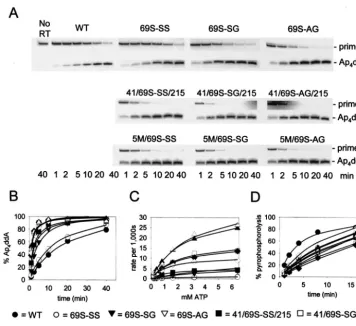
phos-phorimaging as a function of time of incubation with 3.2 mM ATP (Fig. 1A and B) and as a function of ATP concentra-tion (Fig. 1C and Table 2). There was no increase in Ap4ddA
synthesis conferred by the 69S-SS mutation, in agreement with published data on ATP-dependent removal of AZTMP (19). The 69S-SG and 69S-AG mutations, however, did confer
mod-est (three- or fourfold) increases over results for WT RT. The difference between the 69S-SG/AG and the 69S-SS mutations was also observed in RT-containing AZT resistance mutations. The 41L/69S-SS/215Y mutations conferred about a 10-fold in-crease in Ap4ddA synthesis over WT RT, consistent with an
additive effect of the 10-fold increase conferred by the 41L/ 215Y mutations (25) and minimal increase due to the 69S-SS mutations. The 41L/69S-SG/215Y and the 41L/69S-AG/215Y mutations resulted in 21-fold increases in Ap4ddA synthesis
relative to WT RT, also consistent with an additive effect of the finger insertion mutations and the AZT resistance mutations. Addition of the mutations 210W, 211K, and 214F to the 41L/ 215Y mutations in HIV-1 RT containing the finger insertion mutations further increased the Ap4ddA synthesis activity by
approximately 50%. Two enzymes, 5M⫹69S-SG RT and 5M
⫹69S-AG, formed Ap4ddA 32 times more efficiently than did
WT RT. Similar methods were used to measure the pyrophos-phorolysis reaction catalyzed by WT and mutant enzymes. The [32P]ddAMP-terminated primer-template was incubated with
WT or mutant RTs in the presence of PPi, and [32P]ddATP was
quantitated by phosphorimaging (Fig. 1D). The mutant en-zymes had pyrophosphorolysis activities that were at most 60 to 70% of the WT activity.
Inhibition of ATP-dependent removal of ddAMP by the next
complementary dNTP.The large increase in ATP-dependent
removal of ddAMP conferred by the combination of AZT resistance mutations and finger insertion mutations suggests a mechanism for resistance for the mutant HIV-1 to dideoxyi-nosine (ddI) (which is converted to its active form, ddATP, by host enzymes). However, removal of ddAMP by either WT or AZT-resistant RTs is very sensitive to inhibition by dNTPs (50% inhibitory concentrations [IC50s] approximately 3 to 20
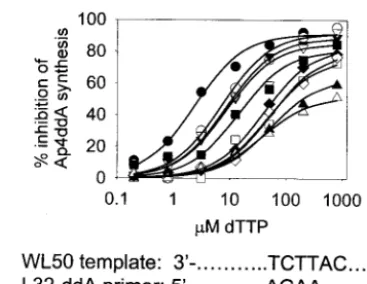
M [22, 24, 25]). We therefore investigated the effects of the finger insertion mutations on the sensitivity of the removal reaction to dTTP, the dNTP complementary to the next nu-cleotide position on the template. Briefly, the synthesis of Ap4ddA was determined as described above in the presence of
[image:2.603.304.542.76.219.2]increasing concentrations of dTTP. The percent inhibition of
TABLE 1. Nomenclature of HIV-1 RT mutants useda
Name Mutations
WT...None
69S-SS ...T69S and an insertion of SS after 69 69S-SG ...T69S and an insertion of SG after 69 69S-AG...T69S and an insertion of AG after 69 41L/215Y...M41L, T215Y
41L/69S-SS/215Y...M41L, T69S, an insertion of SS after 69, and T215Y 41L/69S-SG/215Y...M41L, T69S, an insertion of SG after 69, and T215Y 41L/69S-AG/215Y...M41L, T69S, an insertion of AG after 69, and T215Y
5M⫹69S-SS ...M41L, T69S, an insertion of SS after 69, L210W,
R211K, L214F, and T215Y
5M⫹69S-SG ...M41L, T69S, an insertion of SG after 69, L210W,
R211K, L214F, and T215Y
5M⫹69S-AG ...M41L, T69S, an insertion of AG after 69, L210W,
R211K, L214F, and T215Y
aHis-tagged HIV-1 RT was prepared as previously described (24). The
RNA-dependent DNA polymerase activities of the WT and mutant RTs were as follows: WT, 35,000 U/mg; 69S-SS, 40,000 U/mg; 69S-SG, 23,000 U/mg; 69S-AG, 41,000 U/mg; 41L/215Y, 27,000 U/mg; SS/215Y, 33,000 U/mg;
41L/69S-SG/215Y, 38,000 U/mg; 41L/69S-AG/215Y, 33,000 U/mg; 5M⫹69S-SS, 25,000
U/mg; 5M⫹69S-SG, 29,000 U/mg; and 5M⫹69S-AG, 27,000 U/mg, where 1 U
is equal to the amount of enzyme required for incorporation of 1.0 nmol of
[3H]dTMP in 10 min when using poly(rA)/oligo(dT) as the substrate (32).
3872 NOTES J. VIROL.
on November 8, 2019 by guest
http://jvi.asm.org/
Ap4ddA synthesis is shown as a function of dTTP
concentra-tion (Fig. 2), and the IC50for dTTP inhibition was determined
for each RT (Table 3). WT RT was the most sensitive to inhibition by dTTP with an IC50of about 3M. Each of the
finger insertion mutations decreased sensitivity to dTTP inhi-bition of Ap4ddA synthesis by about threefold. Together with
the 41L/215Y mutations, the finger insertion mutations de-creased sensitivity to dTTP inhibition by 5- to 18-fold. Sensi-tivity to dTTP inhibition was decreased only about 25% by the 41L/215Y mutations alone (Table 3) (25). Therefore, the effect of the combination of finger insertion mutations with 41L/ 215Y mutations on dTTP inhibition was synergistic. When the 41L/210W/211K/214F/215Y mutations were present as well as the finger insertion mutations, dTTP inhibition was decreased by 16- to 23-fold relative to WT RT. The decreased sensitivity to dTTP inhibition of Ap4ddA synthesis by the mutant RTs is
likely related to decreased formation or decreased stability of
DEC formed by the mutant enzymes with ddAMP-terminated primer-template and dTTP (data not shown).
Effects of the finger insertion mutations on HIV-1 RT
DNA-dependent polymerization.The decreased sensitivity of mutant
RTs to dNTP inhibition and decreased ability to form stable ternary complexes with dNTP and primer-template suggested that dNTP incorporation might also be altered by these muta-tions. We therefore measured the ability of each enzyme to carry out DNA-dependent polymerization on M13 template-primer in the presence of low, 625 nM (Fig. 3A) or high, 200
M (Fig. 3B) concentrations of dNTPs. A comparison of DNA chain elongation with 41L/215Y RT and isogenic WT RT at each dNTP concentration is shown in Fig. 3C.
At low levels of dNTPs, WT and 41L/215Y RTs had the greatest DNA chain elongation activity, but short products still predominated (Fig. 3A and C). The three RTs containing only the 69S-XX mutations had reduced DNA polymerization
ac-FIG. 1. Effect of finger insertion mutations and AZT resistance mutations on removal of [32P]ddAMP from blocked primer-template through
transfer to ATP or PPi. (A) [32P]-ddAMP-terminated L32 primer-WL50 template (5 nM) was incubated with the indicated RT and 3.2 mM ATP
for 1, 2, 5, 10, 20, or 40 min in reaction buffer (40 mM HEPES, pH 7.5, 20 mM MgCl2, 60 mM KCl, 1 mM dithiothreitol, 2.5% glycerol, and 80 g of bovine serum albumin/ml) at 37°C. Products were separated on a 20% denaturing polyacrylamide gel. (B) The radioactivity in primer and Ap4ddA was quantitated by phosphorimaging, and the percent Ap4ddA formed was plotted versus time. (C) Ap4ddA synthesis as a function of ATP
concentration. Reactions were carried out as for panel A but with 0.2 to 6.4 mM ATP and for 20 s to 10 min, depending on the enzyme, to allow a maximum of 35% Ap4ddA formation. (D) PPi-dependent formation of [32P]ddATP (pyrophosphorolysis). Experiments were performed as
described in Fig. 1A legend but with 5M PPisubstituted for ATP, and incubation times were 1, 2, 4, 8, and 16 min. The amount of radioactivity
in primer and ddATP was quantitated by phosphorimaging, and the percentage of label in ddATP was plotted versus time. For panels B, C, and D, the symbols represent data points obtained with the RTs indicated at the bottom of the figure, and the lines represent the best fit to hyperbolae when Sigmaplot 4.0 was used. L32 primer, 5⬘-CTACTAGTTTTCTCCATCTAGACGATACCAGA-3⬘; and WL50 template, 5⬘-GAGTGCTGA GGTCTTCATTCTGGTATCGTCTAGATGGAGAAAACTAGTAG-3⬘.
on November 8, 2019 by guest
http://jvi.asm.org/
[image:3.603.113.470.68.394.2]tivities compared to WT RT. Of the three finger insertion mutations, the 69S-SS mutant was slightly more active than the 69S-SG and AG mutants, with more products in the SP and intermediate-length size ranges and fewer very short products than the other two enzymes. RTs containing the finger inser-tion mutainser-tions in combinainser-tion with the 41L/215Y mutainser-tions showed a dramatic reduction in DNA-dependent polymeriza-tion activity, with products in the very short range predomi-nating and no difference between the three finger insertion mutations. The 41L/69S-XX/215Y RTs were much more de-fective in primer extension than either 41L/215Y RT or the 69S-XX RTs, and it is clear that the deficiency in chain elon-gation is due to interaction between these mutations. Enzymes containing the finger insertion mutations in combination with the 41L/210W/211K/214F/215Y mutations also had greatly re-duced polymerization activity compared to WT RT.
At high dNTP concentrations (200M), WT RT and 41L/ 215Y RT extended almost all chains into very long products (Fig. 3B and C). Each of the three enzymes containing the finger insertion mutations in the absence of AZT resistance mutations could also extend the majority of DNA to very long products. Even at these high dNTP levels, however, the en-zymes containing the finger insertion mutations in combination with the 41L/215Y mutations produced much shorter products. With the addition of mutations at 210W, 211K, and 214F (5M), longer products were observed (Fig. 3B), although the DNA chains did not reach the lengths seen with WT or 41L/215Y RT. In summary, the DNA-dependent DNA polymerase ac-tivity was greatest for WT RT with WT⬃41L/215Y⬎69S-XX
⬎69S-XX⫹5M⬎41L/69S-XX/215Y.
Conclusions.AZT resistance mutations confer an increase
in ATP-dependent removal of many chain terminators from blocked DNA ends (3, 4, 16, 17, 19, 22, 23, 25, 26). The concentration of dNTPs in infected cells, however, should in-hibit removal of most chain terminators other than AZTMP under physiological conditions. Our results suggest a mecha-nism for multidrug resistance conferred by the combination of finger insertion and AZT resistance mutations. In addition to a large increase in ATP-dependent removal of ddAMP from blocked DNA chains (up to 32-fold increase over WT RT,
mostly conferred by the AZT resistance mutations), the com-bination of finger insertion and AZT resistance mutations con-ferred a greatly reduced sensitivity of the removal reaction to dNTPs (up to 23-fold-decreased sensitivity relative to WT RT), which would enable the mutant RT to remove nucleotide an-alogues such as ddAMP and d4TMP, in addition to AZTMP, more efficiently than WT RT under physiological conditions.
[image:4.603.330.514.69.211.2]The 69S-XX mutations confer several different properties on HIV-1 RT; some of these depend on the nature of the amino acids inserted, while others do not. While the 69S-SS mutations conferred no increase in removal compared to WT RT, the 69S-SG and 69S-AG mutations increased removal by three- or fourfold. In combination with the AZT resistance mutations, 41L/215Y, the 69S-SG and 69S-AG mutations con-ferred up to a 21-fold increase in ATP-dependent removal.
FIG. 2. Ability of the complementary dNTP to inhibit dinucleoside polyphosphate synthesis. Inhibition of Ap4ddA synthesis by dTTP. The
ATP-dependent removal of ddAMP was performed as described in the Fig. 1 legend in the presence of 0.2 to 800M dTTP. The amount of Ap4ddA was measured by phosphorimaging, and the percent
inhibi-tion of Ap4ddA formation was plotted versus dTTP concentration.
Symbols are identified in the legend to Fig. 1. Lines represent the theoretical curves obtained by fitting the data to hyperbolae by using Sigmaplot 4.0 and were used to determine IC50s (Table 3). A portion
[image:4.603.45.283.89.233.2]of the L32-ddAMP–WL50 sequence is shown at the bottom of the figure.
TABLE 2. Kinetic parameters for Ap4ddA formation
by WT and mutant RTs
HIV-1 RT used
Values for formation of Ap4ddAa
kcat/Km, ATP
(M⫺1S⫺1) Increase (versus WT RTn-fold)
WT 0.38⫾0.02 1.0
69S-SS 0.38⫾0.03 1.0
69S-SG 1.2⫾0.1 3.2
69S-AG 1.6⫾0.2 4.2
41L/215Y 1.9⫾0.4 9.0ⴱ
41L/69S-SS/215Y 4.0⫾0.1 10
41L/69S-SG/215Y 8.0⫾0.9 21
41L/69S-AG/215Y 7.8⫾0.8 21
5M⫹69S-SS 7.0⫾1.8 18
5M⫹69S-SG 12⫾2.0 32
5M⫹69S-AG 12⫾2.0 32
aATP-dependent removal of ddAMP was measured as described in the Fig. 1
legend. Numbers shown are the averagekcat/Kmfrom two experiments (plus or
minus the standard deviation). *, in comparison with isogenic WT RT (pKRT2), as previously reported (25).
TABLE 3. Ability of dTTP, the dNTP complementary to the next nucleotide position on the template, to inhibit Ap4ddA synthesis
by HIV-1 RT and ddAMP-terminated primer-template
HIV-1 RT used
Values for inhibition of
Ap4ddA synthesisa
IC50(M) of dTTP IC50versus WT
WT 2.8⫾0.5 1.0
69S-SS 8.6⫾2.0 3.1
69S-SG 7.3⫾1.7 2.6
69S-AG 8.8⫾0.4 3.1
41L/215Y 4.9⫾2.3 1.2b
41L/69S-SS/215Y 14⫾1 5.0
41L/69S-SG/215Y 42⫾17 15
41/69S-AG/215Y 50⫾25 18
5M⫹69S-SS 64⫾14 23
5M⫹69S-SG 48⫾9 17
5M⫹69S-AG 44⫾11 16
aAp
4ddA synthesis was performed as described in the Fig. 1 legend in the
presence of various dTTP concentrations to obtain the IC50s for each HIV-1 RT.
bIn comparison with isogenic WT RT as previously reported (25).
3874 NOTES J. VIROL.
on November 8, 2019 by guest
http://jvi.asm.org/
[image:4.603.301.541.557.699.2]Since removal of ddAMP by WT RT or by several enzymes containing AZT resistance mutations is sensitive to inhibition by physiological concentrations of dNTPs (12, 25), an increase in removal might not by itself be expected to confer significant levels of resistance to ddI in vivo. However, the most dramatic in vitro effect of the 69S-XX finger insertion mutations, espe-cially when present in combination with the 41L and 215Y mutations, was to decrease the sensitivity of the removal reac-tion to inhibireac-tion by dNTPs. The addireac-tion of mutareac-tions at 210W, 211K, and 214F had little additional effect, except in the case of the 41L/69S-SS/215Y combination, where the addition of the mutations at 210, 211, and 214 resulted in a fivefold decrease in dNTP inhibition. The decrease in sensitivity to dNTP inhibition was due to a reduced tendency of the mutant RTs to get trapped as a DEC together with primer-template and dNTP. The combination of finger insertion mutations and AZT resistance mutations would therefore confer both an in-crease in ATP-dependent removal of chain terminators from blocked DNA chains and decreased sensitivity of the removal reaction to dNTP inhibition. These effects could explain the cross-resistance to many chain terminators, such as AZT, stavudine (d4T), ddI, dideoxycytosine (ddC), and abacavir (14).
The severe defect in DNA chain elongation that we ob-served for the combination of 69S-XX mutations with the 41L/215Y mutations is consistent with impaired dNTP binding suggested by the decreased sensitivity to dNTP inhibition of the unblocking reaction. Previous studies (17, 19; P. R. Meyer et al., unpublished data) have shown small decreases in binding affinity between mutant RTs and primer-template and in af-finity for dNTP substrates; however, the defect in DNA
syn-thesis is likely to depend on the precise genetic makeup of the mutant enzymes. A detailed investigation of the catalytic pa-rameters of DNA synthesis by these enzymes is not yet avail-able.
The combination of 41L/215Y mutations and 69S-XX mu-tations is usually observed only in patients receiving multiple nucleoside analogue therapy (14, 37), and Lukashov et al. (18) have reported that a virus containing a 69S-XX/215Y combi-nation was completely replaced by WT virus within 1 month after termination of therapy with d4T and 3⬘thiacytidine (lami-vudine). These results strongly suggest that viruses with these combinations of mutations are at a selective disadvantage in the absence of therapy, as would be predicted from the DNA chain elongation defects that we have observed. We have shown that addition of mutations 210W, 211K, and 214F to the 41L/69S-XX/215Y combination partially repairs the defect in DNA chain elongation, suggesting that these mutations should improve viral replication fitness. Quin˜ones-Mateu et al. (27) have recently reported that the removal of the 69S-SS muta-tions from the genome of a virus containing 69S-SS mutamuta-tions in a background containing a variety of mutations, including AZT resistance mutations, produced a virus with reduced fit-ness. This result suggests that the contribution of the 69S-SS mutations to fitness depends on the mutational environment in the rest of the RT coding region.
[image:5.603.120.468.71.286.2]How are the 69S-XX mutations generated? One possibility is that the 69S mutation increases the likelihood of the RT slipping during DNA synthesis after it has replicated the 69S codon. This could lead to rereplication of the 69S codon. If this occurred twice, an insertion of 6 bases would result. Since the codon at position 68 also encodes a serine, another possibility
FIG. 3. DNA-dependent polymerization by WT and mutant RTs. 5⬘-[32P]-labeled 35-mer DNA primer (5⬘-AAGTTGGGTAACGCCAGGG
TTTTCCCAGTCACGAC) annealed to M13 template (2.5 nM) was incubated with excess RT (100 nM) at 37°C for 5 min followed by incubation with either a 625 nM (Low dNTPs [A and C]) or 200M (High dNTPs [B and C]) concentration of each dNTP for 2.5 min at 37°C. Reactions were stopped by heating at 90°C for 5 min. Samples were separated by electrophoresis through a 10% denaturing polyacrylamide gel. Extension products are indicated at the right of each panel as VL (very long products), LP (long products), MP (intermediate products), SP (short products), VSP (very short products), and P (unextended primer). The enzyme used for the extension is indicated above each lane: NEG, no enzyme; W, WT RT; 69S-XX, 69S-SS, SG, or AG RT as indicated; 41/215, 41L/215Y RT with 69S-XX mutations as indicated; 5M, 41L/210W/211K/214F/215Y RT with 69S-XX mutations as indicated.
on November 8, 2019 by guest
http://jvi.asm.org/
is that the inserted codons arise from a rereplication of both the 68 and 69 codons, as suggested by Boyer et al. (2). Pub-lished reports support the latter hypothesis. The sequence of the first and second inserted serine codons of six different HIV-1 viruses containing the 69S-SS insertion was identical in sequence to the codons at positions 68 and 69, respectively (5, 37). If the 69S-XX insertion mutations were indeed created by rereplication of codons 68 and 69, all finger insertion muta-tions should initially be 69S-SS. The two inserted serines would then be under selective pressure to change to any amino acids that would confer a growth advantage. The 69S-SS mutations conferred no detectable increase in ATP-dependent removal of chain terminators, while both the 69S-SG and the 69S-AG mutations did confer such an increase. The 69S-SS did confer reduced sensitivity to dNTP inhibition of the removal reaction, which could explain its selection; however, removal activity could be improved by subsequent mutation of the SS codons to codons for other amino acids. The in vitro results are consis-tent with viral drug susceptibility assays, since the 69S-SG mutations are associated with two- to sevenfold-greater resis-tance to AZT, ddI, ddC, and d4T than the 69S-SS mutations (17, 37). Taken together, these results lead to the prediction that the 69S-SS mutations may be replaced by 69S-SG or other amino acid insertions over time due to selective pressure. The predicted evolution has, in fact, been reported for several HIV-1-infected individuals (6, 14, 31).
Our results reinforce the importance of ATP-dependent re-moval of chain terminators in resistance to nucleoside ana-logues. Initially, it was shown that AZT resistance mutations confer an increase in ATP-dependent removal of AZTMP from blocked DNA chains (3, 16, 22), which would be a likely mechanism for AZT resistance. Since then, a role of ATP-dependent removal has also been suggested as a mechanism of resistance to d4T (17, 20, 23) and as a mechanism of multi-nucleoside resistance (4, 18; this report). Therefore, chain-terminating compounds that are refractory to removal and drugs that block the removal reaction could greatly increase the antiviral potency of nucleoside analogues and are impor-tant candidates for future drug research.
As this paper was about to be submitted, a paper by Boyer et al. (4) appeared showing that excision of various chain-terminating nucleotides was enhanced in RT containing 69S-XX insertion mutations even in the presence of relatively high levels of dNTPs. These authors showed that ternary complex stability was diminished in the mutant RT and proposed that enhanced excision of these chain terminators could be ex-plained by destabilization of the ternary complex of RT with dNTP resulting from the amino acid insertions in the finger domain.
This work was supported by amFAR fellowship 70567-31-RF (to P.R.M.), a scholarship from Wenner-Gren Stiftelsen, a grant from the Swedish Research Council (to J.L.), and NIH grant AI39973 (to W.A.S.).
REFERENCES
1. Arion, D., N. Kaushik, S. McCormick, G. Borkow, and M. A. Parniak.1998.
Phenotypic mechanism of HIV-1 resistance to 3⬘-azido-3⬘-deoxythymidine
(AZT): increased polymerization processivity and enhanced sensitivity to
pyrophosphate of the mutant viral reverse transcriptase. Biochemistry37:
15908–15917.
2. Boyer, P. L., J. Lisziewicz, F. Lori, and S. H. Hughes.1999. Analysis of amino
insertion mutations in the fingers subdomain of HIV-1 reverse transcriptase.
J. Mol. Biol.286:995–1008.
3. Boyer, P. L., S. G. Sarafianos, E. Arnold, and S. H. Hughes.2001. Selective excision of AZTMP by drug-resistant human immunodeficiency virus reverse
transcriptase. J. Virol.75:4832–4842.
4. Boyer, P. L., S. G. Sarafianos, E. Arnold, and S. H. Hughes.2002. Nucleoside analog resistance caused by insertions in the fingers of human immunodefi-ciency virus type 1 reverse transcriptase involves ATP-mediated excision.
J. Virol.76:9143–9151.
5. Briones, C., A. Mas, G. Go´mez-Mariano, C. Altisent, L. Mene´ndez-Arias, V. Soriano, and E. Domingo.2000. Dynamics of dominance of a dipeptide insertion in reverse transcriptase of HIV-1 from patients subjected to
pro-longed therapy. Virus Res.66:13–26.
6. Briones, C., A. Mas, M. Pe´rez-Olmeda, C. Altisent, E. Domingo, and V. Soriano.2001. Prevalence and genetic heterogeneity of the reverse transcrip-tase T69S-S-X insertion in pretreated HIV-infected patients. Intervirology
44:339–343.
7. de Jong, J. J., J. Goudsmit, V. V. Lukashov, M. E. Hillebrand, E. Baan, R. Huismans, S. A. Danner, J. H. ten Veen, F. de Wolf, and S. Jurriaans.1999. Insertion of two amino acids combined with changes in reverse transcriptase containing tyrosine-215 of HIV-1 resistant to multiple nucleoside analogs.
AIDS13:75–80.
8. de Mendoza, C., O. Gallego, and V. Soriano.2002. Mechanisms of resistance
to antiretroviral drugs—clinical implications. AIDS Rev.4:64–82.
9. Feng, J. Y., and K. S. Anderson.1999. Mechanistic studies examining the efficiency and fidelity of DNA synthesis by the 3TC-resistant mutant (184V)
of HIV-1 reverse transcriptase. Biochemistry38:9440–9448.
10. Gao, W.-Y., R. Agbaria, J. S. Driscoll, and H. Mitsuya.1994. Divergent anti-human immunodeficiency virus activity and anabolic phosphorylation of
2⬘,3⬘-dideoxynucleoside analogs in resting and activated human cells. J. Biol.
Chem.269:12633–12638.
11. Gao, W.-Y., A. Cara, R. C. Gallo, and F. Lori.1993. Low levels of de-oxynucleotides in peripheral blood lymphocytes: a strategy to inhibit human
immunodeficiency virus type 1 replication. Proc. Natl. Acad. Sci. USA90:
8925–8928.
12. Isel, C., C. Ehresmann, P. Walter, B. Ehresmann, and R. Marquet.2001. The emergence of different resistance mechanisms toward nucleoside inhib-itors is explained by the properties of the wild type HIV-1 reverse
transcrip-tase. J. Biol. Chem.276:48725–48732.
13. Krebs, R., U. Immendo¨rfer, S. H. Thrall, B. M. Wo¨hrl, and R. S. Goody.
1997. Single-step kinetics of HIV-1 reverse transcriptase mutants responsible for virus resistance to nucleoside inhibitors zidovudine and 3-TC.
Biochem-istry36:10292–10300.
14. Larder, B. A., S. Bloor, S. D. Kemp, K. Hertogs, R. L. Desmet, V. Miller, M. Sturmer, S. Staszewski, J. Ren, D. K. Stammers, D. I. Stuart, and R. Pau-wels.1999. A family of insertion mutations between codons 67 and 70 of human immunodeficiency virus type 1 reverse transcriptase confer
multi-nucleoside analog resistance. Antimicrob. Agents Chemother.43:1961–1967.
15. Larder, B. A., B. Chesebro, and D. D. Richman.1990. Susceptibilities of zidovudine-susceptible and -resistant human immunodeficiency virus isolates to antiviral agents determined by using a quantitative plaque reduction assay.
Antimicrob. Agents Chemother.34:436–441.
16. Lennerstrand, J., K. Hertogs, D. K. Stammers, and B. A. Larder.2001. Correlation between viral resistance to zidovudine and resistance at the reverse transcriptase level for a panel of human immunodeficiency virus type
1 mutants. J. Virol.75:7202–7205.
17. Lennerstrand, J., D. K. Stammers, and B. A. Larder.2001. Biochemical mechanism of human immunodeficiency virus type 1 reverse transcriptase
resistance to stavudine. Antimicrob. Agents Chemother.45:2144–2146.
18. Lukashov, V. V., R. Huismans, M. F. Jebbink, S. A. Danner, R. J. de Boer, and J. Goudsmit.2001. Selection by AZT and rapid replacement in the absence of drugs of HIV type 1 resistant to multiple nucleoside analogs.
AIDS Res. Hum. Retrovir.17:807–818.
19. Mas, A., M. Parera, C. Briones, V. Soriano, M. A. Martı´nez, E. Domingo, and L. Mene´ndez-Arias.2000. Role of a dipeptide insertion between codons 69 and 70 of HIV-1 reverse transcriptase in the mechanism of AZT
resis-tance. EMBO J.19:5752–5761.
20. Mas, A., B. M. Va´zquez-A´lvarez, E. Domingo, and L. Mene´ndez-Arias.2002. Multi-drug resistant HIV-1 reverse transcriptase: involvement of ribonucle-otide-dependent phosphorolysis in cross-resistance to nucleoside analogue
inhibitors. J. Mol. Biol.323:181–197.
21. Masquelier, B., E. Race, C. Tamalet, D. Descamps, J. Izopet, C. Buffet-Janvresse, A. Ruffault, A. S. Mohammed, J. Cottalorda, A. Schmuck, V. Calvez, E. Dam, H. Fleury, F. Brun-Ve´zinet, and The ANRS AC11 Resistance Study Group.2001. Genotypic and phenotypic resistance patterns of human immunodeficiency virus type 1 variants with insertions or deletions in the reverse transcriptase (RT): multicenter study of patients treated with RT
inhibitors. Antimicrob. Agents Chemother.45:1836–1842.
22. Meyer, P. R., S. E. Matsuura, A. M. Mian, A. G. So, and W. A. Scott.1999. A mechanism of AZT resistance: an increase in nucleotide-dependent
primer unblocking by mutant HIV-1 reverse transcriptase. Mol. Cell4:35–43.
23. Meyer, P. R., S. E. Matsuura, R. F. Schinazi, A. G. So, and W. A. Scott.2000.
3876 NOTES J. VIROL.
on November 8, 2019 by guest
http://jvi.asm.org/
Differential removal of thymidine nucleotide analogues from blocked DNA chains by human immunodeficiency virus reverse transcriptase in the
pres-ence of physiological concentrations of 2⬘-deoxynucleoside triphosphates.
Antimicrob. Agents Chemother.44:3465–3472.
24. Meyer, P. R., S. E. Matsuura, A. G. So, and W. A. Scott.1998. Unblocking of chain-terminated primer by HIV-1 reverse transcriptase through a
nucle-otide-dependent mechanism. Proc. Natl. Acad. Sci. USA95:13471–13476.
25. Meyer, P. R., S. E. Matsuura, A. A. Tolun, I. Pfeifer, A. G. So, J. W. Mellors, and W. A. Scott.2002. Effects of specific zidovudine resistance mutations and substrate structure on nucleotide-dependent primer unblocking by human immunodeficiency virus type 1 reverse transcriptase. Antimicrob. Agents
Chemother.46:1540–1545.
26. Naeger, L. K., N. A. Margot, and M. D. Miller. 2002. ATP-dependent removal of nucleoside reverse transcriptase inhibitors by human immunode-ficiency virus type 1 reverse transcriptase. Antimicrob. Agents Chemother.
46:2179–2184.
27. Quin˜ones-Mateu, M. E., M. Tadele, M. Parera, A. Mas, J. Weber, H. R. Rangel, B. Chakraborty, B. Clotet, E. Domingo, L. Mene´ndez-Arias, and M. A. Martínez.2002. Insertions in the reverse transcriptase increase both drug resistance and viral fitness in a human immunodeficiency virus type 1 isolate harboring the multi-nucleoside reverse transcriptase inhibitor
resis-tance 69 insertion complex mutation. J. Virol.76:10546–10552.
28. Roy, B., C. Beuneu, P. Roux, H. Buc, G. Lemaire, and M. Lepoivre.1999. Simultaneous determination of pyrimidine and purine deoxyribonucleoside
triphosphates using a polymerase assay. Anal. Biochem.269:403–409.
29. Schinazi, R. F., B. A. Larder, and J. W. Mellors.2000. Mutations in retroviral genes associated with drug resistance: 2000–2001 update. Int. Antivir. News
8:65–91.
30. Sugiura, W., M. Matsuda, Z. Matsuda, H. Abumi, A. Okano, T. Oishi, K. Moriya, Y. Yamamoto, K. Fukutake, J. Mimaya, A. Ajisawa, M. Taki, K. Yamada, and Y. Nagai.1999. Identification of insertion mutations in HIV-1 reverse transcriptase causing multiple drug resistance to nucleoside analogue
reverse transcriptase inhibitors. J. Hum. Virol.2:146–153.
31. Tamalet, C., N. Yahi, C. Tourre`s, P. Colson, A.-M. Quinson, I. Poizot-Martin, C. Dhiver, and J. Fantini.2000. Multidrug resistance genotypes
(Insertions in the3-4 finger subdomain and MDR mutations) of HIV-1
reverse transcriptase from extensively treated patients: incidence and
asso-ciation with other resistance mutations. Virology270:310–316.
32. Tan, C.-K., J. Zhang, Z.-Y. Li, W. G. Tarpley, K. M. Downey, and A. G. So.
1991. Functional characterization of RNA-dependent DNA polymerase and RNase H activities of a recombinant HIV reverse transcriptase.
Biochemis-try30:2651–2655.
33. Terai, C., and D. A. Carson.1991. Pyrimidine nucleotide and nucleic acid
synthesis in human monocytes and macrophages. Exp. Cell Res.193:375–
381.
34. Tong, W., C.-D. Lu, S. K. Sharma, S. Matsuura, A. G. So, and W. A. Scott.
1997. Nucleotide-induced stable complex formation by HIV-1 reverse
tran-scriptase. Biochemistry36:5749–5757.
35. Ueno, T., and H. Mitsuya.1997. Comparative enzymatic study of HIV-1
reverse transcriptase resistant to 2⬘,3⬘-dideoxynucleotide analogs using the
single-nucleotide incorporation assay. Biochemistry36:1092–1099.
36. van Vaerenbergh, K., K. van Laethem, J. Albert, C. A. B. Boucher, B. Clotet, M. Floridia, J. Gerstoft, B. Hejdeman, C. Nielsen, C. Pannecouque, L. Perrin, M. F. Pirillo, L. Ruiz, J.-C. Schmit, F. Schneider, A. Schoolmeester, R. Schuurman, H. J. Stellbrink, L. Stuyver, J. van Lunzen, B. van Remoortel, E. van Wijngaerden, S. Vella, M. Witvrouw, S. Yerly, E. de Clercq, J. Desmyter, and A.-M. Vandamme.2000. Prevalence and characteristics of multinucleoside-resistant human immunodeficiency virus type 1 among Eu-ropean patients receiving combinations of nucleoside analogues.
Antimi-crob. Agents Chemother.44:2109–2117.
37. Winters, M. A., K. L. Coolley, Y. A. Girard, D. J. Levee, H. Hamdan, R. W. Shafer, D. A. Katzenstein, and T. C. Merigan.1998. A 6-basepair insert in the reverse transcriptase gene of human immunodeficiency virus type 1
confers resistance to multiple nucleoside inhibitors. J. Clin. Investig.102:
1769–1775.

![FIG. 3. DNA-dependent polymerization by WT and mutant RTs. 5�TTTTCCCAGTCACGAC) annealed to M13 template (2.5 nM) was incubated with excess RT (100 nM) at 37°C for 5 min followed by incubationwith either a 625 nM (Low dNTPs [A and C]) or 200were stopped by](https://thumb-us.123doks.com/thumbv2/123dok_us/293902.61971/5.603.120.468.71.286/dependent-polymerization-ttttcccagtcacgac-annealed-template-incubated-followed-incubationwith.webp)
