0022-538X/95/$04.0010
Copyrightq1995, American Society for Microbiology
Replication and Amplification of Novel Vesicular Stomatitis
Virus Minigenomes Encoding Viral Structural Proteins
ELIZABETH A. STILLMAN,
1JOHN K. ROSE,
2AND
MICHAEL A. WHITT
1*
Department of Microbiology and Immunology, University of Tennessee at Memphis, Memphis,
Tennessee 38163,
1and Departments of Pathology and Cell Biology, Yale University
School of Medicine, New Haven, Connecticut 06513
2Received 17 January 1995/Accepted 10 February 1995
We have developed a system in which vesicular stomatitis virus (VSV) minigenomes encoding viral structural
proteins can be expressed from plasmids. These RNAs can be replicated, transcribed, and packaged into
infectious particles when coexpressed with the other VSV proteins. The minigenomes contain either the
glycoprotein (G protein) gene (GMG [stands for G minigenome]) or both the G and matrix (M) protein genes
(GMMG [stands for G/M minigenome]) from the Indiana serotype of VSV flanked by the trailer and leader
regions from the wild-type VSV genome. Northern (RNA) blot analysis showed that the minigenome RNAs were
replicated and that a positive-sense replicative intermediate was synthesized when coexpressed with the
nucleocapsid (N) protein and the two VSV polymerase proteins (phosphoprotein [P] and the large catalytic
subunit [L]) in vivo. In addition, functional mRNAs were transcribed from the minigenome templates, and the
appropriate encoded proteins were expressed. Expression of the G and M proteins from GMMG resulted in the
assembly and release of infectious particles that could be passaged on cells expressing the N, P, and L proteins
only. Amplification occurred during successive passages, and after four passages approximately 30% of the
cells expressed both the G and M proteins. Analysis of the RNAs produced in the GMMG-infected cells also
showed that the minigenomes accurately reproduced all of the replicative and transcriptional events that
normally occur in a VSV-infected cell. GMMG is therefore a novel type of defective particle which encodes
functional viral proteins critical to its own propagation.
Vesicular stomatitis virus (VSV) is a nonsegmented
nega-tive-strand virus that belongs to the Rhabdoviridae family and
has been used extensively as a model to study virus entry (20,
37), replication (2, 3), and assembly (21, 33, 35). Although
VSV has been a good model for studying various aspects of the
virus life cycle, one of the limitations in using VSV to study
virus replication and assembly has been the inability to
intro-duce specific mutations into the negative-sense RNA genome
of this virus. The difficulty in manipulating the genome of VSV,
and those of other negative-strand viruses, results from the
nature of the functional template for replication and
transcrip-tion. For VSV and other negative-strand viruses, the genomic
RNA must be encapsidated by the nucleocapsid protein (N
protein) before it can serve as a template for either
transcrip-tion or replicatranscrip-tion by the viral polymerase (16). In the case of
VSV, the viral polymerase is composed of two subunits
con-sisting of the phosphoprotein (P protein) and the large
cata-lytic subunit (L protein). Encapsidation of functional genomes
is thought to occur on nascent transcripts; therefore, all four
components (viral RNA and the N, P, and L proteins) must be
expressed and assembled in vivo to generate a transcriptionally
active template.
The VSV polymerase is responsible for both transcription of
individual mRNAs from the five genes encoded by VSV and
replication of the negative-sense genome to a full-length,
an-tigenomic replicative intermediate (RI). The RI is then used as
a template by the VSV polymerase to generate progeny
ge-nomes for subsequent rounds of transcription and replication
or for packaging into nascent virions. In addition to the N, P,
and L proteins, the two other genes encoded by VSV are the
glycoprotein (G) and matrix (M) protein. The G protein is
located in the virion envelope and is responsible for binding of
virus to cells and for virus entry by virtue of its membrane
fusion activity. The M protein is associated with both the inner
leaflet of the infected cell plasma membrane and with
con-densed nucleocapsids.
To gain a better understanding of the role that each of the
VSV proteins plays in virus replication and assembly,
signifi-cant effort has been made to develop systems that allow genetic
manipulation of the VSV genome. Several different systems
have been developed for VSV and other related
negative-strand viruses to study the replication, transcription, and
as-sembly of these viruses starting from DNA constructs.
Re-cently, infectious virus has been obtained from full-length
DNA clones of both rabies virus (31) and VSV (18); however,
most systems employ expression of RNA molecules from
DNAs that encode modified, shorter versions of the viral
ge-nome. These synthetic genome analogs can be encapsidated,
replicated, and passaged when the appropriate viral proteins
are expressed in the same cell.
One approach that has been used to identify sequences
important for the encapsidation, replication, and expression of
viral genes utilizes synthetic RNA genomes containing a
re-porter gene in an antisense orientation flanked by the terminal
genomic sequences required for packaging and replication
(10–12, 22). These synthetic genomes are encapsidated either
in vitro and the assembled nucleocapsids are transfected into
cells or the genome analogs are expressed from plasmids in
vivo. Mutations that affect encapsidation, replication, and/or
transcription are often identified by measuring the activity of a
reporter gene after infection with the homologous helper virus
or after expression of the nucleocapsid and polymerase
pro-teins from cDNA clones. Replication and packaging are
evi-* Corresponding author. Mailing address: 858 Madison Ave.,De-partment of Microbiology and Immunology, University of Tennessee at Memphis, Memphis, TN 38163. Phone: (901) 448-4634. Fax: (901) 448-8462. Electronic mail address: [email protected].
2946
on November 9, 2019 by guest
http://jvi.asm.org/
dent by the ability to detect the reporter gene activity after
subsequent passages onto fresh cells expressing the
appropri-ate viral proteins. Other systems utilize cDNAs of defective
interfering (DI) particles (7, 8, 23). The genomic DI RNAs are
transcribed from plasmids containing the cDNAs in vivo, using
the vaccinia virus-T7 polymerase transcription system. A
pre-cise 3
9
end is created by autocatalytic cleavage directed by a
ribozyme located immediately following the terminal
nucle-otide of the DI RNA. These systems typically do not utilize
transcription of a reporter gene to measure transcription;
in-stead, DI replication is measured directly by detecting
radio-labeled RNA after immunoprecipitation of nucleocapsids or
by Northern (RNA) blot analysis. Each of the systems
cur-rently in use for nonsegmented negative-strand viruses has
advantages and disadvantages. One of the disadvantages
suf-fered by all of these systems is the requirement that all viral
proteins be provided in trans, either from individual cDNAs or
from a helper virus, to study the assembly and release of
infectious virus particles.
In this report we describe a new system using VSV
mini-genomes that can be used to investigate the requirements for
virus assembly. The minigenome RNAs are expressed from
cDNAs and contain either one or two VSV genes flanked by
the VSV leader and trailer regions, such that all of the
se-quences thought to be required for VSV replication and the
synthesis of viral mRNAs are present. When plasmids
encod-ing a minigenome that contains either the G protein gene
(GMG [stands for G minigenome]) or the G and M protein
genes in tandem (GMMG [stands for G/M minigenome]) are
transfected into cells along with plasmids encoding the N, P,
and L proteins of VSV, individual mRNAs are produced and
either G protein or G and M proteins are synthesized,
respec-tively. Using GMMG, sufficient G and M protein is produced
to allow the assembly and release of infectious particles from
the transfected cells. Subsequent passaging onto cells
express-ing the N, P, and L proteins results in an amplification of the
infectious particles. VSV minigenomes will not only provide
new tools to study the role of the G and M proteins in VSV
assembly, but they should also be useful in defining the signals
important for mRNA initiation, transcription, and
polyadenyl-ation.
MATERIALS AND METHODS
Expression plasmids and minigenome constructs.The cDNAs for the N, P, and L proteins of VSV were subcloned into a modified form of pBluescript (pBS-SK1; Stratagene, Inc.) that contained the bacteriophage T7 RNA poly-merase terminator (Tf) inserted at the end of the polylinker most distal to the T7 promoter. The sequences for Tfwere obtained from the plasmid pET-3 (29) by PCR amplification. The primers used for amplification contained either ApaI and SacII sites (sense-strand primer, with respect to the T7 promoter) or SacI and KpnI sites (antisense primer) at the 59end to allow subcloning of the Tfinto the polylinker of pBS-SK1or pBS-KS1. The sequence of the sense-strand primer (called T7-term2) was 59-TATAGGGCCCCCGCGGGGCTGCTAACAA
AGCCCG-39, and the sequence of the anti-sense primer (called T7-term1) was 59-TATAGGTACCGAGCTCATCGAGGTCTCGATCCGGATATAG-39 .Nucleo-tides complementary to the Tfsequences are in boldface. A single nucleotide substitution (underlined) was introduced into the antisense primer to eliminate the BglII site at the end of the terminator in pET-3 (29). The PCR-amplified fragment was digested with SacII and SacI and then inserted into pBS-SK1to generate pBS-SK-Tfor digested with ApaI and KpnI and inserted into pBS-KS1 to generate pBS-KS-Tf.
The N protein cDNA was recovered from pJS223 (34) after digestion with XhoI and then subcloned into pBS-SK-Tf. To eliminate sequences derived from pBR322 present at the 39end of the N protein cDNA, a BglI-to-EcoRV fragment corresponding to the 39end of the N gene, the N-P intergenic region, and the 59 untranslated region of the P protein gene was recovered from pBS-N/P (40) and ligated into the plasmid mentioned above containing the N protein gene after digestion with BglI and EcoRV. This plasmid is called pBS-N-Tf. The P protein cDNA was recovered from pBS-N/P (40) by digesting with EcoRV and PstI and then subcloned into pBS-SK-Tf. The L protein cDNA was obtained from
pSV-VSL1 (32) as an XhoI fragment and initially cloned into pBS-SK1to generate pBS-L. To eliminate additional non-VSV sequences at the 39end of the L clone, we linearized pBS-L with AflII and then generated a blunt end by filling in, using Klenow fragment. The linearized plasmid was then digested with ApaI, and the L protein cDNA was gel purified and subcloned into pBS-SK-Tfby using the ApaI and EcoRV sites in the polylinker. The L protein cDNA was derived from the Mudd-Summers strain of the Indiana serotype of VSV (VSVInd), whereas the N and P protein cDNAs originated from the San Juan strain of VSVInd. The M and G genes used in the minigenomes described below were also obtained from the San Juan strain of VSVInd.
Plasmids encoding VSV minigenomes were derived from a full-length cDNA clone of the VSVIndgenome called pVSVFL(2) and are in pBluescript vectors. Although the methodology used to assemble the VSV cDNA will be presented elsewhere (40), the procedures that were used to join the terminal sequences of VSV to the T7 promoter and the hepatitis delta virus (HDV) ribozyme are described below.
First, the trailer region at the 59end of the VSVIndgenome was fused to the T7 promoter with a synthetic linker that extended from the HinfI site in the T7 promoter to the AflII site at nucleotide 46 of the VSV trailer. The linker was designed such that there would be two (non-VSV) G residues at the 59end of the transcript produced by T7 RNA polymerase. The sequence of the coding-strand oligonucleotide used in the synthetic linker was 59-ACTCACTATAGGACGAA GACCACAAAACCAGATAAAAAATAAAAACCACAAGAGGGTC-39. The two non-VSV nucleotides are underlined. When annealed with the complemen-tary, non-coding-strand oligonucleotide, a double-stranded linker with the proper 59overhangs for the HinfI and AflII sites was generated. The synthetic linker was used with a NaeI-to-HinfI fragment from pBS-SK1, an AflII-to-SacII fragment containing the majority of the L protein cDNA, and a vector derived from pBS-SK1to generate a plasmid called pBS-Lgen (for genomic sense).
The sequences at the 39end of the VSV genome were obtained by reverse transcription-PCR with an oligonucleotide primer that contained sequences complementary to the 26 terminal nucleotides in the VSV leader region at the 39 end and sequences for ApaI, SpeI, RsrII, and SnaBI restriction sites at the 59end. The sequence of the primer was 59-TATAGGGCCCACTAGTCGGACCGT ACGTAACAGAAGACAAACAAACCATTATTATC-39. The ApaI site at the 59 end of the oligonucleotide is underlined, and the VSV sequences are in boldface. This oligonucleotide was used to prime first-strand cDNA synthesis from genomic RNA purified from the San Juan strain of VSVInd, using AMV reverse transcriptase. Following cDNA synthesis, the leader-N oligonucleotide was used with an antisense primer that overlapped the BglII site in the N protein gene to PCR amplify a fragment containing the 39end of the VSV genome through the BglII site in the N protein gene. The fragment was digested with BglII and ApaI and then ligated into a plasmid that contained both the N and the P protein genes, including the N-P gene junction (pBS-N/P [40]). The plasmid containing the leader region and the N and P protein genes is called pBS-,/N/P.
Sequences for the HDV ribozyme (25) were fused to the last nucleotide of the leader region by using a two-step, overlap PCR amplification strategy. An oli-gonucleotide called HDV/,-1 that contained sequences from the RsrII site in the HDV ribozyme and that extended through the HDV-leader junction was used with the antisense, N protein gene primer described above to amplify a fragment containing a portion of the HDV ribozyme. This fragment was gel purified and then used as the template in another PCR amplification with a second oligonu-cleotide that contained sequences complementary to the first 20 nuoligonu-cleotides of HDV/,-1, the remainder of the HDV ribozyme sequence, and that had an ApaI site at the 59end together with the same N gene antisense primer. This DNA fragment was digested with BglII and ApaI and used to replace the 39end of the ,-N region in pBS-,/N/P. This plasmid is called pBS-,/N/P-HDV. A plasmid containing the T7 terminator immediately following the HDV sequence was then constructed by inserting the PCR-amplified Tffragment described above be-tween the ApaI and SacI sites at the end of pBS-,/N/P-HDV.
To construct cDNAs encoding VSV minigenomes that contained either the G protein gene only (GMG) or the G and M protein genes in tandem (GMMG), we first constructed a full-length VSV cDNA [pVSVFL(2)] in which two unique restriction sites (MluI and NheI) were introduced in the 59and 39untranslated regions of the G protein gene. To position the polyadenylation signal for the G protein gene at the exact position where the L protein polyadenylation signal is normally located in the VSV genome, we designed an oligonucleotide primer that would fuse the G protein gene to the trailer region. This oligonucleotide, (59-TATACTTAAGGATCAAAGTTTTTTTCATAAAAATTAAAAACTCAA ATATAATTGAGG-39), contained sequences that overlapped the AflII site at nucleotide 46 of the VSV genome (in boldface) and extended through the polyadenylation signal (underlined) and into the 39untranslated region of the G protein gene. This primer and a second PCR primer that overlapped the unique NheI site near the termination codon for G protein were used to amplify a fragment that would result in deletion of the L protein gene when the fragment was ligated into pVSVFL(2). This plasmid is called pVSV-DL.
To join the 59end of the G protein gene to the leader region at the 39end of the VSV genome, we used an oligonucleotide (59-CATAGTGACGCGTTTTG ATTACTGTTAAAGTTTCTC-39) that overlapped the new MluI site in the G protein gene 59untranslated region (in boldface) and that extended into the leader. This preserved the conserved sequence AACAG at the 59end of all VSV mRNAs (the antisense sequence in the oligonucleotide is underlined). A DNA
on November 9, 2019 by guest
http://jvi.asm.org/
fragment was amplified by PCR by using the above-mentioned oligonucleotide and a primer complementary to sequences in the T7 terminator. After digestion with MluI and RsrII, which cuts in the HDV ribozyme, this fragment was used to replace the M, P, and N protein genes in pVSV-DL. This plasmid is called pBS-GMG. A similar strategy was used to construct the plasmid encoding a two-gene minigenome containing the M and G genes (pBS-GMMG). To join the 59 end of the M protein gene to the leader region we used a primer (59 -GATCGTGATATCTGTTAAAGTTTCTCCTGAGCC-39 [the conserved M gene start sequence is underlined]) together with the T7 terminator primer to generate a DNA fragment that would replace the P and N protein genes in pVSV-DL after digestion with EcoRV (in boldface) and RsrII.
All PCR-amplified regions were sequenced by using the dideoxynucleotide method (17, 30) and Sequenase (United States Biochemical), and only those clones containing the consensus sequences for the VSVIndgenome (nucleotide sequence accession number, J02428) as reported in the GenBank database were used in these studies.
Cell culture, plasmid transfections, and immunofluorescence analysis.Baby hamster kidney (BHK-21) cells were grown in Dulbecco modified Eagle medium containing 5% fetal bovine serum, 100 U of penicillin per ml, and 100mg of streptomycin per ml. Stocks of the recombinant vaccinia virus vTF7-3 (15) were prepared as described previously (39). Cell transfections were performed as described previously (38) with a suspension of liposomes composed of dimeth-yldioctadecyl ammonium bromide andL-a-dioleoylphosphatidylethanolamine at a weight ratio of 1:2.5 (28). For cells grown in 35-mm-diameter dishes, we transfected 10mg of plasmid encoding the VSV minigenome cDNAs with 5, 3, and 1mg of plasmids encoding the N, P, and L proteins, respectively. Indirect immunofluorescence was performed between 18 and 24 h posttransfection, es-sentially as described previously (27). To detect G protein on the cell surface, the primary antibody was either a polyclonal rabbita-VSV serum or the G protein-specific monoclonal antibody I1 (19). To detect both G protein on the cell surface and cytoplasmic M protein, fixed cells were first incubated with the a-VSV serum (diluted 1:300) and then with a lissamine rhodamine sulfonyl chloride-labeled, affinity-purified donkey anti-rabbit secondary antibody (Jack-son ImmunoResearch Laboratories, Inc.). After being washed, the cells were permeabilized with 1% Triton X-100 in phosphate-buffered saline containing 10 mM glycine and then incubated with an M-specific monoclonal antibody (19) and a fluorescein isothiocyanate-conjugated donkey anti-mouse secondary antibody. Immunofluorescence microscopy was performed with a Zeiss Axiophot micro-scope.
Minigenome passaging.BHK-21 cells that were plated on coverslips in 35-mm-diameter dishes were infected with vTF7-3 and transfected with plasmids encoding GMMG and the N, P, and L proteins as described above. The medium containing the plasmid-liposome suspension was replaced with Dulbecco modi-fied Eagle medium containing 5% fetal bovine serum after 3 h of incubation at 378C in a 5% CO2incubator, and the cells were maintained at 378C overnight. The culture supernatant was collected between 20 and 24 h posttransfection and cleared by centrifugation at 1,2503g for 10 min. The cells were fixed in 3% paraformaldehyde and processed for immunofluorescence analysis as described above. To passage GMMG particles, another set of BHK cells plated on cover-slips was infected with vTF7-3 and transfected with 5, 3, and 1mg of plasmids encoding the N, P, and L proteins, respectively. The transfection medium was replaced after 3 h with Dulbecco modified Eagle medium containing 5% fetal bovine serum. One-half of the cleared supernatant was then added to these cells at 5 h posttransfection. Subsequent passages were performed by plating the supernatants from these cells onto BHK cells transfected with plasmids encoding the N, P, and L proteins only.
RNA (Northern blot) analysis.Total RNA was isolated from transfected cells at 18 to 24 h posttransfection by the method described by Chomczynski and Sacchi (9). Following extraction with phenol-chloroform and precipitation with isopropanol, the resuspended pellets were treated with RNase-free DNase as instructed by the manufacturer (Promega), extracted again with phenol-chloro-form, and ethanol precipitated. The RNA pellets were resuspended in diethyl pyrocarbonate-treated deionized H2O, denatured by heating to 658C in dena-turing sample buffer (13MOPS buffer [0.2 M MOPS (3-[N-morpholino]pro-panesulfonic acid), 0.05 M sodium acetate, 0.01 M EDTA], 6.5% formaldehyde, 50% formamide), and then fractionated on 1% agarose-formaldehyde gels in 13 MOPS buffer as previously described (1), except the formaldehyde concentration in the gel was 1.1%. The RNA was transferred to a Nytran membrane (Schlei-cher & Schuell), cross-linked by UV-irradiation, and then examined by Northern blot analysis using standard procedures (1).
For end-labeled oligonucleotide probes, the membranes were prehybridized in 35% deionized formamide–53 SSPE (13 SSPE is 0.18 M NaCl, 10 mM NaH2PO4, and 1 mM EDTA [pH 7.7])–53Denhardt’s solution–0.1%mg of denatured salmon sperm DNA per ml for 6 to 8 h at 428C and then hybridized with 13106
to 53106
cpm of end-labeled probe in 53SSPE–13Denhardt’s solution–0.1% SDS–0.05% sodium pyrophosphate–50mg of denatured salmon sperm DNA per ml for 12 to 15 h at 428C. The membranes were washed three times for 15 min each in 23SSC (13SSC is 0.15 M NaCl plus 0.015 M sodium citrate)–0.1% SDS at 508C.
RNA probes were generated by in vitro transcription with T7 RNA poly-merase and [a-32
P]CTP. The G protein mRNA-specific probe was transcribed from a pBS-SK1plasmid containing sequences from the KpnI to the PstI sites of
the G protein cDNA. KpnI cleaves at nucleotide 1042 and PstI cleaves at nucle-otide 818 in the G protein cDNA. The M protein mRNA-specific probe was transcribed from a template derived from pBS-KS1that contained sequences from the SacI site at nucleotide 541 to the EcoRV site immediately before the translational start codon of the M protein cDNA. Runoff transcripts were pro-duced after the G-specific template was linearized with XbaI and the M-specific template was linearized with HindIII. Both XbaI and HindIII are in the polylinker and are 39to the T7 promoter in the respective plasmids.
When RNA probes were used, the membranes were prehybridized in a solu-tion of 50% deionized formamide–0.1 M PIPES [piperazine-N, N9 -bis(2-ethane-sulfonic acid); 1,4-piperazinediethane-bis(2-ethane-sulfonic acid] (pH 6.8)–0.5 M NaCl–103 Denhardt’s solution–0.2% SDS–50mg of denatured salmon sperm DNA per ml–50mg of tRNA for 2 to 3 h at 688C. Hybridization occurred in 5 ml of fresh solution containing 53106
cpm of the probe for 15 to 18 h at 688C. After hybridization of the membranes at 688C, the temperature was raised to 758C for 2 h. The membranes were then washed in 0.23SSC–0.01% SDS at 688C, four times each for 30 min.
RESULTS
Construction of cDNA clones for VSV minigenomes.
To
determine if VSV minigenomes expressing one or more VSV
proteins could be generated, we assembled two cDNAs in a
modified pBluescript vector. The cDNAs contained sequences
for the 5
9
(trailer) and 3
9
(leader) ends of the genomic RNA
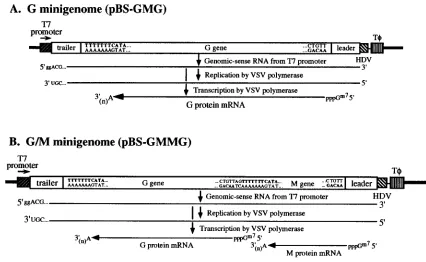
fused to either a single VSV gene (Fig. 1A) or two VSV genes
in tandem (Fig. 1B). These constructs are called pBS-GMG
and pBS-GMMG. The genes were positioned such that the
conserved AACAG start sequence found at the 5
9
end of each
mRNA and the stop-polyadenylation signals at the 3
9
end of
each gene were joined to the leader and trailer regions,
re-spectively, as found in the genomic RNA of VSV. Expression
of the minigenome RNAs was driven by a modified T7
pro-moter in which two additional G residues are present at the 5
9
end of the genomic-sense transcript. To generate RNAs having
the exact 3
9
end of the genomic RNA, we fused sequences for
the HDV ribozyme and the T7 terminator (T
f
) immediately
downstream and adjacent to the last VSV-specific nucleotide
in the minigenome cDNAs.
Minigenome replication requires coexpression of the N, P,
and L proteins.
To determine if RNA expressed from a
mini-genome construct could be encapsidated and replicated by
VSV proteins provided in trans, we transfected
vTF7-3-in-fected BHK-21 cells with either GMG alone or with
pBS-GMG and different combinations of plasmids encoding the N,
P, and L proteins of VSV. Total RNA was isolated from these
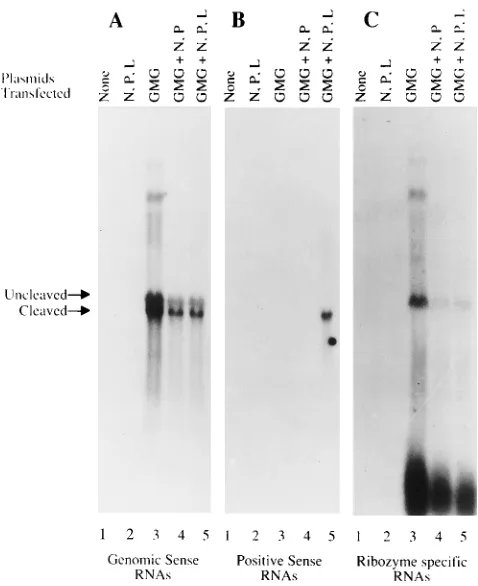
cells and then examined by Northern blot analysis. To detect
genomic-sense RNAs expressed from the T7 promoter, we
used an end-labeled oligonucleotide probe that is
complemen-tary to nucleotides 35 through 56 in the trailer region of the
VSV genome. To detect positive-sense RNAs, we used a
224-nucleotide antisense RNA probe corresponding to sequences
from within the G gene.
Two major genomic-sense RNA species were detected from
cells transfected with pBS-GMG alone or with pBS-GMG plus
any combination of plasmids encoding the N, P, and L proteins
(Fig. 2A, lanes 3 to 5). The faster-migrating species
corre-sponds to the full-length GMG transcript after cleavage by the
HDV ribozyme. The species migrating slightly slower are
pri-mary transcripts that have not been autocatalytically cleaved by
the ribozyme (Fig. 2A and C, lanes 3 to 5). In addition to the
cleaved primary transcript, some genomic-sense RNAs
result-ing from a complete cycle of replication by the VSV
poly-merase may also be present in the lower band from cells
ex-pressing GMG and the N, P, and L proteins (Fig. 2A, lane 5
only).
Figure 2B shows that the GMG RNA was replicated to a
positive, antigenomic-sense molecule. A single RNA species
with a mobility identical to that of the cleaved, genomic-sense
on November 9, 2019 by guest
http://jvi.asm.org/
GMG RNA was detected from cells that were transfected with
pBS-GMG and plasmids encoding the N, P, and L proteins
(Fig. 2, lane 5) but not from cells in which one or more of the
plasmids were omitted (Fig. 2, lanes 1 to 4). These results
demonstrated that the GMG RNA synthesized by T7 RNA
polymerase could serve as a template for the synthesis of a
positive-sense RI by the VSV polymerase.
Since GMG contains all of the cis-acting sequences thought
to be required for the transcription of mRNA by the VSV
polymerase, we should also detect G protein mRNA in cells
expressing GMG and the N, P, and L proteins (Fig. 2B, lane 5).
However, because the GMG RI and polyadenylated G protein
mRNA are approximately the same size, these two species
were not resolved in Fig. 2B. To determine if G protein mRNA
was present, we isolated polyadenylated RNAs from cells
transfected with pBS-GMG and N, P, and L plasmids and then
examined these RNAs by Northern blot analysis using a
G-specific, antisense RNA probe. A single polyadenylated species
that migrated with the same mobility as the full-length
positive-sense RI was detected (data not shown). This result indicated
that both full-length RI and G protein mRNA were produced
in cells transfected with pBS-GMG and plasmids encoding the
N, P, and L proteins.
Expression of G protein from GMG.
To determine if the N,
P, and L proteins could indeed direct the synthesis of a
func-tional mRNA from a GMG genomic-sense template, we used
immunofluorescence microscopy to identify cells that were
ex-pressing G protein on the cell surface. BHK-21 cells were
infected with vTF7-3 and then transfected with either
pBS-GMG only; pBS-pBS-GMG and plasmids encoding the N and P
proteins only; or pBS-GMG and plasmids encoding the N, P,
and L proteins. The cells were fixed at 24 h posttransfection
and then probed for G protein, using a G-specific monoclonal
antibody (I1) (19).
Approximately 1% of the cells expressed G protein on the
cell surface when transfected with pBS-GMG and plasmids
encoding the N, P, and L proteins. Both single cells (Fig. 3A)
as well as groups of cells expressing G protein (Fig. 3B) were
observed. No G protein-positive cells were detected in cultures
transfected with pBS-GMG only or when the plasmid encoding
L protein was omitted. These results demonstrate that G
pro-tein expression requires a functional VSV polymerase.
Expression of G and M proteins from GMMG.
To
deter-mine if two genes could be expressed from VSV minigenomes,
we transfected vTF7-3-infected BHK-21 cells with plasmids
encoding the N, P, and L proteins and a minigenome
contain-ing the G and M protein genes in tandem (pBS-GMMG). Cells
were fixed at 24 h posttransfection and first probed for G
protein on the cell surface and then probed for M protein in
the cytoplasm after the cells were permeabilized. Figure 4A
shows a group of cells expressing G protein on their surface,
and Fig. 4B shows that the same cells also expressed M protein.
Both single cells and groups of cells were observed.
Occasion-ally there were cells that expressed M protein but that did not
appear to express any G protein (Fig. 4A, arrow). The
expres-sion of M protein but not G protein may result from the
capping of full-length, positive-sense RIs by the vaccinia
virus-capping enzymes in the absence of sufficient N protein for RI
encapsidation.
[image:4.612.89.515.69.331.2]We also examined total RNA from cells expressing GMMG
and the N, P, and L proteins by Northern blot analysis. As with
GMG, when the blots were hybridized with the
genome-spe-cific probe, we detected two RNA species which corresponded
to the full-length uncleaved and ribozyme-cleaved species
FIG. 1. Schematic representations of VSV minigenome cDNAs. The trailer region at the 59end of the VSV genome is fused to the bacteriophage T7 RNA polymerase promoter such that the primary transcript will contain two non-VSV nucleotides at the 59end (59gg). The polyadenylation signal (TTTTTTTCATA) for G protein is fused to the trailer region, and the complement of the conserved AACAG sequence found at the 59end of all VSV mRNAs is fused to the leader region. The M gene polyadenylation signal, dinucleotide (AG) G-M intergenic junction, and the conserved pentanucleotide sequence at the 59end of the G protein gene are shown. The leader region at the 39end of the genome is adjacent to the HDV ribozyme sequence, which is followed by the terminator (Tf) for T7 RNA polymerase. Representations of the genomic-sense primary transcript synthesized by T7 RNA polymerase, the positive-sense RI, and the capped and polyadenylated mRNA for either G protein (A) or both G and M proteins (B) are shown below the cDNA diagrams.on November 9, 2019 by guest
http://jvi.asm.org/
(data not shown). Because of a lower transfection efficiency
with GMMG, our antisense RNA probe was not sensitive
enough to detect the full-length, positive-sense RI, although
we could detect G and M protein mRNAs. The full-length
positive strand was detected readily after passaging (see
be-low).
Replication and passaging of GMMG.
To determine if the G
and M proteins expressed from GMMG could function in virus
assembly, we attempted to passage GMMG particles. The first
passage (P1) supernatant from a culture transfected with
pBS-GMMG, N, P, and L plasmids was used to infect a second set
of cells that had been transfected with the N, P, and L plasmids
only. In this experiment, the initial transfection resulted in 30
cells that expressed G protein, which corresponds to
approxi-mately 0.015% of cells transfected. After the first passage we
observed a 2.7-fold increase in the number of cells that
ex-pressed G protein (Table 1). The supernatant from this culture
(the second passage, or P2 supernatant) was then used to infect
a third set of cells transfected with the N, P, and L plasmids.
Each set of cells was subsequently examined for either G
pro-tein expression or G and M propro-tein expression by
immunoflu-orescence microscopy. After four passages, approximately 20
to 30% of the cells expressed G protein. Expression of both G
and M proteins did not result from carryover of the original
GMMG plasmid, since omitting any of the N, P, or L plasmids
prevented subsequent expression of G and M protein on the
newly transfected cells. These results showed that GMMG
particles could be passaged and amplified on cells expressing
the N, P, and L proteins. These results also show that the
amounts of G and M proteins expressed from GMMG were
sufficient for virus assembly and budding. Because the number
of cells having the proper ratios of N, P, and L proteins may be
limiting in this transfection scheme, the number of infectious
GMMG particles may be much higher than indicated by the
number of cells expressing G protein (Table 1).
Analysis of RNAs produced in GMMG-infected cells.
To
examine the RNA species produced in cells infected with
GMMG particles, we used a GMMG P6 supernatant to infect
N, P, and L plasmid-transfected BHK-21 cells and examined
total RNA by Northern blot analysis (Fig. 5). For comparison,
total RNA from cells infected with wild-type VSV
Indwas also
examined. When a genomic-sense-specific probe was
hybrid-ized to total RNA from GMMG-infected cells, a single band
with a length of approximately 2.6 kb was detected (Fig. 5, lane
1). This band corresponds to the full-length, minus-strand
GMMG genome. Lanes 2 to 4 (Fig. 5) show either G-specific,
M-specific, or both G- and M-specific positive-sense RNA
spe-2
[image:5.612.59.298.69.362.2]1
FIG. 2. Northern blot analysis of total RNA extracted from pBS-GMG-transfected cells. Total RNA was fractionated on agarose-formaldehyde gels, transferred to membranes, and hybridized with an antigenomic-sense, end-la-beled oligonucleotide to detect genomic-sense RNAs (A), an antisense, G gene-specific RNA probe to detect positive-sense RNAs (B), or a positive-sense, end-labeled oligonucleotide specific for the HDV ribozyme (C). Approximately threefold more RNA was loaded on the gel to detect positive-sense RNAs. To detect RNAs containing the ribozyme, the membrane from panel A was stripped by washing at 908C in 0.23SSC–0.1% SDS and reprobed with the
ribozyme-specific oligonucleotide. FIG. 3. Expression of G protein in pBS-GMG-transfected cells. BHK-21 cells were infected with vTF7-3 and then transfected with pBS-GMG and plas-mids encoding the N, P, and L proteins. The cells were fixed in 3% paraform-aldehyde at 24 h posttransfection and then probed for G protein on the cell surface with a G protein-specific monoclonal antibody (I1) and a rhodamine-conjugated donkey anti-mouse secondary antibody. Photomicrographs show both single cells (A) as well as a group of cells (B) expressing G protein.
on November 9, 2019 by guest
http://jvi.asm.org/
[image:5.612.346.521.69.430.2]cies present in these cells. The slowest-migrating RNA
corre-sponds to full-length, positive-sense GMMG RI, which has the
same mobility as the full-length GMMG genome (Fig. 5,
com-pare lane 1 with lanes 2 to 4). The two other species in Fig. 5,
lane 4, correspond to the G and M protein mRNAs, which are
indistinguishable in size from the G and M protein mRNAs
isolated from VSV-infected cells (Fig. 5, lane 5). These results
demonstrate that the VSV polymerase transcribed individual
G and M protein mRNAs from the GMMG template. These
results also show that our two-gene minigenome system
faith-fully reproduced all of the replication and transcriptional
events that occur during a normal VSV infection cycle.
DISCUSSION
[image:6.612.71.286.70.533.2]Two cDNAs encoding VSV minigenomes were constructed
in order to establish a novel system that could be used to study
VSV replication, transcription, and assembly. Our system
dif-fered from other systems described to date in that the
mini-genomes expressed functional VSV proteins. They contained
either the G protein gene (GMG), or the G and M protein
genes in tandem (GMMG). Northern blot analysis showed that
FIG. 4. Immunofluorescence of cells expressing G and M proteins from GMMG. BHK-21 cells were infected with vTF7-3 and then transfected with pBS-GMMG and plasmids encoding the N, P, and L proteins. The cells were fixed at 24 h posttransfection and first probed for G protein on the cell surface with a rabbit polyclonal anti-VSV serum and a rhodamine-conjugated anti-rabbit secondary antibody. The cells were then permeabilized and probed for M protein in the cytoplasm with an M protein-specific mouse monoclonal antibody (MAb 23H12 [19]) and a fluorescein isothiocyanate-conjugated anti-mouse secondary antibody. (A) A group of cells expressing G protein on their surface. (B) The same cells expressing M protein. Occasionally there were cells that expressed M protein but that did not express detectable amounts of G protein (arrow in panel A).
[image:6.612.317.555.84.175.2]FIG. 5. Northern blot analysis of RNAs purified from GMMG-infected cells. Total RNA was extracted from cells that were transfected with plasmids encod-ing the N, P, and L proteins and then infected with GMMG particles from a P6 supernatant. The RNA was fractionated on a 1% agarose-formaldehyde gel and transferred to a nylon membrane. Individual lanes were cut from the membrane and then probed with either a positive-sense, end-labeled oligonucleotide com-plementary to sequences in the trailer region (lane 1), antisense RNA probes specific for G protein mRNA (lane 2), or M protein mRNA (lane 3). Lanes 4 and 5 show RNAs detected when the G and M protein mRNA probes were used together. Lane 5 contains RNA extracted from VSV-infected cells.
TABLE 1. Passaging and amplification of GMMG
Passage supernatant no.
Plasmids transfected
No. of cells expressing G proteina
None (primary transfection) pBS-GMMG1 N, P, and L
30
P1 N, P, and L 81
P2 N, P, and L 215
P3 N, P, and L .1,000
P4 N, P, and L .2.53105
a
Cells were fixed between 20 and 24 h posttransfection and examined for G protein expression by immunofluorescence microscopy. The number of cells expressing G protein was determined by scanning the entire coverslip.
on November 9, 2019 by guest
http://jvi.asm.org/
[image:6.612.316.551.404.645.2]the VSV polymerase proteins provided in trans could replicate
negative-sense minigenome RNAs to a positive-sense,
full-length RI in vivo. The VSV polymerase could also direct the
synthesis of functional mRNAs from the minigenomes. In
ad-dition, the expression of G and M proteins from GMMG,
along with the N, P, and L proteins expressed from plasmids,
resulted in the assembly and release of infectious particles that
could be passaged.
The first interesting observation made with our minigenome
system related to the detection of foci, or groups of cells, that
expressed G protein in cells transfected with the single gene
minigenome, pBS-GMG, and plasmids encoding the N, P, and
L proteins. This observation was unusual, considering that
typically only 1% of the cells expressed G protein. Because of
this relatively low transfection frequency, it is unlikely that
multiple adjacent cells were transfected with all four of the
plasmids in the proper ratios to allow replication of GMG and
expression of G protein. One mechanism that could account
for the appearance of foci is the release of infectious particles
from a single transfected cell and subsequent replication and
transcription of GMG in the adjacent cells. In fact, a similar
phenomenon has been noted in cells expressing VSV G
pro-tein from a Semliki Forest virus vector (SFV-G [26]). The
formation of SFV-G particles, which are composed of RNA
surrounded by a lipid envelope that contains G protein, does
not require expression of either the VSV N or M proteins.
If sufficient infectious particles had been released from cells
replicating GMG, we might have been able to amplify these
particles in a manner similar to that used for GMMG.
How-ever, we were unable to passage GMG when culture
superna-tants were used to infect cells that were transfected with
plas-mids encoding the N, P, and L proteins. Only when we
expressed M protein, in addition to N, P, and L, from plasmids
could we obtain infectious GMG particles (36). These data
conform to our current understanding of the requirements for
VSV particle formation and are similar to results reported
previously from experiments using a defective interfering
par-ticle replication system in which all five VSV proteins were
required to passage DI particles (23, 24).
If focus formation occurs in the absence of M protein, what
then is responsible for the appearance of foci in cells
trans-fected with GMG and plasmids encoding the N, P, and L
proteins? Most likely it involves cell-to-cell spread of GMG
nucleocapsids from a single transfected cell. Preliminary
re-sults indicate that focus formation requires the membrane
fusion activity of G protein. Using several recently described
membrane fusion mutants of G protein (13), we have found
that no foci are observed when G-minigenomes that contain
the fusion-defective mutations are used (14). In addition, focus
formation can be prevented by including neutralizing antibody
to VSV in the medium following transfection. Although we
were unable to detect infectious particles in the supernatant
from pBS-GMG-transfected cells, it is possible that low levels
of particles are released and that these immediately bind to the
adjacent cells and result in the G protein expression observed.
However, efficient particle production clearly requires M
pro-tein as expected.
The second observation made with the minigenome system
was that, in the case of GMMG, occasionally there were cells
that expressed M protein but that did not appear to express
significant amounts of G protein (Fig. 4, arrow). Expression of
M protein in these cells may have resulted from capping of the
RI by the vaccinia virus guanylyltransferase and subsequent
translation by host cell ribosomes. Alternatively, mutations
may have occurred during replication of the minigenome that
prevented G protein expression in those cells. Protein
expres-sion resulting from translation of the RI might occur if N
protein was limiting in a subset of cells, such that the amount
of N protein expressed was not sufficient to encapsidate the
majority of the positive-sense RI RNAs. However, enough N
protein must have been present initially to package some of the
primary transcripts produced by T7 RNA polymerase to allow
the synthesis of the RI by the VSV polymerase. Expression
from the RI should only occur when a vaccinia virus expression
system is used, since capping of the positive-sense RI is
pre-sumably a prerequisite for translation by the host cell
ribo-somes. Expression from the RI could pose serious problems in
systems that utilize a sensitive reporter gene such as
chloram-phenicol acetyltransferase to measure the effect of mutations
in the genome on virus replication and transcription, especially
if the mutations reduce encapsidation of the RI, but not the
primary, genomic-sense transcript.
A third relevant finding from this study was that, in general,
the number of cells expressing G and M proteins after
trans-fection with pBS-GMMG and the N, P, and L plasmids was less
than the number of cells expressing G protein in cells
trans-fected with pBS-GMG and the N, P, and L plasmids. This
observation suggested that the transfection efficiency with
GMMG was much lower than with GMG. The lower efficiency
may be due, in part, to the larger size of GMMG compared
with GMG (2,621 nucleotides and 1,775 nucleotides,
respec-tively). Similar observations, with regard to the size of the
representative viral genome, were made with the rabies virus
system in which a synthetic RNA genome containing the
chlor-amphenicol acetyltransferase gene was encapsidated and
pack-aged more efficiently than one containing the larger
b
-galac-tosidase gene (11). Alternatively, it is known that M protein is
cytotoxic (4–6), and since GMMG expresses substantial
amounts of M protein, it is possible that some of the cells
expressing M protein had detached from the coverslip prior to
fixation and examination by immunofluorescence microscopy.
However, since GMMG could be amplified and over 30% of
the cells expressed both G and M proteins following several
rounds of passaging with GMMG, it appears that M protein
cytotoxicity is probably not responsible for the lower
transfec-tion efficiencies. We plan to test directly whether the lower
transfection frequencies result from a size limitation or
whether M protein is responsible, by replacing the M protein
gene with a non-VSV gene of similar size. Because the low
efficiency of recovery observed with the full-length VSV (18)
and rabies virus systems (31) is a significant obstacle to genetic
engineering of nonsegmented negative-strand viruses, it is
im-portant that we understand the factors that influence recovery
to enhance the utility of these systems.
Lastly, the system we have described in this report has
sev-eral advantages over previously developed systems for studying
negative-strand viruses. Like some of the recently described
systems, our infectious minigenomes are derived entirely from
RNAs and proteins expressed from cDNAs. However, our
VSV minigenomes more closely approximate a wild-type VSV
genome, since both replication and transcription occur in a
manner similar to that occurring in VSV-infected cells.
More-over, it is now possible to examine the role of upstream
se-quences in the expression of downstream genes, which will
allow us to more precisely understand how the viral
poly-merase functions both in VSV replication and in the synthesis
of individual mRNAs.
ACKNOWLEDGMENTS
We thank Kathy Cox for suggesting the use of RNA probes to detect positive-sense RIs and for instruction in preparing the probes. We also thank Manfred Schubert for pSV-VSL1 and Doug Lyles for the G
on November 9, 2019 by guest
http://jvi.asm.org/
protein- and M protein-specific hybridoma cell lines. Oligonucleotides were provided by the Molecular Resource Center at the University of Tennessee, Memphis.
This work was supported by grants IN-176-B and VM-43 from the American Cancer Society (to M.A.W.) and by NIH grant R37 AI 243245 (to J.K.R.).
REFERENCES
1. Ausubel, F. M., R. Brent, R. E. Kingston, D. D. Moore, J. G. Seidman, J. A.
Smith, and K. Struhl.1994. Analysis of RNA by Northern and slot blot hybridization, p. 4.9.1–4.9.8. In K. Janssen (ed.), Current protocols in mo-lecular biology, vol. 1. Wiley and Greene, New York.
2. Banerjee, A. K. 1987. Transcription and replication of rhabdoviruses. Micro-biol. Rev. 51:66–87.
3. Banerjee, A. K., and S. Barik. 1992. Gene expression of vesicular stomatitis virus genome RNA. Virology 188:417–428.
4. Black, B. L., G. Brewer, and D. S. Lyles. 1994. Effect of vesicular stomatitis virus matrix protein on host-directed translation in vivo. J. Virol. 68:555–560. 5. Black, B. L., and D. S. Lyles. 1992. Vesicular stomatitis virus matrix protein inhibits host cell-directed transcription of target genes in vivo. J. Virol.
66:4058–4064.
6. Blondel, D., G. G. Harmison, and M. Schubert. 1990. Role of matrix protein in cytopathogenesis of vesicular stomatitis virus. J. Virol. 64:1716–1725. 7. Calain, P., J. Curran, D. Kolakofsky, and L. Roux. 1992. Molecular cloning
of natural paramyxovirus copy-back defective interfering RNAs and their expression from DNA. Virology 191:62–71.
8. Calain, P., and L. Roux. 1993. The rule of six, a basic feature for efficient replication of Sendai virus defective interfering RNA. J. Virol. 67:4822–4830. 9. Chomczynski, P., and N. Sacchi. 1987. Single-step method of RNA isolation by acid guanidinium thiocyanate-phenol-chloroform extraction. Anal. Bio-chem. 162:156–159.
10. Collins, P. L., M. A. Mink, and D. S. Stec. 1991. Rescue of synthetic analogs of respiratory syncytial virus genomic RNA and effect of truncations and mutations on the expression of a foreign reporter gene. Proc. Natl. Acad. Sci. USA 88:9663–9667.
11. Conzelmann, K.-K., and M. Schnell. 1994. Rescue of synthetic genomic RNA analogs of rabies virus by plasmid-encoded proteins. J. Virol. 68:713– 719.
12. Dimmock, K., and P. L. Collins. 1993. Rescue of synthetic analogs of genomic RNA and replicative-intermediate RNA of human parainfluenza virus type 3. J. Virol. 67:2772–2778.
13. Fredericksen, B. L., and M. A. Whitt. 1995. Vesicular stomatitis virus glyco-protein mutations that affect membrane fusion activity and abolish virus infectivity. J. Virol. 69:1435–1443.
14. Fredericksen, B. L., and M. A. Whitt. Unpublished data.
15. Fuerst, T. R., E. G. Niles, R. W. Studier, and B. Moss. 1986. Eukaryotic transient-expression system based on recombinant vaccinia virus that syn-thesizes bacteriophage T7 RNA polymerase. Proc. Natl. Acad. Sci. USA
83:8122–8126.
16. Garcia-Sastre, A., and P. Palese. 1993. Genetic manipulation of negative-strand RNA virus genomes. Annu. Rev. Microbiol. 47:765–790.
17. Hattori, M., and Y. Sakaki. 1986. Dideoxy DNA sequencing method using denatured plasmid templates. Anal. Biochem. 152:232–238.
18. Lawson, N., E. Stillman, M. A. Whitt, and J. K. Rose. Recombinant vesicular stomatitis viruses from DNA. Proc. Natl. Acad. Sci. USA, in press.
19. Lefrancois, L., and D. S. Lyles. 1982. The interaction of antibody with the major surface glycoprotein of vesicular stomatitis virus. I. Analysis of neu-tralizing epitopes with monoclonal antibodies. Virology 121:157–167. 20. Marsh, M., and A. Helenius. 1989. Virus entry into animal cells. Adv. Virus
Res. 36:107–151.
21. Metsikko, K., and K. Simons. 1986. The budding mechanism of spikeless vesicular stomatitis virus particles. EMBO J. 5:1913–1920.
22. Park, K. H., R. Huang, F. F. Correia, and M. Krystal. 1991. Rescue of a foreign gene by Sendai virus. Proc. Natl. Acad. Sci. USA 88:5537–5541. 23. Pattnaik, A. K., L. A. Ball, A. W. LeGrone, and G. W. Wertz. 1992. Infectious
defective interfering particles of VSV from transcripts of a cDNA clone. Cell
69:1011–1020.
24. Pattnaik, A. K., and G. W. Wertz. 1991. Cells that express all five proteins of vesicular stomatitis virus from cloned cDNAs support replication, assembly, and budding of defective interfering particles. Proc. Natl. Acad. Sci. USA
88:1379–1383.
25. Perrotta, A. T., and M. D. Been. 1991. A pseudoknot-like structure required for efficient self-cleavage of hepatitis delta virus RNA. Nature (London)
350:434–436.
26. Rolls, M. M., P. Webster, N. H. Balba, and J. K. Rose. 1994. Novel infectious particles generated by expression of the vesicular stomatitis virus glycopro-tein from a self-replicating RNA. Cell 79:497–506.
27. Rose, J. K., and J. E. Bergmann. 1982. Expression from cloned cDNA of cell-surface and secreted forms of the glycoprotein of vesicular stomatitis virus in eucaryotic cells. Cell 30:753–762.
28. Rose, J. K., L. Buonocore, and M. A. Whitt. 1991. A new cationic liposome reagent mediating nearly quantitative transfection of animal cells. BioTech-niques 10:520–525.
29. Rosenberg, A. H., B. N. Lade, D.-C. Chui, S.-W. Lin, J. J. Dunn, and F. W.
Studier.1987. Vectors for selective expression of cloned DNAs by T7 RNA polymerase. Gene 56:125–135.
30. Sanger, F., S. Nicklen, and A. R. Coulson. 1977. DNA sequencing with chain-terminating inhibitors. Proc. Natl. Acad. Sci. USA 74:5463–5467. 31. Schnell, M. J., T. Mebatsion, and K.-K. Conzelmann. 1994. Infectious rabies
viruses from cloned cDNA. EMBO J. 13:4195–4203.
32. Schubert, M., G. G. Harmison, C. D. Richardson, and E. Meier. 1985. Expression of a cDNA encoding a functional 241-kilodalton vesicular sto-matitis virus RNA polymerase. Proc. Natl. Acad. Sci. USA 82:7984–7989. 33. Simons, K., and H. Garoff. 1980. The budding mechanisms of enveloped
animal viruses. J. Gen. Virol. 50:1–21.
34. Sprague, J., J. H. Condra, H. Arnheiter, and R. A. Lazzarini. 1983. Expres-sion of a recombinant DNA gene coding for the vesicular stomatitis virus nucleocapsid protein. J. Virol. 45:773–781.
35. Stephens, E. B., and R. W. Compans. 1988. Assembly of animal viruses at cellular membranes. Annu. Rev. Microbiol. 42:489–516.
36. Stillman, E. A., and M. A. Whitt. Unpublished data.
37. White, J. M. 1990. Viral and cellular membrane fusion proteins. Annu. Rev. Physiol. 52:675–697.
38. Whitt, M. A., L. Buonocore, J. K. Rose, V. Ciccarone, A. Chytil, and G.
Gebeyehu.1991. TransfectACE reagent: transient transfection frequencies greater than 90%. Focus 13:8–12.
39. Whitt, M. A., L. Chong, and J. K. Rose. 1989. Glycoprotein cytoplasmic domain sequences required for rescue of a vesicular stomatitis virus glyco-protein mutant. J. Virol. 63:3569–3578.
40. Whitt, M. A., E. A. Stillman, N. Lawson, R. Burdine, R. Owens, and J. K.
Rose.Unpublished data.