The perception of number:
towards a topological approach
MSc Thesis
(Afstudeerscriptie)
written byMarco Bacchin
(born June 29th, 1984 in Feltre, Italy)
under the supervision ofProf. Dr. Michiel van Lambalgen, and submitted to the Board of Examiners in partial fulfillment of the requirements for the degree of
MSc in Logic
at theUniversiteit van Amsterdam.
Date of the public defense: Members of the Thesis Committee:
September 27th, 2017 Prof. Dr. Benedikt Löwe (Chair) Dr. Jakub Szymanik
Dr. Luca Incurvati
A
BSTRACT
It has been suggested that our understanding of numbers is rooted in the perception of numerosities. A capacity, that of assessing the approximate number of objects in a scene, which is believed to be available also to other species.
The present work fits within the current debate on whether a ‘true sense of number’ is perceptually available. We will provide a comprehensive review of the behavioral, neurophysiological, and computational findings that seems to support the claim, and the limitations of the approaches taken.
A
CKNOWLEDGEMENTS
I
should like to thank my supervisor, Michiel van Lambalgen. I was afraid, and by now and then I still am, that I could not live up to your expectations, and I’ve always felt a little out of my depth in our meetings. I’ve scratched pages of notes, and studied seemingly unrelated topics, only to realize the deeper connection already impressed in your mind. Most of those notes, thoughts and reflections didn’t fit in this thesis. I was daunted at first, before realizing that what I’ve been left with is the greatest intellectual gift one can receive. A lifelong path of research.I should moreover like to thank Tom Verguts, for his support in understanding Self Organizing Maps, and his application of unsupervised learning to numerosity perception in particular.
I wish to thank Lorenzo Galeotti, for the denumerable chats about logic and math. In these MOL years you have been my closest friend, jokingly referred to by others as my boyfriend.
I am grateful to Lisa Benossi, often the last person to leave the MOL room at night, sometimes morning. Our conversations started from the common interest in logic programming, and Kant’s philosophy, and easily spread out to any topic. ‘Stealing’ coffees, and smoking too many cigarettes, have never been healthier.
I am also grateful to Almudena Colacito. You always pushed me in the right direction, when often I was taking the weirdest route to solve a problem.
I wish to thank Valentina Maggi, for her patience in reading, and correcting the draft of this thesis. And how I could not be grateful for ’il lattino’, ‘ the morning milky’, that became a daily ritual.
T
ABLE OF
C
ONTENTS
Page
1 Introduction 1
2 Representing numbers 7
2.1 Abstraction, Representation and Information . . . 7
2.2 Neurosemantics . . . 10
2.3 Representing numerosity and fearing natural numbers . . . 15
2.3.1 Numbers in the scrum . . . 18
2.4 Summary . . . 22
3 Behavioral observations, or what (almost) everyone finds 23 3.1 Behavioral observations . . . 24
3.2 Distance effects . . . 24
3.2.1 Comparison distance effect . . . 25
3.2.2 Distance priming effect . . . 25
3.3 Size effect (a.k.a. magnitude effect) . . . 26
3.4 Subitizing effect . . . 26
3.5 SNARC effect . . . 28
3.6 Transfer Effect . . . 28
3.7 Interference effect . . . 29
3.8 Weber’s law . . . 30
3.9 Summary . . . 31
4 Functional and Computational models 33 4.1 Functional Models . . . 34
4.1.1 Barcode Magnitude representation, (BMR) . . . 34
TABLE OF CONTENTS
4.1.3 Number line models (a.k.a. place code, a.k.a. analog magnitude) . 35
4.1.4 Pattern recognition model . . . 39
4.1.5 Object-file/FINST representation . . . 39
4.2 Computational Models . . . 41
4.2.1 Deahene & Changeaux, (1993) . . . 41
4.2.2 Verguts & Fias, (2004) . . . 43
4.3 Summary . . . 45
5 Neurophysiology 47 5.1 Number neurons . . . 48
5.1.1 Number line neurons: bandpass filters . . . 48
5.1.2 Summation neurons: high/low pass filters . . . 53
5.2 Summary . . . 55
6 Numerosity as topological invariant 57 6.1 Discussion . . . 60
6.2 A formal approach . . . 61
6.2.1 Homological approach . . . 61
6.2.2 Simplicial homology primer . . . 62
6.2.3 Homology groups of a digital set . . . 72
6.2.4 Tolerance homology . . . 74
6.3 Summary . . . 80
7 Computational models of Visual Numerosity 81 7.1 Deahene & Changeaux, (1993) . . . 81
7.1.1 Invariance principle . . . 82
7.2 Stoianov & Zorzi, (2012) . . . 82
7.2.1 The Model . . . 83
7.2.2 Invariance principle . . . 84
7.3 Dakin & Morgan, (2011-2014) . . . 85
7.3.1 The model . . . 86
7.3.2 Invariance principle . . . 87
7.4 Summary . . . 88
8 Conclusions and further works 89 8.1 Future works and works in progress . . . 93
TABLE OF CONTENTS
8.1.2 Theory . . . 94
C
H
A
P
T
E
R
1
I
NTRODUCTION
As man possesses the same senses as the lower
animals, his fundamental intuitions must be the
same.
Charles Darwin,The descent of man
CHAPTER 1. INTRODUCTION
intuition. Something we share with Pirahã. In a certain sense, Darwin’s idea is appealing. It suggests that we, speakers of a language with numerals, the Pirahã with no numerals and Monkeys, with no language whatsoever, share a fundamental intuition with respect to numbers.
Fundamental intuitions are fleeing and Darwin’s remark is vague. The suggestion that the fundamental intuitions must be the same can be read in a Kantian or in an anti Kantian way. If we take Darwin to be an associationist then a priori intuitions have no place in his remark. However, reading the passage in a Kantian way suggests that the way we construct the world out of the manifold of sensory data “goes beyond the information given1." Interpreted in this fashion, having the same senses is regarded as sharing the way the sensory data are organized, up to a certain degree. In this spirit, cognitive neuroscience is advocating a Kantian project, a quest in the search of the intuitions our mind2contributes to shape the sensory impressions.
Replacing the term ‘understanding’ with the term ‘mind’, however, is only morpholog-ical sugar unless we take a stance on what we mean by mind. We share Minsky [105]’s view: “the mind is what the brain does.” Therefore, the search for fundamental intuitions in mathematical cognition can be put simply as asking how do population of neurons encode distance, size, location, duration and number, and how numerical cognition might arise from the interaction of these neural codes. Although at first it might seem we are taking Kant’s ideas too freely, it may help to recognize that we are pursuing the Transcendental Idealism, in brief the stance that we don’t know anything about objects in themselves. We will return to this significant matter in chapter 2, in the interim it is sufficient to recognize that this philosophical excursus is not an exotic rambling into the wild mind of philosophers, but it’s a sketchy portrait of the tacit assumption made by the working scientists.
Seeking an explanation that goes all the way down to the neural level is the long term stand of psychology in general and of mathematical cognition in particular. It’s by no mean the objective of this thesis to try to lay down a theory so broad, yet, I maintain that a cognitive theory that is totally blind and uninterested in the neural level is quite ill posed3.
I’ve always read with a sort of incredulity and admiration Locke’s Epistle to the
1cf. Bruner [17] and Stenning and Van Lambalgen [159] for a discussion on how this connects to Kant. 2“Understanding” or “spontaneity” in Kant’s terms.
3In particular, it seems to me there is a gap between the quest in trying to understand our concept
reader, and I feel I am in a similar circumstance, where people much smarter and knowledgeable than I am, are tackling this problem. It’s therefore even more ambitious to me“to be employed as an under-labourer in clearing the ground a little, and removing some of the rubbish that lies in the way”4.
Housekeeping
Housekeeping may be felt as a mundane task. A mere reorganizing of thoughts, concepts, techniques and methods in a jumble. However, sometimes reshuffling things around it’s sufficient to highlight aspects previously not considered and therefore to reorganize the material.
Before starting with any cleaning let’s have a look at the building condition. There are three critical points we have to look into,
1. foundation
2. infrastructures
3. neighborhood
The edifice has no foundation. The central concept, the one of numerosity has not been formally defined. Numerosity is taken to be the number of items in a scene, where what counts as an item varies as much as what counts as a scene. The most clear definition has been given in Nieder and Dehaene [111]:numerical quantity refers to the empirical property of cardinality of sets of objects or events (also called numerosity).The cardinality of a set is a technical and well defined term that doesn’t apply to sounds or images. The use of the term ‘numerosity’ instead of ‘cardinality’ to be technically uncommitted points in the direction of a lack of definition.
The district is under developed. This is made apparent in two situations. On one side, the main findings may be appreciated only from report of data and not directly from the data. As a matter of fact, only a handful of papers are connected to an open access repository. Metadata are totally useless in the text, but it is the common practice to give ceremonious descriptions of technical details. Some notable exceptions exist where experiments are described exceptionally well, however it is hard to make a point out of this exercise in technical writing. On the other side, for only a few models in the
CHAPTER 1. INTRODUCTION
field the code is available5. By papers’ inspection and by mail communications, I got the strong impression that nobody else but the authors actually “shook down” the models6. The fact that in the numerical cognition literature, so many models are abandoned and dismissed is weird when compared to what happens in other fields. ACT-R, Emergent, Nengo Models, to name a few, all are shared on-line. A notable exception is Testolin et al. [164]’s effort to promote the use of a simple deep network tool for neuroscientists. Coding the models in an unitary framework is therefore a work that will keep me busy well after this thesis and it might be seen as a continuation of what they have started.
Neighbors don’t get along. Although interdisciplinarity is advocated and always praised, it’s rarely practiced. There is an almost total lack of communication among fields pursuing closely related objectives. Philosophy of mathematics is practically absent and the brief incursions have usually more the flavor of historical curiosities rather than insightful proposals. No different is the exchange between the AI community and the neuroscience one7.
Contributions of this thesis
Save point one, the situation is not serious, and it’s quite subjective. Briefly having the code it’s helpful, but not necessary, and walking into the philosophical minefield might help to discern what is possible from what is ill posed. Notwithstanding, rewriting the simulations’ code from the few specifications given in the literature it’s not a trivial task. This is especially the case in computational cognitive modeling. In machine learning, we wish the algorithms to be as efficient as possible, and if a different implementation of an algorithm leads to better performances, it is considered a better one. In cognitive modeling, although the architectures are similar, we have more restrictions, both with respect to learning rules and with respect to the interpretation of the network’s behavior. Moreover, although it’s often assumed that a network might scale flawlessly, the gener-alization is almost never achieved by simply adding more units. Particularly the code for Dehaene and Changeux [35] and Verguts and Fias [179] models, despite they are
5This makes the peer reviewed community quite small, and the code, when available, obsolete. 6Even in a recent review (Anobile, Cicchini, and Burr [7]) the authors claim the model of Dehaene
and Changeux [35] is able to account for Weber fraction and invariance by describing summarily how the model supposedly achieves these results. When it comes to be precise about the model, alas, they admit that it’s not certain that the same behavior emerges in a more powerful network.
7For the first we note the often quoted Kronecker’s phrase “God made the integers, all the rest is the
considered the leading models, is not publicly available. The reader might have a look at Dehaene-Verguts model in the online support material of this thesis8, to appreciate how easier it is to understand the models’ assumptions, and how deeper the understanding of the models goes, once the code is provided9. For what concerns behavioral experiments, we are working on a JavaScript library, Stimulus, to run psychophysical experiments in a web browser with minimal performance loss compared to standalone softwares. This will give us, and hopefully the mathematical cognition community, an easier and faster tool to assess the models’ hypotheses. Especially, we are devising this tool to assess the plausibility of the definition of numerosity we will provide in chapter 6.
The lack of a definition of ‘numerosity’ is, indeed, the most serious issue. Being stimuli modal by their nature, a modality independent definition that is blind to these differences is ill posed. Visual numerosity is mostly spatial and auditory numerosity is mostly temporal, as is tactile numerosity. This implies we need at least a definition of visual numerosity and a definition of auditory numerosity, and only once we have these two in place, we should seek for a way to encompass both into one definition. We will focus on visual numerosity, and the main task of this thesis is to argue that the correct way of modeling it is by considering visual numerosity as a topological invariant. The idea of considering a topological framework arose in connection with recent findings that topological properties affect numerosity judgments. Interestingly, when I was trying to lay down a definition of numerosity, I come across a, strangely neglected, paper by Kluth and Zetzsche [80] tackling the same problem10. Although the formalism we will propose comes from algebraic topology, whilst the one in Kluth and Zetzsche [80] is inspired by results in differential geometry, our definition aligns with theirs. The two approaches might be regarded as complementary, whilst they use infinitary methods to describe human behavior, we resort to finitary tolerance homology. Importantly, the two choices lead to different insights with respect to the proposed definition.
8Available at https://github.com/bramacchino/numberSense/blob/master/Competitive_VergutsFias.ipynb 9We invite the reader to have a look at the weights definition, and try to change their values.
Interest-ingly an uncommitted network is unable to generate the desired behavior.
10The fact that this interesting paper is not considered in the mathematical cognition literature seems
CHAPTER 1. INTRODUCTION
Overview
C
H
A
P
T
E
R
2
R
EPRESENTING NUMBERS
A mathematician is a device for turning coffee
into theorems.
Alfréd Rényi
2.1
Abstraction, Representation and Information
I
f we take at face value Rényi definition of mathematics, mathematical cognition is the field of research that aims to understand how coffee can be turned into theorems. Less metaphorically, how the brain (its neurons, neurotransmitters, structures, and so on) acts during a complex mathematical task. In the present thesis we are interested in a subfield of mathematical cognition, numerical cognition, which aims to understand how numbers are cognized and represented. In Newell’s [109] terms, we are interested in seeing how the “cognitive wheels turn” and “the cognitive gears grind” during the numerical cognitive behavior.As mentioned in chapter 8, explanation in computational neuroscience invokes the notion of representation. Representations, broadly speaking, serve to relate the internal state of the agent to its environment. We might say that representations “stand-in for” some external state of affairs.
CHAPTER 2. REPRESENTING NUMBERS
are symbols in the classicist approach, whilst they are real valued vectors in a high dimensional feature space encoded via “subsymbols” in a connectionist approach. These differences are mirrored in the respective computational models. We wish to avoid falling into the sterile discussion of past decades between classicists and connectionists culminated in Fodor and Pylyshyn’s [45] provocative paper1. In particular, a sprout of that argument is the still often claimed belief that connectionist architectures can be seen at most as implementation of classical architectures. Regrettably, the term ‘implementation’ is quite misguiding. In fact, it might suggest that somehow a connectionist network is at a different level of abstraction from a classic model. It can be, but it doesn’t need to be2. The terms ‘translation’ and ‘interpretation’ seem to be more to the point. Specifically, even assuming that two “theories” can be bi-interpretable doesn’t imply that we can pick one or the other indifferently. Which paradigm is better suitable can be assessed on a case per case basis. Indeed, such is the current state of practice, where depending on the situation a symbolic or a connectionist architecture is preferred, and it is quite common to pursue an hybrid approach. Moreover, to what extent the two theories are bi-interpretable is ongoing research under the label of “neural symbolic integration”. When singling out a meaning of representation, the classicist/connectionist distinction can be furthermore problematic. The often spurious separation into symbolic and subsymbolic may indeed give the impression that logic might be the right tool for cognitive processes, but not for perceptual ones. On the contrary, it is difficult to find a better tool to bridge higher level cognitive representations, such as language meaning, with low level perceptual features than logic3.
Nonetheless, the connectionist approach, if carefully designed, might provide a slight advantage, when it comes to define representations, with respect to the classical ap-proach. A neural network is a theoretical tool that forces the experimenter to state the representational assumptions in a testable form. That is, if carefully specified, a connectionist model can be indeed taken as abstracting neuronal networks, and the representations can be seen as neuronal representations. In the theory of representation we are about to delineate, this is favorable and the majority of models analyzed in this
1The reader may refer to Garson [52] for a clear and up to date overview of the issue.
2Indeed, ‘connectionist models’ is just an umbrella term comprising a wide variety of approaches, some
of which are better seen as statistical inference engines. For a thorough discussion on the matter, we refer the reader to Kohonen [82, chapter 2]. In particular we share the view thatespecially many supervised learning models, although they look like (neuronal) networks, may not describe low level neuronal anatomy or physiology at all: they should rather be regarded as behavioral model or general models of learning, where the nodes represent abstract processor and communication channels, respectively.
2.1. ABSTRACTION, REPRESENTATION AND INFORMATION
thesis are artificial neural networks. This doesn’t mean that the neural grounding cannot be achieved by means of a symbolic approach. Nor, particularly, that the route down the Marr [101]’s path has to go through a connectionist approach.
No matter how representations are structured, they relate the internal state to the environment. But what grounds these representations? Prima facie it seems desirable to have
some description of this processing that yields the right predictions without descending all the way to the neuron-by-neuron level (Lycan [95, pag. 259]).
As Van Der Does and Van Lambalgen [175] show, this can be done to a certain extent by investigating the model theoretic core underlying a mathematical construct used in psychophysics such as Gaussians, Laplacian and other operators. But the full extent of this grounding is achieved via models that are informed at the neuronal level. We agree with Eliasmith [39] that a neuron-by-neuron grounding is not a bad idea after all, and that a fruitful information theoretic view on representations as neural codes ( cf. Eliasmith and Anderson [41]) better characterizes representations in a neural system. This characterization of the cognitive inquiry as an information processing task allows us to characterize the above mentioned Marr’s three levels of inquiry4. Defining representations in information theoretical terms, and grounding them at the neuronal level, stresses the fact that the three levels cooperate to give an explanation of the task at issue. This simple move allows us to avoid a common pitfall. It’s not rare to see authors claiming that their models are just ‘computational’ to underlie the fact that no algorithmic level, nor implementation is addressed. Grounding representations on the neuronal level implies that those models might not be computational level models after all, if it turns out such an implementation is not possible. It seems that the term ‘computational’ referred to that practice is just chosen to replace the disgraced ‘phenomenological’ term. Phenomenological models, however, have no place in Marr’s framework, and the assumption that a phenomenological model might be used as a computational one is either originated by a strong abuse of terminology, or it arises from a misinterpretation of the framework.
The theory of representation we have in mind is borrowed from Eliasmith and Anderson [41] and Eliasmith [39, 40], and the textbook Dayan and Abbott [28] to which the reader is referred for a more in dept technical analysis.
4For a description of Marr’s level as information processing stages we invite the reader to look at
CHAPTER 2. REPRESENTING NUMBERS
In the next section, we will give an overview of the theory that is sufficient for our purposes. This is needed because the term representation is used in a variety of ways, sometimes to indicate an encoding, sometimes to indicate a decoding, sometimes as a vague term. With a clear stated notion in the back of one’s mind, these different uses are immediately discernible. This will allow us to disentangle some seemingly incompatible positions and clearly indicates why and how a theory that goes all the way down to the neural level, as stated in the introduction, can be addressed.
2.2
Neurosemantics
[image:20.595.163.466.344.384.2]The simplest communication system one can imagine is made up by a transmitter or sender, a channel, and a receiver (Figure 2.1).
Figure 2.1: Schema of a communication system
Codes are then defined by the complementary encoding and decoding procedures. A sender sends the encoded information through a channel, possibly noisy, that is then decoded before reaching the receiver. The minimal information relation is therefore a three place relation schematizable as
carries(channel,in f ormation,receiver)5.
By mirroring this schema the representation relation may be stated by using the standard terminology in ‘vehicles represent content w.r.t. a system’:
re present(vehicl es,content,s ystem)
Therefore, defining representations as codes requires defining encoding and decoding procedures, and (possibly different) input and output alphabets. Describing representa-tions in these terms is broad enough to allow us to extend the concept of representation to that of transformation. In this way, a transformation of a representation is still a representation6. This gives us a powerful tool to talk directly about representations at a higher level on the hierarchy and thus of all mental representations:
5These three objects are necessary and sufficient to define Information in Shannon’s terms.
6This is achieved via a transformational decoder such that the transformed representation can be
2.2. NEUROSEMANTICS
That is, since all mental representations can be described as some combina-tion of scalars, vectors, and funccombina-tions, and those mathematical objects can be neurally represented, these methods can be used to describe all mental representations (Eliasmith [39, pag. 1043])
Although powerful, defining the representation relation in such terms misses the contribution of the referent. If we assume that referents are contents, as suggested by causal theories, then accounting for misrepresentation becomes quite cumbersome. On the other side, if we take contents to be referents, there is no place for truth conditions in determining of meaning. For these reasons, Eliasmith proposes the fourth place relation ‘vehicles represent content regarding a referent w.r.t. system’:
re present(vehicl es,content,re f erent,s ystem)
Incidentally, it could be helpful to see the introduction of referents in the relationship as somehow mirroring the Fregean sense (Sinn).
So far, we have been uncommitted about the four arguments of the representation relation, and we have been only moved by the close relationship between information processing and biological systems.
Bysystem(the receiver), we mean the whole nervous system.
Vehicles, that we might call representations, are physical objects that carry repre-sentational content (namely, neurons and population of neurons described by the pair encoder and decoder7).
Referents are measurable external objects that representations assign properties to. But how are referents and vehicles related? Being they measurable quantities, we can assign random variables to them. The dependence of two random variables X,Y
is summarized by the mutual information I(X;Y), that captures the relation between change in one and change in the other. That is, if X,Y are independent random variables such thatP(X,Y)=P(X)∗P(Y) thenI(X;Y)=0. The set of relevant events (referents) are thus the ones that maximize the mutual information I(X;Y). Notice that all there is to know about the stimulus and the response relation is contained in the joint probability
P(X,Y), that is to compute the mutual information I(X;Y) we need the joint probability or a conditional probability, and the marginal probability it is conditioned over.
This corresponds to what Eliasmith [40] dubbed Statistical Dependence Hypothesis (SDH):
7Clearly, this is an oversimplification: glia cells and neurodynamics might carry representational
CHAPTER 2. REPRESENTING NUMBERS
Definition 2.1. The set of causes relevant to determining the content of neural responses (referent of a vehicle) is that set that has the highest statistical dependence with the neural responses under all stimulus conditions and does not fall into the computational description.
Where the computational description refers to the neural functioning provided by the theory of representation and computation (that is, we want the referent to be outside the system).
Contents may be taken to be the properties ascribed to a referent by a vehicle, thereforecontentis determined by decoders8. If no information about the stimulus can be extracted from the spiking neurons, then it makes no sense to say that it represents the stimulus.
Working with a four place relation instead of the standard three place relation prompts us to define the relation between content and referent. This requires choosing a perspective among first person perspective and third person perspective. We don’t refer to the experimenter perspective as opposed to a first person perspective intended as a phenomenological favorite access (Dennett [37]). In this respect, we advocate a third person perspective. What we are interested in is a third person perspective filtered thorough the subject perspective.
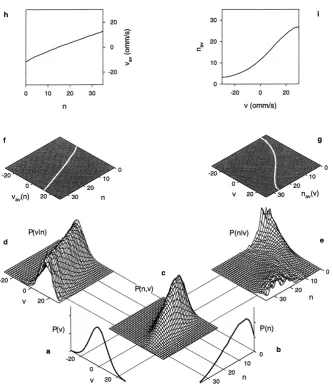
Briefly the representational content problem can be addressed by means of two con-ditional probabilities: p(res ponse|stimul i) vs p(stimul i|res ponse). The former char-acterizes the observer perspective. Notice that this is what we obtain in a standard experimental settings. However, from the point of view of the subject that probability doesn’t make any sense9. The latter characterizes the subject perspective, namely the problem of inferring the stimuli in the world from the “neural response”.
A look at Fig 2.2 clarifies the point. All there is to know about the probabilistic relation between a stimulus and a response, the referent-vehicle relation, is given by the joint probability p(r,s). The left part of the graph corresponds to the animal perspective. That is, from the joint distribution P(n,v) (spiking rate and velocity) the conditional probability p(v|n) is inferred and so it is the graph of the best estimate of the velocity given some spike rate. The right part of the graph, instead, corresponds to the observer perspective. The graphs on top show how the representational content can be highly different given a perspective.
2.2. NEUROSEMANTICS
Figure 2.2: Figure from Rieke et al 1997
That representations need both perspectives is often overlooked, and seemingly contradictory point of views are in several cases just different, and importantly not incompatible perspectives10. This happens frequently in numerical cognition. On one side, we have those that advocate
there is no reason to think that number is a complex parameter of the external world, one that is more abstract than other so-called objective or physical parameters such as color, position in space, or temporal duration. In fact, provided that an animal is equipped with the appropriate cerebral modules,
CHAPTER 2. REPRESENTING NUMBERS
computing the approximate number of objects in a set is probably no more difficult than perceiving their colors or their positions (Dehaene [32]).
On the other side, this illusory simplicity is challenged by those claiming
it is easy to see that there is no such single visual attribute unambiguously related to the number of dots. Strictly speaking, it is impossible to see nu-merosity at all. The only possibility is to rely on an intermediate impression of numerosity which is formed on the basis of a certain stimulus attribute, more or less closely correlated with the number of objects. The visual number can be communicated to the observer only through a certain set of visual attributes, none of them being the visual number as such (Allik, Tuulmets, and Vos [2]).
The scenario envisaged by Dehane focuses mostly on the (external) observer side. Numerosity is out there, we know it, and we can capture how to compute the approximate number of objects by looking at p(res ponse|numerosit y). Allik, on the other side, is thinking about p(numerosit y|res ponse): none of the visual attributes and therefore the responses are the numerosity itself, but somehow the subject has to infer the numerosity from these responses. The representational content is therefore different and both positions are partial and need to be complemented in order to achieve a computational theory of numerical cognition.
In conclusion of this discussion on representations, we wish to highlight how the problem of misrepresentation is easily addressed within this theory. What the SDH picks is the “conceptual content” (determination of decoders over all stimulus conditions), which however may be different from the “occurent content”:
Definition 2.2. The referent of an occurent representation is the cause that has the highest statistical dependency with the representation under the particular stimulus conditions in which it is occurent.
To sum up, in order to understand our capacity to deal with numbers, it is crucial to identify the type of number representations that our brain uses. We have to identify the referents, the vehicles (that is the encoding and decoding procedures), and pick a perspective11.
11The most complicated part of this plan is, unsurprisingly, picking up the referents. This is especially
2.3. REPRESENTING NUMEROSITY AND FEARING NATURAL NUMBERS
Given that the standard psychophysical experiments in numerical cognition involve dot arrays in a screen, starting out with visual numerosity seems a promising approach.
Although numerosity is at this stage still a vague term, and it will be our effort through this thesis to give the necessary concepts in order to propose a formal defi-nition, we remind the reader that we were prompted to investigate numerosity from the suggestion that number might not be a primitive concept, and that some kind of fundamental intuitions, which we share with other species, can be its primitives. With this we wish to point out that, although we cannot claim to have a computational theory of numbers, unless we have all the components of the representation relations, the way we fill in the details is not constrained by the representational theory proposed. A back and forth between levels reshapes, step after step, the concepts, constraining the space of possibilities on the higher levels, and narrowing down the guesses needed for reverse engineering the neural code.
In fact, although the definition that we will propose for numerosity is mainly intended for visual numerosity, there is another line of research, that starts from the higher level in the hierarchy seeking those representations that should be foundational. The starting point is therefore the representation of natural numbers.
2.3
Representing numerosity and fearing natural
numbers
Natural numbers are abstract entities. This makes finding an adequate representation even harder. At first sight, how might we know a vehicle represents a referent if we don’t know what this referent is? This might suggest to give an account of what things our number words and numerals name or stand for. However, this is a dangerous and possibly fallacious path, in Mayberry’s [102] words,
the beginning of wisdom is to realise that there simply are no such things as “natural numbers”, that natural numbers as “mathematical objects” are illusions, non-entities, mere artifacts of our notation, reified and alienated products of our counting and calculating procedures, and that, consequently, to devise a theory of what “they” are as particular objects is utterly otiose
CHAPTER 2. REPRESENTING NUMBERS
and, indeed, productive of quite unnecessary confusion (Mayberry [102, pag. 258]).
Naturally, the above sentence provokes strong reaction, but such a “philosophical position” highlights the impasse in which the cognitive psychologist finds herself. When working at this level of abstraction, the researcher has to rest on an intuitive definition of numbers that avoids any pitfall into philosophy of mathematics. That natural numbers don’t necessitate any definition seems to be, probably surprisingly, a widespread opinion even among mathematicians. That this doesn’t create a problem is captured by Jouko Väänänen [174], according to whom “mathematicians argue exactly but informally”, which “has worked well for centuries”. An intuitive pretheoretic concept of number is the sequence of which we don’t know nothing else other than that it is generated from zero by successive iterations of the operation of passing from a number to its immediate successor12. As far as it goes, such a characterization should suffice. Indeed, as Rips, Asmuth, and Bloomfield [139, pag. 9] pointed out, this seems to be the one implicitly or explicitly assumed by many cognitive scientists.
By this, we don’t want to claim that a dialogue between mathematicians, philoso-phers of mathematics and cognitive scientists wouldn’t be profitable. As stressed in the introduction, the opposite is advised. We just want to point out that, once one is aware of the informality of the definition, and importantly of the limitations of it, its adoption is legitimate. Failing to account for the limitations, however, might result in empirically misguided inferences. For example, from the fact that the structure of finite ordinals, with the ordinal operations (+o,xo) is isomorphic to the structure of the numerosities with the cardinal operation (+c,xc), one might be inclined to infer that an ordinal defi-nition suffice13. However this assumption might mask comprehension. In Gelman and Gallistel’s [55] proposal the infant comes to understand that the last word in the counting sequence denotes the cardinality of the enumerated set (cardinality principle). If the child associates with the number words only the ordinal position, for example, then it might appear she doesn’t yet know the cardinality principle, whilst in fact, she might already have inferred it. Moreover it might not be the case that the operations an infant uses are the standard binary operations we usually associated with natural numbers,
12Although intuitive, the definition is in fact circular. It implies that a collection is finite if it can be put
in correspondence with an initial segment of the natural numbers, that is if it can be counted out. But it can be counted out if the iteration of the successor function is finite. The appealing of the definition comes from the belief that a definition by recursion doesn’t need justification. A fallacy reminiscent of the sorites paradox (cf. Mayberry [102]).
2.3. REPRESENTING NUMEROSITY AND FEARING NATURAL NUMBERS
and might be the plus-one, minus-one, unary operations, applied only to ‘Spelke-objects’, roughly a persistent object, or a pair of persistent objects (Spelke [157]).
This brings up a fundamental distinction of intents. On the one hand, if mathematical cognition’s research is trying to single out the ‘intended model’, that is to seek the representations underlying the intuition that there is a paradigmatic structure of the natural numbers, then a formal theory of natural numbers, such as Peano arithmetic, is of little use. In fact, if those intuitions were again formalized according to a given theory, the explanation will be circular and not informative. This is what the majority of scholars address. For them, an informal definition should suffice: paraphrasing Jouko Vaananen’s statement, mathematical cognitive scientists should argue exactly but informally. On the other hand, if what is claimed is our possession of the concept of natural numbers, then mirroring it by means of a formal theory seems appropriate. Less straightforward is which theory is the one to use as benchmark. Are cognitively experienced natural numbers the “standard” natural numbers? To answer this question, one can embark in a different project and try to see which among various different mathematical theories is the closest to psychological reality. From this point of view, it could be the case that cognized natural numbers are not the PA, ZFC numbers defined in standard mathematics, but a different, and admittedly more exotic, kind of natural numbers. In this respect we observe that there are only few studies in mathematical cognition in which “big” natural numbers are investigated(e.g. Rips [137]). 9223372036854775807 is a number as much as 2, but surely doesn’t behave cognitively in the same way14. Theexoticismis therefore necessary. More broadly, the history of the concept of infinity, from the Greekhorror infiniti to the embracing of its paradoxes, and the confused statements that children give when prompted, suggests us not to blindly assume that the concept is naturally available.
Therefore, what we can do with just an intuitive definition is asking ourselves what are the cognitive foundations, the representational primitives out of which the natural number representations are built. Which constraints do we have in seeking representations? Are these representations innate or are they learned from more basic representations? In the context of core cognition (Carey [20]), and in the neural equivalent (Dehaene and Cohen [36], Dehaene [29]), for example, is hypothesized that, when we learn and practice science and mathematics, we take capacities of the mind and the brain that evolved to serve other functions, and we harness them for new purposes15. In
14For the curious reader, the number presented is 263−1, that is the largest 64 bit number, usually, the
largest number representable by a computer. In Python for example type sys.maxint or sys.maxsize.
CHAPTER 2. REPRESENTING NUMBERS
the representational framework proposed, this means that the representations we seek are transformations of earlier representations. As Carey [20] (by extending Dehaene’s [ 32] proposal) lists, those encompass number line, representation of space and continuous quantities, time, length, distance, iterative capacities, logical capacities, relational and order capacity, the syntactic/semantic representation of numbers in natural language, and the system of parallel indexing of small sets in mid level attentional systems.
This list is daunting. Way too broad and too abstract to actually have one’s hands dirty. What one can do is to hypothesize how these capacities must be organized in order for the concept of natural number to emerge. From all the items in the list, particular relevance is given to the approximate number sense (ANS), a specification of the representation of continuous quantities, and to the parallel individuation system (PIS)16.
2.3.1
Numbers in the scrum
How those representations are to be organized in order to support the concept of natural number is subject of strong debate. We can identify three major contenders:
- Natural numbers are innate, while abstract number sense and possibly other capacities in the list are just ancillary
- Core systems are foundations. Throughout life, representing and reasoning about natural numbers depends on them.
- Core systems are scaffolding. Once the natural number system is constructed, it has a life of its own.
Nativists
Nativists are of the opinion “rather be on a subs bench than in the scrum”. Without denying the representations in the list might play a role, they contend their foundational nature. Being an opposition party gathers different approaches. Gallistel and Gelman [51] and Gelman [53] propose that the presence of ‘preverbal numbers’ is innate and that the child learns a bidirectional mapping along with them. However, this account doesn’t explain the developmental trajectory, suggesting a much briefer learning pattern than the one actually observed. Leslie, Gelman, and Gallistel [90, 89], and Izard et al.
16In chapter 4 we will explain why the hypothesis of an approximate number sense (ANS) has emerged
2.3. REPRESENTING NUMEROSITY AND FEARING NATURAL NUMBERS
[74] maintain that exact equality and successor functions are sufficient and necessary to build up the natural numbers, and are not learned for other primitives. However, whether and when the child understands the successor function, and whether ordinal numbers are learned before cardinal numbers is still debated (cf. Kaminski [77]). Bloom [15] and Hauser, Chomsky, and Fitch [62] maintains that numbers are built in natural language, in particular in the recursive capacity that is a hallmark of human language. However, Gelman and Butterworth [54] strongly criticize this approach by claiming that dissociation between language and numbers is possible. Moreover the claim that natural language, as a cognitive capacity, is recursive, it’s not an innocent and self evident position17. It’s probably in Rips, Asmuth, and Bloomfield [140, 139] and Rips and Hespos [141] that the nativist approach has its peak. Here, it is claimed that there is no difference between cognitive and mathematical natural numbers. These are taken as any list that obeys Dedekind axioms, or a cognitive plausible version of Peano-Dedekind axioms, although to what this cognitive plausible version amounts to remains unanswered18.
Foundationalists
This thesis is championed by Dehaene [32], in his wordsthese abilities (ANS) not only enable us to quickly work out the numerosity of sets, but also underlie our comprehension of symbolic numerals such as Arabic digits. In essence, the number sense that we inherit from our evolutionary history plays the role of a germ favoring the emergence of more advanced mathematical abilities. (For a recent update of this view, called neuronal recycling , and its possible extension to reading and language skills see Dehaene [30] and Dehaene and Cohen [36]). In particular, as noted in Graziano [59], there is a will to distance from the nativist, in the sense that the language-less features of numerical competence are the basis of numerical cognition, and yet to accept the idea that language is necessary. The main claim is that the ANS encode both symbolic and non symbolic numerosities. In particular, it is suggested that number symbols simply operates with narrower tuning curves (Nieder and Dehaene [111], Piazza et al. [120], Verguts and Fias [179]).
17The classical ‘competence/performance’ dichotomy is blurred out at the cognitive level (see Stenning
and Van Lambalgen [159, pag. 371], and the Turing Equivalence of recursion and iteration is often confounded for a claim that, cognitively and neurally speaking, one can be replaced by the other (Luuk [94]).
18En passant, in Rips, Asmuth, and Bloomfield [139, pg. 58, commentary)] this seems to refer to the
CHAPTER 2. REPRESENTING NUMBERS
Recent behavioral and neurophysiological studies, however, suggest that the non symbolic and symbolic numbers are more distinct, and that the latter form a system of discrete, categorical, representations, rather than being coded simply by narrower tuning curves (Cohen Kadosh et al. [25], Lyons, Ansari, and Beilock [97, 96], Holloway et al. [70]). The outcome of these studies suggests a greater importance on how a symbol is related to other symbols, than how its related to the quantity it represents (in terms of ANS). The fact that, at the neural level, network overlapping has been observed, prompted the hypothesis that the detachment might be a learned one, fostering the developmentalists view.
Developmentalists
Given the difficulties of the Nativists and Foundationalists, respectively violating Oc-cam’s razor and the aforementioned studies, a third position gained momentum. As a middle way between the two positions, Spelke [158] maintains that natural numbers concept emerges thorough the combination of core knowledge and natural language. And that the use of natural language to combine core representation rapidly and productively is fundamental. A stronger position is advocated in Carey [20, 21], within the core cog-nition proposal. Natural numbers are Bootrstrapped from the earlier representations of the ANS and the parallel individuation system (PIS). In particular it is suggested that the ANS grants the concept of progression, and the PIS the one of discreteness. Tangential to our concerns, but fundamental in Carey’s system, is the “discontinuity hypothesis” underling the “Quinian bootstrapping”19. Carey proposes that by combining the two systems we should be able to “bootstrap” our knowledge developing the concept of exactness and successor. Importantly the new conceptual system developed is not translatable into its foundational system.
The discontinuity claim is the more problematic, and taken Carey’s approach as a whole, there are no mathematical or computational models to support the theory. Indeed, as noted in Rips, Asmuth, and Bloomfield [138], the only model for Carey’s Bootrstrapping Theory, Piantadosi, Tenenbaum, and Goodman [119], is not a model of Bootstrapping but of Fodorian hypothesis and testing. Indeed it’s more in line with Spelke’s proposal than with Carey’s one (for example the ANS has no use in the model) and recursion play the same role that nativist advocates.
We therefore take some liberty from Carey’s actual proposal, and we will briefly present her proposal omitting the discontinuity hypothesis. Carey’s suggestion, although
2.3. REPRESENTING NUMEROSITY AND FEARING NATURAL NUMBERS
interesting, is quite vague about the details, therefore our reconstruction of her argument might differ from her actual assumptions. Briefly the proposal might be summarized in four (possibly five) steps.
1. The child starts memorizing a short list of ordered numerals S (e.g.one, two, ..., ten) as an uninterpreted place holder structure.
2. She later linksSto a mental representation of ‘set numbers’ induced by the Parallel Individuation System. That is the nameoneis mapped into the object file {O1}, the numeraltwointo the object file tracking any two objects {O1,O2}, andthreeinto {O1,O2,O3}20.
2b. The child is then able to linkS to a mental representation of “magnitude ordering” given by the ANS21.
3. From 2 and 2b the child realizes a parallel exists between ‘syntactical order’ and ‘representation’22.
4. This helps the child realizing thatthe meaning of the next element on the numeral list is the set size given by adding one to the set size named by the preceding numeral.
5. The concept of natural numbers might arise by taking the limit of the sequences generated by successive applications of step 4.
Step 5 embodies a passage from a potential infinite, implicit in the numerals grammar, to an actual infinity through a limit operation. This last step is the one Rips is interested in, whilst Carey seems to have doubt that this mature stage is ever reached in numerical development. Only through a lengthy historical process the concept of natural numbers arises as a cultural invention.
20The limit of the infant PIS is taken to be around three objects. This mapping is acquired via what
Carey dubs a “modeling process” (see Carey [20] pag. 307, 418): induction, abduction, analogy, limited case analyses and thought experimentation).
21Carey doesn’t explain how this is achieved. We might, for example, represent the ANS ordering as
the partial order naturally induced by set inclusion over the tolerance classes associated to the tolerance relation given by the Weber fraction. Assuming the child has access to the ANS implicit ordering, the link might be established via “modeling processes”.
22This require a refinement of the partial order into a linear order. For example the child has to infer a
rule of the form x<y z∈P∧y∈P
CHAPTER 2. REPRESENTING NUMBERS
2.4
Summary
C
H
A
P
T
E
R
3
B
EHAVIORAL OBSERVATIONS
,
OR WHAT
(
ALMOST
)
EVERYONE FINDS
There is a great difference between the Idols of
the human mind and the Ideas of the divine.
That is to say, between certain empty dogmas,
and the true signatures and marks set upon the
works of creation as they are found in nature.
Francis Bacon, Novum Organon
W
hen it comes to single out the capacities our mind possesses, an intuitive ap-peal to appearances may lead astray1. We have seen in chapter 2 that most researchers (except for ‘nativists’) share the view that, among the representa-tions our mind needs to build up the concept of number, the approximate number sense and the parallel individuation system play a major role. Thus, in this chapter, and in chapter 4, we will delve into these topics deeper. In particular, here we will provide an excursus about the behavioral experiments devised in order to assess our numerical competence, while in the following chapter, we will investigate various theories that have been proposed to account for these results.1The philosophically inclined reader may read this as an application of Kant’s transcendental argument
to cognitive science. Here we are not simply interested in what are the necessary intuitions thata mind
CHAPTER 3. BEHAVIORAL OBSERVATIONS, OR WHAT (ALMOST) EVERYONE FINDS
3.1
Behavioral observations
Behavioral observations and hypotheses explaining them are usually presented together. We have decided to disentangle the findings both from the theories that generates them and from the hypotheses that can explain such facts. Moreover the behavioral observations cluster various findings. Outward similar behavior can be elicited by differ-ent underlying mechanisms. This remains the case also when behavioral findings are correlated to neurophysiological one2.
Special attention must be held to the fact that the behavioral observations may not be about ‘numbers’ (or numerosity) after all. Although this situation seems paradoxical, the reader may convince herself of the difficulty of devising a behavioral experiment that remove all confounding factors correlated with numerosity. An ideal numerosity mechanism should be insensible about the shape and spatial distribution of objects in the scene (see section 3.7). There is indeed an ongoing debate on whether there is a dedicated (visual) mechanism for the ‘sense of number’ (Burr and Ross [19], Ross and Burr [148], Arrighi, Togoli, and Burr [9]), or whether the representation of numerosity is linked to other visual attributes such as density, or non visual attributes like coding of duration (Tokita and Ishiguchi [168], Walsh [183], Tibber, Greenwood, and Dakin [166], Dakin et al. [26], Durgin [38]). A limitation of most behavioral, and physiological, studies is the small range of numerosities tested, usually in the range one to six3, and almost never higher than thirty two. The assumption that on larger numerosities the behavioral findings align is thus not granted. A recent review (Raphael and Morgan [133]) in fact concluded that at the present stage, we cannot claim that numerosity is a perceptual feature. However, Cicchini, Anobile, and Burr [24] suggest that the same data speaks for two systems, one numerical, another based on density.
As a matter of fact this debate is a driving force behind this thesis, and we deem that speaking about general magnitude effects is at this stage less committing.
3.2
Distance effects
The distance effect has first been recognized in the seminal work of Moyer and Landauer [108] and it has by then occupied a prominent place in numerical cognition. Usually the various kinds of distance effects are grouped into the broader term ofdistance effect,
2The simple fact that a given region represents two types of stimuli does not means that the underlying
neural codes are the same (see Lyons, Ansari, and Beilock [96] for an example).
3.2. DISTANCE EFFECTS
Van Opstal and Verguts [177] pointed out that this obfuscate the origin of the behavioral effects.
3.2.1
Comparison distance effect
This effect is apparent in the number comparison task and in the same-different task. In the former, participants need to select the largest (or smallest) of two numbers. In the latter, the participants have to indicate whether a item is equal or different than another (therefore removing any ordinal decision). What is observed is a systematic dependency of error rate and response time on the numerical separation between the items, where reaction time (RT) smoothly decreases with the numerical distance between them. The effect is modality independent, and has been observed both in stimuli containing dot arrays, and in numerical stimuli presented in a symbolic form.
3.2.2
Distance priming effect
By priming we refer to a temporary change in the ability to identify a stimulus as a result of a specific prior experience. A priming effects for numbers has been reported in several studies (e.g., Heyer and Briand [68]; Reynvoet, Brysbaert, and Fias [136]). The priming effect is inversely proportional to the numerical distance between the prime and the target. That is, it’s easier to respond to a numerical stimulus when it is preceded by a prime (number) that is numerically close, compared to when it is preceded by a prime that is numerically far. Moreover, the effect is symmetric with respect to the priming direction, that is the size of the priming effect for a given target,n, is the same for both
CHAPTER 3. BEHAVIORAL OBSERVATIONS, OR WHAT (ALMOST) EVERYONE FINDS
3.3
Size effect (a.k.a. magnitude effect)
For a given numerical distance, pairs of small numbers are compared faster, and more accurately, than pairs of large numbers. For example chimpanzees have no difficulty in determining that an array containing two dots is more numerous than one containing a single dot, even though these two quantities differ only by one unit. However, they fail increasingly more often as one moves to larger numbers such as three versus four, and so on. The effect is observed also when the subject is required to assess the relative magnitude of symbolic numerals, and it appears to be modality aspecific.
3.4
Subitizing effect
3.4. SUBITIZING EFFECT
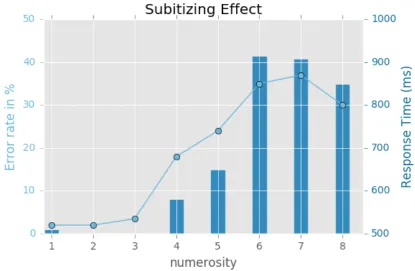
Figure 3.1: Subitizing effect. Error rate and response time are reported for numerosity 1 to 8. A discontinuity at 3 is clearly visible. Data from Piazza et al. [124].
latency and errors above this threshold. (Akin and Chase [1], Mandler and Shebo [100], Sathian et al. [151], Piazza et al. [123], Ross [147]). Although Von Glasersfeld [181] goes beyond this range. Interestingly in several animals the subitizing limit appears higher than in human subjects (Davis and Pérusse [27]).
The typical experimental design is asking people to enumerate a patch of scattered items as rapidly and accurately as possible. In the “subitizing” range error rate and reac-tion time increase only slightly, above that range they grow faster, as can be appreciated by inspecting Figure 3.1.
CHAPTER 3. BEHAVIORAL OBSERVATIONS, OR WHAT (ALMOST) EVERYONE FINDS
3.5
SNARC effect
SNARC is an acronym for “Spatial Numerical Association of Response Code”, a term minted by Dehaene as a tribute to Lewis Carrol’s
wonderfully nonsensical poem. “The Hunting of the Snark”, tells of the relentless quest for a mythical creature, the Snark, that no one has ever seen but whose behavior is known in exquisite detail
What is observed is that larger numbers elicit a faster response on the right side whilst smaller numbers elicit a faster response on the left side. The direction effects is associated with reading habits (Dehaene, Bossini, and Giraux [34], Shaki and Fischer [154]) and is flexible and instable in bilinguals (Fias [44]).
3.6
Transfer Effect
We take here some liberty with respect to our commitment to present the data disentan-gled by the hypothesis that inspired the experiments generating them. In the case of the transfer effect, it’s not only the explanations that clash, but the very effect that is in question. Indeed, this is the most controversial of the behavioral findings here presented. With transfer effect we term the findings that the behavioral signature for number symbols transfer to those of symbolic manipulation. We mean this in a strong sense. As we have seen, distance and size effects are observed in both numeral and dot arrays. However the fact that the same, or better a closely similar signature, is observed, if it can suggest a relation, of course it doesn’t imply one4. If the developmental trajectories for the symbolic acquisition, and successful use of numerals, are predicted by what we termed ‘general magnitude effects’, however, we would be in a better position to claim a relation. The way this is usually expressed is by saying that the Abstract Number Sense (ANS)5 correlates and predicts mathematical abilities6. Piazza et al. [122] cautiously report a correlation between ANS and number knowledge, but no correlation where found between ANS and calculation abilities. On the contrary, Libertus, Feigenson, and
4For example (Van Opstal and Verguts [177]) show how distance effects may arise as a byproduct of a
decision mechanism.
5That is, the subjective signature of the general magnitude effects. ANS is one widely accepted
hypothesis on the explanation of those signatures, and we will dedicate much of the next chapter to explain it.
6The term ‘math abilities’ has to be taken with a grain of salt, what it’s meant is simply elementary
3.7. INTERFERENCE EFFECT
Halberda [91] and Mazzocco, Feigenson, and Halberda [104] conclude that the ANS’ precision predicts performance on school arithmetic, but does not predict non numerical abilities. A recent study (Lindskog, Winman, and Poom [92]) suggests a correlation with math anxiety. However, Sasanguie et al. [150] found no correlation between ANS acuity and symbolic number processing, and in a large scale (170 children), one year long study (Göbel et al. [57]) the authors found no correlation with ANS7.
That the effect is dubious is not surprising. As we pointed out in section 3.1 the very nature of the behavioral observations here presented is puzzling. Recall that for both developmentalists and foundationalists (cf. chapter 2) the numerical content in the approximate number system is required to build the natural number concept, therefore, if no transfer were observed, it would be very much less direct the way to adopt the ANS as a building block. We are dubious, however, that this is the right strategy to assess that. Checking the transfer effect requires proving a negative: an empirically impossible task. That this has long been the strategy of choice is correlated to the lack of a formal definition of numerosity we highlighted in chapter 8. The definition we will put forward in 6 will gives us another strategy correlated with the interference effect we are now going to look at.
3.7
Interference effect
As we pointed out in chapter 8 invariance is assumed by “definition”. As such the degree of invariance is mostly not reported, but implicitly, in the literature. However, as briefly mentioned, interference effects are quite widespread.
Allik, Tuulmets, and Vos [2] report size invariance in numerosity comparision, but dependence on spatial arrangement, in particular to proximity (two proximal dots have less impact than two far apart on numerosity estimation). Ross [147] found that mixing sizes disrupt numerosity estimation (more specifically the Weber ratio increases). Hurewitz, Gelman, and Schnitzer [72] report that cumulative area interferes with, and predicts numerosity estimation, interestingly even in the subitizing range.
Numerosity is influenced by topological invariants such as connectivity and insid-e/outside relationship. In He et al. [64, 65], connecting and enclosing items led to robust numerosity underestimation, with the extent of the underestimation increasing monoton-ically with the number of connected/enclosed items. The same effect has been reported even when participants were explicitly told the lines were irrelevant and after extensive
CHAPTER 3. BEHAVIORAL OBSERVATIONS, OR WHAT (ALMOST) EVERYONE FINDS
training (Franconeri, Bemis, and Alvarez [46]). The underestimation is present no matter the contours are real or illusory (Kirjakovski and Matsumoto [79]). Similarly Im, Zhong, and Halberda [73] report that grouping dots by proximity induces underestimation.
3.8
Weber’s law
Collectively, Comparison Distance Effect and Size effect are usually reported compressed into a single law: “the time to judge the numerosity of two stimuli is a function of the ratio of the numerical magnitude they represent”. Weber’s law states that the just-noticeable difference between two stimuli is proportional to the magnitude of the stimuli. This is an old stand finding in psychophysic that date back to 18348, and has hold true as an approximation for various senses within a specific bandwidth of the external stimuli.
Let’s call the initial intensity Iand, let∆I be the minimal amount needed to detect a difference (JND). In discrimination experiment we are interested to found ∆I as a function of I (s.t. I+DI is just discriminable from I). Therefore Weber’s law is usually stated by the linear equation
∆I=w∗I
or more generally∆I=w∗(I+I0) (to account for very small values, that isw∗I0is the absolute threshold, the smallest intensity we can reliably detect) where wis a constant called Weber fraction. In Fechnerian’s terms the differential change in perception is a geometric progression of the differential change in stimulus
dψ=w∗d I I
By integrating,R
dψ=R
w∗d I
I we obtain Fechner’law
ψ=w∗ln(I)+C
3.9. SUMMARY
3.9
Summary
Experiments similar to the one in our demo9have been widely used to assess numerosity perception in both humans and animals. Whether these experiments target numerical competence, or other non numerical mechanisms are at play, is currently a matter of a strong debate. We reviewed various effects, and noticed that the transfer effect, to wit the observation that performances in the above tasks correlate with arithmetical achievement, faintly suggests that numerical competence is indeed addressed. The results of the experiments are however inconclusive and discordant results are reported in the literature. Theinterference effect, the observation that numerosity perception is not totally invariant to various transformations of the visual stimulus, is frequently disregarded. The interference effect will play a major role in chapter 6 where we indicate how the proposed definition of numerosity can be lifted to cast some light into the aforementioned debate. For the numerosities in the range one to three (possibly four) asubitizingeffect is observed, reaction time and error rate in this range increase only slightly. The perception of numerosities obeys the Weber-Fechner law according to which relative differential sensitivity remains the same regardless of size, as observed in the
size effect and in the comparison distance effect. An interference of numerosity with space has also been observed (SNARC effect) which direction is correlated to the reading direction of the tested subjects.
9Available at https://bramacchino.github.io/stimulus/demo.html and based on the library Stimulus
C
H
A
P
T
E
R
4
F
UNCTIONAL AND
C
OMPUTATIONAL MODELS
There are reasons to believe that the goal of
understanding the human mind strictly from
observations of human behavior is ultimately
untenable, except for small and limited task
domains.
Ron Sun,Introduction to computational cognitive
modeling
CHAPTER 4. FUNCTIONAL AND COMPUTATIONAL MODELS
to the exactness of the subitizing range. Another, approximate, able to give an estimation of numerosity1.
4.1
Functional Models
ANS
4.1.1
Barcode Magnitude representation, (BMR)
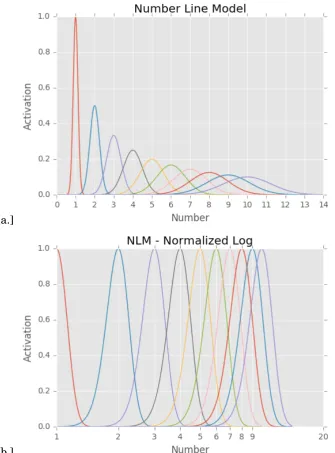
The first representation of numerical information has been presented in a series of arithmetical architectures ( Anderson et al. [4], Anderson, Spoehr, and Bennett [6], and Anderson [5]). In the BMR number magnitude is coded as a moving bar of activation on a topographic scale. Numerosity is encoded as a “discrete number line” where each number is encoded by activating the corresponding node and its immediate neighbors. That is assuming a fixed length of the moving bar, this representation might be seen as a discrete version of the number line coding with logarithmic scaling described below. This representation is however too crude. In the most basic form (the one used in the above mentioned models) the BMR is represented as a finite subset of the natural numbers equipped with a tolerance relationτ(i.e. a symmetric, reflexive, not transitive relation) defined by the rule
n,m∈τ↔ |n−m| ≤1
The problem for this account lies in choosing one as a threshold ad hoc. More generally for any thresholdn∈Nthe maximum elements in the tolerance classes will form a linear order2. To avoid this conclusion, in the models of Anderson and colleagues, it’s assumed a skewed frequency with which numbers are encountered during learning. With this frequency based accounts, the size effects emerges by a weakening of the connection for larger numerosities3.
1Moving from a behavioral description to a neuronal implementation, there is an ongoing debate
whether the two systems are still separated, or if they might be instantiated in the same network (Sengupta, Surampudi, and Melcher [153]).
2A winner takes all network to find the maximum is indeed quite trivial to construct in this case. For a
given numerical stimulus, the elements of an ordered tolerance class are activated. If we let the connection weights to be excitatory in the right direction and inhibitory on the left direction, the network activation will settle on the maximum.
3For example, by imposing a weakening of the inhibitory links in the WTA network for classes