70 | P a g e
DEVELOPING A GAME FOR DISABLED USERS
WITH GESTURE CONTROL FOR LEAP MOTION
BASED ON UNITY PLATFORM
Adrian Karashanov
1, Agata Manolova
2, Ivo Draganov
31,2,3
Faculty of Telecommunications, Technical University of Sofia, (Bulgaria)
ABSTRACT
Nowadays, modern computational technologies used in rehabilitation processes have grown considerably in health care centers. These open a broad of new paradigms which improve the rehabilitation process, robotic hardware, virtual reality system and others. Particularly, Virtual Reality systems are notable for having a high interaction with the user based on real-time responsive actions. In rehabilitation, these systems are offered as modern strategies where a patient performs a set of therapy activities recognized as integration tasks through games or simulations. Several health care centers are using these strategies as part of the regular therapy due to the treatment time is less than using the standard ones. If a therapy is focused on upper limbs, a set of specialized gestures are necessary for the total recovery of patients. In this paper we present basic application destined for younger patients suffering from Cerebral Palsy for example using the opportunities that the new technologies offer by making the rehabilitation process fun and engaging. Leap Motion is the chosen sensor for gesture recognition due to many factors.
Keywords : Gesture Recognition, Gamification, Human-Computer Interface, Leap Motion
Controller, Rehabilitation, Unity 3D Game Engine
I INTRODUCTION
Conventional therapy methods have proven useful for upper extremity rehabilitation, but can lead to non-compliance due to children getting bored with the repetition of exercises. Virtual reality and game-like simulations of conventional methods have proven to lead to higher rates of compliance, the patient being more engaged during exercising, and yield better performance during exercises. Most games are good at keeping players engaged, but does not focus on exercising fine motor control functions.
71 | P a g e heart disease) that can be prevented by regular physical activity. The current scenario of physical inactivity is associated with public health problems and increase of non-communicable diseases, such as atherosclerosis and type 2 diabetes. Considering the culture and the lifestyle as prevention and health promotion strategies, this paper aims to offer a way to control the virtual environments with physical activities that recruit muscle groups of upper and lower limbs, so that occurs increase on blood circulation and consequent in energy expenditure. Gesture recognition systems are capable of allowing patients with mobility impairments greater control over their environment. Several techniques such as the use of inertial sensors, vision systems, and other forms of tracking can be used to capture body gestures [2], [3], [4], [5], [6]. Gesture recognition systems for individuals with mobility impairments, however, present a set of fundamental challenges that typical gesture recognition systems often fail to address. First, sensors for gesture recognition are intrusive, bulky, or expensive [7], [8]. Leap Motion controller [9] offers the answers to those questions.
In this paper, we developed an application based on the gamification approach to capture and recognize the movement of upper limbs using the Leap Motion controller with application in the physical rehabilitation therapy for younger users. Thus, we define an automaton for gesture action for helping users with upper limb problems increase muscle tonus and precision in fun and engaging ways. This paper is organized as follows: Section 2 presents a briefly overview of computer vision systems. Next, Section 3 describes our approach proposed in recognition using low cost hardware, specifically the Leap Motion. In Section 4, we show the developed application. Finally, Section 5 presents conclusions and future work.
II. RELATED WORK
There are two types of devices for recognizing gestures available on the market that enable independent developments of the third-party developers [8]:
• Motion sensing systems - bracelets, rings, bracelets under elbow, gloves and pointers; • Computer Vision Systems
Depth sensing time of flight systems that are suitable for integration into compact HMDs all work in a similar fashion. They consist of two or more camera sensors and one or more infrared laser or LED light projectors. The cameras track infrared light which is outside of the visible spectrum and work in stereo to aid depth perception through parallax as human eyes do. The angle of the camera lenses defines the width of the sensor system’s field of view which gets wider as it gets farther from the lenses; however the viewing range is limited by the output of the light source. The lights are the most energy intensive feature and need reach only 2 feet (60 cm) or so in front of the Human Computer Interaction (HCI). Readings are taken hundreds of times per second. At this point, the sensor data buffers into the device’s own local memory before being streamed to the tracking software.
72 | P a g e of frames. This all behaves as a service organized as classes in a library that can then be consumed as an API by apps that utilize the recognized gestures for interaction.
Computer vision based systems have several advantages. Unlike motion sensing peripherals, the depth sensing time of flight components can be integrated directly into the HMD. This means that there is only one device to carry, one battery to charge and no pairing necessary between devices. Also the gesture recognition software is integrated into the operating system of the HMD which should make for smoother, more efficient user experience because there is no interoperability overhead.
There are also disadvantages of this technology which are related to the physical aspects of hand gesturing. The sensors have a relatively narrow band of sight which means the gestures must be performed immediately below ones line of sight. Such gesturing may be socially awkward in certain public situations (this has been referred to as the “gorilla arms” effect). In comparison, motion sensed gestures can potentially be performed more subtly. Also, holding ones arms elevated in front of them tends to lead to fatigue after a period of time. As the technology matures it is likely that the angle of view of the sensors will improve and the recognition of gestures will allow for more subtle gesturing.
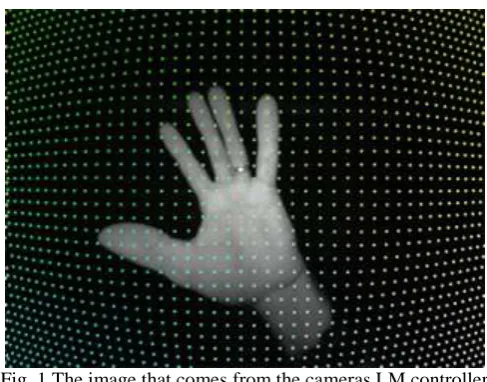
Leap Motion (LM) controller is a device from the second type. The controller is a computer hardware sensor device developed by the American company Leap Motion, Inc. It can detect in real time the movement of the hands and pointers. It is used as an input peripheral device, similar to the computer mouse, but there is no need for physical contact. The mechanics of Leap Motion controller are relatively simple. The basic units of LM controller are two VGA monochrome cameras, three infrared LEDs (light-emitting diode) and a USB controller. The cameras and light emitting diodes serve for monitoring the infrared light with wavelength λ = 850 nm (outside the visible spectrum to the human eye). Thanks to the wide-angle lens the unit has a large space of interaction, it is approximately 0.23m³ (8 ft3) of the shape of inverted pyramid obtained by the intersection of the visual fields of the two cameras. The data is converted to gray scale stereo image divided into left and right camera (Fig. 1).
Fig. 1 The image that comes from the cameras LM controller
73 | P a g e addition, it must be able to operate at close distances. This will allow to be used by patients in a seated or lying position. Not the last we needed to consider the economic factors - the price needed to be accessible, so there will be an opportunity for wider applications in practice.
Leap motion work with shorter distances, usually no more than 20 cm from the camera. It can recognize fingers and palms of the human hand, but also distinguish a tool held by the hand, and interact with it. The accuracy with which the LM runs is significantly higher than that of other similar sensors. It can detect very fine movements and can track 10 fingers simultaneously. The processing speed is so high that the delay of the screen is almost imperceptible. Leap motion controller has an advantage in physical size also. This means easier transportation and positioning. It would be advantageous, from the viewpoint of the medical application because it would facilitate the implementation of therapy in different locations with different patients. Efforts to transfer of LM controller are negligible.
Other advantages of the LM have the opportunity to work with all operating systems. The ability to sign an electronic document to paint a picture or even perform remote medical operation put Leap Motion forward. The application for the rehabilitation of hand requires careful and precise actions and coordination to be able to properly monitor the treatment of the patient and to take account of a significant improvement if such occur. The physical dimensions of both devices are comparable and according to this criterion no device has an advantage. On to the physical characteristics, it can be said that LM has a very slight advantage since it does not require synchronization gesture. This allows for easy use of people of different ages and different physiological characteristics.
This results as Leap Motion controller being a logical choice for the searched device. The application based on the gamification approach in a virtual reality environment will strive to achieve the effects of conventional physiotherapy and real improvements in the condition of patients with upper limb motor problems.
III. APPLICATION DEVELOPPMENT USING UNITY 3D GAME ENGINE
The application, developed for the purpose of this work, will be used with younger patients and it can be divided into three basic logical parts: ball control, gun control and others. Control of the ball is the submission to the commands of the user, which affects its condition. These commands are fed through the gestures of one hand, thanks to Leap Motion. The control of the gun similar to that of the ball, but with some particularities. It includes not only manipulation movement, but shooting.
The controlling hand is that of which five fingers are stretched. If the fingers of both hands are stretched, then the controlling hand will always be the right one. Once it is determined whether there is controlling hand and which is it the application will measure the following parameters:
74 | P a g e
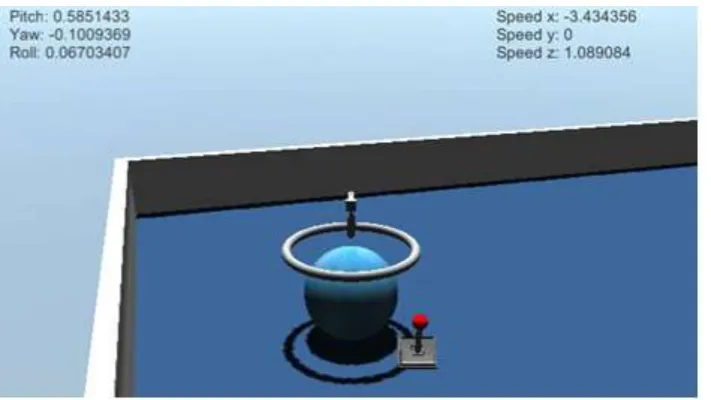
Fig. 2 Direction information and commands filed in both upper corners
Yaw - angle in radians, represents the angle between the negative Z axis and the projection of the vector on the plane XZ. In other words, rotation about the axis Y. If the vector points to the right of the negative Z axis, then the returned angle is between 0 and π radians (180 degrees); if pointing to the left, the angle between 0 and - π radians.
Roll - angle in radians, represents the angle between the Y axis and the projection of the vector on the plane XY. In other words, the rotation about the axis Z. If the vector pointing to the left of the y axis, then returns an angle between 0 and π radians (180 degrees); if he shows the right angle between 0 and - π radians.
Changing these parameters will be used as the setting commands from the user.
Pitch angle is used for rolling the ball forward and backward, respectively, where is greater than 0.3 radians or less than -0.3 radians. Yaw angle is used in a similar manner as Pitch. When its value is less than -0.4, the ball moves on the left, and when greater than 0.4, is moving to the right. Here again, a check of speed, with a view to its limit. Roll angle is used in the same way. When its value is greater than 0.8 the camera is rotated to the left, and when it is less than -0.8 is rotated to the right. Fig. 2 shows the information about the data displayed on the screen of the user.
There is a possibility for the user to track what commands fed to Leap Motion, or more precisely, what Leap Motion takes into account, and what is the direction and speed of the ball. Information about the commands in the upper left corner of Fig. 2, and the movement of the ball - the top right.
Verification of the controlling hand is the same process as how to check the control of the ball, but use slightly different logic. This time, the controlling hand is that of which only stretched is the index finger. If both hands fulfill this condition will then be selected left hand.
75 | P a g e
Fig. 3 Shooting and ball direction control
It would undertake the direction in which the specified index of the ruling hand, there are some restrictions. The weapon is a straight forward direction when pointing the finger is -Z axis of Leap Motion controller. When the angle is increased as it is a corner in the XZ plane to the controller, the gun moves with the same angle. This angle may not exceed 45 degrees, as the controlling hand will take un-natural position that would be quite difficult to play face.
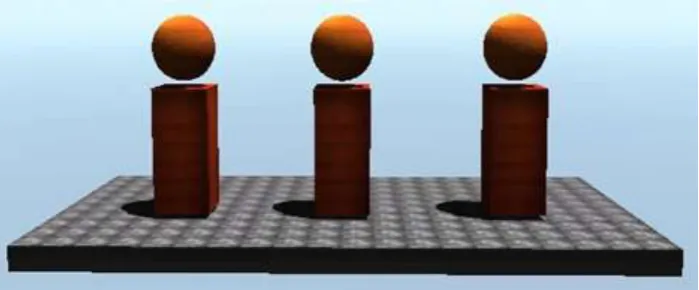
The established level has a bridge that is initially invisible, inactive. This represents an obstacle that the player needs to hit three targets if he wants to pass to the next level (Fig. 4).
Fig. 4 Shooting targets for the hidden level
The bridge is activated when the targets are hit.
IV. CONCLUSION
In this paper, we present a simple and effective application based on gamification approach for upper limbs physical rehabilitation using the Leap Motion as an acquisition device. By giving the patient specific tasks that need to be achieved to overcome specific obstacles, the games teach perseverance and increase our overall level of motivation. It has long been known that games improve coordination between eyes and hands, as well as helping to increase the spatial orientation (ability to mentally manipulate two- and three-dimensional objects, to navigate on the map, etc.). Separately, the games help to overcome the "technophobia", that is when the user is worrying to use high-tech machine - something that many adults share.
76 | P a g e aware of the locations of their hands, because any a slight displacement can lead to different action from the desired.
These applications are designed taking into account the needs of patients with mobility problems. They were developed and tested through consultation with people having problems with the upper limbs. For future work, adding new levels will offer greater adaptability and flexibility in the platform to embrace a wider range of motion detection applications and adding a measurement of muscle tonus will increase the usefulness. Also, it would be possible to add more precision and versatility with technologies as Oculus Rift.
ACKNOWLEDGEMENTS
This work was supported by contract DFNI I02/1 for research project: ”Intelligent man-machine interface for assistive medical systems in improving the independent living of motor disabled users“ of the Bulgarian Research Fund of the Ministry of Education and Science.
REFERENCES
[1] GBrandão, A.F.; Parizotto, N.A ; Trevelin, L.C“ Gesture recognition for health and rehabilitation,” Resumos do IX Congresso Internacional de Educação Física e Motricidade Humana XV Simpósio Paulista de Educação Física, 2015
[2] Holger Junker, Oliver Amft, Paul Lukowicz, and Gerhard Troster. Gesture spotting with body-worn inertial sensors to detect user activities. Pattern Recognition, 41(6):2010–2024, 2008.
[3] Ari Y Benbasat and Joseph A Paradiso. An inertial measurement framework for gesture recognition and applications. In Gesture and Sign Language in Human-Computer Interaction, pages 9–20. Springer, 2002.
[4] Sung-Jung Cho, Jong Koo Oh, Won-Chul Bang, Wook Chang, Eunseok Choi, Yang Jing, Joonkee Cho, and Dong Yoon Kim. Magic wand: a hand-drawn gesture input device in 3-d space with inertial sensors. In IWFHR-9 2004, pages 106–111. IEEE, 2004.
[5] Ying Wu and Thomas S Huang. Vision-based gesture recognition: A review. In Gesture-based communication in human-computer interaction, pages 103–115. Springer, 1999.
[6] Yi Xia, Zhi-Ming Yao, Xian-Jun Yang, Sheng-Qiang Xu, Xu Zhou, and Yi-Ning Sun. A footprint tracking method for footprint tracking method for gait analysis. Biomedical Engineering: Applications, Basis and Communications, 26(01), 2014.
[7] Susan Koch Fager and Judith M Burnfield. Patients’ experiences with technology during inpatient rehabilitation: opportunities to support independence and therapeutic engagement. Disability and Rehabilitation: Assistive Technology, 9(2):121–127, 2013.
[8] Gurashish Singh, Alexander Nelson, Ryan Robucci, Chintan Patel, and Nilanjan Banerjee. Inviz: Low-power personalized gesture recognition using wearable textile capacitive sensor arrays. In Perv. Comp. and Comm. (PerCom), IEEE Int. Conf. on. IEEE, 2015.
[9] www.leapmotion.com