International Journal of Innovative Technology and Exploring Engineering (IJITEE) ISSN: 2278-3075, Volume-8 Issue-9, July 2019
Abstract: Today’s era is of smart technology, Computing
intelligence and simulations. Many areas are now fully depended on simulation results for implementing real time workflow. Worldwide researchers and many automobile consortium are working to make intelligent Vehicular Ad hoc Network but till yet it is just a theory-based permutation. If we take VANET routing procedures then it is mainly focussing on AODV, DSDV and DSR routing protocols. Similarly, one more area of Swarm Intelligence is also attained attention of industry and researchers. Due the behavior of dynamic movement of vehicle and ants, Ant Colony Optimization is best suited for VANET performance simulations. Much of the work has already done and in progress for routing protocols in VANET but not focused on platooning techniques of vehicle nodes in VANET. In our research idea, we came up with a hypothesis that proposes efficient routing algorithm that made platooning in VANET optimized by minimizing the average delay waiting and stoppage time. In our methodology, we have used OMNET++, SUMO, Veins and Traci for testing of our hypothesis. Parameters that we took into consideration are end-to-end delay as an average, packet data delivery ratio, throughput, data packet size, number of vehicle nodes etc. Swarm Intelligence has proved a way forward in VANET scenarios and simulation for more accurate results. In this paper, we implemented Ant Colony Optimization technique in VANET simulation and proved through results that if it integrates with VANET routing scenarios then result will be at its best.
Index Terms: Swarm Intelligence, Simulation, VANET, platooning, Ant Colony Optimization.
I. INTRODUCTION
Traffic is increasing worldwide and we have no control over it. The best way to deal is to just to optimize in better way and make it a continual process of improvement. the World Health Organization has revealed in its first ever Global Status Report on road safety that more people die in road accidents in India than anywhere else in the world, including the most populous China. The road fatalities can be called an epidemic that will become the world’s fifth biggest killer by 2030, if nothing was done today. In last 50 years, India’s automobile population has grown 170 times while the road infrastructure has expanded only nine times. 90% of deaths on the world’s road occur in low and middle income countries. These statistics motivates to develop a technology so that road
Revised Manuscript Received on July 5, 2019.
Gagan Deep Singh, School of Computer Science, University of Petroleum & Energy Studies, Dehradun, India.
Dr. Manish Prateek, School of Computer Science, University of Petroleum & Energy Studies, Dehradun, India..
Dr. Hanumat Sastry G, School of Computer Science, University of Petroleum & Energy Studies, Dehradun, India..
casualties can be minimized. VANET simulation are used for predefined scenarios to churn out the best possible solution for Intelligent Traffic System. In near future VANET technology will be deployed to reduce the fuel consumption, traffic congestion, pollution and as well as driver’s irritation due to undesired traffic conditions. The World Health Organization has revealed in its first ever Global Status Report on road safety that more people die in road accidents in India than anywhere else in the world, including the most populous China [1]. The road fatalities can be called an epidemic that will become the world’s fifth biggest killer by 2030, if nothing was done today. In last 50 years, India’s automobile population has grown 170 times while the road infrastructure has expanded only nine times. 90% of deaths on the world’s road occur in low- and middle-income countries. At least 13 people are injured every hour in India due to road accidents. The number of accidents per 1000 vehicles in India as high as 35 while the figure ranges from 4 to 10 in developed countries. [2]. VANET routing protocols history starts with traditional MANET protocols such as AODV (Ad hoc on Demand Distance Vector Routing) [3] and DSR (Dynamic Source Routing) [4]. AODV and DSR have been considered efficient for Multi hop wireless ad hoc networks [5]. Routing plays a major role when we design any of the VANET scenarios for Vehicle-to-Vehicle communication. Now the technology is upgrading in a random manner. Therefore, after launch of 5G network on GSM spectrum then Vehicle-to-Infrastructure will be able to establish its roots in Urban Intelligent Transportation System (UITS). Vehicular ad hoc network constitutes of vehicle, here referred as nodes with capability to establish wireless communication with other nodes, thereby transforming the network into a self-organized shared mesh. This network of vehicles makes VANET, which gives numerous applications so as to make the road travel experience more safe, effective, convincing, easy, efficient and pleasant by decreasing traveling time, traffic congestion, avoiding congested areas, increasing road capacity and emergency situations resulting in lesser fuel wastage [6]. That also helps to makes our environment clean. Many of the VANET routing protocols and Wireless standards are already available but none of yet is able to provide the concrete routing solution for VANET [7].
Swarm Intelligence based efficient routing
algorithm for platooning in VANET through Ant
Colony Optimization
Optimization
II. SWARMINTELLIGENCEThe newly emerged Swarm algorithm is capable to simulate the behavior of various animals such as birds, fish, bees and ants. Swarm intelligence algorithms are newly emerged Swarm intelligence techniques that replicate the behavior of existing living organisms are also used in literature for routing in VANETs. Swarms have the unique talent to answer any given real-time and complex tasks, which are a challenging to answer through normal algorithms and hence are suitable for the real-time traffic scenario. Ant colony optimization (ACO) is an artificial Swarm algorithm that can be used for building paths in communication and networking domains. It has the ability to develop self-organizing methods that help in solving real-time routing problems [8]. In ACO, a chemical called pheromone is dropped, by ants on its route while passing through that route, which is sensed by other ants to help them follow the path [9]. Other ants in the group can discover the accumulation of the pheromone and if encountered with higher concentrations of pheromone then, follow that path. Pheromone starts evaporating in the situation where the route remains unused by the vehicles for some time [10]. A modified version of ACO for the vehicular traffic environment to yield more optimized results on complex road network [11]. The core objective is to minimize the waiting time during journey, which in turn reduces the total travel time irrespective of the path length used by the vehicle [12].
III. ANTCOLONYOPTIMIZATIONTECHNIQUE Ant Colony Optimization Ant Colony Optimization (ACO) is a meta-heuristic approach proposed by Colorni et al. in 1991 and further modified by Dorigo et al. in 1996 for the Ant Colony System [13]. It is used to solve numerous disconnected optimization problems and is considered as one of the swarm intelligent algorithm types [14]. ACO simulates the real ants to find shortest path between source and their nest, while searching the ant deposit chemical substance called pheromone along the past path. This pheromone value can be used by other ants as indicator to find the shortest path to food places. The path with stronger pheromone value will be preferable for coming ants. If the number of ants decreased in a specific path, the pheromone evaporates with passed time and vice versa [15]. Different Ant Colony Optimization algorithms have been proposed. All of them share the same idea. The original ant colony optimization is known as ANT system, and the two most successful variants max-min Ant system and ant colony system [16]. ACO is iterative algorithm, a number of artificial ants are generated at each time and build a solution to the considered optimization problem and exchange the quality information of these solutions via communication scheme. A distributed heuristic solution like ACO routing algorithm shows many features that makes it particularly suitable for wireless sensor network [17]. Algorithm is fully distributed that mean there is no single point of failure. The operations done in every node are simple. Autonomous interaction of ants, and the algorithm based on agents‟ synchronous. It is self-organizing, thus robust and fault tolerant. There is no need to define path recovery algorithm. Intrinsically adapts to traffic without requiring complex, and yet inflexible metrics. It inherently
adapts to all kinds of variations in topology and traffic demand, which are difficult to consider into account by deterministic approaches.
IV. PROPOSEDEFFIECENTROUTING
ALGORITHMFORPLATOONING
International Journal of Innovative Technology and Exploring Engineering (IJITEE) ISSN: 2278-3075, Volume-8 Issue-9, July 2019
Figure 1: self-adaptive behaviour of Ants
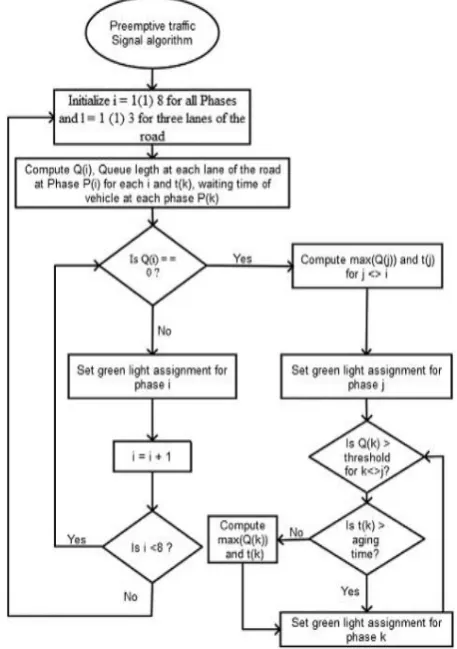
Hence, to resolve this issue we have integrated preemptive traffic signal algorithm [20] with existing ACO algorithm to devise our new GMHU algorithm for VANET Platooning. Preemptive approach shown in fig.2 as per the given flowchart below:
Figure 2: Preemptive traffic signal process flow The proposed GMHU algorithm works under the assumption that all roads are in best working condition. The GMHU algorithm summarized a s below:
Scenario1 = Simple road network Scenario2 = Complex road network
Scenario3 = Clock tower to Mussoorie diversion from openstreetmap.org
Parameters = As shown in Table1
Python Script of Ant Colony Optimization = PACO
Python Script of Modified Ant Colony Optimization =
MPACO
Python Script of Preemptive Road Traffic Algorithm =
PPreRTA
STEP1: Set scenario1, scenario2, scenario3 for VANET simulation
STEP2: Set common parameters for all three scenario using Dijkstra
STEP3: Implement simulation as per the parameters for scenario1
STEP4: Repeat for Scenario2 STEP5: Repeat for Scenario3 STEP6: Run simulation for 100 times
STEP7: Deploy PACO for all scenario
STEP8: Follow STEP6 STEP9: Export data
STEP10: Deploy python MPACO for all three scenario
STEP11: Follow STEP6 STEP12: Export data
STEP13: Repeat STEP10 to deploy PPreRTA
STEP14: Run simulation
STEP15: Start routing nodes in simulation through STEP13
STEP16: if congestion at intersection for green signal STEP17: Check for threshold
STEP18: if congestion > threshold
Apply preemptive road traffic algorithm and apply Routing of nodes
else continue STEP19: Follow STEP6 STEP20: Export Data
STEP21: Perform Ttest for data acquired in all scenario STEP22: Analysis of result
STEP23: Compare STEP24: Conclusion STEP25: END STEP20: Export Data
STEP21: Perform Ttest for data acquired in all scenario STEP22: Analysis of result
STEP23: Compare STEP24: Conclusion STEP25: END
V. METHODOLOGYOPTED
[image:3.595.54.283.325.650.2]Optimization
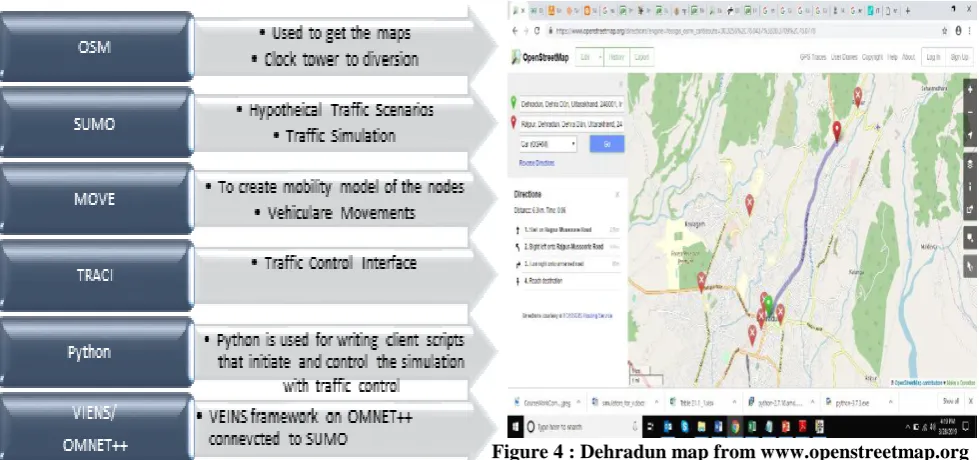
Figure 3 : Methodology Used
We utilized only open source software available online for our experimental setups.
1.OSM
2.SUMO (Simulation of Urban Mobility)
3.MOVE (MObility model generator for Vehicular networks)
4.Python
5.TraCI (Traffic Control Interface) 6.Instant VIENS 4.7.1.
7.OMNET++ 4
[image:4.595.61.551.50.280.2]We have used instant Veins 4.7.1 because, it is a virtual, that can be directly deployed on our system. Veins is distributed as a single-file virtual appliance, ready for one-click import into software like Oracle VM VirtualBox, VMware Workstation Player, or any other software supporting the open virtual format. We integrated two existing algorithm of the VANET. Then we devised our own new algorithm that we have named as GMHU algorithm for optimizing VANET routing. Scripted the algorithm in python adopted from github. Used different VANET scenarios along with Dehradun road network as shown in fig. 4 that was taken through www.openstreetmap.org. Used SUMO, OMNET++, VEINS, MOVE, over TraCI as an interface to run simulation tests. The test results are exported in to excel format and then then compiled test data is used in t-test to conclude our hypothesis. The t-test outcome proved that our proposed newly devised algorithm is able to minimize the travel time as well as waiting time also. Hence, our hypothesis is valid.
[image:4.595.303.549.383.635.2]Figure 4 : Dehradun map from www.openstreetmap.org In this simulation test, we have used ant colony routing protocol Annet which is already available in the library. Total number of vehicles was limited to 30 only so that we can get results faster. The three different speed scenarios were ran on simulation. 20ms, 40ms and 80ms respectively. Parameters for simulation test are shown in table 1 as below.
Table 1 : Simulation Parameters
Parameters Values taken for simulation configuration
Routing Protocol Annet
Wireless Terrain 1300 X 1300
Node Density 30
Velocity 20ms, 40ms, 80ms
Packet size 100bytes
MAC Protocol MAC 802.11p
Type of Traffic CBR
Propagation Model Nakagami Sampling interval 2.5ms Simulation time
period
10 seconds
Network Simulator OMNET++ through instant Veins Simulation Scenarios Simple Road Network, Complex Road Network and OSM from www.openstreetmap.org
VI. EXPERIMENTALSETUPAND IMPLEMENTATION
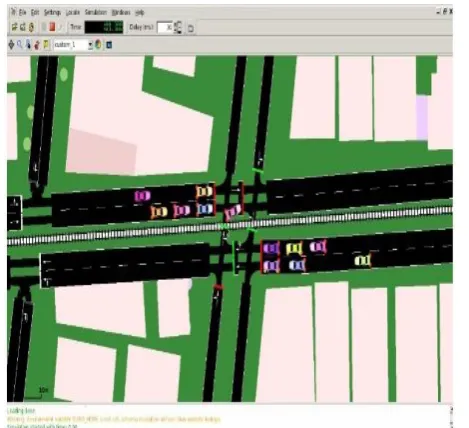
We have done the simulations through VEINS framework on OMNET++ which is connected to SUMO as shown in fig. 5, via local client server model, and to establish this we take help of TraCI(TRaffic Control Interface) which is distributed along with SUMO bundle in src folder[21]. TraCI works as middleware to connect SUMO and OMNET++. VEINS framework which is running inside OMNET++ provide a
python script named
International Journal of Innovative Technology and Exploring Engineering (IJITEE) ISSN: 2278-3075, Volume-8 Issue-9, July 2019
[image:5.595.300.569.159.571.2]TraCl server connection and VEINS via OMNET++, the sever waiting on terminal listening on port 9999 at localhost. When simulation starts on OMNET++ it sends a request to TRaCI server and gets nodes location in response, thereby creating a real-time road network on OMNET++ Simulation panel. This step is to share SUMO mobility on OMNET++, now comes the role of Network Simulator OMNET++, which implies communication between the nodes and make vehicles exchange data. Using Veins framework in OMNET++ we simulate our scenario and took various parameters specified in omnetpp.ini file, which is required by OMNeT simulator to run simulations. We have used scenario specific parameters such as playground size that was taken as 25000m by 25000m and simulation time is set to 6000s. The configuration parameters for WaveAppLayer used for communication between nodes/vehicles, here applType represents the protocol used for information exchange [22].
Figure 5 : Simulation Scenario implementation in SUMO We designed three types of road networks, viz. simple, complex, Dehradun road network using the open source simulator: SUMO along with MOVE. We use simulators to check the efficiency of the proposed GMHU platooning algorithm. For this, the road network is simulated. During the journey, whenever a traffic signal comes in the compared with both the modified Ant Colony and Dijkstra’s algorithms. The GMHU platooning algorithm provides considerable decrement in the total travel time for the vehicles because of the reduction in waiting time. It was assumed that the network consists of too many vehicles with congestion on many of its routes. Vehicles follow the modified ACO path only when vehicles in the network exceed some set threshold, i.e., some congestion exists, otherwise the path followed by vehicles is the default path given by the Dijkstra’s algorithm.
The implementation of the algorithms was done in Python. Testing was performed over all the three selected simulated road networks and results were compared. The two parameters on which comparisons are performed are overall travel time for reaching the destination and the overall waiting time in the entire route. The results justify
that GMHU outperforms the other two algorithms: Dijkstra’s algorithm and modified Ant Colony algorithm, when there is congestion in the network returning the optimal route that is obstruction free. Table 2 and 3 summarizes the results obtained by implementing the GMHU platooning algorithm in our simulated networks over the parameters specified in Table 1 as above.
Table 2 : Data Analysis for Dehradun road simulation
Waiting Time Travel Time
Dehradun road simulation
Vehicl
e
Nodes
Dijkstra’s ACO GMHU Dijkstra’s ACO GMHU
600 2878 529 342 46,789 42,967 40,215
900 10,975 1371 1125 75,277 46,630 42,541
1200 21,624 3101 2541 107,066 101,20
7
65,489
1500 36,361 7286 3627 140,261 135,16
0
85,476
1800 45,967 9487 5487 173,127 170,75
7
96,587
2100 59,248 12,20
9
7825 208,321 205,07
8
108,54
1
2400 78,841 17,26
4
8964 249,799 222,47
7
112,54
7
2700 94,210 22,00
5
9247 287,198 238,85
0
146,54
7
3000 120,114 23,92
2
9876 335,756 282,95
0
152,59
8
3300 140,041 36,94
1
10,054 377,792 294,44
4
179,87
6
3600 177,282 44,25
1
10,265 436,553 382,33
8
185,47
8
3900 209,047 50,27
9
11,429 490,118 399,07
1
216,54
7
[image:5.595.55.290.271.485.2]Optimization
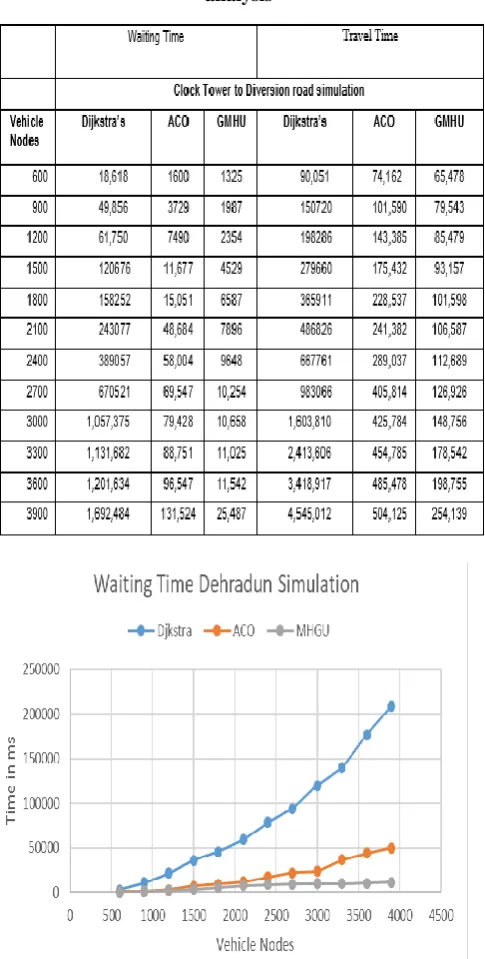
Table 3 : Clock Tower to diversion, simulation data analysis
Figure 6: Graph generated for the waiting time for Dehradun Simulation
Figure 7: Graph generated for the waiting time for clock tower to diversion
The graphs shown above as in figure 6 and 7 clearly emphasize that GMHU is taking minimum duration of waiting time period as compared to ACO and Dijkstra’s routing simulation of vehicle nodes. Hence, here we can conclude that in any of the simulation test if researchers adopt our mentioned VANET scenario and parameters. Then our proposed GMHU platooning algorithm will surely give better results as compared to other routing algorithms that are available for VANET simulations.
VII. CONCLUSION
In our hypothesis, we concluded through our research and experiments that our newly devised swarm based efficient routing platooning algorithm using ACO techniques is able to reduce the travel time in VANET through two factors: first is by providing green time at traffic signals and hence, choosing the optimal congestion-free route for the vehicles. GMHU algorithm was designed by integrating the preemptive traffic signal algorithm with existing modified ant colony optimization algorithm. This made our GMHU platooning algorithm efficient by reducing the waiting time of the vehicle nodes. This combination provides both the optimization of waiting time at the intersection by reducing the average queue length using preemptive algorithm and optimization of the path length chosen for the vehicles using the pheromones to avoid congestion in the network. The GMHU algorithm has the ability to pick any phase for the allotment of green time using the current vehicle density with the avoidance of starvation at any of the phases. Furthermore, GMHU platooning algorithm is able to optimize the path length of vehicles and ensure the avoidance of the congestion by imitating the ant behavior. Here, we also wish to state that there are tremendous area of scope for the improvement of VANET optimization. Hence, experts of this domain can come together for more better and optimize solutions.
REFERENCES
1. https://www.who.int/violence_injury_prevention/road_safety_status/re
port/en/
2. https://apps.who.int/iris/bitstrea
[image:6.595.49.292.207.687.2]International Journal of Innovative Technology and Exploring Engineering (IJITEE) ISSN: 2278-3075, Volume-8 Issue-9, July 2019
5D1211E68126F84AE381AD863EA906B?sequence=1
3. C. Perkins and E. Royer, “Ad-hoc on-demand Distance Vector
Routing,” Proceedings of second IEEE Workshop, Mobile Comp. Sys. App. Feb 1999, pp. 90 – 100.
4. David B. Johnson, David A. Maltz and Josh Broch, “DSR: The
Dynamic Source Routing Protocol for Multi-Hop Wireless Ad hoc Networks”, in Ad hoc networking, Editor : Charles E. Perkins, Chapter 5, pp. 139 – 172, Addison-Wesley, 2010.
5. Manvi, S.S., Kakkasageri, M.S., Mahapurush, C.V., “Performance
Analysis of AODV, DSR and Swarm Intelligence Routing Protocols in VANET Environment”. In International Conference on future Computer and Communication. Pp. 21 – 25, April. 2009.
6. Ravi Tomar, Manish Prateek, G.H. Sastry., “ Vehicular Adhoc Network
(VANET) - An Introduction”. International Journal of Control Theory and Applications, International Science Press, 2016, 9(18), pp 8883-8888
7. Gagan Deep Singh, Ravi Tomar, Hanumat G Sastry, Manish Prateek, A
Review on VANET Routing protocols and Wireless Standards, DOI: 10.10007/978-981-10-5547-8_34, October-2018, Springer, book chapter in Smart Computing and Informatics.
8. M. Dorigo and L M. Gambardella, “Ant colony system: A cooperative
learning approach to the traveling salesman problem,” IEEE Transactions on Evolutionary Computation, vol. 1, pp.53-66, 1997.
9. Cabanes, G., E. Van Wilgenburg, M. Beekman, and T. Latty. 2015. Ants
build transportation networks that optimize cost and efficiency at the expense of robustness. Behavioral Ecology 26 (1):1–9.
10. M. Dorigo and L M. Gambardella, “Ant colony system: A cooperative
learning approach to the traveling salesman problem,” IEEE Transactions on Evolutionary Computation, vol. 1, pp.53-66, 1997.
11. Bin, Y., Y. Z. Zhen, and Y. Baozhen. 2009. An improved ant colony
optimization for vehicle routing problem. European Journal of Operational Research 196 (1):171–76. doi:10.1016/j. ejor.2008.02.028.
12. Dias, J. C., P. Machado, D. C. Silva, and P. H. Abreu. 2014. An inverted
ant colony optimization approach to traffic. Engineering Applications of Artificial Intelligence 36:122–33. doi:10.1016/j.engappai.2014.07.005.
13. M. Dorigo and L M. Gambardella, “Ant colony system: A cooperative
learning approach to the traveling salesman problem,” IEEE Transactions on Evolutionary Computation, vol. 1, pp.53-66, 1997. 14. M. Dorigo, M. Birattari, and T. Stutzle, “Ant colony optimization,”
Computational Intelligence Magazine IEEE, vol. 1, pp. 28-39, 2006.
15. T. Camilo, C. Carreto, J. S. Silva and F. Boavida, “An Energy-Efficient
Ant Based Routing Algorithm for Wireless Sensor Networks,” Ant Colony Optimization and Swarm Intelligence, vol. 4150, pp. 49-59, 2006.
16. Y. Sun, H. Ma, L. Liu, Y. Zheng, “ASAR: An ant-based service-aware
routing algorithm for multimedia sensor networks,” Frontiers of Electrical and Electronic Engineering in China, vol. 3, pp. 25-33, 2008.
17. S.M. Giriraj kumar, K. Ramkumar and S. Sharma, “Real Time
Application of Ants Colony Optimization,” International Journal of Computer Applications, vol. 3, pp. 34-46, 2010.
18. Bell, J. E., and P. R. McMullen. 2004. “Ant colony optimization
techniques for the vehicle routing problem.” Advanced Engineering Informatics 18 (1):41–48. doi:10.1016/j. aei.2004.07.001.
19. Benhala Bachir, Ahaitouf Ali, Mechagrane Abdellah, “Multi objective
Optimization of an Operational Amplifier by the Ant Colony Optimization Algorithm”, Scientific and Academic Publishing, Electrical and Electronic Engineering p-ISSN: 2162-9455 e-ISSN: 216-8459 2012, doi: 10.5923/j.eee.20120204.09.
20. Vinita Jindal and Punam Bedi,, “Preemptice MACO (MACO-P)
Algorithm for reducing travel time in VANETs”, Applied Artificial Intelligence, Taylor & Francis, 2017, VOL. 31, NO. 2, 174–196.
21. Christoph Sommer, Reinhard German and Falko Dressler,
“Bidirectionally Coupled Network and Road Traffic Simulation for Improved IVC Analysis,” IEEE Transactions on Mobile Computing, vol. 10 (1), pp. 3-15, January 2011.
22. Ravi Tomar, Gagan Deep Singh, Manish Prateek, G.H. Sastry,
Modelling and Simulation of Vehicle to Vehicle Communication, International Journal of Control Theory and Applications, ISSN:0974 – 5572, International Press, Vo.10, No.15, 2017.
AUTHORSPROFILE
Gagan Deep Singh is an Assistant Professor in School of Computer Science at University of Petroleum and Energy Studies Dehradun. He is postgraduate in Computer Science and pursuing Doctorate in the area of optimization of VANET routing and its
performance. He has presented many research papers in national and international conferences and published research papers in international journals. He is having more than nine years of teaching and six years of system integration and administration experience. His area of interest is System integration, optimization and performance.
Dr. Manish Prateek is Professor and Dean in School of Computer Science at University of Petroleum and Energy Studies Dehradun. He is Doctorate in the field of Robotics. He is having a vast experience of twenty-three years and associated with many research consortiums. He has many of the publications in reputed national and international journals He has also chaired many national and international conferences. Under his guidance many scholars has completed their doctorate in the area of Computer Science, IT and Robotics. His area of expertise is in teaching, robotics, computers and Information Technology.