Aggressor or protector? Experiences and perceptions of violence predict preferences for masculinity
Martha Lucia Borras, Carlota Batres, David I. Perrett
PII: S1090-5138(16)30122-2
DOI: doi:10.1016/j.evolhumbehav.2017.03.004 Reference: ENS 6121
To appear in:
Received date: 17 June 2016 Accepted date: 21 March 2017
Please cite this article as: Martha Lucia Borras, Carlota Batres, David I. Perrett , Aggressor or protector? Experiences and perceptions of violence predict preferences for masculinity. The address for the corresponding author was captured as affiliation for all authors. Please check if appropriate. Ens(2016), doi:10.1016/j.evolhumbehav.2017.03.004
ACCEPTED MANUSCRIPT
Aggressor or protector? Experiences and perceptions of violence predict preferences for masculinity.
Martha Lucia Borras., Carlota Batres1 and David I Perrett.
Perception Lab, School of Psychology and Neuroscience, University of St Andrews, St Mary’s Quad, St Andrews, Fife, KY16 9JP, Scotland, United Kingdom.
Total word account (excluding references and appendix): 5757
Abstract
Women’s preferences for masculine male partners have been explained in terms of heritable
health. The evidence between masculinity and health, however, is controversial and therefore,
alternative explanations for masculinity preferences reflecting income inequality and
protection from violence have been proposed. This study thus aimed to test the effect of
exposure to violence (i.e., experiences of robberies and perceptions of danger) on the
individual masculinity preferences of women and men from the capital city of Colombia,
Bogota, and surrounding small towns. One hundred and fifty three adult participants (mean
age +/- S.D.= 31.3 +/- 9.4), all heterosexual, were surveyed in reference to indicators related
to health (e.g., drinking water access, frequency of illnesses), access to media (e.g., television
and internet access), education (e.g., graduating from high school, attending university) and
exposure to violence (e.g., frequency of robberies/attacks, feelings of danger from violence).
Participants made two alternative, preference forced-choice for masculinized and feminized
versions of both rural Salvadoran and European male faces. We found that men and women
exposed to higher levels of violence preferred less masculine male faces, although this effect
was only significant for women. Additionally, the effect of violence exposure was more
relevant for the Salvadoran stimuli. Violence contributed significantly to explaining
masculinity preferences after controlling for participant age, education, access to media, and
health-related factors. These preferences may reflect women’s strategy to avoid male
violence demonstrating that exposure to violence matters in interpersonal attraction.
1
ACCEPTED MANUSCRIPT
ACCEPTED MANUSCRIPT
1. IntroductionSexually dimorphic bodily traits are presumed to have arisen from sexual selection
favouring those phenotypic and genotypic characteristics that increase mating opportunities
and offspring (Puts et al., 2012). Sexual selection in males could have operated through
female mate choice (Little, DeBruine, & Jones 2011a; Little, DeBruine, & Jones, 2011b)
and/or through male-male competition (Puts, 2009; Little, Jones, & DeBruine, 2013; Barber,
1995). A great deal of attention however has been put into studies of women’s masculinity
preferences reflecting mate choice at the individual and population level (Rhodes et al., 2003;
Thornhill & Gangestad, 2006; Rantala et al., 2013; DeBruine et al., 2011; Batres & Perrett,
2016), while less emphasis has been given to the effects of male-male competition at any
level of study (de Bara et al., 2013; Batres & Perrettt, 2014, Snyder et al., 2011). Studies at
the population level have utilized measures of health (e.g., mortality), violence (e.g.,
homicide rate), and education (e.g., high-school attendance rates), which are aggregated
indicators that summarize the state of a population as a whole. This level of measurement is
usually based on environmental factors that are external to the individual, but that give a
contextual framework for studies. At the individual level, measures considered are those that
vary within a population and are experienced differently by each individual.
In support of mate choice being the selective pressure behind women’s masculinity
preferences, several studies have found a positive correlation between masculinity and
different indicators of male mate value (i.e., traits associated with heritable health or those
important for the acquisition of resources; Little, DeBruine, & Jones, 2011a; Little, DeBruine
& Jones, 2011b). At the individual level, measures of actual health (i.e., childhood frequency
of diarrhoea, health history, frequency and duration of respiratory diseases)
correlatedpositively with masculinity preferences for male faces (de Barra et al., 2013) and
with measures of facial masculinity (Rhodes et al., 2003; Thornhill & Gangestad, 2006).
Positive correlations between health indicators and attractiveness to masculinity are not the
rule though. Lie, Rhodes & Simmons (2008) found that genetic aspects of health (i.e.,
diversity of the major histocompatibility complex genes of their participants) did not predict
their facial masculinity. Fink and colleagues (2007), on the other hand, found that men’s
strength positively correlated with facial ratings of dominance, masculinity, and
attractiveness. These findings were explained in terms of strength being an honest signal of
capacity to acquire resources and higher social status. Adding to Fink’s results, Snyder et al.,
ACCEPTED MANUSCRIPT
characteristics of aggressive-formidable men. These results suggest that formidable,
masculine men may be effective protectors for women when they feel at risk.
At the population level, contexts that have been suggested to affect women’s reproductive
decisions include measures of environmental health (e.g., parasite load as potential virulence
and number of parasites in the environment), development (e.g., measured as the frequency
of internet use), income inequality (e.g., Gini coefficient), and access to education (e.g.,
DeBruine et al., 2010a, b; Batres & Perrett, 2014; Brooks et al., 2011; Kasser & Sharma,
1999). Evidence at this level, supporting female mate choice as the driver for masculinity
preferences is found by DeBruine et al., (2010a, b). Here women living in USA states and
countries with a higher health index had lower preferences for masculine male faces than
women living in places with a lower health index. Similarly, Penton-Voak, Jacobson, and
Trivers (2004) attributed their findings of rural Jamaican women preferring more masculine
looking males than British women, to the Jamaican environment having a greater pathogen
load which could make signs of heritable health more important for women. Additionally,
Kasser & Sharma (1999) show that when women have less access to education, they prefer
characteristics associated with resource-acquisition in potential partners. Conversely, Scott et
al., (2014) found that facial masculinity preferences for both men and women increased with
lower levels of disease burden across 12 populations and that these preferences were
predicted by level of urbanization, rather than presumed pathogen risk. Likewise, Snyder et
al., (2011) found that women’s mate preferences were not predicted by population violence
(i.e., neighbourhood crime).
Inconsistencies in the results of studies considering mate choice as the driving force behind women’s masculinity preferences (both at the population and individual level) may be
due to an underestimation of the role of intra-sexual competition in men (Puts, 2009). Such
inconsistencies could also be due to the disregard of the link between masculinity and
behavioural traits undesirable to women. For example, more masculine men are more
aggressive and are perceived as less trustworthy (Fink & Penton-Voak, 2002; Gangestad &
Simpson, 2000; Jones et al., 2005; Little et al., 2008).
Women’s masculinity preferences at the population and individual level have been
found to be consistently influenced by male-male competition when taking into account risks
associated to public violence (e.g., violence coming from strangers). At both levels of
ACCEPTED MANUSCRIPT
found that a country’s income inequality index, an indicator of the level of violence, predicted masculinity preferences better than a country’s health index. Since male
masculinity is associated with dominance (Dijkstra & Buunk, 2001; Batres, Re, & Perrett,
2015), it could be advantageous for women to choose a more masculine male in
environments with a high level of male-male competition (Puts, 2010; Brooks et al., 2011).
Ryder et al., (2016) found that at the individual level, women preferred more physically
formidable and dominant partners when they felt more at risk of crime in public places.
Complementing this finding, Little et al., (2011b) found that after priming women with
images of male-male fights, they preferred more masculine male faces. The literature
described above suggests masculine men may be better equipped with physical traits for
antagonistic encounters with other men. This in turn could allow more masculine men to have
higher statuses and hence be more attractive to women. Nevertheless, when women prefer a
more masculine man, they may also put themselves at risk of increased antagonistic
behaviours in the context of a romantic relationship. In fact, Li et al., (2014) found that when
women were primed with images of male-on-female aggression, women’s masculinity
preferences were disrupted and their feelings of disgust and anger increased. These findings
may hint at different effects of domestic violence and/or violence outside the home on
masculinity preferences.
Undesirable correlates to masculinity include preference for short-term, rather than
long-term relationships, low trustworthiness and emotionality (Boothroyd et al., 2008;
Rhodes et al., 2005; Boothroyd et al., 2007; Perrett et al., 1998). Additionally, Suguhara and Warner (2002) found that men’s dominance, decision-making power, and possessiveness (all
linked to masculinity) were associated with violent behaviours, including psychological
aggression, physical assault, and injury in intimate relationships. Therefore, having a higher
preference for more masculine, dominant, stronger men may be beneficial under certain
circumstances and detrimental in others. Preferring a more masculine partner may be
beneficial in environments where the source of violence is external and protection by a strong
partner is an advantage. However, when the source of violence lies within the household or
partnership, preferences may switch to less masculine partners (Li et al., 2014), who will be
less aggressive and dangerous to women, particularly for those women who perceive
ACCEPTED MANUSCRIPT
While the literature presented above suggests that women’s masculinity preferences
differ depending on context and individual perceptions, there is also evidence that men’s
judgments of male facial masculinity parallel women’s judgments (Burris & Little, 2006;
Gangestad et al., 2002; Haselton & Gangestad, 2006). For example, one study found that men
were more jealous of masculine men (Dijkstra & Buunk, 2001). This finding suggests that
men are aware of more masculine men being better able to secure short-term relationships
than less masculine peers. Complementing this finding, Watkins et al., (2011) reported that
men who have more feminine looking partners, perceived more masculine male faces as more
dominant than men with masculine looking partners.
Intra-sexual competition would favour characteristics that enable exclusion of other
mate-rivals by force or threat (Puts, 2009; Little, Jones, & DeBruine, 2013; Barber, 1995) or
assist in the monopolization of resources that interest females (Puts, 2010; Little, DeBruine,
& Jones, 2011b). As men engage in fighting more than women do, it would be advantageous
for men to possess the necessary skills to recognize the fighting ability of potential rivals and
hence reduce the costs of a future antagonistic interaction and perhaps the risk of losing a
romantic partner. Borraz-Leon et al., (2014) found that men with low facial symmetry (linked
to lower masculinity) rated symmetrical men as more attractive to women and as more likely
to be potential rivals than less symmetrical men. This suggests that men with low facial
symmetry may be at higher risks of cuckoldry than symmetric men, and hence they would
have to be more sensitive to cues of male quality.
In the current study, we examined the relationship between masculinity preferences
for male faces and perceptions of danger from violence in both men and women. Previous
research has demonstrated that facial and vocal masculinity and dominance are associated
with greater strength and formidability (Fink, Neave, & Seydel, 2007; Wolff & Puts, 2010)
and therefore, we predicted that masculinity preferences would be higher in environments
where violent scenarios are more common and protection is needed. More specifically,
individuals who experience frequent violence and perceive a greater level of threat from
violence should display higher masculinity preferences. Women’s preferences may reflect
mate choice while men’s preferences could reflect either awareness of what women prefer or
a personal desire for alliances with more physically dominant same-sex peers from whom one
could get protection. Indeed, in several contexts, men’s and women’s preferences for others’
characteristics are congruent (Perrett et al., 1998; Scott et al., 2014; Swami & Tovee, 2005;
ACCEPTED MANUSCRIPT
Examining individuals’ experiences and perceptions of violence may help understand variation in women’s and men’s masculinity preferences (DeBruine et al., 2010a, 2011;
Brooks et al., 2011) and may contribute to the debate between female mate-choice and
male-male competition as drivers of masculinity preferences in women. As health, media access
(internet access, degree of urbanization) and education have all been previously linked to
masculinity preferences, their contribution to explaining masculinity preferences was also
evaluated.
Colombia as study site
Data collection took place in Colombia, one of the most violent nations in the world,
with economic, developmental, and health indicators that differ substantially from frequently
studied populations (e.g., UK and USA). Colombia’s homicide rate per 100,000 inhabitants is
30.8 compared to 1.0 that of the UK. Additionally, life expectancy for women in Colombia is
7% shorter than in the UK. Understanding the effect of violence on masculinity preferences
has been previously attempted at the population level within developed populations with low
indicators of violence or by priming people with images related to violence. Therefore, using
Colombia as a study site maximizes the chance of finding effects of violence. Furthermore,
sampling urban and rural areas within Colombia, where violence indicators differ, increases
the power of our study design.
Masculinity preference studies have been mostly done with participants who are
university students in industrialized countries (e.g., United Kingdom, United States of
America, Japan, etc) and/or via online experiments targeted at participants that have high
access to development (Boothroyd et al., 2007; Debruine et al., 2010; Penton-Voak,
Jacobson, & Trivers, 2004). By contrast, the current sample is more representative, ranging
from educated individuals living in an urban setting to individuals with less access to media,
education, and development living in rural settings. Moreover, Batres & Perrett (2014) found
that online samples are not representative of populations in developing countries (like
Colombia) and therefore the current sample was recruited through in-person testing.
2. Methods
Research protocols were approved by the Ethics Committee of the University of St
Andrews. Written informed consent was obtained from all participants in the study. All data
ACCEPTED MANUSCRIPT
2.1 Participants
Colombians living in either Bogota or in small towns (population <10,000) located at
least two hours away from Bogota were selected as the study population. Participants
recruited outside of Bogota were mostly from the states of Magdalena (61%) and
Cundinamarca (25%), with the remainder (14%) being from the states of Bolivar, Meta, or
Tolima.
Since violence can affect men and women of any age, our adult participants were
recruited regardless of their age. It must be noted, however, that the results presented here are
the same if we were to have limited our sample to a reproductively aged population (i.e., 18
to 46 years of age). One hundred and sixty one participants (81 women and 80 men) were
recruited (81 lived in Bogota and 80 lived in small towns). All participants were older than 17
and eight outliers were omitted in order to achieve normalization of age for the statistical
analyses (i.e., participants older than 68 years of age). This left a sample of 153 participants,
of which 76 were men (mean age +/- S.D.= 31.2 +/- 9.6) and 77 were women (mean age +/-
S.D.= 31.5 +/- 9.4).
2.2 Stimuli used
Stimuli were constructed from two sets of face images. The first set of pictures was
Caucasian (European descent), with 40 females (mean age +/- S.D.= 23.04 +/- 3.81) and 40
males (mean age +/- S.D.= 25.25 +/- 4.64). This set of pictures was accessed from an open
source library (3D.SK). The second set was selected from photographs of individuals from a
rural area of El Salvador (Hispanic descent), with 40 females (mean age +/- S.D.=25.43 +/-
4.64) and 40 males (mean age +/- S.D.=26.32 +/- 5.32) (see Batres & Perrett, 2014 for
details). This second set of faces was included since our participants are also from a Latin
American country and of Hispanic descent. All face images were taken under constant
camera and lighting conditions and showing a neutral expression. Each image was aligned to
a standard inter-pupillary distance and 189 points were delineated. Five male and five female
composite images were made for each ethnic group (Salvadoran and European) by averaging
three original face images. Additionally male and female prototypes were produced by
averaging all female and all male faces separately. Masculinity transforms were made by
adding (or subtracting) 50% of shape difference between male and female prototypes to each
ACCEPTED MANUSCRIPT
(See Figure 1). This resulted in 10 pairs of facial stimuli (5 European male pairs, 5
Salvadoran male pairs).
Figure 1: Example pairs of European (left) and Salvadoran (right) male facial stimuli. The
left of each pair is feminized and the right is masculinized in shape.
Image pairs were presented on printed laminated sheets to each participant. Each
sheet showed one pair of faces, 10 with masculinized faces on the right. Sheet order was
randomized across participants. Preferences for male faces alone are presented here.
Participants were asked which face (the right or the left) they considered more attractive
(Spanish translation: Cuál de las dos caras le parece mas atractiva?) to assess their
masculinity preferences. When participants were doubtful about the meaning of the question,
the interviewer clarified that they should choose the face they considered most handsome
(Spanish translation: Cuál de las dos caras le parece mas guapa?). Subsequently, participants
answered a 57 question survey (see the Appendix for the questions analysed here). The initial
questions inquired about relationship status and whether participants had any children. The
survey also included questions related to indicators of education, access to media (internet
frequency use and having a TV at home), health, danger/violence experiences, and other
relevant questions to this study. Several questions were asked for each indicator. For
education, high school attendance, high school graduation, and university attendance were
assessed. All education questions were binary (yes/no). To establish participants’ access to
media, they were asked if they had a television at home and how frequently they used the
internet. In reference to health, participants were asked if they had access to hospitals,
drinking water (both of which were binary), how frequently they were ill during their
childhood, and how many times on average they had been ill over the past year, among other
questions. Violence questions inquired about both perceptions of danger from violence in the
country, city/town, home, experiences of robberies/attacks in the past year, and how much
[image:10.595.77.453.125.240.2]ACCEPTED MANUSCRIPT
3. Variables analysed
3.1 Dependent variable
Participants’ masculinity preferences were calculated as the percentage of faces high
on the trait that were selected as more attractive across the pairs.
3.2 Independent variables
3.2.1 Factor analysis
When possible, factors were extracted from the violence, education, development, and
health questions via principal component analysis (see Table 1 and Figure 2). The
factorability of the questions related to each indicator was evaluated via the Kaiser-Meyer-Olkin measure of adequacy (when greater or equal to 0.6, it was accepted) and Bartlett’s test of sphericity (accepted when p≤0.05). All solutions were un-rotated and based on Eigen
values greater than 1. All loadings are shown in Table 1. Scores were saved as new
variables/factors.
Indicators Factors and loadings
Violence Danger feelings Men danger to children
Home danger 0.49 -0.20
City/town danger 0.83 0.10
Country danger 0.75 0.38
Robbed frequency 0.56 -0.42
Men danger to children -0.03 0.86
Health Health access Illnesses
Drinking water 0.63 -0.10
Born in a hospital 0.70 -0.17 Access to a hospital 0.77 -0.12 Average illnesses 0.26 0.75
Childhood illnesses 0.08 0.80
Education Education
Graduated high-school 0.70
Attended high-school 0.89
Attended university 0.83
Table 1: Factor loadings: Factors extracted for each indicator and their respective loadings
ACCEPTED MANUSCRIPT
One factor was extracted from the three questions asked about education. This
education factor explained 65% of the variance of the questions. Two factors were extracted
from the five questions related to health. The first factor, health access, strongly related to
drinking water access, being born in a hospital, and having access to a hospital. The second
illness factor was heavily loaded on average illnesses in the past year and frequency of
childhood illnesses. These two factors explained 29% and 25%, respectively, of the total
variance described by the five health-related questions. For the five questions asked in
reference to violence experienced or perceived, two factors were extracted. The first factor,
danger feelings and robberies, explained 35% of the variance from the violence questions and
the second factor, mostly loaded with men being dangerous to their children, explained 22%
of the variance from the violence questions. Since 100% of participants reported access to
television and electricity, only the internet access frequency question was used as a measure
of access to media.
4. Results
4.1 Masculinity preference
A repeated-measures ANOVA was conducted with masculinity preferences for male
faces as the dependent variable, face ethnicity (European vs Salvadoran) as a within-subjects
factor, and participant sex as a between-subjects factor. Covariates in this model were
participant age, individual illness factor, health access factor, media access (i.e., internet
access frequency), danger feelings/robberies factor, and the men dangerous to children factor.
Residuals from this analysis (residual masculinity preferences for Salvadoran faces and
European faces) were normally distributed (skewness and kurtosis lower than +/- 0.74).
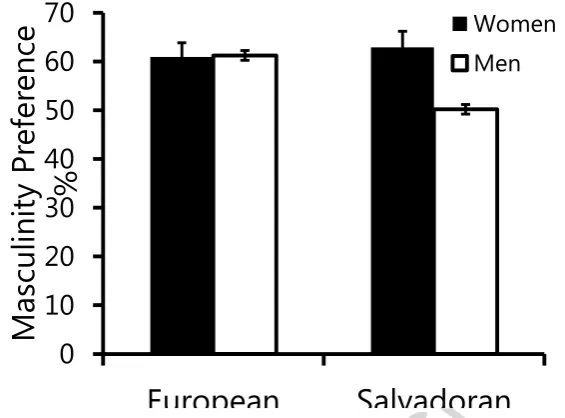
This test revealed that face stimulus ethnicity interacted with participant’s sex F(1,141)= 4.68, p=0.034, η2
= 0.031). Women showed higher masculinity preferences for
Salvadoran male faces than men. Masculinity preferences for European male faces were very
similar for both men and women (see Figure 2). Additionally, ethnicity of the stimuli used interacted significantly with the danger feelings/robberies factor F(1,141)=4.43, p=0.038, η2
=
0.030). Face stimulus ethnicity did not interact with any other variable (namely sex, age,
access to media, and factors relating to health access, individual illnesses, education, or men
ACCEPTED MANUSCRIPT
Figure 2: Stimulus face ethnicity effect depending on participants’ sex.As stimulus ethnicity significantly interacted with participants’ sex and with the
danger feelings/robberies factor, subsequent analyses were done separately for women and
men via univariate ANOVAs for each face ethnicity. Additionally, previous studies have
shown that own-ethnicity faces are a better predictor for attractiveness judgements (Stephen
et al, 2012), hence performing separate analyses for each ethnicity makes theoretical sense.
4.2 Women’s masculinity preference
4.2.1 Masculinity preferences for European faces
Women’s average masculinity preferences for European male faces were significantly
affected by the men being dangerous to their children factor (F(1,83)=4.77, p=0.032, η2
=0.058). The more women agreed with the statement “Men are dangerous to their children”, the lower their masculinity preference. To graphically represent these results, the
repeated measures ANOVA was re-run excluding the men being dangerous to their children
factor, the unstandardized residuals were saved and then plotted against the men being
dangerous to their children factor (Figure 3).
0
10
20
30
40
50
60
70
European
Salvadoran
M
asc
ul
in
ity
P
ref
er
enc
e
%
ACCEPTED MANUSCRIPT
Figure 3: The effect of men being dangerous to their children factor on women’s masculinity preferences for European male faces (% trials choosing masculine faces).
None of the factors relating to health, health access and individual illness, education,
access to media (i.e., internet access frequency), or danger feelings/robberies factor had a
significant effect on masculinity preferences and hardly contributed to variation in male
masculinity preferences (health access: F(1,83)=0.134, p=0.71, η2=0.02; individual illness:
F(1,83)=0.932, p=0.34, η2<0.012; education: F(1,83)=0.025, p=0.87, η2=0.000; access to
media: F(1,83)=0.012, p=0.91, η2<0.000; danger feelings/robberies: F(1,83)=2.18, p=0.14, η2
=0.027). The variable that contributed most to explaining masculinity preferences was the
men being dangerous to their children factor (η2=0.058).
4.2.2 Masculinity preferences for Salvadoran faces
Women’s average masculinity preferences for Salvadoran male faces were
significantly affected by both of the violence factors, men being dangerous to their children
factor (F(1,83)=5.26, p=0.025, η2=0.064) and danger feelings/robberies factor (F(1,83)=4.84, p=0.031, η2
=0.059). In reference to the men being dangerous to their children factor, the
more in agreement women were with this statement, the lower their masculinity preference. Likewise, when the danger feelings/robberies factor was higher, women’s masculinity
ACCEPTED MANUSCRIPT
plotted against the unstandardized residuals of the univariate model run with all factors as
covariates, excluding relevant factor related to violence.
[image:15.595.74.529.122.359.2]a. b.
Figure 4: Effect of violence factors on masculinity preferences for Salvadoran male faces. a. Effect of men being dangerous to their children factor. b. Effect of the danger feelings/robberies factor.
Most of the other factors did not contribute to explaining women’s masculinity
preferences for Salvadoran male faces (namely age, access to media, individual illnesses,
education; all p>0.20). The health access factor did show a trend (F(1,83)=3.41, p=0.069, η2
=0.042). When women had more access to health they had a lower masculinity preference.
4.3 Men’s masculinity preferences
In the univariate ANOVAs none of the variables/factors affected men’s masculinity
preferences for Salvadoran male faces (all p>0.19). Preferences for European male faces were
marginally influenced by the men being dangerous to their children factor (F(1,65)=2.93, p=0.092, η2
=0.048). Men who agreed more with men being dangerous to their children had a
lower masculinity preference. None of the other variables/factors contributed significantly to explaining men’s masculinity preferences for European male faces (p> 0.11).
5. Discussion
ACCEPTED MANUSCRIPT
violence, they had lower masculinity preferences for male faces. The results found here go
against our initial prediction. Additionally, the effect of violence on women’s masculinity
preferences depended on the ethnicity of the stimuli used. When women felt more in danger
and/or had experienced more robberies they showed reduced masculinity preferences for
Salvadoran male faces but not European. When women agreed more with men being
dangerous to their children, they had lower masculinity preferences for male faces regardless
of the ethnicity of the face shown to them. Violence effects remained significant even after
controlling for participant’s sex and age as well as for factors related to health, education, and
access to media. Furthermore, the violence factors (i.e., either reflecting experience of
robberies and feelings of danger or thinking that men are dangerous to their children)
explained significantly more of the variation in women’s masculinity preferences than
education, health, and access to media. Indeed these variables were found to be largely unrelated to women’s masculinity preferences.
5.1 Violence effect on women’s masculinity preferences
Masculine characteristics in men have been associated with more aggressive
behaviour, cheating, dominance, and physical strength (Boothroyd et al., 2007; Booth &
Dabbs, 1993; Jones et al., 2010; Fink et al., 2002). Hence, women’s lower masculinity
preferences when exposed to violence may reflect their fear of violence from men being
directed towards them. Women may try to avoid masculine men who are likely to be
aggressive and violent. According to this interpretation, women may value more low
masculine traits in environments where avoiding violence is important, for example, places
where partner violence is high. This argument is in line with research by Li et al., (2014) in which women’s masculinity preferences were disrupted with images of male aggression
towards females. Further research is needed in order to determine how fear of domestic
violence may impact on masculinity preferences in Colombia and other populations.
5.1.1 Violence effects depending on ethnicity of stimuli
Thinking that men are dangerous to their children goes beyond the ethnicity of the
stimulus used. European and Salvadoran male faces generated the same response pattern at
the individual level. This was apparent in the lack of interaction between face stimuli
ethnicity and the men being dangerous to their children factor on preferences. Less masculine
ACCEPTED MANUSCRIPT
family, preferring those men who are less likely to be violent and more likely to invest in
their household. Women, relative to men, invest a lot more time and energy in their offspring
(Trivers, 1972; Geary, 2000), hence, there would be a strong selective pressure to recognize
any facial cues in men that relate to a violent, dangerous, or untrustworthy disposition (Stirrat
& Perrett, 2010).
The effect of the danger feelings/robberies factor preferentially affected the
Salvadoran stimuli. When women had higher danger feelings or experienced more robberies,
they preferred less masculine Salvadoran male faces. Colombia and El Salvador are both
Hispanic countries separated by 1200 km, their people look more similar to one another than
to European faces (see Figure 6 for a comparison). This makes the Salvadoran stimuli more
relevant to the everyday experiences of Colombian women. That is, the participants would be
more likely to be exposed to danger from men similar to the Salvadoran than the European
stimuli.
a. b. c.
Figure 5: Men’s facial averages (25 faces, average age 25). a. Colombian (facial images
included here are from Bogota and nearby towns), b. rural Salvadoran and c. European.
5.2 Direction of violence effects
Several researchers (Puts, 2010; Brooks et al., 2011; Snyder et al., 2011; Fessler,
Hollbrook, & Fleischman, 2015; Ryder et al., 2016) have suggested that women’s
masculinity preferences reflect their need for protection in violent environments. Brooks et
ACCEPTED MANUSCRIPT
income inequality index and homicide rates as proxies of violence. Women living in
countries with a higher income inequality preferred more masculine male faces. Our results, however, show the opposite tendency: women’s masculinity preferences were lower when
they had been more exposed to violence or when they agreed more that men are dangerous to
their children. The discrepancy between our results and those of Brooks et al., (2011) may
reflect level of analysis. The cross-cultural analysis by Brooks and colleagues was done at the
population level, using aggregated indicators for the population as a whole, whereas the
analysis here reveals variation in preferences at the individual level, within a population. The
results from a country (or location of residence) level analysis, may conflate the effects of
multiple factors (e.g., violence and pathogen load may correlate across countries, either or
both could affect masculinity preferences). In fact, Snyder et al., (2011) found no effect for
violence at the population level (i.e., neighbourhood crime) but did find an effect of self-assessed vulnerability to crime on women’s formidability preferences. Perhaps, measures at
the population level, can only be a mere approximation of an individual’s real exposure to
danger/violence. It may be that the larger the scale of the measure, the greater discordance
between these measures and some individual’s real experience.
Furthermore, Snyder et al., (2011) found that women who felt vulnerable to public
violence preferred bodies and personality characteristics of formidable male partners. Our results do not necessarily contradict those results. We believe that women’s preferences
should differ depending on the source of violence. On one hand, if women fear, and are more
likely to experience violence from strangers (e.g., public violence), they may prefer male
partners who are more capable of offering protection, hence women would prefer more
masculine/formidable males. On the other hand, if women fear, or have experienced violence
within the family household, then they may prefer male partners who are less aggressive and
more feminine in appearance. Our results may show effects of fear of a different type of
violence than that studied by Snyder and colleagues. Both of our violence factors loaded on
danger of violence inside the home. The danger feelings/robberies factor included feelings of
danger in the home and the men being dangerous to their children also relates to danger
within the home. Another possibility to explain the differences between our results and those
of Snyder et al., (2011) is that women’s desires for a mate may differ depending on the level
of reflection when answering questions. Women might reflect more on the benefits and costs
ACCEPTED MANUSCRIPT
2011 assessed) than when asked to choose on the aesthetic difference between two types of
face (as here).
Priming experiments (Little et al., 2011b, 2013) have also suggested that women
prefer more masculine men when exposed to more violent environments. Little and
colleagues found that when women were primed with images of male-male contests (e.g.,
boxing) their preferences for masculinity in male faces increased. These results, however, may reflect priming of women’s preferences for muscularity, as a boxer’s muscle mass is
usually higher than average. Alternatively, priming may reveal more about short-term
preferences or short-term adaptation to masculinity, both of which raise masculinity
preferences.
5.3 Violence effects on men’s masculinity preferences
Neither violence nor any other of the variables used in this analysis had an effect on men’s masculinity preferences for male faces. However, there was a trend for men’s
masculinity preferences paralleling those of women (Burris & Little, 2006; Gangestad et al.,
2002; Haselton & Gangestad, 2006), being lower when they considered men being dangerous
to their children. Another possibility is that men prefer less masculine men because they
recognize them as being less aggressive and more likely to invest in parental care, which may
lead to better allies in protecting children.
6. General conclusion
Consistent with predictions from the trade-off theory (Thornhill & Gangestad, 1996; Gangestad & Simpson, 2000) we report an inverse relationship between women’s facial
masculinity preferences and violence, reflecting variation in experience of
robberies/perceptions of danger and fear of men being dangerous to their children. Across Colombian women, as the fear/experience of violence increased, individuals’ masculinity
preferences decreased. While previous research has emphasized the effect of environmental
variables (e.g., national health, income inequality, homicide rate) at the population level or
the effect of experimental exposure of primes related to health and violence, our findings
point out that mate preferences are also affected by individual perceptions and experiences of
violence. The current and past studies reveal a gap in research regarding mate preferences:
ACCEPTED MANUSCRIPT
detailed surveys are needed to distinguish how fear of violence from within or outside the
household influences partner preferences.
7. Data Accessibility
All data underlying the findings presented here are fully available as supplementary
online material.
8. Competing interests
The authors have declared that no competing interests exist.
9. Figure Captions
Figure 1: Example pairs of European (left) and Salvadoran (right) male facial stimuli.
The left of each pair is feminized and the right is masculinized in shape.
Figure 2: Effect of face ethnicity: Stimulus face ethnicity effect depending on participants’ sex.
Figure 3: The effect of men being dangerous to their children factor on women’s masculinity preferences for European male faces (% trials choosing masculine faces).
Figure 4: Effect of violence factors on masculinity preferences for Salvadoran male
faces. a. Effect of men being dangerous to their children factor. b. Effect of the danger
feelings/robberies factor.
Figure 5: Men’s facial averages (25 faces, average age 25). a. Colombian (facial
images included here are from Bogota and nearby towns), b. rural Salvadoran and c.
European.
10. Acknowledgements
We thank Anne Perrett for proofreading; Rafael Borras, Luz Martha Guevara and
Carolina Borras for being the best research assistants, for all their logistical and emotional
support while collecting data.
11. Funding
ACCEPTED MANUSCRIPT
12. References
de Barra, M., DeBruine, L. M., Jones, B. C., Mahmud, Z. H., & Curtis, V. A. (2013). Illness in childhood predicts face preferences in adulthood. Evolution and Human Behavior, 34(6), 384-389.
Barber, N. (1995). The evolutionary psychology of physical attractiveness: Sexual selection and human morphology. Ethology and Sociobiology, 16(5), 395-424.
Batres, C., & Perrett, D. I. (2014). The influence of the digital divide on face preferences in El Salvador: People without internet access prefer more feminine men, more masculine women, and women with higher adiposity. PloS One, 9(7), e100966.
Batres, C., Re, D. E., & Perrett, D. I. (2015). Influence of Perceived Height, Masculinity, and Age on Each Other and on Perceptions of Dominance in Male Faces. Perception, 44(11), 1293-1309.
Booth, A., & Dabbs, J. M. (1993). Testosterone and men's marriages. Social Forces, 72(2), 463-477.
Boothroyd, L. G., Jones, B. C., Burt, D. M., & Perrett, D. I. (2007). Partner characteristics associated with masculinity, health and maturity in male faces. Personality and Individual Differences, 43(5), 1161-1173.
Boothroyd, L. G., Jones, B. C., Burt, D. M., DeBruine, L. M., & Perrett, D. I. (2008). Facial correlates of sociosexuality. Evolution and Human Behavior, 29(3), 211-218.
Borráz‐León, J. I., Cerda‐Molina, A. L., Hernández‐López, L., & Chavira‐Ramírez, R. (2014). Steroid hormones and facial traits in the recognition of a potential rival in men. Ethology, 120(10), 1013-1023.
Brooks, R., Scott, I. M., Maklakov, A. A., Kasumovic, M. M., Clark, A. P., & Penton-Voak, I. S. (2011). National income inequality predicts women's preferences for masculinized faces better than health does. Proceedings of the Royal Society of London B: Biological Sciences, 278(1707), 810-812.
Burriss, R. P., & Little, A. C. (2006). Effects of partner conception risk phase on male perception of dominance in faces. Evolution and Human Behavior, 27(4), 297-305.
DeBruine, L. M., Jones, B. C., Crawford, J. R., Welling, L. L., & Little, A. C. (2010a). The health of a nation predicts their mate preferences: cross-cultural variation in women's preferences for masculinized male faces. Proceedings of the Royal Society of London B: Biological Sciences, 277(1692), 2405-2410.
ACCEPTED MANUSCRIPT
DeBruine, L. M., Jones, B. C., Little, A. C., Crawford, J. R., & Welling, L. L. (2011). Further evidence for regional variation in women's masculinity preferences. Proceedings of the Royal Society of London B: Biological Sciences, 278(1707), 813-814.
Dijkstra, P., & Buunk, B. P. (2001). Sex differences in the jealousy-evoking nature of a rival's body build. Evolution and Human Behavior, 22(5), 335-341.
Fink, B., Neave, N., & Seydel, H. (2007). Male facial appearance signals physical strength to women. American Journal of Human Biology, 19(1), 82-87.
Fink, B. & Penton-Voak, I. S. (2002): Evolutionary psychology of facial attractiveness. Current Directions in Psychological Science, 11, 154–158.
Gangestad, S. W., & Simpson, J. A. (2000). The evolution of human mating: Trade-offs and strategic pluralism. Behavioral and Brain Sciences, 23(04), 573-587.
Gangestad, S. W., Thornhill, R., & Garver, C. E. (2002). Changes in women's sexual interests and their partner's mate–retention tactics across the menstrual cycle: evidence for shifting conflicts of interest. Proceedings of the Royal Society of London B: Biological Sciences, 269(1494), 975-982.
Haselton, M. G., & Gangestad, S. W. (2006). Conditional expression of women's desires and men's mate guarding across the ovulatory cycle. Hormones and behavior, 49(4), 509-518.
Jones, B. C., Little, A. C., Boothroyd, L., Feinberg, D. R., Cornwell, R. E., DeBruine, L. M., & Davis, H. P. (2005). Women's physical and psychological condition independently predict their preference for apparent health in faces. Evolution and Human Behavior, 26(6), 451-457.
Jones, B. C., DeBruine, L. M., Main, J. C., Little, A. C., Welling, L. L., Feinberg, D. R., & Tiddeman, B. P. (2010). Facial cues of dominance modulate the short-term gaze-cuing effect in human observers. Proceedings of the Royal Society of London B: Biological Sciences, 277(1681), 617-624.
Kasser, T., & Sharma, Y. S. (1999). Reproductive freedom, educational equality, and females' preference for resource-acquisition characteristics in mates. Psychological Science, 10(4), 374-377.
Li, Y., Bailey, D. H., Winegard, B., Puts, D. A., Welling, L. L., & Geary, D. C. (2014). Women’s preference for masculine traits is disrupted by images of male-on-female aggression. PloS One, 9(10), e110497.
Lie, H. C., Rhodes, G., & Simmons, L. W. (2008). Genetic diversity revealed in human faces. Evolution, 62(10), 2473-2486.
ACCEPTED MANUSCRIPT
symmetry in male faces. Proceedings of the Royal Society of London B: Biological Sciences, 268(1462), 39-44.
Little, A. C., & Mannion, H. (2008). Viewing attractive or unattractive same-sex individuals changes self-rated attractiveness and face preferences in women. Animal Behaviour, 72(5), 981-987.
Little, A. C., DeBruine, L. M., & Jones, B. C. (2011a). Exposure to visual cues of pathogen contagion changes preferences for masculinity and symmetry in opposite-sex faces. Proceedings of the Royal Society of London B: Biological Sciences, 278(1714), 2032-2039.
Little, A. C., Jones, B. C., & DeBruine, L. M. (2011b). Facial attractiveness: evolutionary based research. Philosophical Transactions of the Royal Society B: Biological Sciences, 366(1571), 1638-1659.
Little, A. C., DeBruine, L. M., & Jones, B. C. (2013). Environment contingent preferences: Exposure to visual cues of direct male–male competition and wealth increase women's preferences for masculinity in male faces. Evolution and Human Behavior, 34(3), 193-200.
Penton-Voak, I. S., & Perrett, D. I. (2000). Female preference for male faces changes cyclically: Further evidence. Evolution and Human Behavior, 21(1), 39-48.
Penton-Voak, I. S., Jacobson, A., & Trivers, R. (2004). Populational differences in attractiveness judgements of male and female faces: Comparing British and Jamaican samples. Evolution and Human Behavior, 25(6), 355-370.
Perrett, D. I., Lee, K. J., Penton-Voak, I., Rowland, D., Yoshikawa, S., Burt, D. M., ... & Akamatsu, S. (1998). Effects of sexual dimorphism on facial attractiveness. Nature,
394(6696), 884-887.
Puts, D. A., Jones, B. C., & DeBruine, L. M. (2012). Sexual selection on human faces and voices. Journal of Sex Research, 49(2-3), 227-243.
Puts, D. A. (2009). The Evolution of Human Sexuality: an Anthropological Perspective.
Dubuque, Iowa: Kendall/Hunt.
Puts, D. A. (2010). Beauty and the beast: Mechanisms of sexual selection in humans. Evolution and Human Behavior, 31(3), 157-175.
Puts, D. A., Jones, B. C., & DeBruine, L. M. (2012). Sexual selection on human faces and voices. Journal of sex research, 49(2-3), 227-243.
ACCEPTED MANUSCRIPT
Rhodes, G., Chan, J., Zebrowitz, L. A., & Simmons, L. W. (2003). Does sexual dimorphism in human faces signal health? Proceedings of the Royal Society of London B: Biological Sciences, 270(Suppl 1), S93-S95.
Rhodes, G., Simmons, L. W., & Peters, M. (2005). Attractiveness and sexual behavior: Does attractiveness enhance mating success?. Evolution and human behavior, 26(2), 186-201.
Ryder, H., Maltby, J., Rai, L., Jones, P., & Flowe, H. D. (2016). Women's fear of crime and preference for formidable mates: how specific are the underlying psychological mechanisms?. Evolution and Human Behavior, 37(4), 293-302.
Scott, I. M., Clark, A. P., Josephson, S. C., Boyette, A. H., Cuthill, I. C., Fried, R. L., & Honey, P. L. (2014). Human preferences for sexually dimorphic faces may be evolutionarily novel. Proceedings of the National Academy of Sciences, 111(40), 14388-14393.
Stephen, I. D., Scott, I. M., Coetzee, V., Pound, N., Perrett, D. I., & Penton-Voak, I. S. (2012). Cross-cultural effects of color, but not morphological masculinity, on perceived attractiveness of men's faces. Evolution and Human Behavior, 33(4), 260-267.
Snyder, J. K., Fessler, D. M., Tiokhin, L., Frederick, D. A., Lee, S. W., & Navarrete, C. D. (2011). Trade-offs in a dangerous world: Women's fear of crime predicts preferences for aggressive and formidable mates. Evolution and Human Behavior, 32(2), 127-137.
Stirrat, M., & Perrett, D. I. (2010). Valid facial cues to cooperation and trust male facial width and trustworthiness. Psychological Science, 21(3), 349-354.
Suguhara, Y., & Warner, J. A. (2002). Dominance and domestic abuse among Mexican Americans: Gender differences in the etiology of violence in intimate relationships.
Journal of Family Violence, 17(4), 315-340.
Swami, V., & Tovée, M. J. (2005). Female physical attractiveness in Britain and Malaysia: A cross-cultural study. Body Image, 2(2), 115-128.
Tiddeman, B., Burt, M., & Perrett, D. (2001). Prototyping and transforming facial textures for perception research. Computer Graphics and Applications, IEEE, 21(5), 42-50.
Thornhill, R., & Gangestad, S. W. (2006). Facial sexual dimorphism, developmental stability, and susceptibility to disease in men and women. Evolution and Human Behavior, 27(2), 131-144.
ACCEPTED MANUSCRIPT
Tybur, J. M., & Gangestad, S. W. (2011). Mate preferences and infectious disease: Theoretical considerations and evidence in humans. Philosophical Transactions of the Royal Society of London B: Biological Sciences, 366(1583), 3375-3388.
Watkins, C Evolutionary Psychology. D., Debruine, L. M., Little, A. C., Feinberg, D. R., Fraccaro, P. J., & Jones, B. C. (2011). Perceptions of partner femininity predict individual differences in men's sensitivity to facial cues of male dominance. Journal of, 9(1), 69-82.
Wolff, S. E., & Puts, D. A. (2010). Vocal masculinity is a robust dominance signal in men. Behavioral Ecology and Sociobiology, 64(10), 1673-1683.
13. Appendix
Questionnaire
Spanish version
1. Cuál es su sexo?
2. Cuál es su orientación sexual? (1-7, 1 siendo completamente homosexual, 4 bisexual y 7 completamente heterosexual).
3. De qué país es usted? 4. Cuál es su edad?
5. Usted está en una relación ahorita? (Si/No) 6. Usted tiene hijos? (Si/No)
7. Cuantos hijos tiene usted?
8. Usted atendió el bachillerato? (Si/No) 9. Usted se graduó del bachillerato? (Si/No) 10.Usted atendió la universidad? (Si/No) 11.Usted tiene electricidad en su casa? (Si/No) 12.Usted tiene acceso al internet en su casa? (Si/No) 13.Tiene usted televisión en su casa?
14.Cuantas veces al año tiene usted acceso al internet? (1. Cada día, 2. Cada semana, 3. Cada mes, 4 cada tres meses, 5 cada 6 meses, 6. Anual y 7. Nunca).
15.Usted tiene acceso fácil a un hospital? (Si/No)
16.En promedio, cuantas veces al año se enferma usted? 17.Usted tiene agua potable en su casa? (Si/No)
18.Usted nació en un hospital? (Si/No)
19.Durante su niñez (antes de los 13 años) que tan frecuentemente una enfermedad grave lo obligo a estar en cama?
20.Donde vive usted? Escoja una de las siguientes opciones.
21.En general que tan seguro frente a la violencia se siente usted en los siguientes lugares? En una escala de 1 a 7, 1 siendo ningún riesgo a su seguridad y 7 alto riesgo a su seguridad.
En su casa
En su ciudad/pueblo En el país
ACCEPTED MANUSCRIPT
23.Que tan de acuerdo está usted con la siguiente afirmación? “Los hombres pueden ser un peligro para sus propios hijos” (1-4, 1 completo desacuerdo – 4 completo
acuerdo).
English version
1. What is your gender?
2. What is your sexual orientation? (1-7, 1 completely homosexual, 4 bisexual and 7 completely heterosexual)
3. Where are you from? 4. How old are you?
5. Are you currently in a relationship? (Yes/No) 6. Do you have any children? (Yes/No)
7. How many children do you have? 8. Did you attend high-school? (Yes/No)
9. Did you graduate from high-school? (Yes/No) 10.Did you attend university? (Yes/No)
11.Do you have electricity at home? (Yes/No) 12.Do you have television at home? (Yes/No) 13.Do you have internet at home? (Yes/No)
14.How many times a year do you have access to the internet? (1. every day, 2. every week, 3. every month, 4. every 3 months, 5. Every 6 months, 6. Once a year, 7. never) 15.Do you have easy access to a hospital? (Yes/No)
16.On average, how many times a year do you get sick? 17.Do you have potable water at home? (Yes/No) 18.Were you born at a hospital?
19.During your childhood (before age 13) how frequently did you get a serious illness that confined you to bed?
20.Where do you live?
21.In general how much in danger from violence do you feel in the following places? (1-7, 1 being not at all in danger to 7 very much in danger).
At home
In the city/town
In the country
22.Over the last year, how frequently have you or anyone you know been victim of an actual or attempted mugging or physical attack?
23.How much do you agree with the following statement? “Men are dangerous to their
ACCEPTED MANUSCRIPT
Highlights Women who agree more with the statements “Men are dangerous to their children”, have lower masculinity preferences for both Salvadoran and European male faces.
Women who feel more in danger at home/city/country and who have experienced more robberies have lower masculinity preferences for Salvadoran male faces.