City, University of London Institutional Repository
Citation
:
MacFarlane, A., Petrie, H. and Jones, S. A. (2005). A user study on the effect of Dyslexia on Information Retrieval. In: UNSPECIFIED . UNSPECIFIED.This is the accepted version of the paper.
This version of the publication may differ from the final published
version.
Permanent repository link:
http://openaccess.city.ac.uk/4449/Link to published version
:
Copyright and reuse:
City Research Online aims to make research
outputs of City, University of London available to a wider audience.
Copyright and Moral Rights remain with the author(s) and/or copyright
holders. URLs from City Research Online may be freely distributed and
linked to.
A user study on the effect of Dyslexia on Information
Retrieval
A. MacFarlane*, H. Petrie+ and S. A. Jones* Centre for Interactive Systems Research* Centre for Human Computer Interaction Design+
City University London, Northampton Square, London EC1V 0HB
Abstract: Very little attention has been paid to the effect disabilities have on the process of information retrieval, particularly those most likely to be effected, namely the print disabled. By print disabled we mean either blind or dyslexic people. While some attention has been paid to the needs of blind people, little or no attention has been paid to the information seeking needs of dyslexic people. The purpose of this proposed study is to examine the effect of dyslexia on information retrieval and ultimately to develop interfaces and tools which will help such users to improve their information seeking experience.
1.
Introduction
Little attention has been paid to the needs of disabled people in information retrieval. Disabilities are many and wide ranging, and the effect on the information seeking process will naturally be very different depending on the type of disability the user has. Some groups of disabled people will be more affected than others. A particularly vulnerable group in this regard are the print
disabled who for one reason or another have difficulty reading and writing, largely blind and
dyslexic people. While some attention has been paid to the needs of Blind users, very little attention has been paid to the needs of dyslexic people. In this study we intend to address this lack of research in the area by conducting a real world user evaluation with both dyslexic and non-dyslexic users in order to understand the effect of dyslexia on the information seeking process. Dyslexia for the purpose of this study is defined as “A learning disorder marked by impairment of the ability to recognise and comprehend written words” [8].
The paper is structured as follows. In section 2 we give the motivations for the study. The dyslexic cognitive profile and its potential effect on information retrieval are discussed in section 3. We declare our research hypothesis in section 4. The data, systems and methods to be used for the experiment is then described (section 5), and both the experimental design (section 6) and experimental procedure (section 7). A summary and conclusion is given at the end.
2.
Motivation for the study
3.
The dyslexic Cognitive profile and Information Retrieval
Morgan and Klien [1] describe key aspects of the dyslexic cognitive profile (p13 to 20), and which we believe have a significant impact on dyslexics undertaking the process of IR. More specifically to how effective dyslexics can be in terms of searching i.e. identifying relevant documents. It should be noted that learning disabilities in adults effect each individual differently and every dyslexic will have a different pattern of strengths and weaknesses. The key aspects are described below together with thoughts on the potential effect.
3.1 Effect of learning style
The learning style of dyslexics can be summed up as ‘obsessional and labour intensive’. Do these users keep up the IR process above and beyond that of a non-dyslexic user. Will they for example keep refining their query and use more iterations, will they look at more screens of results (rather than just one) etc.
3.2 Weakness in language processing
This has an effect on reading and writing, phonological coding and motor processing. This means that users may not be able to recognise familiar words, segment words and sounds, and even form letters and words. The impact of this is obvious. Such users may have problems formulating a useful query (non dyslexics also have these problems, but dyslexic users problems may be more profound). They may also have problems identifying useful terms from documents, and hence useful concepts to be used to refine their searches. They may have difficulty in applying query modification techniques, particularly those of the manual variety.
3.3 Reliance of semantic coding
Dyslexics need meaning to remember information e.g. real examples. Some kind of context needs to be provided for this user.
3.4 Poor short term memory
Dyslexics are quick forgetters and they rely on long term memory. Short term memory problems have a significant impact on IR – if you can’t absorb the necessary information in one part (or iteration) of a search session, the implication is that you won’t be so effective a searcher as a non-dyslexic (at least within a single iteration). The problems with short term (or working memory) may have a significant impact on phonological processing which ties in with section 3.2 above. Our target users will often use auditory rehearsal and a visuo-spatial scratch pad to get round their problems. The good news is that these users can have good long term memory – can we exploit this (and understand it in the context of the ASK model)?
3.5 Visual motor processing difficulties
This implies problems with writing (see section 3.2 above).
3.6 Sequencing, direction and time
3.7 Personality
Not necessarily part of the cognitive profile, but has an impact none the less. Many dyslexics have fairly bad life experiences due to their condition (being labelled a stupid child at school) and react to this in different ways. This lack of self confidence can mean that dyslexics can be shy and reserved or arrogant and pushy. This may have an overall effect on how they search.
4.
Research hypotheses
Each of these aspects described in section 3 pull our research agenda in different directions and implies various hypothesis to examine. We have some evidence from web search seeking behaviour studies, which may give us pointers [3-5] and help to narrow our focus down a little:
• Query size: 2-3 for web users
• Query modification methods: manual, automatic
• Page views: web users only look at 1st page for the most part (and only the top set of results at that).
• Type of logic: Boolean, proximity, natural language (implicit operators)
Given this we formulate a hypothesis to examine, including a null hypothesis
• H0 - There is no difference in the information seeking behaviour of dyslexics and non-dyslexics.
• H1 – There is a difference between the information seeking behaviour of dyslexics and non-dyslexics.
o H1.1: Weaknesses in language processing will effect querying skills.
o H1.2: Weaknesses in short term memory will effect interaction in viewing documents, hit-lists and iterations in searches.
Precisely what we mean by information seeking behaviour will become clear when we describe our experimental process below. We are not in a position to examine all aspects of dyslexia and information retrieval at this time. We therefore focus on the issues of poor short term memory and phonological processing problems, which are regarded as core elements of dyslexia by leading researchers in the field [9]. The data on Terms will be used to examine hypothesis H1.1, while the data on Sessions and Documents will be used to examine hypothesis H1.2. Relevance judgement data will also be used to examine hypothesis H1.1.
5.
System, data and methods to be used
5.1 Interface
We will use the Okapi systems for our experiments, utilising a PHP web interface developed for conducting user experiments [6]. A logging mechanism has been produced to record the variables we will examine. We will tackle natural language queries only, as Proximity or Boolean operators have not yet been implemented. Pre tests will need to be done to ensure that both the interface and the logging is working correctly. Instructions on how to use this interface will need to be produced.
5.2 Collection information
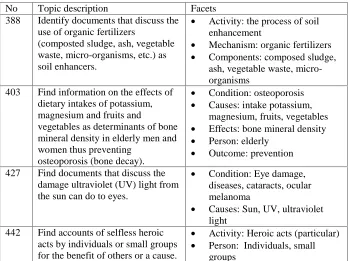
No Topic description Facets 388 Identify documents that discuss the
use of organic fertilizers
(composted sludge, ash, vegetable waste, micro-organisms, etc.) as soil enhancers.
• Activity: the process of soil enhancement
• Mechanism: organic fertilizers
• Components: composed sludge, ash, vegetable waste, micro-organisms
403 Find information on the effects of dietary intakes of potassium, magnesium and fruits and
vegetables as determinants of bone mineral density in elderly men and women thus preventing
osteoporosis (bone decay).
• Condition: osteoporosis
• Causes: intake potassium, magnesium, fruits, vegetables
• Effects: bone mineral density
• Person: elderly
• Outcome: prevention
427 Find documents that discuss the damage ultraviolet (UV) light from the sun can do to eyes.
• Condition: Eye damage, diseases, cataracts, ocular melanoma
• Causes: Sun, UV, ultraviolet light
442 Find accounts of selfless heroic acts by individuals or small groups for the benefit of others or a cause.
• Activity: Heroic acts (particular)
[image:5.595.124.474.118.379.2]• Person: Individuals, small groups
Table 1: Topic descriptions and facet analysis
The document collection we will use with this was used in both TREC 7 and 8, which is disk 4 and 5 of the TIPSTER collection consisting of:
• Financial times 1991-1994
• Federal register 1994
• Foreign Broadcast Information service (FBIS)
• LA Times
The collection of documents is made up largely of news articles together with U.S. Government documents. Relevant judgements for each of the topics are available (details are given in table A2-2): Topic No TREC Conf. Total Rels Judged Rel %Judged Rel
388 7 1467 51 3.48%
403 8 1046 21 2.01%
427 8 1528 50 3.27%
442 8 2679 94 3.51%
Table 2: Relevance judgements for topics on collection
[image:5.595.159.438.584.668.2]5.3 Questionnaires
These will be to used gather both quantitative data we need about our users. We intend to pilot these questionnaires. We will use both pre and post search questionnaires.
5.3.1 Pre-search
The purpose of the pre-search questionnaire is to gather general information about the participants and to gather information on the types of dyslexia that our dyslexic participants may have. There are many tests for dyslexia such as the Dyslexia Adult Screening Test (DAST) and Scholastic Abilities Test for Adults (SATA), but these are very time consuming and some can only be used by qualified psychologists [10]. We therefore do not intend to use any of these tests.
General information
1) Demographic information: What is your age? What is your sex?
2) Knowledge of search engines/online services:
What search engines to you use? Do you use any online services e.g. Dialog/Factiva?
3) Knowledge of resources: online, hardcopy, web:
What papers/magazines do you read? How would you define information quality?
4) Knowledge of computers and the internet: How often do you use the internet? Do you have a broadband connection? 5) How often do you do searching?
Dyslexic specific
6) Have you been diagnosed as dyslexic? Yes (finish questions)
No (Go to Q7)
7) Do you think you are dyslexic? Yes (go to Q8)
No (finish questions)
8) Do you have any difficulties when reading silently?
Yes No
9) If yes, does it involve any of the following phenomena?
Words move around on the page. Words disappear from the page. Spaces between words form "rivers" down the page
10)Do you have any difficulties when reading aloud?
Yes No
11)Do you have difficulty spelling words? Yes
No
12)Do you have difficulty thinking in a "linear" manner?
Yes No
13)Would you say you were more than averagely clumsy?
Yes No
14)Do you confuse your left and right hands/side sometimes?
Yes No
15)Do you have difficulty navigating (either in the real world or in virtual worlds such as the World Wide Web)?
Yes No
5.3.2 Post-search
The purpose of the questionnaire is to collect qualitative data on the users experience with the Okapi interface.
• Usability of the interface
What did you like about the interface? What did you dislike?
What feature would you like which was missing from the interface?
• How difficult did you find the topics
• Did you manage to find documents which satisfied your need?
The data will be used to analyse the usefulness of the interface for our experiments.
5.4 Interviews/Observations
We need to gather some qualitative data, which is best done through observations and interviews. Observations will be used to gather qualitative data on the users information seeking behaviour. Interviews will be used to flesh out the data gathered on both the questionnaires and observations.
6.
Experimental design
In this section we describe our experimental design including such issues as sampling, requirements of the experiment etc.
6.1 Sampling issues
There are a number of potential problems which we need to be wary of. There may be problems with using dyslexic people in IT: this may bias the sample due to the strategies developed to get around the symptoms. There are differences in dyslexics pattern of strengths and weaknesses e.g. there is a danger of picking on one type of dyslexic user or bias towards one type of user. We need to identify samples of dyslexic and non-dyslexic that do not introduce some bias which would create an artificial difference between the two groups e.g. differences in educational attainment. Ensuring that the non-dyslexic control group does not contain any undiagnosed dyslexics (questions declared above will help us with this problem). However there are core elements of dyslexia, which will apply to all people who have this condition e.g. poor short term or working memory and phonological processing problems.
6.2 Specification of sample statistic
The test will be a two tailed one. We will need two sets of participants: dyslexic and non-dyslexic. We need to ensure that the two groups are a representative sample. A further (and I think somewhat thorny issue) is how can we be sure that are non-dyslexic users are in fact non dyslexic? The size of our two groups will be around 20 to 30 participants.
6.3 Level of Significance
We will require 95% confidence interval for H1 to be accepted, rather than 99%. In our case I think it is better to commit Type I errors rather than Type II errors: as this is exploratory research accepting Type II errors could be fatal for the whole programme.
6.4 Decision rule
i) Terms [3.2, 3.5]
• Query size (user entered terms)
• Rate of spelling mistakes
• Number of terms deleted in Relevance Feedback
• Query exhaustivity: % of query terms which are expressed in facets
ii) Documents [3.3, 3.4]
• Documents examined per iteration
• Documents judged relevant
• Documents judged non-relevant
• Changes of judgements from relevant to non-relevant
• Level of success compared with TREC relevance judgements
iii) Session [3.1, 3.4 ,3.6]
• Session length
• Number of searches (or search iterations)
• Number of expansions
• Hit-lists examined per iteration
• Username (to uniquely identify the session, this will not be needed otherwise)
Variables were treated separately in the study two of the authors were involved in [6], so it makes sense to treat them separately in this study – we have no way to treat the variables as a whole. Are we sure that we have the right variables to measure differences in IR behaviour? One particular issue we can think of is the one of short term memory: an assumption could be that the worse a users short term memory is, the more they interact with the system e.g. more searches in a session, more document inspections etc.
6.5 Test statistic
The Chi-squared test is much used in IR experiments but there may be problems with this
and we do not intend to use it. We are investigating the use of non-parametric tests.
Standard deviation or some form of analysis of variance may well be more useful (our hunch is that dyslexic data may vary more than non-dyslexics).
6.6 Decision
The decision could be one of three e.g.
• The difference between the two groups is considerable (significant difference in all variables)
• There is no difference between the two groups (no significant difference in all variables)
Our hunch is that the third will be the most likely outcome (the reasoning is that there must be some similarities between the information seeking behaviour of dyslexic and non-dyslexic people).
7.
Experimental
procedureWe describe the procedure for the experiment given the experimental design above.
7.1 Obtain participants
We need to obtain around 20/30 participants for each group. We have submitted the project to the ethics committee for their approval. Total amount of time for each participant on the experiments will be 1 hour. We do not want our participants to be participating in the experiment for to long, because of the tiredness dyslexic people can experience when undertaking learning tasks. However we will spend some time before the experiment, meeting and greeting etc.
7.2 Pre search questionnaire and Training
Each participant will be given a pre-search questionnaire and some training on how to use the Okapi web interface. 20 minutes is allocated for this process, 10 for each task. Arrangements need to be made for severely dyslexic participants i.e. the researcher may have to fill out questionnaire and give more assistance in training. One task ‘latin american debt reduction’ will be used for training.
7.3 Search session and observation
In [6] each participant in the experiment was given 20 minutes per topic, this is sufficient time for each of the topics. Topics will need to be randomised to ensure that effects from information needs are reduced. Participants will be asked to search only one of the topics.
7.4 Post search questionnaire and interview
Each participant will be given a post search questionnaire and interviewed about their experience of search. Around 20 minutes is allocated to this process.
8.
Summary and conclusion
Our aim in this research is to make a start on understanding the information seeking behaviour of dyslexic users in order to pursue a wider research agenda – which is to produce interfaces and tools to help dyslexic people with information retrieval. There are a number of problems involved in this study (including many ethical ones) which we need to tackle to make sure the experiment produces useful information for our further research. Any comments on conducting experiments of this type will be gratefully received.
9.
Acknowledgements
10.
References
[1] Morgan, E. and Klein, C. (2000). The Dyslexic Adult in a non-dyslexic world, Whurr Publishers.
[2] Ingwersen, P. (1992). Information Retrieval Interaction, Taylor-Graham (available on the web).
[3] Jansen, B.J. Spink, A. Bateman, J, and Saracevic, T. (1998) Real life information retrieval: a study of user queries on the web, SIGIR Forum, Vol 32, No. 1.
[4] Silverstein, C., Henzinger, M., Marais and Moricz M. (1999) Analysis of a Very large Web Search Engine Query log., SIGIR Forum, Vol, 33, No 1.
[5] Spink, A., Ozmutlu, S, Ozmutlu, H and Jansen, B. (2002). U.S. versus European web searching trends. SIGIR Forum, Vol 36, No. 2.
[6] Vakkari, P., Jones, S., MacFarlane A, and Sormunen E. (2004). Query exhaustivity and Relevance Feedback, Journal of Documentation, Vol. 60 No. 2.
[7] http://www.dyslexic.com/database/articles/subjectpreference1.html [8] http://www.answers.com
[9] Snowling, M.J. (2000). Dyslexia, 2nd Edition. Blackwell Publishing.