Coming to Realisation
By
Rosemary Burtt
RN; RM; Bachelor of Health Science Nursing.
A thesis submitted as partial fulfilment of the
requirements for the degree
of
Master of Nursing
Declaration.
I certify that this thesis contains no material which has been submitted for any other degree in any tertiary institution.
Any material previously published or help received in the preparation of this thesis have all been acknowledged in the body of the work.
i
Authority to Access.
Abstract
Grounded theory research methodology has been used to explore the midwife's understanding and beliefs of the woman's pain of labour. A group of seven midwives working in a rural hospital participated in this study. The participants had all practiced midwifery in the rural setting for more than two years.
When working in this rural hospital midwives are also required to work as general nurses providing care for the sick and aged. As the birthing population of the rural setting is falling so is the opportunity for midwives to practise their craft. Thus they are practising predominately as registered nurses. However there exists an anomaly for them in managing pain relief. Contemporary midwifery allows the well woman to experience some or all her pain of labour while the sick patient has his pain relieved as soon as possible.
Data from the participants' interviews was analysed using constant comparative analysis. The core variable
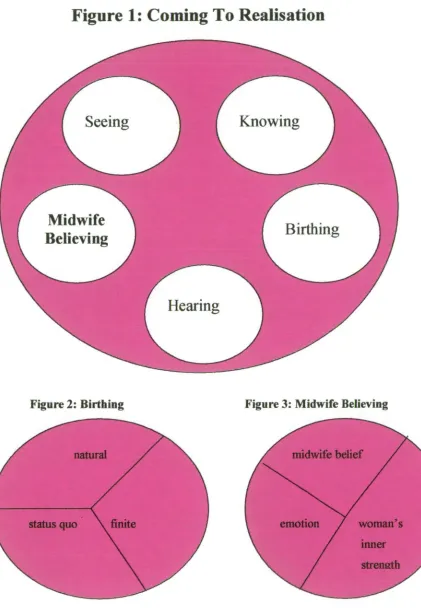
coming to realisation
and five concepts hearing, seeing, knowing, birthing and midwife believing and their associated sub-concepts were identified. With time and confidence the midwives in their practice environment have applied they apply these aspects of learning to other labouring women thuscomplimenting complementing their formal education.
This research study identified areas of experiential learning that occur and develop the practice of the midwives. It was also discovered there exists for each midwife a
Acknowledgements
I would like to acknowledge the support and encouragement of the following people who contributed to the completion of this thesis.
I acknowledge:
the midwife participants who willingly shared their stories and experiences with me;
the midwives, registered nurses and enrolled nurses in this rural hospital who gave me support during this journey;
my friends who have endured neglect while I have undertaken this project;
my parents for being always available to offer encouragement and emotional support;
my husband who blindly encouraged me to undertake this project and has not wavered throughout;
Dedication
TABLE OF CONTENTS
Declaration ii
Authority to access iii
Abstract iv
Acknowledgements
Dedication vi
Table of Contents vii
List of Figures ix
Chapter 1 Introducing the Study
Introduction 1
Research task 1
Research question 2
Organisation of thesis 2
Background to study 3
Value of the study 4
Assumptions underpinning study 4
Summary 5
Chapter 2 Literati= Review
Introduction 6
Midwifery practice historical perspectives 6
Midwifery practice following white settlement in Australia 7
Early midwifery practice in Tasmania 9
Midwifery practice in the twentieth century 10
Contemporary midwifery practice the role of the midwife 12
Midwifery models of care 17
Midwifery Practice in Rural Hospitals 23
Chapter 3 Research Method and Data Analysis
Introduction 25
Research approach 25
Symbolic Interactionism 26
Grounded Theory 27
Research Design 29
Sources of Data 30
Data Analysis 32
Establishing Trustworthiness 33
Ethical Considerations 35
Limitations 37
Summary 37
Chapter 4 Presenting the Findings
Introduction 38
Conceptual Framework 38
Core Variable: coming to realisation 40
Concepts and sub-concepts 42
Paradox of Realisation 58
Summary 62
Chapter 5 Concluding the Study
Introduction 64
Overview of the Study 64
Conclusions 68
Implications for Practice 72
Suggestions for Further Research 76
Reflections of a novice researcher 78
References
81Appendices
Appendix 1 Information sheet 94
List of Figures.
Chapter 1
Introducing the study
Introduction
Women living in rural communities in Tasmania often have to travel long distances to give birth in regional hospitals. However, in some rural areas, where a general
practitioner has obstetric qualifications women may choose to remain and have their babies. The terms of employment in these hospitals encourage registered general nurses to also practise midwifery. This creates a dichotomy for these midwives between the practice philosophies of nursing and midwifery. The registered nurse endeavours to alleviate the pain of the sick patient while the midwife supports the healthy labouring woman helping her to cope with her pain with little or no pharmacological analgesia.
Much has been written and explored in midwifery and obstetrics that pertains to the needs of the woman, technology and medical intervention. However there exists a deficit in research which relates to the midwife, how she performs within her
profession, how she reflects on her practice and how she defines the influences on her practice (Hicks, 1991; Seibold et al.1999). The aspect of research chosen for this study is the midwives' understanding and beliefs of the woman's pain of labour.
Research Task
midwives have varied backgrounds, some having practiced in large regional hospitals before coming to the rural hospital while others have predominately practised in the rural setting. All the midwives were prepared for practice in hospital-based
educational programmes. The participants were experienced midwives having been licensed for approximately 20 years. An average licensure of 20 years, however, does not take into account the midwives career having been interrupted by family
commitments and other career practice although during these times the midwives' maintained their licence to practice. Therefore it is difficult to reveal an accurate estimate of the duration of the midwives' professional careers.
In the rural hospital midwifery becomes an adjunct to the total of health care services provided. The midwife's predominate practice is as a general nurse caring for ill patients. Also a change to the community demography is impacting on midwife's practice. Each year there are less women birthing in the rural hospital due to the falling birth rate within the local community. In 1990, ninety-seven women birthed at the hospital where the research was conducted while the number in 2003 was twenty-seven. These figures reflect the trend across the state of Tasmania where the crude birth rate fell from 27.1 per 1,000 in 1947 to 12.1 per 1,000 in 2000 (Austats, 2002).
Research Question.
What are the midwife's understanding and beliefs of the woman's pain of labour ?
Organisation of the Thesis.
This study is presented in 5 chapters. Chapter 1 has introduced the research topic. The literature review presented in Chapter 2 describes the historical development of midwifery practice, the contemporary midwives role, midwifery models of practice and the rural hospital environment.
undertake the research. A description of Grounded Theory and symbolic
interactionism which underpins Grounded Theory is included. This chapter also provides an overview of the research design, data collection, data analysis, ethical considerations, establishing trustworthiness and the study's limitations.
The findings of the study are presented in chapter 4. The conceptual model which best represents the theory is identified and described. The conceptual model includes the core variable and 5 concepts with their associated sub-concepts. Each concept and sub-concept is defined and supported with extracts from the collected data.
Chapter 5 discusses the conclusions drawn from the study. It describes the implications for midwifery practice and further research.
Background to Study.
The study has been carried out as part of the requirements for the Master of Nursing program at the University of Tasmania. I am a registered nurse and a midwife. I have been employed in both of these capacities for the last 15 years at the rural hospital in which the research was undertaken. Before undertaking this study I believed that knowledge of how midwives practice was limited. Thus I decided to examine an aspect of midwifery practice in a rural hospital.
Value of the study.
The study is valuable because it explored an area of practice that has not been largely investigated in research, Hicks (1991, p,13) comments "midwives produce
significantly fewer research articles than nurses. This pattern is confirmed in the literature search of nursing and midwifery....". Midwives themselves have been overlooked when explanation of midwifery or obstetric practice has been researched. The study while small has interpreted phenomena within the setting and while this is not generalisable it does encourage further research into midwifery practice. The study has both a professional and social value as the midwife empowers the woman to seek and meet her needs. Studies reveal that women who acknowledge support from the midwife have felt more positive about their birth experience (Tarkka, 1996). Midwives practising the art of midwifery deserve to have their practice explored and validated. Within the midwifery practice domain there exists a silence of description of the midwife profession and the midwife persona (Hunter, 2001). This study explores one area of midwifery practice.
Assumptions underpinning the study.
endeavouring to enhance the experience for women and their families much of the struggle includes ethical and moral issues. Thus it is significant to explore how these midwives in the rural hospital function with an individuality that reflects their
contextual situation and their limited interaction with midwives in other midwifery practice domains.
Summary.
The topic chosen for the study is a poorly researched area of midwifery practice. There is little discussion in the literature that pertains specifically to the midwife. The research that exists has come from reflecting women's needs and experiences of midwifery and obstetric care (Hunter, 2001.) As a midwife working in a rural hospital and observing my colleague's midwifery practice over several years I decided to investigate their understanding and beliefs of the woman's pain in labour. In chapter 1 the thesis topic has been introduced and the research method has been identified. The remaining chapters include the literature review, an explanation of the research method, a discussion of the research findings and a conclusion which
Chapter 2.
Literature Review.
Introduction.
In this chapter, literature which provides a descriptive background to the research topic will be reviewed. Literature related to the substantive area of the study is
reported during theory generation (Glaser, 1992). This process is part of the grounded theory method and according to Glaser (1992) prevents the researcher from becoming biased. Denzin and Lincoln (2000) note that the purpose of delaying the literature review is to encourage the researcher's analytic process. A historical overview of midwifery practice from its earliest beginning to the present day, midwifery models of care and the rural hospital environment are all described as a means of establishing a context for the study.
Midwifery Practice: Historical Perspectives.
The English meaning of midwife is "with woman" while translated from the French the meaning of midwife, "sage — femme" is a wise woman (Sullivan, 2002; Hunter, 2001), and the art of midwifery has been the business of women throughout history. These definitions direct the way in which midwives work, the underpinning
philosophy of their practice and their intuitive actions with women and other health professionals.
became the second twin to be born (Sweet, 1997). Midwives were considered to be magical and with mystique they performed the care role for women in labour. The midwife of biblical times,
was sometimes revered, sometimes feared sometimes
acknowledged as a leader of society, sometimes tortured and killed.
The midwife had knowledge and skill In an area of life that was a
mystery to most people. Since women had no access to formal education
it was assumed that the midwife 's power came from supernatural
sources, such as an alliance with the devil". (Ulrich, 2003, p.1).
During the 5th to 13th century the Church was charged with imposing strict regulation
on the practice of medicine. The 13th century is remembered as the beginning of the witch-hunts, which focused on the eradication of women healers many of whom were also midwives. This societal activity continued until the 17th century (Ehrenreich and English, 1973). From the 13th century barber surgeon guilds began to establish themselves. These groups of men saw an opportunity to undertake a profitable
vocation in medicine including obstetrics. Although they did not invent forceps as we know them they introduced intervention. Forceps became part of midwifery in the 17th century (Ehrenreich and English, 1973). The 17th century is recognised as the time of
regulatory control of midwifery practice, "man midwives" established themselves, with practice becoming the privilege of the physician (Bogossian, 1998, p.24).
By 1902 in England, midwives were controlled by the Midwives Act. This caused the encapsulation of midwifery practice to that of an occupation controlled by medicine. Midwives were from this time subservient to medicine and medical technology. Their reliance and practice of mystical knowledge was deemed unlawful.
Midwifery Practice: Following White Settlement in
Australia.
who had often been brutalised during their transportation to this country. While male convicts were considered lesser beings, the women were thought to be even lesser characters (Adcock et al. 1984). The government of the day determined that a woman's worth was measured by her childbearing capabilities (Adcock et al. 1984). In these early years of colonial development midwifery practice occurred in hospital tents "erected on the west side of Sydney Cove, and the first colonial hospital was established by 29 January 1788" (Adcock et al. 1984, p,22). It transferred to George Street North, in April 1788 to be known as "General Hospital", the first hospital of the settlement (Adcock et al 1984, p.22).
Female factories also provided midwifery services for many convict women who were usually attended by one of their own. In time, some of these convict women came to be midwives for the free settler women in the town of Sydney and
surrounding region (Adcock et al. 1984; Wright, 1991). Doctor-surgeons attended women of worth at confinement with or without the assistance of a midwife. Midwives attended the women of lower socio-economic groups.
The first notion of a maternity care unit in the new colony was developed in the "Female Factory at Parramatta" (Adcock, 1984, p.26). Societal groups for example, The Benevolent Society of New South Wales and in Tasmania the Young Women's Christian Association who were to be known as the Amateur Nursing Band, became involved in the provision of midwifery care, and in time gained substantial control of midwifery practice (Adcock et al. 1984; Bogossian, 1998; Wright, 1991; AusStats,
1985). In New South Wales a service known as "The Ladies Monthly Nurse" began, these midwives provided care to the woman and her family in the home for one month when the birth of the baby was expected, one week prior to confinement and for three weeks post confmement (Adcock, 1984, p.30).
By 1806 there is evidence that two - three midwives were employed in the colonial settlement. In 1838, midwife attendance
had extended
to many women, who were confined without the attendance of a doctor (Adcock, 1984). It is believed that "byand there is evidence to say they were successful, as they were listed ten years later to be providing care.
By the mid 19th century the training of midwives became the expected practice and was structured on the British model. Formal training of midwives was occurring by the early 1900's, and these hospital-trained midwives were replacing many untrained women leading to the demise of the colonial community midwifery practice. By 1907 there were at least four training schools in New South Wales (Wright, 1991).
Early Midwifery Practice in Tasmania.
The attitude that convict women were "worthless workers" and should be
"appropriately married off to their class" also existed in Tasmania. In September 1827 the "Female Factory" of Hobart Town was noted to have "7 nursing children and 2 lying-in women" (Fawcett, 2000, pp. 5-6).
Towards the end of the 19th century in North East Tasmania (the setting of the current study), unskilled midwives cared for women giving birth. The doctor was not
expected to attend unless there was a complication (Beswick, 2003). Cottage hospitals existed throughout the district but generally birth was conducted at home within the family and supported by a midwife (Beswick, 2003). Oral histories of Doherty, (1998) and Mather, (2000) describe the midwives of the late 19th century as unqualified but capable women who attended homebirths and helped the family during the mother's lying-in period.
hospital (Wilson, 1988). This enabled Tasmania's lay midwives to continue in
practice thus often avoiding certification of their midwifery status. The Midwives Act of 1911 was an endeavour to tighten up the conditions for registration, with a
minimum age of 23 years and it raised penalties for non-compliance to the act. This had little impact on the midwifery work that was happening especially in the country areas. The Nurses Registration Act 1927 replaced the Midwives Act but still allowed suitably certificated midwives to practise from a room within their own home. This was seen to change as communities built local hospitals and people gained greater access to vehicular transport (Kelly, 1977).
By 1918 in Tasmania Wilson (1988, p.123), suggests "of 638 midwives on the Tasmanian register only 259 had gained certificates enabling them to practice under Tasmanian legislation". In 1927 a Nurses Registration Act was legislated which is understood to have included midwifery practice as a specialist area of nursing
practice. Even though a requirement was made for midwives to be certified as early as 1901 it took some years for the practice of midwifery by lay midwives in the
community to be fully excised.
Midwifery Practice in the Twentieth Century.
Australia became a federated country in which the states desired self-administration although maintaining strong links to the mother country, England were maintained. The provision of midwifery care was taken over by the physicians. Many in the early colony days had accepted nursing and midwifery care from their peers but as the colony progressed toward greater wealth there was a desire for provision of
professional services (Wright, 1991). Nursing had become the support of medicine and midwives were being educated within this doctrine. A need to control practice was seen by both physicians and nurses as desirable as they viewed midwifery as an extension of their health care role. Thus nurses progressed the regulation of nursing and within this, included midwifery. The Nurses Act's that were established around Australia controlled both nursing and midwifery under the title of nursing.
In Australia midwifery training has traditionally been in the hospital as a specialist qualification. Training was based on apprentice model. The 1970's saw a dynamic shift to the university for nursing education. Reports completed by DEST 2001 and 2002, such as the National Review of Nursing Education cited the earlier Dawkins report as having provided information and planning strategies. These reports impact on how nurses were educated. Thus in the 1970's following the Dawkins Report it was perceived appropriate to change nursing education to the tertiary system. At this time tertiary education was being provided in what was known as Advanced
Education Colleges and the Universities. There was a consistent separation around Australia of teaching and nursing from law, medicine and other professions. The DEST National Review of Nursing Education Report, (2002) highlighted a need for the education of nurses, midwives and others to have a national strategy to
contemporise nursing education and support the shift and expansion of studies in the university communities.
Nursing was considered a professional discipline that required academic focus for education that was not provided by the apprentice style vocational training. The Commonwealth government sought information on the education of the nurse. The term nurse included general and specialist nurse roles. The education of nurses on the university campus followed a similar profile to other academic schools. Once the undergraduate nursing programmes were soundly established the specialist nurse areas including midwifery drifted to the university campuses and were offered to nurses and others as a variety of post-graduate and in the case of some universities under graduate programs (DEST, Nursing Education and Practice Today Report, 2002).
Across Australia midwifery programmes vary in curricula, content and cost. Some Australian states provide several pathways to achieve education to be licensed as a midwife. They can include Graduate Diploma of Midwifery, Bachelor of Midwifery, and Double Degree in Nursing / Midwifery. Today a variety of programmes exist that include men or women who may or may not have previously completed general nursing education. In the past Australia had been dramatically out of step with many other countries who recognised midwifery as a discipline not
, 2001). Midwifery is becoming recognised as a stand-alone profession. However in Tasmania currently there exists only one pathway to education as a midwife. The University of Tasmania offers a Graduate Diploma of Midwifery. The last training for midwives in a Tasmanian hospital closed in August 1997 at the Royal Hobart
Hospital.
Efforts by the professional organisation for midwives the Australian College of
Midwives Incorporated, (ACMI), have endeavoured to establish national standards for midwifery education. Currently ACMI have no authority to approve curriculum. This remains responsibility of the nursing/midwifery board of each state and territory.
Both nursing and midwifery have become available professions for men and women. It is difficult to define a specific time when men were admitted to midwifery
education in Australia but Sweet, (1997) describes the uninhibited admission of men to midwifery education in Britain, following the advent of anti-discrimination legislation. Hicks, (1991, p.13) states men have found a significant role in nursing with a suggested "occupancy of 10% of the nursing population but midwifery has a male occupancy of 0.1%".
Contemporary Midwifery Practice.
The Role of the Midwife.
The World Health Organisation, WHO (1992, appendix 4) definition of a midwife is:
Gi
a person who, having been regularly admitted to an educational programme, duly recognised in the country in which it is located, has successfully completed the prescribed course of studies in midwifery and has acquired the requisite qualifications to be registered and /or legally licences to practice midwifery. She must be able to give the necessary supervision, care and advice to women during pregnancy, labour and the postpartum period, to conduct deliveries on her own responsibility and to care for the newborn and the infant. This care includes preventative measures, the
She has an important task in health counselling and education, not only for women, but also within the community. The work should involve antenatal education and preparation for parenthood and extends to certain areas of gynaecology, family planing and childcare. She may practise in hospitals, clinics, health units, domiciliary conditions or any other service". This definition was recognised by the International Confederation of Midwives in 1972 and amended in 1990. The definition describes a midwife with a broad role of care for the woman and family. Historically the midwife was the friend of the woman who then became the obstetric handmaiden of the consultant obstetrician (Kirkham, 1999). In recent years there has been a paradigm shift in care principles resulting in a return to the midwife being with the woman, her support and advocate.
The WHO (1997) describe care of the woman in birthing that reflects the individual woman's needs through evidence based practice and informed consent. There exists an inference that in some settings intervention is liberal, not offering the woman the opportunity to birth with minimal medicalisation, (Leap, 1994; Wagner, 1997;). Banks suggests that labour is not "normal or abnormal" but a "journey of childbirth" (Banks, n.d. p.1).
person to doctor's handmaiden to autonomous practitioner.
Today the relationship role between the midwife and the woman is significant. The relationship appears as the foundation of the midwife role. There are many aspects to the development of a relationship. At times these relationships are not clearly defined. When the midwife is able to provide continuous and supportive care during birthing Guilliland and Pairman (1995) suggest that the mother often expresses a greater sentiment of fulfilment and knowledge of her birthing experience. Seibold et al. (1999, p.23) describe the midwife as "acting as head coach" or allowing the woman "to act out". Leap, (1994, p.9) refers to the midwife as the "skilled companion" while Bluff and Holloway, (1994) in their study found women expressed comfort and confidence from being guided during the birth process. The skills of the midwife permit the woman to feel empowered and able to direct her birth. When the woman is seemingly out of control the midwife uses soothing and confident care to reassure and guide the woman toward meeting her goals of birthing, (Seibold et al.1999). It is difficult to call this an equal relationship. It is definitely a valid, respective, professional and friendship styled relationship but the balance of power does not appear equal. The power at times would be with the woman and at others with the midwife.
Within the relationship, is the midwife's ability to listen and hear what the woman is asking or stating. Stapleton et al. (2002) have challenged midwives to reflect on how they exchange information with women. They expressed that often when time is restricted "women receive information by leaflet..." which gave "the perception women held of midwives as being busy people" thus inhibiting the woman's comfort to pursue with the midwife issues of concern and relationship building (Stapleton et al. 2002, p.395). The dilemma for midwives and women is understanding what each wants and how achievable this is.
McCrea et al. (1998) discuss the midwife's role with the intent that an equal
exchange fails to acknowledge the intrinsic and extrinsic factors that require the midwife to be a skilful guide who "supports and assists with her presence as she engages with the clients in a one-to-one interaction" (Hunter, 2002, p.651). Women have been noted to have expectations of the role of the midwife that include the principle of working together.
"----me doing the work and going through the agony, I felt that it was the three of us working together that achieved the birth. Its such a strange relationship with a midwife, as
you speak through intense pain, when you are on another planet and not at all 'normal', especially in this case when there wasn't any time. Someone could really annoy you
through either being too weak or too overbearing Sarah was perfect for us. We didn't need to be fussed over but we didn't want to be left on our own either. She took control
but respected our characters" (Clarke, 2000 p.17).
Leap (1994) also describes the midwife's role as being with.
However this description fails to describe many of the midwife's activities. Thomson, (2000, p. 418) in her discussion of medicalisation in midwifery describes midwife's work as "spending time--, an emphasis on counselling; establishment of trust; emotional support; and empowerment of women". An emphasis exists on the relationship that is formed. The descriptors outline the criteria as more than a
birthing. Often they had children of their own or had been apprenticed to the role by an older midwife in the community village. The midwife's role was to provide care, support for the woman through her knowledge of effective birth care.
The actual equality of power in the relationship would appear to be a theoretical appraisal rather than a clinical one. Fleming, (1997) in her study of midwives in private practice in New Zealand comments on the equality of relationship, she believes is an ideal and not a reality. Women are considered to be the designer of the relationship. In some situations there is little consultation with the midwife although she is expected to meet all the woman's needs. Fleming, (1998) comments that her study revealed that women and midwives had different perceptions of the relationship that were not always complimentary. Her discussion highlights the notion, that
midwives felt they were abused or there was potential for abuse by their women clients at times. There exists an expected sacrifice by midwives who empower the woman. While the trust and friendship are established with the woman, the care expectations challenge the midwife (Guilliland, 1999; Kirkham and Stapleton, 2000). The relationship of women and midwives is not always one of a reciprocated equality. From the feminist perspective midwives have remained a subservient population (Kirkham, 1999; Hunter, 2001). While women have found a voice, it appears that midwives remain doing care for others while neglecting their own needs (Hunter, 2001).
Hunter, (2001) also describes midwives experiencing an invisible festering of
There was an expectation that the midwife would conform. Midwives were shown as putting emphasis on the relationship building, while the woman's focus was far less concerned with this aspect.
"Midwives were seen to be the 'medical half' of the
relationship. Yet it's with the aim of moving away from
the medicalization that midwives advertise their services"
(Fleming 1998, p. 10).
Further adverse reporting of the relationship occurs in the commentary of Kirkham and Stapleton (2000.) This paper contemplates the notion that while women have achieved a considerable degree of choice and empowerment, in being the vehicle to assist, the midwife has actually made her role more subservient. There has been a lack of change in the structures and systems that provide midwifery care. The lack of change to funding has had an impact on the power of the midwife role. Midwives are cited as feeling more stress in the provision of continuous care with limited staffmg resources, in addition to lack of support from peers and supervisors. An ethnographic study by Kirkham (1999) explored the increasing sacrifice that midwives expressed they were now making to enable the woman to fully benefit from woman-centred care.
In contemporary midwifery practice it appears that the relationship between women and midwives is far from the ideal but is central to the practice of midwifery. The rules of the relationship are those negotiated within the agreed boundaries between the woman and midwife (Guilliland,1999). The midwife's role is unique within the health system as she works with the well woman providing physical, psychological,
emotional and social support while maintaining the relationship, and guiding without being intrusive while being with the woman (Leap, 1994).
Midwifery Models of Care.
1997). Contemporary midwifery models include the partnership model, the shared care model of care, team midwifery, independent midwifery practice and the obstetric model.
Historically the medical profession controlled the process of pregnancy, labour, delivery and the puerperium. However in the 1970's some childbearing women began to seek choices for their pregnancies, births and after care. The women were
supported by a growing movement of midwives who have worked towards
re-establishing the art of midwifery care. This has led to the development of a variety of models of care and has encouraged midwifery practice to be less prescriptive. Women have been invited and encouraged to participate in decisions the planning of their labour and birth. The most remarkable shift in birthing is the shift to a practice model that is woman-centred (Leap, 1994; Guilliland and Pairman, 1995; Guilliland,1999;). Within this context models of care have developed that maintain the focus on the woman's needs.
The partnership model.
The interpretation of this model is a relationship between the woman and the midwife to work as co-equals. The expectation is
a
holistic approach to care that reflects respect and friendship while maintaining a professional role. This is a model of care that is predominately used in the homebirth setting. The midwife is perceived as negotiating and contracting her services to the woman for the appropriateremuneration. The woman receives skilled professional care from a midwife whom she has been able to befriend during antenatal, birth and postnatal periods. A significant feature of home birth is the midwife is an invited guest. This is not so in most other settings where the woman is in an unfamiliar environment (McCrea et al.
1998.)
the premise of an equal relationship being established between the woman and the midwife. There is a significant focus on developing and maintaining the status of equality and power sharing within the relationship (Guilliland and Pairman, 1995).
Shared Model of Care.
The shared care midwifery model has several variations. In seeking a common definition of shared care I have used the Victorian Government information on birthing alternatives (Victorian Government Health Information Service, 2003). The underlying premise of shared care is that a woman receives care from several
collaborative health professionals in relation to childbearing. The shared care model is a broad concept and evolved from a shift in the traditional obstetric model of care. Sweet, (1997) describes shared care as the collaborative care between the midwife and doctor provided to childbearing women.
Because of its broad criteria, shared care is practised in various settings. Within the shared care menu is the concept of choosing a main care provider who is supported by another who has a less significant role in the process. In some settings there may be a number of providers involved in the delivery of care to the one woman. Shared care models include combinations of G.P. and Obstetrician, G.P. and midwife, Community Midwife, Obstetrician and Midwife and occasionally a private midwife may be
included in the equation. Most models of shared care are government funded under the Medicare scheme. The private midwife cannot be paid by Medicare funding, her costs would be met by the woman (Victorian Government Health Information Service, 2003.)
Team Midwifery.
In
team midwifery the midwife is a primary care provider for a number of women and is supported by a second midwife. This modelof care supports
the midwife inmaintaining her role and not being subjected
to
early burnout. The sharing of clients with other midwives can provide a long-term service to a community or region.Referral or sharing with a doctor may be part of the model but generally for the low risk mother the care provision is by midwives only. The setting for team midwifery practice is usually the hospital or birth centre. There are some variations where antenatal visits are completed in the home or the community. Team midwifery within the hospital provides an alternative for women who wish to have midwifery care.
The aim of team midwifery is to develop and sustain the continuity of midwifery care to women (Victorian Government Health Information Service, 2003). Women in the team programme visit a doctor usually two to three times in the antenatal period. Team midwifery thus incorporates within its concept some of the elements of shared care. The practice of team midwifery occurs in major Tasmanian regional hospitals (Carroll, 2002). The first evaluation of team midwifery was completed in the United Kingdom in 1989 by Flint et al. cited in National Health Research and Medical Council Report, (1998, p.22). While "no significant maternal or neonatal outcomes were found the concept of continuity of care provided women greater satisfaction and less intervention".
Caseload Midwifery.
Caseload midwifery also known as know your midwife scheme is practised in Tasmania. It is sporadic and reliant on the model of care of the particular institution (Carroll, 2002). The premise of this model is the development of a relationship between a particular midwife and the woman. Other midwives may meet the woman two or three times during her antenatal period but will have a secondary role to play at the time of birth. The expectation is that the primary midwife will be available to the woman when she requires her assistance (Victorian Government Health Information Service, 2003). In this model each midwife carries a caseload of four to five women for the month. The midwife is allocated the woman's care and endeavours to provide a continuing role through antenatal, birth, and the postnatal periods.
UN
IV
ER
SI
TY
OF T
AS
Independent midwifery practice.
Independent midwives offer a service to childbearing women who wish to experience natural childbirth in their own homes or birth centres. Midwives practising within the description of other midwifery models are protected by their employer vicarious liability insurance. The independent practice midwife is alone and currently in Australia her access to professional indemnity is non-existent due to the exorbitant costs of insurance premiums. However she is not unregulated with each state nursing or nursing/midwifery act commenting on independent practice (Bogossian, 1998). The woman who employs the independent midwife negotiates the elements of the pregnancy and birth plan with the midwife and accepts her practice. There is no government funding to support the woman to pay this midwife.
Independent midwives perceive a need in the community for their practice, from women who desire a natural birth experience without the influence of the medical model. With a philosophy of holistic care midwives have often provided their service at great cost to themselves (Enkin et al. 2000). Many work part time in other settings to be able to continue to practise independently. The service unfortunately remains elitist from a socio economic view. Many women would be unaware of such a service, as the media does not broadly advertise it. Regulation within a country defines the amount of activity such a model of care is able to provide (Guilliland and Pairman,
1995).
The Obstetric model.
community (National Maternity Action Plan, 2002).
The obstetric model has a well-defmed history of development. It eventuated from the outlawing of the unlegislated art of midwifery (Bogossian, 1998). This was not only a local Australian issue but also a global affront on midwifery practice (Ehrenreich and English, 1973). In Britain in 1567 a midwife was licensed but in later years physicians and surgeons successfully removed the privileges of midwives, and took over the practice of midwifery and duly called it obstetrics (Ridgway, 2002). The Midwives Act was introduced in both Britain and Tasmania in 1902. This meant that parliament and medicine had control of midwifery practice (Stevens, 2002).
Models of practice have appeared in many settings advocating midwife led and woman centeredness. In recent years there has been discussion and at times criticism of models of care (Leap, 1994; Guilliland and Pairman, 1995; Wagner, 1997; Homer et al. 2001). Benjamin, Walsh and Taub, (2001) completed a study comparing team and caseload midwifery with their findings supporting a caseload model. They asserted that there was less medical intervention with caseload than with team midwifery. Review of models by Carroll in Tasmania states "Team midwifery is like a vocation — so is caseload. It is not sustainable for practical reasons...If the midwife lives along way from the hospital, she is not likely to want to come on call - be a service provider" (Carroll, 2002, p.4).
Midwifery Practice in Rural Hospitals.
Definitions of "Rural".
Couper comments that it is impossible to provide a generalised definition of the word "rural". He states "rural cannot be defined as non-urban, as rural and underserved are not interchangeable (some rural areas are not underserved, e.g. well known tourist areas, and some underserved areas may be in inner cities). 'Rurality' is like beauty, which is in the eye of the beholder. Defining 'rural' is useful as a focus on which to build recommendations and policy, which will in turn impact on underserved areas" (Couper, 2003, p.2).
An Australian perspective presented by the Commonwealth Department of Education, Science and Training Report (DEST, 2001), suggests no one definition is appropriate but an acceptance of a way of living that is not urban. There is a perceived risk of higher mortality and morbidity of disease, higher exposure to workplace accident, socio-economical disadvantage, and inequitable access to health services when one resides in a rural setting (DEST, 2001).
Tasmanian Health Practice in the Rural Environment
The range of health services offered in the rural environment is varied. Health care may be available in a multi purpose centre or in a small district hospital, which has accident/emergency facilities, surgical and medical beds and occasionally some midwifery care (National Rural Health Alliance Report, 1999-2003). When midwifery is practised in a rural hospital, the nurses employed must hold the dual qualifications of registered nurse and be endorsed to practice midwifery. He/she must also be willing to practise as a midwife. However the registered nurse has been educated to provide care for illness management and illness prevention. The midwife has been educated to provide assistance to the pregnant woman. This woman is well and considered to be a low risk pregnancy (Davis, 1997).
the midwife and the birthing woman work alone during the birth process, being supported by the General practitioner with obstetric qualifications, when the baby's arrival is expected. Thus the nurse/midwife in this setting refines her practice from the influence of patients, peers, pregnant women and G.P. The nurse/midwife in the rural setting is considered to have expertise of a generalist. She is not perceived as a specialist in any area of nursing but has significant expertise in her practice (Hegney, 2002).
From hospital records held in North East Tasmania there is a demonstrated decline in the birth rate over the last two decades (AusStats, 2002). With the fall in birth rate the midwifery component of rural practice has declined significantly. The ability to attract midwives to rural areas has become increasingly difficult. There is limited work for a partner and limited education opportunities for children. Midwives are generally not seeking to practice as a midwife and a general nurse (Guilliland and Pairman, 1995). The nurse midwife concept is recognised as favourable for the employer, (Davis,
1997), due to the ability of an employer to redeploy the skilled practitioner. Financial considerations drive government and private health providers who need to manage budgets to deliver health care. The anomaly is that to work in the rural hospital the professional often needs to be both a nurse and midwife. But the contemporary midwifery ethos recognises the separation of the two disciplines (Gilliland and Pairman, 1995; Davis, 1997; Homer, Brodie and Leap, 2001).
Summary.
Chapter 3.
Research Method and Data Collection.
Introduction.
This chapter describes the method used to carry out this research. It includes the research approach, a description of the research method of grounded theory, the research design, selection of participants and the process of collecting and analysing the data. The chapter also includes the notions related to trustworthiness, as well as ethical and limitation issues.
Research Approach.
A qualitative approach was chosen for this project because these methods allow the exploration of experience and the lived story of participants (Denzin and Lincoln, 2000). Minichello et al. (1999) describes it as allowing the researcher to share an intimacy with the reader. Qualitative research supports the notion that behaviour is best understood in the context of participant's stories and setting. Clarke (1995) believed that qualitative research evolved from the narrative and not statistical evidence. Hancock (1998) states that qualitative research is interested in
understanding behaviour and social phenomena of how people think, feel and relate to their situation. The data is not manipulated, what is presented is accepted as the peculiarity of the particular study (Clarke, 1995).
women's pain during labour, what they believe regarding the pain of labour and how their beliefs underpin their practice. It was therefore appropriate to use a qualitative research method given I wanted to elicit a rich description of phenomena within a particular context.
A small number of participants were involved in the study. This means that while the fmdings are not generalisable to the broader community of midwives, they will offer a revealing insight and explanation of a component of a minority group of midwives practice. Hancock, (1995, p.5) states when writing about qualitative research "the explanations that emerge are genuinely new knowledge and are used to develop new theories about phenomenon". Therefore the aim of the study was to investigate the understanding and beliefs the midwives had of the pain of labour. To complete this study Grounded Theory was the qualitative method chosen.
Symbolic Interactionism.
The theoretical framework of grounded theory is founded on the research tradition of symbolic interactionism (Chenitz and Swanson 1986). Herbert Mead (1863-1931) was a philosopher and social psychologist who founded "a social philosophy" that contextualised man's experience of social interaction in human daily life (Glaser and Strauss, 1967; Grbich, 1999, p.172). From the teaching of Mead, Herbert Blumer progressed the notion of symbolic interactionism (Chenitz and Swanson, 1986; Benoliel, 1996; Gribich, 1999). Blumer refined the teachings describing concepts of mind, self and society (Kendall, 1999). According to Blumer people learn "self
concept" and achieve a "sense of self' (Grbich, 1999, p.172). Symbolic interactionism considers the way people behave in their social interactions. Holloway and Wheeler, (1996, p.100) state that "symbolic interactionism focuses on the actions and
perceptions of individuals, their ideas and intentions". The explanation is individualized in that it is attributable to an individual.
"This approach is particularly useful to conceptualise behaviour in complex
situations, to understand unresolved or emerging social problems, and to understand the impact of new ideologies" (Chenitz and Swanson, 1986, p. 7). The purpose of grounded theory is to generate theory from the everyday lives of people. The researcher, when using the grounded theory method, accepts the meaning that each participant infers through his own language and behaviour.
Grounded Theory.
Grounded theory was the research method used for this study. It has been defined as "the discovery of theory from data" (Glaser and Strauss, 1967, p.1). Grounded theory method was first described by sociologists Glaser and Strauss in the 1960's. They expressed disillusion with the focus of qualitative research at the time (Glaser and Strauss, 1967), because they believed that data was being continually reformed and modified to fit theory. The method of grounded theory evolved from their classic work Awareness and Dying by Glaser and Strauss, (Stern et al. 1982). Glaser and Strauss as sociologists considered that the generation of theory provided an obvious method to verify social process. They believed strongly that theory must be
understandable and applicable (Glaser and Strauss, 1967).
The aim of the method "is to generate theory about social and psychological phenomena" (Chenitz and Swanson, 1986, p.3). The method uses a systematic approach "that illuminates human behaviour...." (Chenitz and Swanson, 1986, p.5). Glaser and Strauss, (1967, p.3) describe the interrelated functions of theory as to:
"Enable prediction and explanation of behaviour; Be useful in theoretical advance in sociology; Be usable in practical applications....;
Provide a perspective on behaviour ....;
Guide and provide style for a research on particular areas of behaviour."
collect data and explore phenomena using a process that she is familiar with.
Another strength often proffered in relation to grounded theory is its ability to prevent the researcher from presenting hypotheses which they then try and fit the data to. Further, it has been suggested that an advantage of using a grounded theory method is its ability to be "understood by the sociologists of any view point, to students and to significant laymen" (Glaser and Strauss, 1967, p.3).
As with any research method grounded theory has limitations. Glaser (Glaser and Strauss, 1967) proposes one limitation when he warns that novice researchers can produce a descriptive account of the subject under study rather than capturing the process of the phenomena (Denzin and Lincoln, 2000). Another limitation,
particularly for the novice researcher, is the fact that it remains an evolving method. Following its inception there has been a separation of stances taken by its founders. Glaser defends the original interpretation of the method while Strauss and Corbin added another layer to the analysis process. Hall and Callery (2001) postulate that in trying to demystify the method, Corbin and Strauss in adding an extra process to the analysis led to it becoming very mechanical. Further, some writers have suggested that the method allows only a micro-level view of the world when it concentrates on how individuals make sense of the subject under study with the larger political and social influences being ignored, for example power and gender issues ((Maths and Meltzer, 1978; Angus, 1986).
Application of the method to the current study is appropriate. As a researcher and a midwife I was beginning without a hypothesis or a particular question of enquiry. What existed was an interest in how a group of midwives in a rural setting explicated their understanding and beliefs of a woman's pain of labour. As midwifery is
Research Design.
Research question.
What do midwives in a rural hospital understand and believe about the woman's pain of labour?
Aims of the study.
: To understand the midwife's perspective.
: To develop a substantive theory grounded in the data.
: To document one aspect of midwifery practice in a rural hospital.
The nature of grounded theory allows the researcher to construct the theory from the collected and analysed data (Glaser and Strauss, 1967). Information derived from each interview is compared and analysed to form categories and codes. Analysed data was collapsed into properties, categories and concepts. Eventually a time was reached when the concepts became repetitive, no new information was being unearthed and the core variable coming to realisation emerged.
Selection of Participants
The participants were midwives who had worked in a rural hospital for a minimum of 2 years. It was not an issue whether they had been hospital or university educated as the study sought their individual appreciation of pain in labour. Some of these midwives had worked in both rural and regional midwifery units. The midwives who participated in the research ranged in age from 30 to 55 years and were all female. The study was introduced to the midwives at a ward meeting. There was also a brief overview of the research at several ward handovers to inform those who were unable to attend the initial meeting. If midwives wished to participate they were encouraged to make contact with myself. Following this informal contact I discussed with each respondent the aim and process of the research. I gave each interested participant the information sheet and consent form for completion. Following receipt of completed consent forms I contacted each willing participant and duly arranged a date and venue for an interview.
Sources of Data.
Unstructured interviews.
Unstructured interview is described by Chenitz and Swanson (1986, p.66), as an interview that has form is "intensive, in-depth" and seeks data in the words of the participants. The interviewer comes to the interview seeking information on only a few topics and structures the conversation around this. During the interview the researcher may ask the participant various questions around the chosen topic exploring it from many different angles. The unstructured interview is different to other forms of interview as there are no predetermined interview questions except for the initial one. The introductory question was: "I want to explore your understanding and beliefs as a midwife of a woman's pain in labour. Tell me about your
understanding of the pain of labour".
The unstructured interview was the primary source of data collection. It allowed the greatest freedom to capture the experience of each midwife. Openness is considered an essential credential for the researcher (Koch, 1998). The informal interview style has the least researcher impact on the participant. The duration of the interview was planned to be approximately 1 hour.
The unstructured interview is more than a social conversation. The unstructured interview has some elements of form as the researcher steers the conversation to reveal data. Melia (1987) comments that there exist narrow parameters when data collection is from unstructured interview, and there is a need to balance the interview for research ideas and theory purpose, while the participants explore their ideas and thoughts through their conversation. Denzin and Lincoln (2000) in their appraisal of the unstructured interview comment that it allows non-prescriptive collection of material compared with other methods. This was encouraging as I was seeking the richness of the midwives stories.
of the interview as Denzin and Lincoln describe it "to go native" (Denzin and Lincoln, 2000, p.655).
With permission from the participants the interviews were tape recorded and transcribed by myself. Each midwife was given a pseudonym and any identifying information was fully de-identified. As a beginning researcher the purpose of tape-recording allowed me the opportunity to focus on the interview and not be distracted with note taking. It also prevented the overlooking of data, as some data during interview may seem insignificant but at analysis was important (Stern and Pyles, 1985). Tape recording allowed me to capture the subtle voice changes and the use of language. It meant I could review the interviews at length during the transcription and data analysis. The participants were fully aware that the interview was being tape-recorded. They were informed if they particularly did not want any part of the conversation recorded, this would be respected. Before commencing the next
interview analysis occurred. This was the process of categorising and coding collected data. The codes became the focus of the next and following interviews. Emerson (1998) comments that codes are the beginning of the outcome and continue to change and evolve with each completed interview.
My basic premise was to use the unstructured interview to acquire the most elaborate story of each participant. I had a fear of the power of researcher influence. Thus I believed in using an open-ended question such as: I want to explore your
understanding and beliefs as a midwife of a woman's pain in labour. Tell me about your understanding of the pain of labour". Participants were encouraged to share their story with little prompting from myself. In the initial interview I found myself
restricting my responses to monosyllables and body language to allow the participant to continue with minimal engagement (Denzin and Lincoln, 2000).
Literature.
rural hospital and midwifery models of care.
Literature related to the data was reviewed during data analysis. Grounded theory method
advocates that literature is sought at two different intervals in research. First a literature review is completed in the beginning of the research project but its purpose is limited to setting the
background of the study. The second literature review is the collection of data from the literature for the comparison with the core process. The literature at times may not agree with the
emerging theory but it should be considered as a source of data and thus a tool for testing emerging theory. The literature is "to establish the study's purpose, background and significance" (Chenitz and Swanson, 1986, p.44).
Self as source of data.
As a midwife and the researcher I am considered a source of data, "a study is enhanced by theoretical sensitivity (Glaser, 1978; Strauss and Corbin, 1990;). This consists of disciplinary or professional knowledge as well as both research and personal experiences, that the researcher brings to his or her inquiry"(Denzin and Lincoln, 1978, p.173). I completed my midwifery training 25 years ago. I have practiced both in regional and rural hospitals during my professional career. I have been a member of the professional organisation for midwives,
Australian College of Midwives Inc. (ACMI) for many years. During my professional life I have maintained contacts with midwives who work in various settings. Some midwives practise within the medical model, whilst others utilise a midwifery-led woman-centred philosophy.
Data Analysis.
time when no new information can be found the code is deemed saturated and the researcher moves on to sort and develop the emerging theory. Chenitz and Swanson (1986, p.9) state "simultaneous data collection and analysis are critical elements in Grounded Theory research". This process continues for all interviews and data collected for the study.
Memoing is an intense and valuable characteristic of grounded theory method (Minichelo et al.1999). Memoing is a process of note taking from the data. It may be in the columns of the transcripts or journalled separately, but usually both. Memoing links and sorts the ideas to categories and codes. Memoing is an activity that is managed parallel to note taking, coding and category development. It is a method of keeping the researchers thoughts and ideas in a manageable format and accessible during the continuing analysis. Memos were written when completing the
categorising and coding. This strategy was used to keep the researcher faithful to the collected data (Denzin and Lincoln, 2000). Memoing occurred throughout the project as categories and codes were constructed from the collected data. It provided the relationship that linked categories "we bring raw data right into our memos so that we maintain their connections and examine them directly" (Denzin and Lincoln, 2000, p.517). Minichelo (1999, p.130) comments that memos extend further than just being the link pin for categories and codes. He infers that they also include "researcher insight" are "descriptive" and" include theories".
Establishing Trustworthiness.
The revelation in qualitative research that not one view is necessarily correct allows freedom to explore the social realities that each participant shared. The findings are then presented as a study with a perceived concept of trustworthiness. Koch (1996) suggests that the ultimate check of trustworthiness is whether the reader is able to believe the results and the emergent theory. The importance of qualitative research is the "balance between the credibility of the research enterprise and systematic
and the process of analysis becomes the checking mechanism (Koch, 1996).
Lincoln and Guba (1985) describe four criteria for establishing trustworthiness. These are credibility, transferability, dependability and confirmability. Dependability and confirtnability can be described as co-dependent thus, are often described together.
Credibility or the truth-value lie in the researcher's ability to present the studied human behaviour in the contextual way that is interpretable and believable to the reader (Lincoln and Guba, 1985). The findings are credible when they are
recognisable by those who have similar experience. Glaser (1978) suggests that fmdings are made credible by the correcting nature of constant comparative analysis. Glaser (1978) describes factors of work, relevance and modifiability as equitable to the criteria of credibility proposed by Lincoln and Guba (1985).
Transferability is described by Lincoln and Guba (1985) as having sufficient data available that can be applied or transferred to enable other investigators to develop outcomes and assumptions. Glaser (2000, cited in Nathaniel, 2003) argues that grounded theory is uniquely transferable because of its conceptual rather than descriptive nature. The constant comparative analysis works the data to an
abstractness that enables the theory to be modifiable thus transferable to other groups. Glaser (1978, p40) wrote "these deducted hypotheses are not forced on the data when they fit poorly, they are discarded and others emerge in their place by constant comparative analysis. This method underlines the fact that interpretations must be researched and grounded just as much as the patterns themselves."
Dependability is determined by various audit techniques (Lincoln and Guba, 1985). Memoing and note taking are two valid means of providing the researcher with an audit trail. These activities are used to confirm the dependability of the study. This is also a means of establishing confirmabiltiy a fourth criteria described by Lincoln and Guba (1985). Confirmability is the audit process. Glaser (1998) discourages use of tape recordings and computer programs he encourages the use of note taking, journaling and written aspects of grounded theory record such as memoing. This
of a grounded approach from the researcher.
The intent of any study is to have the reader believe the findings. Koch (1996)
believes to establish trustworthiness the researcher should develop a criterion that fits the study and then validate this process by establishing the trail of process. To this end it is suggested that the researcher keep a journal of her progress throughout the study. This documentation is then used to show the validity and rigour of the study (Koch,
1996). She suggests the use of transcripts in the body of the thesis or appendices inform credibility (Koch, 1998).
As the researcher for this study the application of note taking and memoing has been valuable to maintain trust to the collected data. An easily accessible trail of data collection and analysis has developed from these intensive activities. While Glaser discourages the use of transcription it is not an enforced criteria. For myself,
transcribing interviews immersed me in the data. The participant's stories are trusted thus extracts are included in the thesis to support authenticity.
Ethical Considerations.
A qualitative study has a moral obligation not to harm participants (Mathers et al. 1998). Ethics committees in their deliberation of the studies consider the researcher qualifications and ethical aspects with a no harm approach to participants (Roberts and Taylor, 1995; Grbich, 1999). This study was presented to the Northern Health and Science Ethics Committee of the University of Tasmania and approval was gained.
To maintain anonymity participants were encouraged to select a pseudonym for themselves and for any clients or others they chose to mention in the interview. In a small hospital I believed it was important for me to be able to de-identify each interview from the individual midwife participant early in the analysis process. This thought was reflected by my need to immerse my focus on the detail of each story and not be distracted or biased by my previous knowledge and relationship with each participant.
Confidentiality was discussed with each participant. The midwives were assured that only pseudonyms would be used in the transcripts or included in findings. Participants were given permission to ask for the tape to be turned off at any time. If they wished they could talk about an issue they did not want recorded or have a part of the discussion erased. All participants were informed that they could withdraw from the study at anytime without impediment to their relationship with myself.
Another ethical consideration not mentioned often is fidelity (Mathers et al.1998). The premise is that if you promise to do something you actually complete the task. I was very aware of this when negotiating interview times and places with the
participants. Most of the midwives who volunteered for the interviews were full time workers, often with families and other commitments to the local community. Thus their spare time is of great value and not an item for squander. Fidelity extends to the obligation of presenting the findings, to the participants and remaining faithful to the study objectives (Mathers et al. 1998).
The interviews were tape recorded and transcribed by myself. Analysis of the data was undertaken with support of my supervisor. All hard copy data was securely maintained according to National Health and Research Medical Council (NHRMC) and University guidelines. All data tapes, transcripts and findings will be destroyed 5 years after the study is completed according to NHMRC guidelines.
Limitations
The size of the study may be considered not large enough to produce generalisable data that can be reliable and informative. The grounded theory method does not seek a large number of participants. The activity endeavours to collect data with depth, description and to saturation of the subject with a resultant emergent theory being achieved (Koch, 1998).
A second issue was my experience as a novice researcher. The study was undertaken as a part of my master of nursing programme. Fortunately, I have been guided and advised by a supervisor who has been patient and nurturing. She has previous experience in completing a published Ph.D study using Grounded Theory.
Thirdly I admit to reservations because of my relationship with the participants as colleagues working in the same hospital. Initially I feared that the midwives invited to participate might have been reluctant. This was not to be the case. I was also aware because of my proximity to the participants and midwifery practice there was potential to create a bias when reviewing the data. However I found that my midwifery experience allowed me to explore some of the subtle comments shared during the interviews. No funding was applied for to undertake this study. All costs for the study have been met by myself. This study is limited to one particular institution and is a beginning project.
Summary.
This chapter details grounded theory method which was used to complete this study. The research design and data collection using unstructured interviews, literature review and self as a source are included. The process of data analysis and the formation of a grounded theory were discussed. Informed consent, protection of participant's rights, establishing trustworthiness and the study's limitations were also considered.