International Journal of Innovative Technology and Exploring Engineering (IJITEE) ISSN: 2278-3075, Volume-9 Issue-1, November 2019
Abstract: Many applications have developed for networks that are ad hoc in nature. Various routing protocols are suggested, of which routing protocols on-demand in nature is the most widespread protocol because they are simple to figure it out and they don’t’ use priority and power for communication of data in routing. Routing protocol has an essential role in VANETs. In the latest decade, AODV routing protocol turns into the consideration of concentrated research on VANETs. Several protocols were formulated to upgrade and improve AODV in order to attain the maximum in the pursuit of consistent protocol.
Here, our proposal to improve ad-hoc distance vector suggests various points. I-AODV, our suggested protocol, improved AODV in Power consumption and Priority models. We also evaluate performance pointers for some metrics, like packet delivery ratio, energy, end-to-end delay, and routing overhead, in WiMAX ad hoc network.
Keywords: Routing Protocol, AODV, I-AODV, Mobility, WiMAX, VANET, Priority, Power Consumption.
I. INTRODUCTION
Different work has been carried out in VANETs for the last decade, especially in AODV [40] for improvement and better performance. Due to the nature and features of VANET which constantly self-configured, modified, distributed and no infrastructure to handle, it was expected that we will have a reliable and robust protocol surely. Researchers focused on improving basic tasks or the services provided by routing protocol like ad-hoc on-demand distance vector, such as route discovery, pooled channel and nodes that are dynamic in natures. Their studies focused on achieving a topology of ad-hoc network that constantly changes and solves the route disconnection fault caused by the node's degree of flexibility that cannot be forecast.
They don‟t have the mechanism to transfer the priority choice of or energy or best path while setting up route, this might be the main shortcoming of current routing (ad hoc) protocols. Due to in efficient load balancing, Power and Priority is chosen. A route is elected on the bases of metric, minimum number of hopes to the destination by reactive and proactive protocol. It might increase rate of packet drop, delay of packets end- to-end, or increase routing overhead, may not be most prominent route.
Revised Manuscript Received on November 05, 2019.
Rahul Rastogi, Assistant Professor, Department of Computer Science
and Engineering. Invertis University, Bareilly, India, Email: [email protected]
Ravi S. Shukla, Assistant Professor, Department of Computer, Saudi
Electronic University, KSA, Email: [email protected]
AODV and DSR routing protocols (Conventional on-demand) are energy unaware. The shortest path methodology is used in routing. Cost is measured either hop count or end to end delay at route establishment time. Routes are not modified proactively by protocols until they break. Metrics like energy-constrained may have prejudicial effect on the lifetime on network on the whole, if nodes use such metrics. Replacing the battery or recharging is not practical solution in mostly ad hoc network applications so it required designing and developing a routing protocol which saves the energy of node and prevents early death of node.
Here, we suggested a new improved variety of protocol of ad-hoc on-demand distance vector, called I-AODV, which brought few changes to like models with priority as well as consumption of energy.
II. LITERATURE SURVEY
A. AODV with optimization
In [3,4] delivered a very widespread and thorough study about the QoS of routing in VANETs. We identify an ongoing review of key commitments to VANET routing protocols issued between 1997 and 2011.It addressed protocols, QoS routing metrics, and the elements that interrupt protocol performance. The findings stress the following things:
The MAC-centered protocol Reliability protocol.
Management session. Rout discovery optimization. Quality measure estimate
We have identified many potential fields of research that can be performed as follows:
Multi-constraint routing.
Algorithm for optimization.
Topology and layout of the network.
AODV protocol has many flaws as per RFC3561 [4]. The difficulties faced in improving the ad-hoc on-demand distance protocol, including managing a path (link failure) using load balancing, model of energy and priority can be recognized.
Mayank Dave and Anita Rani [13] amended AODV in 2007 for the purpose of load balancing. In their suggested protocol, the number of packets in their boundaries is always handled. When an origin node starts route discovery equation using flooding RREQ messages to the network, each node getting an RREQ with retransmit a message and add its own limit queue size. Target node will use RREP to choose the finest route and answers
.
Rahul Rastogi, Ravi S. Shukla
Asad Amir Pirzada et al. [14] expanded multi-linked ad-hoc on-demand distance vector and the protocol is referred as AODV-ML Ad-hoc on-demand vector range offers over 100% perfection in the context of packet transmission speed, overhead and latency over the standard multi-radio ad-hoc on-demand vector routing protocol. Unlike Multi-Radio ad-hoc on-demand vector [25], AODV-ML provides multi-home nodes to create multiple bidirectional parallel links between all involved nodes during the formation of a proactive routing path.
B. Model of Energy in AODV
AODV protocol, a protocol on request uses the shortest path principle during the discovery phases of the route and implements this direction until the route breaks. Battery power of nodes might be drain while using same route continuously. The condition is especially true if the other routes also have one or more nodes. Remember that any message sent or received consumes the energy of the battery. If battery of a node loses its power and is unable to send any messages, it essentially drops out of the network. In these circumstances, Break downs of the route and ad-hoc on-demand vector seek a replacement route in this situation via discovery of alternative route. Moreover, nodes that malfunction in this manner influence the ad hoc network's operational life.
Several applications in which the vanishing nodes are the end point of communication will be unsuccessful. Even if the vanishing nodes don‟t interact, the network communication will be weak and there will be network partitioning. [2],[36].
The target of our protocol on low battery power is routing or re-routing around nodes. This will elongate the lifetime of network. This must, however, be achieved in the manner in which other critical performance measures such as end- to-end delay and throughput are not substantially affected. The robust energy-conscious protocol is developed using two phases. In first phase, nodes are identified by the remaining power of the battery. Nodes respond to the routing protocol in different ways according to their classification. Second, routing metrics uses a different cost feature which takes into account battery rate and node hop wise length. Developing routing protocol for VANETs could be from any point of views. While different proposed routing protocols did not focus on energy constraints in wireless communication, some of the proposed protocols are energy-aware and few of them are especially attentive to the development of protocols determining route that offer energy efficiency while conducting route discovery [12, 13, 14]. Because nodes in VANETs [18] are wireless in nature, two major problems such as load and energy arise in VANETs. A mathematical model of VANETs is suggested which considers bandwidth estimation model, sustainable energy and consumed energy. Main Objective of them was to advance AODV by using reduced hops count as the chosen route without issue in bandwidth and energy. By inserting four different tuples in the RREQ email, load weight (Lw), remaining energy
threshold (Rth), overload threshold (Oth) and energy weight
(Ew) they define their improved AODV protocol based on
bandwidth and power. Here a best route is selected by node to pass data which has maximum value(Amax)of weight but finest route that has least hops is chosen by node, if Amax is corresponding with several routes. They escape overloaded
nodes to estimate the bandwidth. Balanced distribution is achieved when node with minimum load is chosen. In real time condition every node discovers its information of path when RREQ message is forwarded or broadcasted. Their work in mathematical model alone, however, is not carried out for simulation or evaluation. In [19], AODV routing protocol provided comprehensive energy optimization locally and globally. Their work examined the combination of capacity of runtime battery and loss data of propagation power, the energy knowledge implanted in the message of Hello and route discovery message. Hello(Test) message is transmitted only one hop to maintain local connection. Energy data is built into it, so that neighboring nodes can update the neighboring node's energy information. They also changed the RREQ / RREP message to optimize globally and end-to-end. They used OPNET to implement their algorithm in to AODV simulation.
C. Priority
Tetsuro Ueda, Somprakash Bandyopadhyay, Siuli Roy, Dola Saha, and S.Tanaka in the IEEE Communication Society, proposed a scheme in 2004 that supports QoS based on priority in vehicular ad hoc networks by grouping network traffic flows into various priority groups and coping differently with flow rates of different classes. A control-theoretical methodology is used by them to adjust low-priority movements in order to preserve high priority flow rates at their desired consistency, promising high-priority QoS flow [39].
In 2011, J.Y. Khan, A. Asheralieva and K. Mahata claimed that packet transmission based on priority was extensively used throughout network communication support for multimedia services. Queue or service measurement based transmission of packets priority procedures are used in wireless networks. Their paper introduces an exclusive two-stage priority strategy for Local Area Network infrastructure in wireless mode. The algorithm suggested by us modifies the priority communication queues and facilities in a wireless network based on the expected congestion efficiency and the conventional form of the digital packet transmission priority service procedure. Simulation results indicate that their innovative algorithm significantly improves QoS [38] multimedia traffic
III. VEHICULAR COMMUNICATION
An important feature of inter-vehicle communication (IVC) is the moving condition of the vehicles. Various physical conditions are known to result in different performances. Multi-path intervention is very critical because if the signal is dispersed and reaches a precise location from different angles, the arrival time will not be the same, making the signal transmitted difficult or impossible to understand. For urban environments (towers, trees, signs, etc.) multi-path intervention is primarily due to the presence of buildings and internal barriers. In addition, researchers also need to investigate the different speeds suggested in dissimilar circumstances. Overall, to
International Journal of Innovative Technology and Exploring Engineering (IJITEE) ISSN: 2278-3075, Volume-9 Issue-1, November 2019
and more range. Vehicles will go at a higher speed in an urban scenario and be more spaced because drivers expect more popular response times than in urban settings .Scope and comparative momentum are therefore very important reasons for significantly affecting communications .Inter-vehicle ranges, for example, are very small in metropolitan conditions for long periods of time due to reduced spacing due to frequent stops and fusions. Therefore, more information can be shared between nearest vehicles than in highway conditions where the distances and speeds between vehicles are significantly higher.
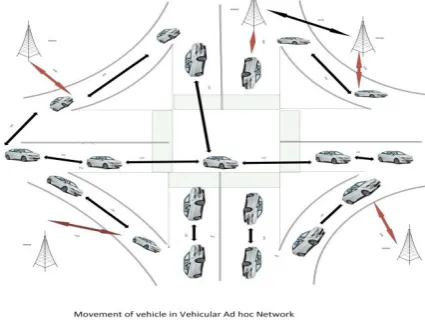
VANET is a specific type of ad hoc cellular network where each vehicle acts as a node and contact point between neighboring vehicles and roadside units located in centralized locations such as road junctions and car parks. Fig 1 shows diverse ways of communication that can exist on the road. Communication can usually be separated into two categories: Vehicle to Vehicle Communication (V2V): Vehicles in close proximity exchange data in V2V communication using wireless short-range technologies such as Wi-Fi and WAVE [12]. Every vehicle has a particular electronic device that permits them to accept or transmit messages.
[image:3.595.61.274.380.542.2]Vehicle to Infrastructure Communication (V2I): In V2I, vehicles are linked to the nearby road infrastructure through consistent wireless transmission, i.e. wide / long range wireless technologies or Wi-Fi hotspots for the exchange of information applicable to the specific road segment.
Fig 1: Ad-Hoc Vehicular network
IV. IEEE802.11POVERVIEW
Grounded on the standard draft of IEEE 802.11p [40], Vehicular ad-hoc network uses the procedure of dedicated short-range communication for the enrichment of safety drive, as well as security of automotive drivers. The U.S F.C.C. allotted 75 MHz of the DSRC spectrums out of 5.9 GHz to be solely used for v-to-v and infrastructure-to-vehicles communications. Seven different channels of frequency are used from overall bandwidth. The CH178 (CCH) control system acts like public channel for applications safety on road. The remaining channels (SCHs) are described as service channels for general purpose applications comfort of driving [41]. For IEEE 802.11p and IEEE 1609 standard families, Wireless access in vehicular environments is planned for ITS at 5.9 GHz frequency. Orthogonal frequency division multiplexing procedure is used on the PHY, which provides up to a 27 Mb/s data rate with 10 MHz bandwidth and a 300–1000 m communication distance.
V. MOBILE WIMAXOVERVIEW
IEEE 802.16-2004 specifications, standards for WiMAX cares both for PMP (point-to-multipoint) and mesh topology nodes. Several subscriber stations are attached to one base station in PMP mode where the channel of access from Base Station to subscriber stations is named the DL(downlink) channel, and the one from the subscriber stations to the base station is named the UL (uplink) channel. To support mobility, the IEEE has defined the IEEE 802.16e amendment, Mobile variant of the 802.16 protocol, sometimes known as a mobile WiMAX .Life of Battery and handover in cellular WiMAX are crucial matters in promoting flexibility between micro-mobility subnets (domain in same network) and macro-mobility (domains in two different network).The amendment is intended to preserve the relation between mobile clients and MAN when traveling. There is a provision for portable devices from PDA to notebook mobile, smart-phones andlaptop.IEEE802.16eworksinthe 2.3 GHz and 2.5 GHz frequency bands.
VI. DEPICTION OF AODV ROUTING PROTOCOL
Ad-hoc on-demand distance vector is a protocol an on-demand i.e. Routes are learned as required during discovery process. To retain routing information [2] a traditional table of routing is used one entry per destination. RREQ is transmitted by node when a path is required to a new destination. Upon reaching RREQ to the destination route can be resolute, or a „fresh new route which intermediate have can be used. A ' fresh new route ' is a legal entry of the route whose linked sequence number is as good as the one included in the RREQ for the destination at any point.
A sequence number is retained by AODV as individual destination which determines updated routing information preventing routing loops. All packets used in routing carry these sequence number. When RREP is unicasted back to RREQ origin then the route is available. AODV relies on the routing table entries to transmit an RREP back to the source and thus route data packets to the target. AODV has one imperative property to maintain the timer-based status of each node; with respect to a significant property of AODV, the status of timer-based each node is maintained with respect to the individual routing table entry. An unused entry of routing table is expired. For entry of each routing table, a collection of ancestor nodes is maintained, representing the collection of adjacent nodes used to route packets of data. Such nodes will be recorded with packets of RERR when the next hop connection interrupts. Therefore, each ancestor node transmits RERR packets to its own set of ancestors, thus commendably eliminating all routes using broken links A. Features of
Ad hoc on demand distance vector
Multicast communication, Unicast and Broadcast. Sequence numbers is used to prevent loop creation and
as route freshness criteria.
Route establishment of route on demand bases with minimum delay.
To track information accuracy Sequence numbers is used. Multicast trees that bind members of the group maintained
for multicast group lifetime.
Only next hop monitors for a path instead of the entire route Sporadic TEST messages are used to track nearby nodes. Merits /Demerits of Ad-hoc on-demand distance vector
Prerequisite of Broadcast medium: The method assumesthat the broadcasts of each other can be remembered by all nodes residing in the broadcast media.
Bandwidth Overhead: Bandwidth Overhead occurred as incompatible with all other protocols when an RREQ transfers from one node to another during the evaluation of the data on demand, it generates the opposite path in itself with the address nodes it passes over and it carries all these information through these methods.
It is unsafe to mistreatment: Insider assaults, including resource consumption, node isolation, and route invasion and disruption, can misuse the messages.
Lack of high-performance routing metrics in AODV: The lower hop count metric is considered to support AODV. This metric supports fast latency, long connections through medium, low bandwidth connections.
No recycling of details about routing: AODV is inefficient to maintain the route. This routing data is constantly achieved on demand.Route discovery latency: A route discovery is not being initiated till a flow is originated since AODV is reactive. The latency of route discovery would be great in large scale networks (mesh).
VII. DESCRIPTION OF PROPOSED PROTOCOL
This section presents summary of our suggested protocol known is I-AODV. Here we include priority issues to improve proposed protocol. Our goal is to develop a system with the ability to evaluate the battery of transitional node along with the application's priority. Main objectives of our suggested protocol, I-AODV, are to pick a energy node as a factor. That mobile node has an activated energy number. To increase the lifespan of the node, consideration of the available resources is necessary. Therefore, selecting a node with a high residual energy is critical. [40]
In I-AODV used WiMAX [1], the process of route discovery is as follows:
Review the application‟s priority.
Find the route's energy level and change on a regular basis. Calculate the path‟s average energy and the node with
lowest charge battery power.
Choose the high average data transmission energy path.
VIII. SIMULATION PARAMETER
As cited before, we have accomplished our work with our proposed I-AODV and Ad hoc on demand distance vector.
A grid of 1500 ×1500 m of node is used .We use 50,100,150,200,250 nodes. The time for simulation is 3000 sec. For each node, CBR (Constant Bit Rate) is used as a source of data. Each source node transmits packets of 512 byte size.
A scenario of movement arranges the nodes motion and location as per to the model of random waypoint. Omni directional mode is used by antenna. Gaussian distribution
having 5.0 mean value of load and 1.0 with standard deviation which relies on node count implements linear battery model.
Quality Measures
To test the impact of I-AODV [2], We use the performance metric below:
Standard (end-to-end) delay - Delay between the originated time (initiated time for the packet of data) at the origin node and the arrival time (time of arrival at the destination) is defined. This method results in an overall average latency for a data packet to move from the origin node to the end node. This comprises the lineup delay of node, the path discovery time, the MAC layer transmission delay and the wireless channel transmission and propagation time. It is defined as end-to-end delay when the source decides to transmits a packet between the point in time and the time the packet hits its endpoint.
Average performance: It could be represented to the simulation time as the number of total acknowledged packets. The following are some factors analyzed and evaluated on the basis of simulation:
After simulation process available energy known as remaining power is described as:
Original Energy-Used Energy
Utilization of energy is the energy castoff for dissimilar density and frequency of nodes.
IX. RESULT AND ANALYSIS
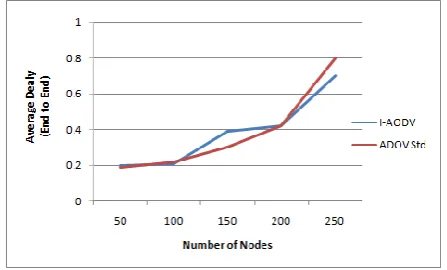
Here, in WiMAX setting, we implemented the I-AODV. We test I-AODV routing protocol efficiency. I-AODV and the standard AODV routing protocol for the WIMAX setting were also compared.
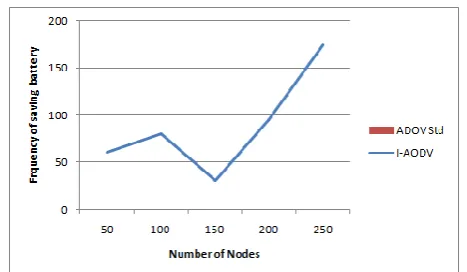
[image:4.595.314.538.551.686.2]Therefore, since the nodes are powered by batteries, they should save energy in order to optimize battery life. Based on the simulations we can draw the conclusion that it is very useful to use energy knowledge to seek routes reason is that the gap in usage of battery between dissimilar nodes is compact. Usually this means longer network life and shorter node failure time. For better and faster communication, we also give priority to the data packets. Our study shows that this smart protocol significantly reduces a mobile node's power consumption.
Fig 2: Study of end to end delay (average) Vs nodes count
International Journal of Innovative Technology and Exploring Engineering (IJITEE) ISSN: 2278-3075, Volume-9 Issue-1, November 2019
Fig 3: Study of throughput Vs nodes count
When the first node drops, I-AODV works better than AODV. The consequence is more VANET's network lifespan.
Fig 4: First node analysis dies in the specific node situation
[image:5.595.52.291.410.552.2]Since I-AODV focuses on node battery and energy constraints, rate of death of nodes per second improves. This eventual decreases the frequency of setting up the path.
Fig 5: Review of node numbers dead in various node numbers
[image:5.595.54.288.618.754.2]By using I-AODV, we reduce the network's energy consumption as each node is now attentive about the restrictions of power of its communication of data.
Fig 6: Analysis of consumed energy in the condition of diverse nodes counts
XIII. CONCLUSION
Another model has been recommended that deals with features of energy depend upon priority of for origin-to-destination interaction. A proposed structure will be implemented on Ad hoc on demand distance vector as well as outcomes will be matched with the prioritized and embedded energy framework of current AODV. We found better results than standard AODV. Graphical notations are used to represent. End-to end delay, distribution rate of packet and parameters or nodes directed to the battery and throughput measures are used. Most critical part in VANET is delivery of RREP message successfully because multiple attempts are wasted on route discovery when a response message is missing; an alternative discovery of route must be initiated again. Performance shown by the output our test depicts that new devised protocol i.e. I-AODV has a good lifespan of the network with a small modification in the WiMAX ad hoc network bandwidth.
This output of simulation analyzes AODV & I-AODV and evaluates performances of the protocols. Through studying other routing protocols with different traffic sources, we can further develop.
REFERENCES
1. Md. Arafatur Rahman, , Md. SaifulAzad,MohammadMoshee Uddin,FarhatAnwar, “Performance Analysis of Ad hoc Routing Protocols in Mobile WiMAX Environment”, IAENG, 35:3, IJCS_35_3_13.2010.
2. RiriFitriSari,AbdusySyarif, “Performance Analysis of AODV-UI Routing Protocol With Energy Consumption Improvement Under Mobility Models in Hybrid Ad hoc Network”, International IJCSE, ISSN : 0975-3397 Vol. 3 No. 7 July 2011, pp2904-2918
3. Dr. P. Chandrasekhar Reddy, Dr.P. C. Reddy , “Performance Analysis of Adhoc Network Routing Protocols”, Academic Open Internet Journal, ISSN 1311-4360, Volume 17,2006.
4. Wendi .B.Heinzelman, ,Lei Chen, “A Survey of Routing Protocols that Support QoS in Mobile Ad hoc Networks”, IEEE Communication Society Networks, Vol. 21,2007
5. P.S.Sastry, M.A.L. Thathacar“Varietes of Learning Automata: An Overview”, IEEE Transactions on Systems, Man, and Cybernetics Part: B, Cybernetics, Vol. 32, No. 6, December,2002
6. Request For Comment (RFC) AODV, http://www.ietf.org/rfc/rfc3561.txt
7. AminHamidian, “Performance of Internet Access Solutions in Mobile Ad hoc Networks”, Master Thesis, Lund University, 2001
8. WibergB.,”Porting AODV-UU Implementation tons-2 and Enabling Trace-based Simulation”, Master Thesis, Uppsala University, 2002 9. Nordstrom E. ,”APE-a Large Scale Ad hoc Network Testbed for
Reproducible Performance Test”, Master Thesis, Uppsala University,2002
10. Byoungchul. Ahn ,Chonggun. Kim, Elmurod. Talipov, “A Reverse AODV Routing Protocol in Ad hoc Mobile Networks”, IFIP, Seoul, Korea, August2006
11. YJ Choi, C, E. Talipov, D. Jin, J. Jung, I. Ha, Kim,”Path Hopping based on Reverse AODV for Security”, APNOMS, Busan, Korea, September2006
12. M. Zarei,“Reverse AODV Routing Protocol Extension Using Learning Automata in Ad hoc Networks”, Computer, Control and Communication, IC4, Karachi, 5 May2009
13. M. Dave, A. Rani, “Performance Evaluation of Modified AODV for Load Balancing”, Journal of Computer Science 3, Science Publication,2007
14. M. Portmann, Asad Amir Pirzada, “High Performance AODV Routing Protocol for Hybrid Wireless Mesh Networks”, 4rd Annual International Conference on Mobile and Ubiquitous System: Networking & Services, MobiQuitous, Philadelphia, USA, 6-10 August, 2007
15. M. Portmann, Asad Amir Pirzada, R. Wishart, “Multi-Linked AODV Routing Protocol For Wireless
Mesh Networks”, IEEE Global Telecommunications
Washington, DC, USA, 26-30 November,2007
16. J Indulekha, Asad Amir Pirzada, M. Portmann, “Evaluation of Multi-Radio Extensions to AODV for Wireless Mesh Networks”, in Proceedings of the 4rd ACM International Workshop on Mobility Management and Wireless Access (MobiWac), Torremolinos, Spain, 2 October,2006
17. M. Romoozi, H. Babaei, “Multi Objective AODV Based On a Realistic Model”, International Journal of Computer Science Issues, Vol 7, Issue 3, No. 3, May 2010
18. L. M. Gambardella, G. Di Caro, F. Ducatelle, “Special Issue on Self-Organization in Mobile Networking. AnthocNet : An Adaptive Natured-Inspired Algorithm for Routing in Mobile Ad hoc Networks”, European Transactions and Communications, Vol. 16,2005
19. G. Einicke, J. Homer, HY. Zhang, M.E Bialkowski, “An Extended AODV Protocol for VoIP Application in Mobile Ad hoc Network”, ECTI Transactions on Electrical Eng., Electronics, and Communications Vol.7, No.2, August,2009
20. L. Wan, L. Ding,” Improvement Suggestions to the AODV Routing Protocol”, International Conference on Wireless Networks and Information Systems, WNIS, pp. 370, 28-29 December,2009 21. MJ Lee, X. Jing,”Energy-Aware Algorithms for AODV in Ad hoc
Networks”, Proceeding of International Conference on Mobile Computing and Ubiquitous, ICMU, Japan, 8-9 January,2004 22. P. Lorenz, F.D. Tolba, D. Magoni,”Energy Saving and Connectivity
Tradeoff byAdaptative Transmission Range in 802.11g VANETs”, International Conference on Wireless and Mobile Communication, ICWMC, IEEE Conference, pp. 45, 29-31 July,2006
23. P. Lorenz, F. D. Tolba, D. Magoni,” Connectivity, Energy and Mobility Driven Clustering Algorithm for Mobile Ad hoc Networks”, Global Telecommunications Conference, GlobeCom IEEE, pp. 2786-2790, 26-30 Nov,2007
24. L M. Feeney,” An Energy Consumption Model for Performance Analysis of Routing Protocols for Mobile Ad hoc Networks‟, Mobile Networks and Applications, pp. 239-249,2001
25. P. Manzoni, J.C. Carlos,”A Performance Comparison Energy Consumption for Mobile Ad hoc Routing Network Protocols”, In Proceedings of the 8th International Symposium on Modelling, Analysis and Simulation of Computer and Telecommunication Systems, San Francisco, CA,2000
26. K. Ramli, R. F. Sari, A. Syarif,B. Budiardjo,“Performance Evaluation Of AODV Routing Protocol On Adhoc Networks Testbed Using PDA”, IEEE Malaysia International Conference On Communications And IEEE International Conference On Networks, Kuala Lumpur, Malaysia,16 -18 November,2005
27. J.H Zygmunt, B. Liang,”Predictive Distance Based Mobility Management for PCs Networks”, in Proceedings of IEEE Infocom-99, New York, March, 21-25,1999
28. The BonnMotion Software, http://net.cs.uni-bonn.de/wg/cs/applications/bonnmotionM.A. Sayid, H. Suhaidi, G. Osman, M.M Kadhum,”Pause Time Optimal Setting for AODV Protocol on RPGM Mpbility Model in VANETs”, International Journal of Advanced Computer Science and Applications, Vol 1, No.6, December2010
29. Zygmunt B. Haas, Liang B.,”Predictive distance-based mobility management for PCS networks”. In: Proc. of the IEEE Infocom, S. 1377-1384,1999
30. MobilityUserManual,http://nile.cise.ufl.edu/important/mobility-user- manual.pdf
31. AbdusySyarif et al. / International Journal on Computer Science and Engineering(IJCSE)
32. Charles E. Perkins, 2001. Ad Hoc Networking: Addison Wesley,USA. 33. J. SauvolaandSun, J.Z. 2002. On Fundamental Concept of Mobility for Mobile Communications: Proc. Of 13th IEEE International Symposium on Personal, Indoor and Mobile Radio Communication, Lisbon, Portugal, 2:799-803.
34. M. T. Wysocki, E. Dutkiewicz,andAbolhasan, 2001. A Review of Current On-demand Routing Protocols: ICN 2001, LNCS 2094, pp:186-195.
35. Samir R. Das and Nishant Gupta, “Energy-Aware On- Demand Routing for Mobile Ad Hoc Networks”, Proceedings of the 4th International Workshop on Distributed Computing, Mobile and Wireless Computing pp164-173.
36. Tamilarasi M. , Palanivelu T. G., “Integrated Energy- Aware Mechanism for VANETs using On-demand Routing”, International Journal of Computer and Information Engineering , 2008, pp212-216. 37. Kaushik Mahata , Jamil Y. Khan andAliaAsheralieva, “Traffic Prediction Based Packet Transmission Priority Technique in an
Infrastructure Wireless Network”, published in Wireless Communications and Networking Conference (WCNC), 2011 IEEE, pp 404- 409
38. Shinsuke Tanaka ,Siuli Roy, SomprakashBandyopadhyay, Tetsuro Ueda andDolaSaha in IEEE Communication Society, 2004, pp4172-4176
39. R. Tafazolli, L. Hanzo, “A Survey of QoS Routing Solution For Mobile Ad hoc Networks”, IEEE Communications Surveys & Tutorials, Vol. 9, Issue: 2, 2007
40. Draft Amendment for Wireless Access in Vehicular Environments (WAVE), IEEE Std. P802.11p/D3.0, Jul.2007.
41. Boukerche, R. W. N. PazziandK. Abrougui, ,“Design and evaluation of context-aware and location-based service discovery protocols for vehicular networks,” IEEE Trans. Intell. Transp. Syst., vol. 12, no. 3, pp. 717–735, Sep.2011
AUTHORSPROFILE
First Author Mr. Rahul Rastogi, M.Tech in Computer
Science and Engineering from U.P.T.U Lucknow in 2012.Pursuing Ph.D. from Invertis University, Bareilly. Currently Working as Assistant Professor in the dept. of CSE of Invertis University, Bareilly. His Research area includes Computer Networking, Mobile computing and Adhoc networking.
Second Author Dr. Ravi S Shukla obtained a M.Tech.
Degree in Software Engineering in 2002 and Ph.D. Degree in Computer Science & Engineering on 2015 from MNNIT, Allahabad, Deemed University.