COMMUNITY SPACE IN COMPLEX LEARNING
COMMUNITIES: LESSONS LEARNT
Diane M. McDonald and George R.S. Weir
University of Strathclyde[email protected]; [email protected]
ABSTRACT
Highly complex learning communities where diverse participants collaborate to achieve multiple aims through synergy have the potential to be highly creative and productive. However the diversity and multiple aims can also mean the advantages of a community - share understand, trust and direction - are difficult to achieve, resulting in few if any of the aims being realised. We review two case studies, where the learning community is trying to achieve multiple aims, in order to explore how virtual and physical space are employed to support collaborative learning and enhance synergistic potential. The analysis shows that high levels of diversity have influenced these spaces and trends towards differentiation and holistically designed hybrid, virtual and physical, collaboration space. The characteristics of theses cases are sufficiently general to lead us to draw insights for the building of collaborative space in multi-purpose complex learning communities. These are equably applicable to learning communities which share features such as heterogeneity, multiple locations or a mixture of spaces.
1.
LEARNING COMMUNITIES
Life at the beginning of the 21st century is increasingly complex and rapidly changing, due in large measure to the global reach of information and communication technology. Success at an individual or national level increasingly depends on the ability to quickly adapt to new situations and effectively process ever more information; learning is core to success (Toffler 1999). This recognition, combined with 20th century research into the psychology of learning resulting in social theories of learning such as Vygotsky’s (1978) social constructivism and Bandura’s (1977) Social Learning Theory, led to interest in learning communities where learning occurs through social relationships. Many learning community based initiatives designed to meet learning objectives such as formal education (e.g. (Gabelnick et al 1990), (Clarke 1996) or problem solving (e.g. Communities of Practice (CoP), (Wenger 1998)) have developed. With technological advances, virtual learning communities (VLCs) (Rheingold 1993) which use technology to support communication and collaboration at a distance have emerged.
This paper reports on how two very different synergy-based complex learning communities tackle these problems. This section finishes with a review of relevant literature. A brief outline of the research method follows. Next, two case studies are introduced and then their community spaces are analysed. The paper concludes by presenting general insights for building community spaces in complex learning communities and a dissection and summary of findings, identifying the novelty of this research and future steps.
Wenger et al (2002) have little to say about community space in their seven principles for cultivating CoPs apart from their recommendation of having both public and private spaces. Lewis and Allan (2004) suggest the need for both virtual communication tools and meeting environments to enable collaborative working in a private meeting space. These they suggest are provided in Virtual Learning Environments which in many respects replicate facilities seen in physical organizations. Goodyear (2001) suggests that while learner centred pedagogy is core to the success of learning communities, the learning is severely constrained by the learning environment – the physical setting including technology in which it takes place. Goodyear also usefully distinguishes task, set by either a tutor or real world problem, and the activity which it generates. Social aspects will of course affect community development. Reduced face-to-face contact makes developing social relationships slower and more difficult. Preece and Maloney-Krichmar (2003) emphasises grounding, social presence, discouraging misunderstanding and aggression, prevent flames, relationship formation, encouraging empathy, trust and critical mass and discouraging social dilemma; Rheingold (1993) - reciprocity and a strong sense of shared identity and Fukuyama (1995) – trust, based on commonly shared norms . In synergy-based learning communities however shared norms and identity may not exist initially. Zellner (1999) discusses hybrid spaces, a architectural movement that “organizes the world by arranging the spaces between things rather than perpetuating the myth of ideal form”. Kazmer (2005) applies this to educational contexts, proposing that learners co-create their learning place – their on-line classroom – from a blend of their physical and virtual space and their educational and social contexts. This employs Harrison and Dournish (1996) argument of place as opposed to space as a design model.
2.
RESEARCH METHOD
A case study approach following Yin (2003) was used to describe and explore multi-purpose learning communities. These qualitative studies explored the cases ’ heterogeneity, effect of multiple drivers, system complexities and their community spaces. Data collection used a semi -structured interview technique which provided a framework to ensure the relevant issues were examined while open-end questions enabled the respondents’ perspectives to be noted and additional areas explored. Cases (2) were selected purely on the basis of their multi-purpose nature, duration and accessibility to researcher; the specifics of the community space were not a factor. In line with Miles and Huberman (1994), small groups of respondents were purposefully sampled to enable in-depth qualitative study. Participants who had an influential, development or management role within the learning communities were selected, as they would have sufficient oversight of the learning community and its development. As pre -existing studies of the learners within both cases already existed, this strategy provided information-rich studies. Ten respondents were interviewed face-to-face, the eleventh being carried out by phone due to the US base of the respondent. Additional secondary documentation regarding the cases under investigation was used to corroborate findings and identify additional issues. This paper concentrates on the outcomes of the community space analysis , supported by quotations from respondents in italics. Results from the other issues investigated are presented elsewhere.
3.
THE CASE STUDIES
4.1
DIDET
within design engineering and while the project was not about building technology per se, in reality the development of technology to support the day-to-day working practices and the capturing of tacit knowledge produced was a major part of the project along with analysis of its effects, development of good practice and dissemination of the lessons learned.
The learning community supported a number of activities - student projects, pedagogical and technical development and research – with different, sometimes overlapping groups of community participants involved. The multi-disciplinary student projects followed a constructivist project based learning approach, akin to Blumenfeld et al (1991), where students were assigned a problem which then drove group activity ultimately to produce an artefact - a prototype solution to the problem. Librarians and pedagogists interacted with the students during the projects as well as academics. The learning took place in university design labs in each country. The development and implementation of the pedagogy and technology was carried out by a project team divided across the UK and US. This multi-disciplinary team consisting of technologist, academic, pedagogist and learning technologist/librarian was also heavily involved in classroom and project activities. Research activity again cut across the community with students and researchers across both countries carrying out research activities both on and through the learning community. This multi-disciplinary nature was considered a key success factor.
The technology developed initially for the student team working was also used by the project team to both share information and develop ideas. Due to the distance, the team often worked in sub-communities within each country although fortnightly video conferences were held, both for reporting purposes and to develop and refine ideas.
While the project out of which the learning community arose had one ultimate purpose – to investigate the use of digital repositories in the classroom, the learning community itself had many – researching teaching and learning, researching global collaborative working practices, delivering design training, developing eLiteracy skills and solving development and project management problems – all of which had collaborative learning at their core. This multi-purpose learning community still supports many of these activities although the original funded investigation is now completed.
4.2
REAL Learning City and Trialect Project
The REAL case study was quite different in context. The learning community grew up within the community outreach and development domain and was a collaboration involving the Local Development Agency, formal education providers, community outreach workers, developers, industry practitioners and the learners themselves. The aim was to building a learning city within a large post-industrial city to improve the employment profile and general well-being of its citizens and to aid economic regeneration.
As the city had a very high rate of disenfranchised learners and long term incapacity unemployment, one of the prime objectives of REAL was to give such people the skills and confidence to rejoin the workforce. Particular emphasis was placed on developing “21 century skills” and bite-sized learning material, grounded in popular culture, were developed to make the learning readily accessible and attractive. Similarly, although the learning was available over the Internet, to maximise potential engagement and provide support and guidance, a number of learning centres were opened in the city libraries, workplaces and other community resources , which offered a communal, supported learning space. As experience in what worked grew, more innovative learning tools were developed which took a ‘stealth learning’ approach (Gee 2003), engaging citizens through the production of a useful resource. The iBroadcast tool which enabled learners to develop and broadcast Internet radio programmes about music or community issues is a prime example. Community based workshops were built around such products to embed the learning, tools and developed resources within local communities, pulling yet more people into the learning city community.
Those responsible for managing and developing the learning interventions formed another learning sub-community - learning what was effective and how to overcome problems. This was made more effective by involvement with the community learning environments either through tutoring or by observation to improve products. A real sense of community was reported - input was encouraged and valued from all participants. This was seen as one o f the major reasons for success .
Thus REAL consisted of a number of interconnecting learning sub-communities which supported the development of learning material, the delivery of the learning and learning itself. While the eLearning tools and community spaces are still supported on an ongoing basis for the benefit of city learners, a subsequent project has now been spawned for future development work.
4.
THE COLLABORATIVE SP ACE
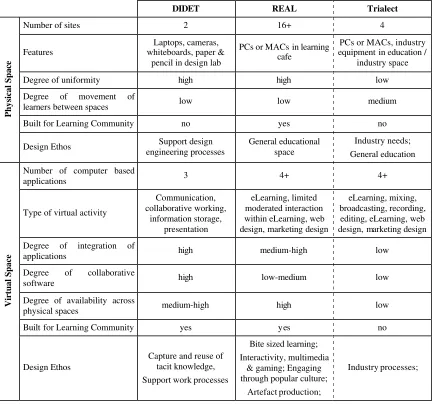
[image:4.596.91.525.295.699.2]The two cases made extensive use of both physical and virtual spaces, although both what they consisted of and how they were utilised differed significantly, as Table 1 illustrates.
Table 1: Analysis of approach to physical and virtual spaces in case CLCs
DIDET REAL Trialect
Number of sites 2 16+ 4
Features
Laptops, cameras, whiteboards, paper &
pencil in design lab
PCs or MACs in learning cafe
PCs or MACs, industry equipment in education /
industry space
Degree of uniformity high high low
Degree of movement of
learners between spaces low low medium
Built for Learning Community no yes no
Physical Sp
ace
Design Ethos Support design
engineering processes
General educational space
Industry needs;
General education
Number of computer based
applications 3 4+ 4+
Type of virtual activity
Communication, collaborative working,
information storage, presentation
eLearning, limited moderated interaction within eLearning, web design, marketing design
eLearning, mixing, broadcasting, recording, editing, eLearning, web design, marketing design
Degree of integration of
applications high medium-high low
Degree of collaborative
software high low-medium low
Degree of availability across
physical spaces medium-high high low
Built for Learning Community yes yes no
Virtual Space
Design Ethos
Capture and reuse of tacit knowledge, Support work processes
Bite sized learning;
Interactivity, multimedia & gaming; Engaging through popular culture;
Artefact production;
4.1
Physical Space
Multiple physical locations were the norm. In DIDET, the physical spaces being used by the various sub-communities have a high degree of similarity. This was similarly observed within REAL, where the various physical sites offered general education spaces for the local communities. On the other had, Trialect employed multiple sites differently. The learners all began in the same general education space, but each then moved on to domain specific physical workspaces – broadcast, video or music studios - to gain experience within actual industry environments. There was an element of cross-over between spaces with some members of the sub-communities visiting the working environments of others as part of the learning experience. Towards the end, all the Trialect sub-communities came together in the same physical space to put together their final product – ‘the event’. This difference in the use of physical space, it is suggested, is due to the different nature of the learning being undertaken within the case studies . While both DIDET and Trialect claimed that readying the learners for working in their chosen industries was a key aspect, DIDET is within the higher education sector with many full-time students and included an industrial component at a distance. On the other hand, Trialect which had no dedicated educational, with its focus on developing small groups of disenfranchised learners, sought actively to undertake much of the learning within industry environments; for Trialect, industry-based learning environments were key. Such an approach however does not scale – it would be infeasible for the university-based DIDET or the general activity of REAL.
In DIDET, typical tools used by collaborative designers in industry were provided but the arrangement was sometimes ad hoc due to space and time constraints – the facilities were not sole-use. In REAL and Trialect focus was on state of the art industry technology to builda sense of worth and relevant experience– “We will always strive to provide a high level of quality. [Our aim,] … whether it be a physical space or an on-line resource …, is to provide people with quality, a sense of being valued”. Thus, the learning objectives dictated the content of the physical space but this was moderated by conflicting resource demands and motivation of learners.
There was a tendency for differentiated sub-communities to form; DIDET and REAL (including Trialect) consisted of a number of learning sub-communities based around task and location. In Trialect, transverse tasks were assigned like marketing which required interaction with all the groups, or individuals from different groups collaborated in tasks – for example, video students liaised with music students to produce promotional videos. In DIDET, despite fortnightly video conferences, there were still trust and understanding issues between the UK and US. It was only when collaborative UK-US student research projects were held and the link used as an educational tool that things improved – “We're not generally involved in activities that need to be synchronous. I think it would probably help bring us closer together … We ran a collaborative experiment a couple of weeks ago and tried getting a class actually working together - was a lot more challenging. We had two or three video conferences a week and we were actually talking about real issues getting solved.” and “we just had a great session, where we really - the community moved on”. Trust issues were not reported in Trialect, it was claimed due to the project design. Thus, transverse learning tasks can be used to minimise the problems that arise from differentiated sub-communities. Additionally, both cases reported this to be extremely creative through cross-fertilisation of ideas.
4.2
Virtual Space
moderation was not anticipated within DIDET, problems did occur; inappropriate usage filters had to be hastily written. This combined with ‘netiquette’ training proved sufficient, allowing a rich and vibrant virtual communication environment to flourish.
Lack of literacy skills were another unanticipated issue in DIDET and the multi-disciplinarity accentuated this – “there is a complete range of understandings within the team of what that [information literacy] meant”. Staff’s range of eLiteracy skills affected the use of technology of their students – “There are students who still WILL not take on the technology, but then we found out that their supervisor is not using it at all” and “Information literacy is new to the engineers, … there is this conflict - conflict amongst the staff, that they don't actually teach it and don't know how to do it”. Thus, like physical space, the rationale for virtual space appeared to relate to the nature of learning being undertaken rather than the fact that there were multi-purposes.Again, this was modified by diversity of the learner and educator profiles. Communication and interaction in both cases were seen as essential because of the heterogeneous nature and as major success factors although they were achieved in very different ways.
Both cases developed their own virtual environments. For REAL, the decision to commission eLearning technology arose from the need to engage disenfranchised learners and compete with television and video games. The approach was innovative – “It sounds really silly now but no one was using interactivity in learning, eLearning before.” adopting “multimedia and game space learning and put[ting it] into an educational environment.” The innovation of DIDET’s virtual space technology, like REAL’s was driven by a lack of availability. DIDET took existing Wiki technology and radically changed it to include a detailed permissions system which was required to support multiple assessed group learning. This development was seen as “heretical” in some quarters as wikis are traditionally open. Similarly, a digital library was developed because existing offerings did not store information in a way which was searchable within the learning scenario. Thus, both learning communities developed innovative virtual solutions due to gaps in current offerings within their sectors; lack of availability drove innovation.
4.3
Co-location
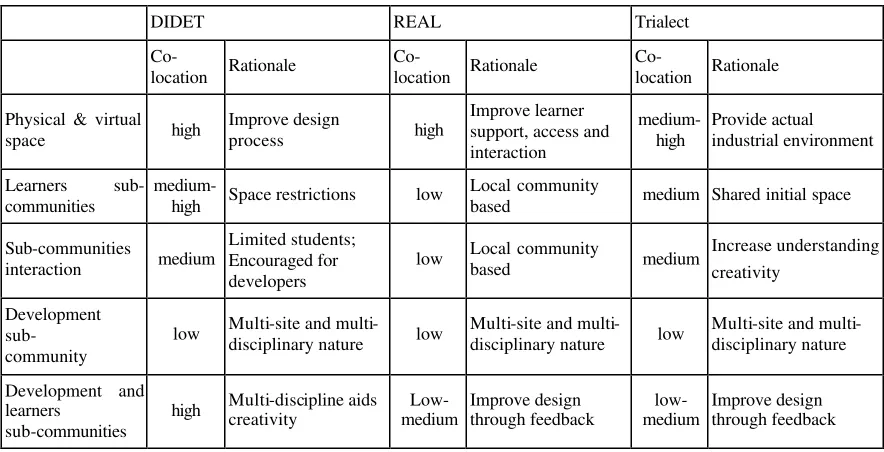
[image:6.596.83.525.454.680.2]The results are of the analysis of co-location of learners within a physical space and of physical and virtual spaces are displayed in Table 2.
Table 2: Analysis of degree and rationale for co-location in case studies
DIDET REAL Trialect
Co-location Rationale
Co-location Rationale
Co-location Rationale
Physical & virtual
space high
Improve design
process high
Improve learner support, access and interaction
medium-high
Provide actual industrial environment
Learners sub-communities
medium-high Space restrictions low
Local community
based medium Shared initial space
Sub-communities
interaction medium
Limited students; Encouraged for developers
low Local community
based medium
Increase understanding creativity
Development sub- community
low Multi-site and multi- disciplinary nature low
Multi-site and multi- disciplinary nature low
Multi-site and multi- disciplinary nature
Development and learners
sub-communities
high Multi-discipline aids creativity medium Low- Improve design through feedback medium low- Improve design through feedback
project, dedicated development space is available. DIDET likewise had a high degree of co-location of learners within local sub-communities. One key aspect however was global team working; physical co-location of all learners was not practical. DIDET utilised video conferencing to bring people face-to-face to address potentially difficult areas of community building such as shared understanding. Face-to-face contact was still necessary though – “trust between the two partners is really cha llenging and any … globally collaborative project is like what happens in a small team doubled and tripled and then there's all the cultural differences. But, we went to meet them … and that makes a difference now to how we can trust…. We have video conferences every two weeks, but having that actual personal contact has made a difference. We can use humour [to] make it easier”. Thus, physical presence was fundamental to the buy-in process and for some of the activities although DIDET was actively researching how to replace much of this by video and virtual techniques.
Despite the relatively high degree of co-location of physical and virtual spaces in both case studies , , neither learning community believed they had taken an integrated approach to the design of the physical and virtual spaces. For example, in REAL – “Not deliberately in the sense - I mean we didn't sit down and say 'ok let's take this kind of all encompassing, holistic approach to theses things', it was more of a case of what will develop will be appropriate as it develops and if that is something that ultimately ends up being some kind of holistic solutions then so be” and in DIDET - “The experience the department had of supporting the students to do learning … in design engineering means that in a sense … that knowledge is so ingrained, so a part of what they do in the department, that that's holistic in a way.” The spaces employed in both cases were a culmination of the project team’s previous experience in educational space design in their given domains. Interestingly in the post-REAL development project, a more holistic approach to the design of the physical and virtual space has been undertaken. Similarly, in DIDET a research project is currently being undertaken to specify a holistic des ign approach to the physical and virtual space used. Thus while a holistic approach to design and implementation of a hybrid space and not been taken, the experience has led to such an approach now being implemented.
5.
INSIGHTS, DISCUSSION AND CONCLUSION
A number of insights can be drawn which will be useful in the development of community spaces within multi-purpose learning communities:
• The collaboration space may be physical and, or virtual and a trend to develop differentiated sub-communities based on location and task was observed, even when they were linked virtually .
• Transverse tasks which generate synchronous activities across sub-communities aid development of shared understanding and creativity in multi-purpose communities.
• Virtual technology is an important facilitator of multi-purpose learning communities, but the issues to do with lack of ‘literacy’ skills be they communication, information or technological are an obstacle to participation and particularly noticeable in multi-disciplinary communication. These, along with the need for moderation, must first be addressed. Such issues can be expected to be particularly prominent in communities where there is a high degree of diversity and multiple purposes as a common ‘binding’ aim is often lacking.
• The choice of physical and virtual facilities depend mainly on the type of learning being undertaken, but is moderated by physical connectivity of learners and their needs for engagement. The trend observed was for innovative development driven by lack of availability which lends support to the proposition that such learning communities are novel.
• A holistic approach to design of the community space creating a hybrid physical and virtual space is deemed advantageous .
The novelty of the work reported here was the investigation of the community spaces of synerg y-driven multi-purpose learning communities. Differentiation of sub-communities linked to physical locations in line with Wenger et al’s (2002) observations occurred. What we have shown here is that with transverse tasks – unfocussed activities were not enough - links could be re-established and that the flow of ideas between these differentiated sub-communities was creative. While a holistic approach to design of integrated physical and virtual spaces in line with Zellner (1999) was not observed, the future plans of both cases studied support this . While the insights developed were in relation to multi-purpose learning communities, they will be equally applicable to learning community which share features such as heterogeneity, multiple physical locationsor a mixture of spaces.
The research also offers a different perspective, analysing the developers’ rationale and experiences (direct and observed) of development of community spaces within learning communities rather than the typical learner centric usage analysis. The DIDET case study supported Olson and Olson’s (2000) observation that while techniques normally used in face-to-face learning scenarios can be carried out over a distance using video conferencing, a diluting effect occurs.
The next step for this research is to investigate further the relationship between the community space/place and the achievement of the multiple purposes and other incidental emergent products of these learning communities with the aim of contributing to a framework for successful seeding of multi-purpose complex learning communities.
REFERENCES
Bandura, A,, 1997. Social Learning Theory. Prentice Hall, New Jersey.
Blumenfeld, P. C., et al, 1991. Motivating project-based learning: Sustaining the doing, supporting the learning. Educational Psychologist, Vol. 26, pp369-398.
Clark, D., 1996. Schools as Learning Communities. Cassell, London.
Fukuyama, F., 1995. Trust. New York: Free Press Paperbacks, Simon and Schuster.
Gabelnick, F., et al 1990. Learning Communities: Creating Connections Among Students, Faculty, and Disciplines. San Francisco: Jossey-Bass.
Gee, J. 2003. What Video Games Have to Teach Us About Learning and Literacy. Palgrave Macmillan. Goodyear, P, 2001. Networked learning in higher education: Notes and guidelines. JISC/CALT.
Harrison, S. and P. Dourish, P., 1996. Re–Place–ing Space: The Roles of Place and Space in Collaborative Systems. In Proceedings of the ACM Conference on Computer Supported Cooperative Work. New York: ACM Press, pp. 67–76. Lewis, D. and Allan, B., 2004. Virtual learning communities: A Guide for Practitioners. Open University Press, UK. Kazmer, M. M., 2005. Cats in the classroom: Online learning in hybrid spaces. FirstMonday, Vol 10 No 9, September.
Electronic journal. http://firstmonday.org/issues/issue10_9/kazmer/index.html
McDonald, D.M. 2005. Complex Learning Communities, In Proceedings of eSociety 2005 Conference, Qawra, Malta. Miles, M.B. and Huberman, A.M., 1994. Qualitative data analysis: an expanded sourcebook. Sage Publications,
Thousand Oaks.
Olson, J. and Olson, G., 2000. Distance Matters. In Human Computer Interaction, Vol. 15 pp139-179.
Preece, J. and Maloney-Krichmar, D. 2003. Online Communities. In J. Jacko and A. Sears, A. (Eds.) Handbook of Human-Computer Interaction. Lawrence Erlbaum Associates Inc. Publishers. Mahwah: NJ. 596-620.
Rheingold, H., 1993. The virtual community: homesteading on the electronic frontier. Addison-Wesley.
Toffler, A. and Toffler, H., 1999. Forward. In Rethinking the Future : Rethinking Business, Principles, Competition, Control & Complexity, Leadership, Markets, and the World. Gibson, R. (Ed).Nicholas Brealey Publishing. Wenger, E., 1998. Communities of practice. Cambridge, UK: Cambridge University Press.
Wenger, E. et al, 2002. Cultivating Communities of Practice: A Guide to Managing Knowledge. Harvard Business School Press.
Yarnit, M. 2000. Towns, cities and regions in the learning age: A survey of learning communities. LCN, UK. Vygotsky, L.S., 1978. Mind in Society. Harvard University Press, Cambridge, MA.