A Comparison of New Zealand Police
Officers
’
Perceptions of Development
Practice within New Zealand
Development Programmes
A research project presented in partial fulfilment of the requirements
for the degree of Master of International Development
School of People, Environment and Planning
Massey University
Manawatu, New Zealand
Kevin J Brennan
iii
Abstract
From the 1990s onwards, the New Zealand Police followed a global trend of progressively becoming involved in overseas peacekeeping and development deployments that over time changed from operational interventions to deployments that were more developmental in nature. While development concepts within these New Zealand Police development interventions have been committed to in principal, there has been little or no research undertaken as to how New Zealand police perceive and undertake their roles within these interventions. Using a post-development framework this research explores how these development interventions and the subsequent expectations for the role of the New Zealand police officer during development interventions overseas were created. A survey and interviews were conducted with a small number of New Zealand police officers who have deployed within these interventions to identify their perceptions of development practice so as to compare with the expectations of the development programmes.
My research predominantly finds that New Zealand police officers place a high value on their prior New Zealand policing experiences. In implementing development programmes there was an overwhelming recognition by the research participants for the need to form
positive relationships by listening and acknowledging another’s culture. This recognition
v
Acknowledgements
Thank you to my supervisor Dr Maria Borovnik for all your support, wisdom and encouragement in undertaking this research, such a positive nature goes a long way. To the men and women of the New Zealand Police, I am extremely grateful for the time you made to tell me the stories of your experiences and provide insight, it was great to connect.
vii
Acronyms
ABG Autonomous Bougainville Government AFP Australian Federal Police
ASEAN Association of Southeast Asian Nations
AusAid Australian Agency for International Development BCPP Bougainville Community Policing Project
BCPP Bougainville Community Policing Programme
CAP Community Auxiliary Police
CDI Commitment to Development Index CGD Centre for Global Development
CPP Community Policing Pilot (in Timor-Leste)
COP Community-Oriented Policing
DAC Development Assistance Committee ECP Enhanced Cooperation Programme
HDI Human Development Index
IDG International Deployment Group IPMT International Peace Monitoring Team ISG International Services Group
MFAT Ministry of Foreign Affairs and Trade
NGO Non-Governmental Organisation
NZ New Zealand
NZAID New Zealand Agency for International Development 2002-2009 NZAID The New Zealand Aid Programme 2009-current
NZP New Zealand Police
ODA Overseas Development Assistance
OEDC Organisation for Economic Co-operation and Development PICP Pacific Islands Chiefs of Police
PNG Papua New Guinea
PPDVP Pacific Prevention of Domestic Violence Programme
PNTL (Polísia Nasionál Timór Lorosa'e) National Police of Timor-Leste RAMSI Regional Assistance Mission to Solomon Islands
viii
TLCPP Timor-Leste Community Policing Programme TPDP Tonga Police Development Programme
UN United Nations
UNFICYP United Nations Peacekeeping Force in Cyprus UNMIT United Nations Integrated Mission in Timor-Leste UNPOL United Nations Police
UNTAC United Nations Transitional Authority in Cambodia UNTAET United Nations Transitional Administration in East Timor UNTAG United Nations Transition Assistance Group
US United States
VPF Vanuatu Police Force
ix
Contents
Abstract ... iii
Acknowledgements ... v
Acronyms ...vii
List of Tables ... xiii
Chapter One: Introduction ... 1
1. Introduction ... 3
1.1 The Research Problem ... 4
1.2 Research Aim and Questions ... 4
1.3 The Project Framework ... 6
1.4 Research Method - Document Analysis ... 7
1.5 Research Method - Survey and Interviews ... 7
1.6 Ethics ... 8
1.7 Limitations ... 9
1.8 Development Theory and Project Structure ... 9
1.9 Research Structure and Chapter Overview ... 12
Chapter Two: Literature Review; Police in Development Interventions ... 13
2. Introduction ... 15
2.1 Police in Peacekeeping Operations and Development ... 15
2.2 The Politicising of Policing Development Interventions ... 16
2.3 Participation and Partnership Within Policing Development Interventions ... 17
2.4 Capacity Building Within Policing Development Interventions ... 19
2.5 Personal Agency Within Policing Development Interventions... 20
2.6 Chapter Conclusion ... 21
Chapter Three: Literature Review of New Zealand Police Deployments ... 23
x
3.1 Background and Formation of New Zealand Police ... 25
3.2 The Focus for New Zealand Police Deployments Within the Asia-Pacific Region . 26 3.3 New Zealand Police and the New Zealand Aid Programme Relationship ... 32
3.4 Alliance with the Australian Police ... 34
3.5 Parallel Structures of the New Zealand and Australian Police and Aid Agencies ... 38
3.6 Characteristics of New Zealand Police Deployments ... 38
3.7 Chapter Conclusion ... 44
Chapter Four: New Zealand Police Overseas Development Programmes, Case Study of Timor-Leste... 47
4. Introduction ... 49
4.1 Plans, Reviews and Evaluations ... 49
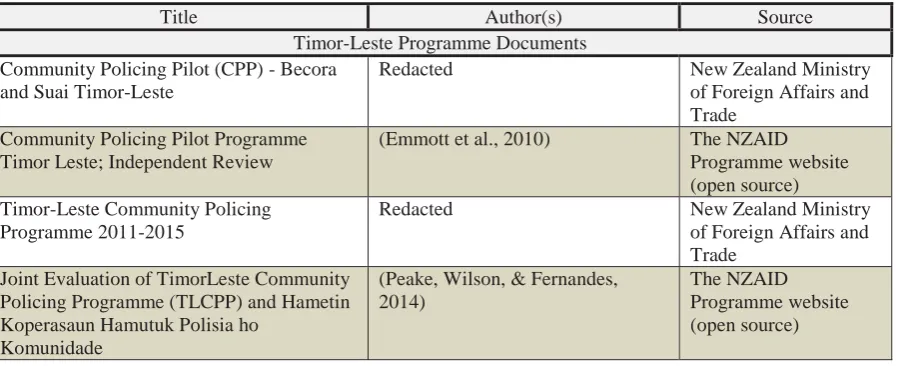
4.2 Procedure Undertaken for the Document Analysis ... 50
4.3 Background and Setup of Development Programmes in Timor-Leste Involving New Zealand Police ... 53
4.4 Common Findings on Outcomes and Achievement for Development in Timor-Leste Involving New Zealand Police... 54
4.5 Common Findings on the Design of Development Interventions in Timor-Leste Involving New Zealand Police... 55
4.6 Chapter Conclusion ... 55
Chapter Five: Key Findings of Survey and Interviews with Individual Police Officers .... 57
5. Introduction ... 59
5.1 Survey and Interviews... 59
5.2 Survey and Interviewee Demographics ... 60
5.3 Participants Views on the Reasons Why New Zealand Police are Deployed... 60
5.4 Role Identification and Tasks ... 64
5.5 Achievement ... 65
5.6 Challenges ... 66
xi
Chapter Six: Discussion and Conclusion ... 71
6. Introduction ... 73
6.1 Partnerships and Power Sharing Within Development Programmes Involving New Zealand Police ... 73
6.2 Recognising the Use of New Zealand Police Officers Within Development ... 75
6.3 Conceptualising Development Interventions Involving New Zealand Police ... 77
6.4 Post-Development Theory in Practice Involving New Zealand Police... 79
6.5 Conclusions ... 81
Appendix A 1: Document examination Community Policing Pilot Timor-Leste ... 95
Appendix A 2: Document examination Community Policing Programme Timor-Leste ... 97
xiii
List of Tables
Table 1 New Zealand Police overseas deployments 1909 to 2014 ... 27
Table 2 United Nations deployments involving New Zealand police ... 28
Table 3 New Zealand Police deployments since 2002 ... 31
Table 4 New Zealand Police deployments with an Australian Police presence ... 35
Table 5 New Zealand Police overseas programmes funded by NZAID ... 38
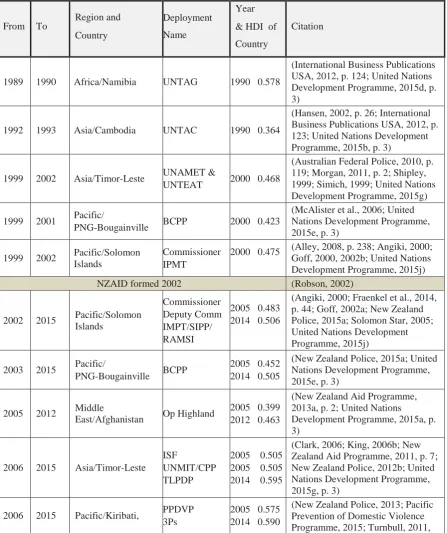
Table 6 New Zealand Police deployment comparison to Human Development Index ... 41
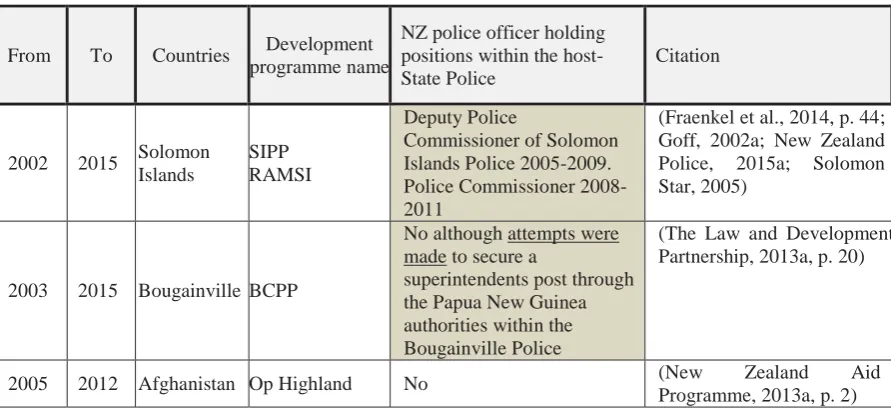
Table 7 Positions of power for New Zealand police in deployments from 2002 ... 42
Table 8 Programme documents examined for Timor-Leste ... 50
Table 9 Ranks and gender of participants ... 60
1
3
1. Introduction
This research project investigates the deployment of New Zealand police officers to developing countries. There has, since the 1990s, been a significant global increase in police from one state deploying to another to assist in the development and strengthening of the policing services in post conflict, fragile or developing States (Greener, 2011b, p. 184). The New Zealand Police has deployed officers, on direction of the New Zealand Government, to these development assistance interventions. The increasing use of overseas police is due to the idea that for development to take place issues of security must be addressed; this includes developing the host-State's security institutions (Holm & Eide, 2000, pp. 2-3). It is now generally accepted that such development interventions are needed and there has been much discussion on the concept of the reform of these security institutions overall. There has been little study, however, given to the specific circumstances of such interventions (Krogstad, 2012, pp. 261-262).
As a New Zealand Police officer who has deployed to Solomon Islands and Timor-Leste as part of New Zealand development programme interventions, I came to realise that whilst these development interventions contain elements of policing, in reality the interventions transcended the policing role and its tasks. Police officers, when working in New Zealand, generally have a very clear idea of the parameters and expectations of their job. Yet when deployed to another country they find themselves working in completely different contexts in terms of culture, political systems, political stability, security threats, standards of living and social cohesion. Police officers must not only navigate these obvious differences in their working environments but must also adapt to another, quite different role, that of someone helping to develop skills and abilities in others rather than carrying out law enforcement duties. With this in mind, I wanted to further explore the complexity of the development interventions that New Zealand police officers work in. I wanted to examine the frameworks they must work within and untangle how New Zealand police officers perceived the development interventions they were involved in. This is to understand how the development interventions and their frameworks actually constrained or enabled them in carrying out their work. Whilst this research has a strong focus on the
experiences of a ‘donor’ partner within development, it aims to contribute to improving
4
The aim of this chapter is to offer readers an introduction to this research and the questions underlying this change. While development and security continued to merge, there remain gaps in the knowledge as to understanding how the actors involved in security reform to support the process of development can contribute in more meaningful ways. The involvement of New Zealand police in development is key in this study. The means to undertake this will be explored through a post-development lens and address issues on power and agency.
1.1 The Research Problem
Bevan (2011, p. 2) points out that there has been little research on how Police officers involved within overseas development interventions conceptualise their activities and actions. Cuddy (2012, pp. 2-3), similarly, highlights that while both New Zealand and Australian police have been involved in overseas development interventions for the last 15 years and there has been research available on Australian interventions and the experiences of Australian personnel, there has not been the same examination of personnel within New Zealand-led or managed interventions. This raises the question that if little is known on how New Zealand police conceptualise their place within development interventions, how can these interventions be designed so that the expectations of the development program and the police officers implementing them are aligned? This in turn leads to questioning the potential effectiveness for the implementation of such development programmes. If one partner of a development programme is uncertain of what their contribution involves then this may have an adverse effect on the programme as a whole and therefore reduce the value of the development programme for those people it is meant to benefit.
1.2 Research Aim and Questions
5 development. By addressing individual perception, the study aims to improve the knowledge of the actual outcomes of police interventions in development and specifically how this particular occupational group understands their placement within these interventions. The main research aim is:
To compare how New Zealand Police officers perceive development practice to New Zealand development programme expectations.
To explore this aim there are three primary research questions and affiliated objectives designed as the means to answer each question.
Research Question One
In what way are the New Zealand Police involved in overseas development?
Objectives
a) To explore the history of police officers participation in development interventions overseas.
b) To understand the recommended practices involving police for development interventions overseas.
c) To analyse overseas development interventions that New Zealand Police officers are involved in.
Research Question Two
What are the gaps between the expectation of New Zealand Police officer involvement during development interventions and the actual outcome?
Objectives
a) To explore development practices involving New Zealand police officers that achieved good outcomes.
b) To identify areas involving New Zealand police officers where outcomes were not being met (and the reasons for this).
Research Question Three
6
Objectives
a) To identify the roles that New Zealand Police officers associate themselves to in development interventions
b) To identify the preparation for New Zealand Police officers for development interventions at an organisational and personal level.
c) To explore the challenges that New Zealand Police officers experienced.
d) To explore the enablers that New Zealand Police officers found contributed to achieving planned outcomes.
1.3 The Project Framework
7 the research but also as a means to triangulate to confirm any subsequent conclusions (O'Leary, 2013, p. 94).
1.4 Research Method - Document Analysis
The first main area of research undertaken was a document analysis. This document analysis was conducted on the plans, reviews and evaluations of New Zealand development interventions involving New Zealand police officers. The plans, primarily designed by New Zealand Aid/The New Zealand Aid Programme, represented the mutually agreed goals and objectives of the development intervention between New Zealand and Timor-Leste. They stipulated how goals and objectives would be met while utilising the New Zealand Police as implementers. The reviews and evaluations were carried out by independent contractors. An analysis was undertaken to identify any gaps within the plans (expectations) and the recorded outcomes (from the reviews and evaluations) in the use of New Zealand police within these interventions. This was a qualitative exercise where information from text had to first be interpreted and then categorised, refer to Appendixes A1 and A2, to identify any occurrences or trends (O'Leary, 2013, p. 224).
1.5 Research Method - Survey and Interviews
The second main component of this research was a survey and interviews with New Zealand police officers who had deployed overseas as part of development interventions. In line with the nature of this research, the survey and interviews that were conducted were qualitative in nature. This approach was adopted so that in exploring a particular group of people, namely New Zealand police officers engaged in development overseas, a
larger picture was able to be built through the diversity of an individual’s understanding
(O'Leary, 2013, p. 115). The initial survey consisted of a number of demographic questions as well as questions related to identifying what the participants perceived as their roles within the deployment. They were also asked what challenges and successes they had experienced whilst on deployment.
8
were conducted from the 24th of September 2015 to the 29th of September 2015 by telephone or the telecommunication programme Skype with survey participants who had provided their details for a follow up interview.
The subsequent interviews were semi-structured, comprising of a number of key questions that allowed for participants to provide open responses within the conversation depending
on the participant’s area of expertise, experience or just general interest in a particular line
of questioning and subject matter. An open response is where respondents provide answers in their own words and are able to communicate what they wish (O'Leary, 2013, p. 191). This was an attempt to have participants share their thoughts and experiences rather than answering simple, short response questions. I aimed to capture the experiences and perceptions of the participants that would be highlighted and prioritised as a means to understanding what their experiences had been like and what they had meant for them, including what had been learnt (Chambers, 1997, 2013b; O'Leary, 2013, pp. 119-120).
1.6 Ethics
Prior to the fieldwork being carried out I sought ethical clearance from Massey University and an in-house ethics review process was conducted by a panel of two academics, Dr Gerard Prinsen and my supervisor Dr Maria Borovnik. I was asked to reflect on my
methodological approach, positionality and my fieldwork plan. A ‘Notification of ‘low risk’ research/evaluation involving human participants’ was then submitted, and the project was evaluated as ‘low risk’.
9 actions. Hence, in order to overcome the issue of power, due to rank structure, initial contact with potential research participants to participate in the survey contained clear advice that participants would remain anonymous and that there was no obligation to participate. People that had been approached understood there was no obligation or pressure to participate in the survey.
Another aspect to consider was using personal contacts and networks to make contact with participants. Considered was that while my personal networks were helpful in establishing a rapport they also potentially implied social obligations that could possibly influence the interview. Particularly, in relation to interviewing people, I had to consider my levels of familiarity with the person I was interviewing (McConnell-Henry, James, Chapman, & Francis, 2010, p. 3; Platt, 1981, p. 78 & 79). While the means undertaken to manage these potential issues was through the clarification of my role as a researcher (McConnell-Henry et al., 2010, p. 3). What I found in the interviews was that the interviewees appeared to be more than willing to share their experiences. While alert to the multiple subjectivities brought to this research, I felt it was our shared experience of having deployed overseas that made the dialogue more open and authentic.
1.7 Limitations
For many qualitative studies the selection and grouping of data does not follow a pattern, rather studies based on subjective decisions made by a researcher might lead to a situation where no two researchers will finally come up with the same data, even if they had investigated the same unit of investigation under the same research question, at the same time and with the same methods (Diefenbach, 2009, p. 885). Such subjectivity might become a limitation as this also affects the relative weight that should be given to participants accounts when compared to documenting the reality (Shilling, 1992, p. 70). Another limitation was that the surveys and interviews were conducted with a relatively small number of participants. The conducting of surveys and telephoned interviews also reduced opportunity for closer contact where other forms of communication, such as body language or opportunities for clarification were potentially lost.
1.8 Development Theory and Project Structure
10
working as a component of New Zealand development programmes overseas. These police officers, while attempting to solve problems, intentionally or not, intervene in the social events around them. They do this whilst monitoring their own actions and acknowledging the exercise of power associated to their placement which affects the agency and relationships with those they are meant to partner with, in the development intervention (Long, 1990, p. 8). In order to carry out this research it was necessary to understand the paradigms, processes and structures that have contributed towards creating those development programme plans which have been placed on New Zealand police officers working overseas. Further to this, it was also essential to understand the personal agency of these officers participating in these programmes in that the choices they make
are also influenced by the belief in one’s effectiveness in performing specific tasks and
skills, (Groves & Hinton, 2004, p. 28; Long, 1990, p. 6; Zimmerman & Cleary, 2006, p. 45).
Development theory, relating to power and agency, viewed through a post-development lens, was used to undertake this research. Post-development acknowledges that there is not one universal truth but rather that the world is made up of diverse voices. It puts the idea of development into play and that the ideal of development is contested (Blaikie, 2000, p. 1045). However, the idealisation of development is often accompanied by the
setting of performance targets and numerical measures of success as a way of ‘driving’ the
change that is desired. Yet, much development literature is littered with examples of how this approach is more likely to lead to failure rather than success. This is often put down to weak implementation rather than weak conceptualisation (Mowles, 2010, p. 151). Considering this conceptualisation, De Vries (2007, p. 27) advocates that development is not just about the materialisation of what is planned but just as importantly it is about sustaining the capacity to desire a different kind of society that is not yet defined, a conceptualisation of what can be achieved. Post-development not only looks at how development shapes and constitutes people and places but also examines how development actors have agency to re-imagine to shape places and development and seek alternatives to it (McGregor, 2009, p. 1696).
11 identify problems, create theories or allow objects to emerge that can be named, analysed and later transformed into a policy or a plan to be followed. It is this systemising of relationships and the restriction of knowledge that sets the rules and agenda for the contemporary discourse on development that, in turn, becomes a form of power and control over others (Escobar, 1988, p. 430; 1997, p. 86 & 87). This is particularly relevant to the practice of sending New Zealand police to work in other countries as this practice could be viewed as New Zealand police officers being considered ‘the experts’ who hold the right kind of knowledge as opposed to the host-State police. Such situations, if not handled correctly, could in turn stifle the very agency of the people they are required to support.
Post-development theory has been influenced by post-structuralism which is the study of the systems of knowledge that produce the object. It is concerned with understanding the processes of how meaning and content have passed through a system (Cilliers & Spurrett, 1999; McKinnon, 2007). This research brings about understanding how systems, structures and organisations have shaped the development interventions that these New Zealand police officers find themselves working with and in. There are limitations in that approaches to development often adopt macro-level analysis that overlook the important micro-level processes in development (Shilling, 1992, p. 69 & 70).
12
freedoms, such as free agency, capability and choice for intended beneficiaries (Desai & Potter, 2008, p. 44), therefore how those structures enabled or constrained those whom New Zealand police officers interacted with becomes just as relevant.
Critics of post-development argue that post-development tends to misrepresent people and places and also represents development as homogenised (McGregor, 2009, p. 1694). It is also argued that post-development creates an impression that contemporary development is a problem where only certain things can be said or done. For some post-development theorists this can mean taking an anti-development stance who heavily critique and reject the current practices of development altogether (Corbridge, 1998, p. 138 & 148; Ziai, 2004, pp. 1045-1060). In exploring the historical politics and power relationships that shape development and in the case of this research, the history of development interventions involving New Zealand police, it becomes important to not reject what has happened in the past. Through this study I wanted to highlight the importance of seeing that there is more than one way of shaping the world and to recognise that in doing this, other possibilities and spaces become available. Post-development teaches us not to take that space for granted (Desai & Potter, 2008, p. 35 & 36).
1.9 Research Structure and Chapter Overview
13
15
2. Introduction
This chapter provides an overview of police involvement within development. In doing so this chapter contributes to research question one; ‘In what way are the New Zealand
Police involved in overseas development? Firstly the history of police officers
participation in development interventions overseas is explored. Following this the challenges around using police for development interventions are discussed in conjunction with the concept of forming partnerships within these kinds of development interventions. Finally the contemporary approaches and recommended practices involving police for development interventions overseas are examined.
2.1 Police in Peacekeeping Operations and Development
16
order management that less developed countries could readily provide in comparison to technical skills. However, also cited as a reason for a decrease in the participation of developed States contributing towards police development are the rising inefficiencies and costs within UN missions that some member States are unwilling to continue to support (Russel, 2013; Westhead & Aulakh, 2013). Fleitz (2002, p. 77 & 111) points out that these inefficiencies are directly linked to idealistic and political aspirations that have been put ahead of operational realities. Hills (2015a, p. 146), in examining United Kingdom police deployments, puts it more directly in explaining that the officers themselves are mostly inexperienced in working overseas in different environments and therefore become ineffectual.
Yet the demands for police for UN missions are still rising. Greener (2009, pp. 124-125) warns that with the situation where developed States are committing less police, conditions could be created that exacerbate the divide between States, where wealthier States either pay contractors or poorer States to police those areas of high risk. This in turn could lead to a garrison effect where wealthier States seal themselves off from those States characterised by a lack of law and order.
2.2 The Politicising of Policing Development Interventions
While UN missions are political constructs, the UN has a legitimate basis for its actions, bestowed upon it through consensus by member States. However other policing development interventions that are carried out by individual States as a component of foreign aid programmes may become problematic (Claude, 1966, p. 373; Higate & Henry, 2009, p. 470; Stenning & Shearing, 2005, p. 169). This is because at an individual State
level there are different motivations for intervening in another State’s affairs. Foreign
donor aid is often consistent with the donor’s own interests rather than the issues or priorities identified by the recipient. Police development programmes carried out as foreign aid have raised such concerns and questions such as in whose interest is it that the interventions are carried out and who will benefit from the reform and the appropriateness of the kind of police model being introduced into a post-conflict environment (Brogden, 2005; Marenin, 1998, p. 155 & 156; Stenning & Shearing, 2005, p. 169)?
17 some cases a militarised kind of intervention. In 2005 it was estimated that while at least 90% of US bilateral assistance for police programmes was for capacity building, the goals were not linked to reform (Bayley, 2005, p. 206). In Afghanistan the reform of the Afghanistan police through the US Defence Department saw US efforts that were geared towards military training and support while removing or ignoring training on community
and democratic policing, as well as domestic violence and women’s rights. This approach
was seen as a failing to meet not only the short-term need for security but also the long-term requirement for establishing the rule of law, prioritising the concerns of external actors at the expense of local needs (Friesendorf, 2011, pp. 1,86,87,90,91; Greener, 2011a, p. 221; Murray, 2007, p. 118). This reform of the Afghanistan Police, Greener (2011a, p. 221) says, was nothing more than a post 9/11 agenda as its focus was primarily on security rather than the development of a police service that would meet the needs of the local communities.
Burnell (2008, p. 504) calls such designs, that may or may not be motivated by a national interest and aligned to other objectives within programmes, as multiple goals. The realisation or perception of multiple goals can also cause a reaction from the supposed beneficiaries. In 2004 a report for an Australian Police deployment to Bougainville, a former protectorate of Britain under Australian administrative control up until 1975, revealed that the intervention was seen by some parties as a form of re-colonization by a former colonial master (Chin, 2005, p. 193; National Archives of Australia, 2015; RT, 2015). Such sensitivities and perceptions can ultimately have a significant impact on the intervention for both sides. That particular case resulted in Australia having to withdraw from Bougainville at a significant cost (Dixon, 2005). Ultimately, as Goldsmith and Posner (2002, p. 118) state, while nations may provide legal or moral justification for their action's, their legal or moral justifications cleave to their interests and when their interests change so does the rational for their action. Development interventions then further require that donors and recipients should not only have identical, or at least closely aligned, preferences (Martens, 2005, p. 646), but they must also have as Baaz (2005, p. ix) says the material differences or the means to realise their goals.
2.3 Participation and Partnership Within Policing Development Interventions
18
international level, the concept of participation through partnership was ratified as a core tenet of the Paris Declaration in 2005 as a means to deliver aid more effectively at all levels (Organisation for Economic Cooperation and Development, 2008b; Wood et al., 2010). In terms of Policing Development interventions, the application of those concepts took some time to appear at an implementation level which is demonstrated by de Heyer (2012) in a study of 23 missions involving international police from a period of 1999 to 2007. The study found that when planning for policing interventions did occur there was often no indication of local participation in the planning or subsequent evaluations. However, an examination of UN documents does shows a growing awareness of the concept of partnership for United Nations Police. The 2011 report to the General
Assembly on UN Policing had a section on ‘partnership’ that provided details on the
creation of partnerships at an international and regional level (United Nations, 2011b, p. 15 & 16). The 2014 UN policy on Police in Peacekeeping operations and political missions is more specific in that it directs that UN Police (UNPOL) shall base their mandate implementation on a comprehensive strategic plan. The resulting plan should form a joint vision with host-State authorities that is developed in collaboration with the host-State and is subject to joint evaluation in partnership. (United Nations, 2014a, pp. 10,11 & 17). With such plans, as Spratt (2011, p. 1 & 2 ) highlights, it is also important to recognise that not all planned interventions have the power to deal with human problems that are often resistant to change and are prone to fragmented responses, as is found in international development. This also requires what Eyben (2010, p. 2 & 7) says is a focus on processes and people, rather than results to become successful.
19 more extensive involvement from those whom the interventions were meant to benefit produced better results.
Irrespective of the vagaries around what partnership is at a structural and procedural level, using police for peace building requires that host-State organisations must be an integral part of the planning process as a means to create national ownership (United Nations, 2014b, p. 2). This requirement necessitates an appreciation that partnerships are never neutral and that power relations shape the boundaries of partnerships (Tolley, 2011, p. 39). This means that to achieve change in development also requires an understanding where power lies, such as understanding that the political elites in a country will have their own political and cultural agendas. These agendas may be positive, negative or neutral in nature when applied to the goals of the intervention (Grabosky, 2009, p. 221; Groves & Hinton, 2004, p. 31).
In terms of peace building interventions, Unsworth (2009, p. 892) writes that the provision of technical support is not the solution. A greater understanding of the shared responsibility of the problem and what the key issues are that impact either positively or negatively on the policing role is the solution (Grabosky, 2009, p. 220). A significant component of police reform, typically carried out by non host-State actors, has recently been conducted through the process of capacity building and development (Caparini, 2014, p. vii; United Nations, 2015a).
2.4 Capacity Building Within Policing Development Interventions
In exploring the concept of capacity development the UN (2006, p. 7 & 8) provides a definition in that capacity development is a long-term process in which individuals, organizations, institutions and societies develop abilities to perform functions, solve problems and set and achieve objectives. It is broken into three inter-related levels of the individual, institutional and societal. Separating groups and organisations from individuals, the UN (2006, p. 7 & 8) defines that capacity development for individuals is
20
The lack of a clear or concise definition has implications for the implementation of police capacity-building and development activities. While the newly promulgated UN (2015a, p. 36 & 40) guidelines on Police Capacity-Building and Development provides the UN with a framework for identifying the areas of intervention, the guidelines do not explain at an individual level how UN Police are meant to manage themselves and others when interacting at the field level. However, as Ubels, Acquaye-Baddoo, and Fowler (2010, p. xviiii & 6) emphasise, capacity develops as much through relationships between actors as it does within individual organizations. The significance of relationships, they say, involves not only unleashing collaboration but also being able to deal with power and politics. For many post conflict or fragile States, it has long been highlighted that policing services can be heavily politicised and act as an instrument of the State. They can also be factionalised and these factions inside such organisations may have different motivations, points of view and interests (Baranyi & Salahub, 2011; Enloe, 1976; Neild, 2001). There is then a requirement for systems and abilities that work with and through these differences in points of view and power to achieve effective collaboration. More specifically Long and Long (1992, p. 272) explain, capacity development becomes more about supporting structures and enablers to make decisions that deal with the complexities of power and relationships. Power can include the power from being seen as a knowledge expert who can fix problems that others cannot (Escobar, 1988, p. 430; 1997, p. 86 & 87). This ability to make the right decisions in the development context, Groves and Hinton (2004) believe, is determined by personal agency.
2.5 Personal Agency Within Policing Development Interventions
21 institutions, can create a dichotomy in expectation. For example, Harris and Goldsmith (2012, pp. 1029-1031) evaluated 120 interviews with police officers working within Australian Police deployments, focusing on the three key areas of partnership, capacity building and community engagement. They found that Australian Police officers primarily still saw their roles as that of policing rather than of persons involved in developing host-State police officers.
In the development context, Groves and Hinton (2004) emphasise that personal agency requires a recognition that the process of development is unpredictable and fluid, requiring flexible and adaptive procedures. In recognising that, people working in the development context must have the appropriate behaviours and attitudes for working in different contexts (Chambers, 2013a) . Goldsmith and Dinnen (2007, pp. 1106-1107) have recommended for police preparing themselves for working overseas to:
1. Learn about the foreign setting in considerable detail before active engagement. 2. Display a degree of re-flexivity and humility about the objectives behind police
building and how these might be perceived and responded to locally.
3. Adopt a methodology of practice that is flexible and adaptive to local circumstances, including the ability to defer to local knowledge and methods in developing appropriate measures.
4. Practise a kind of institutional reform that is not limited to the short-term technical aspects of police service delivery, but rather is grounded in the broader set of political relations, informal as well as formal, that constitute the terrain of police building.
These preparatory recommendations emphasise that such changes, if required, are not the sole responsibility of the individual. Groves and Hinton (2004) highlight that in development practice individuals must also be encouraged by their organisations to act flexibly and creatively in ways to promote relationship building to also break down power imbalances. How New Zealand incorporates those approaches involving New Zealand police officers will be explored later in Chapter Four.
2.6 Chapter Conclusion
22
23
25
3. Introduction
This chapter contributes to analysing the overseas development interventions that New Zealand police officers are involved as a final objective of research question one ‘In what
way are the New Zealand Police involved in overseas development?’ This is undertaken
by exploring the history of New Zealand Police contributions and involvement in peace keeping missions and long term deployments for reform, restructuring and rebuilding. To
understand New Zealand’s placement within the geopolitical environment and the use of
New Zealand police the background, makeup and characteristics of the New Zealand Police as an organisation will be examined. A mapping of the changes in the types of New Zealand Police deployments is then undertaken. How these changes are now aligned to the New Zealand Governments pursuit of overseas development that has its focus on the Asia Pacific region is shown. Also examined is the formation of the New Zealand Agency for International Development (NZAID), later named as The New Zealand Aid Programme, (also to be referred to as NZAID) and how its structural and political changes have affected New Zealand Police deployments. Finally discussed are the similarities to and co-operation that New Zealand has with Australia in terms of policing interventions. This comparison shows the structures and systems that formulate New Zealand’s past and current placement within the role of policing development interventions.
3.1 Background and Formation of New Zealand Police
26
approximately 8700 sworn police officers (O'Connor, 2015, p. 2) serving a population of approximately 4.5 million people in a country that in 2015 was considered 11th on the OECD global better life index, that measures a countries perceptions as to quality of life (Organisation for Economic Cooperation and Development, 2015a).
To cope with an increase of New Zealand police deploying overseas the International Services Group (ISG) was formed in 2004 within the New Zealand Police Headquarters to become the point of contact and management for those deployments (Greener, 2013, p. 6; New Zealand Police, 2015b). However, as with many other developed countries, there are constraints on the numbers of New Zealand police available for long term deployment. With no standing police capacity for such work, recruitment must be rotated from police districts and there is a discretionary nature as to who will deploy (Greener, 2011a, p. 229; Greener, 2013, p. 6). In October 2014 there was a commitment of 33 New Zealand police officers on long term capacity building deployments (New Zealand Police, 2014, p. 4).
3.2 The Focus for New Zealand Police Deployments Within the Asia-Pacific Region
As there has been no comprehensive work published that details and describes the history of New Zealand Police deployments, I conducted a mapping exercise as part of this research to identify the history and range of changes to New Zealand Police deployments. This was undertaken to understand why and how these changes had occurred as part of the issues within this study. The deployments mapped were those that were of a peacekeeping, reform, rebuilding and restructuring nature that also represent a longer term commitment to an intervention. Information relating to the timing of deployment, country deployed to, numbers of New Zealand police officers deployed, nature of the intervention as well as the sources of information were placed into a series of tables to compared and identify any patterns and changes to deployments.
27 Council for a two year period that commenced in January 2015 (Organisation for Economic Cooperation and Development, 2015e, p. 13). Of the six UN missions the New Zealand Police participated in, only two had a development component to it, as highlighted in Table 2.
Table 1 New Zealand Police overseas deployments 1909 to 2014
No From To Country Deployment Name Citation
1 1909 1986 Cook Islands Chief of Police (Butterworth, 2005, p. 232)
2 1928 unknown Samoa none (The Auckland Star, 1928)
3 1951 1975 Niue Chief of Police (Butterworth, 2005, p. 233)
4 1964 1967 Cyprus UNFICYP (Brown, Barker, & Burke, 1984, p. 223 to 225)
5 1974 1976 Papua New Guinea none (Butterworth, 2005, p. 229)
6 1981 1983 Vanuatu None (Butterworth, 2005, p. 229)
7 1989 1990 Namibia UNTAG (International Business
Publications USA, 2012, p. 124)
8 1992 1993 Cambodia UNTAC
(Hansen, 2002, p. 26; International Business
Publications USA, 2012, p. 123)
9 1999 1999 Timor-Leste UNAMET (Australian Federal Police, 2010, p. 119; Simich, 1999)
10 1999 2002 Timor-Leste UNTEAT (Morgan, 2011, p. 2; Shipley, 1999)
11 1999 2000 Solomon Islands Commissioner (Alley, 2008, p. 238; Angiki, 2000)
12 2000 2001 Bougainville BCPP (McAlister, Pisi, Darroch, & Busil, 2006)
13 2000 2002 Solomon Islands IPMT (Goff, 2000, 2002b)
14 2000 2013 Niue Chief of Police (ABC Radio Australia, 2013; Butterworth, 2005, p. 223)
15 2002 2003 Solomon Islands SIPP (Goff, 2002a; New Zealand Police, 2015a)
16 2003 2015 Solomon Islands RAMSI (New Zealand Police, 2015a)
17 2003 2014 Bougainville BCPP (New Zealand Police, 2015a)
18 2005 2012 Afghanistan Op Highland (New Zealand Aid Programme, 2013a, p. 2)
19 2005 2009 Solomon Islands Deputy Commissioner
(Fraenkel, Madraiwiwi, & Okole, 2014, p. 44; Solomon Star, 2005)
20 2006 2006 Timor-Leste ISF (Clark, 2006)
21 2006 2015
Cook Islands, Kiribati, Samoa, Tonga, Vanuatu
PPDVP
28
No From To Country Deployment Name Citation
22 2006 2012 Timor-Leste UNMIT (King, 2006b; New Zealand
Police, 2012b) 23 2006 unknown Tonga Nuku’alofa riots (King, 2006a)
24 2007 2009 Cook Islands Commissioner
(Island Notebook, 2007; New Zealand Press Association, 2009)
25 2008 2011 Solomon Islands Commissioner (Fraenkel et al., 2014)
26 2008 2015 Pitcairn Island Police Officer
(Department for International Development, nd; Northern News, 2008)
27 2008 2015 Tonga TPDP (New Zealand Police, 2015a)
28 2008 2015 Tonga Commissioner
(Matangi Tonga, 2011; Ministry of Information and
Communications, 2015)
29 2008 2010 Timor-Leste CPP (New Zealand Aid Programme,
2011, p. 7)
30 2009 2011 Cook Islands
(New Zealand Agency for International Development, 2008a; New Zealand Police & Ministry of Foreign Affairs and Trade, 2013, p. 2)
31 2011 2015 Timor-Leste TLCPP (New Zealand Police, 2015a)
32 2013 2014 West Papua
(New Zealand Government, 2013; Pearl & Arnaz, 2014; Santos, 2013)
33 2013 2015
Cook Islands, Kiribati, Tuvalu, Niue, Tokelau Vanuatu & Samoa
3Ps (New Zealand Police, 2013)
[image:43.595.67.517.554.755.2]34 2014 2015 Bougainville BCPP (New Zealand Police, 2015a)
Table 2 United Nations deployments involving New Zealand police
Fro
m
To Total C
ountry Dep
loy
men
t
Total Sent Op
erations
Elemen
ts of
R
eform
Restru
ctu
re
Reb
u
ild
Citation
May-64
Jun- 67
36
mth Cyprus UNFICYP 79 Yes No (Butterworth, 2005, p. 232)
May-89
Mar- 90
11
mth Namibia UNTAG 32 Yes No
(International Business
Publications USA, 2012, p. 124)
Feb- 92
Sep- 93
19
mth Cambodia UNTAC 5 Yes No
(Hansen, 2002, p. 26; International Business Publications USA, 2012, p. 123)
Jun- 99
Sept- 99
3 mth
Timor-Leste UNAMET 10 Yes No
29
Fro
m
To Total C
ountry Dep
loy
men
t
Total Sent Op
erations
Elemen
ts of
R
eform
Restru
ctu
re
Reb
u
ild
Citation
Oct- 99
May- 02
20 mth
Timor-Leste UNTEAT 24 Yes Yes
(Morgan, 2011, p. 2; Shipley, 1999)
Oct- 06
Dec- 12
75 mth
Timor-Leste UNMIT 160+ Yes Yes
(King, 2006b; New Zealand Police, 2012b)
Total 164
mth Approx Total 332
With increasing requests for peace support operations from other countries and the United Nations, the New Zealand government developed four criteria to determine whether or not to contribute to a particular peace support operation;
1. The strategic implications of the operation, including its effect on security, the
humanitarian situation and New Zealand’s relationships with other countries.
2. The nature of the mission – the legality of the proposed mission and mandate under international law.
3. The possible repercussions for New Zealand agencies involved in the proposed operation.
4. The question of whether New Zealand can assist the fragile or post-conflict state in other ways (Capie, 2014).
30
role in the Asia-Pacific Economic Co-operation (APEC) and the Association of Southeast Asian Nations (ASEAN) after both New Zealand and Australia were invited to join in
2004. Such participation was summed up in 2007 when New Zealand’s Ministry of
Foreign Affairs and Trade (MFAT) stated ‘New Zealand must continue to develop
positive relationships and make contributions to regional affairs that underpin our participation’(Ministry of Foreign Affairs and Trade, 2007, pp. 19-21). From the 1990s there has been a shift to New Zealand’s identity being that of a Pacific nation and this coupled with a growing number of unsettling incidents within the Asia Pacific region, that Australia named the ‘arc of instability’, created a realisation that politics did not rotate around the old superpowers. This change in the geo-political situation resulted in a narrowing of focus by New Zealand to this region (Dobell, 2006; Kerslake, 2010, p. 13 & 14; Rumley, Forbes, & Griffin, 2006; Thakur, 1993, p. 76 & 77). These security concerns resulted in what some called a new and powerful ‘doomsday’ stereotype of the South Pacific, promoting the idea of Pacific islands as ‘failing’ States by both Australian and New Zealand Pacific experts. Others, however, took a differing view in not judging Pacific Island States harshly as they are still in the process of development and retain traditional sources of cohesion (Baird, 2008, p. 37).
31
Table 3 New Zealand Police deployments since 2002
From To Region & Country
Deployment Name
Elements of Reform Restructure Rebuild
Citation
2002 2003 Pacific/Solomon Islands SIPP Yes (Goff, 2002a; New Zealand Police, 2015a)
2003 2015 Pacific/Solomon Islands RAMSI Yes (New Zealand Police, 2015a)
2003 2014 Pacific/Bougainville BCPP Yes (New Zealand Police,
2015a)
2005 2012 Middle East/Afghanistan Op Highland Yes (New Zealand Aid Programme, 2013a, p. 2)
2005 2009 Pacific/Solomon Islands Deputy
Commissioner Yes
(Fraenkel et al., 2014, p. 44; Solomon Star, 2005)
2006 2006 Asia/Timor-Leste ISF No
2006 2015
Pacific/ Cook Islands, Kiribati, Samoa, Tonga, Vanuatu
PPDVP Yes
(Pacific Prevention of Domestic Violence Programme, 2015; Turnbull, 2011, p. i)
2006 2012 Asia/Timor-Leste UNMIT Yes (King, 2006b; New
Zealand Police, 2012b)
2006 unknown Pacific/Tonga Nuku’alofa
riots No
(King, 2006a)
2007 2009 Pacific/Cook Islands Commissioner Yes
(Island Notebook, 2007; New Zealand Press Association, 2009)
2008 2011 Pacific/Solomon Islands Commissioner Yes (Fraenkel et al., 2014)
2008 2015 Pacific/Pitcairn Island Police officer Yes
(Department for International Development, nd; Northern News, 2008)
2008 2015 Pacific/Tonga TPDP Yes (New Zealand Police,
2015a)
2008 2015 Pacific/Tonga Commissioner Yes
(Matangi Tonga, 2011; Ministry of Information and Communications, 2015
2008 2010 Asia/Timor-Leste CPP Yes (New Zealand Aid
Programme, 2011, p. 7)
2009 2011 Pacific/Cook Islands Yes
(New Zealand Agency for International Development, 2008a; New Zealand Police & Ministry of Foreign Affairs and Trade, 2013, p. 2)
2011 2015 Asia/Timor-Leste TLCPP Yes (New Zealand Police,
2015a)
2013 2014 Pacific/West Papua Yes
(New Zealand Government, 2013; Pearl & Arnaz, 2014; Santos, 2013)
2013 2015
Pacific/ Cook Islands, Kiribati, Tuvalu, Niue, Tokelau Vanuatu & Samoa
3Ps Yes
32
From To Region & Country
Deployment Name
Elements of Reform Restructure Rebuild
Citation
2014 2015 Pacific/Bougainville BCPP Yes (New Zealand Police,
2015a)
Afghanistan appears to have been an exception to the Asia Pacific focus for three reasons; it supported the UN, offered an opportunity to work more closely with NATO and was an important part of restoring the bilateral security relationship with the United States of America, which had been strained after New Zealand adopted nuclear-free policies in the 1980s (Capie, 2014). Those development interventions within the Asia Pacific region have since forged closer relationships between the New Zealand Police, the New Zealand Aid Programme and Australia, weighing the balance of power towards Australia and New Zealand (Boswell, 2010, p. 83). This will be discussed in more detail in the following sections.
3.3 New Zealand Police and the New Zealand Aid Programme Relationship
In July 2002 the Minister responsible for overseas aid and development, Matt Robson,
formally announced New Zealand’s first dedicated developmental aid agency – New
Zealand Aid (NZAID), as solely dedicated to the elimination of extreme poverty in the world (Robson, 2002). The formation of NZAID was a result of the Overseas Development Assistance (ODA) review that recommended separating ODA from MFAT. While the creation of NZAID was primarily concerned with efficiency, it also sought to reconcile the philosophical disconnect between ODA and MFAT missions. The provision
of ODA was about fulfilling partner government’s needs, while MFAT dealt with New
Zealand’s foreign policy. NZAID, as semi-autonomous from MFAT, had its own budget
33 reduction and diversified livelihoods to economic growth, whilst the geographical focus remained in the Pacific region (Banks et al., 2012).
This focus on economics and security as a mechanism for the delivery of aid and development has resulted in changes in how New Zealand is viewed with its commitment and involvement for aid and development. For example, in July 2015 New Zealand was ranked 8th out of the top 27 wealthiest countries in the Commitment to Development Index (CDI) (Krylová & Barder, 2015, p. 2). The CDI is produced by the Centre for Global Development (CGD), a US non-profit think tank based in Washington, D.C. that focuses on international development. The index ranks all of the member nations of the OECD's Development Assistance Committee (DAC) measures on “development-friendliness” (the DAC is a forum of 29 countries to discuss issues surrounding aid, development and poverty reduction in developing countries (Organisation for Economic Cooperation and Development, 2015d)). This measures their potential to help poor countries with their policies in seven policy areas: aid, trade, investment, migration, environment, security, and technology. The index penalises countries that give with one hand, for instance through aid or investment, but take away with the other, through trade barriers or pollution. (Krylová & Barder, 2015, p. 1) New Zealand ranked the highest performer in trade, just above Australia, because of its low agricultural subsidies and low tariffs on imports from developing countries. It also ranked top in the Service Trade Restrictions Index (Krylová & Barder, 2015, p. 3 & 5). In the area of security, New Zealand, together with Norway and Denmark, took the top spots for their significant contributions to internationally sanctioned peacekeeping and humanitarian interventions and for ratifying major arms control treaties and the Rome Statute which created the International Criminal Court. However it was noted by the CDI that New Zealand, like Greece, tended to channel aid through lower quality multilateral agencies (Krylová & Barder, 2015, p. 5 & 8).
In comparison to the above study, a 2015 Development Cooperation peer review of New Zealand by the OECD’s Development Assistance Committee found that New Zealand was
considered to be a ‘good global citizen’ that was mostly a result of a development friendly
34
Economic Cooperation and Development, 2015e, pp. 19, 21 & 25). Also, in terms of contribution the 2014-15 estimated contribution of US $489 million, equivalent to 0.27% of gross national income, was well below the 0.39% for DAC members and did not compare well with other countries with similar population, size and economy (Organisation for Economic Cooperation and Development, 2015e, p. 41).
During the period of 2005 to 2011, with the primary focus in the Asia Pacific region, the New Zealand Aid Programme invested over NZ $75 million, approximately one and a half percent of the total aid programme, in development interventions to support policing (The Law and Development Partnership, 2013b, p. 12). Development interventions that support security structures are allowed through the Development Assistance Committees guidelines of which New Zealand has been a member since 1973. The guidelines for the development of police in other countries, unlike military, can be claimed as Overseas Development Assistance (Organisation for Economic Cooperation and Development, 2008a, p. 2; 2015c). The use of New Zealand police officers in development interventions has resulted in a situation where New Zealand works in co-operation with Australia in policing development programmes.
3.4 Alliance with the Australian Police
The Asia Pacific focus has also forged a stronger trans-Tasman alliance between the New Zealand Police and the Australian Federal Police (AFP). The AFP was formed in 1979 and is responsible for Australian Police deployments (Australian Federal Police, 2010, p. 12; 2015b). In 2008 this relationship was described as the most important of all the New Zealand Police’s foreign law enforcement relationships. There are regular continuing bilateral meetings between the Australian Federal Police and the New Zealand Police regarding off shore missions as well as programme and project work in the Pacific (New Zealand Police, 2008, p. 26; 2012a, p. 38). Table 4 shows all New Zealand Police deployments and highlights if there was no presence of Australian Police within those interventions or country. It can be seen in Table 4 that the majority of New Zealand Police deployments the Australian Federal Police, or Australian Police prior to the Australian Federal Police forming, have either played a part or have been present in country.
35 Boswell (2010, pp. 81-82) in conducting a study of policing in the Pacific, however, advises caution on such relationships and approaches. While Boswell (2010, pp. 81-82) acknowledged Australia and New Zealand genuinely want to advance development in the Pacific, adds no country enjoys being labelled as a failing or failed state as it means it can only be fixed by those with the power and resources. This kind of unequal power in turn can breed resentment, frustrating western ideas of progress which typically wants to move things along.
[image:50.595.80.530.425.770.2]The Australia New Zealand relationship, as Ayson (2006, p. 38) says only tends to become energised when Australia and New Zealand are both focused on security challenges in the South Pacific. Yet both Australia and New Zealand are continuing to support each other and are following similar patterns both in terms of police deployments and development assistance. Australia, like New Zealand, has significantly reduced its police contributions to UN missions and as of March 2015 has 15 police officers working in the UN mission (UNFICYP) in Cyprus (United Nations, 2015b), reducing all other activities to the Asia Pacific region (Australian Federal Police, 2015a; United Nations, 2015b).
Table 4 New Zealand Police deployments with an Australian Police presence
From To Country Deployment Name
Australian Police present in country
Citation
1909 1986 Cook Islands
Chief of
Police No
(Australian Federal Police, 2010; Butterworth, 2005, p. 232)
1928 unknown
Samoa none No
Nosworthy, 1928; The Auckland Star, 1928, 1929)(Australian Federal Police, 2010)
1951 1975 Niue
Chief of
Police No
(Australian Federal Police, 2010; Butterworth, 2005, p. 233)
1964 1967 Cyprus UNFICYP Yes (Australian Federal Police, 2010, p. 84; Brown et al., 1984, p. 223 to 225)
1974 1976 Papua New
Guinea none Yes
(Australian Federal Police, 2010; Butterworth, 2005, p. 229; Goldsmith & Sheptycki, 2007, p. 107)
1981 1983 Vanuatu None No (Australian Federal Police, 2010; Butterworth, 2005, p. 229)
1989 1990 Namibia UNTAG Yes (Australian Federal Police, 2010, p. 94; New Zealand Police Association, 2010)
1992 1993 Cambodia UNTAC Yes
(Australian Federal Police, 2010, p. 100; International Business Publications USA, 2012)
1999 1999 Timor-Leste UNAMET Yes (Australian Federal Police, 2010, p. 119; Morgan, 2011; Simich, 1999)
36
From To Country Deployment Name Australian Police present in country Citation
1999 2000 Solomon
Islands Commissioner No
(Alley, 2008, p. 238; Angiki, 2000; Australian Federal Police, 2010) 2000 2001 Bougainville BCPP Yes (Australian Federal Police, 2010, p. 114;
McAlister et al., 2006)
2000 2002 Solomon
Islands IPMT Yes
(Australian Federal Police, 2010, p. 122; Goff, 2000, 2002b)
2000 2013 Niue Chief of
Police No
(ABC Radio Australia, 2013; Australian Federal Police, 2010; Butterworth, 2005, p. 223)
2002 2003 Solomon
Islands SIPP No
(Australian Federal Police, 2010; Goff, 2002a; Plowman, 2003, p. 126)
2003 2015 Solomon
Islands RAMSI Yes
(Australian Federal Police, 2010, p. 66; New Zealand Aid Programme, 2013c, p. 5; New Zealand Police, 2015a)
2003 2014 Bougainville BCPP
Australia arrives 2004 but leaves 2005
(McAlister et al., 2006, p. 4; New Zealand Police, 2015a; The Law and Development Partnership, 2013b, p. 28).
2005 2009 Solomon Islands
Deputy
Commissioner Yes
(Fraenkel et al., 2014, p. 44; New Zealand Police, 2007; Solomon Star, 2005)
2005 2012 Afghanistan Op Highland Yes
(Australian Federal Police, 2010, p. 175; New Zealand Aid Programme, 2013a, p. 2)
2006 2006 Timor-Leste ISF Yes (Australian Federal Police, 2010, p. 69; Clark, 2006)
2006 2015
Cook Islands, Kiribati, Samoa, Tonga, & Vanuatu PPDVP No but Australia joins 2013
(Australian Federal Police, 2010; McGovern, 2011; Pacific Prevention of Domestic Violence Programme, 2015; Turnbull, 2011, p. i)
2006 2012 Timor-Leste UNMIT Yes
(Australian Federal Police, 2010; King, 2006b; New Zealand Police, 2012b; United Nations, 2015c)
2006 unknown Tonga Nuku’alofa
riots Yes
(Australian Federal Police, 2010, p. 73; King, 2006a)
2007 2009 Cook Islands Commissioner No
(Australian Federal Police, 2010; McGovern, 2011; Pacific Prevention of Domestic Violence Programme, 2015)
2008 2011 Solomon
Islands Commissioner Yes
(Australian Federal Police, 2010, p. 175; Fraenkel et al., 2014; New Zealand Aid Programme, 2013b, p. 6)
2008 2015 Pitcairn
Island Police officer No
(Andrews, 2007; Australian Federal Police, 2010; Department for International Development, nd; King, 2008, p. 4; New Zealand Police, 2014, p. 4; Northern News, 2008)
2008 2015 Tonga TPDP Yes
37
From To Country Deployment Name
Australian Police present in country
Citation
2008 2015 Tonga Commissioner Yes
(Australian Federal Police, 2010; Matangi Tonga, 2011; Ministry of Information and Communications, 2015)
2008 2010 Timor-Leste CPP Yes
(Australian Federal Police, 2015a; Dinnen & Peake, 2013; New Zealand Aid Programme, 2011; New Zealand Police, 2015a; United Nations Development Programme, 2015j)
2009 2011 Cook Islands No
(Australian Federal Police, 2015a; New Zealand Agency for International
Development, 2008a; New Zealand Police & Ministry of Foreign Affairs and Trade, 2013, p. 2)
2011 2015 Timor-Leste TLCPP Yes
(Australian Federal Police, 2015a; Dinnen & Peake, 2013; New Zealand Aid Programme, 2011; New Zealand Police, 2015a)
2013 2014 West Papua No
(Australian Federal Police, 2015a; New Zealand Government, 2013; Pearl & Arnaz, 2014; Santos, 2013)
2013 2015
Cook Islands, Kiribati, Tuvalu, Niue, Tokelau, Vanuatu & Samoa
3Ps Yes (Australian Federal Police, 2015a; New Zealand Police, 2013, 2015b)
2014 2015 Bougainville BCPP No
(Australian Federal Police, 2015a; New Zealand Aid Programme, 2014, p. 8 & 9; New Zealand Police, 2015a; The Law and Development Partnership, 2013b, p. 28; United Nations Development Programme, 2015j).
38
3.5 Parallel Structures of the New Zealand and Australian Police and Aid Agencies
In relation to police deployments, New Zealand and Australia have since duplicated the structures for these deployments. For example the counterpart to the New Zealand Police's International Service Group (ISG), that manages overseas police deployments and programmes is the Australian Federal Police’s International Deployment Group (IDG) that was formed in 2004 just before the New Zealand Police ISG in 2005 (Australian Federal Police, 2015a; The Law and Development Partnership, 2013b, p. 12). Similarly, the New Zealand Aid Programme’s development counterpart is the Australian Agency for International Development (AusAid). The relationship was strengthened when their respective governments signed the Cairns Compact on Strengthening Development Coordination. This was endorsed in 2009 by all members of the Pacific Islands Forum (Coxon, HilaryTolley, Fua, & Nabobo-Baba, 2011, p. 6). AusAid, like NZAID, had been autonomous from its parent agency, the Australian Department of Foreign affairs and Trade (DFAT). Similarly AusAid like NZAid was brought back into DFAT in 2013. There have been similar concerns to those in relation to NZAID’s absorption back into MFAT of the inevitably of the aid budget being used to promote national interests (Banks et al., 2012; SBS World Australia, 2013).
3.6 Characteristics of New Zealand Police Deployments
[image:53.595.65.516.588.761.2]Table 5 is an examination of the types of interventions used by New Zealand Police in reform, rebuilding and restructuring activities funded by NZAID. It shows there are two main themes that run through the interventions which are: the mentoring and training of host-State police and Community-Oriented Policing.
Table 5 New Zealand Police overseas programmes funded by NZAID
From To
Countries with COP
used
Name NZP in
country Theme & General Tasks Citation
2002 2003 Solomon
Islands SIPP 10
Mentoring for project management, Criminal Investigations, Front line response & Community Policing.
(Goff, 2002a; New Zealand Government, 2002 Plowman, 2003, p. 126)
2003 2015 Solomon
Islands RAMSI 35-10
Executive police powers & Advising working with Solomon Island Police/mentoring and training
39
From To
Countries with COP
used
Name NZP in
country Theme & General Tasks Citation
2003 2014 Bougainville BCPP 5-7
Continue training Community Auxiliary Police. Strengthening Management Capacities, Operational and Community Policing, Enhancing Community Planning for Law and Order, Project Management and Coordination
(McAlister et al., 2006, p. 4; New Zealand Police, 2015a; The Law and Development Partnership, 2013b, p. 28).
2005 2012 Afghanistan Op
Highland 2-5
Mentoring to Senior Afghan Police & Train the trainers at academy on community information & refresher courses
(New Zealand Aid Programme, 2013a, p. 2 & 3)
2006 2015
Cook Islands, Kiribati, Samoa, Tonga, Vanuatu
PPDVP 5 Domestic violence intervention mentoring and training delivered
(Pacific Prevention of Domestic Violence Programme, 2015; Turnbull, 2011, p. i)
2008 2010
Timor-Leste CPP 19
Develop community policing model, mentor & train on COP
(New Zealand Aid Programme, 2013a, p. 2; New Zealand Police, 2015c)
2008 2015 Tonga TPDP 3
Trainers & mentors to new recruits. Included a Commissioner until 2014.
(New Zealand Police, 2015a; Peek, White, Weg, & Fukofuka, 2011, p. 2)
2009 2011 Cook Islands
Mentoring & training / technical assistance on a short term basis each year for leadership development programme, installation of a radio communications network, support for outreach to youth
(New Zealand Agency for International Development, 2008a; New Zealand Police & Ministry of Foreign Affairs and Trade, 2013, p. 2)
2011 2015
Timor-Leste TLCPP 2
To increase capacity to implement COP and to mainstream COP across the police service.
(Dinnen & Peake, 2013; New Zealand Aid Programme, 2011; New Zealand Police, 2015a)
2013 2014 West Papua 2
Training, mentoring support, curriculum development and community engagement
(New Zealand Government, 2013; Pearl & Arnaz, 2014; Santos, 2013)
2013 2015
Cook Islands, Kiribati, Tuvalu, Niue, Tokelau Vanuatu &
Samoa 3Ps
Training and support activities to improve prosecutions, youth, alcohol, road safety, operational emergency response &
community policing
(Australian Federal Police, 2015a; New Zealand Police, 2013, 2015b)
2014 2015 Bougainville BCPP 11
Building leadership, management, specialist policing capacity-Advisors