0022-538, Copyright
X/93/116909-07$02.00/0
t© 1993,American Society for Microbiology
Context-Dependent
Role of
Human
Immunodeficiency
Virus
Type
1
Auxiliary Genes in the
Establishment of
Chronic
Virus Producers
FARAH MUSTAFA AND HARRIET L. ROBINSON*
Departments of Molecular Genetics and Microbiology and Pathology,
University
of
Massachusetts MedicalCenter, Worcester,
Massachulsetts
01655Received4November 1992/Accepted 12 August 1993
Two molecularly cloned viruses, human immunodeficiency virus type 1 (HIV-1)-NL4-3 (NL4-3) and HIV-1-HXB-2 (HXB-2), have been used to study the role of HIV-1 auxiliary genes in the establishment of chronic virus producers. NL4-3 encodes all known HIV-1 proteins, whereas HXB-2 is defective for three
auxiliarygenes: vpr, vpu, and nef. Studies were done in H9 cells, a T-cell line unusually permissive for the
establishment ofchronic virus producers. NL4-3 and HXB-2 undergolytic phases of infection in H9 cultures with HXB-2, but not NL4-3, supporting theefficientestablishment of chronic virus producers. Tests of mutant NL4-3 genomes containing various combinations of defective auxiliary genes revealed that both vpr and nef limited the ability of NL4-3 to establish chronic virus producers. Tests of a series of recombinants between NL4-3 and HXB-2 revealed that 5' internal sequences as well as fragmentscontainingdefective auxiliary genes affected the establishment of chronic virus producers. Viral envelope sequences and levels of virus production did not correlate with the ability to establish chronic virus producers. These results suggest that complex interactions ofviral auxiliary and
nonauxiliary
geneestablish chronicvirus producers. functions with the host cell
determine the ability to
One ofthe poorly understood phenomena associated with humanimmunodeficiency virustype 1(HIV-1) infections is the
ability to establish chronic virus producers. Spreading
infec-tions in T cells are almost invariably cytopathic. However,
cultures oflong-term virus-producing cells canbe established in certain T-cell lines (6, 10, 13, 34, 37). In this study, two
molecularly cloned viruses, HIV-1-NL4-3 (NL4-3) and HIV-1-HXB-2(HXB-2),have been used to study theroleofHIV-1 sequencesin chronicvirus production. Thetwoviruses differed both in the ability to establish chronic virus producers and
in the expression of functional auxiliary genes. One, NL4-3, had a low ability to generate chronic virus producers and
encodes all known HIV-1 gene products (1). The other, HXB-2, hadahigh abilitytoestablish chronicproducersandis defective for three nonessential auxiliary genes: vpr, vpu, and
nef (12).
Prior to the undertaking of studies on the genetic basis of chronic virusproduction, four T-cell lineswere compared for the ability to establish chronic virus producers. Infections of C8166, H9, A3.01, and Jurkat cells were initiated with NL4-3 or HIV-1-IIIb. C8166 cells did not establish chronic virus producers, as these cells did not survive the lytic phase of infection. InH9, A3.01,andJurkatcultures, thelyticphaseof infectionwasfollowedby theappearance ofsurviving
popula-tions of cells. In A3.01 cultures, the survivors did not express
virus. In H9 and Jurkat cultures, surviving populations con-tained both virus-expressing and
non-virus-expressing
cells.Thelevels ofchronicallyexpressing cellsweremuch higherin H9thanin Jurkatcultures (datanotshown andreference 29).
On the basisofthis screen, further studieswereconducted in H9cells.
NL4-3 and HXB-2 have distinct abilitiestoestablishchronic
*Corresponding author.
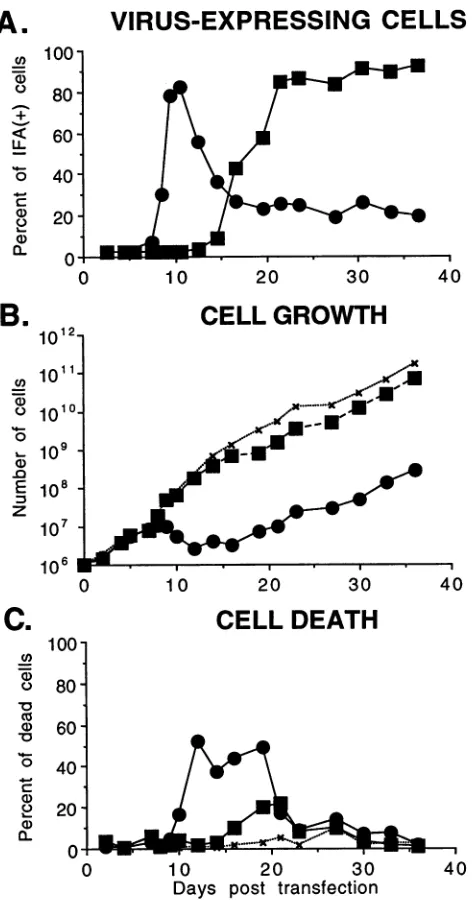
virus producers. As afirststep tostudiesonthe role of HIV-1 sequences inchronic virusproduction,molecularclones of the parental viruses were compared for the ability to establish chronic virusproducers. Infections wereinitiatedby transfect-ing 1 ,ug of plasmid DNA per one million H9 cells with DEAE-dextran (Pharmacia, Uppsala, Sweden). Infections weremonitored forvirus-expressing cells (Fig. IA), cellgrowth
(Fig. IB),and cell death (Fig. IC) (30).
The pNL4-3- and pHXB-2-transfected cultures exhibited
distinctive profiles for the establishment of chronic virus
producers (Fig. 1). NL4-3 established low levels of chronic virusproducers(15to20%), whereas HXB-2established high
levels (>80%) (Fig. IA). In keeping with this trend,
HXB-2-transfected cultures hadnormal growth characteristics similar to those of uninfected H9 cells(Fig. IB). In contrast, NL4-3-transfected cultures exhibited both poorer cell growth and more cell death (Fig. lB and C).NL4-3 and HXB-2 transfec-tions also differed in thatHXB-2-transfectedcells exhibitedan -10-day lag behindNL4-3transfectionsforthe appearance of
infected cells(Fig. IA).Thislagwas notobserved if viruswas
used to initiate infections. The lagwas consistently observed
with differentpreparations of HXB-2 DNA.
The infection andgrowth patterns of theparental genomes werehighlyreproducible,with similar resultsbeingobtainedin
independent growthtests.Forstudiesonthe temporal expres-sion of mutant viruses, simultaneous growth patterns of the
parental genomes served asstandards.
Tests for the effects of vpr, vpu, and nefon the ability of NL4-3 to establish chronic virus producers. To test for the effects ofauxiliarygene differences between NL4-3 and HXB-2
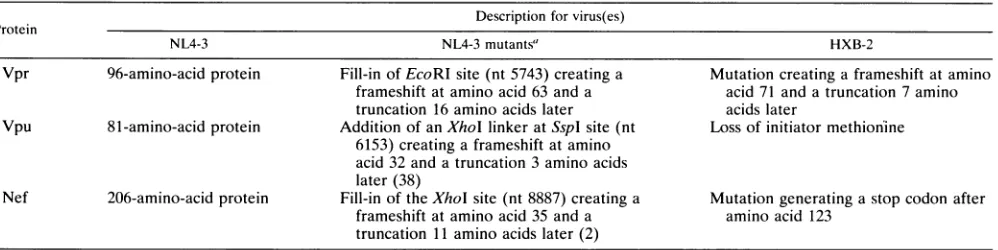
on the establishment of chronic virus producers, mutants of NL4-3 containing all possible combinations of defective vpr
(NLAR), vpu (NLAU), and nef (NLAN) genes were con-structed (Table 1). Tests for the abilities of the mutant 6909
on November 9, 2019 by guest
http://jvi.asm.org/
VIRUS-EXPRESSING
CELLS
low abilitiesto
generatechronic virusproducers (Fig. 2A). Theefficiency with which these mutants
generated
chronic virusproducers
was similar to that of the NL4-3parent.
Threemutants,
NLAR,
NL/N,
andNLAvRAU,
showed intermediate abilitiestoestablish chronic virusproducers
(Fig. 2B).
Cultures infected with these viruses exhibited transienthigh
levels ofvirus-expressing
cells(days
5 to 15 ofculture).
Twoviruses,
the double mutant,
NLARAN,
and thetriple
mutant,NLARLvUAN,
hadhigh
abilities togenerate
chronic virusproducers
(Fig.
2C).
There was no difference in the relativeabilities of these two mutants to
generate
chronic virus pro-ducers. This suggests that defects in both vpr andnef
are sufficient for NL4-3 to establishhigh
levels of chronic virus 0 10 20 30 40 thisproducers and that mutations in vpu do not further enhanceability.
CELL
GROWTH
Ingeneral,
theability
to establish chronic virusproducers
2 correlated
inversely
with theamount of cell death in cultures.Thiscanbeseenmost
clearly
in Table 2 in whichmutantsare listed fromdecreasing
toincreasing
ability
toestablish chronic virusproducers.
ThetwoNL4-3mutantsthat had lowabilitieso 0X
,JC
to establish chronic virusproducers
(NLAU
andNLAUAN)
exhibited
high
levels of cell deathduring
the acutephase
of infection.By
contrast, the two mutants that were efficientat
generating
chronic virusproducers,
NLARAN andNLARAUAN,caused
only
lowlevelsof cell death. Inkeeping
with this
trend,
culturesinfected withtwoof the three viruses withintermediate abilitiestogeneratechronic virusproducers,
NLL\R and NLAN, had intermediate levels of cell death.However,
the culture infected with the third virus with an0 1 0 20 30 40 intermediate
ability
to establish chronic virusproducers,
NLARAU,
had lowlevels of dead cells. Thisexception suggests
CELL DEATH
that lowcytopathicity
does not ensurethe efficientoutgrowth
D ofchronic virus
producers.
The efficient establishment of chronic virus
producers
didnot
necessarily
correlate with cultureshaving
anormalgrowth
potential.
Thegrowth
potential
of cultures was determined bothby
the amount of cell deathduring
the acutephase
of infection andby
thedoubling
times of thesurviving
cells.Following
the acutephase
ofinfection,
thedoubling
times forNLARAN- and
NLARAUAN-expressing
cultureswerelonger
than for uninfected orHXB-2-expressing
cultures. These cultures hadonly
intermediategrowth
characteristics and didD
.r
not exhibit the normalgrowth
characteristic of uninfected or0 1 0 20 30 40 HXB-2-expressing H9 cells (Fig. 2C).
Days
post transfection Use ofNL4-3-HXB-2
recombinants to map sequences thataffecttheestablishmentof chronic virus
producers.
Totestfor Temporal analysisofpNL4-3-andpHXB-2-transfectedH9 effects ofnonauxiliary
aswell asauxiliary
gene sequenceson0 and *, respectively) and uninfected H9 cells
(x). (A)
thegenerationofchronic virusproducers,
reciprocal
recombi-Lppearanceofvirus-expressingcells; (B) growthofcultures; nants between NL4-3 and HXB-2 were constructed and tested
ral presence of dead cells. IFA, indirect immunofluores- for the ability to establish chronic virus producers. The con-y. The cell numbers shown for the growth curves were struction and
expression
ofvpr, vpu, andnef by
these recoi-d from thegrowth ratesobtainedfor each timepoint.
binants is illustrated inFig.
3. As with the NL4-3 mutants, resultsofgrowth
testsaresummarizedby
grouping
constructs that encoded low(Fig. 4A),
intermediate(Fig. 4B),
andhigh
toestablish chronicvirusproducerswereinitiatedby
(Fig. 4C)
abilitiestoestablish chronic virusproducers.
)ns. Transfections with parental DNAs were carried Temporal analysis of H9 cells transfected with theNL4-3-rallel to allow direct comparison of the ability of HXB-2recombinants revealed effects of 5' internal
(non-long
id parental genomes to establish chronic virus pro- terminal repeat) sequences as well as effects offragments
ransfected cultures were monitored over time for encoding defective auxiliary genes on the abilityto establish
essing cells, cellgrowth, and cell death. chronic virusproducers (Fig. 3 and4). Inthe presence of the A-3auxiliarygenemutantsvaried in their abilitiesto 5'
SpeI-to-EcoRI
fragmentofNL4-3(bp1507to5743ofNL4-3,hronic virusproducers. Overall,three patternswere proviralDNA),HXB-2fragments encodingdefective vpr, vpu, inefficient establishment of chronic virus producers andnefordefective vprand vpu didnotconfer
high
ability
tointermediate establishment of chronic virusproduc- establish chronic virusproducers
(see
NLHX-4 andNLHX-2,
2B), and efficient establishment of chronic virus Fig. 3 and
4B).
However, when 5' internal sequences were(Fig. 2C).
Twomutants,NLlAUandNLAUUAN,
had fromHXB-2,
3' HXB-2fragments
encoding
defective vpr andA.
0) 100
o 80
< 60
U-0 40
0~4) 20
B.
1012
101
(I)-.0 E
108
z107
106
10(
8C
6C
4C
FIG. 1. cultures (I Temporala
(C) tempor
cence assa'
extrapolates
genomest
transfectic out in pa mutant ar ducers. T:
virus-expri The NL establishc observed:
(Fig. 2A), ers (Fig. producers
Cu
c()
0
~0
-)
o
a)
-0
0~ 2(
I - I
on November 9, 2019 by guest
http://jvi.asm.org/
[image:2.612.62.298.78.528.2]TABLE 1. Comparison ofvpr, vpu,andnefgenesofNL4-3, NL4-3 mutants, and HXB-2
Description for virus(es) Protein
NL4-3 NL4-3 mutants' HXB-2
Vpr 96-amino-acid protein Fill-in ofEcoRI site (nt 5743) creating a Mutation creating a frameshift at amino frameshiftatamino acid 63 anda acid71 and a truncation7amino truncation 16amino acids later acids later
Vpu 81-amino-acid protein Addition of anXhoI linker atSspIsite (nt Loss of initiator methionine 6153)creatingaframeshiftatamino
acid 32 andatruncation 3 amino acids later(38)
Nef 206-amino-acid protein Fill-in of theXhoI site (nt 8887) creating a Mutation generating a stop codon after frameshiftataminoacid 35 anda amino acid 123
truncation 11amino acids later(2)
"Mutantswithmultiple gene defects were constructed by interchanging appropriate restriction endonuclease fragments. nt, nucleotide.
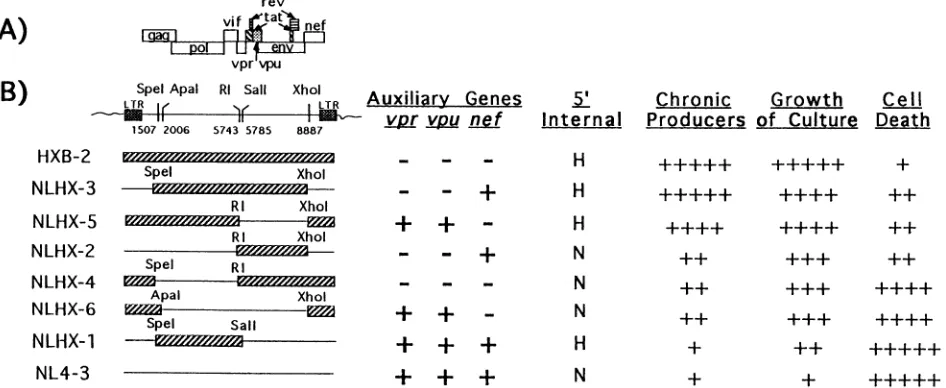
vpu (NLHX-3) or defective nef (NLHX-5) were able to confer high ability to establish chronic virus producers (Fig. 3 and 4C). Thus, in the recombinants, the ability to establish chronic virus producers required5' internal HXB-2 sequences as well as 3' fragments containing defective vpr and vpu or defective nef genes.
Aswith the NL4-3 mutants (Table 2), the overall ability to establish chronic virus producers correlated with low cyto-pathic potential (Fig. 3). For example, recombinants NLHX-3 and NLHX-5, with high abilities to establish chronic virus producers, were the least cytopathic for cultures. The recom-binant NLHX-1, with the lowest ability to establish chronic virus producers, showed high cytopathic potential for cells in culture. Two of the three recombinants with intermediate
abilities to establish chronic virus producers, NLHX-4 and
NLHX-6, had intermediate cytopathic potential for cells in
culture. One exceptionto this overall trend was observed for
NLHX-2. In NLHX-2-transfected cultures, low cell death did not correlatewith the efficient establishment of chronic virus producers (Fig. 3 and 4B).
Incontrast tothe NL4-3 mutants,the NL4-3-HXB-2 recom-binants were able to establish chronic virus producers that exhibited normal cellgrowth (Fig. 4). This is shown bytestsof NLHX-3and NLHX-5, the two recombinants with the highest abilities to establish chronic producers (Fig. 4C). Both
NLHX-3- and NLHX-5-transfected cultures had doubling times similar tothose of the uninfected orHXB-2-expressing
H9 cultures.
A. VIRUS-EXPRESSING CELLS
a B.
1007 t 80
LL 60 MO 40
0
4-
20-a1) 0-a) L
C.
W
U1)
0
a)
E
z
CELLGROWTH CELL DEATH
H9C NL4-3 HXB-2 NLAU NLAUL.,N
H9C
NL4-3 HXB-2
NLAR NLLN NLk\RZU
H9C NL4-3
HXB-2
NLARAN
NLARAUAN
Days post transfection
FIG. 2. Temporal analysisof H9 cultures transfected with pNL4-3, pHXB-2, and NL4-3 mutants.
(A)
Mutantsthatwere inefficient at theestablishment of chronic virusproducers; (B) mutantswith intermediate abilitiesto establishchronic virus
producers; (C)
mutants thatwere efficientatestablishingchronic virusproducers. IFA,indirectimmunofluorescenceassay;H9C,uninfectedH9cells. Theopensymbolspresentdatafor themutants.Thesolid symbolspresent dataforNL4-3 and HXB-2.
on November 9, 2019 by guest
http://jvi.asm.org/
[image:3.612.65.564.87.212.2]TABLE 2. Summaryof data on theNL4-3 mutants Expressionof Extentof testedphenotypeh auxiliarygene'
Testvirus
nef Chronic Growth of Cell death
vpr VPU nef producers culture
NL4-3 + + + + + +++++
NLAUAN + - - + + ++++
NLAU + - + + ++ ++++
NLAR - + + ++ ++ +++
NLz\N + + - ++ ++ +++
NLARAU - - + ++ ++ ++
NLARAN - + - ++++ ++ ++
NLARAUA\N - - - ++++ +++ ++
HXB-2 - - - +++++ +++++ +
a +and -, presence andabsence ofauxiliarygeneexpression,respectively.
bSymbolsareon ascale of+for least effectto + + + + +for maximum effect.
Virusproductiondoes notdeterminetheabilitytoestablish chronic virusproducers. Totestforeffects of virusproduction
on the ability to establish chronic virus
producers,
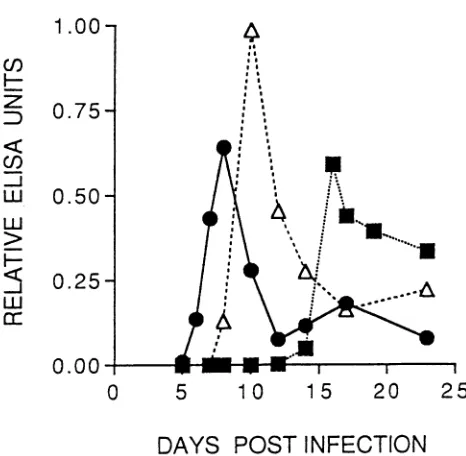
temporalvirus production was compared for the parental viruses and NLHX-3, the recombinant with the best ability to establish chronic virusproducers(Fig.5).Theamountof viralantigenin supernatants ofthe infected cultureswas quantitatedwithan
antigen capture enzyme-linked immunosorbent assay(ELISA)
(11). Virus production by the three tested viruseswas quite similar. Each of the infections producedhigherlevels of virus during the acute phase of infection than during the chronic phase, with the actual levels ofvirus productionnotreflecting
the efficiencyoftheestablishment of chronicproducers.Thus,
virus production did not play a determining role in the
establishment of chronic virusproducers.
Complex context-dependent requirements for HIV-1
se-quences in theestablishment of chronic virus producers. We havedemonstrated thatmultipleregionsof theHIV-1genome determine theabilitytogeneratechronic virus producers. For
A)
B)
SpelApal1507 2006
RI Sall
5743 5785
Xhol Auxiliary
Genes
vprVU nef
NL4-3infections, defective vpr and nef genes were sufficient to change the efficiency of the generation of chronic virus pro-ducers from low to high (Fig. 2 and Table 2). For infections with NL4-3-HXB-2 recombinants, 5' internal HXB-2 se-quences, as well as 3' fragmentscontaining defective auxiliary genes, were required for the efficient establishment of chronic virus producers (Fig. 3 and 4). These 3' fragments could encode either defective vpr and vpu or defective nef genes. Thus, the effects of defective auxiliary gene sequences were contextdependent.
env sequencesand levels of virus production do not deter-mine theability toestablish chronic virus producers.envis a
frequent determinant of the cytopathic potential of HIV-1 isolates (5, 9, 21, 22, 23, 33, 37, 39). The ability of the NL4-3-HXB-2recombinants to generate chronic virus
produc-ers did not correlate with the presence of HXB-2 env se-quences(Fig. 3). TheenvsequencesofNL4-3 and HXB-2 are both derived from the HIV-1 LAIfamily of viruses (1,4, 12,14, 38a). Env proteins of both viruses cause syncytia during the early and lytic phases of infection. However, once the lytic phase of infection had passed, the presence of syncytium-inducing Envglycoproteins did not prevent the efficient estab-lishment of chronic virus producers.
High levels of viral expression have also been suggested to be associated with the cytopathic effects of HIV-1 infections (25,35). Temporal levels of virusproductionwerequitesimilar for the two parental viruses as well as a recombinant with highability to establish chronic virus producers(Fig.5).Thus,
virus load, as measured by virusproduction, didnotappearto
be a determinant of the ability to establish chronic virus producers.
Involvement of multiple regions may reflect the involvement of multiple phenomena. Studies presented here reveal the
complexrelationshipof sequences in the HIV-1 genometothe establishment of chronic virus producers. The fact that a
minimum of two defective auxiliary genes, or two regions of the HXB-2 genome, were required for NL4-3 to efficiently
'5'
Chronic Growth CellInternal
Producers of Culture Death
Spel Xhol
RI Xhol
R I Xhol
Spel RI
Apal Xhol
Spel Sall
H +++++ +++++ +
H +++++ ++++ ++
H N N
N
H
++ ++ ++
++++ ++
+++ ++
+++ ++++ +++ ++++ ++ +++++
NL4-3 + + + N + + ++++
FIG. 3. Summary of dataontheNL4-3-HXB-2 recombinants. (A) Representationof the HIV-1 genome; (B) restriction endonucleasesites used inconstructionoftherecombinants, recombinantgenomes,and growthcharacteristics ofcultures transfected with the recombinants. 1, HXB-2sequences; ,NL4-3 sequences; RI, EcoRI; + and -,presence andabsenceof auxiliarygenes, respectively; H,HXB-2 5' internal
sequences;N,NI4-3 5' internalsequences.The lastthree columnsrepresent theextent towhich various growth profileswereobservedwith +
indicating least effect and +++++indicating maximumeffect.
HXB-2
NLHX-3
NLHX-5
NLHX-2 NLHX-4 NLHX-6
NLHX-1
rev
vif ta nef
U-ml n
R
I 12 uVP
_ _ +
_ _ +
on November 9, 2019 by guest
http://jvi.asm.org/
[image:4.612.71.544.480.674.2]A.
VIRUS-EXPRESSING CELLS100- 80-
60-
40iN-20-A
co
B
0 10
+-t
8LL 6
4
0
o 2
c
a)
0
81)
C 10
8
6
4
2 0
o-0
o0-
-to
0
10-10
10
10
20
20
1010°
109 108
107
106
105
-CO)
0
a)
E z
CELL GROWTH
-._
7.
ffcr
O
100- 80-60 40-
20-10 20 30
1010-072
106
-^5
1V20
0 10 20 30c)
°
100-CZs 80 ;
a)
-0 60
-c 20 <3
8)
(D01- 3
CELL DEATH
H9C
* NL4-3
* HXB-2
----D1:--- NLHX1
1 0 20 30
1001
80] 60
----0
20-~-0
0 10 20 30
H9C NL4-3 HXB-2 NLHX2 NLHX4 NLHX6
H9C NL4-3 HXB-2 NLHX3 NLHX5
Days post transfection
FIG. 4. Temporal analysis of H9 cells transfected with the NL4-3-HXB-2 recombinants. (A) Recombinants that were inefficient at the
establishment of chronic virusproducers;(B) recombinants with intermediate abilities to establish chronic virus producers; (C) recombinants that wereefficientat establishing chronic virus producers. IFA, indirectimmunofluorescence assay; H9C, uninfected H9 cells. The open symbols present data for the recombinants. The solid symbols present data for NL4-3 and HXB-2. The cell numbers shown for the growth curves were extrapolated
fromthe growth rates obtained for each time point.
establish chronic virus producers suggests that at least two
virus-host interactions may be important for chronic virus
production. Wesuggest thatthese may include (i) cytopathic
interactions with vital cell functions and (ii) noncytopathic
1.00
interactions with signalling pathways that control cell growth.As forcytopathic interactions, prior studies would be
consis-C/) ,', tentwith the activities ofvpr
(7,
8,
18,
24)
andsequencesin theIt
,'5'
internalregion (13,
19, 31, 32,
36)
potentially being
cyto-Z 0 5 pathic for vital cell functions. As for effects on
signalling
D*,'
pathways, reported
activities of Nefon theexpression
of cellsurface molecules such as CD4
(3,
15-17,
20,
32a),
lympho-C<)
p kines such as interleukin 2 (26), and transcriptional factors such asNF-KB andAP-1 (27, 28) couldpotentially affect theLU 0.50 growth of virus-expressing cells. A potential ability of Nef to
LLIv'\ 4 . ".^ limitgrowth would be consistent with the two viruses having
low
cytopathic potentials but only intermediate abilities toH : L * 3 establish chronic producers (NLARAU and NLHX-2) both
2;
0.251
\ 7e>,>expressing
functionalNef-encoding
genes.lr4;,+ WeareindebtedtoC. Mulder and G.Vigliantiforcritical reviewof
/: themanuscript. Weareindebtedtothe NIAID AIDSRepositoryfor
0.00-
pNL4-3and theC8166,H9, A3.01,and Jurkatcells;toR. C. Gallo for0 5 1 0 1 5 20 25 J.pHXB-2; to K. Strebel forSullivanforpatientsera.
NLAU;
to S. Venkatesan forNLAN;
and toThis work was supported by Public Health Research Grant Al
[image:5.612.84.550.77.343.2]DAYS
POST INFECTION
24474.
FIG. 5. Temporal analysis of virus production in H9 cultures
transfected with the recombinant NLHX-3 (A) and the parental
virusesNLA-3(0)and HXB-2(-).ELISA unitswerenormalized with astandard NL4-3 stock.
REFERENCES
1. Adachi, A.,H. E.Gendelman, S. Koenig,T.Folks, R.Willey,A. Rabson, andM. A.Martin. 1986.Production ofacquired
immu-
on November 9, 2019 by guest
http://jvi.asm.org/
[image:5.612.64.297.457.685.2]nodeficiency syndrome-associated retrovirus in human and non-human cells transfected with an infectious molecular clone. J. Virol. 59:284-291.
2. Ahmad, N.,and S. Venkatesan. 1988.nef protein of HIV-1 is a
transcriptionalrepressorofHIV-1LTR. Science 241:1481-1485. 3. Anderson, S., D. C. Shugars, R. Swanstrom, and J. V. Garcia.
1993.Nef fromprimaryisolates of humanimmunodeficiencyvirus
type1 suppressessurface CD4expressionin human andmouseT cells.J.Virol. 67:4923-4931.
4. Barre-Sinoussi, F., J.-C. Chermann, F. Rey, M. T. Nugeyre, S.
Chamaret,J.Gruest,C.Daugeut,C.Axier-Blin,F.Vezinet-Brum, C.Rouzioux,W.Rozenbaum,and L.Montagnier. 1983. Isolation ofaT-lymphotropicretrovirus from apatientatrisk foracquired immune deficiency syndrome (AIDS).Science 220:868-871. 5. Cheng-Mayer,C.,M.Quiroga,J.W.Tung,D.Dina,andJ.A.Levy.
1990. Viraldeterminants of humanimmunodeficiencyvirustype 1 T-cellor macrophage tropism, cytopathogenicity, and CD4
anti-gen modulation. J. Virol. 64:4390-4398.
6. Cheng-Mayer, C.,D.Seto,andJ.A.Levy.1991.Alteredhost range of HIV-1after passagethroughvarious human celltypes.Virology
181:288-294.
7. Cohen,E.A.,G.Dehni,J.G.Sodroski,and W. A.Haseltine.1990. Human immunodeficiencyvirus vprproductisavirion-associated
regulatoryprotein. J.Virol. 64:3097-3099.
8. Cohen, E. A., E. F. Terwilliger, Y. Jalinoos, J. Proulx, J. G.
Sodroski,and W.A. Haseltine. 1990. Identification of HIV-1 vpr
productandfunction. J.AcquiredImmuneDefic.Syndr.3:11-18. 9. De Jong, J.-J.,A. De Ronde, W. Keulen, M. Tersmette,and J. Goudsmit. 1992. Minimal requirementsfor the human
immuno-deficiency
virus type I V3 domain to support thesyncytium-inducing phenotype: analysis by singleamino acid substitution. J. Virol. 66:6777-6780.
10. Evans, L.A.,T. M. McHugh,D. P. Stites,and J.A. Levy. 1987. Differential ability of human immunodeficiency virus isolates to
productively infect human cells. J. Immunol. 138:3415-3418. 11. Fernandez-Larsson, R., K. K. Srivastava, S. Lu, and H. L.
Robinson. 1992. Replicationofpatientisolates of human
immu-nodeficiency
virus type 1 in T cells: a spectrum of rates andefficiencies ofentry. Proc.Natl.Acad. Sci. USA 89:2223-2226. 12. Fisher,A. G., E.Collati, L. Ratner, R. C. Gallo, and F.
Wong-Staal. 1985. A molecular clone of HTLV-III with biological
activity. Nature (London)316:262-265.
13. Gabuzda, D. H., K. Lawrence, E. Langhoff, E. Terwilliger, T.
Dorfman,W. A.Haseltine, and J. Sodroski. 1992. Role ofvifin
replication
of human immunodeficiencyvirus type 1 in CD4+Tlymphocytes.
J. Virol.66:6489-6495.14. Gallo, R. C., S.Z. Salahuddin, M. Popovic, G. M. Shearer, M.
Kaplan,B. F.Haynes,T.J.Palker,R.Redfield,J.Oleske,B.Safai,
G.White,P.Foster,and P.D. Markham.1984.Frequentdetection andisolation ofcytopathicretroviruses(HTLV-III)frompatients with AIDS andat risk for AIDS. Science 224:550-553.
15. Garcia,J.V.,J.Alfano,andA.D.Miller. 1993. Thenegativeeffect of humanimmunodeficiencyvirus type 1 Nefoncellsurface CD4
expression is not species specific and requires the cytoplasmic
domain of CD4. J. Virol. 67:1511-1516.
16. Garcia, J. V., and A. D. Miller. 1991. Serine
phosphorylation-independent downregulation of cell-surface CD4 by nef.Nature
(London)
350:508-511.17. Guy, B.,M. P.Kieny,Y.Riviere,C.LePeuch,K.Dott,M.Girard, L.Montagnier, andJ.-P. Lecocq. 1987. HIVF/3' orfencodes a
phosphorylated GTP-binding protein resembling an oncogene
product. Nature(London)330:266-269.
18. Hattori, N.,F.Michaels,K.Fargnoli,L.Marcon,R.C. Gallo, and G.Franchini. 1990. Thehumanimmunodeficiencyvirus type 2 vpr geneisessential forproductive infection of humanmacrophages.
Proc. Natl.Acad. Sci. USA 87:8080-8084.
19. Hirsch, I., D.Salaun, B. Brichacek, and J.-C. Chermann. 1992. HIV-1cytopathogenicity:geneticdifferences between direct
cyto-toxic andfusogenic effect. Virology186:647-654.
20. Hovanessian, A. G. 1992. Third forum invirology:onthe Nef gene product. Res. Virol. 143:31-81.
21. Hoxie, J. A.,L. F.Brass, C. H. Pletcher, B. S. Haggarty, and B. H. Hahn. 1991.Cytopathic variants of an attenuated isolate of human immunodeficiency virus type 2 exhibit increasedaffinity for CD4. J. Virol. 65:5096-5101.
22. Koga,Y.,M.Sasaki, K.Nakamura,G.Kimura,and K.Nomoto. 1990. Intracellular distribution of the envelope glycoprotein of human immunodeficiency virus and its role in the production of cytopathic effect in CD4+ and CD4- human cell lines. J. Virol. 64:4661-4671.
23. Kowalski, M., L. Bergeron, T.Dorfman, W. A.Haseltine, andJ. Sodroski. 1991. Attenuation of human immunodeficiency virus typeIcytopathic effectbyamutationaffecting the transmembrane envelope glycoprotein. J. Virol. 65:281-291.
24. Lang, S. M., M. Weeger, C. Stahl-Hennig, C. Coulibaly, G. Hunsmann, J. Muller, H. Muller-Hermelink, D. Fuchs, H. Wachter, M. M. Daniel, R. C. Desrosiers, and B. Fleckenstein. 1993. Importance of vpr for infection of rhesus monkeys with simianimmunodeficiency virus. J. Virol. 67:902-912.
25. Leonard, R., D.Zagury, I. Desportes, J. Bernard,J.-F. Zagury,
and R. C. Gallo. 1988. Cytopathic effect of human immunodefi-ciency virus in T4 cells is linked to the last stage of virus infection. Proc. Natl. Acad. Sci. USA 85:3570-3574.
26. Luria, S.,I.Chambers,and P.Berg. 1991.Expressionof the type I human immunodeficiency virus Nef protein in T cells prevents
antigen receptor-mediated induction of interleukin 2 mRNA. Proc. Natl. Acad. Sci. USA 88:5326-5330.
27. Niederman,T. M.J., J.V.Garcia,W. R.Hastings, S. Luria, and L. Ratner. 1992. Human immunodeficiency virus type I Nef
protein inhibits NF-KB induction in human T cells. J. Virol. 66:6213-6219.
28. Niederman,T. M.J.,W. R.Hastings,S.Luria, J.C.Bandres, and L. Ratner. 1993. HIV-1 Nefprotein inhibits the recruitment of AP-1 DNA-binding activity in human T-cells. Virology 194:338-344.
29. Popovic, M.,M.G.Sarngadharan,E.Read,and R. C. Gallo.1984.
Detection, isolation, and continuous production of cytopathic retroviruses(HTLV-III)frompatientswith AIDS and pre-AIDS. Science 224:497-500.
30. Robinson,H.L.,and D. M.Zinkus. 1990. Accumulation of human
immunodeficiencyvirus type I DNA inTcells: result of multiple infectionevents.J. Virol. 64:4836-4841.
31. Sakai, K.,S.Dewhurst,X.Ma,andD.J.Volsky.1988.Differences in cytopathogenicityandhost cell range among infectious molec-ular clones of human immunodeficiency virus type 1
simulta-neouslyisolated fromanindividual. J. Virol. 62:4078-4085. 32. Sakai, K.,X.Ma,I.Gordienko,and D.J.Volsky. 1991.
Recombi-natorialanalysisofa natural noncytopathic human
immunodefi-ciencyvirus type 1 (HIV-1) isolate: role of the vif gene in HIV-1 infection kinetics andcytopathicity.J.Virol. 65:5765-5773.
32a.Skowronski, J.,D. Parks,and R.Mariani. 1993. Altered T cell activation and development in transgenic mice expressing the HIV-1nefgene. EMBO J. 12:703-713.
33. Sodroski, J., W. C. Goh, C. Rosen, K. Campbell, and W. A. Haseltine. 1986. Role ofthe HTLV-III/LAV envelope in syncy-tium formation and cytopathicity. Nature (London) 322:470-474.
34. Somasundaran, M.,and H. L.Robinson. 1987. A major mecha-nism ofhuman immunodeficiencyvirus-induced cell killing does not involve cellfusion. J.Virol.61:3114-3119.
35. Somasundaran,M.,and H. L.Robinson. 1988. Unexpectedlyhigh levels of HIV-1-RNA and protein synthesis in a cytocidal infec-tion. Science 242:1554-1557. (Author's correction, 247:1531,
1990.)
36. Spire,B.,I.Hirsch,C.Neuveut, J. Sire, and J.-C. Chermann. 1990. The env gene variability is not directly related to the high cytopathogenicityofan HIV-1variant. Virology 177:756-758. 37. Stevenson, M.,S.Haggarty, C. Lamonica, A. M. Mann, C.Meier,
and A. Wasiak. 1990. Cloning and characterization of human immunodeficiencyvirus typeI variantsdiminished in the ability to inducesyncytium-inducingcytolysis. J. Virol. 64:3792-3803.
on November 9, 2019 by guest
http://jvi.asm.org/
38. Strebel,K., T.Klimkait, and M. A.Martin. 1988. A novelgeneof HIV-1 vpuand its 16-kilodalton product. Science 241:1221-1223.
38a.Wain-Hobsson, S., J.-P. Vartanian, M. Henry, N. Chenciner, R. Cheynier,S.Delassus, L. P. Martins, M. Sala,M.-T.Nugeyre,D. Guetard, D. Klatzmann, J.-C. Gluckman, W. Rozenbaum, F. Barre-Sinoussi, and L. Montagnier. 1991. LAVrevisited: origins
of theearlyHIV-1isolates from Institut Pasteur. Science 252:961-965.
39. York-Higgins, D., C. Cheng-Mayer, D. Bauer, J.A.Levy, and D. Dina. 1990. Human immunodeficiency virus type 1 cellular host
range, replication, and cytopathicity are linked to the envelope region of the viral genome.J. Virol.64:4016-4020.