Abstract: Learning and playing games has a similar process. The learning process allows learners to perfect their choices. Similar to games, game players must face several choices so they have maximum results. Thus, the game can be used in learning because it sees results from its similar nature. A type of learning learning game in which can support learning called Serious Game. To give value to the learning process, Serious Games is used to combine principles from learning theories available to its elements. Therefore, the game must have the ability to adapt to each element level. Ability to adapt not only from within the game, but also from outside. Therefore, the teacher can control the adaptation of the game based on the learner's ability. This is what causes the ability of students to reach the learning phase will diverse, based on different experiences, heredity, background, interests, and talents of learners. This paper aims to present the literature review for challenges and and opportunities in serious game for learning authoring tool. Literature review was conducted with papers obtained from international journal databases, using related keywords. The review shows that authoring tool specialized to build serious game for learning is not yet present. The opportunity to make serious game for learning more efficient is open through research focusing on that matters.
Keywords: Serious game, learning, authoring tool, adaptive
I. INTRODUCTION
Learning is the process by which relatively permanent changes occur in behavioural potential as a result of experience [1]. Learning is the process whereby knowledge is created through the transformation of experience. Knowledge results from the combination of grasping experience and transforming it [2]. Someone’s knowledge acquisition through experience is done with recurring action of picking options, until they get the best possible result. These choices are part of the interaction carried out by someone with their environment when the learning process takes place. The consequences of the choices chosen will then be processed by people as new knowledge. The acquisition process will diverse, caused by differences, experiences, perspectives, backgrounds, talents, interests, capacities, and needs of each person.
Revised Manuscript Received on May 22, 2019.
Wanda Gusdya Purnama, School of Electrical Engineering and Informatics, Institut Teknologi Bandung, Indonesia
Nur Ulfa Maulidevi, School of Electrical Engineering and Informatics, Institut Teknologi Bandung, Indonesia
Iping Supriana Suwardi, School of Electrical Engineering and Informatics, Institut Teknologi Bandung, Indonesia
Some theories propose to help someone (with various numbers) to make the best choice in learning, even some theories overlap with each other. The basics of learning theory come from the fields of biological, social, and psychological sciences.
There are four learning theories that are most recognized: behaviorism, cognitivism, constructivism, and humanism. Theories are essentially to improve the learning process of various types.
Those theories reinforce the statement that the learning process will take place more effectively if done repeatedly. However, a problem related to human psychology emerges, humans will use a repetitive process because the human brain will always look for new stimuli. The learning process will provide new stimuli to get new people new knowledge. If nothing can be accessed by humans, then humans will lose their motivation. Games can provide stimuli addition other than stimuli obtained by humans to gain new knowledge. The game is also a medium that is used as a learning aid because of its nature which is related to the nature of learning. Both game and learning provide features that have consequences for the player. Games are also useful to provide context for learning. Related to the lesson as one of the stimuli for the human brain. What can be used in a game can bring curiosity so students get more interested in learning.
Research conducted by [3] has created a game architecture that aims to help students improve their learning skills. The architectural game called Serious Game for Learning (SGfL) can support experience-based learning with adaptability to adjust the difficulty level of the game with students' abilities. The adaptation module in SGfL is divided into two, the macro strategy and micro strategy, each of which manages the status of the game as an aspect of state learning and learning that represents the learning progress for appropriate learning. However, the process of playing for a lesson is not easy and takes a long time. To make a number of different games for some learning purposes is a difficult thing for teachers to do. Therefore, it is necessary to have an authoring game that can minimize the effort to restore the game based on the needs of teachers and students to improve the quality of learning activities. This paper discusses the challenges and opportunities in the serious game for learning authoring tool research.
Challenges and Opportunities in Serious
Game for Learning Authoring Tool
II. MATERIAL AND METHODS
This paper maps research trends on serious game authoring tool with two steps. First, a relatively comprehensive search is done with some relevant keywords. To find papers related to serious game authoring, we use keywords like:
Authoring Tool for Serious Game,
Authoring Tool,
Serious Game,
Game
Searches with these keywords are carried out at sources such as ACM, IEEE, Science Direct, Springer, Elsevier, and some others international journal database. Second step, this paper reviews the problem related to evolution of serious game authoring tools. Papers that found using these keywords selected considering the paper’s subject interests. If the subject interests are relating to this paper purposes, the paper will be reviewed. The papers obtained based on search keywords is reviewed to find and understand the purpose of the research conducted and enriching our insight about Authoring Tool for Serious Games. In this literature review, we also reviewed the papers’ reference papers to have a more comprehensive understanding of the field. Some crucial points we reviewed from those papers are
Problems,
Contributions,
Method and/or solutions,
Results, and
Constraints
III. RELATED RESEARCH
Learner-Centered Approach
Learner-centered is a perspective that combines focus on individual students (descendants, experiences, perspectives, backgrounds, talents, interests, capacities, and needs) with a focus on learning (knowledge of the best learning and how it is done and about the most effective teaching practices in encouraging motivation, learning, and all achievements of all students to the highest level). These two focuses then inform and direct decision making in education. The learner-centered perspective reflects the twelve principles of psychology learner-centered in programs, practices, policies, and people that support learning for all [4].
The theoretical foundation of the learner-based approach combines constructivism, cognitivism, and humanism [5]. The theory of learning constructivism emerged in the mid-twentieth century. Constructivism as a learning theory is a derivative of cognitive science in the field of psychology. The cognitive scientists study how people learn, remember, and interact, with a major emphasis on mental processes and modern technology. The definition of cognitive psychology is the study of mental processes such as learning, observing, remembering, using language, reasoning, and problem solving [6]. Constructivism views learning as a result of mental construction. Constructivism states that learning takes place when new information is built and added to one's structure of
knowledge, understanding, and skills. Humans learn well when they actively build their own understanding [6].
The theory of cognitivism provides the foundation for information processing for each student based on the experience and knowledge that the student has. Information processing theory explains how information received and structured in students 'minds is the subject of students' mental processes. Students selectively pay attention to the information that comes in and turn it into a kind of code in their short-term memory in their own way, to be recalled according to the code associated [7], [8]. Therefore, the technique and ability to sort, process and recall information can vary for each student [5]. In information processing, schema theory explains how knowledge is managed as structured units based on relationships between units [9]. Humanism theory states that humans have a hidden desire to learn, but a person cannot be taught directly, a teacher can only facilitate one's learning [10]. Based on this theory, learning must be started by oneself and managed by oneself as well, motivated by one's desire to learn the things needed to develop [11]. [5] explains that there are several principles of education that should exist in student-centered education. The principle is divided into universal principles and situational principles. There are five universal principles of learner-centered approach according to [5], they are:
1. Achievement-based instruction: Achievement of students must be learning-based, not time. If the instructions given are based on achievement, student testing should be based on criteria, not norms. The report on student learning outcomes must also be a list or map of the student's achievement, not a list of subjects with their grades.
2. Task-centered instructions: Instructions must be regulated by considering the performance of tasks. These tasks can be in the form of projects, problems, questions, and other forms of learning by doing. However, the teacher should as much as possible provide a framework for the task environment, to accelerate learning and make students more motivated. 3. Instructions that are tailored to the students’ personalities: Instructions at the time of completion of the assignment must be adjusted to the personalities of each student.
4. Change of role: The role of the teacher, students, and technology must be changed. The teacher must be a co-designer of the work of students, a facilitator of students’ work (providing a framework), and a mentor who cares for his students. Students must change to be more active and independent. Technology must change from tools for teachers to tools for students.
5. Curriculum changes: The curriculum must be developed and reorganized.
The situational principles are needed to provide a variety of methods that are explained by universal principles. For example, on the principle of "task-centered instruction" it is explained that the assignment must be realistic. However, it is still possible to develop the tasks with imaginary creation. It still can help the learning process well.
Game
Games generally symbolize an interactive situation that usually involves many players. A game with only one player is called a decision problem. The formal definition of the game consists of the players, player preferences, player information, strategic actions available to the player, and how they impact on the final results [12]. The concept of the game is an abstract concept of the game, which was adopted as games intended to entertain, including digital games.
According to [13] games, both digital and conventional games, are much preferred for several reasons. For example, game players like challenges, want to socialize or even do not want to socialize, want things that can be boasted, want an emotional experience, want to explore new things, want to fantasize, and interact. These things can be an incentive for players to continue playing the game.
Serious Game
One of the things that has an important role in the learner-centered approach is the use of technology as a learning tool for students. Technology allows personal learning experiences that were never imagined before, with opportunities to monitor students’ progress and involvement. Technology can also increase students’ involvement. Technology products that can be used as educational tools include e-Learning and serious games. E-learning is a tool used to access the curriculum through electronic technology, while serious games are teaching aids that are part of the curriculum, so that they can be integrated with e-Learning.
The term serious game consists of two contradictory words, because many people believe it is impossible for a game to be a serious thing. To explain that, [14] states that serious gaming is a game that explicitly has a well thought out educational goal where entertainment is not its main goal. However, that does not mean serious games cannot be entertaining [14]. Whereas [15] states that serious games are games where the main goal is education (in various forms), not entertainment. In addition to learning, serious games can be used for training, such as for medical personnel, firefighters, or the military. It can be concluded, serious games are games that are designed to be used as tools for education, learning, training, campaigns, or the like.
The development of serious games today cannot compensate for the development of commercial games intended for entertainment. [16] states the difficulties of serious game to compensate entertainment games, including:
1. High technical demand is faced with the ability to finance limited educational institutions.
2. Difficulty in adjusting the serious game with the educational process that you want to run. Most games are
designed for specific purposes so they cannot be adjusted at all, or require special adjustment capabilities that are difficult to find in teachers / instructors, who are usually not game developers / designers.
3. Difficulty in providing support for serious games, because most teachers do not know serious games, so the amount of feedback that students can get from teachers through serious games is relatively small.
4. There are no standards for serious game design. Although approaches to standardize the design of serious games have been carried out, these efforts cannot be widely accepted or have never even been brought into the practical realm. [16] Serious Game Classification
There are several studies in model classification of serious game, but the classification that claimed to cover serious and gaming aspects is the G / P / S model [17]. This classification model is claimed to be more precise than its predecessor, the Market and Purpose Model by adding gameplay aspects. The following are aspects of the G / P / S classification model: 1. Gameplay used, refers to how the game is played. There are two types of gameplay identified by Djaouti, game-based and play-based. Game-based and play-based are distinguished from the presence or absence of the final goal in the game. Games with game-based gameplay have a final goal, while play-based has no final goal. The examples of game-based gameplay are applied to Pac-Man and Super Mario Bros, while examples of play-based gameplay are applied to The Sims and Sim City.
2. Purposes or goals which are certainly not for entertaining. The purpose of serious games is divided into three main objectives, the delivering messages, training, and data exchanging. Message delivery includes educative, informative, persuasive, and subjective messages. Games with training objectives are designed to improve one's cognitive performance or motor skills. Games with the purpose of data exchange are designed to be able to gather information from their players and encourage their players to exchange data. 3. Scope is the target of implementing serious games. Scope is divided into two sub-criteria, market and target audience. Market represents a domain that is targeted by serious games, while the public refers to the target audience. [17]
Serious Games for Learning
Serious Games for Learning ideally combine entertainment and learning in such a way that students do not feel that learning is something that is outside the game [6]. Learning modes designed in serious games can be very different from other learning innovation concepts such as edutainment and e-Learning.
Game-Based Learning is part of edutainment, including the use of all types of games for learning and education purposes. It can be board games, card games, sports, or digital games. Digital game-based learning (DGBL) is part of a serious game, which blends education / learning as the main goal or sole purpose. E-Learning does not combine education with entertainment, only combining digital media with learning. While serious games can be categorized as e-learning methods, not all e-Learning must be entertaining (for example, the recording of lectures or computer-based online examinations).
In serious games for learning, adaptivity is needed to adjust the game seriously with the progress of mastery of skills and achievement of student learning targets [3]. Research [3] has produced a flexible computational model for adaptive game components represented in teaching materials. The study adopted the micro strategy and macro strategy terminology of instructional design theory as an adaptive game model. In general, adaptivity in serious games can be done online or offline. The offline mechanism is done by survey approach to the user before the game starts (called content generation), while the online mechanism is carried out as long as the user plays the game (called content adaptation).
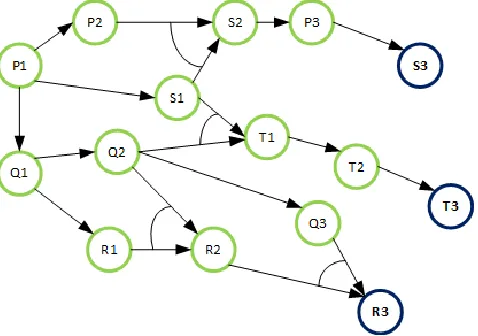
[image:4.612.327.566.437.604.2]A serious game design [3] applies adaptivity to macro-strategy levels. Adaptivity applied is based on the third universal principle of learner-centered approach, which is instruction tailored to the student's personalities. Students must complete a learning state to advance to other learning states, until the students reach the goal state as the achievement for the student. The ability of students to learn from one learning state to another varies, as explained in the universal principle of learner-centered approach. A serious game can apply adaptivity to adjust the threshold value for each learning state that is difficult for students, so that students can carry on to other learning states.
Fig. 1 Relationship between Learning States on Serious Games [3]
[18] has developed a serious game model that is adaptive for cognitive levels in terms of learning, play, and narration to be able to increase motivation, learning efficiency, and enjoyment of players (students). Furthermore, according to
[18], the author of a serious game (usually a teacher), must be equipped with the ability to make several alternative game contents.
Serious Game Components
A developed serious game, such as [3], uses a conventional digital game approach to assemble its components. [3] combines the concept of game components proposed by [13] and [19]. According to [13], there are three types of game concept sequences that can be selected, they are:
1. Gameplay → technology → story, 2. Technology → story → gameplay, 3. Story → gameplay → technology
[19] proposed a framework for developing gameplay and game mechanics. They are as follows:
1. Quest / Challenge / Puzzle is a core interaction between players and games.
2. Gameplay, Game Mechanic, and NPC cannot be defined separately, → (Gameplay X Game Mechanic X PC / NPC). 3. Quest is a weak entity to story or (Gameplay X Game Mechanic X PC / NPC).
4. Story can be followed by gameplay, or gameplay followed by story.
5. Gameworld must be relevant to the plot. Plots are spread across all game components, collaborating to build stories. So, changes to gameworld will have an impact on most components.
[image:4.612.51.290.486.654.2]6. On the player story or emergent story, the story is formed by (Gameplay X Game Mechanic X PC / NPC) → (Gameplay X Game Mechanic X PC / NPC) X Story
Fig. 2 Relationship between Game Components
1. Teaching materials for the cognitive domain in taxonomy can be integrated in all game components.
2. Teaching materials for psychomotor domains can be integrated into game mechanic components.
3. Teaching materials for the affective domain can be integrated into the story component.
To get adaptive serious games in each domain of taxonomy bloom, an adaptive module is needed on all game components. Authoring Tool
The authoring tool is a tool in the form of computer software that allows users who do not have the technical skills to do work that they normally cannot do (due to limited expertise, especially in programming languages) [20]. The authoring tool concept has long existed, referring to the tools used to create collaborative works, such as interactive stories, multimedia presentations, and educational games. Authoring tools are popular because they can speed up content development by shortening and automating common jobs. In addition, the authoring staff can also reduce effort in collaborating for the involved author groups, such as writers and graphic designers.
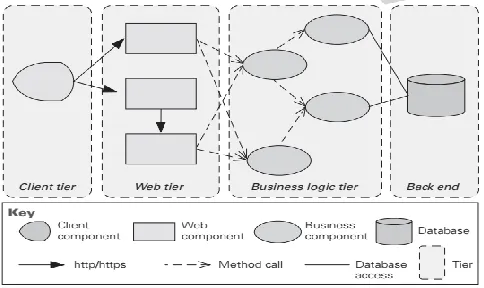
[image:5.612.51.293.519.663.2]The process of building an authoring tool, such as the development of other software, is based on the principles of software engineering. Software engineering is a layered technology, which is based on a focus on quality. To produce quality software products, quality processes, methods and tools are needed [21]. The architecture of the authoring tool is the embodiment of the concept of software architecture. According to [22], software architecture is a division that is done with full consideration of a unit into parts, with a specific relationship between the parts. Software architecture is what makes a set of components from software work together to achieve clear goals. The criteria for division of components is similar to the concept of parts or divisions within an organization, which allows a part of the organization to work together with other parts to solve a larger problem, which cannot be solved individually.
Fig. 3 Example of Software Architecture
IV. RESULTS
Research on serious game authoring tools was initiated in the early 2000s. [23] produced a mobile-based Intelligent Tutoring System (ITS) authoring tool to replace ITS based SMS (Short Messaging System). The authoring staff of [23] accommodates questions that can be answered by students, and the teacher can monitor students’ achievement in answering these questions. A year later, [24] created an authoring tool for Intelligent Tutoring System-based applications based on Reusable Educational Design Environment and Engineering Methodology (REDEEM) to support Computer Based Training (CBT). Kakas authoring’s [24] is designed to run on Windows 95+, consisting of two main software, namely ITS and authoring tools. REDEEM supports several teaching strategies, including in determining choices (by teachers, by students, or both), teaching more or more tests, and giving questions determined by the teacher or students. In addition, REDEEM also provides a choice of difficulty level questions (easy, medium, and difficult) and question presentation styles (multiple choices, filling in the blanks, matching, true / false, and multiple true / false).
Research of [25] produced an architecture for generic authoring staff who can manage subjects in ITS. The generic term is used, because the authoring staff can manage simple to more complex subjects. [26] produced authoring tools for web-based ITS. The authorization feature has a prediction feature of student learning styles, using a neural network. Next, [27] produced an authoring tool called CHOCOLATO, which was intended to assist novice teachers in creating collaborative learning scenarios. Research of [28] is different from previous studies, resulting in authoring tools for Augmented Reality systems. The authorization tool allows the creation of an interactive Augmented Reality system that is easy without the need for programming knowledge.
The series of story threads can be seen in the following Figure.
Fig. 4 Story Thread
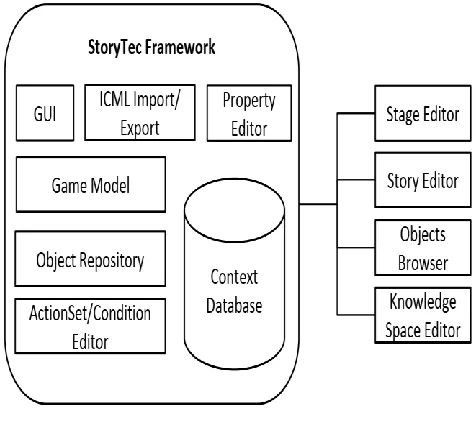
Tool design of [18] is called StoryTec, which continues to be developed in research [30], to use architecture as in the following Figure
Fig. 5 StoryTec Architecture
Areas of Innovation in Research Authoring Tools
The development of authoring capacity has not been able to answer the challenges of serious game development difficulties. [31] states there were six innovations that could be carried out in the field of authoring tools, including:
1. procedural content generation, such as the level of difficulty that continues to rise in Super Mario Bros games,
2. improved visual programming language skills,
3. a new paradigm of authoring tool that is simpler, such as a block-based paradigm in the Minecraft game that allows
players to create 3D worlds without coping to have 3D modeling capabilities,
4. checking model, examining errors found in the game model, especially semantic errors made by the user,
5. multiplayer authoring that allows students to play by collaborating or competing with other students directly, 6. in-game editing that allows users to change and add content directly in the game (can apply the gamification concept to motivate users to add and share educational content with other users). [31]
V. CONCLUSION
Serious games have been one of the tools to help the efficiency of the learning process. In fact, research of [3] has produced a serious game architecture that can be adapted to students' abilities at the cognitive level. These serious games can adapt by lowering the graduation threshold for students who get a failure to exceed the passing threshold value of more than that specified. This adaptation ability is important to adjust the game seriously to students' abilities, which is in line with the principle of learner-centered approach. [18] explains that adaptivity for serious games must include aspects of learning, play, and narration. However, to always adjust the serious game with learning needs is a difficult thing to do and takes a long time.
Software authoring tools that are devoted to the development and management of serious games have not yet appeared. Usually, serious game authors use authoring tools for games in general. This causes the management of learning content to be difficult. Research of [18] has produced authoring tools that can help teachers to develop serious games that are adaptive learning for cognitive levels. This can help teachers in preparing several scenarios for various students with different abilities.
There is a wide range of opportunities for research in the field of authorization for the development and management of adaptive serious games, at the cognitive, affective, and psychomotor levels. Authoring tools are expected to provide further adaptability to serious games produced, by allowing the teacher to intervene directly when serious games are played (on-the-fly).
REFERENCES
1. J. R. Anderson, Learning and Memory: An Integrated Approach. Wiley, 1995.
2. D. A. Kolb, Experiential Learning: Experience as the Source of Learning and Development. Pearson FT Press, 1984.
3. R. D. Agustin, A. Purwarianti, K. Surendro, and I. S. Suwardi, “Computing Game and Learning State in Serious Game for Learning,” TELKOMNIKA (Telecommunication Comput. Electron. Control., vol. 13, no. 4, pp. 1422–1437, 2015.
[image:6.612.55.293.374.586.2]5. R. D. M. Charles M. Reigeluth, Brian J. Beatty, Instructional-Design Theories and Models, Volume IV: The Learner-Centered Paradigm of Education. Routledge, 2017.
6. A.Pritchard, Ways of Learning: Learning Theories for the Classroom. Routledge, 2009.
7. G. A. Miller, “The magical number seven, plus or minus two: some limits on our capacity for processing information,” Psychol. Rev., vol. 63, 1956. 8. K. A. Miller, George A., Galanter, Eugene., Paribram, Plans and the
Structure of Behavior. Martino Publishing, 2013.
9. J. R. Anderson, The Architecture of Cognition. Harvard University Press, 1983.
10.C. R. Rogers, Freedom to learn: a view of what education might become. C. E. Merrill Pub. Co., 1969.
11.S. Rogers, C.R. and Koch, A Theory of Therapy, Personality, and Interpersonal Relationships: As Developed in the Client-centered Framework. McGraw-Hill, 1959.
12.B. Turocy, Theodore L and von Stengel, “Game theory*: Draft prepared for the enciclopedia of information systems,” Dept. Math., London Sch. Econ., London, UK, Tech. Rep. LSE-CDAM-2001-09, 2001.
13.R. Rouse, Game design: Theory and practice, vol. 8. 2005. 14.C. C. Abt, “Serious games,” 1987.
15.D. R. Michael and S. L. Chen, “Serious Games: Games That Educate, Train, and Inform,” Education, vol. October 31. pp. 1–95, 2005. 16.R. Klemke, P. van Rosmalen, S. Ternier, and W. Westera, “Keep It
Simple: Lowering the Barrier for Authoring Serious Games,” Simul. Gaming, vol. 46, no. 1, pp. 40–67, 2015.
17.D. Djaouti, J. Alvarez, and J.-P. Jessel, “Classifying serious games: The G/P/S model,” Handb. Res. Improv. Learn. Motiv. through Educ. games Multidiscip. approaches, no. 2005, pp. 118–136, 2011.
18.S. Göbel, F. Mehm, S. Radke, and R. Steinmetz, “80Days: Adaptive digital storytelling for digital educational games,” CEUR Workshop Proc., vol. 498, no. 498, 2009.
19.C. Fabricatore, “Gameplay and game mechanics design: a key to quality in video games,” Proc. OECD-CERI Expert Meet. Videogames Educ., pp. 1–18, 2007.
20.F. Mehm, “Authoring Serious Games,” Proc. Fifth Int. Conf. Found. Digit. Games, no. June, pp. 271–273, 2010.
21.R. Pressman, Software Engineering: A Practitioner’s Approach. New York: McGraw-Hill, Inc., 2010.
22.P. Garlan, David and Bachmann, Felix and Ivers, James and Stafford, Judith and Bass, Len and Clements, Paul and Merson, Documenting Software Architectures: Views and Beyond, 2nd ed. Addison-Wesley Professional, 2010.
23.M. Virvou and E. Alepis, “Mobile educational features in authoring tools for personalised tutoring,” Comput. Educ., vol. 44, no. 1, pp. 53–68, 2005.
24.S. Ainsworth and P. Fleming, “Evaluating authoring tools for teachers as instructional designers,” Comput. Human Behav., vol. 22, no. 1, pp. 131– 148, 2006.
25.H. Escudero and R. Fuentes, “Exchanging courses between different intelligent tutoring systems: A generic course generation authoring tool,” Knowledge-Based Syst., vol. 23, no. 8, pp. 864–874, 2010.
26.R. Z. Cabada, M. L. Barrón Estrada, and C. A. Reyes García, “EDUCA: A web 2.0 authoring tool for developing adaptive and intelligent tutoring systems using a Kohonen network,” Expert Syst. Appl., vol. 38, no. 8, pp. 9522–9529, 2011.
27.S. Isotani, R. Mizoguchi, A. Inaba, and M. Ikeda, “The foundations of a theory-aware authoring tool for CSCL design,” Comput. Educ., vol. 54, no. 4, pp. 809–834, 2010.
28.S. Á. Sánchez, M. Á. Gimeno-gonzález, and T. Martín-garcia, “Augmented reality sandbox : a platform for educative experiences,” pp. 0–3, 2016.
29.M. Gaeta, V. Loia, G. R. Mangione, F. Orciuoli, P. Ritrovato, and S. Salerno, “A methodology and an authoring tool for creating Complex Learning Objects to support interactive storytelling,” Comput. Human Behav., vol. 31, no. 1, pp. 620–637, 2014.
30.“Florian Mehm,” vol. 5, no. 3, p. 4598, 2013.
31.F. Mehm, C. Reuter, S. Göbel, and R. Steinmetz, “Future trends in game authoring tools,” Lect. Notes Comput. Sci. (including Subser. Lect. Notes Artif. Intell. Lect. Notes Bioinformatics), vol. 7522 LNCS, no. September, pp. 536–541, 2012.