networks
.
White Rose Research Online URL for this paper:
http://eprints.whiterose.ac.uk/108661/
Version: Accepted Version
Article:
Bukhari, SHR, Siraj, S orcid.org/0000-0002-7962-9930 and Rehmani, MH (2018) NS-2
based simulation framework for cognitive radio sensor networks. Wireless Networks, 24
(5). pp. 1543-1559. ISSN 1022-0038
https://doi.org/10.1007/s11276-016-1418-5
© 2016, Springer Science+Business Media New York. This is an author produced version
of a paper published in Wireless Networks. The final publication is available at Springer via
https://doi.org/10.1007/s11276-016-1418-5. Uploaded in accordance with the publisher's
self-archiving policy.
[email protected] https://eprints.whiterose.ac.uk/
Reuse
Items deposited in White Rose Research Online are protected by copyright, with all rights reserved unless indicated otherwise. They may be downloaded and/or printed for private study, or other acts as permitted by national copyright laws. The publisher or other rights holders may allow further reproduction and re-use of the full text version. This is indicated by the licence information on the White Rose Research Online record for the item.
Takedown
If you consider content in White Rose Research Online to be in breach of UK law, please notify us by
(will be inserted by the editor)
NS-2 Based Simulation Framework for Cognitive Radio
Sensor Networks
Syed Hashim Raza Bukhari · Sajid Siraj · Mubashir Husain Rehmani
Received: date / Accepted: date
Abstract In this paper, we propose a simulation model
for cognitive radio sensor networks (CRSNs) which is
an attempt to combine the useful properties of wireless
sensor networks and cognitive radio networks. The
ex-isting simulation models for cognitive radios cannot be
extended for this purpose as they do not consider the
strict energy constraint in wireless sensor networks. Our
proposed model considers the limited energy available
for wireless sensor nodes that constrain the spectrum
sensing process - an unavoidable operation in cognitive
radios. Our model has been thoroughly tested by
per-Syed Hashim Raza Bukhari
Department of Electrical Engineering
COMSATS Institute of Information Technology, Wah Cantt-Pakistan.
Department of Electrical Engineering
COMSATS Institute of Information Technology, Attock-Pakistan.
E-mail: [email protected]
Sajid Siraj
Department of Electrical Engineering
COMSATS Institute of Information Technology, Wah Cantt-Pakistan.
Portsmouth Business School, Richmond Building, Portland Street, Portsmouth PO1 3DE, United Kingdom.
E-mail: [email protected]
Mubashir Husain Rehmani
Department of Electrical Engineering
COMSATS Institute of Information Technology, Wah Cantt-Pakistan.
E-mail: [email protected]
forming experiments in different scenarios of CRSNs.
The results generated by the model have been found
ac-curate which can be considered for realization of CRSNs.
Keywords Cognitive radio · dynamic spectrum
access · wireless sensor networks · cognitive radio
sensor networks·simulation model.
1 Introduction
Wireless sensor networks (WSNs) are battery powered
devices that can sense, transmit and relay data
con-tinuously to the other information-seeking nodes. Due
to their battery-powered nature, the sensors are
de-signed for low-power low-range transmissions, and the
network operates in a multi-hop fashion where
infor-mation is relayed through multiple intermediate nodes.
WSNs have been traditionally designed with fixed
chan-nel coding schemes, and therefore work in a fixed range
of frequencies. As a consequence, the available spectrum
quickly gets occupied as the density of sensor nodes
in-creases. However, although occupied, the channel is still
cap-Simulator patch Goal Platform WSN CRSN MC PR activity EM
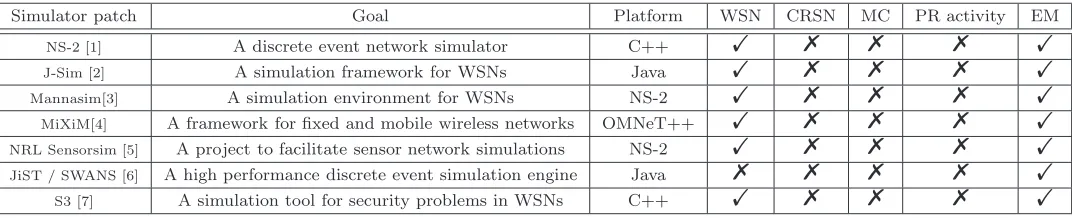
NS-2 [1] A discrete event network simulator C++ ! % % % !
J-Sim [2] A simulation framework for WSNs Java ! % % % !
Mannasim[3] A simulation environment for WSNs NS-2 ! % % % !
MiXiM[4] A framework for fixed and mobile wireless networks OMNeT++ ! % % % !
NRL Sensorsim [5] A project to facilitate sensor network simulations NS-2 ! % % % !
JiST / SWANS [6] A high performance discrete event simulation engine Java % % % % !
[image:3.612.44.580.39.148.2]S3 [7] A simulation tool for security problems in WSNs C++ ! % % % !
Table 1:Simulation models and their goals to simulate the networks in literature
ture periodic (or sporadic) events that generally
trans-mit short bursts of traffic and remain silent rest of the
time [8]. This issue has fueled a new concept of adding
cognitive radio capabilities in WSNs, usually termed
as cognitive radio sensor networks (CRSNs). CRSNs
are the opportunistic sensor networks wherein nodes
have the ability to sense vacant channels (called
spec-trum sensing) and changetheir transmission
parame-ters accordingly (calledspectrum decision). CRSNs are
comprised of two kinds of nodes: primary radio (PR)
nodes and the cognitive radio (CR) sensor nodes [9].
The CR capable node can be configured to use both the
licensed and unlicensed bands. Like traditional WSNs,
the CRSN nodes are also energy-constrained devices
and therefore the issue of minimum power
consump-tion is equally important in both types of networks. In
fact, it becomes even more challenging in CRSNs due
to an additionaltaskof spectrum sensing.CRSNs have
gained so much importance in real world scenarios that
in near future, all the sensor based applications will
re-quire CRSNs. Some real world applications of CRSNs
are battle-field surveillance, food items security, health
monitoring, railway track selection and smart grids etc.
[10].Efficient CRSNs deployment requires dynamic
pro-tocols that can perform accurate channel sensing along
with energy conservation. This channel sensing will also
contain channel selection among all multiple channels
present in the network. PR activity also playsan
im-portant role in the channel selection processtherefore
theimpact of PR activity also needs to be considered.
For this purpose, CRSN simulation models are required
which should be able to utilize the channels which are
free from PR traffic and can disseminate the data in
multi-hop scenario.
Extensive simulations are being required for any
network before deployment to optimize the deployment
procedure as well as to achieve required goals from the
network. Simulations for WSNs can be done in
var-ious simulators such as NS-2 and OMNET++. NS-2
has been generally considered to be the suitable
plat-form for WSN simulations. To the best of our
knowl-edge, there exists no simulator model for CRSNs in
NS-2 which is the primary motivation behind this work.
We provide an environment where CRSN nodes can be
modeled in the presence of several multiple channels
wherein various types of PR activities may occur. CR
nodes can use these channels whenever they are free
Simulator patch Goal Platform CRN CRSN MC PR activity EM
CogNS [11] A simulation framework for CRNs NS-2 ! % ! % %
Cr simulator [12] A discrete simulation model for CRAHNs OMNeT++ ! % ! % %
CRNRM [13] A routing model for CRNs NS-2 % % ! % %
TFRC-CR [14] A transport layer protocol for CRNs NS-2 ! % % % %
CRAHN [15] Modelling of end-to-end protocol for CRAHNs NS-2 ! % % ! %
CRCN [16] A patch for simulating CRN based networks NS-2 % % % % %
[17] The consideration of energy model for WSNs NS-2 % % % % !
[image:4.612.40.574.35.161.2][18] An event triggered node energy model for WSNs OPNET % % % % !
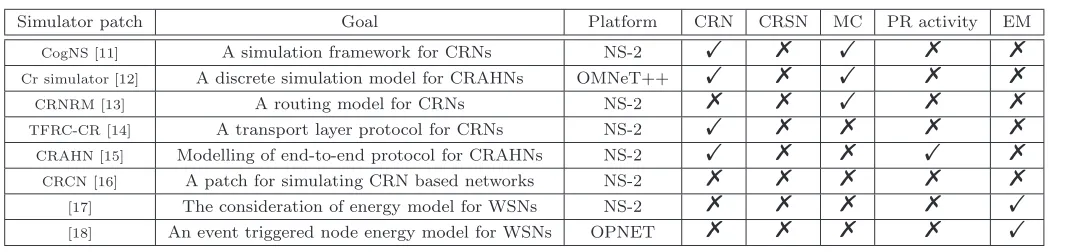
Table 2: Simulation models for CRNsand their objectives
in a multi-hop fashion. As all the nodes in CRSNs are
consideredaswireless nodes, therefore power
consump-tion of nodes has been carefully observed in our
pro-posed model. A user can simulate different topologies
for CRSN environment including the number and
den-sity of nodes, available number of channels, noise, and
other possible network parameters.
The proposed simulation model has been tested in
different scenarios like changing the PR activities,
topolo-gies, density of nodes and number of available channels.
The simulation results generated by the model have
been thoroughly tested and validated for the generated
scenarios. The remaining paper is organized as below:
section 2 discusses the related work on traditional
net-works simulators; CRSN simulator requirements have
been discussed in section 3; section 4 then provides
CRSN simulator model; Simulation details have been
given in section 5 and the topic concludes in section 6.
2 Related Work
Wireless network simulators are usually software tools
or scripts that are developed/written to gain insight
into the behavior of a given wireless network under a
given scenario. Some simulators have been implemented
as hardware or hybrid systems but they are not widely
used for research due to their high costs. In a
simula-tor, the wireless network can be described as a set of
parameters, for example, number of nodes, density of
nodes, network topology, mobility model, traffic
gen-eration model, signal power, waveform type, channel
coding method, and contention schemes etc. The
envi-ronment can also be described in a similar way, for
ex-ample, terrain map, interference patterns, and type and
intensity of noise etc. The purpose of simulation vary
from experiment to experiment, however, most of these
experiments measure network performance in terms of
bit error rate (BER), packet error rate (PER),
through-put, goodthrough-put, and latency. This is not the exhaustive
list as there exist several other measures, and some of
which may have greater significance in their specific
do-main of applications. For example, WSNs consist of
battery powered wireless sensor nodes, therefore the
overall power consumption and transmission range of
these nodes must be investigated when simulating these
networks. Similarly, in case of CRNs, the activities of
CR nodesshould not affect communication among
pri-mary nodes; therefore PR-CR interference becomes a
Ref. Year Description Simulator Used or Not Platform MC PR Activity EM [19] 2014 A packet size adaptation scheme to conserve the node energy Not Used - - - -[20] 2012 The exploration of transport protocols for delay sensitive transport in CRSNs Used NS-3 % % %
[21] 2013 A power control scheme to address the communication requirements of CR based industrial WSN Not Used - - - -[22] 2011 To minimize the total power consumption of CRSN node Not Used - - - -[23] 2014 A scheme to preserve node power for enlarging network life time for CR based VANETs Not Used - - - -[24] 2007 An adaptive modulation scheme to maximize the network life time Not Used - - - -[25] 2008 A distributive power allocation algorithm to minimize the energy consumption Not Used - - - -[26] 2010 A scheme for selection of CR nodes with best detection performance Not Used - - - -[27] 2011 An architecture to model and implement a cognitive sensor network Used Custom % % % [28] 2011 A framework to analyze the performance of CRSN Not Used - - - -[29] 2011 A channel management scheme to enhance energy efficiency of CRSN Not Used - - - -[30] 2011 An investigation of channel assignent problem for CRSN Not Used - - - -[31] 2011 A dynamic scheme to increase the delivery ratio and throughput of CRSN Not Used - - - -[32] 2012 A scheme to select optimal packet size to improve energy utilization Not Used - - -
-[33] 2012 A channel assignment scheme for CRSNs Not Used - - -
-[34] 2012 A scheme to select optimal transmit power for CRSNs Not Used - - - -[35] 2012 A user selection scheme to minimize overhead energy consumed by CRSNs Not Used - - - -[36] 2013 A cluster based co-operative architecture for CRSNs Not Used - - - -[37] 2014 A spectrum-aware cluster-based energy-efficient routing protocol for CRSNs Not Used - - - -[38] 2014 A spectrum-aware clustering scheme for CRSNs Not Used - - -
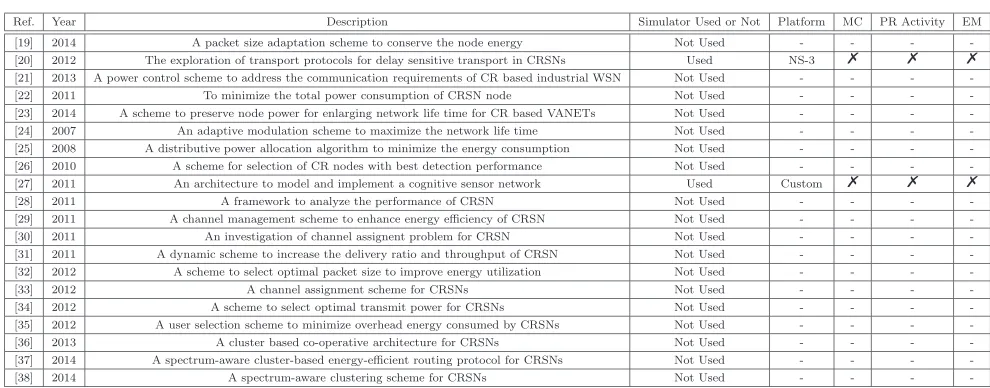
-Table 3:Overview of simulations work for CRSNs
these networks. Network simulators are very useful tool
to perform sensitivity and trend analysis. They have the
ability to generate those scenarios that are not easily
achievable in practice due to high cost involved in
em-pirical methods. However, it is important to realize that
the simulation is not a real experiment, and therefore,
great care must be taken at understanding the model,
its limitations, and its results.
By far, the most widely used simulation tools for
wireless networks are NS-2 [1] and OMNET++ [39].
WSNs include wireless nodes which sense and
trans-mit the required parameters upon occurrence of
spe-cific event. Table. 1 provides the list of some widely
used simulation models available for WSNs. In
liter-ature, there is a wide variety of simulators available
for WSNs which cannot be included here due to
lim-ited space. There are many platforms which support
simulation of WSNs such as NS-2, OMNeT++, Java
and C++ etc. Amongthese platforms, NS-2 and
OM-NeT++ are the most commonly used simulators in the
network community. Since NS-3 is currently in
devel-oping phase and it will take few more years for NS-3
to become credible, thus, we have chosen NS-2 for our
simulation model. Moreover there is another simulation
patch i.e., CogNS, however, it does not supports PR
ac-tivity.
These days most of the wireless equipment are
us-ing Industrial, Scientific and Medical (ISM) radio band
for communication. Due to humungous increaseofthe
Wi-Fi and Bluetooth enabled devices, the ISM band of
2.4 GHz has started becoming overly saturated. As a
consequence, unlicensed traffic has been allowed to also
operate in the TV broadcast range. The spectrum
dedi-cated for TV broadcasts can be used for data
communi-cation in a cognitive way [40]. This concept emerged the
technology of CRNs where CR nodes can
opportunisti-cally access the licensed spectrum without creating any
harmful interference to PR nodes.
For a practical approach, a simulation model should
provide all the blocks which are required for CRNs and
CRSNs. Three main blocks which are MC (multiple
[image:5.612.40.535.33.227.2]re-quired for CRSN simulation have been discussed and
implemented in the proposed technique due to which
the proposed simulation model is a complete and
prac-tical approach towards simulation of CRSNs. The issue
of energy consumption has been elaborated in more
de-tail in [18] and an event triggered based node energy
model has been presented. As traditional WSNs do not
consider multiple channels and cognitive radio
capabil-ities so these features are missing in above mentioned
work.
Many CR based models have been proposed in
lit-erature (see table. 2) that can be used to simulate CR
networks. However, some important features like PR
user activity and multiple channels support are missing
in these models. Moreover, traditional CR based
net-works are assumed to have no constraints on energy
consumption, and therefore, energy model must be
in-troduced for wireless nodes containing limited power.
The CR based issues are mostly related to
phys-ical layer where transmitting parameters need to be
changed according to availability of free channels, but
the importance of media access layer (MAC) and
net-work layer cannot be neglected. In CRSNs, data
dis-semination is usually achieved using multi-hop scenario
and a particular channel can be selected on the basis
of PR occupancy and the number of CR nodes
shar-ing the channel. Reliable data dissemination becomes
a complex task in multi-hop CRSN where no central
entity is present for coordination among CR nodes. If
a CR node selects a channel randomly, it is highly
un-likely that the neighbor receivers will also tune to the
same channel. In such scenarios, decisions should
bet-ter be taken at network layer since a complete picture
of the whole network can be obtained at network layer
[41].
In [42], authors have performed a detailed review of
simulation tools for intelligent vehicular networks. The
issues of wireless communication between the nodes
have been elaborated for researchers. Modeling of
wire-less links and wirewire-less signal propagation and
simula-tion models available for these networks have been
dis-cussed. The authors have also pointed out the
impor-tance of simulator tools for authentication of generated
results whichhighlightsthe necessity of this step while
performing simulations. The importance of application
scenario while performing a simulation has been
elabo-ratedin [43] in which authors simulated various
applica-tions for mobile opportunistic networks and concluded
that performance of simulation model varieswithtypes
of application under consideration. A number of famous
and reliable simulation platforms including NS-2, NS-3
[44] and OMNet++ are available for simulating WSNs
and CRNs but none of these platforms provide CRSNs
based simulation model. As summarized in Table. 2,
we can analyze that no simulation model at present
is providing support for combined features of WSNs
and CRNs. It has been also demonstrated in Table. 3
that mostly researchers are using analytical methods to
understand the behavior of CRSNs. Those researches
which are being performed using NS-3 or custom
de-signed simulators are not assuming the required metrics
for CRSNs. Hence, to simulate a CRSN,it is required
con-sidered in multiple channel and multi-hopscenario for
realization of CRSNs.
2.1 WSNs in NS-2
NS-2 is a platform which provides user to simulate
wire-less networks scenarios and many contributions have
been made to add advanced functionalities in the
simu-lator. Various analytical models and performance
anal-ysis techniques for ad hoc networks have been discussed
in [45]. Specifically, the simulation environment for WSNs
is available in NS-2 but CRNs simulations cannot be
performed without adding the CR based
functionali-ties. A CRN based tool has been developed for NS-2
in [16], and is available online, but this work has not
been adopted widely by the researchers. The possible
reasons can be the lack of multiple channels support
at MAC layer and that the PR activity has not been
supported for cognitive radio environment. The issue of
accuracy and credibility has also been raised for these
simulation models [46]. The authors in [14] have
pre-sented an equation based transport layer protocol while
simulating for CRNs. They have first performed
spec-trum management to utilize the available channels in
an opportunistic manner and simulations are done in
NS-2. Another transport layer end-to-end protocol for
cognitive radio network tool is provided by authors in
[15]. This tool has also been developed for NS-2 and
it provides PR activity analysis and routing based on
this activity but multiple channel support is also
miss-ing in this work. The authors in [13] have proposed a
routing layer model for CR based networks in NS-2.
Their focus is to enhance throughput by performing
ef-ficient routing but existence of multiple channels effects
throughput hence channel selection becomes also
cru-cial to achieve high throughput.
2.2 CRNs in NS-2
A comprehensive evaluation of CR based network in
the presence of multiple channels has been performed
in [11]. The authors have given a brief study of impact
of multiple channels on packet drop probability, TCP
end-to-end packet delay, TCP throughput and average
packet size to satisfy QoS using NS-2. [47] has used
NS-2 for flooding packets in the network using sensor
networks and estimated the accuracy of generated
re-sults. Another CR based simulation model for
cogni-tive radio ad-hoc networks has been presented in [12]
for OMNeT++ simulator. The authors have designed
their tool for only two data channels which is very
lim-ited when considering the CR based network and also
no PR activity has been assumed. There are bundle
of application areas where no simulation or estimation
can be performed without considering PR activity over
the data channels. [48] discussed the concept of smart
grids and estimation of electricity requirement for all
home appliances through ZigBee but as ZigBee
oper-ates in Industrial, Scientific and Medical (ISM) band
so there is high probability of interference among
ap-pliances with in a home. The only promising solution
rests with CR based appliances connected with smart
meter which communicates with the grid. The home
area networks (HAN), neighbor area network (NAN)
and wide area network (WAN) of smart grid
Activity Type Purpose Pattern
Long PR activity Utilize spectrum for special call packages Long ON and long OFF periods
High PR activity Utilize spectrum in congested areas or during rush hours Long ON and short OFF periods
Low PR activity Utilize spectrum in rural areas or during less peak hours Short ON and long OFF periods
Intermittent PR activity Utilize spectrum for short duration of time Short ON and short OFF periods
[image:8.612.42.536.35.121.2]Mixed PR activity To have an un predictable pattern over the spectrum Mixture of multiple activities
Table 4: PR activity patterns
view the complexity of NS-2 as network grows [49]. To
summarize the discussion, there is a need of the time
for such a simulation model which should be capable
of considering all the parameters of cognitive radio
sen-sor networks and generate the results which should be
acceptable for research community. [50] emphasizes on
the need of such simulator because to make the best
use of scarce spectrum CR based technologies are
grow-ing tremendously but the challenge is to co-exist with
PR nodes with avoiding interference. In this context, a
CRSN simulator is presented in this work which
collec-tively takes all the parameters of WSNs and CRNs to
ensure the accuracy of CRSN simulation model. This
model is not only easy to integrate butisalso scalable
for any further additions in the network. NS-2 [51] has
been chosen as simulation platform due to its vast
ap-plication and acceptability of results by research
com-munity.
3 CRSN Simulator Requirement
There are some specific requirements for
implementa-tion of CRSNs so they need to be discussed before going
into the details of CRSN simulator. Upon fulfilling these
requirements, the CRSN simulator will become general
and can be applied to any sort of wireless environment
with variable length of multiple channels and various
kinds of PR activities.
3.1 Multiple Channels
In the literature, as discussed in related work section,
a very little work has been done by assuming
multi-ple channels when simulating CR based networks.
How-ever cognitive radio environment cannot be simulated
in its true spirit in the absence of multiple channels.
Among multiple channels present in the network, the
suitable channel is selected and transmission
parame-ters are adjusted dynamically according to the channel
requirement. The number of multiple channels impacts
throughput and packets drop probability [11]. It is due
to the fact that the larger is the size of available
chan-nel set, harder is the decision of selecting same set of
channels between source to destination. This is a
ba-sic concern of CR based network that there should be
multiple channels in the network so that when these
channels are not utilized by PR nodes, they become
available for CR nodes. Alsothefunctionality of
multi-ple channels should be scalable so that number of
mul-tiple channels can be increased/decreased according to
specific application requirements. The broadcasting of
hello packets over multiple channels in NS-2 has been
trans-mitted in the whole network successfully, the data
pack-ets can be sent in the same fashion on the channels from
where acknowledgement of hello has been received.
Ac-cording to some special requirements of nodes, channels
can be assigned to some nodes on fixed basis too or
oth-erwise routing layer makes decision about the selection
of channels.
3.2 PR activity
As CR based networks are opportunistic networks, so
only those frequency slots can be utilized by CR nodes
which are free from PR traffic. Hence impact of PR
activity is very important on the performance of CR
nodes. A detailed survey on the types of PR
activi-ties and their implementation depending on network
type has been given in [53]. PR activity models give
the information about behavior and spectrum
utiliza-tion by PR users. By using this informautiliza-tion, CR users
can predict the future states of PR users and can
uti-lize best available spectrum bands for their
communi-cation. In literature various PR activity models have
been proposed for implementation in different network
scenarios. We can classify them in four major classes
such as Markov process, queuing theory, time series and
ON/OFF periods. Markov process has been widely used
by researchers to estimate the PR user activity in CR
based networks [54–58,41,59–62]. This class has been
also widely implemented for developing spectrum
shar-ing mechanisms in medium access control (MAC) for
CRNs, dynamic spectrum sharing and CRSNs. Queuing
theory has been used for modeling PR activity where
PR user medium access delay and average packet delay
can be used to calculate PR user queue length [63–66].
Time series modeling is used to estimate spectrum
oc-cupancy in GSM based networks [67,63] and ON/OFF
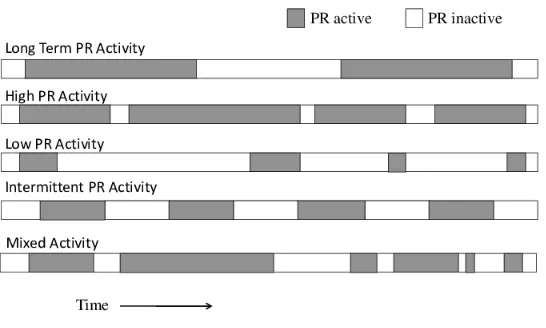
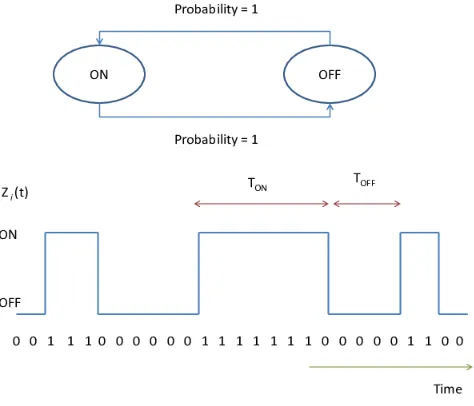
periods are used to model PR activity. The presence of
PR user is represented by ON period and when there
is no PR activity over the channel, OFF period is
rep-resented by Fig. 1. This model has been also used by
other models like two-state markov model where BUSY
state is represented by ON period and IDLE state is
represented by OFF period. ON/OFF periods are also
widely used in super WiFi concept. Super WiFi is WiFi
like internet service which takes opportunistic access of
spectrum holes in the network [68–72].
The PR activity i.e. the presence or absence of PR
signal can be modeled as continuous-time, alternating
ON/OFF Markov Renewal Process (MRP) [73]. The
effect of PR activity on network performance by
chan-nel selection has been evaluated by [57]. Five kinds of
PR nodes activity patternshave been considered in this
simulator areelaborated in Table. 4.
3.3 Energy Model
As inherited from WSNs, CRSNs are energy constrained
networks in which node energy determines the network
lifetime. The ability of node to use cognitive capabilities
and dynamic selection of best channel requires
intelli-gent protocols at network and mac layer level. These
in-telligent protocols are more complex and consume more
power which reduces the node life. While simulating
CRSNs, it is necessary to consider the relation between
required QoS parameters and node’s energy. To
Fig. 1: Types of PR activities
considering cognitive capabilities and its effects on
en-ergy.
4 The Proposed CRSN Simulation Model
The complex system of computer network is facilitated
by the concept of layering. Using the layering structure,
the functionalities of communication networks can be
handled. This layering structure makes smooth progress
of peer-to-peer relationship between corresponding
lay-ers in two communicating nodes. In the layering stack,
each layer represents a well defined function and
pro-vides its services to the immediate upper layer. The
ac-cessibility between two layers is made possible through
interfaces and the function of each layer is called its
protocol. It is worth mentioning here that each layer
in the stack is independent in its operation. It means
whatever protocol a layer implements does not effects
the functionality of its upper layers [51]. NS-2 has also
become available on web by [74] providing integrated
environment for remote simulation and analysis of
sim-ple wired as well as wireless networks. Beginners who do
not want to go into the details of NS-2 installation can
utilize this web-based application. The selection of
plat-form for any simulation based model is very important.
Custom designed simulators do not simulate and
eval-uate all the design parameters and results generated
by them cannot be considered accurate. In contrast,
choosing a standard framework increases the
reliabil-ity of evaluation process and results. There should also
be an understanding of validation of results which
re-flects the effectiveness of techniques [75,76]. Along with
tool selection, the assumptions made regarding wireless
environment have their impact on the results. For
au-thentic results, it is required that realistic assumptions
should be made[77]. Various simulators for IEEE 802.11
and IEEE 802.15.4 have been compared in [78] and the
need for more advanced and trustworthy simulators has
been highlighted. The CRSN simulator model is
devel-oped for NS-2 platform. It is due to the reason that
NS-2 is an open source event-driven simulator
specifi-cally designed for research in communication networks.
Fig. 2: CRSN simulator architecture
this model very simple. It is due to the reason that NS-2
already supports WSN and CRN simulation platforms.
Some functionalities of CRN were missing such as
multiple channel support and PR activity support which
has been added in this proposed simulator. Another
as-pect of selecting NS-2 is the wide acceptability of this
simulator in network research community. The results
generated by this platform are accurate and give a real
insight of issues of the network.
4.1 Architecture
In this section, the architecture of CRSN simulator will
be discussed. The graphical representation of CRSN
simulator architecture is shown in Fig. 2. In [79],
au-thors have discussed that researchers should avoid using
default parameters available in the simulators rather
these parameters should be modified according to changes
in the network. In our proposed simulator, simulation
parameters like number of channels, PR activity over
these channels, energy model have been modified and
the following subsections will cover the details of those
layers which have been modified in NS-2 for simulation
of CRSN environment. These modifications have been
made due to the requirements specific to CRSN and
these can be changed according to implementation of
CRSN in any particular scenario.
4.1.1 CRSN Network Layer
The network layer implementation allows user to
se-lect the suitable routing protocol. This routing protocol
is responsible for transmission of packets from source
to destination in multi-hopscenario choosing the best
route. AODV is known as an efficient routing algorithm
for wirelessad-hocnetworks. [80] gives the comparison
of multiple routing algorithms in NS-2 and AODV has
performed well among all the multi-hop routing
algo-rithms. In this simulator, AODV has been used as
rout-ing protocol of CRSNs and the functionality of
(a) (b)
Fig. 3:(a) Channel Occupancy by PR nodes. (b) Channel Occupancy by CR nodes.
network layer is also used to collect statistics of the
net-work e.g. average delivery ratio, hop count, average
de-lay between source to destination, harmful interference
ratio, number of receivers etc. By keeping this data,
network layer helps to improve the energy utilization of
nodes. The nodes become aware of shortest path to the
destination with minimum interference to PR nodes.
The interference reduction results into less number of
re-transmissions which saves energy.
4.1.2 CRSN MAC Layer
Medium access control in CR based WSN should be
intelligent enough to provide the dynamic behavior of
spectrum selection without creating any harmful
inter-ference to PR node activity. The MAC protocol must
be able to sense the channel and selects the suitable one
for CR node. It should be monitoring PR activity
con-tinuously and if there is any PR activity found on any
selected channel, it should stop the CR traffic and
re-lease the channel for PR node. For this purpose CSMA
is used to ensure channel utilization by both PR and
CR nodes. To utilize the cognitive capabilities, multiple
channels are added so that among these channels, the
suitable channel for CR node can be selected to
trans-mit the data. Once multiple channels are added in the
simulator then PR activity is introduced on each
chan-nel as discussed in previous section. Here it is worth
mentioning that activity pattern of PR traffic can be
different on each channel hence it is functionality of
low PR activity or the channels which can be
avail-able for CR nodes for a consideravail-able amount of time.
Along with PR traffic, MAC protocol for CRSN selects
the suitable path on the basis of energy of nodes. The
energy model provides information about the total
en-ergy, remaining life time and required energy to fulfill
certain transmission.A channel can be either vacant or
occupied. When vacant, it can be utilized by either PR
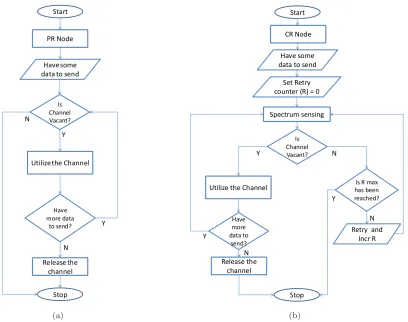
or CR node. Fig. 3(a) represents that how a PR node
utilizes a channel for its communication. If it has some
data to be sent, it senses the channel and utilizes it
ac-cordingly. When its transmission has been completed,
it releases the channel to be used by CR nodes. If a CR
node needs a channel to transmit the data, it performs
spectrum sensing to avoid any PR-CR interference as
shown in Fig. 3(b). When it successfully transmits its
data, it releases the channel for other nodes. If CR node
detects that the channel is busy, it retries to access the
channel with a limit assigned to number of retries. As
we increase the number of channels, the CR nodes can
sense the PR activity and can utilize the free channel. A
large set of channels may result into increased sensing
time but with decreased PR interference probability.
Cognitive Radio Cognitive Network (CRCN) patch
provided by [16] has been used as base of our simulator
model. This patch can be installed on NS-2 version 2.31
and provides CSMA based maccon protocol for channel
sensing and selection. There are certain shortcomings in
the CRCN patch which have been removed to become
practical for application of CRSN based network.
Chan-nel sensing and selection isnecessarydue to presence of
PR activity over the same set of channels but
unfortu-nately no PR activity model is present in CRCN patch.
To overcome this, PR activity block is added in the
simulator and all the activities as discussed in section
3.2 have been implemented on the channels. Here one
more thing is important to discuss that maccon
proto-col supports a single channel for packets transmission
where as multiple channels are required for a CR based
network so the suitable channel among a set of channels
can be selected. To obtain this objective, multiple data
channels are added in our simulator and all these
chan-nels have PR activities on them. The amount of time for
which a channel is being utilized by a PR node is
repre-sented by a percentage called utilization factor. A high
utilization factor tells that a channel is more busy and
not suitable for a CR node to utilize it, whereas a low
utilization factor shows a low PR traffic pattern over
the channel which makes a channel suitable to be used
by CR node. PR activity block which is added in our
simulation model is a generalized block. For our
simu-lations, ON/OFF PR activity has been used however
other PR activities available in literature like Markov
Process, Queuing Theory, Time series etc can also be
implemented.
CRCN patch also lacks the implementation of
en-ergy model. As in CRSN scenario, enen-ergy is an
impor-tant parameter to estimate the lifetime of sensor mote.
Our simulation model is equipped with energy model
which gives the energy status about all the wireless
sensor nodes in the network. The route selection by
network layer is done in connection with energy of all
Fig. 4: Major files modified
all the nodes in the route should be able to complete
the transmission of packet.
4.1.3 CRSN Physical Layer
Physical layer modeling effects the performance of higher
level layers and hence the overall behavior of simulation
model [81]. In [82], the author has also emphasized the
need of such physical layer having cognitive
capabil-ities where transmission radii can be selected at this
layer dynamically and higher layers utilize this
infor-mation for intelligent decision making. Physical layer
for CRSN provide nodes the adaptability to the
chan-nel’s condition. By using multiple physical interfaces,
sensor nodes can operate at multiple frequencies by
se-lecting one frequency channel at a time. The
informa-tion regarding selecinforma-tion of frequency channel is given to
this layer by MAC protocol of upper layer. The task of
physical layer is to adapt the transmission parameters
to communicate with the suitable channel.
5 Evaluation of Proposed CRSN Model
This section covers the details of simulation steps which
are performed to implement CRSN simulator. After
in-stalling CRCN patch in NS-2.31, the first step is to
enhance the functionality of AODV protocol to
multi-hop data dissemination. For this purpose, we turn off all
the functions of AODV and transmit only hello packets
and get the acknowledgement from all the nodes in the
network. Due to topological changes, sometimes it is
quite possible that a node is sending a packet but
can-not receive the incoming packets. To ensure the
trans-mission and reception capabilities of all the nodes in
the network, we select a random node every time for
Fig. 5: Alternating Markov Renewal Process for PR activity
the packet or not. We control the selection of
trans-mitting node and the time when transmission starts
through a simple tcl script and generate traces. To
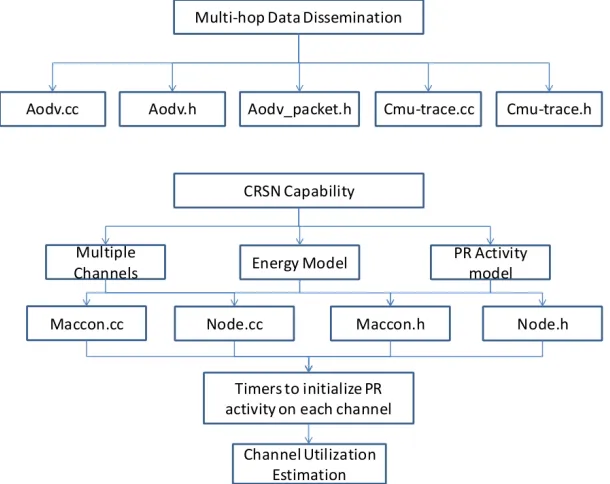
per-form these changes, we need to modify aodv.cc, aodv.h,
aodv packet.h, cmu-trace.cc and cmu-trace.has shown
in Fig. 4. All these files can be found in AODV and
trace folders located at the base directory of NS-2.31.
We have added customized packet to be transmitted
us-ing AODV routus-ing protocol. For addus-ing this packet, we
need to make modifications in aodv.cc and aodv.h. The
packets class in AODV is dependent on aodv packet.h
so it also needs to modify. The traces of packets are
generated through cmu-trace.cc and cmu-trace.h. We
have also modified these accordingly to show the traces
of packet while transmission through multi-hops.
The flow of simulation starts from tcl script. In tcl
script, we specify the type of protocols applied at
net-work and MAC layer. We also mention the radio
prop-agation model for physical wireless channel. Other
net-work parameters, such as, number of multiple channels,
number of wireless sensor nodes and total simulation
time have been also mentioned in tcl script.
Tcl script calls the network layer protocol i.e. AODV
which performs neighbor discovery through our
cus-tomized packet to reach the destination node. The AODV
then passes its packet to the MAC layer for
hop-to-hop delivery of data. MAC layer then initializes
multi-ple channels for each node and immulti-plement PR activity.
The presence or absence of PR activity is the key factor
to select the channels for CR node. MAC layer selects
those channels for CR node which are free from PR
activity or less occupied by PR nodes.
For addition of multiple channels and PR activity,
we need to modify CSMA based maccon protocol. The
protocol by default supports a single-channel single-hop
transmission without any PR activity over the channel.
We first extend the number of channels and convert
it into a generic entity so that each time user can vary
the number of data channels present in the network. For
Parameters Values
Number of nodes 50
Number of channels 10
Size of simulation area 1000*1000
Radio propagation model Two-ray ground model
Network interface type Wireless PHY
Routing protocol AODV
MAC type Mac/Maccon
PR activity ON / OFF MRP
Simulation time 52 sec
Table 5: Simulation Parameters
determines the occupancy of channel. We need to
mod-ify maccon.cc and maccon.h present in the mac folder to
make these changes. To extend the number of channels,
NS-2 sets the maximum number of channel up to 12,
we have used 10 channels but if any network requires
more than 12 channels support, some modifications are
required. A variable named as “Maxchannel” contains
the maximum allowable multiple channels. The value
of this variable should be increased and this variable
can be found in three header files namely topography.h,
phy.h and mobilenode.h. Increase the value ofthis
vari-able at three mentioned placesup to a maximum limit
where multiple channels can exist.
After successful addition of multiple channels, next
thing comes to the implementation of PR activity over
each channel. PR activity gives the information about
presence or absence of PR users over the channel. It can
be modeled as continuous-time, alternating ON/OFF
Markov Renewal Process (MRP) [83,56]. This PR
ac-tivity model has been widely used in the literature [56,
83–87]. The ON/OFF PR activity model approximates
the spectrum utilization pattern of voice networks [88]
and also very famous for public safety bands [87,89].
Fig. 5 shows the model of a wireless channel where the
ON state represents that channel is currently busy and
occupied by PR node. The OFF state represents that
channel is idle and unoccupied by any PR node. The
time duration for which the channel i is in ON and
OFF states are denoted asTi
ON andT i
OF F respectively.
The duration which a channel takes to complete one
consecutive ON and OFF period is called renewal
pe-riod. Let this renewal period for a channeli at time t
is denoted by Zi(t) = Ti ON +T
i
OF F [56,90,91]. Both
ON and OFF periods are assumed to be independent
and identically distributed (i.i.d). Since each PR user
arrival is independent so according to [91], each PR
user arrival follows the poisson arrival process and the
length of ON and OFF periods are exponentially
dis-tributed. The time duration for which a channel i is
being utilized by PR user is called utilization factor of
ith channel and can be written as
ui= E[T i ON] E[Ti
ON] +E[T i OF F]
(1)
whereE[Ti
ON] andE[T i
OF F] are the expected values
of exponential distribution [90]. In this way any kind
of PR activity can be added by describing the pattern
as discussed in [41]. The formulations are easily
imple-mented in maccon.cc and maccon.h and with the help
of these formulations, we can estimate the number of
successful attempts to access a channel, number of
colli-sions with PR nodes which caused harmful interference
etc. We control the activity of PR nodes on channels
and number of channels from the same tcl script as
dis-cussed earlier so that each time user does not need to
modify the code file. Similarly we have added the
en-ergy model in maccon protocol to sense the enen-ergy of
network layer we need to modify node.cc and node.h so
that network layer is aware of node’s energy.
For validation of implemented modules, some results
have been included for each kind of PR activity. As
followed by simulation parameters shown in Table. 5,
we are using 10 channels and performed simulations for
all five kinds of PR activities as discussed in section
3.2 on each channel. The number of channels can be
increased as per user requirement. The results shown in
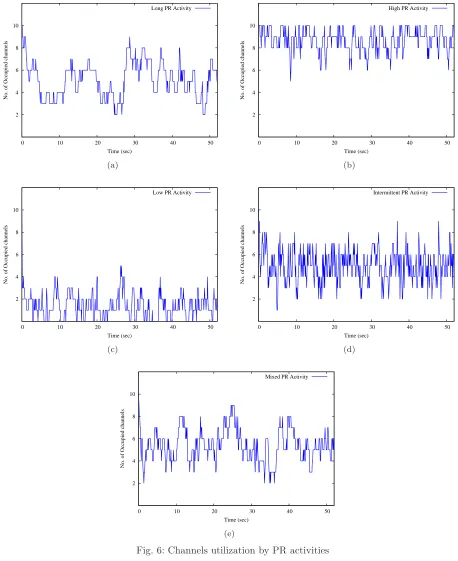
Fig. 6 elaborate the impact of PR activities on channel’s
utilization over complete simulation time. Long term
PR activity (as shown in Fig. 6(a)) contains long ON
and long OFF periods. This trend also reflects in the
plot that channel utilization distribution is even by PR
users and a long high channel utilization is followed
by a long low utilization. This type of activity is found
where PR users are subscribed to some special packages
to utilize the channels. CR users can opportunistically
use these channels because after a long ON there is high
probability of long OFF period which can be useful for
opportunistic spectrum access.
Fig. 6(b) gives the implementation of high PR
activ-ity which is showing that most of the time all channels
are being occupied by PR nodes. If a CR user attempts
to access such a channel having high PR activity, there
is a high percentage that it will cause harmful
inter-ference to the PR users. As there are very short white
spaces in the channel, it is recommended that only when
CR nodes have very little data to transmit can use such
channels.
The most suitable PR activity for any CR user has
been shown in Fig. 6(c). It is clearly evident from the
plot that very few numbers of channels are being
oc-cupied by PR nodes throughout the simulation time.
This type of activity can be found in rural areas or less
peak hours. CR users can take maximum utilization in
these durations when there is low PR activity over the
channel. As there are very little chances of interference
with PR users, so a less sensitive (less complex) channel
sensing algorithm can be used which will preserve the
node energy as well. Intermittent PR activity (as shown
in Fig. 6(d)) has short ON and short OFF periods and
number of occupied channels are showing this behavior.
This type of PR activity is found where users come for a
very short duration of time. Examples of such scenario
can be airports, bus terminals etc. To utilize such a
channel having intermittent PR activity, it is required
that CR nodes must be capable of fast channel
sens-ing and selection and equipped with powerful battery
modules.
If more than one activity type is found over the
net-work, it is called as mixed PR activity (Fig. 6(e)). This
kind of activity occur where behavior of PR users vary
from time to time. For such kind of activity, it is
diffi-cult for a CR node to select a band with a probability
to complete its transmission.
We can estimate the channel utilization by any PR
activity using Fig. 7 where for each type of PR
activ-ity the total utilization of all channels has been
repre-sented. It is evident from Fig. 7(a) that long PR activity
is appearing for almost 50 % of total simulation time
and for rest of the time the channels are idle. An effect
of high PR activity can be seen in Fig. 7(b) in which
2 4 6 8 10
0 10 20 30 40 50
No. of Occupied channels
Time (sec)
Long PR Activity
(a)
2 4 6 8 10
0 10 20 30 40 50
No. of Occupied channels
Time (sec)
High PR Activity
(b)
2 4 6 8 10
0 10 20 30 40 50
No. of Occupied channels
Time (sec)
Low PR Activity
(c)
2 4 6 8 10
0 10 20 30 40 50
No. of Occupied channels
Time (sec)
Intermittent PR Activity
(d)
2 4 6 8 10
0 10 20 30 40 50
No. of Occupied channels
Time (sec)
Mixed PR Activity
[image:18.612.56.514.43.604.2](e)
10 20 30 40 50 60 70 80 90 100
0 1 2 3 4 5 6 7 8 9
Channel Utilization (%)
Channel Number
Long PR Activity
(a)
10 20 30 40 50 60 70 80 90 100
0 1 2 3 4 5 6 7 8 9
Channel Utilization (%)
Channel Number
High PR Activity
(b)
10 20 30 40 50 60 70 80 90 100
0 1 2 3 4 5 6 7 8 9
Channel Utilization (%)
Channel Number
Low PR Activity
(c)
10 20 30 40 50 60 70 80 90 100
0 1 2 3 4 5 6 7 8 9
Channel Utilization (%)
Channel Number
Intermittent PR Activity
(d)
10 20 30 40 50 60 70 80 90 100
0 1 2 3 4 5 6 7 8 9
Channel Utilization (%)
Channel Number
Mixed PR Activity
[image:19.612.52.515.39.595.2](e)
Fig. 8: All PR activities
this type of activity, all channels are busy most of the
time and very little idle periods can be found. In
con-trast, a low PR activity is found in Fig. 7(c) and all
the channels have low utilization factor. An
intermit-tent and mixed activity can be seen in Fig. 7(d) and
Fig. 7(e).
The concept of PR activities as discussed in Fig. 1
has been proved by simulations and the effect of all PR
activities on all channels has been shown in Fig. 8. A
“1” is showing an “ON” state whereas a “0” is used to
represent an “OFF” state. It can be seen that the
sim-ulated results are exactly following the PR activities.
Here the effect of long PR activity on channel
utiliza-tion is more clearly visible as it is showing long “ON”
and long “OFF” periods. The high PR activity is
hav-ing long “ON” and short “OFF” periods where as low
PR activity has short “ON” and long “OFF” states.
Another analysis of all five PR activities can be
per-formed using Fig. 9 where the effect of each PR activity
on all channels has been combined and shown as
per-centage of channel utilization. Lets examine the high
PR activity in which all the channels are almost 90%
occupied by PR users and remain idle for only 10% of
the time. As intermittent PR activity has short “ON”
and short “OFF” states (as shown in Fig. 8) so it is
utilizing the channels for 50% of the time but the
re-maining 50% cannot be effectively utilized by CR nodes
due to short “OFF” states and it is expected that PR
user will appear again for a short period of time. This
fast switching of PR nodes makes the channel
unsuit-able for CR nodes. The long PR activity has long “ON”
and long “OFF” states due to which it is also utilizing
the channels for almost 50% of the time and this
activ-ity is suitable for CR nodes because it is expected that
for a considerable amount of time. A low PR activity
is attractive for CR nodes to utilize the channels as all
the channels are less than 20% utilized by PR users and
rest of the time remain idle. The mixed PR activity is
also utilizing the channels for almost 50% of the time
but a CR node cannot predict the next appearance of
PR node over the channel as PR nodes do not follow
any specific behavior in this type of activity.
6 Conclusion
In this paper, NS-2 based CRSN simulator model has
been presented. This model supports the fundamental
requirements of a CR based wireless sensor network.
As the research trend is shifting towards CRSNs so it
is need of the time for such a simulator so that all the
future research and simulations can be based on this
module. This module has been designed on NS2 so it
is very flexible to extend for future enhancements and
channel bonding block will be added as the extension
of this work. It will provide the CR users a chunk of
large bandwidth to utilize for multimedia applications.
Other types of PR activities and energy models can also
be integrated in this module.Another important future
enhancement is to check the accuracy of our simulator
in real world scenarios. It will provide a stronger base
for the future researchers in this field of CRSN.
References
1. The network simulator ns-2, 1995.
2. A simulation framework for sensor networks, 2003.
3. Manna sim framework, 2002.
4. Mixim framework, 2011.
5. Nrl sensorsim, 2005.
6. Java in simulation time / scalabale wireless adhoc
net-work simulator, 2004.
7. Sensor security simulator (s3), 2005.
8. O. B. Akan, O. B. Karli, and O. Ergul. Cognitive radio
sensor networks. IEEE Network, Vol. 23, No. 4:34–40,
2009.
9. P. Steenkiste, D. Sicker, G. Minden, and D.
Raychau-dri. Future directions in cognitive radio network research.
Technical Report Vol. 4, No. 1, National Science
Foun-dation Workshop Report, 2009.
10. Syed Hashim Raza Bukhari, Mubashir Husain Rehmani,
and Sajid Siraj. A survey of channel bonding for wireless
networks and guidelines of channel bonding for futuristic
cognitive radio sensor networks. IEEE Communications
Surveys & Tutorials, 18(2):924–948, 2016.
11. Vahid Esmaeelzadeh, Reza Berangi, Seyyed Mohammad
Sebt, Elahe Sadat Hosseini, and Moein Parsinia. Cogns:
A simulation framework for cognitive radio networks.
Wireless Personal Communcations, 2013.
12. Shah Nawaz Khan, Mohamed A. Kalil, and Andreas
Mitschele-Thiel. crsimulator: A discrete simulation model
for cognitive radio ad hoc networks in omnet ++.
In Wireless and Mobile Networking Conference (WMNC),
2013.
13. Pingnan Lee and Gengyu Wei. Ns2 model for cognitive
radio networks routing. InIEEE International Symposium
on Computer Network and Multimedia Technology, 2009.
14. Abdulla K. Al-Ali and Kaushik Chowdhury. Tfrc-cr: An
equation-based transport protocol for cognitive radio
net-works.Ad Hoc Networks, 11:1836 – 1847, 2013.
15. Marco Di Felice, Kaushik Roy Chowdhury, Wooseong
Kim, Andreas Kassler, and Luciano Bononi. End-to-end
protocols for cognitive radio ad hoc networks: An
evalu-ation study.Performance Evaluation, 68:859 – 875, 2011.
16. Cognitive radio cognitive network simulator, 2013.
17. Neha Singh, Rajeshwar Lal Dua, and Vinita Mathur.
Network simulator ns2-2.35. International Journal of
Ad-vanced Research in Computer Science and Software
0 10 20 30 40 50 60 70 80 90 100
High Intermittent Long Low Mixed
Channel Utilization (%)
[image:22.612.136.434.44.257.2]PR Activities
Fig. 9: Combined channel utilization
18. Hai-Ying Zhou, Dan-Yan Luo, Yan Gao, and De-Cheng
Zuo. Modeling of node energy consumption for wireless
sensor networks. Wireless Sensor Network, 3:18–23, 2011.
19. Xiaoyuan Li, Dexiang Wang, Janise McNair, and Jianmin
Chen. Dynamic spectrum access with packet size
adapta-tion and residual energy balancing for energy-constrained
cognitive radio sensor networks. Journal of Network and
Computer Applications, 41:157–166, 2014.
20. A Ozan Bicen, V Cagri Gungor, and Ozgur B Akan.
Delay-sensitive and multimedia communication in
cogni-tive radio sensor networks. Ad Hoc Networks, 10(5):816–
830, 2012.
21. Tran Minh Phuong and Dong-Seong Kim. Robust
dis-tributed power control for cognitive radio based
indus-trial wireless sensor networks. InProc. Int. Conf. Sensors,
volume 41, pages 9–12, 2013.
22. Huazi Zhang, Zhaoyang Zhang, Xiaoming Chen, and Rui
Yin. Energy efficient joint source and channel sensing
in cognitive radio sensor networks. In2011 IEEE
Inter-national Conference on Communications (ICC), pages 1–6.
IEEE, 2011.
23. Mohammad Jalil Piran, Yongwoo Cho, Jihyeok Yun,
Am-jad Ali, and Doug Young Suh. Cognitive radio-based
ve-hicular ad hoc and sensor networks.International Journal
of Distributed Sensor Networks, 2014, 2014.
24. Song Gao, Lijun Qian, Dhadesugoor R Vaman, and
Qi Qu. Energy efficient adaptive modulation in wireless
cognitive radio sensor networks. In2007 IEEE
Interna-tional Conference on Communications, pages 3980–3986.
IEEE, 2007.
25. Song Gao, Lijun Qian, and Dhadesugoor R Vaman.
Dis-tributed energy efficient spectrum access in wireless
cog-nitive radio sensor networks. In2008 IEEE Wireless
Com-munications and Networking Conference, pages 1442–1447.
IEEE, 2008.
26. Zaheer Khan, Janne Lehtomaki, Kenta Umebayashi, and
Johanna Vartiainen. On the selection of the best
de-tection performance sensors for cognitive radio networks.
IEEE signal processing letters, 17(4):359–362, 2010.
27. Chung-Hsien Kuo and Ting-Shuo Chen. Pn-wsna: an
ap-proach for reconfigurable cognitive sensor network
imple-mentations.IEEE Sensors Journal, 11(2):319–334, 2011.
28. Zhongliang Liang, Shan Feng, Dongmei Zhao, and
Xuemin Sherman Shen. Delay performance analysis for
supporting real-time traffic in a cognitive radio sensor
network.IEEE Transactions on Wireless Communications,
29. Jeong Ae Han, Wha Sook Jeon, and Dong Geun Jeong.
Energy-efficient channel management scheme for
cogni-tive radio sensor networks. IEEE Transactions on
Vehic-ular Technology, 60(4):1905–1910, 2011.
30. Xiaoyuan Li, Dexiang Wang, Janise McNair, and
Jian-min Chen. Residual energy aware channel assignment in
cognitive radio sensor networks. In2011 IEEE Wireless
Communications and Networking Conference, pages 398–
403. IEEE, 2011.
31. Zemin Hu, Yongmei Sun, and Yuefeng Ji. A dynamic
spectrum access strategy based on real-time usability in
cognitive radio sensor networks. In Mobile Ad-hoc and
Sensor Networks (MSN), 2011 Seventh International
Con-ference on, pages 318–322. IEEE, 2011.
32. Mert Can Oto and Ozgur B Akan. Energy-efficient
packet size optimization for cognitive radio sensor
net-works. IEEE Transactions on Wireless Communications,
11(4):1544–1553, 2012.
33. Mehdi Askari, Yousef S Kavian, Hooman Kaabi, and
Habib F Rashvand. A channel assignment algorithm for
cognitive radio wireless sensor networks. InWireless
Sen-sor Systems (WSS 2012), IET Conference on, pages 1–4.
IET, 2012.
34. Jose Roberto Ayala Solares, Zouheir Rezki, and
Mohamed-Slim Alouini. Optimal power allocation of a
single transmitter-multiple receivers channel in a
cogni-tive sensor network. In2012 International Conference on
Wireless Communications in Underground and Confined
Ar-eas, ICWCUCA 2012, 2012.
35. N.u. Hasan, W. Ejaz, S. Lee, and H.S. Kim.
Knapsack-based energy-efficient node selection scheme for
coopera-tive spectrum sensing in cognicoopera-tive radio sensor networks.
IET Communications, Vol. 6, No. 17:2998–3005, 2012.
36. K Hareesh and Poonam Singh. An energy efficient
hy-brid co-operative spectrum sensing technique for crsn.
In Automation, Computing, Communication, Control and
Compressed Sensing (iMac4s), 2013 International
Multi-Conference on, pages 438–442. IEEE, 2013.
37. Ghalib A Shah, Fatih Alagoz, Etimad A Fadel, and
Ozgur B Akan. A spectrum-aware clustering for efficient
multimedia routing in cognitive radio sensor networks.
IEEE Transactions on Vehicular Technology, 63(7):3369–
3380, 2014.
38. Huazi Zhang, Zhaoyang Zhang, Huaiyu Dai, Rui Yin, and
Xiaoming Chen. Distributed spectrum-aware clustering
in cognitive radio sensor networks. In Global
Telecom-munications Conference (GLOBECOM 2011), 2011 IEEE,
pages 1–6. IEEE, 2011.
39. Object oriented modular discrete event network
simula-tion framework, 2003.
40. Y. Yuan, P. Bahl, R. Chandra, and P. Chou. Knows:
Cognitive radio networks over white spaces. In
Interna-tional Sumposium on New Frontiers in Dynamic Spectrum
Access Networks, pages 416 – 427, 2007.
41. M. H. Rehmani, A. C. Viana, H. Khalife, and S. Fdida.
SURF: A distributed channel selection strategy for data
dissemination in multi-hop cognitive radio networks.
Computer Communications, Vol. 36, No. 10:1172–1185,
2013.
42. Francisco J. Ros, Juan A. Martinez, and Pedro M. Ruiz.
A survey on modeling and simulation of vehicular
net-works: Communications, mobility, and tools. Computer
Communications, 2014.
43. Iain Parris, Fehmi Ben Abdesslem, and Tristan
Hender-son. Facebook or fakebook? the effects of simulated
mo-bile applications on simulated momo-bile networks. Ad Hoc
Networks, 12:35–49, 2014.
44. Mubashir Husain Rehmani and Yasir Saleem. Network
Simulator NS-2, chapter 615, pages 6249 – 6258.
IGI-Global, 2015.
45. Jiajia Liu, Hiroki Nishiyama, Nei Kato, Tomoaki
Ku-magai, and Atsishi Takahara. Toward modeling ad hoc
networks: Current situation and future direction. IEEE
Wireless Communications, 20:51–58, 2013.
46. Todd R. Andel and Alec Yasinsac. On the credibility of
manet simulations. IEEE Computer Society, 39:48 – 54,
2006.
47. David Cavin, Yoav Sasson, and Andre Schiper. On the
sec-ond ACM international workshop on Principles of mobile
computing, 2002.
48. Rong Yu, Yan Zhang, Stein Gjessing, Chau Yuen, Shengli
Xie, and Mohsen Guizani. Cognitive radio based
hier-archical communications infrastructure for smart grid.
IEEE Network, 25:6 – 14, 2011.
49. Weilin Li and Xiaobin Zhang. Simulation of the smart
grid communications: Challenges, techniques, and future
trends. Computers and Electrical Engineering, 40:270 –
288, 2014.
50. Jianfeng Wang, Monisha Ghosh, and Kiran Challapali.
Emerging cognitive radio applications: A survey. IEEE
Communication Magazine, pages 74 – 81, 2011.
51. Teerawat Issariyakul and Ekram Hossain. Introduction to
Network Simulator NS2. Springer, 2009.
52. Zeeshan Ali Khan and Mubashir Husain Rehmani. A
tu-torial on broadcasting packets over multiple-channels in
a multi-inferface network setting in ns-2. Technical
re-port, LEAT, CNRS, University of Nice Sophia
Antipo-lis, France and Lip6/Universtie Pierre et Marie Curie
(UPMC) Paris, France, 2010.
53. Yasir Saleem and Mubashir Husain Rehmani. Primary
radio user activity models for cognitive radio networks:
A survey.Journal of Network and Computer Applications,
Vol.43:1–16, 2014.
54. Suzan Bayhan and Fatih Alagoz. A markovian approach
for best-fit channel selection in cognitive radio networks.
Ad Hoc Networks, 12:165–177, 2014.
55. Yang Li, DongYu ning, Zhang Hui, Zhao Hai tao,
Shi-Hai xian, and ZhaoXin-xing. Spectrum usage prediction
based on high order markov model for cognitive radio
net-works. InIEEE10th international conference on computer
and information technology(CIT), 2010.
56. A.W. Min and K.G. Shin. Exploiting multi channel
di-versity in spectrum agile networks. InINFOCOM, 2008.
57. S. Bayhan and F. Alagoz. Distributed channel selection in
CRAHNs: a non-selfish scheme for mitigating spectrum
fragmentation. Ad Hoc Networks, 10:774–788, 2012.
58. M. H. Rehmani. Opportunistic Data Dissemination in
Ad-Hoc Cognitive Radio Networks. PhD thesis, University of
Pierre and Marie Curie, 2011.
59. Wang Zheng, Huat Chew Yong, and Yuen Chau. On
discretizing the exponential on off primary radio
activ-ities in simulations. InIEEE 22nd international
sympo-sium on personal indoor and mobile radio communications
(PIMRC), 2011.
60. Wang Shanshan, Zhang Junshan, and Tong Lang. A
char-acterization of delay performance of cognitive medium
access. IEEE Transaction on Wireless Communications,
11:800–809, 2012.
61. Jiao Lei, Song Enbin, Pla V, and Li FY. Capacity upper
bound of channel assembling in cognitive radio networks
with quasistationary primary useractivities.IEEE
Trans-action on Vehicular Technology, 62:1849–1855, 2013.
62. Geirhofer Stefan, Tong Lang, and Sadler Brian M.
Cog-nitive radios for dynamic spectrum access dynamic
spec-trum access in the time domain : modeling and exploiting
white space. IEEE Communication Magazine, 45:66–72,
2007.
63. Wang Zhe and Salous Sana. Spectrum occupancy
statis-tics and time series models for cognitive radio.Journal of
Signal Processing Systems, Vol. 62, No. 2:145–155, 2011.
64. H. Shiang and M. Van Der Schaar. Queuing-based
dy-namic channel selection for heterogeneous multimedia
ap-plications over cognitive radio networks. IEEE
Transac-tions on Multimedia, Vol. 10, No. 5:896–909, 2008.
65. Jonathan Gambini, Simeone Osvaldo, Bar-Ness Yeheskel,
Spagnolini Umberto, and Yu Takki. Packet wise vertical
handover for unlicensed multi standard spectrum access
with cognitiveradios.IEEE Transaction on Wireless
Com-munications, 7:5172–5176, 2008.
66. Jonathan Gambini, Simeone Osvaldo, Spagnolini
Um-berto, Bar-Ness Yeheskel, and Kim Yungsoo.
Cogni-tive radio with secondary packet-by-packet vertical
han-dover. In IEEE international conference on
communica-tions (ICC), 2008.
67. Li Li, Xu Changqing, and He Jian. Resource allocation
for ofdma-based cognitive radio systems with primary
user activity consideration. In IEEE international
68. Mitola Joseph Hu Nansai, Yao Yu-Dong. Most active
band (mab) attack and countermeasures in a cognitive
radio network. IEEE Transaction on Wireless
Communi-cations, 11:898–902, 2012.
69. S. Joshi, P. Pawelczak, D. Cabric, and J. Villasenor.
When channel bonding is beneficial for opportunistic
spectrum access networks. IEEE Transactions on
Wire-less Communications, Vol. 11, No. 11:3942–3956, 2012.
70. Brah, Felix, Dayoub, Iyad, Vandendorpe, and Luc.
Con-strained resource allocation for ofdma cognitive radio
networks with primary users activity consideration. In
IEEE international symposium on wireless communication
systems (ISWCS), 2012.
71. Chen Chiuan-Hsu and Wang Chin-Liang. Power
alloca-tion for ofdm-based cognitive radio systems under
pri-mary user activity. InIEEE 71st vehicular technology
con-ference (VTC), 2010.
72. Sabharwal Ashutosh Dash Debashis. Paranoid
sec-ondary:waterfilling in a cognitive interference channel
with partial knowledge. IEEE Transaction on Wireless
Communications, 11:1045–1055, 2012.
73. W. Lee and I. F. Akyildiz. Optimal spectrum sensing
framework for cognitive radio networks. IEEE
Transac-tions on Wireless CommunicaTransac-tions, Vol. 7, No. 10:3845–
3857, 2008.
74. Barun Kumar Saha, Sudip Misra, and Mohammad S.
Obaidat. A web-based iintegrated environment for
sim-ulation and analysis with ns-2.IEEE Wireless
Communi-cations, 20:109–115, 2013.
75. Lee Breslau, Deborah Estrin, Kevin Fall, Sally Floyd,
John Heidemann, Ahmed Helmy, Polly Huang, Steven
McCanne, Kannan Varadhan, Ya Xu, and Haobo Yu.
Ad-vances in network simulation.IEEE Computer, 33:59–67,
2000.
76. John Heidemann, Kevin Mills, and Sri Kumar.
Expand-ing confidence in network simulations. IEEE Network,
15:58–63, 2001.
77. David Kotz, Calvin Newport, Robert S. Gray, Jason Liu,
Yougu Yuan, and Chip Elliott. Experimental evaluation
of wireless simulation assumptions. In7th ACM
interna-tional symposium on Modeling, analysis and simulation of
wireless and mobile systems MSWiM, 2004.
78. Laura Marie Feeney. Towards trustworthy simulation of
wireless mac/phy layers: A comparison framework. In
15th ACM international conference on Modeling, analysis
and simulation of wireless and mobile systems MSWiM,
2012.
79. Daniel Hiranandani, Katia Obraczka, and J.J.
Garcia-Lunia-Aceves. Manet protocol simulations considered
harmful: The case for benchmarking.IEEE Wireless
Com-munications, 20:82–90, 2013.
80. Josh Broch, David A. Maltz, David B. Johnson,
Yih-Chun Hu, and Jorjeta Jetcheva. A performance
compar-ison of multi-hopwireless ad hoc network routing
proto-cols. InIEEE international conference on Mobile computing
and networking MobiCom, 1998.
81. Mineo Takai, Jay Martin, and Rajive Bagrodia. Effects
of wireless physical layer modeling in mobile ad hoc
net-works. In2nd ACM international symposium on Mobile ad
hoc networking & computing MobiHoc, 2001.
82. Johnson Kuruvila Ivan Stojmenovic, Amiya Nayak.
De-sign guidelines for routing protocols in ad hoc and sensor
networks with a realistic physical layer.IEEE
Communi-cation Magazine, 43:101–106, 2005.
83. G. Yuan, R. Grammenos, Y. Yang, and W. Wang.
Perfor-mance analysis of selective opportunistic spectrum access
with traffic prediction. IEEE Transactions on Vehicular
Technology, 59:1949–1959, 2010.
84. H. Kim and K. Shin. Fast discovery of spectrum
oppor-tunities in cognitive radio networks. InIEEE DySPAN,
2008.
85. O. Mehanna, A. Sultan, and H.E. Gamal. Cognitive mac
protocols for general primary network models. Technical
report, Cornell University, 2009.
86. A.S. Zahmati, X. Fernando, and A. Grami. Steady-state
markov chain analysis for heterogeneous cognitive radio
networks. InSarnoff, 2010.
87. L. Yang, L. Cao, and H. Zheng. Proactive channel access
in dynamic spectrum networks.Physical Communications