This is a repository copy of Solubility and Nucleation of Methyl Stearate as a Function of Crystallization Environment.
White Rose Research Online URL for this paper: http://eprints.whiterose.ac.uk/128034/
Version: Supplemental Material Article:
Camacho Corzo, DM orcid.org/0000-0001-5330-4110, Roberts, KJ
orcid.org/0000-0002-1070-7435, More, I et al. (1 more author) (2018) Solubility and Nucleation of Methyl Stearate as a Function of Crystallization Environment. Energy and Fuels, 32 (3). pp. 3447-3459. ISSN 0887-0624
https://doi.org/10.1021/acs.energyfuels.7b03212
(c) 2018, American Chemical Society. This document is the Accepted Manuscript version of a Published Work that appeared in final form in Energy & Fuels, copyright (c) American Chemical Society after peer review and technical editing by the publisher. To access the final edited and published work see: https://doi.org/10.1021/acs.energyfuels.7b03212
[email protected] https://eprints.whiterose.ac.uk/
Reuse
Items deposited in White Rose Research Online are protected by copyright, with all rights reserved unless indicated otherwise. They may be downloaded and/or printed for private study, or other acts as permitted by national copyright laws. The publisher or other rights holders may allow further reproduction and re-use of the full text version. This is indicated by the licence information on the White Rose Research Online record for the item.
Takedown
If you consider content in White Rose Research Online to be in breach of UK law, please notify us by
SUPPLEMENTARY INFORMATION
SOLUBILITY AND NUCLEATION OF METHYL STEARATE AS A FUNCTION OF CRYSTALLISATION ENVIRONMENT
Diana M. Camachoa*, Kevin J. Robertsa, Iain Moreb, Ken Lewtasb,c
[a] School of Chemical and Process Engineering, University of Leeds, Leeds, LS2 9JT, UK
[b] Infineum UK Ltd, Milton Hill Business and Technology Centre, Abingdon, OX13 6BB,
UK
[c] Current address: Lewtas Science & Technologies Ltd., Oxford, OX2 7DY, UK
Keywords: Biodiesel cold-flow behaviour, solubility, solution ideality, nucleation kinetics and
mechanism, methyl esters, solvent effect, solution turbidometric characterisation, polythermal
method, KBHR model
ABSTRACT
Additional and more detailed materials are provided as a supplement to the paper with the
above title. It includes:
1. Comparative schemes for the isothermal or the polythermal method based on a
concentration vs temperature profile
2. The full derivation of the set of expressions that comprise the approach [1, 2]
3. Kerosene n-alkanes chain length distribution
4. Temperature calibration lines for the Crystal 16 unit
5. Flow chart describing how to apply the KBHR approach for the analysis of nucleation
kinetics from polythermal experimental data
6. Experimental crystallisation and dissolution temperatures as a function of
cooling rate
7. Comparative figures of nucleation kinetics parameters for methyl stearate crystallising
from dodecane, kerosene and toluene solvents at the experimental crystallisation
temperatures
The reference numbering in the supplementary information coincides with that in the paper.
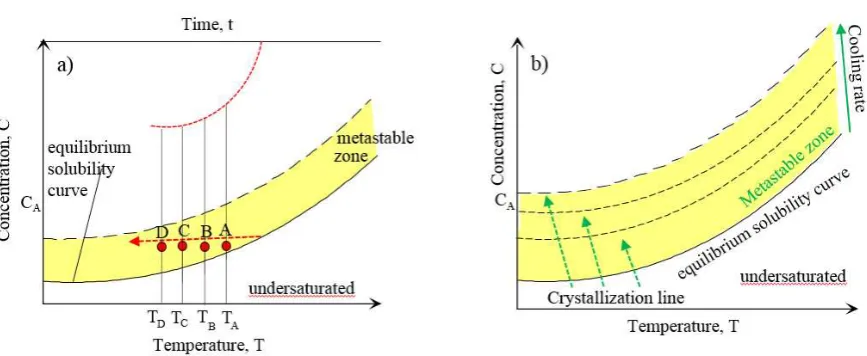
1. Comparative schemes for the isothermal or the polythermal method based on a
[image:4.595.80.514.159.337.2]concentration vs temperature profile
Fig. S1 Comparative scheme of the different approaches used to collect experimental data to assess nucleation kinetics based on a concentration vs temperature plot a) isothermal b) polythermal
2. Detailed derivation of the model equations, used to assess solution’s crystallisation
kinetics, from the Kolmogorov-Johnson-Mehl-Avrami expression
A detailed derivation of the set of expressions that conforms the approach is presented
below. Expressions for the dependence of critical undercooling on cooling rate are derived for
the cases of progressive and instantaneous nucleation mechanism from the
Kolmogorov-Johnson-Mehl-Avrami .
The approach makes use of a master equation presented by Kashchiev [37] that
describes the first-order transition nucleation process restricted to one component nucleation
In crystallisation of a single component the phase transformation kinetics can be explained by
the Kolmogorov-Johnson-Mehl-Avrami equation [37]. The central idea of this equation
is to focus on the increment in the fraction transformed and to relate it to the current value of
the fraction transformed. A conversion fraction of the crystallites´ volume is typically defined
as
(1)
where is the volume of crystallites and the total volume of solution
Estimating the dependence of the volume of crystallites on time from the master equation
is a complex mathematical challenge especially at the late stages of crystallisation when
multiple contacts between crystallites should be considered. To overcome this difficulty the
theory assumes that results from nucleation of material points at a rate which
then only expand irreversibly in radial direction with growth rate [37].Under this
assumption can be easily found at the early stage of crystallisation not long after the initial
moment when there is already a certain level of supersaturation, the whole volume of the
solution is available for nucleation and there is no contact between the growing crystallites.
The obtained formula limited to the early stage of nucleation shows that the progression
of the fraction of crystallised volume is controlled by two basic parameters of the process of
crystallisation: crystallite nucleation and growth rates [1, 2, 37].
In the case of progressive nucleation the formula can be expressed as [2, 37]
(2)
where and are time integration variables, is the time dependent rate of either homogeneous
or heterogeneous nucleation, is the time dependent radial crystallites´ growth rate,
is the dimensionality of crystallites´ growth i.e. 3 for spheres or cubes, 2 for disk or plates and
1 for needle shaped crystals, crystallites´ growth shape factor i.e. for spheres, 8
for cubes, for disks, for square plates ( is the fixed disk or plate thickness), and
for needles ( is the fixed needle cross-sectional area)
Starting at from the equilibrium temperature at steady cooling, relative undercooling
is defined as
(3)
where is the solution’s temperature
From classical nucleation theory the rate of crystallites nucleation can be expressed in terms
of relative undercooling as
where is the nucleation rate constant and the dimensionless thermodynamic parameter is
given by
(5)
where is the nuclei numerical shape factor i.e. for spherical nuclei and for cubic
nuclei, is the volume occupied by a solute molecule in the crystal, is the effective
interfacial tension of the crystal nucleus, is the molecular latent heat of crystallisation and
is the Boltzmann constant
In the same way the radial crystallite growth rate in terms of undercooling can be
expressed as
(6)
where is the crystal growth rate constant and and crystallites’ growth exponents.
for growth mediated by diffusion of solute and growth controlled by the presence
of screw dislocations in the crystallite. ranges between ½ and 1. for growth
controlled by undisturbed diffusion of solute and for growth by diffusion of solute
through a stagnant layer around the crystal and normal or spiral growth limited by transfer of
solute across the crystal/solution interface. At the crystallite radius increases linearly
(7)
Inserting equation (4) and (6) in equation (2) and defining and , can
be expressed in terms of undercooling
(8)
where the dimensionless parameter is given by
(9)
Equation (8) can be solved if the analysis is restricted to small enough values of satisfying
inequalities
(10)
then
and
(11)
(12)
Likewise, it has been shown [1, 2] that the inner integral in equation (12) can be solved for
small values of , satisfying
(13)
leading to
(14)
Additionally, it was observed [2] that the exponential term in the above equation is an
approximate of and thus equation (14) becomes
(15)
where the dimensionless parameter is given by
(16)
Equation (15) can be expressed in terms of the number of crystallites upon replacing by
and setting
(17)
where is obtained by making and is given by
(18)
If plots of and are constructed as a function of they show that and are monotonically
increasing functions of , with a sharp rise at a certain value that corresponds to the relative
critical undercooling for crystallisation [2] defined as
(19)
where
(20)
Here is the crystallisation temperature
For crystallites are so small or few that and cannot be detected or are below the
and will be detected and . This means is the maximum relative
undercooling that a solution can sustain without detectable crystallisation. In other words,
represents the solution metastability limit in terms of undercooling [1,2]. This limit, however,
depends on a number of parameters among which one of the most featured is the cooling rate
. With the help of the previously presented equations for and , the dependence
can be determined.
Expressing equation (17) it in terms of gives
(21)
Upon taking logarithms at both sides of equation (21) a model expression that relates relative
critical undercooling with cooling rate is obtained
(22)
Likewise, if the parameters , and are defined by
(23)
(24)
Then the latter equation becomes
(26)
When equation (26) is derived by means of the parameters , and are defined by
(27)
(28)
(29)
The parameters in equation (26) ln , and have a physical meaning. has a relation
with the crystallites growth as its values are determined by the growth exponents
and . is proportional or equal to the thermodynamic nucleation parameter and
has a relation with parameters of both nucleation and crystallite growth processes.
2.2 Instantaneous nucleation case
In the case of instantaneous nucleation a similar derivation was done [1]but taking into
the moment . Thus the change of the volume of crystallites with time will only depend on
the crystallites´ growth and can be expressed as
(30)
Where time integration variables, dimensionality of crystallite´s growth,
crystallite´s growth shape factor.
Using equation (6) and setting an expression for in terms of can be found
(31)
where the dimensionless parameter is given by
(32)
For small enough undercooling
(33)
and (34)
The integral in equation (31) can be solved leading to
(35)
In this expression is the relative undercooling at the time and is given by
(36)
Here is defined by
(37)
where is the solution temperature at the time
Likewise, is given by
(38)
As in the case of progressive nucleation is a monotonically increasing function of [1] with
a sharp rise at a certain value that corresponds to the relative critical undercooling .
Therefore defining and taking logarithms at both sides of equation (35), an
expression can be obtained for the dependence of relative critical undercooling on cooling rate
ln ln ln (39)
In this expression , and the parameter is given by
(40)
If additionally, the undercooling at which all nuclei spontaneously appear is small enough so
that
(41)
Equation (39) takes the form of a straight line given by
ln ln ln (42)
It should be noted that a comparison of equation (39), with the one obtained for derived by
means of , which is defined as
shows how the dependence of the relative critical undercooling on the cooling rate is
different depending of the mechanism by which nucleation takes place. In the case of the
expression contains parameters depending on both crystallites nucleation and growth whereas
in the case of the parameters in the expression are only related to the crystallite´s growth.
2.3 The nucleation rate
The nucleation rate given by expression (4) equates that given by 3D classical nucleation
theory expressed in terms of relative critical undercooling .
The classical theory equation for nucleation is given by expression (44)
exp (44)
Due to the drop of during cooling, changes primarily because of the strong temperature
dependence of the exponential factor. In this factor, is an exponential function of T which
can be approximated by the integrated van’t Hoff equation
. (45)
Here the reference solute concentration and the molecular latent heat of crystallisation are
weak functions of temperature and can be treated as T-independent. Since and equal their
(46)
and hence
(47)
where is the undercooling.
Thus combining equation (44) and (47) yields
exp (48)
3. Kerosene n-alkanes chain length distribution
Fig. S2 Kerosene n-alkane mass fraction distribution as obtained by 2D Gas Chromatography analysis performed by Infineum UK
4. Temperature calibration lines for the Crystal 16 unit
Temperature calibration lines for dodecane, kerosene and toluene solvents are provided below.
These are obtained by plotting the temperature at which the Crystal 16® is programmed against
the actual temperature of the solvent as measured by a calibrated thermocouple.
C6 C7 C8 C9 C10 C11 C12 C13 C14 C15 C16 C17 C18 C19
0 1 2 3 4
mass %
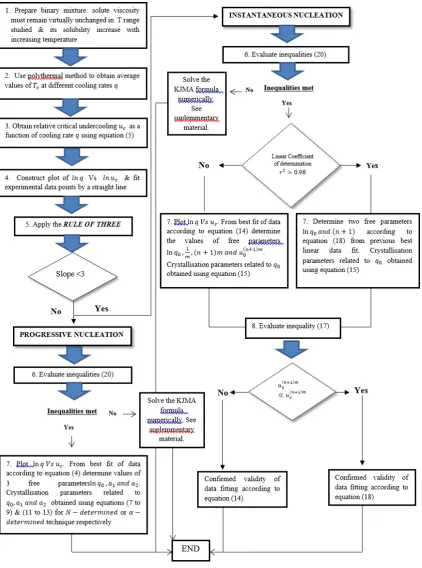
5. Flow chart describing how to apply the KBHR approach for the analysis of
[image:20.595.75.498.136.705.2]nucleation kinetics from polythermal experimental data
6. Experimental crystallisation and dissolution temperatures as a function
of cooling rate
Table S1. Average dissolution and crystallisation temperatures as a function of cooling rate for methyl stearate in dodecane, kerosene and toluene at solution concentrations 200, 250, 300 and 350 g/L of solvent for the first two solvents and 154, 192, 231 and 269 g/L of solvent for toluene. Standard deviation of crystallisation and dissolution temperatures. Relative critical undercooling calculated according to equation (5). Equilibrium temperatures obtained from extrapolation of best-fit straight lines through data points
Rate /min
dodecane 200
0.25 15.81 0.19 19.67 0.11 0.010
1 15.03 0.10 20.71 0.10 0.013
3.2 13.61 0.48 23.47 0.26 0.017
9 10.86 0.04 35.37 0.10 0.027
= 18.70 250
0.25 17.43 0.28 22.19 0.10 0.012
1 16.82 0.36 22.80 0.10 0.015
3.2 15.45 0.30 25.30 0.33 0.019
9 12.88 0.55 36.36 0.41 0.028
= 21.09 300
0.25 18.84 0.26 23.04 0.11 0.011
1 18.56 0.13 23.94 0.20 0.012
3.2 17.15 0.18 26.29 0.22 0.017
9 14.56 0.31 36.72 0.10 0.026
= 22.18 350
0.25 19.76 0.14 24.18 0.10 0.015
1 19.18 0.26 25.49 0.26 0.017
3.2 17.90 0.21 29.22 1.02 0.021
9 14.67 0.43 36.85 0.06 0.032
= 24.12 Kerosene
200
0.25 12.43 0.66 17.66 0.07 0.017
1 11.76 0.96 18.67 0.09 0.019
3.2 10.11 0.59 22.11 0.15 0.025
9 7.66 0.38 30.75 0.49 0.033
=17.25 250
0.25 15.37 0.47 19.54 0.05 0.013
1 14.85 0.50 20.67 0.11 0.015
[image:21.595.74.526.199.767.2]9 9.98 0.50 33.47 0.63 0.032 = 19.21
300
0.25 16.73 0.45 21.03 0.04 0.014
1 15.53 0.46 22.34 0.17 0.018
3.2 13.91 0.36 27.02 0.46 0.024
9 11.24 0.35 36.01 0.97 0.033
= 20.86 350
0.25 17.81 0.56 22.19 0.11 0.014
1 16.95 0.16 23.65 0.23 0.017
3.2 15.28 0.57 28.18 0.73 0.023
9 11.90 0.07 37.58 1.09 0.034
= 22.01 Toluene
154
0.25 -2.39 1.48 2.17 0.09 0.016
0.5 -3.69 1.56 2.42 0.19 0.020
1 -3.02 0.92 3.01 0.18 0.018
1.5 -4.11 1.08 3.51 0.05 0.022
= 1.90 192
0.25 -0.10 1.79 4.48 0.11 0.016
0.5 -0.65 1.02 5.09 0.07 0.018
1 -0.83 1.46 5.47 0.12 0.019
1.5 -1.42 0.93 5.97 0.14 0.021
= 4.36 231
0.25 1.06 1.16 6.20 0.09 0.018
0.5 0.78 0.96 7.13 0.09 0.019
1 0.30 1.07 7.71 0.09 0.018
1.5 0.13 0.63 8.39 0.09 0.022
= 6.04 269
0.25 2.92 0.50 7.69 0.10 0.016
0.5 3.03 0.46 8.79 0.10 0.016
1 2.34 0.55 9.39 0.10 0.018
1.5 1.85 0.61 10.26 0.08 0.020
7. Comparative plots of nucleation kinetic parameters for methyl stearate
crystallising from dodecane, kerosene and toluene solvents
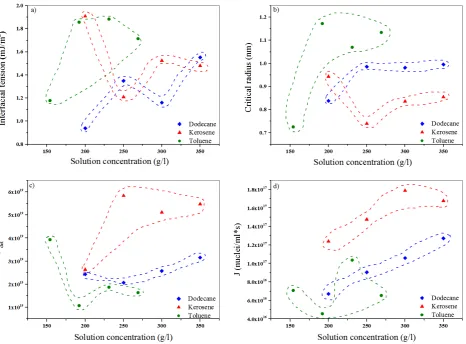
Fig. S5 shows the results for each of the nucleation parameters obtained as a function of solvent
and solution concentration at the corresponding experimental crystallisation temperatures i.e.
the crystallisation temperatures obtained from the extrapolated lines to 0°C/min for the
dependence of crystallisation temperature on cooling rate , at each of the chosen
solutions’ concentrations.
Given that these plots are not obtained at iso-supersaturation values they can be used to perform
only an initial screening of the behaviour of methyl stearate nucleation as a function of
crystallisation environment. From the engineering point of view Fig S5. shows practically the
impact of solution environment on nucleation parameters at the experimental crystallisation
temperatures e.g. that interfacial tensions are higher in toluene, which has a direct impact on
Fig. S5 Comparison of nucleation kinetics parameters for methyl stearate crystallising from dodecane, kerosene and toluene solvents at different solution concentrations. a) interfacial tension ; b) critical radious r* ; c) number of crystals