White Rose Research Online URL for this paper: http://eprints.whiterose.ac.uk/85562/
Version: Accepted Version Article:
Austin, Gavin, Pongpairoj, Nattama and Trenkic, Danijela orcid.org/0000-0001-6340-6030 (2015) Structural competition in second language production : towards a
constraint-satisfaction model. Language Learning. pp. 689-722. ISSN 0023-8333 https://doi.org/10.1111/lang.12108
[email protected] https://eprints.whiterose.ac.uk/
Reuse
Items deposited in White Rose Research Online are protected by copyright, with all rights reserved unless indicated otherwise. They may be downloaded and/or printed for private study, or other acts as permitted by national copyright laws. The publisher or other rights holders may allow further reproduction and re-use of the full text version. This is indicated by the licence information on the White Rose Research Online record for the item.
Takedown
If you consider content in White Rose Research Online to be in breach of UK law, please notify us by
RUNNING HEAD: Structural competition in L2 production
Structural competition in second language production: Towards a constraint-satisfaction model*
This paper is published in Language Learning as:
Austin, G., Pongpairoj, N. and Trenkic, D. (2015), Structural competition in second language production: Towards a constraint-satisfaction model. Language Learning, 65(3), 689–722. doi: 10.1111/lang.12108
Gavin Austin, University of Southern Queensland, Australia Nattama Pongpairoj, Chulalongkorn University, Thailand Danijela Trenkic, University of York, UK
* This research was supported by the University of York and by National Research
University Project, Office of Higher Education Commission in Thailand (WCU-068-HS-57). We wish to thank Jelena Mirkovic for useful discussions, Heather Goad for advice on
phonological matters and Leah Roberts for help on statistics. We are grateful to Annie Clarke for her assistance in recruiting and testing the participants. Versions of this paper were
presented at the 9th International Symposium on Bilingualism (ISB 9) and the 22nd Annual Conference of the European Second Language Association (EUROSLA 22). We thank the audiences at these meetings for their constructive suggestions. We also thank the anonymous reviewers for their helpful feedback and to the editor for his thorough guidance in revising the manuscript. All remaining errors are our own.
Address for correspondence: Danijela Trenkic
Department of Education University of York York, YO10 5DD United Kingdom
Structural competition in second language production:
Towards a constraint-satisfaction model
Structural competition in second language production:
Towards a constraint-satisfaction model
Abstract
Second language (L2) learners often show inconsistent production of some aspects of L2
grammar. One view, primarily based on data from L2 article production, suggests that L1-
and L2-licensed grammatical patterns compete for selection leading to variability in L2
functional morphology production (Trenkic, 2009). Here we show that the idea of structural
competition has broader applicability, in correctly predicting certain asymmetries in the
production of both the and plural -s by Thai learners of English. At the same time, we
recognise that learners’ growing sensitivity to structural regularities in the L2 might be an
additional contributing factor, and therefore make a novel proposal for how the L1-L2
structural competition model and the sensitivity-to-L2-structural regularities account could be
integrated and their respective contributions studied under the constraint-satisfaction model
of language processing (Trueswell & Tanenhaus, 1994). We argue that this approach is
particularly suited to studying bilingual processing as it provides a natural framework for
explaining how highly disparate factors, including partially activated options from both
Introduction
Late second language (L2) learners often find mastering the grammar of another
language to be a difficult task (DeKeyser, 2005; Johnson & Newport, 1989). Inconsistent
production of at least some aspects of grammar may persist even after years of L2 learning
and of daily use (Han, 2009; Lardiere, 2009; White, 2003). One of the central tasks of L2
research is to explain why learning and using L2 grammar poses such a challenge. A factor
that is often shown to have a contributing effect on L2 production, and the one we focus on in
this study, concerns the properties of the learner’s first language (L1) (e.g., Luk & Shirai,
2009). In this paper, we explore the issue of variable production of L2 functional morphology
by focusing on two grammatical properties of the English nominal phrase: the use of the
definite article (the), and of the regular plural (formed by adding –s to the singular form of a
noun, e.g., cats). We study their production by Thai learners, an L2 population whose L1
lacks both articles and nominal plural marking.
The point of departure for our study was an explanation for variability in L2 functional
morphology production which takes L1 transfer as an important factor, and has stemmed
from studying L2 article use. Trenkic (2009) and Trenkic and Pongpairoj (2013) suggest that,
for L2 learners from article-lacking L1 backgrounds, the L2-licensed (Art + N) and
L1-licensed (bare noun) forms of a target noun-phrase (NP) compete with each other for
selection, and that this competition leads to variability in production. Particularly, in
cognitively more demanding contexts, the more established (i.e., article-less) form of the NP
will be more likely to be selected.
In this study, we investigated the possibility that the idea of competition between forms
of a target NP might have broader applicability. Our specific objective was to determine if the
plurals as well as definite articles, when the L1 lacks grammatical markers for both of these
properties.
The problem: articles and plurals
In English and many other languages, nouns must be marked for plurality whenever
reference involves more than one entity (as in the contrast A cat is hungry vs. Cats are
hungry). When reference is to a singular countable entity, the noun must be preceded by an
article (a/the); when the referent exists and is unique in a domain mutually manifest to
speaker and hearer, a definite article must precede the noun (The cat is hungry vs. A cat is
hungry).
A large number of studies have explored variability in the production of articles and
plurals in L2 English (see below). This interest has arisen for several reasons. Nominals
needing marking for definiteness and/or number occur in most, if not all, sentences in
English, creating contexts in which errors in L2 production can, and do, frequently occur.
Thus, understanding the mechanisms by which L2 articles and plurals are produced is an
important component of understanding L2 production more generally, and, by implication,
the knowledge that is involved in it. Moreover, how articles and plurals are acquired and
produced by L2 users is relevant to several contentious issues within the study of L2
acquisition, including the extent of L1 influence and whether a recovery from L1 transfer is
ever possible.
Many languages lack grammatical markers of definiteness or number (or both), and
previous research suggests that learners from these L1 populations experience more problems
with English articles and/or plurals than learners whose L1s mark these concepts
broader range of functional morphemes are acquired, Luk and Shirai (2009) show that
English learners from L1s which do not mark definiteness and plural, such as Chinese,
Japanese and Korean, acquire these grammatical morphemes later than Spanish learners of
English, whose L1 does mark these categories, and later than the ‘natural order’ hypothesis
(Krashen, 1977) would predict. Other studies that directly compared L2 populations with and
without articles/plurals in their L1s reveal essentially the same findings. All other variables
being equal, learners from article-lacking L1s seem to produce English articles less
consistently than learners from L1s that have an article system, and the same holds for plural
marking when comparing learners whose L1s do not grammatically mark plural on nouns
with learners whose L1s do (for articles, see the comparison of Chinese and Spanish learners
in Díez-Bedmar & Papp, 2008; Finnish and Swedish in Jarvis, 2002, and Ringbom, 1987;
Japanese and Spanish in Snape, 2006; Russian and Spanish in Chrabaszcz & Jiang, 2014;
Thai and French in Pongpairoj, 2008, and Pongpairoj & Trenkic, 2013; for plurals, see the
comparison of Chinese [no plural] and Czech and Polish [plural L1s] learners in Young,
1991).
Finally, the sheer number of studies that document article and plural difficulties of L2
populations that do not have these categories in their L1s speaks for itself (for articles, see
Leung, 2002, Robertson, 2000, and Tryzna, 2009, for L1 Chinese; Žegarac, 2004, for Croatian; Young, 1995, for Czech; Butler, 2002, Hakuta, 1976, and Kuribara, 1999, for
Japanese; Ionin, Ko & Wexler, 2004, for Korean and Russian; Avery & Radišić, 2007 and Trenkic 2002, 2004, 2007, for Serbian; for plurals, see Bialystok & Miller, 1999, Bliss, 2006,
Jia, 2003, Jiang, 2004, Johnson & Newport, 1989, Lardiere, 2009, and Young, 1988, for L1
Chinese; Austin, 2014, and Yeni-Komshian, Robbins & Flege, 2001, for L1 Korean; Mellow
& Cumming, 1994, for L1 Japanese; Charter, Dao & Jensen, 2012, and Dao, 2007, for L1
production of L2 populations that have corresponding systems in their L1s – and when they did, far fewer problems were identified (e.g., García-Mayo, 2009).
In sum, the available literature strongly suggests that L2 production of English articles
and plurals is negatively affected by the absence of corresponding markers in the L1. The aim
of the present study was to explore the mechanisms that underpin this production
disadvantage, in the hope that it may contribute to a better understanding of L2 functional
morphology more generally. In the next section, we look at one particular account of
variability in the production of L2 functional morphology with specific reference to L2 article
production, which serves as a departure point for our study.
The L1-L2 structural competition account
Two basic theoretical assumptions underlie our research. First, language learning
involves both contingency learning of constructions that relate meanings which are to be
expressed to forms that express them and learning of the strength of these associations. On
this view, grammars emerge through “piecemeal learning of many thousands of constructions and the frequency-based abstractions of regularities within them” (Ellis, 2004, p. 51).
Second, two languages in a bilingual speaker are often simultaneously activated and
compete for selection, even when only one language is used. This language non-selectivity
has been predominantly demonstrated in lexical processing (Gollan, Montoya, Cera &
Sandoval, 2008; Kroll & Steward, 1994; Marian & Spivey, 2003; Weber & Cutler, 2006), but
some recent research also suggests parallel activation of syntactic structures in bilingual
processing, both in comprehension (Sanoudaki & Thierry, 2014) and in production
(Runkqvist, Gollan, Costa & Ferreira, 2013). Earlier research on cross-linguistic priming
Christianson, 2009) and transfer in sentence processing (MacWhinney, 2005) lends further
support for L1-L2 structural co-activation in on-line processing.
In a series of publications, Trenkic and collaborators extend the idea of
cross-linguistic competition to morphosyntax (Trenkic, 2009; Trenkic & Pongpairoj, 2013;
Trenkic, Mirković & Altmann, 2014). Their model argues that variability in L2 article
production stems directly from structural competition between L1- and L2-licensed forms for
encoding referential expressions. For example, in reference to a uniquely identifiable
countable referent, for L2 speakers of English from L1 backgrounds where bare nominals can
be used, there will be competition in production between the well-established L1-licensed
bare N structure and the newly-learned L2-licensed Art + N structure (e.g., between cat and
the cat). In other words, even though these learners may have formed a new, L2-licensed
association that maps identifiable countable referents onto the Art + N structure in English,
the strength of this association will suffer because of an already existing, L1-licensed
association of identifiable countable referents with bare nominals, with which it competes in
production. This competition between the L1- and L2-structures leads to variability:
sometimes the L2-appropriate Art + N option will be selected, while at other times the
L1-appropriate bare nominal structure will be used.
The model also predicts that when cognitive resources are depleted by concurrent task
demands, the L1-licensed (i.e., article-less) form of the NP will be more likely to be selected
than in less demanding contexts. Because more entrenched L1-licensed options can easily
override newly-established L2 alternatives, L1-licensed options need inhibiting in production
so that the correct option can be selected – a process which requires cognitive resources. The
suppress the unwanted, L1-licensed competitors.1 Finally, the model stipulates that the
knock-on effect of this competition, and of the premium it puts on cognitive resources, is
difficulty in integrating syntactic (Is an article required?) and pragmatic (Is this article
appropriate in the context?) information. This means that the L1-L2 competition leads not
only to article omission but to inconsistent article choices as well, for instance, in the form of
substitution errors (see Trenkic, 2009, for an extended discussion).
The structural competition model straightforwardly explains some well-attested
patterns of L2 article production from previous literature, including the tendency for articles
to be omitted more when a noun is premodified by an adjective (Art + Adj + N; e.g., the
white cat) than in non-modified noun phrases (Art + N; e.g., the cat) (Goad & White, 2004;
Jarvis, 2002; Pongpairoj, 2008; Sharma, 2005; Snape, 2006; Trenkic, 2002, 2007, 2009;
Young, 1995). In the model, as a sequence with an extra element, Art + Adj + N requires
more processing resources than the simpler Art + N structure, leaving fewer resources
available for suppressing the article-less L1 alternative. Consequently, the probability of
selecting this alternative (i.e., dropping an article) is higher in the Art + Adj + N context than
in the simpler Art + N one, all other things being equal.
The structural competition model (as outlined above) could be used to make further
predictions both for L2 article production and for other functional morphemes. For example,
if a higher rate of article omissions in Art + Adj + N contexts, compared to Art + N contexts,
is due to the structural complexity of the former, making the L1-override more difficult, one
1 Thomson-Schill and colleagues document the competition/selection issue in the domain of lexical access in
monolingual language processing (e.g., Bedny, Hulbert & Thompson-Schill, 2006; Kan & Thompson-Schill,
2004; Thompson-Schill, D’Esposito, Aguirre & Farah, 1997). The cases where several possible contenders for
production exist require greater inhibition, so that all but one option may be selected from the cluster. Thus,
larger sets of items lead to more exaggerated response times and, crucially, to greater involvement of inhibitory
would expect to see a higher rate of article omissions in other structurally complex contexts.
One obvious feature of a noun phrase that presents itself as a way to manipulate its
complexity is nominal number (singular vs. plural). Here, the extra element is another
functional morpheme rather than a lexical item. So, to further test the predictions of the
L1-L2 structural competition model, the current study compared the rate of article omissions
between definite singular NPs (Art + N) and definite plural NPs (Art + N + s). As the
structure that overtly encodes two grammatical concepts, the definite plural is a more
complex form than the definite singular, which grammatically marks only one concept, so a
higher rate of article omissions could be expected as L2 users produce plural than singular
targets.
Furthermore, as definite plurals are contexts that combine two functional morphemes,
they provide an opportunity to test the broader applicability of the model by extending its
prediction to the plural-marking morpheme -s. More specifically, if competition between L1-
and L2-licensed forms explains variability in the production of L2 functional morphology
more generally, one would expect a higher rate of plural omissions in (structurally more
complex) definite plurals (Art + N + s) compared to non-definite plurals (N + s), for L2 users
whose L1 does not obligatorily mark nominal number. These two predictions, ensuing from
the model developed in Trenkic and Pongpairoj (2013) and Trenkic et al. (2014), were the
focus of the current investigation.2
2Throughout the rest of this paper, unless otherwise specified, we use the term ‘article’ to refer only to the
definite article. There is no need to specify the article type here since an article and a plural marking can only
Method
Participants
Twenty intermediate Thai learners of English (15 female, 5 male) participated in this
study. Their English proficiency was determined using the Oxford Placement Test (OPT;
Allan, 2004). In addition, six age-matched native English-speaking participants (5 female, 1
male) acted as controls. Because the experiment was based on certain assumptions about the
production of articles and plurals by native speakers, the use of a control group enabled us to
confirm that these assumptions were well-founded. The Thai participants were students at
Chulalongkorn University, while the native English speakers were students at the University
of York. The Thai participants’ history of learning English and their achieved English
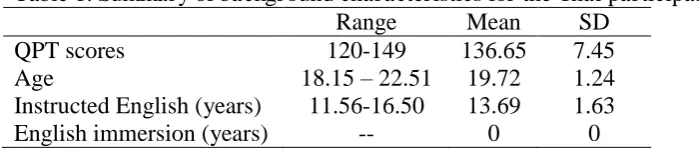
[image:11.595.65.415.455.531.2]proficiency are summarised in Table 1.
Table 1. Summary of background characteristics for the Thai participants.
Range Mean SD
QPT scores 120-149 136.65 7.45
Age 18.15 – 22.51 19.72 1.24
Instructed English (years) 11.56-16.50 13.69 1.63
English immersion (years) -- 0 0
Materials
Twelve short stories were created, illustrated in examples (1) and (2), with the full set
of materials provided in the appendix. Text (1) contains one definite-singular target (i.e., the
drum), and one definite-plural target (i.e., the trucks); text (2) contains one definite-plural
(1) Jenny went to a toy shop to buy presents for her son. First of all, she purchased a
drum which was made in Korea. A shop assistant wrapped it for her in colourful
paper. Jenny bought the drum for her son because he likes music. After that, she
bought four trucks for him to play with as well. She chose them because he loves
playing with toy vehicles. Jenny put the trucks very carefully into a lovely bag. But
her son didn’t like anything that she had bought for him.
(2)Billy used to work as a dishwasher in a large restaurant. Late one evening, he washed
six pans for his boss quite badly. After that, he dried them extremely carelessly as
well. Then he dropped the pans very loudly and made a huge mess. His boss was
really furious with him and fired him at once. So Billy had to find another way to
make a living. Nowadays he sells planes from Russia and earns lots of money. He’s
glad he doesn’t work as a dishwasher anymore.
All story texts were 81-90 words in length, each comprised of eight sentences. Each
sentence contained 14-16 syllables. Twenty-four target NPs across three conditions – 8 bare plurals, 8 definite singulars and 8 definite plurals – were interspersed within the 12 stories (e.g., the drum, the trucks, the pans and planes in the above examples). The target NPs were
neither pre- nor post-modified. Together, these 24 NPs provided contexts for the production
of 8 definite articles in singular and 8 in plural contexts, as well as 8 plurals with definite and
8 plurals with non-definite NPs.
The target nouns referred to countable, concrete and easily imageable entities. They
were all monosyllabic and orthographically short. Fifteen had a CVC syllable structure (e.g.,
cat), six were CCV(C) (e.g., drum, tree), and three had a (C)CVVC structure (e.g., plate,
Thai,3 which reduced the likelihood of pronunciation problems with the target nouns. Special
care was taken to ensure that none of the target nouns was an English loanword in Thai, as
frequent use of a loanword without an article or plural marker in Thai might be expected to
suppress the suppliance of functional morphology with such nouns in English. Low
frequency words were avoided,4 and all words were deemed likely to be familiar to the
participants by a native speaker of Thai working on a daily basis with this population.
Each target NP was located post-verbally, ensuring consistency of position across
conditions. The number of syllables preceding each target in the sentence in which it
occurred was also controlled for. Thus, there were 2-7 syllables before each bare-plural target
(M = 3.88, SD = 1.73), 2-6 syllables before each definite-plural target (M = 3.75, SD = 1.49)
and 2-7 syllables before each definite-singular target (M = 3.75, SD = 1.67). A one-way
ANOVA confirmed that there were no differences between the conditions, F(2, 23) = .016, p
> .05, vis-à-vis the number of syllables which preceded the target. The number of bare
(article-less) NPs was also balanced across texts to minimise the likelihood of a negative
priming effect on article production in the targets. The mean number of article-less lexical
NPs in the texts in which definite singular targets appeared was 5.00 (SD= 1.60), and in the
texts containing definite plural targets 4.63 (SD = 1.85). There was no statistical difference
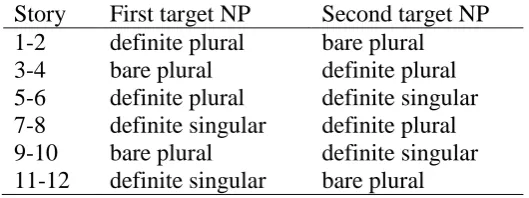
between the two means, t(14) = .43; p > .05. Each story contained two target NPs, and they
were distributed in a counterbalanced fashion. Table 2 shows the ordering of target NPs
within and across the story texts.
3 Although the templates shown here generated all of the target nouns used in the experiment, they do not
generate all possible syllables in Thai (see Iwasaki & Ingkaphirom, 2005, for further information about syllable
structure in this language).
4To determine word frequency, we used the list of frequencies per million words in the SUBTLEX
US database
(see http://expsy.ugent.be/subtlexus/). The values for the target nouns ranged from 3.55 (for pots) to 213.20 (for
Table 2. Counterbalancing of target NP types across texts.
Story First target NP Second target NP
1-2 definite plural bare plural
3-4 bare plural definite plural
5-6 definite plural definite singular 7-8 definite singular definite plural
9-10 bare plural definite singular
11-12 definite singular bare plural
Each of the definite targets was the third mention of the referent in the text. Two
slightly different approaches were employed depending on whether the target was singular or
plural. For singular targets, the referent was introduced into the discourse via an indefinite NP
(e.g., a drum). Then, in the following sentence, this referent was expressed as a pronoun (e.g.,
it). In the sentence after that, the referent was relexicalised as a noun within the target (e.g.,
the drum). For plural targets, a numeral plus plural noun was used and then a pronoun, before
the referent was relexicalised as a noun (e.g., four trucks … them … the trucks). The second
mention was added to each of these lexical chains for the sake of discourse naturalness;
generally speaking, there is rarely a discourse-pragmatic motivation for relexicalising a
referent as a noun on its second mention.
For plural targets, each item was situated immediately before a word beginning with
either [f] or [v], as in trucks very. As Thai does not have words ending with two or more
consonants, the absence of final consonant clusters in the L1 may inhibit learners’ production
of the plural -s in a word such as trucks ([t ks]), resulting in plural omissions (cf. Lardiere,
2003, showing omission of tense inflection in L2 English). However, such a ban on final
consonant clusters can be circumvented if the inflection occurs in an environment in which it
can be resyllabified as the onset of the following syllable (Goad, White & Steele, 2003). For
example, if trucks is followed by the preposition in, Thai learners of English may resyllabify
In a context in which resyllabification is possible, one might therefore expect an increase in
inflectional suppliance rate compared to a context in which this process is not possible. But
resyllabification of inflection is not guaranteed to occur in an environment in which it can
occur theoretically; in fact, resyllabification may depend on non-linguistic factors, such as a
speaker’s fluency. In light of this uncertainty, it seemed preferable to simply block
resyllabification in all contexts by ensuring that plural targets were consistently located in an
environment in which inflectional -s could not be resyllabified.5 For L1 Thai/L2 English
learners, resyllabification can be blocked by locating each plural target before [f] or [v] (e.g.,
trucks very [t ks.v ]), since the onset [sf] or [sv], respectively, is illicit or rare in both
English and Thai.6
To minimise any effect of presentation order, two semi-randomised orderings of the
12 experimental stories were created (lists A and B). These two versions were given to equal
numbers of participants in each group. Additionally, two warm-up texts were included, which
were similar in length and structure to the experimental texts. They served to familiarise
participants with the tasks.
Tasks
Two oral tasks were used to elicit the data: keyword-prompted story recall and
elicited imitation (sentence repetition). Both tasks focused on spoken production only. In the
story recall task, participants were asked to retell the story they had read and heard using
written keywords as prompts. For the most part, only content words (in particular, nouns,
5 Another way is to locate each of these targets directly before a pause. We did not use this strategy in the
present experiment.
verbs and adjectives) from the text were used; however, a preposition, particle or personal
pronoun was retained if its omission could cause confusion. Each line corresponded to one
sentence in the story; the items in the line appeared in the order in which they occurred in that
sentence. All of the nouns or verbs in the stories were used in their bare forms. This approach
seemed appropriate given that we were interested in the production of functional morphology
in obligatory contexts. These design features are exemplified in (3) using keywords which
correspond to the sample text in (1).
(3) • Jenny / go / toy shop / to buy / present / her son
• first of all / she / purchase / drum / which / made / Korea • shop assistant / wrap / it / for / her / colourful paper
• Jenny / buy / drum / for / her son / because / he / like / music
• after that / she / buy / four / truck / for / him / to play / with / as well
• she / choose / them / because / he / love / playing / toy vehicle
• Jenny / put / truck / very carefully / lovely bag
• but / her son / do / not / like / anything / that / she / buy / for / him
In the elicited imitation task, participants were played all sentences from the story,
one sentence at a time, and were asked to repeat each sentence back. The sentence length of
14-16 syllables was intended to prevent participants from being able to merely “echo” the sentence without parsing it structurally (Gass & Mackey, 2005), and to push them instead to
regenerate the sentence using normal sentence production mechanisms (Potter & Lombardi,
1998). The two tasks were used for triangulation purposes: when the same effect is found in
more than one task, one can be more confident in the results. Using more than one task also
reduced the possibility that a real effect may be missed, since not every task is equally good
Procedure
Thai learners of English were screened for proficiency on the basis of their OPT
performance. Only those scoring in the lower- (120-134) or upper-intermediate (135-149)
ranges were selected for the study. The story-texts were presented through a PowerPoint
slideshow on a computer that the participants controlled. The audio input was presented via
headphones, apart from a warm-up story, when it was presented via loudspeakers so that the
experimenter could check that each participant had understood the instructions correctly. The
participants’ spoken production was recorded using the freeware application Audacity and a
high-quality microphone. The participants read the instructions and had a practice run using a
warm-up story. They were instructed to read each story text once, after which they heard the
same text while reading along silently again. After being familiarised with the story in this
way, the participants were presented with the keywords and instructed to use them to retell
the story orally (story recall task). The keywords had to be used in the order in which they
appeared. The participants were asked to imagine that they were telling the story to someone
who had never heard it before. Finally, each sentence from the story was played individually,
and the participants were asked to repeat it back (elicited imitation task).
For the Thai participants, all written instructions for the task procedure were
presented in Thai. Additionally, even though the stories were constructed using vocabulary
which was deemed likely to be familiar to this population, the target nouns (two for each
story), along with 5-7 others, were presented with Thai translations before each story. For
example, for the text shown in (1), the vocabulary list contained vehicle, loud, drum, truck
and Korea.The entries in each list were semi-randomly reordered with respect to their actual
locations in the text. The participants were given one minute to read the entries, listen to
All participants were tested in two sessions. In both sessions, they heard a warm-up
story and six experimental texts. To reduce the risk of fatigue, three short breaks were
incorporated into each session after experimental stories one, three and five. Each session
was completed in about 35-40 minutes by the Thai participants and in about 30-35 minutes
by the native English speakers. In session one, the participants also completed a language
background questionnaire; at the end of session two, the Thai participants were invited to
comment on whether they found any part of the task particularly easy or difficult, or provide
any other feedback. All the participants were tested individually in a quiet room. They were
paid for their participation.
Scoring and analysis
The data was transcribed and statistically analysed. Two aspects of the transcription
procedure must be mentioned briefly. Whenever a participant self-corrected an utterance,
only the self-corrected version of the utterance was retained; and mispronunciations of the
targets were disregarded if it seemed unlikely that these errors could have had a significant
impact on how the target nouns were inflected (e.g., plans for pans).
For the purpose of calculating omission rates, we focused only on the opposition
between “functional morpheme supplied” with target referents and “functional morpheme omitted”. In the bare plural and definite singular conditions, each of which requires only one functional morpheme, participants could either produce or omit the required morpheme (i.e.,
two different NP patterns). With definite plurals, where two functional morphemes are
needed, participants could either supply both morphemes, omit both, or supply one or the
other, but not both (i.e., four different NP patterns). We were interested in comparing how
often the participants omitted the in reference to conceptually singular targets with how often
omissions, irrespective of whether the plural was actually marked (i.e., combining Ns and N
patterns in reference to plural targets). Similarly, we compared the omission rates of the
plural morpheme -s with indefinite (bare) plurals and with definite plurals, irrespective of
whether the article was supplied with definite plurals (i.e., combining the N and N patterns in
reference to plural targets). Trials which resulted in errors other than omission (e.g.,
substitution errors, such as a lake for the lake) or where an appropriate but non-target
structure was produced (e.g., her gun for the gun) were excluded from the analysis, as our
predictions did not concern determiner substitution cases. This resulted in the exclusion of
10.16% of trials in the elicited imitation task and of 6.41% of trials in the story-recall task for
the Thai group.
Predictions
We expected that Thai learners of English would supply functional morphology less
consistently in structurally more than structurally less complex contexts. Specifically, our
predictions were:
(1) articles will be omitted at a higher rate in plural target NPs than in
definite-singular target NPs; and
(2) plurals will be omitted at a higher rate in definite-plural target NPs than in bare-plural
target NPs.
These patterns were expected in both tasks, irrespective of the overall suppliance rates for
articles and plurals.7
7 Comparing the overall suppliance of articles and plural morphology was not the focus of our research.
Results
Native speakers of English
The native speakers supplied all articles and plurals accurately in all conditions. This
suggests that any article and plural omissions in the speech of the Thai participants were
highly unlikely to reflect any particular properties of the tasks themselves and could be safely
attributed to L2-specific factors instead. Because the native speaker data in this experiment
only served to control for possible task effects, these data will not be discussed any further.
Thai learners of English
Table 3 summarises the percentage of trials in which the Thai participants omitted the
definite article and plural-s in reference to targets in the elicited imitation and the story-recall
[image:20.595.64.487.570.642.2]tasks.
Table 3. Mean values of omission errors (standard deviations in parentheses) in the
story-recall and elicited imitation tasks
Target Story recall Elicited imitation
the-omission in Definite Singular (the N) 36.64 (28.20) 5.48 (10.13) the-omission in Definite Plural (the Ns) 51.79 (31.95) 5.14 (7.35) -s omission in indefinite (bare) plural (Ns) 41.25 (29.55) 39.55 (24.98) -s omission in Definite Plural (the Ns) 39.61 (28.96) 54.25 (26.15)
evidence that production of high-frequency grammatical structures is less adversely affected by competition in
bilingual processing than production of low frequency structures (Runqvist, Gollan, Costa & Ferreira, 2013) and
Figure 1 illustrates article omissions in definite singular versus definite plural contexts
in the two tasks. Performance in the elicited imitation task appeared to be at ceiling for both
singular and plural targets, with a very low omission rate (5.14% and 5.48%, respectively).
However, performance in the story-recall task was more variable, and in line with our first
prediction: Thai learners of English were omitting definite articles more often with plural
(51.79%) than with singular targets (36.64%).
Figure 1. Thai learners’ of English article omission in simpler (i.e., singular NP) and more complex (i.e., plural NP) contexts in the story-recall and the elicited imitation tasks. The error
[image:21.595.86.315.258.461.2]bars represent standard error (SE).
Figure 2 summarises the results for plural omission by Thai learners of English in the
two tasks. Unlike article production, plural suppliance appeared well below ceiling levels in
both the story-recall and the elicited imitation tasks, with omissions of at least 40% in all
conditions. No discernible difference between plural omissions in definite and indefinite
contexts was observed in the story-recall task (39.55% and 41.25%, respectively). However, 0 10 20 30 40 50 60 70 80 90 100
story recall elicited imitation
a r t ic le o m is s io n %
in line with our second prediction, the plural morpheme was omitted at a higher rate in
[image:22.595.86.312.135.338.2]definite (54.25%) than indefinite contexts (39.61%) in the elicited imitation task.
Figure 2. Thai learners’ of English plural -s omission in simpler (indefinite, i.e., bare NP) and
more complex (definite NP) contexts in the story-recall and the elicited imitation tasks. The
error bars represent standard error (SE).
For the purpose of data analysis, we ran a series of mixed-effect logistic regression
models, using the lme4 package in R version 2.11.0. 8 The random effect structure included
two random effect factors, participant and item, with random intercepts. Contrast coding was
used for the fixed effects, with grammatical morpheme production rates (“supplied” and
“omitted”) as the outcome variable. The model included a predictor variable, which was the
structural complexity of the context in which the grammatical morpheme should appear (“less
8 Mixed-effects logistic regression techniques are particularly suited to use with outcome variables that are
binary, such as in the current study, and to use with both categorical and continuous predictor variables (see
Baayen, 2008; Baayen, Davison & Bates, 2008; Bresnan, Cueni, Nikitina & Baayen, 2007; Jaeger, 2008;
Narasimhan & Dimroth, 2008). The same results were obtained in a repeated-measure ANOVA.
0 10 20 30 40 50 60 70 80 90 100
story recall elicited imitation
p lu r a l -s o m is si o n % simple (Ns)
complex” vs. “more complex”). As items were presented to participants in two different
[image:23.595.67.537.197.391.2]semi-randomised orders (lists A and B), list was also entered as a control variable.9
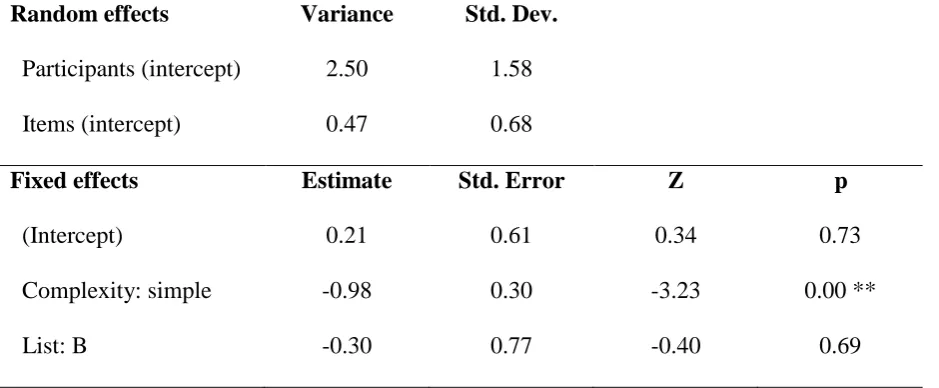
Table 4. Coefficients for a logistic mixed-effects regression model fitted to the article
omission data in the story-recall task (Thai learners of English).
Random effects Variance Std. Dev.
Participants (intercept) 2.50 1.58
Items (intercept) 0.47 0.68
Fixed effects Estimate Std. Error Z p
(Intercept) 0.21 0.61 0.34 0.73
Complexity: simple -0.98 0.30 -3.23 0.00 **
List: B -0.30 0.77 -0.40 0.69
Note. Reference levels are complex for Complexity and list A for List.
Table 4 summarises the results of the analysis for the article data from the story-recall
task, with model coefficients reported under the heading “Estimate”. The values of standard
errors provide an indication of how confident one can be of the estimate of the coefficient:
the smaller the error, the smaller the chance that the estimate could just be zero (and hence a
worthless predictor). The Z-value was calculated by dividing the coefficient value by its
standard error; with the polarity of the value (positive/negative) indicating the direction of the
effect. If the p-value is significant, this means that the coefficient is significantly different
from zero (and therefore is a useful predictor for the dependent variable). As the critical
9 Following the advice of an anonymous reviewer, we carried out additional analyses with the following factors
used as control variables: number of article-less NPs in the texts; order of item presentation; ratios of bare
plurals vs. definite plurals, and of definite singulars to definite plurals in the British National Corpus for each
experimental variable was structural complexity in this analysis, the model compared the
omission of articles in simple (the NP) versus complex (the NPs) contexts. The omission of
the article in structurally simpler contexts was significantly lower than in structurally more
complex ones, = -.98, Z = -3.23, p < 0.01. However, this was only the case in the
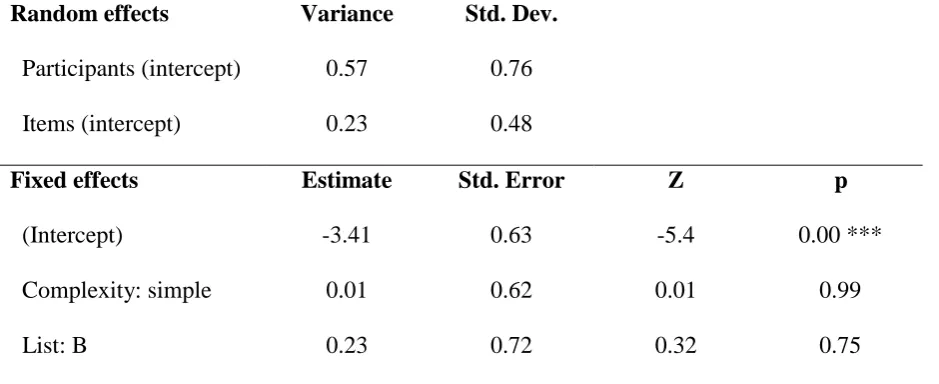
story-recall task. As can be seen in Table 5, there was no effect of complexity on article production
in the elicited imitation task, = .006, Z = .01, p > .05. The list factor (i.e., two different
[image:24.595.67.537.349.541.2]orders of item presentation) was not a significant predictor in either task.
Table 5. Coefficients for a logistic mixed-effects regression model fitted to the article
omission data in the elicited-imitation task (Thai learners of English).
Random effects Variance Std. Dev.
Participants (intercept) 0.57 0.76
Items (intercept) 0.23 0.48
Fixed effects Estimate Std. Error Z p
(Intercept) -3.41 0.63 -5.4 0.00 ***
Complexity: simple 0.01 0.62 0.01 0.99
List: B 0.23 0.72 0.32 0.75
Note. Reference levels are complex for Complexity and list A for List.
Tables 6 and 7 show the results of the analysis for the plural -s data from the two
tasks. As before, the critical experimental variable was structural complexity and the model
compared omissions of plural -s in simple (i.e., indefinite, bare plurals, or NPs) versus
complex (i.e., definite plurals, or the NPs) contexts. This time, the effect of structural
complexity was significant only in the elicited imitation task, as shown in Table 7, with the
structurally simple ones, = -.65, Z = -2.70, p < .01. A similar effect was not observed in the
story-recall task, as shown in Table 6, = .09, Z = .34, p > .05. As with articles, the list factor
was not a significant predictor for plural –s production, in either the story-recall or the
[image:25.595.72.529.222.419.2]elicited imitation task.
Table 6. Coefficients of a logistic mixed-effects regression model fitted to the plural -s omission data in the story-recall task (Thai learners of English).
Random effects Variance Std. Dev.
Participants (intercept) 1.49 1.22
Items (intercept) 0.00 0.00
Fixed effects Estimate Std. Error Z p
(Intercept) -0.71 0.44 -1.60 0.11
Complexity: simple 0.09 0.25 0.34 0.73
List: B 0.42 0.61 0.70 0.49
Note. Reference levels are complex for Complexity and list A for List.
Table 7. Coefficients for a logistic mixed-effects regression model fitted to the plural -s
omission data in the elicited-imitation task (Thai learners of English).
Random effects Variance Std. Dev.
Participants (intercept) 0.64 0.80
Items (intercept) 0.00 0.00
Fixed effects Estimate Std. Error Z p
(Intercept) -0.08 0.33 0.24 0.81
Complexity: simple -0.66 0.24 -2.70 0.01 **
List: B 0.20 0.43 0.46 0.64
[image:25.595.69.533.528.724.2]Discussion
The aim of the present study was to contribute to the debate concerning factors that
make learning and using L2 grammar difficult. Specifically, the study set out to test a
prediction arising from the L1-L2 structural competition model (Trenkic & Pongpairoj, 2013;
Trenkic et al., 2014). This model predicts that if L1- and L2-licensed structures compete for
selection in L2 production, thus putting a premium on cognitive resources, it will be more
difficult for L2 users to suppress inappropriate L1 options in cognitively more than less
demanding contexts. Our focus was on two functional morphemes of the English nominal
phrase with which learners often struggle: the definite article and plural marking –s.
Cognitive demand was operationalised as the complexity of the immediate linguistic context
in which a functional element should be used, specifically as the number of functional
meanings expected to be overtly encoded within a phrase. We employed a story-recall task
and an elicited imitation task to explore whether Thai learners of L2 English, whose L1 does
not obligatorily mark either number or definiteness, omit the definite article more often with
plural than singular NPs (Prediction 1), and whether they omit the plural -s more often with
definite than indefinite (bare) NPs (Prediction 2).
Both predictions received support from the data. In the story-recall task, articles were
supplied better in the simpler context in which only definiteness, but not number, needed to
be overtly encoded, compared to the more complex context, which called for the explicit
encoding of both definiteness and number. Similarly, in the elicited imitation task, plurals
were more consistently used in the context in which grammatical number but not definiteness
needed to be overtly marked, compared to the context in which both needed to be marked
These results lend support to the L1-L2 structural competition model, which assumes
that L2 learners acquire new L2-licensed patterns for encoding a particular meaning but that
these patterns compete with existing L1 patterns, contributing to variability in L2 production.
When an extra element of meaning needs to be encoded within a single phrase, making the
phrase more complex and thus more resource-demanding, fewer resources are left available
for the task of inhibiting the L1 structural alternatives, and the probability that these
(non-target) alternatives will be selected increases, compared to simpler contexts without this extra
element. The model was originally developed to account for higher rates of article omissions
with adjectivally modified (Art + Adj + N) than non-modified (Art + N) NPs in the
production of L2 speakers whose L1s do not obligatorily mark definiteness.10 The current
data show that this model also accurately predicts a higher rate of article omissions with
definite plurals (Art + N + s), compared to definite singulars (Art + N), where the complexity
is increased by the presence of another functional morpheme. This is also the first
demonstration that the coverage of the model extends beyond L2 article production, with the
model correctly predicting a higher rate of plural omission with more complex definite (Art +
N + s) than less complex indefinite (N + s) NPs when the L1 does not overtly mark plurality.
Overall, our results support accounts which propose that activation of grammatical structures
in bilingual production is not language-selective (Hartsuiker et al., 2004; Hartsuiker &
Pickering, 2008; Runkqvist et al., 2013).
10 This model was also used to explain a higher rate of article omissions with more than less salient referents in
the production of Thai learners of English. Trenkic and Pongpairoj (2013) argue that salient referents take up
more representational space in memory compared to less salient referents, leaving fewer resources to suppress
Alternative explanations
While these results are in line with the idea that competition between L1- and
L2-licensed grammatical patterns contributes to variability in the production of L2 functional
morphology, with L1-licensed patterns selected more often in more than in less
cognitively-demanding contexts, there could be alternative explanations. One important point to consider
is whether the patterns of behaviour we have observed could be explained without assuming
L1-L2 competition. Definite singular constructions in English are overall more frequent in
the input than definite plurals (Ramscar, Dye & McCauley, 2013), and the frequency with
which the definite article is encountered with different constructions may result in it being
supplied more accurately with singular than with plural nouns. Similarly, bare plurals are
overall more frequent than definite plurals, and this asymmetry may lead to a more accurate
use of bare plurals. Furthermore, omitting the article with a definite plural NP (the chairs)
results in a bare plural (chairs), and omitting the plural marker results in a definite singular
(the chair), both of which are grammatically well-formed structures. However, omitting the
article with a definite singular (the chair) or omitting the plural marker in a bare plural
(chairs) gives rise to a bare nominal (chair), which is grammatically unacceptable in English,
at least in reference to countable concepts.11 It is therefore conceivable that the asymmetries
in article and plural suppliance reveal the participants’ underlying sensitivity to the
11
One situation in which bare-singular countable nouns can be used appropriately is when they are re-classified
as mass (e.g., when talking about the meat of an animal, as in I like duck, especially in a spicy curry). Such
reclassifications are relatively infrequent, however, and when they do occur, the reference is to a mass, not a
countable concept. Note, though, that while bare nominals are rarely encountered in reference to singular
countable concepts, they are far from rare in English: Master (1993, cited in Lu, 2001, p. 44) reports that nearly
half of all nominals in English appear without an article (48%), slightly more than a third with the definite
grammatical options and structural regularities of English. In other words, the competition
that leads to variability may be coming solely from the L2 itself.
The computation of co-occurrence relations and transitional probabilities between
elements has been shown to be one of the central mechanisms in L1 learning (e.g.,
Lew-Williams & Fernald, 2007; Saffran, Aslin & Newport, 1996), and it seems only reasonable to
assume that it remains available in adult L2 learning, too. L2 learners, through the input they
receive, must gradually develop an implicit understanding for what is and what is not a
legitimate L2 grammatical pattern; this emerging sensitivity may partly be reflected in our
data.12 But can the L2-internal competition alone account for the obtained findings? We think
that it is unlikely for reasons explained below, but the idea can be empirically tested in future
research: if the emerging sensitivity to structural regularities in the L2 were the sole reason
for asymmetric patterns in functional morphology production, we would expect to see the
same patterns across L2 populations, irrespective of the grammatical structures that their L1s
utilise. In that case, one would expect to see that French learners of English, who mark both
number and definiteness in their L1, omit articles and –s at the same rate as the Thai learners
in our study did, furthermore omitting the more often with plurals than singular NPs and
omitting –s more with definite than indefinite plurals. If they did, this would lend support to
the L2-internal-competition-only view and would argue against the involvement of L1-L2
competition, which would predict differences between these two populations. While our data
12
Trenkic (2009) observes that implicit statistical learning may also in part be responsible for
previously-observed higher levels of article omissions with adjectivally modified (the sleepy cat) than non-modified NPs
(the cat). While neither sleepy cat nor cat are legitimate referential forms in English, there is a stronger
co-occurrence relation between an article and a count noun (the cat) than an article and an adjective (the sleepy), as
adjectives can modify mass and plural nouns without an associated determiner (Trenkic, 2009). An implicit
statistical sensitivity to such grammatical contingencies in the input may lead to more frequent article omissions
from a single L2 population cannot speak to this possibility, previous research argues
strongly against it. Not only is it well documented that L2 populations whose L1s do not
mark definiteness and nominal number struggle clearly more with English articles and plural
–s than L2 populations whose L1s mark these functional meanings, but some evidence
already exists that an increased cognitive demand created by context complexity negatively
affects the suppliance of functional morphology with the former L2 populations but not the
latter. For example, Pongpairoj (2008) shows that intermediate and advanced Thai learners of
English, but not proficiency-matched French learners, show a statistically significant
asymmetry in article suppliance with adjectivally modified (the fat cat) versus non-modified
NPs (the cat).
In sum, we maintain that unless competition arising from L1 grammatical patterns is
assumed, it is difficult to account for the regularly-observed higher rates of
functional-morphology omission in L2 populations whose L1s do not obligatorily mark a particular
grammatical concept compared to populations whose L1s do, and for the less pronounced or
non-existent asymmetries in functional-morphology production by the latter L2 populations
(Austin, 2014; Díez-Bedmar & Papp, 2008; Jarvis, 2002; Luk & Shirai, 2009; Pongpairoj,
2008; Pongpairoj & Trenkic, 2013; Sarko, 2009; Snape, 2006). Furthermore, an explanation
based on sensitivity to the grammatical options and structural regularities in the L2 leaves
many attested asymmetric patterns unaccounted for. For example, Thai learners of English
also omit articles more often with more, compared to less salient referents in discourse (e.g.,
showing greater article omission with the subject than the object in sentences such as The red
fish has eaten the blue fish), while proficiency-matched French learners of English do not
exhibit this pattern (Trenkic & Pongpairoj, 2013).
The question remains, however, what contribution, if any, the emerging sensitivity to
interacts with L1-L2 structural competition. Although we cannot answer this question based
on the current data, we outline a novel proposal for how the L1-L2 structural competition
model and the sensitivity-to-L2-structural-regularities account could be integrated and their
respective contributions studied under a constraint-satisfaction approach to language
processing. But first, we consider the limitations of the present research arising from task
differences.
Limitations: Task differences
The results of the present study support our hypotheses that the and -s would be
omitted more often in more complex the Ns contexts than in simpler the N and Ns structures.
However, context complexity had the predicted effect on article omissions in the story-recall
but not in the elicited imitation task; in contrast, for the plural, the effect was only present in
the elicited imitation but not the story-recall task. This was an unexpected finding. Task
effects on functional morphology production were not the focus of our research, and our
study was not designed to account for task differences.
The results from the story-recall task lend themselves to at least two interpretations:
(a) context complexity has the predicted effect on L2 article production, confirming the
findings from previous research, but it does not extend to L2 plural –s production; or (b) a
story-recall task is not a sensitive instrument for detecting this effect in the production of
functional morphemes such as plural –s. The results from the elicited imitation task, which
show the effect of context complexity on plural production, favour this second interpretation.
Because the notion of plurality (“more than one”) is relatively easy to conceptualise,
compared to the notion of definiteness, and because there was more time for utterance
recall may not have been sufficiently difficult, as far as the plural –s production is concerned,
for the context complexity effect to be detected.
The elicited imitation task, however, yielded another unexpected finding in that the
participants supplied the article at ceiling levels in this task. This was surprising given that
their mastery of this functional morpheme was far from perfect, as demonstrated by their
much weaker performance in the story-recall task. One methodological concern regarding the
elicited imitation task is that participants may in some cases rely on rote repetition rather than
on reconstructive imitation (Erlam, 2006; Hsieh & Lee, 2014; Mackey & Gass, 2005;
Vinther, 2002), and this may have been the issue with articles here. Whether a participant can
rely on rote memory depends on a number of factors (see Hsieh & Lee, 2014, for an
overview), one of which can be the perceptual salience of the element in question. While
functional morphemes in general have low salience compared to content words, English
articles are perceptually more salient than the plural –s in terms of number of phones, syllabic
structure and sonority (Goldschneider & DeKeyser, 2001), in addition to being independent
rather than bound morphemes, and preceding the noun with which they are associated, rather
than following it. All this may help articles to be better preserved in memory, allowing L2
users to reproduce them at ceiling levels through rote repetition and minimizing any potential
effect of context complexity. Thus, the elicited imitation task may not be a good choice for
studying more salient functional morphemes such as articles, but perfectly adequate for less
salient morphemes like plural –s, which are less likely to be reproduced by rote memory.
This is a testable hypothesis which future research on the interaction between task
characteristics and functional morpheme properties may explore. For example, it would be
interesting to investigate whether other functional morpheme that are difficult to perceive due
to low perceptual salience but that stand for concepts that are relatively easy to conceive of,
showing the effect of context complexity through elicited imitation but not story recall.
Would another functional morpheme that is relatively perceptually salient but that represents
a conceptually less transparent property, such as aspect marking in have/has, behave like
articles, showing the effect of structural complexity in the story-recall but not in the elicited
imitation task? And would the effect be present in both tasks for functional morphemes that
are both perceptually non-salient and which may be difficult to conceptualise, such as
third-person singular –s? In sum, while task differences were not expected, the outcome is
nevertheless intriguing. It calls for further research to test the robustness of the obtained
effect, and to understand the interplay between task characteristics and functional morpheme
production.
We note here that the choice of keyword prompted story-recall and elicited imitation
tasks used in this study were motivated by the experimental need to control strictly for a
number of important variables, including lexical form of a target noun (e.g., planes rather
than airplanes), words directly following a target noun to avoid resyllabification of plural –s
as the onset of another syllable, sentence position of a target noun, number of syllables that
precede it (see Methods). A less constrained production task would not have allowed for
these experimental controls. A possible direction for future research would be to triangulate
the findings from a prompt-based story-recall task, as used here, with those from a less
constrained picture-based story-retelling task, which would be a more authentic speaking
task. Furthermore, different tasks can be used in future research to address some of the
methodological issues identified above. For example, a variant of elicited imitation known as
syntactic priming comprehension and production (SPCP, see Hsieh & Lee, 2014) has the
potential to dramatically reduce the likelihood of rote repetition. In this task, participants first
match an aural stimulus with a picture (comprehension), which later serves as a prompt for
two or three comprehension trials may precede the elicited imitation block. This task appears
well suited to studying both more and less salient functional morpheme production;
additionally, the procedure makes it possible to control for whether the stimulus was correctly
processed in comprehension, so that problems of production and comprehension can be
teased apart.
Future directions: Towards a constraint-satisfaction approach to L2 variability
So what impact might an emerging sensitivity to statistical regularities in the L2 input
have on L2 functional morphology production, and how might it interact with L1-L2
structural competition? We propose that important insights into L2 production mechanisms
can be gained in future research by considering constraint-satisfaction theories, originally
developed in the context of work on L1 language processing, including research on L1
comprehension (MacDonald, Pearlmutter & Seidenberg, 1994; see also research carried out
within the Competition Model, e.g., Bates & MacWhinney, 1989), and L1 production
research (Haskell & MacDonald, 2003; see also Bock & Levelt, 1994). In the
constraint-satisfaction framework, the result of processing is determined by the interaction of multiple
probabilistic cues that activate, in parallel, information from a variety of sources: grammar,
meaning, discourse, world-knowledge and so on (Elman, Hare & McRae, 2004). Cues
compete to constrain the outcome of processing; they interact with each other and contribute
towards promoting or inhibiting particular alternatives, to arrive at a preferred analysis or
structure.
Most of the time, different cues and information sources converge to promote the
same outcome. For example, both the grammar of a singular noun like ship, and its
conceptual characteristics (denoting a singular entity) converge to promote the use of a
alternatives, for example, the grammar of the singular noun fleet promoting the use of a
singular verb but its conceptual characteristics promoting the use of a plural verb, this leads
to variability in responses (e.g., The fleet is/are sailing west) and longer processing times
(Bock, Nicol & Cutting, 1999; Haskell & MacDonald, 2003).Language processing and
language acquisition are tightly linked in this framework: learning involves accumulation of
information about statistical and probabilistic aspects of language across many thousands of
constructions. On the basis of exposure to examples in the input, learners acquire statistical
information about the behaviour of lexical items, and abstract regularities across them
(Seidenberg & McDonald, 1999).
A strength of this approach is that it provides a natural framework for explaining how
highly disparate factors interact during processing. As such, it seems particularly suited to
analysing bilingual processing as it allows, in principle, for both language-internal and
cross-linguistic competition. In L2 production, the speaker knows two languages, which represent
two sources of information on how a concept or an event could be structurally encoded. Both
will receive a partial activation, will interact with each other and will promote or inhibit
certain alternatives. For example, if an object is encoded by a singular noun in the L2 (e.g.,
door in English) but by a plurale tantum noun in the L1 (e.g., vrata = “door-pl” in Serbian),
the model predicts that the L1 will promote the use of the plural form of the verb while the
L2 will promote the singular form, contributing to variability in responses (e.g., The door
is/are closed.). A constraint-satisfaction model of L2 production would explicitly assume that
the contribution of a given source of information (e.g., an L1 or L2 grammar) will be
modulated by other constraints such as frequency and discourse contexts. For example, a
context in which the L2 is normally spoken will act as an inhibitor of L1 lexical and
structural alternatives while promoting those from the L2. At the same time, however, the
past to encode similar events may counteract to boost the activation of a more entrenched L1
option over L2 options. The relative strengths of all constraints would lead to graded effects
in production (i.e., varying degrees of preference for particular alternatives). As the relative
strengths of constraints change (e.g., through amassing L2 input), so too does L2 behaviour.
Because a constraint-satisfaction model allows for both language-internal and
cross-linguistic competition to operate simultaneously, it offers a suitable framework for extending
the present line of research. For example, future research could investigate the effect of
lexical frequency on suppliance of specific functional morphemes (such as the marking of
number and definiteness on nouns). If learning proceeds by acquiring item-based regularities
first, then we would expect to see a more accurate use of functional morphology with high-
than low-frequency items (i.e., items about whose behaviour the learner has acquired more
statistical information through input and exposure). Another interesting question that could be
profitably explored within the constraint-satisfaction model is the effect that the frequency
with which individual lexical items occur as definite singular, definite plural or indefinite
plural has on article/plural production. For example, an L2 user may be less likely to supply
definite articles with plural forms of certain lexical items, if they are almost exclusively
encountered as bare plurals (i.e., where the ratio of definite vs. bare plural is particularly
low).13
Furthermore, it would be revealing to look at nouns whose distributional properties
buck the general trend. For example, most count nouns are more frequently encountered as
definite singular than definite plural, and it is difficult to tease apart the influence of L1-L2
13We didn’t control for this when selecting our experimental items, but post-hoc analyses based on the British
National Corpus (BNC) searches suggest that there was no statistical difference in the bare versus definite plural
competition from a possible effect of L2 structural regularities (as discussed previously).
However, there are some reasonably high-frequency items which are encountered more often
as definite plural (e.g., the neighbours) than as definite singular (e.g., the neighbour). If L2
learners are developing sensitivity to such statistical and probabilistic aspects of the target
input, we would expect to see an interaction with L1-L2 structural competition. Thus, in the
case of nouns which are more frequently encountered as definite singular than definite plural
(e.g., the cat/the cats), we would expect to see a higher level of article suppliance in the
singular than in the plural, both on account of the characteristics of the input (e.g., the cat is
more frequent than the cats) and L1-L2 structural competition (i.e., cognitive resources are
more depleted and so the L1 option(s) more difficult to suppress in plural than singular
contexts). In contrast, we would expect to see this asymmetry attenuated, or disappear, in
nouns such as neighbour, which are more frequently encountered as definite plural than
definite singular; in this case, the two constraints would operate in the opposite directions,
cancelling each other out.
Finally, the constraint-satisfaction model of L2 production would predict that some
L2-internal competition may be detectable in most L2 populations (at least in early stages of
learning, or under time pressure), but that its interaction with L1-L2 competition would lead
to some production patterns being far more pronounced in populations that do not mark
particular functional meanings in their L1s. One of the important assumptions of
constraint-satisfaction models is that the interactions between constraints are non-linear (Seidenberg &
McDonald, 1999). This means that a type of information that is not very constraining in
isolation (e.g., options that are grammatically available, but not contextually appropriate in
the L2, such as dogs in reference to a group of uniquely identifiable dogs) may become
highly influential when considered with another one (e.g., options that are grammatically