Copyright 0 1973 AmericanSocietyforMicrobiology PrintedinU.S.A.
Bacteriophage
Tail
Components
V.
Complementation
of
T4D
Gene 28--Infected
Bacterial Extracts
with
Pteroyl
Hexaglutamate
L. M. KOZLOFF, M. LUTE, AND C. M. BAUGH
DepartmentofMicrobiology, Universityof Colorado MedicalCenter, Denver, Colorado80220, andThe NutritionProgram, Universityof Alabama School ofMedicine, Birmingham,Alabama35233
Received forpublication 2October 1972
Synthetic pteroyl hexaglutamate (9 x 10⁻⁶M) stimulated the formation of new T4D particles invitro in extracts of Escherichia coli B infected withT4D
gene28-. The stimulation wasspecificfor this form of folic acid since neither pteroyl pentaglutamate norpteroyl heptaglutamate stimulated phage forma-tion. T4D formationinvitroin E. coli B extractspreparedafterinfection with11 otherphagemutantsknowntobe involved inphagetailplateformation(5-, 6-, 7-, 8-, 10-, 25-, 26-, 27-, 29-, 51-,53-) wasnot stimulatedbytheadditionof pteroyl hexaglutamate. It can be concluded that the T4D gene 28product is
involvedinthe formation of the phage tail plate pteroyl hexaglutamate.
Thisreport is concernedwith the identifica-tion ofthebacteriophagegeneorgenes
respon-sible for the formation of the dihydropteroyl hexaglutamate used for the assembly of the T4D phage tail plate (5-9) during in vitro complementation experiments. Twelve T4D
genes wereidentifiedearlier (1-4, 12)as
essen-tial for the formationofthe T4Dtail plate. In addition, the viral-induced dihydrofolate
re-ductase is a tail plate component (9). Dihy-dropteroyl hexaglutamate, which is not a
pro-tein, cannotbe the primary product ofanyof these 13 genes. However, one or moreof these
genes could be producing a catalytic
pro-teins(s) which participates in the formation of thefolate compound. Anextractof the
nonper-missivehost, Escherichia coliB,infectedwith
an amber mutant in such a gene would be expected to have all ofthe phage components
necessary for phage assembly, except for the folate compound. The addition of synthetic pteroyl hexaglutamatemight then stimulate in
vitro T4D formation in such an extract. It should be emphasized that sucha stimulation will be limited by the ability oftheextract to
reduce the added folatecompound and by the presence of anycompetingfolatecompounds.
Chemical studies ofthe formation offolate polyglutamate compounds in uninfected and T4D-infected cells show thatthemetabolismof
these compounds is quite complex (6).
Al-though uninfected host cells contain mostly compoundsequivalentinsize to
pte(glu),,
they do contain small amounts of larger folate637
compounds. T4D infection stimulated the
con-version of
pte(glu),
compounds to pte(glu), compounds. These studies also showed thatinfectionwithT4D 28- caused theproductiona verylarge folatepolyglutamatescontaining7 to 12 glutamate residues.
In agreementwith these chemicalstudies, it
has nowbeen found thatT4Dgene28- extracts
are apparently deficient in pteroyl
hexagluta-mateand do form smallamountsofnewphage particles in response to added pteroyl hexa-glutamate. A preliminary report of this work has beenpresented earlier(L.M.Kozloff,Fed. Proc. 30:1263, 1971).
MATERIALS AND METHODS
Preparation and purification of
bacterio-phage stocks and extracts of Excherichia B in-fected with T4 D amber mutants. Most of the
bio-logicalmaterials andmethods were identical to those used earlier (7-9). Various T4Damber mutants were
obtained from R. S.Edgar, W. B.Wood, and their colleagues (1-4, 12). Single plaques of thesemutants werepicked and grown on the permissive host E. coli CR63 and purified by standard procedures. The mutants, all defectivein tailplate formation, were gene5(amN135),gene6(amN102),gene 7(amB16), gene 8 (amN132), gene 10 (amB255), gene 25
(amN62),gene 26(amN131), gene 27(amN120), gene 28 (am452), gene 29 (amB7), gene 51 (amS29), and gene 53 (amH28). Extracts of mutant-infected non-permissive host E. coli B were prepared by the procedures used earlier (7, 9), except that the bacte-ria at3 x 108were usuallyinfected with a multiplic-ityofinfection of4:1 at 30 C. Occasionally, espe-cially for the preparation of gene 28- extracts, the
on November 10, 2019 by guest
http://jvi.asm.org/
KOZLOFF, LUTE, AND BAUGH cells were superinfected 5 min after the initial
infection. This laterprocedureimprovedsubsequent
complementation but resulted in a higher initial
phage titer. Some extracts of28-(am452),about 10% of those prepared, were inactive upon subsequent
complementation andwerediscarded.
Extracts were treated with Norit A-activated
char-coal byplacing the charcoal (100 mg) in a dialysis
bag with 0.5 ml of buffer(7) andthenimmersing the
bag in 0.5 ml of the extract. Pteroyl
pentagluta-mate, pteroylhexaglutamate (twoseparate prepara-tions), andpteroylheptaglutamateweresynthesized
by the solid-phase method, purified by DEAE-cel-lulose chromatography, desalted, and suspended in water at a concentration of 2 x 10⁴to 4 x 10-i M (10). Normally these compounds were added to complementation mixturesataratio of2to5vol per 100 vol ofextract,givingafinal concentration about
10-5M.
RESULTS
Stimulation of in vitro T4D formation by syntheticpteroylhexaglutamatein extracts
of infected host cells. Synthetic pteroyl hexaglutamate was addedto separate extracts
preparedby infectingE.coli Bwith the differ-entphagemutantsknowntobeinvolved in tail
plate formation. Only gene 28- extracts were
stimulatedto form smallamounts ofnewT4D
phage upon the addition of this compound (Table 1). Gene 28- extracts hadstartingtiter of from 5 x 10⁸ to 2 x 10⁹, and the actual
increase inphagetiterobserved wasusually 50 to 400%. No other extract ever responded in
TABLE 1. Invitro T4Dformationin bacterial extracts
T4DMutant Effect of
us4ed
to infectn 9x10⁻⁶M Roleof geneE.coli B pteroyl product (11)
hexaglutamatea
Gene5(amN135) None(4)b Stoichiometric
Gene6(amN102) None (6) Stoichiometric
Gene7(amB16) None (3) Intermediate-stoichiometrice Gene8(amN132) None(1) Stoichiometric
Gene10(amB255) None(2) Ambiguous-stoichiometricc Gene25(amN62) None(2) Stoichiometric Gene26(amN131) None(2) Catalytic Gene27(amN120) None (2) Stoichiometric Gene 28(amA452) STIMULATED Catalytic(?)
-50)
Gene29(amB7) None(2) Stoichiometric Gene51(amS29) None(2) Catalytic
Gene53(amH28) None(2) Stoichiometric a Stimulation isdefined asthe formation of at least 109 newT4Dparticlesin 1 to 3 h at 30C in at least twoseparate experiments.
bNumberofexperiments.
cJ. King (personal communication) has found that the
products of gene 7 and gene 10 are phage tail plate constituents.
this way. The starting titers of the other
extracts varied; forexample, 5-, 7-, 10-, 25-,
27-,29-,and53-hadstarting titers from109to 4 x 10⁹, andnoneofthem gave morethan a 5%
increase upon the addition of pteroyl hexa-glutamate. Otherextracts such as 6-, 8-, 25-,
26-, and 51- had starting titers of about 1010, and the addition ofhexaglutamate caused no
increase in phage titer. Several experiments were carried out with a preparation of pteroyl
hexaglutamate reduced with dithionate and
ascorbate. These preparations were found to
inhibit complementation, and the inhibitory elements were found tobe the residual
dithio-nateandascorbate. For unknownreasons,
occa-sional28-extracts, about 10to 15% ofa total of
over 50different preparations, did not appear
to respond to added pteroyl hexaglutamate.
The properties described below are therefore
typical of the bulk of 28- preparations
pre-pared.
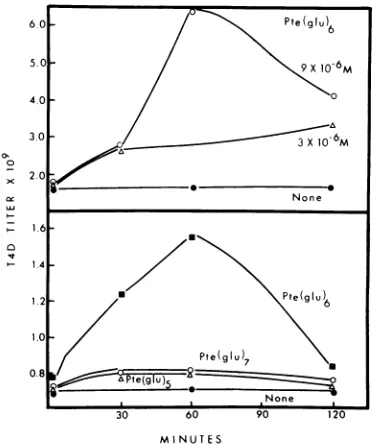
Some of theproperties of phageformationin T4D gene 28--infected E. coli B are shown in
Fig. 1. Similartowhat was found previously in
mixed infectedbacterialextracts (7), the
stim-ulation ofphageformation in 28- extracts was
related to the concentration of added pteroyl
hexaglutamate; about 10-5 M was optimal (7); higher concentrations inhibited phage
assem-6o0
Pte(glu)'6
5.O 9X10⁻⁶M
4.0 0
3X0K6m
2.0
None
1.6
1.4
M NUTES
FIG. 1. Effect of various pteroyl polyglutamates
on the in vitro formation of new T4D particles in
extracts ofE. coli B infected with T4D 28-. Top, effect of different concentrations ofpte(glu)6; bot-tom,effect ofdifferent pteroylpolyglutamates,allat
9x 10⁻⁶ M.
638 J.VIROL.
on November 10, 2019 by guest
http://jvi.asm.org/
[image:2.493.268.454.392.615.2] [image:2.493.59.251.420.612.2]PHAGE TAILCOMPONENTS. V
bly. Neither the pteroyl pentaglutamate nor
the pteroyl heptaglutamate stimulated phage
formation intheseextracts.
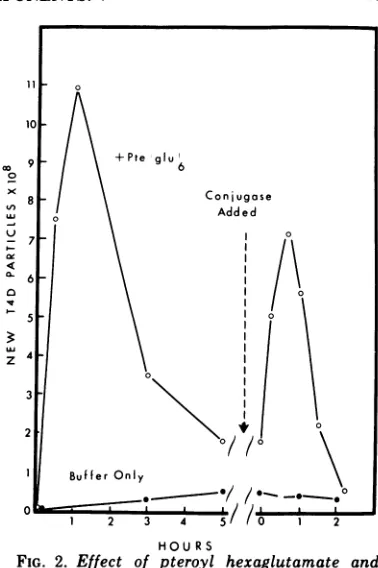
One unusual feature of phage formation in
28- extracts of Fig. 1 observed many times was the decrease in the apparent number of
newphageparticles after 1 to2h. Onepossible explanation for the fall in phage titer is that
extraglutamyl residuesareaddedtothephage particlepteroylpolyglutamate. Whena28-cell
extract was complemented with pteroyl hexa-glutamate, there was an initial rise and then subsequentdecrease inphage titer (Fig. 2). If,
at this time, a portion of the extract was
diluted into acetatebuffer(pH 4.5) containing partially purified hogkidney conjugase (5), an
exopeptidase which hydrolyses glutamyl resi-dues from folatepolyglutamates, therewas an
apparent transient reactivation of the newly formed phage particles. Since this enzyme is knowntobe abletoattack thephagetail folate compound (and to inactivate phage [5]), it is possible that the original fall in phagetiter in these complementation systems is due to the addition of extra glutamyl residues to the phage tail folatecompound.
Snustad (11) haspointed outthat T4Dgene
products appear to act either stoichiometri-callyorcatalytically informingnewphage(see Table 1). The results of Snustad suggest a
catalytic role for the product of T4D gene 28
and support the conclusion that such a gene
productis actingcatalyticallyinthe formation ofthe pteroyl hexaglutamate needed for tail assembly.
Stimulation of in vitro T4Dformation by synthetic pteroylhexaglutamate in mixtures of infected bacterial exracts. An extract of E. coli B infected with aT4D mutant contain-ingan amber mutation in gene 7 wasdepleted of its folate compounds by treatment with activated charcoal. These depleted extracts were then mixed with a secondextract. If the second extract was deficient in pteroyl hexa-glutamate, new phage particles would not be formed upon addition of charcoal-treated 7-extracts, but new particles would still be formeduponadditionofuntreated7- extracts. Furthermore, theaddition ofsyntheticpteroyl
hexaglutamate should stimulate phage forma-tion only if this compound was the limiting phage component.
Extracts ofE. colimade after infection with 7- orwith 10-T4Dmutants were used in these
experiments, since bothofthese geneproducts
arestructural proteincomponentsofthe phage tail plates, and theseextracts should presuma-blycontain the appropriatefolatecompounds.
/ 0 Conjugase
x | Added
0i
5
1 Bu f fer O nl y /
O/4
1 2 3 4 5/ /O 1 2 HOUR S
FIG. 2. Effect of pteroyl hexaglutamate and subsequent treatment with hog kidney conjugase on the in vitro formation of new T4D particles in extracts of E. coli B infected with T4D 28-. In this experiment the starting T4D titer was 1.2 x 10⁹,and the maximum titer reached after 1 h was 2.3 x 10⁹.
Both mutant extracts canbepartially depleted
by charcoal treatment (7). Three T4D mutants
(26-, 28-, and 51-), shown or suspected to make geneproducts havingacatalytic function
in tail plate formation (11),were thentested for their ability to form phage with 7- and
10-extracts.
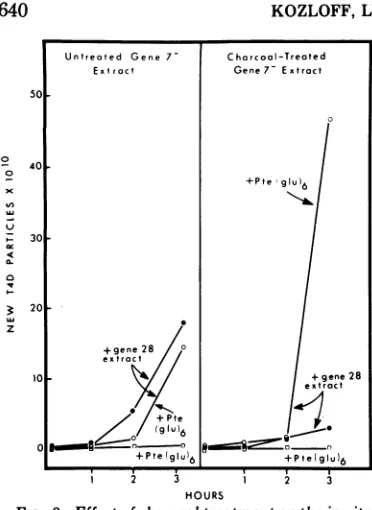
Typical experiments with 7- extracts are
shown in Fig. 3 and 4. The formation ofnew T4D particles in mixtures of untreated 7-extracts plus 28- extracts is not stimulated by
the additionofpteroyl hexaglutamate, and the
rate of phage formation actually was inhibited
by the addition of thiscompound. On theother hand, charcoal treatment of 7- extracts to
partially deplete them of folate compounds greatly inhibited phage formation upon subse-quent complementation with a 28- extract. Furthermore, mixtures of 28- extracts plus depleted 7- extracts now responded to the
addition of pteroyl hexaglutamate by forming increased amounts of new phage particles.
Similar results were obtained when untreated or charcoal-treated 10- extracts ratherthan 7
extracts werecomplementedwith 28- extracts. In can be concluded that 28- extracts lack
639
VOL.11,1973
on November 10, 2019 by guest
http://jvi.asm.org/
[image:3.493.246.435.72.356.2]KOZLOFF, LUTE, AND BAUGH
50
4
0
x "I
u
clc
z
40
30
20
HOURS
FIG. 3. Effect of charcoaltre formation ofnewT4Dparticle,
B infected with T4D gene 7-.
complemented with equal volt Thepte(glu).wasatafinalcon
Mandamountedtoonly3%of tation volume.Starting titerw
Charcoal-Treated Ge
plus Gene 28 E
34
cb 30
26
x 26/
22
0~~~~~~~~~~
14
3:~/
Charcoal-Treated pteroyl hexaglutamate and thegene28product Gene7? Extract participates in the formation of this compound. Figure4 shows thespecificityof the
stimula-0 tion due to the addition of the polyglutamate
compounds. Gene 28- extracts plus partially depleted 7- extracts form increased amounts of
+Pte glu) phage in response to the addition of the pteroyl hexaglutamate compound, but the addition of the correspondingpenta- orheptaglutamyl
de-rivatives did not increase the amount of new phage particles formed. When these com-pounds were added to mixtures of 28- extracts and untreated 7- extracts, all inhibited com-plementation, and the penta- and hepta- were
more effective inhibitors than the hexagluta-myl compound. These observations not only
+gene28 support the conclusion that 28- extracts are
extroct deficient specifically in"thehexaglutamyl
com-pound, but also demonstrate that over a period _
_n
of several hours these extracts are unable to+Pte(glu)6
convert significant amounts of either thepter-11 2 3 oyl pentaglutamate or the pteroyl heptgluta-mate to the pteroylhexaglutamate.
!atment on theinvitro Although neither 26- nor 51- extracts were
sinextracts
of
E.coli stimulated by pteroyl hexaglutamate insingleunes
of28- extracts. complementation incubation mixtures,experi-centration
of 9x10⁻⁶
ments were carried out with 26- extracts andthefinalcomplemen- 51 extracts to complement untreated and
ias 2 x 10⁹/ml. charcoal-treated7- extracts. Contrary towhat
was found with 28- extracts, charcoal
treat-ment of the 7- extracts did not inhibit later complementation with either 26- or 51-
ex-ene 7 Extract tracts.Thissupportsthe view that26- and
51-xtract extracts can furnish sufficient folate com-ADDITIONS pounds tosupport in vitro T4D
phage
forma-O in-6U tion.
HOURS
FIG. 4. Effect of various pteroyl polyglutamates
ontheformations ofnewT4Dparticlesinmixturesof charcoal-treatedgene 7- extracts and gene 28-
ex-tracts.Startingtiterwas2 x 109/ml.
DISCUSSION
Although the addition of synthetic pteroyl hexaglutamatetoextractsofE.coli Binfected with T4D amber mutant 452 (28-) results in
only a small increase in the rate of phage
formation in vitro and a small increase in the
absoluteamountofphage formed,the specific-ity of the reaction indicates that the gene 28
product plays arole in formation ofthisphage
component. These extracts must reduce the
pteroyl hexaglutamyl compoundtothedihydro compound, andthis might limit the abilityof
the unreduced compound to complement
ex-tracts. One other factor undoubtedly limiting the amount ofphage formed uponaddition of
pteroyl hexaglutamate to 28- extracts is the presence ofthe high-molecular-weight pteroyl compounds containing 7 to 12glutamate resi-dues (6). Experiments with 28- extracts to
complementfolate-depleted7- or10-extracts
Untreated Gene 7-Extract
+gene28 extract
+Pt/ Pte
C°/1
(g1u)6bm_l n ,o
+ Pte(gl1u)6S
YxI1U- M
0 Pte(glu)6
none
/ Pte(glu)5
Pte(glu)7
640 J. VIROL.
F
on November 10, 2019 by guest
http://jvi.asm.org/
[image:4.493.68.254.61.316.2] [image:4.493.66.259.394.635.2]showed significant phage formation (of the order of 2 x 10¹⁰ to 3 x 10¹⁰ new particles) could be stimulatedby the additionofpteroyl hexaglutamate. This result shows that
28-extracts aredeficient inpteroylhexaglutamate and supports the conclusion that T4D gene 28
product is involved in pteroyl hexaglutamate
formation.
From theseinvitrocomplementation
experi-ments, it is apparentthat theprimaryproduct of T4D gene 28is acatalytic proteinrequired for either the formation of pteroyl
hexagluta-mate or the regulation of its concentration. From the observation (6) that very high-molecular-weight folate-like compounds are
produced in T4D 28--infected cells, it seems
likely that the28product is acleavageenzyme
which hasanimportantphysiologicalfunction. This enzyme notonlyforms the pteroyl
hexa-glutamate from higher-molecular-weight
com-pounds, but also removes any larger folates which interferewith phage tail assembly.
ACKNOWLEDGMENTS
Thisinvestigation was supportedbyPublic Health Serv-ice grantsAI-06336 from the National Institute of Allergy and Infectious Disease and IC3M from the American Cancer
Society.
LITERATURE CITED
1. Edgar, R.S., andI.Lielausis. 1968. Some steps in the assembly of bacteriophage T4. J. Mol. Biol. 32:263-276.
2.Edgar, R. S.,and W. B. Wood. 1966. Morphogenesis of bacteriophage T4 in extracts of mutant-infected cells. Proc. Nat.Acad. Sci. U.S.A. 55:498-505.
3. Epstein, R H., A. Bolle, C. M. Steinberg, E. Kellen-berger, E. Boy de la Tour, R. S. Edgar, M. Susman, G. H.Denhardt, and A. Lielausis, 1963. Physiological studies of conditional lethal mutants ofbacteriophage
T4D. Cold Spring Harbor Symp. Quant. Biol. 28:375-394.
4. King, J. 1968.Assembly of the tail ofbacteriophage T4. J.Mol. Biol. 32:231-262.
5. Kozloff, L. M., and M. Lute. 1965. Folic acid, a structural component of T4 bacteriophage. J. Mol. Biol.12:780-792.
6. Kozloff, L. M.,and M. Lute. 1973.Bacteriophage tail components. IV. Pteroyl polyglutamate synthesis in T4D-infectedEscherichiacoli B. J. Virol.11:000-000. 7. Kozloff, L. M., M. Lute, and L. K. Crosby. 1970.
Bacteriophage tail components. III. Use of synthetic pteroylhexaglutamate for T4D tail plage assembly. J. Virol.6:754-759.
8. Kozoloff, L. M., M. Lute, L. K. Crosby, N. Rao, V. A.
Chapman,andS. S.DeLong. 1970.Bacteriophagetail components. I.Pteroyl polyglutamates in T-even bac-teriophages. J. Virol. 5:726-739.
9. Kozloff, L. M., C. Verses, M. Lute and L. K. Crosby. 1970. Bacteriophage tail components. II. Dihydrofo-late reductase in T4D bacteriophage. J. Virol. 5:740-753.
10. Krumdieck, C. L., and C. M. Baugh. 1969. The solid-phase synthesis of polyglutamates of folic acid. Bio-chemistry 8:1568-1572.
11. Snustad, D. P. 1968. Dominance interactions in
Esche-richiacoli cells mixedly infected with bacteriophage
T4D wild-typeand amber mutants and their possible implications as to type of gene-product function: catalytic vs. stoichiometric. Virology 35:550-563. 12. Wood, W. B., R.S. Edgar, J. King,I.Lielausis, and M.
Henninger. 1968.Bacteriophageassembly. Fed. Proc. 27:1160-1166.
641
on November 10, 2019 by guest
http://jvi.asm.org/