
City, University of London Institutional Repository
Citation:
Asif, W. (2016). Critical Node Identifcation for accessing network vulnerability, a necessary consideration. (Unpublished Doctoral thesis, City, University of London)This is the accepted version of the paper.
This version of the publication may differ from the final published
version.
Permanent repository link:
http://openaccess.city.ac.uk/16398/Link to published version:
Copyright and reuse: City Research Online aims to make research
outputs of City, University of London available to a wider audience.
Copyright and Moral Rights remain with the author(s) and/or copyright
holders. URLs from City Research Online may be freely distributed and
linked to.
City Research Online: http://openaccess.city.ac.uk/ [email protected]
Critical Node Identification for Accessing
Network Vulnerability, A Necessary
Consideration
By
Waqar Asif 120050615
Supervisors
Dr. Muttukrishnan Rajarajan Dr. Marios Lestas
Dr. Hassaan Khaliq Qureshi Dr. Veselin Rakocevic
A THESIS SUBMITTED TO THE SCHOOL OF ENGINEERING AND MATHEMATICAL SCIENCES, CITY, UNIVERSITY OF LONDON IN PARTIAL
FULFILMENT OF THE REQUIREMENTS FOR THE DEGREE OF DOCTOR OF PHILOSOPHY
London EC1V 0HB United Kingdom
T +44 (0)20 7040 5060
www.city.ac.uk Academic excellence for business and the professions
THE FOLLOWING CHAPTERS HAVE BEEN PUBLISHED AND HAVE
BEEN REMOVED FROM THIS THESIS FOR COPYRIGHT REASONS:
pp. 31-37: Chapter 3. APL.
Published as: Asif, W., Qureshi, H.K., Iqbal, A. & Rajarajan, M. (2014)
"On the Complexity of Average Path Length for Biological Networks and
Patterns",
International Journal of Biomathematics,
7(4).
doi:
10.1142/S1793524514500387
pp. 39-73: Chapter 4. VRAM.
Published as: Fiaz, M., Yousaf, R., Hanif, M., Asif, W. Qureshi, H.K. &
Rajarajan, M. (2014), "Adding the Reliability on Tree Based Topology
Construction Algorithms for Wireless Sensor Networks",
Wireless
Personal Communication
, 74 (2), pp 989-1004.
doi:
10.1007/s11277-013-1334-2
Asif, W , Qureshi, H.K. & Rajarajan, M.(2013) "Variable Rate Adaptive
Modulation (VRAM) for introducing Small-World model into WSNs,"
47th
Annual Conference on Information Sciences and Systems (CISS)
,
pp.1-6. doi:
10.1109/CISS.2013.6552329
pp. 75-112: Chapter 5. CBDI.
Published as: Asif, W., Qureshi, H.K., Rajarajan, M. & Lestas, M.
(2016) "Combined Banzhaf & Diversity Index (CBDI) for critical node
detection."
Journal of Network and Computer Applications
64, 76-88.
doi:
10.1016/j.jnca.2015.11.025
pp. 114-155: Chapter 6. Optimization based spectral partitioning for
node criticality assessment.
Published as: Asif, W., Lestas, M,. Quereshi, H.K. & Rajarajan, M.
(2016)"Optimization Based Spectral Partitioning for Node Criticality
Assessment",
Journal of Network and Computer Applications
75,
279-292.
Declaration
I hereby declare that except where specific reference is made to the work of others, the
contents of this dissertation are original and have not been submitted in whole or in
part for consideration for any degree or qualification in this, or any other university.
This dissertation is my own work and contains nothing which is the outcome of work
done in collaboration with others, except as specified in the text. This dissertation
contains fewer than 65,000 words including bibliography, footnotes, tables and
equa-tions and has fewer than 150 figures.
Waqar Asif
Acknowledgement
First And foremost, I am immensely thankful to Almighty Allah for letting me pursue
and fulfil my dreams. Nothing could have been possible without His blessings.
I would like to thank my parents for their support throughout my educational
career, specially during my Ph.D years, where their unending financial and moral
support has helped me in completing this work. I would also like to thank my sisters,
my elder brother and my wife for always being their for me at all times. I wish to
express my gratitude to my academic advisors: Dr. Muttukrishnan Rajarajan, Dr.
Marios Lestas, Dr. Hassaan Khaliq Qureshi and Dr. Veselin Rakocevic for guiding
me throughout this work. I specially want to thank Dr. Marios Lestas for being
more of a friend than a supervisor to me and guiding me through in every possible
matter in life and for making my stay in Cyprus one of the best moments. I must
acknowledge Dr. Arshad Ali and Dr. Christos Themistos for their sincere efforts and
for selecting me as an exchange student for Cyprus. Here I would also like to thank
everyone from the coordinating team of Erasmus Mundas Strong Ties who sponsored
my stay in Cyprus and helped me groom both as a person and as a researcher.
List of Abbreviations
CBDI . . . Combined Banzhaf & Diversity Index
WSN . . . Wireless Sensor Network
CDS . . . Connected Dominating Set
APL . . . Average Path Length
VRAM . . . . Variable Rate Adaptive Modulation
NAW . . . Neighbour Avoiding Walk
HILPR . . . . Hybrid Interactive Linear Programming Rounding
QAM . . . Quadrature Amplitude Modulation
BFS . . . Breath First Search
SNR . . . Signal to Noise Ratio
BER . . . Bit Error Rate
RF . . . Radio Frequency
WFB . . . Wireless Flow Betweenness
CSMA/CA . Carrier Sense Multiple Access with Collision Avoidance
NS3 . . . Network Simulator 3
OLSR . . . . Optimized Link State Routing
Cont . . . Controllability of complex networks
NUM . . . Network Utility Maximization
LHS . . . Left Hand Side
RHS . . . Right Hand Side
SSD . . . Sum Squared Difference
NSSD . . . . Normalized Sum Squared Difference
List of Notations/Symbols
G(V, E) . . . . Graph withV vertices and E edges
l . . . Average Path Length
d(v, w) . . . . Geographic distance between v and w
N . . . Number of nodes
CC(v) . . . Closeness centrality of v
σuv . . . Shortest path between u and v
κuv(x) . . . Betweenness centrality of nodex
Fsal . . . maximum power flowing froms to d through node a
Fsl . . . maximum power flowing from source s to destination l
CB(a) . . . Flow betweenness
λ1 . . . First Eigenvalue
vt . . . Eigenvector corresponding to node t
Pf . . . Packet forwarding probability
R(Pf, l) . . . . Packet delivery reliability
A . . . Adjacency matrix
L . . . Laplacian matrix
Gd(v, w) . . . . Minimum distance between nodesv and w in graph G
Pb . . . Probability of bit error
b . . . Constellation size
M . . . Modulation constellation
N0 . . . Noise power
γb . . . average signal to noise ratio
Es . . . Symbol energy
Eb . . . Bit energy
α . . . Drain efficiency
d16 . . . Distance covered by 16 QAM modulation
d64 . . . Distance covered by 64 QAM modulation
Dd(x) . . . Variation in link length of node x
Tx . . . Transmission radius of node x
N(x) . . . Neighbours of nodex
Dn(x) . . . Weighted node degree of node x
H(x) . . . Diversity index of nodex
vii
w(i, j) . . . Source destination pair node i and j
Sp(w) . . . Set of nodes participating in the shortest path for pair w
Ck . . . Banzhaf power index
δ(G) . . . Diagonal degree matrix
N(G) . . . Incidence matrix
Dmin . . . Minimum node degree
Dmax . . . Maximum node degree
P(u, v) . . . . Probability of having a link betweenu and v
ζ . . . Probability of having an edge between any two nodes
ξ . . . Ratio of long distance to short distance nodes
χ . . . Distance between two nodes
al . . . Column matrix
µ(L) . . . Algebraic connectivity ofL
Lo . . . Laplacian matrix of the original network
hk . . . Column matrix of the node k being removed
xk . . . Boolean variable
Us(xs) . . . Utility function assigned to the used xs
Lk(s) . . . Set of links associated with source s
~
nl . . . Cardinality ofl
~
Abstract
Timely identification of critical nodes is crucial for assessing network vulnerability
and survivability. This thesis presents two new approaches for the identification of
critical nodes in a network with the first being an intuition based approach and the
second being build on a mathematical framework. The first approach which is referred
to as the Combined Banzhaf & Diversity Index (CBDI) uses a newly devised diversity
metric, that uses the variability of a node’s attributes relative to its neighbours and
the Banzhaf power index which characterizes the degree of participation of a node
in forming the shortest path route. The Banzhaf power index is inspired from the
theory of voting games in game theory whereas, the diversity index is inspired from the
analysis and understanding of the influence of the average path length of a network on
its performance. This thesis also presents a new approach for evaluating this average
path length metric of a network with reduced computational complexity and proposes
a new mechanism for reducing the average path length of a network for relatively
larger network structures. The proposed average path length reduction mechanism
is tested for a wireless sensor network and the results compared for multiple existing
approaches. It has been observed using simulations that, the proposed average path
length reduction mechanism outperforms existing approaches by reducing the average
path length to a greater extent and with a simpler hardware requirement.
The second approach proposed in this thesis for the identification of critical nodes
is build on a mathematical framework and it is based on suboptimal solutions of two
optimization problems, namely the algebraic connectivity minimization problem and a
min-max network utility problem. The former attempts to address the topological
as-pect of node criticality whereas, the latter attempts to address its connection-oriented
nature. The suboptimal solution of the algebraic connectivity minimization problem
is obtained through spectral partitioning considerations. This approach leads to a
distributed solution which is computationally less expensive than other approaches
that exist in the literature and is near optimal, in the sense that it is shown through
simulations to approximate a lower bound which is obtained analytically. Despite
the generality of the proposed approaches, this thesis evaluates their performance on
a wireless ad hoc network and demonstrates through extensive simulations that the
proposed solutions are able to choose more critical nodes relative to other approaches,
as it is observed that when these nodes are removed they lead to the highest
degrada-tion in network performance in terms of the achieved network throughput, the average
Publications
The following seven publications are part of this thesis:
0.1
Conference Publications:
1. Waqar Asif, Hassaan Khaliq Qureshi, Muttukrishnan Rajarajan, ”Variable Rate
Adaptive Modulation (VRAM) for introducing Small-World model into WSNs,”
in 47th Annual Conference on Information Sciences and Systems (CISS), 2013,
pp,1-6.
2. Waqar Asif, Hassaan Khaliq, Muttukrishnan Rajarajan, Marios Lestas, ”CBDI:
Combined Banzhaf & diversity index for finding critical nodes,” Global
Commu-nications Conference (GLOBECOM), 2014 IEEE, Austin, TX, 2014, pp.
758-763.
3. Waqar Asif, Marios Lestas, Hassaan Khaliq, Muttukrishnan Rajarajan,
”Spec-tral partitioning for node criticality,” 2015 IEEE Symposium on Computers and
Communication (ISCC), Larnaca, 2015, pp. 877-882.
0.2
Journal Publications:
1. Mahzeb Fiaz, Roomana Yousaf, Maryam Hanif, Waqar Asif, Hassaan Khaliq
Qureshi, Muttukrishnan Rajarajan, ”Adding the Reliability on Tree Based
Topol-ogy Construction Algorithms for Wireless Sensor Networks”. Wireless Personal
Communication, January 2014, Volume 74, Issue 2, pp 989-1004.
2. Waqar Asif, Hassaan Khaliq Qureshi, Adnan Iqbal, Muttukrishnan Rajarajan,
”On the Complexity of Average Path Length for Biological Networks and
Pat-terns”, International Journal of Biomathematics 7.04 (2014): 1450038.
3. Waqar Asif, Hassaan Khaliq, Muttukrishnan Rajarajan, Marios Lestas,
”Com-bined Banzhaf & Diversity Index (CBDI) for critical node detection.” Journal
of Network and Computer Applications 64 (2016): 76-88.
4. Waqar Asif, Marios Lestas, Hassaan Khaliq, Muttukrishnan Rajarajan,
”Opti-mization Based Spectral Partitioning for Node Criticality Assessment”, Journal
Table of Contents
List of Figures
Chapter 1
Introduction
The importance of Graph theory was first recognized by Euler in 1736. He used it to
identify a suitable path with which a single person could pass through seven bridges
in the city of K¨onigsberg exactly once and return to the starting point [?]. Euler
not only proved that such a path does exist, but also gave a general solution that
could be applied to any arbitrarily arranged landmass and bridge structure. He also
identified that the physical distance and the geographical locations of the bridges were
not important for identifying the correct solution and what matters is the geometric
position of the bridges.
A graph is a mathematical representation of a network which comprises of
inter-connected components known as nodes with the links between these nodes known
as edges. A graph can be represented in a number of different ways: an undirected
graph depicts no directional information to the connections whereas, a directed graph
denotes the direction of flow of information through the links. Moreover, in binary
graphs, the presence of an edge is denoted by a one and the absence of an edge is
denoted by a zero, whereas, in a weighted graph the interconnection strength is
quan-tified as weights of the links. Furthermore, the density of connections can range from
fully connected graphs which are also referred to as completely connected graphs to
very sparse graphs.
A graph can easily depict an abstraction of the reality and this is why graph
theory methods have been widely used for understanding a wide range of systems.
In a graph theoretic representation, network components are represented in terms of
nodes and edges that connect these nodes. In a transport geography most networks
have an obvious spatial foundation, namely the road and rail networks, which tend
to be defined more by their links than by their nodes. This is not necessarily the
case for all transportation networks. For instance, maritime and air networks tend
to be more defined by their nodes than by their links since links are often not clearly
defined. A telecommunication system can also be represented as a network, while
its spatial expression can have limited importance and would actually be difficult
to represent. Mobile telephone networks or the internet, possibly the most complex
graphs to be considered, are relevant cases of networks having a structure that can
be difficult to symbolize. However, cellular phones and antennas can be represented
as nodes while the links could be individual phone calls. Routers, the core of the
internet, can also be represented as nodes within a graph while the physical
infras-tructure between them, namely fiber optic cables, can act as links. Consequently, all
CHAPTER 1. INTRODUCTION 3
or the other.
Every graph differs from the other based on the attributes of its individual nodes
and edges, where for example, attributes of a node comprise of the nodes location
and the attributes of an edge incorporates its length and capacity. These individual
components of a network influence their individuality upon the other thus enabling
researchers to analyse carefully the characteristics of a network by only monitoring
one set of components, either nodes or edges. The interconnectivity of these
individ-ual components defines the structure of a network and in the past a lot of research
has been done in identifying prominent/vital network structures [?][?][?]. For
exam-ple, in a multihop Wireless Sensor Network (WSN), nodes can be connected using
various edges, each having a smaller length, compared to a conventional WSN, for the
reduction in transmission energy consumption for the network. Nodes in a network
are evaluated based on both their geographical location and the combined influence
of all the edges that are connected to that node. The geographical location of a node
helps approximate the traffic flow rate through nodes as it is established that a nodes
close to the center of the network will experience a higher traffic flow compared to
nodes close to the edge of a network. The later, on the other hand has its own
impor-tance, such as, a node with a higher number of edges is neighbour to a larger number
of nodes in the network and therefore, it is critical for ensuring connectivity of the
network. More elaboration of this phenomenon is explained later in this thesis.
The combined affect of both the aforementioned attributes defines the importance
which when removed result in disconnecting a chunk of the network and thus affect
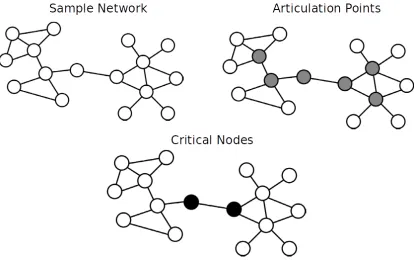
[image:21.612.119.533.158.421.2]the performance of a network. These nodes are referred to as the articulation points.
Figure 1.1: Difference in articulation points and critical node.
In the sample network of Fig ??, we represent the articulation points in grey
color. It is clear from the figure that, removal of any of these articulation points will
render the network disconnected, where we use the term disconnected for a network
in which every node is not accessible by every other node in the network. A few of
these articulation points have shown to report a higher reduction in the performance
of the network and these points which are coloured in black are referred to as the
critical nodes of a network.
The aforementioned example is a special case in point where critical nodes are also
CHAPTER 1. INTRODUCTION 5
literature, Wehmuth et al. in [?] refer to a node as critical based on how much affect
it has on the notion of network centrality, a node that has a higher network centrality,
is referred to as a critical node in a network. On the other hand, Ashwin et al. in [?]
and Mario et al. in [?] refer to nodes as critical based on the affect they have on the
pair-wise connectivity of the network upon there removal. Moreover, Nasiruzzaman
et al. in [?] refer to a node as critical if it has maximum network traffic flow through
it, the removal of such a node will reduce the network traffic flow to the minimum
and is thus referred to as the most critical node in the network. In this thesis, we
combine the above stated definitions and form a new definition that is used in this
work. We refer to a node as critical if its removal has the highest influence on the
performance of the network and we evaluate the performance of a network in both
aspects, the connectivity of a graph and the network traffic flow that it is observing,
therefore, according to the above stated definition, a node is referred to as critical
if by its removal, the network observes maximum dis-connectivity and the network
traffic flow observes the highest amount of decrease.
The identification of these critical nodes is vital for assessing the vulnerability of a
network and this is the main motivation behind this thesis. The next section explains
in detail the motivation.
1.1
Motivation
Evaluation of node criticality is significant in various complex networks. A few nodes
to have a higher impact on the performance of a network [?][?][?]. This initiates the
need for timely identification of these critical nodes for the purpose of timely
rectifi-cations and avoidance of any unexpected/unwanted network performance changes.
The importance of critical node identification was reignited when a Georgian
woman in march 2011 disconnected 90% of Armenia from the access to the
inter-net by accidentally sabotaging an optical fiber that was passing by her house [?]. She
was scavenging for copper to sell as scrap when she came across this cable.
Coin-cidently she had cut the only fiber cable that was connecting 3.2million Armenian
people, thus depriving them from the access to the internet for continuous 5 hours.
This highlighted the fact that despite the looks of the internet as depicted in Fig ??
the removal of a single critical node can have a high affect on the performance of the
network.
The influence of critical nodes is not only limited to the internet, but it is also
reflected in other fields such as a Peer to Peer Gnutella Network which reported a
major network fragmentation after a removal of 4% of the most critical nodes of a
network [?] and the North American power grid network which reported a 60% loss
of network connectivity upon the removal of only 4% of the nodes in the network [?].
Similarly, in transportation networks [?], the need to identify critical nodes has
increased with the ever increasing population which provokes the need for having
a better and reliable network. These transportation networks, are prone both to
the predictable human intervention and the unpredictable natural disasters such as
CHAPTER 1. INTRODUCTION 7
Figure 1.2: Partial map of the Internet based on the data found on January 15, 2005 [?].
cause network blockages due to two broadly defined reasons, either a regular network
edge between two critical points is observing blockage due to limited link capacity
or the transportation network observes occasional network blockages, as for example
near a couple of famous touristic spots (critical nodes) in the network. In the former
scenario, an efficient critical node detection algorithm will help in identifying such
a critical link and thus to avoid the blockage, an alternate re-route can be designed
that avoids the identified link. In the later scenario, the need of an extra special edge
across all the critical nodes of the network can be avoided by efficiently re-routing
traffic through edges that are not commonly used by various critical nodes of the
network, thus avoiding network blockage. Regarding the the unpredictable nature of
rescue and recovery processes [?]. The proactive identification of critical nodes such
as schools and hospitals can aid the rescuers to act quickly by using the shortest and
the most affective paths and similarly for the reconstruction of an area that has been
hit by a natural disaster such as a hurricane, the identification of critical nodes will
aid the authorities in deciding as to which roads should be built first.
Likewise, in Telecommunication networks [?], the need to identify these critical
nodes has never been more important than now. These days, with the introduction
of smart phones for the purpose of increasing connectivity between people and for
making life easier, we have also increased the risk of sabotaging our privacy by
cre-ating nodes (such as cellphones and tablets) that have all our vital information. A
single virus that reaches our smart device can extract vital information such as our
credit card details, our home address, can have access to our email and the list goes
on. These viruses/bugs travel through our telecommunication network and thus to
prevent the spread of such viruses, it is essential to timely identify the critical nodes
and suppress their communication and thus avoid spreading these viruses and also
maintain normal functionality for the rest of the customers [?]. Similarly, in
biolog-ical networks [?], the detection of critical nodes can aid in neutralizing potentially
harmful organisms such as bacteria and viruses. The interaction of protein with other
proteins in a network can be represented in terms of graph theory and it is generally
referred to as the protein-protein interaction network. These structures provide vital
information for understanding biological structures and thus are widely used for
CHAPTER 1. INTRODUCTION 9
set of proteins (the critical node set of a graph) whose removal will destroy the
pri-mal interaction and thus help neutralize the potentially harmful organism. The next
section, explains in detail the problem statement of this thesis.
1.2
Problem Definition
Critical node identification plays a vital role in accessing network vulnerability and
multiple approaches exist in literature that can be used for identifying critical nodes
in a network. Some of the existing algorithms are based on intuition, whereas
oth-ers are based on mathematical abstractions of networks of arbitrary topology and are
thus characterized by properties which can be verified analytically prior to
implemen-tation. Most of these approaches either identify critical nodes based on the affect of
a node on the traffic flow pattern of the network or they use the topological structure
of the network to identify these critical nodes. To the best of our knowledge, no such
algorithm exists in literature that identifies critical nodes based on both the
topolog-ical structure and the traffic flow pattern of the network. To address this problem,
this thesis proposes two metrics, the first is based on intuition and it uses a newly
defined node diversity metric which incorporates the weighted node degree and the
variation in link length capability of a node to address the topological properties of a
network. The weighted node degree metric is a slight variant of the well know degree
centrality metric [?], the major difference lies in the evaluation of the degree of a
node based on the number of new nodes that are introduced by a particular node if
which evaluates the affect of Average Path Length (APL) of a network. The variation
in link length metric evaluates the diversity of a network by using the difference in
path length that a node is maintaining, the intuition behind this approach is that a
node that connects multiple nodes at varying distances is highly likely acting as a
bridge node among various nodes in the network thus, it is probable that by removing
that node the network will report a higher degradation in performance. The traffic
flow pattern on the other side is incorporated in this critical node evaluation metric
with the use of the Banzhaf power index, it is a slight variant of the well known
betweenness centrality metric [?] and was previously used for weighted voting games.
The second metric is based on pure mathematical abstraction where we formulate
the critical node identification problem in the form of an optimization problem where
the objective is to identify a node that when removed has the highest impact on
both, the algebraic connectivity of the network and the maximum traffic flow of the
complete network. Here, the first part of the optimization problem deals with the
topological properties of the network and the second part deals with the traffic flow
of the network, thus addressing both sides of the problem. More detail on both these
metrics are explained in Chapter ?? and ?? respectively.
1.3
Research Objectives
The objective of this research is to develop a new model that can correctly identify
critical nodes in a network. The identified node, upon its removal, should:
CHAPTER 1. INTRODUCTION 11
for nodes to communicate with each other.
• Reduce the Algebraic connectivity of the network, which means that the
net-work is loosely connected and the removal of a few nodes will result in netnet-work
partitioning. These few nodes that are holding the network together are the
ones that will create bottleneck for the complete network.
• Increase network congestion and probability of collision thus reducing the
net-work throughput and increasing per packet delay of the netnet-work.
Furthermore, the objectives include:
• The design of a distributed algorithm that can correctly identify the most critical
node of a network without the need of a centralized monitoring body. This will
aid in implementing this algorithm in complex networks such as, Wireless Sensor
Network (WSN), Road networks, Communication networks and various other
large sized complex network for the assessment of network vulnerability.
• The distributed critical node identification algorithm should be computationally
less complex, thus increasing the possibility of its implementation in
computa-tionally complex networks.
1.4
Research Method
In order to identify the most critical node in a network, it is essential to identify the
attributes of a node in a network. This thesis uses the node attributes in a network
to evaluate various metrics. This selection is based on the consideration that the edge
attributes are reflected in the node attributes of the nodes that are connected through
that edge. A well known metric that reflects the node attributes of a network is known
as the Average Path Length metric. The Average Path Length metric reflects the
average time it takes a message to move from one node to any other node in the
network. This thesis first emphasises on the existing approaches for estimating the
Average Path Length of a network as it is known to be one of the major influencing
factor for node criticality and then proposes a new approach that reduces the time
complexity of calculating the Average Path Length (APL) of complex networks.
Later, this thesis considers a Wireless Sensor Network (WSN) as a special case
example to highlight the affects of changing the Average Path Length of a network and
proposes a new methodology for its reduction. The new methodology uses a Variable
Rate Adaptive Modulation (VRAM) scheme on top of a Neighbour Avoiding Walk
(NAW) mechanism for reducing the Average Path Length using the same transmission
power. This helps in building an intuition based metric for the identification of
critical nodes in a network. The intuition based critical node identification metric
is referred to as the Combined Banzhaf & Diversity Index (CBDI). The Diversity
index in CBDI originates from the Neighbour avoiding walk mechanism discussed in
the APL reduction mechanism and the Banzhaf Power index in CBDI is a variant of
the well known betweenness centrality metric. The CBDI mechanism is tested using
CHAPTER 1. INTRODUCTION 13
The intuition based CBDI metric lacks in providing mathematical ground about
the way that it works and for this a new critical node identification metric is proposed
that is the resultant of the suboptimal solutions of two optimization problems. The
critical node identification metric originating from these suboptimal solutions is tested
through simulations and analysis. These suboptimal solutions have shown to perform
well in identifying the most critical node in the network and they are used to formulate
a critical node identification algorithm which is also among the contributions of this
thesis.
1.5
Contribution
In this thesis, a new mathematical model is presented that evaluates the Average
Path Length of a tree structured network. This is an advancement upon the existing
approaches that require tedious computation of all the possible paths in a network
for the approximation of the average path length of a network. This contribution is
also accompanied by a new approach for the reduction of the average path length of a
network which can be used in various network scenarios for the introduction of small
world network phenomenon into comparatively large networks.
The contribution of this thesis also incorporates the introduction of a network
distributed critical node identification metric which is the outcome of the suboptimal
solutions of two well known optimization problems. This thesis also presents a
mathe-matical formulation that identifies the algebraic connectivity of the resultant network
degree centrality metric is also proposed which is referred to as the weighted degree
centrality metric and is shown through analysis and simulation that it is a better
metric than the conventionally used degree centrality metric.
1.6
Thesis Structure
Chapter 1: Introduction This chapter provides information on the context of
the research in hand along with the focus of the research work. It also highlights the
aims and objectives of the research work.
Chapter 2: Related Work This chapter explains in detail the existing work
that relates to the work in this thesis and highlights the deficiencies of the existing
work that had initiated the need for this work.
Chapter 3: Average Path Length Calculation For Complex Tree
Struc-tures This chapter describes the conventional approaches used for calculating the
APL of a complex topology and then proposes a simpler approach, that reduces the
computational complexity of calculating the APL of a complex structure.
Chapter 4: Average Path Length and Network PerformanceThis chapter
highlights the affects of changing the APL of a network and in it we propose a new
mechanism for reducing the APL.
Chapter 5: Intuition Based Critical Node Identification Approach This
chapter elaborates on the importance of critical node detection and propose a new
intuition based metric for identifying the most critical node in the network.
Crit-CHAPTER 1. INTRODUCTION 15
icality Assessment This chapter discusses the use of optimization theory for the
identification of critical nodes in a network and with the aid of this theory we propose
a new algorithm that can identify critical nodes in any arbitrary network.
Chapter 7: Conclusion and Future Work This chapter concludes this thesis
Related Work
2.1
Introduction
A number of approaches have been proposed in literature for the identification of the
critical nodes in a network. These approaches can be broadly categorized into two
categories namely the connection based approach and the topology based approach,
where the former uses the information flow pattern of the network to identify the most
critical node and the later uses the topological structure of the network to identify
the most critical node in the network.
2.2
Connection based schemes
The connection based approaches identify the criticality of a node based on the
in-formation flow pattern of a network. The inin-formation flow pattern in a network
highlights the data flow rate through each individual node and also enables in
CHAPTER 2. RELATED WORK 17
fying the node that can be the cause of a potential bottleneck in the network. Both
of these parameters play a key role in identifying node criticality and a number of
approaches exist in literature that use the information flow pattern of a network to
identify the criticality of a node. This section highlights a few well known approaches
that are later referred to as the connection based approaches in this thesis.
2.2.1 Average Path Length metric
The average path length metric is among the very widely used metrics and it is also
referred to as the characteristic path length metric of a network [?]. This metric uses
the sum of the shortest path of every node to every other node in the network for
the identification of the most critical node in the network. In a graph G = (V, E),
whereV is the set of vertices andE is the set of edges, the characteristic path length
is defined by:
l = 1
N(N −1)
X
v∈V X
w6=v∈V
d(v, w) (2.1)
where, d(v, w) is the geodesic distance between v and w with v, w ∈ V, i.e., the
cumulative distance of all the edges that lie in the shortest path between the two
nodes and the factor 1/N(N−1) is the one over the total number of pairs of vertices.
In such a network, a larger value oflrepresents a relatively larger time for the message
to be disseminated inside a network whereas, a smaller value of l denotes a tightly
bonded network where nodes are placed close to each other. The average path length
on the average path length of the complete network. It is easily relateable that the
node with the shortest path length to every other node in the network, will have
the highest influence on average path length of the network where, the average is
[image:35.612.197.454.219.387.2]computed using eq ??.
Figure 2.1: Weighted sample network for accessing shortest path length metric.
The sample network in Fig ??shows an undirected weighted network of six nodes
where, the weights represent the length of an edge. The shortest path length metric
calculates the distance of every node to every other node in the network and then the
node that has the shortest path length among the whole network is referred to as the
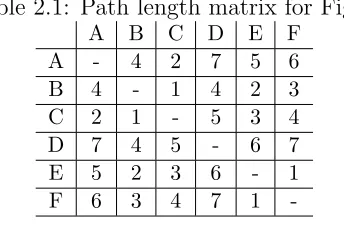
most critical node in the network. The shortest path lengths for the sample network
are shown in the symmetric matrix of table ??.
It is clear from the table that node B has a shortest distance of 14 units from all
the nodes in the network, thus it is assumed to be in the center of the network and
the most accessible node in the network. Removing such a node will thus increase
CHAPTER 2. RELATED WORK 19
Table 2.1: Path length matrix for Fig ?? A B C D E F
A - 4 2 7 5 6 B 4 - 1 4 2 3 C 2 1 - 5 3 4 D 7 4 5 - 6 7 E 5 2 3 6 - 1 F 6 3 4 7 1
-the network according to this average path length metric.
2.2.2 Closeness Centrality metric
Another well known approach that has been in consideration for a long time is the
closeness centrality metric [?]. This metric identifies the criticality of a node by
analysing the total distance of one node with all the nodes in the network and thus a
node that has the lowest total distance and therefore is closer to all the nodes in the
network is thus considered as critical in the network. The phenomenon behind the use
of this metric is that a node closer to all the other nodes in the network will eventually
have the highest network traffic flow through it, as it can reach maximum nodes in
the network with the shortest distance. In order to calculate the closeness centrality
of a node, researchers use the reciprocal of the total distance from a particular node
to all other nodes in a network [?]:
CC(v) = P 1
u∈V d(v, u)
(2.2)
Unlike the average shortest path metric which is defined as the average distance
identifies how close each individual node is to the rest of the network nodes. Fig ??
shows a sample network of 34 nodes where the criticality of the node is represented
with both color and size of the node. A bright red node with the biggest size is
considered as the most critical node in the network. As expected from the definition
of the closeness centrality metric, the nodes close to the center of the network have a
[image:37.612.238.417.282.470.2]higher closeness centrality among all the nodes in the network.
Figure 2.2: Sample network representing nodes with the highest closeness centrality [?].
2.2.3 Betweenness Centrality metric
The betweenness centrality metric was originally proposed by Freeman in his seminal
paper [?] and since then it has been used by various researchers for identifying critical
nodes in a network [?][?][?]. This is also a shortest path enumeration based metric
and it identifies the most critical node based on the number of shortest paths that a
CHAPTER 2. RELATED WORK 21
will have the highest influence on the performance of the network upon its removal
and thus it is considered as the most critical node in the network. Let κuv(x) denote
the fraction of shortest paths between node u and v that pass through node x, then
[?]:
κuv(x) =
σuv(x)
σuv
(2.3)
The betweenness centrality of a vertex x is then defined as [?]:
BC(x) = X
u6=v6=t∈V
[image:38.612.238.414.339.589.2]κuv(x) (2.4)
Figure 2.3: Sample network representing nodes with the highest betweenness central-ity [?].
The betweenness centrality of a node measures the control of a node on the overall
communication in a network, and it is therefore used to identify critical nodes in a
shortest path routes and thus by its removal the network will face a greater decrease in
the average network traffic flow rate. Fig ?? shows in red the nodes that participate
in maximum shortest path routes in a network of 34 nodes. The size of the node
reflects its importance in the network and therefore the node with the largest size
and the brightest red color is referred to as the most critical node in the network
based on the betweenness centrality metric.
2.2.4 Ego centrality metric
A slight variant of the betweenness centrality is the ego centrality metric [?][?]. The
ego centrality metric was designed for a special class of graphs that are known as
the centred graphs [?], these graphs are in a star structure and thus restrict nodes
from either having a direct link with the neighbour or a path of 2 hops between
any two nodes in the network. The ego centrality metric takes benefit of this graph
structure and determines the criticality of a node based on the number of times a node
participates in forming this two hop path between any two nodes. This definition is in
line with the previously defined betweenness centrality metric but the major difference
lies in the network structure type. As the ego centrality metric was mainly defined
for the star network, thus the maximum length between two nodes of a graph cannot
CHAPTER 2. RELATED WORK 23
2.2.5 Network traffic flow metric
Nasiruzzaman et al. [?] on the other hand believe that it is not necessary that all
real life networks use the shortest path routes to relay traffic/messages. Instead they
propose a new metric which is build on the phenomenon that the traffic flow pattern is
a better estimation metric for the evaluation of critical nodes in a network. Therefore,
their proposed approach considers a node to be critical if it observes a higher traffic
flow through it. Let Fa be the net maximum power flowing through node a in the
network with source node s∈S and load node l∈L. Then Fsal is defined as:
Fsal =
X
s∈S X
l∈L
Fasl (2.5)
where s 6= l 6= a. Also let, Fn be the net maximum power flowing through the
network with the source node s∈S and load node l∈L, then Fsl is defined as:
Fsl=
X
s∈S X
l∈L
Fnsl (2.6)
The ratio of these two powers could be used to measure the importance of a node
and this ratio is called the flow betweenness. This flow betweenness is defined as:
CB(a) =
Fsal
Fsl
(2.7)
With this approach, a node that has a relatively higher flow betweenness in the
Figure 2.4: Sample network representing nodes with the rank of each node in the network [?].
2.2.6 The Rank matrix
Another approach that exists in literature is the rank matrix approach [?][?]. This
matrix uses the traffic that passes through a node to form aV ×V matrix to evaluate
the most critical nodes in the network. Unlike previous approaches, this metric
iden-tifies a set of critical nodes whereas, the previously stated approaches can identify a
single most critical node in the network. In this approach, the minimum number of
nodes that report a full rank ofV ×V matrix of the network are reported as the most
critical nodes. Here theV ×V matrix represents the traffic on the link between nodes
in the network. Fig ?? represents a network with multiple nodes where, the size of a
node represents the degree whereas, the color represents the criticality. Nodes in red
are the ones that have the highest influence on the rank of the network. As per the
CHAPTER 2. RELATED WORK 25
rank of the matrix is considered as the most critical node in the network, this means
that the larger red nodes are the most critical nodes in the network.
2.3
Topology based schemes
The topology of a network refers to the arrangement of nodes and their
interconnec-tion through edges. These topology based schemes have always been of keen interest
to researchers when it comes to networks where there is no relative traffic flow such as,
social networks. To tackle this phenomenon of network structure and to understand
node criticality based on this structure, various approaches have been proposed in
the literature. This subsection highlights a few of these approaches that are highly
relevant to the work presented.
2.3.1 Degree Centrality metric
Among all the topology based approaches, the most widely used approach is the
degree centrality metric [?][?]. The degree centrality metric as obvious from the
name, uses the degree of a node to identify the most critical node of a network. The
node that reports the highest node degree is thus referred to as the most critical
node of the network. The key idea here is that, a node with a higher node degree is
neighbours to more nodes in the network and thus by removing that particular node
a higher number of non-neighbouring nodes will loose connection with each other.
Fig ?? shows a graph of 34 nodes with the size and color of a node representing the
from the definition of the degree centrality metric that the most critical node will lie
[image:43.612.232.413.166.356.2]in the center of the network and that is also depicted in Fig ??.
Figure 2.5: Sample network representing nodes with the degree of each node in the network [?].
2.3.2 Bonachich metric
Bonachich et al. in [?] improvised on the degree centrality by proposing a new power
measure and then connecting it with a modified degree centrality measure to obtain
a better centrality metric. Bonachich metric is build on the phenomenon that the
neighbours of a node play a vital role in determining its importance in a network. A
node whose neighbours are connected to less neighbours makes the particular node
more powerful as it is likely that the node under consideration is the reason that its
neighbours are connected to multiple nodes in the network. Therefore, a node whose
neighbours are less connected makes that node more powerful as, by its removal the
CHAPTER 2. RELATED WORK 27
to more neighbouring nodes then this makes you more central and less powerful thus,
the identification of node criticality requires a trade off between node power and
centrality. Fig ?? shows a network of 34 nodes with the colors and size of the nodes
representing the criticality of a node. It is worth mentioning that the modifications
that Bonachich et al. proposed identifies a different node as compared to the one
[image:44.612.237.417.281.470.2]pointed out by the degree centrality metric.
Figure 2.6: Sample network representing nodes with the highest bonachich centrality [?].
2.3.3 Eigenvector Centrality metric
Another approach that exists in literature is the eigenvector centrality [?][?].
Eigen-vector centrality is a measure of the influence of a node in a network. It assigns
relative scores to all the nodes in a network based on the concept that connections to
high scoring nodes contributes more to the score of a node when compared to equal
A = (ax,t) will have ax,t = 1 if node x is linked to node t and zero otherwise. The
centrality score of node x is defined as:
vx =
1
λ
X
t∈M(x)
vt (2.8)
where, vt is the eigenvector of the node t that belongs to the neighbour set M(x)
of nodexwith λbeing a constant. With a small rearrangement this can be rewritten
in a vector notation as the eigenvector equation:
Av =λv (2.9)
In general, there will be many different eigenvalues λ for which an eigenvector
solution exists but considering the additional requirement of all positive eigenvectors
[image:45.612.235.413.474.661.2]only the highest eigenvalue reports the desired result.
CHAPTER 2. RELATED WORK 29
Fig??reflects the most critical node in the network with aid of size and color. the
brightest red coloured node with the biggest size is represented as the most critical
node in the network.
2.3.4 The HILPR metric
In the Hybrid Interactive Linear Programming Rounding (HILPR) algorithm [?] Yilin
et al. propose a different approach of defining node criticality based on the pairwise
connectivity of the resultant network after the node removal. They emphasise that
the node pair whose removal leads to the most balanced disconnected components and
ensures the non-existence of giant components will result in the highest degradation
in the performance of the network and thus should be ranked as the most critical
node of the network. A similar approach is followed in the GREEDY Critical Node
Detection Problem approach (GREEDY-CNDP) [?] and theβ−disruptor approach
[?], both of which propose an efficient algorithm to minimize pairwise connectivity
upon removal ofk nodes from the network. Another approach that exists in literature
is the algebraic connectivity metric [?][?][?], which is also the focus of this work and
is explained in detail in later chapters. The phenomenon here is that the algebraic
connectivity is known to be a well defined connectivity metric for a network, therefore
to identify a critical node, it is vital to identify the node that reports the highest
reduction in the algebraic connectivity of the network. The node that reports the
highest reduction in the algebraic connectivity of the network will thus be identified
Average Path Length Calculation
For Complex Tree Structures
3.1
Introduction
Among all the critical node identification approaches highlighted in this thesis, one of
the key approach that exist in literature is the Average Path Length (APL) metric.
APL is defined as the mean of the shortest path lengths between all pair of vertices
and it represents the closeness and consequently, how quickly information transfer
takes place in a network [?] and this makes it as one of the key metric in evaluating
the criticality of a node in a network. A node is deemed critical if by its removal the
Average Path Length of a network increases and as a resultant information transfer
takes a longer time. Most real world networks unexpectedly have short average path
lengths, as popularized by six degree of freedom play. This property is known as
Chapter 4
Average Path Length and Network
Performance
4.1
Introduction
Average Path Length (APL), node criticality and network reliability are three closely
connected features. A network that has a higher APL would have nodes located at
a farther distance and thus a few selected nodes will be responsible for relaying most
of the data through the network, making these nodes critical. Moreover, the larger
the distance between nodes (a larger APL) the lower will be the network reliability
[?]. This chapter focuses on elaborating on the connection between the APL of a
network and network reliability and also proposes a new approach for reducing the
APL of a network which is adopted from the Small-World phenomenon used in Social
Networks. In the end this chapter highlights how the APL of a network affects network
Intuition Based Critical Node
Identification Approach
5.1
Introduction
Critical node discovery is an important process for understanding network
vulnera-bility. A node is deemed as critical, if it plays a vital role in maintaining network
performance and by removing that node, the overall performance deteriorates and in
some cases leads to network partitioning [?] which is highly undesirable. Evaluating
the criticality of nodes is significant in various complex networks. In Wireless Sensor
Networks (WSNs) employing geographical routing, for example, malicious attack or
malfunction of a few beacon nodes leads to fallacious node discovery for the remaining
nodes in the network, thus jeopardizing the stable operation of the routing protocol
[?]. Moreover, in [?] it was observed that removal of 4% of the nodes in a Peer to Peer
Chapter 6
Optimization Based Spectral
Partitioning for Node Criticality
Assessment
6.1
Introduction
The identification of critical nodes is vital for accessing network vulnerability and
security [?]. The failure of a few critical nodes can have an adversarial effect on
net-work performance varying from slight degradation in the Quality of Service up to the
complete breakdown of the network [?]. The significance of critical nodes has been
highlighted in a number of examples most of which are explained in chapter??&??.
Some of these algorithms are based on intuition, whereas others are based on
mathe-matical abstractions of networks of arbitrary topology and are thus characterized by
Conclusion and Future Work
This chapter provides the conclusion of the work presented in this thesis along with
a brief overview of a future direction of research.
7.1
Conclusion
The change in APL of a network upon removal or addition of a node is among the
key considerations when dealing with critical node identification or accessing network
vulnerability. This thesis, addressed this critical node identification problem by first
identifying the parameters that affect the APL of a network, which is shown in
litera-ture to be computed using the complete knowledge of the network, where each nodes
computes its distance from every other node in the network. This tedious approach
is replaced by a much simpler and computationally less expensive approach in this
thesis where, the network is broken down into branch and leaf nodes and then the
APL approximated. The proposed approach when tested against existing approaches
CHAPTER 7. FUTURE WORK 157
using extensive simulations was shown to outperform existing approaches in terms of
computational complexity.
The APL of a network, as established in this thesis, plays a major role in
ap-proximating the average time it takes for a message to be transferred throughout the
network and extensive research has been done in order to reduce the APL of a
net-work. Existing approaches achieve this goal by either equipping nodes with special
high power antennas that would cover a longer distance or equip nodes with special
directed antennas for a directed beam forming or rely on the addition of a dedicated
wire, connecting different nodes for increasing the connectivity of the network. This
thesis eliminated this requirement of adding special hardware by proposing a new
Variable Rate Adaptive Modulation (VRAM) scheme, that changes the modulation
schemes to achieve long distance communication. The proposed approach reduces the
APL of a network and improves the communication between nodes. It was observed
here that, the proposed approach reported an average improvement of 41% in
reduc-ing the APL of a network and it reported an average 21% increase in the average
node degree of the network when compared to existing approaches. The increase in
average node degree is evidence to the fact that more nodes are directly connected
with each other and thus message sharing among distant nodes in a network will take
a shorter amount of time. This led to the deduction that a critical node will be the
one that would increase the APL of a network upon its removal and will therefore
increase the time taken for communication between nodes in the network. Numerous
A number of approaches that exist in literature mainly deal with the geographic
location of nodes or the networks traffic flow pattern to identify these critical nodes
of a network whereas, this thesis proposes two approaches, the first being an
intu-itive approach, that identifies critical nodes of a network (nodes that result in the
highest decrease in the performance of the network upon their removal), based on
a newly defined diversity index which is combined with an existing Banzhaf power
index approach. The newly defined diversity index comprises of the diversity in the
link length capability of a node and is referred to as the variation in link length metric
and the diversity in weights of the node degree which is referred to as the weighted
node degree. The combined affect of the diversity index and the banzhaf power index
has been reported in this thesis to outperform existing approaches in identifying
crit-ical nodes in a network. The identification of these critcrit-ical nodes will aid in timely
adaptation of the network so that their influence on the performance of the network
can be mitigated. The proposed approach reported a 7% and 18% percent increase
in average path length of the random and WaxMan network topology respectively
took place and a total paths elimination for the small world network topology when
the identified critical nodes were removed from the network. Furthermore, it was also
reported that a prominent decrease of 13%,28% and 68% took place in the average
node degree for the random, WaxMan and Small World network topologies
respec-tively which means that the identified/removed node was connected to multiple node
in the network thus breaking multiple connections upon its removal. The proposed
CHAPTER 7. FUTURE WORK 159
of isolated nodes in a network. The increase in number of isolated nodes is the
ev-idence to the fact that the network has been partitioned into multiple disconnected
components. The proposed approach reported a 150%,400% increase in the number
of isolated nodes in the random and Small World network topologies respectively
and a small increase of 0.8% decrease in the number of isolated nodes in a WaxMan
network topology. This small increase is negligible when it comes to really large
net-works. The proposed approach was also tested against other approaches for analysing
the connectivity and the affect it had on the performance of the network and it was
observed that the critical nodes identified by the proposed approach when removed
from the network result in a decrease in the algebraic connectivity of a network by
58% whereas, as for the performance of the network, the throughput of the network
degraded by 22% for the random network topology and it was backed by an increase in
the average delay, average jitter and average number of dropped packet by 33%,45%
and 75% respectively. These all are evidence to the fact that the identified critical
node is vital for maintaining normal network functionality and upon its removal the
network undergoes major performance degradations.
In order to justify the claims made in the aforementioned work, a
mathemati-cal framework was also built which uses suboptimal solutions for two optimization
problems, namely the algebraic connectivity minimization and the network utility
maximization problem. The resultant solution of these optimization problems when
used to identify critical nodes in a network has been shown to outperform existing
the algebraic connectivity is also calculated that identifies the affect on the algebraic
connectivity of the network when a certain node is removed from the network. The
critical node identified using this mathematical abstraction resulted in a reduction in
the algebraic connectivity of the network by 22% which denotes that the network is
loosely connected and the removal of a few more nodes can easily partition the
net-work. It is also reported in this thesis that, the loosely connected network formed after
removing the identified critical node results in a bottleneck close to the center of the
network which increases the network congestion, reduces network throughput by 16%
and increases the average per packet delay, the average number of dropped packets
and the average jitter experienced in the network by 6%,4% and 6% receptively. The
proposed approach is complimented in this thesis with a distributed implementation
that is computationally less complex and can be implemented in complex networks.
It was observed that the proposed approach reduces the average computation time
of a network by 36% when compared to existing approaches in the network. These
statistics clearly state that the proposed approach outperforms existing approaches
in identifying critical nodes in a network and that these nodes when removed result
in a higher degradation in performance of the network, thus, in order to maintain
normal network functionality, it is necessary to timely identify these critical nodes
CHAPTER 7. FUTURE WORK 161
7.2
Future Direction of Research
This thesis proposes solutions to two major problems, the first being the estimation
of the average path length of a network and the second being the identification of
critical nodes in a network. In the first problem, the underlying assumption is of
reducing an arbitrary network into a tree structure and it uses a simple tree structure
of a single stem with only one set of leaf nodes, the elimination of this assumption
will lead to multiple open problems and this can be used as a future direction of work.
The second problem that is being addressed by this thesis initiates its own set of
problems that can be addressed in the future. The first being that, as a conventional
approach the vulnerability of a network is estimated for a particular instance when
the most critical node is removed from the network, but in real life scenarios, most of
the networks have a recovery mechanism with the aid of which they adapt and change
the network structure to regain maximum network utility. A new direction of research
in this domain would be of finding a particular critical node, who’s removal will have
an impact that cannot be recovered by the network with the aid of a conventional
recovery mechanism.
Along with this, another open problem that originates from this thesis is the design
of an efficient distributed critical node identification mechanism that is scalable to
large sized networks. The proposed approach uses a flooding approach for identifying
critical nodes in a network and it is believed that an efficient approach if used would
reduce the computation time to a greater extent and thus will be appropriate for
identification of critical nodes but it relies only on the sign of the Fiedler vector
elements that correspond to each node in the network. It was observed during this
thesis that, the magnitude of the Fiedler values decreases as one moves to a node
close to the center of the network (the sign cut region) and it increases as one moves
away from this region. As a future direction of research, the use of this change
in magnitude along with the change in sign would help in forming a more efficient
Bibliography
[1] Centrality metrics. https://cs.hse.ru/data/2015 /05/14/1098547089 /4.
Cen-trality Metrics.pdf.
[2] Maple homepage. http://www.maplesoft.com.
[3] Ian F Akyildiz, Weilian Su, Yogesh Sankarasubramaniam, and Erdal Cayirci.
Wireless sensor networks: a survey. Computer networks, 38(4):393–422, 2002.
[4] R´eka Albert, Istv´an Albert, and Gary L Nakarado. Structural vulnerability of
the north american power grid. Physical review E, 69(2):025103, 2004.
[5] K.M. Alzoubi, P.J. Wan, and O. Frieder. Distributed heuristics for connected
dominating sets in wireless ad hoc networks. Journal of Communications and
Networks, 4(1):22–29, 2002.
[6] J.S. Andrade Jr, H.J. Herrmann, R.F.S. Andrade, and L.R. da Silva. Apollonian
networks: Simultaneously scale-free, small world, euclidean, space filling, and
with matching graphs. Physical review letters, 94(1):18702, 2005.
[7] Ashwin Arulselvan, Clayton W Commander, Lily Elefteriadou, and Panos M
Pardalos. Detecting critical nodes in sparse graphs. Computers & Operations
Research, 36(7):2193–2200, 2009.
[8] Ashwin Arulselvan, Clayton W Commander, Oleg Shylo, and Panos M Pardalos.
Cardinality-constrained critical node detection problem. InPerformance models
and risk management in communications systems, pages 79–91. Springer, 2011.
[9] W. Asif, M. Lestas, H. K. Qureshi, and M. Rajarajan. Spectral partitioning
for node criticality. In Symposium on Computers and Communication (ISCC),
pages 877–882. IEEE, 2015.
[10] W. Asif, H.K. Qureshi, M. Rajarajan, and M. Lestas. Cbdi: Combined banzhaf
and diversity index for finding critical nodes. InIEEE Global Communications
Conference (GLOBECOM), pages 758–763, Dec 2014.
[11] Waqar Asif, Hassaan Khaliq Qureshi, and Muttukrishnan Rajarajan. Variable
rate adaptive modulation (vram) for introducing small-world model into wsns.
In 47th Annual Conference on Information Sciences and Systems, pages 1–6.
IEEE, 2013.
[12] Giorgio Ausiello, Donatella Firmani, et al. Real-time monitoring of undirected
networks: Articulation points, bridges, and connected and biconnected
BIBLIOGRAPHY 165
[13] David Bader, Kamesh Madduri, et al. Parallel algorithms for evaluating
cen-trality indices in real-world networks. In International Conference on Parallel
Processing, ICPP, pages 539–550. IEEE, 2006.
[14] Abhik Banerjee, Rachit Agarwal, Vincent Gauthier, Chai Kiat Yeo, Hossam
Afifi, and FB Lee. A self-organization framework for wireless ad hoc networks
as small worlds. IEEE Transactions on Vehicular Technology, 61(6):2659–2673,
2012.
[15] Alexander Bertrand and Marc Moonen. Distributed computation of the fiedler
vector with application to topology inference in ad hoc networks. Signal
Pro-cessing, 93(5):1106–1117, 2013.
[16] Vladimir Boginski and Clayton W Commander. Identifying critical nodes in
protein–protein interaction networks. Clustering challenges in biological
net-works, pages 153–167, 2009.
[17] Phillip Bonacich. Power and centrality: A family of measures.American journal
of sociology, pages 1170–1182, 1987.
[18] Phillip Bonacich. Some unique properties of eigenvector centrality. Social
Net-works, 29(4):555–564, 2007.
[19] U. Brandes. A faster algorithm for betweenness centrality*. Journal of
![Figure 1.2: Partial map of the Internet based on the data found on January 15, 2005[?].](https://thumb-us.123doks.com/thumbv2/123dok_us/1440315.96419/24.612.197.453.108.361/figure-partial-map-internet-based-data-january.webp)

![Figure 2.2: Sample network representing nodes with the highest closeness centrality[?].](https://thumb-us.123doks.com/thumbv2/123dok_us/1440315.96419/37.612.238.417.282.470/figure-sample-network-representing-nodes-highest-closeness-centrality.webp)
![Figure 2.3: Sample network representing nodes with the highest betweenness central-ity [?].](https://thumb-us.123doks.com/thumbv2/123dok_us/1440315.96419/38.612.238.414.339.589/figure-sample-network-representing-nodes-highest-betweenness-central.webp)
![Figure 2.4: Sample network representing nodes with the rank of each node in thenetwork [?].](https://thumb-us.123doks.com/thumbv2/123dok_us/1440315.96419/41.612.202.445.111.298/figure-sample-network-representing-nodes-rank-node-thenetwork.webp)
![Figure 2.5: Sample network representing nodes with the degree of each node in thenetwork [?].](https://thumb-us.123doks.com/thumbv2/123dok_us/1440315.96419/43.612.232.413.166.356/figure-sample-network-representing-nodes-degree-node-thenetwork.webp)
![Figure 2.6: Sample network representing nodes with the highest bonachich centrality[?].](https://thumb-us.123doks.com/thumbv2/123dok_us/1440315.96419/44.612.237.417.281.470/figure-sample-network-representing-nodes-highest-bonachich-centrality.webp)
![Figure 2.7: Sample network representing nodes with the highest eigencentrality. [?].](https://thumb-us.123doks.com/thumbv2/123dok_us/1440315.96419/45.612.235.413.474.661/figure-sample-network-representing-nodes-highest-eigencentrality.webp)
