Vol. 0022-538X/91/052476-08$02.00/0
Copyright© 1991,American Society for Microbiology
A
Subset of
Herpes Simplex Virus
Replication Genes Provides
Helper
Functions
for
Productive Adeno-Associated
Virus
Replication
FRIEDRICH W. WEINDLERANDREGINE HEILBRONN*
Angewandte Tumorvirologie, Deutsches Krebsforschungszentrum, ImNeuenheimer Feld506, D-6900
Heidelberg,
FederalRepublic of Germany
Received 23 October1990/Accepted18January 1991
Herpesviruses are helper viruses for productive adeno-associated virus (AAV) replication. To analyzethe
herpessimplex virus type 1 (HSV-1) functions mediating helper activity, we coinfected HeLa cellswith AAV
type 2(AAV-2) and different HSV-1 mutants defective inindividual HSV replication genes. AAVreplication wasfully accomplished in the absence of HSV DNA replicationandthusdidnotrequireexpression oflateHSV genes. Inaddition, HSV mutants lacking either the origin-binding proteinorthe functionalDNApolymerase fully maintained the capacity to replicate AAV. Cotransfection of the cloned, replication-competent AAV-2 genometogether with the sevenHSV replication genes (UL5, UL8,UL9, UL29, UL30, UL42, and UL52) led
toproductive AAVreplication. Cotransfections with different combinationsof thesegenes demonstratedthat a subset of four of them, coding for the HSV helicase-primase complex (UL5, UL8, UL52) and the major DNA-binding protein(UL29), was already sufficient to mediate the helpereffect. Thus, the HSV helper activity forproductive AAV replicationseems toconsistof DNAreplicationfunctions. Thisappears to bedifferent from the helpereffectprovided by adenovirus, which predominantly modulatesAAVgeneregulation.
Adeno-associated viruses (AAVs) belong to the parvovi-rusfamily, a group of small single-stranded DNA viruses (4, 5). Three viral functions have been mapped on the 4.7-kb AAV type 2(AAV-2) genome. The right-hand openreading frame codes for the threecapsid proteins, and the left-hand open reading frame codes for Rep, a family of multifunc-tional nonstructural AAV proteins required for AAV gene expression andDNAreplication. The 145-bp terminal repeat sequences serve as originsof replication.
Parvoviruses exhibitunique replicationproperties. Auton-omousparvovirusesreplicate independently in proliferating cells, whereas AAVs either integrate into the host cell genome ormakeuse of helper viruses forproductive repli-cation (4). Since low-level AAV replication has also been observed after treatment of AAV-infected cells with chemi-cal orphysical carcinogens (22, 51, 59, 60), the replication defectiveness of AAV is not considered to be absolute. Helper virusesforefficientAAVreplication include several adenovirus strains(5) andvirusesof the herpesvirus group, suchasherpes simplex virus (HSV) (6) and human cytomeg-alovirus (HCMV) (35). Coinfection with either
varicella-zoster virus (17) or vaccinia virus (50) has been shown to induceAAVantigen synthesis without direct demonstration of denovo-synthesized infectious AAV. Likewise, different avianherpesviruses provide helper activity for avian AAV (1, 2). So far, only the helper functions provided by adeno-virushave been characterized in some detail. The
adenovi-rusearly genesElA,E1B,E2A, E4 and thevirus-associated (VA) RNA I exhibit helper activity at different stages of AAV gene expression (reviewed in reference 4).
Althoughit is not clear at present how the human AAVs
arereplicated in vivo, adenoviruses as well as herpesviruses
areassumed toplayarole in the primary infection of AAV (17, 42). Although both adenoviruses (20, 38) and
herpesvi-* Correspondingauthor.
ruses (45) can establish latency after primary infection, regularinvivo reactivations from the latentstate are
inher-ent to herpesvirus infections only. During these episodes, herpesvirusesmaybe abletoreactivateAAVfromthe latent state.Wethereforedecidedtoanalyzeherpesvirus functions with helper activity for AAV replication. Except for one
reportdefiningasmall HSV type 1 (HSV-1)DNAfragment thatappearedtosupport AAVantigensynthesis (53) andthe finding that an HSV temperature-sensitive mutant for the polymerase gene supported AAV synthesis like wild-type AAV (13), the herpesvirus genes providing the full helper effect forAAV have notbeencharacterizedindetail.
Two different approaches have been used toidentify the HSV genesinvolvedinHSVreplication. First, temperature-sensitive mutants and null mutants, generated by targeted insertional mutagenesis of specificHSV genes, were tested for HSV DNA synthesis (reviewed inreference 56). Inan
alternativeapproach, thetransfection of clonedHSVDNAs demonstrated that seven HSV early genes provided the necessarytransfunctions for the replication ofthe
cotrans-fected HSVoriginsofreplication,
oris
andoriL (9, 58). The HSVreplicationgenescode forenzymesandfactorsdirectly involved in viral DNA replication (33), namely, the HSV DNA polymerase (encoded by the UL30 gene), the single-stranded (major) DNA-binding protein (UL29), a double-stranded DNA-binding protein (UL42) (15, 16, 19, 43), anorigin-binding protein (UL9) (14, 40),andacomplexof three tightlyassociatedproteins (UL5, UL8, UL52) with helicase and primase activity (11). In previous studies, we have shown thata subset of six ofsevenHSV replicationgenes induced DNAamplificationwithin the hostcell genome(24) and that this was completely suppressed by the AAV rep gene (21). Furthermore, rep concomitantly reduced HSV DNA replication (21). Since these studies indicated an
interaction between the HSVreplicationgenesand the AAV replicationfunctionrep(25, 54),wedecidedtodirectlytest
these HSV genes for helper activity. By the use of HSV 2476
on November 10, 2019 by guest
http://jvi.asm.org/
mutants defective in individual replication genes and by cotransfection ofexpression plasmids for these genes, we show here that a subset of the HSV replication genes provideshelper activity for productive AAVreplication.
MATERIALS AND METHODS
Recombinant plasmid DNAs. The AAV-2 wild-type ge-nomecloned into pBR322 (pAV2)waskindlyprovidedby C. Laughlin (29). The series of plasmids carrying the open readingframes of the HSV-1replication genes (UL5, UL8, UL9, UL29, UL30, UL42, and UL52) under the control of theHCMVimmediate-early enhancer-promoter(pCM-UL5, -UL8, -UL9, -DBP, -POL, -UL42, and -UL52) have been described before(24). Plasmids werepurifiedby-the alkaline lysis procedure(30) withtwosubsequentgradients in CsCl. Cells andviruses.HeLaand Verocellsweregrown at37°C and5% CO2inDulbecco'smodified Eagle medium supple-mented with 10 or 5%heat-inactivated (30
min,
56°C) fetal calf serum, respectively, antibiotics, and 10 mM HEPES(N-2-hydroxyethylpiperazine-N'-2-ethanesulfonic
acid) (pH 7.2).AAV-2 was propagated in HeLa cells with adenovirus type 2 as the helper, as described previously (60). The HSV-1wild-type strains KOS and17syn+ were propagated and titrated by plaque assay in Vero cells as described previously (32). HSV mutant tsH (temperature-sensitive mutation in the DNA polymerase gene) is derived from HSV-1 strain 17 syn+ and waspropagated inVero cells at the permissivetemperature
(33°C),
as describedpreviously (10, 31). The HSV nullmutantshr8O
(disrupted UL8 gene) (8), hr94(disruptedUL9gene) (23, 56), d21(disruptedUL29 gene)(41),andhrll4 (disruptedUL52gene)(18)arederived from HSV-1 strain KOSand were akindgift of S.K. Weller and P. A. Schaffer. They were propagated on helper cell lines which provide the defective functions in trans. The virusstocksof the nullmutants weretested forthepresence ofcontaminating
wild-type virus by performing a plaque assay with Vero cells which are not permissive for the mutants (Table 1).Infections. HeLa cells were infected in suspension with AAV-2(multiplicity of infection
[MOI]
= 2) for1h at37°C, medium was added, and 2 x10⁶
cells were seeded into 6-cm-diameter dishes. Twenty to 28 h later, cells were infected with HSV-1 wildtype or mutants(MOI =2)for1h and subsequently supplied with 2 ml of growth medium. After another 40 to 48 h, newly synthesized AAV was harvested by three cyclesoffreeze-thawing.Transfections. Transfections were performed by the cal-cium phosphate transfection protocol as described before (24). In brief, 2 x 10⁶ HeLacells were plated onto 10-cm-diameter dishes. Thenextday, fresh mediumwassupplied, and 2 to 4 h later, cells were transfected with 20 ,ug of plasmid DNA per dish. The amounts of the individual plasmid DNAs transfected were as indicated in the figure legends and, ifnecessary,supplementedwith vector DNA to atotal of20
jig.
Thecells
were treatedfor4 min with25%dimethyl
sulfoxide 3 to 4h later. The next day, cells were refed with3 mlofgrowthmediumand wereanalyzed40 to 48 haftertransfection forAAV DNAreplication and de novo AAVsynthesis.AAVreplication assay. Infected ortransfected cells were lysedby three freeze-thaw cycles.The disrupted
cells
were pelletedand analyzed forAAV DNA replication. Genomic DNA was extracted by digestion with proteinase K, re-peated extractions with phenol and chloroform, digestionwith RNaseA, and dialysis against Tris-EDTA buffer. For titration of infectious AAV, freeze-thaw supernatantswere heat treated (56°C for 30 min) to inactivate helper virus (HSV) and then inoculated in 1:10 dilution steps onfresh HeLacells grownon 96-wellplates. Cellswere infected with HSV-1 as ahelper (MOI= 10)20 to24 h later.Finally,40 to 48h after HSVinfection,cells werelysed bythreerounds of freeze-thawing,sucked ontoGeneScreenmembranes
(NEN,
Boston, Mass.), denatured,andhybridizedwith32P-labeled AAV-2DNA.
RESULTS
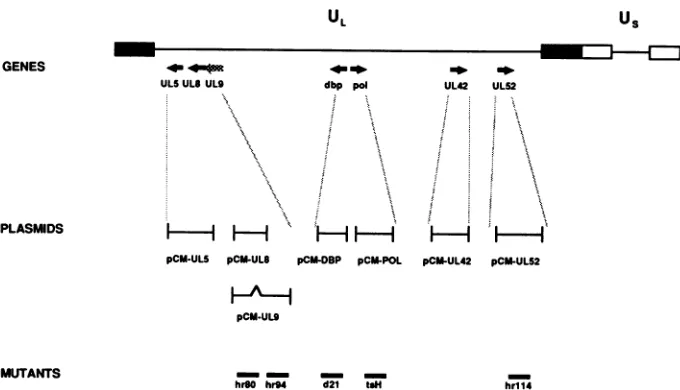
Helperactivity of HSV-1 mutants for AAV-2propagation. HSV-1and HSV-2 have been shown to act ashelperviruses for AAV replication with an efficiency similar to that of adenoviruses (6). Under theassumptionthat the HSV repli-cation genes could represent helper functions for AAV, HeLacells wereinfectedwithAAV-2 (MOI=2) and 20to 24 h later with different HSV mutants (MOI = 2) carrying defects in individualreplicationgenes(Fig. 1). Fortyto48h later, infectedcellswereprocessed for the determinationof newly synthesized AAV. Supernatants of heat-inactivated freeze-thawlysatesweretitratedinduplicateonfreshHeLa cells with HSV-1 as a helper virus. The AAV titer was analyzed by hybridization of membrane-bound denatured cells with32P-labeledAAV DNA.
The HSV wild-type strains KOS and 17 syn+ yielded an AAV titer of 6.7 x 10⁷ infectious particles per ml of supernatant (Fig. 2, KOS wt, 17 syn+ wt), in accordance withpublished data (6). HSV mutants hr94(Fig. 2, AUL9) and tsH (Fig. 2, tspol) inducedanAAVtiter similartothat induced by HSV wild type. This is in agreementwith data previously published by Drake et al. (13) using another temperature-sensitive mutantfor the HSVpolymerase gene. With the null mutants hr8O (Fig. 2, AUL8), d21 (Fig. 2, Adbp), and hrll4 (Fig. 2,AUL52), theAAVtiterdroppedto 6.7 x
103,
6.7 x10⁵,
and 3.7 x 10⁶ infectious AAVparticles per ml oflysate, respectively, suggesting a role for these genesinproviding helper functions forAAVreplication. All mutant virus stocks had been testedforpossible wild-type contamination(Table1), whichwasfoundtobe low enough that it couldnotexplain theobservedhelper effect for AAV. Inaddition, toexclude thepossibility
thatthe temperature-sensitive HSV mutanttsH was leaky atthe nonpermissive temperature(39.5°C),tsH wasplaqueassayedonVerocells atboth 33and39.5°C in parallel withthecoinfection exper-iment. At 33°C, the titer was 3 x10⁵
PFU, whereas no plaques could be detected at 39.5°C (Table 1). This differ-enceinplaquingefficiencyatthepermissiveversus nonper-missive temperature suggests that AAV can be efficiently replicated in the absence of an enzymatically functional HSVDNApolymerase.Fromtheabovefindings,threeconclusionscanbedrawn. First, HSV DNAreplication and subsequent expression of late genes does notappear tobe necessary forAAV repli-cation, sincethereplication-defective HSV-1mutantsfor the origin-binding protein (hr94) as well as for the DNA poly-merase (tsH) exhibitedahelper effect for
productive
AAV replication similar to that ofwild-type
HSV. In addition, neither UL9 nor the HSV DNA polymerase themselves appear toplayanessentialroleashelpergenes.The reduced levelsofAAVproduction withHSV mutantsdefectiveinthe replication gene UL8, UL29, or UL52 suggest that these genes aredirectly
required forAAVreplication.Identification of individual HSV-1genes withhelper activity
on November 10, 2019 by guest
http://jvi.asm.org/
UL
GENES
PLASMIDS
us
-_}E
ULSUL8 UL9
I I \
I I
dbp pol UL42 UL52
Hl
i- H-II
1
pCMbULS pCM-ULS pCM-DBP pCM-POL pCM-UL42 pCM-ULS2
pCM-UL9
MUTANTS -- -
-h hr9 d2t tal hrl14
FIG. 1. Schematic representation of the 153-kb HSV-1 genome. The unique long (UL)and unique short
(Us)
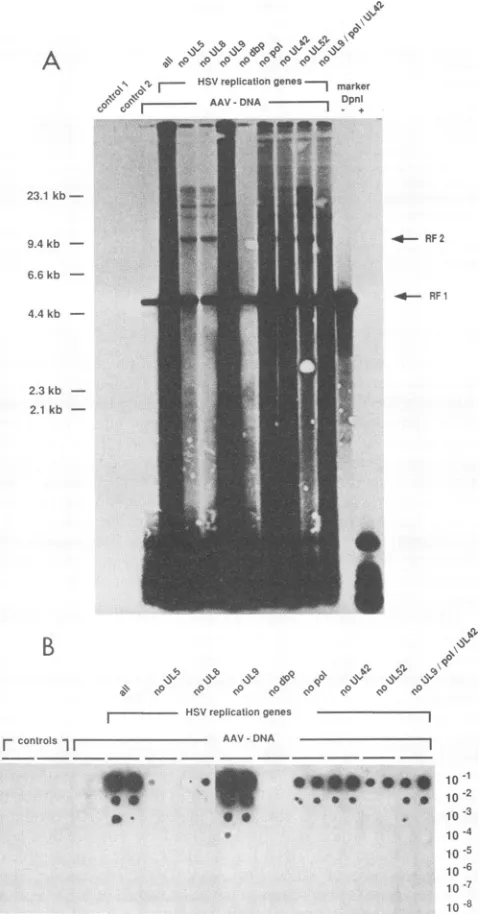
regions are flanked by inverted repeats (filled boxes for the long region and open boxes for the short region). The relative positions of the HSVreplicationgenes are indicated below: UL5, UL8, UL9, dbp (major DNA-binding protein [UL29]),pol (DNA polymerase [UL30]),UL42, and UL52. The arrows indicate the direction of transcription. Black arrows represent genes which are necessary for both HSV DNA replication and host cell DNA amplification (UL5, UL8, dbp, pol, UL42, and UL52). The grey arrow represents UL9, which is necessary only for HSV DNA replication. The plasmidseriesrepresenting the HSV replication genes under the control of the heterologous HCMV immediate-early enhancer-promoter (pCM series of expression constructs) is given below. The bottom line indicates the HSV-1 mutants tested for AAV helper activity. The mutantshr8O, hr94, d21,andhrll4arenull mutants in the HSV genes UL8, UL9, dbp (UL29), and UL52, respectively, whereas tsHcarries atemperature-sensitive mutation in the HSV DNA polymerase gene.for AAV-2 replication. To testthe role of the HSV replication genes for AAV replication separately, we transfected sub-sets of expression constructs for these genes driven by the heterologous HCMV immediate-early promoter into HeLa cells together with cloned replication-competent AAV-2 DNA (pAV2). Cells were harvested 48 h after transfection forthedetermination of AAV DNAreplicationbySouthern blot analysis (Fig. 3A) and, in parallel, production of infec-tious AAV particles (Fig. 3B). Blots of genomic DNAs doubly digested with BgIII and DpnI were hybridized to 32P-labeled AAV-2 DNA. DpnI digests the input DNAs, whereas AAV molecules replicated in eukaryotic cells are resistant to DpnI and appear as the typical replicative intermediates ofAAV.
Transfection ofthe seven HSV replication genes (pCM-UL5, -UL8, -UL9, -DBP, -POL, -UL42, -UL52) andpAV2 ledtoAAV DNA replication (Fig. 3A, lanesall) and to de novo synthesis ofinfectious AAV (Fig. 3B, lane all). Ona
short exposure of the Southern blot, the typical replicative intermediatesarevisible(datanotshown).The 4.65-kbband
seen upon transfection of cloned AAV-2 DNA alone (Fig. 3A, AAV-DNA) represents double-stranded monomer
AAV-2(RF1), possibly generated bysecond-strand synthe-sis on single-strand AAV templates, thus rendering the double strand DpnI resistant. However, neitherhigher
oli-gomeric replicative
intermediates nor infectious progenywere seen(Fig. 3B, AAV-DNA).
Totest the role of individual HSV replicationgenes, we
transfected pAV2 together with the seven HSV replication genes, omitting one ofthem at a time. Omission of pCM-UL9, coding for the HSV origin-binding protein, did not
hamperAAV DNAreplicationorparticle synthesis(Fig.3A and B, no UL9). This is in line with the result of the coinfection of AAV and the UL9-defective HSV mutant, which hadalready suggested that UL9was notrequiredfor AAVreplication.Omissionofplasmidscoding for eitherthe
DNApolymerase (pCM-POL) or the polymerase accessory protein (pCM-UL42) allowed AAV DNA replication and particle synthesis,albeitto aslightlyreduced level(Fig. 3A and B, no pol, no UL42). Thisreductionwas not observed after coinfections of AAV and the temperature-sensitive HSVmutantfor the DNApolymerase (tsH) (Fig. 2, tspol). This may be due to thefactthat tsHsynthesizes anenzyme whosepolymeraseactivity isimpairedatthenonpermissive temperaturebut inwhich otherfunctions,suchas apotential protein-protein interactionin amultienzyme complex, may still remain intact. Since the HSV DNA polymerase is knowntointeract notonlywith UL42(15, 19)but also with the major DNA-binding protein (39), it is conceivable that omission ofpCM-POL or pCM-UL42 from the set of co-transfected genes would interfere with the function of other replication factors actinginacomplex with the HSV DNA polymerase and its accessory protein(UL42).
In contrast to the HSV polymerase, the major DNA-binding protein appeared to be essential forAAV replica-tion, since omission of pCM-DBP from the cotransfected DNAs allowed neither AAV particle synthesis nor AAV DNAreplication (Fig.3A andB,nodbp).Omission of either pCM-UL5orpCM-UL8from the setofcotransfected repli-cation genes strongly reduced AAV DNA replication and particle synthesis (Fig. 3A and B, no UL5, no UL8). Omission of
pCM-UL52
resulted inanintermediate pheno-type leadingto slightly reduced AAV DNAreplication and particle synthesis (Fig. 3A andB, no UL52). Thispointsto an essential role of the HSVhelicase-primase
complex composedofUL5,UL8,
and UL52in AAVreplication
and is in line with the reduced AAV titers obtained with theUL8-orthe UL52-defectiveHSV mutant
(Fig.
2).Since the HSV
replication
genesUL5,
UL8,
UL52,
and the genecodingfor themajor
DNA-binding protein
appearedto play an essential role as
helper
functions for AAV replication, they weretested together. AAV DNAreplica-J. VIROL.
on November 10, 2019 by guest
http://jvi.asm.org/
[image:3.612.138.478.78.273.2]-1 -2 -3 -4 -5 -6 -7 -8 10 10 10 10 101010 10
Co 1
Co2
KOSwt
17syn wt
AUL8
aULg i
Adbp
tspol **
aUL52
FIG. 2. AAV-2 helper activity of HSV-1 mutants defective in
individualreplicationgenes. HeLacellswereinfected withAAV-2
(MOI =2) and 24 h later with HSV-1wildtypeorHSV-1mutantsas
indicated(MOI = 2 PFU). Cellswereharvested 48 h later by three
freeze-thaw cycles. Heat-inactivated cell-free supernatants (15
RI)
weretitratedin duplicate in 1:10 dilutionstepsonHeLacellsgrown
in 96-well microtiter plates. Multiplication ofthemeanvalue of the
indicated dilution steps by 67 leads to the actual AAV titer per
milliliter oflysate. Cellswereinfected with HSV-120 h later. After
another 48 h, cells were sucked onto a Gene Screen filter and
hybridized to 32P-labeledAAV-2 DNA. Supernatants from nonin-fected cells (Co 1) orfrom cells only infected with AAV-2 (Co2) servedasnegative controls. KOSwt,HSV-1 wild-type strain KOS; 17syn+ wt, HSV-1 wild-type strain 17syn+ (incubatedat39.5°C); AUL8, HSV-1 nullmutanthr8Odeficient in the UL8gene;AUL9,
HSV-1 null mutanthr94deficient in the UL9 gene; Adbp, HSV-1
null mutant d21 deficient in the gene for the major DNA-binding
protein (UL29); ts pol, HSV-1 mutant tsH with a
temperature-sensitive mutation inthe DNApolymerasegene (UL30),grownat
the nonpermissive temperature(39.5°C); AUL52, HSV-1 null
mu-tanthrll4deficient inthe UL52gene.
tion and the synthesis of infectious particles could be initi-atedby cotransfecting these fourgenestogether with pAV2
(Fig. 3A and B,no UL9/polIUL42, and Fig. 4A and B, UL5
+ UL8+ UL52 + dbp). Further analysis demonstrated that omission ofany one of thesegenes abolished AAV
replica-tionentirely (Fig. 4A and B). Similarly,noAAVreplication could be detected when the genes UL5, UL8, UL29, and UL52weretransfectedindividually (datanotshown). These experiments were repeated with AAV-infected cells, in
which the AAV template DNA has theauthentic configura-tion. Upon subsequent transfection of the HSV replication
genes, similar resultswereobtained(datanotshown). Thus, the requirement for agiven HSV helpergene isnot dueto the fact that the cloned AAV genome enters the cell as a
double-stranded genome without the proper origin confor-mation.
Takentogether, these experiments demonstrate (i) that the HSV replication complex is sufficient to induce de novo
AAV particle synthesis; (ii) that a subset of four HSV
replicationgenes, namely, UL5, UL8, UL29, and UL52, is
sufficienttoallow theproduction of infectious AAVprogeny
[image:4.612.104.249.80.252.2]almost to the level obtained with all seven genes;and (iii) that there isastrongcorrelation between AAV DNA repli-cation and the synthesis ofinfectiousparticles.
TABLE 1. Determination of wild-type contamination of HSV mutants
Virus Mutant gene Wildtype/mutanta
hr8O UL8 <1/106
hr94 UL9 21/106
d21 UL29 (dbp) 7/106
hrll4 UL52 37/106
tsHb UL30 (pol)
<1/105
a Plaquingfrequencies were measured by determining the titers of mutant
virus stocks on the respective helper cell lines providing the defective
functions in trans (seeMaterials and Methods) and, in parallel, on
nonper-missive Verocells on which only the wild type would grow.
b Plaquing efficiency of the temperature-sensitive mutant was determined
onVero cells at thepermissive(33°C) and non permissive (39.5'C)
tempera-tures.
DISCUSSION
Inthisreport, wedescribe the identification of HSV helper functions for the de novo synthesis of infectious AAV. Although we cannot exclude the possibility that additional HSV genes play a role in the full helper effect for AAV replication, we clearly show here that a subset of HSV replication genes is sufficient to induce productive AAV replication in the absence of HSV DNA replication. The HSV helpergenescode for the major DNA-bindingprotein and a multienzyme complex composed of the genes UL5, UL8, and UL52. Neither the HSV DNA polymerase to-gether with its accessory protein (UL42) nor the HSV origin-binding protein (UL9) are required forAAV replica-tion.
UL9, however, is absolutely required for HSV DNA replication (7, 23, 56, 58). It appears to initiate HSV DNA replication by specifically binding to the HSV origins of replication,
oris
andoriL,thusdirectingthe HSVreplication complextothecorrectinitiation sites(14,40). Since there isno significantsequencehomology between the HSVorigins
oris
andoriL,on onehand,andthe AAVorigin,ontheother hand, it appears plausible that an HSV mutant for UL9 providedafull helpereffectforAAV replication similartowild-type HSV. Omissionof UL9fromthe setof transfected replicationgenes evencaused anincrease in AAV produc-tion (Fig. 3), which may be explained by competition
be-tweenHSV and AAV DNAforthe HSVreplication complex in the presence of UL9. For AAV DNA replication, the AAV rep geneisalsorequiredin the presenceofHSVasthe helper (21), and it was recently shown that Rep68 directly binds to an AAV origin promoting the first steps in AAV
replication (26, 52).The AAVorigin of replication comprises
a hairpin structure which is assumed toprime AAV DNA replication (47, 48).Rep68notonlybindstothishairpinbut isalsodirectly involvedin severalof theearlystepsin AAV DNA replication. Rep68 is an ATP-dependent
site-specific
endonucleaseand unwinds theself-primedAAVorigin byits helicase
activity
(26). In the light of thesefindings,
it is difficult tounderstand why AAV needs theHSV helicase-primase complex for itsreplication. However, it isentirely possiblethatthere existasyetundefinedadditionalfunctions associated with this three-subunit enzymecomplex
which mayturn out tobemore relevant for AAVreplication.
Therole of the HSVmajor
DNA-binding
protein
forAAV DNA replicationappears more obvious. Themajor DNA-binding
proteinbinds single-stranded DNA and is assumed tohold the replication fork inan extended
configuration
(46). Thereplicationof the
single-stranded
AAV genome maywell beon November 10, 2019 by guest
http://jvi.asm.org/
[image:4.612.314.559.101.170.2]2480 WEINDLER AND HEILBRONN
-l
~~0 (,0~p "S
__ HSVreplicationgenes marker
(.J (<i AAV-DNA - DpnI
--.
low_ _Woo
00c0F - +
L~~~~~~~~-*
L
F1
- F
4- 4-- F
9 \ 4s c~9
45 _0 50 ,~,0 (P (P
_s~
o _ (" S-'° -QP' <r'° sS° -c' -C° HSVreplicationgenes
r controlsI AAV-DNA I
0 ...*0 ...*
a ' 0 *
10.1 10-2
10-3
10-4
10-5 10-6 10-7
10-8
FIG. 3. Identification of individual HSV-1 replicationgeneswith helper activity for AAV-2 synthesis. HeLa cells weretransfected
with replication-competent cloned AAV-2 DNA (pAV2) and
dif-ferentcombinations ofcloned HSV replicationgenes as indicated
below. Cellswereharvested 48 h posttransfection bythree freeze-thaw cycles, and thedisrupted cellswerepelleted. Genomic DNA was extracted from the pellet for a Southern blot analysis (A).
Cell-free supernatants wereusedfor titration of infectious AAV-2
particles (B). (A) Southern blotofBglII and DpnI doubly digested genomic DNA (5 ,ug per lane) hybridized to 32P-labeled AAV-2 DNA. The replicative intermediates are indicated: RF1 (4.65 kb)
represents the double-stranded monomer, and RF2 (9.3 kb) is the
double-stranded dimer. In addition, higher oligomeric forms are
visible. The bands in the low-molecular-weight range represent
DpnI-digested inputDNAs whichindicate comparable transfection efficiencies in all samples. The following combinations of DNAs
weretransfected: Co1, 20jigof Bluescribe; Co 2, pCM-UL5,-UL8,
-UL9, -DBP, -POL, -UL42, -UL52, 2.5jigof each;AAV-DNA, 2,ug ofpAV2; HSV replication genes, pCM-UL5, -UL8, -UL9, -DBP, -POL, -UL42, -UL52, 2.5 jig of each.Sensitivity markersare125pg
facilitatedby thisfunction, althoughthemajorDNA-binding protein appears to be associated with the HSV DNA poly-merase (39) and its accessory protein (UL42) (15, 16, 19), neither of which seem to be involved in the replication of AAV. Instead, there is evidence that the cellular DNA polymerases a and/or 8 are involved in parvovirus DNA
replication (44). Similarly,
with.
adenovirusas a helperfor AAV, the adenovirus DNA polymerase does not seem to playarolein AAVreplication (34, 37).We thereforeassumethat with HSV as a helper, cellular DNA polymerases replicate AAV by interacting with the HSV major DNA-bindingprotein. Thisassumption is supported bytherecent
demonstration that the HSV major DNA-binding
protein
colocalizes and possibly interacts with cellular replication complexesintheinfectedcellnucleus(12).We haveshown previously that the HSV replication complex can
amplify
integrated simian virus 40 DNA sequences withinthe host cell chromosome, where the simian virus 40 T antigen is assumed to direct theHSVreplication machinery towardthe simianvirus 40origin (24). Inthelight ofthosefindings and thosedescribed above,it appears that the components of the HSVreplication machinery are capable of interactingwith other viralorcellular
replication
factors onseveral different templates. These may be viral replication origins, as in simianvirus 40orAAV,butpossibly alsocellularreplication
origins from which DNA
amplification
within the host cell genomeisassumedto start.A recent report by Mishra and Rose (36) described a
similar experimental approach which identified a different subset of the HSV replication genes (UL5, UL8, UL9, UL29, and UL30) as helpers for AAV DNA replication. Since theseinvestigators nevertestedthe setofsevenHSV replicationgenes separatefrom therestofthe HSV genome, didnotmeasureAAVvirusproduction, and didnotcontrol their results by the use of HSV mutants, the two studies
cannotbecompared directly.Itisdifficulttounderstandhow individual components of the HSV helicase-primase com-plex (UL5, UL8, and UL52) (11) on the one side and the complex of DNA polymerase (UL30) and its accessory protein(UL42) (15, 16, 19) on the other side could function separately. Inaddition, ourstudyclearlyshows that UL9is
not required. Whatever experimental difference led to the conclusions drawn, we have no evidence fromour
experi-ments(24,55a)which would suggest that the useof different cell types (Vero versus HeLa) or promoters for the trans-fectedHSV genes (authentic HSV promoters versus heter-ologous strong HMCV promoters) plays acrucialrole.
Although the roles of the HSV helper genes may appear to be welldefined, sofar it is still difficulttofullyunderstand the HSVhelper effect for productive AAV replication. All HSVhelper functionsidentified in thisstudy arereplication enzymesorfactors(56). However, these proteins seem to be capableofdoingmorethanjustreplicate the AAV template. In our study, the extent ofAAV DNA replication always correlated with the amountof infectious progenyproduced. Fromourearlier studies employing carcinogen treatment as
ofBgIII-digestedor250pgofBgIIland DpnIdoubly digested pAV2, respectively. (B) Titration of denovo-synthesizedinfectious AAV-2 particles. Supernatants (15
RI)
were titrated in duplicate in 1:10dilution stepsonHeLacellsgrownin96-well plates. After 24 h, the
cellswere infected with HSV-1 (MOI = 10), and 40 h later, they
weresuckedontoaGeneScreen filter and hybridizedto32P-labeled AAV-2 DNA.
A
23.1kb -.
9.4 kb
-6.6 kb
-4.4kb
-2.3 kb
-2.1 kb
-B
9o'S.- lb
Is45 450
on November 10, 2019 by guest
http://jvi.asm.org/
[image:5.612.63.303.88.545.2]HSV HELPER FUNCTIONS FOR AAV REPLICATION
;; M > ox x a 'S 4"K
&l
41
3,A 'p-, <3x lbxA 43DN l Dpnl
r- AAV -DNA DpnI
23.1 kb
-9.4 kb -6.6 kb
4.4 kb
2.3 kb
2.1kb
m:. :. .;:
,, >,..r
,.,,
*:,,:...
..,...NSt,>.._
'''+"
Iere
52e
ez
_. D.
^
_
:', 5..
.,b..
*'f.RA,..
*s'.'W^>
;^h'S'
A>w.',
s . te ;
4ets.8.
*;
. ,*
.
_ s
-4-- RF2
4- RF1
B I ,
x
4
K
3,X
9,,0K
2K44.X
I AAV DNA I
0
I.a¢
10-3 10 1 10 1
10.-6
10-7 0 08
FIG. 4. TheHSVhelicase-primasecomplexand themajor
DNA-binding protein are sufficient for AAV synthesis. The experiment
was performed as described in the legendto Fig. 3. (A) Southern
blot analysis was performed for the detection of AAV replicative
intermediates. (B) Cell extracts were titrated in duplicates in 1:10
dilution steps to detect de novo synthesis of infectious AAV-2
particles.
the inducer of AAV replication, we know that, although
AAV DNA replicationcould be induced toahigh level in a
variety of celllines, it proveddifficult todemonstrate infec-tious viral progeny, which was, in addition, restricted to
some specific celllines (59, 60). These data suggest thatthe
mereinduction ofAAV DNAreplication doesnot
necessar-ily mean that the AAV infectious cycle can progress without additionalhelper functions. From studies withadenovirus as
a helper, it is clear that this virus group provides helper activityatseveralstepsin AAVgeneexpression.In contrast toHSV, the adenovirus proteinsthat are directlyinvolvedin adenovirusDNAreplication, the adenovirus DNA
polymer-ase,the DNA-binding protein, andthe terminalprotein, do not appear to be essential for AAV DNA replication (4). Instead, adenovirus earlygenes are involved in the coordi-natedtransactivationorrepression ofAAV promoters(3,28,
55). Posttranscriptional regulation mechanisms have also beenproposed (27, 49, 57). Whether HSV provides similar, asyetunidentified functions remains an unresolved question at present. Since the adenovirus single-stranded DNA-bind-ing protein not only appears to play a role in DNA replica-tion but also affects geneexpression, it would be interesting to look for a similar dual function of the HSVsingle-stranded DNA-binding protein (UL29). To ourknowledge, however, there is no indication so far that the HSV helper genes which we have identified may have functions apart from those involved in DNA replication. Since the replicationfunctions of these genes are well characterized (reviewed inreference 56), it is reasonable to assume that these genes provide helper activity directly for AAV DNA replication. Further biochemical studies will add to the fullunderstanding of the underlying molecular mechanisms. It appears that efficient AAV replication can be achieved by different molecular mechanisms which are induced by herpesviruses, adenovi-ruses, or different drugs. The elucidation of these mecha-nisms may also provideinsights into themechanisms used to reactivate AAV from latency. Since AAV can be replicated
under specific conditions in the absence of helper viruses (59, 60), the study of viral helper functions may also lead to
the identification of related cellular activation pathways
which may be relevantfor the propagationof AAV in vivo.
ACKNOWLEDGMENTS
We aregratefultoB. Matz, P. A. Schaffer,and S. K. Weller for HSV mutants. Wethank H. zurHausenforcontinuoussupport. We are grateful to A. Burkle, V. Bosch, M. Boshart, J. A. Klein-schmidt, and J. R.Schlehoferforstimulatingdiscussionsand critical reading of the manuscript. We appreciate the assistance of S. Stephan in the propagationandtitration ofvirusmutants.
This work was supported in part by grant HE 1598/1-1 from the Deutsche Forschungsgemeinschaft.
REFERENCES
1. Bauer, H. J., and G. Monreal. 1986. Herpesviruses provide helper functions for avianadeno-associated parvovirus. J. Gen. Virol.67:181-185.
2. Bauer, H. J., and G. Monreal. 1988. Avian adeno-associated parvovirus and Marek's disease virus: studies of viral interac-tions in chickenembryo fibroblasts. Arch. Virol. 98:271-277. 3. Beaton,A.,P.Palumbo,andK.I.Berns. 1989.Expression from
the adeno-associated virus p5 and p19 promoters is negatively regulated in trans by the Rep protein. J. Virol. 63:4450-4454. 4. Berns, K. I. 1990. Parvoviridae and theirreplication, p.
1743-1763. In B. N. Fields et al. (ed.), Virology. Raven Press, New York.
5. Berns, K. I., and R. A. Bohenzky. 1987. Adeno-associated viruses: an update. Adv. Virus Res. 32:243-306.
6. Buller, R. M. L., J. E. Janik, E. D. Sebring, andJ. A. Rose. 1981. Herpes simplex virus types 1 and 2 completely help
adenovirus-associated virus replication. J. Virol. 10:241-247. 7. Carmichael, E. P., M. J. Kosovsky, and S. K. Weller. 1988.
Isolation and characterization of herpes simplex virus type 1 host range mutants defective in viral DNA synthesis. J. Virol. 62:91-99.
VOL.65, 1991 2481
on November 10, 2019 by guest
http://jvi.asm.org/
[image:6.612.79.270.73.571.2]2482 WEINDLER AND HEILBRONN
8. Carmichael, E. P., and S. K. Weller. 1989. Herpessimplex virus type 1 DNA synthesis requires the productof the UL8 gene: isolation and characterization of anICP6::lacZinsertion muta-tion. J. Virol. 63:591-599.
9. Challberg, M. D. 1986. A method for identifying the viral genes required for herpesvirus DNA replication. Proc. Natl. Acad. Sci. USA 83:9094-9098.
10. Chartrand, P., N. D. Stow, M. C. Timbury, and N. M. Wilkie. 1979. Physical mapping ofpaar mutation of herpessimplex virus type 1 and type 2 by intertypic marker rescue. J. Virol. 31:265-276.
11. Crute, J. J., T. Tsurumi, L. Zhu, S. K. Weller, P. D. Olivo, M. D. Chaliberg, E. S. Mocarski, andI. R. Lehman. 1989. Herpes simplex virus 1 helicase-primase: a complex of three herpes-encoded gene products. Proc. Natl. Acad. Sci. USA 86:2186-2189.
12. deBruyn Kops, A., and D. M. Knipe. 1988. Formation of DNA replication structures in herpes virus-infected cells requires a viral DNA binding protein. Cell 55:857-868.
13. Drake, S., P. A. Schaffer, J. Esparza, and H. D. Mayor. 1974. Complementation of adeno-associated satellite viral antigens and infectious DNA by temperature-sensitive mutants of herpes simplex virus. Virology 60:230-236.
14. Elias,P., and I. R. Lehman. 1988. Interaction of origin binding protein with an origin of replication of herpes simplex virus 1. Proc.Natl. Acad. Sci. USA 85:2959-2963.
15. Gallo, M. L., D.I.Dorsky, C. S. Crumpacker, and D. S. Parris. 1989. The essential 65-kilodalton DNA-binding protein of her-pessimplex virus stimulates the virus-encoded DNA polymer-ase. J. Virol. 63:5023-5029.
16. Gallo,M. L., D. H. Jackwood, M. Murphy, H. S. Marsden, and D. S. Parris. 1988. Purification of the herpes simplex virus type 165-kilodalton DNA-binding protein: properties of the protein and evidence of its association with the virus-encoded DNA polymerase. J. Virol. 62:2874-2883.
17. Georg-Fries, B., S. Biederlack, J. Wolf, and H. zur Hausen. 1984. Analysis of proteins, helper dependence, and seroepide-miology of a new human parvovirus. Virology 134:64-71. 18. Goldstein, D. J., and S. K. Weller. 1988. An ICP6::lacZ
inser-tional mutagen is used to demonstrate that the UL52 gene of herpes simplex virus type 1 is required for virus growth and DNAsynthesis. J. Virol. 62:2970-2977.
19. Gottlieb, J., A.I. Marcy, D. M. Coen, and M. D. Challberg. 1990. The herpes simplex virus type 1 UL42 gene product: a subunitof DNA polymerase that functions to increase proces-sivity.J. Virol. 64:5976-5987.
20. Green, M., W. S. M. Wold, J. K. Mackey, and P. Ridgen. 1979. Analysisofhuman tonsil and cancer DNAs and RNAs for DNA sequencesof group C (serotypes 1, 2, 5, and 6) human adeno-viruses. Proc. Natl. Acad. Sci. USA 76:6606-6610.
21. Heilbronn,R., A. Burkle, S. Stephan, and H. zur Hausen. 1990. Theadeno-associatedvirus rep gene suppresses herpes simplex virus-inducedDNA amplification. J. Virol. 64:3012-3018. 22. Heilbronn, R., J. R. Schlehofer, A. 0. Yalkinoglu, and H. zur
Hausen. 1985. Selective DNA amplification induced by carcin-ogens (initiators): evidence for a role of proteases and DNA polymerase alpha.Int. J. Cancer 36:85-91.
23. Heilbronn, R., S. K. Weller, and H. zur Hausen. 1991. Herpes simplex virus type 1 mutants for the origin-binding protein induce DNA amplification in the absence of viral replication. Virology 179:478-481.
24. Heilbronn, R., and H. zur Hausen. 1989. A subset of herpes simplex virus replication genes induces DNA amplification withinthehostcell genome. J. Virol. 63:3683-3692.
25. Hermonat,P. L., M. A. Labow, R. Wright, K. I. Berns, and N. Muzyczka. 1984. Genetics of adeno-associated virus: isolation andpreliminarycharacterization of adeno-associated virus type 2mutants. J. Virol. 51:329-339.
26. Im, D.-S., and N. Muzyczka. 1990. The AAV origin binding protein rep68 is an ATP-dependent site-specific endonuclease with DNAhelicaseactivity. Cell 61:447-457.
27. Janik, J. E., M. M. Huston, K. Cho, and J. A. Rose. 1989. Efficientsynthesisof adeno-associated virus structural proteins
requires bothadenovirus DNAbindingproteinandVA IRNA. Virology168:320-329.
28. Labow, M. A., P. L.Hermonat, and K.
I.
Berns. 1986. Positive and negativeautoregulation of theadeno-associated virustype2 genome. J.Virol. 60:251-258.29. Laughlin, C. A., J. D. Tratschin, H. Coon, and B. J. Carter. 1983. Cloning ofinfectious adeno-associated virus genomes in bacterial plasmids. Gene 23:65-73.
30. Maniatis, T., E. F. Fritsch, and J. Sambrook. 1989. Molecular cloning: a laboratory manual. Cold Spring HarborLaboratory, Cold Spring Harbor,N.Y.
31. Marsden, H. S.,I. K. Crombie, and J. H.Subak-Sharpe. 1976. Controlof protein synthesis inherpesvirus-infected cells: anal-ysis of the polypeptides induced by wild-type and sixteen temperature-sensitive mutants of strain 17. J. Gen. Virol. 31: 347-372.
32. Matz, B. 1987. Herpes simplex virusinfection generates large tandemly reiterated simianvirus 40 DNA molecules in a trans-formed hamster cell line. J. Virol. 61:1427-1434.
33. McGeoch, D. J., M. A. Dalrymple, A. Dolan, D. McNab, L. J. Perry, P. Taylor, and M. D.
Challberg.
1988. Structures of herpes simplex virus type 1 genes required for replication of virus DNA. J. Virol. 62:444 453.34. McPherson, R. A., H. S. Ginsberg, and J. A. Rose. 1982. Adeno-associated virus helper activity of adenovirus DNA binding protein. J. Virol. 44:666-673.
35. McPherson, R. A., L. J. Rosenthal, and J. A. Rose.1985. Human cytomegalovirus completely helps adeno-associatedvirus repli-cation. Virology 147:217-222.
36. Mishra, L., and J. A. Rose. 1990.Adeno-associated virus DNA replication is induced by genes that are essential for HSV-1 DNA synthesis. Virology 179:632-639.
37. Myers, M. W., C. A. Laughlin, F. T. Jay, and B. J. Carter.1980. Adenovirus helper function for growth of adeno-associated virus: effect of temperature-sensitive mutations in adenovirus early gene region 2. J. Virol. 35:65-75.
38. Neuman, R., E. Genersch, and H. J. Eggers. 1987. Detectionof adenovirus nucleic acid sequences in human tonsils in the absence of infectious virus. Virus Res. 7:93-97.
39. O'Donnell, M. E., P. Elias, B. E. Funnel, and I. R. Lehmen. 1987. Interaction between the DNA polymerase and single-stranded DNA-binding protein (infected cellprotein 8)of herpes simplex virus 1. J. Biol. Chem. 262:4260-4266.
40. Olivo, P. D., N. J. Nelson, and M. D. Challberg. 1988. Herpes simplex virus DNA replication: the UL9 gene encodes an origin-binding protein. Proc. Natl. Acad. Sci. USA 85:5414-5418.
41. Orberg, P. K., and P. A. Schaffer. 1987. Expression of herpes simplex virus type 1 major DNA-binding protein, ICP8, in transformed cell lines: complementation of deletion mutants and inhibition of wild-type virus. J. Virol. 61:1136-1146.
42. Parks, W. P., D. W. Boucher, J. L.
Melnick,
L. H. Taber, and M. D. Yow. 1970. Seroepidemiologic and ecologic studies of the adenovirus-associated satellite viruses. Infect. Immun. 2:716-722.43. Parris, D. S., A. Cross, L. Haarr, A. Orr, M. C. Frame, M. Murphy, D. J. McGeoch, and H. S. Marsden. 1988. Identifica-tion of the gene encoding the 65-kilodalton DNA-binding protein of herpes simplex virus type 1. J. Virol.
62:818-825.
44. Robertson, A. T., E. R. Stout, and R. C. Bates. 1984.
Aphidicolin
inhibition of the production of replicative-form DNA during bovine parvovirus infection. J. Virol. 49:652-657.45. Roizman, B., and A. E. Sears. 1987. An inquiry into the mechanisms of herpes simplex virus latency. Annu. Rev. Mi-crobiol. 41:543-571.
46. Ruyechan, W. T. 1983. The major herpes simplex virus DNA-binding protein holds single-stranded DNA in an extended configuration. J. Virol. 46:661-666.
47. Samulski, R. J., K. I. Berns, M. Tan, and N. Muzyczka. 1982. Cloning of adeno-associated virus into pBR322: rescue of intact virus from the recombinant plasmid in human cells. Proc. Natl. Acad. Sci. USA 79:2077-2081.
48. Samulski, R. J., A. Srivastava, K. I. Berns, and N. Muzyczka.
on November 10, 2019 by guest
http://jvi.asm.org/
1983. Rescue ofadeno-associated virus from recombinant plas-mids:genecorrection within the terminalrepeatsof AAV. Cell 33:135-143.
49. Samulski, R. J., and T. Shenk. 1988. Adenovirus E1B 55-Mr polypeptide facilitates timely cytoplasmic accumulation of ad-eno-associated virus mRNA. J. Virol. 62:206-210.
50. Schlehofer,J.R., M.Ehrbar, and H.zurHausen.1986. Vaccinia
virus, herpes simplex virus, and carcinogens induce DNA amplification inahuman cell line andsupportreplication ofa
helpervirusdependent parvovirus. Virology 152:110-117. 51. Schlehofer, J. R., R. Heilbronn, B. Georg-Fries, and H. zur
Hausen. 1983. Inhibition of initiator-inducedSV40gene
ampli-fication inSV40-transformedChinese hamster cells byinfection withadefective parvovirus. Int. J. Cancer 32:591-595.
52. Snyder, R.O., R. J. Samulski, andN.Muzyczka.1990.In vitro resolution of covalently joined AAV chromosome ends. Cell 60:105-113.
53. Tifley, R. D., and H. D. Mayor. 1984. Identification ofaregion
of theHSV-1genomewithhelperactivity for AAV. Virus Res. 1:631-647.
54. Tratschin, J. D.,I. L.Miller, and B. J. Carter. 1984. Genetic
analysis of adeno-associated virus: properties ofdeletion
mu-tantsconstructed in vitro and evidence foranadeno-associated
virus replication function. J. Virol. 51:611-619.
55. Tratschin, J. D., J. Tal, and B. J. Carter. 1986. Negative and positive regulation in trans ofgene expression from adeno-associated virusvectorsin mammaliancellsbyaviralrepgene
product. Mol. Cell. Biol. 6:2884-2894.
55a.Weindler, F. W., and R. Heilbronn. Unpublished data. 56. Weller, S. K. 1990.InHerpesvirus transcription and its
regula-tion, inpress. CRCPress,Inc., Boca Raton, Fla.
57. West, M.H.P., J. P. Trempe, J.-D. Tratschin,andB.J.Carter. 1987. Gene expression in adeno-associated virus vectors: the effects of chimeric mRNAstructure,helper virus, and
adenovi-rusVA1 RNA. Virology 160:38-47.
58. Wu, C. A., N.J. Nelson, D. J. McGeoch, and M. D. Challberg. 1988. Identification of herpes simplex virus type 1 genes
re-quired for origin-dependent DNA synthesis. J. Virol. 62:435-443.
59. Yakobson, B., T. Koch, and E. Winocour. 1987. Replication of adeno-associated virus in synchronized cells without the addi-tion ofahelper virus. J. Virol. 61:972-981.
60. Yalkinoglu, A. O., R. Heilbronn, A. Burkle, J. R.Schlehofer,
and H. zurHausen. 1988. DNAamplification of
adeno-associ-ated virus asa response to cellulargenotoxic stress. Cancer Res. 48:3123-3129.