EFFECTIVENESS OF STRUCTURED TEACHING PROGRAMME
ON KNOWLEDGE AND ATTITUDE REGARDING HEPATITIS
AMONG PATIENTS ATTENDING OUTPATIENT
DEPARTMENT OF GASTROENTEROLOGY
AT A SELECTED HOSPITAL, SALEM.
By
Mrs. VIVINA.A Reg. No: 301611601
A DISSERTATION SUBMITTED TO
THE TAMILNADU DR. M.G.R. MEDICAL UNIVERSITY, CHENNAI, IN PARTIAL FULFILLMENT OF THE REQUIREMENT FOR THE
DEGREE OF MASTER OF SCIENCE IN NURSING (MEDICAL SURGICAL NURSING)
CERTIFICATE
Certified that this is the bonafide work of Mrs. VIVINA.A, Final year M.Sc.(Nursing), Student of Sri Gokulam College of Nursing, Salem, submitted in partial fulfillment of the requirement for the Degree of Master of Science in Nursing to The Tamil Nadu Dr. M.G.R, Medical University, Chennai, under the Registration No. 301611601.
College Seal:
Signature: ……… Prof.Dr. K. TAMIZHARASI, Ph.D. (N)., PRINCIPAL,
SRI GOKULAM COLLEGE OF NURSING, 3/836, PERIYAKALAM,
EFFECTIVENESS OF STRUCTURED TEACHING PROGRAMME ON KNOWLEDGE AND ATTITUDE REGARDING HEPATITIS
AMONG PATIENTS ATTENDINGOUT PATIENT DEPARTMENT OF GASTROENTEROLOGY
AT A SELECTED HOSPITAL, SALEM.
Approved by the Dissertation Committee on: 02.08.2018
Signature of the Clinical Specialty Guide: ……….
Prof. N.ANITHA, M.Sc. (N).,
HOD & Professor,
Medical Surgical Nursing Department,
Sri Gokulam College of Nursing,
Salem – 10.
Signature of the Medical Expert : ………
Dr. N.RAJESH MD.DNB.,DM.,
Consultant Gastroenterologist & Hepatologist
Sri Gokulam Hospital, Salem – 04.
CERTIFICATE
This is to certify that the dissertation entitled “Effectiveness of Structured Teaching Programme on Hepatitis among patients attending Out Patient Department at a selected Hospital, Salem” is a bonafide work done by Mrs. VIVINA.A, Sri Gokulam College of Nursing, Salem, in partial fulfillment of the University rules and regulations for the award of Master of Science in Nursing under the guidance and supervision during the academic year 2018.
Name and Signature of the Guide : ……….. And Head of Department Prof. N.ANITHA, M.Sc. (N).,
HOD & Professor,
Medical Surgical Nursing Department, Sri Gokulam College of Nursing, Salem – 10.
Name and Signature of the
Head of Department : ……… Prof. N.ANITHA, M.Sc. (N)., HOD & Professor,
Medical Surgical Nursing Department, Sri Gokulam College of Nursing, Salem – 10.
Name and Signature of the
Dean/ Principal : ……….. Prof.Dr. K. TAMIZHARASI, Ph.D. (N)., Principal,
Sri Gokulam College of Nursing, 3/836, Periyakalam, Neikkarapatti,
ACKNOWLEDGEMENT
“As we express our gratitude, we must never forget that The highest appreciation is not to utter words, but to live by them,”
- john Fitzgerald Kennedy
With great pleasure I express my gratitude to all who have rendered their valuable time, suggestions and support for the successful completion of this study.
First and foremost, I thank almighty God for his blessings showered on me during my study period and also to complete this study successfully.
I wish to express my deep sense of gratitude and thanks to our honorable Managing Trustee Dr. K. Arthanari, M.S., Sri Gokulam College of Nursing, Salem for the opportunity and all the facilities he has provided to undertake the course in this esteem Institution.
I am extremely grateful to Prof.Dr. K. Tamizharasi, Ph.D. (N)., Principal, Sri Gokulam College of Nursing, Salem for all opportunities and facilities extended to complete my research work. It is a privilege to complete this study under her expert supervision. Her contributions are indeed and an asset for the valid completion of this work.
I also extend my sincere gratitude to Prof. Kamini Charles, M.Sc.(N)., Vice Principal and Research Co-ordinator, Sri Gokulam College of Nursing for her complete guidance and support throughout the study.
I am grateful to Dr. N. Rajesh MD.DNB.,DM., Consultant Gastroenterologist & Hepatoligist Sri Gokulam Hospitals, Salem, for his guidance and contribution to the dissertation. He has given permission to conduct study in his department.
I humbly thank Mrs. R. Nithya M.Sc. (N)., Associate Professor, Medical Surgical Nursing department for her timely help and guidance throughout my study.
I express my sincere thanks to my class coordinator Mrs.P. Lalitha M.Sc. (N)., for her guidance at every possible level.
I oblige to the Medical SurgicalNursing Experts for validating the tool and content used in this research study.
I would like to extend my gratitude to all Faculty Members of Sri Gokulam College of Nursing, Salem for their moral support and guidance.
I widen my genuine gratitude to the Dissertation Committee for offering constructive criticism and due sanction for carrying out this research study.
I extend my thanks to Mr. P. Jayaseelan, M.Sc., Librarian, Sri Gokulam College of Nursing, Salem, for extending library facilities throughout the research study.
I would like to acknowledge the input received from Mr. Mani, M.Phil., Biostatistician for his assistance in statistical analysis and data interpretation.
I am thankful to Mrs.Premaselvi PG Asst, (English Literature) and Mr. Anbarasan B.A., B.Ed ( Tamil Literature) whose editing, suggestions and precise sense of language were decisive in shaping of this research study.
I whole heartedly thank the Research subjects who willingly agreed to cooperate during data collection period. Without them it would have been impossible to complete this study.
I express my profound thanks to my Seniors Mrs. Sasirekhaand Mr. Sudhakarfor their timely help, prayers and motivation. I wholeheartedly thank my juniors Ms. Amutha, Ms. Sandhiya, Mrs. Devika and B.Sc. (N) Final Years for their support and prayers.
Life has blessed me with an understanding foresighted and value-orientedparents, Mr. A. Albert Raj and Mrs. A. Catherine Mary who were the sole inspiration for me especially my mom, to pursue my higher studies. I am grateful for them and for all their support and prayers.
I express my sincere thanks to my lovable Husband Mr. D. Leon Manoj, and my family members, for their timely support, motivation, encouragement and prayers.
TABLE OF CONTENTS
CHAPTERNO CONTENT PAGE NO
I INTRODUCTION 1 – 13
Need for the study Statement of the problem Objectives
Operational definitions Assumptions
Hypotheses Delimitations Projected Outcome Conceptual framework
4 - 7 7 7-8 8 9 9 10 10 10-12
II REVIEW OF LITERATURE 14-22
Literature related to Incidence & Prevalence of hepatitis
Literature related to Knowledge and Attitude regarding Hepatitis.
Literature related to Structured Teaching Programme on hepatitis
14-16 16-19 19-22
III METHODOLOGY 23 - 31
Research approach Research design Population
Description of setting Sampling
Variables
Description of the tools Validity and reliability Pilot study
Method of data collection Plan for data analysis
23 23 25 25 25 27 27 – 29 30 30 31 31
IV DATA ANALYSIS AND INTERPRETATION 32-52
V DISCUSSION 53-57
VI SUMMARY, CONCLUSION, IMPLICATIONS
AND RECOMMENDATIONS
58-63
BIBLIOGRAPHY 64-68
LIST OF TABLES
TABLENO TITLE PAGE NO
3.1 Scoring procedure on Knowledge regarding hepatitis 28
3.2 Scoring key for Five - point Likert Scale 29
3.3 Scoring procedure on Attitude regarding hepatitis 29 4.1 Frequency and Percentage distribution of patients according
to their personal variables.
34
4.2 Frequency and Percentage distribution of patients according to their health-related variables.
36
4.3
Mean, standard deviation, and mean difference on pretest and post test score on knowledge and attitude regarding hepatitis among patients attending Outpatient department of gastroenterology.
44
4.4
Area wise mean, standard deviation and mean difference score on Knowledge and Attitude regarding hepatitis among patients attending outpatient department of gastroenterology.
45
4.5
Mean, standard deviation, ‘t’ value on pretest and post test score on knowledge regarding hepatitis among patients attending outpatient department of gastroenterology.
47
4.6
Mean, standard deviation, ‘t’ value on pretest and post test score on knowledge regarding hepatitis among patients attending outpatient department of gastroenterology.
48
4.7
Correlation between pretest and post test score on the knowledge and attitude regarding hepatitis among patients attending outpatient department of gastroenterology.
49
4.8
Chi – square test on pretest score on knowledge regarding hepatitis among patients attending outpatient department of gastroenterology.
50
4.9
Chi – square test on pretest score on knowledge regarding hepatitis among patients attending outpatient department of gastroenterology.
LIST OF FIGURES
FIGURENO TITLE PAGE NO
1.1 Conceptual Framework based on Imogene King’s goal attainment Theory on effectiveness of structured teaching programme on hepatitis among patients attending outpatient department of gastroenterology.
12
3.1 Schematic representation of research methodology 24 4.1 Percentage distribution of patients according to their pretest
score on knowledge regarding hepatitis among patients attending outpatient department of gastroenterology.
38
4.2 Percentage distribution of patients according to their pretest score on attitude regarding hepatitis among patients attending outpatient department of gastroenterology.
39
4.3 Percentage distribution of patients according to their post test score on knowledge regarding hepatitis among patients attending outpatient department of gastroenterology.
40
4.4 Percentage distribution of patients according to their post test score on attitude regarding hepatitis among patients attending outpatient department of gastroenterology.
41
4.5 Percentage distribution of patients according to their pretest and post test score on knowledge regarding hepatitis among patients attending outpatient department of gastroenterology.
42
4.6 Percentage distribution of patients according to their pretest and post test score on attitude regarding hepatitis among patients attending outpatient department of gastroenterology.
LIST OF ANNEXURES
ANNEXURE TITLE PAGE NO
A. Letter seeking permission to conduct research study i B. Letter granting permission to conduct a research study ii C. Letter requesting opinion and suggestion of experts for
content validity of the research tool. iii
D. Tool for Data Collection (Tamil/English) iv
E. Certificate of Validation Ixvii
F. List of Experts Ixviii
G. Certificate of Editing Ixxiv
H. Certificate of Plagiarism Ixxvi
ABBREVATIONS
HAV – Hepatitis A virusABSTRACT
A study was done to evaluate the effectiveness of Structured Teaching Programme on Knowledge and Attitude Regarding Hepatitis Among Patients AttendingOut Patient Departmentof Gastroenterology at a selected hospital, Salem. Pre-experimental one group pretest posttest design was used for this study. Sixty patients were selected through Non – Probability Convenience Sampling Technique. Pretest score on Knowledge and Attitude were assessed by using Structured Questions and five - point Likert scale, pre test was conducted and intervention was given on the same day. Posttest assessment was done on the 7th day by using same scales.
The findings revealed that among 60 patients 31 (51.6%) were in the age group of 41-50, 37 (61.6%) patients were males and 45 (75%) patients were Hindus. According to Education 17 (28.3%) had higher secondary education and 24 (40%) patients were employees. 27 (45%) patients had co morbid illness of Hypertension. In the pretest 32 (53.3%) patients had inadequate knowledge and in the posttest 46(76.6%) patients had adequate knowledge regarding hepatitis. In the pre test26(43.3%) patients had unfavorable attitude and, in the posttest 27(45%) patients had most favorable attitude regarding hepatitis.
1
CHAPTER I
INTRODUCTION
“Is life worth living ? It all depends on the Liver”
-William James.
Viral hepatitis is an ongoing global infectious public health problem and a
major cause of chronic liver disease , including liver cancer. Viral hepatitis has been
known to exist since ancient civilizations. The contagious nature of the illness was
suspected even in the eighth century. Records from major military campaigns in
different continents from the 18th to 20th centuries, including the American Civil War and the First and second World wars, reported that “campaign jaundice” caused
significant morbidity of the troops and impacted war strategies. (David T Wong, 2015)
Hepatitis A is referred to as one of the oldest disease known to humankind by
the world health organization. Hepatitis A virus was first discovered in 1973 by
Steven M Feinstone as a nonenveloped, spherical, positive RNA virus.Hepatitis A
virus was an unidentified viral disease prior to this discovery. Hepatitis A virus has
been called epidemic hepatitis, epidemic jaundice. Virulence factors associated with
hepatitis A virus include viral agents that produce an immune response. These
antibodies become present five to ten days after the initial infection. Hepatitis A virus
is absorbed into the bloodstream from the small intestines and reaches the liver
through portal circulation. The humans are the only known reservoir of hepatitis.
Worldwide outbreak and localized infections occur more often in areas of the world
2
The natural history of hepatitis C virus infection remains incompletely
understood in part due to differing research methods used to determine disease course
across studies. There also seems to be variability in natural history between infected
groups. In 1989, The Centers for disease Control and Prevention (CDCP) and Chiron
company came together to identify the hepatitis C (HCV) virus, there isn’t a vaccine
for HCV at that time. (Steve Kim, 2016)
In 1977 an Italian doctor named Mario Rizzetto discovered a new nuclear antigen in
the liver cells of patients infected with hepatitis B virus (HBV). The antigen was
thought to be a new protein encoded by HBV, and it was labeled as the delta antigen.
Subsequently research on chimpanzees, however, indicated that this antigen was
derived from a new virus named the Hepatitis Delta Virus(HDV). HDV is co -
infection of HBV. (Robert Siegel, 2005)
Despite the fact that Hepatitis E Virus was discovered only in late 20th century, its origin appears to be fairly ancient. Even in geographical areas where
currently hepatitis E is infrequent, epidemics of acute hepatitis with features
resembling those of HEV infection were common during the 18th and 19th centuries. Further, a molecular – clock analysis of the currently – available HEV genomic
sequences suggests origin from a common ancestor that existed between 500 and
1300 years ago.Hepatitis E as a distinct entity was first suspected nearly 30 years ago
in India. (Rakesh Aggarwal, 2017)
Hepatitis has been a major plague of mankind. The history of the discovery of
causative viruses is one of the most fascinating scientific adventure of this half
century. Individualization of several types of hepatitis only emerged after World war
3
medicine and public health. The discovery of HBV brought the first ever vaccine not
prepared by tissue culture but initially directly from plasma andsoon the first vaccine
proved to be the first “anti – cancer” vaccine by preventing hepatocellular carcinoma
and practically eradicating it from childhood in Taiwan. Successful vaccines became
also available for HAV and more recently HEV. The discovery of HCV in 1989
opened a new era since it was the first virus was identified by direct molecular
approach. (Trepo C, 2014)
Viral hepatitis is a cause for major health care burden in India and is now
equated as a threat comparable to the “big three” communicable diseases –
HIV/AIDS, Malaria and tuberculosis. Hepatitis A virus and Hepatitis E virus are
predominantly enterically transmitted pathogens and are responsible to cause both
sporadic infections and epidemics of acute viral hepatitis. Hepatitis B virus and
Hepatitis C virus are predominantly spread via parenteral route and are notorious to
cause chronic hepatitis which can lead to grave complications including cirrhosis of
liver and hepatocellular carcinoma. Around 400 million people all over the world
suffer from chronic hepatitis and the Asia – Pacific region constitutes the epicenter of
this epidemic. However, in recent times there has been a sero – epidemiological shift
in HAV infection in India, with increasing incidence of infection being noted in the
adults and adolescent’s populations compared with children. It has been estimated a
prevalence of HBV infection to be 3.07% in non-tribal population when compared to
11.85% in tribal population. The estimated prevalence of HCV infection in India is
about 1 – 1.9%. (SandeepSatsangi and Yogesh K. Chawla, 2016)
Hepatitis C infection is a major health concern worldwide and also in the
Indian subcontinent. The Indian subcontinent consists of India, having the second
4
the highest hepatitis C viral infection. The Indian subcontinent is conglomeration of
nine countries, namely, India, Pakistan, Myanmar, Afghanistan, Nepal, Bangladesh,
Sri Lanka Bhutan and Maldives.Although the hepatitis C virus in World is over 2.2%,
the incidence of HCV in the Indian subcontinent varies in the nine countries. In
Pakistan it is 6 – 6.8%, the second highest in the world: in Bhutan 1.3%: in Myanmar
0.34 – 2.03%: in Afghanistan 10% : in Nepal 0.6%: in Bangladesh 0.6%: in India
0.33%: and in Sri Lanka 0.16%: the incidence in Maldives is not known. (Shashi Shekhar, 2017)
Need for Study
Viral hepatitis cause 1.34 million deaths in 2015, a number comparable
to deaths caused by tuberculosis and HIV. Approximately 1.75 million people were
newly infected with HCV in 2015, bringing the global total of people living with
hepatitis C about 71 million. (WHO, 2017)
Estimation of 257 million personor 3.5% of the population were living
with chronic HBV infection in the world. The Africa and Western pacific regions
accounted for 68% of those infected.71 million persons were living with HCV
infection in the world, accounting for 1 % of the population. Viral hepatitis was
responsible for 1.34 million deaths. Mortality from viral hepatitis has increased by
22% since 2000. (Global Hepatitis Report, 2017)
The number of new hepatitis C infections reported to Centers for
Disease has nearly tripled, reaching a 15 year high. The greatest increase, and the
highest overall number of cases, were among young people 20 – 29, with injection
5
quarters) of the 35 million Americans already living with Hepatitis C are baby
boomers, born from 1945 to 1965. (Smith BD. et al.,2017)
HAV is responsible for several outbreaks of sporadic viral hepatitis in
India. Nearly 119,000 cases of all causes viral hepatitis were reported in 2014. The
Integrated Disease Surveillance Programme of the NCDC received notification of
2,90,000 cases of acute viral hepatitis in 2015. ( NCDC Newsletter , 2015)
Diverse Indian population provides an excellent opportunity to study the
prevalence and feature of hepatitis virus for understanding viral evaluation and viral
pathogenesis. India is in intermediate Zone of pathogenesis of Hepatitis B (2-5%), and
India is having around 40 million Hepatitis B virus carriers. A wide variation in
prevalence of hepatitis B is observed from region to region and community to
community. The prevalence of HBV is higher among tribal population, than nontribal.
Population prevalence ofHCV infection in India is 1%. Prevalence study among blood
donors may reflect population prevalence. Hepatitis B virus prevalence at community
level in Tripura (North – east region of India) is 3.6 %, West Bengal 2.97%, Tamil
Nadu 5.7%, Northern India 2.1%. Prevalence of HBV in tribal and non – tribal
population is 15.9% and 2.4% respectively. It has been observed that prevalence of
HBV at community level in India is highly variable with higher prevalencein Tribal
population. (PradeepBhaumik , 2015)
As per World Health Organization (WHO) statistics, India is amongst
the top 11 countries which carry the global burden of chronic hepatitis. Estimated that
in India 40 million people are chronically infected with hepatitis B and around 6 to 12
6
The burden of viral hepatitis in India is not well characterized. Integrated
Disease Surveillance Programme (IDSP) began conducting surveillance across all
Indian states for epidemic – prone disease. This report summarizes viral hepatitis
surveillance and outbreak data reported to IDSP during 2011 – 2013. During this
period, 8,04,782 hepatitis cases and 291 outbreaks were reported; the virus type was
unspecified in 92% of cases. Among 5,99,605 cases tested for hepatitis A, 44 ,663
(7.4%) were positive, and among 1,87, 040 tested for hepatitis E, 19,508 (10.4%)
were positive. At least one hepatitis outbreaks report was received from 23 (66%) of
35 Indian states. Two – third of outbreaks were reported from rural areas.
(Tripurarikumar, 2015)
A cross sectional study was conducted to determine HBV and HCV
prevalence and associated factors in rural and urban populations of Tamil Nadu.
Blood samples from a total of 2291 individuals from randomly chosen urban and rural
areas of Tamil Nadu from May 2014 to 1November 2014. The overall prevalence of
HBV was 3.6 %. The prevalence was higher in urban than rural area.
(KrishnasamyNarayanasamy, 2015)
There was an outbreak of hepatitis A in Mylapore village, Kollam district,
Kerala, Southern India during February to June 2013. An outbreak investigation was
initiated with the objective of describing the epidemiological features of the hepatitis
outbreak. Line list generated consisted of 45 cases. Attack rate was the highest among
the age group 15 – 24 years (4.6%) followed by 5 – 14 years (3.1%)as a result of pipe
water contamination supplied from a bore well. The study warrants establishment of
7
The Chennai Liver Foundation and the city – based Kovai Medical Centre and
Hospital (KMCH) have jointly launched a study to understand the prevalence of liver
disease in the district and also screen people for hepatitis B and C. Screening 4000
men and women who works in Emerald Jewelers. Beside from the Salem – Namakkal
belt, gets lot of patients from places such as Annur, Kovilpalayam and
Gobichettipalayam where many people don’t have access to hepatitis vaccinations and
knowledge of its symptoms and treatment. Around 3% to 4% tests positive for
hepatitis B and 1% for hepatitis A. (Vivekandan, 2016 ).
Hepatitis is a serious global public health problem. It is a contagious and easy
to be transmitted from one infected individuals to another by blood to blood contact,
mother to child, unprotected sexual intercourse, sharing of eating utensils and other
barbar shops, beauty salon equipment and improper personal hygiene. Various studies
showed that there is a lack of Knowledge regarding hepatitis. Hence, the researcher
has decided to assess the effectiveness of teaching Programme on Knowledge and
attitude regarding hepatitis among patients.
Statement of the Problem:
A Study to Assess the Effectiveness of Structured Teaching Programme on
Knowledge and Attitude Regarding Hepatitis Among Patients Attending Out Patient
Department of Gastroenterology at a Selected Hospital, Salem.
Objectives:
1. To assess the knowledge and attitude regarding hepatitis among patients
attending outpatient department of Gastroenterology.
2. To evaluate the effectiveness of Structured teaching programme on
8
3. To find out the correlation between knowledge and attitude regarding
hepatitis among patients attending outpatient department of
Gastroenterology.
4. To find out the association between the pre-test knowledge and attitude
regarding hepatitis and their selected demographic variables.
Operational Definition: Effectiveness:
It refers to the improvement in the post test score of knowledge and attitude
regarding hepatitis among patients who are attending the outpatient department after
administration of Structured teaching programme.
Structured Teaching Programme:
It is a systematically developed instructional programme using instructional
aids, designed to provide information on hepatitis.
Knowledge:
It is the correct responses given by patients on hepatitis and which can be
assessed through structured questionnaire.
Attitude:
It is the opinion, idea and beliefs given by patients about hepatitis which can
be assessed by a 5-pointLikert scale.
Hepatitis:
Hepatitis is an inflammation of liver. This condition can be self - limiting or
9
Patient:
It refers to the persons who are attending the outpatient department of
Gastroenterology at Sri Gokulam Hospital, Salem.
Assumptions:
Knowledge and attitude regarding hepatitis among patients may vary from
individual to individual.
Patients may have some knowledge and positive attitude regarding hepatitis.
Structured teaching programme may be one of the best methods to improve
the knowledge regarding hepatitis among patients who attends the outpatient
department of Gastroenterology.
Hypothesis:
H1: There is a significant difference between pretest and post test score on
knowledge regarding hepatitis among patients before and after Structured Teaching
Programme at p≤ 0.05 level.
H2:There is a significant difference between pretest and post test score on
attitude regarding hepatitis among patients before and after Structured Teaching
Programme at p≤ 0.05 level.
H3:There is a significant correlation between knowledge and attitude regarding
hepatitis among patients attending Outpatient department of Gastroenterology at
p≤ 0.05 level.
H4:There is a significant association between the knowledge and attitude
regarding hepatitis among patients and their selected demographic variables at
10
Delimitations:
The study was limited to only 60 samples.
The data collection period was limited to four weeks.
The study was limited to those who were willing to participate in the study.
Projected Outcome:
The study will improve the knowledge and attitude regarding hepatitis among
patients who are attending outpatient department of Gastroenterology.
Conceptual Framework:
The researcher adopted Imogene King’s goal attainment theory (1981) based
on the personal and interpersonal system including interaction, perception, judgment,
communication and transaction.
The investigator adopted goal attainment as a basic theory conceptual frame
work, which is aimed to show effectiveness of Structured Teaching Programme in
improving the knowledge and developing most favorable attitude regarding hepatitis
among patients attending outpatient department. This involves interaction between the
researcher and the patients who are attending outpatient department of
Gastroenterology.
Six major concepts describe these phenomena.
Perception:
This involves each person’s representation of reality. Researcher perceived the need
for Structured Teaching Programme to improve the knowledge and attitude regarding
11
Judgment:
Judgment is a decision which is made. The researcher decides to provide Structured
Teaching Programme regarding hepatitis to improve the knowledge and develop a
positive attitude among patients attending outpatient department of Gastroenterology.
Action:
The researcher’s action is to provide Structured teaching programme to the patients
who attending outpatient Department of Gastroenterology and patients decide to
receive the intervention.
Reaction:
Reaction helps in setting a mutual goal. The researcher and the patients set a mutual
goal. Here the mutual goal is to improving the knowledge and develop most favorable
attitude regarding hepatitis.
Interaction:
It refers to the verbal communication between two or more individual who involve
goal directed perception. The researcher provides Structured teaching programme to
the patients who are attending outpatient department of Gastroenterology.
Transaction:
This is the achievement of the goal. The researcher goal is to improving knowledge
and developing a most favorable attitude regarding hepatitis among patients attending
outpatient department of Gastroenterology and evaluate the effectiveness of
13
Summary:
This chapter dealt with introduction, need for the study, statement of the
problem, objectives, operational definition, hypothesis, assumptions, delimitations,
14
CHAPTER II
REVIEW OF LITERATURE
Review of literature is an essential step in the development of a research project.
It helps the researcher to design the proposed study in a scientific manner so as to
achieve the desire result. It helps to determine the gap, consistencies and
inconsistencies in the available literature about particular subject under the study.
This chapter attempts to present a review of studies done, methodology adopted
and conclusion assured by earlier investigators, which helps to study the problem in
depth. The sources of information obtained from text book, internet, published journals,
editorials, published and unpublished thesis. In this chapter, the researcher presents the
review of literature is based on the following division.
Literature related to:
1. Prevalence and incidence regarding Hepatitis.
2. Knowledge and attitude regarding Hepatitis
3. Effectiveness of Structured Teaching Programme on Hepatitis.
1.Literature related to prevalence and incidence regarding Hepatitis:
A study was conducted to determine the incidence and the prevalence
of Hepatitis B and C viral infection in patients on hemodialysis (HD) across Lebanon.
A total of 3769 samples were selected from 60 affiliated HD centers across Lebanon.
The prevalence was calculated by dividing the number of patients with positive HbsAg
or HCV serology to the total number of patients. The result reveals that sixty out of
3769 HD patients were found to have positive HbsAg and 177 out of 3769 were
positive for HCV Antibodies. The prevalence of hepatitis B virus (HBV) and HCV in
15
0.27for HBV and 0.37for HCV. There was no significant difference concerning the
incidence of HBV between HD centers at different governorates (all P values > 0.1),
but this difference was highly significant concerning the incidence rate of HCV with p
value of 0.00068 and 0.00374 when compared to Mount Lebanon (0.21) and the
northern centers (0.19), respectively. Hence the incidence rate of HBV and HCV is
very low in the Lebanese HD centers and their prevalence is decreasing over the last
two decades. (Antonie Abou etal., 2015)
A cross sectional study was conducted to assess the prevalence and
risk factors for Hepatitis B virus infection in Roma population, Slovakia. Total sample
of 855 samples were selected by random sampling technique. Data was collected by
questionnaire. The result reveals that global Hepatitis B surface antigen (HbsAg)
positivity rate was 7.7% (i.e., active Hepatitis B) and anti-hepatitis B core IgG antibody
(Anti HBC IgG) positivity rate was 34.6%. Roma population had significantly higher
prevalence of Hepatitis B, Both active chronic infection 95% p<0.0001 and anti HBC
IgG positivity 95%; p<0.0001. There is very higher prevalence of Hepatitis B in Roma
community in Slovakia. (Sylvia Drazilovaetal., 2018)
A cross sectional study was conducted to assess the prevalence of
HBsAg and knowledge about hepatitis B in pregnancy. The study was conducted in
Buea Health District, Cameroon. A total of 176 pregnant women were selected by
purposive sampling technique. Participants were evaluated by using structured
questionnaire. The result reveals that 9.7% tested positive for HbsAg. The hepatitis B
knowledge summary score ranged from 0 to 12 with mean of 1.5 (SD = 3.14) Only
16% participants had scores greater than 6 / 12. The knowledge summary score of the
participants was associated with the educational level. (P =0.0037). Hence the result
16
Health District. Knowledge about hepatitis B among pregnant women was poor. (Andrea A Besong etal., 2014)
A Study was conducted to assess the prevalence of hepatitis B and C virus
infection in Urban and rural population of Tamil Nadu, India. A total of 2291 samples
were selected by random sampling technique. Serum samples were collected from the
samples and were screened for the HbsAg and anti – HCV using rapid test device. The
result reveals that of the 2291 individuals screened, 5 (0.2%) were positive for anti –
HCV. All the five participants were urban residents. The overall prevalence of HBV
was 3.6%. The prevalence was higher in urban than in rural area p = 0.001. More males
were infected with HBV than females 0.56%, p = 0.013. Alcoholics were at two times
more risk of getting HBV infection than non – alcoholics 2.01% p = 0.004. hence, the
general population prevalence of HBV or HCV were limited in India. (Krishnasamy Narayanasamy etal., 2015).
2.Literature related to knowledge and attitude regarding Hepatitis:
A cross sectional study was conducted to assess the knowledge regarding risk
factors of hepatitis C virus transmission and options to avoid them at Taluka hospital,
Sindhu, Pakistan. A total of 520 samples were selected by purposive sampling
technique. Data was collected by structured questionnaire and was analyzed by cross
tabulation and chi – square method. The result reveals that the highest infection 39%
was in age of 21 – 30 years with more infection in urban population (75.6%) and
illiterate group (52.9%), followed by farmers (30.5%)and labors (26.7 %). Majority of
HCV positive respondents had misperceptions of water (11.3%; p < 0.036), food
(10.3%; p=0.283) and mosquitoes (9.9%; p < 0.003) as the major factors of HCV
17
A cross sectional study was conducted to assess the knowledge, attitude and
practices regarding Hepatitis B virus infection among health sector personnel. A sample
size of 120 were selected by random sampling technique. Data was collected by
questionnaire. The chi square test and percentage was used to analyze. The result shows
that chi square value is 13.61 with 2 degrees of freedom at 5% level. P= 0.001. Highly
significant. Hence health sector personnel have adequate knowledge. (Kumbha U.Tet al., 2017)
A cross sectional study was conducted to assess knowledge, attitude and
practices of patients and their attendants regarding Hepatitis B and Hepatitis C. The
study was conducted at outpatient department of shaikh Zayed Hospital, Lahore during
June 2016 to July 2016. Total of 340 samples were selected by convenient sampling
technique. Data was collected through a close ended questionnaire. The result shows
that 219 (79 %) claimed to know about hepatitis B and hepatitis C. Only 121 (38 %) out
of people were found to have satisfactory knowledge of hepatitis B and hepatitis C. The
population that was literate 89 (50.80 %) had satisfactory knowledge about hepatitis B
and hepatitis C. Whereas 86 (49.20 %) had unsatisfactory knowledge. (Rana Arslan et al., 2017)
A descriptive cross-sectional study was conducted to assess knowledge, attitude
and practice towards hepatitis B among healthy population, in Saudi Arabia. Total of
890 samples were selected by convenience sampling technique. Data was collected by
questionnaire. The result shows that 69.3 % were females, 48.3 % were working, 77 %
had college degree and 50.9 % of them aged from 20 – 30 years. The attitude of
subjects was good in 66 % but level of practice was poor among 60 %. The level of
18
scores of good knowledge and attitude but with poor practice levels among most of
subjects. (Mohammed Abdulrahman wedhaya et al, 2017)
A quantitative descriptive study was carried out to assess knowledge and
attitude of Health care workers towards hepatitis B infection and vaccination in a
Federal teaching hospital in south west, Nigeria. A sample of 139 were selected by
stratified random sampling technique. Data was collected by using structured self
-administered questionnaire. Data was analyzed by using descriptive statistics. The
result shows that 41 % and 48 % of the respondents were in the age range of 20 – 30
years and 31 – 40 years, respectively. Only 30.2 % of the respondents believe that it is
vital to recap needles after use while 79.9 % believes that hepatitis B can transmitted as
a nosocomial infection. It is therefore imperative to improve their knowledge to
influence their practice. (Akpor O.A& Akingbehin O.M – 2017)
A quantitative method of study was conducted to assess knowledge, attitude and
practice of hepatitis C in adolescents in Chennai, India. Total of 100 samples were
selected by purposive sampling technique. The data was collected by questionnaire
method and data was analyzed by descriptive statistics. The result shows that 28.44%
were found to have heard of hepatitis C. However, 71.5 % had not heard of disease
Knowledge, attitude and practice about hepatitis C among adolescents was totally
unsatisfactory. Results of this study highlights that there is alack of understanding about
basis of infection control and prevention of hepatitis C transmission. (Joshini Shanmugam, Gheena Ranjith – 2017)
A cross sectional study was conducted to assess the knowledge, attitude and
practices toward prevention of hepatitis B virus infection among students of medicine
19
2015 to July 2015. A total of 246 students were selected by random sampling
technique. Data were collected by using structured questionnaire. The result reveals that
(> 80%) had an adequate knowledge on risk factor for HBV, 246 ( 83.3%) participants
had positive attitude and 201 (81.7%) respondents believe that all Health care workers
should take HBV vaccine. The study found that trainees in health profession are at high
risk of contracting HBV infection during their training owing to the low HBV vaccine
uptake rate and high rate of accidental exposure to blood.(Abdnur Abdela etal., 2016)
A quantitative cross-sectional study was conducted to assess the knowledge,
attitude and practices concerning Hepatitis B infection, among Health care workers.
The study was conducted in Bantama, Ghana. A total of 175 health care workers were
selected by purposive sampling technique. Knowledge was assessed by using structured
questionnaire. The result reveals that mean score for KAP were 13.69 ± 2.81, 6.68 ±
2.28, 2.23 ± 1.19 respectively. Age, occupation and experience were significantly
associated with mean knowledge score (P< 0.05 ) Spearman rank correlation revealed significant positive correlation between knowledge – attitude (r = 0.53, p<0.01),
knowledge – practice (r = 0.38,P< 0.01), and attitude – practice (r = 0.45,
P<0.01).Thestudy highlighted non – optimal KAP with regards to several aspects of
HBV. Hence, there arises a need for policy guidelines along with extensive health
education campaigns to manage all aspects of KAP of health care workers regarding
Hepatitis B virus. (Mary y. Afihene et al., 2015)
3.Literature related to Effectiveness of Structured Teaching Programme on Hepatitis:
A Quasi experimental study was conducted to assess the effectiveness of
20
students in selected schools of nursing, Moga, Punjab. Total of 60 samples were
selected by purposive sampling technique. A self-structured and self - reported
questionnaire on knowledge assessment regarding hepatitis B was used to collect data.
The questionnaire administered to Nursing students to assess their pretest knowledge
score in both the group. After the pretest Structured teaching programmegiven to
experimental group. The data was analyzed through descriptive and inferential
statistics. The result shows that posttest mean knowledge score of experimental group
was higher than the posttest mean knowledge score of control group at p < 0.05 level.
This indicates that Structure Teaching Programme was effective. (Rani Dhiraj, 2015).
A pre-experimental study was conducted to assess the effectiveness of planned
teaching programme on knowledge among mothers of school children (6 -14yrs)
regarding hepatitis A & E at Anakaputhur. Total of 60 samples were selected by
non-randomized purposive sampling technique. The result of pretest shows majority of the
mothers 34 (56.8%) had moderate adequate knowledge level, 22 (36.6%) inadequate
knowledge level and 4 (6.6%)had adequate knowledge level. In posttest majority of
samples have adequate level of knowledge (86.6%) and have moderate adequate level
of knowledge (13.4 %). The pretest knowledge score is 16.0 and the posttest knowledge
score is 24.9 the obtained ‘t’ value 12.2 statistically significant. This indicates that
Planned teaching Programme was effective. (Hemavathy, V.J.Bini paul, Meena.R, 2015).
A quasi experimental study was conducted to assess the effectiveness of
Structured teaching programme on knowledge regarding prevention of viral hepatitis
among pre – university students in selected pre-university college at Hassan. 60
samples were selected by using stratified sampling technique. Data was collected from
21
75.77% which was significantly higher than the pretest knowledge. The paired ‘t’ test
value was 30.67 at p=0.00 level. Thus, the finding of the study signify that Structured
Teaching Programme was effective in enhancing the knowledge. (Shinedev.T et al., 2017)
A comparison study was conducted to evaluate changes in knowledge, attitude
and practice of Hepatitis B vaccination. Total of 100 second year medical students were
selected by non – randomized sampling technique. Data was collected by questionnaire.
The result shows that mean score for modes of transmission p = 0.0001, preventive
measures p = 0.0001 and hepatitis B vaccine p = 0.0001 to post test. Hence Structured
educational intervention among medical students about hepatitis B vaccination showed
improved knowledge and behavior. (Sareetha A.V, Nagabushan. H, Supriya K.H, 2018)
A one group pretest and posttest pre-experimental study was conducted to
assess the effectiveness of Structured teaching programme of knowledge on prevention
of Hepatitis A among adultsat Thandalam village at Kanchipuram district, Tamil Nadu.
A total of 100 adult were selected by convenient sampling technique. Questionnaire is
used to collect the data. The result reveals that in pretest 67 (67%) had inadequate
knowledge and 33% had moderately adequate knowledge whereas in posttest 82 (82%)
adults had adequate knowledge and 18 (18%) had moderately adequate knowledge. By
comparing pretest and posttest knowledge score, Structured teaching programme
improved their knowledge on Prevention of Hepatitis A with Statistical significance
p<0.05. (Ashok B, 2015).
Quasi experimental study was conducted to determine the effect of hepatitis
22
Amasya, Turkey. A total of 200 samples were selected by convenient sampling
technique. The data was collected by using questionnaire. The result reveals that there
was a statistically significant difference among the total mean pre and post test scores
in the hepatitis training p< 0.05. The study concluded that the hepatitis education raised
the nursing students level of knowledge and awareness regarding hepatitis. (Eylem Topbas et al., 2017).
Summary:
This chapter dealt with review of literature related to prevalence and incidence
of hepatitis, knowledge and attitude regarding hepatitis and effectiveness of structured
23
CHAPTER III
METHODOLOGY
The methodology of research indicates general pattern of organizing the
procedure for gathering valid and reliable data for the purpose of investigation. [ Polit D.F. Hungler, 2003]
This study aims to assess the effectiveness of Structured teaching programme on
knowledge and attitude regarding hepatitis among patients attending outpatient
department at selected hospitals, Salem. This chapter includes research design,
description of settings, variables, population, sample, sampling technique, sample size,
criteria for sample selection, description of tool and data analysis method.
Research Approach:
Quantitative research approach was adopted for this study.
Research design:
The research design chosen for the study was pre – experimental one group pre –
test post – test design. This design represented as
E = O1x O2
O1 – Assessment of pre – test knowledge and attitude regarding hepatitis among
patients who are attending outpatient department of Gastroenterology.
x - Structured teaching programme on hepatitis.
O2 – Assessment of post – test knowledge and attitude regarding hepatitis among
24
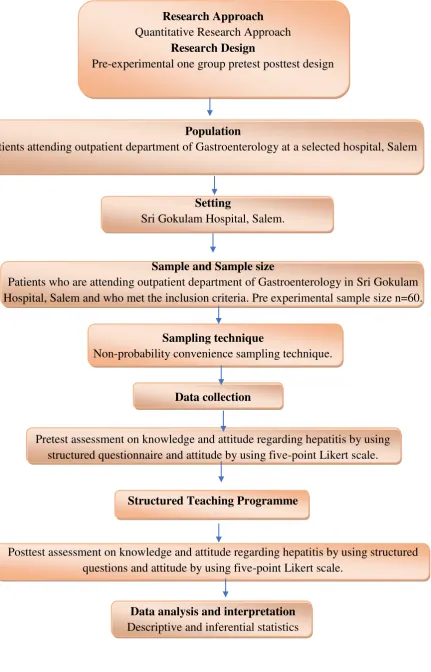
Research Approach
Quantitative Research Approach
Research Design
Pre-experimental one group pretest posttest design
Population
Patients attending outpatient department of Gastroenterology at a selected hospital, Salem
Setting
Sri Gokulam Hospital, Salem.
Sample and Sample size
Patients who are attending outpatient department of Gastroenterology in Sri Gokulam Hospital, Salem and who met the inclusion criteria. Pre experimental sample size n=60.
Sampling technique
Non-probability convenience sampling technique.
Data collection
Pretest assessment on knowledge and attitude regarding hepatitis by using structured questionnaire and attitude by using five-point Likert scale.
Structured Teaching Programme
Posttest assessment on knowledge and attitude regarding hepatitis by using structured questions and attitude by using five-point Likert scale.
Data analysis and interpretation
[image:37.595.106.538.63.736.2]Descriptive and inferential statistics
25
Population:
The population of this study includes the patients who are attending
gastroenterology outpatient department at Sri Gokulam Hospital, Salem. On an
average, 100 - 150 patients per month were attending the gastroenterology outpatient
department in Sri Gokulam hospital and previous year census was around 1300 patients
per year.
Description of the settings:
The investigator selected Sri Gokulam Hospital to conducted the study. The
bed strength of the hospital was 350. The hospital was well known for all specialties. It
was 7km away from Sri Gokulam College of Nursing. The investigator selected the
setting based on the
1. Availability of subjects
2. Economy of time and money access.
3. Feasibility in terms of cooperation extended by the gastroenterologist in Sri
Gokulam Hospital, the health team members and investigator’s familiarity
with the setting in term of professional experiences.
Sampling: Sample:
Sample of the study includes patients attendingoutpatient department of
gastroenterology and those who fulfilled the inclusion criteria and present at the time of
26
Sample size:
Sample size of the study was 60 patients who were attending outpatient
department of gastroenterology at Sri Gokulam Hospital, Salem.
The formula used for sample size estimation is n= Z1- 𝛼2 2 P (1-P) d2
n= (1.96)2 0.2 (1-0.2)
(0.10)2
n= 3.84 X 0.2 (0.8) 0.61
=
0.01 0.01
n= 61
Where Z1 = Desired confidence level
P = Expected proportion
d = Absolute precision or error
Sampling technique:
Sampling technique involves selecting the sample population on non random basis. It
means that not everyone in the population has a equal chance of being
selected.Non-probability convenience sampling technique was adopted for selecting samples for the
study. It has been selected at an ease and convenience of the researcher.
Criteria for sample selection: Inclusion criteria:
The patients who are attending outpatient department of
gastroenterology.
Age group is between 21 years and 70 years.
27
The patients who could understand Tamil or English.
Patients who are newly attending the OPD of Gastroenterology.
Exclusion Criteria:
The patients who are not willing to participate in the study.
Variables:
Independent variable:
It is a stimulus or activity that is manipulated or varied by the researcher to
create the effect on the dependent variable. Here the independent variable was
Structured Teaching Programme on hepatitis.
Dependent variable:
It is the outcome or response due to the effect of the independent variable. Here
the dependent variables were Knowledge and attitude regarding hepatitis.
Demographic variable:
It is the characteristics and attributes of the study subject. Here demographic
variables were age in years, gender, religion, educational status, occupation, dietary
pattern, habit of smoking and alcoholism, previous knowledge regarding hepatitis and
comorbid illness.
Description of the tool:
The tool was prepared by the investigator after an extensive study of the related
28
Section A: Demographic data
Structured interview schedule was used to collect demographic data. This
section consists of demographic variables such as Age in years, Gender, Religion,
Educational status, Occupation, Dietary pattern, Habits of smoking, habits of
alcoholism, Previous knowledge regarding hepatitis and comorbid illness.
Section B: Structured questions to assess knowledge regarding Hepatitis among patients attending Outpatient department of Gastroenterlogy.
This section consists of Anatomy and physiology of liver, general information about
hepatitis, definition of hepatitis, Types, Causes, Mode of transmission, Clinical
[image:41.595.109.533.478.592.2]manifestations, Diagnostic evaluation, Treatment, prevention and complication.
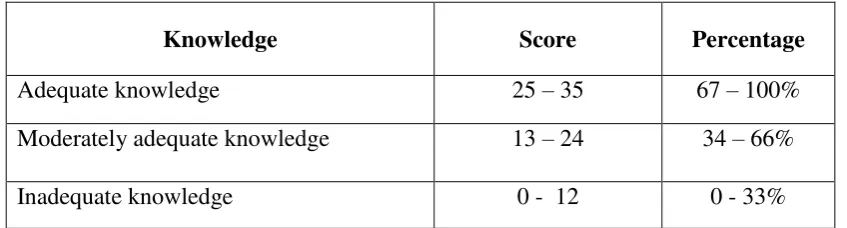
Table-3.1: Scoring procedure on knowledge regarding hepatitis
It consist of 35 questions and the knowledge were categorized based on the scores
obtained, the correct answer scored as 1 and wrong answer scored as 0.
Knowledge Score Percentage
Adequate knowledge 25 – 35 67 – 100%
Moderately adequate knowledge 13 – 24 34 – 66%
Inadequate knowledge 0 - 12 0 - 33%
Section C: Five-point Likert scale to assess attitude regarding hepatitis among patients attending outpatient department of gastroenterology.
The five- point Likert scale was used to assess the attitude regarding
hepatitis. It consists of 20 statements (12 positive statements and 8 negative
29
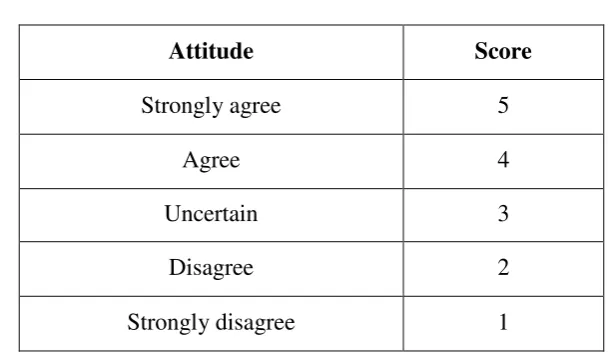
Table – 3.2: Scoring key for five - point Likert scale a) Positive statement:
Attitude Score
Strongly agree 5
Agree 4
Uncertain 3
Disagree 2
Strongly disagree 1
b) Negative statement (Reverse Score):
Attitude Score
Strongly disagree 5
Disagree 4
Uncertain 3
Agree 2
Strongly agree 1
The scores are divided into following categories,
Table – 3.3: Scoring procedure on attitude regarding hepatitis
Category Score Percentage
Most favorable attitude 81 – 100 81 – 100%
Favorable attitude 61 – 80 61 – 80%
Uncertain attitude 41 – 60 41 – 60%
[image:42.595.129.435.123.299.2] [image:42.595.101.534.612.755.2]30
Validity and Reliability: Validity:
Validity of the tool was established with the consultation of the Guide and
Experts. The tool was validated by four experts in the field of nursing and one from the
field of medicine. The tools were found adequate and minor suggestions given by the
experts were incorporated.
Reliability:
The reliability of tool was checked and established by using test re-test method
for knowledgeand obtained ‘r’ value was0.87and by using interrater method for attitude
and obtained ‘r’ value was0.94, which showed that the tool was reliable and was
considered for proceeding.
Pilot study:
Pilot study was conducted from 02.05.2018 to 07.05.2018. Formal permission was
obtained from the managing director of Sri Gokulam Specialty Hospital. The pilot
study was conducted with a sample size of 6 patients attending gastroenterology
outpatient department. The collected data were analyzed by using descriptive and
inferential statistics. The pilot study reveals that the tool was practicable and feasible to
conduct the research study.
Ethical consideration:
Prior to data collection written permission was obtained from the managing
director of Sri Gokulam Hospital, Salem. A written informed consent was obtained
31
Data collection procedure:
The data was collected from 14.05.2018 to 02.06.2018. Total 60 patients who
fulfil the inclusion criteria were selected from Sri Gokulam hospital by non –
probability convenience sampling technique. The demographic variables was collected
by the structured interview schedule and the knowledge was assessed by using
structured questionnaire and attitude was assessed by using five point Likert scale on
the first day. After the pretest “Structured teaching programme on hepatitis, and
teaching was given to patients for 30 minutes by images imparted through Laptop. The
posttest knowledge and attitude was assessed on the 7th day after the intervention, by
using same structured questionnaire and five point Likert scale.
Data analysis method:
Data was analyzed using descriptive and inferential statistics. The data related
to demographic variables was analyzed by using descriptive measures(frequency,
percentage) knowledge and attitude were analyzed by using descriptive statistics(mean,
standard deviation). The effectiveness of Structured teaching programme on knowledge
and attitude was analyzed by using inferential statistics (‘t’ test),the relationship of
knowledge and attitude was analyzed by inferential statistics (Karl Pearson correlation)
and the association of knowledge and attitude among patients attending outpatient
department of gastroenterology with their selected demographic variables was done by
using inferential statistics (chi – square test).
Summary:
This chapter dealt with research approach, research design, population,
description of the setting, sampling, variables and description of the tool, method of
32
CHAPTER IV
DATA ANALYSIS AND INTERPRETATION
Analysis is the process of the organizing and synthesizing data in such a way
that questions can be answered and hypothesis tested. (Polit, D.F., Hungler, 2003). This chapter deals with analysis and interpretation of data collected to evaluate the
effectiveness of Structured Teaching Programme on knowledge and attitude regarding
Hepatitis among patients attending outpatient department of Gastroenterology. The
collected data was tabulated, organized and analyzed by using descriptive and
inferential statistics as follows,
Section-A:
a) Distribution of patients according to their demographic variables.
Section-B:
a) Distribution of patients according to their pre-test score on knowledge
regarding Hepatitis.
b) Distribution of patients according to their pre-test score on attitude
regarding Hepatitis.
Section-C:
a) Distribution of patients according to their post-test score on knowledge
regarding Hepatitis.
b) Distribution of patients according to their post-test score on attitude regarding
Hepatitis.
c) Comparison of pretest and post test scores on Knowledge and attitude regarding
33
d) Area wise comparison between the pretest and post test scores on knowledge
regarding Hepatitis among patients attending OPD of Gastroenterology.
Section-D:
a) Effectiveness of Structured Teaching Programme on knowledge regarding
Hepatitis among patients attending outpatient department of Gastroenterology.
b) Effectiveness of Structured Teaching Programme on attitude regarding Hepatitis
among patients attending outpatient department of Gastroenterology.
c) Relationship between pretest and post test scores of knowledge and attitude
regarding Hepatitis among patients attending outpatient department of
Gastroenterology.
d) Association between the pre-test score of knowledge regarding Hepatitis among
patients attending outpatient department of Gastroenterology and their selected
demographic variables.
e) Association between the pre-test score of attitude regarding Hepatitis among
patients attending outpatient department of Gastroenterology and their selected
34
SECTION- A
[image:47.595.101.540.216.713.2]Distribution of patients according to their demographic variables. Table-4.1:
a) Frequency and Percentage distribution of patients according to their
demographic variables. n=60
S.No Demographic variables f %
1) Age in years
a) 21 – 30 7 11.6
b) 31 – 40 11 18.4
c) 41 – 50 31 51.6
d) 51 – 60 9 15
e) 61 – 70 2 3.4
2) Gender
a) Male 37 61.6
b) Female 23 38.4
3) Religion
a) Hindu 45 75
b) Muslim 5 8.4
c) Christian 10 16.6
d) Others - -
4) Educational status
a) No formal education 5 8.3
b) Primary education 6 10
c) Secondary education 16 26.7
d) Higher secondary 17 28.3
e) Any degree 16 26.7
5) Occupation
a) Daily wages 18 30
b) Home maker 7 11.6
c) Student 5 8.4
d) Employee 24 40
e) Agriculture 6 10
6) Dietary pattern
a) Vegetarian 7 11.6
35
Table 4.1: The table describes the distribution of patients according to their
demographic variables. Among 60 patients, most of the patients 31(51.6%)are in age
group of 41 – 50yrs, 11(18.4%) patients are in age group of 31 – 40yrs,9 (15%) patients
are in age group of 51-60yrs,7 (11.6%) patients are in age group of 21 – 30yrs and
remaining 2 (3.4)patients are in age group of 61 – 70 yrs.
Most of the patients 37(61.6%) are males and the remaining 23(38.4%) patients
are females. According to the religion,45(75%) patients are Hindu, 10(16.6%) patients
are Christian and remaining 5(8.4%) patients are Muslims.
In Educational status, 17(28.3%) patients have higher secondary education,
16(26.7%) patients have secondary education, 16(26.7%) patients have got
degrees,6(10%) patients have primary education and remaining 5(8.3%) patients have
no formal education.
Based on the occupation, 24(40%) patients are employees, 18(30%) patients are
daily wages, 7(11.6%) patients are home makers, 6(10%) patients are Agriculture, and
only 5(8.4%) patients are students.
In the dietary pattern 53(88.4%) patients are non- vegetarian and 7(11.6%) are
36
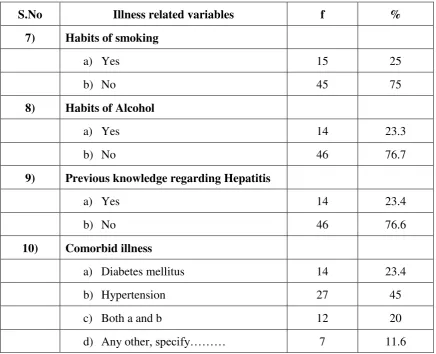
Table-4.2:
Frequency and Percentage distribution of patients according to their illness
related variables. n=60
S.No Illness related variables f %
7) Habits of smoking
a) Yes 15 25
b) No 45 75
8) Habits of Alcohol
a) Yes 14 23.3
b) No 46 76.7
9) Previous knowledge regarding Hepatitis
a) Yes 14 23.4
b) No 46 76.6
10) Comorbid illness
a) Diabetes mellitus 14 23.4
b) Hypertension 27 45
c) Both a and b 12 20
d) Any other, specify……… 7 11.6
Table 4.2 shows the distribution of patients according to their health-related
variables. In the habit of smoking most of the patients, 45(75%) patients do not have
the habit of smoking and 15(25%) patients are smokers, In that 11(%) patients are
smoking cigarettes / beedi every day and 4(%) patients are taking cigarettes / beedi less
[image:49.595.102.539.169.523.2]37
In the habit of alcohol,46 (76.7%) do not consume alcohol and 14(23.3%) are
alcoholics. In that 9(%) have the habit of taking alcohol thrice in a week, and 5(%)
patients have the habit of taking alcohol occasionally.
Most of the patients 46(76.6%) are not having previous knowledge regarding
hepatitis and 14(23.4%) are having previous knowledge regarding hepatitis.
In co morbid illness 27(45%) patients have hypertension, 14(23.4%) have
diabetes mellitus, 12(20%) patients have both hypertension and diabetes mellitus and
38
SECTION-B
a) Distribution of patients according to their pre-test score on knowledge regarding hepatitis.
Fig-4.1: Percentage distribution of patients according to their pre-test score on knowledge regarding hepatitis among patients attending outpatient department of Gastroenterology
The above bar diagram shows that 32(53.3%) patients have inadequate
knowledge, 28(46.6%) patients have moderately adequate knowledge and none of them
have adequate knowledge regarding hepatitis in the pretest. 0.00%
10.00% 20.00% 30.00% 40.00% 50.00% 60.00%
Inadequate knowledge Moderately adequate knowledge
Adequate knowledge 53.30%
46.60%
0%
pe
rc
entag
e
of
pa
ti
ents
Knowledge
[image:51.595.100.541.166.425.2]39
b)Distribution of patients according to their pre-test score on attitude regarding hepatitis.
Fig-4.2: Percentage distribution of patients according to their pre-test scores on attitude regarding hepatitis among patients attending outpatient department of Gastroenterology.
The above bar diagram shows that 26(43.3%) patients have unfavorable
attitude, 21(35%) patients have uncertain attitude, 10(16.6%) patients have favorable
attitude and 3 (5%) patients have most favorable attitude regarding hepatitis in the
[image:52.595.146.533.166.441.2]40
SECTION-C
a) Distribution of patients according to their post-test scores on knowledge regarding hepatitis.
Fig-4.3: Percentage distribution of patients according to their post-test scores on knowledge regarding hepatitis among patients attending outpatient department of Gastroenterology.
The above bar diagram shows that 46(76.6%) patients have adequate
knowledge, 14(23.3%) patients have