EFFECTIVENESS OF STRUCTURED TEACHING PROGRAMME
ON KNOWLEDGE AND ATTITUDE REGARDING SELECTED
BEHAVIOURAL PROBLEMS OF PRIMARY SCHOOL CHILDREN
AMONG PRIMARY SCHOOL TEACHERS.
A DISSERTATION SUBMITTED TO
THE TAMILNADU DR. M.G.R. MEDICAL UNIVERSITY, CHENNAI,
IN PARTIAL FULFILLMENT OF THE REQUIREMENT FOR THE
DEGREE OF MASTER OF SCIENCE IN NURSING
CHILD HEALTH NURSING
EFFECTIVENESS OF STRUCTURED TEACHING PROGRAMME ON
KNOWLEDGE AND ATTITUDE REGARDING SELECTED
BEHAVIOURAL PROBLEMS OF PRIMARY SCHOOL CHILDREN
AMONG PRIMARY SCHOOL TEACHERS.
A DISSERTATION SUBMITTED TO
THE TAMILNADU DR. M.G.R. MEDICAL UNIVERSITY, CHENNAI,
IN PARTIAL FULFILLMENT OF THE REQUIREMENT FOR THE
DEGREE OF MASTER OF SCIENCE IN NURSING
CHILD HEALTH NURSING
AUGUST 2015
INTERNAL EXAMINER: EXTERNAL EXAMINER:
Signature: Signature:
EFFECTIVENESS OF STRUCTURED TEACHING PROGRAMME ON
KNOWLEDGE AND ATTITUDE REGARDING SELECTED
BEHAVIOURAL PROBLEMS OF PRIMARY SCHOOL CHILDREN
AMONG PRIMARY SCHOOL TEACHERS.
COLLEGE SEAL:
SIGNATURE: ___________________________________________________
Prof. Mrs. V. Kavitha M.Sc(N)., Principal,
Arvinth College of Nursing, 2/191, Ellaikkal Medu, Mettupatti (Post),
Namakkal District- 637020
A DISSERTATION SUBMITTED TO
THE TAMILNADU DR. M.G.R. MEDICAL UNIVERSITY, CHENNAI,
IN PARTIAL FULFILLMENT OF THE REQUIREMENT FOR THE
DEGREE OF MASTER OF SCIENCE IN NURSING
CHILD HEALTH NURSING
EFFECTIVENESS OF STRUCTURED TEACHING PROGRAMME ON
KNOWLEDGE AND ATTITUDE REGARDING SELECTED
BEHAVIOURAL PROBLEMS OF PRIMARY SCHOOL CHILDREN
AMONG PRIMARY SCHOOL TEACHERS.
Approved by Dissertation committee on: 06.04.2015
Research Guide: ___________________________________________________
Prof. Mrs. V. Kavitha, M.Sc(N)., Principal,
Arvinth College of Nursing,
2/191, Ellaikkal Medu, Mettupatti (Post), Namakkal District- 637020.
Clinical Guide: ___________________________________________________
Ms. V.Udhayakumari, M.Sc(N)., Associate Professor,
Arvinth College of Nursing,
2/191, Ellaikkal Medu, Mettupatti (Post), Namakkal District- 637020
A DISSERTATION SUBMITTED TO
THE TAMILNADU DR. M.G.R. MEDICAL UNIVERSITY, CHENNAI,
IN PARTIAL FULFILLMENT OF THE REQUIREMENT FOR THE
DEGREE OF MASTER OF SCIENCE IN NURSING
CHILD HEALTH NURSING
CERTIFICATE
This is to certify that, this thesis, titled ³$study to assess the effectiveness of structured teaching programme on knowledge and attitude regarding selected behavioural problems of primary school children among primary school teachers in selected school at Namakkal District´ submitted by Ms.S.Nithya, II year M.Sc Nursing (2013 - 2015 Batch) Arvinth College of Nursing in partial fulfillment of the requirement of the Degree of Master of Science in Nursing from the Tamilnadu Dr. M.G.R. Medical University in her original work carried out under our guidance.
_________________________________ Professor.Mrs.V.Kavitha, M.sc (N)., Principal,
Arvinth College Of Nursing, 2/191,Trichy main road,
ACKNOWLEDGEMENT
I am grateful to Almighty God for Grace, Strength and support throughout this study.
It is a great pleasure to express my sincere and respectful regard to our honourable Chairman Dr. K. Mani M.S Ortho, D.Ortho, Arvinth College of Nursing, Namakkal for granting unlimited access to utilize the facilities of this esteemed institution.
I wish to express my profound and sincere and heartfelt gratitude to my guide Mrs.V.Kavitha, M.Sc(N)., Professor cum Principal, Arvinth College of Nursing, Namakkal, for her encouragement, patience,valuable suggestions and guidance to complete this study.
I extend my heartfelt thanks and sincere gratitude to my guide Ms.V.Udhayakumari, M.Sc(N), Head of the Department of Child Health Nursing, Namakkal, for her immense patience, gentle reminders, timely and succinct advice and guidance throughout the study.
I heartful thanks and gratitude to Mrs.V.Thendral, M.Sc (N)., Professor our Class Coordinator, Head of the Department of Obstetrics and Gynecological Nursing for her immense help and moral support, timely help, essential motivation throughout the study.
I extend my sincere thanks to Mrs. R. Ruckmani, M.Sc(N)., Head of the Department of Medical Surgical Nursing for her valuable suggestions and inspiration throughout the study.
I extend my thanks to Mr.R.Nagaraj, M.Sc(N), Head of the Department of Mental Health Nursing for his constant support throughout the study.
I am obliged to Mr.G.K.Venkataraman, MSc, Biostatistician for his guidance and efforts in statistical analysis and presentation of data.
I am grateful to all the experts who have contributed with their valuable suggestions in validating the tool.
My special thanks to Mr. Raman, Librarian for extending library facilities throughout the study.
I wish to extend my sincere thanks to Mrs.Suganthi, MA, M.Phil, Principal Modern Academy Matriculation School, Pudhupatty, Namakkal for giving
opportunity to collect data from the samples.
I thank all the samples who have participated in this study with interest.
I am extremely thankful to Mr. Kumarasamy, M.Sc., M.Phil, and
Mr.Shanmugavel, M.A., M.Phil., Professors in English Department for their
valuable editorial support.
I thank Mr. V.Abraham Murugesan, Grace Printers, who spent hours to prepare the script of thesis and timely help in formatting and printing.
We are what, we are with the blessings and of dear and near one. It would not have been possible for me to complete this work without the love and support if my parents and my friends, who initiated me to take up this noble profession and also their strong support, prayers and encouragement throughout the career.
I extend my deep sense of gratitude to my lovable father Mr.Shanmugam and my mother Mrs.Periyakkal , my beloved brother Mr.Jayaraj, sisters Mrs.Amutha, Ms.Chandra, and Ms.Kanjana for their invaluable support, constant encouragement, timely help and inspiration throughout the course of this study.
I render my deep sense of gratitude to all my classmates and friends for their constant help throughout the study.
INDEX
CHAPTER CONTENT PAGE
NO
I INTRODUCTION 1-9
x Background of the study 1-4
x Need for the study 4-6
x Statement of the problem 6
x Objectives of the study 6
x Research hypothesis 7
x Operational definitions 7
x Assumptions 8
x Delimitations
x Project outcome
8 9
II REVIEW OF LITERATURE 10-20
x Studies related to behavioural problems of
primary school children 10-12
x Studies related to knowledge and attitude regarding behavioural problems of primary school children
12-13
x Studies related to effectiveness of structured teaching programme on behavioural problems of primary school children
14-17
x Conceptual framework 18-20
III METHODOLOGY 21-29
x Research Approach 21
x Research Design 22
x Setting of the study 24
x Variables 24
x Population
x Sample and sample size
24 25
x Sampling technique 25
x Development of the tool for data collection 26
x Description of the tool 26
x Content validity 27
x Reliability 27
x Pilot study 28
x Data collection procedure 28
x Plan for data analysis 29
IV DATA ANALYSIS INTERPRETATION 30-46
V RESULTS AND DISCUSSION 47-52
VI SUMMARY, RECOMMENDATIONS,
CONCLUSION, NURSING IMPLICATIONS AND LIMITATIONS
53-55
REFERENCES 56-61
APPENDICES 62-136
ABSTRACT 137-138
LIST OF TABLES
TABLENO TABLES
PAGE NO 4.1 Frequency and percentage distribution of demographic
variables of primary school teachers 32 4.2 Frequency and percentage distribution of pretest and post test
level of knowledge regarding selected behavioural problems of primary school children among primary school teachers
34
4.3 Frequency and percentage distribution of pretest and post test level of attitude regarding selected behavioural problems of primary school children among primary school teachers
36
4.4 Comparison of pretest and post test knowledge scores regarding selected behavioural problems of primary school children among primary school teachers
38
4.5 Comparison of pretest and post test attitude scores regarding selected behavioural problems of primary school children among primary school teachers
40
4.6 Correlation between post test knowledge and attitude scores regarding selected behavioural problems of primary school children among primary school teachers
42
4.7 Association of post test level of knowledge regarding selected behavioural problems of primary school children among primary school teachers with their selected demographic variables.
43
4.8 Association of post test level of attitude regarding selected behavioural problems of primary school children among primary school teachers with their selected demographic variables.
LIST OF FIGURES
FIGURES NO
TITLE PAGE NO
2.1 Conceptual Framework 20
3.1 Schematic representation of study design 23 4.1 Percentage distribution of pre test and post test level of
knowledge regarding selected behavioural problems of primary school children among primary school teachers
35
4.2 Percentage distribution of pre test and post test level of attitude regarding selected behavioural problems of primary school children among primary school teachers
37
4.3 Comparison of pretest and post test knowledge scores regarding selected behavioural problems of primary school children among primary school teachers
39
4.4 Comparison of pretest and post test attitude scores regarding selected behavioural problems of primary school children among primary school teachers
LIST OF APPENDICES
APPENDIX TITLE I Letter seeking permission to conduct study.
II Letter seeking expert¶s opinion for content validity III List of experts for content validity
IV Informed consent requisition form
V Letter seeking consent of the subject for the participation in the research study.
VI Certificate for English Edition VII Content validity certificate VIII Format for content validity
IX Lesson plan X Data collection tool
1
CHAPTER I
INTRODUCTION
BACKGROUND OF THE STUDY
³Children are the wealth of tomorrow;
Take care of them if you wish to have a strong India,
(YHU\ERG\VKRXOGEHUHDG\WRPHHWWKHYDULRXVFKDOOHQJHV´
-Pandit Jawaharlal Nehru
Children are the greatest gift of God to humanity. They are like clay in the SRWWHU¶VKDQG+DQGOHG ZLWKORYHDQGFDUHWKH\EHFRPHVRPHWKLQJEHDXWLIXORUHOVH they will break. Children are developing individuals, whose capacities and coping skills change markedly during childhood. The childhood is also a period of life, characterized by change, challenge and the necessity for adoption.
Primary school age is the period between 6-10 years. Early childhood is the critical period of behaviour formation. The school period is an exciting period of transition from limited language ability, primarily sensory motor engagement with the surrounding environment to mastery of communication, a high degree of motor activity and a significant competence in self regulation, expanding cognitive, behaviour and emotional changes and heightened ability to empathies with others.
Children are one third of our population and all of our future. In order to develop a health society, it is important that we have healthy Children. (Shetty 2009)
India has the highest number of children in the world. More than one third of WKH FRXQWU\¶V SRSXODWLRQ LV EHORZ \HDUV $SSUR[LPDWHO\ RI WKH WRWDO population is children.
Behavioural problem is a departure from normal behaviour beyond a point, to the extent behavioural problems can manifest themselves in many ways.
2
Warning signs of behaviour disorders include harming or threatening themselves and other people, damaging or destroying property, lying, stealing, not doing well in school, skipping of school.
Most of the behavioural problems in school children occur due to lack of parental knowledge, inconsistent discipline, over criticizing, neglect, problem between parents, siblings rivalry and bad habits of mothers during pregnancy.
Children who suffer from behaviour disorders are at higher risk for school failure, suicide and mental health problems.
Numerous behaviours considered appropriate at certain early developmental levels are obviously pathogenic when they present at later age. These behaviours are probably the result of frustration and anger. These abnormal behaviour will create problems not only for themselves but for others also. Behavioural problems that commonly occur during childhood conduct disorders, emotional disorders, attention deficit hyperactivitiy disorder and scholastic disorders. All young children can be naughty, defiant and impulsive from time to time, which is perfectly normal. However, some children have extremely difficult and challenging behaviours that are outside the norm for their age. The behaviour of some children and adolescent are hard to change. Children do not always display their reactions to events immediately although they may emerge later.
Children with 6-10 years of age spend most of their time in school. School is the place where growing children come to grips with their emotional integration into the larger society. Schools are aiming the full support of families and community to provide comprehensive mental health to the children. School can act as a safety net to protect the children from hazards that affect their learning and promote psychological well being of the children.
3
The 9th conference of central council of health and central family welfare resolved that the teachers in primary and secondary classes should be trained to observe and screen the students for detect and deviation from normal physical and mental health to maintain effective surveillance. The supportive training programme can be planned for the teachers about prevention of behavioural problems and to develop desirable psychological wellbeing with the group and to the society.
The school is an institution in society specifically designed as the formal instrument for educating children. School should offer a safe and respectful learning environment for everyone. Mental health programmes in schools are effective in identifying the children with behavioural problems early and target them for intervention.
Teachers have often received some teaching in mental health programmes and problems of the children. This makes the teachers to become potentially well qualified in identification of behavioural problems among school children and planning the remedial mental health programmes. The mental health programmes help to improve the coping skills, decrease the stress and increase the behavioural support with the group for improvement of behaviour of school children.
Teachers need to use positive interactive approaches than responding to inappropriate behaviours. The teachers need to communicate care and concern rather than a desire to punish when reacting to inappropriate behaviours. The early detection and treatment of children with behavioural problems at early age may reduce treatment costs and improve quality of life of those children. Effective way of reducing behavioural problems can be through behavioural plan developed by parents, teachers, administrators and school staff and use positive interactive approaches that remove the inappropriate behaviour. The components include inform people what is expected, avoid threats, build self confidence, use positive modeling and provide positive learning environment.
4
relationship skills, self awareness, empathy and skills for coping with emotional stress among school children.
NEED FOR THE STUDY
³:KDWHYHUWKH\JURZXSWREHWKH\DUHVWLOORXUFKLOGUHQDQGWKHRQHPRVW important of all the things we can give to them is unconditional love. Not a love that
depends on anything at all except that they are our FKLOGUHQ´
-Rosaleen Dickson
In worldwide, the prevalence rate of behavioural problems is 15% and 12.2% conduct disorder, 9.5% attention deficit hyperactivity disorder, 8.3% emotional disorders, 0.4% scholastic disorders, 1.5% adjustment disorder, 1% pervasive developmental disorder.
In India, the prevalence rate of behavioural problems is 43.1% and 14.5% conduct disorder, 29.7% attention deficit hyperactivity disorder, 12.5% emotional disorder, 7.1% scholastic disorders, 2% adjustment disorder, 9.5% pervasive developmental disorder.
In Tamilnadu state, the prevalence rate of behavioural problems is 72.2%and 9% conduct disorder, 33% attention deficit hyperactivity disorder, 8%emotional disorder, 7.1% scholastic disorder, 5% adjustment disorder,1% pervasive development disorder.
In Namakkal District, the prevalence rate of behavioural problems is 60%.The common behavioural problems were 87%conduct disorder, 47% attention deficit hyperactivity disorder, 23% emotional disorder, 0.41% scholastic disorder, 1.58% adjustment disorder, 1.38% pervasive developmental disorder.
Incidence of behavioural problems in school children
S. No Behavioural problems India Maharashtra Pune
1. Antisocial behaviour 1340000 57000 12400
Stealing 278000 19800 1113
Lying 748000 25600 10119
2. Sleep disorder 238000 24000 530
3. School phobia 524000 199000 1275
4. Temper Tantrum 2760 559 54
5
Common behavioural problems of primary school children 6-10 years of age were 15.82% conduct disorder, 10.2% attention deficit hyperactivity disorder, 8% oppositional defiant disorder, 4% separation anxiety disorder, 9% nail biting, 7.7% thumb sucking, 6% bed wetting, 7% food fad, 3.2% temper tantrum.
Millions of children suffer from conduct disorder, learning disorder, attention deficit hyperactivity disorder and attachment disorder. Conduct disorder is one of the most frequently diagnosed disorder of childhood and adolescence. Currently 1 to 4 million children and adolescents have conduct disorder in United States.
Behavioural problems among children may be due to genetic factors, psychological factors or environmental factors of the particular child. General practioners, community practioners including teachers are seeing may children with behavioural problems. Many of the problems are curable, if they are identified early.
6FKRROWHDFKHUVDUHWKHPRVWLPSRUWDQWSHUVRQLQZKRPDFKLOGVHHV³SDUHnt
ILJXUH´DZD\IURPKRPH7KHWHDFKHUKDVWUHPHQGRXVLQIOXHQFHRQWKHFKLOGEHFDXVH RIWKH³HPRWLRQDOERQGLQJ´WKDWWDNHVSODFHEHWZHHQWKHWHDFKHUDQGWKHSXEOLF0DQ\ children accept their teachers and their opinions and consider them to be ³UROH model´. This resource and influencing factor must be tapped in the wider context of the situation. The teachers need to help the children to cope with health and illness (Antony 1990).
The teacher could identify the high risk population and psychosocial
SUREOHPVDPRQJFKLOGUHQ³5LVNWDNLQJEHKDYLRurs such as aggression, stealing, lying
and life endangering adventures may be an early indication of children facing
SUREOHPV´'U53DUWKDVDUDWK\, 2000).
6
The investigator observed during the clinical experience some of the children have shown the fear of going to school and they acted antisocially by EUHDNLQJRWKHU¶VWKLQJVDQGIXUQLWXUH7KHLQYHVWLJDWRUDJDLQIHOWWKDWWKHVHSUREOHPV can be prevented with the help of teachers by early identification of behavioural SUREOHPV 7KH VFKRRO WHDFKHUV PXVW SOD\ D YLWDO UROH LQ FKDQJLQJ WKH VWXGHQW¶V behaviouUV LQ D ULJKW ZD\ EHFDXVH WRGD\¶V FKLOGUHQ DUH WRPRUURZ¶V FLWL]HQV ³The mother is the first teacher; the teacher is the second mother´ as per this citation, the teachers are the influential person to develop and change student behaviour in an expected manner. The nursing personnel should take responsibility to update knowledge of teachers should be trained in the aspects of psycho ± social , emotional development of children ,early identification of behavioural problem and coping strategies to manage the children with behavioural problems. So, the investigator felt it is best and very effective to teach the school teachers regarding behavioural problems of primary school children. So, the investigator planned to evaluate the effectiveness of structured teaching programme on knowledge of primary school teacher regarding selected behavioural problems of primary school children.
STATEMENT OF THE PROBLEM
A STUDY TO ASSESS THE EFFECTIVENESS OF STRUCTURED TEACHING PROGRAMME ON KNOWLEDGE AND ATTITUDE REGARDING SELECTED BEHAVIOURAL PROBLEMS OF PRIMARY SCHOOL CHILDREN AMONG PRIMARY SCHOOL TEACHERS IN SELECTED SCHOOL AT NAMAKKAL DISTRICT.
OBJECTIVES
1. To assess the pretest knowledge regarding selected behavioural problems of primary school children among primary school teachers.
2. To assess the pretest attitude regarding selected behavioural problems of primary school children among primary school teachers.
3. To assess the effectiveness of structured teaching programme on selected behavioural problems of primary school children.
4. To correlate the knowledge and attitude regarding selected behavioural problems of primary school children among primary school teachers.
7 HYPOTHESES
H1: There will be significant difference between pre and post test knowledge and
attitude score regarding selected behavioural problems of primary school children among primary school teachers.
H2: There will be significant association between post test knowledge and attitude score with selected demographic variables.
OPERATIONAL DEFINITION Assess
Evaluate the level of knowledge and attitude of primary school teachers regarding selected behavioural problems of primary school children.
Effectiveness
It refers to significant gain in knowledge and positive attitude as determined by significant difference between pre and post test knowledge and attitude score.
Knowledge
It refers to the correct response of the primary school teachers to the items on selected behavioural problems of primary school children and assessed by structured knowledge questionnaire.
Level of Knowledge Score
Inadequate Below 50
Moderately Adequate 50-75
Adequate Above 75
Attitude
It refers to expressed opinion of primary school teachers regarding selected behavioural problems of primary school children.
Level Of Attitude Score Unfavorable Attitude Below 50
Favorable Attitude 50-75 Most Favorable Attitude Above 75
Structured Teaching Programme
8
diagnosis, management of i) Conduct disorder ii) Attention deficit hyperactivity disorder and teaching power point presentation visual aids designed for primary school teachers.
Primary School Teachers
Teachers who are currently teaching the classes from I to V standard with the qualifications of D. Ed, B. Ed, M. Ed in Modern Academy Matriculation School at Pudhupatty, Namakkal.
Primary School Children
Children who are at the age group of 6-10 years and studying from I to V standard in Modern Academy Matriculation School at Pudhupatty,Namakkal.
Behavioural Problems
It refers to a behaviour that goes to an extreme level. There are many behavioural problems in primary school children. As per this study, i) Conduct disorder, ii) Attention deficit Hyperactivity disorder are considered as behavioural problems.
ASSUMPTIONS
1) Primary School teachers will have varying level of knowledge regarding selected behavioural problems of primary school children.
2) Structured teaching programme will enhance the knowledge and attitude of primary school teachers regarding selected behavioural problems of primary school children.
3) Knowledge regarding behavioural problems will develop positive attitude among primary school teachers to find out the students who have behavioural problems.
DELIMITATIONS
The study is limited to the primary school teachers,
x Who are taking class for I to V Standard.
x Who are willing to participate in the study.
9 PROJECTED OUTCOMES:
x The study will improve the knowledge and attitude regarding selected behavioural problems of primary school children among primary school teachers
x The study will help to find out the problematic children.
10
CHAPTER II
REVIEW OF LITERATURE
Review of literature is a broad systematic and critical collection and evaluation of important scholarly published literature as well as unpublished materials.The review serves as evidence and essential background for any research (Basavanthappa, 2004)
Review of literature is critical summary of research on a topic of interest generally prepared to put a research problem is content to identify gaps and weakness is prior studies so as to justify a new investigation (Polit and Beck, 2010)
A literature review involves the systematic identification, location, scrutiny and summery of written material that contains information on research problem (Polit and Hungler, 2006)
It has two parts
Part ± I: Review of literature Part ±II: Conceptual framework.
PART ± I REVIEW OF LITERATURE
Section-A: Studies related to behavioural problems of primary school children.
Section-B: Studies related to knowledge and attitude regarding behavioural problems of primary school children.
Section-C: Studies related to effectiveness of structured teaching programme on
behavioural problems of primary school children.
SECTION-A: STUDIES RELATED TO BEHAVIOURAL PROBLEMS OF PRIMARY SCHOOL CHILDREN
Gupta, G.V.S, (2014) conducted a study on prevalence of behavioural problems of school going children in Ludhiana, India. The study included 957 school children was assessed the behavioural problems by using Rutter B Scale, which was to be completed by the class teachers. Based on the screening instrument results and parental interview, it was found that 45.6% of the children were estimated to have behavioural problems, of which 36.5%had significant problems.
11
Agalya. L, (2014) conducted a Prevalance study of behavioural problems in primary school children,a Rural setting,in India. In this cross- sectional study, 198 children, 114 boys and 84 girls between 6 and 12 years of age, were rated on Achenbach Child Behavior Checklist (CBCL 6-12years) - Teacher Rating Form (TRF), by his/her class teacher. Behavioural and emotional disorders in children include internalizing symptoms which affect the self and externalizing symptoms that impact others and the environment.The prevalence rate for behaviour/emotional SUREOHPV ZDV IRXQG WR EH DV SHU $FKHQEDFK¶V FXWRII VFRUHV &RPPXQLW\ studies done in India on behavioural disorders in children and adolescents showed the prevalence figures varying from 2.6% to 35.6%.The mean CBCL score in this study was 50.54 with a S.D of 19.403.
Taghreed Farahat, et.al, (2014) conducted a prevalence study of
Attention-deficit hyperactivity disorder among primary school children in Menoufia Governorate, Egypt. A cross-section comparative study was conducted in a randomly selected four primary schools in Menoufia governorate, Egypt. All children after a valid consent of their parents (N. 1362) were subjected to complete history taking, medical and psychological assessment, and IQ estimation. Their parents and teachers were subjected to the corresponding Arabic forms of Conner's questionnaire. Suspected cases were confirmed and categorized by DSM-IV criteria. The sample was divided into cases and controls to study the risk factors. Prevalence of ADHD was 6.9% and the maleԜand Ԝfemale ratio was 3.5Ԝ:Ԝ1. The main risk factors were neonatal problems (OR = 4.3), family history of psychiatric and medical illnesses (OR = 3.5 and 2.8), and male gender (OR = 2.9). Prevalence of ADHD among Menoufia school children was 6.9%. Dealing with its risk factors is mandatory for prevention, early management, and better outcome.
12
were assessed for the presence of any co-morbid factors by administering Children's Behavioural Questionnaire (CBQ) to the teachers and Personal Information Questionnaire to the parents. Statistical Product and Service Solutions (SPSS) 10 software, Mean and Standard Deviation, and student's t test were used for statistical analysis. The prevalence of ADHD among primary school children was found to be 11.32%. Prevalence was found to be higher among the males (66.7%) as compared to that of females (33.3%). The prevalence among lower socio-economic group was found to be 16.33% and that among middle socio-economic group was 6.84%. The prevalence was highest in the age group 9 and 10 years. The present study shows a high prevalence of ADHD among primary school children with a higher prevalence among the males than the females.
Salwa SM, et.al, (2011) conducted a cross-sectional study to find out the
prevalence rate of behavioural disorders and emotional disorders among school children at Baquba city during educational year 2010-2011.1500 school children of both male and female were selected by random sampling technique. Revised Rutter Scale (RRS) was used for identification and measurement of behavioural disorders. It was found that 24.6% of school children had behavioural disorders and 13.8% had conduct disorders and 10.8% had emotional disorders.
SECTION - B STUDIES RELATED TO KNOWLEDGE AND ATTITUDE ON BEHAVIOURAL PROBLEMS OF PRIMARY SCHOOL CHILDREN.
Deelip Natekar, (2014) conducted a descriptive study to assess the
knowledge of primary school teachers regarding behavioural problems and their prevention among children in selected Government primary schools at Bangalore.50 primary school teachers were selected by purposive sampling technique. Descriptive survey approach was adopted and structured questionnaire was used to collect the data. The collected data was analyzed by using differential statistics and the results shows that 46% of primary school teachers had less knowledge regarding prevention of behavioural problems among children.
13
assess the mothers knowledge. The result shows that all the mothers (100%) had inadequate knowledge regarding preschool behavioural problems.
G. Mala, et.al, (2013) conducted a comparative study between the urban and rural school teachers knowledge regarding the selected behavioural problems of school children in selected schools at Choolai & Nandhivaram.100 & 50 teachers selected from urban and rural area by multistage and cluster random sampling technique. A structured questionnaire was used to assess the knowledge of teachers. The findings of this study reveal that the urban school teachers have more knowledge than the rural school teachers. The overall knowledge score shows that both of them have inadequate knowledge on the selected behavioural problems among school children.
Hala A Malik Al- itakeem et al, (2013) conducted a cross sectional study to evaluate the knowledge and attitude of primary school teachers regarding attention deficit hyperactivity disorder in selected school at Bahrain. A sample of 160 teachers was randomly selected from a total of 4314primary school teachers, working in 114 government primary school in Bahrain. The tool used to collect the data were structured knowledge questionnaire and attitude scale. The result shows that,84(53.2%)of the teachers had inadequate knowledge about attention deficit hyperactivity disorder.
14
SECTION-C: STUDIES RELATED TO EFFECTIVENESS OF STRUCTURED TEACHING PROGRAMME ON BEHAVIOURAL PROBLEMS OF PRIMARY SCHOOL CHILDREN.
Kapil Kumar, (2014) conducted a quasi experimental study to assess the
effectiveness of planned teaching programme through booklet on knowledge of parents regarding selected emotional and behavioural problems of children in selected school at Jaipur.30 parents were selected by convenient sampling technique. The tool used for gathering data was structured questionnaire on knowledge regarding selected emotional and behavioural problems of children. The result shows that the mean post test knowledge score 16.13 was apparently higher than the mean pre test knowledge score 9.46 .The computed paired µW¶ YDOXH ZDV ZKLFK ZDV KLJKO\ VWDWLVWLFDOO\ significant at P < 0.05 level. This indicates that planned teaching programme through booklet was effective in increasing knowledge score of parents regarding selected emotional and behavioural problem of children.
Sandeep Garg, (2014) conducted a study to assess the effectiveness of structured teaching programme on knowledge regarding selected common behavioural problems of children among primary school teachers in selected school at vadodara.60 primary school teacher were selected by convenient sampling method. Self reportive structured interview tool was used to collect data. The result shows that in pretest primary school teachers were had average 49.40 % knowledge regarding selected common behavioural problems of children and mean score was 14.82 ± 3.372 and in post test, average 75.83% knowledge regarding selected behavioural problems of children and mean score was 22.75 ± 2.802. T calculated value is 33.233 which more than the tabulated value of 2.00 at 0.05 level of significance. This study concluded that structured teaching programme is effective tool to improve the knowledge of primary school teachers regarding selected common behavioural problems of children.
15
problems and structured health teaching on behavioural problems of children. Findings of the study revealed that in pretest, majority 86.7% of the mothers had poor knowledge (Score 0-8) and 13.3% of them had average knowledge (Score 9-16). In post test, majority 71.7% of them had good knowledge (Score 17-25) and 28.3% of them had average knowledge (Score 9-16). The study concludes that there is significant difference in the pre-test and post-test knowledge scores. This indicates that the structured teaching programme is effective in improving the knowledge of subjects.
Pawan Sharma Jagject Kaur, (2014) conducted a quasi experimental study to assess the effectiveness of structured teaching programme on knowledge regarding behavioural problems of children among mothers at Ludhiana, Punjab. A sample of 60 mothers were kept 30 in experimental group and 30 in control group. Data was collected by self structured multiple choice questionnaire. Findings revealed that in pretest majority of mothers (50%) in both control and experimental group had average knowledge regarding behavioural problems of children. The mean post test knowledge score of control group is 7.47 and experimental group is 24.47and majority of mothers 66.66 % obtained below average post test knowledge score in control group and majority of mothers (93.33%) obtained excellent post test knowledge score in experimental group. Hence it was concluded that the structured teaching programme is an effective tool in improving the knowledge of mothers regarding behavioural problems of children.
16
Prashant B Patil, (2014) conducted a quasi experimental study to assess the
effectiveness of structured teaching programme on knowledge and attitude of primary school teachers regarding selected behavioural problems in selected schools at Mangalore.60 primary school teachers were selected by convenient sampling method. The tool used to collect data were structured knowledge questionnaire and attitude scale. The results shows that the mean post test knowledge and attitude scores ( X2 = 43.17, X2 = 52.72 ) was higher than the mean pretest knowledge and attitudes scores (X1 = 30.40, X1 = 44.52). The structured teaching programme was effective in increasing the knowledge and attitude of the teachers (t = 14.34, t =7.57).There was a significant positive correlation between knowledge and attitude r = 0.2227 at 0.05 level of significance. There was a significant improvement in knowledge and attitude of teachers after structured teaching programme and hence it is found to be effective.
Sharmila, (2013) conducted a quasi experimental study to evaluate the effectiveness of structured teaching programme on knowledge regarding behavioural therapy for primary school children among school teachers in selected school at pallipalaiyam.30 primary school teachers were selected by non probability convenient sampling technique. The tool used for gathering data was structured knowledge questionnaire regarding behavioural therapy for primary school children. The result shows that the difference between mean pre test (16.48 ± 2.7273)and post test (29.88 ± 2.2373) knowledge scores of school teachers was found to be statistically significant at P < 0.05 level. It was found that structured teaching programme was very effective teaching method to increase the knowledge of school teachers.
17
Susheel Kumar V. Ronad, (2013) conducted a quasi experimental study to evaluate the effectiveness of structured teaching programme on behavioural problems of school children among school teachers in selected school at Bangalore. 50 school teachers were selected by simple random sampling.The tool used for collected the data was structured knowledge questionnaire. The mean pretest knowledge score was ZKHUH DV WKH SRVW WHVW PHDQ VFRUH ZDV 7KH FDOFXODWHG µW¶ YDOXH ZDV 28.107 which was higher significant at P < 0.001.These finding shows that structured teaching programme was effective in enhancing the knowledge of school teachers regarding behavioural problem of primary school children.
Saraswathi K.N, (2012) conducted a study to assess the effectiveness of structured teaching programme on behavioural problems of school children among school teachers in selected schools at Bangalore.40 school teachers were selected by purposive sampling technique. The tool used to collect data were structured knowledge questionnaire to assess the knowledge. The comparison of pretest and post test knowledge scores on behavioural problems of school childreQVKRZVWKDWWKHµW¶ value was 28.51 which was highly statistically significant at P < 0.05. The mean post test score was 87.4%which was significantly higher than the pretest score 37.8%.The result shows that there is significant increase in the knowledge of school teachers regarding behavioural problems of school children and it was found that the effectiveness of structured teaching programme in terms of increase in knowledge score among school teachers.
18 PART- II
CONCEPTUAL FRAMEWORK:
The conceptual frame work enables the researcher to create a distinct relationship between theoretical and empirical literature in addressing spiritual care in nursing practice (Christenson, 2007)
A conceptual framework is used in research to outline possible courses of action or to present a preferred approach to an idea (or) thought. It can act like maps that give coherence to empirical inquiry (paula.J.2006)
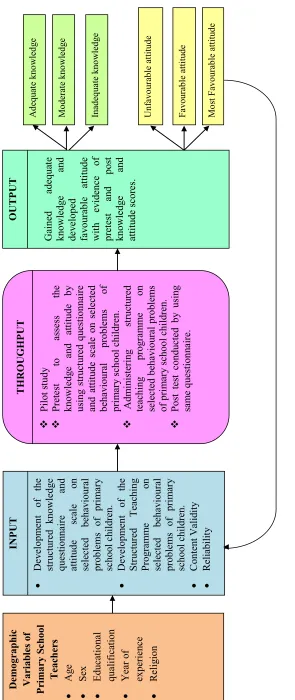
The present study aims at developing and evaluating structured teaching programme in terms of improving the knowledge and developing attitude regarding behavioural problems of primary school children.s
The conceptual model for the study was based on the general system theory by Ludwig Von Bertalanffy (1969). In this theory the main focus is on the discrete parts and their interrelationship.
Which consist of input, throughput and output. ³6\VWHP´ DV D FRPSOH[ interaction, which means that systems consist of two or more converted elements. Which from an organized whole and which interact with each other.
Input
It is the first phase in an system. Based on Ludwig Von Bertalanffy input can be a information, material or energy that enters the system.
,Q WKLV VWXG\ ³LQSXW´ LV FRQVLGHUHG WR EH LQIRUPDWLRQ UHODWHG WR VHOHFWHG behavioural problems among primary school children. It includes,
Development of the structured questionnaire regarding selected behavioural problems among primary school children.
Development of the structured teaching programme on selected behavioural problems.
19 Through put
According to Ludwig Von BertaODQII\³WKURXJKSXW´UHIHUVWRWKHSURFHVVE\ which the system processes input and release an output. In this study the through put considered for the processing the inputs are,
Pilot study
Pretest by using the structured questionnaire
Administering structured teaching programme on selected behavioural problems
Post test
Output
$FFRUGLQJWRV\VWHPWKHRU\³RXWSXW´UHIHUVWRHQHUJ\PDWWHUDQGLQIRUPDWLRQ WKDW OHDYH D V\VWHP ,Q WKH SUHVHQW VWXG\ ³RXWSXW´ LV FRQVLGHUHG WR EH WKH JDLQ LQ knowledge obtained through the processing of the post test. It will be received in the form of post test knowledge scores.
20
[image:32.612.157.452.28.728.2]F
IG-2.1 CON
CEP TU A L F R AMEWORK BAS E
D ON G
E
NERAL
S
YSTEM THE
ORY BY L
U DWIG VON BERTA LANFFY, (1968) Demogr aphic Variab les o f P rim ary S chool Teacher s x Ag e x Sex x Education al qualif ica ti on x Yea r o f exper ien ce x Relig ion INPUT x Dev elopm ent of the st ru ctu red k nowledg e quest ion naire and att it ude s ca le on sele cted be hav io ur al probl em
s of pr
im ary schoo l ch ild ren. x Dev elopm ent of the Str uc tu red Teach ing Prog ramm e on sele cted be hav io ur al probl em
s of pr
im ary schoo l ch ild ren. x Conten t Valid ity x R eli abi li ty OU T P U T Gained ad equa te k nowledg e and dev eloped fav ourab le a tt it ude with ev id ence of pretes t an d pos t k nowledg e and att it ude s cores. Mo st Favo u rab le attitu de A d eq u ate k n o w led g e Fav ou rab le attit u d e Un fa vo u rab le attitu de Mo derate k n o w led g e In ad eq u ate kn o w led g e TH RO UGHP UT Pil o t s tudy Pret est t o as ses s the k nowledg
e and att
21
CHAPTER III
METHODOLOGY
Methodology is a guide by the research to answer question or test hypothesis (Paul T.Lasard, 2004)
Research methodology is a way to solve the problems systematically. It indicates the general pattern of organizing the procedure for gathering the valid and reliable data for the purpose of investigation (Green, 2010)
This chapter deals with the method adopted for the study and includes the description of the research design ,setting of the study, variables, population, sample size, sampling technique, criteria for sample selection, description of the tool, method of data collection and plan for data analysis.
RESEARCH APPROACH
According to Polit and Hungler, evaluative research is an applied form of research that involves finding how well a programme, practice, procedure or policy is working. It involves the collection and analysis of information leading to the functioning of a programme or procedure with the aim of assessing its effectiveness.
The selection of research approach is a basic procedure for conducting research study. In view of the nature of the problem selected for the study and objective to be accomplished, evaluative research was considered an appropriate research approach for the present study.
22 RESEARCH DESIGN
Research design is a blue print for conducting a study that maximizes control over factors that could interfere with the validity of the findings (Nancy burns, 2005)
5HVHDUFK GHVLJQ UHIHUV WR UHVHDUFKHU¶V RYHUDOO SODQ VWUXFWXUH DQG VWUDWHJ\ RI investigations conceived so as to obtain answers to research questions and to control variance (Kerlinger, 2004)
The researcher adopted Quasi Experimental one group pretest and post test design. The study design depicted as below,
GROUP PRETEST INTERVENTION POSTTEST
E O1 X O2
Primary school teachers
Knowledge and attitude regarding selected behavioural problems of primary school children among
primary school teachers before administration of structured teaching programme.
Structured Teaching Programme on selected behavioural problems of primary school children.
23
3.1 SCHEMATIC REPRESENTATION OF RESEARCH DESIGN Research Design
Quasi Experimental One Group, Pre Test and Post Test Design
Study Setting
Modern Academy Matriculation School at Pudhupatty, Namakkal (Dt)
Target Population Primary School Teachers
Accessible Population
Teachers who meets the Inclusive Criteria
Sampling Technique Simple Random Sampling Technique
Sample size - 30
Pre Test
Assessment of knowledge and attitude regarding selected behavioural problems of primary school children.
Intervention
Structured teaching programme on selected behavioural problems of primary school children
Post Test
Assessment of Effectiveness of Structured Teaching programme
Data Analysis
Descriptive & Inferential statistics
24 SETTING OF THE STUDY
Setting is the physical, location and condition in which the data collection takes place (Polit and Hungler, 2006)
The study was conducted in Modern Academy Matriculation School at Pudhupatty, Namakkal district, which is 12 km away from the Arvinth College of Nursing, Namakkal.35 numbers of female and 5male staffs are working in this school.
The selection of setting was done on the basis of feasibility of conducting the study with regard to time, geographical distance, permission from authorities and availability of the sample subjects.
VARIABLES
Variables are concept at different levels of abstractions that are concisely defined to promote their measurement or manipulation within the study.
Independent Variables
In this study independent variables refers to structured teaching programme on selected behavioural problems of primary school children.
Dependent Variables
In this study knowledge and attitude score of primary school teachers regarding selected behavioural problems of primary school children among primary school teachers.
POPULATION
The population is defined as the entire aggregation of cases that meet a designed set of criteria (Polit and Hungler1999)
Target Population
25 SAMPLE AND SAMPLE SIZE
Sample is the subset of population selected to participate in a research study. It is portion of the population which represents the entire population (Polit and Hungler, 2002).
Sample size was decided according to the objectives, resources available, nature of study, method of sampling followed, nature of respondents and other field conditions and nature of population.
In this study samples are 30 primary school teachers working in Modern academy matriculation school situated at Pudhupatty, Namakkal those who are fulfilling the inclusion criteria.
SAMPLING TECHNIQUE
Sampling technique is a process of selecting a portion of the population to obtain data regarding a problem.
Sampling technique adopted for this study was Simple Random sampling technique. The samples are selected by lottery method.
Each member of the population is assigned a unique number. Each number is placed in bowl and mixed thoroughly. From that picked up the lots and assigned a subject in order.
SAMPLING CRITERIA Inclusion criteria
The study includes,
Teachers who have qualification like D. Ed, B. Ed, and M. Ed. Teachers who are willing to participate in the study
26 Exclusion criteria
The study excludes,
Teachers who are not taking class for I to V standard. Teachers who are not available at the time of data collection. Teachers who are not willing to participate.DEVELOPMENT OF THE TOOL FOR DATA COLLECTION
Treece and Treece, (2000) stated that the instrument selected in a research should as far as possible be the vehicle that would best obtain data for drawing conclusions pertinent to the study and add to the body of knowledge in the discipline.
DESCRIPTION OF THE TOOL
The tool consists of 3 sections, Section- A:
It consists of demographic data such as age, sex, educational qualification, year of experience, and religion.
Scoring key:
Demographic data of the instrument not scored but used for descriptive analysis.
Section- B:
This section consists of structured self administered knowledge questionnaire which includes 30 Multiple choice questions to assess the knowledge regarding selected behavioural problems of primary school children among primary school teachers.
Scoring Key:
Knowledge Questionnaire consists of 30 multiple choice questions. Each correct answer carries one mark and wrong answer carries zero mark .The total score of knowledge was 10 marks.
For the purposes of study the level of knowledge was classified as follows <50% - Inadequate knowledge
27 Section- C:
A five point rating scale was prepared by the investigator to assess the attitude of primary school teachers regarding selected behavioural problems of primary school children. It consists of 10 statements. Each statement was scored in following manner.
Scoring key:
Each item has 5 options such as strongly agree, agree, uncertain, disagree, strongly disagree.
The scores for the positive item was 5 points for those who strongly agree, 4 points for those who agree,3 points for uncertain,2 points for those who disagree and 1 point for those who strongly disagree.
Maximum possible score was 50 and minimum was 10. <50% - Unfavorable attitude
50-75% - Favorable attitude >75% - Most favorable attitude
CONTENT VALIDITY
Content validity refers to the extent to which measuring instrument provides adequate coverage of the topic under the study .Criteria rating scale for validation of the tool was developed with options like strongly agree, agree, disagree and need modification and suggestion from experts.
The tool was submitted to a pediatrician, psychiatrist and 3 expert in child health nursing department. Experts were asked to give their opinions and suggestions about the concept of the tool. Modifications were made as per experts opinion. These modifications were incorporated in the final preparation of the tool by the investigator.
RELIABILITY
28
established. Results revealed that there was a positive correlation. The tool was found feasible and practicable.
PILOT STUDY
Pilot study is a small scale version or trail run of the major study. The function of this to obtain information for improving the project and to assess its feasibility.
The investigator conducted a pilot study with 5 sample in Kalaimagal Matriculation School at Namakkal district in the month of March 2015. The pre test knowledge and attitude questionnaire was administered and structured teaching programme was conducted on the same day. We assessed the post test knowledge and attitude on 8th day.
The investigator proceeded for the main study no modification was done in the methodology and tool.
PROCEDURE FOR DATA COLLECTION
Main study was conducted after obtaining formal permission from principal of Modern Academy Matriculation School at Pudhupatty, Namakkal. The data was collected during 01/04/2015 to 30/04/2015.
29 PLAN FOR DATA ANALYSIS
Talbot (2001) designed data analysis as evaluation of information and to study variables, data analysis help the researcher to organize, summarize, evaluate interpret and communicate the numerical facts.
Data was analyzed on the basis of objective and hypothesis by using descriptive and inferential statistics.
1. Descriptive statistics was used to analyze the frequency, percentage, mean and standard deviation of the following variables.
¾ Demographic variables ¾ Knowledge
¾ Attitude
2. Inferential statistics was used to determine the comparison, relationship and association.
¾ PaireGµW¶WHVWZDVXVHGWRILQGRXWWKHVLJQLILFDQFHRIWKHSUHWHVWDQGSRVWWHVW scores of knowledge and attitude of primary school teachers.
¾ Correlation co-efficient was used to find the relationship between knowledge and attitude.
30
CHAPTER IV
DATA ANALYSIS AND INTERPRETATION
Kerlinger (1995) defines analysis is the categorizing, ordering, manipulating and summarizing of data to obtain answers to research question. The purpose of analyzing is to reduce the data into interpretable form so that relations of research problem can be studied and tested.
This chapter deals with the analysis and interpretation of data collected from 30 primary school teachers in selected school at Namakkal District, to assess the effectiveness of structured teaching programme on knowledge and attitude regarding selected behavioural problems of primary school children among primary school teachers. The data collected for the study was grouped and analyzed as per the objectives set for the study. The findings based on the descriptive and inferential statistical analysis are presented under the following sections.
OBJECTIVES:
1. To assess the pretest knowledge regarding selected behavioural problems of primary school children among primary school teachers.
2. To assess the pretest attitude regarding selected behavioural problems of primary school children among primary school teachers.
3. To assess the effectiveness of structured teaching programme on selected behavioural problems of primary school children.
4. To correlate the knowledge and attitude regarding selected behavioural problems of primary school children among primary school teachers.
31 ORGANIZATION OF DATA
The findings of the study were grouped and analyzed under the following sections.
Section-A: Description of the demographic variables of primary school teachers.
Section-B: Assessment of pretest and post test level of knowledge and attitude
regarding selected behavioural problems of primary school children among primary school teachers.
Section-C: Effectiveness of structured teaching programme on knowledge and
attitude regarding selected behavioural problems of primary school children among primary school teachers.
Section-D: Relationship between post test knowledge and attitude score regarding
selected behavioural problems of primary school children among primary school teachers.
Section-E: Association of post test level of knowledge and attitude regarding
32
[image:44.612.127.519.117.687.2]SECTION-A: DESCRIPTION OF THE DEMOGRAPHIC VARIABLES OF PRIMARY SCHOOL TEACHERS.
Table-4.1: Frequency and percentage distribution of demographic variables of
primary school teachers N = 30
S.No Demographic Variables No. %
1. Age in years
<30 years 25 83.33
31-40 years 5 16.67
41-50 years 0 0.00
>50years 0 0.00
2. Sex
Male 1 3.33
Female 29 96.66
3. Educational qualification
Teacher training course 0 0.00
Degree with teacher training 17 56.67
Master degree with B.Ed. 12 40.00
Master degree with M.Ed 1 3.33
4. Years of teaching experience
<5 Years 28 93.33
6-10 Years 2 6.67
11-15 Years 0 0.00
16-20 Years 0 0.00
5. Religion
Hindu 27 90.00
Muslim 2 6.67
Christian 1 3.33
Others 0 0.00
6. Do you have child psychiatry in your curriculum?
Yes 15 50.00
No 15 50.00
7. Do you know information regarding behavioural
problems among primary school children?
Yes 0 0.00
No 30 100.00
33
The table 4.1 shows that majority 25 (83.33%) of primary school teachers were in the age group of < 30 years and 5 (16.67%) were in the age group of 31 to 40 years.
Majority 29 (96.66%) of primary school teachers were female and 1 (3.33%) were male.
With respect to educational qualification of the primary school teachers, Majority 17 (56.67%) possess degree with teacher training and 12 (40%) had master degree with B. Ed and only 1(3.33%) had master degree with M.Ed.
With regard to years of experience of primary school teachers, Majority 28(93.33%) had < 5 years of teaching experience and 2 (6.67%) had 6-10 years of teaching experiences.
With regard to religion of the primary school teachers, Majority 27(90%) were Hindus, 2 (6.67%) were Muslim and only 1 (3.33%) were Christian.
Considering the child psychiatry in curriculum of primary school teachers, 15(50%) had child psychiatry in curriculum and 15(50%) had no child psychiatry in their curriculum.
34
SECTION-B: ASSESSMENT OF PRETEST AND POST TEST LEVEL OF
[image:46.612.124.517.217.324.2]KNOWLEDGE AND ATTITUDE REGARDING SELECTED BEHAVIOURAL PROBLEMS OF PRIMARY SCHOOL CHILDREN AMONG PRIMARY SCHOOL TEACHERS.
Table-4.2: Frequency and percentage distribution of pretest and post test level of knowledge regarding selected behavioural problems of primary school children among primary school teachers.
N = 30
Knowledge
Inadequate ( 50%)
Moderately adequate ( 51 ± 75%)
Adequate ( >75%)
No. % No. % No. %
Pretest 30 100.0 0 0 0 0
Post Test 0 0 4 13.33 26 86.67
35
Fig:4.1 Percentage distribution of pretest and post test level of knowledge regarding selected behavioural problems of primary school children among primary school teachers
0 10 20 30 40 50 60 70 80 90 100
Inadequate Moderately Adequate Adequate
100
0
0 0
13.33
86.67
Percentage
Level of Knowledge
Pretest
36
Table 4.3: Frequency and percentage distribution of pretest and post test level of attitude regarding selected behavioural problems of primary school children among primary school teachers
N = 30
Attitude
Unfavourable ( < 50%)
Moderately Favourable (50 ± 75%)
Favourable (>75%)
No. % No. % No. %
Pretest 25 83.33 5 16.67 0 0
Post Test 0 0 5 16.67 25 83.33
37
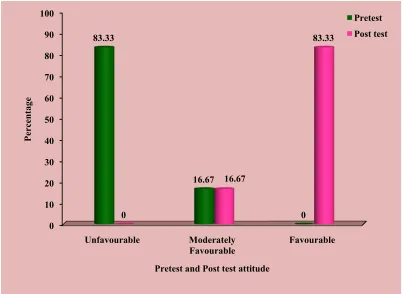
Fig:4.2 Percentage distribution of pretest and post test level of attitude regarding selected behavioural problems of primary school children among primary school teachers
0 10 20 30 40 50 60 70 80 90 100
Unfavourable Moderately
Favourable
Favourable 83.33
16.67
0 0
16.67
83.33
Percentage
Pretest and Post test attitude
Pretest
38
[image:50.612.122.528.222.326.2]SECTION-C: EFFECTIVENESS OF STRUCTURED TEACHING PROGRAMME ON KNOWLEDGE AND ATTITUDE REGARDING SELECTED BEHAVIOURAL PROBLEMS OF PRIMARY SCHOOL CHILDREN AMONG PRIMARY SCHOOL TEACHERS.
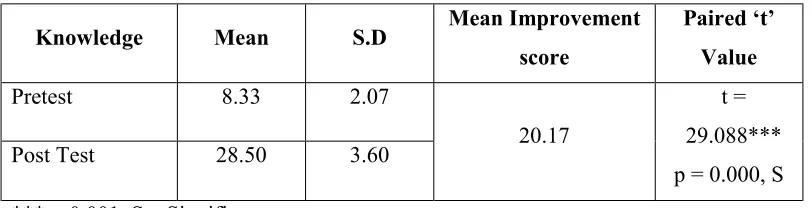
Table -4.4: Comparison of pretest and post test knowledge scores regarding selected behavioural problems of primary school children among primary school teachers.
N = 30
Knowledge Mean S.D Mean Improvement
score
3DLUHGµW
Value
Pretest 8.33 2.07
20.17
t = 29.088*** p = 0.000, S Post Test 28.50 3.60
***p<0.001, S ± Significant
39
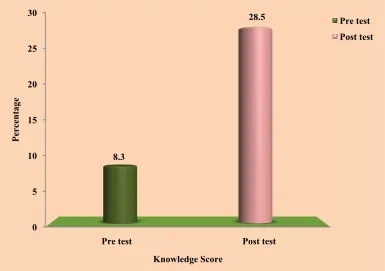
Fig:4.3 Comparison of pretest and posttest knowledge scores regarding selected behavioural problems of primary school children among primary school teachers.
0 5 10 15 20 25 30
Pre test Post test
8.3
28.5
Percentage
Knowledge Score
Pre test
40
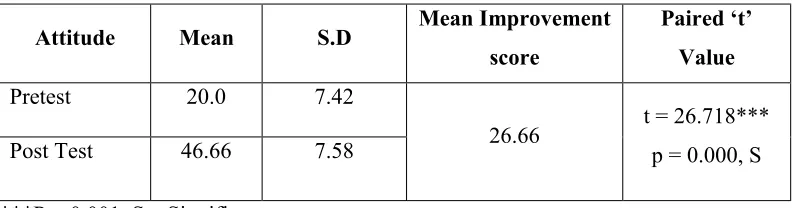
Table 4.5: Comparison of pretest and post test attitude scores regarding selected behavioural problems of primary school children among primary school teachers .
N = 30
Attitude Mean S.D Mean Improvement
score
3DLUHGµW
Value
Pretest 20.0 7.42
26.66 t = 26.718*** p = 0.000, S Post Test 46.66 7.58
***P < 0.001, S ± Significant
The table 4.5 shows that in the pretest, the mean score of attitude was 20.0 with S.D 7.42 whereas in the post test the mean score of attitude was 46.66 with S.D 7KHPHDQLPSURYHPHQWVFRUHZDV7KHFDOFXODWHGSDLUHGµW¶YDOXHRIW 26.718 was found to be statistically significant at P < 0.001 level. This clearly shows that the structured teaching programme on attitude regarding selected behavioural problems of primary school children among primary school teachers had significant improvement in their level of attitude in the post test.
41
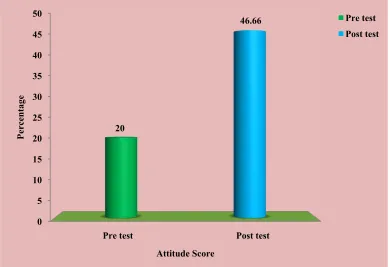
Fig:4.4 Comparison of pretest and post test attitude score regarding selected behavioural problems of primary school children among primary school teachers.
0 5 10 15 20 25 30 35 40 45 50
Pre test Post test
20
46.66
Percenta
ge
Attitude Score
Pre test
42
[image:54.612.128.520.220.286.2]SECTION D: RELATIONSHIP BETWEEN POST TEST KNOWLEDGE AND ATTITUDE SCORE REGARDING SELECTED BEHAVIOURAL PROBLEMS OF PRIMARY SCHOOL CHILDREN AMONG PRIMARY SCHOOL TEACHERS .
Table-4.6: Correlation between post test knowledge and attitude scores regarding selected behavioural problems of primary school children among primary school teachers.
N = 30
Variables Mean S.D µU¶9DOXH
Knowledge 28.50 3.60 r = 0.87
p = 0.000, S**
Attitude 46.66 7.58
**p<0.01, HS ± Highly Significant
43
[image:55.612.116.535.111.693.2]SECTION E: ASSOCIATION OF POST TEST LEVEL OF KNOWLEDGE AND ATTITUDE REGARDING SELECTED BEHAVIOURAL PROBLEMS OF PRIMARY SCHOOL CHILDREN AMONG PRIMARY SCHOOL TEACHERS WITH SELECTED DEMOGRAPHIC VARIABLES.
Table-4.7: Association of post test level of knowledge regarding selected behavioural problems of primary school children among primary school
teachers with their selected demographic variables. N = 30
S.
No Demographic Variables
Moderately Adequate (51 ± 75%)
Adequate
(>75%) Chi-Square
Value
No. % No. %
1. Age in years
F2 = 0.923 d.f = 1 p = 0.337
N.S
<30 years 4 13.3 21 70.0
31-40 years 0 0 5 16.7
41-50 years - - - -
>50years - - - -
2. Sex F2 = 0.231
d.f = 1 p = 0.631
N.S
Male 1 3.3 4 13.3
Female 3 10.0 22 73.3
3. Educational qualification
F2 = 0.687 d.f = 2 p = 0.709
N.S
Teacher training course - - - -
Degree with teacher training 3 10.0 14 46.7 Master degree with B.Ed. 1 3.30 11 36.7 Master degree with M.Ed 0 0 1 3.3
4. Years of teaching experience
F2 = 2.493 d.f = 1 p = 0.114
N.S <5 Years 3 10.0 25 83.3
6-10 Years 1 3.3 1 3.3
11-15 Years - - - -
16-20 Years - - - -
5. Religion
F2 = 0.513 d.f = 2 p = 0.774
N.S
Hindu 4 13.3 23 76.7
Muslim 0 0 2 6.7
Christian 0 0 1 3.3
Others - - - -
44
45
Table -4.8: Association of post test level of attitude regarding selected behavioural problems of primary school children among primary school
teachers with their selected demographic variables. N = 30
S.
No Demographic Variables
Moderately Favourable (51 ± 75%)
Favourable
(>75%) Chi-Square
Value
No. % No. %
1. Age in years
F2 = 1.200 d.f = 1 p = 0.273
N.S
<30 years 5 16.7 20 66.7
31-40 years 0 0 5 16.7
41-50 years - - - -
>50years - - - -
2. Sex F2 = 0.048
d.f = 1 p = 0.827
N.S
Male 1 3.3 4 13.3
Female 4 13.3 21 70.0
3. Educational qualification
F2 = 1.376 d.f = 2 p = 0.502
N.S
Teacher training course - - - -
Degree with teacher training 4 13.3 13 43.3 Master degree with B.Ed. 1 3.3 11 36.7 Master degree with M.Ed 0 0 1 3.3
4. Years of teaching experience
F2 = 1.714 d.f = 1 p = 0.190
N.S <5 Years 4 13.3 24 80.0
6-10 Years 1 3.3 1 3.3
11-15 Years - - - -
16-20 Years - - - -
5. Religion
F2 = 0.667 d.f = 2 p = 0.717
N.S
Hindu 5 16.7 22 73.3
Muslim 0 0 2 6.7
Christian 0 0 1 3.3
Others - - - -
46
47
CHAPTER V
RESULTS AND DISCUSSION
The purpose of the study was to assess the effectiveness of structured teaching programme on knowledge and attitude regarding selected behavioural problems of primary school children among primary school teachers in selected school at Namakkal District. The results of the study were based on the statistical analysis. The data was collected with the help of structured questionnaire to assess the knowledge, five point scale was used to assess the attitude of primary school teachers. The HIIHFWLYHQHVVRIVWUXFWXUHGWHDFKLQJSURJUDPPHZDVDVVHVVHGE\XVLQJSDLUHGµW¶WHVW Chi square was used to find out the association for knowledge and attitude with selected demographic variables. The results are provided according to the stated objectives.
The first objective was to assess the pre test knowledge regarding selected behavioural problems of primary school children among primary school teachers.
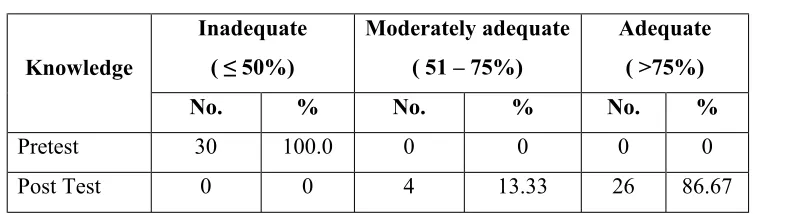
The level of knowledge regarding selected behavioural problems of primary school children among primary school teachers was assessed by using structured knowledge questionnaire. The sample size was 30.Table 4.2 shows the distribution scores on level of knowledge regarding selected behavioural problems of primary school children among primary school teachers. It denotes that in pre test, the level of knowledge on selected behavioural problems of primary school children among primary school teachers on analysis was 30 (100%) of primary school teachers had inadequate knowledge, whereas in the post test, majority 26(86.67%) of primary school teachers had adequate knowledge and 4 (13.33%) of primary school teachers had moderately adequate knowledge regarding selected behavioural problems of primary school children.
The second objective was to assess the pretest attitude regarding selected behavioural problems of primary school children among primary school teachers.
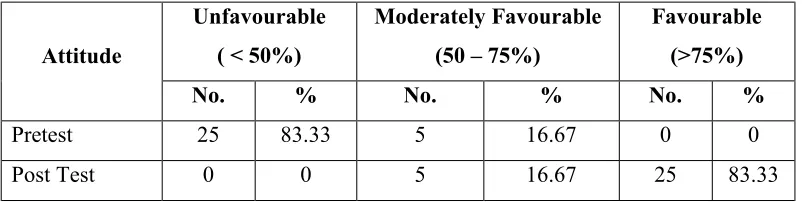
48
Likert scale. The sample size was 30.Table 4.3 illustrates the distribution scores on level of attitude regarding selected behavioural problems of primary school children among primary school teachers. It denotes that in the pretest, the level of attitude regarding selected behavioural problems of primary school children among pri