EFFECTIVENESS OF STRUCTURED TEACHING PROGRAMME REGARDING CHILDHOOD BEHAVIORAL PROBLEM ON KNOWLEDGE AND ATTITUDE
OF SELECTED PRIMARY SCHOOL TEACHERS, COIMBATORE.
Reg. No. 301420401
A DISSERTATION SUBMITTED TO THE TAMIL NADU
Dr. M. G. R. MEDICAL UNIVERSITY, CHENNAI, IN
PARTIAL FULFILLMENT OF REQUIREMENT
FOR THE DEGREE OF MASTER OF
SCIENCE IN NURSING
CERTIFICATE
This is to certify that the Dissertation entitled “A STUDY TO ASSESS THE
EFFECTIVENESS OF STRUCTURED TEACHING PROGRAMME REGARDING CHILDHOOD BEHAVIORAL PROBLEM ON KNOWLEDGE AND ATTITUDE OF SELECTED PRIMARY SCHOOL TEACHERS, COIMBATORE.
”
is submitted to the faculty of nursing, THE TAMILNADU Dr. M. G. R. MEDICAL UNIVERSITY, CHENNAI by REG. No 301420401 in partial fulfillment of requirement for the degree of Master of Science in Nursing. Itis the bonafide work done by her and the conclusions are her own. It is further
certified that this dissertation or any part thereof has not formed the basis for award of
any degree, diploma or similar titles.
Prof. DR. S. Madhavi, M.Sc. (N), Ph.D., Principal,
KMCH College of Nursing,
Coimbatore – 641014
EFFECTIVENESS OF STRUCTURED TEACHING PROGRAMME REGARDING CHILDHOOD BEHAVIORAL PROBLEM ON KNOWLEDGE AND ATTITUDE
OF SELECTED PRIMARY SCHOOL TEACHERS, COIMBATORE.
APPROVED BY DISSERTATION COMMITTEE ON SEPTEMBER 2015
1.
RESEARCH GUIDE:Prof. DR. S. Madhavi, M.Sc. (N), Ph.D.,
Principal,KMCH College of Nursing,
Coimbatore – 641014
2. CLINICAL GUIDE:
Mrs. Jamuna Rani M.Sc. (N),
Asst.Profesor,
KMCH College Of Nursing.
Coimbatore-641014.
3. MEDICAL GUIDE :
Dr. Paranthaman Sethupathi
Consultant psychiatristKovai Medical Centre and Hospital
Coimbatore- 641014
A DISSERTATION SUBMITTED TO THE TAMIL NADU
Dr. M. G. R. MEDICAL UNIVERSITY, CHENNAI, IN
PARTIAL FULFILLMENT OF REQUIREMENT
FOR THE DEGREE OF MASTER OF
ACKNOWLEDGEMENT
The chain of my gratitude begins with GOD Almighty for his refinement,
blessings and direction which strengthened me to do the work and sustained me
throughout this endeavour.
I am immensely thankful to Dr. Nalla.G. Palaniswamy, M.D.,AB (USA),
Chairman and Managing Director, Kovai Medical Centre and Hospital and to Dr. Thavamani D Palaniswamy M.D.,AB (USA), Managing trustee, Kovai Medical Centre and Educational Trust for granting me the opportunity to undertake
this study in their esteemed institution.
I owe my gratitude from bottom of my heart to Prof. DR. S. Madhavi, M.Sc
(N), Ph.D., Principal, KMCH College of Nursing, who was my research guide for her valuable suggestions, timely support and constant moral support, which
contributed to enrich the strength to complete this study successfully. Under her
guidance I successfully overcome many difficulties and learned a lot. I can’t forget
her hard times. I thank her for helping me to complete my analysis in the timeframe
available. I am grateful to her contributions & suggestions to complete this study and
make this a successful one.
I am exceedingly thankful to my medical guide, Dr .Paranthaman
Sethupathy Consultant psychiatrist, Kovai Medical Centre and Hospital for his advocacy, generosity, guidance and readiness to spend his time even in his engaged
schedule. It is a matter of fact that without his permission, constant observation and
proper attention, this work could not have been achieved successfully.
I convey my special thanks to Prof. Sivagami. R. M.Sc. (N), Vice Principal,
KMCH College of Nursing for her generous support, encouragement and timely advice to fulfil this work.
My grateful thanks to Asst. Prof. Mrs. Jamunarani, M.Sc. (N), Department
of Mental Health Nursing, for her enthusiasm and interest that provided me with strength and encouragement to complete the study. I express my sincere thanks for her
valuable guidance and timely suggestions throughout my study.
I am very grateful for the support, help and motivation of especially
Health Nursing for providing extensive guidance, criticisms, continuous support and encouragement throughout the study.
I am exceedingly thankful to Mr. Pradeep Kumar., Statistician, KMCH
College of Pharmacy, for his guidance in statistical analysis and interpretation of data during the study.
I shall always be grateful to all the Teachers who have given consent and
actively participated and for their co-operation in making my study possible.
I express my sincere thanks to our chief librarian Mr. Dhamodharan and all
assistant librarians for permitting and facilitating me to make use of the reservoir of knowledge.
Parents are the first teachers in each child’s life and they are the first and
foremost representatives of God on earth. I would like to thank my loving mother
Mrs. Reeta Stanley without whom I cannot climb the steps of my life. Words are not
enough to express my gratitude to my beloved father Mr. Jacob Stanley for his
constant love and support. Their love, support and encouragement always keep my
spirits high. Their integrity, morals and thoughtfulness will always make me strive to
be a better person.
I will fail in my gratitude if I don’t mention the support extended by my
husband Mr. Charles Christopher.
I extend my heart felt gratitude to my loving aunt Mrs. Usha Christopher
without whom I would have been into this profession. My sincere thanks to my
beloved maternal uncle Mr. Robert Joel who has been my strength and support till the day of my life.
My special thanks to my classmates Ms. Chachu, Mr. Chandiran,
Ms. Chinnu Ms. Saroon, Ms. Anusha, Ms. Jesslin, Ms. Sowmya who directly and indirectly encouraged and helped me throughout this study.
Last but not least, my sincere gratitude and thankfulness to all well-wishers,
friends and relatives for their help and best wishes which helped me to carry out my
TABLE OF CONTENTS
CHAPTER CONTENTS PAGE NO.
I INTRODUCTION 1
NEED FOR THE STUDY 4
STATEMENT OF THE PROBLEM 7
OBJECTIVES OF THE STUDY 7
OPERATIONAL DEFINITIONS 7
HYPOTHESIS 8
ASSUMPTIONS 8
CONCEPTUAL FRAMEWORK 8
II REVIEW OF LITERATURE 11
III METHODOLOGY 17
RESEARCH DESIGN 17
VARIABLES UNDER THE STUDY 17
SETTING OF THE STUDY 17
POPULATION OF THE STUDY 18
SAMPLE SIZE 18
SAMPLING TECHNIQUE 18
CRITERIA FOR SAMPLE SELECTION 18
DEVELOPMENT AND DESCRIPTION OF THE
TOOL
18
CONTENT VALIDITY AND RELIABILITY 20
PILOT STUDY 20
PROCEDURE FOR DATA COLLECTION 20
STATISTICAL ANALYSIS 21
IV DATA ANALYSIS AND INTERPRETATION 22
V DISCUSSION, SUMMARY, CONCLUSION, IMPLICATIONS, LIMITATIONS AND RECOMMENDATIONS
37
ABSTRACT 43
REFERENCES 44
LIST OF TABLES
TABLE NO
TITLE PAGE
NO
1. Distribution of respondents based on Demographic
characteristics.
23
2. Distribution of respondents based on Pre-test Knowledge
Scores regarding childhood behavioural problems.
27
3. Distribution of respondents based on Post-test Knowledge
Scores of teachers regarding childhood behavioural
problems.
27
4. Comparison of the respondents based on mean pre-test and
post -test knowledge scores of the subjects on childhood
behavioural problems
29
5. Distribution of respondents based on pre –test attitude
Scores of teachers regarding childhood behavioural
problems.
31
6. Distribution of respondents based on post –test attitude
Scores regarding childhood behavioural problems.
31
7. Comparison of the respondents based on mean pre-test and
post -test attitude scores regarding childhood behavioural
problems
33
8. Association of demographic variables of the respondents
based on post-test knowledge regarding childhood
behavioural problems
35
9. Association of demographic variables of the respondents
based on post -test attitude regarding childhood behavioural
problems.
LIST OF FIGURES
FIGURE NO
FIGURES PAGE NO
1. Conceptual framework based on Modified Ludwig von
Bertalanffy’s General System Theory(1968)
10
2. Distribution of respondents based on their Age
24
3. Distribution of respondents based on their sex. 24
4. Distribution of respondents based on Religion. 25
5. Distribution of respondents based on Educational status. 25
6 Distribution of respondents based on Experience. 26
7. Distribution of respondents based on Source of
information.
26
10. Distribution of respondents based on Pre-test Knowledge
Scores regarding childhood behavioural problem 28
11. Distribution of respondents based on Post-test Knowledge
Scores regarding childhood behavioural problem 28
12. Comparison of respondents based on the mean pre-test and
post-test knowledge scores teachers regarding childhood
behavioural problem
30
13. Distribution of respondents based on Pre-test attitude
Scores regarding childhood behavioural problem 32
14. Distribution of respondents based on Post-test attitude
Scores regarding childhood behavioural problem 32
15. Comparison of respondents based on the mean pre-test and
post-test attitude scores teachers regarding childhood
behavioural problem
LIST OF APPENDICES
APPENDIX TITLE
A Data Collection Tool
B Copy of Letter Seeking Assistance From A.E.E.O
C Copy of Letter Seeking Content Validity
D Certificate of Content Validity
E Copy of Letter Seeking Ethical Clearance
F Copy of Letter Issued By Ethical Committee
LIST OF EXPERTS
1.
Dr. Paranthaman Sethupathi
MBBS.,MRC Psychiatry(UK)., PGD(PSYCHIATRY),UK.
Consultant Psychiatrist
Kovai Medical Center and Hospital, Coimbatore.
Coimbatore-641014.
2.
Dr. P. Srinivasan
MBBS, M.D. DPMConsultant Psychiatrist
Kovai Medical Center and Hospital,
Coimbatore.-641014.
3.
Prof. DR. S. Madhavi, M.Sc. (N), Ph.D.
Principal,KMCH College of Nursing,
Coimbatore – 641014.
4.
Dr. Ramachandra
Additional Professor
Department Of Nursing
NIMHANS (INI)
Bangalore-560029.
5.
Dr. G. Radhakrishnan
Assisstant professor of nursing
NIMHANS (INI)
1
CHAPTER –I
INTRODUCTION
“Children are the wealth of tomorrow; take care of them if you wish
to have a strong India, ready to meet various challenges.”
(PANDIT JAWAHARLAL NEHRU
)
Children are mirror of a nation. They are our future and our most precious
resources. The quality of tomorrow’s world and perhaps even its survival will be
determined by the well-being, safety and the physical and intellectual development of
children today. It is estimated that 15% of children will be affected by the behavioral
problems by 2020. (World Health Report, 2001). A million children are encountering
behavioral problems, including depression, violence and self-harm. (British Medical
Association, 2006) The early years of life are important in of young children. Parents in 21st Century face many challenges and issues such as poverty, stress and health
problems which affect the health and development of children and have linked to
behavioral problems in childhood. The development of the child’s behavior can be
molded by parents and also by the teachers.
The term behavior refers to the way a person responds to a certain situation or
experience. Behavior is affected by temperament, which is made up of an individual’s
innate and unique expectations, emotions and beliefs. Most children learn to regulate
their reactions and feelings over time in the early years through emotional connections
with significant others and learnt self-understanding.
The etiological factors for behavioral problems of children are usually
biological risk factors, genetic risk factors, family relationship risks, experiential risks
and social environmental risk factors. A number of specific biological factors are
associated with behavioral and developmental problems, mainly they contribute to
behavioral and emotional difficulties. Prenatal exposure to alcohol, tobacco smoke &
drugs also has been found to have an impact on neurocognitive process and is associated
2
Children with behavioral disorders are often tolerated by family however when
these children begin schooling they are identified as problematic because these
behaviors interfere with the child’s academic performance, and the maladaptive
behaviors may provide negative feedback, which may generate low self-esteem. A
child’s coping mechanism is influenced by the individual developmental level,
temperament, previous stress experiences, role models, and support of parents, teachers
and peers. The dysfunctional behaviors lead to further physical or developmental
problems. The common areas of behavior problems are the interplay of self-concept
and self-esteem. So behavioral modifications at home and school are teaching families
techniques to support clear expectations, consistent routines, positive reinforcement for
appropriate behaviors timeout and teachers to meet individual needs for remediation or
alternate instruction methods if necessary, structure activities to respond to child’s
needs.
Today’s children are tomorrow’s responsible citizen of the world. There is great
deal of emphasis on children these days because of the recognition that a very
substantial proportion of the world’s population constitutes young children. The future
of the country depends on the mental health of our young people. Recent evidence
compiled by WHO indicates that by 2020 childhood disorder will rise proportionately
by over 50% internationally to become one of the five most common causes of
morbidity, mortality and disability among children. (WHO, 2001).
The Centers for Disease Control and Prevention estimates that 1 in 88 children in the United States has been identified as having an autism spectrum disorder,
Autism spectrum disorders are almost five times more common among boys than girls
– with 1 in 54 boys identified.
Child mental health problems are reflected by a variety of categories of
behavioral problems. Such problems are usually identified when they result in distress
to either the child or others (Zubrick, 1995). It is usual that information about child
mental health is sought from teachers and care-givers, and that these respondents’
3
There is growing consensus that behavior disorders are apparent in early childhood, and
that they often persist into adulthood. (Campbell & Ewing 1990)
Today’s children are tomorrow’s responsible citizen of the world. There is great
deal of emphasis on children these days because of the recognition that a very
substantial proportion of the world’s population constitutes young children. The future
of the country depends on the mental health of our young people. Recent evidence
compiled by WHO indicates that by 2020 childhood disorder will rise proportionately
by over 50% internationally to become one of the five most common causes of
morbidity, mortality and disability among children. (WHO, 2001).
Children grow into adolescence and adulthood through a process of
development that depends on both intrinsic (genetic) and environmental factors .healthy
development depends on a complex interaction between nurture and nurture, which
leads to the fulfillment of the child’s potential, and prepares them for a mature adult
role. Some of the common behavioral problems in children are temper tantrums,
impulsive behavior, breath hold spell, lying and defiance. Temper tantrums are a
natural part of growing up they are not usually cause for serious concern and will
typically diminish on their own accord .Tantrums are commonly seen pre- school and
school aged children. But as the children mature and their self -control and
understanding of the world increase their frustration levels also decrease, resulting in
fewer tantrums. (Parul Datta)
According to article by behavioral management systems statistical ratio world-
wide, 1 year old child has 14% of tantrums daily,2-3 years child has about 20% of
tantrums and 6 and above age group evidenced 5% of incidence of tantrums. (kids
Mental Health, 2011).
Impulsive behavior are common in young children. When a young child is kicks, or fights with another, it is likely that he or she is having trouble expressing
feelings in words. When these behaviors persist in them it results in serious problems.
(Impulsivity).
4
is angry, frustrated, in pain, or afraid. It is also called as infantile syncope accounts for
4-13% of psychosomatic disorders in pediatric group. (Text book of pediatrics. (Suraj
Gupte)
According to the article it has depicted that breath hold spell occurs in 5% of
otherwise healthy children. They appear at the age of 2 and disappear by age 4 in 50%
of children and by age 8 in about 83%of children. (Stephen Brian Sulkes, 2013)
Defiant disorder is defined by the DSM -5 as a pattern of angry/irritable mood or vindictiveness lasting at least six months. (Wikipedia).
Lying also called as pseudo logia fantastica is a behavior of habitual or compulsive lying. (Wikipedia).
Report prepared by National Institute of Mental Health And Neurological
Sciences (NIMHANS) on District Mental Health Programme highlights the need for
school mental health Programme along with teaching school teachers regarding
identifying and managing behavioral problem.
Behavior problems in the classroom can interfere with instruction, child
development and academic achievement. Yet, many teachers do not have the training
they need to deal with behavior problems. Now, University of Missouri researchers will
use a $2.9 million grant from the U.S. Department of Education's Institute of Education
Sciences (IES) to evaluate the effectiveness of a video training program designed to
help teachers understand and react effectively to behavior issues.
NEED FOR THE STUDY
In India children constitutes about 40% of the total population .Behavioral
disorders are one of the most common childhood disorders. The ideal school is an
institution having sustained daily contact with children. Teachers are the effective
person who plays a vital role in handling children. The numbers of children, who are
coming out of their residence for schooling, are countless, just like stars in the sky or
like drops of water in an ocean. For each of them, this particular school age is a
formative period, physically as well as mentally. There are many problems faced by the
5
Children between six and twelve years should have widened their social horizon
beyond the confines of their own home to schools. The kind of school a child attends is
important to the development of a sense of industry and future achievements. In the
primary school level students achieve behavioral, emotional, social and good academic
levels.
The National Health Policy of 1982 recommends the initiation of organized
school health programs integrated with general, preventive and curative services. A
recent recommendation is given by Central Institute of Psychiatry, Ranchi regarding
management of psychiatric problems in children, emphasizes importance of educating
the school teachers and parents regarding warning signs of mental ill health and right
methods of management
An approach study was conducted among 60 primary school teachers
conveniently selected from five primary schools of Vadodara. The results of the study
shows that in pre- test, primary school teachers were having on average 49.40%
knowledge regarding selected common behavioral problems of children, and in
post-test average 75.83% knowledge regarding selected common behavioral problems of
children. This study concluded that structure teaching program is effective tools to
improve the knowledge of primary school teachers regarding Selected Common
Behavioral Problems of Children. (Garg. 2014).
A Study was conducted in selected schools of Pune city comprised of 60
samples. A structured questionnaire knowledge regarding behavioral problem was
prepared. This study indicates that the planned teaching is effective in increasing the
knowledge of teachers regarding behavioral problem. The various findings of the study
show that the knowledge regarding behavioral problem in School children has been
improved through planned teaching. There is an association between the knowledge
level and variables such as age, designation and years of experience.
(Bhanwara, 2011).
A study on behavioral problems of school children in a pediatric outpatient
department was conducted with 50 children of age 6-14yrs from pediatric outpatient
department were selected after randomization, and subjected to CBCL (Child Behavior
6
found in children; argues a lot [56%], cannot concentrate [54%], cannot sit still, restless,
hyperactive [50%]. Female children had behavioral problems like too concerned with
neatness or cleanliness, feels has to be perfect, and argues a lot. Study concluded;
behavioral problems of school children need more attention. (Prakash, 2006).
A cross sectional exploratory study was done to see the prevalence of
behavioral problems of children and the study conclude that majority of children shows
the evidence of behavioral problems (Sushma, et,al. 2001).
The behavioral problems is the leading mental disorder in today’s world. Many
parents either teachers are unaware about the disorders and show less attention to the
psychological issues compared to the physical illness. The prevalence of each disorder
takes its marked ratio. Each disorder has set ratios in its epidemiological statistics.
It has been estimated that prevalence of temper tantrums in the world wide
among 800 children attending outpatient departments 182 were found to have temper
tantrum (Clinical Paediatrics, 1990)
A national study taken to view the prevalence ratio about impulsivity reported
that among 17% of children were found to have impulsive behavior. (Journal of
psychiatric research, 2007).
The worldwide life time prevalence of defiant disorder estimated to be 10.2%
among (boys-11.2% and girls-9.2%) (Journal of child psychiatry, 2007).
The study done to view the prevalence of breath hold spell has estimated 4.6%
to 4.7% with male to female ratio 3:1. (Case reports in neurological medicine)
Behavioral disorders are vital in the area of school because teachers are the
responsible persons in molding the child when it is in school.
Behavior problems in the classroom can interfere with instruction, child
development and academic achievement. Yet, many teachers do not have the training
they need to deal with behavior problems.
The investigator felt that to know about the awareness of teachers regarding
behavioral problems like temper tantrums, impulsive behavior, lying, breath hold spell,
7
motivated the investigator to provide adequate education to them through a planned
teaching Programme on above mentioned behavioral problems. The investigator also
remembered few friends having this problem and were receiving severe punishment
from the class teachers, during his school period. In later phase of nursing education,
when the investigator came to know about these behavioral problems, decided to teach
the school teachers for handling these problems
STATEMENT OF THE PROBLEM
A Study to assess the effectiveness of structured teaching Programme regarding
childhood behavioral problem on knowledge and attitude of selected primary school
teachers, Coimbatore.
OBJECTIVES OF THE STUDY
1. To assess the knowledge and attitude of primary school teachers regarding
common childhood behavioral problems.
2. To evaluate an effectiveness of Structure teaching Programme regarding
selected childhood behavioral problems on knowledge and attitude of primary
school teachers.
3. To associate the knowledge and attitude of primary school teachers with their
selected demographic variables.
OPERATIONAL DEFINITIONS
1) Knowledge: It refers to the responses of the primary school teachers to the items listed in self-structured questionnaire regarding the knowledge on behavioral
problems among school children.
2) Attitude: It refers to the opinion of teachers about childhood behavioral problems measured by structured questionnaire.
8
HYPOTHESIS:
H1: There will be significant difference between pre -test and post-
test knowledge scores of primary school teachers regarding childhood
behavioral problems.
ASSUMPTION:
Teachers have lot of opportunities to observe and identify early childhood
behavioral problems.
CONCEPTUAL
FRAMEWORK
Conceptual framework refers to interrelated concepts or abstract those are
together in same rational scheme by virtue of their relevance to a common theme (Polit
& Hungler, 1999).
The conceptual framework for this study was developed by applying Ludwig
Von Bertalanffy’s (1968) general system theory. According to the general system theory
a system consists of a set of interaction components. There are two types of general
system that is closed and open.
A closed system does not exchange every matter or information with its
environment .It receives no input from the environment and gives no output to the
environment .In an open, energy, matter or information move into and out of the system.
All living system such as plants, animals, people, families, and communities are
open system. open system consist of the input, throughput and output process
According to theorist view the information, matter, and energy that the system receives
,transforms the input in a process called as throughput and releases information ,matter
and energy as output in the environment output that returns to the system as input is
called feedback ,which may be positive negative or neutral.
In this present study the investigator considered the teachers as open system
9
INPUT
In this study the investigator consider that the input is the assessment of teachers
demographic variables such as age, gender, educational qualification, teaching
experience, undergone any training. Also assess the knowledge, attitude regarding
childhood behavioral problems and the structured teaching Programme.
THROUGHPUT
Regards with throughput it is the processing of information and application of
the information by the school teachers.
OUTPUT
Considering the output the investigator assess the knowledge, attitude after a
two weeks of educational intervention .By creating such awareness through education
10 IN PU T T H R O UG H P UT 1. DE MOGR AP H IC VA R IA B L E S (A ge , S ex ,R elig io n , E duc at io na l s ta tus , Y ea r of ex p er ie n ce, P re v io us K n o w le dge ). 2. S T R U CT U R E D TEA C H IN G PR OG R AMME . OU TP U T A ssessm ent
of kno
w le d g e and at ti tude of te a che rs re g a rd in g beha v ior al pr obl e ms In cr eased kno w le d g e and at ti tude of te a che rs re g a rd in g beha v ior al pr obl e m s
P
R
E
T
E
S
T
P
O
S
T
E
S
T
11
CHAPTER- II
REVIEW OF LITERATURE
A review of literature on the research topic helps the researcher to know about
existing studies and provides information which helps in focusing on particular
prob-lems and enhances the knowledge.
The researcher undertakes a literature review to familiarize themselves with the
knowledge base which is an important step in research with a background for
understanding current knowledge on topic and illuminates the significance of the new
study
The related literature is reviewed for the present study in order to determine the
Knowledge and attitude regarding childhood behavioral problems among
pri-mary school teachers at Madukkarai union Coimbatore.
Review of literature of present study was presented in the following headings
x Literature related to common behavioral problems.
x Literature related to knowledge of teachers on childhood behavioral problems.
x Literature related to structured teaching Programme on knowledge and attitude
of childhood behavioral problems.
Literature related to behavioral problems
A descriptive study was conducted in Ludhiana on 957 school children using
Rutter B scale which was to be completed by the class teachers in Ludhiana. 141
children (14.6%) scored more than 9 points and were included in the second part of the
study. Based on the instrument results and parental interview 45.6% of the children
were estimated to have behavioral problems, of which 36.5% had significant problem.
Close cooperation between school teachers, parents, and health care providers is
12
A descriptive study on behavioral problems in a pediatric outpatient department
.A sample of 50 children between the age group of 6-14 years was selected randomly for the study .The data was collected by administering child behavior checklist .The
study concluded that behavior problems in children were externalizing ones and the
mean score was 40.7 than the internalizing problem score 10.3. (Prakash et al, 2006)
A cross sectional study was conducted in Karachi, to determine emotional and
behavioral problem among school going children aged 5 to 11 years. The investigator
took 1488 samples (700 parents of private school and 788 parents of community school
children). Strength and Difficulties Questionnaire was filled out by parents and school
teachers for the same children. Demographic data of parents, teachers and children were
also collected using a separate Performa. Result was a total of 675 parents agreed to
participate in the study. The response rate was 45.3%. Assessment of children's mental
health was conducted using Strength and Difficulties Questionnaire (SDQ). Parents
rated 34.4% of children as falling under the "abnormal category on SDQ, slightly higher
estimates 35.8% were reported by the teacher. The findings of the study was the
prevalence of child mental health problems was higher than reported in studies from
other countries. There was also a gender difference in prevalence; boys had higher
estimates of behavior/externalizing problems, whereas emotional problems were more
common amongst females and there is a need for developing programs to train, sensitize
and mobilize teachers and parents regarding child's psychological, emotional and
behavioral problems.(Syed, et al, 2009)
A descriptive study was done to identify the types of emotional and behavioral
difficulties that Greek primary teachers saw as problematic in their teaching; and also
to identify their perceptions of the prevalence of these difficulties. A Behavior Inventory
was administered to 170 elementary teachers from 23 randomly selected schools in
Athens. Analysis showed that teachers found work avoidance, depressive mood,
negativism’, ‘physical aggression’ and ‘lack of concentration as most problematic. By
contrast, they found ‘excessive shyness’ and ‘attention seeking’ as least problematic.
However, only one of the most problematic behaviors, ‘lack of concentration’, was
among the highly frequent behaviors. The other highly frequent behaviors were ‘talking
13
‘over-dependence on teacher’ and ‘school phobia’. The findings are discussed in terms
of historical and international patterns and trends in teachers’ perceptions of emotional
and behavioral difficulties. (Poulou & Norwich 2010)
A descriptive study done on Chinese primary school children to determine levels
of behavior problem and to explore key determinants relevant to the Chinese context
being an only child, urban living, school stressors, being bullied and physical
punishment. The investigator examined 2,203 child-parent pairs and administered a
child self-completion questionnaire to children aged 7-13 and Rutter Parent Scales to
their parents in nine primary schools. Result showed that 13.2% of the children (16.4%
of boys, 9.4% of girls) had a behavior problem. Girls manifest more emotional
problems (5.3 vs. 2.3%) and boys more conduct problems. (Hesketh, et al., 2011)
A descriptive study on Prevalence of behavioral and emotional
prob-lems among seven to eleven year old children was carried out in selected schools in
Kandy District, Sri Lanka on 562 children by using random sampling technique. The
findings of the study showed that Indicated a prevalence of 13.8% of emotional and
be-havioral problems in the study population.8.8% of children showed internalizing
prob-lems and 8.8% externalizing probprob-lems (Ginige, et al., 2014)
An exploratory study was carried out in Dharwad cityon prevalence of behavior
problem among the students of Government Primary School in urban area. There were
232 Government Primary Schools, among them 166 schools were in rural area. Out of
which 5 schools from urban area were selected randomly, 2 male and 2 female students
from 1st to 4th standard from each school were selected randomly, the sample consisted
of 38 female and 40 male students aged 5-10 years. So, the sample of this study was 78
students.The standardized questionnaire Emotional problem scale (EPS) developed by
Prout and Strohmea (1985) was used for the study. The study revealed that the
prevalence of anxious/depressed was 64% and hostile/aggressive was43%, and
14
Literature related to knowledge of teachers on childhood behavioral problems. A descriptive study done to assess the knowledge and perceived control of
teachers on behavioral problems of children, among 314 preschool teachers using child
behavioral questionnaires in Upssala University. The study concluded that teachers’
knowledge and perceived control are less and it is evident that teachers’ low perceived
control is associated with their difficulties in handling externalizing behaviors. (Annie
Hammarberg, 2003).
A cross-sectional study was conducted to assess the knowledge of teachers on
behavioral problems of children using cluster sampling method 20 primary and
secondary level schools located in south eastern health region of Jamaica was selected.
A self- structured questionnaire was administered to the teachers. The study concluded
that teachers has less knowledge regarding behavioral and emotional problems.
(Shetty, et al, 2005)
A descriptive study on elementary teachers knowledge and perception
regarding school behavioral problem .The study involved 200 elementary school
teachers The study concluded that misbehavior related attributions were significantly
associated with the teachers preferred practices ,and the knowledge and perception level
is low and education practice should be included. (Nakou, 2008).
A descriptive study was conducted in Singapore to assess preschool teacher’s
knowledge, attitudes and practice on childhood developmental and behavioral
disorders. This study sample was 503 pre-school teachers and they were selected
randomly. The study results showed that teachers had less knowledge regarding
behavioral disorders mainly attention deficit (45%) with median block-scores of (56%)
respectively. (Lian, et al, 2008).
A Quasi Experimental Study was conducted to assess the knowledge of teachers
on behavioral problem. The study was conducted in selected schools of Pune city. In
the study the sample comprised of 60 people. A structured questionnaire knowledge
regarding behavioral problem was prepared to study the sample. Descriptive and
infer-ential statistics had been used to analyze the data obtained through interviews. This
study indicates that the planned teaching is effective in increasing the knowledge of
15
The study was conducted to assess the knowledge of Primary school teachers
regarding Selected Common Behavioral Problems of Children, one test pre-test
post-test design was adopted to evaluate the effectiveness of Structure Teaching Programme
on Selected Common Behavioral Problems of Children and find out association
between pre-test knowledge score and selected demographic variable. The results of
the study shows that in pre-test, primary school teachers were having on average
49.40% knowledge regarding selected common behavioral problems of children and
mean score was 14.82±3.372 and in post-test, average 75.83% knowledge regarding
selected common behavioral problems of children and mean score was 22.75±2.802. T
calculated value is 33.233 which is more than the tabulated value of 2.00 at 0.05 level
of significance. (Garg, et al, 2014).
Literature related to structured teaching Programme on knowledge and attitude of childhood behavioral problems.
A clinical study was conducted to assess the effectiveness of planned teaching
Programme for the care takers of children admitted with minor mental health disorders
in the Child Psychiatry wards of Central Institute of Psychiatry, Ranchi. Total of 80
samples were selected by convenient sampling technique. The outcome of the study
proved marked increase in the knowledge level of the caretakers after the intervention.
(Child Psychiatry wards of Central Institute of Psychiatry, 2004).
A descriptive study was conducted a workshop on teachers focused approach to
prevent and reduce students aggressive behavior .The study concluded that teachers had
to increase teachers awareness and to develop strategies and thus the workshop was
effective to improve the managerial skills to reduce the aggression.
(Orpinas & Home, 2009)
A study was conducted was conducted in Chennai to evaluate the effectiveness
of structured teaching Programme on knowledge and attitude regarding identification
and management of behavioral problem of preschool children .One group pre-test and
post-test research with evaluative approach was adopted. The sample was selected by
using convenient sampling technique .The sample comprises of 120 preschool children
16
mother with the age group of 30-40 years, regarding the educational status 62(52%) of
the mother were illiterates, regarding type of family 68(57%) mothers were belong to
Nuclear family, regarding occupation 94(79%) of the mothers were housewife. The
findings of the study in the pre-test was 104(86.6%) Mothers had inadequate
knowledge,16 (13.4%) mothers had moderately adequate and no mother had adequate
knowledge. In post- test, no mothers are found to have inadequate knowledge,
20(16.6%) mothers had moderately adequate knowledge and 100(83.4%) mothers had
adequate knowledge .It was found that the overall knowledge had markedly increased
after structured teaching Programme. The study shows that the structured teaching
Programme was effective in increasing the knowledge of mothers of preschool children
17
CHAPTER –III
METHODOLOGY
Methodology gives the blue print of the study. This chapter explains the
meth-odology adopted by the researcher to determine the methmeth-odology adopted by the
re-searcher to determine the effectiveness of structured teaching program on childhood
behavioral problems among the primary school teachers Madukkarai in Coimbatore.
This chapter deals with the research design, setting of the study, population, sample
size, sampling technique, criteria for sample selection, variables, description of the
in-tervention, development and description of the tool, testing of the tool, procedure for
data collection and statistical analysis.
RESEARCH DESIGN
The research design applied for this study will be one group pretest posttest design.
E = O1 ×O2
O1 = pretest.
× = intervention
O2 = posttest.
VARIABLES
Independent variable:
Structured teaching program regarding childhood behavioral problems.
Dependent variable:
Knowledge level of the teachers and attitude of teachers towards childhood
behavioral problems of school children.
SETTING OF THE STUDY
The study was conducted at the government elementary schools Madukkarai union
18 POPULATION
The population used in the study are the primary school teachers.
SAMPLE SIZE
The sample size for the study was 30 primary school teachers.
SAMPLING TECHNIQUE
Non-probability purposive sampling will be adapted to select the samples of the study.
SAMPLING CRITERIA FOR SAMPLE SELECTION INCLUSION CRITERIA:
1) Primary school teachers working in selected schools with both male and
fe-male.
2) The headmistress/headmaster of the school.
EXCLUSION CRITERIA:
1)
Primary school teachers who are sick and absent during the period ofcol-lecting data.
DESCRIPTION OF THE INTERVENTION:
The intervention of the present study is regarding the childhood behavioral
problems, the teaching was given through power point presentation. The teaching
con-sist of introduction, nature of behavioral disorders, common behavioral disorders and
their management. The investigator gathered the teachers in a class room and displayed
the teaching by LCD presentation. The structured teaching Programme was prepared
by the investigator after referring various journals, books and in consultation with
var-ious experts. The structured teaching Programme was displayed in the ethical
committee, recommendations were considered
DEVELOPMENT AND DESCRIPTION OF TOOL:
The data was done through Self- structured -administered questionnaire,
19 Section I: Socio demographic variables
The socio- demographic characteristics of the teachers includes age, gender,
educational qualification, teaching experience previous knowledge regarding childhood
behavioral problems.
Section II: Self -Structured knowledge questionnaire to assess the knowledge of the teachers on childhood behavioral problems.
It consists of questionnaire regarding knowledge on common behavioral
prob-lems prepared by the investigator after reviewing literatures and various books. A sum
of 30 questions were prepared to assess the knowledge level of teachers. Each question
was given with 3 options, with one right answer. The subjects has to record their
an-swers by putting tick mark on the choice of answer. Using the scoring key prepared by
the investigator, the correct answers were given as 1 score and wrong answers were
scored as 0. The total score earned by the subject reflect their knowledge about the
childhood behavioral problems. The minimum score was 0 and the maximum score was
30. The total score was classified into
0-10: Poor knowledge.
11-20: Average knowledge.
21-30: Good knowledge.
Section III: Structured self-attitude questionnaire to assess attitude of teachers on Childhood behavioral problems.
It consists of questions regarding attitude on common behavioral problems
pre-pared by investigator after reviewing literatures and various books. A sum of 25
ques-tions were prepared to assess the attitude of teachers on common childhood behavioral
problems. Each question was given with 4 options .The subjects had to record their
answer by putting tick mark on the column The total score earned by the subject reflect
their attitude on common childhood behavioral problems.
25-50: Negative attitude.
51-75: Neutral attitude.
20 CONTENT VALIDITY
Content validity of the tool was ascertained by submitting the tool to two experts
in the field of Psychiatric nursing at NIMHANS, Bangalore. All the valuable comments
and suggestions from the experts are considered and corrections were made.
RELIABILITY
The reliability of the tool was tested with split half method. The reliability for
Knowledge of teachers regarding common childhood behavioral problems was 0.93
and attitude score was 0.80.
PILOT STUDY
Pilot study was conducted among 5 teachers at government school Madukarai
Union, Coimbatore for a period of one week .The investigator explained about her study
and obtained permission from the school authority. The self-structured pre- test
ques-tionnaire for knowledge and attitude as given to the samples on the first day, structured
teaching programme as given on the third day of the week followed by post- test was
done after two days of the intervention. The result of the study reveals that the study
was feasible. The sample used for the pilot study was excluded in the main study.
PROCEDURE FOR DATA COLLECTION
The study was conducted in government schools Madukkarai union Coimbatore .The
formal permission was obtained from Assistant Elementary Educational Officer. The
study was conducted for a time period of four weeks. The investigator informed the
teachers about the study and maintained good rapport. The investigator introduced self.
The purpose and the benefits of the study was explained to the teachers to ensure their
cooperation. Assurance was given to the subjects regarding the confidentiality of the
data collected from them. The first week of the data collection the self- structured
ques-tionnaire was administered to assess the pre- test knowledge and attitude in four schools
for 30 samples. The second week structured teaching Programme was given with the
help of power point presentation regarding childhood behavioral problems. After two
weeks of intervention post test was conducted with the self -structured questionnaire to
21 STATISTICAL ANALYSIS
Collected data were analyzed by descriptive and inferential statistics. The
descriptive statistics included mean, and percentage. Inferential statistics included
paired t - test used to analyze the effectiveness of structured teaching programme.
Chi-Square test was used to associate the knowledge and attitude level with
22
CHAPTER IV
DATA ANALYSIS AND INTERPRETATION
This chapter deals with the analysis and interpretation of data collected to determine
the effectiveness of structured teaching Programme regarding childhood behavioral
problem among primary school teachers.
ORGANIZATION OF FINDINGS
The collected data regarding knowledge of primary school teachers on childhood
be-havioral problems are as follows:
SECTION A: Distribution of respondents according to demographic variables. SECTION B: Distribution of respondents according to their pre-test and
post-test level of knowledge and attitude.
SECTION C: Comparison of mean pre and post-test knowledge and attitude scores of respondents regarding childhood behavioral problems.
SECTION D: Association of demographic variables with post-test knowledge
regarding the childhood behavioral problems.
SECTION E: Association of demographic variables with post-test attitude
23 SECTION –A
DESCRIPTION OF DEMOGRAPHIC VARIABLES OF TEACHERS
(N=30)
24
Fig 2: Distribution of respondents based on to their age
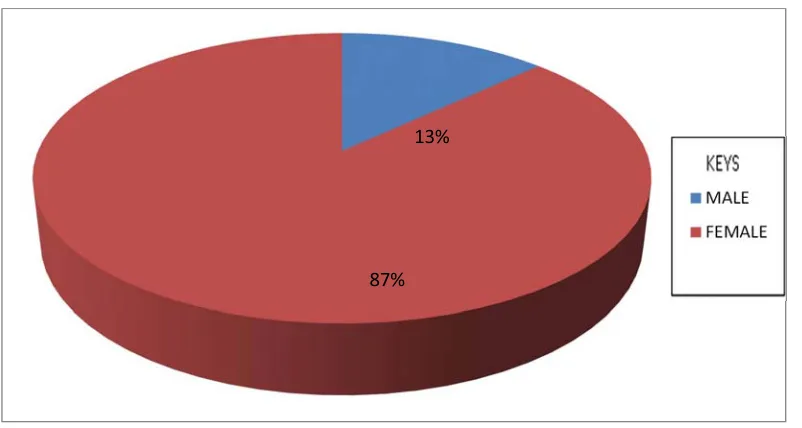
Fig 3: Distribution of respondents based on their sex
21-35 36-45 46-50 51-55
10%
70% 10%
10%
MALE FEMALE
13%
[image:34.612.127.528.387.601.2]25
Fig 4: Distribution of respondents based on their religion
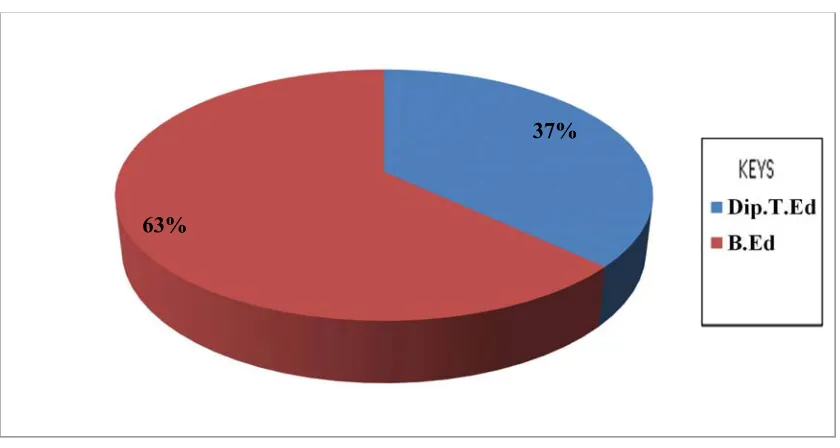
Fig 5: Distribution of respondents based on their educational status
HINDU
CHRISTIAN
MUSLIM 70%
27%
3%
37%
63% Dip.T.Ed
[image:35.612.128.548.404.628.2]26
Fig 6: Distribution of respondents based on their experience.
Fig 7: Distribution of respondents based on their training.
< 5 YEARS 5-10 YEARS 10-15 YEARS >15 YEARS
40% 3%
37%
20%
YES
NO 7%
27 SECTION –B
DESCRIPTION OF KNOWLEDGE AND ATTITUDE OF TEACHERS REGARDING CHILDHOOD BEHAVIOURAL PROBLEMS
Table -2: Distribution of respondents based on pre-test knowledge scores regarding childhood behavioral problems (N-30)
S.NO KNOWLEDGE Pre-test
Frequency(f) Percentage (%)
1. Average (11-20) 28 93%
2. Good (21-30) 2 7% The table 2 depicts the assessment of the respondents based on pretest knowledge scores
regarding childhood behavioral problems. In that among 30 samples, none of them
scored upto 10, 28 (93%) of them scored between 11 – 20 and 2 (7%) of them scored
between 21-30.
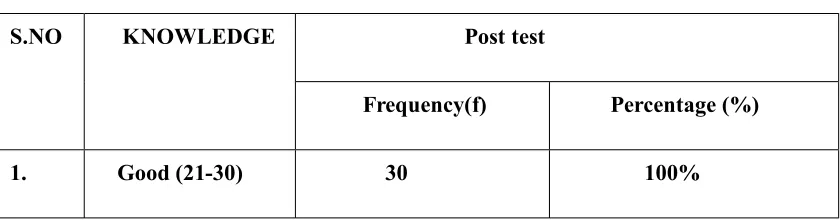
Table -3: Distribution of respondents based on post-test knowledge scores regarding childhood behavioral Problems. (N=30)
S.NO KNOWLEDGE Post test
Frequency(f) Percentage (%)
1. Good (21-30) 30 100%
The table 3 projects the assessment of the respondents based on post-test knowledge
scores regarding childhood behavioral problems. In that among 30 samples, none of
[image:37.612.132.542.196.329.2] [image:37.612.125.545.459.569.2]28
Fig.7: Distribution of respondents based on Pretest Knowledge Scores regarding childhood behavioral problems
Fig.8: Distribution of respondents based on Post-test Knowledge Scores regarding childhood behavioral problems.
PRE TEST KNOWLEDGE SCORES
7% 93
11-20 21-30
21-30 100%
29
Table.4: Comparison of respondents based on mean pre-test and post-test knowledge
scores on childhood behavioral problem.
(N=30)
S.NO Knowledge test Mean SD ‘t’ Value
1. Pre-test 17.97 3.21
15.052*
2. Post-test 27.02 .66
*P< 0.05 level
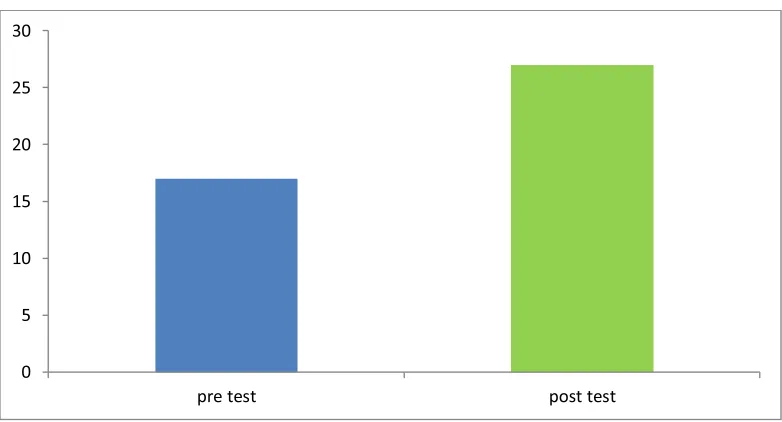
The table 4 displays the paired ‘t’ value 15.052 for the mean difference between the
pre-test and post-test knowledge scores of the respondents on the childhood behavioral
problems is significant at 0.05 level of significance at (df 29) .This means there is a
significant improvement in the knowledge of teachers regarding childhood behavioral
problems.
It shows that the mean pre-test value increased from 17.97 to post-test value 27.02
30
Figure 9: Comparison of the respondents based on mean pretest and post- test knowledge scores regarding childhood behavioral problems.
pre test post test
31
Table-5: Distribution of respondents based on pre-test attitude scores regarding childhood behavioral problems.
(N-30)
S.NO ATTITUDE Pre- test
Frequency (f) Percentage (%)
1. Neutral (51-75) 26 87%
2. Positive (76-100)
4 13%
The table 5 depicts the assessment of the respondents based on Pre-test attitude scores
regarding childhood behavioral problems. In that among 30 samples, none of them
scored 25-50, 26 (87%) of them scored between 51-75 and 4 (13%) of them scored
between 76-100.
Table-6: Distribution of respondents based on post-test attitude scores regarding childhood behavioral problems
(N-30)
S.NO ATTITUDE Post- test
Frequency(f) Percentage (%)
1. Positive (76-100)
30 100%
The table 6 displays the assessment of the respondents based on Post-test attitude scores
regarding childhood behavioral problems. In that among 30 samples, none of them
32
Fig.10: Distribution of respondents based on Pretest attitude scores of regarding childhood behavioral problems
Fig.11: Distribution of respondents based on Post-test attitude scores regarding childhood behavioral problems
51-75
76-100
PRE TEST ATTITUDE SCORES
87%
13%
76-100 100%
POSTTEST ATTITUDE SCORE
33
Table.7: Comparison of respondents based on mean pre-test and post-test attitude
scores on childhood behavioral problem.
S.NO Attitude Test Mean SD ‘t’ Value
1. Pre-test 70.13 7.78
11.336*
2. Post-test 86.8 1.06
*P< 0.05 level
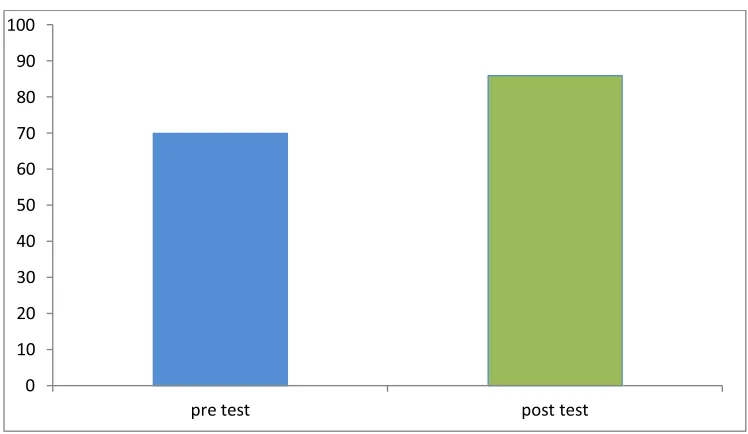
The table 7 projects the paired ‘t’ value 11.336 for the mean difference between the
pre-test and post-pre-test attitude scores of the respondents on the childhood behavioral
problems is significant at 0.05 level of significance at (df 29) .This means there is a
significant improvement in the attitude of teachers regarding childhood behavioral
problems.
It shows that the mean pre-test value increased from 70.13 to post-test value 86.8 which
34
Figure 12: Comparison of the respondents based on mean pre- test and post- test attitude
scores regarding childhood behavioral problems.
pre test post test
35 SECTION-D
ASSOCIATION OF DEMOGRAPHIC VARIABLES OF TEACHERS WITHTHEIR POST TEST KNOWLEDGE REGARDING CHILDHOOD BE-HAVIOURAL PROLEMS
.
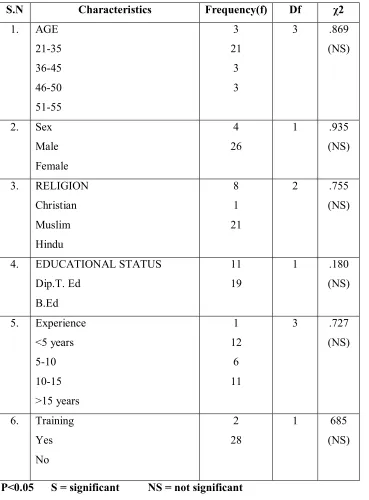
[image:45.612.127.496.176.676.2]P<0.05 S = significant NS = not significant
Table 8: clearly shows that the post-test knowledge of the respondents do not have an
association with the demographic variables
S.N Characteristics Frequency(f) Df Ȥ2
1. AGE 21-35 36-45 46-50 51-55 3 21 3 3 3 .869 (NS) 2. Sex Male Female 4 26 1 .935 (NS) 3. RELIGION Christian Muslim Hindu 8 1 21 2 .755 (NS)
4. EDUCATIONAL STATUS
Dip.T. Ed
B.Ed
11
19
1 .180
36 SECTION E
ASSOCIATION OF DEMOGRAPHIC VARIABLES OF TEACHERS WITH
THEIR POSTTEST ATTITUDE REGARDING CHILDHOOD BEHAVIOURAL PROBLEMS
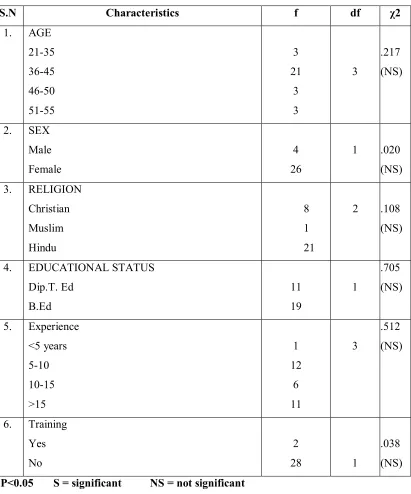
S.N Characteristics f df Ȥ2
1. AGE 21-35 36-45 46-50 51-55 3 21 3 3 3 .217 (NS) 2. SEX Male Female 4 26
1 .020
(NS)
3. RELIGION
Christian Muslim Hindu 8 1 21
2 .108
(NS)
4. EDUCATIONAL STATUS
Dip.T. Ed B.Ed 11 19 1 .705 (NS) 5. Experience <5 years 5-10 10-15 >15 1 12 6 11 3 .512 (NS) 6. Training Yes No 2
28 1
.038
(NS)
[image:46.612.122.533.159.653.2]P<0.05 S = significant NS = not significant
Table 9: Clearly shows that the post-test attitude of the respondents do not have an
37
CHAPTER V
DISCUSSION, SUMMARY, CONCLUSION, IMPLICATIONS, LIMITATIONS AND RECOMMENDATION
This chapter deals with the discussion, summary and conclusion. It also clarifies
the limitations of the study, implication and recommendations given for the different
areas of nursing practice, nursing education nursing administration and nursing
research.
DISCUSSION
The present study was designed to assess the knowledge and attitude regarding
common childhood behavioral problems. The research design adopted for the study was
One Group Pre-test Post-test design. Non probability purposive sampling technique
was used to select 30 teachers for the study. The data collected for the study were
ana-lyzed statistically and discussed based on the objectives.
Demographic variables of teachers participated in the study
According to age group most (70%) of the teacher were in the age group of
36-45 years, 10% of them in 21-35 years, 10% in 46-55 years and 0ther 10 % was having
age group of 51-55 years. Regarding the sex ratio male was about 13% and female was
about 87%.Based on religion most (70%) of them were Hindu, (27%) of them were
Christian and only 3% were Muslim. Regarding education level, majority (63%) of
them has completed Dip.T.Ed and 37% were B.Ed. Based on the experience < 5 years
was 3%, 5-10% was about 40% ,10-15 years was about 20% and >15 years is about
37%.Regarding the training 93% of teachers was not trained and 3% were trained .
The first objective of the study was to assess the knowledge and attitude of primary school teachers regarding childhood behavioral problems.
The present study findings revealed that the mean pre-test knowledge score is
17.97and the mean post-test score obtained was 27.02. The mean pre-test score of
38
The findings was consistent in the study done in Vadodara to assess the
knowledge of primary school teachers regarding childhood behavioral problems. The
findings of the study pre-test scores was 49.40% and the posttest knowledge score was
75.83%. (Garg, et al., 2014)
The second objective is to evaluate an effectiveness of structured teaching programme regarding childhood behavioural problems on knowledge and attitude of primary school teachers.
The present study findings revealed that the mean pre-test score of the
respond-ents is 17.97 and the mean post-test score obtained was 27.02 for knowledge and mean
pre- test score of the respondents is 70.13 and post -test was 86.8. The’t’ value is 15.052
for the mean difference in pre-test and post-test knowledge and 11.336for pre-test and
post-test attitude of teachers. It is significant at 0.05 level of significance. The findings
substantiate that the structured teaching program is effective.
A substantiate study was conducted in Chennai to evaluate the effectiveness of
Struc-tured teaching programme .The study concluded that the pre-test scores showed that
86.6% of mothers has inadequate knowledge ,13.4% has moderately adequate
knowledge. In the post- test mothers evidenced 83.4% has adequate knowledge, which
proved the structured teaching programme was effective. (Vasanthakohila &
Hema-vathy, 2014)
The third objective of the study was to associate the post-test knowledge and attitude regarding childhood behavioural problems.
The post-test knowledge and attitude with selected demographic variables as
age, experience, educational status, previous training. The results revealed that P value
of demographic variables was more than 0.05 level when associated with post-test
knowledge and attitude. Hence it is concluded that there is no significant association
between post-test knowledge and attitude with the demographic variables like age, sex,
39
SUMMARY
The purpose of the study was to assess the knowledge and attitude regarding
childhood behavioral problems among primary school teachers Madukkarai union,
Coimbatore.
The objectives of this study were to:
1. To assess the knowledge and attitude regarding childhood behavioral problems among
primary school teachers.
2. To evaluate the effectiveness of structured teaching Programme regarding childhood
behavioral problems among primary school teachers.
3. To associate the knowledge and attitude of primary school teachers with their selected
demographic variables.
Ludwig von Bertalanffy’s General System Theory (1968) was modified and
used to relate the concept of present study. One Group Pre-test Post-test design was
used for this study. The sample size comprised of 30 primary school teachers
Madukkarai Coimbatore. Non probability purposive sampling technique was used to
select the samples. The study result was that the structured teaching programme was
effective in improving the knowledge and attitude of the teachers regarding childhood
behavioral problems.
The tool was developed for the purpose of obtaining data for the study.
Section I: - Socio demographic variables
Section II: - Self-Structured -administered questionnaire to assess the knowledge of the teachers regarding childhood behavioral problems
Section III: - Self-Structured administered questionnaire to assess the attitude of the teachers regarding childhood behavioral problems
The reliability of the tool was tested with split half method. The reliability for
40 MAJOR FINDINGS:
1. The mean pre- test and post- test knowledge scores of respondents was 17.97 and
27.02 respectively.
2. The mean pre- test and post- test attitude scores of respondents was 70.13 and
86.8respectively.
3. Comparison of the mean pre-test and post-test knowledge scores the ‘t’ value
15.052 significant at 0.05 level which indicate that there is a significant difference
between the knowledge level of the teachers before and after the implementation of
the structured teaching program.
4. Comparison of the mean pre-test and post-test attitude score, the ‘t’ value 11.336
significant at 0.05 level which indicate that there is a significant difference between
the attitude level of the teachers before and after the implementation of the
struc-tured teaching program.
5. There is no association between the post-test knowledge and attitude scores of the
teachers regarding childhood behavioural problems with the demographic
variables.
CONCLUSION
The following conclusions are drawn from the study
¾ The study revealed that there is inadequate knowledge and attitude regarding
childhood behavioral problems for the teachers.
¾ The study proved that there is a significant improvement in the knowledge and
attitude in the level of teachers after the structured teaching Programme.
¾ The study proved that there is no significant association between the knowledge
and attitude of teachers regarding childhood behavioral Problems and
41 IMPLICATIONS
Nursing practice
1. The findings of the study highlight the level of knowledge regarding the childhood
behavioral problems.
2. The study would help the teachers to increase their knowledge regarding childhood
behavioral problem.
3. The study would help the teachers to increase their attitude regarding childhood
behavioral problems.
4. The study can help to train the teachers for identifying the childhood behavioral
problems.
Nursing education
1. Teachers can learn the importance of identifying the childhood behavioral problems.
2. Teachers can learn to handle the childhood behavioral problems.
Nursing administration
1. Nurse administrators can organize and conduct in-service education for the pediatric
nursing staffs to identify and manage the childhood behavioral problems.
2. Nurse administrators can arrange awareness programme in the community settings
to identify and manage childhood behavioral problems.
Nursing Researcher
1. The study can be conducted with a larger sample using more improvised methods
of training including power point presentation.
2. Further study can be conducted in future in the same aspect.
42 LIMITATIONS OF STUDY
The findings can only be generalized to teachers.
The study is limited only to 30 samples due to time constraints.
The study was limited to government primary school teachers
Madukkarai union, Coimbatore.
RECOMMENDATIONS
A similar study may be replicated in different setting with large scale.
The same study can be conducted as a comparative approach through structured
teaching programme among teachers and parents.
A comparative study can be conducted between government and private schools
teachers.
A similar study can be conducted for mothers for identifying the common
43
ABSTRACT
The study entitled “A Study to Assess the Effectiveness of Structured teaching
Programme regarding childhood behavioral problems On Knowledge and Attitude of selected
primary schoolteachers, Coimbatore”. Aimed to assess the knowledge, and attitude
regarding childhood behavioral problems. The study was undertaken by 301430401,
during the year 2014-2016 in partial fulfillment of the requirements for the completion
towards degree of Master of Science in Nursing at KMCH College of Nursing,
Coimbatore-14 which is affiliated by DR. M. G. R University, Chennai.
This study used one group pre-test post-test pre-experimental design and
non-probability purposive sampling technique to select the samples. Data collected from 30
primary school teachers Madukkarai union Coimbatore. Self-Structured questionnaires
were used to collect data regarding demographic variables of the respondents and
knowledge and attitude regarding childhood behavioral problems. Objectives of the
study were to assess the knowledge and attitude level of teachers regarding childhood
behavioral problems, evaluate the effectiveness of structured teaching programme. To
associate the knowledge and attitude with their demographical variables. Conceptual
framework used in this study was The Modified Ludwig Von Bertalanffy’s General
System Theory (1968).The outcome measure was using a self-structured administered
questionnaire. Intervention was the structured teaching program regarding the
childhood behavioral problems. The results showed that the respondents gained
knowledge and attitude. After the teaching, the pre-test mean score of knowledge was
17.97and post test score was 27.02and the ‘ t ‘ value is 15.052.The pre-test mean score
of attitude was 70.13and post test score was 86.8 and the ‘t’ value is 11.336.There is no
association of the post-test knowledge and attitude with the demographic variables.
CONCLUSION
The result concludes that the structured teaching program on childhood
behavioral problems is useful to improve the knowledge and attitude of the primary
school teachers.
KEYWORDS
Structured teaching program, childhood behavioral problems, and primary school
44
REFERENCES
BOOKS
1. American Psychiatric Association. (2000). Diagnostic and Statistical Manual of Mental
Disorders (4th edition.).Washington DC American Psychiatric Association
2. Avery, E.M & First, L.R. (1994). Textbook of Paediatric medicine; (2ndedition), USA,
Library of Congress Cataloging Including Publications.
3. Basvanthappa B.T (2007).Nursing Research (2nd editon.).New Delhi: Jaypee Brothers.
4. Burns, N & Grove, S.K (2001). The Practice of Nursing Research, (4th edition). USA:
W.B Saunders Company.
5. Campbell & Ewing (1990). Working