International Journal of Innovative Technology and Exploring Engineering (IJITEE) ISSN: 2278-3075, Volume-8 Issue-8 June, 2019
A Customised Approach for Reducing Energy
Consumption in Wireless Sensor Network
Krishnapriya K M, Santosh Anand, Somnath Sinha
Abstract:Abstract—Wireless sensor Networks are often used for monitoring and sensing the various environmental conditions .It is collection of sensor nodes which are provided with a fixed battery. Millions of sensor nodes are scattered to monitor smart grids, which consume huge amount of energy. In Wireless sensor network energy wastage is more due to high latency and in-network processing. The only way to enhance the lifetime of the sensor is to reduce the power consumption and support good scalability and collision avoidance. To minimize the energy consumption of the nodes that appropriate algorithm has to be used to make node communicative. Major research challenges of WSN are network lifetime, fault tolerance, power consumption. Therefore there is a need of establishment of energy efficient protocol. This work proposes a customized approach to optimize the energy consumption in wireless sensor network using k-means clustering algorithm and back propagation algorithm.
Key words: Wireless Sensor Network, Clustering, Kmeans, Back propagation, Error rate, Energy Consumption.
I. INTRODUCTION
Wireless sensor networks is used for many applications such as target tracking, military, and remote environmental monitoring and civil applications. WSN is a collection of sensor having very less resources in terms of power, data transmission and data storage. Basics need of WSN is to observe the physical parameters values in the location where it is place and to detect the occurrence of object and event detection and sensing information. WSN is a tool for monitoring the physical world. The sensors can sense, process and communicate. Sensing is important to monitor the physical world. Wireless sensor network nodes are designed to be batter operated. Since they may be utilized in any kind of environment including thick forestry, volcanic mountains and ocean beds. Consequently, everything must be designed to be power-aware in this network. In WSN sensors play an important role to send the information to the sink. It also route the essential data by communicating through wireless channels. The problem is that the sensor nodes are provided with a limited energy, communication bandwidth and computational capacity. Sensor nodes are restricted with computing power and energy.
Revised Manuscript Received on June 07, 2019.
Krishnapriya K M, Computer Sciences, Amrita Vishwavidyapeetham, Mysuru,India.
Santosh Anandh, Computer Sciences, Amrita Vishwavidyapeetham, Mysuru,India.
Somnath Sinha, Computer Sciences, Amrita Vishwavidyapeetham, Mysuru,India..
The main challenges of wireless sensor networks are: 1. Collision: When a transmitted message packet is collided which leads to error in packet, which has to be discarded. So latency will increase.
2. Overhearing: more than one node is transmitting the same data. Here, the consumption of energy is becomes more.
3. Nodes are idle for most of the time. The final source of inefficiency is idle listening.
The sensor nodes are battery powered, and it is very difficult to change or recharge batteries of these nodes. These are the critical issue in case of Prolonging the network lifetime for these nodes. So, it is very important to construct an efficient protocol to minimize the energy consumption of sensors. Load balancing is one of the solutions to avoid large amount of energy consumption in sensor nodes. But if there is a fake node in a network then WSN will try to communicate with fake node, then node with good energy will also be decreased. After considering all the aspects of energy consumption in WSN, there is a need of developing a new algorithm for reducing the power consumption, which will eliminate the wastage of energy and improve the performance of network, which are restricted with energy and computing power. This work proposes a customized approach which will reduce the power consumption to enhance the network lifetime.
II. RELATED WORK
The authors are not proposed any approaches for reducing over hearing and collision avoidance is this work. Protocol to enhance the Lifetime of Wireless Sensor Networks [4]. This algorithm will choose the route that reduces the consumed energy of nodes. The aim of CBR protocol is to prolong the stability and lifespan of the network. The protocol CBR is evaluated with a simulation and mathematical model; is differentiated with related protocol which shows 20%more efficiency. Routing protocols [5] have proposed Radio energy Algorithm (OREO) and Power-Aware Distance Source routing algorithm (PADSR) clustering algorithm to increase network lifetime of WSNs. The clustering algorithm will increase the effectiveness in HWSN. This algorithm which is proposed in this work is capable of improving lifetime to the network. This can be improved using 6LoWPAN standard using mat lab to enhance the QOS(quality of service) in wireless sensor network. Algorithm for Wireless Sensor Networks [6] proposed balanced energy consumption and hole alleviation (BECHA).The sensor are deployed among various coronas. Because of this the distribution of load is normalized in coronas. This work achieves more network lifetime. This work uses balanced load distribution to enhance the energy efficiency. The drawback of this work is it boosting the ratio of packet drop and it will decrease the throughput. Path Routing For Wireless sensor Networks [7] proposed Connected Dominant Set Based Virtual Backbone Path Routing for Wireless Sensor Network which presents a sleeping technique for scheduling called Virtual Backbone scheduling(VBs),Which forms one or more backbones which are overlapped an alternatively work to enhance the network lifetime. This focuses on scheduling backbone which will turn off the radio and save energy of nodes. CDS algorithm to design and develop Back bones.VBS increase upon state-of –the act technique by using advantage of redundancy in WSNs. MAC protocol for Wireless Sensor Network [8] proposed an Energy Efficient MAC protocol for wireless sensor network, in this work author proposes an S-MAC protocol which uses three technique to minimize the power consumption in WSN and support self-configuration SMAC uses combined scheduling and contention scheme. SMAC reduces listening time and over hearing by allowing node goes into periodic sleep. For collision avoidance it uses contention based protocol 802.11. Implementation of this protocol is on remotes and development platform is on test bed. It has some limitation it uses message passing which has no periodic sleep, each node takes too much time in listening ideally when traffic is more.
III. METHODOLOGY
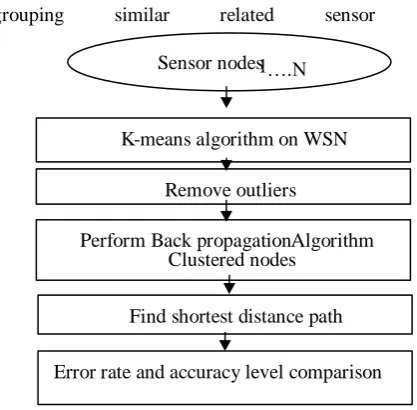
Path creation with low cost data transfer and less error rate for finding the shortest path from sensor nodes to sink node. Proposed path creation is using clustering i.e. using k-means algorithm. Path optimization is done by Back propagation algorithm. Figure 1 shows the flow diagram of proposed system. In this work clustering algorithm is used for
[image:2.595.308.517.49.254.2]grouping similar related sensor nodes.
Figure 1: Flow Diagram of Proposed system
In this work homogeneous nodes of WSN is considered where sensor nodes that are spatially dispersed in the sensor field. Sensors are mainly used for recording physical conditions of the environment.
Data is transmitted through these sensor nodes.
I.PATH
C
REATIONFor path creation clustering technique is used. In this k-means algorithm will cluster the sensor nodes and find out the optimized centroids of each cluster. K-means algorithm will cluster the sensor nodes based on distance. These cluster heads are the nearest centroids which will connect sink node and other sensor nodes in wireless sensor network .K-means algorithm will balance the load in the network and this will prevent some special nodes
from exhausting the energy level quickly.
Figure 2: K –means algorithm on WSN
Sensor nodes are randomly placed in the network as shown n in below figure 4. Above Figure 2 shows the network with 100 sensor nodes. In this figure x and y axis of graph shows the distance in meters with respect to the length and width of a particular area, where nodes are deployed.
K - means algorithm on WSN
Remove outliers
Perform Back propagation Algorithm Clustered nodes
Find shortest distance path Sensor nodes ….N 1
[image:2.595.307.532.438.626.2]International Journal of Innovative Technology and Exploring Engineering (IJITEE) ISSN: 2278-3075, Volume-8 Issue-8 June, 2019
By applying k means algorithm, proposed work will find out the nodes which are clustered based on distance. The main purpose of k-means algorithm on network is to balance the load. The sender will be one of the sensor node and destination will be the sink node.
Input: K value (number of cluster)
Output: Clusters, Cluster number=k
Method: Iterating to find centroids The value of k is 3
Repeat: Assigns sensor nodes to most similar cluste based on distance
2. Update the cluster means (calculate cluster head for each cluster).
Until no change
First step of clustering the network is by fixing the value of k. The value of k can be changed .For this work k value is considered as 3. So, the network will divided into 3 clusters. When we apply this algorithm it will give output as multiple centroids. A centroid is a center point of cluster. This cluster head will have minimum distance from the sender Transferring data from sensor node to sink node is through centroids.
In figure 2 the nodes which are not a part of cluster is considered as outliers. After implementing k-means algorithm these outliers are removed.
II.PATH
O
PTIMIZATIONPath optimization includes shortest path calculation. Back propagation algorithm is used for finding efficient path with less error rate for data transfer. Data transfer should be done with low cost and high frequency without loss of data. Back propagation algorithm will iterate the test data in order to find shortest path with less error rate. The training of data is accomplished with a set of examples. Back propagation algorithm involves the following steps.
Step 1 The network of 500*500 area is formed. Step 2 Deploy n number of nodes
Step 3 Apply k-means algorithm and find efficient distance cluster head between sink and sensor nodes.
Step 4 Establish path between sensor nodes and sink node coverage set of each sensor nodes is drawn including sensor nodes that are within coverage of WSN.
Step 5 Fix coverage rate to 25%.This coverage area means how much area in network is covered using this algorithm. In this work it is fixed to 25%.It can be changed.
Step 6 Evaluate of energy of each sensor nodes in the shortest path.
Step 7 Iterate on different possible node data transfer using Back propagation method.
Step 8 Give equal energy to all sensor nodes
Step 9 Generate output as number of nodes that are failed i.e. shortest path with less error rate.
Step 10 We can optimize the energy consumption of sensor nodes by the value of failed node.
Input: Problem Rate, Iterationsmax, learnrat.
1.Output:Network
2.Method:Network<-ConstructNetLayer 3.Networkenergy<-
IntializeEnergy(Netwiork,Problemrate)
4.For (i=1 to iterationsmax)
5.Patterni<-selectInputPattern(inputPattern) 6.Outputi<-forwardPropogate(patterni,Network) 7.BackpropagteError(Patterni,Outputi,Network) 8.Updateenergy(Patterni,Outputi,Network,Learn
[image:3.595.312.546.51.362.2]te
Figure 3: Back propagation algorithm
Figure 4: Back propagation algorithm on Cluster heads
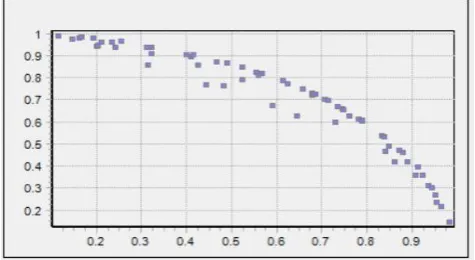
This figure shows the implementation of back propagation algorithm where the X and y axis represents length and width of the network which is measured in meters. Back propagation algorithm on cluster heads will find out the sensor nodes which is having less error rate. From one cluster head back propagation method is implemented it will avoid sensor nodes with high error rate.
IV. RESULT
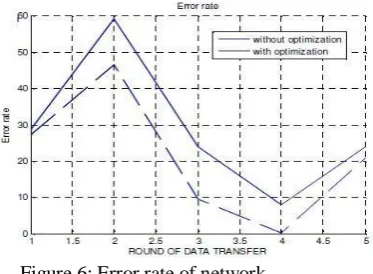
Result of applying K-means and back propagation on wireless sensor network is shown in the form of graph. The Figure 4 shows the spatially dispersed 100 nodes in the area of 500*500.All sensor nodes are randomly placed in network. Shortest path is formed between sink node and sensor nodes by applying back propagation algorithm. The figures are showing the error rate and energy consumption in WSN before and after optimization. It shows error rate and accuracy level comparison. The energy consumption of network is shown based on the number of iteration.
Input
Adjust weight
Neural network including connections
[image:3.595.310.548.311.441.2]It shows that energy consumption is gradually reduced when Kmeans and back propagation algorithm are applied. Back propagation algorithm will find out the dead nodes and it will remove those failure nodes from the network. Faulty nodes are consuming extra energy than other sensor nodes. By removing these dead nodes reduce the energy consumption.
Figure 5: Nodes deployed in network
Above Figure 5 shows randomly placed 100 sensor nodes. In this figure x and y axis of graph shows the distance in meters with respect to the length and width of a particular area, where nodes are deployed.
Figure 6: Error rate of network
Error rate comparison is drown in graph. The k-means and back propagation algorithm makes a great change in the error rate and an important role in optimizing energy in network.
Figure 7: Energy consumption in network
[image:4.595.58.278.147.326.2]The faulty node removal made changes in the parameters of network. The value changes are summarized and shown in table1.
Table 1: parameters comparison Parameters Without
optimization
With
optimiza tion Energy
consumption
15.5J 9.2J
Error rate 28.7 18.4
V. CONCLUSION
In this work, K-means and back propagation algorithm has been implemented to optimize power consumption. In this optimization technique reduces the energy consumption and prolong life time of wireless sensor network. This proposed back propagation algorithm removes unwanted data loss and data transfer. This algorithm also help to reducec the error rate and energy consumption in the network. Reduction in power consumption leads to enhancement of lifetime of WSN. There is a great change in error rate and energy consumption with respect to number of iterations .Application of sleeping technique on cluster heads can be future work.
REFERENCES
1. Ghazanfar Latif, Nadeem Javaid, Arshad Iqbal, Javed Ahmad, Ather Abdul Jabbar , Muhammad Imran,(2018).” An efficient routing protocol via depth adjustment and energy gradation in underwater wireless sensor networks”, International conference on innovative mobile and Internet Services in Ubiquitous Computing, 201-211. 2. WalidOsamy and Ahmed M. Khedr, “An algorithm for enhancing
coverage and network lifetime in cluster-based Wireless Sensor 3. Networks”, International Journal of Communication Networks and
Information Security (IJCNIS), Vol. 10, 2018.
4. Y.Liu et al(2018). , “Qtsac: an energy-efficient MAC protocol for delay minimization in wireless sensor networks”. ,in IEEE Access, vol.6, pp8273-8291.
5. Rajeh ,T.M ,Saleh A.I &Labib.(2018). , “A new Cooperative Balancing Routing(CBR)protocol to Enhance the Lifetime of 6. Wireless Sensor Networks “.L.M Wireless Pers Commun,.98:2623.
J.T, Thirukrishna& V P, Arunachalam&Subburathinam, Karthik. (2017). Revamp energy efficiency in Homogeneous Wireless Sensor Networks using Optimized Radio Energy Algorithm (OREA) and Power-Aware Distance Source Routing protocol.
7. Future Generation Computer Systems. 81. 10.1016/j.future.2017.11.042.
8. Jan, Naeem&Javaid, Nadeem &Javaid, Qaisar&Alrajeh, Nabil & 9. Alam, Muhammad & Khan, Zahoor&Niaz, Iftikhar. (2017). A
Balanced Energy-Consuming and HoleAlleviating Algorithm for Wireless Sensor Networks. IEEE Access. PP. 1-1. 10.1109/ACCESS.2017.2676004.
10. Sensors Journal, IEEE. 15. 48-62. 10.1109/JSEN.2014.2336257.
[image:4.595.67.254.427.564.2]International Journal of Innovative Technology and Exploring Engineering (IJITEE) ISSN: 2278-3075, Volume-8 Issue-8 June, 2019 12. Ye, Wei &Heidemann, John & Estrin, Deborah. (2002). An
energy-efficient MAC protocol for wireless sensor networks. Proceedings - IEEE INFOCOM. 3. 1567-1576 vol.3. 10.1109/INFCOM.2002.1019408.
13. S. Manishankar,P. R. Ranjitha and T. Manoj Kumar[2018], “Energy Efficient Data Aggregation in Sensor Network Using
14. Multiple Sink Data Node”, IEEE Xplore, International Conference on Communication and Signal Processing. 2017.
15. Basma Salah Larbah, Can Do?an Vurdu & Javad Rahebi, An Efficient Optimization Method Base on PSO for Energy Consumption in Wireless Sensor Networks, IMPACT : International Journal of Research in Engineering & Technology, Volume 7, Issue 3, March 2019, pp. 1-8
16. Santosh Anand and Pillai athulyaRadhakrishna[2018], “A protocol for efficient utilization of energy in wireless sensor network”, vol.7, no. 3.3, pp.82-86, 2018.
17. Santosh Anand and Akarsha RR [2018], “A protocol for efficient utilization of energy in wireless sensor network with optimization technique”, vol.7, no. 3.3, pp.93-98, 2018.
AUTHORS PROFILE
Krishnapriya completed her Bachelors in Computer Application from Amrita Vishwavidya peetham University. Currently pursuing Masters in Computer Application in Amrita Vishwavidya peetham Mysuru Campus.
Santhosh Anandh Completed BE and M tech And his research are is Wireless Sensor Network. He is presently Working as an Assistant Professor in the Amrita University Mysuru.
Somnath Sinha completed his PhD in Computer