A DISSERTATION ON
ETIOLOGY, CLINICAL PROFILE
AND OUTCOME OF COMA IN CHILDREN
M.D (BRANCH VII)
PAEDIATRIC MEDICINE
MARCH 2009
THE TAMILNADU
CERTIFICATE
This is to certify that the dissertation entitled “Etiology, Clinical profile and outcome of Coma in children” submitted by
Dr.S. Pushparani to the Faculty of Paediatrics, The Tamil Nadu Dr.M.G.R. Medical University, Chennai in partial fulfillment of
the requirement for the award of M.D. Degree Branch VII
(Pediatrics) is a bonafied research work carried out by her under
our direct supervision and guidance.
Dr.P.Amutha Rajeshwari,M.D.,DCH., Professor and Head of the Department,
Institute of Child Health & Research Centre, Madurai Medical College,
DECLARATION
I Dr. S. Pushparani solemnly declare that the dissertation titled “Etiology, Clinical profile and outcome of Coma in children” has been prepared by me.
This is submitted to the Tamilnadu Dr.M.G.R.Medical University, Chennai in partial fulfillment of the rules and regulations for the M.D.Degree
Examination in Paediatrics.
Place: Madurai
ACKNOWLEDGEMENT
It is with immense pleasure and privilege that I express
my heartful gratitude, admiration and sincere thanks to my chief
Prof.Dr.P.AmuthaRajeswari, Professor and Head of the Department of Pediatrics, for her guidance and support during this
study.
I am greatly indebted to my guide and teacher, Rtd
Prof.Dr.D.Meikandan, Neurologist and Professor of Pediatrics, for his supervision, guidance and encouragement while undertaking this study.
I express my sincere thanks and gratitude to
Prof. Dr.M.L.Vasantha kumari for her support and for her guidance, supervision, constant encouragement and support throughout this study.
I wish to express my sincere thanks to my Asst Profs
Dr. S. Venkateshwaran, Dr. S. Nataraja Rathinam for their valuable suggestions and support.
I would like to thank Prof.Dr.S.Rajasekaran, Prof.Dr.G.Mathevan, Prof.
Prof. Dr, R . A. Sankarasubramaniam who guided me to a great extent. I also thank all the members of the Dissertation Committee for their valuable
suggestions.
I gratefully acknowledge the help and guidance received from Asst. Prof. Dr. K. Mathiarasan at every stage of this study.
I also express my gratitude to all my fellow postgraduates for their kind
cooperation in carrying out this study and for their critical analysis.
I thank the Dean and the members of Ethical Committee, Government Rajaji
Hospital and Madurai Medical College, Madurai for permitting me to perform this
study.
I thank all the parents and children who have ungrudgingly lent
themselves to undergo this study without whom this study would not have seen the
light of the day.
CONTENTS
S.NO. TOPIC PAGE NO.
1. INTRODUCTION 1
2. REVIEW OF LITERATURE 5
3. AIM OF THE STUDY 28
4. MATERIALS AND METHODS 29
5. OBSERVATION, ANALYSIS & RESULTS 35
6. DISCUSSION 55
7. CONCLUSIONS 69
8. LIMITATIONS 71
9. RECOMMENDATIONS 72
BIBLIOGRAPHY
PROFORMA
MASTER CHART
INTRODUCTION
KOMA in GREEK means DEEP SLEEP.
Coma is a medical emergency and may constitute a
diagnostic and therapeutic challenge for the intensivist.
Coma indicates prolonged state of unarousable sleep and
disturbance of consciousness usually resulting from lesions
involving the reticular formation of brain stem, the hypothalamus
and connection with the cerebral hemispheres.
Acute nontraumatic coma accounts for about 10- 15% of the
hospital admissions and is associated with significant mortality.
Coma can result from a wide range of primary etiologies, of
which the major causes are infection, hypoxia, epilepsy, accidental
and non accidental injury .
Etiology of coma and clinical status at the time of presentation
are the important predictors of outcome.
Impairment of the conscious level is objectively graded
according to Glasgow coma scale(GCS) and is used to monitor the
children, a Modified form of the GCS (MGCS) has been used in
them to assess the severity, even though only a very few studies
are available to support its use in pediatric coma as a whole.
Although necessarily limited, a careful neurological
examination is very important in an unconscious children. Posture,
pupil size and reactivity, spontaneous eye ball movements and the
reflex eye movements helps to determine the level of structural
damage and depth of coma.
ANATOMIC SUBSTRATE OF ALERTNESS:
Consciousness is the complex interplay between cerebral
cortex and sub cortical structures i.e., Diencephalon, Midbrain,
upper Pons. In general the maintenance of consciousness depends
on the interaction between the Ascending Reticular Activating
system and the cerebral hemispheres. The ARAS lies in the
paramedian tegmental region of the posterior portion of the Pons
and the Midbrain. It extends from the superior half of the Pons
through the Midbrain to the posterior portion of the Hypothalamus
The Median Longitudinal fasciculi, which connects the
abducens and the oculomotor nuclei, and the oculomotor and
trochlear nuclei themselves are situated amid the neurons of the
pontine and midbrain portions of the ARAS. Thus when
unresponsiveness is caused by brainstem damage, the lesion affects
the mechanisms of ocular motility as well, and its location can
be determined by abnormal patterns of ocular motility.
A better understanding of causes and outcome is essential to
help improve the approach and to plan rational management of
nontraumatic coma.
This study was conducted to assess the various etiologies,
and to assess the relation between MGCS, the various clinical
APPROACH
HISTORY
DETAILED GENERAL & SYSTEMIC EXAMINATION
COMPLETE NEUROLOGICAL EXAMINATION
Initial laboratory studies
CBC, ESR, CRP Blood glucose Urea & creatinine Sr. Electrolytes Sr. Calcium Blood cultures CSF analysis
Liver function tests Mantoux
Radiographic studies Ultrasound
Head CT
Head MRI/ MRA
Subsequent laboratory tests
EEG
Toxicology screening - urine, blood
ABG
Blood coagulation profile Metabolic screening
Literature on pediatric non-traumatic coma is rather
inconclusive, as there are few systematic studies, and most of these
are retrospective. Very little information is available particularly so
from developing countries including India.
INCIDENCE:
The incidence of coma in children under 16 years varies from
place to place. Wong CP et el study2 on “Incidence etiology and
outcome of coma”, the incidence of coma is 30.8 per 100 000
children under 16 per year (6.0 per 100 000 general population per
year). The age specific incidence was notably higher in the first
year of life (160 per 100 000 children per year).
In Sofiah A., Hussain I. H. M. et el 3 studies on
nontraumatic coma, 69% were due to infection, 13% were due to
toxic metabolic causes, 5% were due to hypoxic ischaemic insults,
3.5% had intracranial haemorrhage, 7.8% were due to
miscellaneous causes and in 1.7% the cause was unknown. Age of
Stevens and Bharadwaj et el 4 reviewed all the currently
available data on the etiology, diagnosis, and outcome of coma and
proposed an evidence-based approach for the clinical management
of the comatose patient. They also wrote the neurologic prognosis
is determined by the underlying etiology and may be predicted by
the combination of clinical signs and electrophysiological tests.
Seshia SS, Johnston B, Kasian G et el 5 showed analysis of
clinical variables recorded early in the comatose state can provide
predictive information and stepwise discriminant analysis may be
one method of determining the most likely outcome for individual
cases.
According to a study conducted by Lohr Junior A et el 6,done to study
the etiology, morbidity and mortality of coma in children, 31 (29.8%) of the
19 (18.3%) weretoxic-metabolic, 16 (15.4%) to intra-cranial hypertension, 7
(6.7%) to shock/anoxia, 4 (3.8%) to an indeterminate etiology and 3(2.9%)
were miscellaneous.
Arun Bansal et el7 analysed 100 consecutive cases of non
traumatic coma. He found etiology of coma in 60% cases was CNS
infection (tubercular meningitis - 19, encephalitis - 18, bacterial
meningitis -16,others-7); other causes were toxic-metabolic
conditions (19%), status epilepticus(10%), intracranial bleed (7%),
and miscellaneous (4%).
According to a study conducted by Aswati. et el8 from
Department of Paediatrics, King George's Medical College,
Lucknow, Uttar Pradesh, to study the value of MGCS to predict
the mortality in patients with acute CNS infection along with other
clinical variables, they found that MGCS can be used to predict
discharge in patients with acute infective disorders of the central
nervous system within 24 hours of hospitalization. The scale is
simple, can be applied at the bedside and does not depend on any
A Tatman & A Williams et el 9 showed in their study that
James' adaptation of the Glasgow coma scale (JGCS) was
designed for young children. Intubated patients are not allocated a
verbal score, however, so important changes in a patient's
conscious level may be missed. A grimace score 33 was therefore
developed and assessed for use in intubated children.
Nayana P.C. Prabha et el 10 in their study noted that low
total MGCS was found to be associated with adverse outcome.
They also observed a relationship between brainstem reflexes and
poor outcome. Absence of one or more reflexes predicted adverse
short term outcome. They also noted that etiology did not affect the
short term outcome. They concluded ocular, motor response scores
and brainstem reflexes are more predictive of short term outcome
Bolton et el 14 proposed that clinical examination combined
with the results of Electro Encephalography (EEG) and
somatosensory evoked potentials can be used to establish an early,
definitive prognosis in a significant proportion of patients in
DEFINITIONS
33,34,35CONSCIOUSNESS:
Consciousness defined as a state of awareness of self &
surrounding.
ALERT:
Alertness is the normal state of arousal.
DELIRIUM:
Delirium is agitated confusional stage, in which the child
responds incoherently and many times violently. The child will
respond continuously without slipping back to sleep.
DROWSY:
The child is sleeping but arousable by ordinary stimulus or a
loud call. Once awake, the child responds appropriately without
further stimulation, but goes into sleep again if left alone.
Stupor is the state of unresponsiveness from which the
subject can be aroused only by vigorous (painful) and repeated
stimuli. Soon after the removal of stimulus, the child slips into
sleep.
OBTUNDATION:
It is a stage between drowsiness and stupor. Here the child
may be awakened by a strong stimulus other than pain (loud call
with simultaneous shaking). The child will respond inappropriately
to the stimulus.
COMA :37
“The patient who appears to be in asleep and at the same time is
incapable of being aroused by any external stimulus or by his inner
needs” is said to be in coma.
IMPORTANT CAUSES OF ACUTE ENCEPHALOPATHY 33
INFECTIOUS & PARA INFECTIOUS ENCEPHALOPATHIES:
Meningitis
Primary viral encephalitis
Post infectious encephalitis
Cerebral malaria
Acute Disseminated EncephaloMyelopathy (ADEM)
HYPOXIC ISCHEMIC ENCEPHALOPATHIES
Status epilepticus
Near drowning
Near miss Sudden Infant Death syndrome
Post cardiac arrest, Cardiac arrhythmias, Hypotension
Disseminated Intravascular Coagulopathy
Hypoglycemia
Vitamin & other cofactor deficiencies
EXOGENEOUS TOXINS
Neem oil/Camphor
DRUGS
Antihistamines, Antidepressants, Hypnotics and sedatives
Analgesics
Anti-inflammatory drugs
Antimetabolites
ILLICIT SUBSTANCES
Alcohol , Cannabis, Cocaine,Opiates
ENVIRONMENTAL TOXINS
Carbon monoxide, Phosphates, DDT, Iron, Lead, Pesticides,
venom.
HYPOTHERMIA
HEAT STROKE
HYPERTENSION
ENDOGENEOUS AGENTS
Water intoxication
Acidosis and Alkalosis
ENDOCRINE DISORDERS
Diabetic Keto Acidosis, Hypoglycemia, Hypothyroidism,
Hyperthyroidism, Hypoadrenalism, Hypopituitarism,
Hypoparathyroidism, Hyperparathyroidism
Hepatic failure
Renal failure
Reye syndrome
INBORN ERRORS OF METABOLISM
Urea cycle defects, Fatty acid oxidation defects,
Mitochondrial disorders
CEREBRO VASCULAR DISEASE
NONCONVULSIVE STATUS EPILEPTICUS
GRADES OF COMA
Stage 1 or stupor:The patient can be aroused briefly and shows verbal or motor
response to stimuli.
Stage 2 or light coma:
The patient cannot be aroused easily, except with painful
stimulus.
Stage 3 or deep coma:
kept in primitive reflex posture. The limbs may be in decorticate or
decerebrate posturing.
Stage 4 or brain death:
All cerebral functions are lost. Pupillary reflexes are lost.
There is no spontaneous respiratory effort, but local spinal reflexes
are preserved.
BEHAVIORAL STATES CONFUSED WITH COMA
1. LOCKED IN SYNDROME:
Locked in syndrome refers to a condition in which the patient
is mute and motionless (deefferented) but remains awake, alert,
aware of self and capable of perceiving the sensory stimuli due
to bilateral ventral pontine lesions. Here the subject is only able
to move eyes vertically or blink or both, though the horizontal
eye movements are impaired ( PPRF).
This syndrome is due to Pontine infarction following basilar
artery thrombosis, Pontine hemorrhage or tumor or central
intact.
2. PERSISTENT VEGETATIVE STATE
Persistent vegetative state is defined as vegetative state
persisting for atleast one month after acute traumatic or non
traumatic brain injury or in patients with degenerative or metabolic
disorders or developmental malformations.
It is characterized by lack of awareness of self and external
stimuli, accompanied by sleep-wake cycles, with preservation of
vital vegetative functions such as cardiac function, respiration, and
maintenance of BP. Spontaneous movements may occur and eyes
may open in response to external stimuli but subject does not speak
or obey commands.
3.ABULIA
It is a state of severe apathy in which subject has blunting of
feeling, drive, mentation and behavior so they neither speak nor
move spontaneously.
It is the state of muteness with dramatically decreased motor
activity. The maintenance of body posture with preserved ability
to sit or stand distinguishes from organic stupor.
5. PSEUDOCOMA(PSYCHOGENIC UNRESPONSIVENESS)
In this state the subject appear comatose but have no
structural, metabolic, toxic causes.
ENCEPHALOPATHY:
Encephalopathy is a disorder of consciousness and applied to
comatose state or continuum of worsening of altered states of
consciousness from fully alert to deep coma.
Arousal is impaired in encephalopathy and absent in coma.
COMA SCALES
1. CLINICAL STAGING SYSTEM
2. GLASGOW COMA SCALE
3. CHILDREN COMA SCALE
4. MODIFIED CHILDREN COMA SCALE
Total score is 15 and the minimum score is 3. Score less than
8 require aggressive management. GCS provides a rapid
assessment of cerebral cortical function.
GLASGOW COMA SCALE AND PEDIATRIC COMA SCALE 9
Sign GCS PCS Score
Eye openin g Spontaneous To command To pain None Spontaneous To sound To pain None 4 3 2 1 Verbal respon se Oriented Age-appropriate
vocalization, smile, or
orientation to sound 5 Confused,
disoriented
Irritable, consolable, uncooperative, aware of
the environment
4
Inappropriate words Irritable, inconsistently consolable 3
Incomprehensible sounds
Inconsolable, unaware of the environment,
restless, agitated 2
Motor respon
se
Obeys commands spontaneous movementsObeys commands, 6
Localizes pain Localizes pain 5
Withdraws Withdraws 4
Abnormal flexion to
pain Abnormal flexion to pain 3
Abnormal extension
to pain Abnormal extension to pain 2
None None 1
Best total score 15
• Data from: Teasdale, G and Jennett, B. Assessment of coma and
impaired consciousness. A practical scale. Lancet 1974; 2:81.
• Data from: Simpson, D and Reilly, P. Pediatric coma scale (letter).
Lancet 1982; 2:450.(9
Glasgow coma scale which is widely applicable to adults
depends on higher integrative function which is not present in
infants or very young children.
Modification of Glasgow coma scale alters the best verbal
response to following:
MODIFIED COMA SCALE FOR INFANTS & CHILDREN LESS THAN 4 YEARS 33
Coos and babbles - 5 Irritable cries - 4
Cries to pain - 3 Moans to pain - 2
None - 1
development so that the maximum total score is adjusted to reflect
maturation as follows:
Birth to 6 months 09 6months to 12months 11 1year to 2year 12 2year to 5year 13 More than 5 year 14
CLINICAL STAGING IN ENCEPHALOPATHY 35
STAGE 1 Lethargic
Follows commands Pupils reactive Breathing normal Normal muscle tone
STAGE 2 Combative
Inconsistently following commands Pupils sluggish
May hyperventilate Reflexes inconsistent
STAGE 3 Comatose
Occasional responds to command Eyes may deviate
Irregular breathing Decorticate posturing
Comatose
Respond only to pain Weak pupillary response Very irregular breathing Decerebrate posturing
STAGE 5 Comatose
No response to pain No pupillary response
Require mechanical ventilation Flaccid state
A simple bedside assessment can be made using the AVPU
SCALE:
ALERTNESS
RESPONSE TO VERBAL COMMAND
RESPONSE TO PAIN
UNCONSCIOUS
SIGNS WITH LOCALISING VALUES IN COMA 34, 36, 26
For localization of structural lesions and to assess the prognosis
the following examinations are helpful
1) State of consciousness
2) Pattern of breathing
4) Eye movements
5) Motor movements & involuntary movements
MANAGEMENT:
Children in coma need repeated reassessment with particular attention
to pupil size, reactions, reflex eye movements, motor response, fundus and
skilled neurological care.
Cerebral perfusion pressure and cerebral blood flow should be
maintained and monitoring of ICP can be useful in head trauma, intracranial
infection and certain metabolic encephalopathies.
Control of seizures and specific treatment as per etiology like
antibiotics, antidotes, metabolic corrections should be made appropriately.
INVESTIGATIONS :
1. Complete blood count
2. Blood – Glucose, S. Calcium
4. Blood & urine osmolarity
5. Coagulation profile
6. Bacteriological & virological studies (Culture, serology, PCR)
7. Mantoux
8. Imaging studies – USG, CT, MRI
9. Arterial Blood Gas analysis
10. Plasma Ammonia, Plasma lactate – To R/o inborn errors of
metabolism
11.Urine & Blood Toxicology – for drugs like anti-histamines,
anticholinergics, antidepressants, hypnotics & sedatives, analgesics, anti
epileptics, antimetobolites, alcohol, cannabis, cocaine, opiates.
12. Blood – Anticonvulsants level
13. Urine metobolic screening - To R/o Aminoacidopathies, organic
acidurias, Urea cycle defects, mitochondrial disorder
14. CSF Analysis
15. Liver function test
16. TFT & other endocrine investigations – to R/o DM, Hypoglycemia,
hypopituitarism, hypoadrenalism.
TREATMENT :
• ABC - maintain airway, breathing and circulation
• Cervical immobilization : It should be employed where there is any
possibility of cervical spine trauma.
• Intubate the patient if GCS is 8 or less than 8
• Avoid neck flexion, which may obstruct jugular venous return.
• Elevate head end of the bed to 15-30O with the head in neutral position
to reduce venous outflow pressure.
• Sedation and neuromuscular blockade to avoid valsalva maneuvers
from coughing which is common with an endothracheal tube in place.
• Maintain normal or high normal blood pressure with isotonic fluids and
inotropic support, if needed.
• Maintain body temperature normal to slightly hypothermic to reduce
the whole body and cerebral metabolism.
• Inj. Mannitol 0.25 – 0.5 gm/kg - every 6th hourly
pyogenic meningitis.
• Ventricular Catheterization – allows most accurate measurement of ICP
and therapeutic drainage of CSF to
lower ICP.
MODERATE HYPERVENTILATION - Leads to cerebral vasoconstriction
and a reduction in cerebral blood flow and volume, decreasing ICP.
o Maintain PCO2 at 25-35 mm Hg
o More aggressive or prolonged hyperventilation may produce
cerebral ischemia and should be avoided.
• Bladder care : Catheterize the bladder
• Bowel Care : Suppositories and oral lactulose
• Eye Care : Artificial tear drops and topical antibiotics
• Back Care : Change the position of the patient frequently
and use skin hardening solutions like spirit.
• Administer specific treatment according to the etiology
LONG TERM MANAGEMENT AND PROGNOSIS :
• In EEG - Indicators for poor outcome are
i. Low-voltage undifferentiated tracings
ii. Burst suppression
iii. Electro cerebral inactivity
• Once mechanical ventilation can be discontinued, circulatory
function has stabilized and ICP has normalized, early
rehabilitation interventions like various sensory stimulation
techniques, physiotherapy, occupational therapy and speech
AIM OF THE STUDY
1) To know the different etiologies of coma in children between
1 month to 12 years.
MATERIALS AND METHODS
STUDY CENTRE:
The study was conducted in the Institute of Child Health and
Research Center, Government Rajaji Hospital, Madurai.
STUDY PERIOD:
The study was carried out prospectively from December
2006 to May 2008.
STUDY DESIGN:
Prospective observational study
STUDY POPULATION:
Children admitted in Govt. Rajaji Hospital, Madurai medical
college, Madurai.
INCLUSION CRITERIA
Children between 1 month- 12 yrs fitting with the definition of
coma
EXCLUSION CRITERIA
1) Age < 1 month & >12 yrs
2) Traumatic coma
3) Child with neuro developmental delay, any other pre-existing
neurological illness.
CONFLICT OF INTEREST : Nil
FINANCIAL SUPPORT : Nil
METHODOLOGY:
For all children admitted with the above mentioned
criteria, a detailed history, general examination and a focused
neurological examination (brainstem reflexes including pupillary
reactivity) were made. MGCS were assessed every 12th hourly
from the time of admission upto 48 hrs. In case of children who
were intubated or who developed respiratory failure secondary to
neurological condition, the best verbal response is taken as
grimace. Etiology of coma was determined on basis of clinical
history, examination and relevant laboratory investigations. All the
children were followed up till discharge or death. The outcome
was recorded as survived or died, and among those who survived,
STATISTICAL METHODS:
The information collected regarding all the selected cases
were recorded in a Master Chart. Data analysis was done with the
help of computer using Epidemiological Information Package (EPI
2002).
Using this software, frequencies, percentages, means,
standard deviations, Chi- square, 'p' and coefficient of correlation
values were calculated. Kruskul Wallis Chi- square test was used
to test the significance of difference between quantitative variables
and Yate's test for qualitative variables. A 'p' value less than 0.05
is taken to denote significant relationship. If the coefficient of
correlation (r) is more than 0.5 then the two variables are taken to
be correlated.
ANALYSIS:
Data will be spread in excel spread sheet and analysed using
CASE DEFINITIONS PYOGENIC MENINGITIS 24:
Acute febrile encephalopathy with culture positive Cerebro
Spinal Fluid or presence of the 2 of the following abnormalities
in CSF – polymorphonuclear leukocytes/ glucose <40mg/dl or
50% of blood sugar/ micro organisms seen by gram staining.
TUBERCULOUS MENINGITIS:
Child with features of meningitis, with CSF pleocytosis with
lymphocyte predominance and organisms seen by AFB staining/
absence of bacteria on direct microscopy, elevated proteins, CT
features s/o TB- basal meningitis, obstructive hydrocephalus,
prominent cisterns.
VIRAL MENINGOENCEPHALITIS:
Acute febrile encephalopathy with CSF pleocytosis with
lymphocyte predominance and absence of bacteria on direct
microscopy.
Encephalopathy in association with BP >95th percentile for
age and sex with or without retinal changes.
HYPOXIC ISCHEMIC ENCEPHALOPATHY:
Encephalopathy following hypoxic cerebral injury such as
near drowning, accidental/ homicidal hanging.
TOXIC ENCEPHALOPATHY:
Encephalopathy following ingestion of toxin containing
substances (neem oil, organophosphorus, drugs, kerosene)
HEPATIC ENCEPHALOPATHY 30:
Spectrum of potentially reversible neuropsychiatric
abnormalities seen in patients with liver dysfunction after
exclusion of unrelated neurologic and metabolic abnormalities
INTRACRANIAL BLEED:
Children with coma with evidence of bleed on radio imaging
RESULTS
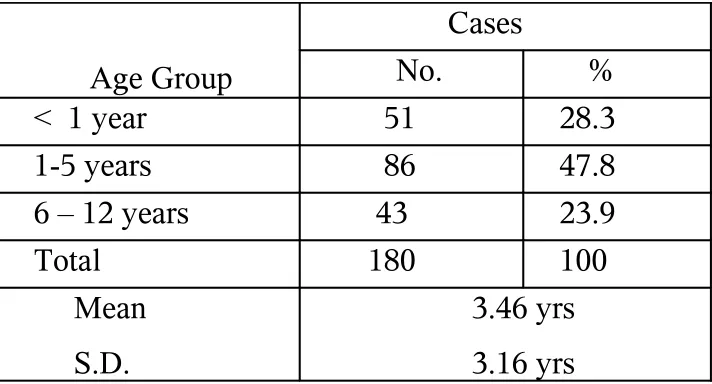
The study population consisted of 180 children with acute
[image:40.612.129.485.281.473.2]non-traumatic coma whose average age was 3 years and 5 months.
TABLE - 1 AGE GROUP
Age Group
Cases
No. %
< 1 year 51 28.3
1-5 years 86 47.8
6 – 12 years 43 23.9
Total 180 100
Mean S.D.
3.46 yrs 3.16 yrs
51 were less than 1 yr of age, 86 were between 1 to 5 yrs, 43
SEX DISTRIBUTION
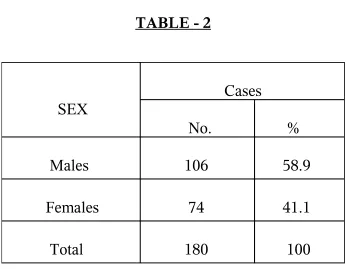
Of the 180 children, 106 were males and 74 were females.
TABLE - 2
ETIOLOGY OF COMA : TABLE - 3
SEX
Cases
No.
%
Males
106 58.9
Females 74 41.1
[image:41.612.133.479.191.460.2]S. No Diagnosis No of cases % of cases among the total I Intracranial infection
A) Pyogenic Meningitis B) TBM
C) Viral Meningo encephalitis D) Dengue
E) Cerebral Malaria F) ADEM 99 52 18 20 2 2 5 55.2% II Vascular
a) Intra cranial Haemorrhage i) Parenchymal
ii) Subdural iii) Sub thalamic b) Thrombosis
c) CVT
d) Infarction – vasculitis
17 13 11 1 1 2 1 1 9.4% III Encephalopathy
A) Toxic encephalopathy (Neem oil poisoning, Drugs, OPC, Cypermethrin)
B) Metabolic
i) Hepatic encephalopathy Wilson disease Leptospirosis
Chronic liver disease ii) Diabetic coma
C) Hypoxic encephalopathy i) Status epilepticus
ii) Cobra bite iii)Near drowning
D) Hypertensive encephalopathy i) CRF
ii) AGN 59 16 - 19 15 3 2 10 4 21 18 1 2 3 2 1 32.7%
IV Idiopathic 5 2.7%
CLINICAL PROFILE
MODIFIED GLASGOW COMA SCALE AT 24 & 48 HOURS TABLE - 4
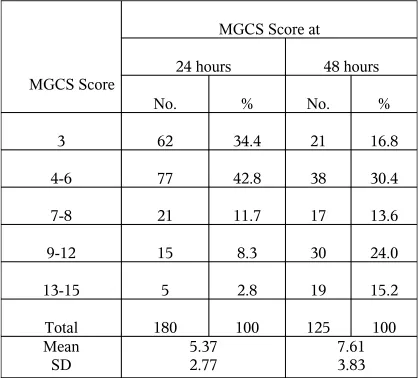
The MGCS at 24 hours was < 8 in 160 patients and
between 9- 12 in 15 and 13 – 15 in 5 patients with a mean score of
5.37. The MGCS at 48 hours was <8 in 76, between 9- 12 in 30
[image:43.612.97.515.157.535.2]and >12 in 19 with a mean score of 7.61.
MGCS Score
MGCS Score at
24 hours 48 hours
No. % No. %
3 62 34.4 21 16.8
4-6 77 42.8 38 30.4
7-8 21 11.7 17 13.6
9-12 15 8.3 30 24.0
13-15 5 2.8 19 15.2
Total 180 100 125 100
Mean
PUPILLARY REFLEX TABLE - 5
Pupillary Reflex
Cases
No. %
Reactive 136 75.6
Non Reactive 44 24.4
Total 180 100
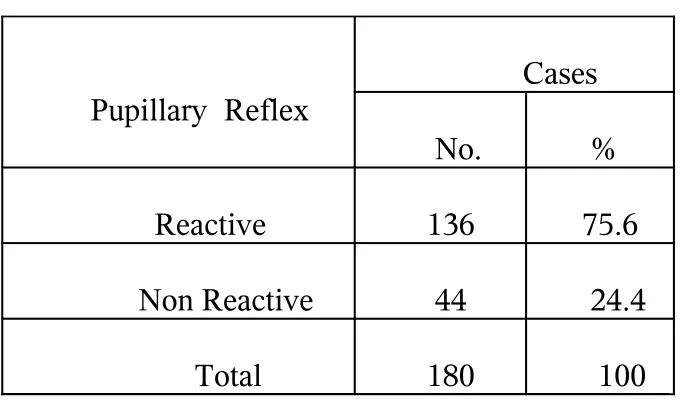
Of the 180 studied, pupillary reflexes were preserved in 136
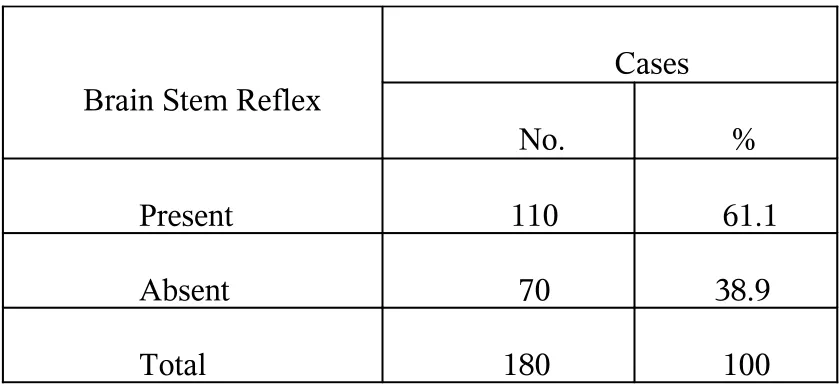
BRAINSTEM REFLEXES TABLE - 6
Brain Stem Reflex
Cases
No. %
Present 110 61.1
Absent 70 38.9
Total 180 100
Brainstem reflexes were preserved in 110 cases out of
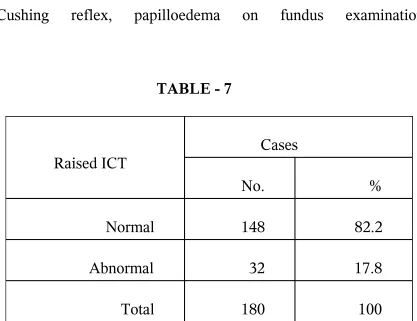
WITH INTRACRANIAL HYPERTENSION
ICT was assessed clinically by the presence of
[image:46.612.97.514.162.483.2]Cushing reflex, papilloedema on fundus examination.
TABLE - 7
Of the 180 studied 32 had features of raised ICT.
Raised ICT
Cases
No. %
Normal 148 82.2
Abnormal 32 17.8
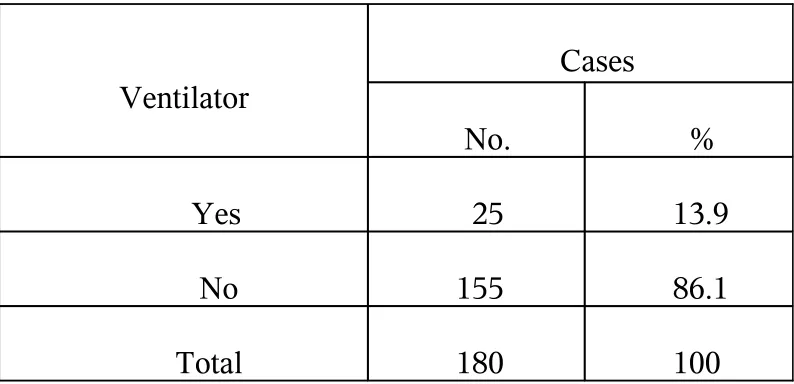
REQUIRING VENTILATORY SUPPORT
TABLE - 8
Of the 180 studied, ventilatory support was needed
in 25(13.9 %) cases.
Ventilator
Cases
No. %
Yes 25 13.9
No 155 86.1
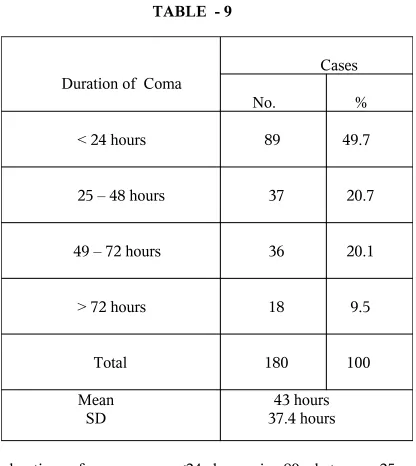
DURATION OF COMA TABLE - 9
The duration of coma was <24 hours in 89, between 25 –
48 hours in 37, between 49- 72 hours in 36. In 18 cases coma
persisted for >72 hours. The mean duration of coma was about
43 hours.
Duration of Coma
Cases
No. %
< 24 hours 89
49.7
25 – 48 hours
37
20.7
49 – 72 hours 36 20.1
> 72 hours 18 9.5
Total 180 100
Mean SD
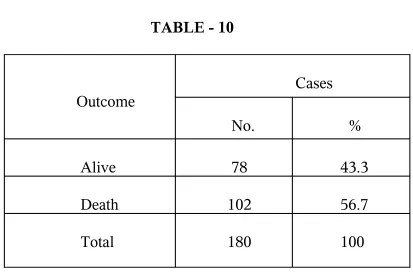
OUTCOME TABLE - 10
Outcome
Cases
No.
%
Alive 78 43.3
Death 102 56.7
Total 180 100
Among the 180 cases studied 78 (43.3%) survived, and
102 (56.7%) cases died. Of the 102 cases , 36 died within 24
hours of admission, 55 died between 24- 48 hours and
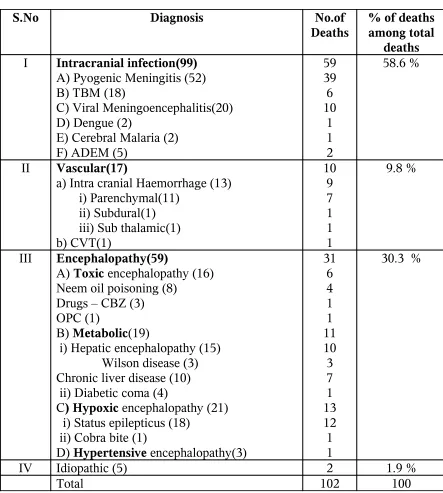
MORTALITY PATTERN TABLE - 11
S.No Diagnosis No.of
Deaths % of deaths among total deaths
I Intracranial infection(99)
A) Pyogenic Meningitis (52) B) TBM (18)
C) Viral Meningoencephalitis(20) D) Dengue (2)
E) Cerebral Malaria (2) F) ADEM (5)
59 39 6 10 1 1 2 58.6 % II Vascular(17)
a) Intra cranial Haemorrhage (13) i) Parenchymal(11)
ii) Subdural(1) iii) Sub thalamic(1) b) CVT(1) 10 9 7 1 1 1 9.8 % III Encephalopathy(59)
A) Toxic encephalopathy (16) Neem oil poisoning (8)
Drugs – CBZ (3) OPC (1)
B) Metabolic(19)
i) Hepatic encephalopathy (15) Wilson disease (3) Chronic liver disease (10) ii) Diabetic coma (4)
C) Hypoxic encephalopathy (21) i) Status epilepticus (18)
ii) Cobra bite (1)
D) Hypertensive encephalopathy(3)
31 6 4 1 1 11 10 3 7 1 13 12 1 1
30.3 %
IV Idiopathic (5) 2 1.9 %
Total 102 100
RELATIONSHIP BETWEEN VARIOUS PARAMETERS AND OUTCOME:
[image:51.612.52.512.196.470.2]AGE & OUTCOME
TABLE - 12
Age Outcome Alive Dead Mean 2.75 4.00 S.D. 2.62 3.43 'p’ 0227 Significant
There is a statistically significant co-relation between the
GENDER AND OUTCOME
TABLE - 13
Sex
Outcome
Alive Dead No % No %
Males(106) 52 49.1
54 50.9 Femal
es(74) 26 35.1 48 64.9
'p' 0.0889
Not significant
Relative risk 1.4
There is no statistically significant relation between
ETIOLOGY AND OUTCOME TABLE - 14
Etiology
Diagnosis
Outcome Alive Dead
No % No %
I)Intra cranial Infection (99)
II) Vascular ( 13)
III)Encephalopathies ( 63 )
IV) Idiopathic ( 5 )
40 7 28 3 41.4 41.1 47.5 60 59 10 31 2 58.6 58.9 52.5 40
"p" Value between
I & II
I&III
I & IV
0.2701-Not significant
0.9712 -Not significant
0.1272 -Not significant
There is no significant co-relation between the
etiology and outcome. The mortality was higher in coma due
to vascular pathology, 10 out of 13 cases died (58.9%). The
mortality was also higher in intracranial infection 59 out of 99
RELATION BETWEEN MGCS AND OUTCOME AT 24 HOURS
TABLE - 15
MGCS at 24hrs
Alive Dead N
o
% No %
3 (62)
4 – 5 (77)
6 - 8 (21)
9 – 12 (15)
13 – 15 (5) Total (180) 7 3 7 1 8 1 1 5 7 8 11.3 48.1 85.7 73.3 100 100 55 40 3 4 102 88. 7 51.9 14.1 26.7 100
RELATION BETWEEN MGCS AND OUTCOME AT 48 HOURS
TABLE - 16
Death is more common in cases with lower MGCS scores
at 24 hr and 48 hrs. MGCS at
48 hrs Alive Death
No % No %
3 (21)
4 – 5 (38)
6 – 8 (17)
9 – 12 (30)
13 – 15 (18)
Total (125 2 15 13 27 16 73 9.5 39.5 76.5 90.0 84.2 100 19 23 4 3 3 52 90.5 60.5 23.5 10 15.8 100
PUPILLARY REFLEX AND OUTCOME TABLE - 17
Pupillary Reflex
Outcome
Alive Dead
No % No %
Reactive (136)
Non Reactive (44)
73
5
53.7
11.4
63
39
46.3 88.6
p value
0.0001 (Significant)
Relative Risk 4.72
Non reactive pupils were associated with a higher
mortality of 88.6%, (39 out of 44 cases). There is a
statistically significant co- relation between pupillary reflex
BRAINSTEM REFLEXES AND OUTCOME TABLE - 18
Absent brainstem reflexes are associated with a high
percentage of mortality (84.3%), 59 out of 70 cases. There is
statistically significant correlation between absent brainstem
reflexes and outcome with a relative risk of 3.88 times. Brain Stem
Reflex
Outcome
Alive Dead
No. % No. %
Present (110) 67 60.9 43 39.1
Absent (70) 11 15.7 59 84.3
"p"
Relative Risk
DURATION OF COMA AND OUTCOME
TABLE - 19
The mean duration of coma for alive are 39.39 hours and
for the death it is about 34.23 hours. There is no significant
correlation between the mean duration of coma and outcome. Duration of Coma in hours
Outcome Aliv
e Dead
Mean
39.39 45.73
SD 34.23 39.6
RAISED ICT AND OUTCOME TABLE - 20
With raised ICT
Outcome
Alive Dead
No. % No. %
Normal (148) 68 45.9 80 54.1
Abnormal (32) 10 31.3 22 68.8
"p" Relative Risk
0.1853 (Not Significant) 1.42
There is no statistically significant correlation
DISCUSSION
It is a well known fact that the prognosis in coma depends on its
severity. Assessing the severity of coma by subjective, poorly defined terms
such as stupor, semi-coma, deep coma was ineffective in predicting the
outcome and there was a great deal of inconsistency when different
observers carried out the assessment 17.Glasgow Coma Scale (GCS) Score
reflects the integrity of cerebral functions. Eye movements (in response to
vestibularstimulation), pupillary responses, and corneal responses primarily
express functions regulated by the brain stem.
The Glascow coma scale is a standardized system developed initially in
traumatic coma to assess the degree of coma and to identify the seriousness
of brain injury in relation to the outcome 9.It has gained widespread use as it
is highly reproducible, can be quickly performed at the bedside and provides
useful information on the progress and prognosis of comatose individual 18, 19.
One limitation of the Glasgow coma scale is that only a few studies
are available regarding its usefulness in non-traumatic pediatric coma as a
Another drawback of GCS score is loss of information, which occurs
due to the summation of individual scores 20.
In comatose patients, evidence of widespread damage of
brain stem or cerebral hemispheres at onset usually predicts death
or severe disability. Therefore clinical signs that reflect extent and
severity of dysfunction of cerebral hemispheres and/or brain stem
were studied.
This study included 180 children in the age group of 1
month to 12 yrs.
51 were less than 1 yr of age, 86 were between 1 to 5 yrs,
43 were between 6 to 12 yrs with a mean age of 3.46 yrs. Of the
180 children, 106 (58.9%) were males and 74 (41.1%)were
females.
Incidence of coma was higher in males when compared to
females.But this is incontrast to a study by Seshia5 and Seshia et el
who did not observe any significant difference in the incidence of
ETIOLOGICAL PROFILE:
With regard to etiology, Intracranial infection accounts for
about 99 (55.2%) cases which included 52 cases of pyogenic
meningitis (52.5%), 18 cases of tuberculous meningoencephalitis
(18%), 22 cases of viral encephalitis (22%), 2 cases of Dengue
(2%), 2 cases of Cerebral malaria (2%) and 5 cases of viral
ADEM (5%).
It was observed that CNS infections were the commonest
cause of non-traumatic coma. This is also supported by other
studies, wherein infections of the CNS were found to be the
leading causes of non-traumatic coma in children 12, 13.
Of the neuro infections, Pyogenic meningitis constituted the
most common accounting for about 52.5%. This is similar to a
study done by Awasthi S et el 8, Department of Paediatrics, King
George's Medical College, Lucknow, Uttar Pradesh, where 42.2%
infection.
Among the non-infectious causes, toxic-metabolic causes
(no- 35, 18%) were the commonest and were also comparable in
frequency with other studies 3,5,12,13.
Encephalopathy accounts for about 59 cases (32.7%) which
included Toxic (16 cases – 8% ), Metabolic (19 cases – 10%),
Hypoxic (21 cases – 11.6%). 3 cases were due to hypertensive
encephalopathy (1.6%).
Etiology of toxic encephalopathy included neem oil ( no-8),
Drugs (no-5) including carbamazepine(no-3), antipsychotic drugs
like reserpine(no-1), INH(no-1), organophosphorus compounds
(no- 2), Cypermethrin (no- 1).
Toxic encephalopathy included a case of accidental INH
poisoning which presented with seizures and coma, the child was
treated symptomatically with anticonvulsants and Pyridoxine and
the child regained consciouness within 12 hours 16.
Neem oil encephalopathy is one of the important cause for
institute by Dr. Suresh during the period of 2005 to 2007, there
were 88 cases of neem oil encephalopathy of which 27 cases died.
In a study conducted by Nayana P C Praba et el 10 on Role of
Glascow coma scale in pediatric nontraumatic coma in JIPMER
reported that 8 out of 218 cases of coma were due to toxic
encephalopathy including neem oil.
Metabolic causes included hepatic and diabetic coma.
Hepatic encephalopathy constituted about 15 cases of which 3
were due to Wilson disease and 2 were due to Leptospirosis.
Hypoxic causes of encephalopathy were due to status
epilepticus (no-18, 10%), neuro-paralytic snake bite, cobra
(no-1, 0.5%), near drowning (no- 2, 1%).
Hypertensive encephalopathy constituted about 3 cases of
which 2 is due to chronic renal failure, 1 is due to acute
glomerulonephritis.
Intracranial Hemorrhage, thrombosis and infarction.
The etiology of coma was not known in 2.7% (no- 5) of the
cases.
Similar study done by Arun bansal at PGIMER 7,
Chandigarh showed the etiology of coma in 60% cases was CNS
infection (tuberculous meningitis-19, encephalitis-18, bacterial
meningitis-16, others-7); other causes were toxic-metabolic
conditions (19%), status epilepticus (10%), intracranial bleed (7%),
and miscellaneous (4%).
SOFIAH A et el and HUSSAIN I. H. M. I et el 3 at
Neurology Unit, Paediatric Institute, Kuala Lumpur Hospital,
MALAYSIA showed that the etiology of coma in the 116 cases
they followed, eighty cases (69%) were due to infection, 15 (13%)
to toxic metabolic causes, six (5%) to hypoxic ischaemic insults,
four (3.5%) had intracranial haemorrhage, nine (7.8%) were due to
CLINICAL PROFILE AND OUTCOME OUTCOME:
Among the 180 cases studied, 78 (43.3%) survived and
102 (56.7%) cases died. Of the 102 cases, 36 died within 24
hrs of admission, 55 died between 24- 48 hours and 11cases
died after 48 hours.
Of the 72 cases survived, 63 were discharged without any
sequelae and 15 cases had sequelae. The sequelae included
hemiparesis (3), PVS (5), rigidity & extrapyramidal
movements (2), hydrocephalus (3), aphasia (1), cortical
blindness (1).
AGE AND GENDER:
51 were less than 1 yr of age, 86 were between 1 to 5 yrs,
43 were between 6 to 12 yrs with a mean age of 3.46 yrs. Of the
180 children, 106 (58.9%) were males and 74 (41.1%) were
females.
The mortality rate was higher in children <5 years age group
and outcome. The higher incidence and mortality in children <5
years age group is related to higher frequency of toxic-metabolic
causes, intracranial bleed and higher mortality with CNS infections.
The incidence and outcome of coma was not associated with
gender.
Seshia and Seshiaet el also did not observe any significant
difference in the incidence of coma between the two sexes.
Earlier studies 21 had shown a greater mortality in male (42%)
compared to female children (20%)
ETIOLOGY AND OUTCOME:
The mortality was highest among Intracranial infection
(57.8%, 59/102). The mortality rate among vascular and
encephalopathies were 9.8% (10/102) and 30.5% (31/102)
respectively.
The case fatality rate was 59.5% (59/99) for intracranial
infection, 58.8% (10/17) for vascular etiology , 52.5%(31/59)
Among the intracranial infection, mortality rate was
higher in Pyogenic meningitis (39/52, 75%). The mortality
was also equally higher in Cerebral malaria(1/2) and Dengue
encephalopathy (1/2).
In the viral encephalitis group, there were 2 cases of
herpes encephalitis (characteristic findings in CT & MRI), but
only one case survived among the two. The one who survived
had sequelae (Aphasia, drooling of saliva). But on follow-up
the patient improved, drooling of saliva stopped by 3 months
and the patient regained speech by 1 year 25.
Among the toxic encephalopathies, neem oil
constituted a major group (8/16 cases) and the mortality was
50% (4/8).
The mortality was also high in hepatic encephalopathy
(10/15, 66.6%). It also included three cases of Wilson disease.
The mortality in hypoxic encephalopathy was 62%
(13/21). It included a case of near drowning 27.
outcome. Similar observation was made by Nayana P C Praba
in their study10.But many authors 17,22,23 have concluded in
their study that outcome of coma was dependent on etiology.
It is important to realize that death often results not
only from the primary neurological problems, but also from
other secondary non-neurological causes. Therefore these
could have affected the assessment of the effect of etiology on
outcome in our study.
MGCS:
The MGCS at 24 hours was < 8 in 160 patients and
between 9- 12 in 15 and between 13 – 15 in 5 patients with a mean
score of 5.37. The MGCS at 48 hours was <8 in76, between 9- 12
in 30 and >12 in 19 with a mean score of 7.61. Of the 160 with
score < 8 at 24 hours, only 62 survived with a mortality rate of
61% (98/160). The mortality rate for those with score <8 at 48
hours was 61% ( 46/76). Death was more common in cases with
lower MGCS scores at 24 hr and 48 hrs. The prognosis was good
This is similar to a study conducted by Pushpa Chadurvedi et el and
Manu kishore et el 15at Mahatma Gandhi institute of medical sciences,
Wardha on Modified Glasgow Coma Scale to predict mortality in febrile
unconscious child, where the positive predictive value for death for those
with lower scores ( MGCS <5 ) was 88.8%.Many earlier studies also reported
similar findings2,5,6,7,8,9
.
BRAINSTEM FUNCTIONS
1) PUPILLARY REFLEX:
Of the 180 studied, pupillary reflexes were preserved in 136
patients and absent in 44 cases. The mortality rate for those with
non-reactive pupils was 88.6% (39/44). However, it should be
appreciated that about 11% of children with non-reactive pupils
have survived in our study.
Pupillary signs were very good predictors of survival and
48 hours were strong predictors of a fatal outcome. Similar
observation was made in a study by Arun Bansal et el 7.
In the study by Seshia et al 68% of children with fixed
dilated pupils for more than 2 hr died 5.
Ogunmekan made similar observations in a large
retrospective study from Nigeria 13.
2) BRAINSTEM REFLEXES:
Presence of Doll’s eye movements suggests intact
interconnections between cranial nerve nuclei III, IV and VI via
the medial longitudinal fasciculus and intact vestibular input to this
system. Asymmetrical or partial absence of eye movements
therefore, generally indicates asymmetrical brainstem lesion in mid
brain or pons while complete absence of doll’s eye movements
suggests bilateral structural brainstem abnormality or severe
metabolic-toxic encephalopathies.
(110/180). The mortality rate for those with absent brainstem reflexes was
84.3% with a relative risk of 3.88.
Nayana P C Praba et el in their study also noted relationship between
brain stem reflexes and poor outcome.
Various other authors also have noted similar
findings 4, 5, 7,10, 13, 14
.
DURATION OF COMA AND OUTCOME:
In our study the mean duration of coma did not affect the outcome in
terms of mortality. But there is a high incidence of sequelae in these patients.
Similar observation was found in the studies by Pushpa Chadurvedi et el 15
and Aswati S et el 8. But this is in contrast to a study by Quzi S A, Shan M A,
Mughal N et el 24
In our study we also found 89% (91/102) of the deaths occurred within
first 48 hours of admission. These cases could be identified on admission
Chadurvedi etel 15 where 85.7% of the deaths have occurred in first 24 hours
of admission.
CONCLUSIONS
• The incidence of coma is high in age less than 5 years.
• The incidence of coma is high in males when compared
to females.
• Intracranial infection is the most common cause of coma
in children.
• Mortality rate in this study was 56.7% (102/180).
• 20.8% had sequelae.
• Age have an association with mortality.
• The mortality was highest in the intracranial infection.
• Gender did not have an association with outcome.
• MGCS scores can be easily assessed at bedside without
mortality.
• Low total MGCS score was associated with adverse
outcome. Mortality was high in those with MGCS score
<8, when compared to those with a score >8.
• The prognosis was better for those with higher scores at
the time of admission.
• Absence of brain stem reflexes predicted adverse
outcome.
• There is no association between duration of coma and
LIMITATIONS OF THIS STUDY
• Etiology could not be found out for those with shorter
duration of hospital stay.
• Follow up could not be done to predict long term outcome.
• Certain metabolic conditions (IEM, Reye syndrome) could
not be ruled out because of limited investigation facilities.
• EEG could not be done in all the cases.
• Head injury cases are not included in our study as they were
not managed in our department.
• Toxicological studies in cases with toxic encephalopathy
could not be done due to practical difficulties.
• Radio imaging (CT, MRI) could not be done in all cases due
to poor general condition or financial constraints
• Ventilator therapy could not be guided by ABG analysis due
• Microbiological confirmation of acute CNS infection were
not possible for majority of the cases due to technical
difficulties in our setup.
RECOMMENDATIONS
• All the investigations for complete work up should be
available in tertiary care hospitals.
• Nursing staffs and students can be taught MGCS, so that
monitoring the progress can be easier.
• Early recognition and intensive management of shock and
respiratory depression may improve the survival of the child.
• The supportive facilities for management of coma such as
vital sign monitors, appropriate biochemical investigations
and electrophysiological studies (bedside EEG in cases of
BIBLIOGRAPHY
1) Development of a modified paediatric coma scale in intensive
care clinical practice A Tatman,a A Warren,a A Williams,b J E
Powell,c W Whitehouseb. a The Birmingham Children's Hospital
NHS Trust: Department of Intensive Care, b Department of
Paediatric Neurology, c Department of Public Health and
Epidemiology, University of Birmingham.
2) Incidence, aetiology, and outcome of non-traumatic coma: a
population based study CP Wong, R J Forsyth,TP Kelly, JA Eyre
3) Childhood non-traumatic coma in Kuala Lumpur, Malaysia
SOFIAH A. HUSSAIN I. H. M. I.; Neurology Unit, Paediatric
Institute, Kuala Lumpur Hospital, MALAISIE
4) Approach to a comatose patient. Stevens RD, Bhardwaj A. crit
care. 2006 Jan;34(1):31-41 Division of Neurosciences Critical
Care, Department of Anesthesiology/Critical Care Medicine,
Neurology and Neurosurgery, The Johns Hopkins University
School of Medicine, Baltimore, MD, USA
Child Neurology; 1983 Aug;25(4):493-501
6) Acute coma in children: etiology morbidity and mortality
Löhr Junior A, Liberalesso PB, Luzzi GC, de Faria AC,
Bugallo MJ, Santos ML. Centro de Ciências Biológicas, Pontifícia
Universidade Católica do Paraná, Paraná, Brasil.
7) Non Traumatic Coma , Arun Bansal, Sunit C. Singhi, Pratibha
D. Singhi, N. Khandelwal1 and S. Ramesh. Departments of
Pediatrics and Radiodiagnosis, Advanced Pediatrics Center, Post
Graduate Institute of Medical Education and Research Center,
Chandigarh. [Indian J Pediatr 2005; 72 (6) : 467-473]
8) Modified GCS to predict the mortality in patients with
infections of the central nervous system. Awasthi S, Moin S,
Iyer SM, Rehman H.Department of Paediatrics, King George's
Medical College, Lucknow, Uttar Pradesh, India. Natl Med J India.
1997 Sep-Oct;10(5):214-6
9) Teasdale G, Jennett B: Assessment of coma and impaired
consciousness. A practical scale. Lancet 1974; 2:81–84
10. Naraya Prabha PC, Nalini P, Serane VT. Role of Glasgow
40: 620-625.
11. Kirkham FJ. Non-traumatic coma in children. Arch Dis Child
2001; 85: 303-312.
12. Vijayakumar K, Knight R, Prabhakar P, Murphy PJ, Sharples
PM. Neurological outcome in children with non-traumatic
coma admitted to a regional paediatric intensive care unit.
Arch Dis Child 2003; 88: A30-32.
13. Ogunmekan AO. Non-traumatic coma in childhood: etiology,
clinical findings, morbidity, prognosis and mortality. J Trop
Pediatr 1983; 29: 230 – 232.
14) Prediction of outcome in patients with anoxic coma: a clinical
and electrophysiologic study. AU Chen R; Bolton CF; Young B
SO Crit Care Med 1996 Apr;24(4):672-8.
15. Modified Glasgow coma scale to predict outcome in
febrile unconscious child, Pushpa Chadurvedi, Manu kishore,
dept of pediatrics, Mahatma Gandhi institute of medical
sciences, Sevagram, Wardha
16. Case Report ACCIDENTAL ISONIAZID POISONING - A
Sachin Jain4 and Anand Agrawal [Indian J Tuberc 2008;55:94-96]
17. Bates D: The prognosis of medical coma. J Neurol Neurosurg
Psychiatry 2001; 71(Suppl 1):i20 –i23
18. Menegazzi JJ, Davis EA, Sucor AN, Paris PM. Reliability of
Glasgow coma scale either used by emergency physicians and
paramedicals. J Trauma 1993; 34: 46-48
19. Prasad K. The Glasgow coma scale, A critical appraisal of its
clinimetric properties, J Clin epidemiol 1996; 49: 755-763
20. Teasdale G, Jennett B, MurrayL, Murray G. Glasgow coma
scale, to sum or not to sum? Lancet 1983; 2: 678
21. Johnston B, Seshia SS. Prediction of outcome in non-traumatic
coma in childhood. Acta Neurol Scand 1984; 69 : 417–427.
22. Sacco RL, VanGool R, Mohr JP, et al: Nontraumatic coma.
Glasgow Coma Score and coma etiology as predictors of 2-week
outcome.Arch Neurol 1990; 47:1181–1184.
23. Levy DE, Bates D, Corona JJ, Cartilidge NE, Knill- Jones RP,
Lapinski RH, et el. Prognosis in nontraumatic coma. Ann Intern
Med 1981; 94: 293- 301
24. Quzi SA, Shan MA, Mughal N et el. Dexamethasone and
25. Long term neurological outcome of herpes encephalitis
E Lahat,a J Barr,a G Barkai,a G Paret,b N Brand,a A Barzilaib
a Paediatric Department, Assaf Harofeh Medical Center, Zerifin,
Israel, b Paediatric Infections Unit, Sheba Medical Centre, Tel
Hashomer, IsraelCorrespondence to: Dr E Lahat, Paediatric
Neurology Clinic, Assaf Harofeh Medical Center, Zerifin, Israel.
26. Paul W brazis, Joseph C Masdeu, Jose Biller, Localisation in
clinical neurology , 4th edition
27. Predicting outcome from hypoxic-ischemic coma. AU Levy
DE; Caronna JJ; Singer BH; Lapinski RH; Frydman H; Plum F
SO JAMA 1985 Mar 8;253(10):1420-6.
28. Outcome of children with cerebral edema caused by fulminant
hepatic failure. AU Alper G; Jarjour IT; Reyes JD; Towbin RB;
Hirsch WL; Bergman I SO Pediatr Neurol 1998 AD Department of
Pediatrics and Neurology, Children's Hospital of Pittsburgh,
University of Pittsburgh School of Medicine, Pennsylvania 15213,
USA. PMID 9588523