University of South Carolina
Scholar Commons
Theses and Dissertations
2015
The Turkish Foreign Policy Under The Justice And
Development Party (AKP): A Paradigm Shift?
Ali Demirdas
University of South Carolina
Follow this and additional works at:https://scholarcommons.sc.edu/etd
Part of thePolitical Science Commons
This Open Access Dissertation is brought to you by Scholar Commons. It has been accepted for inclusion in Theses and Dissertations by an authorized administrator of Scholar Commons. For more information, please [email protected].
Recommended Citation
THE TURKISH FOREIGN POLICY UNDER THE JUSTICE AND DEVELOPMENT
PARTY (AKP): A PARADIGM SHIFT?
by
Ali Demirdas
Bachelor of Arts Ankara University, 2003
Master of Science
Suleyman Demirel University, 2009
Master of Science
University of South Carolina, 2013
Submitted in Partial Fulfillment of the Requirements
For the Degree of Doctor of Philosophy in
Political Science
College of Arts and Sciences
University of South Carolina
2015
Accepted by:
Robert H.Cox, Major Professor
Gordon Smith, Committee Member
Timothy Peterson, Committee Member
Mustafa Kibaroglu, Committee Member
ii
© Copyright by Ali Demirdas, 2015
iii
DEDICATION
I am dedicating this work to the people who supported me throughout this
journey. I would like to dedicate this to Monteze Starling; without her belief in me and
her support I would not have been able to return to the United States to study. I wish she
could have lived to see me receive my degree. I only hope I can live up to the kind of
person she believed possible for me to be. I want to thank my mother, Sukran Ormeci for
bringing me into this world and supporting me throughout this journey and my sister
Fatma Demirdas Calik, who always loved and encouraged me. I also want to thank my
Uncle Nuri Ormeci, who helped me learn and who believed in me. Most of all, I would
like to thank my daughter Marki for pushing me forward and sometime in the not-so-far
future I will be helping her go through this same process for her degree. Finally, I would
like to thank my dear love Susan Starling, whose infinite support helped me finish this
dissertation and earn the degree.
iv
ACKNOWLEDGEMENTS
I would like to thank the committee members; Dr. Robert H.Cox, who helped me find
the direction I needed to go to do the research, which resulted in this body of work; Dr.
Gordon Smith, who gave me a job working with him, which helped me survive my years
at school in the Doctoral program; Dr. Mustafa Kibaroglu, who, though very busy with
his academic works, took time out to read and advise me on my writing; Dr. Timothy
Peterson, who graciously agreed to serve as a committee member and read this lengthy
body of work. I would also like to thank Mariam Dekanozishvili, who helped me
organize my thoughts so this would make sense to others. There are many others who,
though not named, helped me along the way to research, find the information I needed
and encouraged me along the way. Most of all, I would like to thank my daughter Marki
Starling and the love of my life, my sweetheart, Susan Starling for devoting countless
hours to reading and editing all my papers, encouraging me when I felt discouraged and
helping me find the light at the end of the tunnel. Without her I am not sure I would have
v
ABSTRACT
Understanding the Turkish foreign policy has become even more important in
recent years given the developments surrounding the country. Furthermore, the last
decade witnessed a radical change in the Turkish foreign policy making under the Justice
and Development Party (AKP).
This dissertation aims to explain the nature of this change based on the
application of the Policy Paradigms Theory, comparing the components of the AKP
foreign policy understanding with those of the Kemalist, the status que paradigm that
defined the foreign policy making in Turkey well into the early 21st century. The
application of the theory provides evidence, based on the changes in ideological,
institutional and practical settings, that a paradigm shift in Turkish foreign policy did
indeed take place, but not in the manner of leaving the west in favor of the east but the
paradigm shift was in the Kemalist understanding being replaced by the neo-Ottomanist
vi
TABLE OF CONTENTS
DEDICATION ... iii
ACKNOWLEDGEMENTS ... iv
ABSTRACT ...v
LIST OF TABLES ... ix
LIST OF FIGURES ...x
LIST OF ABBREVIATIONS ... xi
CHAPTER 1. INTRODUCTION ...1
1.1 Objectives and Significance of the Study ...1
1.2 The Outline of the Dissertation ...4
CHAPTER 2. PARADIGM SHIFT CONCEPT IN THEORY ...9
2.1 Introduction ...9
CHAPTER 3. THE KEMALIST PARADIGM ...24
3.1 Introduction ...24
3.2 In Search of a Paradigm ...25
3.3 The Birth of the Kemalist Paradigm in Turkey ...31
3.4 Pillars of the Kemalist Ideology ...34
vii
3.6 Summarizing the Main Principles of the Kemalist Foreign Policy ...53
3.7 Conclusion ...55
CHAPTER 4. THE INSTITUTIONALIZATION of THE KEMALIST ELITE AND THE KEMALIST BUREAUCRACY ...60
4.1 Introduction ...60
4.2 Creation of the Kemalist Elite...61
4.3 The Ruling Kemalist Bureaucracy ...68
4.4 The Most Influential Kemalist Institution: The Turkish Armed Forces ...84
4.5 Conclusion ...131
CHAPTER 5. RISE OF ALTERNATIVE PARADIGM; NEO-OTTOMANISM IN OZAL ERA (1983-1993) ...137
5.1 Introduction ...137
5.2 Pre-Ozal Era:The 1980 Coup d’etat and Its Implications in Turkish Politics139 5.3 The 1980s and Rise of Ozal ...142
5.4 Özal's Personality ...145
5.5 Ozalism in Foreign Policy ...158
5.6 The Gulf War: Return of Activism and Özalism vs. Kemalist Bureaucracy .170 5.7 Conclusion ...177
CHAPTER 6. THE ERBAKAN ERA (1996-1997) ...182
6.1 Introduction ...182
6.2 The Rise of Political Islam in Turkey ...183
6.3 Rise of Erbakan: The Islamist Victory of the Mid-1990s ...186
6.4 Turkish Foreign Policy during the WP Era ...190
6.5 The WP’s Islamic, Anti-Kemalist Rhetoric ...205
viii
6.7 Conclusion ...214
CHAPTER 7. THE JUSTICE AND DEVELOPMENT PARTY ERA ...219
7.1 Introduction ...219
7.2 The Rising of the Alternative Elite: “Islamist Calvinists” ...219
7.3 The Islamic Calvinism and Turkish Politics ...223
7.4 Prelude to AKP’s Electoral Success ...226
7.5 The Path to Consolidation of Power ...228
7.6 AKP Takes on the Kemalist Bureaucracy ...252
7.7 The 2007 Onward: The AKP Consolidates Its Power; the Ruling Phase ...257
7.8 The Turkish Foreign Policy under the AKP ...260
7.9 Conclusion ...292
CHAPTER 8. CONCLUSION...298
ix
LIST OF TABLES
Table 2.1 Order of Changes ...23
Table 3.1 Pillars of Kemalist Ideology ...42
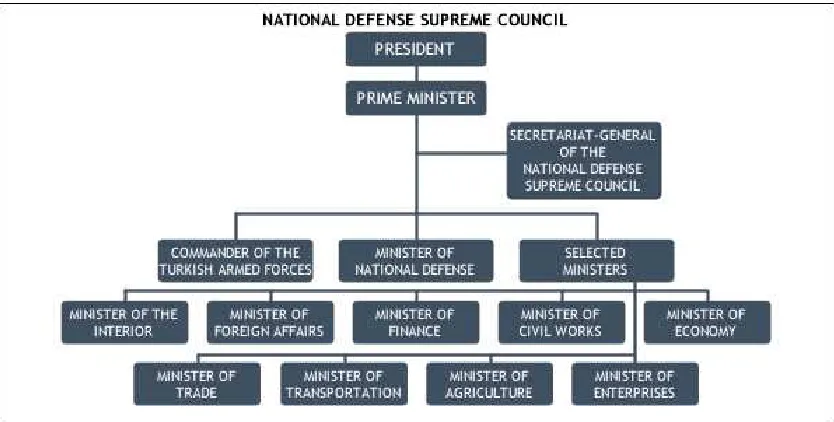
Table 4.1 National Defense Supreme Council ...93
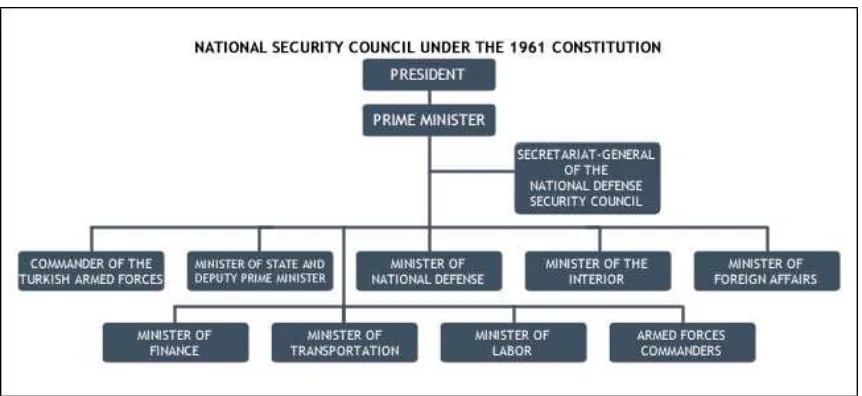
Table 4.2 National Security Council under the 1961 Constitution ...95
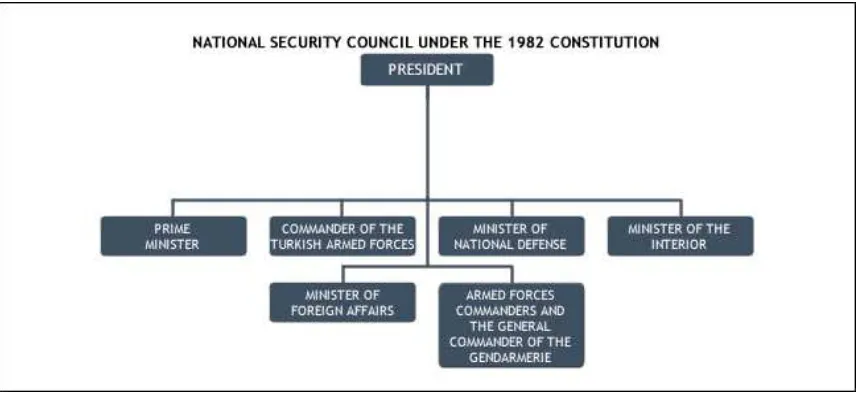
Table 4.3 National Security Council under the 1982 Constitution ...97
x
LIST OF FIGURES
Figure 6.1 Turkish-Israeli Trade in $ million (1994-2013) ...200
Figure 7.1 Turkey-Brazil Bilateral Trade (millions $)...280
Figure 7.2 Turkey-Greece Trade (Millions $) ...295
Figure 7.3 Turkey-Russia Trade (Millions $) ...295
Figure 7.4 Turkey-Iran Trade (Millions $) ...296
Figure 7.5 Turkey-Armenia Trade (Millions $) ...296
Figure 7.6 Turkey-Southern Cyprus Trade (Millions $) ...297
xi
LIST OF ABBREVIATIONS
AKP... Justice and Development Party
CUP ... Committee of Union and Progress
PKK...Kurdistan Workers Party
PRP ... People’s Republican Party
1
CHAPTER 1. INTRODUCTION
1.1 Objectives and Significance of the Study
The advent of the Justice and Development Party (AKP) to power by forming a
super majority government in the Turkish Parliament in 2002 heralded far reaching
implications not only for Turkey’s social, economic and cultural makeup but also in the
country’s foreign policy. The foreign policy practices under the AKP coupled with the
background and the pro-Islamic identity of the party brought about the oft asked
question; “Is Turkey leaving its traditional westward foreign policy direction in favor of
the East, creating a paradigm shift?” For example, the direction of Turkey’s foreign
policy orientation became a source of contention when Turkey set out to improve its
relations with the Bashir Regime in Sudan, openly siding with the Hamas Government in
Gaza severing the relations with Israel, and fostering more resilient ties with Russia and
China. Therefore, in this context, the question of a paradigm shift was merely posed
based upon the foreign policy snapshots of the time, omitting the bigger picture. What is
missing with this approach is that it fails to properly establish the concept of “paradigm”
in policy making and what constitutes “shift”.
By applying the policy paradigms theory with the focus of Peter Hall’s “Policy
Paradigms, this research seeks to establish whether there is an actual paradigm shift in
2
Turkey is leaving the West focusing on the East. Although predominantly applied to
Economic policies, the major theoretical and methodological contribution of the
dissertation is to set the groundwork for the application of the “Paradigm Shift” concept
as applied to foreign policy. As part of comparative case study, process tracing and
pattern matching techniques are employed. According to this, “process tracing focuses on
the unfolding of events or situations over time…To characterize process, key steps in the
process must be properly characterized.” 1
In order to accomplish this objective, this dissertation compares the instrument
settings, overall goals, instruments of policy and the ruling elite of the main paradigm,
Kemalism, with those of the Justice and Development Party (AKP). Furthermore, the
periods of the former prime minister and the president of Turkey, Turgut Ozal
(1983-1993) and the former Prime Minister Necmeddin Erbakan (1996-1997) were also
included in the comparative study as, like AKP, they too display signs of deviation from
the Kemalist paradigm. Additionally, these two prominent figures, their ideology and
their implemented policies culminated into the creation of those of the AKP.
This dissertation also aims to contribute to the literature on the impact of domestic
politics on foreign policy. A substantial part of this dissertation is devoted to evaluating
Turkey’s social, economic and cultural evolution since its inception in 1923 and how the
identity has had an impact on decision makers’ thinking, determining the priorities and
the means of the Turkish foreign policy.
3
The main idea of this dissertation, such that it corresponds to Hall’s definition of a
paradigm shift, is to examine if the AKP government has changed and reoriented the
instrument settings, overall goals, and instruments of policy in Turkey turning it towards
the East away from the West. The study has found that there is a paradigm shift.
However, the findings disproved the supposition that Turkey is leaving the West and
turning to the East as Turkey’s economic and political interaction with the West has
increased under the AKP administration. Turkey’s increasing interaction with
non-Western actors does not in fact constitute a complete detaching from the West but is
attributed to the nature of the emerging post-Cold War international environment.
Turkey’s aspirations to be a regional power, as well as an important international actor is
opting for more dynamic foreign relations, not leaving the West. It is just diversifying its
foreign policy options to include the East.
Finally, the research carries policy relevance. Due to its history, geography and culture,
Turkey’s relations with state and non-state actors in a vast geography from Eurasia and
Africa to North America, have important political, economic and cultural implications.
Especially, in light of the current tumultuous situation in the Middle East, the
Turkish-American relations in this context, political and economic changes in the European Union
and the recent resurgence of Russia in the Black Sea rim have made it more important to
understand the dynamics and practices of the Turkish foreign policy as well as the
thinking of the policy makers in Turkey. Therefore, this dissertation hopes to be a broad
source of information for those scholars and individuals who are interested in Turkish
foreign policy. Furthermore, considering that the internal socio/political evolution of and
4
attention, this dissertation also endeavors to contribute to the literature providing relevant
research information to understand the changes in Turkish domestic policy that brought
about changes in Turkish Foreign policy development.
1.2 The Outline of the Dissertation
Chapter two establishes the theoretical framework on which this dissertation rests.
Drawing from literature, it defines the concept of a policy paradigm, scrutinizing the
conditions which bring about change in those paradigms as well as the nature of
paradigmatic changes.
Chapter three conceptualizes the Kemalist paradigm in Turkey. It starts with a
comprehensive analysis of the events that took place in the late stages of the Ottoman
Empire that culminated into the creation of the Republic of Turkey by Mustafa Kemal
and the establishment of a new paradigm. The second part of the chapter comprises an
in-depth analysis of the ideological make-up of Kemalism, which has important implication
for the domestic and foreign politics. The last part of the chapter explores the impact of
the Kemalist ideology on the making of the Turkish foreign policy of the time referring to
the cases that were reflective of the Kemalist worldview.
Chapter four provides a comprehensive analysis of how the Kemalist paradigm
created and consolidated its ruling elite through institutional means, especially the
military and the civilian bureaucracy. This chapter includes the exploration of the
transition to democracy in the late 1940s and 1950s. The results of the first democratic
elections of 1950 has had profound impact on the relations between the existing Kemalist
ruling elite and the new rising, more conservative elite, whose five decade long of
5
to power. One of the most important parts of the chapter is the detailed examination of
the praetorian Turkish Military, who has been considered to be the defender of the
Kemalist values and the foundation of the republic. In this context, the means through
which the Turkish Armed Forces (TAF) established and maintained its privileged and
sovereign status within the state bureaucracy as well as the methods it employed to
control the civilian administrations based on Kemalist principles and the creation of a
securitization culture by TAF are examined. I found that with the failure of the Kemalist
civilian state machinery in 1950 to prevent the opposing entities from rising, the Kemalist
elite began to rely heavily on the Turkish Military, part of the Kemalist elite itself, in the
hopes of keeping such future challenges under control. Therefore, after the 1960 military
coup, the Turkish military became the single most important Kemalist entity to navigate
the civilian governments. Furthermore, this chapter provides an overarching inquiry of
the military-civilian relations in Turkey and aims to contribute to the related literature.
Chapters five and six are an in-depth exploration of the political movements that
display features that fall outside of the Kemalist realm in Turkey. Also, these movements
represent the rise of an alternative elite to that of Kemalism and they preceded the Justice
and Development Party, ideologically, especially in foreign policy, inspiring it. In
Chapter five, I scrutinized the Turgut Ozal Era (1983-1993). His period is relevant for
this dissertation in that Ozal challenged the status-quo oriented, stagnant, isolationist,
reactive orthodox Kemalist foreign policy tradition that persisted for decades in favor of a
more pro-active as well as culture based foreign policy, which then was coined as
“neo-Ottomanism” since it aspired for Turkey to become a more dominant entity in the
6
once was a dominant power. Ahmet Davutoglu, the architect of the AKP foreign policy
stated that Ozal inspired him greatly in his foreign policy making. Ozal overtly criticized
the Kemalist bureaucracy and ideology for its insufficiency to meet Turkey’s growing
demands in the post-Cold War era as well as the Kemalist demonization of the Ottoman
past. He clearly shows his intention to revive Ottoman multi-culturalism, and the
“glorious” days of that time.
I heavily resorted to qualitative document analysis by examining Ozal’s speeches,
related newspapers, parliamentary archives and documents. This chapter begins with
examination of the social, political and economic conditions that brought Ozal to power.
It scrutinizes his distinct personality and ideology that separated him from the
mainstream Kemalist paradigm. The next part of the chapter examines the Ozalist foreign
policy in action delving into the implications of the fall of the Soviet Union and how he
perceived it as an opportunity to fulfill his foreign policy aspirations as well as promote
his staunch pro-American stance during the Gulf War of 1991, which created friction
with the Kemalist military and bureaucracy. In the end, I find that while Ozal’s ten year
tenure, which ended abruptly upon his premature passing, display thoughts and practices
that run counter to traditional Kemalist approach, it cannot be said that he ushered in a
paradigm shift in Turkey for the very reason that the institutional, bureaucratic and
ideological fabric of the Kemalist paradigm remained intact despite Ozal’s efforts to
challenge them.
The sixth chapter dwells on Erbakan and his “Just Order Movement”. The
Erbakan movement represents the fruition of political Islam, the major blatant challenge
7
dissertation. Furthermore, the rise of political Islam epitomizes the demographic shift in
the form of a more Islamized population as well as the intensification of the identity
politics, which also has important implications for foreign policy. Finally, understanding
the movement is significant since the founders of the AKP are the former members of the
Erbakanist movement, who broke apart from it after the 1997 military ousting of
Erbakan, establishing the reform movement in Turkish political Islam.
The beginning of the sixth chapter offers a comprehensive explanation of the
nature and the rise of political Islam in Turkey. This is followed by the analysis of the
application of the Erbakanist ideology in Turkish foreign policy. While the Erbakan Era
Turkish foreign policy displayed activism as well as neo-Ottomanist elements, its heavy
reliance on pan-Islamic principles, limited the foreign policy priorities of the Erbakan
government to the Islamic world. The forcible overthrow of the Erbakan government by
the all-powerful Kemalist Turkish military demonstrated that the short lived Erbakan
government failed to create a paradigm shift.
The final and the seventh chapter is the overarching examination of the AKP
government. The first part of the chapter is divided into three parts; the examination of
the process that led to the inception of the AKP, as well as an in-depth analysis of the
ideological composition of the party and the subsequent successful ascent to power by
forming single party government in the parliament; the power struggle with the Kemalist
establishment, especially with the military and finally the consolidation of power, in
which the AKP government managed to subdue the military and took over the Kemalist
bureaucracy. The second part of the chapter seven is devoted to theoretical and operative
8
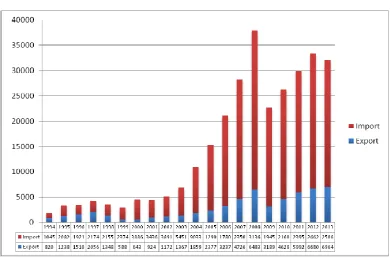
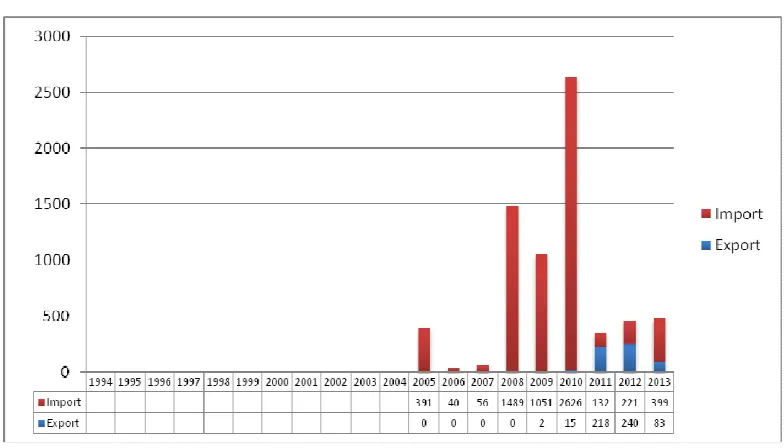
of case analyses. Additionally, export and import figures between 1994 and 2013, are
charted in order to determine whether there is a change of direction in Turkey’s economic
policy vis-à-vis its immediate neighborhood. The final section of Chapter seven contains
the comparative analysis of the institutional makeup of the foreign ministry under the
AKP government with that of the pre-AKP era.
The eighth chapter concludes the dissertation by providing a comprehensive
summary of the findings and the implications of the research to the Turkish foreign
9
CHAPTER 2. PARADIGM SHIFT CONCEPT IN THEORY
2.1 Introduction
The importance of using the policy paradigm concept has been proven significant
in evaluating and understanding the interplay between the ideas, organizations and related
actors who are involved in political and organizational process. According to Marcus
Carson et al. the policy paradigm concept can be used to explain the key ingredients of
paradigms, how they form, develop, institutionalize and de-institutionalize as well as how
paradigm shifts occur.2
Louis Moreno argues that overall, paradigms offer a novice means to gather
scientific data, new problem solving techniques, and even enable us to find new solutions
that existing paradigms fail to expound. Thanks to paradigms we are able to understand
how important political and social actors behave when they attempt to solve important
problems. He says, “Paradigms, value systems and réferentiels provide normative and
cognitive elements, which shape principles and actions adopted by actors within the same
frame.”3
Policy paradigm, which Marcus Carson calls ‘a powerful, cognitive-normative
concept’, allows us to theorize such aspects of policymaking as interests, goals and
solutions. A policy paradigm is defined as a “generally coherent complex of assumptions
2 Marcus Carson, Tom R. Burns, Dolores Calvo eds. (2009) Paradigms in Public Policy: Theory and
Practice of Paradigm Shifts in the EU. Peter Lang GmbH. 1st edition. pp. 11-12.
10
and principles, simplifying metaphors, and interpretive and explanatory discourses”. It
represents a shared conceptual framework through which adherents envision "how things
should be" and "how the world works", and with which they define the kinds of issues
that should be considered social problems. This conceptual frame-work helps impose
order on a chaotic environment in which actors engaged in making or influencing public
policy are frequently required to make decisions with limited expertise, inadequate or
contradictory information, and often on a comparatively short time frame.4
One of the most widely recognized conceptualization of policy paradigm is that of
Peter A. Hall. Hall derives this conceptualization from Charles Anderson's "the Logic of
Public Problems: Evaluation in Comparative Policy Research" in which Anderson states
"the deliberation of public policy takes place within a realm of discourse...policies are
made within some system of ideas and standards which is comprehensible and plausible
to the actors involved.”5 In other words, Hall is convinced that policymakers routinely
work within a framework of ideas and standards that specifies not only the goals of
policy and the kind of instruments that can be used to attain them but also the very nature
of the problems they are meant to be addressing.6 It is this point that Hall utilizes Thomas
Kuhn’s notion of scientific paradigms to better explain Anderson's "system of ideas and
standards".7 According to Hall, policy paradigms can be seen as one feature of the overall
terms of political discourse. They suggest that the policymaking process can be structured
4 Carson et.al, p. 17
5 Peter A. Hall. (1993) "Policy Paradigms, Social Learning, and the State: The Case of Economic
Policymaking in Britain", Comparative Politics 25 (3), p. 279. Quoted from: Charles Anderson, "The Logic of Public Problems: Evaluation in Comparative Policy Research," in Douglas Ashford, ed., Comparing Public Policies (Beverly Hills: Sage, 1978), p. 23
6 Hall, p. 279.
7 Thomas Kuhn (1970) The Structure of Scientific Revolutions, Chicago University of Chicago Press, pp.
11
by a particular set of ideas, just as it can be structured by a set of institutions. He further
argues that the two often reinforce each other since the routines of policymaking are
usually designed to reflect a particular set of ideas about what can and should be done in
a sphere of policy.8
Hall's main concern is to explain factors that bring about the stability as well as
the precipitating factors that create paradigmatic change. Hall's dependent variable is
policy change and he is more interested in explaining not a single change but the nature
of change in general. Some of the questions of interest are "Is it typically incremental, is
it immune from radical change?” or, is it perhaps prone to the characteristics of
punctuated equilibrium?" This would indicated that policy change is minimal most of the
time but liable, on rare occasion, to be quite dramatic. One of the most important
explanatory variables is the ideas due to the fact that policy change is typically highly
constrained because the ideas that support the status quo remain extremely powerful.
However, in the presence of paradigmatic shifts the policies themselves can be
transformed, creating a new equilibrium and a severe break from the past. 9
In discussing paradigm shift, Hall identifies three orders of change in a policy
environment or domain. The first-order is the “process whereby the [policy] instrument
settings are changed in the light of experience and new knowledge, while the overall
goals and instruments of policy remain the same…” The process of first order change is
likely to display the features of incrementalism, satisficing, and routinized
8 Hall. p. 290
9 Frank R. Baumgartner. (2012) "Ideas and Policy Change", Governance: An International Journal of
12
making that we normally associate with the policy process.10 First order change is likely
to be ongoing, incremental and often routine - "normal" policymaking.11
With second-order change, the hierarchy of goals remains largely the same;
however, the basic methods used to achieve these goals are altered due to dissatisfaction
with the prevailing policy. Hall notes that such changes can lead to a situation where “the
instruments of policy as well as their settings are altered in response to past experience
even though the overall goals of policy remain the same”12 Second order change
represents increasingly "strategic action" in developing policy, but does not directly
challenge the fundamental goals of policy, and is therefore less likely to be conflict
ridden. 13
Hall refers to the third-order change as policy making marked by radical changes
in the overarching terms of policy discourse creating a policy paradigm shift.Third-order
change entails simultaneous changes in instrument settings, instruments themselves, and
the rearrangement of policy goals. He argues that the third-order change occurs when an
emerging policy failure leads to the discrediting of an old paradigm, which subsequently
leads to “a wide-ranging search for alternatives and to a process of experimentation with
modifications to policy.”14 The movement from one paradigm to another that
characterizes third order change is likely to involve the accumulation of anomalies,
experimentation with new forms of policy, and policy failures that precipitate a shift in
the locus of authority over policy and initiate a wider contest between competing
13
paradigms. 15 This contest may well spill beyond the boundaries of the state itself into
the broader political arena. It will end only when the supporters of a new paradigm secure
positions of authority over policymaking and are able to rearrange the organization and
standard operating procedures of the policy process so as to institutionalize the new
paradigm.16
First and second order change can be seen as cases of "normal policymaking,"
namely of a process that adjusts policy without challenging the overall terms of a given
policy paradigm, much like "normal science." Third order change, by contrast, is likely to
reflect a very different process, marked by the radical changes in the overarching terms of
policy discourse associated with a "paradigm shift." If first and second order changes
preserve the broad continuities usually found in patterns of policy, third order change is
often a more disjunctive process associated with periodic discontinuities in policy.17
Hall goes on giving examples to these three orders of changes. For the first order
change Hall gives the example that the levels (or settings) of the basic instruments of
British policy, such as the minimum lending rate or the fiscal stance, were altered at
frequent intervals during the 1970-89 period, even when the overall goals and
instruments of policy remained the same. Most of the adjustments made in the annual
budget took this form: the settings of the government's policy instruments were modified
in the light of past experience and projections for the future performance of the economy.
We can call the process whereby instrument settings are changed in the light of
14
experience and new knowledge, while the overall goals and instruments of policy remain
the same, a process of first order change in policy.18
Second, there were several instances in the 1970-89 period when the hierarchy of
goals behind British macroeconomic policy remained largely the same but the basic
techniques used to attain them were altered, as a result of dissatisfaction with past
experience. These episodes included the introduction of a new system of monetary
control in 1971, the development of a new system of "cash limits" for public spending
control in 1976, and the movement away from strict targets for monetary growth in
1981-83. Changes of this sort, when the instruments of policy, as well as their settings, are
altered in response to past experience even though the overall goals of policy remain the
same, might be said to reflect a process of second order change.19
Finally, when monetarism replaced Keynesianism as the template guiding policy,
there was a radical shift in the hierarchy of goals guiding policy; the instruments relied on
to affect policy, and the settings of those instruments. Moreover, these changes were
accompanied by substantial changes in the discourse employed by policymakers and in
the analysis of the economy on which policy was based. In short, the third order change
in British policymaking that occurred during this period was accompanied by a wholesale
shift in policy paradigms.20
One aspect of the third order change that Hall emphasizes is the simultaneous
shift in authority. He says the center of authority over macroeconomic issues began to
shift. Although the movement began around 1976, the most intense break in policy came
15
after a Conservative government led by Margaret Thatcher was elected in 1979. Not only
were the settings of policy changed but hierarchy of goals and set of instruments
employed to guide policy shifted radically as well. Inflation replaced unemployment as
the preeminent concern of policymakers. Macroeconomic efforts to reduce
unemployment were rejected in favor of balanced budgets and direct tax reductions.
Monetary policy replaced fiscal policy as the principal macroeconomic instrument, and it
was reoriented toward fixed targets for the rate of monetary growth. Many regulatory
instruments associated with state intervention, such as incomes policies, exchange
controls, and quantitative limits on bank lending, were eliminated. To Hall, this was a
clear case of third order change in policy.21
Frank Baumgartner asserts that Hall's “third-order” change, in order to happen,
may require a serious degree of discredit to the status quo policy and to its protectors.
Things that could produce such change include obvious policy failures or crises that
occur “on the watch” of a set of incumbent policymakers. When the terrorist attacks of
September 11, 2001 occurred, it was clear that major elements of U.S. intelligence had
failed and that airport security procedures were insufficient. No one stepped forward to
defend these policies, especially the private security firms that hired poorly paid and
relatively ill-trained personnel to screen passengers in airports. The creation of the
Transportation Security Administration was not particularly controversial in spite of the
fact that it was a Republican administration creating a vast new public bureaucracy. So, it
is clear that obvious policy failures can discredit the status quo, sometimes even to the
16
level that the incumbents who benefit from or who implement the existing policy do not
even mobilize to protect it, knowing that this is a hopeless cause.22
Lawrence C. Reardon states that paradigm shifts can be either comprehensive or
sectoral. The former takes place when revolutionary elites undergo complex learning
initiated by the absolute rejection of the polity adaptations adopted by the country's ruling
elites. Such was the case in 1917 and 1949 when the Soviet and the Chinese communist
revolutionaries became the new ruling elites; they fundamentally transformed the state's
political, economic and social structures. Sectoral paradigm shift occurs when policy
elites learn that adaptations of policy strategies have failed over time. According to
Lawrence, this type of paradigm shift includes many of the anti-authoritarian "color"
revolutions in Eastern Europe and Central Asia since 2000, which he classifies as
political; China's transition from a revolutionary to techno-economic paradigm as
economic; and the United States’ adoption of the Civil Rights Act of 1964, as social.23
Marcus Carson, Tom R. Burns, and Dolores Carvo state that paradigm shifts
entail fundamental, conceptual and organizational changes, which guide policy in a
markedly different direction than previous paradigms. Such shifts are the result of the
creation of a new-problem solving model within a particular policy sector. These shifts
manifest themselves in the reconfiguration of the core principles used in defining the
nature of policy problems and in guiding political problem solving activities.24
The term paradigm shift is best used to characterize what amounts to conceptual
and organizational tipping points in an ongoing, often incremental process of adjustment
22 Frank Baumgartner. (2013) Ideas and Policy Change, Governance, Volume 26, Issue 2, April, p. 253. 23 Lawrance C. Reardon. (2012) Shifting Global Paradigms and Obama's Adaptive Foreign Policy, in
William Crotty (ed.) The Obama Presidency: Promise and Performance. Lexington Books. pp. 116-17.
17
that began long before the actual "shift" is said to occur and is likely to continue for some
time afterwards. That is to say, Carson et al. define the concept of paradigm shift as the
articulation of a new model and the initial concrete steps taken to realize that model in
practice. Given the nature of the process, they continue to argue, it is likely that the
actions constituting paradigm shift cannot be pinned down to a single moment in time
and that should be considered as a phrase in a broader process of change. Therefore, the
institutionalization of paradigm shift is best understood as a process rather than a point of
time and constitutes changes in the institutional arrangement, a rule regime that gives
effect to reordering of guiding principles and redefinition of policy problems through
changes in regulatory, organizational, and relational structures. 25
Another important point that Carson et al. make regarding the policy paradigm
shift is that due to its lengthy duration of institutionalization, and such institutionalization
must frequently take place within a variety of existing, organizational/ institutional
cultures, policies adopted after the paradigm change may not be greatly consistent with
the new paradigm. An operative policy paradigm may not be necessarily
contemporaneous with the conceptual framework that has guided it.26
Paradigms are complexes ideas of how to conceptualize, analyze and deal with
public issues. In that vein, one of the important features of policy paradigms is that
paradigm transformation entails a fundamental restructuring of elements of such
problem-solving and organizational complexes and the relations between them. This
reconfiguration may or may not entail the introduction of new principles or goals. Carson
et al. found in their case studies that new principles are introduced and adopted
18
incrementally as considerations that temper the application of existing institutionalized
paradigm. The paradigm shift can be identified in some form of the re-ordering of core
principles. When competing goals came into conflict with one another, the new paradigm
is distinguishable in terms of a different priority ordering of principles, and thus different
kinds of problem definitions, preferred remedies, authorities and experts, and ultimately
different outcomes.27
The paradigm shift can be identified in some form of re-ordering of core
principles whereas changes in the periphery do not constitute a paradigm shift. When
competing goals come into conflict with one another, the new paradigm is distinguishable
in terms of different priority ordering of principles and therefore different kinds of
problem definitions, preferred remedies, authorities, experts and eventually different
outcomes.28
In general, the analytical strategy is to trace the process of fundamental policy
change as it evolves from ideas and through action to become institutionalized. The basic
elements of this change process include: a) the emergence of new phenomena that are
defined as problems or the redefinition of existing phenomena as pressing problems, then
impelled by new claims and demands for structural change made by organized interests
and policy entrepreneurs, b) the replacement of an established complex of policy ideas
with a new one that is not comparable in the same terms, and c) the institutionalization of
the new set of ideas in the form of new norms, policy competencies, revised or new
19
organizational structures and goals, and new types or groups of actors defined as having a
legitimate role to play.29
Replacing an earlier elite to institutionalize the new paradigm may occur relying
on force, as in coup d'état or violent revolution or through democratic process, such as
elections or nominations, societal negotiation, or generational cohort shift. A new group
or coalition with a new paradigm or model of institutional arrangements appears on the
scene and assumes a position of power, enabling it to bring about a substantial shift in the
institutional paradigm and arrangements. This may be, but is not necessarily, proceeded
by a breakdown in consensus among established power elites about the appropriate
paradigm or about reform of the existing paradigm. However, a breakdown in consensus
facilitates a coalition between parts of the elites and the contender groups, which refuse
to defer to the established authority or to adhere to the established, rule regime and its
organizing principles and norms. Such new, emerging coalitions were apparent in the
case of "peaceful" revolutions in, for example, Poland or Hungary, in 1989, which
involved negotiated settlements and elections. In Poland the negotiated elections brought
unexpected victory to groups advancing liberal market and political paradigms.30
Carson et al. summarize the conditions of paradigm shifts as follows:
(1) Policy failures, anomalies. A "paradigm crisis" arises when policy failings
occur and accumulate, or cognitive and control problems emerge (policies and programs
lead to unacceptable or negative unintended consequences), and the status and authority
of the original policy paradigm is undermined. The negative judgments may be those of
20
key authorities or experts associated with the established paradigm- or, more often,
challengers to the authority and expertise of the established groups.
(2) Emergence of new ideological ideas, a change in the normative context.
Initiatives to change paradigm, in such a way, that a restructured paradigm is perceived or
judged to fit better or to be more compatible with global values and norms. Those
responsible and/or experts are driven to adopt these ideas and values or are pressured by
their constituencies or the general public. These generalized norms may concern gender
equality, security, health, etc.
(3) Power gain. Power agents propose (or adopt) a new paradigm as a way of
enhancing their power and/or undermining the power of those associated with the
established paradigm. There may be no anomalies or performance failings of the
established paradigm.
(4) Competition. Political or group competition may pressure a group to
differentiate themselves from others. Interest in differentiating "them" from "us" results
from agential processes in a group configuration or network.
(5) Breaking of Solidarity. A key shift in a paradigm, such as a transformation of
dominant values (e.g. increased value placed on the environment or social welfare (or on
the market) in conjunction with an economic crisis (and relative decrease in government
revenues, or increases in the cost of fuel) may contribute to conflicts and the breakdown
of an existing coalition, e.g. in an oligarchy or a majority within a polyarchy. For
instance, this has happened in the case of social welfare coalitions; or, environmental
21
(6) Problematic change in practice. Paradigm shifts result more from changes in
institutional practices. The Marxian conception of the "contradiction" between
institutional arrangements/cognitive-normative components ("the relations of
production"), on the one hand, and new knowledge, new technologies, new practices
("the forces of production") sets the stage for "revolution" (of course, there are other
possibilities, such as suppression of "forces of production").
(7) Failure of Change Efforts. The failure of mass mobilization to bring about a
paradigm shift when structural conditions (problem situation or crisis) seem otherwise
ripe may be accounted for by the absence of a resonant paradigm and/or insufficient
power to overcome a dominant regime.31
While changes may involve one or more of these dimensions, changes in radical
nature would include significant changes in multiple dimensions. Even if only a few
dimensions are changed initially, some changes have much greater secondary
consequences than others. Examples of such changes are:
• Shift from public agency responsibility to private (the laws, incentive
structures etc. differ substantially),
• Shifts from covering one population (the middle class) to another (lower
classes or marginal groups), or both,
• Shifts from narrow scope of policy to comprehensive scope, which will
affect many more us and involve a much greater array of methods, types of
knowledge and expertise.32
22
Michael J. Oliver and Hugh Pemberton refer to Hall's propositions as deliberate
evocation of Thomas Kuhn’s argument that scientific paradigms “gain their status
because they are more successful than their competitors in solving [the] problems that the
group of practitioners has come to recognize as acute”33 In Hall’s schema, Oliver and
Pemberton argue, first and second order change are essentially the same as Kuhn’s
“normal science” but third order change amounts to a revolution in ideas and practice in
policy and the replacement of one policy “paradigm” by another.34
While ideas as policy solutions may exist, their proponents must wait for the right
opportunity to present them and have them adopted. This shifts the focus from an ‘idea
whose time has come’, suggesting inevitability to the need for a range of conditions to be
satisfied before a policy will change, suggesting uncertainty and that the receptivity to,
and acceptance of, the idea is more important than the idea itself.35
Robert C. Lieberman suggests, an idea’s time arrives not simply because the idea
is compelling on its own terms, but because opportune political circumstances favor it. At
those moments when a political idea finds persuasive expression among actors whose
institutional position gives them both the motive and the opportunity to translate it into
policy-then, and only then, can we say that an idea has found a time.36
33 Kuhn, p. 23
34 Michael J. Oliver Hugh Pemberton, Learning and Change in Twentieth-Century: British Economic
Policy, Center for European Studies. Working Paper No. 09, p. 3
(http://www.people.fas.harvard.edu/~ces/publications/docs/pdfs/OliverPemberton.pdf)
35Kettell Steven and Cairney Paul (2010) 'Taking the Power of Ideas Seriously - the Case of the United
Kingdom's 2008 Human Fertilization and Embryology Bill', Policy Studies, 31: 3, pp. 303- 304.
http://www.researchgate.net/publication/232911183_Taking_the_power_of_ideas_seriously__the_case_of_ the_United_Kingdom's_2008_Human_Fertilisation_and_Embryology_Bill
23
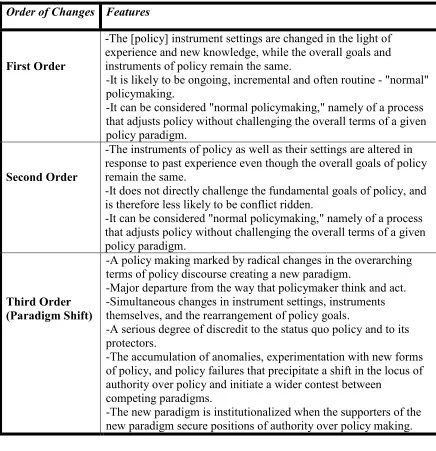
Table 2.1 Order of Changes
Order of Changes Features
First Order
-The [policy] instrument settings are changed in the light of experience and new knowledge, while the overall goals and instruments of policy remain the same.
-It is likely to be ongoing, incremental and often routine - "normal" policymaking.
-It can be considered "normal policymaking," namely of a process that adjusts policy without challenging the overall terms of a given policy paradigm.
Second Order
-The instruments of policy as well as their settings are altered in response to past experience even though the overall goals of policy remain the same.
-It does not directly challenge the fundamental goals of policy, and is therefore less likely to be conflict ridden.
-It can be considered "normal policymaking," namely of a process that adjusts policy without challenging the overall terms of a given policy paradigm.
Third Order (Paradigm Shift)
-A policy making marked by radical changes in the overarching terms of policy discourse creating a new paradigm.
-Major departure from the way that policymaker think and act. -Simultaneous changes in instrument settings, instruments themselves, and the rearrangement of policy goals.
-A serious degree of discredit to the status quo policy and to its protectors.
-The accumulation of anomalies, experimentation with new forms of policy, and policy failures that precipitate a shift in the locus of authority over policy and initiate a wider contest between
competing paradigms.
24
CHAPTER 3. THE KEMALIST PARADIGM
3.1 Introduction
It is crucial to recognize that the fundamentals of Turkish policy were conceived
and implemented by the founder of the republic, Mustafa Kemal Ataturk between 1923
and 1938. These standards and code of conducts that he created became so embedded in
the Turkish politics that literally every government and policymaker who came after him
strove not to veer off from them and those few who did or believed to have done so were
labeled as the traitor to his legacy and to the republic. Therefore, it would not be wrong to
call these principles “indisputable dogmas” to denote that they are religiously perceived
unquestionably and implemented unconditionally.37
This chapter is an in-depth exploration of many aspects of the Kemalist paradigm
in Turkey. The chapter starts with an analysis of the conditions of the very late stages of
the Ottoman Empire, out of which the Kemalist ideology was born. A good grasp of the
historical background of Kemalism is important as it will be a useful tool to compare
between the Kemalist paradigm, which is seen as the anti-thesis of the Ottmanism, and
the Justice and Development Party (AKP) policy making, which is considered to have
undertaken the task of reviving the principles of the Ottomanist policy making. The
second part of the chapter will analyze the birth and the institutionalization of the
Kemalist ideology in the newly created Turkish Republic. The final part will study how
25
the Kemalist ideology and the conditions of the time laid the foundations of new
republic’s foreign policy as well as its evolution after the death of Mustafa Kemal.
3.2 In Search of a Paradigm
Mustafa Kemal was a soldier in the last decades of the crumbling Ottoman
Empire. Therefore, his experiences during his time in the Ottoman army greatly shaped
his worldview, thus it shaped the paradigm he would create for Turkey. The late 19th
century was extremely gloomy for the Empire. Among the territories that had already
been lost was Greece (1832), Egypt (1882) Bosnia and Herzegovina (1878). To make
matters worse, Trablusgarb (today’s Libya) was occupied by the Italian forces only to be
lost in 1912. The sultans and the bureaucrats endeavored to implement a series of reforms
to amend the military and daily life but they were proven ineffective. The most
detrimental development for the empire turned out to be the impending upsurge of
nationalism and ensuing involvement of European powers in the Ottoman domestic
politics. Because of “the capitulations”, the Ottoman Empire continued to lose power
against Russia, Great Britain and France, as these powers intensified their patronage over
such Christian subjects as the Greeks and the Armenians.
It is important to point out that the Ottoman Empire did not constitute a nation
state nor were its subjects recognized based on their nationality. The Millet System38 that
38 Bernard Lewis states that the relationship between the Ottoman state and its non- Muslim subjects was
bound by the Islamic law. Because Islam recognizes Christianity and Judaism and their followers as being the people of the book, they were allowed to practice their faith and tradition; were guaranteed their personal and property security. The adherents of these religions were subject to their respective
26
the Ottoman Empire implemented for centuries to govern its vast territories stipulated
that the subjects be divided into Muslims and non-Muslims, rather than their ethnic
background. Therefore, such concepts as Arab, Greek, Armenian and Turk were foreign
to the Ottoman ruling elite. This aspect of the Ottoman governance would later play a
great role in the creation of ideologies that were aimed to save the Ottoman Empire from
collapsing.39 This is an important point because it will play a great role in shaping
Ataturk's policy making before and after the establishment of the Republic of Turkey and
has serious implications in the debate whether the AKP government, which adopted a
more pro-Ottoman approach in both domestic and foreign policy, is shifting its foreign
policy making paradigm away from the established Kemalism.
Bernard Lewis concedes that it was the religion of Islam not the ethnic
background of Muslims that kept them loyal to the Ottoman sultan, who was at the same
time the Caliph. He was considered to be the ultimate epitome of Islam for the Ottoman
society while at the same time acted as the commander in chief. His religious role
overshadowed all his other roles, including the military one. Because of this reason, the
Sultan was a Muslim before anything else. Hence, it would not be wrong to assume that
the concept of Turkishness as we see in the Kemalist Turkey was not applicable to the
Ottoman Empire. Therefore, the ruling elite and the Sultan did not really resort to the
concept of Turk or Turkishness to define themselves or the empire, although they were
cognizant of their ancestral background. This began to change through the mid-19th, the
Tanzimat (Reorganization) Era, when it became evident to the ruling elite and the sultan
that serious measures had to be taken to halt or even reverse the fast implosion of the
empire. While the need for a drastic change was acknowledged, what was not agreed
27
upon was the method by which it was to be implemented. Because of this divergence,
several movements were put forward. Most important of these were Ottomanism,
pan-Islamism and Westernism/Turkism. 40
In the following section, I will explain these streams of ideologies that impacted
the last decades of the Ottoman Empire.
3.2.1. Ottomanism
One of the ideological movements was the Ottomanism. According to this the
empire could be saved if the non-Muslim entities were to be declared equal with the
Muslims in order to construct, what Yelda Demirag of the Baskent University coins, a
"we-feeling of being Ottoman" and an incorporating "Ottoman nation".41
The roots of this movement go back to the Greek independence. The secession of
the Greeks prompted the need for a new constitution by the sultan, named the Tanzimat
Fermani (Imperial Edict of Reorganization), which was declared in Istanbul in 1839. This
ensured the legal equality of the Muslim and non-Muslim subjects. Although the ruling
elite of the Empire hoped that this new constitution would quell the resentments of
non-Muslims, fortifying their loyalty to the sultan and thus the empire, the European powers
deemed it an exceptional tool to meddle with domestic politics of the Ottomans. The new
reforms only deteriorated the situation in the Balkan territories of Ottoman, where the
majority of its non-Muslim subject lived, only aggravating the nationalistic feelings.42
Through the end of the 19th century it was evident that Ottomanism was due to fail.
40 Eligur, p. 39
41 Yelda Demirag, (2005) Ideologies In The Ottoman Empire Against The West: From Pan-Ottomanism To Pan-Turkism, Turkish Yearbook Vol. 36. p. 145
28
The signs of failure began to emerge when the Muslim subjects expressed
displeasure that they were rendered equal with non-Muslims. The Ottoman-Russian War
of 1877-78 was the real blow to the Ottomanist idea as the Ottoman Empire lost its
Balkan territories (Romania, Serbia and Montenegro), where most of the non-Muslims
Ottomans lived. The Muslim influx from these territories into the Ottoman heartland,
Anatolia, and the only remaining territories outside Anatolia, albeit under the British and
French threat, were those of the Middle East and North Africa. The influx of Muslims
into Anatolia brought the idea of pan-Islamism.43
3.2.2 Pan-Islamism
The dismal defeat against the Russians prompted the rescinding of the
constitution by Sultan Abdulhamid II (1842-1918). Having realized that the European
style governance did not work, he resorted to the idea of Muslim unification in order to
save the empire. The fact that now the Muslims in the empire made up of the majority of
population reinforced his hopes. His title “Caliph”, the ruler of all Muslims, would be
functional not only to coalesce the Muslims at home but also those who were in India and
South East Asia. The emphasis in the splendor of bygone Arab-Islam past which
appealed to Muslims, especially those in the Middle East only resulted in the Arabs’
gaining their national consciousness. This even resulted in the emergence of such ideas
among Arabs such as Arabic is the language of the Qur’an, hence Arabs were the chosen
people of Allah. All this was in conjunction with the rising British and French influence
on Arabs. In the early 20th century, with the dismantling of the Ottoman Middle East, it
was proven that pan-Islamism too was in vain.44 Eventually, it became evident that
29
Islamism turned out to be a futile effort to save the empire as the Arabs, one of the most
important Muslim nations in the empire, put their ethnicity in front of the religion.
Despite Abdulhamid's efforts to use Islamism, the empire was losing territories in the
Middle East and North Africa.
3.2.3 Pan-Turkism/ Westernism
When Abdulhamid’s pan-Islamist movement failed to address the problem of
dissolution, secular ideas gained prominence. In this regard, the Ottoman Committee of
Union and Progress (CUP) was established by the Young Turk movement in 1889 in
defiance of the Sultan. The Young Turks were heavily influenced by such European
streams of thought as scientific materialism and Social Darwinism. Pan-Turkism was also
part of their worldview.45 Also, pan-Turkist ideology was a principal one in the CUP.
Among the prominent members of CUP and pan-Turkist, Yusuf Akcura, who at
the same time was a close friend of Mustafa Kemal, urged the Ottoman rulers to embrace
pan-Turkism, which aimed at resuscitating the Turkish nationalism and uniting not only
the Ottoman Turks but also the Turks in the Caucasus and Central Asia. This idea of
uniting the Turks across the Eurasia was a new concept in history.46 To him, this
endeavor was a new one and not even Genghis Khan, let alone the Ottoman Empire,
whose founders were of Turkic origin, had ever pursued such an ideology.47
The prominent Turkologue Jacob M. Landau argues that the secular nature of
pan-Turkism in the second part of 19th century is worth noting because it meant that the
45M. Şükrü Hanioğlu, (2010) A Brief History of the Late Ottoman Empire. Princeton, NJ: Princeton
University Press, p. 138.
46 Hanioğlu, pp. 146-147 (Quoted from Yusuf Akçura, Üç Tarz-I Siyaset (Cairo: Matbaa-I İctihad, 1907),
pp. 4-12.)
30
pan-Turkists had been convinced that Islam was not strong enough an identity to retard
the dissolution of the empire.48
One of the most remarkable developments in the late history of the Ottoman
Empire took place in 1906 when the anti-Abdulhamid opposition of bureaucrats, military
officers and members of the CUP united under the Ottoman Freedom Society, in the then
Ottoman city Salonika (in today's Greece). Now, with the military on their side, there was
virtually nothing blocking the path of the CUP to keep them from openly confronting the
sultan. In July 1908, the CUP staged a coup against Abdulhamid, which culminated into a
revolution, whose motto was “Liberty, Equality, Fraternity and Justice". According to
Sukru Hanilioglu, this revolution is different from other European revolutions such as the
French and Russian in that the purpose was not to replace the absolutist monarch but to
reinstate the constitutional governance as well as the parliamentary rule, which had been
dissolved in 1878. Hanilioglu notes that the CUP members did not want to eradicate the
monarchy because they wanted to "pull the levers of imperial power”. From its
ascendance to power in 1908 to the end of World War I, the CUP was the sole ruler of the
Ottoman Empire rendering the monarch powerless but left as a figure-head.49
In conjunction with their ideology, the CUP began to carry out reforms to
secularize many aspects of the Ottoman life, from education, such as mandatory foreign
language, to judiciary, by which they sought to diminish the authority of religious clergy
over the Sultan. As part of their attempt to westernize the Ottoman society, the CUP
31
abolished polygamy, introduced women’s rights, and supplanted the fez in favor of
European type head gear.50
Most members of the Young Turk movement were staunch advocates of 19th
century German materialistic idea of “Vulgärmaterialismus”, which combines the
principles of materialism, Darwinism and scientism, thereby they aimed to maintain such
scientific understanding in the society. The roots of the official state ideology that we
have in modern Turkey has its roots in the Young Turks period.51 The official state
ideology of modern Turkey was shaped during the period of the early Young Turks and
to this day has continued to influence Turkey's intellectual and political life.52 It would
not be erroneous to assume that being a member of the Young Turks movement, the
founder of modern Turkey, Mustafa Kemal, was heavily influenced by the policies that
were conceived and implemented by the CUP.53
It is at this point that it is important to examine how the Young Turks influenced
Ataturk and in turn how his policies created and shaped the future of the newly
established Republic of Turkey.
3.3 The Birth of the Kemalist Paradigm in Turkey
The end of World War I sealed the fate of the 600-year-old empire. Having been
an experienced and successful commander in the Ottoman ranks, Mustafa Kemal
capitalized on the power vacuum created by the implosion of the empire. Having won the
Turkish independence war against the British, French, Italians, Greeks and Armenians,
the Kemalist clique deposed the Sultan and established the new Turkish republic in 1923.
50 Yucel Bozdaglioglu, Turkish Foreign Policy and Turkish Identity: A Constructive Approach, pp. 43,44. 51 M. Sukru Hanioglu (2011) Ataturk: An Intellectual Bibliography, Princeton University Press. pp. 49-50 52 M. Sukru Hanioglu. The Young Turks in Opposition. p. 3.
32
The Kemalist triumph of Westernism marked the end of a power struggle among the
ideologies that competed to save the empire. Given his experiences in the battlefronts and
the CUP ranks, M. Kemal was convinced that it was impossible to continue with the
legacy of the Ottoman Empire hence the need for a clean slate. That is to say, to Ataturk,
this newly emerging nation-state, of which he was the architect, ought to be completely
detached from its past. Therefore, first and foremost, the Kemalists launched a
comprehensive de-Ottomanisation campaign to eradicate the Islamic/Ottoman state
institutions. The complete overhaul of state alone would not have been meaningful if the
society remained Ottoman. Thus, the extensive restructuring of the society was set to be
one of the major endeavors of the Kemalists. M. Kemal was adamant about creating a
society and a state identity based on western values. To him, the two had to go in hand in
hand because the divergence between state and social identity would create a legitimacy
problem.54
Above all, the catastrophic experiences of the past century that lead to the
impending collapse of the empire prompted the Kemalist elite55 of the newly established
republic to concede that in order to be able to hold onto the hard earned territory, a
strongly centralized state and ethnically homogenized nation was paramount. Therefore,
the Turkification efforts in the new republic went as far as changing the Kurdish or
54 Yücel Bozdaglioglu (2003) Turkish Foreign Policy and Turkish Identity: A Constructivist Approach,
New York: Routledge p. 45, http://www.questia.com/read/106192540.
55 According to Bozdaglioglu, the Western oriented Kemalist reforms contributed greatly to the creation of