University of South Carolina
Scholar Commons
Theses and Dissertations
6-30-2016
Creating and Implementing Community-Based
Performance Programs: A Guide for the Applied
Studio Teacher
Lauren Watkins
University of South Carolina
Follow this and additional works at:https://scholarcommons.sc.edu/etd Part of theMusic Performance Commons
This Open Access Dissertation is brought to you by Scholar Commons. It has been accepted for inclusion in Theses and Dissertations by an authorized administrator of Scholar Commons. For more information, please [email protected].
Recommended Citation
CREATING AND IMPLEMENTING COMMUNITY-BASED PERFORMANCE PROGRAMS: A GUIDE FOR THE APPLIED STUDIO TEACHER
by
Lauren Watkins
Bachelor of Music
The Ohio State University, 2011
Master of Music
University of Southern California, 2013
Submitted in Partial Fulfillment of the Requirements
For the Degree of Doctor of Musical Arts in
Performance
School of Music
University of South Carolina
2016
Accepted by:
Jennifer Parker-Harley, Major Professor
David Cutler, Committee Member
Joseph Eller, Committee Member
Rebecca Nagel, Committee Member
DEDICATION
For Alana, Brittany, Jessica, and Siri
ACKNOWLEDGEMENTS
My professor and advisor Jennifer Parker-Harley was instrumental in the
development of this document. Her editing expertise was a tremendous help, and I am
most appreciative of the advice and direction she has provided during my doctoral
degree. My committee members, Dr. Nagel, Dr. Cutler, and Professor Eller, offered
wonderful comments and insights that helped strengthen this document. Please accept my
sincere gratitude for your time and effort.
Words cannot express the acknowledgement that I owe my family and close
friends for endless support both in my personal life and during my educational pursuits. I
would not be where I am today if it were not for the guidance and support from my
wonderful parents and the never-ending encouragement from my brother.
Last but never least, I must acknowledge all of my wonderful flute teachers and
chamber music coaches who have encouraged me, mentored me, and helped me develop
as a flutist and presenter of community-based performance and education projects.
Katherine Borst Jones, Jim Walker, Kristy Morrell, Patricia George, Mark Thomas and
ABSTRACT
As performers, many professionals in the fields of chamber music and orchestral
playing participate in educational and community programming. In an effort to help
graduates meet these new challenges, 21st century music schools are creating diverse
performance and education experiences for their students to gain skills for success
beyond graduation. Until recently, not many music schools offered opportunities for
students to learn and develop skills in the area of community programming. In the
current music school curriculum, there exists a largely untapped potential for applied
teachers to create and institute community performance-based programs for their
students. Participation in these programs gives students the training, information, and
experience that will benefit them in their future career pursuits.
This document focuses on four types of community performance programs.
1. outreach music for intermittent listening
2. community outreach performances
3. community engagement performances
4. interactive educational concerts
After exploring the abundance of programming options for the four types of
community performance programs, suggestions for expanding existing classes and
TABLE OF CONTENTS
DEDICATION ... iii
ACKNOWLEDGEMENTS ... iv
ABSTRACT ...v
LIST OF FIGURES ... ix
FOREWORD ...x
CHAPTER 1:INTRODUCTION ...1
1.1DESCRIPTION OF THE PROBLEM ...1
1.2PURPOSE OF THE STUDY ...3
1.3LIMITATIONS OF THE STUDY ...4
1.4LITERATURE REVIEW ...4
1.5DESIGN AND PROCEDURES ...6
CHAPTER 2:BENEFITS FOR APPLIED FACULTY WHO IMPLEMENT COMMUNITY PERFORMANCES ...7
CHAPTER 3:BENEFITS FOR COLLEGE STUDENTS PARTICIPATING IN COMMUNITY PERFORMANCES ...10
CHAPTER 4:UNDERSTANDING THE CLASSIFICATIONS OF COMMUNITY PROGRAMS ...14
4.1COMMUNITY OUTREACH ...15
4.2COMMUNITY ENGAGEMENT ...16
4.3ADDITIONAL COMMUNITY ENGAGEMENT PROGRAMS ...18
4.4SUMMARY ...21
5.1WHAT TO EXPECT AT A COMMUNITY PERFORMANCE ...24
5.2FAMILIARIZING STUDENTS WITH THE PARTNER COMMUNITY ...26
5.3MUSICAL PREPARATION ...28
5.4PROGRAM DESIGN AND CONTENT DELIVERY ...29
5.5MAINTAINING AFLEXIBLE APPROACH ...37
5.6SUMMARY ...37
CHAPTER 6:DEVELOPING COMMUNITY PROGRAMS ...39
6.1INTRODUCTION ...39
6.2PREPARATION TIMELINE ...39
6.3IDENTIFY A COMMUNITY PARTNER AND PERFORMERS ...39
6.4CHOOSING A PROGRAM FORMAT ...44
6.5OUTREACH MUSIC FOR INTERMITTENT LISTENING ...44
6.6COMMUNITY OUTREACH PERFORMANCES ...46
6.7COMMUNITY ENGAGEMENT PERFORMANCES ...48
6.8INTERACTIVE EDUCATIONAL PERFORMANCES ...49
6.9REHEARSE THE MUSIC,SCRIPT, AND VISUAL COMPONENTS FOR FEEDBACK ...54
6.10SCHEDULE AND HOLD A DRESS REHEARSAL ...54
6.11SUMMARY ...56
CHAPTER 7:COMMUNITY-BASED PERFORMANCE PROGRAMS WITHIN THE EXISTING FRAMEWORK OF HIGHER EDUCATION ...57
7.1STUDIO RECITALS ...58
7.2STUDIO CLASS ...60
7.3STUDIO ENSEMBLES ...60
7.5DEGREE AND NON-DEGREE RECITALS ...61
7.6CHAMBER MUSIC REQUIREMENTS ...62
7.7PEDAGOGY AND LITERATURE CLASSES ...63
7.8PERFORMANCE ENHANCEMENT CLASSES ...63
7.9INDEPENDENT STUDY COURSES ...64
7.10STUDENT ORGANIZATIONS AND FUNDING OPPORTUNITIES ...64
CHAPTER 8:CONCLUSION ...66
8.1FURTHER RESEARCH ...66
8.2CONCLUDING THOUGHTS ...66
REFERENCES ...68
APPENDIX A–COMMUNITY OUTREACH PERFORMANCE PROGRAM ...72
APPENDIX B–INTERACTIVE EDUCATIONAL PROGRAM ...76
LIST OF FIGURES
Figure 4.1 Spectrum of Community Based Programs ...15
Figure 5.1 Comparison of Preparation of School Recital vs. Community Performance ...25
Figure 5.2 Information to Obtain from the Community Partner ...27
Figure 5.3 Step by Step Illustration of Student Contributions to “Alphabet Soup” ...30
Figure 5.4 Sample Process for Developing an Entry Point ...33
Figure 5.5 Tailoring Speaking Components to Different Age Groups ...35
Figure 5.6 Tips for Preparing Speaking Components ...36
Figure 6.1 Community Performance Preparation Timeline ...40
Figure 6.2 Community Programming and Possible Venues ...41
Figure 6.3 Tips for Outreach Music for Intermittent Listening Programs ...46
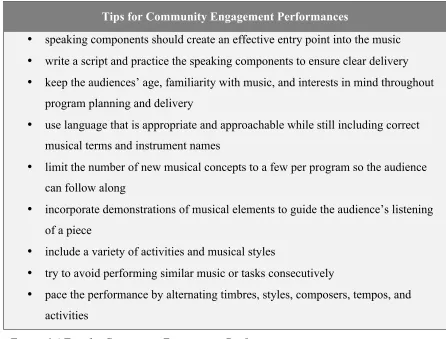
Figure 6.4 Tips for Community Engagement Performances ...49
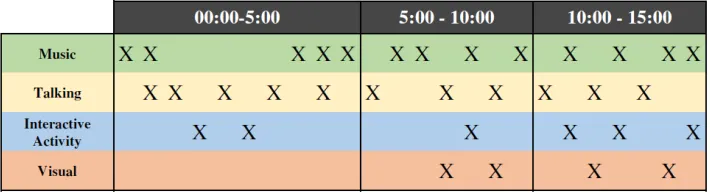
Figure 6.5 Alternating Elements throughout an Interactive Educational Program ...51
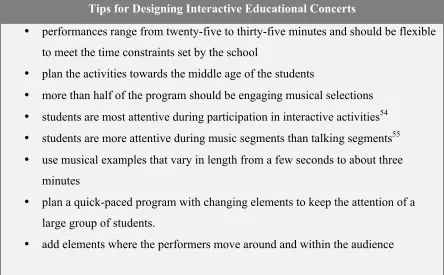
Figure 6.6 Tips for Designing Interactive Educational Concerts ...52
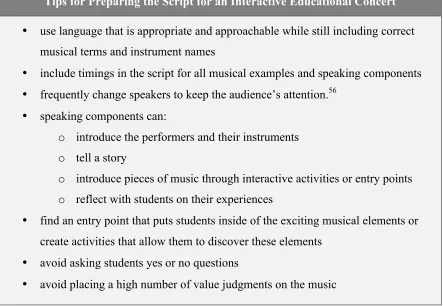
Figure 6.7 Tips for Preparing the Script for an Interactive Educational Concert ...53
Figure 6.8 Tips for Presenting Interactive Educational Concerts ...53
FOREWORD
This document is part of the dissertation requirement for the Doctor of Musical
Arts degree in Performance. The major portion of the dissertation consists of four public
recitals. Copies of recital programs are bound at the end of this paper, and recordings of
CHAPTER
1
INTRODUCTION
1.1DESCRIPTION OF THE PROBLEM
Universities and music schools are emphasizing community programs in their
missions and searching for more ways to be involved in their communities. As a part of
increased community initiatives, many music schools currently offer private lessons,
music classes, and ensemble performance opportunities to children, pre-college, and adult
students. Some music schools provide community performance opportunities to students
through partnerships with local hospitals, libraries, schools, and retirement homes.
However, few provide adequate training and information to these performers and
educators working in the community.
Student performers need to learn about the fields of community outreach and
engagement as part of their undergraduate and graduate training. Many orchestras,
chamber ensembles, and arts organizations initiate innovative community programs and
require the people they hire to have engagement skills in addition to being top-level
performers. The Houston Symphony created new positions for community-embedded
musicians beginning in their 2015-2016 season. In addition to performing concerts with
the Houston Symphony, these musicians work and perform in the schools and
offered by the Houston Symphony.1 With this push to engage with the community, many
musicians find that they are learning necessary skills way too late in their career,
and they would have greatly benefitted from participation in community programs during
their time in school.2
In order to adequately train musicians to function in these roles, schools of music
and faculty members must understand the different types of community programs. All
programs fall within the categories of outreach, engagement, or both. Current literature
suggests a difference between programs deemed community outreach and those that are
community engagement. On the most basic level, outreach programs are performed for an
audience and engagement programs are performed with an audience. Outreach programs
are most often performed outside of the school of music for a community that might be
unfamiliar with activities in the school of music. Students reach out and share their craft
with these new audiences. Engagement programs often contain the same element of
reaching out to new communities. However, in an engagement program the performer
takes great care to design a program with the audience in mind that includes more
opportunities for audiences to interact with elements of the program. Engagement
encourages reciprocal learning and communication between the audience and performers.
Many applied studio teachers have existing platforms available for creating
programs, training students, and discussing the benefits and responsibilities of
participation in community-based performance programs. Faculty members involved
with studio classes, studio recitals, independent study projects, and chamber music
1 Houston Symphony, “Community-Embedded Musicians Program.” 2 Eric Booth, Music Teaching Artist's Bible, 7.
coaching sessions can use these platforms to focus on developing community
performance programs. Using the information presented in this document, applied studio
teachers will have the resources to create initiatives that benefit their students, the
community, and their institutions.
1.2 PURPOSE OF THE STUDY
This document will serve as a resource guide for applied teachers in higher
education to create and implement community-based performance programs with their
students. Undertaking a community program without prior experience and knowledge of
the wide scope of possible programs can be overwhelming. This document provides base
knowledge for any applied teacher interested in starting or advising initiatives in
community performance, discusses the benefits of such programs to help further the
understanding of the importance of these initiatives, and provides sample programs to
give precise examples of successful community performance programs. Differences
between programs belonging to community outreach and those considered community
engagement are highlighted, but information pertinent to both avenues is discussed.
The goals of this document are:
1. to identify and outline necessary skills and training needed for students
participating in programs that engage with the community through musical
performance
2. to provide suggestions and examples for how applied studio teachers can create
strong community outreach and engagement programs
3. to present sample programs and a guide for implementing community
Emphasis will be placed on research aligning with the view that an institution of
higher education has a responsibility to positively contribute to its surrounding
community. The benefits for both applied faculty members and students participating in
community performance programs are addressed, and the benefits for the institution and
community will be taken into consideration.
1.3 LIMITATIONS OF THE STUDY
This document focuses on creating a guide for applied teachers working within
institutions in the United States of America to create community-based performance
programs for their students. Research from other countries is used in this document, but
the primary focus on the outcome of the research is on higher education in the US. The
study will only directly pertain to community programs within colleges and universities,
but because the communities served will be broad, research pertaining to outreach and
engagement programs within the larger context of other arts programs will be addressed.
1.4 LITERATURE REVIEW
While there are resources available with information on how to plan and prepare
interactive educational music outreach performances for chamber ensembles, there are no
resources available geared specifically toward applied music teachers and college
students. In addition, there are no resources available showing the scope of possible
community-based performance projects and how to plan and prepare for different types
of programs.
The most inclusive resource for designing interactive educational programs is
David Wallace's Reaching out: a musician's guide to interactive performances, but this
schools, with little mention of possible programs in community centers, hospitals,
retirement communities, etc. While resources like Wallace's book have an abundance of
useful information, there is no information directed toward how outreach and engagement
initiatives can fit into existing programs within higher education.
Eric Booth's The Music Teaching Artist's Bible presents a comprehensive
understanding of the history of the teaching artistry profession and current developments
in higher education to meet the demands of educating twenty-first century musicians for
successful careers. While Booth's book does not serve as a how to guide for musicians
interested in beginning a career in teaching artistry, he does bring years of study and
experience in the field of educating and connecting with audiences of various ages and
ranges of familiarity with music.
Other literature pertinent to this study falls into five categories that will be combined
to create a comprehensive guide for applied teachers:
1. creating interactive educational music programs
2. varying classifications of community programs
3. service-learning programs and their benefits
4. university-created community programs and their benefits
5. teaching artistry materials
This document highlights the pertinent material from Wallace, Booth, and many
other researchers along with the author's personal experiences with community programs
in higher education to create a guide for applied studio teachers interested in starting new
community-based performance programs or advising ongoing programs within the
1.5 DESIGN AND PROCEDURES
This guide contains eight chapters and three appendices. Chapter 1 provides a
description of the problem, purpose of the study, limitations of the study, review of
related literature, and design and procedures. Chapters 2 and 3 outline the benefits for
applied teachers initiating community-based performance programs and the benefits for
students participating in these programs, respectively. Chapter 4 presents information
needed for understanding different types of community programs that fall within the
broader categories of community outreach, community engagement, community music,
and teaching artistry. Chapter 5 focuses on preparing musicians to succeed in
community-based performance programs. Chapter 6 includes specific information for
how applied teachers can form community partnerships, select suitable music, prepare
appropriate audience engagement activities, and successfully plan and produce
performance programs. Chapter 7 gives suggestions for applied studio teachers instituting
community programs into the existing framework of higher education, and Chapter 8
provides concluding thoughts and further research. Three sample community
CHAPTER 2
BENEFITS FOR APPLIED FACULTY WHO IMPLEMENT
COMMUNITY PERFORMANCES
“Meaningful engagement can be used as a valuable tool to connect with the broader community, to enrich the scholarship of faculty, to broaden the educational experience of students, and to help promote a positive image of the university, which can potentially attract more economic and political support.”3 - Darwin Prioleau
Through teaching the next generation of professionals and scholars, professors
guide students’ understanding of how knowledge and learning relates to the world
beyond the campus.4 Community programs bridge classroom learning with the needs and
interests of a community, and professors are able to provide real world performance
opportunities for their students. As faculty and students create community programs
together and work towards a common purpose, they will experience a heightened sense of
community within the studio. In some cases, community programs can lead to prolonged
partnerships between applied studios and community members. Depending on the scope
of the partnership, community programs can increase scholarship donations to the studio
and raise student recruitment and retention rates.
Faculty members who choose to collaborate with other applied studios or
departments will benefit from the shared knowledge created by tapping into a larger
creative potential. Collaboration within the school of music promotes community
3 Prioleau, “Engagement: Transcending Outreach,” 58.
building amongst the faculty and students. Broader community performance initiatives
that utilize large ensembles and chamber ensembles often make more impact on a wider
group of students and faculty members.
Community-based performances benefit senior faculty members looking for new
challenges as a way to not feel “isolated from disciplinary developments and irrelevant to
institutional concerns.”5 Participation in community performance programs breathes life
and vitality back into the scholarly pursuits of an established faculty member. Even
seasoned faculty members benefit from the renewed sense of community engagement
provided by community-based performance programs. Scholarship Reconsidered
emphasizes the importance of university support for faculty member’s efforts to pursue
new projects in community-engaged scholarship. 6
Through the process of creating and advising community-based performance
programs, faculty members can improve their own skills in public speaking, content
development, and program planning. This can lead to more community-based
performance initiatives in their personal careers aside from advising studio projects.
Faculty members can apply for grants to provide funding for their community projects,
and funded grant proposals can be documented during their tenure and promotion review.
Applied teachers in higher education are required to fulfill responsibilities within
the areas of teaching, research, and service. Boyer’s publication Scholarship
Reconsidered cites many examples of colleges and universities that have tailored their
tenure and promotion evaluation criteria in order to consider individual faculty talents
and campus needs.7 Beginning in the 1990’s many researchers documented a shift in
higher education towards making efforts to recognize community-engaged scholarship.
Faculty members at universities that recognize a commitment to public engagement
projects can include their initiatives in the tenure and promotion review as they relate to
the areas of teaching, research, and service.8
Faculty who initiate and participate in community performance programs within
their university studios can experience benefits for their own career as well as for the
future careers of their students. As leaders in their respective fields and of their applied
studios, faculty members can serve as a positive example of a community-engaged
musician. In their roles as advisor and guide for community-based performance
initiatives, applied teachers can showcase the importance of professional musicians
remaining engaged with their community.
CHAPTER 3
BENEFITS FOR COLLEGE STUDENTS PARTICIPATING IN
COMMUNITY PERFORMANCES
Participation in community programs benefits students interested in many
different career paths including employment with orchestras that have educational
programs, freelancing, and music education. Through participation in community
performances students strengthen their network with local communities, improve their
public speaking abilities, and broaden their educational and performance experiences.
Community programs allow students to connect what they learn in their courses
with the needs and interests of the community. In an article from the Journal of Music
Teacher Education, Suzanne Burton and Alison Reynolds address the benefits of student
teachers working in service-learning activities. They emphasize the importance of
developing outlets for students to “respond to a community’s articulated need(s), apply
what they are learning in the classroom to a real world setting or problem, reflect
critically during and after engagement, celebrate their accomplishments with members of
the community, and -ideally-- emerge with a new or renewed sense of commitment to
continued civic engagement.”9
In addition to students gaining rewarding experiences through participation in
community programs, many performance careers include elements of community
outreach and engagement. Students “will be called upon to take part in educational
performances and presentations in their professional careers so involvement in
educational outreach is a valuable experience.”10 A growing number of orchestras11 are
expanding their educational offerings and “including joint planning with schools, more
opportunities to bring the orchestra musicians to the schools and into the students’
classrooms, and collaboration with school music specialists.”12
Community performances provide a unique opportunity for music students to
connect with people through music performance while advocating for the importance of
their work. Through involvement with community programs students apply their skills as
musicians and learn about community building and communication. Successful
community programs can heighten a student’s awareness of their local community and in
turn show audiences the importance of supporting a musical culture.
Eva Jacob, creator of the Chamber Music Rural Residencies Program at the
National Endowment for the Arts quotes Robert Freeman, “People who are really good as
performers and make it their business to teach music and communicate their enthusiasm
and love of it to anybody they come in contact with are the ones who will succeed…
There was never a better opportunity than the present, in the United States, to make a
positive difference as musicians.”13 Freeman notes the importance of not only being a
great performer but also having skills in communicating and sharing enthusiasm for
music with any audience. After participation in community performances, students are
10 Hearn, “Collaborative partnerships,” 14.
11 For more information about educational programs in orchestras, visit the websites of the Houston Symphony, LA Philharmonic, Philadelphia Orchestra, NY Philharmonic, Baton Rouge Symphony, National Symphony Orchestra
more likely to understand the benefit and importance of engaging with their audiences
through music and speaking.
Eric Booth has found in his work as a teaching artist that advancing music
education skills enhances one’s growth as a musician.14 He and other teaching artists
realize that their work in classrooms greatly benefits their performance and advocacy
skills as well as their lives as musicians. Participation in community programs gives
students greater insight into the audience’s perspective and allows extensive opportunities
to evaluate and generate ideas about the music from many different angles.
Students spend months planning and learning repertoire for a degree recital.
Through community outreach performances, they can host multiple performances.
Performances at community venues require students to approach each program with
flexibility toward the performance environment, audience reaction, and speaking
components. Students must evaluate information in real time and adapt to the needs of
their audience throughout the duration of the performance.
When participating in community-based performances, students still report to the
professor for guidance in developing the program, selecting musical content, and
planning expertise.15 The students function as both an expert and novice in their field. 16
Faculty members are able to observe students working in real world experiences and
offer feedback to guide students towards becoming a better community performer,
musician, and educator.
14 Booth, Music Teaching Artist’s Bible, 42. 15 Hearn, “Collaborative partnerships,” 23.
Community programs designed and presented by instrumental studios provide a
sense of camaraderie for participating students and their studio teacher. Students learn to
work together, accept other’s ideas, and work towards a common goal of performing a
successful program for the community. Students spend time getting to know one
another's strengths and weaknesses while deciding how each student can best contribute
to the program. Community programs have the potential to change people’s lives for the
CHAPTER 4
UNDERSTANDING THE CLASSIFICATIONS
OF COMMUNITY PROGRAMS
Understanding the different types of community programs gives applied teachers
and students a foundation to begin their own programs. As suggested by Dr. Donna T.
Emmanuel, Professor and Director of Service Learning and Community Engagement at
the University of North Texas, community programs are best understood as they relate to
a single continuum.17 Figure 4.1 offers a visual representation of this continuum with
programs ranging from outreach on the left to engagement on the right. The various
community programs discussed in this chapter and later chapters of the document are
presented as points along this continuum. When discussing any community program, it is
important to remember that the terms outreach and engagement are not as
interchangeable as some might think. Many programs of outreach and engagement can
share similar elements, but the difference between these two types of programs lies in the
approach to planning and presenting a community program. The following sections
contain in-depth information about outreach and engagement that highlights the
importance and benefits of both program classifications.
Figure 4.1 Spectrum of Community Based Programs
4.1 COMMUNITY OUTREACH
The first defining factor of an outreach performance is that the program happens
outside of the university for an audience that is usually unfamiliar with the activities in
the school of music. Outreach activities are presented in traditional “time-honored
formats in which academic music professionals share their music and/or research with
interested community members, using delivery systems most comfortable to the
presenters.”18 Outreach programs most often involve audiences with limited musical
training and knowledge in the area of the musician’s expertise. Outreach performances
can include performances of an upcoming recital program at a retirement community,
guest lectures at a community event, or background music concerts at a local hospital.
There are many benefits to student involvement in community outreach programs
including multiple performances of recital material, experience in scheduling
performances at public venues, experience finding or arranging repertoire, and
performance experience in venues outside of the traditional recital hall. Preparation for
an outreach performance is typically synonymous with preparation for an in-school
performance, and the program format resembles a traditional concert. However, outreach
performances require additional elements of scheduling with a community partner,
planning for an off campus event, and creating a program with written or spoken program
notes.
For a music performer, planning outreach programs includes selecting repertoire
for the performance. Planning the program can involve researching and gathering a
diverse selection of music to fit the instrumentation or creating original arrangements for
a specific ensemble. In addition, students might be inclined to commission works for the
performing ensemble or create their own compositions. Outreach performances offer an
abundance of programming possibilities, and they provide a great exploration into the
process of presenting concerts outside of the traditional recital experience.
4.2 COMMUNITY ENGAGEMENT
Towards the other end of the spectrum outlined by Emmanuel are engagement
activities that “contain elements of shared benefit and reciprocity, in which all parties
learn from one another over time.”19 An engagement program bridges the skills of the
music presenters with the needs or knowledge of the community. Engagement programs
require consultation with the community prior to the planned program in order for the
musicians to take special considerations for the interests, needs, and prior knowledge of
the community audience.
Depending on the design and purpose of a program, it might feature several
engagement elements or it might feature only one element of engagement, e.g. a question
and answer session with the audience. Adding engagement components allows the
performers to take a creative approach in deciding how to best engage the audience with
the music. Examples of engagement elements include:
• personal stories relevant to the program
• visual aids or art work that relate to the music
• musical connection to a broader context or theme
• guided audience participation in part of the music making
• entry points that allow for a deeper experience with the music20
• audience interests guiding the music selection process
Preparations for engagement activities can include conversations with members of
the community while planning the program, researching other programs given in the
community, and designing opportunities for interaction between musicians and
community members.
One type of engagement program that requires special attention due to the nature
of combining elements of performance and education is the interactive educational
program. These programs involve trained musicians as both performers and educators
who plan and present a program designed for education and entertainment. Interactive
educational programs allow performers with an interest in education the opportunity to
create activities where audiences directly interact with musical elements of the program.
While the programs can be developed for a variety of audiences, interactive educational
programs most often involve elementary school students.
4.3 ADDITIONAL COMMUNITY ENGAGEMENT PROGRAMS
Two types of engagement programs that this document does not address in later
chapters are community music and teaching artistry. This document focuses on creating
performance opportunities for students, and community music and teaching artistry align
more closely with music education and music therapy initiatives. As part of the gamut of
community engagement programs, it is important for musicians working in the
community to understand the basics of both community music and teaching artistry
programs. Many resources provided by community music workers and teaching artists
have enhanced the materials presented in this document.
Community Music
While the words community and music can describe many community programs,
the field of community music exists to support “active collaboration between individuals
who play, create, improvise, and perform music together. It is the music making that
fosters individual growth and community development.”21 As a contributor to the practice
of community music, Lee Higgins explains in Community Music: In Theory and in
Practice, “Community music activities do more than focus on individual expressions of
music making; they encourage and empower participants to become agents for extending
and developing music in their communities.”22 Community music workers use their
knowledge and expertise to create musical situations that “may be part of cultural and arts
events, linked with celebrations, ceremonies, rituals, play, education, social uplift, or life
passages.”23 Examples of these programs include community bands and orchestras, ethnic
choirs, world percussion ensembles, ukulele groups, and music programs for people with
special needs.24
The main goal in community music programs is to provide an outlet for people to
learn skills in the field of music and to participate in making music. In higher education,
music education and music therapy faculty usually supervise these initiatives.
Organizations like New Horizons International Music Association25 are associated with
universities and conservatories and feature faculty members leading the community
members to develop new skills in music performance. The Community Music School at
Michigan State University provides group music therapy classes for children with special
needs. Community members do not need prior training in music to participate, and the
classes provide therapy through engaging participants with music making.26
Community music initiatives feature a high level of engagement of all involved
parties. The community music worker is constantly assessing the level of understanding
of the material and developing new approaches to strengthen a participant’s knowledge,
experience, and skills in music. In return, the community music worker strengthens their
own skills through meeting challenges presented by the community members. Everyone
benefits from the shared sense of community created through making music together.
Faculty and students involved in community performance programs can learn from the
high level of engagement found in community music programs. Over time, they can
develop ways to include similar engagement elements into their performance programs.
23 Veblen, “The May Ways of Community Music,” 6. 24 Music Australia. “Types of Community Music.” 25 www.newhorizonsmusic.org
Teaching Artistry
The field of teaching artistry began to develop in the 1980s and quickly grew to
include an international journal (Teaching Artist Journal)27, local and national
organizations, conferences, and arts organizations to financially support teaching artist
programs (Young Audiences28, Lincoln Center Education29, Crossing Paths). While the
tenets of teaching artistry can be molded to fit the needs of each classroom and
community, many people have been working to codify the definition of teaching artistry
and standardize the field. Eric Booth provides this definition of teaching artistry: a
teaching artist is “an artist who chooses to include artfully educating others, beyond
teaching the technique of the art form, as an active part of a career.”30 Typically, teaching
artists integrate their musical skills and knowledge into classroom learning. Teaching
artists can work in various community settings, but many focus on K-5 education.
Teaching artists visit classrooms in frequencies that range from once a week to a few
times per school year. They design sequential lessons that connect explorations into their
art form with other curricular subjects.
For example, teaching artists with the Philadelphia Orchestra have established
ongoing relationships with their partner schools. The schools receive weekly visits from a
teaching artist, who is also a professional musician. The programs are co-designed by the
teaching artist, the Orchestra’s Department of Collaborative Learning, and the classroom
27 www.teachingartistjournal.wordpress.com 28 www.youngaudiences.org
29 www.lincolncentereducation.org
teachers.31 Rooted in the state curriculum standards, the lessons are designed to develop
skills in music fundamentals, critical listening, performance, and reflection.32
Teaching artistry and community engagement performances share similar values
and benefits. Both require a well-thought out and well-delivered program that strives for
shared learning through engagement with the material. It is important for performers to
know about the field of teaching artistry and use similar elements and approaches in
community-based performance programs. Booth’s discussion of twenty-five important
principles for teaching artists provides guidelines for a musician working in various
settings to plan proper engagement elements with their audience.33 Many of these
principles provided direction for the development of the materials presented in Chapters 5
and 6 of this document.
4.4 SUMMARY
Community programs are important and time-consuming projects, each with their
own benefits and challenges. For an applied teacher with little to no experience
performing in the community or taking students into the community, outreach programs
can provide a good introduction to off-campus performances. From there, interested
musicians can expand to create engagement programs. For any community performance
program, adding effective elements of audience engagement heightens the experience for
both the performer and listener.
A combination of information from the areas of community outreach, community
engagement, interactive educational concerts, community music, and teaching artistry
31 The Philadelphia Orchestra, “School Partnership Program.” 32 Ibid.
influenced the creation of this document. It is important for any faculty member or
student to explore the various types of community programming and understand their
roles and responsibilities to the program they are creating. As with the creation of any
program, creative explorations into the diverse areas of outreach, engagement,
interaction, and education will yield the best results. The remaining chapters of this
document reference teaching artistry and community music but focus on the creation and
CHAPTER 5
PREPARING STUDENTS FOR SUCCESS IN
COMMUNITY PERFORMANCES
Based on Lee Higgins’ (2012) approach to training community musicians, this
chapter discusses how applied studio teachers can help prepare students for participation
in community performance programs. Training for students embarking on the
development of community programs should begin with information about the variety of
community-based performance opportunities. Through the training process, students
should gain an understanding of what constitutes a community program, and they should
learn how to develop effective speaking and communication skills. In addition to this
background information, training and information sessions should accomplish a number
of other goals:
1. familiarize students with the partner community
2. outline a process for ensuring successful preparation and performance
3. create opportunities for students to rehearse speaking components
4. explore appropriate language and visual aids for the audience
5. discuss special considerations requested by the community contact
Eric Booth, an experienced teaching artist, notes that in the beginning of their
training. 34 Many community programs take a similar approach to training new
performers by letting experience be the teacher. No training can prepare a musician
working within the community for every possible scenario, but students should use the
research, planning, and preparation phases of developing a community program to learn
new skills. Adequate training throughout the process will reduce the number of mistakes
made in a performance when maintaining energy and attention is crucial for both
performers and audience members alike.
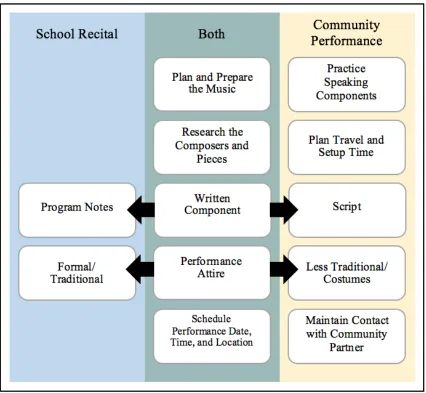
With an understanding of how community programs relate to traditional degree
recitals (Figure 5.1), students will feel less overwhelmed and more willing to contribute
to any additional planning necessary for successful community programs. The applied
teacher must clearly communicate all expectations for student involvement with enough
time for students to meet the expectations. This could mean that the planning stage
begins a semester in advance of the performance date.
The following sections provide in-depth information regarding necessary training
and knowledge that students working in any community outreach or engagement program
need.
5.1 WHAT TO EXPECT AT A COMMUNITY PERFORMANCE
Community program audiences generally range from twenty to forty people. This
small audience allows the performers to meet audience members before and after the
performance and also provide an intimate musical experience during the performance.
School assemblies can have anywhere from fifty to over one hundred students, and
accommodations for audiences of this size are discussed in Chapter 6. Most community
sites will not have a stage for the performers. Instead, venues create a performance area
for the musicians that is separate from the audience. Performances often take place in
venues most comfortable for the audience and not necessarily the performers. Expecting
recital hall acoustics and lighting is unrealistic at most community venues. If the applied
teacher is concerned about the performance space, plan a visit with the community
contact to make sure the space will work for everyone involved.
Community venues typically program activities in one-hour time slots. To fit
within this period, programs should run around fifty minutes with time at the end for
questions and conversation. An exception would be programs at elementary schools
where the school might request two 25-30 minute programs instead.
Unlike traditional recital settings, the performers should expect to converse with
audience members before and after the performance. This will help the audience feel at
ease with the performers and give them a chance to ask questions they might not ask in
front of the group. If the musicians and audience members begin to separate before the
performance, the applied studio teacher should encourage conversation between people
who seem uninterested or uninvolved. Applied teachers must relay these expectations to
the students early in the training process and remind them in advance of the performance.
5.2 FAMILIARIZING STUDENTS WITH THE PARTNER COMMUNITY
Understanding the partner community involves the applied teacher researching
the community and seeking information from the community contact (Figure 5.2).
the importance of performers understanding the atmosphere associated with an upcoming
community performance. 35
Once the applied teacher has an idea about what to expect in terms of the
audience and the environment, they must relay that information to the students at the
aforementioned training sessions. With this information, students can mindfully rehearse
and prepare the performance with the audience in mind. Having knowledge about the
community can influence program details like time and day of performance, length of
program, appropriate speaking components, choice of repertoire, and development of
interactive activities. For example, knowing that residents at a nursing home often take
naps after lunch will ensure that a program does not conflict with a time when residents
will be uninterested or unavailable for a performance.
The applied teacher can invite the community contact to give a brief presentation
containing details that will be helpful for the students working on the program. Not only
will the community contact provide necessary information, this interaction can strengthen
the bond between the community and school of music and lay the groundwork for future
collaborations.
5.3 MUSICAL PREPARATION
The foundation of a community performance program lies in the music and the
performers. Community performances require the same amount of musical preparation as
any on-campus concert or recital. It is imperative that applied teachers interested in
implementing community-based performances continue to stress the importance of
preparing musical selections to the highest level. In addition, teachers must continually
check for adequate progress towards preparing the music.
Through the process of accounting for additional preparations necessary for
community performances, it is easy to neglect musical preparation. Student ensembles
must hold regular rehearsals and seek coaching sessions from faculty members or
graduate students. Since community performances often include different audiences each
time, students might find it helpful to program pieces they have performed before and
want to revisit.
5.4 PROGRAM DESIGN AND CONTENT DELIVERY
Because of the many components involved in preparing for a community
performance, applied teachers must outline specific steps to ensure students meet all of
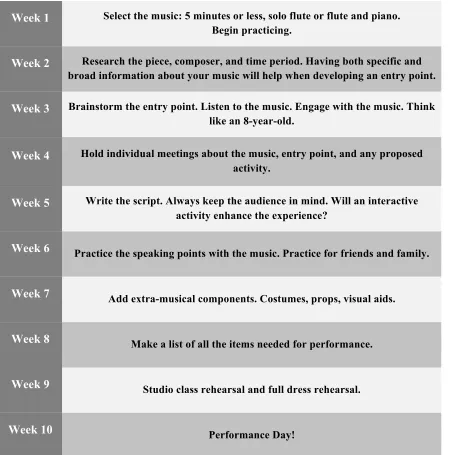
the expectations. Figure 5.3 shows the specific steps used to create each student’s
contribution to “Alphabet Soup,” an elementary school performance program, found in
Appendix C of this document. The students received this information over two months
before the performance to help them keep track of their responsibilities. Along the way,
specific deadlines were set and often revisited to keep the program progressing towards
the performance.
Developing Entry Points
Booth and Wallace highlight the importance of finding and developing an entry
point for each piece. An entry point connects the performer and the audience through the
music. Wallace describes an entry point as “a compass for navigating the complexities of
a music work -- or a key you give listeners to unlock a particular piece.”36An entry point
Week 1 Select the music: 5 minutes or less, solo flute or flute and piano. Begin practicing.
Week 2 Research the piece, composer, and time period. Having both specific and broad information about your music will help when developing an entry point.
Week 3 Brainstorm the entry point. Listen to the music. Engage with the music. Think like an 8-year-old.
Week 4 Hold individual meetings about the music, entry point, and any proposed activity.
Week 5 Write the script. Always keep the audience in mind. Will an interactive activity enhance the experience?
Week 6 Practice the speaking points with the music. Practice for friends and family.
Week 7 Add extra-musical components. Costumes, props, visual aids.
Week 8 Make a list of all the items needed for performance.
Week 9 Studio class rehearsal and full dress rehearsal.
Week 10 Performance Day!
goes beyond delivering information and expecting the audience to make their own
connections. Booth suggests selecting “one crucial entry point that lies at the heart of
what you care about in the work of art, and invite people in experientially.”37 Choosing
an entry point is a creative process that is unique to each performer. 38 Each person must
find their own way of finding a thoughtful entry point, but many practiced teaching artists
have offered suggestions.
Teaching Artist Thomas Cabaniss recommends beginning the process of finding
an entry point by listening to the piece with a freshness akin to how an audience member
will hear the piece for the first time. 39 Cabaniss then encourages multiple listening
sessions to collect observations and increase familiarity with the music.40 In addition to
listening, conducting research and analysis on musical content provides a foundational
knowledge for exploring possible entry points. During the brainstorming phase, it is
important to refrain from fully developing or committing to any one idea. Instead, use the
time to explore many possible entry points. Based on the preparation process outlined by
Cabaniss, students can develop entry points in five steps.
1. Collect observations about the music41
2. Form questions that arise from the observations42
3. Research and analyze the music to gain a deeper understanding of observations
4. Develop one entry point for the piece
5. Prepare activities and speaking points based on the entry point
37 Booth, Music Teaching Artist’s Bible, 90. 38 Ibid., 90.
39 Cabaniss, “A Teaching Artist Prepares,” 34. 40 Ibid.
Before students begin writing their script, the applied teacher should be prepared
to hold a session to introduce the topic of entry points. After introducing the topic, guide
students through the process of developing an entry point to a piece of familiar music
(Figure 5.4). Some students might benefit from working in groups and others might
prefer to try the process as an individual. After students complete the process, discuss
what they discovered and how they arrived at their entry point. Once students reach the
last step in the process, they might find they want to explore a different entry point
instead. The multitude of possible entry points for any piece of music are only limited by
a student’s imagination and base knowledge If a student feels stuck or unsure, revisit
steps 1- 3 to brainstorm more ideas and collect more observations. The process of
developing an entry point takes time, and the first idea is most likely not the one that will
be used in the final performance.
Applied teachers have a much broader knowledge of music theory, history, and
repertoire than their students and can serve as guides through the process of entry point
development. They can also offer suggestions and feedback, but it is up to the performer
to determine the most beneficial entry point that uses their own knowledge and
understanding of the piece to guide the listener’s experience.
Preparing and Practicing Speaking Points
Learning the skills to become a better public speaker can happen with practice,
reflection, planning, and seeking outside help from public speaking classes or
experienced theater educators. All teaching artists and experienced musicians who
speaking with audiences both from the stage during performance and in one-on-one
settings before and after the performance.
Inexperienced public speaking combined with a lack of script preparation and
practice can lead to longwinded and unfocused explanations. Booth, along with other
teaching artists, encourages the development of a written performance script that is
focused, concise and engaging. Students can alleviate awkwardness and nervousness
when speaking in performance through experience and consultation with public speaking
professionals including actors, drama teachers, and public speaking coaches.
In training sessions for community programs, applied teachers can address the
importance of clear communication with audiences and give students strategies for the
successful delivery of speaking components. Once a student writes their own script,
applied teachers can use it as a concrete product with which to offer additional
suggestions to enhance the speaking. Well written scripts that are retained by the applied
teacher can also serve as a helpful example for future students and projects.
Community musician David Price advocates for the development of
communication and interpersonal skills for a “wide variety of groups (young, old, mixed,
single-sex, etc.).” 43 For the training outlined in this document, applied teachers can take
a broad approach to addressing skills necessary for communication with diverse
populations of people, or they can tailor the training specifically to the needs of the
community they have chosen to work with. While it is encouraged to address a variety of
populations, given time restrictions and limited training time, it is advantageous to
narrow the focus of the training to specifically detailed skills needed for the chosen
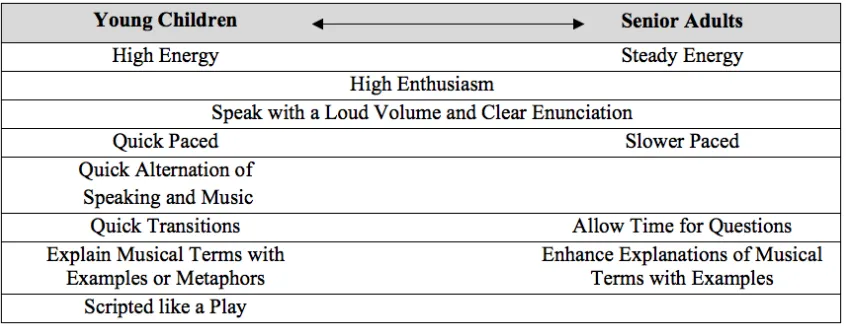
population. Use information obtained from the community contact (Figure 5.2) and
information specific to different age groups (Figure 5.5) to influence the preparation of
speaking components for the specific audience.
Figure 5.5 Tailoring Speaking Components to Different Age Groups
The best way to gauge a student’s skill level with public speaking is to observe a
program run-through in studio class. While students might feel awkward, they must have
many chances to practice and revise speaking components before the performance.
Applied teachers can give feedback about which elements seemed incoherent or
unimportant. Students should also test out any interactive activity they have scripted.
Applied teachers should take notes and make comments on both the presentation of the
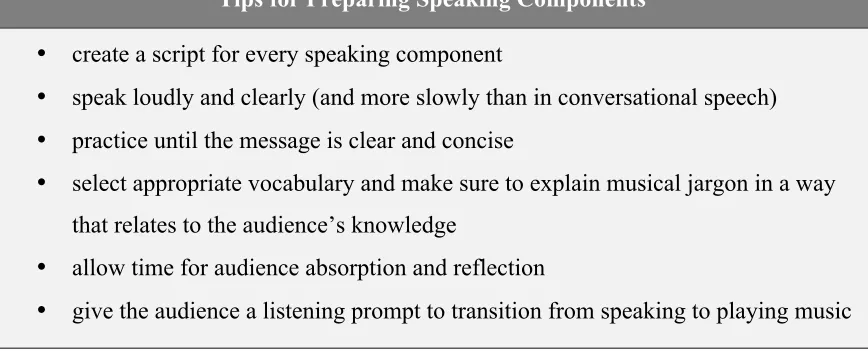
Tips for Preparing Speaking Components
• create a script for every speaking component
• speak loudly and clearly (and more slowly than in conversational speech) • practice until the message is clear and concise
• select appropriate vocabulary and make sure to explain musical jargon in a way that relates to the audience’s knowledge
• allow time for audience absorption and reflection
• give the audience a listening prompt to transition from speaking to playing music
Figure 5.6 Tips for Preparing Speaking Components
Creating Effective Means of Communication
Good communication skills involve a sense of ease when speaking with the
audience.44 Performers who exhibit enjoyment through making connections between
ideas and concepts create a pathway for their audience to experience that same
gratification.45 Students should be encouraged to let their individual personalities and
interests shine during communication with the audience.
Effective communication also includes the students providing a well-researched
spoken context for the music they will perform.46 In the areas of communication and
advocacy, upperclassmen and graduate students will have a broader knowledge of music
history, theory, and education to draw upon. Younger students will need more guidance
in understanding the importance of thoroughly researching their music. Explorations
44 Plourde, “Training musicians to perform for and work with children,” 99. 45 Ibid.
aimed at the development of meaningful speaking components will give students a deeper
understanding of their subjects and their music.47
Training in the area of effective communication happens when applied teachers
coach students through their speaking components. Encourage the students to create their
speaking points from a place of curiosity and observation. Allow that curiosity and
excitement to stand out, and always urge students to find a genuine and comfortable place
from which to deliver their speaking components.
5.5 MAINTAINING A FLEXIBLE APPROACH
Program success often depends on flexibility and willingness to change during the
planning, preparation, and performance stages of a program. The applied teacher can set
a great example by remaining willing to learn along with the students through the process
of continually developing the program content and delivery. Students must understand
that at any point new information could issue a change in some element of a program,
and that what might have seemed like a great idea on paper might not translate well to the
performance. Students must be willing to remain open-minded as it is difficult to know
exactly what will happen when performing in an unfamiliar venue with a diverse
audience.
5.6 SUMMARY
The research and writing by many experienced teaching artists and community
music workers highlights the importance of training performers new to community
performance programs. Applied teachers should host a general information session before
beginning the planning for a specific community-based performance. At this session,
students should receive information about the types of community-based performances,
the expectations for participating students, how to research and design effective speaking
components, and how to find and construct an entry point. The applied faculty member
can oversee all of these areas throughout the process, but it is important for students to be
fully involved with the aspects of the planning and preparation.
For further information regarding constructing interactive activities, reference
David Wallace’s Reaching Out: a musician’s guide to interactive performance, Eric
Booth’s The Music Teaching Artist’s Bible: Becoming a Virtuoso Educator, and Terry
CHAPTER 6
DEVELOPING COMMUNITY PROGRAMS
6.1 INTRODUCTION
This chapter addresses research and information specifically geared towards
exploring the possibilities of community performances, finding a community partner, and
developing a performance program. The research of David Wallace, Eric Booth, Terry
Fonda Smith, Susan Helfter, and Alina Plourde provided direction in creating the
following guide for applied teachers to develop their own community performance
programs.
6.2 PREPARATION TIMELINE
Putting together a new community program can take anywhere from two to four
months, depending on the frequency of planning sessions. The preparation timeline
(Figure 6.1) details each step of planning any community-based performance. The
elements might differ depending on the needs of each program, but this timeline gives a
good representation of the components that go into planning and performing a
community program.
6.3 IDENTIFY A COMMUNITY PARTNER AND PERFORMERS
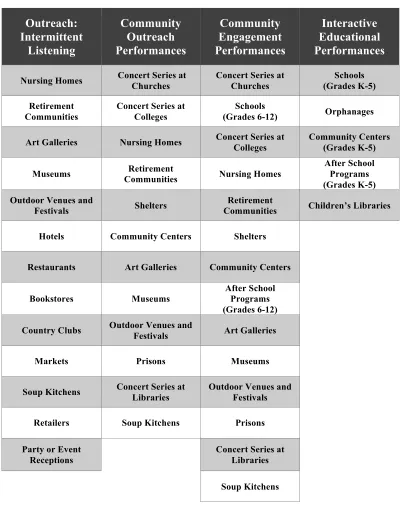
The numerous possibilities for performance venues (Figure 6.2) include churches,
schools, nursing homes, retirement communities, shelters, orphanages, community
Figure 6.2 Community Programming and Possible Venues ! Outreach: Intermittent Listening Community Outreach Performances Community Engagement Performances Interactive Educational Performances
Nursing Homes Concert Series at Churches Concert Series at Churches (Grades K-5) Schools
Retirement Communities
Concert Series at Colleges
Schools
(Grades 6-12) Orphanages
Art Galleries Nursing Homes Concert Series at Colleges Community Centers (Grades K-5)
Museums Communities Retirement Nursing Homes
After School Programs (Grades K-5) Outdoor Venues and
Festivals Shelters
Retirement
Communities Children’s Libraries
Hotels Community Centers Shelters
Restaurants Art Galleries Community Centers
Bookstores Museums
After School Programs (Grades 6-12)
Country Clubs Outdoor Venues and Festivals Art Galleries
Markets Prisons Museums
Soup Kitchens Concert Series at Libraries Outdoor Venues and Festivals
Retailers Soup Kitchens Prisons
Party or Event Receptions
Concert Series at Libraries
Soup Kitchens
!
restaurants, prisons, bookstores, country clubs, libraries, markets, soup kitchens, and
retailers. While each venue and potential audience offers a different experience, consider
the benefits of programming an event at a place like a retirement community where the
audience is built-in. Since there is no need to attract audience members, planning time
can focus on the performance itself and not on promotion for the event.
When searching for a community partner, consider first reaching out to personal
contacts including music teachers, librarians, activities coordinators, or church music
directors. Initial contact with the community partner should include:
• possible dates and times for the performance • a proposed program length
• whether this will be a one-time performance or part of a recurring series
• cost of the program, if any
Maintain contact with the community partner as questions arise, and ask for their
advice regarding programs that community members have enjoyed in the past.
Community contacts can provide information about what type of music their audience
enjoys and any special considerations to address during the planning and presentation of
the program.
The applied teacher can make programming decisions with or without input from
students. For example, a studio teacher might want to include a studio discussion about
what type of community program students are interested in pursuing. Figure 6.2 shows
which community venues are best suited for each type of community performance. After
a type of performance is determined; the applied teacher or a selected student can make