Realization of Discourse Relations by Other Means: Alternative
Lexicalizations
Rashmi Prasad and Aravind Joshi University of Pennsylvania
rjprasad,[email protected]
Bonnie Webber University of Edinburgh [email protected]
Abstract
Studies of discourse relations have not, in the past, attempted to characterize what serves as evidence for them, beyond lists of frozen expressions, or markers, drawn from a few well-defined syntactic classes. In this paper, we describe how the lexical-ized discourse relation annotations of the Penn Discourse Treebank (PDTB) led to the discovery of a wide range of additional expressions, annotated as AltLex
(alterna-tive lexicalizations) in the PDTB 2.0.
Fur-ther analysis of AltLex annotation sug-gests that the set of markers is open-ended, and drawn from a wider variety of syntactic types than currently assumed. As a first attempt towards automatically identifying discourse relation markers, we propose the use of syntactic paraphrase methods.
1 Introduction
Discourse relations that hold between the content of clauses and of sentences – including relations of cause, contrast, elaboration, and temporal or-dering – are important for natural language pro-cessing tasks that require sensitivity to more than just a single sentence, such as summarization, in-formation extraction, and generation. In written text, discourse relations have usually been con-sidered to be signaled either explicitly, as lexical-ized with some word or phrase, or implicitly due to adjacency. Thus, while the causal relation be-tween the situations described in the two clauses in Ex. (1) is signalled explicitly by the connective
As a result, the same relation is conveyed
implic-itly in Ex. (2).
(1) John was tired. As a result he left early. (2) John was tired. He left early.
This paper focusses on the problem of how to characterize and identify explicit signals of dis-course relations, exemplified in Ex. (1). To re-fer to all such signals, we use the term “discourse relation markers” (DRMs). Past research (e.g., (Halliday and Hasan, 1976; Martin, 1992; Knott, 1996), among others) has assumed that DRMs are frozen or fixed expressions from a few well-defined syntactic classes, such as conjunctions, adverbs, and prepositional phrases. Thus the lit-erature presents lists of DRMs, which researchers try to make as complete as possible for their cho-sen language. In annotating lexicalized discourse relations of the Penn Discourse Treebank (Prasad et al., 2008), this same assumption drove the ini-tial phase of annotation. A list of “explicit con-nectives” was collected from various sources and provided to annotators, who then searched for these expressions in the text and annotated them, along with their arguments and senses. The same assumption underlies methods for automatically identifying DRMs (Pitler and Nenkova, 2009). Since expressions functioning as DRMs can also have non-DRM functions, the task is framed as one of classifying given individual tokens as DRM or not DRM.
In this paper, we argue that placing such syn-tactic and lexical restrictions on DRMs limits a proper understanding of discourse relations, which can be realized in other ways as well. For example, one should recognize that the instantia-tion (or exemplificainstantia-tion) relainstantia-tion between the two sentences in Ex. (3) is explicitly signalled in the second sentence by the phrase Probably the most
egregious example is, which is sufficient to
ex-press the instantiation relation.
proviso in the appropriations bill for the executive office that prevents the president’s Office of Man-agement and Budget from subjecting agricultural marketing orders to any cost-benefit scrutiny.
Cases such as Ex. (3) show that identifying DRMs cannot simply be a matter of preparing a list of fixed expressions and searching for them in the text. We describe in Section 2 how we identi-fied other ways of expressing discourse relations in the PDTB. In the current version of the cor-pus (PDTB 2.0.), they are labelled as AltLex
(al-ternative lexicalizations), and are “discovered” as
a result of our lexically driven annotation of dis-course relations, including explicit as well as im-plicit relations. Further analysis of AltLex anno-tations (Section 3) leads to the thesis that DRMs
are a lexically open-ended class of elements which may or may not belong to well-defined syntactic classes. The open-ended nature of DRMs is a
challenge for their automated identification, and in Section 4, we point to some lessons we have already learned from this annotation. Finally, we suggest that methods used for automatically gen-erating candidate paraphrases may help to expand the set of recognized DRMs for English and for other languages as well (Section 5).
2 AltLex in the PDTB
The Penn Discourse Treebank (Prasad et al., 2008) constitutes the largest available resource of lexically grounded annotations of discourse tions, including both explicit and implicit rela-tions.1 Discourse relations are assumed to have two and only two arguments, called Arg1 and Arg2. By convention, Arg2 is the argument syn-tactically associated with the relation, while Arg1 is the other argument. Each discourse relation is also annotated with one of the several senses in the PDTB hierarchical sense classification, as well as the attribution of the relation and its arguments. In this section, we describe how the annotation methodology of the PDTB led to the identification of the AltLex relations.
Since one of the major goals of the annota-tion was to lexically ground each relaannota-tion, a first step in the annotation was to identify the explicit
1
http://www.seas.upenn.edu/˜pdtb
markers of discourse relations. Following stan-dard practice, a list of such markers – called “ex-plicit connectives” in the PDTB – was collected from various sources (Halliday and Hasan, 1976; Martin, 1992; Knott, 1996; Forbes-Riley et al., 2006).2 These were provided to annotators, who then searched for these expressions in the corpus and marked their arguments, senses, and attribu-tion.3 In the pilot phase of the annotation, we also went through several iterations of updating the list, as and when annotators reported seeing connectives that were not in the current list. Im-portantly, however, connectives were constrained to come from a few well-defined syntactic classes:
• Subordinating conjunctions: e.g., because,
although, when, while, since, if, as.
• Coordinating conjunctions: e.g., and, but,
so, either..or, neither..nor.
• Prepositional phrases: e.g., as a result, on
the one hand..on the other hand, insofar as, in comparison.
• adverbs: e.g., then, however, instead, yet,
likewise, subsequently
Ex. (4) illustrates the annotation of an explicit connective. (In all PDTB examples in the paper, Arg2 is indicated in boldface, Arg1 is in italics, the DRM is underlined, and the sense is provided in parentheses at the end of the example.)
(4) U.S. Trust, a 136-year-old institution that is one of the earliest high-net worth banks in the U.S., has faced intensifying competition from other firms that have established, and heavily promoted, private-banking businesses of their own. As a result, U.S. Trust’s earnings have been hurt. (Contin-gency:Cause:Result)
After all explicit connectives in the list were annotated, the next step was to identify implicit discourse relations. We assumed that such rela-tions are triggered by adjacency, and (because of resource limitations) considered only those that held between sentences within the same para-graph. Annotators were thus instructed to supply a connective – called “implicit connective” – for
2All explicit connectives annotated in the PDTB are listed in the PDTB manual (PDTB-Group, 2008).
3
each pair of adjacent sentences, as long as the
re-lation was not already expressed with one of the explicit connectives provided to them. This
proce-dure led to the annotation of implicit connectives such as because in Ex. (5), where a causal relation is inferred but no explicit connective is present in the text to express the relation.
(5) To compare temperatures over the past 10,000 years, researchers analyzed the changes in concen-trations of two forms of oxygen. (Implicit=because)
These measurements can indicate temperature changes,. . .(Contingency:Cause:reason)
Annotators soon noticed that in many cases, they were not able to supply an implicit connec-tive. Reasons supplied included (a) “there is a re-lation between these sentences but I cannot think of a connective to insert between them”, (b) “there is a relation between the sentences for which I can think of a connective, but it doesn’t sound good”, and (c) “there is no relation between the sentences”. For all such cases, annotators were instructed to supply “NONE” as the implicit con-nective. Later, we sub-divided these “NONE” im-plicits into “EntRel”, for the (a) type above (an entity-based coherence relation, since the second sentence seemed to continue the description of some entity mentioned in the first); “NoRel” (no relation) for the (c) type; and “AltLex”, for the (b) type, which we turn to next.
Closer investigation of the (b) cases revealed that the awkwardness perceived by annotators when inserting an implicit connective was due to
redundancy in the expression of the relation:
Al-though no explicit connective was present to re-late the two sentences, some other expression ap-peared to be doing the job. This is indeed what we found. Subsequently, instances of AltLex were annotated if:
1. A discourse relation can be inferred between adjacent sentences.
2. There is no explicit connective present to re-late them.
3. The annotator is not able to insert an im-plicit connective to express the inferred rela-tion (having used “NONE” instead), because inserting it leads to an awkward redundancy in expressing the relation.
Under these conditions, annotators were in-structed to look for and mark as Altlex, whatever
alternative expression appeared to denote the
re-lation. Thus, for example, Ex. (6) was annotated as AltLex because although a causal relation is in-ferred between the sentences, inserting a connec-tive like because makes expression of the relation redundant. Here the phrase One reason is is taken to denote the relation and is marked as AltLex.
(6) Now, GM appears to be stepping up the pace of its factory consolidation to get in shape for the 1990s.
One reason is mounting competition from new Japanese car plants in the U.S. that are pour-ing out more than one million vehicles a year at costs lower than GM can match. (Contin-gency:Cause:reason)
The result of this procedure led to the annota-tion of 624 tokens of AltLex in the PDTB. We turn to our analysis of these expressions in the next section.
3 What is found in AltLex?
Several questions arise when considering the Alt-Lex annotations. What kind of expressions are they? What can we learn from their syntax? Do they project discourse relations of a different sort than connectives? How can they be identi-fied, both during manual annotation and automat-ically? To address these questions, we examined the AltLex annotation for annotated senses, and for common lexico-syntactic patterns extracted using alignment with the Penn Treebank (Marcus et al., 1993).4
3.1 Lexico-syntactic Characterization
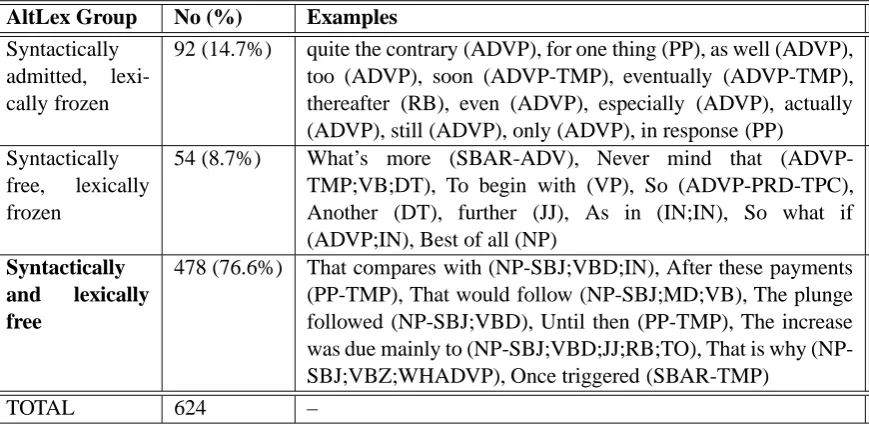
We found that we could partition AltLex annota-tion into three groups by (a) whether or not they belonged to one of the syntactic classes admit-ted as explicit connectives in the PDTB, and (b) whether the expression was frozen (ie, blocking free substitution, modification or deletion of any of its parts) or open-ended. The three groups are shown in Table 1 and discussed below.
4
AltLex Group No (%) Examples Syntactically
admitted, lexi-cally frozen
92 (14.7%) quite the contrary (ADVP), for one thing (PP), as well (ADVP), too (ADVP), soon (ADVP-TMP), eventually (ADVP-TMP), thereafter (RB), even (ADVP), especially (ADVP), actually (ADVP), still (ADVP), only (ADVP), in response (PP)
Syntactically free, lexically frozen
54 (8.7%) What’s more (SBAR-ADV), Never mind that (ADVP-TMP;VB;DT), To begin with (VP), So (ADVP-PRD-TPC), Another (DT), further (JJ), As in (IN;IN), So what if (ADVP;IN), Best of all (NP)
Syntactically
and lexically
free
478 (76.6%) That compares with (NP-SBJ;VBD;IN), After these payments (PP-TMP), That would follow (NP-SBJ;MD;VB), The plunge followed (NP-SBJ;VBD), Until then (PP-TMP), The increase was due mainly to SBJ;VBD;JJ;RB;TO), That is why (NP-SBJ;VBZ;WHADVP), Once triggered (SBAR-TMP)
TOTAL 624 –
Table 1: Breakdown of AltLex by Syntactic and Lexical Flexibility. Examples in the third column are accompanied (in parentheses) with their PTB POS tags and constituent phrase labels obtained from the PDTB-PTB alignment.
Syntactically admitted and lexically frozen: The first row shows that 14.7% of the strings an-notated as AltLex belong to syntactic classes ad-mitted as connectives and are similarly frozen. (Syntactic class was obtained from the PDTB-PTB alignment.) So, despite the effort in prepar-ing a list of connectives (cf. Section 1), additional ones were still found in the corpus through AltLex annotation. This suggests that any pre-defined list of connectives should only be used to guide anno-tators in a strategy for “discovering” connectives.
Syntactically free and lexically frozen: AltLex
expressions that were frozen but belonged to syn-tactic classes other than those admitted for the PDTB explicit connectives accounted for 8.7% (54/624) of the total (Table 1, row 2). For exam-ple, the AltLex What’s more (Ex. 7) is parsed as a clause (SBAR) functioning as an adverb (ADV). It is also frozen, in not undergoing any change (eg,
What’s less, What’s bigger, etc.5
(7) Marketers themselves are partly to blame: They’ve
increased spending for coupons and other short-term promotions at the expense of image-building advertising. What’s more, a flood of new
prod-ucts has given consumers a dizzying choice of
5
Apparently similar headless relative clauses such as
What’s more exciting differ from What’s more in not
func-tioning as adverbials, just as NPs.
brands, many of which are virtually carbon copies of one other. (Expansion:Conjunction)
Many of these AltLex annotations do not con-stitute a single constituent in the PTB, as with
Never mind that. These cases suggest that ei-ther the restrictions on connectives as frozen ex-pressions should be relaxed to admit all syntactic classes, or the syntactic analyses of these
multi-word expressions is irrelevant to their function.
Both syntactically and lexically free: This
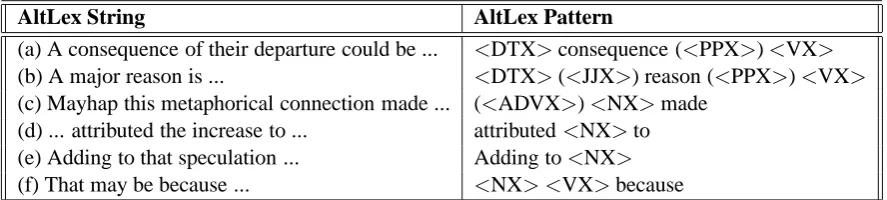
third group (Table 1, row 3) constitutes the major-ity of AltLex annotations – 76.6% (478/624). Ad-ditional examples are shown in Table 2. Common syntactic patterns here include subjects followed by verbs (Table 2a-c), verb phrases with comple-ments (d), adverbial clauses (e), and main clauses with a subordinating conjunction (f).
All these AltLex annotations are freely modifi-able, with their fixed and modifiable parts shown in the regular expressions defined for them in Ta-ble 2. Each has a fixed “core” phrase shown as lexical tokens in the regular expression, e.g,
con-sequence of, attributed to, plus obligatory and
op-tional elements shown as syntactic labels. Op-tional elements are shown in parentheses. <NX>
AltLex String AltLex Pattern
(a) A consequence of their departure could be ... <DTX>consequence (<PPX>)<VX>
(b) A major reason is ... <DTX>(<JJX>) reason (<PPX>)<VX>
(c) Mayhap this metaphorical connection made ... (<ADVX>)<NX>made (d) ... attributed the increase to ... attributed<NX>to (e) Adding to that speculation ... Adding to<NX>
(f) That may be because ... <NX> <VX>because
Table 2: Complex AltLex strings and their patterns
<JJX>, any adjectival phrase
These patterns show, for example, that other variants of the identified AltLex A major reason
is include The reason is, A possible reason for the increase is, A reason for why we should consider DRMs as an open class is, etc. This is robust
sup-port for our claim that DRMs should be regarded as an open class: The task of identifying them can-not simply be a matter of checking an a priori list. Note that the optional modification seen here is clearly also possible with many explicit con-nectives such as if (eg, even if just if, only if ), as shown in Appendix C of the PDTB manual (PDTB-Group, 2008). This further supports the thesis that DRMs should be treated as an open class that includes explicit connectives.
3.2 Semantic Characterization
AltLex strings were annotated as denoting the dis-course relation that held between otherwise un-marked adjacent utterances (Section 2). We found them to convey this relation in much the same way as anaphoric discourse adverbials. Accord-ing to (Forbes-Riley et al., 2006), discourse ad-verbials convey both the discourse relation and an anaphoric reference to its Arg1. The latter may be either explicit (e.g., through the use of a demon-strative like “this” or “that”), or implicit. Thus, both as a result of that and as a result are dis-course adverbials in the same way: the latter refers explicitly to Arg1 via the pronoun “that”, while former does so via an implicit internal argument. (A result must be a result of something.)
The examples in Table 2 make this same two– part semantic contribution, albeit with more plex expressions referring to Arg1 and more com-plex modification of the expression denoting the
relation. For example, in the AltLex shown in (Table 2c), Mayhap this metaphorical connection
made (annotated in Ex. (8)), the relation is
de-noted by the causal verb made, while Arg1 is referenced through the definite description this
metaphorical connection. In addition, the adverb Mayhap further modifies the relational verb.
(8) Ms. Bartlett’s previous work, which earned her an international reputation in the non-horticultural art world, of-ten took gardens as its nominal subject.
Mayhap this metaphorical connection made the BPC Fine Arts Committee think she had a literal green thumb. (Contingency:Cause:Result)
These complex AltLex’s also raise the question of why we find them at all in language. One part of the answer is that these complex AltLex’s are used to convey more than just the meaning of the rela-tion. In most cases, we found that substituting the AltLex with an adverbial connective led to some aspect of the meaning being lost, as in Ex. (9-10). Substituting For example for the AltLex with an (necessary) accompanying paraphrase of Arg2 loses the information that the example provided as Arg2 is possibly the most egregious one. The con-nective for example does not allow similar modi-fication. This means that one must use a different strategy such as an AltLex expression.
(9) Typically, these laws seek to prevent exec-utive branch officials from inquiring into whether certain federal programs make any economic sense or proposing more market-oriented alternatives to regulations.
Probably the most egregious example is a pro-viso in the appropriations bill for the executive office that prevents the president’s Office of Management and Budget from subjecting agri-cultural marketing orders to any cost-benefit scrutiny. (Expansion:Instantiation)
Of-fice of Management and Budget from subjecting agricultural marketing orders to any cost-benefit scrutiny.
Another part of the answer to Why AltLex? is that it can serve to convey a relation for which the lexicon lacks an adverbial connective. For exam-ple, while English has several adverbial connec-tives that express a “Cause:Consequence” relation (eg, as a result, consequently, etc.), it lacks an adverbial connective expressing “Cause:Reason” (or explanation) albeit having at least two sub-ordinating conjunctions that do so (because and
since). Thus, we find an AltLex whenever this
re-lation needs to be expressed between sentences, as shown in Ex. (11).
(11) But a strong level of investor withdrawals is much more unlikely this time around, fund
man-agers said. A major reason is that investors al-ready have sharply scaled back their purchases of stock funds since Black Monday. (Contin-gency:Cause:reason)
Note, however, that even for such relations such as Cause:Reason, it is still not the case that a list of canned expressions will be sufficient to generate the Altlex or to identify them, since this relation can itself be further modified. In Ex. (12), for ex-ample, the writer intends to convey that there are multiple reasons for the walkout, although only one of them is eventually specified in detail.
(12) In Chile, workers at two copper mines, Los Bronces and El Soldado, which belong to the
Exxon-owned Minera Disputada, yesterday voted
to begin a full strike tomorrow, an analyst
said. Reasons for the walkout, the analyst said, included a number of procedural issues, such as a right to strike. (Contingency:Cause:reason)
4 Lessons learned from AltLex
Like all lexical phenomena, DRMs appear to have a power-law distribution, with some very few high-frequency instances like (and, but), a block of mid-frequency instances (eg, after,
be-cause, however), and many many low-frequency
instances in the “long tail” (eg, much as, on the
contrary, in short, etc.). Given the importance
of DRMs for recognizing and classifying dis-course relations and their arguments, what have we learned from the annotation of AltLex?
First, the number of expressions found through AltLex annotation, that belong to syntactic classes
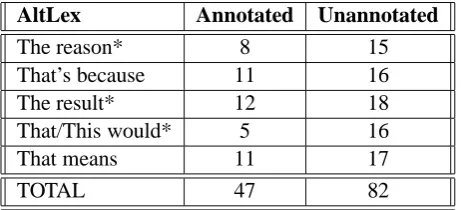
admitted as connectives and also similarly frozen (Table 1, row 1) shows that even in the PDTB, there are additional instances of what we have taken to be explicit connectives. By recognizing them and unambiguously labelling their senses, we will start to reduce the number of “hard cases” of implicit connectives whose sense has to be rec-ognized (Marcu and Echihabi, 2002; Sporleder and Lascarides, 2008; Pitler et al., 2009; Lin et al., 2009). Secondly, the number of tokens of expres-sions from other syntactic classes that have been annotated as AltLex (Table 1, rows 2 and 3) may actually be higher than was caught via our Alt-Lex annotation, thus making them even more im-portant for discourse processing. To assess this, we selected five of them and looked for all their tokens in the WSJ raw files underlying both the PTB and the PDTB. After eliminating those to-kens that had already been annotated, we judged whether the remaining ones were functioning as connectives. Table 3 shows the expressions we used in the first column, with the second and third columns reporting the number of tokens annotated in PDTB, and the number of additional tokens in the WSJ corpus functioning as connectives. (The asterisk next to the expressions is a wild card to al-low for variations along the lines discussed for Ta-ble 2.) These results show that these DRMs occur two to three times more frequently than already annotated.
Increased frequencies of AltLex occurrence are also observed in discourse annotation projects un-dertaken subsequent to the PDTB, since they were able to be more sensitive to the presence of Alt-Lex. The Hindi Discourse Relation Bank (HDRB) (Oza et al., 2009), for example, reports that 6.5% of all discourse relations in the HDRB have been annotated as AltLex, compared to 1.5% in the PDTB. This also provides cross-linguistic evi-dence of the importance of recognizing the full range of DRMs in a language.
5 Identifying DRMs outside the PDTB
En-AltLex Annotated Unannotated
The reason* 8 15
That’s because 11 16
The result* 12 18
That/This would* 5 16
That means 11 17
TOTAL 47 82
Table 3: Annotated and Unannotated instances of AltLex
glish biomedical articles with discourse relations, Yu et al (2008) report finding many DRMs that don’t appear in the WSJ (e.g., as a consequence). If one is to fully exploit DRMs in classifying discourse relations, one must be able to identify them all, or at least many more of them than we have to date. One method that seems promising is Callison-Burch’s paraphrase generation through back-translation on pairs of word-aligned corpora (Callison-Birch, 2007). This method exploits the frequency with which a word or phrase is back translated (from texts in language A to texts in language B, and then back from texts in language B to texts in language A) across a range of pivot languages, into other words or phrases.
While there are many factors that introduce low-frequency noise into the process, including lexical ambiguity and errors in word alignment, Callison-Burch’s method benefits from being able to use the many existing word-aligned translation pairs developed for creating translation models for SMT. Recently, Callison-Burch showed that para-phrase errors could be reduced by syntactically constraining the phrases identified through back-translation to ones with the same syntactic cat-egory as assigned to the source (Callison-Birch, 2008), using a large set of syntactic categories similar to those used in CCG (Steedman, 2000).
For DRMs, the idea is to identify through back-translation, instances of DRMs that were neither included in our original set of explicit connec-tive nor subsequently found through AltLex an-notation. To allow us to carry out a quick pi-lot study, Callison-Burch provided us with back-translations of 147 DRMs (primarily explicit con-nectives annotated in the PDTB 2.0, but also in-cluding a few from other syntactic classes found
through AltLex annotation). Preliminary analysis of the results reveals many DRMs that don’t ap-pear anywhere in the WSJ Corpus (eg, as a
con-sequence, as an example, by the same token), as
well as additional DRMs that appear in the cor-pus but were not annotated as AltLex (e.g., above
all, after all, despite that). Many of these latter
instances appear in the initial sentence of a para-graph, but the annotation of implicit connectives — which is what led to AltLex annotation in the first place (Section 2) — was not carried out on these sentences.
There are two further things to note before clos-ing this discussion. First, there is an additional source of noise in using back-translation para-phrase to expand the set of identified DRMs. This arises from the fact that discourse relations can be conveyed either explicitly or implicitly, and a translated text may not have made the same choices vis-a-vis explicitation as its source, caus-ing additional word alignment errors (some of which are interesting, but most of which are not). Secondly, this same method should prove useful for languages other English, although there will be an additional problem to overcome for languages (such as Turkish) in which DRMs are conveyed through morphology as well as through distinct words and phrases.
6 Related work
Similarly, Taboada (2006), in looking at how of-ten RST-based rhetorical relations are realized by discourse markers, starts by considering only ad-verbials, prepositional phrases, and conjunctions, but then notes the occurrence of a single instance of a nominal fragment The result in her corpus. Challenging the RST assumption that the basic unit of a discourse is a clause, with discourse rela-tions holding between adjacent clausal units, Kib-ble (1999) provides evidence that informational discourse relations (as opposed to intentional dis-course relations) can hold intra-clausally as well, with the relation “verbalized” and its arguments realized as nominalizations, as in Early treatment
with Brand X can prevent a cold sore developing.
Since his focus is intra-clausal, he does not ob-serve that verbalized discourse relations can hold across sentences as well, where a verb and one of its arguments function similarly to a discourse adverbial, and in the end, he does not provide a proposal for how to systematically identify these alternative realizations. Le Huong et al. (2003), in developing an algorithm for recognizing dis-course relations, consider non-verbal realizations (called NP cues) in addition to verbal realizations (called VP cues). However, they provide only one example of such a cue (“the result”). Like Kib-ble (1999), Danlos (2006) and Power (2007) also focus only on identifying verbalizations of dis-course relations, although they do consider cases where such relations hold across sentences.
What has not been investigated in prior work is the basis for the alternation between connec-tives and AltLex’s, although there are several ac-counts of why a language may provide more than one connective that conveys the same relation. For example, the alternation in Dutch between
dus (“so”), daardoor (“as a result”), and daarom
(“that’s why”) is explained by Pander Maat and Sanders (2000) as having its basis in “subjectiv-ity”.
7 Conclusion and Future Work
Categorizing and identifying the range of ways in which discourse relations are realized is impor-tant for both discourse understanding and gener-ation. In this paper, we showed that existing prac-tices of cataloguing these ways as lists of closed
class expressions is problematic. We drew on our experience in creating the lexically grounded an-notations of the Penn Discourse Treebank, and showed that markers of discourse relations should instead be treated as open-class items, with uncon-strained syntactic possibilities. Manual annota-tion and automatic identificaannota-tion practices should develop methods in line with this finding if they aim to exhaustively identify all discourse relation markers.
Acknowledgments
We want to thank Chris Callison-Burch, who graciously provided us with EuroParl back-translation paraphrases for the list of connectives we sent him. This work was partially supported by NSF grant IIS-07-05671.
References
Callison-Birch, Chris. 2007. Paraphrasing and
Trans-lation. Ph.D. thesis, School of Informatics,
Univer-sity of Edinburgh.
Callison-Birch, Chris. 2008. Syntactic constraints on paraphrases extracted from parallel corpora. In
Pro-ceedings of Conference on Empirical Methods in Natural Language Processing (EMNLP).
Danlos, Laurence. 2006. Discourse verbs. In
Pro-ceedings of the 2nd Workshop on Constraints in Dis-course, pages 59–65, Maynooth, Ireland.
Forbes-Riley, Katherine, Bonnie Webber, and Aravind Joshi. 2006. Computing discourse semantics: The predicate-argument semantics of discourse connec-tives in D-LTAG. Journal of Semantics, 23:55–106.
Halliday, M. A. K. and Ruqaiya Hasan. 1976.
Cohe-sion in English. London: Longman.
Huong, LeThanh, Geetha Abeysinghe, and Christian Huyck. 2003. Using cohesive devices to recog-nize rhetorical relations in text. In Proceedings of
4th Computational Linguistics UK Research Collo-quium (CLUK 4), University of Edinburgh, UK.
Kibble, Rodger. 1999. Nominalisation and rhetorical structure. In Proceedings of ESSLLI Formal
Gram-mar conference, Utrecht.
Knott, Alistair. 1996. A Data-Driven Methodology
for Motivating a Set of Coherence Relations. Ph.D.
Lin, Ziheng, Min-Yen Kan, and Hwee Tou Ng. 2009. Recognizing implicit discourse relations in the penn discourse treebank. In Proceedings of the
Confer-ence on Empirical Methods in Natural Language Processing, Singapore.
Maat, Henk Pander and Ted Sanders. 2000. Do-mains of use or subjectivity? the distribution of three dutch causal connectives explained. TOPICS
IN ENGLISH LINGUISTICS, pages 57–82.
Marcu, Daniel and Abdessamad Echihabi. 2002. An unsupervised approach to recognizing discourse re-lations. In Proceedings of the Association for
Com-putational Linguistics.
Marcus, Mitchell P., Beatrice Santorini, and Mary Ann Marcinkiewicz. 1993. Building a large annotated corpus of english: The Penn Treebank.
Computa-tional Linguistics, 19(2):313–330.
Martin, James R. 1992. English text: System and
structure. Benjamins, Amsterdam.
Oza, Umangi, Rashmi Prasad, Sudheer Kolachina, Dipti Mishra Sharma, and Aravind Joshi. 2009. The hindi discourse relation bank. In Proceedings
of the ACL 2009 Linguistic Annotation Workshop III (LAW-III), Singapore.
Pitler, Emily and Ani Nenkova. 2009. Using syntax to disambiguate explicit discourse connectives in text. In Proceedings of the Joint Conference of the 47th
Meeting of the Association for Computational Lin-guistics and the 4th International Joint Conference on Natural Language Processing, Singapore.
Pitler, Emily, Annie Louis, and Ani Nenkova. 2009. Automatic sense prediction for implicit discourse relations in text. In Proceedings of the Joint
Con-ference of the 47th Meeting of the Association for Computational Linguistics and the 4th International Joint Conference on Natural Language Processing.
Power, Richard. 2007. Abstract verbs. In ENLG ’07:
Proceedings of the Eleventh European Workshop on Natural Language Generation, pages 93–96,
Mor-ristown, NJ, USA. Association for Computational Linguistics.
Prasad, Rashmi, Nikhil Dinesh, Alan Lee, Eleni Milt-sakaki, Livio Robaldo, Aravind Joshi, and Bonnie Webber. 2008. The Penn Discourse TreeBank 2.0. In Proceedings of 6th International Conference on
Language Resources and Evaluation (LREC 2008).
PDTB-Group. 2008. The Penn Discourse TreeBank 2.0 Annotation Manual. Technical Report IRCS-08-01, Institute for Research in Cognitive Science, Uni-versity of Pennsylvania.
Sporleder, Caroline and Alex Lascarides. 2008. Using automatically labelled examples to classify rhetori-cal relations: an assessment. Natural Language
En-gineering, 14(3):369–416.
Steedman, Mark. 2000. The Syntactic Process. MIT Press, Cambridge MA.
Taboada, Maite. 2006. Discourse markers as signals (or not) of rhetorical relations. Journal of
Pragmat-ics, 38(4):567–592.
Yu, Hong, Nadya Frid, Susan McRoy, P Simpson, Rashmi Prasad, Alan Lee, and Aravind Joshi. 2008. Exploring discourse connectivity in biomedical text for text mining. In Proceedings of the 16th Annual
International Conference on Intelligent Systems for Molecular Biology BioLINK SIG Meeting, Toronto,