Automatic Temporal Expression Normalization with Reference
Time Dynamic-Choosing
Xujian Zhao, Peiquan Jin, and Lihua Yue
School of Computer Science and Technology
University of Science and Technology of China
[email protected], {jpq,llyue}@ustc.edu.cn
Abstract
Temporal expressions in texts contain significant temporal information. Under-standing temporal information is very useful in many NLP applications, such as information extraction, documents sum-marization and question answering. Therefore, the temporal expression nor-malization which is used for transform-ing temporal expressions to temporal in-formation has absorbed many research-ers’ attentions. But previous works, whatever the hand-crafted rules-based or the machine-learnt rules-based, all can not address the actual problem about temporal reference in real texts effective-ly. More specifically, the reference time choosing mechanism employed by these works is not adaptable to the universal implicit times in normalization. Aiming at this issue, we introduce a new refer-ence time choosing mechanism for tem-poral expression normalization, called reference time dynamic-choosing, which assigns the appropriate reference times to different classes of implicit temporal ex-pressions dynamically when normalizing. And then, the solution to temporal ex-pression defuzzification by scenario de-pendences among temporal expressions is discussed. Finally, we evaluate the system on a substantial corpus collected by Chinese news articles and obtained more promising results than compared methods.
1
Introduction
Temporal expression normalization is very im-portant for temporal information processing be-cause it is in charge of transforming temporal expressions in surface texts to temporal informa-tion behind surface texts. Temporal informainforma-tion is defined as the knowledge about time or dura-tion, which can be abstracted into some objects defined as temporal attributes in TIMEX2 Stan-dard [Ferro et al., 2005]. Human being can take temporal relation reasoning and anchor events on the time line with this information. Mean-while, temporal expressions are defined as chunks of texts which convey explicit or implicit temporal information. So TERN evaluation plan1 gives the task of temporal expression normaliza-tion that is annotating the appropriate temporal attributes for each temporal expression in texts. For example, a simple temporal expression, “May 1, 2009”, can be normalized as <TIMEX2 VAL = “2009-05-01”> May 1, 2009 </TIMEX2>.
Unfortunately, temporal expressions in real texts are more complicated because they contain a large number of Implicit Times besides Expli-cit Times. Here,
(1) Explicit Time: Explicit Time can directly be laid in the timeline. Basically, it is a direct entry in the timeline and need not to be trans-formed. E.g., “May 1, 2009”.
(2) Implicit Time: Implicit Time can be mapped as an entry in the timeline with help of real contexts and some predefined knowledge and need to be transformed. E.g., “May 1”, “to-morrow” and “two day ago”.
Consequently, temporal expression normali-zation is mainly aiming at Implicit Times that
need to be transformed with referring to some specific times. However, the previous works on temporal expression normalization which basi-cally adopt two mechanisms for choosing refer-ence time, static time-value [Mani and Wilson, 2000; Wu et al., 2005; Wu et al., 2005] and stat-ic choosing-rules [Vozov, 2001; Jang et al., 2004; Lin et al., 2008], are not compatible with the real texts. The static time-value mechanism refers to taking the report time or publication time of the document as the fixed reference time for the whole text when normalizing. And the static choosing-rules mechanism means that the ma-chine always uses fixed rules by contexts to choose reference time for each Implicit Time whatever its temporal semantics is. The rule based on the nearest narrative time [Lin et al., 2008] is the most typical and effective one, which uses the nearest narrative time in text above as the reference time all the while. But actually the context-free assumption or the rote operation is unsuitable for universal Implicit Times. For example, a news report is as Figure 1 shows:
(Beijing, May 6, 2009) B company took over A company totally on March 8, 2000. After one week, B company listed in Hong Kong, and became the first listed company in that industry. However, owing to the decision-making mistakes in the leadership and the company later poor management, B company got into debt for several hun-dred million dollars, and was forced to announce bank-ruptcy this Monday.
Figure 1. Example of news reports For these two Implicit Times in the text, “after one week” and “this Monday”, obviously there will be critical conflicts when using these two mechanisms referred above to choose reference time. The static time-value is unsuited for the “after one week”, and “this Monday” makes mistakes when taking the nearest narrative time (i.e., “after one week”) as the reference time to normalize according to the static choosing-rules.
Motivated by this issue, we propose a new ref-erence time choosing mechanism for temporal expression normalization. Firstly, we segment the Implicit Time into two parts, modifier and temporal noun, and then train a classifier with referential features of these two parts to classify Implicit Times. As a result, we choose the cor-responding reference time for each temporal ex-pression depending on its class when normaliz-ing. Meanwhile an acceptable defuzzification
solution is introduced to normalize fuzzy times in our method. And the contributions of this pa-per are:
(1) We introduce a simple but effective refer-ence time choosing method, called dynamic-choosing mechanism, which can choose the ap-propriate reference times automatically for uni-versal Implicit Times as well as be compatible with the dynamically changeable contexts.
(2) Going beyond traditional normalization approaches, we develop a new way to deal with the defuzzification in order to figure out the fuzzy reference time (the reference time is vague or has imprecise start and end in timeline), which makes the normalization robust and im-prove the accuracy of reference times.
The rest of this paper is organized as follows. Section 2 discusses related works. In section 3 we describe the reference time dynamic-choosing mechanism. The temporal expression normalization is presented in section 4. Section 5 gives the description about experiments and evaluations. Finally, conclusion and future work are presented in section 6.
2
Related Work
In general, several research works on normalizing temporal expressions, which are involved in English [Mani and Wilson, 2000], French [Vozov, 2001], Spanish [Saquete et al., 2002], Korean [Jang et al., 2004] and Chinese [Wu et al., 2005; Lin et al., 2008], have been reported in recent years. Among them, the hand-crafted rules-based methods [Saquete et al., 2002; Schilder and Habel, 2001; Mani and Wilson, 2000] can deal with various temporal expressions, but the procedure to build a robust rules system is quite time-consuming. With regard to the machine learning for normalization [Jang et al., 2004; Wu et al., 2005; Vicente-Diez et al., 2008], the potential task is the classification which is deciding one explanation of a temporal expression from several alternatives.
refer-ence-choosing taking into account the effects of tense, aspect, temporal adverbials and rhetorical relations. Dorr and Gaasterland [2002] presented the enhanced one in addition considering the connecting words. But they are theoretical in nature and heavily dependent on languages. Cur-rently, the static time-value mechanism [Mani and Wilson, 2000; Wu et al., 2005; Wu et al., 2005] and the static choosing-rules mechanism [Vozov, 2001; Jang et al., 2004; Lin et al., 2008] for reference time choosing are applied into some systems widely. Nevertheless, as the dis-cussion in section 1, these two ways are not adaptable to universal Implicit Times. In addi-tion, Vicente-Diez et al. [2008; 2009] discussed the reference date for relative times, but the al-ternative rules are not effective in experiments. Lin et al. [2008] considered the condition that there is no report time or publication time when choosing reference time.
Referring to the defuzzification, TIMEX2 Standard [Ferro et al., 2005] takes the X place-holder to express fuzzy times’ value, so the re-lated works [Jang et al., 2004; Lin et al., 2008; Vicente-Diez and Martinez, 2009] almost follow this vague expressing way. However, this me-thod can not address the actual situation that the fuzzy time is referred to by other times. Based on the human cognitive psychology, Anderson et al. [1983] presented a classical scenario-time shifting model that discussed the time includes the fuzzy time is the clue to scenario shifting when people reading. Inspired by this issue and based on our experiments, we find all times in a same scenario own strong dependences in tem-poral granularity, which can effectively help us determine granularity in defuzzification. And more details are discussed in section 4.2.
Aiming at solving these challenges above, we establish a temporal expression normalization system for real texts, which improves the accu-racy of temporal reference normalization re-markably by the dynamic-choosing mechanism.
3
Reference Time Dynamic-choosing
Mechanism
3.1 Referential feature in Implicit Time
In this paper, we define the Implicit Time con-sists of the modifier and the temporal noun which is modified by modifiers. And here we
extend the modifier based on the TIMEX2 Stan-dard, which include verb, conjunction, adverb and preposition that quantify or modify temporal nouns. For example, “ten days” is a temporal noun, but “ten days ago” is modified after add-ing the modifier “ago”.
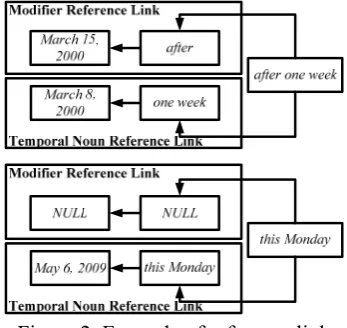
Meanwhile we find no matter how long or how many modifiers modify the temporal noun, the whole temporal expression holds the original temporal reference inferred from the temporal noun. Moreover, the key point of normalizing temporal expressions is choosing the appropriate reference time according to the real context ra-ther than deciding the right direction or compu-ting the measurable offset. For instance, with regard to these two Implicit Times in Figure 1, “after one week” and “this Monday”, we can achieve the referential direction easily from the modifiers through some mapping rules. Mean-while, the offsets are able to be understood di-rectly by machine with pattern matching. But for the reference time, we must build the context-depending reference reasoning to trace it. The reference link is described as Figure 2 shows.
classi-fication of the Implicit Time based on the classes of temporal noun’s reference time. Basically we tag the Implicit Time as the same class as its temporal noun’s under classifying temporal nouns into two classes according to the referen-tial feature.
(1) Global Temporal Noun: Global Temporal Noun takes the report time or publication time of the document as the reference time when norma-lizing. Basically, it is independent of the local context.
(2) Local Temporal Noun: Local Temporal Noun makes reference to the nearest narrative time in text above in normalization due to de-pending on the local context.
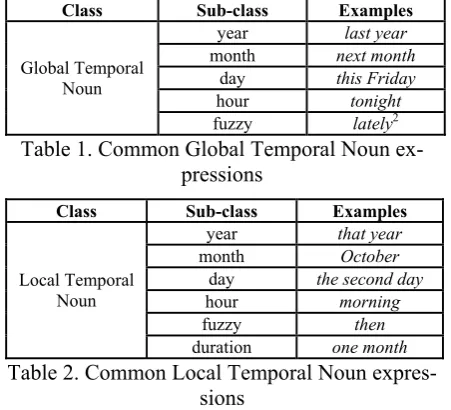
Table 1 and 2 give some examples of Global Temporal Noun and Local Temporal Noun in real texts.
Consequently, here we denote the Implicit Time consists of the Global Temporal Noun and the modifier(s) by Global Time or GT, and ac-cordingly the Local Temporal Noun corresponds to Local Time or LT.
Class Sub-class Examples
Global Temporal fuzzy lately2
Table 1. Common Global Temporal Noun ex-pressions
Class Sub-class Examples
Local Temporal Noun
year that year month October
day the second day hour morning fuzzy then duration one month Table 2. Common Local Temporal Noun
expres-sions
3.2 Naïve Bayesian Classifier
A variety of machine learning classifiers are de-signed to resolve the classification problem, such as SVM classifier, ME classifier and the Decision Tree family. But the performance of these classifiers is greatly depending on the fea-tures selection. Based on the observation and analysis in our experiments, we find the
2 Some single temporal adverbs are taken as temporal noun,
e.g. recently, currently and so on.
tial feature holds in the temporal noun is hard to express with some explicit denotations. For ex-ample, “that year” and “this year” are nearly identical in surface feature, but the former is lo-cally context-depending while the latter is local-ly context-free. So the Naïve Bayesian Classifier that assumes independence among feature deno-tations is suitable to be applied to our method.
We take the single word in the temporal noun as the object attributexiafter removing the
Ex-plicit Time in the whole text. Given the class labelc, the classifier learns the conditional prob-ability of each attribute xi from training data.
Meanwhile, achieving the practical instance ofX, classification is then performed by apply-ing Bayes rules to compute the probability ofc, and then predicting the class with the highest posterior probability.
Applying Bayes rules to (2), we have:
1 2 Maximum Likelihood Estimation (MLE) from training data with Dirichlet Smoothing method [Li et al., 2004].
3.3 Reference Time Choosing
The time table consists of two parts: Global Ref-erence Time and Local RefRef-erence Time.
(1) Global Reference Time: Global Reference Time (GRT) is a type of reference time which is referred to by the Global Time. Specifically, it is the report time or the publication time of the document.
(2) Local Reference Time: Local Reference Time (LRT) is made reference to by the Local Time. It will be updated dynamically after each normalizing.
Figure 3 shows a sample of the interaction be-tween reference times and target times.
Figure 3. Interaction between reference times and target times
In Figure 3, we notice that different classes of time dynamically and automatically choose ref-erences based on their respective classes rather than do it using the fixed value or the inconside-rate rule under the static mechanism. And the reference time table is updated in real time fi-nishing each normalizing, which makes the tem-poral situation compliable with dynamically changeable contexts.
4
Temporal Expression Normalization
4.1 Basic Normalizing Algorithm
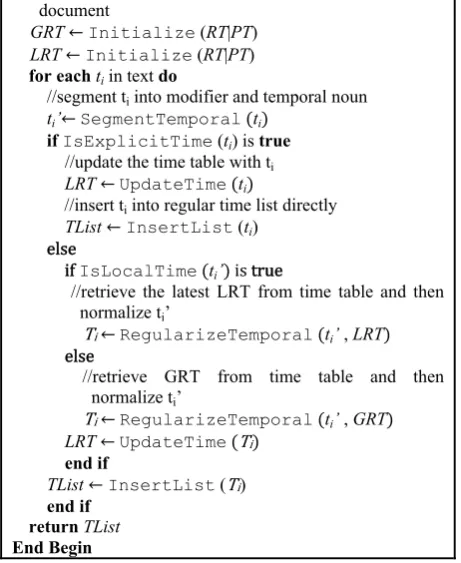
In the beginning, we need to achieve the report time (RT) or the publication time (PT) of the document to initialize the GRT and LRT. Addi-tionally, the fuzzy time can be referred to by other times in the normalization, but we must solve the defuzzification problem before taking it as the reference time. With respect to this issue, we will discuss it in the next section. Conse-quently, the practical normalizing algorithm is as follows.
Algorithm:TimeNormalize
Input: temporal expression ti in text
Output: regular time list TList
Begin
//initialize the GRT and LRT with RT or PT of this
document
GRT Initialize (RT|PT) LRT Initialize (RT|PT)
for each ti in text do
//segment ti into modifier and temporal noun
ti’ SegmentTemporal ti
ifIsExplicitTime (ti) is true
//update the time table with ti
LRT UpdateTime ti
//insert ti into regular time list directly
TList InsertList (ti)
else
if IsLocalTime ti’ is true
//retrieve the latest LRT from time table and then normalize ti’
Ti RegularizeTemporal ti’ , LRT
else
//retrieve GRT from time table and then normalize ti’
Ti RegularizeTemporal ti’ , GRT
LRT UpdateTime Ti
end if
TList InsertList (Ti)
end if return TList
End Begin
4.2 Temporal Expression Defuzzification
Figure 4. Variation process of temporal granu-larity
As conveyed in Figure 4, temporal expressions in the same scenario are constrained by the sce-nario depending. Hence fuzzy times should keep pace with scenario-correlative times in granu-larity. For example, two sentences in different scenarios:
“He was in Hong Kong yesterday, but now he is in Beijing.”
“He was in Hong Kong last year, but now he is in Beijing.”
Obviously, the first “now” means “today” in that scenario, and it has the same temporal gra-nularity with “yesterday”. Meanwhile it will be more appropriate for the second “now” choosing “year” as the temporal granularity than choosing “day” because of the dependence to the scena-rio-correlative time. In narrative, the paragraph is normally considered as the minimum unit of the scenario, so scenario-correlative relations should stand on the one paragraph at least.
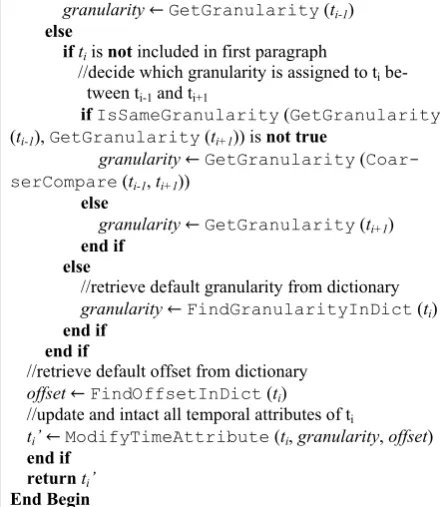
But for the first temporal expression in the pa-ragraph, we need to think about two specific conditions: when it appears in the first paragraph and in the non-first paragraph if it is a fuzzy time. Because there is no scenario shifting to the first paragraph, we employ a dictionary to initialize the algorithm when the first time included in the first paragraph is fuzzy time. The defuzzification process is outlined as follows.
Algorithm:TempGranuarityDefuzzify
Input: temporal expression ti in text
Output: precise-granularity time ti’
Begin
//obtain the granularity of ti
granularity GetGranularity (ti)
//decide whether ti is a fuzzy time
if granularity is not null
ti’ ti
else
if ti is not first temporal expression in current
para-graph
//assign the former’s granularity to the ti
granularity GetGranularity (ti-1)
else
if ti is not included in first paragraph
//decide which granularity is assigned to ti
be-tween ti-1 and ti+1
ifIsSameGranularity (GetGranularity
(ti-1), GetGranularity (ti+1)) is nottrue
granularity GetGranularity (
Coar-serCompare (ti-1, ti+1))
else
granularity GetGranularity (ti+1)
end if
else
//retrieve default granularity from dictionary granularity FindGranularityInDict (ti)
end if
end if
//retrieve default offset from dictionary offset FindOffsetInDict (ti)
//update and intact all temporal attributes of ti
ti’ ModifyTimeAttribute (ti, granularity, offset)
end if return ti’
End Begin
It’s possible for the first temporal expression to correlate with forenamed times in last para-graph in real texts, so we choose the coarser gra-nularity for the fuzzy time when appearing con-flicts in granularity between the last temporal expression and the next temporal expression. Additionally, an empirical fuzzy time dictionary is constructed as the default in order to figure out the offset problem. For example, “lately” is denoted in dictionary as below.
Lately
Common synonyms: recently, latterly, late, of late Default granularity: day
Default offset: 7 units
Finishing the defuzzification for the whole text, the basic normalizing algorithm is evoked then. In the experiments, we find that the temporal expression defuzzified can clearly improve the accuracy of reference times besides discovering the implicit temporal information much more.
5
Evaluation
5.1 Setup
Because the normalization for temporal expres-sions is independent of the language [Wilson et al., 2001], we take the formal Chinese news3 as
3People’s Daily news corpus (January, 1998), supported by
the experimental corpus, which consist of 3148 Chinese news articles. The data collection con-tains 2,816,612 characters/967,884 words and 21,176 manually annotated temporal nouns. Among this corpus, 2518 articles (80%) include 13,835 temporal expressions are used as training data for the classification, and the rest (20%) as test data. Then the whole corpus is tested for the normalization. Event-anchored expressions are relevant with a specific event and it is hard to represent the exact meaning of them, so in our system, event-anchored expressions are not normalized.
5.2 Results
Results on Implicit Times classification: We
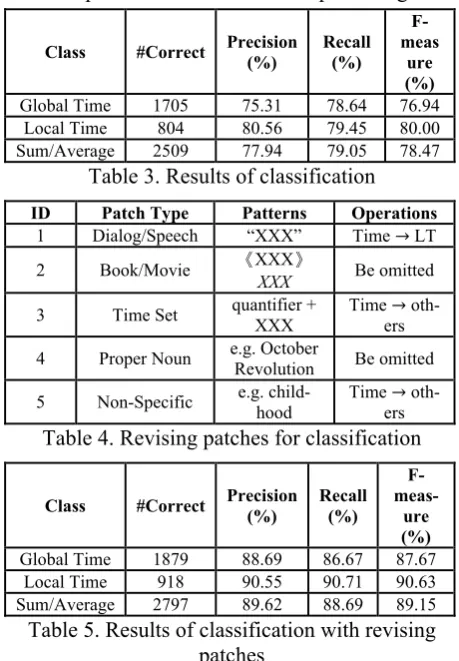
firstly choose some temporal expressions classi-fied in advance by crafted, and manually extend them in expressing patterns as the original train-ing samples. For example, “last month” will ex-tend to “this month” and “next month”, which all belong to Global Times. Actually there are only 16,104 temporal expressions in our experi-ment because integrated temporal expressions in corpus are segmented into several parts, and we combine them together again before operating. Using classifier trained by training data, we get 2,264 Global Times and 998 Local Times from testing collections, where there are 1,705 Global Times and 804 Local Times are correct respec-tively by manual statistics. Table 3 gives the de-tails of classification.
From the experiment data, we find the preci-sion and the recall almost below 80%, and the classification performance is not expected. The reason is that we do not consider some special application situations beforehand, which result in classifying errors. For example, the Global Time should be taken as the Local Time when it appears in the dialog or speech that marks boun-daries by a pair of quotation marks. So we intro-duce some revising patches shown in Table 4 to deal with this issue. Here the second and the fourth patches make corresponding temporal expressions be treated as non-target times that need not be processed. In addition, Time Set and Non-Specific are taken as the other classes ex-cept the Implicit Time and the Explicit Time. The final results with revising patches are shown in Table 5. Obviously, revising patches make the
classification be more adapted for the real texts, and the performance evaluation is promising.
Class #Correct Precision (%) Recall (%)
F-meas
ure (%)
Global Time 1705 75.31 78.64 76.94 Local Time 804 80.56 79.45 80.00 Sum/Average 2509 77.94 79.05 78.47
Table 3. Results of classification
ID Patch Type Patterns Operations
1 Dialog/Speech “XXX” Time LT
2 Book/Movie 《XXX》
XXX Be omitted
3 Time Set quantifier + XXX Time oth-ers
4 Proper Noun e.g. October Revolution Be omitted
5 Non-Specific e.g. child-hood Time oth-ers
Table 4. Revising patches for classification
Class #Correct Precision (%) Recall (%)
F-
meas-ure (%)
Global Time 1879 88.69 86.67 87.67 Local Time 918 90.55 90.71 90.63 Sum/Average 2797 89.62 88.69 89.15 Table 5. Results of classification with revising
patches
Results on temporal expression normalization:
For evaluating our algorithm objectively, we compare the experiment result with other two methods on the same testing corpus. The first compared method which is adopted in many tra-ditional systems [Li et al., 2004; Wu et al., 2005] applies the static time-value mechanism to de-termine the reference time. The nearest narrative time [Lin et al., 2008; Vicente-Diez and Marti-nez, 2009] that represents the static choosing-rules mechanism is taken as the second com-pared method. Table 6 presents the results.
Method
Average referent updating/
article
Accuracy (%)
Errors Referent
(%)
Others (%)
STVM 0 68.42 22.84 8.74
SCRM 7.8 76.19 11.25 12.56
Our
method 4.2 83.55 7.33 9.12
*STVM: Static Time-Value Mechanism SCRM: Static Choosing-Rules Mechanism
The data shows that our method exceeds the compared ones evidently. The accuracy increas-es by 15.13% at most, and the errors by referent decreases by 3.92% at least. In contrast to the SCRM, we avoid the limitation that SCRM only concentrates on the nearest distance for choosing referent. Meanwhile, because the SCRM pays no attention to the normalization for fuzzy temporal expressions, the error by others (e.g. granularity) is greater than ours. Additionally, the STVM method applies the report time or the publication time of the document as the reference time for the whole text, so there is no referent updating in process. We mark all errors as referent errors as long as they involve with false reference time in results analysis, therefore, the STVM gets the highest referent errors ratio.
With respect to the defuzzification, we eva-luate it on fuzzy times separately. All defuzzi-fied fuzzy times are assessed by human, and then decided whether they are acceptable to the context. The evaluation results are shown in Ta-ble 7.
Type #Acceptable Acceptable ratio (%) rent (%)As
refe-Global Time 687 80.14 18.39 Local Time 159 92.61 6.43 Sum/Average 846 86.38 12.41
Table 7. Evaluations on temporal expression defuzzification
For the fuzzy temporal expression in Local Time, it is much fewer and easier than the one in Global Time in number and expression respec-tively, so the defuzzification in Local Times achieves more expected results. On the other hand, the fuzzy time in Global Time is often the first temporal expression in the first paragraph, and the corresponding dictionary-based method certainly affects the experiment results. Accord-ing to the percentages that the temporal expres-sions defuzzified successfully account for in the all reference times, it demonstrates that the de-fuzzification makes contributions to the referen-tial normalization besides discovering the inter-nal temporal information in the fuzzy time.
6
Conclusion
In this paper, we present an approach to auto-matically normalizing temporal expressions un-der the reference time dynamic-choosing me-chanism. The referential feature in temporal
nouns is applied to classify Implicit Times. Based on this, different classes of times can be normalized according to their respective classes. Meanwhile, we introduce the scenario-time shifting model to deal with the defuzzification problem. The experiment shows that our ap-proach achieves more promising evaluation re-sults, and makes the automatic normalization more adaptable to real texts than the prior works. However, the neglect on the event-anchored ex-pression certainly restricts the whole system in applications, so the event-anchored expression will be our research focus in future.
Acknowledgement This work is supported by
the National Natural Science Foundation of Chi-na under the grant no. 60776801 and 70803001, the Open Projects Program of National Labora-tory of Pattern Recognition (no.20090029), the Key Laboratory of Advanced Information Science and Network Technology of Beijing (no. xdxx1005), the National High Technology Re-search and Development Program ("863" Pro-gram) of China (Grant No. 2009AA12Z204).
References
Anderson, A., Garrod, S.C. and Sandford, A.J. 1983. The Accessibility of Pronominal Antecedents As a Function of Episode Shifts in Narrative Text. Quarterly Journal of Experimental Psychology, 35a, pp. 427-440.
Dorr, B. and Gaasterland, T. 2002. Constraints on the Generation of Tense, Aspect, and Connecting Words from Temporal Expressions. Technical Re-port CS-TR-4391,UMIACS-TR-2002-71, LAMP-TR-091, University of Maryland, College Park, MD, 2002.
Ferro, L., Gerber, L., Mani, I., et al. 2005. TIDES 2005 Standard for the Annotation of Temporal Expressions [EB/O L]. (2005-09)
http: //timex2.mitre.org.
Hitzeman, J., Moens, M. and Grover, C. 1995. Algo-rithms for Analyzing the Temporal Structure of Discourse. In Proceedings of the 7th European Meeting of the Association for Computational Lin-guistics, pp. 253-260.
Lascarides, A., Asher, N. and Oberlander, J. 1992. Inferring Discourse Relations in Context. In Pro-ceedings of the 30th Meeting of the Association for Computational Linguistics, pp. 1-8.
Li, W.J., Wong, K.F., Cao, G.H. et al. 2004. Apply-ing Machine LearnApply-ing to Chinese Temporal Rela-tion ResoluRela-tion. In Proceedings of the 42nd An-nual Meeting on Association for Computational Linguistics, pp. 582-588.
Lin, J., Cao, D.F. and Yuan, C.F. 2008. Automatic TIMEX2 tagging of Chinese temporal information. Journal of Tsinghua University 48(1), 117-120. Mani, I. and Wilson, G. 2000. Robust Temporal
Processing of News. In Proceedings of the 38th Annual Meeting of the Association for Computa-tional Linguistics, pp. 69-76.
Saquete, E., Martinez-Barco, Patricio and Munoz, R. 2002. Recognizing and Tagging Temporal Expres-sions in Spanish, in Proceedings of Workshop on Annotation Standards for Temporal Information in Natural Language, pp. 44-51.
Schilder, F. and Habel, C. 2001. From Temporal Ex-pressions to Temporal Information: Semantic Tag-ging of News Messages. In Proceedings of the ACL 2001 Workshop on Temporal and Spatial In-formation Processing, pp. 65-72.
Vazov, N. 2001. A System for Extraction of Tempor-al Expressions from French Texts based on Syn-tactic and Semantic Constraints. In Proceedings of the ACL Workshop on Temporal and Spatial In-formation Processing, pp. 96-103.
Vicente-Díez, M.T., Samy, D. and Martínez, P. 2008. An Empirical Approach to a Preliminary Success-ful identification and Resolution of Temporal Ex-pressions in Spanish News Corpora. In Proceed-ings of the Sixth International Language Re-sources and Evaluation, pp. 2153-2158.
Vicente-Díez, M.T., Martinez, P. 2009. Temporal Semantics Extraction for Improving Web Search. In Proceedings of the Workshop on Database and Expert Systems Application, pp. 69-73.
Wilson, G., Mani, I., Sundheim, B. et al. 2001. A Multilingual Approach to Annotating and Extract-ing Temporal Information. In Proceedings of the Workshop on Temporal and Spatial Information Processing, pp. 1-7.
Wu, M.L., Li, W.J., Lu, Q. and Li, B.L. 2005. CTEMP: A Chinese temporal parser for extracting and normalizing temporal information. In Pro-ceedings of International Joint Conference on Natural Language Processing, pp. 694-706.