Measurement of
d
s
兾兾兾
dM
and Forward-Backward Charge Asymmetry for High-Mass Drell-Yan
e
1e
2Pairs from
p
p
¯
Collisions at
p
s
5
1
.
8 TeV
T. Affolder,23 H. Akimoto,45 A. Akopian,37M. G. Albrow,11 P. Amaral,8D. Amidei,25 K. Anikeev,24 J. Antos,1 G. Apollinari,11T. Arisawa,45 A. Artikov,9T. Asakawa,43W. Ashmanskas,8 F. Azfar,30 P. Azzi-Bacchetta,31 N. Bacchetta,31 H. Bachacou,23S. Bailey,16 P. de Barbaro,36 A. Barbaro-Galtieri,23 V. E. Barnes,35 B. A. Barnett,19
S. Baroiant,5M. Barone,13 G. Bauer,24 F. Bedeschi,33 S. Belforte,42W. H. Bell,15 G. Bellettini,33 J. Bellinger,46 D. Benjamin,10 J. Bensinger,4 A. Beretvas,11J. P. Berge,11J. Berryhill,8A. Bhatti,37M. Binkley,11 D. Bisello,31 M. Bishai,11 R. E. Blair,2C. Blocker,4K. Bloom,25 B. Blumenfeld,19 S. R. Blusk,36 A. Bocci,37 A. Bodek,36
W. Bokhari,32 G. Bolla,35 Y. Bonushkin,6D. Bortoletto,35J. Boudreau,34 A. Brandl,27 S. van den Brink,19 C. Bromberg,26M. Brozovic,10E. Brubaker,23N. Bruner,27E. Buckley-Geer,11J. Budagov,9H. S. Budd,36K. Burkett,16 G. Busetto,31A. Byon-Wagner,11K. L. Byrum,2S. Cabrera,10P. Calafiura,23M. Campbell,25W. Carithers,23J. Carlson,25 D. Carlsmith,46 W. Caskey,5A. Castro,3D. Cauz,42A. Cerri,33 A. W. Chan,1P. S. Chang,1P. T. Chang,1J. Chapman,25 C. Chen,32 Y. C. Chen,1M.-T. Cheng,1M. Chertok,5G. Chiarelli,33 I. Chirikov-Zorin,9G. Chlachidze,9F. Chlebana,11 L. Christofek,18M. L. Chu,1Y. S. Chung,36C. I. Ciobanu,28 A. G. Clark,14 A. Connolly,23J. Conway,38M. Cordelli,13
J. Cranshaw,40R. Cropp,41R. Culbertson,11D. Dagenhart,44S. D’Auria,15F. DeJongh,11 S. Dell’Agnello,13 M. Dell’Orso,33 L. Demortier,37 M. Deninno,3P. F. Derwent,11T. Devlin,38J. R. Dittmann,11 A. Dominguez,23 S. Donati,33J. Done,39 M. D’Onofrio,33 T. Dorigo,16 N. Eddy,18K. Einsweiler,23J. E. Elias,11 E. Engels, Jr.,34 R. Erbacher,11 D. Errede,18 S. Errede,18Q. Fan,36 R. G. Feild,47 J. P. Fernandez,11 C. Ferretti,33R. D. Field,12 I. Fiori,3
B. Flaugher,11 G. W. Foster,11 M. Franklin,16 J. Freeman,11 J. Friedman,24 Y. Fukui,22I. Furic,24 S. Galeotti,33 A. Gallas,16,* M. Gallinaro,37T. Gao,32 M. Garcia-Sciveres,23 A. F. Garfinkel,35P. Gatti,31 C. Gay,47D. W. Gerdes,25
P. Giannetti,33 P. Giromini,13V. Glagolev,9D. Glenzinski,11 M. Gold,27 J. Goldstein,11I. Gorelov,27A. T. Goshaw,10 Y. Gotra,34K. Goulianos,37 C. Green,35G. Grim,5P. Gris,11L. Groer,38 C. Grosso-Pilcher,8M. Guenther,35 G. Guillian,25 J. Guimaraes da Costa,16R. M. Haas,12C. Haber,23 S. R. Hahn,11C. Hall,16 T. Handa,17R. Handler,46 W. Hao,40F. Happacher,13 K. Hara,43 A. D. Hardman,35R. M. Harris,11F. Hartmann,20 K. Hatakeyama,37J. Hauser,6
J. Heinrich,32 A. Heiss,20M. Herndon,19C. Hill,5K. D. Hoffman,35C. Holck,32R. Hollebeek,32L. Holloway,18 R. Hughes,28 J. Huston,26 J. Huth,16H. Ikeda,43J. Incandela,11 G. Introzzi,33 J. Iwai,45 Y. Iwata,17 E. James,25 M. Jones,32U. Joshi,11 H. Kambara,14 T. Kamon,39 T. Kaneko,43 K. Karr,44 H. Kasha,47 Y. Kato,29T. A. Keaffaber,35
K. Kelley,24 M. Kelly,25 R. D. Kennedy,11 R. Kephart,11D. Khazins,10 T. Kikuchi,43 B. Kilminster,36 B. J. Kim,21 D. H. Kim,21H. S. Kim,18 M. J. Kim,21S. B. Kim,21 S. H. Kim,43Y. K. Kim,23 M. Kirby,10M. Kirk,4L. Kirsch,4 S. Klimenko,12 P. Koehn,28 K. Kondo,45 J. Konigsberg,12 A. Korn,24 A. Korytov,12 E. Kovacs,2J. Kroll,32M. Kruse,10
S. E. Kuhlmann,2K. Kurino,17 T. Kuwabara,43A. T. Laasanen,35 N. Lai,8S. Lami,37S. Lammel,11J. Lancaster,10 M. Lancaster,23R. Lander,5A. Lath,38 G. Latino,33 T. LeCompte,2A. M. Lee IV,10K. Lee,40S. Leone,33J. D. Lewis,11
M. Lindgren,6T. M. Liss,18 J. B. Liu,36Y. C. Liu,1D. O. Litvintsev,11O. Lobban,40 N. Lockyer,32 J. Loken,30 M. Loreti,31D. Lucchesi,31P. Lukens,11S. Lusin,46L. Lyons,30J. Lys,23R. Madrak,16 K. Maeshima,11 P. Maksimovic,16 L. Malferrari,3M. Mangano,33 M. Mariotti,31 G. Martignon,31 A. Martin,47J. A. J. Matthews,27
J. Mayer,41 P. Mazzanti,3K. S. McFarland,36 P. McIntyre,39E. McKigney,32M. Menguzzato,31A. Menzione,33 C. Mesropian,37 A. Meyer,11T. Miao,11 R. Miller,26 J. S. Miller,25H. Minato,43 S. Miscetti,13M. Mishina,22 G. Mitselmakher,12 N. Moggi,3E. Moore,27 R. Moore,25 Y. Morita,22 T. Moulik,35M. Mulhearn,24A. Mukherjee,11 T. Muller,20 A. Munar,33 P. Murat,11 S. Murgia,26 J. Nachtman,6V. Nagaslaev,40 S. Nahn,47H. Nakada,43 I. Nakano,17
C. Nelson,11 T. Nelson,11C. Neu,28D. Neuberger,20C. Newman-Holmes,11C.-Y. P. Ngan,24 H. Niu,4L. Nodulman,2 A. Nomerotski,12S. H. Oh,10 Y. D. Oh,21 T. Ohmoto,17 T. Ohsugi,17 R. Oishi,43T. Okusawa,29 J. Olsen,46 W. Orejudos,23 C. Pagliarone,33 F. Palmonari,33R. Paoletti,33V. Papadimitriou,40 D. Partos,4J. Patrick,11G. Pauletta,42
M. Paulini,23,† C. Paus,24D. Pellett,5L. Pescara,31 T. J. Phillips,10 G. Piacentino,33 K. T. Pitts,18A. Pompos,35 L. Pondrom,46 G. Pope,34 M. Popovic,41 F. Prokoshin,9J. Proudfoot,2F. Ptohos,13 O. Pukhov,9 G. Punzi,33 A. Rakitine,24 F. Ratnikov,38 D. Reher,23 A. Reichold,30A. Ribon,31 W. Riegler,16 F. Rimondi,3 L. Ristori,33 M. Riveline,41W. J. Robertson,10A. Robinson,41 T. Rodrigo,7S. Rolli,44L. Rosenson,24 R. Roser,11 R. Rossin,31
A. Roy,35 A. Ruiz,7A. Safonov,5R. St. Denis,15W. K. Sakumoto,36 D. Saltzberg,6C. Sanchez,28 A. Sansoni,13 L. Santi,42H. Sato,43P. Savard,41P. Schlabach,11 E. E. Schmidt,11 M. P. Schmidt,47M. Schmitt,16,† L. Scodellaro,31
A. Scott,6 A. Scribano,33 S. Segler,11 S. Seidel,27 Y. Seiya,43 A. Semenov,9F. Semeria,3T. Shah,24 M. D. Shapiro,23 P. F. Shepard,34 T. Shibayama,43M. Shimojima,43 M. Shochet,8A. Sidoti,31 J. Siegrist,23 A. Sill,40P. Sinervo,41
P. Singh,18 A. J. Slaughter,47 K. Sliwa,44C. Smith,19 F. D. Snider,11 A. Solodsky,37J. Spalding,11 T. Speer,14 P. Sphicas,24 F. Spinella,33 M. Spiropulu,16 L. Spiegel,11 J. Steele,46A. Stefanini,33J. Strologas,18 F. Strumia,14 D. Stuart,11K. Sumorok,24T. Suzuki,43T. Takano,29 R. Takashima,17K. Takikawa,43P. Tamburello,10 M. Tanaka,43
B. Tannenbaum,6M. Tecchio,25R. Tesarek,11 P. K. Teng,1K. Terashi,37 S. Tether,24 A. S. Thompson,15 R. Thurman-Keup,2P. Tipton,36 S. Tkaczyk,11D. Toback,39 K. Tollefson,36 A. Tollestrup,11D. Tonelli,33 H. Toyoda,29
W. Trischuk,41 J. F. de Troconiz,16 J. Tseng,24N. Turini,33 F. Ukegawa,43T. Vaiciulis,36 J. Valls,38 S. Vejcik III,11 G. Velev,11 G. Veramendi,23 R. Vidal,11 I. Vila,7R. Vilar,7I. Volobouev,23 M. von der Mey,6 D. Vucinic,24 R. G. Wagner,2R. L. Wagner,11N. B. Wallace,38Z. Wan,38C. Wang,10M. J. Wang,1B. Ward,15 S. Waschke,15T. Watanabe,43
D. Waters,30 T. Watts,38 R. Webb,39H. Wenzel,20 W. C. Wester III,11 A. B. Wicklund,2E. Wicklund,11 T. Wilkes,5 H. H. Williams,32 P. Wilson,11 B. L. Winer,28 D. Winn,25 S. Wolbers,11D. Wolinski,25J. Wolinski,26S. Wolinski,25
S. Worm,27 X. Wu,14 J. Wyss,33 W. Yao,23 G. P. Yeh,11P. Yeh,1J. Yoh,11 C. Yosef,26 T. Yoshida,29I. Yu,21 S. Yu,32 Z. Yu,47 A. Zanetti,42 F. Zetti,23 and S. Zucchelli3
(CDF Collaboration)
1Institute of Physics, Academia Sinica, Taipei, Taiwan 11529, Republic of China 2Argonne National Laboratory, Argonne, Illinois 60439
3Istituto Nazionale di Fisica Nucleare, University of Bologna, I-40127 Bologna, Italy 4Brandeis University, Waltham, Massachusetts 02254
5University of California at Davis, Davis, California 95616 6University of California at Los Angeles, Los Angeles, California 90024 7Instituto de Fisica de Cantabria, CSIC-University of Cantabria, 39005 Santander, Spain
8Enrico Fermi Institute, University of Chicago, Chicago, Illinois 60637 9Joint Institute for Nuclear Research, RU-141980 Dubna, Russia
10Duke University, Durham, North Carolina 27708 11Fermi National Accelerator Laboratory, Batavia, Illinois 60510
12University of Florida, Gainesville, Florida 32611
13Laboratori Nazionali di Frascati, Istituto Nazionale di Fisica Nucleare, I-00044 Frascati, Italy 14University of Geneva, CH-1211 Geneva 4, Switzerland
15Glasgow University, Glasgow G12 8QQ, United Kingdom 16Harvard University, Cambridge, Massachusetts 02138
17Hiroshima University, Higashi-Hiroshima 724, Japan 18University of Illinois, Urbana, Illinois 61801 19The Johns Hopkins University, Baltimore, Maryland 21218
20Institut für Experimentelle Kernphysik, Universität Karlsruhe, 76128 Karlsruhe, Germany 21Center for High Energy Physics, Kyungpook National University, Taegu 702-701, Korea,
Seoul National University, Seoul 151-742, Korea,
and SungKyunKwan University, Suwon 440-746, Korea
22High Energy Accelerator Research Organization (KEK), Tsukuba, Ibaraki 305, Japan 23Ernest Orlando Lawrence Berkeley National Laboratory, Berkeley, California 94720
24Massachusetts Institute of Technology, Cambridge, Massachusetts 02139 25University of Michigan, Ann Arbor, Michigan 48109
26Michigan State University, East Lansing, Michigan 48824 27University of New Mexico, Albuquerque, New Mexico 87131
28The Ohio State University, Columbus, Ohio 43210 29Osaka City University, Osaka 588, Japan 30University of Oxford, Oxford OX1 3RH, United Kingdom
31Universita di Padova, Istituto Nazionale di Fisica Nucleare, Sezione di Padova, I-35131 Padova, Italy 32University of Pennsylvania, Philadelphia, Pennsylvania 19104
33Istituto Nazionale di Fisica Nucleare, University and Scuola Normale Superiore of Pisa, I-56100 Pisa, Italy 34University of Pittsburgh, Pittsburgh, Pennsylvania 15260
35Purdue University, West Lafayette, Indiana 47907 36University of Rochester, Rochester, New York 14627
37Rockefeller University, New York, New York 10021 38Rutgers University, Piscataway, New Jersey 08855 39Texas A&M University, College Station, Texas 77843
40Texas Tech University, Lubbock, Texas 79409
43University of Tsukuba, Tsukuba, Ibaraki 305, Japan 44Tufts University, Medford, Massachusetts 02155
45Waseda University, Tokyo 169, Japan 46University of Wisconsin, Madison, Wisconsin 53706
47Yale University, New Haven, Connecticut 06520
(Received 11 June 2001; published 7 September 2001)
We report on a measurement of the mass dependence of the forward-backward charge asymmetry,AFB,
and production cross section ds兾dM fore1e2 pairs with mass M
ee.40GeV兾c2. The data sample
consists of108pb21ofpp¯collisions atps苷1.8TeV taken by the Collider Detector at Fermilab during
1992–1995. The measured asymmetry andds兾dM are compared with the predictions of the standard model and a model with an extra Z0 gauge boson.
DOI: 10.1103/PhysRevLett.87.131802 PACS numbers: 13.85.Qk, 12.38.Qk, 12.15.Ji, 12.15.Mm
In hadron-hadron collisions at high energies, massive
e1e2 pairs are predominantly produced via the Drell-Yan [1] process. In the standard model, quark-antiquark anni-hilations form an intermediategⴱ orZ共gⴱ兾Z兲 vector bo-son, which may yield ane1e2 pair. The presence of both vector and axial-vector couplings in this process gives rise to a forward-backward asymmetry, AFB, in the final-state angle of the electron in the rest frame of the e1e2 pair (with respect to theprotondirection). The standard model predicts accurately the mass 关M兴dependence of the pro-duction cross section 共ds兾dM兲 and AFB. In the region of theZ resonance, the predicted asymmetry is related to the electroweak mixing angle. For M ¿ MZ, the large
predicted asymmetry (near 0.6) is a consequence of the in-terference between the propagators of thegⴱandZ. Vari-ous new interactions not included in the standard model could result in deviations from the standard model predic-tions for bothds兾dM andAFB. Possible new interactions include additional gauge bosons [2 –4], quark-lepton com-positeness [5], exchange of Rparity violating supersym-metric particles or leptoquarks, and extra dimensions [6]. For example, although the mass limits [4] extracted from
ds兾dM for a variety ofZ0 models are in the600GeV兾c2 range, the limits are reduced [3] if theZ0 width (typically
GZ0 艐0.01MZ0) is increased to, e.g.,艐0.01MZ0to account
for the possibility of a more general [3]Z0model with en-hanced couplings to the third generation. Therefore, it is important to use bothds兾dM andAFBin a more general search for new physics.
In this Letter we extract measurements ofds兾dM and improve the existing measurements of AFB. The previ-ous Collider Detector at Fermilab (CDF) measurements in the e1e2 [5] and m1m2 [7] channels reported, on a central 共jhj,1.1兲 region, measurements of d2s兾dMdy averaged over rapidities [8] of jyj,1. Electrons in the plug共1.1, jhj, 2.4兲but not forward共2.2, jhj,4.2兲
calorimeter were included in the previous CDF measure-ment [9] ofAFB, but backgrounds in the plug region were large resulting in significant uncertainties. This analy-sis includes electrons in the plug and forward regions of the calorimeter, thus covering a larger range of rapidity. New analysis techniques and tracking requirements in the forward region greatly reduce the backgrounds and uncer-tainties. In addition, by applying electroweak and QED
radiative corrections [10,11] (which correct for the change in Mfrom the emission of final state photons), measure-ments ofAFBin small bins over a large range in mass are extracted for the first time. Our measurement of e1e2 pairs with invariant masses between 40 and500GeV兾c2 complement measurements ine1e2machines, which cur-rently extend to 200GeV兾c2.
The e1e2 pairs come from108pb21 ofpp¯ collisions at ps 苷1.8TeV taken by CDF [8] during 1992–1993 共18.7 60.7pb21兲 and 1994 –1995 共89.1 63.7pb21兲. The CDF detector consists of a solenoidal magnetic spectrometer surrounded by projective-tower-geometry calorimeters and outer muon detectors. Only detector components used in this measurement are described here. Charged particle momenta and directions are measured by the spectrometer embedded in a 1.4 T axial magnetic field, an 84-layer cylindrical drift chamber (CTC), an inner vertex tracking chamber (VTX), and a silicon vertex detector (SVX). The polar coverage of the CTC tracking is jhj,1.2. The pp¯ collision point along the beam line共Zvertex兲is determined using tracks in the VTX. The energies and directions [8] of electrons, photons, and jets are measured by three separate calorimeters covering three regions: central (C), end plug (P), and forward (F). Each calorimeter has an electromagnetic (EM) and a hadronic (HAD) calorimeter. We follow the analysis procedure used in our previous measurements [12,13] of
ds兾dy andds兾dPT ofZ boson pairs. The measurement ofAFB requires the sign of at least one lepton. Therefore, we require one of the leptons to be in the central region.
central electron must have a CTC track that extrapolates to the electron’s shower cluster in the EM calorimeter. This cluster must have EM-like transverse shower profiles. The track momentum and the EM shower energy must be con-sistent with one another. The track is also used to de-termine the position and direction of the central electron. The fraction of energy in the HAD calorimeter towers be-hind the EM shower is required to be consistent with that expected for an EM shower共EHAD兾EEM兲. The plug elec-trons must also have an EM-like transverse shower profile. The end plug and forward electrons are required to pass the
EHAD兾EEM requirement and to have a track in the VTX which originates from the same vertex as the other elec-tron and points to the position of the electromagnetic clus-ter in the calorimeclus-ter. The ratio of found to expected hits in the VTX is required to be greater than 70% and50%
for plug and forward electrons, respectively. The VTX tracking efficiency is共97.8 60.3兲%for plug electrons and 共97.060.9兲% for forward electrons. To eliminate back-grounds from dijet events for very forward electrons both lepton legs for CF events are required to be on the same side of the detector, i.e., have the same sign inh. The total data sample after all cuts consists of 7632 events.
With the above cuts, backgrounds are low and can be re-liably estimated using the data. Because of the CTC track-ing requirement, the jet background for the central-central (CC) sample is negligible. All CC events are required to be opposite sign (the eight same sign events are all in theZ
mass region and originate from the small charge misiden-tification probability). The CC background is mainly composed of e1e2 pairs from W1W2, t1t2, cc¯, bb¯, andt¯tsources. This background is estimated usinge6m7
pairs. Because of the tracking and same side requirements, the backgrounds in the plug (CP) and central-forward (CF) topologies are also small [12,13] and mainly come from dijet events. As described in Refs. [12,13], these are extracted from the data by fitting the isolation energy distribution to a sum of the expected distributions for signal and background events. For Mee .105GeV
the isolation energy fraction is used. The shapes of the isolation energy distributions are extracted from selected jet background-dominated and electron signal-dominated data samples.
The acceptance for e1e2 pairs is obtained using the Monte Carlo event generator PYTHIA 6.146 [15], and CDF detector simulation programs. PYTHIAgenerates the LO QCD interaction 共q 1q¯ !gⴱ兾Z兲, simulates initial state QCD radiation via its parton shower algorithms, and generates the decay, gⴱ兾Z !e1e2. To approximate higher order QCD corrections to the LO mass distri-bution, a K factor [16] is used as an event weight:
K共M2兲 苷11 4 3共11
4
3p2兲as共M2兲兾2p, where as is
the QCD coupling. This factor improves the agree-ment between the NLO and LO mass spectra. (For
M .50 GeV兾c2, 1.25, K , 1.36.) The CTEQ5L [17] PDFs are used in the acceptance calculations. Final state QED radiation [10] from the gⴱ兾Z !e1e2 vertex
is added by the PHOTOS [11] Monte Carlo program. The parameters of PYTHIA 6.146 are tuned [15] to fit experimentally measuredPT [13] andydistributions [12]
of e1e2 pairs in the Z region. Generated events are processed by CDF detector simulation programs and are reconstructed as data. Reconstructed Monte Carlo events are accepted if they pass the fiducial, kinematic, and mass cuts.
The angle of the electron is determined in the Collins-Soper [18] frame, which reduces the uncertainty in the angle introduced by the transverse momentum of the incoming partons. We determine the cross sections
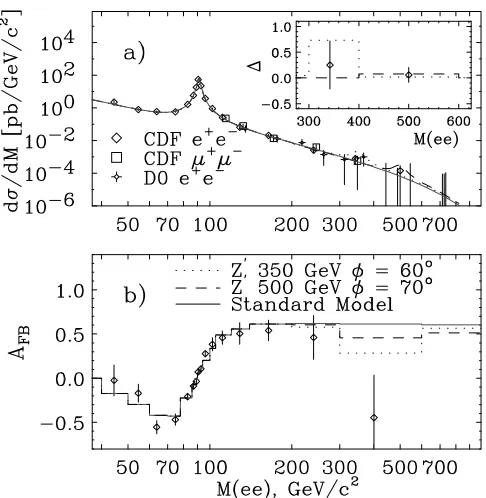
ds1兾dM and ds2兾dM for forward and backward events, respectively. ds兾dM [shown in Fig. 1(a)] and
AFB[shown in Fig. 1(b)] are extracted from the sum and difference of the forward and backward cross sections. The very small misidentification probability is handled as a dilution factor inAFB. The CC, CP, and CF samples are combined and are binned inM, andds兾dM is given by
ds
dM 苷
N 2B
DMPrLreArc
.
Here N is the number of observed events, B is the estimated background in a bin, DM is the bin width, the
FIG. 1. (a)ds兾dMdistribution ofe1e2andm1m2pairs. All
errors (except for the overall3.9%luminosity error) have been combined in quadrature. The standard model theoretical predic-tions (solid line) have been normalized by a factor of 1.11 to the data in theZboson mass region. Also shown aree1e2
measure-ments from DØ. (b)AFBversus mass compared to the standard
model expectation (solid line). Also, predicted theoretical curves fords兾dM andAFBwith an extraE6Z0boson (width of10%)
with MZ0 苷350 (dotted line) and 500GeV兾c2 (dashed line).
The inset in (a) is the difference, “D” in fb兾GeV兾c2, between
the CDFe1e2ds兾dMdata and the standard model prediction
sum r is over the 1992–1993 and 1994 –1995 runs, Lr
is the integrated luminosity, andeArcis the run’s combined event selection efficiency, radiative corrections, and accep-tance. The backgrounds subtracted from the event count are predicted using the data and background samples. Acceptances are calculated separately for CC, CP, and CF pairs. They are combined with the corresponding event selection efficiencies to giveeArc.Arcincludes corrections for detector resolution smearing. Since thePYTHIA/PHOTOS [11] Monte Carlo program includes radiative final-state photons, the effects of the final-state radiated photons [10,11] are calculated together with the acceptance calculation. Also shown in Fig. 1(a) are CDF dimuon results for ds兾dM (which have not been previously published). These were extracted from the published dimuon [7] data (d2s兾dMdy for jyj,1) by applying a correction using a QCD-NLO calculation [19] that de-scribes our measuredZe1e2pairydistributions [12] over the entire kinematic range. The e1e2 cross sections and asymmetries forMee , 105GeV兾c2are given in Table I,
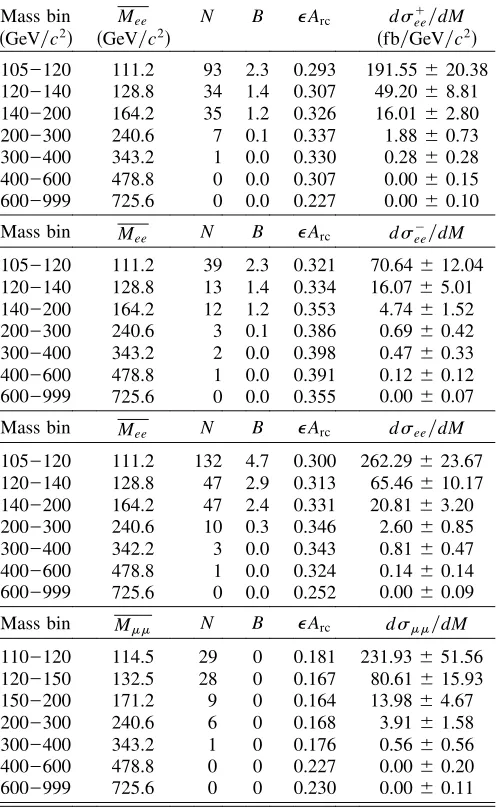
and the higher mass data samples and backgrounds are summarized in Table II. We define M to be the mass value for which the cross section is equal to the average cross section over each bin, as calculated from a NNLO theoretical prediction [20] fords兾dM.
The systematic errors are determined from the fol-lowing: statistical errors in the fits to the fractional background, variations in the background estimates using different methods, the background in the efficiency sample, the uncertainty in energy resolution of the calorimeter, the choice of PDFs, and the distribution of
e1e2PT used in the Monte Carlo event generator. Above the region of the Z mass, the total systematic errors are much smaller than the statistical errors, and the total errors shown in Table II are dominated by statistics. In the Z
mass region, the systematic errors are less than half of the statistical error (as shown below). The pp¯ collision lu-minosity is derived with CDF’s beam-beam cross section,
sBBC 苷51.156 1.60 mb [21,22]. The luminosity error
TABLE I. The e1e2 cross sections and asymmetries for
Mee,105GeV兾c2. The statistical and systematic errors have
been combined in quadrature. The 3.9% overall luminosity error is not included.
Mass bin Mee dsee兾dM AFB
共GeV兾c2兲 共GeV兾c2兲 共pb兾GeV兾c2兲
40 50 44.5 2.3060.47 20.0260.17
50 60 54.6 0.8060.11 20.1760.10
60 70 63.8 0.6060.06 20.5660.07
70 78 74.7 0.5860.05 20.4760.06
78 86 82.9 1.6460.06 20.2160.04
86 88 87.1 5.8960.22 20.0960.04
88 90 89.2 18.2860.52 20.0460.03
90 92 90.6 54.8561.39 0.0760.02
92 94 92.8 22.7560.66 0.1160.03
94 100 96.2 3.8060.12 0.2860.03
100 105 102.2 0.9160.07 0.3860.07
of3.9%contains thesBBC error and uncertainties specific to running conditions. As described in a previous com-munication [12], the extracted cross section in theZmass region is 252.16 3.9共stat兲 61.6共syst兲 69.8共lum兲 pb. Note that since the pp¯ inelastic cross section used by CDF in luminosity calculations differs from DØ’s by
15.9%[22], the DØ e1e2 cross sections [23] shown in Fig. 1 have been multiplied by 1.059.
Figure 1 also compares the measuredds兾dM andAFB to theoretical predictions. The ds兾dM curve is a QCD NNLO [20] calculation with MRST99 NLO PDFs [24]. The predictions in Fig. 1(a) are normalized by a factor
F 苷1.11, the ratio of measured total cross section in theZ
region to the NNLO prediction (the overall normalization uncertainties are 3.9% for the experimental data and 5%
TABLE II. The number of signal and background events and correction factors involving the extraction of ds1
ee兾dM,
ds2
ee兾dM,dsee兾dM, and dsmm兾dM for mass bins above the
Z pole. HereN is the number of events, B is the background estimate,eArcis the combined efficiency, acceptance, smearing,
and radiative correction. The statistical and systematic errors for ds兾dM have been combined in quadrature. The 3.9% overall luminosity error is not included.
Mass bin Mee N B eArc ds1ee兾dM
共GeV兾c2兲 共GeV兾c2兲 共fb兾GeV兾c2兲
105 120 111.2 93 2.3 0.293 191.55620.38
120 140 128.8 34 1.4 0.307 49.2068.81
140 200 164.2 35 1.2 0.326 16.0162.80
200 300 240.6 7 0.1 0.337 1.8860.73
300 400 343.2 1 0.0 0.330 0.2860.28
400 600 478.8 0 0.0 0.307 0.0060.15
600 999 725.6 0 0.0 0.227 0.0060.10
Mass bin Mee N B eArc ds2ee兾dM
105 120 111.2 39 2.3 0.321 70.64612.04 120 140 128.8 13 1.4 0.334 16.0765.01
140 200 164.2 12 1.2 0.353 4.7461.52
200 300 240.6 3 0.1 0.386 0.6960.42
300 400 343.2 2 0.0 0.398 0.4760.33
400 600 478.8 1 0.0 0.391 0.1260.12
600 999 725.6 0 0.0 0.355 0.0060.07
Mass bin Mee N B eArc dsee兾dM
105 120 111.2 132 4.7 0.300 262.29623.67 120 140 128.8 47 2.9 0.313 65.46610.17 140 200 164.2 47 2.4 0.331 20.8163.20
200 300 240.6 10 0.3 0.346 2.6060.85
300 400 342.2 3 0.0 0.343 0.8160.47
400 600 478.8 1 0.0 0.324 0.1460.14
600 999 725.6 0 0.0 0.252 0.0060.09
Mass bin Mmm N B eArc dsmm兾dM
110 120 114.5 29 0 0.181 231.93651.56
120 150 132.5 28 0 0.167 80.61615.93
150 200 171.2 9 0 0.164 13.9864.67
200 300 240.6 6 0 0.168 3.9161.58
300 400 343.2 1 0 0.176 0.5660.56
400 600 478.8 0 0 0.227 0.0060.20
for the NNLO theory). The standard model predictions for AFB have been calculated [3,10] in NLO-QCD. The measuredds兾dM andAFB values are in good agreement with the standard model predictions. However, AFB in the highest mass bin共300 600GeV兾c2兲is2.2s(standard deviations) below the standard model prediction. There are three events [25] in the negative hemisphere and one event in the positive hemisphere. A negative asymme-try in this region could be a fluctuation, or could result from new interactions including additional gauge bosons [2– 4] (discussed as an example below), quark-lepton com-positeness [5], exchange of Rparity violating supersym-metric particles, leptoquarks, and extra dimensions [6]. These data can be used in global fits to electroweak data to search (or extract limits) for physics beyond the standard model. For example, the predicted theoretical curves [3] for ds兾dM and AFB in models which include extra E6
Z0 bosons (with parameters tuned to fit low energy elec-troweak data) are shown as the dashed and dotted curves in Fig. 1.
We thank the Fermilab staff and the technical staffs of the participating institutions for their vital contributions. This work was supported by the U.S. Department of Energy and National Science Foundation; the Italian Istituto Nazionale di Fisica Nucleare; the Ministry of Education, Science, Sports and Culture of Japan; the Natural Sciences and Engineering Research Council of Canada; the National Science Council of the Republic of China; the Swiss National Science Foundation; the A. P. Sloan Foundation; the Bundesministerium fuer Bildung und Forschung, Germany; the Korea Science and Engineering Foundation (KoSEF); the Korea Research Foundation; and the Comision Interministerial de Ciencia y Tecnologia, Spain.
*Present address: Northwestern University, Evanston, IL 60208.
†Present address: Carnegie Mellon University, Pittsburgh,
PA 15213.
[1] S. D. Drell and T.-M. Yan, Phys. Rev. Lett.25,316 (1970). [2] J. Rosner, Phys. Rev. D54,1078 (1996).
[3] A. Bodek and U. Baur, hep-ph/0102160, 2001 [Eur. Phys. J. C (to be published)].
[4] F. Abeet al.,Phys. Rev. Lett.79,2192 (1997); M. Pillai, Ph.D. thesis, University of Rochester, UR1478, 1996. [5] F. Abeet al.,Phys. Rev. Lett.79,2198 (1997).
[6] H. Davoudiasl, J. L. Hewett, and T. G. Rizzo, Phys. Rev. Lett. 84, 2080 (2000).
[7] F. Abeet al.,Phys. Rev. D59,052002 (1999).
[8] F. Abeet al.,Nucl. Instrum. Methods Phys. Res., Sect. A
271,387 (1988). CDF coordinates are in共u,f,z兲, where u is the polar angle relative to the proton beam (the 1z axis), and f is the azimuth. The pseudorapidity is h 苷2ln tan共u兾2兲. Here PT 苷Psinu,y苷
1 2ln
P1Pz
P2Pz,P
andPz are the magnitude andzcomponent of a particle’s
momentum, andET 苷Esinu, whereEis the energy
mea-sured in the calorimeter.
[9] F. Abeet al.,Phys. Rev. Lett.77,2616 (1996).
[10] U. Baur, S. Keller, and W. K. Sakumoto, Phys. Rev. D57,
199 (1998).
[11] E. Barberio and Z. Was, Comput. Phys. Commun.79,291 (1994); E. Barberio, B. van Eijk, and Z. Was,ibid.66,115 (1991).
[12] T. Affolderet al.,Phys. Rev. D63,011101(R) (2001); J. B. Liu, Ph.D. thesis, University of Rochester, UR1606, 2000. [13] T. Affolderet al.,Phys. Rev. Lett.84,845 (2000). [14] The CDF top-quark high-PT dilepton selection [F. Abe
et al., Phys. Rev. D 50, 2966 (1994)] is used, but with both leptons isolated and no jet cuts.
[15] T. Sjöstrand, Comput. Phys. Commun. 82, 74 (1994). The default PYTHIA 6.146 is used except MSTJ共41兲苷1, MSTP共91兲苷1, and PARP共62, 91, 92兲苷2.25, 2.0, 10.0 GeV.
[16] G. Altarelli, R. E. Ellis, and G. Martinelli, Nucl. Phys.
B157,461 (1979).
[17] H. L. Laiet al.,Eur. Phys. J. C12,375 (2000). [18] J. Collins and D. Soper, Phys. Rev. D16,2219 (1977). [19] P. J. Rijken and W. L. van Neerven, Phys. Rev. D51, 44
(1995).
[20] MS: R. Hamberg, W. L. van Neerven, and T. Matsuura, Nucl. Phys. B359, 343 (1991). DIS: W. L. Van Neerven and E. B. Zijlstra, Nucl. Phys.B382,11 (1992).
[21] F. Abeet al.,Phys. Rev. Lett.76,3070 (1996).
[22] D. Cronin-Hennessyet al.,Nucl. Instrum. Methods Phys. Res., Sect. A443/1,37 (2000).
[23] B. Abbottet al.,Phys. Rev. Lett.82,4769 (2000). [24] A. D. Martinet al.,Eur. Phys. J. C14,133 (2000). [25] The (mass, cosu, region) of the four highest masseeevents