CSEIT184687 | Published – 08 May 2018 | May-June 2018 [ (4 ) 6 : 463-468 ]
National Conference on Engineering Innovations and Solutions (NCEIS – 2018)
International Journal of Scientific Research in Computer Science, Engineering and Information Technology
© 2018 IJSRCSEIT | Volume 4 | Issue 6 | ISSN : 2456-3307
463
Artificial Inteligence Based Face Detection And Recognition
For Automatic Attendance System
Deeksha M1, Sana Seham1,Geethanjali S1, Tanuja K2
1Student, Department of Information Science and Engineering, GSSS Institute of Engineering and Technology
for women, Mysore, India
2Assistant Professor Department of Information Science and Engineering, GSSS Institute of Engineering and
Technology for women, Mysore, India
ABSTRACT
A robust and reliable classroom attendance system using Artificial Intelligence, which is based on face detection and recognition is presented in this paper. Here input to the system is a live video and output is a consolidated with attendance of the students in the video. Automated attendance system can be implemented using various techniques of biometrics. Face recognition is one of them which do not involve human intervention. In this paper, attendance is registered from a live video of students. Students are identified by first performing Face Detection which separates faces from non- faces, and then Face Recognition is carried out which finds the match of the detected face from the face database (collection of student’s name and images). If it is a valid match then attendance is registered to a tailored database and further status will be forwarded to parents, in case if students have attendance shortage. Face recognition is performed and matched on the basis of the accuracy by detection and recognition using Principle Component Analysis (PCA) algorithm and Viola Jones algorithm.
Keywords:Face Recognition; PCA; ViolaJones; Face Detection; Video; Attendance Management; Image Processing; Passing Attendance Status;
I.
INTRODUCTION
Maintaining the attendance is essential in each and every groundwork for checking the performance of students. Each organization has its own technique.
Traditionally student’s attendance is taken
substantially by utilizing participation sheet. The Current participation stamping techniques are monotonous and tiresome. Physically recorded participation can be effortlessly controlled. Besides, it is exceptionally hard to confirm one by one student in a substantial classroom environment with scattered branches whether the verified students are really present or not. Consequently this paper is implemented to handle each of these issues.
Framework is such that it uses face detection and recognition algorithms which automatically detect and registers student attending particular class. Face detection and recognition is often referred to as, analyses characteristics of a person's face image input through a camera. It processes overall facial structure, distances between eyes, nose and mouth. Hence, this system handles all the issues which occurred in traditional system and other bio metrics methods.
II.
EXISTING SYSTEM
while some have adopted the biometric technique like iris recognition, fingerprint, and voice recognition. The traditional method makes it difficult to verify students one by one for larger strength. Using traditional method takes longer time and may not be accurate all the time, in case of biometric iris recognition and fingerprint makes it difficult to verify students one by one for larger strength, and in voice recognition technique using voiceprint of an individual to authenticate being used. Using Radio frequency Identification (RFID) helps to identify a large number of crowd steps methodology which involves face detection and face recognition. To get high recognition rate, detection plays a major role. In recent years researchers have developed numbers of face detection and face recognition algorithm. Huge amount of work is being carried out to implement classroom attendance system [1-6]. In [1] we came to know about the two stage methodology of automated attendance system. [4] Suggests the improvised recognition rate by enhancing the quality of the image. In [7] & [8] there are different approaches to face detection.[7] gives the study of Local Binary Pattern (LBP), Ad Boost algorithm, SMQT Features and SNOW Classifier Method and Neural Network-Based Face Detection. To get an efficient system for image /video-based face recognition, researchers proposed various algorithms like [9] [10] [11] [12] [13] & [14] using Eigen faces in Principle Component Analysis (PCA), Linear Discriminant Analysis (LDA). [15] [16] compared LDA and other methods of face recognition. [17] [18] [19] used hidden Markov model, probabilistic appearance manifold, and
ARMA model respectively. [20-25] presented deep review of various proposed methods for overcoming the difficulties.
IV.
ARCHITECTURE
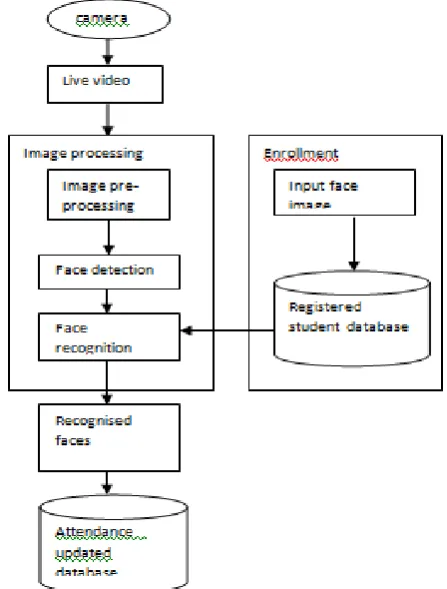
System block diagram represents the overview of the system, registered students database will be maintained, a camera placed within the class room will take live video, gives it as input to the image processing system. Where initially face detection phase will takes place using Viola Jones algorithm, then face recognition phase will be followed by using PCA algorithm. Then identified students will be updated in student attendance database.
Figure 1. Block Diagram of an Automated System.
Face recognition
Registering attendance 1. Creating face database
The database is the training set of our system and is created in such a way that it contains images of camera to get the efficient detection and recognition. It should be connected to the PC and its drivers
After getting the video, the system reads the frames. Once the reading stops, it gets the frame and sends it for face detection.
Viola Jones Face Detection Framework
The Viola–Jones algorithm is first object detection framework to provide competitive object detection rates in proposed by Paul Viola in 2001 and Michael Jones. It is a machine learning based Approach, this algorithm is used to differentiate face region from non face region. It includes,
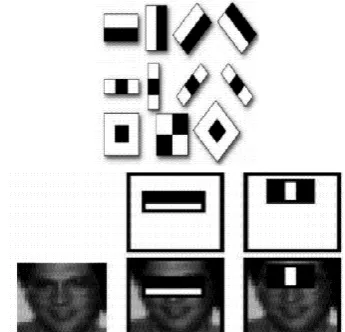
a. Haar features: Haar features are similar to that of
Figure 2. shows haar features which are observed in human faces
b. Integral Image: In an integral image the pixel(x, y) is the sum of pixels above and to the left. Which helps to calculate the sum of pixel value at a region. 1 1 1 irrelevant features with respect to face detection. d. Cascading: All features available in haar features are classified into set of classifiers including 10 or more features each, and arranged in hierarchy, which helps to eliminate non facial region easily.
Figure 3. block diagram shows how cascading procedure
3.Face Recognition
This is the most important module of the system which is used to perform the comparison between the test images and the training images. To execute the recognition operation, there are various algorithms but here algorithm used is PCA.
PCA Face Recognition Framework
PCA invented by Karl Pearson mostly used as a tool in exploratory data analysis and for making predictive models. It is the simplest of the true eigenvector-based multivariate analysis. Its operation is like revealing the internal structure of the data in a way which best explains the variance(major features/directions) in the data set.
Let us consider face image i(x,y) be a two dimensional M by N array of intensity values. An image can also be considered as a vector of dimension of M*N
Steps included in PCA are: 1. Prepare the training faces 2. Prepare the data set
3. Compute average face vector 4. Subtract the average face vector 5. Calculate the covariance matrix
6. Calculate the eigenvectors and eigen values of the covariance matrix.
7. Keep only K eigenvectors., where K will be less than the M value.
4. Registering Attendance
After completion of the face recognition module, next comes the module to register the attendance. If the detected face has been recognized, then it marks the attendance in the consolidated form. Further attendance status will be forwarded to Head of the Department and parents.
VI.
RESULTS
Figure 4. admin and lecturer login page
Figure 5. registration page of the lecturer
Figure admin home page where he can manage users,
attendance table, student data table.
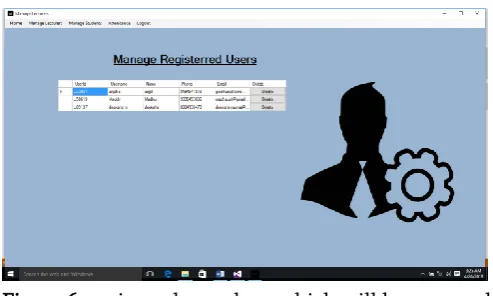
Figure 6. registered user data, which will be managed by admin
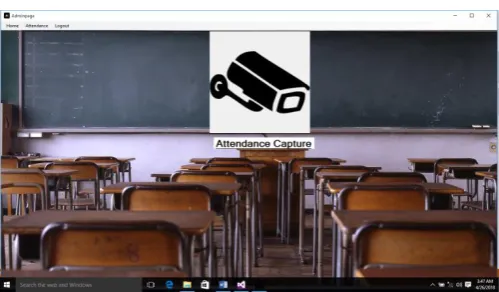
Figure 8. by selecting attendance capture option live video will start and identifies the students presence.
Figure 9. attendance capturing page, where students presence will be recognised and updated.
Figure 10. it shows the attendance report which can viewed by admin
VII.
CONCLUSION
To eliminate the manual labor involved in recording attendance, an automated Attendance Management System based on Artificial intelligence face detection
and face recognition techniques is proposed. The Viola-Jones algorithm and Principal Component
Analysis (PCA) algorithm together are used for face
detection and recognition. The proposed system improves the performance of existing attendance management systems in the following ways:
i) Automatic tracking of the records of the students ii) Minimizing the manual labor and pressure on the lecturers for accurate marking of the attendance iii) Minimizing the time required for marking attendance and maximizing the time required for actual teaching process
iv) Increase the user interface and efficiency of overall system
v) Improving the security
vi) Passing the attendance status to HOD and parents, in case of attendance shortage.
VIII. REFERENCES
1. “Attendance Management System Using Hybrid Face Recognition Techniques” Surekha Borra Nazare Kanchan Jayant.
2. “Prototype model for an Intelligent Attendance System based on facial Identification” Raj Malik, Praveen Kumar, Amit Verma, Seema Rawat. 3. “An efficient automated attendance management
system based on eigen face recognition”, Rekha.E, Dr.Ramaprasad.P.
4. “RFID and Pose Invariant Face Verification
Based Automated Classroom Attendance
System”, Srivignessh Pss, Bhaskar.M.
5. “Automated Attendance System using Machine Learning Approach”, Hemantkumar Rathod, Yudhisthir Ware, Snehal Sane, Suresh Raulo, Vishal Pakhare and Imdad A. Rizvi.
6. “Automatic attendance management system
using face detection”, E.Varadharajan,R.Dharani, S.Jeevitha, B.Kavinmathi, S.Hemalatha.
7. “Automated Attendance Management System
Based On Face Recognition Algorithms”, Shireesha Chintalapati, M.V. Raghunadh.
8. “FaceTime – Deep Learning Based Face
Recognition Attendance System”,Marko
9. “Visual System for Student Attendance
Monitoring with Non-standard Situation
Detection”, O. Kainz, D. Cymbalįk, J. Lįmer and F. Jakab.
10. “University Classroom Attendance Based on Deep Learning”, Rong Fu, Dan Wang, Dongxing Li, Zuying Luo.
11. “An Automated Classroom Attendance System Using Video Based Face Recognition”, Anshun Raghuwanshi,Dr. Preeti D Swami.
12. “A Feedback Estimation Approach for
Therapeutic Facial Training”,Cornelia Dittmar, Joachim Denzler and Horst-Michael Gross. 13. “An automated attendance system using video
surveillance camera”,Nilesh D. Veer, B. F. Momin.
14. “Attention-Based Template Adaptation for Face Verification”, Bin Dong, Zhanfu an, Jian Lin and Weihong Deng.
15. “Using Real Time Computer Vision Algorithms in Automatic Attendance Management Systems”, Visar Shehu, Agni Dika.
16. “Research and implementation of Access Control System based on RFID and FNN Face Recognition”, PAN Xiang.
17. “Biometrics Based Attendance Checking using Principal Component Analysis”, Jennifer C. Dela Cruz, Allan Jake D. Flores, Earl Vic B. Hurna. 18. “Joint Head Pose Estimation and Face Alignment
Framework Using Global and Local CNN Features”, Xiang Xu and Ioannis A. Kakadiaris. 19. “A review on Face Detection and study of Viola
Jones method”, Monali Chaudhari, Shanta sondur, Gauresh Vanjare.
20. “Face Recognition Using PCA and Geometric Approach”, Navya Sushma Tummala, PNRL Chandra Sekhar.
21. “Face Recognition using Principal Component Analysis and RBF Neural Networks”, S. Thakur, J. K. Sing, D. K. Basu, M. Nasipuri, M. Kundu. 22. “Feature Based Face Recognition Using Slopes”,
Isra Anwar, Shah Nawaz, Ghulam Kibria, Syed Farooq Ali, Malik Tahir Hassan and Jeong-Bae Kim.
23. “Face Detection and Facial Feature Extraction Based on a Fusion of Knowledge Based Method
and Morphological Image Processing”,
Devadethan. S, Geevarghese Titus,
Purushothaman S.
24. “Face Recognition Using Appearance Based Approach: A Literature Survey”, M. Parisa Beham, S. Mohamed Mansoor Roomi.